



Abstract
Using the records of the Indo-China Steam Navigation Company (ICSN) from the Jardine Matheson archive, this article shows that the performance of foreign steamships on the China coast at the end of the nineteenth century was characterised by instability and weakness. Poor market performance is then placed in the context of regionalisation using Imperial Maritime Customs data and the price and market information produced by contemporary British brokering houses and statistics institutions. This article argues that the nature of developments in international shipping meant that the regionalisation of China’s trade did not prevent its incorporation into the global shipping market. Further, market weakness is linked to the failure of ICSN and other Western firms to adapt to a changing paradigm in shipping practice in East Asia. This paradigm is discussed in terms of a development towards a modern and open shipping market on the China coast.
Globalisation intensified during the last decades of the Qing Dynasty. China was affected by a process that saw the world’s economy become more interconnected. Europeans had lived and traded on Chinese shores since the sixteenth century, but it was not until the late nineteenth century that their number significantly increased. The telegraph, carrying information around the world faster than ever before, reached China in 1869, 1 and was used extensively along the coast by 1900. 2 The Suez Canal, which opened for traffic in 1869, dramatically reduced voyage times between Shanghai and London. 3 Foreign trade, a true marker of globalisation, also increased in China at this time – its total value jumping 235 per cent during the 1880s and 1890s. 4 In short, the world in 1900 was metaphorically smaller than it had been half a century previously, with its steadily growing population ever more connected socially, politically and economically. Yet in this era of growing interconnectivity, China’s traditional trades declined in foreign markets as they were overtaken by the products of foreign competitors. Chinese tea was replaced by Indian and Ceylon brands in Europe, 5 Chinese silk lost out to its superior Japanese rival, 6 while the import of opium from India fell away as native supply increased. 7 As globalisation proceeded apace, China’s share in foreign markets contracted and its inter-Asia regional trade became more important.
The late nineteenth century witnessed a watershed in the development of Chinese coastal shipping. The decline of China’s traditional trades, and the associated reduction in average haul, led to a crippling oversupply of tonnage, while changes in the products shipped altered the annual demand cycle. Concomitant with changing commodity flows, technological developments improved the carrying capacity of vessels deployed on the China coast, leading to innovations in commercial practices. 8 The introduction of steam propulsion and the telegraph not only changed the way ships traded, but also exacerbated tonnage oversupply.
Shipping has generally been neglected by scholars writing on Chinese trade. Sugihara and Motono, for example, both discuss the East Asian commodity trade without investigating the commercial side of the shipping that connected the region. 9 Although an industry of derived demand, it was in part down to developments in shipping that the East Asia trade could expand. Conversely, shipping is often written about in isolation from trade, which is a nonsensical approach that discusses an industry without consideration of demand factors. Liu writes on steamship rivalry without any consideration of the commercial nature of his subject. 10 In some Japanese papers, the operation of native shipping is examined, but the commercial aspect is again neglected. 11 This article attempts to bridge the gap between the wealth of scholarship on China’s foreign trade and the paucity of work on the freight business that served it.
To do this, the performance of the shipping market is investigated through the records of the Indo-China Steam Navigation Company (ICSN), a Jardine Matheson subsidiary. In order to contextualise this firm’s activities, China’s changing trade dynamics and their effect on tonnage demand are analysed. From here, the means by which developments in shipping technology and trading practice affected tonnage supply are identified. In this way, the shipping market can be better understood, which in turn illuminates how the changing dynamics of the China shipping market responded to the regionalisation of China’s primary trades in the context of globalisation. At this juncture, it is important to acknowledge that the available sources restrict the analysis to part of China’s foreign trade. Imperial Maritime Customs (IMC) data account for only a proportion of China’s trade, the total scale of which is difficult to determine. It has been postulated that even as late as 1940, foreign steamers accounted for only eight per cent of the total carrying trade in central China, with native junks moving the vast majority. 12 While this may have been the case, it is still relevant to understand the development of foreign steam shipping, as it represents a shift of shipping practice in the Far East towards the Western standard.
Market analysis in the modern sense is also hindered by fundamental structural differences between past and present practice – the division between bulk and liner cargo was not so clear as it is today, with foreign steam lines carrying some cargoes that are now considered bulk. 13 Shipping was also tied to colonial interests that often forced enterprises to contravene commercial logic. 14 Finally, the difference in quantity is so large it cannot go ignored; the current throughput of Rotterdam alone is greater than the sum of global trade in 1913. The situation before 1900 does not warrant comparison. 15
The Indo-China Steam Navigation Company
Following its initial public offering in 1882, the ICSN developed in three broad stages down to 1900. Firstly, its early performance, measured in tonnage terms, was weak in a period when the market was slack. Towards the middle of its first decade, the company began to perform better, with dividends issued to shareholders, even though market conditions remained difficult. In the third period, commencing with the Sino–Japanese War in 1894, the company made good ground in what appeared to be a market that was conducive to shipping growth. 16
The ICSN was established during a period in which North Atlantic steam shipping was dominant in the China coastal market, as it was globally. 17 Tempted by what an American businessman called ‘an incalculable volume of trade’, 18 an influx of European tonnage led to the agency model being replaced by one of ownership. 19 It would appear this shift in practice was related to the increasing complexity of the market. The Canton era had seen vessels serving a limited number of established trades, with shipping firms tending to monopolise individual shipping routes and so maintain firm rates. Liu notes that competition took place between eight American, Chinese and capital-rich British lines, 20 which were owned by a handful of major Hongs, who enjoyed an organised, profitable market. Dividend yields were stratospheric; the Shanghai Steam Navigation Company (Russell) Yangtze monopoly did not return less than eighteen and a half per cent annually on share value between 1867 and 1874, 21 while the Jardine lines performed similarly, with China Coast Steam Navigation dividends reaching twenty per cent in the 1870s. 22 To contextualise these figures, the dividend yield of Moller-Maersk, the world’s largest shipping concern in the twenty-first century, did not rise above three per cent between 2005 and 2015. 23
The opening of ports, particularly on the Yangtze, to foreign trade saw the market for steam vessels on the coast expand and diversify. This increasingly dynamic market called for more involved line coordination and vessel management as competition intensified. 24 Whereas previously it had avoided direct competition, Jardines followed Swire into the China market in the 1870s to challenge Russell directly. Swire’s ‘practically unlimited supply of British pride and capital’ ended Russell dominance in 1873. The Jardine Lines, China Coast Steam Navigation and Yangtze Steam Navigation performed strongly through the 1870s, but falling returns due to native competition led Robert Jardine to consider for a time selling his shipping interests in the second half of the decade. 25 The expectation of strong returns is important in understanding the ICSN, for shareholders had seen two decades of good dividends in China coastal shipping, and therefore expectations for a similar outcome were high. Although annual returns were far from dismal, these expectations could not be realised.
The prospectus of the ICSN demonstrated impressive ambition. The company was founded to consolidate Jardine interests on the China coast and create the largest line to date, with shares issued to the value of 1.2 million sterling. 26 This plan betrays a belief that the trade could be monopolised by a large concern. Without proper regulation of competition by a group that disseminated information, as brokers were doing in the Atlantic, an open market could not function and instead firms competed directly. Before 1880, large, capital-rich lines could simply watch their opponents waste away. While this was a practice that rapidly became obsolete, the ICSN would initially trade on a market that, despite becoming increasingly dynamic, attempted to function in this way.
Liu asserts falsely that the ICSN’s floatation at US$1,375,000 made it the largest shipping firm trading in China. 27 Although this was the ICSN’s original intention, the firm was dramatically undersubscribed in its initial offering of 60,000 £10 shares, with starting share capital below £500,000 and a second £600,000 offering cancelled. 28 The result was a scaling down of operations, with shipbuilding projects cancelled and a consolidated ICSN unable to dominate the market. This setback was exacerbated by the aggressive expansion of the Chinese, who purchased the Russell concern in the late 1870s. Despite this downscaling, close ties to Jardines meant the ICSN remained well placed in the China market. 29 The relationship between the two entities indicates that the ICSN was not merely a shipping concern in the manner of later Japanese mail lines Osaka Shosen Kaisha (OSK) and Nippon Yusen Kaisha (NYK). Rather, at this protean stage, shipping was an adjunct to Jardines’ wider operations. This is borne out by the way the firm’s vessels were kept running as much for intra-firm communications as for the pursuit of profit. 30
Early company reports indicated that returns were deemed to be disappointing: ‘the period from February–December 1882 has probably been one of the most unfavourable experienced in the history of China Coast freighting business’. Poor performance reportedly resulted primarily from heavy competition between the large concerns. Contradicting this claim, however, are complaints that the fleet was inadequate to provide a full service, 31 and reports of continuous shipbuilding. Excessive competition suggested an oversupply of tonnage. As such, further saturation of the market with new builds, especially prior to the establishment of a formal demolition market, was fundamentally unwise. Furthermore, contrary to conventional wisdom, the ICSN looked unfavourably on chartered tonnage, 32 which proved cheap in a poor market, thereby mitigating losses incurred by owned vessels. The ideal of vessels providing ‘service’ and competing ‘lines’ go some way to explain this unusual behaviour: the ICSN was not operating vessels in an open market, but rather attempting to provide full coverage with its own vessels according to an out-dated, ‘aristocratic’ notion of shipping, in which information and trade were controlled by a privileged few. The failure of this approach to produce returns reveals a changed market.
Market depression owing to tonnage oversupply was exacerbated by demand-side factors. Imperial Maritime Customs reports for 1882–1883 discussed the failure of joint-stock enterprises in these years due to over aggressive investment by Chinese traders and the consequent failure of native banks. 33 The decreased value of gross foreign trade in Shanghai from 1882 to 1885 reflected depressed commodity movement (see Figure 1). Moreover, the ICSN report of 1883 emphasised the effect of apprehension over escalating Sino–French hostilities, although the actual fighting was limited to Tonkin at that time. 34 The weakness of this early period reflected the depressed state of shipping globally. Angier’s, a London broker, paints a gloomy picture of the prospects for global shipping from 1884: ‘as unprofitable for steamers as any year that can be remembered … without any visible prospects for improvement in the near future’. 35 Depression persisted until 1886: ‘a monotonous continuation … extremely anxious and trying for the shipping industry. The amount of carrying work done has been enormous, but the result has been either a net loss, or a bare covering of expenses’. 36 Such reports inferred that while the ICSN served regional trades, the China shipping market was integrated into the global market and so was affected by its fluctuations.
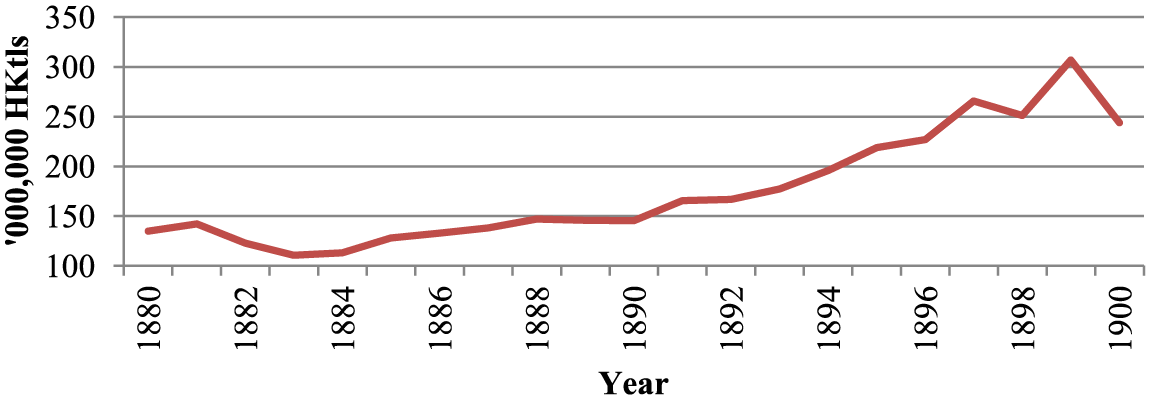
The gross value of Shanghai’s foreign trade, 1880–1900.
The slump in earnings that coincided with the formation of the ICSN was a source of worry, as demonstrated by the reinvestment of meagre steamer earnings in lieu of dividend payment. The company’s chairman, William Keswick, feared that the slump would continue for some time. 37 British houses operating on the market were forced to cooperate and coordinate tonnage distribution, Swire and Jardines were engaged in such negotiations from 1883, and were almost certainly dealing with the China Merchant Steam Navigation Company (CMSNC) at the same time. 38 Large concerns cooperated directly according to the ‘aristocratic’ shipping ideal, with firms attempting to monopolise the trade through a ‘conference’, as the institutions that might enable open market competition on the China coast did not exist.
Cooperation between the primary players sustained the market through the 1880s, allowing the ICSN to issue dividends, albeit at a lower level than had been the norm in this market prior to 1880. By 1885, the term ‘conference’ was being used with reference to foreign steam shipping in China, which suggests that working agreements between the major lines were common enough to be considered institutional. 39 This suggestion is borne out by the limited growth of entries and clearances in Chinese ports before 1889, which, according to IMC tonnage statistics, increased by only two per cent as against a thirty-five per cent rise in trade (see Figure 2).
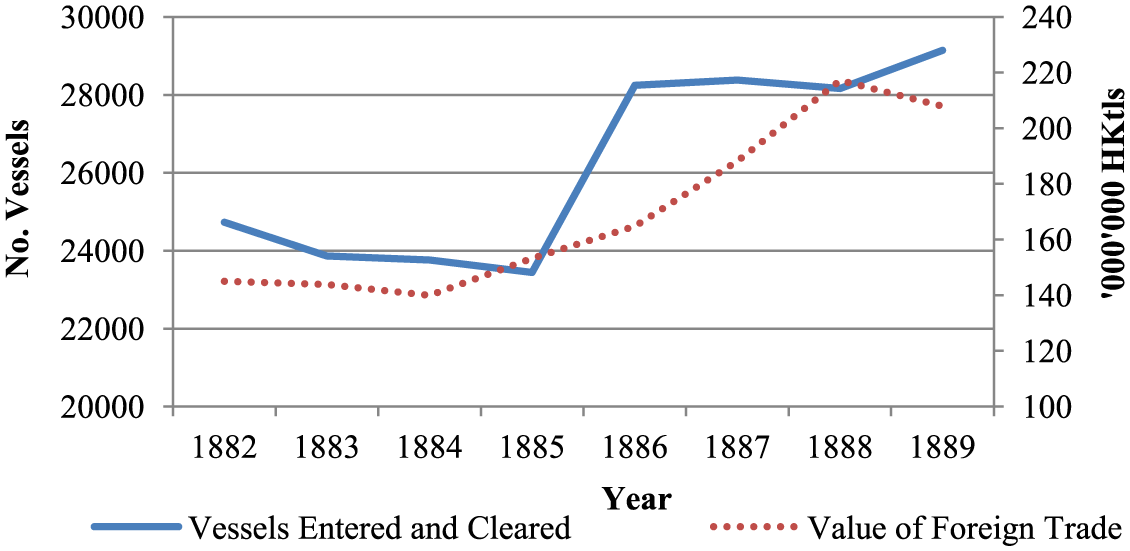
Stability in fleet employment, 1882–1889.
These figures are indicative of market weakness before 1888; meagre earnings globally imply a dearth of cargoes that could have repositioned vessels in the Atlantic or east of Singapore. 40 Reduced entries and clearances also suggest better cooperation between steam lines. 41 The stability from 1886 to 1889 indicates that vessels worked consistent trades and therefore returns improved on fuller cargoes. The benefits of conference shipping are manifest on the ICSN balance sheet, with annual steamer earnings in 1885 doubling the previous year’s total, running counter to the trend in a weak global market. A dividend of seven per cent was paid in 1885, a return that was more typical of the 1870s than the early 1880s (see Figure 3).
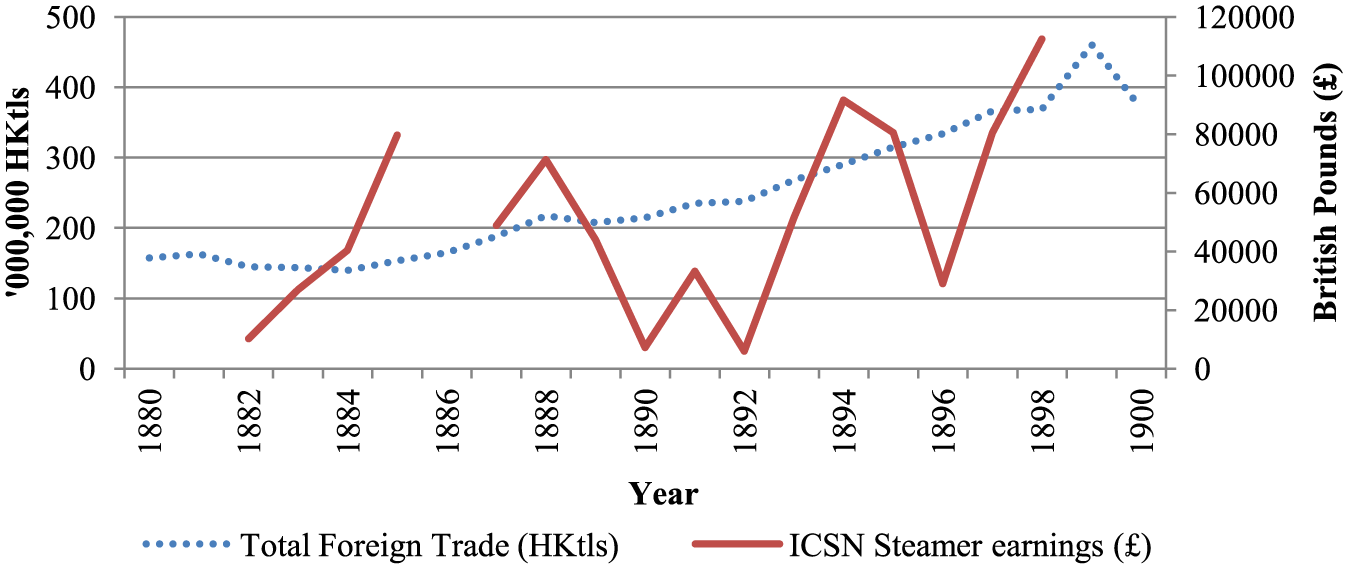
Indo-China Steam Navigation Company steamer earnings, 1880–1900.
After 1890, market stability was disrupted by external factors, in terms of both tonnage supply and demand. After reaching a high point in 1888, steamer performance plummeted, with the ICSN complaining of ‘bad native trade … Money scarce, traders crippled’. 42 Once again, steamer earnings were held back, generating dividends of just three per cent in 1889, the highest yield until the market recovered in 1894. Indeed, during the ‘ruinous depression’ of 1893, the ICSN made a loss, carrying forward £1,086 of funds transferred from their underwriting account. Over this period ICSN vessels struggled to find cargoes for even the Shanghai–Canton line, while Yangtze cargoes were too few for the tonnage saturating this market. 43 Poor returns from the busiest lines were indicative of the weakness of the market overall (see Figure 4).

Foreign trade growth, 1888–1893.
Somewhat surprisingly, IMC data do not corroborate the complaints in the ICSN archives. While foreign trade growth clearly stuttered in 1890, the next decade saw trade expand, if less smoothly. On the supply side, more voyages were being made, corroborating ICSN reports, and so the considerable oversupply must have contributed to steamer losses. Brokerage reports show that this performance was part of a global slump from 1888, although the difficulties were particularly apparent on the China coast. 44 This soft demand might be explained by anti-foreign unrest in the Yangtze region at the turn of the century, as Chinese shippers came under pressure from local brokers to favour native junks, 45 a tendency mentioned in the 1892 report. 46
Regarding the slump before 1894, both the ICSN and IMC reported ‘global depression in trade and finance’, 47 which was linked by Angier’s to the effects of the London Barings crisis on global shipping. 48 Hence, despite the regionalisation of commodity movements at this time, the China market remained at risk from the vicissitudes of a global financial system owing to the heavy concentration of foreign capital in Shanghai and the international ownership structure of the steam lines engaged in the carrying trade.
During this period, the ICSN also suffered from the negative impact of foreign exchange fluctuations. While from 1880 to 1900 the Haikwan tael fell against Sterling, the decline was particularly sharp from 1890 to 1894, its value decreasing nearly forty per cent (see Figure 5). This meant that better steamer earnings in 1893 could not be passed on to the shareholder as dividends. While it is difficult to determine the exact effect of the weak tael on the carrying trade, it is fair to assume that the impetus to import from gold standard countries would have fallen in favour of those with silver, including Japan and India. This would have meant a reduction in average haul, exacerbating tonnage oversupply.
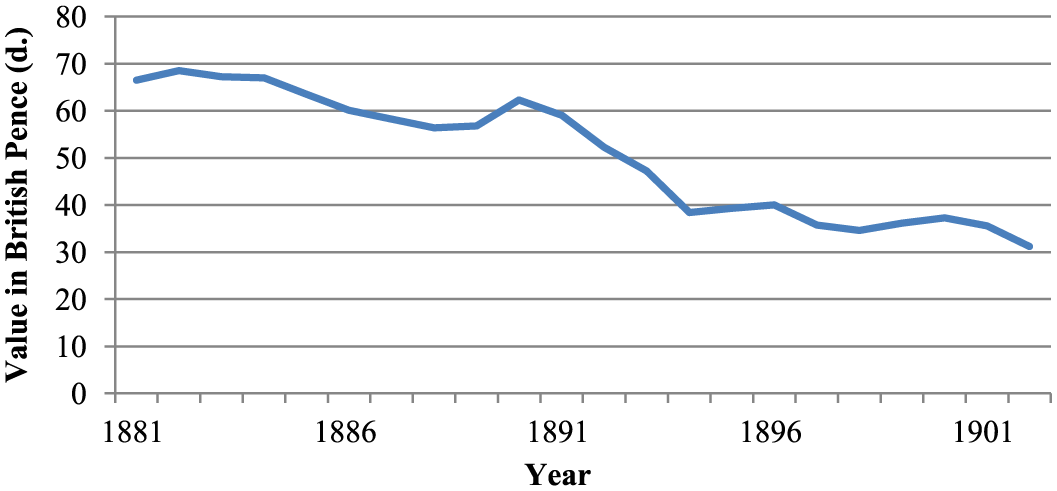
The value of the Haikwan tael, 1881–1901.
The Sino–Japanese War, which commenced in 1894, served to stimulate shipping after the disappointing performance evident from 1889 to 1894. From this point, ICSN steamer earnings increased dramatically, with the 1898 figure more than doubling the 1893 total. This was due to the effects of war on tonnage supply and a better global context influencing demand, while the localised nature of the war did not hinder trade growth. This demonstrated how regionally traded tonnage relied on favourable circumstances in global markets, and how the interplay of local and global conditions affected the shipping market. The impact of the Sino–Japanese War was therefore localised, with only the IMC house in Newchwang reporting difficulties. 49 As the trade served by the foreign steamship lines was focused in the Yangtze and southern littoral regions, and the Japanese refrained from interference in the treaty ports, 50 tonnage demand was not reduced in the south, while the war stimulated demand in the north. 51 Indeed, the ICSN reported 1894 as a particularly strong year, paying the highest dividends since the company’s incorporation in 1882. 52
Although the value of foreign trade continued to grow despite the war, this did not reflect a changing dynamic in tonnage demand. Strong market performance was related to tightening supply. The war saw the disruption of ‘conference’ agreements between the major Hongs as Chinese tonnage was pulled from the market and put to military use. Where this was not the case, Japanese naval supremacy had a bearing on Chinese trades, as even ICSN ships came under fire. 53 Supply disruption primarily affected Chinese and Japanese tonnage, with IMC data showing a drop of eighty per cent in the number of Japanese vessels calling at the treaty ports, while a fall of twenty-two per cent was recorded for both Chinese steamers and junks. 54 The tonnage of most other nations spiked in 1894 and then continued strongly from 1895. While there are no data supporting the collapse of conference agreements, it seems that where Chinese companies had been dominant, they were now unable to honour agreements and so the ICSN may have been able to benefit from carrying the slack of the CMSNC, which controlled over a third of the market’s tonnage. 55
Tonnage attracted east by the war was suddenly unemployed when hostilities ceased, saturating the Chinese coast. Exacerbating this was the depressed global freight market, which meant that few backhaul cargoes were available to reposition ships in the Atlantic. While ICSN steamers suffered in 1896, this situation was beneficial to global shipping, as vessels were kept from the Atlantic market. 56 Stability followed the war, despite the arrival of Japanese tonnage, which grew in importance from 1894. 57 Despite this tonnage influx, this period saw strong returns continue for ICSN steamers, with the fleet expanding from twenty-two vessels in 1894 to thirty-one vessels five years later, when the company paid eight per cent dividends to its shareholders (see Figure 6). While oversupply means it is difficult to understand the strong performance of the ICSN at this time, the relative stability of the Haikwan tael perhaps strengthened the growing import trade that Chinese coastal shipping served.
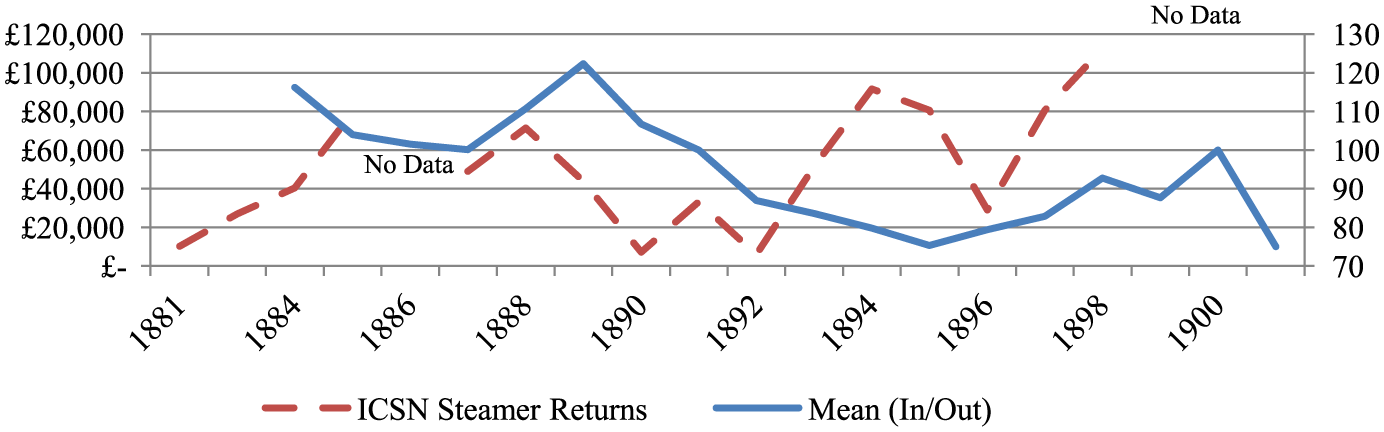
Indo-China Steam Navigation Company steamer earnings in relation to Angier’s freight index.
In terms of supply, native Chinese tonnage never recovered from the Sino–Japanese War, and so the normal Chinese merchant tactic of forcing down rates to damage competition and thus expand market share was perhaps less prevalent. Against a background of large, ‘national interest’ players now competing on the market, this makes sense. The ‘conference’ of the CMSNC, the Swire China Navigation Company (CNC) and the ICSN was now joined by OSK and NYK, which were backed by the Japanese government, as well as German lines such as Norddeutscher Lloyd (NDL). The prevalence of large, ‘modern’ and ‘Western’ shipping firms allowed for better organisation of the China steam conferences. The decreasing share of the market held by sail certainly stabilised the market, as conference rates were less liable to be undercut by smaller operations. 58
The performance of the ICSN in its early years disappointed the expectations of London investors. Steamer returns indicate that the shipping market fluctuated dramatically due to qualitative changes, exacerbated by the arrival of rival shipping lines in the China market. Through this period, the ICSN approached shipping with ‘aristocratic’ ideals, as the institutions and means of disseminating information that begat a functionally competitive shipping market did not yet exist in a mature form. Indeed, even Fernley’s, a large Norwegian shipbroker, dealt largely with high-level connections between large, established players, rather than disseminating information across an entire market. 59 Angier’s published more extensive market reports, but their concern with China was minimal, and their price reporting and analysis of these trades remained shallow until the late 1890s. Explaining the volatility of steamer earnings, which far exceeded the vacillations evident in the global market, and the ICSN’s own operations and failures, necessitates a broader understanding of the structural changes in the shipping market. These changes, as discussed in the next section, resulted from the paradoxical regionalisation of China’s trade in a period of increasing globalisation. The Chinese, failing to understand the global dimension of these developments, have tended simply attribute these changes to ‘Western Imperialism’. Many of these changes were not directly related to China, however. A more accurate understanding of this regionalisation offers a better context for understanding the performance of the ICSN and therefore developments in the late-nineteenth-century shipping market.
Market development
Regarding the nineteenth-century China trade, Le Fevour states that ‘the basic features of the trade were the smallness of annual values … prolonged stagnation, the dominance of a few commodities, and import growth in the final decade of the period’. 60 This analysis is flawed, for the China trade saw volume growth and increasing dynamism resulting from the introduction of new commodities and the decline of traditional trades. The term ‘commodities’ is also problematic, as it has connotations of the high-volume industrial raw material trades that dominate modern shipping. Rather, change marked the type of goods shipped in late-nineteenth-century China, from those typical of the Canton era to those important today. This impacted on tonnage demand in three ways. Firstly, new products decreased the average unit-value of the commodities being shipped, which increased the impetus for efficiency and specialisation. Secondly, the lessening seasonality of traded products smoothed the annual tonnage cycle. Thirdly, average haul was reduced as China’s trades regionalised. In addition, volumes increased and more ports were served, resulting in growing market complexity and thus a more complex model of tonnage supply to serve it.
Before 1842, trade on foreign ships was dominated by the carriage of opium, silk and tea – supplemented by porcelain and iron goods. Rice and millet were traded largely on native ships. It should be immediately evident that the unit-value and so the viability for transport of these products was high (see Table 1).
The unit-value of selected commodities, 1872–1911.

Source: Imperial Maritime Customs data. 61
Unit: Haikwan tael/picul.
It was the high unit-value of these products that underpinned the Canton trade in the early period. These commodities were profitably shipped in risky sailing voyages since freight as a percentage of the CIF price was so low. As steam transport carried less risk and increased sailing efficiency, product demand could be comfortably covered by relatively few vessels. Moreover, there was no impetus to increase vessel deadweight while commodities remained low in unit-value as less could be gained from economies of scale.
Opium, silk and tea declined as a percentage of the value of Chinese foreign trade before 1900, being replaced by products of far lower unit-value, 62 particularly kerosene and coal before 1900 (see Table 2), and gasoline, metals and machinery as the twentieth century progressed. As a result, efficient and cost-effective shipping was required to handle greater volumes of these commodities, as shippers expected owners to hold rates down. In addition, the growing volume of traded commodities rapidly increased tonnage demand.
The volume and value of selected goods in the China trade, 1880–1900.
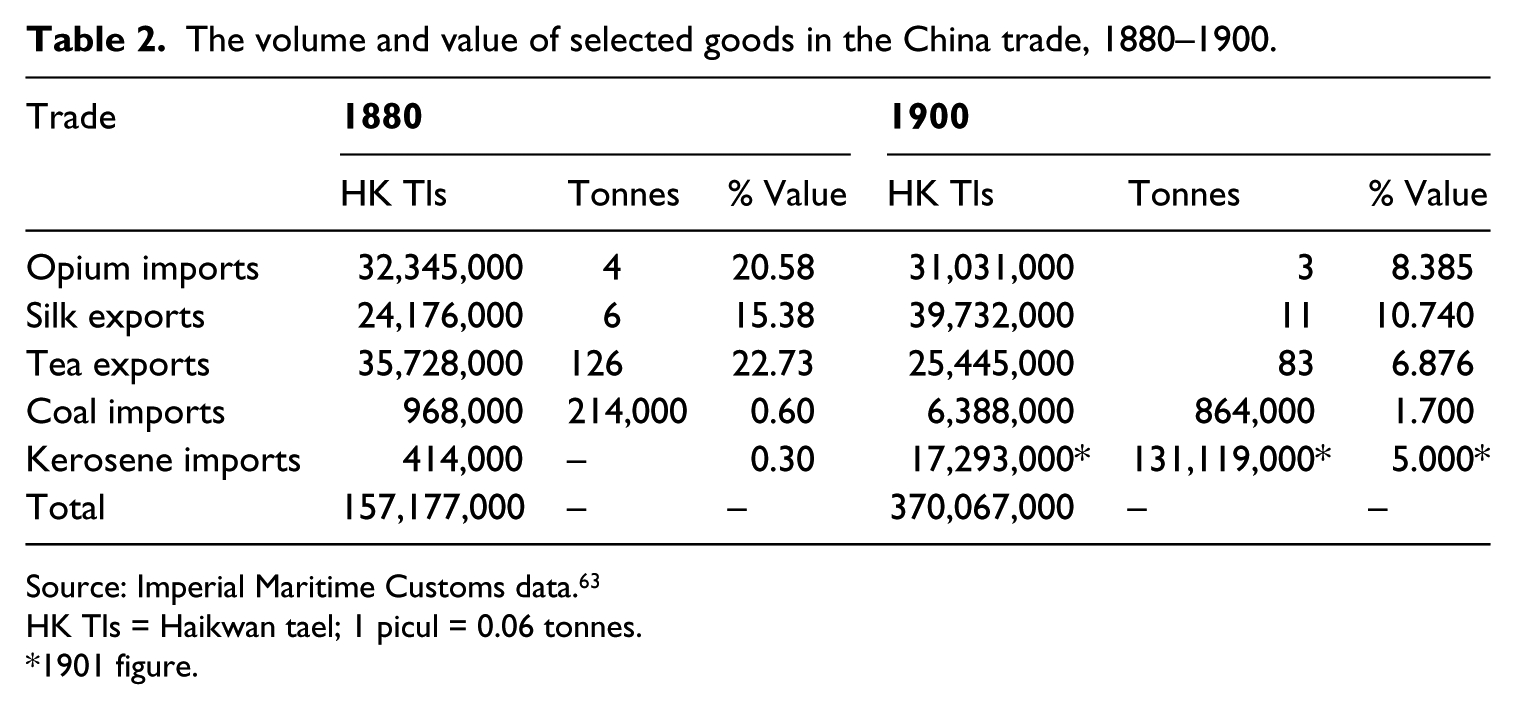
Source: Imperial Maritime Customs data. 63
HK Tls = Haikwan tael; 1 picul = 0.06 tonnes.
1901 figure.
Quantitative growth led to a clearer division between bulk and liner cargo. Changed parcel size distribution (PSD) of low unit-value commodity trades meant that shipping was more efficient in bulk, 64 reducing pressure on cargo lines. With the need to reduce freight cost impact on CIF price, the imperative for both bulk and liner efficiency intensified, and ship management became increasingly specialised. It could no longer be a simple adjunct to a profitable trading venture.
The ICSN was slow to adapt. While its incorporation suggests an attempt at consolidation and specialisation, its fleet management suggests that, like its contemporaries, the company’s approach was ‘aristocratic’. This created the paradoxical situation in which the ICSN complained of both tonnage oversupply and undersupply, 65 while local traders complained that the cargo lines did not accommodate their requirements. 66 Undersupply perhaps resulted from an attempt to provide full coverage with ICSN vessels, rather than entering its vessels into a market with the capacity to employ them. The mechanisms to secure such employment did not exist. Simultaneously, growth in bulk shipping and greater commodity volumes meant that liner shipping could not be ‘aristocratic’; rather, in order to sate demand for general cargo shipping against the competition of bulk shipping and a free freight market, competing lines needed to coordinate more effectively.
Changing cargo products resulted in vessel specialisation. The increasing bulk of cargoes meant multi-decked general cargo liners became inefficient, and the need for specialised vessels that could carry these products in bulk form increased. Notably, in the case of oil products, the carriage of imports to the China coast deviated from liner and dry bulk trade during the 1890s.
Although barrels were used in the 1860s, seven-gallon rectangular ‘cases’ packed in pairs soon replaced these as a way of stowing oil with general cargo. 67 From 1894, specialised ‘tankers’ carrying Russian and later Sumatran kerosene arrived on the China coast, with the percentage of product carried in tankers increasing from four per cent to fifty per cent by 1901 (see Table 3). 68 Companies such as Shell Trading and Transport, and Royal Dutch Petroleum, built and operated the infrastructure for this trade in treaty ports. 69 The twenty-five to thirty per cent premium on cases shipped in liners demonstrated the greater efficiency of specialised bulk shipping.
Imports of kerosene into Chinese ports, 1894–1901.
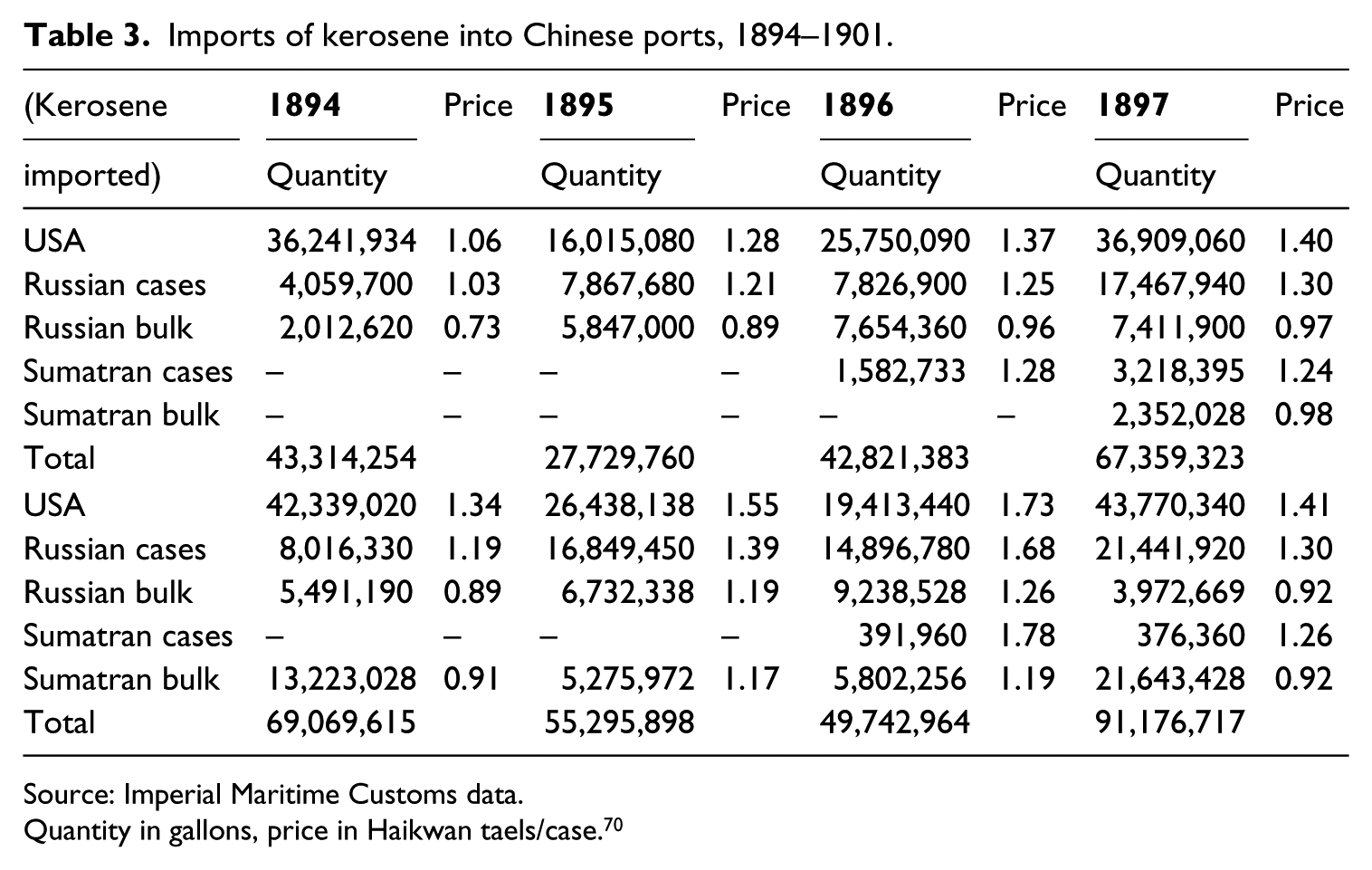
Source: Imperial Maritime Customs data.
Quantity in gallons, price in Haikwan taels/case. 70
Increasing demand for bulk shipping perhaps also benefitted tramp vessels and junks. Global shipping tended towards multi-port voyages during the late nineteenth century, due to the relative immunity of steam vessels from weather risk. Bulk ships carrying full cargoes need not stop en route, however, and port time was so expensive that minimising it was the most cost efficient way to move low unit-value cargo. 71 The result was a division between multi-port, scheduled liner trade and bulk commodity trade on the China coast, as is the norm today. 72 As such, although Chinese coastal trade was growing, the ICSN was providing a ‘transport’ service that was less suited to the expanding segments of the market than the inherently ‘commercial’ junks. 73 This explains why the ICSN reported a weak market even as trade volumes increased; the extra volume was being moved in tramps and junks, which disrupted the liner demand served by the conference. 74 Again, ‘aristocratic’ shipping failed in the face of changing market conditions.
The shift from Canton era trades to industrial products represented a move away from agricultural commodities. This suggests that some Chinese ports and their environs were reaching the third Rostow stage of economic development, 75 although Rostow himself asserts that China proper reached this stage only later. 76 The result was the reduced seasonality of the annual tonnage demand cycle, against a background of stabilising tonnage supply.
Previously, tonnage demand had spiked during the summer ‘season’, a term used frequently in ICSN reports. 77 Rice, a low unit-value agricultural product, was shipped north from the Yangtze during the summer and again when the second crop harvested in October. Huge volumes meant a pronounced peak in demand for northbound steamers at this time, with native tonnage covering local shipments. The opium ‘season’ fell before the rice harvest, while the shipping of products derived from mulberry trees and tea plants was also concentrated in the summer. This demand spike would have required some slack in annual supply. As the annual demand cycle became flatter owing to the greater planning possible in industrial operations, 78 tonnage could be kept moving for more of the year and tonnage supply was perhaps too great. This contributed to the ICSN’s difficulties.
The reduction of average haul in the late nineteenth century was perhaps most damaging to steamer rates on the Chinese coast, a result of the regionalisation of China’s trades. Customs data show Britain’s percentage of China’s export trade halving over two decades (see Table 4), which meant that the tonnage supply was growing to cover increases in total trade, mainly focused on the shorter routes. In addition, by the 1880s, all vessels transited Suez, and so a China–London voyage was half the distance it had once been. 79 Finally, the growth of Japanese imports represents the loss of a potential market for British cotton. Imperial Maritime Customs data show cotton imports grew by £3,032,068 in quantity between 1892 and 1901, despite falling cotton prices. This pick up primarily concerned Indian and Japanese products, with only half a per cent of the increase due to British trade. 80
The value of Chinese trades with selected destinations, 1880–1900.

Source: Imperial Maritime Customs data. 81
Values in Sterling.
Elsewhere, Customs data show the decline of tea exports by £1,719,209 in the decade to 1901, and silk exports by a further £2,068,764. This contributed to a twenty-five per cent fall in export volumes over the same period. 82 Thus, while the growing value of total trade suggests increased demand for shipping, China’s shift from exporting to importing seriously reduced average haul. China’s ‘traditional’ trades were primarily long distance, while the import trades that account for growth in Customs figures were regional. Regionalisation was linked to the lower unit-value of commodities, as exemplified by China’s kerosene imports. It is clear that imports of Russian kerosene increased in the early part of the decade and that this supply was quickly rivalled by Sumatran produce. While the role of American kerosene should not be understated, it quickly lost market share (see Figure 7). Fluctuations in its import suggest that the relative reliability of American wells allowed it to be imported when Sumatran and Russian product could not cover demand. A comparison of prices supports this model of the kerosene market, with American product supplied at a fifty per cent premium. As the percentage of CIF price represented by freight increased, not only was there a strong impetus to find regional sources of imports, but the importance of efficient shipping also increased.
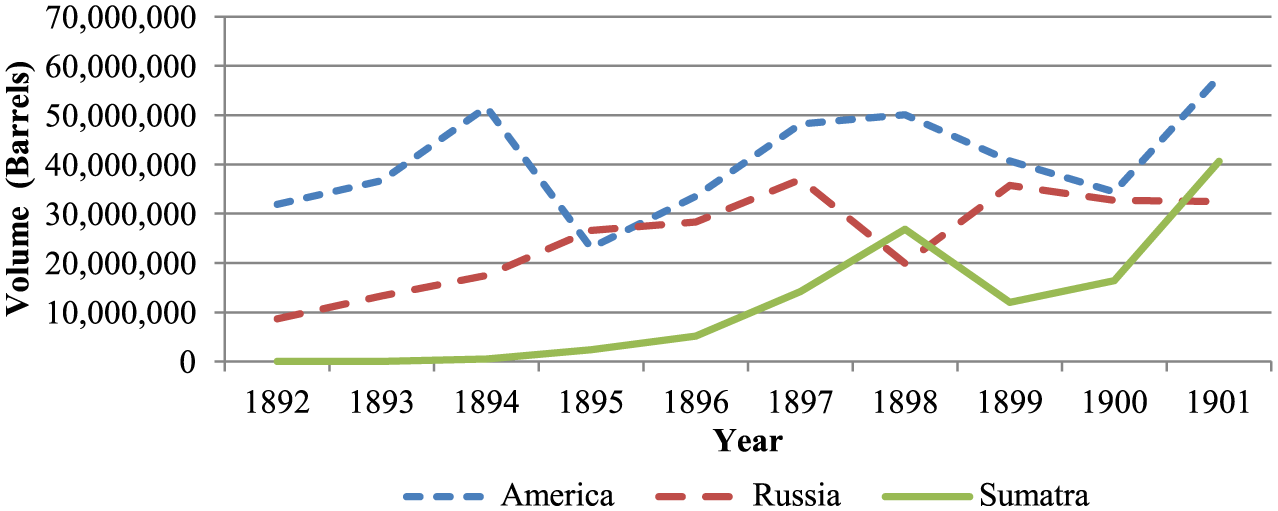
Kerosene imports to China, 1892–1901.
The changing model of tonnage demand in the China market was mirrored by qualitative changes on the supply side due to technological advances. The key drivers were the move from sail to steam and the diffusion of the telegraph, which proved increasingly important in the China market. Kaukainen argues that global steam capacity overtook sail in the 1880s, 83 and although IMC data suggest this occurred earlier in China, Western sailing vessels continued to call at treaty ports. The average size of these vessels diminished over time, from a mean of 251 tons in 1882 to an average of 100 tons in 1901, suggesting their voyages became shorter to avoid competition from steamships. 84 In addition, IMC figures do not account for the thousands of junks operating on the coast, thereby supporting Kaukainen’s contention that the supply and demand of tonnage balanced in various ways, unlike the more homogenous contemporary shipping system.
According to Kaukainen’s model, the thriving steam shipping industry became more capital intensive, with supply-side costs increasing, as the Canton market’s supply model could only endure in a low-cost market. While this is true, the greater efficiency of steam also reduced profitability by allowing the lower rates required by the falling unit-value of commodities and tightening sales margins. Falling freight rates is an ongoing, global trend, as British trade statistics reveal (see Figure 8). 85
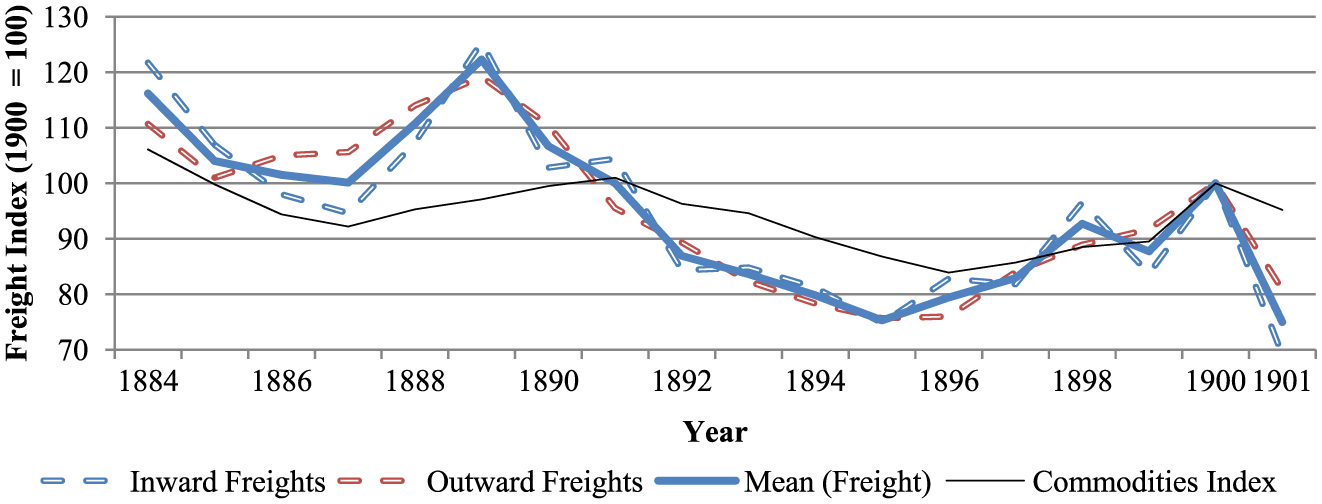
Freights between UK and foreign ports, 1884–1901.
The telegraph fundamentally altered the mechanisms of the shipping market. Previously, limited communication had meant that vessel management was necessarily conducted in advance, and commodities sold on this basis. Now, thanks to the telegraph, information could move faster than people, facilitating greater vessel utilisation, the mitigation of trading risk and the changing position of personal relations in market function.
Improved communication meant that commodities could be traded between geographically remote concerns on a shorter timescale. China trades were made on the London market with ‘to arrive’ terms meaning tighter margins and with greater frequency, diminishing both risk and the possibility of large profits. 86 As Lew and Cater demonstrate, tonnage could be redirected according to changing opportunities and so meet demand more efficiently. 87 In discussing Finnish brokers, Ojala shows how slow communications forced plans for vessel availability to be made months in advance, and it follows that slack tonnage supply existed to meet inevitable foresight failure. 88 Better communication meant better vessel utilisation, and therefore as the telegraph became widespread on the China coast, market rates fell and an adjustment was made to the resultant oversupply.
Before the telegraph, decision-making responsibility lay in the hands of the master and port agents, rather than the buyers or sellers of commodities. 89 The telegraph facilitated the re-appropriation of responsibility; the master was increasingly concerned with the management of the vessel, while trading decisions could be made elsewhere. 90 Although this was symptomatic of the separation of shipping from trading ventures, close relationships persisted between the ICSN and Jardines, and between Chinese firms, though not with later Japanese postal lines.
Telegraphy mitigated the risk that had meant only high unit-value products were viable for long-distance trade. Better access to capital, reduced timescales and increased vessel utilisation allowed business to proceed on tighter margins, which benefitted the trade of lower unit-value commodities. 91 While vessel inefficiency precluded long-distance international bulk trade in the 1880s, the possibility for movement of these commodities was dramatically increased on China’s regional trade routes. Once again, increased efficiency begat a reduction in risk, and so enhanced profitability on tighter margins. The expertise required to provide this efficiency increased, thus hastening specialisation of shipping and trading.
A fast and effective communications network meant that information was reliable. Before the telegraph, shipping was conducted according to close, long-term personal relationships, as these most effectively mitigated the unreliability of information. 92 In the case of the ICSN, Swire and Keswick were in regular contact, which helped ensure effective conference agreements. The telegraph was a means other than a bond of personal trust for the owner of ship or cargo to mitigate information risk, which meant that these relationships no longer needed to exist. This opened up the possibility of the wider dissemination of market information, where it had previously been controlled by a privileged few. This transition was a gradual one, as the shorthand way the telegraph transmitted information was mistrusted. 93 The communications of the ICSN show that the telegraph was used to move information, with further detail following in letters. 94 Whereas Du Boff has shown that the telegraph only served to benefit the interests of those dominating the commercial sector in the United States, this was not the case in China. 95 Rather, the telegraph aided the development of an efficient coastal freight market that was much less constrained by the central pricing function of monopolies, much as argued by Hayek. 96 As such, technological change contributed to the shift from an ‘aristocratic’ to a ‘democratic’ market model.
Market fragmentation further diversified operations. Whereas prior to the foundation of the ICSN, a limited number of concerns representing a few nationalities dominated the market, stifling ‘outside’ competition, by 1900 the market was more fragmented. In 1900, more nationalities were represented on the China coast than in the 1860s and trade volumes were shared more equally between them. As a result, information was produced and proliferated more widely.
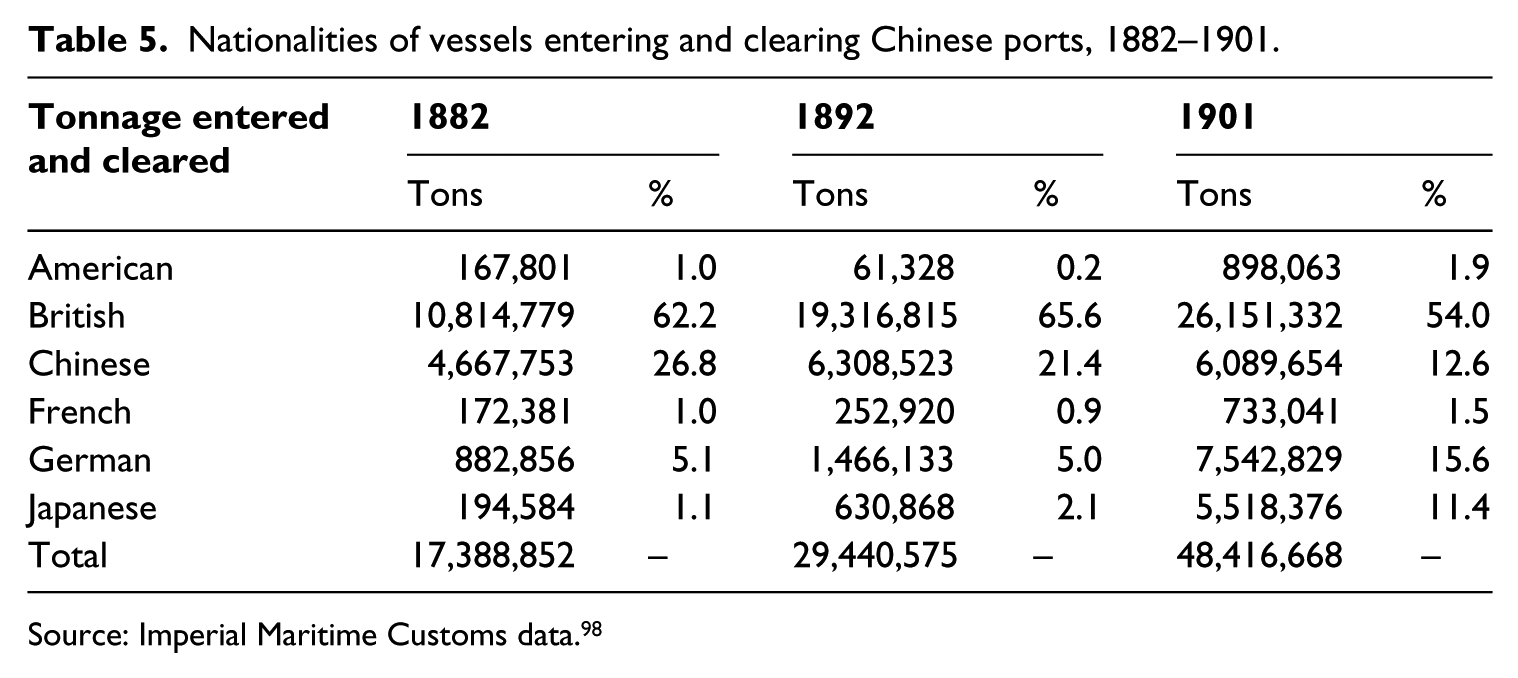
While the IMC did not collect data on individual firms, using IMC data to show changing fleet composition by nationality sufficiently demonstrates its fragmentation. From 1882 to 1901, the British and Chinese share of tonnage was dented by German and Japanese entrants, while other nationalities also made incremental gains. As a result, rather than the market being dominated by the British and Chinese, the Chinese, Japanese and Germans held an eighth each, the British controlled half and the remaining eighth was held by other nations (see Table 5). Whereas pooling agreements to monopolise a line in the late 1880s could be made between three firms, 97 the situation in 1901 must have been different, with Japanese and German firms impossible to exclude.
Nationalities of vessels entering and clearing Chinese ports, 1882–1901.
Source: Imperial Maritime Customs data. 98
The homogeneity of the largest firms operating on the China coast is evident; the new lines NDL, NYK and OSK resemble the better established CMSNC, CNC and ICSN. These companies had sizeable international operations, and were linked to and supported by the colonial (or anti-colonial) operations of their home governments. 99 Most importantly however, they were primarily shipping concerns. Changing market dynamics meant shipping was no longer simply an adjunct to trade; rather, it had become a specialised industry integral to the health of colonial trade. National interest in these lines thus contributed to the development of a specialised shipping function in global trade.
Despite this, China’s coastal shipping diverged from national borders. Although China’s primary trades regionalised, the ships engaged on the coast became more international. Cargo lines maintained national identities, but the market was fragmented between nations. This meant that whereas in 1882 the British and Chinese could control Chinese coastal trade by virtue of controlling its communications, by 1901 the fragmentation of market share enabled shippers to trade around political alliances. For example, during the Sino–French war, the CMSNC manufactured a ‘sale’ of tonnage to the Russell group to change its vessels’ flags and therefore avoid the hostilities of the French, who were loathe to disrupt American vessels. 100 Imperial Maritime Customs data recorded a 1420 per cent increase in American tonnage entered and cleared for this period. 101
Global freight rates fell between 1869 and 1913, and it is generally accepted that this was related to the technological developments of the third Kondratieff cycle. 102 Cheaper shipping across the globe facilitated the growth of China’s regional trade by opening up a larger market, thereby improving the operation of what Adam Smith called the central force of capitalist society: the division of labour. 103 As such, the changing dynamics of the trade arising from globalisation and regionalisation arguably benefitted the Chinese economy, at least on the coast. The same cannot be said for the ICSN, as the market that the company was founded to serve did not exist by 1900. Trade had grown in value and bulk, benefitting shipping generally without creating the demand for the general cargo line that the ICSN had created. It was the ICSN’s failure to foresee these changes that explains the volatility of ICSN steamer earnings, just as it was its failure to restructure along more specialised lines that led to its slow development once the prospects for Western shipping had improved.
Conclusion
The paradoxical regionalisation of China’s trade in the context of the globalisation of the shipping industry changed the dynamics of China’s coastal shipping. Industrial products were shipped on more regular schedules, in greater volumes and at lower rates. The resultant requirement for efficiency was fulfilled by technological advances changing both vessel management and how cargoes were traded. As shipping developed during the 1880s, specialisation caused it to diverge from other trading functions and become an industry in itself.
This new industry lost the ‘aristocratic’ flavour that had persisted into the 1870s. With specialisation came fragmentation between lines and nations offering different services. This meant market domination by a privileged few was no longer viable on the China coast, and so with fragmentation came the modern market in a protean form. This was a competitive market of established players that, despite being of ‘national interest’, were so numerous that the contemporary shipper could transport his goods regardless of political vicissitudes. While banking, trading and industrial functions remained national concerns that merely transcended borders, the nature of shipping made it a truly global industry that carried any product, whether nationally or internationally, whether coastally, regionally or globally.
The ICSN was caught up in this evolving paradigm. The company’s failure to perform consistently, despite its advantageous position, is demonstrated in the ICSN archive. This failure was the result of an approach fundamentally unsuited to the market. As the Jardine shipping ventures had been profitable throughout the 1870s, it is clear the ICSN was unable to keep up with later market developments. The ICSN was an ‘aristocratic’ venture doomed to fail against the dynamism of coastal Chinese shipping.
From 1880 to 1900, the market altered with unprecedented rapidity. Average haul and unit-value fell while parcel size distribution changed and the annual tonnage cycle flattened. Technological developments increased the working efficiency of ships, while the telegraph improved the efficiency with which they were operated. The result was a new ‘democratic’ model of tonnage demand that diffused information and market control to greater numbers of people. The ICSN’s out-dated approach meant that it failed to produce consistent returns.
The less ‘aristocratic’ market reflected the changing international environment. It better suited the globalised world that emerged from the trials of the long nineteenth century. The meaning of ‘empire’ altered dramatically, as did the players of this ‘Great Game’, in which China’s involvement continued apace. Chinese coastal shipping was a part of this dynamic, which was characterised by cooperation more than conflict, dynamism more than stagnation and profit more than loss. As such, Chinese coastal shipping between 1880 and 1900 was a perfect expression of globalisation.
Footnotes
1.
D. Faure, The rural economy of pre-liberation China (Oxford, 1989), 25.
2.
Inspectorate General of Customs, China, Imperial Maritime Customs, decennial reports on the trade, navigation, industries, etc. of the ports open to foreign commerce in China and on the condition and development of the treaty port provinces 1882–1891 – First issue, Customs [hereafter IGC, decennial reports 1893], (Shanghai, 1893), 41 and 235.
3.
E. Motono, Conflict and cooperation in Sino-British business 1860–1911: The impact of the pro-British commercial network in shanghai (London, 2000), 27.
4.
L. Hsiao, China’s foreign trade statistics 1864–1949 (Cambridge, MA, 1974), 268.
5.
R. Gardella, Harvesting mountains: Fujian and the China tea trade, 1757–1937 (London, 1994), 143.
6.
S. Kaneko, ‘Inter-Asian competition in the world silk market 1859–1929’, in A. J. H. Latham and H. Kawakatsu, eds., Intra-Asian trade and the world market (London, 2006), 76–84.
7.
H. Janin, The India–China opium trade in the 19th century (Jefferson, NC, 1999), 182.
8.
David M. Williams and John Armstrong, ‘Changing voyage patterns in the nineteenth century: The impact of the steamship’, International Journal of Maritime History XXII (2010), 167.
9.
See K. Sugihara, Japan, China and the growth of the Asian international economy 1850–1949 (Oxford, 2010); and Motono, Conflict and cooperation.
10.
See Kwang-Ching Liu, Anglo-American steamship rivalry in China 1862–1874 (Cambridge, MA, 1962).
11.
See A. Watson, Transport in transition: The evolution of traditional shipping in China (Ann Arbor, MI, 1972).
12.
Watson, Transport in transition, 7.
13.
J. O. Jansson and D. Sheneerson, Liner shipping economics (London, 1987), 20.
14.
See P. N. Davies and K. Katayama, ‘Aspects of Japanese shipping history’, Discussion paper N.JS/99/376 (London, 1999); and Martin Stopford, Maritime economics (2nd edition, London, 1997), 291–378.
15.
Yrjo Kaukainen, ‘Growth, diversification and globalisation: Main trends in international shipping since 1850’, in Lewis R. Fischer and Even Lange, eds., International merchant shipping in the nineteenth and twentieth centuries: The comparative dimension (St John’s, 2008), 55.
16.
Cambridge University Library, JMA [hereafter JMA], JM/I15/1/1: ICSN annual reports (1882–1894).
17.
Kaukainen, ‘Growth, diversification and globalisation’, 30.
18.
Kwang-Ching Liu (edited by Yung-Fa Chen and Kuang-Che Pan), China’s early modernization and reform movement: Studies in late nineteenth-century China and American–Chinese relations (vol. 2) (Taipei, Taiwan, 2009), 400.
19.
IGC, Decennial reports 1893, 319.
20.
Liu, Anglo-American steamship rivalry, 11.
21.
Liu, China’s early modernization, 428.
22.
Liu, China’s early modernization, 447.

24.
Stopford, Maritime economics, 25.
25.
Liu, China’s early modernization, 437 and 455.
26.
JMA, JM/I15/1/1: ICSN prospectus (1881).
27.
Liu, Anglo-American steamship rivalry, 11.
28.
JMA, JM/I15/1/1: ICSN 1882 annual report (1883) and ICSN prospectus (1881).
29.
JMA, JM/F1/81: Jardine Matheson–ICSN relationship agreement (1882).
30.
JMA, JM/I15/1/1: ICSN 1883 annual report (1884).
31.
JMA, JM/I15/1/1: ICSN 1883 annual report (1884).
32.
JMA, JM/I15/1/1: ICSN 1885 annual report (1886).
33.
IGC, Decennial reports 1893, 317; JMA, JM/I15/1/1: Investors guardian, 23 June 1883.
34.
JMA, JM/I15/1/1: ICSN 1883 annual report (1884).
35.
J. C. Gould, Angier & Co. Ltd, Angier Brothers’ Freight and Steam Shipping Review [hereafter Angier Shipping Review] (London, 1884), 61: note for 31st December 1884.
36.
Angier Shipping Review (1886), 66: note for 31st December 1886.
37.
JMA, JM/B6/10: Reel 369, letter 20672 (1883).
38.
JMA, JM/B6/10: Reel 369, letter 20667 (1883).
39.
Inspectorate General of Customs, China Imperial Maritime Customs, Returns of trade at the treaty ports and trade reports for the year 1885 – 27th/21st issue [hereafter IGC, Returns of trade 1886], (Shanghai, 1886), see ‘Hankow’.
40.
Angier Shipping Review; and L. Isserlis, ‘Tramp shipping cargoes and freights’, Journal of the Royal Statistical Society 101 (1938), 57.
41.
Williams and Armstrong, ‘Changing voyage patterns’, 169.
42.
JMA, JM/I15/1/1: ICSN 1889 annual report (1890).
43.
JMA, JM/I15/1/1: ICSN annual reports 1889–1894.
44.
Angier Shipping Review (1889).
45.
K. Teizo, ‘The operation of Chinese junks’, in Watson, Transport in transition, 8–12.
46.
JMA, JM/I15/1/1: 1891 annual report (1892).
47.
Inspectorate General of Customs, China, Imperial Maritime Customs, Decennial reports on the trade, navigation, industries, etc. of the ports open to foreign commerce in China and on the condition and development of the treaty port provinces 1892–1901 - Second issue, Customs [hereafter IGC, Decennial reports 1904] (Shanghai, 1904), 417.
48.
Angier Shipping Review, 1891.
49.
Inspectorate General of Customs, China, Imperial Maritime Customs, Returns of trade at the treaty ports and trade reports for the year 1895 – 37th/31st issue [hereafter IGC, Returns of trade 1896] (Shanghai, 1896), see ‘Newchwang’.
50.
JMA, JM/I15/1/2: 1894 annual report (1895).
51.
Angier Shipping Review (1891).
52.
JMA, JM/I15/1/1: 1895 annual reports (1895–1896).
53.
New York Times, 31 July 1894.
54.
IGC, Decennial reports 1904, Appendix I.4
55.
JMA, JM/F1/96: Pooling agreement (1889).
56.
Angier Shipping Review (1896).
57.
Davies and Katayama, ‘Aspects of Japanese shipping’, 6.
58.
IGC, Decennial reports 1904, Appendix I.4.
59.
Lewis R. Fischer and Helge W. Nordvik, ‘Economic theory, information and management in shipbroking: Fearnley and Eger as a case study 1869–1872’, in Simon P. Ville and David M. Williams, eds., Management, finance and industrial relations in maritime industries: Essays in international maritime and business history (St John’s, 1994), 5–9.
60.
W. Le Fevour, Western enterprise in late Ch’ing China: A selective survey of Jardine Mathesons and Company’s operations 1842–1895 (Cambridge, MA, 1968), 1.
61.
H. L. Man, ‘China’s dual economy in international trade relations 1842–1949’, in K. Sugihara, ed., Japan, China and the growth of the Asian international economy 1850–1949 (Oxford, 2010), 186.
62.
Man, ‘China’s dual economy’, 185.
63.
Hsiao, China’s foreign trade statistics.
64.
Stopford, Maritime economics, 10–12.
65.
JMA, JM/I15/1/1: ICSN 1883 annual report (1884).
66.
IGC, Returns of trade 1886, see ‘Hankow’.
67.
L. Dunn, The world’s tankers (London, 1956), 19.
68.
IGC, Decennial reports 1904, 478.
69.
IGC, Decennial reports 1904, 477.
70.
IGC, Decennial reports 1904, 477.
71.
Kaukainen, ‘Growth, diversification and globalisation’, 3–4.
72.
Williams and Armstrong, ‘Changing voyage patterns’, 158–60.
73.
K. Toziro and N. Yoshio, ‘Junk ownership and operation in North China’, in Watson, Transport in transition, 53.
74.
IGC, Returns of trade 1886, see ‘Hankow’.
75.
W. W. Rostow, ‘The stages of economic growth’, Economic History Review 12 (1959), 7.
76.
W. W. Rostow, The stages of economic growth: A non-communist manifesto (Cambridge, 1971), 38.
77.
JMA, JM/I15/1/1: ICSN 1886/1890 annual report (1887/1891).
78.
Stopford, Maritime economics, 122 and 323.
79.
Motono, Conflict and cooperation, 27.
80.
IGC, Decennial reports 1904, xx.
81.
Hsiao, China’s foreign trade statistics, 138–63.
82.
IGC, Decennial reports 1904, xxi.
83.
Kaukainen, ‘Growth, diversification and globalisation’, 10.
84.
IGC, Decennial reports 1893, iii; IGC, Decennial reports 1904, ii.
85.
Isserlis, ‘Tramp shipping cargoes’, 57.
86.
Faure, Rural economy, 25–6.
87.
B. Lew and B. Cater, The telegraph, co-ordination of tramp shipping and growth in worldwide trade 1870–1910 (Ontario, 2006), 22.
88.
Jari Ojala, ‘The problem of information in late-eighteenth century shipping: A Finnish case’, International Journal of Maritime History XIV (2002), 195.
89.
Ojala, ‘Problem of information’, 197.
90.
Lew and Cater, The telegraph, 7.
91.
Peter N. Davies, ‘The impact of improving communications on commercial transactions: Nineteenth century case studies from British West Africa and Japan’, International Journal of Maritime History XIV (2002), 232.
92.
Ojala, ‘Problem of information’, 192.
93.
G. J. Milne, ‘Knowledge, communications and the information order in 19th century Liverpool’, International Journal of Maritime History XIV (2002), 214.
94.
JMA, JM/B6/10: Reel 369, letter 20666 (1883).
95.
R. Du Boff, ‘The telegraph in nineteenth-century America: Technology and monopoly’, Comparative Studies in Society and History 26 (1984), 571–86.
96.
F. A. Hayek, ‘The use of knowledge in society’, American Economic Review 35 (1940), 519–30.
97.
JMA, JM/F1/96: Pooling agreement (1889).
98.
IGC, Decennial reports 1893, iv; and IGC, Decennial reports 1904, xvi.
99.
See C. D. Sheldon, Some economic reasons for the marked contrast in Japanese and Chinese modernisation: As seen in examples from ‘pre-modern’ shipping and trading by water (Kyoto, 1953), 50–1.
100.
See JMA, JM/I15/1/1: ICSN 1885 annual report (1886); and IGC, Decennial reports 1893, ‘Ichang’.
101.
IGC, Decennial reports 1893, iv.
102.
Stopford, Maritime economics, 48.
103.
Adam Smith, An inquiry into the nature and causes of the wealth of nations (Edinburgh, 1849), 9.