



Abstract
The Spanish monarchy deployed Mediterranean galleys to protect its interests in the Caribbean in the final quarter of the sixteenth century. This article examines English travel accounts and various eyewitnesses’ visual representations of these oared vessels to provide, for the first time, the perspective of the aggressors who were challenging the experimental Spanish defence system. English accounts of struggles with galleys show how gunpowder weapons were changing the pattern of naval fighting, and highlight the inadequacies of Mediterranean oared vessels in their efforts to defend Caribbean coasts. The circulation of information in different publications of the time is analysed, while further lines of enquiry into images depicting these galleys are also identified.
Keywords
From 1578 to around 1620 the Spanish Administration experimented with Mediterranean galleys in its efforts to protect the Caribbean coasts from the small-scale, but persistent, trading and plundering raids of French and English interlopers. As Andrews analysed for the English case, ventures to the West Indies were mainly organized by private merchants whose interests were intermingled with the Crown’s ambitions. 1 In seeking to counter the menace of these privateers, many debates took place in the Spanish Administration. Indeed, besides the galley experiment, various other solutions were tried, including a static defence strategy with fortifications, the organization of militias, the local construction of new vessel types and the formation of the Armada de Barlovento. 2
The decision-making process relating to the use of galleys in the Caribbean commenced with the despatch of a royal cédula on 11 December 1569 to authorities in different points of the New World. In it, the king asked local experts for information and opinions on the use of galleys or galleons to protect the coasts. 3 Meanwhile, between 1570 and 1577, at least 13 English expeditions to the Caribbean were reported. 4 Following the bureaucratic pattern of government established by Philip II, 5 locally generated information was gathered over many years by the Consejo de Indias, where it was examined and evaluated. Finally, in 1578, a decision was made and the first two galleys arrived in Cartagena de Indias, followed in 1583 by two new galleys ordered to reinforce Spanish positions in Cartagena, and two more to Santo Domingo. The system seemed to be effective as the authorities registered a decrease in assaults on areas patrolled by the oared vessels. 6
This apparent success proved illusory. In 1585 and 1586, in the face of the so-called ‘Western Raid’ on Santo Domingo, Cartagena and San Agustin perpetrated by the fleet of Sir Francis Drake, the galleys were unable to prevent the siege and pillage of the Spanish settlements. Despite such an evident failure, the system was maintained and a new station was opened in La Habana in 1586 (see Figure 1).

Galleys stationed in Cartagena de Indias, Santo Domingo and La Habana and their routes.
Drawing upon official Spanish documentation, previous studies of galleys in the Caribbean have focused on the debates around the defence system, the rebellions of prisoners on board, or the role of slaves in the crews. 7 This study takes a different approach, relying for the first time upon other types of sources, notably English travel accounts and images, where references, traces and representations of this particular defensive system were found. This approach offers a new perspective on the deployment of galleys in the Caribbean context; that is, the point of view of the ‘enemies’ of the Spanish Empire, the way that they perceived the system and how that information circulated in Europe.
By the end of the sixteenth century, while a new type of naval warfare emerged in England, 8 the use of Mediterranean galleys in the Caribbean can be considered as another example of the way that Philip II governed his global Empire. In the characteristic state of war of the Iberian monarchy, the New World front and the case of the Caribbean galleys validates Parker’s assessment of Philip’s management style after the failure of the Armada in 1588: ‘His “zero/defects mentality”, his self-generated information overload and his messianic outlook produced grave strategic errors that rendered operational success almost impossible’. 9
The article is divided into three main parts. Initially, attention is afforded to accounts and images relating to the ‘Western Raid’ led by Sir Francis Drake. There is then a discussion of other accounts of English encounters with Spanish galleys in America, which identifies the changes to the defence system that were developed during the 1590s. Finally, visual representations of the galleys made by eyewitnesses are considered.
Sir Francis Drake’s ‘Western Raid’, 1585–1586
The first mention of Caribbean galleys found in English travel accounts refers to episodes in 1586, when Francis Drake commanded an expedition that attacked the Spanish towns of Santo Domingo and Cartagena de Indias. This encounter exposed the limits of the galleys’ efficacy, as well as the difficulties that this Mediterranean solution presented in Caribbean conditions. Shallow waters, overlapping jurisdictions of authorities in charge of forzados, slaves, sailors and soldiers, the dependence on provisions, guns and supplies from Europe were among the most salient of problems. 10
The Summarie and true discourse of sir Francis Drakes West Indian voyage written by Walter Bigges, finished after his death by Lieutenant Croftes and edited by Thomas Cates, is the only account of this adventure published during the period. 11 The first edition of this narrative was published in 1588 in Leiden, and was written in Latin. 12 It was accompanied by four engravings of Saint Jacob in Cape Verde, Santo Domingo, Cartagena de Indias and San Agustin, the most important cities attacked during the expedition. The artist, Bautista Boazio, also engraved a map depicting the trajectory of the fleet (see Figures 2 and 3). 13
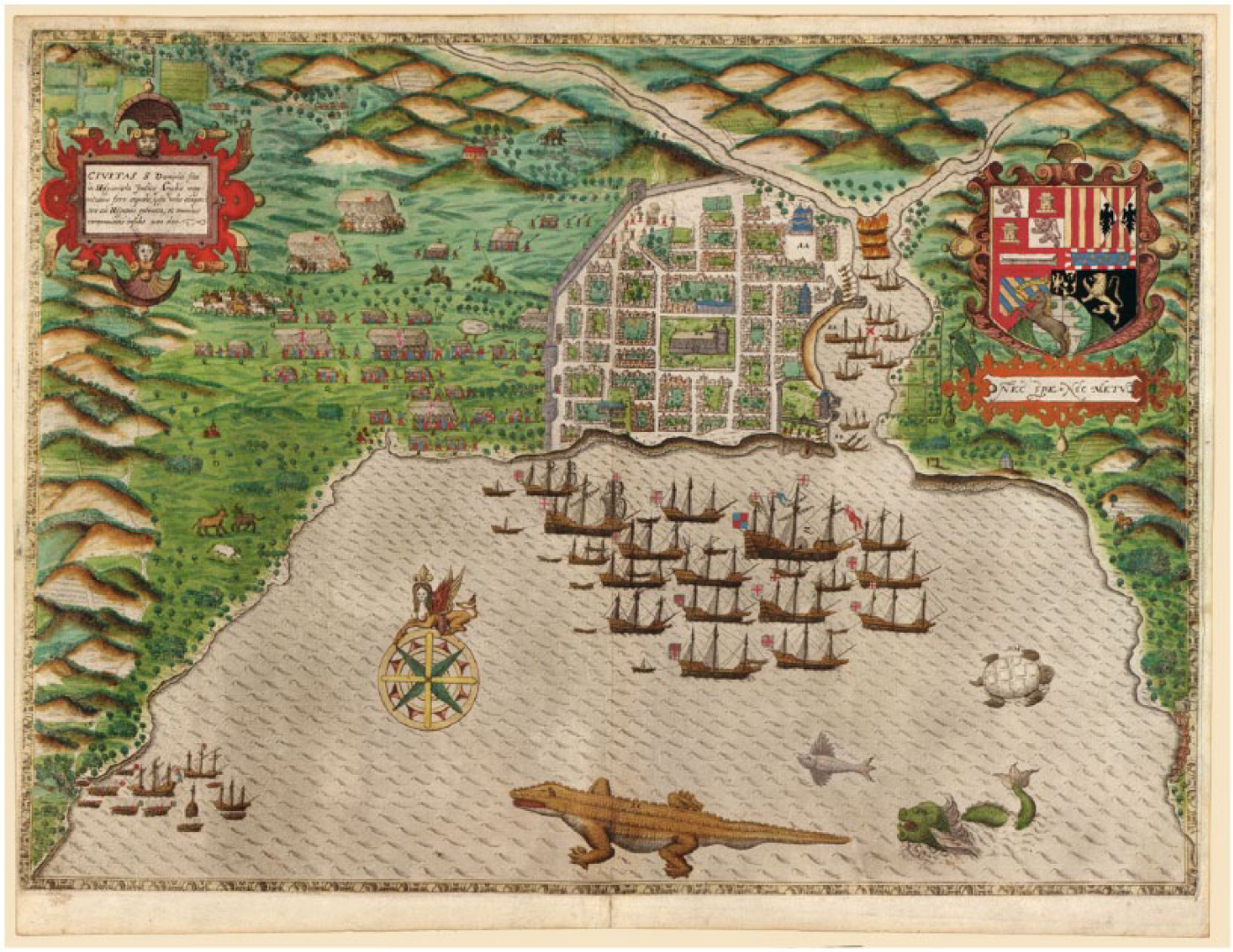
Civitas S. Dominici sita in Hispaniola Indica Angliae magnitudine fere aequlais ipsa urbs elegantor ab Hispanis extructa, et omnibus circumvicinis insulis iura dat. [The city of Santo Domingo, in the Spanish Indies, is almost similar in size to England. This city was beautifully built by the Spaniards and she commands all the islands around.]
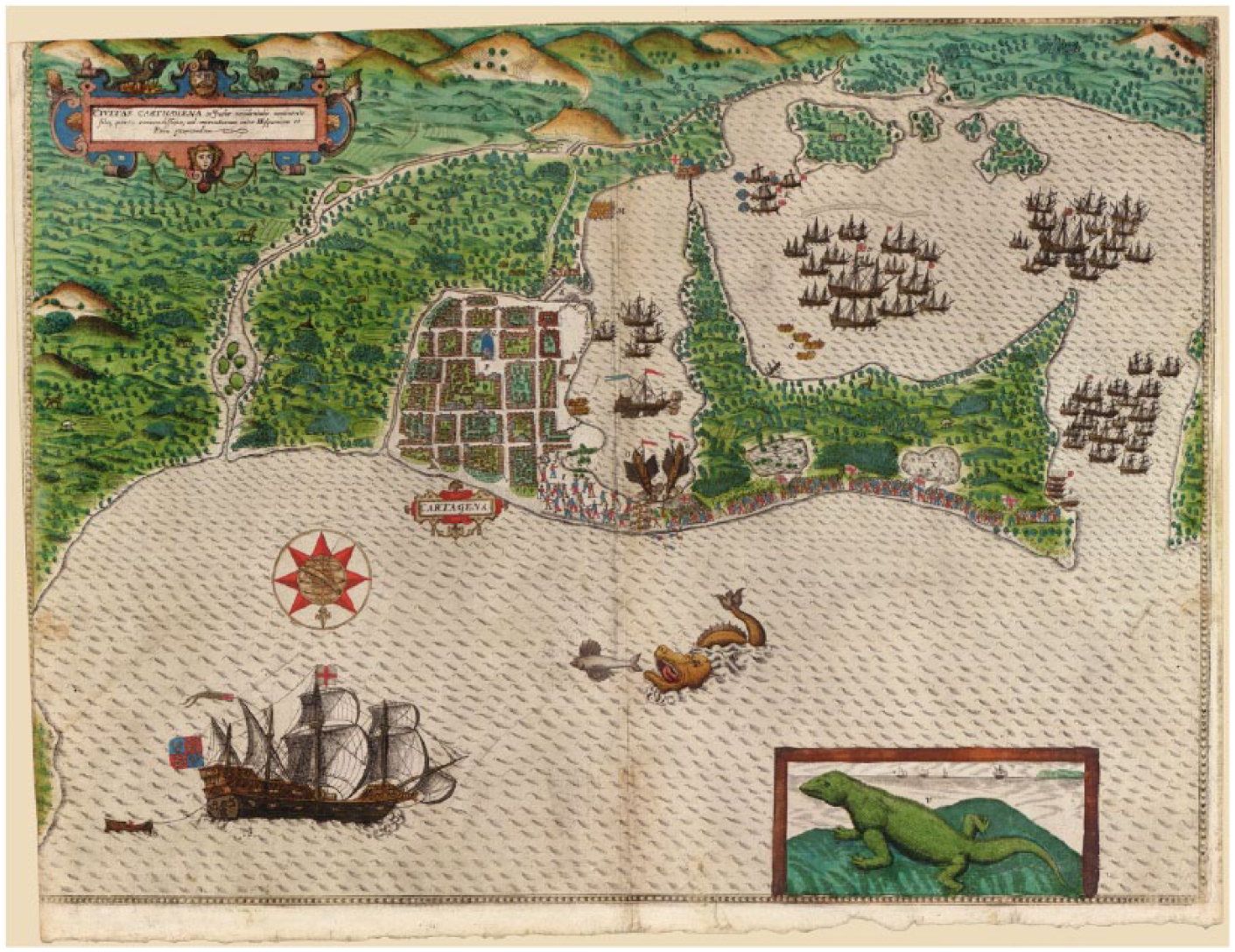
Civitas Carthagena in Indiae occidentalis continente sita, portu commodissimo, ad mercaturam inter Hispaniam et Peru exercendam. [The city of Cartagena, in the Tierra Firme of the Occidental Indies, has a comfortable port for the traffique between Spain and Peru.]
The same account appeared in 1589 in two different English editions in London, one with the same illustrations and references by Boazio, and the other with no illustrations or references. In 1600, in the second edition of Principal voyages, Richard Hakluyt also presented the narrative of Walter Bigges, without illustrations. 14 Other eyewitness sources for Drake’s Western Raid also reference the Spanish galleys in America, and will be detailed in the following sections.
The Santo Domingo galley
In Bigges’s narrative, the only textual mention of a galley from Santo Domingo comes in an episode that involved an English messenger. He was received by ‘some of those who had bene belonging as officers for the king in the Spanish galley’; however, the text makes no further reference. 15 This galley was the Leona, commanded by Ruy Díaz de Mendoza, the capitana who arrived in Santo Domingo from Europe in 1583 in the company of the Santiago, under the authority of Diego Osorio. The first months of patrols made by these two galleys were promising, and many raids were averted. However, this success did not last long. In July 1583, the Santiago ran aground while patrolling the north coast of Hispaniola Island, near Port Monte Cristo. The crew was saved, but the vessel was lost. Finding themselves unaccompanied, the crew of the Leona mutinied, resulting in the murder of Captain Mendoza and the wounding of other officers. 16 Osorio later managed to recover the Leona and punish the culprits. He remained aboard as captain, and in reports sent to the Spanish king, complained about the problems associated with the maintenance and operation of the Leona: the extensive coasts that the galley was commissioned to protect, the lack of assistance from local authorities, and the presence of ‘Frenchmen friends’ among the local population who facilitated illegal commerce and reported information about the region to Spain’s enemies. 17
When Drake arrived and attacked the city early in 1586, Osorio was in charge of the galley. The Englishmen captured and then burnt the Leona after removing the galley’s cannons and liberated and enlisted some of the slaves and forzados. 18 Documentation relating to the capture and destruction of the Leona may be found in sources translated into English by Irene Wright, in the report sent by Diego Osorio to the king explaining how the city was lost, as well as in letters from the president of Santo Domingo’s Audiencia, Cristóbal de Ovalle. 19 Regarding Boazio’s map of Santo Domingo (see Figure 2), in the river in front of the city, the galley is identified between other ships. In the reference ‘EE’, from the English version it states: ‘A goodly great Gallie which the Spaniardes had in their harbour, which at our departure from the citie we burned’ (see Figure 5a, below).
In addition to Bigges’s Summarie, other textual sources from Drake’s expedition also mention the Spanish galleys, including the ship logs of three of the 20 or so ships that comprised the fleet: the Primrose Journal (Captain Martin Frobisher); the journal of the Leicester (Captain Knollys); and the diary of the Tiger (commanded by Christopher Carleill and Edward Powell). The Primrose Journal was first published by Corbett. All three journals, among many other documents, first appeared in Keeler’s book on Drake’s West Indian voyage.
20
The Primrose Journal says the following in relation to the Santo Domingo galley: We found in the harbour a very fair galley; she had belonging unto her four hundred slaves, Turks, Moors, Negroes, Frenchmen and Greeks; she shot at us at our first coming in; her end was we carried her to the sea and set her on fire, and all her slaves we took with us.
21
The record kept aboard the Leicester notes that by the end of January 1586, ‘the galley we fownde at Domingo was towed out and burnt by Captain Vaughan’ and adds that ‘there were burnt an olde shippe of 600 or 700 tonnes & a great many smale barkes. The number of all was no lesse then 20’. 22 Unfortunately, some pages from the Tiger Journal can no longer be found. Keeler explains that ‘The record of events from the departure from Santiago until after the capture of Santo Domingo in Hispaniola (29 November 1585 to 8 January 1586), therefore, has been lost’. 23 From this date on, no further mention of the Santo Domingo galley is to be found in these logs.
Cartagena de Indias’ galleys
By the time Drake arrived in Cartagena de Indias, only three of the four galleys stationed there were operational. They were the Ocasión, one of the first two galleys sent in 1578, and the Santangel and Patrona de España, both delivered in 1583.
24
The fourth galley, the Santiago, was beached and in a miserable condition, if we trust the testimony of Captain Pedro Vique Manrique, who was in charge of the four vessels, and later tried by the Spanish Crown for his role in the debacle.
25
Bigges’s narrative about the episodes relating to the Cartagena de Indias galleys is especially interesting. He describes the English attack and the Spanish defence as follows: … they had brought likewise two great gallies with their prowesse to the shore, hauing planted in them eleuen peeces of ordinance which did beat all crosse the straight, and flanked our coming on. In these two galleys wered planted three or foure hundred small shot, and on the land in the gard onely of this place three hundred shot and pikes.
26
The references on the corresponding map (see Figures 3, 4a and 4b) shine more light on this event. Under the letter ‘H’, in the black and white London edition, we find the description: ‘A great Galleasse well furnished with ordinaunce, which she implored as well as she might, but not to any purpose because she coulde not come so neere the shore, which was not deepe inough of water for her’.
27
This description points to one of the above-mentioned problems faced by the Spanish galleys: the shallow waters bordering Cartagena de Indias complicated the use of such vessels. Under the letter ‘G’ the explanation relating to the galleys is as follows: Two great Gallies which were within the haven, were placed as you see without the slone wall aforsaid, of purpose to beat croste The straight of land: and so to flancke vs in our approach, in which Gallies were planted eleuen peeces of ordinance and 400. souldiers, which of ordinace did belong vnto them & were all small shot, which ordinance & small shot as wel on land as in the Gallies, was wonderfully imploted that it was strange to heare the same.
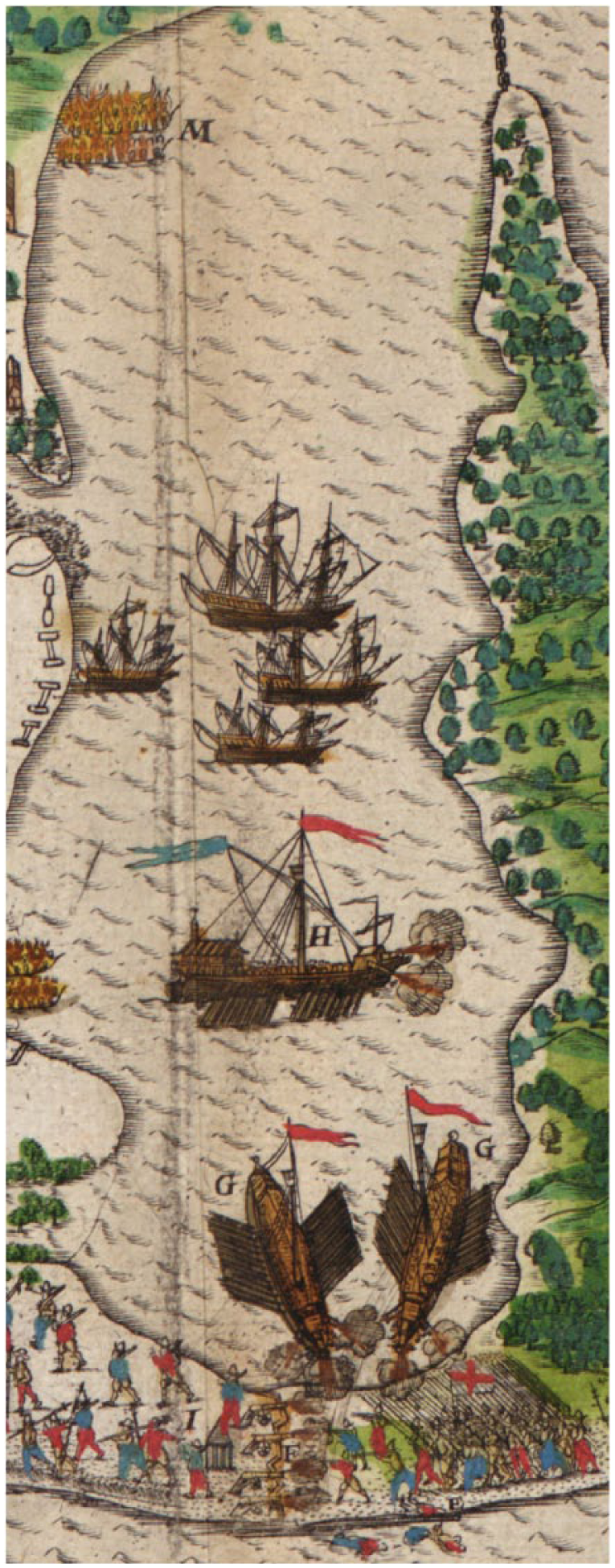
Section taken from Figure 3, the galleys and the galleass firing, and reference M.

Smaller section taken from Figure 4a, close up of references H and G.
Indeed, in Boazio’s map, we can clearly see the galleys’ bow-artillery firing not against other ships, but against English soldiers attempting to enter the city via a narrow passage, through which they eventually managed to proceed. Under the reference ‘M’, we can identify the place where the Spanish burnt the galleys in order to prevent them from falling into English hands.
From the three logs one gains more insight regarding the events in Cartagena. For example, a passage in the Tiger Journal, which was badly damaged by fire, reads: … directly vpon vs beinge a way of narrow passage and … placed.vi.greate brasse peeces, but also two greate Galleys … hand as we came in wherein were no lesse then ix. Greate br[asse pieces] … shote besides who played vpon vs to owr great anoyaunce and … be they had had the day to have had but some reasonable ayme at vs … Lietenaunt Generall / with good courage not fearinge the roaring of the ca[non] from the Galleys, nor the Rente of sworde / havynge God on his syde, de [brave]ly enter …
28
This passage underlines the importance of the gunpowder weapons and their firepower. The Tiger Journal also adds that ‘The ordinaunce which was from the towne, forte, and Galleys were in all three score and two brasse pieces’,
29
and became a valuable part of the bounty looted in Cartagena.
30
Also when describing how Drake’s expedition entered into the city of Cartagena, the Leicester Journal takes particular interest in weapons, giving more information about the three galleys and the way that Englishmen marched and broke through the Spanish defences: … we came to a streyghte, havinge at our left hande the maine sea, on the other the water of the harbor in which, harde by the shore, were 2 galleys & a gallease with 9 peces of Ordinance & 300 good shoott, as the Spaniards confest, moste of which were come out of Flaunders, which did play vpon our men with great shott & smalle, as thicke as haile.
31
Some days after pillaging the city, the English recovered the galleys’ artillery: ‘… 2 canons of brasse were waighed out of the galleyes, which were burnte & sunk by the Spaniards at our first cominge to the towne, and after[wards] 6 smaller peces also’.
32
The Primrose Journal provides additional details: The 2 galleys and galleass were well furnished with men and ordnance, and this was then their saying, as afterwards they did confess, that we should all die but 20 of the best, and they should be made galley-slaves.
33
From the galleys and the galleass, as well as from the fort, the Spaniards ‘ply their ordnance against us that it was wonderful; their calivers, muskets and harquebuses did play their parts’. Once the Englishmen entered the town they noticed that the Spaniards had set fire to both the galleys. The slaves and Spaniards in the galleys ‘fell together by the ears, so that the Spaniards killed many of their slaves, and some they took with them, and very many of them did swim to us’. 34
One can interpret these events from the point of view of naval historians: during the last decades of the sixteenth century there was a general tendency to rely heavily on artillery, and although galleys carried gunpowder weapons, this dependence on artillery can be considered as one cause of the decline of oared vessels as warships. Fire guns and cannons were transforming the ancient tactic practiced during naval battles: physically boarding and controlling the enemy vessel. The possibility of capturing or destroying another ship through heavy shooting not only drove the development and intensive use of gunpowder weapons, but also the design and construction of sailing ships with broadside guns, such as frigates. 35 In this sense, the failure of Spanish galleys in the Caribbean should be set in the context of the technological changes and transitions taking place at the end of the sixteenth century, though this was not the only factor that defined the decline in the use of galleys. 36 It was also a political and economical decision, with many local interests in a game that resulted in an unequal distribution of royal funds for defence. 37
Having identified references to Spanish galleys in Bautista Boazio’s engravings as well as in different accounts of Francis Drake’s Western Raid (1585–1586), other visual representations of this venture are now considered.
German editions of the Western Raid and Boazio-based engravings
In 1589, another edition of Walter Bigges’s account appeared, this time in German and probably printed in Cologne. 38 In this publication, the four cities are also depicted, probably based upon the 1588 Leiden engravings. Some small differences exist between Boazio’s illustrations from Leiden and London, and those from the Cologne edition. In relation to the galleys, for instance, the one from Santo Domingo referred to by the number 28, clearly depicts the long yard (see Figure 5b), which was characteristic of lateen-rigged (triangular sails) masts. Another interesting difference is the supposed location of where the Cartagena galleys were burnt: the Leiden and London editions insert the letter ‘M’ and a written reference, while the Cologne edition presents the textual reference and the number 13, but it is not included in the engraving.

Details of Santo Domingo’s galley.
Yet another edition of Bigges’s narrative with illustrations was published during the sixteenth century. This appeared in Frankfurt in 1598 from Theodore de Bry’s workshop. It was one of the three voyages that comprised the ‘additamentum’ of the eighth part of the Grands Voyages. The addition related to Francis Drake and his presence in America, and includes the circumnavigation, the Western Raid, and his last voyage. 39 Curiously, in the engraving of Santo Domingo made by the de Bry family, a sailing vessel appears in the place where one would expect to find the Leona (see Figure 5c). How could this have happened? Is there a particular reason for this substitution? Should it be explained as a mistake? Unfortunately, the answers to such questions are unknown, and one can only point out this unusual incoherence. The absence of the Santo Domingo galley was repeated in a re-edition of the de Bry document of the Western Raid during the seventeenth century, as well as in other collections based on de Bry’s engravings. Contrary to de Bry’s engraving of Santo Domingo, de Bry’s representation of the three galleys of Cartagena de Indias are clearly based upon those from the Cologne, Leiden and London editions.
Encountering galleys
After Drake’s 1586 raid, other English expeditions crossed the Atlantic Ocean to Spanish America. Some of them came across the new galleys that were sent to Santo Domingo and Cartagena de Indias (after the first six were destroyed), and even to La Habana. This port received her first two vessels in 1586, the San Agustín and the Brava. From 1591 and 1592, two accounts of English expeditions mention the oared vessels in Cuba, most probably referring to the two named above. The first of these expeditions was financed by George Carey, and the most important event of this voyage was a fight between one of the three English ships and certain Spanish ships and galleys on 13 June 1591. 40 According to an anonymous account published by Richard Hakluyt, the battle started after the Englishmen of the Content realized that two vessels within their view were not the other English ships, but were Spanish: ‘…we looked forth and descryed two saile more to the offen: these we thought to haue bene the Hopewell, and the Swallow that had stoode in to ayde us: but it prooued farre otherwise, for they were two of the kings gallies’. A long and tense confrontation between the Content and the fast galleys of the Spanish king then ensued, when ‘…with the way that the gallie had, did so violently thrust in the boordes of our Captaines cabbin, that her nose came into it, minding to give us all their prowe, and so to sinke us’. 41
The Content then fired small shot at the galleys so as to prevent them from employing their main, centreline bow guns, a heavy cannon flanked by other small guns. From an artillery perspective, this scene can be considered as an example of the changes taking place in the last decades of the sixteenth century. Innovations in iron casting techniques allowed Englishmen to equip their vessels with higher numbers of weapons, and although these guns were not of very good quality or accuracy, the quantity tipped the scales against their enemies. 42 The Content twice averted the Spanish galleys from boarding. From seven in the morning until 11 at night, the vessels remained side by side exchanging fire. At two in the morning a wind allowed the Content to pull away and escape without losses, but the ship was heavily damaged by enemy fire. Some days later the galleys caught sight of the Content again, but finally they let her go. The narrative concludes: ‘A frigat of the Spaniards (being afterward taken) confessed, that there were in the gallies above 40. Spaniards slaine, and many were hurt in that combate’. 43
The next account of La Habana galleys recounts the voyage of captain William King with two ships, in early 1592, and was also published by Hakluyt.
44
The Salomon and the Jane Bonaventure departed from Ratcliffe in January, and after some attacks in the Canary Islands, they arrived to Puerto Rico from where they sailed on to Santo Domingo. No mention is made of the galleys that were supposedly stationed in that port. The expedition continued to Jamaica and the Cayman Islands, where they took provisions of turtles. On the west coast of Cuba they captured a small barge and another ship, and then continued to Matanzas. Next they sailed to La Habana, where they came so near the forts that for one hour the Spaniards overreached them with their long ordnance: ‘Then came out the two gallies, having 27 banks on a side, and fought with us another houre’. Leaving that port: … we were incountered by the gallies, which had followed us, and fought with them three houres, oftentimes within caliver shot: but wee made such spoile of their men and oares, that they beganne to be weary, and gave us over…
45
Another example of Spanish galleys in English travel accounts of America is the last voyage of Sir Francis Drake and John Hawkins in 1595.
46
This large expedition was marked by conflicts and changes of ideas and objectives, culminating in the death of both leaders. First, John Hawkins died on the coast of Puerto Rico during December 1595, after a combat that taught the English how the Spanish had improved their defences in America. Indeed, some days before, five fragatas from the Spanish defence system had captured an English ship and were prepared to find and fight the English expedition. The account published by Hakluyt states that the five zabras, or frigates, were of two hundred tons a piece and they ‘had in each of them twenty pieces of brasse, and a hundredth barrels of powder’. Also in Puerto Rico and after Hawkins death, the fragatas again confronted the English fleet, but were destroyed during the combat. The English expedition then continued to Aruba, Rio de la Hacha and Cartagena, where it encountered the galleys there stationed: We lost that night the company of the Phenix, captaine Austin, Peter Lemond, and the Garlands pinnesse, which stood along the shore, and being chased off by gallies out of Carthagena. Peter Lemond with nine of our men was taken, the rest came safe to our fleete.
47
The other accounts that exist about this voyage do not mention the episode with the oared vessels in Cartagena, but shed more light on the fleet’s next stop at Nombre de Dios. In the Hakluyt account it reads that on the last day of December ‘the Generall burned halfe the towne, and the first of Januarie burnt the rest, with all the Frigats, Barks and Galiots, which were in the harbour and on the beach on shore…’. 48 The Maynarde manuscript, for instance, mentions that ‘Nombre de Dios together with theyr negroe towne were fyred & we suncke and fyred 14 smale frigotts which we founde in the rode’. 49 The Trougthon diary, published by Samuel Purchas, states that ‘the vth daie of January all our men beinge shipped, the Towne and galliottes put to fire…’. 50 By ‘frigates’, ‘frigotts’, ‘galiots’ or ‘galliottes’, the English sources of the sixteenth century may refer to small vessels, propelled by oars but having also masts and sails. 51
Indeed, as noted previously, new Spanish defensive strategies came into play after the 1586 raid by Francis Drake, notably the construction of fortifications and the building of new types of vessels in the Americas to defend against enemies. Thus, the so-called fragatas were a technological improvement over Mediterranean galleys. These new ships were constructed from timber and raw materials obtained locally, they used less manpower, carried more artillery and most importantly, they were faster and more manoeuvrable than traditional galleys. 52 Equipped with sails, fewer than 15 benches per side and with low freeboard, fragatas soon began to replace galleys as an imposing new way to conduct naval attacks. The local designs also resolved problems characteristic of the European galleys in the Caribbean; for instance, the importation of significant numbers of slaves and forzados from the Mediterranean area to propel the vessels, as well as the dependence on imported rigging from Spain to maintain the galleys. In sum, fragatas, also called galeoncetes, were more appropriate to the conditions of the Caribbean than galleys.
Eyewitness representations of galleys in the Caribbean: Clues for further investigation
In addition to the various editions of Boazio’s account, other representations of the Spanish galleys can be found in traveller and eyewitness accounts. For example, there is the so-called ‘Drake Manuscript’, otherwise known as the Histoire Naturelle des Indes, which is preserved at the Morgan Library and Museum in New York. 53 In folio 97r, there is an atypical representation of the port of Nombre de Dios, in which two galleys can be identified. This port was one of the most important areas protected by the galleys stationed in Cartagena de Indias. They were called the galleys of Tierra Firme, referring to the area of the Isthmus of Panama where the Peruvian treasure passed from the Mar del Sur to the Mar del Norte. In the port of Nombre de Dios, galleys embarked the king’s silver and other treasures, and transported them to Cartagena de Indias. From there, the silver was transferred to other ships also loaded with pearls and other metals and all went to La Habana where they were joined by more ships coming from San Juan de Ulúa. From here the ships travelled in convoy to Spain, in line with the defensive system of fleets and galleons established it in 1564. 54
After the many attacks suffered in the region during the 1590s, the engineer Antonelli recommended that Portobello was more suitable than Nombre de Dios to serve as a base for Spanish operations, and it was therefore converted it into a defensive stronghold in 1597, with many of Nombre de Dios’s port facilities moved to this new location. 55 Thus, it is believed that the representation of the two galleys from the Drake Manuscript depicted a specific period in which the galleys operated in Nombre de Dios – that is, between 1586 and 1597.
In another eyewitness account, written in manuscript form by a traveller who was present in the New World in 1592, there are additional representations of the galleys of Cartagena de Indias and La Habana. In the second book of the Luz de navegantes, by Baltasar Vellerino de Villalobos, 56 Cartagena and the Icacos point are described thus: ‘… it has their fortresses and there are regularly in the garrison three hundred paid soldiers, two galleys reside there, they protect and patrol all the coast of Tierra Firme’. 57 Regarding La Habana, Villalobos writes that in the fortress resides the governor and alcaide that is also ‘the cabo [corporal] of two galleys very well prepared and armed that overview and protect all that coast’. 58 In the images that accompany the texts, at least one galley can be discerned among the other ships in La Habana. For Santo Domingo, neither representation nor mention of the oared vessels appears in Villalobos’s manuscript.
It is believed that there still exists at least one other eyewitness visual representation of the Spanish galleys in the Caribbean that corresponds to this period. One can hypothesise that in the original manuscript of the Brief discours… by Samuel de Champlain (whereabouts currently unknown), the galleys were probably represented. 59 The diary covers Champlain’s travels in the West Indies from 1599 to 1602, a period in which galleys were still operating in the area. Referring to the city, Champlain writes that ‘I remained a month and a half at the town of Cartagena and took a portrait of the town and of the harbour’. 60 However, the aforementioned images are missing in all the three known copies.
Conclusion
Spain conducted the Caribbean galley experiment within a specific time frame and a specific region. In the context of the imperial defensive problems faced by the Spanish monarchy, the system coexisted with other measures, notably the use of galleons to convoy treasures from the New World, the erection of fortifications, the construction of frigates and the introduction of the Armada de Barlovento. English travel accounts, as well as contemporary visual evidence, provide insights into these measures from the perspective of the aggressors. They show how the use of gunpowder weapons shaped naval warfare. Artillery was becoming more important than the physical control of vessels and new types of ship were developed to deliver more firepower. The sources also reveal other problems that explain why galleys failed in the Caribbean, such as the difficulties encountered in navigating shallow waters and the problems that arose in controlling crews. Moreover, in presenting different representations of the oared vessels, an impression is gained of how visual information regarding the Spanish defence system circulated in Europe. Further research into depictions of Caribbean galleys will enhance our knowledge and understanding of the colonial development of the Caribbean in the early modern era.
Footnotes
Acknowledgements
The author would like to thank the staff of the John Carter Brown Library, especially Susan Danforth. Particular gratitude is also due to Cecilia Tarruell, Manuel Lomas Cortés, José Manuel Díaz Blanco and the referee of this article. This work was partially supported by an Alexander O. Vietor Memorial Fellowship from the John Carter Brown Library, Providence, and the Art Histories and Aesthetic Practices Research Program at the Forum Transregionale Studien, Berlin.
1.
Kenneth Andrews, Elizabethan Privateering: English Privateering during the Spanish War 1585–1603 (Cambridge, 1964); Kenneth Andrews, English Privateering Voyages to the Caribbean, 1588–1595 (New York, 1986)
2.
See, for instance, Enrique Otero Lana, ‘Un avance en la construcción naval: las fragatas construídas en La Habana hacia 1600’, Revista de Historia Naval, IX, No. 34 (1991), 87–94; Diego Angulo Iñíguez, Bautista Antonelli: las fortificaciones americanas en el siglo XVI (Madrid, 1942); Bibiano Torres Ramírez, La Armada de Barlovento (Sevilla, 1981), 1–34.
3.
See Paul E. Hoffman, The Spanish Crown and the Defense of the Caribbean, 1535–1585: Precedent, Patrimonialism, and Royal Parsimony (Baton Rouge, 1980), 179–96.
4.
Kenneth Andrews, Trade, Plunder and Settlement: Maritime Enterprise and the Genesis of the British Empire, 1480–1630 (London, 1984), 129.
5.
Arndt Brendecke, Imperio e información: Funciones del saber en el dominio colonial español (Madrid-Frankfurt am Main, 2012).
6.
For references to Spain’s Caribbean galleys, see Césareo Fernández Duro, Armada española: Desde la unión de los reinos de Castilla y de Aragón (2 vols., Madrid, 1972–73), vol. II, 339–40; Pierre and Huguette Chaunu, Séville et l’Atlantique (1504–1650) (Paris, 1959), deuxième partie, tome VII, 34–5 and tome VIII, 1035–54; Silvio Zavala, ‘Galeras en el Nuevo Mundo’, Diálogos: Artes, Letras, Ciencias humanas, 13, No. 6 (1977), 5–11; Irene A. Wright, Further English Voyages to Spanish America, 1583–1594 (London, 1951); Hoffman, Spanish Crown, 175–212; Juan José Sánchez Baena, ‘La necesidad y el empleo de galeras en el mar Caribe en la segunda mitad del siglo XVI’, Revista de Historia Naval, 28, No. 110 (2010), 75–96; Juan José Sánchez Baena, ‘Galeras para la guarda de la isla de Cuba (1586–1596)’, in Gabriela Dalla-Corte Caballero, Ricardo Piqueras Céspedes, Meritxell Tous Mata, eds, América: poder, conflicto y política (Murcia, 2013).
7.
See Max Deardorff, ‘Imperial Justice, Colonial Power: Pedro Vique y Manrique, the Galley Captain of Cartagena de Indias, 1578–1607’, Colonial Latin American Historical Review, 17 (2008), 117–42; Richard Boulind, ‘Shipwreck and Mutiny in Spain’s Galleys on Santo Domingo Station, 1583’, Mariner’s Mirror, 58 (1972), 297–330; David Wheat, ‘Mediterranean Slavery, New World Transformations: Galley Slaves in the Spanish Caribbean, 1578–1635’, Slavery & Abolition, 31, No. 3 (2010), 327–44.
8.
Geoffrey Parker, The Grand Strategy of Philip II (New Haven and London, 1998), 257.
9.
Parker, Grand Strategy of Philip II, 268.
10.
For Mediterranean galleys, see Francisco Felipe Olesa Muñido, La organización naval de los estados mediterráneos y en especial de España durante los siglos XVI y XVII (2 vols., Madrid, 1968), I, 169–279; John Francis Guilmartin, Gunpowder and Galleys: Changing Technology and Mediterranean Warfare at Sea in the 16th Century (Annapolis, 2003), 209–34.
11.
A summary of the editions and authorship of this account is presented in Mary Frear Keeler, Sir Francis Drake’s West Indian Voyage 1585–1586 (London, 1981), Appendix III, 301–09.
12.
Walter Bigges, Expeditio Francisci Draki eqvitis angli in Indias Occidentales A.M.D.LXXXV. Qua vrbes, Fanum D. Iacobi, D. Dominici, D. Ausutini & Carthagena captae fuêre. Additis passim regionum locorumque omnium tabulis geographicis quam accuratissimis (Leiden, 1588).
13.
See Edward Lynam, ‘English Maps and Map-Makers of the Sixteenth Century’, Geographical Journal, 116 (1950), 7–25; Wright, Further English Voyages, xiii; Keeler, Sir Francis Drake’s West Indian Voyage, 310–20.
14.
Walter Bigges, A Summarie and True Discourse of Sir Frances Drakes VVest Indian Voyage. VVherein were taken, the townes of Saint Iago, Sancto Domingo, Cartagena and Saint Augustine (London, 1589); Walter Bigges, A Summarie and True Discourse … With geographicall mappes exactly describing each of the townes with their scituations, and the manner of the armies approaching to the winning of them: diligently made by Baptista Boazio (London, 1589); Richard Hakluyt, The principal nauigations, voyages, traffiques and discoueries of the English nation, made by sea or ouer-land, to the remote and farthest distant quarters of the earth, at any time within the compasse of these 1600. yeres… (3 vols., London, 1598–1600), III, 534–43.
15.
Bigges, A Summarie, 24–5.
16.
Seville, Archivo General de Indias (hereafter AGI), Patronato, 269, N.2, R.7. Relación de Bartolomé de Emasavel. Santo Domingo, 3 February 1584; AGI, Santo Domingo, 14, N.19. Informaciones de oficio y parte: Diego Osorio. Santo Domingo, 1 February 1584; Boulind, ‘Shipwreck and Mutiny’, 297–330.
17.
AGI, Santo Domingo, 72, R.2, N.4. Carta de Diego Osorio al rey. Puerto de Plata, 18 December 1583.
18.
David Beers Quinn, ‘Turks, Moors, Blacks, and others in Drake’s West Indian Voyage’, in Explorers and Colonies: America, 1500–1625 (London, 1990), 197–204.
19.
Wright, Further English Voyages, documents 13, 19 and 20. See also AGI, Santo Domingo, 51, R.9, N.86. Carta de Cristóbal de Ovalle al rey. Santo Domingo, 23 February 1586.
20.
‘The discourse and description of the voyage of Sir Francis Drake and Mr. Captain Frobiser set forward the 14th day of September, 1585’, in Julian Corbett, ed., Papers Relating to the Navy during the Spanish War, 1585–1587 (London, 1898), 16; Keeler, Sir Francis Drake’s West Indian Voyage – Document 6: The Record kept aboard the Ship Tiger by Christopher Carleill and Edward Powell, 13 September 1585 to 14 April 1586, 69–105. Document 9: The record kept aboard the Ship Leicester, October 1585 to March 1586, 119–179. Document 10: The Primrose Journal, 179–210.
21.
Primrose Journal, in Corbett, Papers, 166.
22.
Leicester Journal, in Keeler, Sir Francis Drake’s West Indian Voyage, 157.
23.
Keeler, Sir Francis Drake’s West Indian Voyage, 150.
24.
AGI, Indiferente 740, N.127. Consulta del Consejo de Indias, Madrid, 26 May 1583.
25.
Documents from Seville, Cartagena and Turbaco can be found in AGI, Patronato, 196, R.18; AGI, Santa Fe, 37, R.5, N.65c. Relaçion de lo que sucedió en la pérdida de Cartagena y galeras, Cartagena de Indias, 1r–9v. Other documents related to Pedro Vique Manrique and Francis Drake in Cartagena may be found in Wright, Further English Voyages, documents 22, 23, 24, 26, 27 and 29; see also Deardorff, ‘Imperial Justice’, 117–42.
26.
Bigges, A Summarie, 32.
27.
According to the Oxford English Dictionary, a galley is ‘a low flat-built sea-going vessel with one deck, propelled by sails and oars, formerly in common use in the Mediterranean’. A galliass or galleass is ‘a heavy, low-built vessel, larger than a galley, impelled both by sail and oars, chiefly employed in war’ Oxford English Dictionary (2nd edition, 20 vols., Oxford, 1989). According to Sir William Monson, Naval Tracts (Vol. 3, London, 1704), 360–1, ‘a Galleass is built … low and snug… and carries the Force of a Ship … the thing that gives her Advantage in Fight, is her Oars’. For the employment of galleys in England, see E. R. Adair, ‘English Galleys in the Sixteenth Century’, English Historical Review, 35 (1920), 497–512.
28.
Tiger Journal, in Keeler, Sir Francis Drake’s West Indian Voyage, 104.
29.
Tiger Journal, in Keeler, Sir Francis Drake’s West Indian Voyage, 105.
30.
See ‘Rough Estimate of the Proceeds of Drake’s Voyage [S.P. Dom. cxci. 38]’. The plate and bullion was worth £42,000, the ships £12,500, the ordnance £5500, the pearls £3500, the hides £800 and the iron and lead and alia £600. In Corbett, Papers, 85.
31.
Leicester Journal, in Keeler, Sir Francis Drake’s West Indian Voyage, 162.
32.
Leicester Journal, in Keeler, Sir Francis Drake’s West Indian Voyage, 167.
33.
Primrose Journal, in Corbett, Papers, 19.
34.
Primrose Journal, in Corbett, Papers, 19–20.
35.
See N. A. M. Rodger, ‘The Development of Broadside Gunnery, 1450–1650’, Mariner’s Mirror, 82 (1996), 301–24; Richard W. Unger, ‘Warships and Cargo Ships in the Medieval Europe’, Technology and Culture, 22, (1981), 233–52; Guilmartin, Gunpowder and Galleys, 269–89; Lawrence V. Mott, ‘Iberian Naval Power, 1000–1650’, in John B. Hattendorf and Richard W. Unger, eds, War at Sea in the Middle Ages and Renaissance (Woodbridge, 2003), 105–18.
36.
For the Mediterranean context, see I. A. A. Thompson, ‘Las galeras en la política militar española en el Mediterráneo’, Manuscrits, 24 (2006), 95–124.
37.
The most complete analysis is provided by Hoffman, who considers the interaction of eight factors to understand the defensive system of the Caribbean from the Spanish perspective: geography, military, technology, patrimonialism, parsimony, population, war material and the pattern of raiders’ activities. Hoffman, Spanish Crown, 4–5.
38.
Walter Bigges, Relation oder Beschreibu[n]g der Rheiss vnd Schiffahrt auss Engellandt… (Cologne?, 1589).
39.
Theodore de Bry, Americae Achter Theil (Frankfurt am Main, 1598). Numbered separately and varying according to the edition.
40.
‘The voyage and valiant fight of the Content, a ship of the right honourable sir George Carey knight, L. Hunsdon, L. Chamberlaine, Captaine of the honourable band of her Maiesties Pensioners, and Gouernour of the Isle of Wight, & c. 1591’, in Hakluyt, Principal nauigations, III, 565–7.
41.
Hakluyt, Principal nauigations, III, 566.
42.
Guilmartin, Gunpowder and Galleys, 287.
43.
Hakluyt, Principal nauigations, III, 567.
44.
‘The voyage made to the bay of Mexico by M. William King Captaine, M. Moore, M. How, and M. Boreman owners, with the Salomon of 200. tunnes, and the Iane Bonauenture of 40. tunnes of Sir Henry Palmer, from Ratcliffe the 26 of Ianuary 1592’, in Hakluyt, Principal nauigations, III, 570–1.
45.
Hakluyt, Principal nauigations, III, 570.
46.
‘The voyage truely discoursed, made by sir Francis Drake, and sir Iohn Hawkins, chiefly pretended for some speciall seruice on the Islands and maine of the West Indies, with sixe of the Queenes ships, and 21 other shippes and barkes, containing 2500 men and boyes, in the yeere 1595. In which voyage both the foresayd knights died by sicknesse’, in Hakluyt, Principal nauigations, III, 583–590. For other sources and the most complete analysis of this voyage see Kenneth Andrews, The Last Voyage of Drake and Hawkins (Cambridge, 1972).
47.
Hakluyt, Principal nauigations, III, 586.
48.
Hakluyt, Principal nauigations, III, 587.
49.
Maynarde, BM Additional Mss, 5209: Sir Francis Drake his voyage 1595, in Andrews, The Last Voyage, 99–100.
50.
Troughton, PRO SP 12/257 no 48. Published in Samuel Purchas, Hakluytus Posthumus, or Purchas his Pilgrimes, IV (1625), 1184–5. Cited in Andrews, The Last Voyage, 112.
51.
See, for instance, Corbett, Papers, 337–41; John Bennell, ‘The Oared Vessels’, in C. S. Knighton and David M. Loades, eds, The Anthony Roll of Henry VIII’s Navy: Pepys Library 2991 and British Library Additional MS 22047 with related Documents (Cambridge, 2000), 34–8.
52.
See, for instance, Otero Lana, ‘Un avance en la construcción naval’, 87–94; Chaunu, Séville et l’Atlantique, VIII, 1035–54.
53.
For the Drake Manuscript, see Helen Wallis, ‘The Cartography of Drake’s Voyage’, in Norman J. W. Thrower, ed., Sir Francis Drake and the Famous Voyage, 1577–1580: Essays Commemorating the Quadricentennial of Drake’s Circumnavigation of the Earth (London, 1984), 128–9; Frank Lestringant, ‘Le «Drake Manuscript» de la P. Morgan Library: un document exceptionnel en marge des «nouveaux horizons» français’, L’Homme, 34, No. 130 (1994), 93–104. See also the Digital Collection at the Morgan Library and Museum, NY (MA 3900),  [accessed 5 May 2017].
54.
From 1562 to 1568, eight galleys operated from the port of Santa María with the aim of protecting the American convoys against Barbary corsairs. See José Manuel Díaz Blanco, ‘Una armada de galeras para la Carrera de Indias: el Mediterráneo y el comercio colonial en tiempos de Felipe II’, Revista de Indias, 74 (2014), 661–92. For the system of galleons, see Clarence Haring, Comercio y navegación entre España y las Indias (México, 1979), 251–88; and Esteban Mira Caballos, La Española, epicentro del Caribe en el siglo XVI (Santo Domingo, 2010), 389–404.
55.
Angulo Iñíguez, Bautista Antonelli, 74.
56.
Baltasar Vellerino de Villalobos, Luz de navegantes. University Library of Salamanca, ms 291, Salamanca, 1592 (Facsimile edition from the Museo Naval, Madrid, 1985).
57.
Vellerino de Villalobos, Luz, ms 133 ‘…tiene sus fuertes y hay ordinariamente de presidio trescientos soldados pagados residen allí dos galeras que guardan y corren toda la costa de tierra firme’.
58.
Vellerino de Villalobos, Luz, ms 155 ‘…el gouernador y alcayde es cabo de dos galeras muy bien adereçadas y armadas que recorren y guardan toda aquella costa’.
59.
Three copies are known today of this French journal: the most complete, with 62 coloured illustrations, is held by the John Carter Brown Library, while another copy exists in the state archives of Turin with 53 illustrations, and the third is in the University Library of Bologna, with 51 ink images. For the location, history, differences and comparisons of the copies, see Luca Codignola, ‘Samuel de Champlain et les mystères de son voyage aux Indes Occidentales, 1599–1601. L’état de la recherche et quelques routes à suivre’, in Cecilia Rizza, ed., La découverte de nouveaux mondes: aventure et voyages imaginaires au XVII siècle. Actes du XXIIe Colloque du Centre Méridional de Rencontres sur le XVIIe siècle (Gênes 23–25 janvier 1992) (Fasano, 1993), 45–58. Laura Giraudo, ‘The Manuscripts of the Brief Discours’, in Raymonde Litalien and Denis Vaugeois, eds, Champlain: The Birth of French America (Montreal, 2004), 63–82.
60.
Samuel Champlain, ms: Brief discours des choses plus remarquables que Samuel Champlain de Brouage à reconneues aux Indes Occidentales, John Carter Brown Library, codex Fr.1, in Narrative of a Voyage to the West Indies and Mexico in the Years 1599–1602 (Providence, ca.1602), 41.