




Abstract
In 2016, the Greek Shipping Co-operation Committee (GSCC) celebrated its 80th anniversary in London. This article, which is part of an ongoing research project on the development of the GSCC in the twentieth century, provides a new interpretive framework by using the tools of historical institutionalism to study and understand the circumstances that led to its establishment, operation and broad activity in London, England. Furthermore, it seeks to answer the question of how the GSCC, as an independent institutional body of the Greek shipping industry, became a successful paradigm of concerted and collective action within a business sector that is known for its spirit of individualism. The particular time period under consideration in this article is the early 1930s to the early post-war years (1946–1950), excluding the Second World War, when exceptional conditions obliged the Committee to alter its normal mode of working.
Keywords
The Greek Shipping Co-operation Committee (GSCC; the Committee) was founded in the mid-1930s in the City of London, which at that time was the metropolis of international commerce, trade and shipping. The GSCC initially was created in London as a subsidiary body of the Union of Greek Shipowners (UGS) in Athens with the aim of strengthening and supporting the internationalized activity of the Greek maritime community. Although the latter had, prior to the 1930s, traded mainly in the Mediterranean and Black Sea, they eventually emerged during the interwar years as a considerable force internationally, mainly in the fields of tramp shipping and dry bulk transportation. What is interesting about the Committee, which actually acted as an independent body, is the strengthening and consolidation it offered to the community of Greek shipowners, managers, brokers, agents, traders and charters based in the capital of the British Empire. The initial vision of the Committee’s creators was to maintain their tradition of independent family businesses while creating the conditions for concerted and collective action that would serve their common business, or other, interests in the UK, as well as in Greece and worldwide.*
Although the power and development of this institutional body has been the subject of academic research, few scholars have focused exclusively on its influence and importance in the development of twentieth-century Greek shipping. The only book written specifically about the Committee and its historical development during the second half of the twentieth century is entitled Greek Shipping Cο-operation Committee 50 Years, with a preface written by the then Chairman of the Committee, John A. Hadjipateras. This was published in 1985 to mark the 50th anniversary of the GSCC. However, there are several scattered reports on the creation and importance of the Committee. For example, in his unpublished work, My Sixty Years in Shipping, Manolis Kulukundis writes about the establishment of the Committee, as he was one of the few ‘firsts’ who contributed to its creation. 1 Andreas G. Lemos, in his books Shipping of the Greek Race: Its History (Vol. A), and Its Anatomy (Vol. B), mentions the inception of the GSCC. 2 Direct and indirect information concerning the history of the Committee is also provided by Matheos Demetrios Los, 3 Gelina Harlaftis, 4 and Ioannis Theotokas, 5 just to name a few studies. And, of course, a valuable source for the studying of the history of the Committee is the fortnightly shipping magazine Naftika Chronika.
The present article examines the Committee’s establishment and operation, focusing on two main questions. First, why did it take until the mid-1930s for the Committee to be set up given the strong presence of Greek offices in London as early as the second decade of the twentieth century? Second, what were the conditions under which the Committee, as an institutional and independent body, functioned, not only as a meeting place, but also as an institution where representatives of London-based Greek maritime-related firms performed business transactions in order to protect their individual and collective business interests?
To answer these questions, we have utilized the methodological tools of historical institutionalism, particularly the notion of ‘critical junctures’ and the ways they influence the creation of an organization and its subsequent institutional development and continuity over time. The archival material used for this article is housed in the extensive archives of the Greek shipping magazine Naftika Chronika, The National Archives in London, and archives relating to the Greek maritime diaspora in London.
Greek shipping representation and institutional development in the twentieth century
Reflecting on the establishment of the GSCC, Manolis Kulukundis stated: It was necessary to have an advisory body in London made up of all the Greek Offices and to this end, I convened a meeting in the Chatzilia’s Offices to discuss the matter. To attract everyone’s interest and co-operation, I set as a precondition that each Office would have one vote regardless of the number of ships it represented. This inspired trust and thus the Greek Shipping Co-operation Committee was established, Periklis Drakoulis was elected chairman, Angelos Louzis Vice chairman and N. B. Metaxas Secretary.
6
Kulukundis was a leading Greek maritime personality, who was known as the mentor, or ‘Dean’ of Greek shipping. 7 His recollections make no mention of the fact that the establishment of the Committee was a formalization of an earlier decision taken by London-based Greek offices to adopt strength through unity, mutual support and collaboration as the basic strategic principles for their own survival and for the further consolidation of the presence of Greek shipping in Britain. Thus, in the mid-1930s, ‘informally and simply, as something natural, the Greek Shipping Co-operation Committee was founded’. 8
At this point, however, a number of questions arise as to the reasons why the London-based Greek Shipping Co-operation Committee was created. Specifically, how predictable was the decision of the representatives of the Greek London offices to meet in the mid-1930s with a view to co-operating through an informal institutional setting, rather than commercially? Second, why did Greek ship operating offices based in London – and also Cardiff and Liverpool – come to appreciate what the maritime press of that period emphasized with great intensity in the early 1930s, namely ‘the harmful consequences of the spirit of individual action that prevailed in shipping and the need for co-operation and the coordination of goals regarding our shipping’s generalized problems’? 9 The third issue that needs to be investigated is the timing of the co-operation among the London offices; notably why was co-operation not implemented earlier, given that the presence of a Greek maritime community in the British capital dated back to the last decades of the nineteenth century and this presence had been increasing quantitatively and qualitatively since the beginning of the twentieth century.
To address these issues, one has to trace the establishment of the Greek community in London. An in-depth study of the history and presence of the Greek diaspora in London allows today’s researcher to fully comprehend its economic and social progress in England, a direct consequence of which was the establishment of a powerful London-based Greek shipping community and, of course, the subsequent creation of the Greek Shipping Co-operation Committee.
Understanding time and space
For Pierson and Skocpol, political historians should examine specific events by focusing on the question of why a particular political occurrence happened at a particular point in time in a particular location – and not in another time or place. 10 Space and time are therefore crucial to the examination of an event, and serve as key parameters in historical institutionalism. Although crises – that is, external shocks – always trigger an examination of strategies, goals and values by elites, leaders or heads, historical institutionalism allow us to understand why and how – if at all – these leaders revise their strategies and, more significantly, redefine ideas and mentalities. The time period after a crisis is particularly important to the analyst, as strategies might change or in some cases traditional and longstanding perceptions might circumvent any change. History is thus examined on the basis of significant periods of time called ‘critical junctures’. During such a critical juncture – a period of explicit external shock or shocks – the elite will have to reconsider both the tools and the means of achieving certain goals or, in some cases, the goals and objectives themselves.
According to Steinmo, historical institutionalism is not a methodology but an approach in understanding the issues of political science. 11 Exogenous shocks, however, are not enough in themselves to change an institution: it is only when these ‘shocks’ lead the key players to adopt new ideas, and to influence other players, that these changes have to be implemented. The main components of change are socio-political and economic factors in the external environment, as well as the leadership profile, dominant ideology and culture prevailing in the interior environment. The role of the stakeholders in an institution’s strategic change is critical at this point. In this context, the evolutionary process of institutions is important because they cannot be examined separately from their past. In other words, historical institutionalism focuses on explaining specific and often unusual events in time, rather than anticipating them. The literature on institutional development from this perspective is growing. By studying groups with long-term relationships with government, Immergut observed political privileges that had been acquired over time, as significant drivers for the future development. 12 On the same wavelength, Fioretos contends that ideas which shape the birth and early life of an institution often become so strong that they hardly allow new ideas to develop in an organization. 13 Or, as James Mahoney states, referring to path dependence theories, ‘once processes are set into motion and begin tracking a particular outcome, these processes tend to stay in motion and continue to track this outcome’. 14
It seems that history does matter in order to understand institutional development and that the conceiving and pivotal idea for the creation of an institution (e.g. an association or trade union) remains always strong despite the external shocks that might challenge its strategies.
Understanding the notion of critical junctures is relevant to understanding how and why the London Greek shipping elite acted and reacted to external shocks in the 1930s, and how and why this elite subsequently developed.
The Greek shipping community of London before and after the First World War
For Greek merchants, ship chandlers, managers and shipowners, settling in the major ports of central and western Europe was a natural progression from their efforts to develop a strong, active presence in the international financial and commercial centres of the time. The Greeks’ basic ambition was to engage in international markets and to search for new sources of funding in order to promote their trade and shipping interests. 15 That is why modern Greek migration to England (mainly to the ports of London, Liverpool and later Cardiff) should be interpreted in economic and social, rather than political, terms. 16
The beginnings of the Greek community in the City of London can be traced back to the late eighteenth and early nineteenth centuries, during the so-called ‘commercial phase’ of the modern Greek diaspora during which ‘the main Greek communities, with the exception of Vienna, were established in the trading seaports of large countries’. 17 This is when ‘the zenith of the first major phase of the Greek diaspora is recorded’. 18 This reached a peak in London during the period 1820–1840, and involved subjects of the Greek state, the Ottoman Empire and the semi-colony of the British Protected Ionian Islands, who ‘shared a common transnational trading culture’ and ‘sufficient capital, credit or connections as well as adequate trading experience’. 19 It was these Greeks, mainly from Chios, Constantinople, and the British-protected Cephalonia and Ithaca, who, by choosing to go to England, managed to establish extensive trade and powerful shipping networks that spread throughout the Mediterranean and much of Northern Europe. The first to be developed was the so-called ‘Chian’ network (1830–1860), whose members came mostly from the islands of Chios and Oinousses. This network took over a significant part of the Levantine trade, thereby securing cargoes for the Greek-owned fleet and opening the ‘door’ to London and the Baltic, with the Rallis family a dominant presence. 20 The ‘Chian’ network declined from the mid-nineteenth century, and in its place emerged the ‘Ionian’ merchant-shipping network (1870–1900), which was characterized by the dominant presence of merchants emanating from the Ionian Islands, and the successful transitions from sail to steam and from the dual profession of merchant/shipowner to specialized shipowner. The Ionian network established strong footholds in the industrial ports of Britain, as well as the ports of the Danube River and the Azov Sea. 21
The person who signalled the start of the modern Greek shipping era for the London community was the protagonist of the ‘Ionian network’, Panagis Vaglianos, a Cephalonian who settled in London in 1858 as the head of the Vaglianos Bros House. In 1860, he created the first Greek shipping office to manage the shipping activities of his family, as well as those of other Greek shipowners, who were represented in England by his office. 22 Strong entrepreneurial spirit was not the only reason behind his successful presence in London; he also had the practical advantage of dual citizenship of the Ionian State and the United Kingdom, of which the Ionian State had been a semi-colony for almost half a century (1809–1864). This meant that at least until 1864, when Britain ceded the Ionian Islands to the Kingdom of Greece, the Ionians had a big advantage when it came to matters of residence and business activity in Britain. 23 Vaglianos’s example was followed by other Greek managers and agents who decided to settle permanently and develop their offices in London, and also in Liverpool and Cardiff, where entrepreneurs from the islands of Chios and Oinousses were well represented. 24 Eight Greek offices had been established in the British capital by the outbreak of the First World War: Michalinos & Co. (office founder’s birthplace: Chios), Mango Doriza & Co. (Cephalonia), A. Frangopoulos (Cephalonia), A. Embiricos & Co. (Andros), D. J. Theophilatos (Ithaca), Lykiardopoulos & Co. (Cephalonia), Ambatiello & Co. (Cephalonia) and P. Wigham Richardson & Co Ltd, in which Cephalonian Angelos Luzis had begun his career, becoming responsible for all the office’s transactions with Greek customers. 25
It is noteworthy that just before the war broke out in 1914, the London offices, which had by then reached 14 in number, accounted for, or owned, almost 30 per cent of the Greek fleet (see Table 1). A few years later, in 1920, the number of Greek offices increased to 19. 26 The operation of such a large number of Greek offices was clear proof that in the early twentieth century London had emerged as the new centre of Greek shipping and that the latter had become completely internationalized. The role of the London-based maritime and shipping-related offices was crucial to the growth of the entire Greek-owned fleet, as is demonstrated in the detailed analysis of the way these offices were set up and run, and of their contribution to Greek shipping entrepreneurship, undertaken by Nikolaos B. Metaxas, the first secretary of the Greek Shipping Co-operation Committee. 27 These offices, which usually appeared as agents of shipping companies established in Greece, undertook the management of their own ships as well as vessels owned by other companies based in Greece, while they also had shares in most ships under their management. In most cases, of course, the London-based offices were the owners of some of the Greek companies they represented.
Greek shipping offices in London and their founders’ birthplaces (1914).
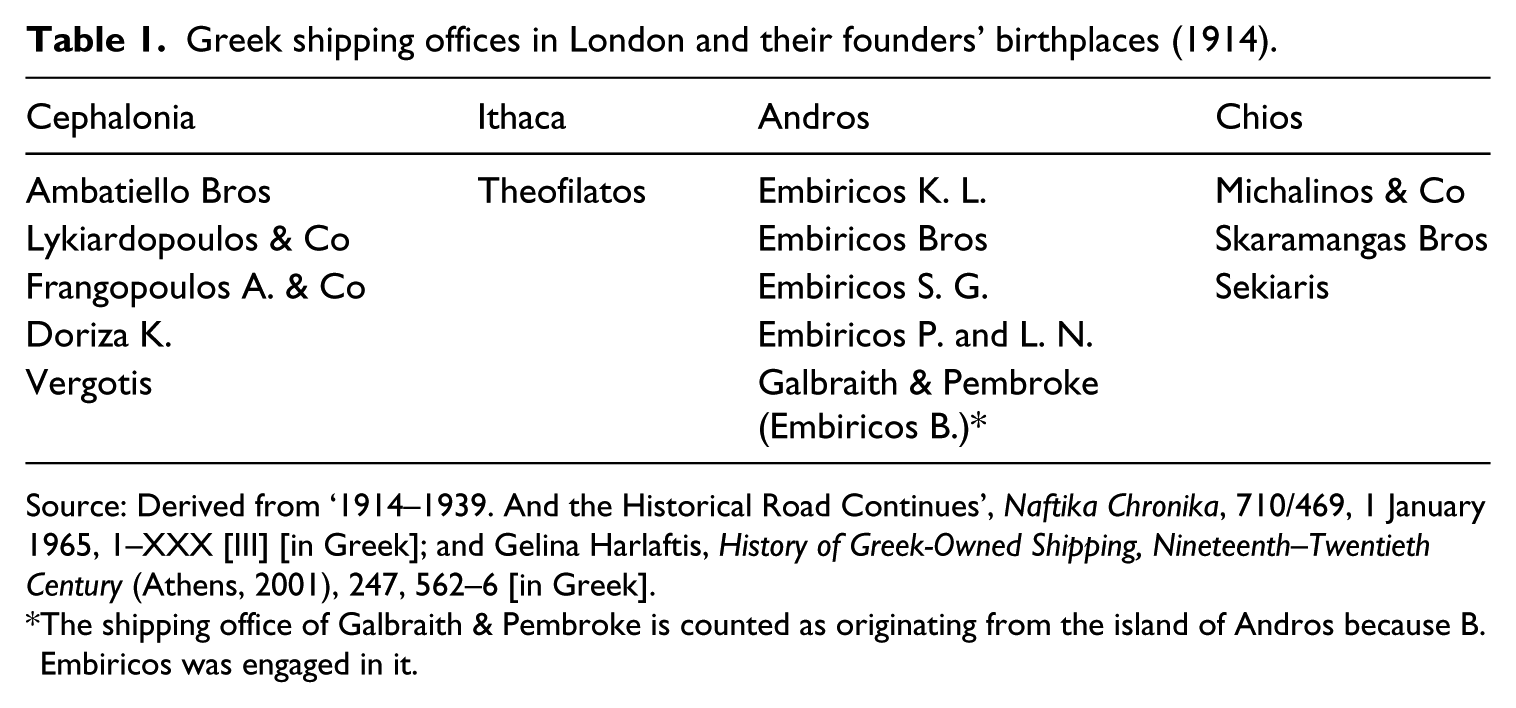
Source: Derived from ‘1914–1939. And the Historical Road Continues’, Naftika Chronika, 710/469, 1 January 1965, 1–XXX [III] [in Greek]; and Gelina Harlaftis, History of Greek-Owned Shipping, Nineteenth–Twentieth Century (Athens, 2001), 247, 562–6 [in Greek].
The shipping office of Galbraith & Pembroke is counted as originating from the island of Andros because B. Embiricos was engaged in it.
The London Greek shipping community in the interwar period
The growing presence of Greek families with a long maritime tradition in the British capital was due to the fact that London had become the centre of world shipping, and also to the outbreak of conflict in the Balkans in 1912 and the Great War in 1914. Both of these wars forced Greek-owned ships that were mainly operating in the Black Sea and the Mediterranean to turn to the Atlantic and the markets of North and (especially) South America to supply the great needs of the Entente forces for ammunition and foodstuffs. 28 Within this context, the British metropolis emerged de facto as the new shipping centre for many long-established Greek maritime families. 29 For Greek tramp shipping, London and the Atlantic were chosen under duress, but this was also a deliberate business decision that promised high profit margins.
Although the Greek fleet had lost almost 67 per cent of its capacity by the end of the First World War, 30 Greek shipowners developed their tramp shipping interests during the interwar years, with the Britain–Argentina routes (mainly in the Rio de la Plata) emerging as the trade of choice for the Greeks. 31 Greek tramp ships exported British coal to Argentina and carried Argentine grain on the return trip to Britain. The growing presence of Greek tramp shipping in the Argentinian trade precipitated a strong reaction from British tramp shipowners. This demonstrated, perhaps for the first time, the need for co-operation and a united front among Greek maritime families in order to deal with international challenges. 32 Accordingly, in the autumn of 1927, when there was an attempt to prevent the Greeks from participating in their ‘main occupation, which was the transportation of cargo on the River Plate’, by excluding most of them from the Bunge Grain House plan for the reduction of premia through the Approved List, which included only 60 Greek vessels out of a fleet of 310, 33 the London-based Greek offices decided to co-operate to address this threat. As the representative of the Union of Greek Shipowners in London, as well as principal of the strong office of Rethymnis & Kulukundis, Manolis Kulukundis took action, and by imposing a premium on every Greek ship destined for Argentina (depending on its age), he persuaded the insurers not to exclude Greek ships from the Plate grain trade. 34 By such means, Greek shipping in Argentina remained strong, and for the first time the London-based Greek offices successfully deployed the strategy of collective action.
Rivalry in Rio de la Plata
Anglo–Greek rivalry in Rio de la Plata amid the global economic recession caused by the 1929 crash and the abolition of the gold standard by Britain were the main external reasons why the Greek Shipping Co-operation Committee was established in London in the mid-1930s. In particular, the oversupply of capacity and the limited grain shipments from the Plate during the 1932–1934 period led to a dramatic drop in freight rates, ‘way below any acceptable level’. 35 Within this framework, at a time when economic protectionist policies prevailed, the Greek tramp fleet had to deal with the British government’s decision to subsidize British tramp shipping to the amount of £2,500,000, while several British shipowners even demanded the exclusion of the companies that the Greeks had set up in Britain. In any case, if this amount ‘was used for competitive purposes, namely to reduce tariffs, it would be enough to lead the Greeks to a deadlock. Some of our competitors had already voiced this intention publicly’. 36
At this critical juncture Manolis Kulukundis again played a key role as the person who, together with the London-based Greek offices, sought an immediate solution by proposing the ‘Minimum Rate Scheme’, which entailed a fixed minimum freight rate for international tramp shipping, as well as mandatory terms and conditions to lay up tramp ships. 37 The plan was accepted by the British, Norwegians, Danes, French and Italians, and the Tramp Shipping Co-operation Committee was formed to monitor its implementation, with Stavros Livanos, Georgios Tachmitzis and Vasilios Mavroleon designated as representatives of the Greek offices. 38 Thus, through this team effort, the operation of all ships and the return to the normal course of business were made possible for the Greeks in Rio de la Plata. 39 The establishment of the ‘Minimum Rate Scheme’ was the excuse the members of the London-based Greek shipping community needed to strengthen their collective action.
Although Greek shipping firms had addressed the issue of freight rates, they continued to face the problem of the high premiums Greek ships were required to pay. In fact, efforts to resolve this issue gave more impetus to collective action among the Greek offices. Thus, according to John A. Hadjipateras, ‘a Big Committee was established, in which all the shipowners and managers of the London-based Greek offices participated’. 40 Events then led to the creation of a small supporting committee ‘composed of the late Perikles Drakoulis and Angelos Louzis and Messrs. Stavros Livanos and Manolis Kulukundis, as well as Mr. Georgios Chr. Lemos as the legal adviser and representative of a large number of small owners’. 41 The committee held weekly meetings in which freight rates, premiums and an increasing number of issues were discussed.
The implementation of the ‘Minimum Rate Scheme’ led London-based Greek offices to strengthen their relations through the creation of another committee. This was the Shipowners’ Compensation Committee, which had an exclusively Greek membership and was responsible for compensating members who were forced to lay up their vessels. The committee lasted as long as the ‘Minimum Rate Scheme’ and, as reported in Naftika Chronika: ‘This consortium agreement was signed by the London-based Shipping Houses of “S. G. Embiricos, Ltd”, “P. Wigham Richardson & Co, Ltd”, “Rethymnis & Kulukundis Ltd”, “Hatzilias & Co. Ltd”, “Drakoulis Ltd”, “A. Luzis”, “Lykiardopoulos & Co. Ltd”, “C. Nikolaou Ltd”, “Vergotis & Co. Ltd”, “Neil & Pantelis, Ltd”, “Pantelis & Co. Ltd”, and “Vlassopoulos Bros”’. These shipping houses elected the members of the Compensation Committee, which was responsible for drafting its terms of reference: Messrs. G. S. Embiricos, I. Vasillios, Man. Kulukundis, Em. Chatzilias and Th. N. Vlassopoulos. P. N. Lykiardopoulos was appointed Treasurer and Th. N. Vlassopoulos Secretary. 42
The raison d’être of co-operative and strategic action
While the Greek offices in London had entered into an informal, but promising, co-operative agreement in the course of an unofficial meeting about the drafting of the ‘Minimum Rate Scheme’, there were also discussions regarding the need for even closer co-operation and the possibility of collective action in agreement with the Union of Greek Shipowners in order to address common problems and challenges in the international shipping arena. 43 Thus, in the mid-1930s, the Greek Shipping Co-operation Committee was established as a logical progression of the co-operative network of London-based Greek offices, which had begun to take shape when the Shipowners’ Compensation Committee was set up. The establishment of the Co-operation Committee was largely initiated by Manolis Kulukundis, and it is noteworthy that the original name of the body had been the ‘Greek Stabilisation Committee’, as it was designed to bring ‘some stability to the precarious freight markets after the recession’ brought on by the New York Stock Exchange crash. 44 According to John Hadjipateras, ‘rumour has it that when the issue of naming the Committee arose, Mr. G. Chr. Lemos together with the late Angelos Louzis baptized it while walking from Bank Station towards St. Mary Axe’. 45
However, besides Kulukundis, another person – one of the most important figures of the Greek shipping community in London during the 1930s – had contributed indirectly, yet decisively, to the debate on the need for co-operation and collective action by London-based Greek shipowners; this was Spyros Sorotos. The latter, who wrote articles in Naftika Chronika under the pen name ‘Realist’, was for many years the managing director of the Lykiardopoulos Ltd office in London. 46 As early as 1932, when the shipping crisis had begun to intensify, Spyros Sorotos had expressed the opinion that there should be co-operation, not only among the Greeks, but also between Greek and foreign shipowners operating in the tramp shipping sector. Moreover, as Lloyd’s List noted, Sorotos was the mainstay of the Greek shipowners’ successful co-operative effort to implement the ‘Minimum Rate Scheme’, 47 and it was he who had proposed the establishment of an international tramp shipping association. 48 In this respect, Spiros Sorotos and Manolis Kulukundis were two key figures, whose public and private positions created the appropriate conditions that highlighted the need for an institution that would represent the tramp shipping interests of the London-based Greek shipping community. 49
The key drivers
At this point, the question arises as to whether it was just the effort to maintain a strong Greek presence in the grain trade in Rio de la Plata that led members of London’s Greek maritime community, which by then had become the centre of Greek shipping, to collaborate through the establishment of the Greek Shipping Co-operation Committee. Our research suggests that such institutionalised co-operation can be attributed to the interaction of a range of external macro-environmental factors in the interwar era; to be more precise, these were economic, socio-political and technological factors, in accordance with the PEST analysis model.
Economic factors
Among the economic factors that acted as catalysts in shaping the conditions for co-operation among London-based Greek offices leading to the establishment of the Committee, first and foremost was the severe global economic crisis that hit the international shipping industry during 1929–1930. This made the Greeks in London realize that a major crisis could only be countered by the strength found in unity. More specifically, the 1929 Wall Street Crash, and Britain’s decision to abandon the gold standard in 1931, were followed by the Great Depression in the 1930s, which had a direct impact on international markets by significantly reducing the demand for goods. Notably, between 1929 and 1932 world GDP fell by an estimated 15 per cent. 50 Due to the decline in disposable income, international trade suffered a major slowdown that led the shipping industry into a deep crisis in which a large number of vessels had to be laid up. One of the biggest victims of this crisis was the Greek-owned fleet. 51
In mid-1935, 12.27% of Greek capacity was laid up due to lack of work. Only three other national fleets fared worse, with 25.9% of the US ocean-going fleet, 15.3% of Dutch-owned tonnage, and 14.04% of French capacity, laid up (see Figure 1). We believe that the high rate of inactive Greek tramp shipping profoundly influenced the decision of the London-based Greek offices to work together and form a united front. In fact, the ‘Minimum Rate Scheme’ itself, which was created in order to prevent a further decline in tariffs, essentially served the purpose of avoiding, as far as possible, the further laying up of Greek-owned ships.
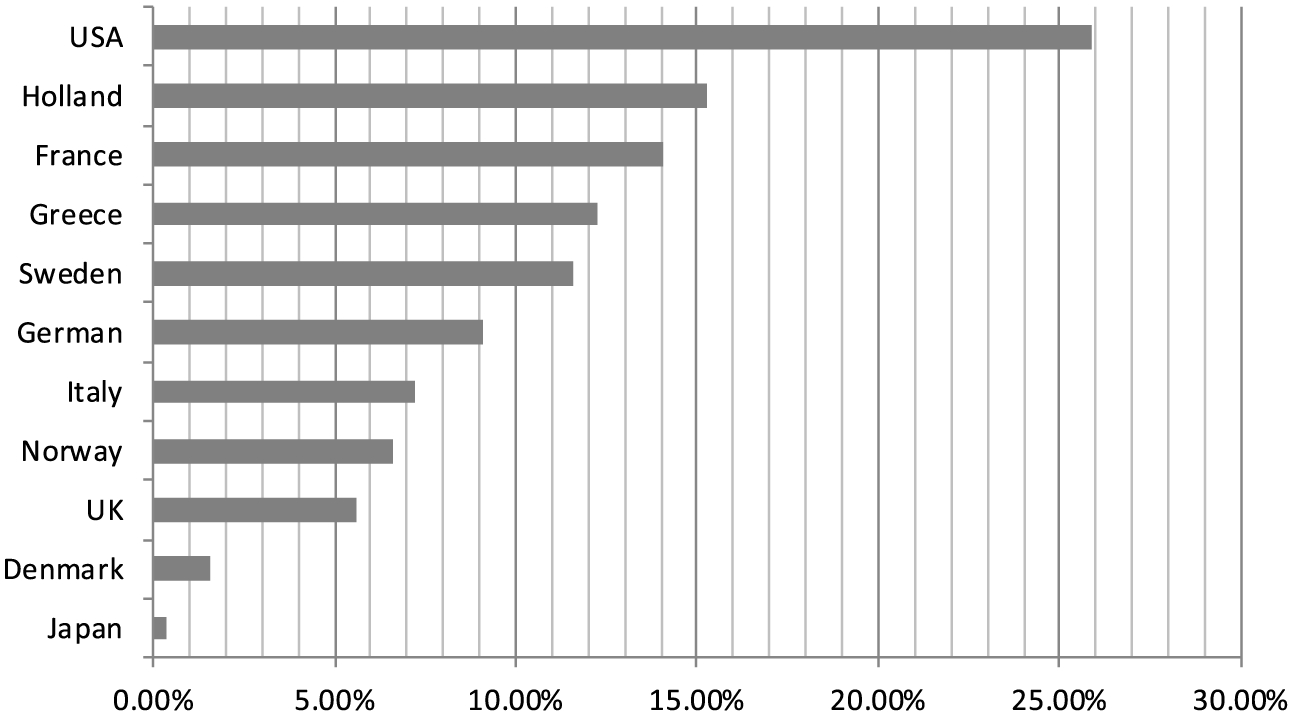
Percentage of laid-up ships in the largest national merchant fleets, 1935.
In the mid-1930s, besides having to deal with the challenges posed by the compulsory laying up of ships, the Greek tramp shipping business had to deal with the protectionist policies implemented by the UK, France, Germany, Italy, Japan, the US and other maritime nations, which aimed at strengthening their national flags and fleets.
52
As Sturmey puts it: the inter-war period was marked by a growth of national consciousness and, in particular, by a widespread desire among nations to see their flags represented, or represented more powerfully, in the mercantile marines of the world … The consequence was the spread of subsidies, preference legislation and the adoption of trading methods favouring national shipping.
53
The Greek state, however, was not in a position to follow a similar path with regard to ocean-going shipping as any aid it granted took the form of direct subsidies and was limited to coastal shipping. 54
The reasons behind the Greek state’s inability to help Greek ocean-going shipping were clearly economic, given that the global economic crisis that followed the US stock market crash in 1929 had led to a drop in the Greek national income, which in turn resulted in a decline in public revenues and the devaluation of Greece’s national currency, the drachma. These events severely impaired the ability of the state, led by the Venizelos government, to meet foreign debt obligations and caused Greece to unilaterally suspend debt-service payments and to formally declare bankruptcy in May 1932. 55
In these circumstances, it was impossible for the government to provide loans to the Greek tramp sector, which was left without state protection and exposed to the challenges of intensifying and often unfair international competition. On the other hand, the complete lack of financial aid from Athens essentially motivated the Greek offices in London to develop their own ‘self-protection’ against mounting competition, and to choose negotiation, co-operation and collective action.
Socio-political factors
The refusal, or inability, of the Athens government to aid Greek tramp shipping and, indirectly, the London-based Greek offices should be seen not only as the result of economic difficulties, which the Greek state was clearly experiencing, but also as the implementation of a policy that viewed the Greek shipping sector as a source of revenue that would always be there without ever needing the financial or legislative support of the state. According to Matheos Los, ‘despite the critical situation that maritime Greece was in during the 30s, the Greek state made no gesture of sympathy and showed no support towards the shipowners’. 56 Indeed, there are grounds to believe that the Greek state’s policy towards shipping companies could actually be characterized as a ‘disincentive policy’. 57 Andreas Lemos, one of the leading maritime authors and historians of the time, argued that ‘the only positive maritime policy from 1931 to the beginning of the Second World War which attempted to counterbalance the State’s failure to provide direct economic aid to the national shipping sector’ was a slight reduction in the shipping companies’ tax burden (business tax and composite tax) under law 5115/1931. 58
Even though the tax system imposed on shipping companies by the Greek state can be characterized as favourable, the same cannot be said for the way in which it behaved towards the vessel and its management. Greek interwar governments created a social protection net for seafarers that had some shortcomings, but in setting up the Seafarers’ Employment Office, the Seafarers’ Unemployment and Sickness Fund and the Seafarers’ House-NAT, as well as passing the law on the ‘crew composition’, revising the seafarer’s food and catering, and publishing the ‘Work Regulation’ for seamen, was generally strong. Yet towards the vessel, the state acted with sternness and at times with inopportune interventionism, 59 creating a rather stifling operating framework for ships and by extension for shipping companies, with commercial shipping being used ‘as a guinea pig’, as Lemos put it. 60 To all this, we must also add the unstable political climate in Greece, which often took on civil war characteristics, the continuous political conflict between ruling parties, and even the armed clashes between Venizelists (followers of Eleftherios Venizelos) and Royalists (followers of George II of Greece), all of which impaired the smooth operation of internationalized Greek merchant shipping.
A characteristic example was the attempted coup d’état on March 1, 1935, which resulted in several Greek tramp ships being trapped in Greek ports due to a suspension imposed on sailing in and beyond Greek waters. This outcome in turn resulted in Russian grain – the main commodity carried in Greek tramp ships – being transported by Italian and British ships, given that Russian ship charterers wanted to secure their loads while the Greek shipowners were unable to guarantee their vessels’ regular dates of arrival at the Soviet ports. 61 It seems that in the absence of state support at a time when rival maritime countries were implementing policies of subsidizing and strengthening their national shipping, the London-based Greek offices, which in the mid-1930s were managing just under 50 per cent of Greek ocean-going merchant fleet capacity, 62 had no other choice but to follow the path of co-operation and coordinated action.
Technological factors
Whether operating in the Mediterranean or in other seas, the Greek-owned fleet had to face the challenge of its aging ships. According to official statistics, in May 1935, the Greek-owned merchant fleet had the largest tonnage (grt) of aging ships, and specifically the largest proportion of ships over 20 years old, as shown in Figure 2. It should be noted that 183 Greek-owned ships of 338,738 grt total capacity were over 25 years old. Furthermore, with certain exceptions, such as the cases of Kulukundis and Rethymnis, Greek shipowners were unable to raise sufficient funds for the purchase of new-built ships during the interwar years, and therefore they turned to the second-hand market, which used coal rather than diesel, which had many advantages, as a fuel. As reported by Naftika Chronika, the Greek-owned ships belonged to the 62.15% of the world’s ships that operated on coal. 63 In effect, the Greek-owned fleet, unable to renew itself with modern, technologically advanced ships, was losing its competitive advantage because of the slow speed, high fuel consumption and extremely expensive maintenance of its aging vessels. So, Greek tramp shipping was once again faced with the risk of rising premiums, just as in 1927, when the aforementioned Approved List came close to being implemented. 64
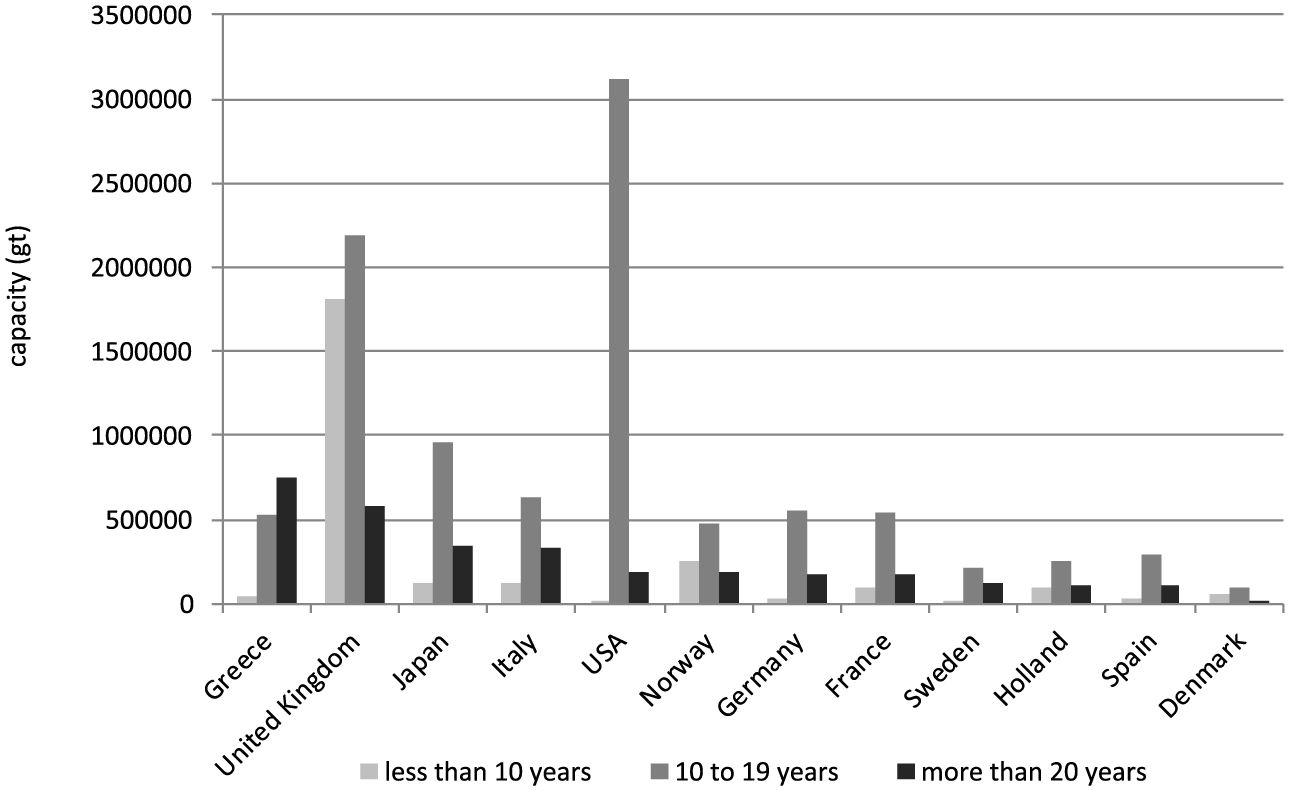
The world merchant fleet by age and flag, 1935.
The early establishment and structure of the Committee
Although the Committee ‘was founded informally and simply’ in the second half of the twentieth century, 65 it managed to become the institutional body in whose offices the representatives of the London-based Greek shipping and maritime-related offices would come together in order to exchange information and formulate a strategic stand towards common political, macroeconomic, technical, legal and social challenges in the UK, Greece and internationally. Members’ common heritage, at least during the first years of the Committee, just before the Second World War, had taken the form of defending Greek shipowners’ business interests, which were being hit hard by the national protectionist policies of Western maritime states.
The original intention of the London-based Greek offices had not been to create a separate association, but rather to strengthen and support the efforts of the Union of Greek Shipowners at the centre of national shipping activities back home, acting as its essential complement. 66 However, the collaboration of Greek shipowners through the London offices would soon expand to cover other fields of common interest with the aim of ‘monitoring – in co-operation with the other Greek shipowners’ associations – the proper functioning and progress of the entire Greek merchant fleet, as the coordinator of public interests, both internationally and in Greece’. 67 This development was more or less expected, given that the rapid growth of Greek shipping in conjunction with the post-war relocation of major traditional Greek shipping houses to the City, led the Committee to take innovative actions that greatly benefited the Greek shipping industry and the Greek islands where it had originated. 68
The establishment and operation of the Committee were founded on the London-based Greek offices’ free will to assemble and to take collective action. During its early years, the Committee functioned in a rather informal fashion, holding regular meetings to discuss the various issues that concerned Greek shipowners – mainly tramp shipping issues – and the useful ‘exchange of information gained from their experiences’. 69 At this point, it should be noted that the Committee had not assumed the characteristics of a typical professional union, chamber or association. Furthermore, the Committee was neither a club nor, of course, a closed club. On the contrary, it functioned within an informal institutional framework, without any strict rules, and any company, not just the shipowning or managing firms, could become a member. In other words, unlike the Union of Greek Shipowners, the Committee allowed maritime and shipping-related offices that did not own or manage ships to become members, while the ships that were registered with the Committee could sail under any flag provided that they were managed by companies representing Greek interests.
Members of the Committee were international or local companies controlled by Greek ship management, agency and/or shipbroking firms, with each having one vote, regardless of the number of ships they represented. 70 This had been a deliberate decision in order to attract smaller sized firms and to encourage them to participate in the Committee. All the offices of the wider London maritime cluster had the right to vote and to stand for office. Interestingly, it was neither necessary nor, of course, mandatory to become a Committee member. Although membership of the Committee did not offer any additional privileges or advantages, the conditions for networking, interacting and exchanging information created by the Committee were among the main positive denominators of this collective body of London’s Greek shipping community. Initially, the Greek Shipping Co-operation Committee did not have any secretarial support. It was only in the spring of 1937, when it was decided to rent offices at 51 St. Mary Axe Street, that Nikolaos Metaxas, a Cephalonian, was recruited to serve as secretary, while Pericles Drakoulis an Ithacan, assumed the role and duties of chairman with the assistance of Angelos Luzis (see Figure 3). 71

The presidents of the Committee from 1937 to 1999.
It soon became evident that the Committee should assume a permanent form, and therefore its members decided to give it ‘some sort of a legal standing’. In fact, as Hadjipateras has pointed out, the Committee’s charter was drafted and all the necessary formalities and arrangements were made, ‘but they have remained in the drawer and, therefore, even to this date [1956] the Committee’s existence is, in legal terms, unofficial’. 72 Even though in its early days the Committee did not acquire a coherent institutional framework and had no legal standing, it managed to function smoothly and to accomplish its main objectives. As a matter of fact, the annual contributions of offices and ships was received regularly and covered all expenses such as office rent, permanent secretarial salaries, etc.
Growth and development
For the Committee, the period of quantitative and qualitative growth began after the Second World War, which marked a gradual increase in the number of Greek shipowning and ship management families choosing to set up (or relocate) their de facto, but not de jure, headquarters in London – and secondarily New York – and/or to run them from there. It was a conscious decision that many traditional Greek maritime families were perhaps forced to make, given the immense reconstruction effort needed after the destruction suffered by the Greek fleet during the war. Such reconstruction obliged Greek shipowners to seek funds in shipping centres around the world, the largest of which was London, 73 and also a stable environment that would allow them to operate freely, which could not be guaranteed by the Greek state. 74
The Greek state’s unfavourable policy towards the Greek fleet in the late 1940s and early 1950s was denounced by the Committee. This is evident in a letter of 15 June 1950 sent by the chairman of the Committee, A. Luzis, to the editor of Naftika Chronika, Dimitris Kottakis, which expresses the obvious dissatisfaction of the Committee’s members at ‘the [Greek] Government’s heavy and misguided measures against shipping’. 75 Indeed, Luzis, writing in Hermes magazine, described the Greek government’s taxation policy of late 1940s as ‘Bulls in a China Shop’. 76
From 1945, especially from 1947 onwards, there was a strong tendency towards setting up Greek shipping companies in London, which gradually led to a substantial increase in the Committee’s membership. Whereas in 1938 the number of offices that were members of the Committee had been 17, this increased to 27 in 1940, to 33 in 1949, it reached 47 in 1953, 66 in 1963 and 108 in 1975, peaking in 1986 when the Committee counted 121 members (see Figure 4). This significant annual increase, combined with the increased activity of the Committee, necessitated a wider representation on the Committee Board, so, finally, in 1963 the Committee’s Rules were drawn up. 77

The evolution of the number of Committee members, 1938–1999.
The decision of an increasing number of Greek offices to become members of the Committee was directly influenced by developments in both the international maritime environment and the domestic environment in Greece. The Committee’s growing power reflected changes in shipping entrepreneurship given that there were developments in the national maritime policy of states with significant commercial fleets. 78 On the other hand, there were also important changes in national and international laws relating to shipping companies and the management of their fleets. These new realities, working in combination with various reversals and realignments in the fields of international relations and global trade, enabled the Committee to utilize successfully the networks that had been formed by the Greek shipowners in London, and to take advantage of the knowledge and information sources provided by the latter as the global metropolis of diplomacy, trade and finance.
Concluding remarks
This article deployed the interpretative tool of historical institutionalism to answer two main questions: first, why was the Greek Shipping Co-operation Committee set up in the mid-1930s and not earlier? And second, under what conditions did the Committee function as an institution and meeting place where representatives of the London-based Greek maritime-related firms performed business transactions in order to protect their individual and collective business interests?
Our research indicates that the Committee was established in the mid-1930s, not before and not later, because all the necessary conditions – political, economic, technological, social – were present during that specific period, making the establishment of the GSCC more than necessary. The GSCC was founded at a critical juncture when the external shocks suffered by the Greek shipping community led its members in London and in Greece to review their vision and key strategies. A refreshed vision and strategy emerged. It entailed the maintenance of the tradition of independent family businesses, while creating a necessary and flexible framework for concerted and collective action that would serve their common business, or other, interests in the UK, as well as in Greece and worldwide.
Three main factors impelled the London-based Greek offices to choose a new path of co-operation. First, the 1930s global financial and shipping crisis led to the reduction in international trade and the compulsory laying-up of hundreds of Greek vessels. Second, the proven economic and political inability of the Greek state to aid Greek tramp shipping in an intensely competitive global environment and to support any renewal plans for the aging Greek fleet. Third, the fact that the then existing institutional bodies representing Greek shipowners seemed to fail at that point to influence, or jointly shape, developments in the international shipping industry had a catalytic effect on Greek shipping (as exemplified by the case of the Río de la Plata grain trade). The conscious decision of London Greeks to co-operate resulted in the establishment of the Greek Shipping Co-operation Committee, which shared a common goal with the Union of Greek Shipowners, namely to address the major challenges in the field of international shipping during the interwar period and thereby protect the interests of the internationalising Greek tramp shipping sector.
As an institutional initiative representing the majority of Greek offices in London, the Committee managed from its creation to represent the interests of the entire Greek-owned fleet and all the shipping offices outside Greece. It did so in a unique way, mainly by adopting a distinctive British flair and attitude in its actions and dealings, influenced by the ‘my word is my bond’ motto that emanated from the ethical code of the Greek shipping community, which originated in the Baltic Exchange in London. 79 As Theotakis has noted: ‘whereas the Union of Greek Shipowners is the true representative body of all Greek shipowners, the Committee is the “eye” focused directly on the key London markets, for the benefit of the entire Greek shipping industry’. 80
The inspired leadership of its chairpersons, in conjunction with the valuable and unceasing assistance of its Board members who represented all sectors of shipping as well as all areas with a maritime tradition in Greece, led the Committee to take decisions and actions in complete harmony and unity and to speak with a strong and robust public voice. In this regard, this article reinforces other research undertaken within the historical institutionalism framework that does not underestimate the conceiving idea that led to the creation of an Association and the power of the elite in shaping long strategies even at times of shock and external pressure. Its board and its illustrious members steadily expressed thoughts and opinions that were considered valuable, not only by all Greek shipowners but by their international partners and competitors as well. 81
Footnotes
1.
Manolis Kulukundis, My Sixty Years in Shipping. Some pages of this unpublished book are kept in the Archive of Naftika Chronika [NAC] [in Greek]; Greek Shipping Co-operation Committee, Greek Shipping Co-operation Committee 50 Years (Piraeus, 1985), 55 [in Greek].
2.
Andreas G. Lemos, Shipping of the Greek Race: Volume A, Its History (Athens, 1968), 221–35 [in Greek]; and Shipping of the Greek Race: Volume B, Its Anatomy (Athens, 1969), 226–7 [in Greek].
3.
Matheos Demetrios Los, The Centuries of Prosperity: Brief History of Greek Merchant Shipping (Athens, 1987) [in Greek].
4.
Gelina Harlaftis, Greek Shipowners and Greece 1945–1975: From Separate Development to Mutual Interdependence (London, 1993), chapter 8; and History of Greek-Owned Shipping, 19th–20th Century (Athens, 2001) [in Greek].
5.
Ioannis Theotokas, ‘The Greek Shipowner Offices of London in the 20th Century’, in Greek–British Relations: Aspects of their Recent History. Proceedings of a conference organized by the Foundation for Democracy and Parliamentarism of the Hellenic Parliament, Athens 2016, 257–69 [in Greek].
6.
Kulukundis, My Sixty Years in Shipping.
7.
Manolis Kulukundis was known as the ‘mentor’ or ‘dean’ of Greek shipping by twentieth-century Greek shipowners. See, 1960–1984, In the Service of Greek Shipping. What Manolis Kulukundis wrote about it in Naftika Chronika (Athens, 1984), 3 [in Greek], and ‘Manolis Ilia Kulukundis: Tribute to the Memory of the Mentor of the Greek Shipping’, Naftika Chronika, 1278/1036, 1 September 1988, 15 [in Greek].
8.
Greek Shipping Co-operation Committee 50 Years, 13.
9.
‘In view of reality’, Naftika Chronika, 99, 1 February (1935), 2 [in Greek].
10.
T. Skocpol and P. Pierson, ‘Historical Institutionalism in Contemporary Political Science’, in Ira Katznelson and Helen V. Milner, eds, Political Science: State of the Discipline (New York, 2002), 693–721.
11.
Sven Steinmo, ‘Historical Institutionalism’, in Donatella Della Porta and Michael Keating, eds, Approaches and Methodologies in the Social Sciences: A Pluralist Perspective (Cambridge, 2012), 113–38.
12.
Ellen M. Immergut, ‘Historical-Institutionalism in Political Science and the Problem of Change’, in Andreas Wimmer and Reinhart Kössler, eds, Understanding Change: Models, Methodologies, and Metaphors (Basingstoke, 2005), 237–59.
13.
Orfeo Fioretos, ‘Historical Institutionalism in International Relations’, International Organization, 65, No. 2 (2011), 367–99.
14.
James Mahoney, ‘Path Dependence in Historical Sociology’, Theory and Society, 29, No. 4 (2000), 507–48.
15.
See Gelina Harlaftis and Maria-Christina Chatziioannou, ‘From the Levant to the City of London: Mercantile Credit in the Greek International Commercial Networks of the Eighteenth and Nineteenth Centuries’, in P. L. Cottrell, E. Lange and Ulf Olsson, eds, Centres and Peripheries in Banking: The Historical Development of Financial Markets (Aldershot, 2007), 13–40.
16.
On the importance of the interpretative dipole ‘political’ and ‘economic-social’, which has dominated Greek historiography on the modern Greek diaspora, see Ioannis Chasiotis, ‘Introduction’, in Ioannis K. Chasiotis, Olga Katsiardi-Hering and Evridiki Α. Ambatzi, eds, The Greeks in Diaspora, 15th–21st c. (Athens, 2006), 13–31 [in Greek].
17.
Chasiotis, ‘Introduction’, 21. See also, Katerina Galani, ‘The Greek Community of London in the 19th Century: A Social and Economic Approach’, Ta Istorika, 63 (2016), 43–68 [in Greek].
18.
Olga Katsiardi-Hering, ‘From the Ottoman Conquest to the Establishment of the Modern Greek State’, in Chasiotis et al., eds, Greeks in Diaspora, 38 [in Greek].
19.
Gelina Harlaftis, A History of Greek-Owned Shipping: The Making of an International Tramp Fleet, 1830 to the Present Day (London, 1996), 127. See also, Maria Christina Chatziioannou, ‘Greek Merchants in Victorian England’, in Greek–British Relations, 223–36 [in Greek].
20.
Ekaterini Vourkatioti, ‘The House of Ralli Brothers, c.1814–1961: The Archetype of Greek Diaspora Entrepreneurship’ (Unpublished PhD thesis, Panteion University, 2004) [in Greek].
21.
Harlaftis, History of Greek-Owned Shipping, chapter 4.
22.
For Panagis Vaglianos, see Gelina Harlaftis, ‘From Diaspora Traders to Shipping Tycoons: The Vagliano Bros’, Business History Review, 81, No. 2 (2007), 237–68.
23.
Panagiotis Kapetanakis, ‘Ionian Shipping in the Service of the British Empire, 1815–1864’, in Greek–British Relations, 201–21 [in Greek].
24.
Chatziioannou, ‘Greek Merchants in Victorian England’, 223–36.
25.
Gelina Harlaftis and Manos Charitatos-Heleni Beneki, Ploto: Greek Shipowners from the Late 18th Century to the Eve of WWII (Athens, 2002), 71 [in Greek].
26.
‘1914–1939: And the Historical Road Continues’, Naftika Chronika, 710/469, 1 January 1965, I–XXX [III] [in Greek]. On the presence of Greek shipping offices in London before the Second World War, see Greek Shipping Co-operation Committee 50 Years, 7–13.
27.
Metaxas’s analysis is published in Lemos, Shipping of the Greek Race, Volume Α, 221–35 [in Greek].
28.
Harlaftis, History of Greek-Owned Shipping, 319–29.
29.
Lemos, Shipping of the Greek Race, Volume A, 196–204.
30.
At the beginning of the First World War, in 1914, the Greek-owned fleet numbered 475 steamers, with a total capacity of 893,650 grt, whereas at the end of the war it numbered only 205 steamers, with a total capacity of 290.793 grt: ‘1914–1939. And the Historical Road Continues’, I–XXX [VIII].
31.
‘The Chartering in Plater, in 1932’, Naftika Chronika, 102, 15 March 1935, 9. The Greek cargo ship emerged as the main competitor of British cargo ships in the Rio de la Plata market. Characteristically, in 1934, of the 1343 chartered vessels loading grain at Río de la Plata, 557 were British and 473 Greek, with the third place occupied by the Italian flag with 96 ships.
32.
Harlaftis, History of Greek-Owned Shipping, 331–5.
33.
Excerpt of letter written by Manolis Kulukundis and sent to C. I. Carras on 21 October 1981, NAC.
34.
Greek Shipping Co-operation Committee 50 Years, 8–10.
35.
Greek Shipping Co-operation Committee 50 Years, 8–10.
36.
Kulukundis, My Sixty Years in Shipping.
37.
Los, The Centuries of Prosperity, 100. See also, S. G. Sturmey, British Shipping and World Competition (London, 1962), 104–12
38.
Greek Shipping Co-operation Committee 50 Years, 12.
39.
‘1914–1939. And the Historical Road Continues’, I–XXX [ΧIII].
40.
John A. Hadjipateras, ‘Greek Shipping Co-operation Committee’, Naftika Chronika, 502/261, 1 May 1956, 15.
41.
Hadjipateras, ‘Greek Shipping Co-operation Committee’, 15.
42.
‘Compensation Fund was Set Up in London for the Implementation of the Plate Plan’, Naftika Chronika, 108, 15 June 1935, 5–6.
43.
‘Compensation Fund’, 57.
44.
Charalambos Fafalios, ‘Since 1935 the Committee Strongly Supports Greek Shipping and its People’, Naftika Chronika, 187, February 2016, 8–10 [in Greek].
45.
Hadjipateras, ‘Greek Shipping Co-operation Committee’, 15.
46.
‘Mourning. Spyros Sorotos’, Naftika Chronika, 258/17, 1 March 1946, 3 [in Greek].
47.
‘Mr. S. Sorotos on the Subject of the Rational Allocation of Capacity. A Letter to the Times’, Naftika Chronika, 113, 1 September 1935, 7–8 [in Greek].
48.
‘On the Creation of a Union for Tramp Shipping’, Naftika Chronika, 103, 1 April 1935, 5.
49.
Gelina Harlaftis, Greek Shipowners and Greece: From Separate Development to Mutual Independence, 1945–1975 (London, 1993).
50.
See Christina D. Romer, ‘The Great Crash and the Onset of the Great Depression’, Quarterly Journal of Economics, 105 (1990), 597–624.
51.
According to Matheos Demetrios Los: ‘… in 1932, 43% of the tonnage of Greek-owned tramp ships was forced to be laid up’. See, Los, The Centuries of Prosperity, 100.
52.
Yrjö Kaukiainen, A History of Finnish Shipping (London, 1993), 132.
53.
Sturmey, British Shipping and World Competition, 98.
54.
Sturmey, British Shipping and World Competition, 104.
55.
The Crisis of 1929, the Greek Economy and the Reports of the Bank of Greece for the Years 1928 to 1940, Economic Research Department of the Bank of Greece, Athens 2009, 32–40 [in Greek].
56.
Los, The Centuries of Prosperity, 100.
57.
Kon. N. Antonopoulos, ‘Greek Shipping Policy’, Naftika Chronika, 975/734, 15 January 1976, ΙΙΙ.
58.
Lemos, Shipping of the Greek Race: Volume B, Its Anatomy, 226–7.
59.
Antonopoulos, ‘Greek Shipping Policy’, Naftika Chronika, 975/734, 15 January 1976, ΙΙΙ.
60.
Lemos, Shipping of the Greek Race: Volume B, Its Anatomy, 227–8. Helen Thanopoulou states that modern Greek shipping ‘reached its current status of world supremacy with no palpable state support, only a tacit one’. Helen A. Thanopoulou, ‘A Fleet for the 21st Century: Modern Greek Shipping’, in Athanasios A. Pallis, ed., Maritime Transport: The Greek Paradigm (Oxford: Research in Maritime Transportation Economics, Vol. 21, 2007), 23–61.
61.
‘The Laid-up Capacity of our Cargo Shipping: Statistical Analysis by Naftika Chronika’, Naftika Chronika, 103, 1 April 1935, 6–7 [in Greek]. See also ‘The Fluctuations of our Laid-up Capacity in 1935’, Naftika Chronika, 121, 1 January 1936, 19–20 [in Greek].
62.
Harlaftis, History of Greek-Owned Shipping, 337.
63.
‘1914–1939. And the Historical Road Continues’, I–XXX [XIII].
64.
See Manolis Kulukundis, ‘To Dimitris Kottakis’, Naftika Chronika, 1095/854, 15 January 1981, 21. On the Approved List, see Greek Shipping Co-operation Committee 50 Years, 8–10.
65.
Greek Shipping Co-operation Committee 50 Years, 13.
66.
Greek Shipping Co-operation Committee 50 Years, 16. See also, Fafalios, ‘Since 1935 the Committee Strongly Supports Greek Shipping and its People’, 8–10.
67.
Lemos, Shipping of the Greek Race: Volume A, Its History, 77.
68.
Ilias G. Bissias, ‘The Greek Shipping Co-operation Committee and its Distinctive Role in Defending the International Interests of Greek Shipping’, Naftika Chronika, 187, February 2016, 28 [in Greek].
69.
NAC, Excerpt of a letter written by Manolis Kulukundis and sent to C. I. Carras, dated 21 October 1981.
70.
See Theotokas, ‘The Greek Shipowner Offices of London in the 20th Century’, 257–69.
71.
Lemos, Shipping of the Greek Race: Volume A, Its History, 221–35.
72.
Hadjipateras, ‘Greek Shipping Co-operation Committee’, 15.
73.
On the reasons why London and then New York and Montreal were chosen as the main cities in which Greek shipping offices were established, see Panagiotis Kapetanakis, ‘Fafalios Family: The paradigm of “Vrontados”’, in Panagiotis S. Kapetanakis and Ilias G. Bissias, eds, The Generation of Liberty: Seventy Years Since the Rebirth of the Greek-Owned Fleet (Athens, 2016), 76 [in Greek]. See also, Theotokas, ‘The Greek Shipowner Offices of London in the 20th Century’, 257–69.
74.
Lemos, Shipping of the Greek Race: Volume A, Its History, 234–45.
75.
‘Letter Sent by the Greek Shipping Co-operation Committee to Naftika Chronika’, Naftika Chronika, 361/120, 15 June 1950, 1–2.
76.
A. Luzi, ‘Bulls in a China Shop’, Hermes, May 1950, 6–7. On the tax policy of the Greek state, see also Harlaftis, Greek Shipowners and Greece, chapter 8.
77.
Greek Shipping Co-operation Committee 50 Years, 34.
78.
See Gelina Harlaftis and Ioannis Theotokas, ‘Maritime Business During the Twentieth Century: Continuity and Change’, in Costas Th. Grammenos, ed., The Handbook of Maritime Economics and Business (2nd edition, London, 2010), 3–34. See also Helen A. Thanopoulou, Greek and International Shipping: Changes in the International Division of Labor in Shipping Industry. The Position of Greek Merchant Fleet (Athens, 1994), 73–132 [in Greek].
79.
Alan Edward Branch and Michael Robarts, Branch’s Elements of Shipping (London, 2014), 176.
80.
Theotokas, ‘The Greek Shipowner Offices of London in the 20th Century’, 257–69.
81.
Bissias, ‘The Greek Shipping Co-operation Committee’, 28–9.
*
Authors’ Note: The Greek names in this article are spelled as they appear in the archive material.