




Abstract
Widespread bottom trawling in British waters has traditionally been dated from the last decades of the 18th century, and its early heartland has most commonly been identified as the Torbay area of Devon. This article shows that, in fact, by the time Torbay became known as a centre for the industry, bottom trawling was already well-known and relatively widespread around much of England and Wales, as well as large parts of Eastern and Southern Ireland. Following on from an earlier contribution in this journal, it also demonstrates that bottom trawling’s unbroken history, going back to at least the first decades of the 17th century, has always been beset by controversy, but that the middle decades of the 19th century saw a sea-change in official attitudes that, in effect, ushered in an era of unfettered expansion in industrial beam trawling by the 1890s.
In a recent article in this journal, the author demonstrated that, contrary to the orthodox view in the literature, by the first decades of the 17th century bottom trawling was already locally widespread and intensive enough to have drawn the attention of statutory bodies, the Admiralty, and even the King himself. Moreover, by this point it was already being viewed with considerable disquiet by those who were in a position to regulate the fisheries. Doubts expressed at the time about the impact of bottom trawling on the local economy and the environment closely echoed those of conservationists and cautious fisheries economists nowadays, and concern was so great that by 1635 an absolute prohibition on trawling in British waters, including relatively deep water trawling, was put in place – the first and only outright ban on trawling in British history. 1 This article takes up the story of bottom trawling in Britain and Ireland in the middle of the 17th century and follows it through to the 1850s, shortly before most commentators and historians really start to take notice of it. It explores the surprising breadth and scale of trawling’s reach throughout this period, and looks in some detail at the determined and variously successful attempts to limit its impact at the local and regional level. But it also demonstrates that, as we move closer to the take-off point of modern ‘industrial’ trawling in the late 19th century, the attitude of those in power shifted decisively away from broad sympathy with non-trawling fishermen’s concerns and towards a variously reformist and laissez-faire approach that resulted in the final sanction of a regulated trawl fleet in England, Wales, and Scotland, and the active encouragement of inshore trawling in Ireland.
Bottom trawling in the 18th century
References to bottom trawling in the State Papers decline markedly following Charles I’s decisive proclamation in 1635. It could be that his nationwide ban was successful in limiting the activities of trawlers in the crucial fisheries close to London, but it is far more likely that wider political events (in particular, the progress of the Civil War) took precedence over the state of the nation’s fisheries. There is little doubt that trawling continued, covertly or otherwise, in the lucrative fisheries around the coast of south-east England, and there is abundant evidence that it spread rapidly around the British and Irish coastlines in the following century. In 1733, for example, an Irish parliamentary committee appointed to enquire into the state of the fisheries reported that ‘the Method of Trawling, now made use of in fishing the Coasts of this Kingdom, is highly prejudicial to the Fishery … and ought to be Prevented’, and it further resolved that ‘no drag-net or any sea-net ought to be made use of on any part of the coast of this Kingdom … which hath a mash [sic] less than three inches and an half from knot to knot.’ Accordingly, an Act was passed that adopted the committee’s recommendations with regard to mesh-size, even though it made no specific reference to trawling. Very soon after this, however, confirmation that bottom trawling was widespread on the south coast of Ireland came in the shape of a very detailed account of the practice and its pitfalls. 2
In 1746, Charles Smith published a historical and topographical account of the city and county of Waterford, one of a number of studies he wrote, or co-wrote, between 1744 and 1756. Among many other interests, Smith had a keen knowledge of the local fisheries and he dedicated an entire chapter to them in his study. In keeping with the times, he was something of a fisheries reformer, bemoaning local fishermen as ‘primitive’ and lacking in zeal (even at Dungarvan, which was already a fishing centre of considerable stature), and promoting the fashionable plan of establishing fishing companies in the region, which, he believed, would be much better placed to exploit the ‘inexhaustible’ riches of the seas around the south coast. But he also complained that ‘[a]bout 30 or 40 years ago [Dungarvan] was frequented by a considerable number of fishing vessels, not only from many parts of this kingdom, but also from England’, and that ‘the fishery has of late much failed, which is a general complaint all over the kingdom.’ Even though he offered no specific reasons for this decline, he went on to describe at length a particularly ‘pernicious practice’ that, he said, had been taken up in recent years. This practice he called ‘tralling’, and it was, he wrote, directly implicated in the decline of stocks of hake that had traditionally been exported in great quantities to Spain. He suggested that all kinds of flat fish were ‘taken in Trail-nets’, and that ‘an hundred pair of large soals, with a good quantity of fluke, plaise, &c. have been commonly taken at a draft.’
3
In fact, his description of the practice is so rich that it is worth dwelling on at some length. He described the ‘beam-trail or trall’ as consisting of:
a large beam or pole, generally between 20 and 30 feet long, headed at both ends with large flat pieces of timber, which resemble the wheels of a common cart, except that instead of being round like them, they are rather semicircular, or resembling an heart cut in two lengthways; they are shod like the wheels of a cart, with iron; to this beam the Trail-net or bag is fixed, and at each end ropes are fastened; by the help of which the ground is intirely swept so clean, that I have been assured a fisherman will venture to throw his knife or any other such small matter over-board in 30 or 40 fathom water, and readily take it up again; and thus the ground is swept clean for a considerable tract, at every put as they call it, the boat commonly sailing a mile or perhaps a league, before the bag and beam are hauled up.
4
It would be difficult to find a better literary description of basic beam gear trawl from any period. From the iron trawl heads to the ‘trail-net or bag’, which was fixed to a 20 or 30 foot beam, and the ropes at each end by which it was dragged over the sea-bed, this piece of equipment would have been instantly recognisable in Kent and East Sussex in the 1630s, in Devon in the 1830s, and, indeed, anywhere along the North Sea coast from the 1840s to the 1870s. Compare Smith’s description, for example, with illustrations of beam trawls from Brabazon’s 1848 work on the Irish fisheries and Collins’ late-century work on Great Britain (see Figures 1 and 2).
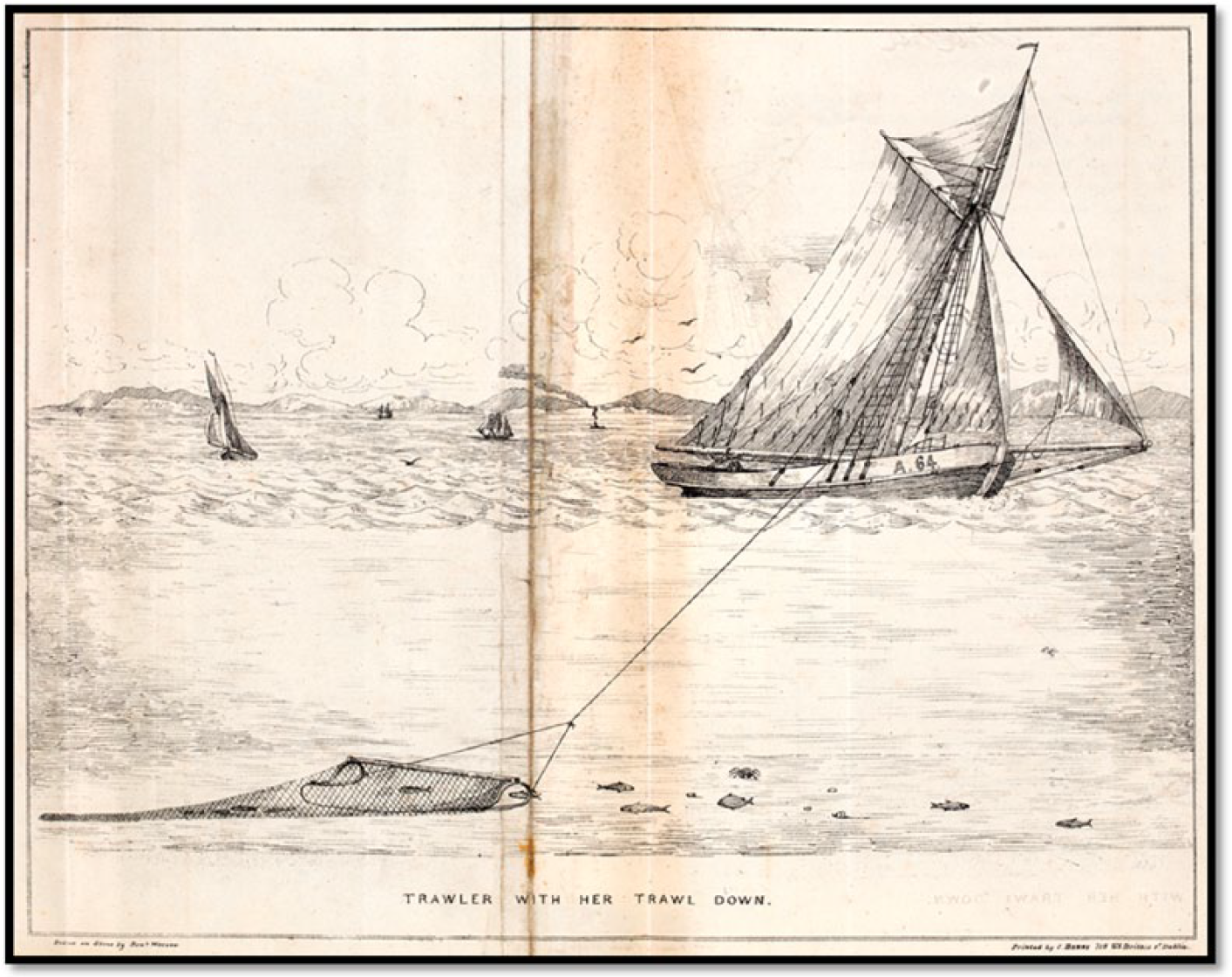
Illustration of a sail trawler towing beam trawl gear.
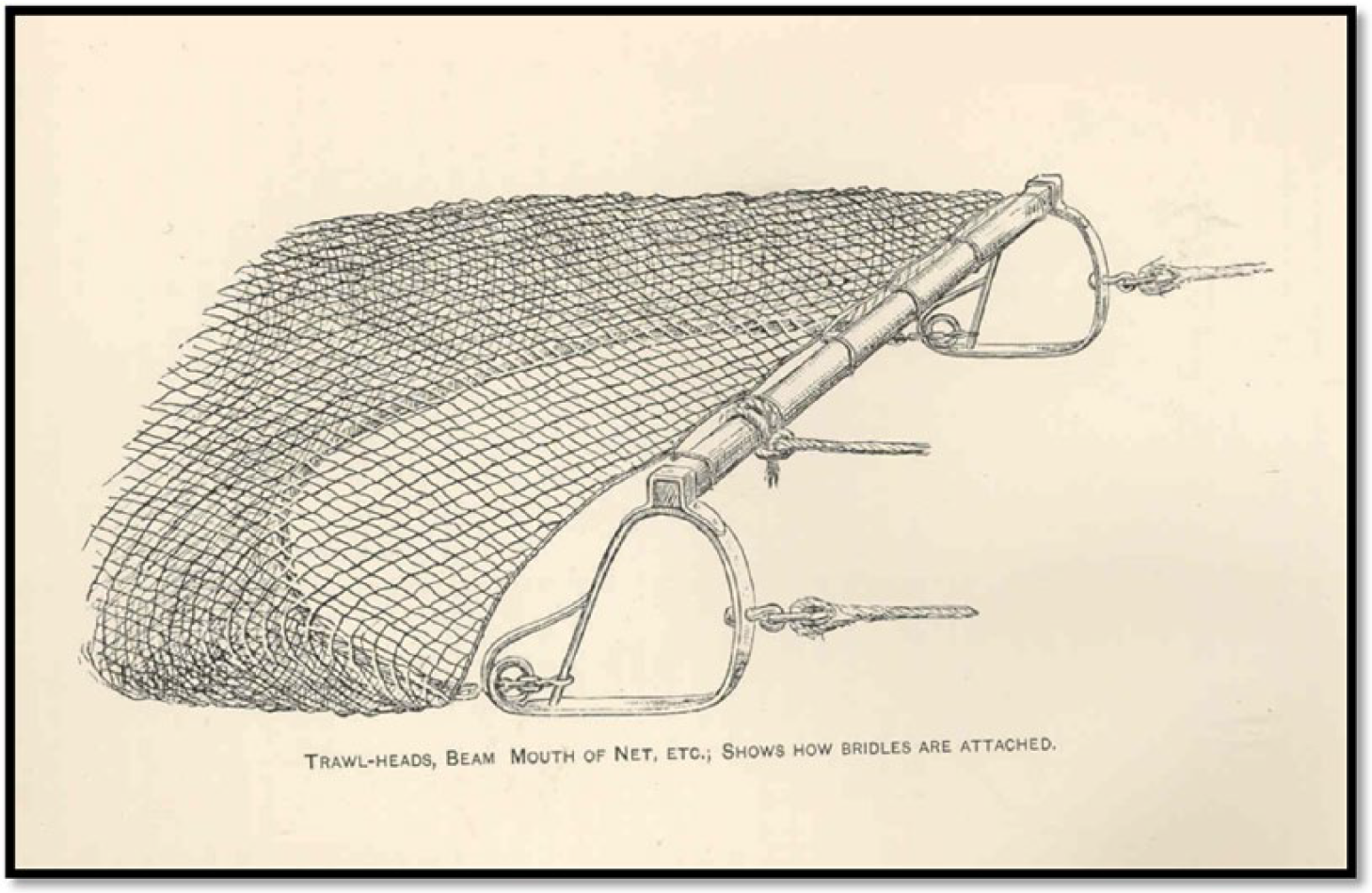
Illustration of beam trawl gear.
Not only did Smith offer one of the great early descriptions of beam trawl gear, he also offered a very thorough – and familiar – critique of its use. It was, he wrote, ‘perhaps the best contrivance yet invented for the taking of flat fish, which generally lie grovelling upon the ground.’ But, he cautioned:
It has great inconveniences, for 1st, it sweeps and tears away all the sea-plants, moss, herring-grass, &c. which some fish feed on, making those species to seek elsewhere for food. 2ndly, it disturbs and affrights the large kinds of fish, as cod, ling, &c. in the same manner as if pursued by large fishes of prey. And, 3rdly, which is worse than all, these Beam-nets and others of the kind which are dragged along the ground, tear away, disturb, and blend up the spawn of many kinds of profitable fish, in a terrible manner, and often many Hogsheads of their spawn are drawn up in the Trall-bags.
5
Smith finished by claiming that ‘it is a matter of fact well known in these parts, that since these Trail-nets have been used (which is but of late years) the other more beneficial branches of the fishery have every year failed more and more.’ Notwithstanding the accuracy of his understanding of the destruction of spawn, in just about every other particular Smith’s list of ‘inconveniences’ are precisely the same as those of the Essex fishermen in 1377, and of critics of the practice in the modern era. 6
It appears that the practice of beam trawling with substantial gear (up to 30 feet long, according to Smith) was stimulated in large part by the discovery of a new fishing bank between County Waterford and the north coast of Cornwall. In 1736, William Doyle, an Irish hydrographer and marine cartographer, set out with seven men on a yacht to map this new bank, which he described as being located ‘about eleven leagues S.S.E. from the High Land of Dungarven.’ 7 Anchoring in almost 40 fathoms of water, he and his crew found ‘[a] wonderful affluence of fish, such was the number of excellent large well-fed cod, hake and ling, reas or schetes [rays or skates] of a monstrous size, bream, whiting, red gurnet, and other fish.’ In his enthusiasm, Doyle wrote that ‘I never saw better diversion, and I think it extraordinary that a bank so near the land as eleven leagues, and its dimensions unknown, should have been many ages neglected.’ This bank he named the Nymph Bank, in honour of the yacht he was sailing in when it was discovered (see Figure 3); and not only is it still known by that name, but there are also indications that it remains the site of high spawning aggregations of commercial fish. 8
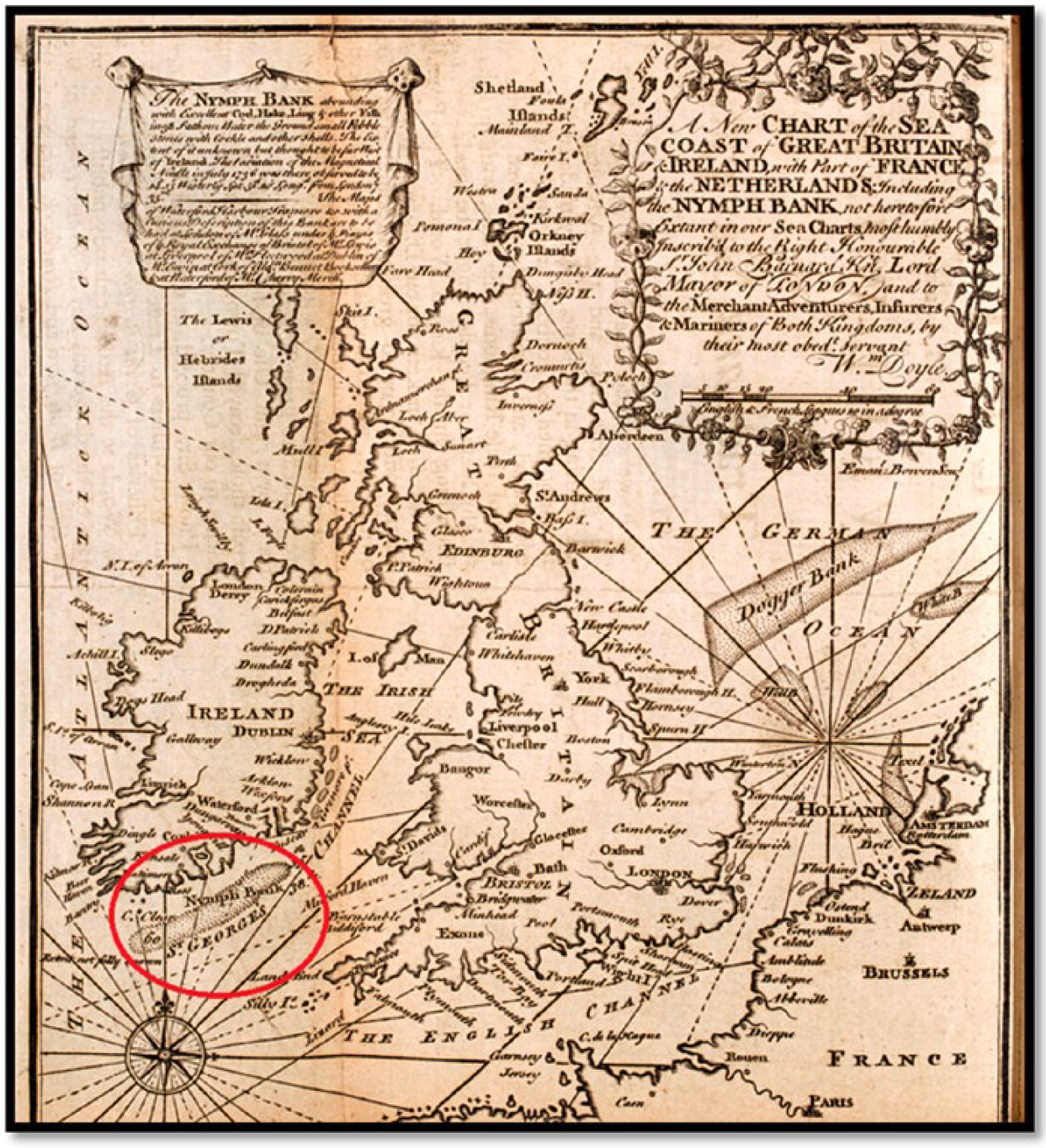
William Doyle’s original map showing the location of the newly-discovered Nymph Bank off the south coast of Ireland. 9
Trawling continued to spread as an important, and hotly contested, fishing practice in Ireland long after the opening up of the Nymph Bank. Smith confirmed that it was the chief means for taking sole off the coast of Cork by the late 1750s. The first local statute against trawling in Dublin Bay was passed in 1773, a measure that was re-enacted more than once before the end of the century, and in the 1777–78 session, a similar prohibition was imposed in the waters around Cork harbour, later to be repeated for the harbours at Waterford in 1784 and Dungarvan in 1787. 10 In other words, by the end of the 18th century, beam trawling already had a long and traceable history on the south and east coasts of Ireland, just as it did on the south and east coasts of England. It was practiced on a relatively large scale, almost certainly by a highly capitalized (and possibly international) fleet on the offshore fishery of the Nymph Bank as early as the 1740s, and it was locally common in many bays and harbours by the 1770s and 1780s. Judging by the first mention of it in the Irish State Papers, in 1733, it may even have been common around parts of the Irish coastline much earlier than that. Elsewhere in the north Celtic and Irish Seas there is evidence that similar local measures to suppress it were put in place at St. Ives in Cornwall, in 1776, to protect the pilchard fishery, and also that trawlers were travelling from Liverpool and Portrush, County Londonderry, to fish off the coast of the Isle of Man and in Dundrum Bay by the end of the century. 11
Returning to the south of England, there is abundant evidence that bottom trawling was commonly and continuously practiced from at least the beginning of the Stuart campaign against it right through to the modern period. Casual references to trawling abound, from an account at Winchelsea dating from 1730 and another from Kent in 1755, to a passing mention at Brightlingsea in 1761 and another from Brighton in 1776. By 1794, complaints were once again being voiced that ‘[w]ithin the last thirty years, the fisheries have very much declined’, this time at Hastings – although the author did acknowledge that there were still ‘great quantities of herrings, mackerel and trawl fish caught, and sent to the London market.’ It is at this point that Brixham and the Torbay area of Devon become more prominent in the annals of beam trawling. In 1795, the Revd. John Malham wrote that, at Brixham, ‘a great many of those small vessels, called Torbay boats, are kept here for the purpose of trawling out at sea’, and by the early years of the 19th century Brixham was acknowledged as an important source of fresh fish for many major markets, including London. Robb Robinson notes that the town had at least 100 trawl boats as early as 1786, and he also makes the point that these Devon boats were travelling long distances to fish offshore, as far as Sussex and Kent, and even Norfolk. Alward, in his oft-cited study of The Seas Fisheries of Great Britain and Ireland, reported that ‘Brixham has aptly been described, and with justification, as the Mother of the trawl fisheries.’ He dates the beginnings of trawling, not only in Devon but throughout the British Isles, from the arrival of William III and his entourage at the port in 1688, and goes on to state that ‘for many years afterwards the craft and the rigging of Brixham smacks resembled those of the Dutchmen who came over with the Prince of Orange.’ He even confidently asserts that ‘[i]t was from Brixham that the trawl fishermen who eventually settled at Grimsby and Lowestoft, first migrated.’ 12
Given the long history of relatively large-scale and widespread beam trawling in Britain and Ireland revealed here and in the previous article, Alward’s assessment may need some revision. While Torbay was undoubtedly a major centre for trawling in the late 18th century, it was by no means unique in this respect. In fact, it is possible that trawling arrived there from elsewhere in the south of England (Kent and Sussex, perhaps), or even from Ireland, sometime in the 17th or 18th centuries rather than the other way round. One thing is for sure, though: far from being a novelty, bottom trawling was already a mature and well-established fishing method in many places around the British Isles by the turn of the 19th century. Given this new perspective, it is important to reconsider how it developed – and how it was viewed and reported – in the great age of pre-industrial fisheries development between 1800 and 1860.
England, c.1800–1843
That Torbay was not alone as a centre of commercial trawling in the late 18th century is explicitly, though briefly, acknowledged by Robinson, but in general it has been ignored in the literature on the history of British sea fishing during this period. Kent and Sussex, Dublin, and the south coast of Ireland all had long traditions of trawling, either locally inshore or further afield. In addition, attempts were made in South Wales to establish viable commercial fleets that could trawl as far as the Devon and Irish coasts, first at Swansea in 1770 and then at Milford Haven in 1813, and there is documentary evidence of trawling activity around Tenby in 1804. One result of the rapid growth and spread of trawling from the later years of the 18th century is that longstanding opposition to the practice grew as well, and by the first decades of the new century opponents were beginning to coordinate their efforts and to consciously reach out to the wider public for support. In some ways, this is not dissimilar to the situation in south-east England in the early-17th century, when the concerns of local fishermen and town councils came together with those of the Admiralty and the royal court. But in the early years of the 19th century, fishermen began to take advantage of a relatively new national forum for the airing of collective grievances. 13
In 1817, the first of many 19th-century parliamentary inquiries into the sea fisheries of the United Kingdom and Ireland was established. This one was convened specifically to look into the state of the South Devon fisheries. Even though the inquiry itself was a relatively small-scale affair, both in terms of its geographical scope and its inquisitorial remit (the report and minutes of evidence combined run to only eight pages), the 1817 Report is important for a number of reasons. For one thing, it was the first modern parliamentary inquiry to investigate concerns over apparent declines of fish stocks. Leading on from this, it is highly significant in that it focused on what was then considered to be the ‘heartland’ of British trawling: Torbay and South Devon. Finally, it is notable that this inquiry was stimulated in the first instance by the concerns of local fishermen, this time including trawlers themselves. 14
The year before the Committee began its work, the Brixham Fishery Society (representing all fishermen, except ‘two or three who were averse to the measure’) resolved unanimously to impose a local ban on trawl and drag-net fishing between 1 April and 1 October each year, and also proposed that the mesh of all nets used in the agreed season should be at least 1.5 inches from knot to knot. The first of these resolutions, relating to a close time, was ‘a proposition emanating directly from the trawlers themselves, the largest and most important class’ of fishermen, in consequence of ‘the progressively rapid decay of the fisheries.’ This voluntary closed time applied to the whole of Torbay and Start Bay on the South Devon coast, and the main witness to the 1817 committee, George Vernon, reported that it was considered a great success by all local fishermen. In its report, the committee endorsed a statutory ban on trawling and drag-netting ‘during the spawning season’ in Start Bay, Torbay, and Exmouth Bay, but declined to go further than the existing legislation with regard to mesh size. 15
Despite the unanimity of local fishermen in South Devon in favour of a seasonal ban on trawling during the summer months, and the approval of the 1817 Committee, no further action was taken to regulate the fishery at this point. In response to the Committee’s work, a bill was brought before Parliament in 1819 ‘to prevent the Destruction of the Brood and Spawn of Fish’, which would have required magistrates in each maritime county of Britain to enforce closed times for trawl and drag nets, to regulate the size of meshes, and to enforce a minimum size for commercial fish put up for sale, but it failed on its third reading. The same bill was again brought forward in 1822 and managed to clear the Commons, but this time it was lost in the House of Lords. We know the fate of these unsuccessful bills because, within a few years, concerns about the state of the fisheries along the entire south coast of England led to another, far more extensive committee of enquiry, one that took in many more areas of complaint than just trawling. 16
The evidence presented by fishermen and others to the 1833 committee was unanimous in reporting significant scarcity of all kinds of demersal and groundfish along the south and east coasts of England, from Cornwall to Norfolk. Indeed, many fisheries relatively close to shore were reported as having failed completely. In its report, the Committee summarised the evidence and went on to give a detailed opinion of how such scarcity had come about:
[T]his scarcity of Fish has been occasioned by the great destruction of the Spawn and Brood of Fish, consequent upon the non-observance of the Laws which at present exist for their preservation, and by which the Fishing with Ground or Drag-nets within a certain distance of the Shore during particular seasons, or with Drift of Floating-nets at all seasons of the year, having the mesh of the net under certain dimensions, has been declared unlawful.
17
One of the laws to which the committee referred was ‘An Act for the better Preservation of Sea Fish’ (1605), an early Stuart measure, which stated:
[I]t is certainly known that the Brood of Sea Fish is spawned and lieth in still waters, where it may have rest and receive nourishment to grow to perfection, and that those who use Draw-nets, Nets with canvass, or engines in the midst of them, do, every day they fish, destroy the Brood of all sorts of Fish in great multitudes.
This Act went on to fix the mesh of such nets at 1.5 inches from knot to knot. 18
Although the 1833 Committee’s conclusions in relation to the taking of fry and immature fish echoed complaints about local scarcity in inshore fisheries going as far back as the 12th century, this was the first official recognition of the widespread failure of such fisheries across large parts of the country. 19 The existing statutes referred to in the report appear, in principle, to have answered the complaints of the Torbay fishermen from 1817. Indeed, those measures were specifically referred to by George Vernon in his evidence to the 1817 Committee, but his main concern was that, by then, the existing laws were ‘inefficient.’ Similarly, the conclusion of the 1833 Committee was, not that these measures needed to be completely revised, but that they needed to be strengthened and better enforced. It, too, believed that ‘the use of Trawl or Drag-nets in the Bays within one league from Low-water Mark, or in less than 10 fathoms of water, should be prohibited during the months of May, June, July and August.’ 20
Even though there was unanimity about the failure of many branches of the fisheries in the south of England in 1833, the reasons given in evidence for these failures differed markedly. So, for example, William Smith, an ex-fisherman and merchant who still owned boats in Brixham, stated his belief that the chief culprits were trawlers and drag-netters; whereas Richard Turner, on behalf of the Brixham Fishing Society, was by now far more concerned with the amount of fish imported from Holland.
21
Overall, Turner’s evidence echoed the complaints of many of the fishermen on the Channel coast that it was foreign ‘interference’ in the fisheries that was mostly to blame, both for declining stocks and for the impoverishment of fishermen more generally. Nonetheless, the two complaints were not always incompatible, and many fishermen, particularly in the east Channel, blamed the French for trawling too close to the English shoreline and for specifically targeting undersized fish for bait. John Lewis, of Dover, complained bitterly that up to 100 French trawlers:
go into two or three fathoms of water, where we never fish ourselves, because we will not spoil the brood; we do not fish within nine or ten or from that to 20 fathom, but those fishermen come in in the morning, shoot their trawls, and get from four to five bushels of little things not bigger than two inches long.
22
In sum, there is evidence that attitudes towards trawling were changing along the south and east coasts of England by the time the committee published its report in 1833. On the one hand, local, small-scale trawlers appear to have been on the decrease, at least in part because of a recognition by fishermen themselves of the damage that could be done to the fisheries by taking immature fish too close to shore (though, no doubt, it also had something to do with the overall degradation of nearshore fisheries). Where this method of fishing persisted it was generally condemned. Most fishermen called for tighter regulations to stop trawling close inshore, particularly during the spawning season, and to better enforce the existing regulations on the mesh size of nets. On the other hand, none of the witnesses to the 1833 commission condemned trawling per se, and none called for an outright ban. Even those who were not trawlers themselves, and therefore had greatest cause to call for its prohibition, were ambivalent towards it in their evidence. For example, John Goldsack of Dover, who was forced to abandon the herring and mackerel fisheries because of declining catches, was clear that trawlers ‘disturb everything upon the ground, because their nets are constantly upon [it];’ yet, when asked if he blamed trawling directly for his plight, he replied, ‘I cannot say as to that.’ 23
Despite the recommendations of the committee, once again, no further measures were enacted to regulate the fisheries following the report of 1833. The earlier statutes relating to mesh size and landing undersized fish remained in force, but were not immediately strengthened. However, as a result of further complaints and petitions from the men of Kent and East Sussex about the incursions of French trawlers the question of territorial limits was finally resolved in a treaty with France that passed into law in both countries in 1843. 24 A mixed committee of French and British officials had passed a number of resolutions in 1839, the most important of which was the establishment of the first binding agreement on a three-mile exclusion zone along the British and French coastlines. Importantly, trawling was completely prohibited within three miles of each coast, regardless of where the boats originated. In addition, the Convention for the first time set specific conditions for beam-trawl gear for both French and British fishermen at sea, for example, limiting the mesh-size of nets to 1.75 inches from knot to knot and the length of the beam to no more than 38 feet. It also limited the weight of the trawl heads and the total weight of chains and leads used to sink the ground rope. Finally, it prohibited trawling wherever herring and mackerel drift netters were fishing, and required trawlers to remain at least three miles from them. 25 For those few fishermen and others who continued to oppose beam trawling outright, the 1843 Convention must have felt like a Pyrrhic victory. On the one hand it pushed bottom trawling activity further offshore and addressed long-standing complaints of interference in the pelagic fisheries. On the other, by its very nature, the Convention validated the existence of a regulated trawl fishery that, given the development of new markets and ever-increasing demand for sea fish, could only expand in the future. Though largely neglected in the secondary literature, the 1843 Convention with France might justifiably be said to be the most important statutory measure for the encouragement of bottom trawling in the United Kingdom’s history.
Ireland, c.1800–1860
Back in Ireland, while the ‘problem’ of inshore trawling was still being tackled with local prohibitions and bye-laws, more distant fisheries were being opened up in the Irish Sea from the port of Dublin. In 1802, it was noted that the number of wherries in Dublin County from 20 to 50 tons burden was 87, and although they used long lines to catch demersal whitefish they were also ‘furnished with nets for trawling, in order to catch ground fish.’ In 1819, a new venture, the Dublin Fishery Company, was launched by a consortium of businessmen to trawl in the North Channel. The company purchased seven Devon smacks, ranging from 35 to 40 tons each, and recruited a number of Devon fishermen to crew them, bringing the men and their families over to Ireland on a permanent basis. Though relatively modest, the Dublin Fishery Company met with reasonable success and survived until 1830. In the longer term, it laid the foundations for an offshore trawl fishery which flourished until the eve of the 20th century, and many descendants of those first Devon migrants continued to man the boats. 26
Despite accounts of its early success, the Dublin Fishery Company’s attempts to develop offshore trawling did not go unopposed. Local fishermen from Howth pursued the new smacks when they first arrived, pelting them with rocks and threatening to cut the crews’ throats. The pursuers were well coordinated, in ‘three squadrons of six [wherries] each … one wherry carried a red flag, and appeared to have a person on board who commanded the entire [fleet].’ On this occasion, the company boats quickly returned to port with the locals in hot pursuit, the last of them only escaping by promising to abandon fishing by trawl. The precise grievances of the Howth men were not recorded: it could be that they were against trawling per se, or it may have been a more basic hostility against well-trained and highly capitalized competition from outside. But the level of threatened violence serves to remind us once again of the bitterness and rancour that bottom trawling has always aroused locally in established fishing communities. 27
By the 1820s, the fisheries in Ireland were, on the whole, more directly encouraged and more closely monitored than those in England, as a result of the activities of the Irish Fishery Board (officially known as the Irish Fisheries Commission). This body, formed in 1819, was analogous to the fishery board that operated in Scotland from 1809 onwards: it was primarily established to encourage the cured fish trade by means of a series of bounties made available to Irish fishermen on condition that they caught and cured the fish according to the Board’s rules. 28 In its first manifestation, the Irish Fishery Board lasted only 11 years; nonetheless, it presided over an increase in the number of registered Irish fishermen from just over 36,000 to almost 64,000. But after its dissolution in 1830, concerns were quickly raised about the rapid decline in the productivity of the fisheries in Ireland, and as a consequence a major commission of inquiry was convened in 1835. It was a thorough and exhaustive enquiry, covering the whole of the Irish coastline and all aspects of sea fishing. Its report, including minutes of evidence and appendices, ran to over 480 pages – three times the length of the 1833 report on the Channel fisheries. 29
Among the many issues covered by the 1835 Commission was the increasing ‘problem’ of bottom trawling in Ireland. Most non-trawling fishermen (the great majority) and others who had an interest in the fisheries once again gave evidence that it was highly destructive, citing the familiar complaints that it destroyed spawn on the seabed, indiscriminately took fry and undersized fish, and interfered with valuable shoals of pelagic fish. Unlike the report on the Channel fisheries, the Irish commissioners remained unconvinced by any of the arguments against bottom trawling. Indeed, at times they were openly sceptical of the evidence, particularly that of fishermen themselves. Whilst they acknowledged that ‘the bulk of the evidence is hostile to the continued legality of trawling’, they stated that ‘[i]n almost all such questions, conflicting interests are engaged; and complaints are most commonly directed against the practices of rivals.’ The commissioners accused fishermen in general of being ‘apt to complain of the shoals being less abundant on their stations as formerly’, and they were highly equivocal about recommending any measures to regulate trawling in Ireland. They did, however, concede that, as ‘the open sea is the place of the Trawl-fishers’ most profitable operations … the protection of the bay line-fisher would be no substantial injury to the trawler’, and they grudgingly agreed that trawling might once again be prohibited in Dublin Bay. But in doing so, they also pointed to the fact that ‘trawling … is confined to a few spots only on the whole Irish coast; and … in Dublin, Dundrum, Galway, and Dingle Bays it has been suppressed or resisted by open force.’ 30
Here, once again, we have definite proof, not only of the hostility of many Irish fishing communities to bottom trawling, but a clear indication that in some of the most profitable trawl fisheries it seems to have been successfully suppressed by popular action. Whereas in the English trawling heartlands of Devon, Sussex, Kent, and Essex it had made steady progress since the mid- to late-18th century (and possibly much earlier) – albeit only with the equivocal support of fishermen as a whole, and often against the wishes of non-trawling fishermen – in Ireland local resistance appears to have been successful in resisting (or, at least, inhibiting) its spread over the same period. There appears to have been a close relationship between popular action and the willingness of local administrators to sanction bans or restrictions on inshore trawling, hence the prohibitions that were implemented at Dublin, Cork, Waterford, etc. But in certain specific locations there is no doubt that it was the combination of custom, tradition, and the resolve of tightly-knit fishing communities that was the main obstacle to the spread of trawling.
Notwithstanding the actions of the Howth men against the Dublin Fishery Company, the best example of this kind of popular resistance (and certainly the best documented example) was in the Claddagh, in Galway Bay. The village of Claddagh was already of ancient origin in the early years of the 19th century. It was situated on the south side of the River Corrib, opposite Galway City, but was distinct both in its appearance and in its governance. In 1843 it was described as ‘a populous district lying to the right of the harbour, consisting of streets, squares, and lanes; all inhabited by fishermen.’ The most remarkable thing about the Claddagh, though, was its system of governance. ‘This singular community’, it was said, was ‘still governed by a “king” elected annually, and a number of bye-laws of their own.’ The most tenacious and, for some contemporaries, the most problematic aspect of the insular and protective customs of the Claddagh related to the protection of the Galway Bay fishery. Robert Allan suggested that the fishermen there ‘look upon the bay of Galway as their inheritance’, and they had ‘up to this period, effectually prevented the use of the trawl, although frequently attempted by gentlemen who had possessed yachts.’ He went on to add, not at all disapprovingly, that ‘[t]heir opinion is that such a mode of fishing is destructive of the spawn, and that the disturbance of the shallows would end in the destruction of the deep sea-fishing, from which, for a great part of the year, they draw their subsistence.’
31
Others were far less charitable, however. James Hardiman, for example, wrote that:
[T]hough [the Claddagh men] sometimes exhibit a great shew of industry, they are still so wedded to old customs, that they invariably reject, with the most inveterate prejudice, any new improvement in their fishing apparatus, which is consequently now very little superior to that used centuries ago by their ancestors.
He went on to describe how they had brought down a fishing company, financed by ‘a number of gentlemen’, which fitted out several vessels specifically to trawl in Galway Bay:
[J]ealous of an infringement on what they called their rights, [they] resolved to suppress this spirit of enterprise by violent means. They accordingly attacked the company’s boats, destroyed their nets, cut their sails and cables, threw their anchors overboard, and ill-treated the crews.
32
As a result, trawling did not resume in Galway Bay for many years. But even here, times were changing, and the forces of modernisation were gaining pace.
It has already been noted that by 1836 the impatience of the Irish Commissioners for Sea Fisheries with this kind of resistance was growing, and within a few years the fishermen of the Claddagh were under concerted pressure to cede ground on the issue of trawling. In a memorial from 1840, the ‘nobility, gentry, and clergy of the county of Galway’ appealed for help to prevent the abuses of the Claddagh fishermen. They complained that ‘[t]he fisheries in the Bay of Galway have been for many years impeded … by the exercise of rights with which the Claddagh fishermen conceive themselves to be invested’, and that ‘being a powerful body, acting in concert, they have hitherto been enabled to enact laws, not only for their own observance, but which they compel all others to respect.’ This time, though, the complainants had the law on their side. In 1843 (the same year that the Convention between England and France was finally ratified), an Act was passed to ‘Regulate the Irish Fisheries.’ In effect, the Act repealed all protective legislation on the statute books relating to sea fisheries, including the ban on trawling in Dublin Bay. It also laid the groundwork for a new commission to oversee the fisheries and report annually on its progress. This body was empowered to pass bye-laws relating to the regulation of local fisheries, similar in principle to those that had been passed in the 18th century to prohibit the use of ‘illegal nets’ in bays and creeks. But the Act was also a clear attempt to wrest control of Ireland’s sea fisheries from local interests, not least the kind of customary controls still powerful in places like Galway Bay and Dublin Bay. 33
The new Commission revealed its attitude towards trawling in its first annual report in the following year. ‘The introduction of trawls and trammel nets’, it stated, ‘has for years been regarded with great jealousy by the fishermen along the coast of Ireland, who felt inclined to continue their long-established habits.’ And it went on:
Preceding Acts of Parliament so far conceded to their views as to admit of trawls and trammels, to be used as an exception; that is, in such places only as might be formally authorised. The present Act, however, is founded on a different principle, and makes the restriction of any mode of fishing in the sea the exception, and consequently admits of these implements being used everywhere, excepting where they shall formerly be prohibited by a bye-law.
The Commission made it clear that bye-laws against trawling, which it alone had the power to impose, would very much be the exception in the future. It had been contacted by many communities on the coast, such as Dublin, Galway, Kinsale, and Dungarvan, ‘to apply restrictions to [trawls] … or rather to prohibit them altogether.’ But, having ‘made every necessary inquiry’, and having taken particular account of the conclusions of the 1836 Commission, it confirmed the principles upon which such decisions would be made in future:
That the greatest caution should be used in applying any restrictions on any mode of fishing in so vast a field as the open sea, and that it should only be done on certain grounds.
That the extent to which the trawls and trammels are used prove that they are productive and profitable modes of fishing, and consequently should meet with encouragement, on public grounds.
That the arguments put forward for an absolute prohibition of them are founded on prejudices and vague theories, not by any means confirmed by facts.
That although it would be greatly to be regretted that the extension of the use of these or any other improved modes of fishing should injure the interests of any other class, by increasing the produce and lowering prices, particularly if that should be a poorer class, such reason cannot be admitted as an argument for their being suppressed. 34
The Commission conceded that some restrictions might be necessary in ‘small bays of comparatively shallow water, or the narrow entrances of deep inlets’, but it is clear that the balance of power had shifted decisively in favour of the sanctioned extension of trawling in Ireland. 35
The following year, the Commission reported that it ‘still had occasion to resist the opposition to trawling and trammel nets’, but maintained that applications for local restrictions were becoming far less frequent. In 1846, it reprinted a favourable report from Dunmore and Waterford where, it was said, ‘[t]he prejudices of the native fishermen in this locality against the use of the deep sea trawl net may be said to be nearly extinguished’, and ‘[t]he great majority of the crews are now natives.’ On the other hand, in an appendix to the same report, the Commission also reprinted the minutes of a separate inquiry into the Irish Salmon fisheries that contained evidence both from the north of Ireland (Lough Foyle) and the south (around Waterford) relating to bottom trawling for groundfish in loughs and creeks. Unlike the optimistic view of the Commission, this evidence was mixed, and still tended to depend very much on whether or not the respondent was a trawler themselves. Clearly, the consensus which the Commission had hoped for had not yet been fully realised. Nonetheless, there was an attritional change in attitudes, even in the strongholds of greatest resistance. In 1854, the Commission was pleased to report that ‘the prejudice which so long prevailed among the Galway fishermen to the use of the trawl net, in any part of their bay, has altogether subsided’, and that ‘the inhabitants of the Claddagh are themselves now only prevented by the want of means from very generally adopting that mode of fishing.’ 36
Yet, tellingly, despite the Report’s triumphalism on the subject of trawling in Galway Bay, this account was immediately followed by a disquieting note of equivocation from the Commission itself. In contrast to its conviction in 1843 that bye-laws against trawling would only be issued in the most exceptional circumstances, in a little over 10 years it had come to the view that:
Notwithstanding our desire to overcome undue prejudices, and to see any spirit of insubordination checked, we are firmly persuaded that those who assert that the constant and indiscriminate use of the trawl net is harmless are in great error.
It went on to state that ‘we have abundant proof that this mode of fishing may be carried too far, and that several places have been trawled out.’ 37 Though not exactly a volte face (the Commission had, after all, grudgingly agreed to the implementation of bye-laws regulating or prohibiting trawling in local creeks and harbours since 1843), this direct acknowledgement of the potentially harmful impact of trawling stands in stark contrast to the general tone of the reports from the 1840s. In a final and unwelcome irony, the Claddagh fishermen rose up once again to protest against the use of trawls in Galway Bay in the late 1850s. Having been persuaded to adopt bottom trawling after decades of resistance, the Claddagh men soon found that they had been right all along: ‘[I]t is not only injurious’, they claimed, ‘but [it] has [entirely] destroyed the fisheries of the bay.’ 38
Conclusion
The late 19th century was a heady time for piscatorial optimists, men like Thomas Huxley who famously declared that the sea’s riches were ‘inexhaustible’, and William McIntosh who argued that ‘the cry concerning the annual diminution of our fish-supply has been dispelled.’ 39 Yet their triumphalism masked the fact that the battle had been far from easy: fierce resistance continued to the de-restriction of all kinds of fishing, and for the vanquished there were many reasons to regret their losses. Indeed, the long history of bottom trawling in British and Irish waters suggests that the kind of unfettered exploitation of marine resources championed by McIntosh and Huxley was far from historically inevitable. It has been stated many times in this and the previous article that until the mid-19th century, local and even national administrative bodies were far more likely to side with the sceptics when it came to the pros and cons of trawling. In fact, it has only been possible to map the history of ‘pre-industrial’ trawling because of the scale of opposition to it, and the number of proclamations, prohibitions, and bye-laws issued against it from the 14th century onwards. It is no coincidence that, as early as 1675, the term ‘Trawler Men’ had come to mean ‘Fishermen who used unlawful Methods of destroying … Fish’; an unambiguously derogatory usage that was reproduced many times between the end of the 17th and the middle of the 19th centuries. 40
Certainly, opposition to trawling came from local communities of ‘traditional’ fishermen, tight-knit economic and cultural units that resented the spread of more efficient, capital-intensive methods that they themselves either chose not to, or could not afford to, adopt. The men of the Claddagh, for example, no doubt had a complex set of motives for resisting trawling in Galway Bay, of which the desire to preserve stocks for the future was only one. But it also came from fisheries reformers – ‘rationalists’ like Charles Smith of Dungarvan – who, while he recognised that trawling was ‘perhaps the best contrivance yet invented’ for taking groundfish, was also convinced that its ‘great inconveniences’ far outweighed its productive strengths. Even the men of Brixham, long-supposed pioneers of the British trawling industry, were convinced by the first decades of the 19th century that it needed to be closely regulated in inshore waters, and that a close season was absolutely necessary for the preservation of all kinds of fisheries. All of which raises one final and unavoidable question: how and why did fisheries ‘optimists’ in the 19th century manage to convince both themselves and the public at large that deregulation was the best option in general, and for trawling in particular?
This is clearly a very complex question, but in the end perhaps the simplest and most obvious answer is also the most persuasive: the population of the United Kingdom (including Ireland) increased dramatically between 1801 and 1901, from approximately 16 million to almost 42 million. 41 As a result, the British and Irish state felt it could no longer ignore the sea’s great bounty, and channelled all the resources of a rapidly industrializing economy towards exploiting it to the full. The oceans provided a rich harvest of cheap protein, one which was free at the point of access. The fisheries also offered great potential to employ parts of a surplus population in key geographic areas (rural Ireland and Scotland, rural southern England) during periods of chronic or temporary underemployment, and to stimulate local economic independence. 42 While the oceans could be relied upon to deliver their great bounty, regardless of the ever-increasing effort required to harvest it, the voices of caution were always likely to be marginalised in debates about the rights and wrongs of fisheries exploitation. As Callum Roberts has noted, the Sea Fisheries Act of 1868 was specifically aimed at ‘expunging from the statute books more than fifty acts of Parliament accrued over several centuries’, so that ‘[f]ishing became possible whenever, wherever, and with whatever methods fishers pleased.’ 43 One might add that the 1868 Act, as notorious as it is in the literature, was in fact anticipated almost clause for clause by its Irish counterpart 25 years earlier.
Although this outline view of fisheries development in the modern era may seem a little simplistic, it is at least partly sufficient to explain both the development of industrial fishing in the North East Atlantic, and the necessary myopia of politicians and fisheries managers with regard to the question of overexploitation. One reason we can be so sure that this version of events is broadly accurate is because it has been repeated many times since, as other nations around the world sought to develop their own fisheries in response to similar structural changes. For example, in describing the development of commercial fisheries in Indonesia between the 1960s and the 1980s, Conner Bailey wrote that:
Through the promotion of rapid technological change, fisheries development in Indonesia has become a zero-sum game, where those who control the most powerful technologies have a clear competitive advantage and individually prosper, even as others are swept aside and fish stocks depleted … these policy outcomes were the direct consequence of [political] choices favouring efficiency over equality, exports over domestic fisheries supply, and resource exploitation rather than resource management.
He concluded that such policies, alongside the withdrawal of any institutional restraint on fisheries, clearly favour entrepreneurs rather than ‘traditional’ small-scale fishermen, and that ‘[t]hese entrepreneurs, in turn, have invested in new fishing technologies, most notably trawlers and purse seiners.’ 44
As we move towards an uncertain future for the world’s fisheries, it is vital that we take full account of the long ‘lost’ history of bottom trawling off the coasts of the British Isles. Lessons are still there be learned about the steadily increasing pace of its adoption, often in the face of fierce local opposition; about the way it appears to have declined in one location, only to pop up (‘like an unwanted marker buoy’ 45 ) elsewhere soon after; but also about the success of many local communities in inhibiting, and sometimes resisting altogether, its spread – in the short term, at least. But perhaps the most important lesson to be learned from this history is that, for all our modern reliance on scientific inquiry and sophisticated ecosystem modelling, the impact of unchecked bottom trawling on benthic ecosystems and its potentially catastrophic effects on commercial fisheries has been recognised for more than 600 years. It can be persuasively argued that it is not a lack of knowledge that has brought us to the situation we find ourselves in with regard to the current controversies over bottom trawling in the world’s oceans: rather, history tells us that the problem is a lack – and, at times, even the active withdrawal – of the political will to address it.
Footnotes
1.
Peter Jones, ‘The Long “Lost” History of Bottom Trawling in England, c.1350–1650’, International Journal of Maritime History, 30, No. 2 (2018), 201–17.
2.
The Journals of the House of Commons of the Kingdom of Ireland, from the Fifth Day of October, 1731, Inclusive, to the Ninth Day of April, 1748, Inclusive (London, 1796), 101–2; Acts and Statutes made in a Parliament begun at Dublin, the Twenty Eighth Day of November, Anno Dom, 1727 (Dublin, 1734), 459–62. A further resolution that trawling should be completely prohibited was reiterated by another committee in 1737. Journals of the House of Commons of the Kingdom of Ireland, 258–9.
3.
Charles Smith, Antient and Present State of the County and City of Waterford: Being a Natural, Civil, Ecclesiastical, Historical and Topographical Description thereof (Dublin, 1746), 259–60, 261, 265.
4.
Smith, Antient and Present State of Waterford, 266.
5.
Smith, Antient and Present State of Waterford, 266–7.
6.
Smith, Antient and Present State of Waterford, 267–8. There is some evidence that the common, pre-1900, complaint that the beam trawl destroyed the ‘spawn’ of many commercially important fish was mistaken. For example, Thurstan, Hawkins and Roberts (2014) note that ‘In reality, with a few exceptions like herring whose spawn does attach to the seabed, this “spawn” was most likely bottom-living fauna such as ascidians.’ R. Thurstan, J. P. Hawkins & C. M. Roberts, ‘Origins of the Bottom Trawling Controversy in the British Isles’, Fish and Fisheries, 15, No. 3 (2014), 517–9. Nonetheless, Smith directly implicated beam trawling in the decline of herring fisheries around Waterford later in the same passage. Smith, Antient and Present State of Waterford, 269–70.
7.
William Doyle, A Letter to Every Well-wisher of Trade and Navigation (Dublin, 1739), 1.
8.
Doyle, A Letter, 1–2; L. Dransfield, O. Dwane, C. McCarney, C. J. Kelly, B. S. Danilowicz & J. M. Fives, ‘Larval Distribution of Commercial Fish Species in Waters Around Ireland’, Irish Fisheries Investigation, 13 (2004), 33.
9.
The legend at top left reads: ‘The Nymph Bank abounding with Excellent Cod, Hake, Ling & other Fish in 38 fathom Water the Ground small Pebble stones with Cockle and other Shells.’
10.
Charles Smith, The Antient and Present State of the County and City of Cork, Vol. II (Dublin, 1750), 306; F. Vesey, An Appendix to the Abridgement of the Statutes of Ireland; Containing an Abridgement of the Several Acts Passed in this Kingdom, in the Seventh Year of the Reign of … George the Third, to the Eleventh and Twelfth Years inclusive (Dublin, 1773), [no page number, second section, under ‘Fish’]; The Statutes at Large, Passed in the Parliaments held in Ireland … Continued to the Twentieth Year of George the Third, A.D. 1780, inclusive (Dublin, 1782), 229; Journals of the House of Lords, Vol. V, From 16 Geo. III 1776, to 26 Geo. III. 1786 (Dublin, 1786), 53; Statutes passed in the Parliaments held in Ireland, Vol. VI, Containing the Thirteenth and Fourteenth Years of George. A.D. 1773–4, to the Nineteenth and Twentieth Years of George III. A.D. 1779–80, inclusive (Dublin, 1796), 401–3; F. Vesey, An Appendix to the Abridgement of the Statutes of Ireland; Containing an Abridgement of the Several Acts Passed in this Kingdom, in the Twenty Third and Twenty Fourth Years of … George the Third (Dublin, 1784) [no page number, under ‘Waterford’, paragraph LXIV]; Statutes passed in the Parliaments held in Ireland, Vol. VIII, Containing From the Twenty-sixth Year of George III. A.D. 1786, to the Twenty-eighth Year of George III. A.D. 1786, inclusive. (Dublin, 1798), 418–9.
11.
The Statutes at Large from the Seventh Year of the Reign of King George the Third, to the Eighteenth Year of the Reign of King George the Third, Volume the Eighth (London, 1786), 471; Revd. J. Dubourdieu, Statistical Survey of the County of Down, with Observations on The Means of Improvement; Drawn up for the Consideration, and by Order, of the Dublin Society (Dublin, 1802), 251.
12.
Magna Britannica et Hibernia, Antiqua & Nova; or, A New Survey of Great Britain, Vol. 5 (London, 1730), 501; J. Ellis, An Essay Towards a Natural History of the Corallines, and other Productions of the Like Kind, Commonly Found on the Coasts of Great Britain and Ireland (London, 1755), 83; London Chronicle, 16–19 May, 1761, 475–6; Anon, The Brighthelmstone Directory or Guide for that Place (London, 1776), 24; Anon, The Hasting’s Guide; or, a Description of that Ancient Town and Port, and its Environs (London, 1794), 61; Revd. J. Malham, The Naval Gazetteer; or Seaman’s Complete Guide… (London 1795), 133; P. Wakefield, A Family Tour Through the British Empire… (London, 1808), 291–2; Robb Robinson, Trawling: The Rise and Fall of the British Trawl Fishery (Exeter, 1996), 18; G. L. Alward, The Sea Fisheries of Great Britain and Ireland (Grimsby, 1932), 158.
13.
Robinson, Trawling, 16, 18; The Tradesman; or, Commercial Magazine (London, 1813), 332–3; E. Donovan, Descriptive Excursions Through South Wales and Monmouthshire, in the Year 1804, and Four Preceding Summers (London, 1805), 393–4.
14.
British Parliamentary Papers [BPP], 1817 (394) Report from Select Committee [sic] on South Devon Fisheries; With the Minutes of Evidence Taken Before Them.
15.
Report on South Devon Fisheries, 1–4. The legislation referred to was ‘the several statutes of Jac. Cap. 112, of 13 and 14 Chas II. Cap. 28, and of Geo. I. stat. 2, cap. 18’.
16.
BPP, 1833 (676) Report from the Select Committee on British Channel Fisheries; With Minutes of Evidence and Appendix, 10, 4–17.
17.
Report on British Channel Fisheries, 8 (author’s emphasis).
18.
‘3 Jas. I. cap. 12 (1605)’, Report from the SC on British Channel Fisheries, 8–9.
19.
Although Smith had noted something similar, in passing, for the whole of Ireland in 1746. See pp. 3–4 above.
20.
Report on South Devon Fisheries, 1817, 3; Report on British Channel Fisheries, 1833, 9.
21.
Report on British Channel Fisheries, 1833, 111, 151. Turner’s evidence was further corroborated by a second petition, this time from the owners of large boats at Brixham, who stated that ‘the free admission of fish into the British market … is productive of the greatest injury and loss to the British fishermen.’ Report on British Channel Fisheries, 1833, 141.
22.
Report on British Channel Fisheries, 1833, 54, 56–7. Lewis also confirmed that there was a scarcity of fish right along the south and east coasts, stating that ‘I can speak from Land’s End to as far as North Yarmouth.’ Report on British Channel Fisheries, 1833, 58.
23.
Report on British Channel Fisheries, 1833, 41–2, 70.
24.
BPP, 1843, An Act to Carry into Effect a Convention Between Her Majesty and the King of the French Concerning the Fisheries in the Seas Between the British Islands and France (6 & 7 Vict. C.79.).
25.
BPP, 1843 (476) Regulations for the Guidance of the Fishermen of Great Britain and of France, in the Seas Lying Between the Coasts of the Two Countries, Prepared in Pursuance of the Provisions of the Eleventh Article of the Convention, Concluded at Paris on the 2nd of August, 1839, Between Her Majesty and the King of the French, Articles XVI–XXVI, 7–9.
26.
R. Fraser, A Review of the Domestic Fisheries of Great Britain and Ireland (Edinburgh, 1881), 8–9; E. P. Symes, ‘The Torbay Fishermen in Ringsend’, Dublin Historical Record, 53, No. 2 (2000), 140–1, 143–4; J. L. J. Hughes, ‘The Dublin Fishery Company, 1818–1830’, Dublin Historical Record, 12, No. 2 (1951), 44–5.
27.
The Morning Post, 30 July 1819; Symes, ‘Torbay Fishermen’, 142.
28.
BPP, 1819 A Bill for the Further Encouragement and Improvement of the Irish Fisheries (59 Geo. III, C.19). For an introduction to the activities of the Fishery Board in Scotland, see J. R. Coull, ‘The Development of Marine Superintendence in Scotland under the Fishery Boards’, International Journal of Maritime History, 10, No. 1 (1998), 41–59.
29.
The Encyclopaedia Britannica, or Dictionary of Arts, Sciences, and General Literature, Vol IX (8th edition: Edinburgh, 1885), ‘Irish Sea Fisheries’, 628; First Report of the Commissioners of Inquiry into the State of the Irish Fisheries; With the Minutes of Evidence and Appendix (Dublin, 1836).
30.
First Report into the Irish Fisheries, xvii, vi, xviii, xix.
31.
S. C. and Mrs. Hall, Ireland: Its Scenery, Character, &c., Vol. 3 (London, 1843), 456, 457; Anon [Robert Allen], The Sportsman in Ireland, with his Summer Route Through the Highlands of Scotland (London, 1840), 307.
32.
J. Hardiman, The History of the Town and County of the Town of Galway, from the Earliest Period to the Present Time (Dublin, 1820), 293–4, 295.
33.
BPP, 1840 (487) Return to an Order of the Honourable The House of Commons, Dated 21 February 1840: Galway Bay Fisheries, 1 [Petition to the Lord-Lieutenant-General and General Governor of Ireland, from the inhabitants of Galway]; An Act to Regulate the Irish Fisheries (5 & 6 Vict. C. 106), 10 August, 1842; Jagoe, The Act 5 & 6 Victoria, Cap. CVI., for Regulating the Fisheries of Ireland, with Notes, Introductory Remarks, and References (London, 1842), 13, 86.
34.
BPP, 1843 (224) The First Annual Report of the Commissioners of Fisheries, Ireland (Presented Pursuant to Act of Parliament 5&6 Vict. c. 106, s. 112), 2.
35.
First Annual Report of the Commissioners of Fisheries, Ireland, 3.
36.
The Fourth Annual Report of the Commissioners of Public Works, in re. the Fisheries of Ireland 1846 (Dublin, 1846), iv, 113–6, 153, 186; Report of the Commissioners of Fisheries, Ireland, for 1854 (Dublin, 1855), 5.
37.
Report of the Commissioners of Fisheries, Ireland, for 1854 (author’s emphasis).
38.
Report of the Commissioners of Fisheries, Ireland, for 1860 (Dublin, 1861), 10.
39.
H. Scott Gordon, ‘The Economic Theory of a Common-Property Resource: The Fishery’, in J. E. Reynolds, J. Martin Redfern & R. N. Schulstad (eds), Readings in Natural Resource Economics (New York, 1974), 85; W. C. McIntosh, The Resources of the Sea: As Shown in the Scientific Experiments to Test the Effects of Trawling and of the Closure of Certain Areas off the Scottish Shores (Cambridge, 1899), 239.
40.
N. Bailey, An Universal Etymological English Dictionary … The Twenty First Edition (London, 1675; reprinted in 1734, 1764, 1770, and 1790); Anon, The Interpreter of Words and Terms, Used Either in the Common or Statute Laws of this Realm and in Tenures and Jocular Customs (London, 1701); E. Buys, A New and Complete Dictionary of Arts and Sciences, Comprehending All the Branches of Useful Knowledge (Amsterdam, 1768); J. Craig, A New Universal Etymological, Technological and Pronouncing Dictionary of the English Language Embracing all the Terms Used in Art, Science, and Literature, Vol. II, (London, 1849).
41.
B. R. Mitchell (with P. Deane), Abstract of British Historical Statistics (Cambridge, 1971), Table 1, 8–9.
42.
This was a constant preoccupation for the Fishery Boards of both Scotland and Ireland in the first half of the 19th century in particular, and this aspect of regional fisheries development certainly deserves to be studied much more closely than it has been so far. For Scotland, see Peter Jones, ‘Technological Innovation and Resource Management in the Fisheries of the British Isles, ca.1400–1900’, (unpublished PhD thesis, University of Strathclyde, 2016), 147–51, 170–205.
43.
Callum M. Roberts, The Unnatural History of the Sea: The Past and Future of Humanity and Fishing (London, 2007), 149.
44.
Conner Bailey, ‘The Political Economy of Marine Fisheries Development in Indonesia’, Indonesia, 46 (1988), 26.
45.
Jones, ‘Long “Lost” History’, 217.