




Abstract
This research note identifies the precursors of the satellite communications systems that are basic to modern shipping activity. It comprises two main sections: first, an outline is provided of the evolution of communication technology from the earliest experiments in rockets in the fifth century BC to the 1950s; second, there is a discussion of the significant development of satellite technology in the 1960s and 1970s.
In the early twenty-first century, communication satellites are vital to the provision of commercial and private telecommunications, as well as forming links between nations. Since their inception in the mid-twentieth century, Mobile Satellite Communications (MSC) have served navies, ground and air forces worldwide, as well as commercial operators, who have become dependent for Mobile Satellite Services (MSS) for ensuring the safety and security of their seaborne properties. Although experiments with aircraft and land vehicles started before ships, they were largely unsuccessful and land-based transportation has long since followed the lead of Inmarsat maritime MSC services and engineering. Thus, the modified ship’s Mobile Earth Stations (MES) are today implemented on land (road or railway) vehicles and aircraft for all civil and military applications, including remote or rural locations and industrial onshore and offshore installations. A new mobile satellite revolution is currently underway, whereby anyone can carry a personal handheld telephone using satellite or cellular/dual systems simultaneously at sea, in the car, in the air, on the street, in rural areas, in the desert – that is to say everywhere and in all positions. 1 This is the culmination of a developmental process that can be tracked back over many centuries.
The evolution of satellite communications
The first known rocket-like device is said to have been used by Archytus of Tarentumin, who invented in 426 BC a steam-driven reaction jet rocket engine that flew a wooden pigeon around his room. Apparently, the first rockets owe their origin to the invention of gunpowder in China around the tenth century. Devices similar to rockets were also used in China during the siege of Beijing in 1232, when the city’s defenders fired missiles at the Mongol forces at their gates. It is believed that during the thirteenth century, knowledge of rocketry reached Italy and France. In England, a monk named Roger Bacon worked on improved forms of gunpowder that greatly increased the range of rockets, while in France, Jean Froissart found that more accurate flights could be achieved by launching rockets through tubes. Froissart’s idea was the forerunner of the modern bazooka. Joanes de Fontana of Italy designed a surface rocket-powered torpedo for setting enemy ships on fire. By the sixteenth century, rockets were rarely deployed as weapons of war, though they were still used for fireworks displays, with a German fireworks maker, Johann Schmidlap, inventing the ‘step rocket’, a multi-staged vehicle for lifting fireworks to higher altitudes. The use of rockets near the Russian city of Belgorod is recorded in 1516 and the first appearance of rockets in the Russian city of Usury dates from around 1675. When Sir Isaac Newton explained the concept of gravity, it became conceivable for a projectile launched at the right speed to go into orbit around the Earth. Following the development and use of military missiles in Europe, the ‘Rocket Enterprise’ was founded in Moscow around 1680 to undertake similar experiments. A signaling rocket developed in Russia in 1717 could reportedly reach an altitude of several hundred metres.
In 1815, Russian artillery engineer Alexander Zasyadko developed three types of battlefield missile for the Russian army, with range up to 2,700 metres. In 1849, another artillery engineer Konstantin Konstantinov developed rockets reaching a range of 4–5 kilometres. Rocket experimenters in Germany and Russia began working with rockets with a mass of more than 45 kilograms. Some of these rockets were so powerful that their escaping exhaust flames bored deep holes in the ground before lift-off. Progress accelerated during the twentieth century as the historical age of space communications began to unfold. Russian scientist Konstantin Tsiolkovsky (1857–1935) published an account of virtually every aspect of space rocketing. He propounded the theoretical basis of liquid propelled rockets, put forward ideas for multi-stage launchers and manned space vehicles, space walks by astronauts and a large platform system that could be assembled in space for normal human habitation. Although the Russian scientific elite was primarily concentrated in Moscow and St. Petersburg, a modest physics teacher living far from these great urban centres conceived a series of profound ideas about travel and communications in space. Almost unknown to its contemporaries, Tsiolkovskiy’s work was universally accepted decades later as the theoretical foundation of modern astronautics.
In 1917, the Bolshevik Revolution inspired far-reaching change in Russia. The new leaders of Soviet Russia conducted a ruthless policy of turning an agrarian peasant society into an industrial power. At the same time, the Soviet government spared no effort in equipping the Red Army with new weapons. In line with this strategy, on 1 March 1921, the Soviet authorities created Gas-Dynamic Laboratory (GDL) for research in rocketry, to be led by Nikolai Tikhomirov, who had started studying problems of solid and liquid-fueled rockets as early as 1894, and in 1915 patented ‘Self-propelled aerial and water-surface mines’. Soviet researchers at GDL worked tirelessly on perfecting military missiles and developing new types of solid rocket fuel, which would allow the new weapons to compete with artillery. In early 1924, two new Soviet (Russian) rocket programmes were founded. They were the Central Bureau for the study of the problems of rockets (TsBIRP), and the All-Union Society for the Study of Interplanetary Flight (OIMS). The main leader of these early Russian rocket efforts was Fridrikh Tsander, who developed liquid propellant rockets in the 1920s and 1930s. A little later, the American Robert H. Goddard launched in 1926 the first liquid propelled engine rocket, which was 1.22 metres high, named ‘Nell’, and reached an altitude of 12 metres, a speed of 60 miles per hour and a distance of 46 metres. The German society for space travel (VfR) was founded in June 1927, and it soon had around 500 members and its first journal, the Rocket.
In the early 1930s, the Soviet government sanctioned the creation of several research groups, which united rocket enthusiasts in organizations (GIRD – Group for Investigation of Reactive Movement) established in Moscow, Leningrad and other Soviet cities. 2 In Moscow, thanks to the efforts of Sergei Korolev and Fridrikh Tsander, the government-sponsored Society for the Advancement of Defense, Aviation and Chemical Technology (Osaviakhim) agreed to fund GIRD. However, after Stalin took over the Soviet country, these rocket programs became Len-GIRD and Mos-GIRD, or ‘Group for the study of reactive motion’ based in Leningrad and Moscow, respectively. These two centres, in turn, soon became the State Reaction Scientific Research Institute.
In January 1933, Tsander began development of the GIRD-X missile. It was originally designed to use a metallic propellant, but after various metals had been tested without success it was powered by the Project 10 engine, which was first bench-tested in March 1933. This design burned liquid oxygen and gasoline, and was one of the first engines to be regeneratively cooled by the liquid oxygen, which flowed around the inner wall of the combustion chamber before entering it. However, problems with burn-through during testing prompted a switch from gasoline to less energetic alcohol. Tsander died suddenly on 28 March 1933 and his engineer, Leonid Konstantinpvich Korneev, became the new leader of his research team. According to a proposal put forward by Stalin, the Revolutionary Military Board was established on 21 September 1933 in a new institute, RNII (Реактивный научно-исследовательский институт [РНИИ]). The activities of RNII began on 31 October with the merger of GDL and GIRD. At the outset, neither rocket-gliders nor rocket engines powered by liquid propellants were part of RNII’s remit; instead, the work of the institute focused on military rockets, using solid fuel.
The first official Soviet rocket launch was the GIRD-9, on 17 August 1933, which reached the modest altitude of 400 metres. Then, on 25 November 1933, GIRD-X (ГИРД-X) became the first Soviet liquid-propellant rocket launched. The final missile was 2.2 metres long by 140 millimetres in diameter, had a mass of 30 kilograms and was expected to carry a two-kilogram payload to an altitude of 5.5 kilometres. On the other hand, Soviet rocket scientists came close to developing an unmanned cruise missile; thus, on 16 June 1936, Korolev presented ‘Object 218’, which was powered by liquid fuel rocket engine and intended for stratospheric flights. On 29 January 1939, a small winged rocket took to the sky at a test range near Moscow as Code named Vehicle 212. Vehicle 212 sported many elements of its future successors, such as a three-axis gyroscopic autopilot.
The development of this rocket was also a backdrop for crucial debates among Soviet rocket pioneers and the missile’s arrival on the launch pad coincided with the start of the Second World War. Korolev was the founder of the Soviet space programme. He was the designer largely responsible for the rocket, and would later go on to mastermind all the early Soviet space triumphs, including wing rockets RP-318, RP-318-1, SK-9, Project 05 that used the ORM-50 engine developed and rocket R-7, the later Soyuz rocket, Sputnik, Yuri Gagarin’s Vostok, and many more. His team attempted to modify Vehicle 212 into an aircraft-launched missile, capable of hitting ‘primarily’ aerial targets as well as those on the ground. 3
Tsiolkovsky was the first to discover that the reaction principle could reach space, a pioneering contribution that gave Russia a clear lead in rocket science. He published a scientific book on virtually every aspect of space rocketing, propounded the theoretical basis of liquid propelled rockets, put forward ideas for multi-stage launchers and manned space vehicles, space walks by astronauts and a large platform system that could be assembled in space for normal human habitation. Between the two World Wars, USSR scientists and constructors used the great experience of Tsiolkovsky to design many models of rockets, and in 1939 to build the first reactive weapon rockets ever – the so-called ‘Katyusha’ – which the Soviet Red Army used against German troops at the beginning of the Second World War. Thus, towards the end of the that conflict, many military constructors in Germany started experiments to use their series V1, similar to Soviet wing rockets, and V2, similar to already developed Russian rockets, to attack targets in England. Among the people working on these projects was Wernher von Braun, who after the Second World War was to work for the US Space Program.
In 1947, on Stalin’s directive, Sergey Korolev created one of the most innovative management mechanisms in the early Soviet missile programme. Known as the Council of Chief Designers, members of this group included Boris Chertok, Vladimir Barmin, Mikhail Ryazanskiy, Korolev, Viktor Kuznetsov, Valentin Glushko, and Nikolay Pilyugin. These Russians devised ballistic rockets that could enter space. In October 1945, the British radar expert and writer of science fiction books, Arthur C. Clarke, proposed that only three communications satellites in Geostationary Earth Orbit (GEO) could provide global coverage for TV broadcasting. The work on rocket techniques in Russia and the former USSR was much extended after 1945, thanks to enthusiastic and productive work of the Russian great rocket constructor and spacecraft designer, Korolev. In 1951, the USSR realized the first launch of the ‘geophysical’ rocket carrying live animals onboard.
The satellite era began when the Soviet Union shocked the globe with the launch of the first in the world artificial satellite, Sputnik-1, on 4 October 1957 (see Figure 1, left). Sputnik contained two radio transmitters, which sent back the ‘beep-beep-beep’ signals heard round the world, and in such a way it provided the first satellite communication link with the control centre on the ground. Then a month later, on 3 November 1957, an even larger and heavier satellite, Sputnik-2, carried a dog, Laika, into orbit. This launch marked the beginning of the use of artificial satellites to extend and enhance the horizon for communications, navigation, weather monitoring, observation and remote sensing. 4

First steps into space: left, Sputnik-1, launched on 4 October 1957; right, Explorer-1, launched on 31 January 1958.
This event signified the announcement of the space race and the development of satellite communications and navigation. That was followed on 31 January 1958 by the launch of US satellite Explorer-1 (see Figure 1, right). Explorer contained a cosmic ray detector, radio transmitter and temperature and micrometeoroid sensors. Accordingly, the development of launchers and satellite systems for future cosmic explorations started, and the space race had begun. On 1–2 January 1959, Luna-1, the first artificial spacecraft to escape the Earth’s orbit, was launched, followed on 12 September 1959 by Luna 2, the first man-made object to impact the Moon, and on 3 October by Luna-3, which photographed the far side of the Moon. On 19 August 1960, two dogs, Belka and Strelka, landed aboard the prototype of the spacecraft Sputnik 5, becoming the first animals to return from orbit. A highly significant milestone in space technology and engineering was reached on 12 April 1961, when Yuri Gagarin, an officer in the Soviet Union Air Force, lifted off aboard the Vostok-1 spaceship from Baikonur Cosmodrome and made the first manned orbital flight in space. A key figure in the success of the Soviet space programme was Sergey Korolev, Chief Designer of Soviet missile, space systems and the founder of modern cosmonautics. 5
Experiments with active communications satellites
After the launch of Sputnik-1, a sustained effort by the USA to catch up with the USSR commenced. This was reflected in the first active communications satellite, which was named SCORE and launched on 18 December 1958 by the US Air Force. The second satellite, Courier, was launched on 4 October 1960 in High-inclined Elliptical Orbit (HEO) with its perigee at about 900km and its apogee at about 1,350km, using solar cells and a frequency of 2 GHz. The maximum emission length was between 10 and 15 minutes for every successive passage.
The third such satellite was Telstar-1, which was designed by Bell Telephone Laboratories experts and launched by NASA on 10 July 1962 in HEO configuration with its perigee at about 100km and apogee at about 6,000km (see Figure 2, left). The plane of the orbit was inclined at about 45º to the Equator and the duration of the orbit was about 2.5 hours. Because of the rotation of the Earth, the track of the satellite, as seen from the Earth stations, appeared to be different on every successive orbit. Thus, over the next two years, Telstar-1 was joined by Relay-1, Telstar-2 and Relay-2. All of these satellites had the same problem, because they were visible to widely separated Ground Earth Station (GES) for only a few short daily periods, so numbers of GES were needed to provide full-time service.
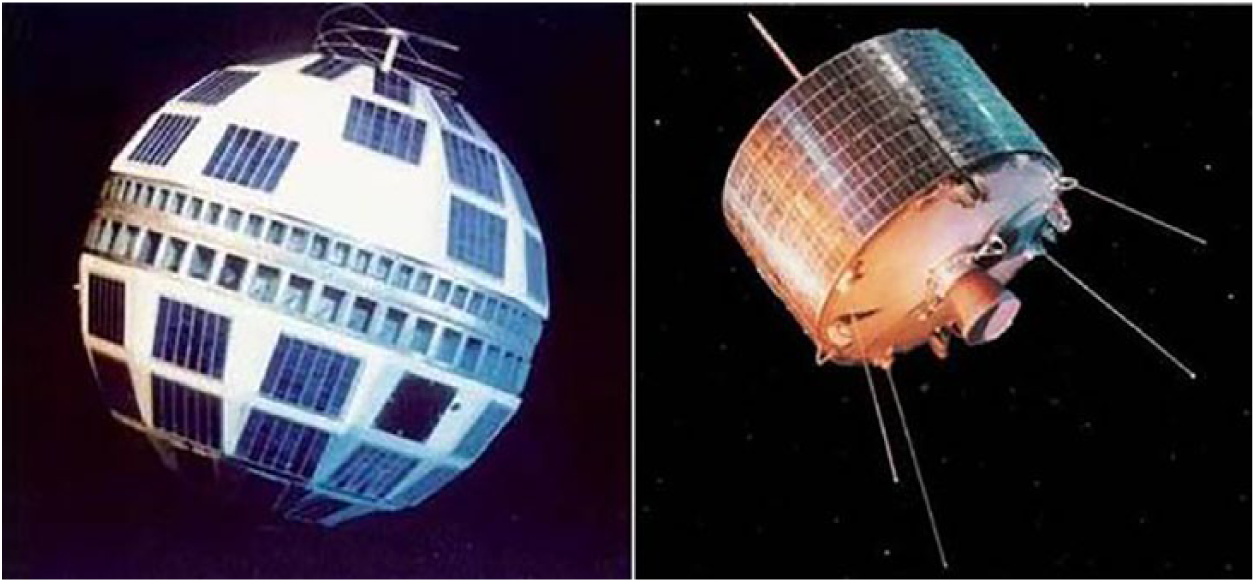
Telstar-1 & Intelsat-1.
On the other hand, GEO satellites can be seen 24 hours a day from approximately 40 per cent of the Earth’s surface, providing direct and continuous links between large numbers of widely separated locations. The world’s first GEO satellite, Syncom-1, was launched by NASA on 14 February 1963, which presented a prerequisite for the development of MSC systems. This satellite failed during launch, but Syncom-2 and 3 were successfully placed in orbit on 26 July 1963 and 19 July 1964, respectively. Both satellites used the military band of 7.360 GHz for the uplink and 1.815 GHz for the downlink. Using Frequency Modulation (FM) or Phase Shift Keying (PSK) mode, the transponder could support two carriers at a time for full duplex operation. Syncom-2 was used for direct TV transmission from the Tokyo Olympic Games in August 1964. After 1965, these spacecraft marked the end of the experimental period.
All these satellite systems were being used primarily for Fixed Satellite Service (FSS) experimental communications, which were used only to relay signals from Fixed Earth Stations (FES) at several locations around the world. Hence, one FES was actually located aboard large transport vessel, the USNS Kingsport, based in Honolulu, Hawaii. The ship had been modified by the US Navy to carry a 9.1m parabolic antenna for tracking the Syncom satellites. The antenna dish was protected, like present mobile antennas, from the marine environment by an inflatable Dacron radome, requiring access to the three-axis antenna through an air lock within the ship. The Kingsport ship terminal was the world’s first true MES and could be considered the first Ship Earth Station (SES). The ITU authorized special frequencies for Syncom experiments at around 1.8 GHz for the downlink (space to Earth) and around 7.3 GHz for the uplink (Earth to space). This project and trial was an unqualified success, proving only the practicality of the GEO system for satellite communications, but because of the large size of the Kingsport SES antenna, some experts in the 1960s concluded that MSC at sea would never really be viable. However, it was clear that the potential to provide a high quality line-of-sight path from a ship to the land, and vice versa, via the satellite transponder existed at this time.
Intelsat was founded in August 1964 as a global FSS operator. The first commercial GEO satellite was Early Bird (Intelsat-1) developed by Comsat for Intelsat (see Figure 2, right), which was launched on 6 April 1965 and remained active until 1969. 6 Routing operations between the US and Europe began on 28 June 1965; a date that should be recognized as the birthday of commercial FSS. The Early Bird satellite, which was later renamed Intelsat-1, had 2 x 25 MHz width transponder bands, the first with 2 Rx uplinks (centred at 6.301 GHz for Europe and 6.390 GHz for the USA) and the second 2 Tx downlinks (centred at 4.081 GHz for Europe and 4.161 GHz for the USA), with maximum transmission power of 10 W for each Tx. This GEO system used several GES located within the USA and Europe, and so the modern era of satellite communications had begun.
In the meantime, considerable progress in satellite communications had been made by the USSR, the first of which, the Molniya-1 (Lightning) satellite, was launched at the same time as Intelsat I on 25 April 1965. These satellites were put into an HEO, very different to those used by the early experiments and were deployed for voice, Fax and video transmission from central FES, near Moscow, to a large number of relatively small receive only stations. This was the era of communications spacecraft in the USSR, USA, UK, France, Italy, China, Japan, Canada and other countries. At first, all satellites were put in GEO, but later HEO and Polar Earth Orbits (PEO) were proposed, because such orbits would be particularly suitable for use with MES at high latitudes. Then started the development of MSC for maritime, land and aeronautical applications. The last step was the development of the Non-GEO systems of Little and Big Low Earth Orbits (LEO), HEO and other GEO constellations for new MSS for personal and GNSS applications. Finally, the International Space Station (ISS) construction began on 20 November 1998, when Russia’s Zarya module was launched into orbit around Earth. 7
Conclusions
Satellite communications now play a vital role in the global telecommunications system. Approximately 2,000 artificial satellites orbiting Earth relay analog and digital signals carrying voice, data and video to and from one or many locations worldwide. In particular, the first MSC for maritime applications was established by the International Maritime Satellite Organization (Inmarsat) in 1979, which marks the commencement of a new era in maritime satellite communications for oceangoing ships. The key developments in this new era are outlined in a separate research note published in this issue of IJMH.