



Abstract
Britain’s imperial and commercial success rested on maritime links. Whether trading wool across the Channel to Europe, seeking spices in South Asia or importing sugar from the Caribbean, shipping was an essential resource. Yet, to undertake these trades, merchants required naval supplies – finished ships, timber to build them and stores to fill them – that were not always easily accessible. This challenge was particularly apparent in the early seventeenth century for trading corporations whose specific needs demanded innovative approaches to the naval supply problem. This article examines the responses of English corporations to the challenge of supplying its international shipping by focusing on activities on each side of the Atlantic. First, it assesses the development of the East India Company’s docks at Blackwall and Dundaniel, before turning to a detailed study of ship-building and supply in Virginia and New England. In doing so, this article highlights the importance of naval supply to Britain’s north Atlantic empire, both in terms of the rhetorical support for empire and the economic incentives of participants. This reveals how traditional interpretations of Britain’s naval development have too often focused on state-driven activities (particularly from the very end of the seventeenth century) and failed to examine the complex, sometimes chaotic attempts by private individuals and corporations to overcome the naval supply challenges common to this early period of globalisation.
In his 1615 publication The Trades Increase, Robert Kayll issued a scathing attack against England’s trading corporations, especially the East India Company (EIC). Printed by Nicholas Oakes, the vitriolic pamphlet condemned the company for the loss of the Trades Increase, a ship of over 1,000 tons; probably the largest vessel ever built for England’s merchants. Kayll believed that, when functioning properly, ‘where trade increases, there is an increase in shipping; where increase in shipping, there increase of mariners likewise’. When undertaken properly, trade was like the ‘swans in Meander flood’ that ‘drew thither all sorts of people in great confluence, and with great expectation to hear, and enjoy their sweet singing’. In the East Indies trade however, ‘they found instead of fair white swans, greedy ravens, and devouring crows; and heard, instead of melodious harmony, untuneable and loathsome croaking’. Despite the riches that could be obtained through the EIC’s Asian trade, Kayll worried that it ‘should be found so discoloured, and we so ill satisfied’ due to its catastrophic toll on England’s shipping. 1
Kayll was well aware that the EIC had ‘built more ships in your time, and greater far than any other merchants’ ships’, accounting that they had built or bought 21 vessels ‘so that at first appearance you have added both strength and glory to the kingdom’. Yet, despite the company’s well publicised claims of boosting the supply of ships and mariners in England, Kayll asked ‘where I pray you are all these ships?’. Four ships, he identified, ‘are cast away’ – including the 1,100-ton Trades Increase – ‘two more are docked up there as pinnaces to trade up and down’, and the rest were either employed on voyages to Asia or under repair. In that case, he questioned how the kingdom could possibly benefit from their service in times of war. The EIC might have built a veritable navy of its own, but according to Kayll these were irrelevant. 2
Not only were the EIC’s ships unable to contribute to England’s defence if called upon, but Kayll suggested that their very construction had ‘hurt even to the whole kingdom’. He pointed to ‘our woods extraordinarily cut down, in regard of the greatness of the shipping, which does as it were devour our timber’ and claimed the price of timber had increased as a consequence. 3 It was not only a dearth in timber that had resulted from the EIC’s excessive shipping; Kayll also highlighted how the trade had stripped England of the very mariners required to man the country’s shipping. 4 Not only were men lost when ships sank, but even when they returned they ‘come home emptied of their men’. He claimed that in total the EIC had lost two-thirds of the 3,000 mariners who had travelled eastward on their ships. Furthermore, by stripping the country of new shipping, the EIC had also increased unemployment, leaving hundreds of mariners without work. 5
Considering the great damage wrought by the EIC’s trade on England’s naval supply, Kayll pondered how ‘to redeem us out of this disaster’ and ‘take away all those discontents and miseries that want of employment breeds in any of our unfortunate countrymen, but that shall also repair our navy, breed sea men abundantly, enrich the subject, advance the King’s custom, and assure the kingdom’. 6 His solution was simple – fishing. 7 Kayll argued that, if naval supplies were no longer wasted on merchant vessels, ‘we have all things that shall be used about this business growing at home in our own land (pitch and tar excepted)’. By taking advantage of the resources in ‘our own inexhaustible sea’ he saw a solution to the naval supply problem and a source of riches. By taking control of what Kayll believed the Dutch called ‘their chiefest trade and gold-mine’, England would take the first, correct steps towards establishing itself a strong, secure and powerful empire in the northern Atlantic. 8
As this attack on trading companies suggests, a fraught relationship between commercial and military demands for scarce naval resources had long been part of British political discourse. The availability of supplies for shipping was essential for merchants, companies and nations who sought to take advantage of a world of opportunities in the sixteenth to eighteenth centuries. 9 Whether for commercial or violent activity (and the two were often not far apart), sea power became increasingly important for a number of countries across northern Europe as they sought to control colonial and mercantile access. 10 The cost of doing business in a highly competitive environment has long been noted as a contributing factor in the growth of professionalised navies and as Frederic Lane has argued, ‘protection costs’ led to an increasingly symbiotic relationship between state and trade. 11 As commercial and imperial activities grew, the importance of access to a ready supply of naval stores grew with them. 12 In the case of the British Empire, sea power would become not only a key strategy for maintaining trans-oceanic colonial possessions but also for dominating trade and imposing its commercial and financial systems in countries across the globe. 13
Yet, while states played an important role in the growth of maritime trade and the application of naval power, naval supply in the emerging British empire was certainly not monopolised by the state. 14 Countries rarely depended only on state navies to impose their maritime power and an array of extraterritorial devises – such as licencing privateers or delegating sovereignty to corporations – were employed. 15 Even where the state took no active role in supporting naval activities there were merchants eager to participate in the vibrant international marketplace for naval supplies. 16 When it came to shipbuilding, this distinction between state and private activity was even clearer, and the vast majority of ships built in Britain during this period, whether large or small, were constructed in private shipyards rather than by the state. 17 Indeed, the development of new forms of shipping in the early modern period – stemming from shifts from coastal, European trading and naval warfare towards a global environment – led to innovations in ship design, and also changed the way people thought about maritime conflict and communication. 18 Taken together, this range of actors and interest in how Britain’s naval demands could be met suggests that a decentred approach is necessary for understanding the early British empire. 19
Rather than separating trade, privateering or colonisation into distinct arenas of interest, the question of naval supply encourages a perspective that integrates them. 20 In spite of the use of Virginian timber for ship building that may have carried goods to markets as varied as the Moluccas or Muscovy, or the use of hemp from Poland to rig ships travelling to Guinea or Greenland, the connectedness of early modern trade and empire in relation to shipbuilding is often given only limited attention. 21 This is a mistake. Not only did trading corporations (including the EIC, but also a plethora of other institutions with ventures crossing the globe) depend on shipping to drive their business, but they were aware of this fact. 22 They were also willing to discuss solutions to shipping challenges in great detail, sometimes offering innovative solutions like those detailed below. Furthermore, corporations were often very careful to develop complementary agendas for the public good as well as their own profitability, allowing considerable insight into how they understood their world, their place within it, and how connections across different regions affected them. 23 Yet, in spite of their superb archival records, interest in naval supply, and connected histories, these organisations are often poorly understood in terms of the ways they sought to overcome these challenges.
Despite the array of work dedicated to the British navy, empire and commercial development, focus has largely rested on supply issues within the already well-established administration of the eighteenth-century Royal Navy. Instead, this article will demonstrate the ways in which merchant activities, often with the support but certainly not at the command of the state, developed their own solutions to the problem of supplying Britain’s booming maritime trade. First, it assesses the development of the EIC’s docks at Blackwall and Dundaniel, before turning to a detailed study of ship-building and supply in Virginia and New England. Through these case studies, this article examines the importance of naval supply to Britain’s north Atlantic empire, both in terms of the rhetorical support for empire and the economic incentives of participants. This reveals how traditional interpretations of Britain’s naval development have too often focused on state-driven activities (particularly from the very end of the seventeenth century) and failed to examine the complex, sometimes chaotic attempts by private individuals and corporations to overcome the naval supply challenges common to this early period of globalisation.
In the history of Britain’s commercial and territorial empire, the late sixteenth and early seventeenth centuries represent a period of rapid change. New ways of doing business and increasing support from the crown allowed for overseas activities that took ships far across the globe. A list compiled by Trinity House in 1609 detailed how English shipping was spreading geographically, employing hundreds of ships and thousands of mariners (Table 1).
Trinity House’s list of current English shipping overseas, 1609.
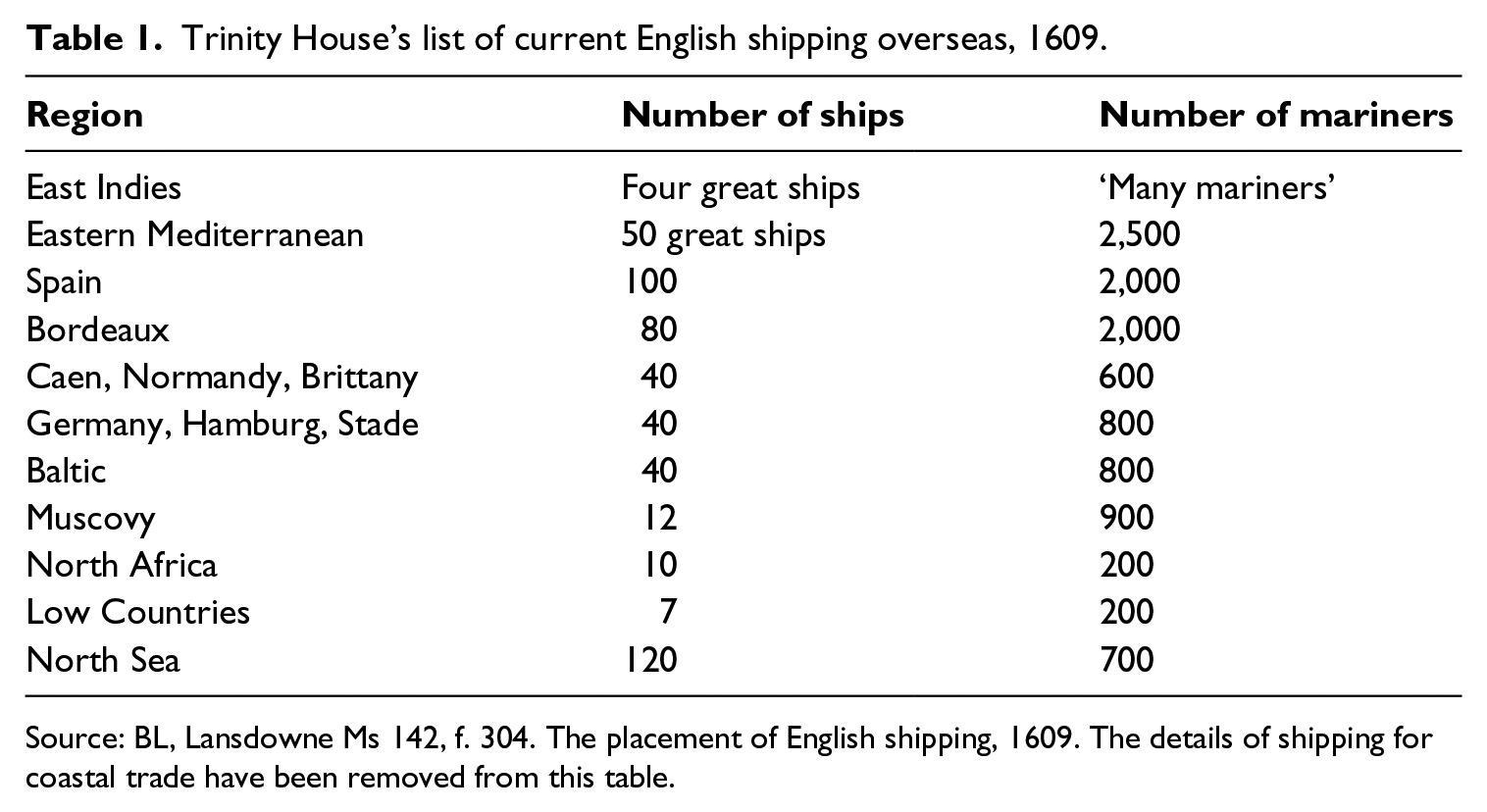
Source: BL, Lansdowne Ms 142, f. 304. The placement of English shipping, 1609. The details of shipping for coastal trade have been removed from this table.
This trend was set to continue, with merchant shipping increasing across the coming two centuries. Yet, at the start of the seventeenth century, this increase in trans-oceanic travel, to America, Asia, Africa and into the Mediterranean, required a new approach to naval supply.
However, while new opportunities strained the availability of essential commodities, trading organisations also took care to mitigate these issues, and to profit from developing novel solutions. For instance, when attempts were made in 1611 to reform England’s fishing industry, proponents of the scheme suggested using Yarmouth as a central harbour for a new corporation to oversee the trade. Doing so would provide a suitable location for receiving ‘ships with salt from Spain or France, the Isle of Mayo or West Indies’ and access to the Eastland Company’s imports that were necessary for ship building. They also believed the scheme would result in a corporation able to ‘purchase lands and build fisher towns ‘, ‘bring out of Ireland timber’ and contribute such an important role in increasing shipping and seamen that its fishermen would be omitted from impressment into the navy. 24 Although this particular scheme was never fulfilled, it demonstrates how English people concerned with naval supply understood it within the complex, entangled environment of early modern international trade.
Indeed, it was through trade that England sources most of its naval supplies, especially timber, tar, pitch and hemp, all of which could be obtained in the Baltic, Scandinavia and Muscovy. Trade in these goods was undertaken by the Eastland Company, a corporation founded in 1579. 25 An array of goods was exported by the Eastland Company, including broad cloth, fox skins, lamb skins, lead, tin, cotton, coney skins, coal, leather, ordinance and saffron. The most important good received in return was timber, 26 but the company’s success in this trade was not enough to meet all of England’s naval supply demands. For instance, in 1622 it faced competition from merchants from Newcastle who had obtained support from the crown to trade into the region to obtain essential supplies for their shipping industry. 27 By the 1630s, the Eastland trade was supporting the rapid expansion of Charles I’s navy, contributing to the construction of 11 ships of over 800 tons each. 28 However, in spite of its success maintaining trade in the Baltic and the efforts of numerous interlopers who sought to break into this commercial sphere, these north-eastern supplies were never enough to meet all of England’s needs.
Neither was it a question of volume of supply. The EIC, and to some degree other corporate actors trading to the Levant, Muscovy and in the Atlantic, required ships that had specific features that were not readily available on hired ships, which were used by most merchants seeking shipping to Europe. 29 Much of the Channel trade was undertaken in vessels smaller than 100 tons. Even voyages to the Caribbean or North America required ships of only around 200 tons. 30 Instead, the EIC relied on large, often specially made, ships that could not only carry goods to and from Asia but also act as a military threat or defensive countermeasure. According to their own estimates, the EIC believed vessels between 300 and 700 tons were the most effective option – although as the Trades Increase indicates, they could be much larger than this too. 31 Corporations, then, were making demands on naval supply, in terms of ships and men, that neither the state’s navy nor independent merchants equalled. 32
One of the strengths of the corporate structure for these organisations was that joint-stock, or at least pooled funding in one sense or another, enabled companies to maintain larger ships and more sailors and undertake longer voyages than had previously been possible. 33 For the EIC, this had initially involved purchasing ships directly from their owners – who were unwilling to rent them for such a risky voyage – but this option was soon deemed inappropriate. 34 By building its own dockyard the company could better ensure ships were built that met its specifications, that could be standardised across the company’s activities, and that were not at risk of being old, damaged or lacking quality construction required.
Perhaps the first major, institutional attempt to mitigate a dearth in vessels capable of trans-continental trade was undertaken by the EIC at Blackwall. Here, from the early 1610s onwards, the EIC built, maintained and managed an extensive dockyard complex. 35 In order to gather and maintain shipping, the EIC had to break with tradition, taking the significant risk of investing in the massive infrastructure necessary for ship building as well as assembling one of London’s largest labour forces. 36 The docks expanded from a decision to build a single large ship in 1607, slowly expanding throughout the 1610s and 1620s into a large complex that by 1640 had constructed over 70 ships (Table 2). 37
Size of EIC Ships built at their Docks.

Source: Data from Chaudhuri, English East India Company, 232–3.
In developing Blackwall, the EIC was continuing a tradition of large-scale ship building complexes that were already well established in other European states. Docks, essential facilities for supplying both merchant and state navies, were ‘the only sizeable industrial centres in most European states’. In Venice, for instance, the state’s Arsenal employed around 2,000 workers and covered over 60 acres. 38 Over the course of its operation, Blackwall was presented by the EIC as an important contribution to the public good. Not only did it increase the supply of larger, specially built ships, but it also contributed to the employment of hundreds of mariners overseas as well as sustaining a considerable workforce in London. Dudley Digges highlighted how the docks stimulated employment and prevented the cost of employing ‘shipwrights, smiths, coopers, ropemakers, porters, lighter-men, and such like infinite number of labourers which they have continually in pay’ from falling on the state. 39 In a similar vein, Thomas Mun suggested the docks ‘maintain many hundred poor people, and greatly increase the number of those artsmen which are so needful for this common wealth’. 40 As these two authors indicated, by building the docks at Blackwall the EIC was doing more than simply meeting its own needs – its actions had wide-ranging positive implications on England’s naval supply problem.
Through this strategy, the EIC was able to radically alter the market for large ships in England, undercutting existing shipbuilders that would take decades to catch up. In 1607, after the ships purchased for the first voyage had proved so hopelessly inadequate, the EIC attempted to commission specially built vessels from England’s shipwrights, offering £30 per ton. 41 This was vastly more expensive that the £3,700 paid for the inadequate, 600-ton Dragon in 1601, but the needs of the company for a reliable supply of ships were deemed to outweigh this difference. 42 However, before employing an independent shipwright for the work, one EIC member, William Burrell, proposed that the company should build its own ships, suggesting that a fully developed dockyard would enable the construction of 800 ton ships for only £4,000 – or £5 per ton. 43
Alongside Blackwall, around 1608 the EIC launched a second dockyard, with a supporting colony of English settlers, in southern Ireland at Dundaniel. 44 It was built following consideration of how ‘excellent use the timber of that kingdom is for building of ships’ and was supported in part as a solution for declining woodland in England. This small colony was the first overseas settlement managed by the EIC and by 1613 was reported to have ‘already within these few years erected three towns’. Here, the EIC employed workers for ‘building of shipping, ironworks and such commendable and worthy labours, as besides private commodity, do tend to the singular good of this State and Commonwealth’. 45 By 1613 the EIC claimed it had spent £7,000 developing the settlement and had built two large ships. 46 Over the coming decade the colony would provide timber for the EIC as well as constructing smaller vessels. 47 While short-lived, the colony at Dundaniel represents an important step in the ways English merchants sought to meet their needs for naval stores – rather than importing goods into England they looked outward, into the Atlantic, for colonial opportunities that would meet their demands.
Through these two facilities, at Blackwall and Dundaniel, the EIC met their own requirements for naval supply and the obligations placed on them by the crown, whose support for the company, including valuable monopoly privileges, was partly dependent on the company bolstering the nation’s maritime strength. This was important, as the company’s charter included provisions that only six ships, six pinnaces and no more than 500 mariners would be expended on their voyage east. 48 In 1609, during discussions about the renewal of the charter, James I wrote to the Privy Council extolling how ‘their trade the greatest shipping of the realm is set a work, and much more great shipping built and is like to be than heretofore’. 49 Indeed, the close relationship between company and state in regard to naval supply went further than these shared obligations, and the new dockyard benefited from the introduction of state subsidies for ship building. 50 Between 1616 and 1618 the company received 5007 crowns for building five ships. 51 Through agreements such as the charter and subsidies, where public good, state interest and private enterprise were supported together, England’s naval supplies were sustained and increased.
Sites like Blackwall represent part of the assumption of powers by corporations that had previously been reserved for sovereign states. 52 While it was an important means for the EIC to overcome problems in naval supply, it would not be until corporations usurped another of the state’s privileges – territorial rule – that the scope of private interest in ensuring naval supply become apparent. It is clear then, that in the early seventeenth-century it was falling to corporate organisations to develop innovative and expensive solutions to the problem of naval supply. Yet, while Dundaniel would quickly fall from the EIC’s agenda and Blackwall would be closed in the 1650s, their role in solving Britain’s naval supply challenge should not be understood independently. 53 Instead, we should place these two facilities within the broader history of colonisation in the north Atlantic. These two enterprises were ambitious but they were only the start of merchants’ attempts to supply Britain’s naval demands.
Looking towards the Atlantic as a means of meeting England’s naval shortages was by no means a new idea, although the harsh practicalities meant it remained novel and only poorly understood. As early as 1584, Richard Hakluyt had presented north America as a source of valuable naval supplies, including pitch, tar, timber and hemp. 54 It was not until 1609, however, that English merchants would start to drive colonisation in north America – and part of their incentive to do so was to access the naval stores they believed ‘New England’ offered. 55 In Virginia, we see a colony built, in part, specifically to meet the needs of England’s shipping industry, and to supply goods necessary not only for the enriching of the settlement and its investors but also contributing to England’s connected, global web of trade and empire. 56
To attract merchant investors, detailed texts were written and distributed that outlined both what the land in Virginia offered and how it would be managed. 57 People were encouraged to take part so that the colony might increase England’s wealth and power, and ‘furnish and provide this Kingdom with all such necessities’. 58 Doing so, they were told, would improve the nation’s shipping – just one way the settlement would support the public good whilst simultaneously enriching investors themselves. 59 One author, Robert Johnson, paid particular attention to the viability of the new colony as a source of ship building supplies, suggesting that those available in Virginia ‘can hardly now be obtained from any other part of the world’. 60 He was adamant that these supplies would ‘yield gold or silver in any our bordering nations’ and that Dutch and English shipbuilders were spending ‘about three hundred thousand pounds sterling every year’ every year on similar products. 61 Not only would Virginian timber meet domestic needs, it would be bountiful enough to export to ‘Hamburg, Holland, or other places’ for ‘fifty per cent better cheap than from Prussia or Polonia, from whence they are only now to be had’. 62 Virginia then, was a colony seen as having the potential to radically reshape England’s naval supply challenge.
Of course, while Virginia may have been considered as having the potential to supply vast quantities of timber, as well as pitch and tar, the early years of the colony were dominated by more mundane demands – such as the requirement to feed its settlers. Early growth, in spite of threats from local people and hunger, was rapid, and by 1611 Thomas West was reporting that the colony sustained 200 men, ‘the most in health, and provided of at least ten months victuals in their storehouse’. 63 Rather than simply increasing the population, however, the Virginia Company sought to develop a well-functioning colony, and a range of craftsmen were sent in consequent fleets. These included ‘none but honest sufficient artificers, as carpenters, smiths, coopers, fishermen, brickmen, and such like’, who could contribute to the colony’s urgent needs but also plan for the future. 64 A further list detailed 238 settlers sought for colony, including 44 to specialise in ship building, 30 for sailing, and 16 for fishing. 65 Although no corresponding information regarding the actual arrivals in Virginia survives, these lists reveal the plans the Virginia Company had for the colony, and the strong maritime dimension envisaged for the settlement.
When John Rolfe left Virginia in 1616 to return to England, he described a colony that was beginning to specialise in a range of industrial activities – including shipping. He recounted that six towns had been built, including a maritime, fishing community at Cape Comfort and a town specialising in the production of pitch, tar, pot-ash and charcoal. 66 This specialisation contributed to the ongoing, early success of the plantation as a source of naval supplies. Virginia had proven, as advertised, to be a viable source of timber, with ‘pines infinite, especially by the sea coast’ reported by settlers. 67 As early as 1610, a 300-ton ship, the Starre, had been ‘fitted and prepared with scupper holes to take in masts’ and sent to the colony to take advantage of stocks so full it reportedly could only carry half back to England. 68 The following year two ships returned to ‘London from Virginia laden with masts for ships and other heavy commodities’. 69 Deliveries of timber from the colony continued, and although limited in volume were gratefully received in England. 70 The success of the colony as a supplier of timber was timely, and commentators noted how ‘our colonies in Ireland and Virginia do now begin to promise good success’ to assuage fears of deforestation in England. 71
In addition to providing timber for transport to England, by 1613 a Spanish captive in Jamestown commented on the development of ‘facilities for making ships’ at the colony – probably at Cape Comfort. 72 Principally used for smaller vessels, especially fishing boats utilised in the waters near the colony or transport ships suitable for navigating the waterways between the colony’s main towns, these were deemed vital for the success of the colony. For example, Captain Argall reported how he had ‘set my men to the felling of timber, for the building of a frigate, which I left half-finished in the hands of the carpenters’, a ship that was completed only three weeks later at which point they started working on a fishing boat. 73 In 1615, a group of settlers travelled to Virginia specifically to ‘build ships there, having materials great store there for the purpose and for that business intend to send and employ some 200 men’ – and predicted they would build five ships in six months. 74 To encourage these activities, officers in Virginia were ordered to ensure ‘the diligent employing of our shipwrights, to whom we give great wages… as also of the sailors and watermen’. 75 As this suggests, the company’s leadership were more than willing to fund the necessary expertise required to develop Virginia as a colony with strong maritime roots – as a fishery, a port, and a dockyard. By 1618 wharfs were being developed for a deep-water channel near Jamestown, and in 1619 merchants were shipping large quantities of cordage to the colony – either for repairing or building ships locally. 76 In Virginia then, English merchants sought to meet the demands of England’s shipbuilding industry, and in turn to underpin commercial expansion across the world, by developing their northern Atlantic colony into a maritime-facing, ship-building, and timber-exporting settlement.
However, it would be further north still, in colonies developed in New England, that they would find even greater success. 77 As in Virginia, these colonies were founded with great expectations, and once again naval supplied formed a key part of their appeal. William Bradford described how near the plantation at Plymouth ‘there is much good timber, both oak, walnut-tree, fir, beech, and exceeding great chestnut trees’. 78 The same year, the New England Company released a pamphlet that described the availability not only timber for ‘spars, masts, for ships of all burdens’ but also ‘commodities to make pitch, resin, tar’. They reported how the colonists had been so encouraged by the local supplies that they had been ‘engaging of ourselves, for the building of some ships of good burden’ and ‘from henceforth’ intended ‘to build our shipping there’. 79 Such commodities were more appealing still to Christopher Levett, who declared: ‘I dare be so bold to say also, there may be ships as conveniently built there as in any place in the world.’ 80 Levett argued that the New England colony ‘may be beneficial to the Commonwealth’ specifically because it would lead to an ‘increase of shipping, (which is the strength of a nation, and that without wasting our timber which is a commodity in England which I fear England will find the want of before many years pass over).’ 81 For Levett, the need to develop the New England colony matched many of the goals of the EIC regarding Blackwall – it would increase shipping, provide employment, and increase the wealth and strength of the kingdom.
The establishment of the New England colonies, following the earlier successes in Virginia, led to new towns across the north-Atlantic coast providing harbours, access to shipping supplies, and often facilities for ship-building or repair. 82 Over the coming century the north-Atlantic colonies would come to play an important role in Britain’s naval supply. By the mid-seventeenth century the requirements for the EIC and other companies to run their own docks in England had declined, and their larger, more powerful vessels were no longer so uncommon that they could not be built by private shipbuilders. Although difficulties would remain for trading companies – especially for accessing shipbuilding facilities overseas, during times of conflict and for cheap prices – the greater challenge shifted from corporations to the state. Increasing investment and interest in the navy during the 1630s, throughout the Civil War and into the Restoration, resulted in changing priorities at the heart of England’s government regarding naval supply. 83
Towards the end of the seventeenth century, greater centralisation in England for supplying the navy led to increasing intervention by the state. 84 It was during this period that naval reforms, combined with wider innovations across public-sector finances in Britain, facilitated the emergence of a larger, more centralised approach to naval supply. 85 Stronger finances enabled the Navy Board to more effectively administer contracts with suppliers, increasing competition between merchants and resulting in a fall in prices for key stores. 86 To support the growth of the navy, increasing demands were made on merchants to import vast amounts of naval stores – especially from the Baltic. However, access to this market was far from guaranteed, and concerns about how conflict might break this link and reduce supply were a common feature of eighteenth-century debates. 87
Northern Atlantic colonies remained an important source of naval supplies throughout the eighteenth century. Not only did America’s natural resources provided a range of vital materials, but dockyards in the region were now building hundreds of ships, large and small, to support trading and fishing activities across the region. The Board of Trade also made considerable efforts to encourage production in the American colonies with the specific intention of increasing imports of vital supplies to England. In 1705, the Naval Stores Act facilitated more efficient supply by rewarding merchants who provided American timber, pitch, tar, hemp, rosin and turpentine for the navy. 88 By incentivising merchants to obtain naval supplies from the American colonies, rather than from European markets, the Naval Stores Act was designed to boost production within Britain’s empire and create an internal market for naval supplies.
This importance for the northern colonies remained, and by the mid-eighteenth century New England was the second largest supplier of large masts in Britain’s dockyards. 89 While the Baltic and Scandinavia remained the most common markets for most naval supplies, the largest ships of the Royal Navy required masts that were difficult to obtain from anywhere but the American colonies. 90 By the Seven Years War (1756–63), large masts from the region were dominating the supplies of the Royal Navy. 91 In the first year of the war at least 243 large masts were delivered from New England, compared to only two from Riga and Norway. The following year saw 205 and 16 sources from each region. This trend continued, with New England supplying at least five times as many large masts as the Baltic trade in all but two remaining years of the war. 92
The development of the British navy as a well-organised institution had led to some radical changes in the way in which naval stores were obtained. It had also contributed to a reduction in costs for merchants undertaking long-distance trade, providing vital protection for English merchants across the world. 93 Yet, in doing so, the British state became increasingly reliant on the very colonies that had been established in hoped of mitigating limited access to naval supplies in the metropole. According to William Cronon, the effects of naval supply on local ecology were considerable, with demands from Britain’s shipbuilders contributing to massive deforestation across much of the New England coast. 94 If we are to believe Robert Albion, the loss of the 13 colonies represented a significant loss for the British navy, who lost access to an important pipeline for the largest mast necessary for maintaining its effectiveness. 95 Indeed, this was a perspective mirrored by contemporaries and among the numerous objections to the independence of the Thirteen Colonies, critics questioned ‘if we should lose the northern colonies, where shall we get pitch and tar, masts and naval stores for our navy?’. 96
As this article has demonstrated, the standardised system for naval procurement that was developed from the second half of the seventeenth century had its roots in a series of corporate activities that were designed to radically alter the way England, and then Britain, conceived of its naval supplies. Through the activities of the EIC at Blackwall and Dundaniel it became clear that private actors could command the resources necessary to change the ways ships were built. It allowed for specialisation in production that was essential for their overseas trading activities but also re-skilled the English labour force to produce larger ships. These two docks represent a changed approach to how shipping could be provided in England and were incentivised by the challenges of international trade. Almost contemporaneously, the Virginia Company, closely followed by plantations in New England, were built in part on a belief that they could mitigate England’s naval supply problem. Their most important role in this respect was providing access to previously untapped forests and woodland – shipping timber to Britain for corporate, private and state dockyards to use. They also became producers of finished ships in their own right. In these corporate activities, on either side of the Atlantic, we can see the ways in which British conceptions of naval supply changed rapidly in response to the challenges and opportunities presented by international trade and empire.
Footnotes
Acknowledgements
I would like to thank the Omohundro Institute and Jamestown Rediscovery Foundation, Hakluyt Society and Leverhulme Trust for supporting this research, as well as William Pettigrew, Aske Brock and Catia Antunes for their input.
1.
Robert Kayll, The Trades Increase (London, 1615), 14. The East India Company quickly issued a response, offering a much more positive account of how their shipping increased the naval supply of the kingdom: Dudley Digges, The Defence of Trade (London, 1615).
2.
Kayll, Trades Increase, 15–6.
3.
Ibid.
4.
For ways manpower was understood economically in the seventeenth-century see Joyce Appleby, Economic Thought and Ideology in Seventeenth Century England (Princeton, 1978); Ted McCormick, ‘Population: Modes of Seventeenth Century Demographic Thought’ in Philip Stern and Carl Wennerlind, eds., Mercantilism Reimagined: Political Economy in Early Modern Britain and its Empire (New York, 2014).
5.
Kayll, Trades Increase, 27, 34–5.
6.
Ibid.
7.
In addition to trade and empire, fishing represents another, often overlooked but important, aspect of maritime activity: see P. Holm, D. J. Starkey, J. T. Thor, eds., The North Atlantic Fisheries, 1100–1976: National Perspectives on a Common Resource (Esbjerg, 1996); A. R. Michell, ‘The European Fisheries in Early Modern History’ in E. E. Rich and C. H. Wilson, eds., The Cambridge Economic History of Europe, vol. 5: The Economic Organisation of the Early Modern World (Cambridge, 1977); D. J. Starkey, C. Reid and N. Ashcroft, eds., England’s Sea Fisheries: The Commercial Sea Fisheries of England and Wales Since 1300 (London, 2000).
8.
Kayll, Trades Increase, 36, 41
9.
R. W. Unger, ed., Shipping and Economic Growth, 1350–1850 (Leiden, 2011).
10.
The classic text exploring this relationship remains Alfred T. Mahan, The Influence of Seapower Upon History, 1660–1783 (Boston, 1890). More recent work includes Jan Glete, Navies and Nations: Warships, Navies and State Building in Europe and America, 1500–1860 (Stockholm, 1993).
11.
Frederic Lane, Profits from Power: Readings in Protection Rent and Violence-Controlling Enterprises (Albany, 1979). See also, N. A. M. Rodger, ‘From the “Military Revolution” to the “Fiscal-Naval State”’, in Journal of Maritime Research, 13, No. 2 (2011), 119–28.
12.
The strains on naval supply brought about by the transition of the British Navy into a key institution of the state in the eighteenth and nineteenth centuries have been given considerable attention. See James Davey, The Transformation of British Naval Strategy: Seapower and Supply in Northern Europe, 1808–1812 (Woodbridge, 2014); Roger Knight and Martin Wilcox, Sustaining the Fleet, 1793–1815: War, the British Navy and the Contractor State (Woodbridge, 2010).
13.
For an introduction to Britain’s naval history see N. A. M. Rodger, The Safeguard of the Sea: A Naval History of Britain, 600–1649 (London, 1997) and Rodger, The Command of the Ocean: A Naval History of Britain, 1649–1815 (London, 2004).
14.
Although they are often conflated, see M. Oppenheim, A History of the Administration of the Royal Navy and Merchant Shipping (London, 1986).
15.
Lauren Benton, A Search for Sovereignty: Law and Geography in European Empires, 1400–1900 (Cambridge, 2009); Richard J. Blakemore, ‘British Imperial Expansion and the Transformation of Violence at Sea, 1600–1850: Introduction’ in International Journal of Maritime History, 25, No. 2 (2013), 143–5; Janice E. Thomson, Mercenaries, Pirates and Sovereigns: State-Building and Extraterritorial Violence in Early Modern Europe (Princeton, 1994).
16.
L. Johnman and H. Murphy, ‘Maritime and Business History in Britain: Past, Present and Future?’ in International Journal of Maritime History, 19, No. 1 (2007), 239–70.
17.
The authoritative account remains R. Davis, The Rise of the English Shipping Industry in the Seventeenth and Eighteenth Century (Newton Abbot, 1962). For an examination of English merchant shipping in the previous centuries see D. Burwash, English Merchant Shipping, 1460–1540 (Newton Abbot, 1969); C. F. Richmond, ‘English Naval Power in the Fifteenth Century’ in History, 52 (1957), 1–15.
18.
David Loades, The Making of the Elizabethan Navy, 1540–1590 (Woodbridge, 2009), 124–42; Jan Glete, Warfare at Sea, 1500–1650: Maritime Conflicts and the Transformation of Empire (London, 2000); N. A. M. Rodger, ‘The New Atlantic: Naval Warfare in the Sixteenth Century’ in John B. Hattendorf and Richard W. Unger, eds., War at Sea in the Middle Ages and the Renaissance (Woodbridge, 2003), 233–48.
19.
Much recent work has taken this perspective, including H. V. Bowen, Elizabeth Mancke and John G. Reid, eds., Britain’s Oceanic Empire: Atlantic and Indian Ocean Worlds, c. 1550–1850 (Cambridge, 2012); William Pettigrew, ‘Corporate Constitutionalism and the Dialogue between the Local and the Global in Seventeenth-Century English History’ in Itinerario, 39, 1 (2015), 487–501; Catia; Antunes and Amelia Polonia eds., Beyond Empires: Global, Self-Organising, Cross-Imperial Networks, 1500–1800 (Leiden, 2015).
20.
This separation has been a long-standing trend in the history of Britain’s empire, see K. R. Andrews, Trade, Plunder and Settlement: Maritime Enterprise and the Genesis of the British Empire, 1480–1630 (Cambridge, 1985); Nicholas Canny, eds., Oxford History of the British Empire, vol. 1: The Origins of Empire: British Overseas Enterprise to the Close of the Seventeenth Century (Oxford, 1998)
21.
Recent work has highlighted this connectedness as a means of re-examining corporations as embedded within their wider social, economic and cultural networks, see Edmond Smith, “The Global Interests of London’s Commercial Community, 1599–1625: Investment in the East India Company” in The Economic History Review, 71, 4 (2018), 1118–1146.
22.
The EIC in particular has become a classic example of state-like powers held by a private organisation, see P. J. Stern, The Company-State: Corporate Sovereignty and the Early Modern Foundations of the British Empire in India (Oxford, 2011).
23.
Anne Goldgar and Robert L. Frost, eds., Institutional Culture in Early Modern Society (Leiden, 2004); Steve Rappaport, Worlds Within Worlds: Structures of Life in Sixteenth-Century London (Cambridge, 1989); Phil Withington, The Politics of Commonwealth: Citizens and Freemen in Early Modern England (Cambridge, 2005).
24.
Kent History and Library Centre [KHLC], SA/ZB/2/60, f. 80. Papers dealing with proposed establishment of a corporation to govern fishing, 1611.
25.
Reasons for the founding of the company were described during a dispute with another company, the Merchant Adventurers, see Company of Merchant Adventurers of York [CMAY], 1/5/3/5/1. Thomas Pullison and Thomas Russell to the Merchant Adventurers of York, 2nd September 1579. For more information see R. W. K. Hinton, The Eastland Company and the Common Weal (Cambridge, 1959).
26.
CMAY, Acts and Ordinances of Eastland Merchants, ff. 8–9. 18th March 1617.
27.
KHLC, U269/1/OE239a, m. 5682. Petition from the Eastland Company, 1622.
28.
John. D. Grainger, The British Navy in the Baltic (Woodbridge, 2014), 30–31.
29.
They were competing both with other European traders but also local merchants in highly contested maritime environments. For example, see S. Subrahmanyam, ed, Maritime India: Rival Empires of Trade in the Orient, 1600–1800 (Oxford, 2004).
30.
Kirti Chaudhuri, English East India Company, 95.
31.
British Library [BL], IOR/B/5, 30th January 1615.
32.
A similar trend was apparent in the United Provinces, where the Dutch East India Company was developing its naval capacity at a pace that far outstripped its English counterparts – it employed around 3,200 people on its ships by 1625. Jan De Vries and Ad van der Woude, The First Modern Economy: Success, Failure, and Perseverance of the Dutch Economy, 1500–1815 (Cambridge, 1997), 462.
33.
The expectation to contribute to an increase in shipping was even written into the EIC’s Charter, see BL, IOR/A/2, ‘Charter for the East India Company, 1600’.
34.
Henry Stevens, ed., Dawn of British Trade to the East Indies: As Recorded in the Court Minutes of the East India Company, 1599–1603 (London, 1886), 6, 8, 27, 92.
35.
For the impact of Blackwall Dockyard on the local community see Hermione Hobhouse, ed., Survey of London: Poplar, Blackwall, and the Isle of Dogs, the Parish of All Saints, vols. 43 and 44 (London, 1999).
36.
The ways in which the company managed this workforce is discussed in William Pettigrew and Edmond Smith, ‘Corporate Management, Labor Relations, and Community Building at the East India Company’s Blackwall Dockyard, 1600–57’, in Journal of Social History (2019), 1–24. Similar studies have been conducted regarding the Royal Dockyards on the Thames that were also undergoing expansion during this period, see Kenneth Lunn and Ann Day, eds., History of Work and Labour Relations in the Royal Dockyards (London, 1999), 
37.
BL, IOR/B/2, 24th August 1607; IOR/B/5, 29th April 1614; IOR/B/6, 30th July 1619; IOR/B/8, 19th September 1621; IOR/B/9, 2nd September 1624 and 6th November 1624.
38.
Robert C. Davis, Shipbuilders of the Venetian Arsenal: Workers and Workplace in the Preindustrial City (Baltimore, 1991), 3–4, 7. Both state and corporate dockyards in the United Provinces were also developing into similarly massive facilities, see Pepijn Brandon, War, Capital, and the Dutch State (1588–1795) (Leiden, 2015), 139; Jan Lucassen, ‘A Multinational and its Labor Force: The Dutch East India Company, 1595–1795’, International Labor and Working-Class History, 66 (2004), 12–39, 33.
39.
Digges, Discourse on Trade, 41.
40.
Thomas Mun, A Discourse of Trade, From England vnto the East-Indies: Answering to Diuerse Obiections Which are Vsually Made Against the Same (London, 1621), 30, 41–43.
41.
BL, IOR/B/2, 19th May 1607.
42.
Stevens, Dawn of British Trade, 31.
43.
BL, IOR/B/2, August 1607.
44.
Paddy O’Sullivan, ‘The English East India Company at Dundaniel’, Bandon Historical Journal, 4 (1988), 3–14.
45.
CMAY, Acts and Ordinances, vol. 33, 107–8.
46.
TNA, PC/2/27, f. 34. A Letter to Lord Chichester, 30th June 1613.
47.
CMAY, Acts and Ordinances, vol. 34, 185–6, 490-1, 617–8; vol. 35, 191, 200, 317–8.
48.
BL, IOR/A/2, ‘Charter for the East India Company, 1600’.
49.
Her Majesty’s Stationary Office, Calendar of the Cecil Papers in Hatfield House, vol. 21 (London, 1970), 154–62.
50.
Although these bounties were certainly helpful, they did not come close to the levels of support the Dutch East India Company received from the Dutch state, Jan Piet Puype, The Arsenal of the World: The Dutch Arms Trade in the Seventeenth Century (Amsterdam, 1996).
51.
William Noel Sainsbury, ed., Calendar of State Papers, Colonial Series, East Indies, China and Japan, 1513–1616 (London, 1864), 1142; Mary Anne Everett Green, ed., Calendar of State Papers Domestic, James I, vol. 88 (London, 1858), 378–389; Mary Anne Everett Green, ed., Calendar of State Papers Domestic, James I, vol. 104 (London, 1858), 599–614.
52.
The relationship between corporations and sovereignty is explored in Philip J. Stern, The Company-State: Corporate Sovereignty and the Early Modern Foundations for the British Empire in India (Oxford, 2011).
53.
Blackwall, in particular, has been described as a commercial folly, see Chaudhuri, English East India Company, 89–108.
54.
Richard Hakluyt, A Discourse Concerning Western Planting (1584), reprinted by Leonard Woods (Cambridge, MA, 1877), 37.
55.
Although founded in 1606, merchants only became significant investors and managers in the Virginia Company after its charter was expanded in 1609.
56.
The 1609 and 1612 charters detail the precise privileges of the Company. Library of Congress, The Thomas Jefferson Papers, series 8, Virginia Records Manuscripts, vol. 6.
57.
The list of merchants considered above was sent alongside a letter encouraging support and supporting materials, KHLC, SA/ZB/2/64, 87. For an assessment of the ways English corporations utilised printed literature see William Pettigrew and Liam Haydon, ‘The Language of Corporate Pamphlets’, Journal for Early Modern Cultural Studies (2017), forthcoming.
58.
Virginia Company, A True and Sincere Declaration of the Purpose and Ends of the Plantation Begun in Virginia (London, 1610), 2–4.
59.
BL, Lansdowne Ms 160, 356–7. Reasons or Motives for Raising of a Public Stock to be Employed for the Peopling and Discovering of New Colonies, 5th January 1608. The intellectual and political currents behind colonisation in the Atlantic have been widely examined – albeit with a considerable focus on elite literature and gentry participants. See, David Armitage, ‘Literature and Empire’ in Nicholas Canny, ed., The Origins of Empire: British Overseas Empire to the Close of the Seventeenth Century (Oxford, 1998), 110; Andrew Fitzmaurice, Humanism and America: An Intellectual History of English Colonisation, 1500–1625 (Cambridge, 2003), 14, 67–8; Alexander Haskell, For God, King, and People: Forging Commonwealth Bonds in Renaissance Virginia (North Carolina, 2017), 12–21. Counter to this trend, Misha Ewen has considered similar questions from a social historical perspective, ‘To the Foundation of a Commonwealth’: English Society and the Colonisation of Virginia, |c. 1607–1642’ (PhD Thesis, University College London, 2017).
60.
Robert Johnson, Nova Britannia (London, 1609), C3.
61.
Ibid.
62.
Ibid.
63.
Thomas West, The Relation of the Right Honourable the Lord De-La-Warre (London, 1611), B2.
64.
Virginia Company, By the Councell of Virginia (London, 1610).
65.
KHLC, SA/ZB/2/67, f. 92.
66.
John Rolfe, A True Relation of the State of Virginia (New Haven, 1951), 39.
67.
BL, Sloane MS 1622. Strachey’s Travaile into Virginia.
68.
Ibid.
69.
BRO, Trumbull Ms, Miscellaneous Correspondence, vol. 3, 174. Arthur Aynscombe to William Trumbull, 11th November 1611.
70.
TNA, SP 14/87, f. 134. John Chamberlain to Dudley Carleton, 22nd June 1616.
71.
BRO, Trumbull Ms, Alphabetical Correspondence, vol. 32, 8. John More to William Trumbull, 18th January 1611.
72.
Don Diego de Molina to [Don Alonzo de Velasco]; Hamor, A True Discourse, 35–6.
73.
John Chamberlain to Dudley Carleton, 12th May 1614. TNA, SP 14/77, 31.
74.
John Woodall to William Trumbull, 6th July 1615. BRO, Trumbull Ms, Miscellaneous Correspondence vol. 7, 49.
75.
Magdalene College Pepys Library, FP 30. Virginia Company to Thomas West, March 1611.
76.
Site 935, see Dennis Blanton, Patricia Kandle and Charles Downing, Archaeological Survey of Jamestown Island (Williamsburg, VA., 2000), 167–9. For cordage, see Piotr Bojakowski and Katie Bojakowski, ‘The Warwick: Results of the Survey of an Early 17th-Century Virginia Company Ship’, Post-Medieval Archaeology 45, No. 1 (2011), 42.
77.
For details on American timber see Charles F. Carroll, The Timber Economy of Puritan New England (Providence, RI, 1974).
78.
William Bradford, A Relation or Journall of the Beginning and Proceedings of the English Plantation Setled at Plimoth in New England (1622), 44.
79.
The Council for New England, A Brief Relation of the Discovery and Plantation of New England (1622), D3.
80.
Christopher Levett, A Voyage into New England Begun in 1623 (1624), 23–4.
81.
Levett, Voyage into New England, 29.
82.
Francis Higginson, New-England’s Plantation, or, a Short and True Description of the Commodities and Discommodities of that Country (1630), B3.
83.
K. R. Andrews, Ships, Money and Politics: Seafaring and Naval Enterprise in the Reign of Charles I (Cambridge, 1964); Richard J. Blakemore, ‘Thinking Outside the Gundeck: Maritime History, the Royal Navy and the Outbreak of the Civil War, 1625–42’ in Historical Research, 87, No. 236 (2014), 251–74; J. S. Wheeler, ‘Navy Finance, 1949–1660’, in The Historical Journal, 39, No. 2 (1996), 457–66.
84.
Clive Wilkinson, The British Navy and the State in the Eighteenth Century (Woodbridge, 2004).
85.
For overviews of the connected military and financial ‘revolutions’ in Britain see John Brewer, The Sinews of Power: War, Money and the English State, 1688–1793 (New York, 1989); Geoffrey Parker, The Military Revolution (Cambridge, 1988); Lawrence Stone, ed., An Imperial State at War: Britain from 1689–1815 (London, 1993).
86.
B. Pool, Navy Board Contracts, 1660–1832: Contract Administration under the Navy Board (London, 1966).
87.
John D. Grainger, The British Navy in the Baltic (Woodbridge, 2014), 116–35.
88.
Naval Stores Act, 1705 (3&4. Anne, c. 9).
89.
TNA, CUST 3/50–54.
90.
TNA, ADM 95/17, 6–7, 62–3.
91.
David Syrett, Shipping and Military Power in the Seven Years War: The Sails of Victory (Exeter, 2008).
92.
TNA, ADM 106/3182.
93.
Henning Hillman and Christina Gathmann, ‘Overseas Trade and the Decline of Privateering’ The Journal of Economic History, 71, No. 3 (2011), 730–61.
94.
William Cronon, Changes in the Land: Indians, Colonists and the Ecology of New England (New York, 1983).
95.
Robert Greenhalgh Albion, Forests and Sea Power: The Timber Problem of the Royal Navy, 1652–1862 (Cambridge, MA, 1926). This analysis has been critiqued in R. J. B. Knight, ‘New England Forests and British Seapower: Albion Revised’ in American Neptune, 46 (1986), 221–9.
96.
Josiah Tucker, A Series of Answers to Certain Objections, against Separating from the Rebellious Colonies, and Discarding them Entirely Being (Gloucester, 1776), 32.