




Abstract
From the 1830s to the 1880s, non-stop voyages from the United Kingdom to the Australasian colonies created highly structured and insular shipboard communities. Emigrant experiences were shaped by the social spaces aboard sailing vessels, alongside layers of formal superintendence and informal communitas. While these increasingly literate travellers commonly recorded their passage in diaries and letters, other means of marking the journey are less well documented. Detailing the voyages to Sydney of sister clipper ships Samuel Plimsoll and Smyrna in 1874–83, this article explores two complementary maritime textual traditions. One practice saw newborns named after their vessel or – in a singular instance – detention in quarantine. Another enduring tradition entailed emigrants carving mementoes of their voyage into the sandstone at Sydney’s North Head Quarantine Station. In contrast with written narratives that often concluded upon arrival, we argue that these informal commemorations kept voyages and vessels alive through the ensuing decades.
The 1870s marked a dwindling decade for sailing ships bearing emigrants from the United Kingdom non-stop to the Australasian colonies. ‘They pass before us in a vision of time,’ eulogised veteran captain James Holmes in 1937, ‘a long procession of increasing stateliness and power, culminating in that perfect work of man, the British sailing ship of the late “seventies”.’ 1 But, notes maritime historian Frances Steel, 1869 had witnessed both the opening of the Suez Canal and the completion of the American Pacific Railway, heralding the ascendance of multi-port steamship voyages to the antipodes via Indian and Pacific Ocean routes alike. 2 Indeed, in his account of the 1876–77 smallpox outbreak in Sydney, New South Wales, medical historian Peter Hobbins remarks that the disease descended upon the colonial capital simultaneously aboard three separate steamers, inbound respectively from Hong Kong, San Francisco and Sheerness. 3
Just as steam technology transformed passenger experiences of time and distance, the decline of sail also bookended a particular form of colonial voyaging. 4 From the 1830s into the 1880s, well over a million self-funded and assisted emigrants embarked at Irish, Scottish or English ports for the Australian colonies, most making no landfall until reaching Hobart, Melbourne or Sydney. 5 In Britain, the winding up of the Emigration Commission in 1878 affirmed an overwhelming sense of imperial satisfaction with the reliability, efficiency and salubrity of these transits. In particular, notes Robin Haines, from the early 1850s disease and death rates at sea had been lower than those ashore in the United Kingdom. This achievement came primarily via the acquiescence of both assisted and full-fare passengers to a rigid routine of personal hygiene and communal sanitation. 6
Steel has likewise emphasised shifts in the bodily experience of ocean travel from the 1850s to the 1890s, including the norms governing class and gender relations between crew and passengers. 7 In concert with the physical design of the vessels themselves, such rules and structures created highly insular communities aboard emigrant ships through their uninterrupted months under sail. Yet, as Roland Wenzlhuemer and Michael Offermann contend, ‘only very focused attention has so far been given to the time of the passage itself, let alone to questions of sociocultural interaction on board’. 8
If many antipodean sailing journeys proved reassuringly unremarkable, others became so imprinted upon passengers that their textual mementoes remain legible into the present day. Detailed archival records of passages to Sydney across the heyday of sail are sadly rare, although revealing bundles survive for particularly notable arrivals – especially when vessels were damaged, mismanaged or quarantined. 9 Disease outbreaks, wild storms and poor provisions often intensely united emigrants through shared waves of misery, fear and relief. 10 By the 1870s, these largely literate travellers employed diverse texts to inscribe their experiences of shipboard communitas. They included personal diaries and letters, the names of infants born at sea or immediately thereafter, and carvings etched into the sandstone at Sydney’s North Head Quarantine Station.
These archival, genealogical and archaeological relics have, in turn, enjoyed historical biographies that long outlived their emigrant creators. 11 Taking a multidisciplinary approach that integrates archaeology, medical and maritime history, this article focuses on the voyages to Sydney of sister clipper ships Samuel Plimsoll and Smyrna in 1874–83. 12 It argues that the persistence of textual traces challenges assertions that sailing to Australia was merely an interruption, discrete from the larger arc of emigrants’ personal narratives.
‘A poem upon the water’
The iron-hulled clippers built in Walter Hood’s Aberdeen yards for the White Star Line, enthused Captain Holmes, represented ‘a poem upon the water’. 13 Typical were the square-rigged Samuel Plimsoll and Smyrna, launched in 1873 and 1876 respectively. Constructed to nearly identical designs, the later ship was slightly smaller in dimensions and tonnage. 14 Built for the Australia run, both clippers typically conveyed 450 emigrants on the outbound leg and – of greater import to their layout – wool on the return voyage. 15 Narrow-beamed and rigged with a considerable yardage of sail, they vied with famed counterparts Cutty Sark and Thermopylae for the fastest passage home. Thus speed rather than stability dictated the form of these ‘sharp’ ships. Although praised by sailors and passengers alike, both were prone to rolling in a swell and losing their masts in rough weather. 16 Indeed, for most emigrants, the southward journey commenced with days of wretched seasickness in the Bay of Biscay, followed by sporadic fears of foundering.
Departing from Plymouth, Samuel Plimsoll and Smyrna completed 11 and seven emigrant voyages to Sydney, respectively, before both commenced freight haulage in 1884. Smyrna sank in this capacity en route to Sydney in 1888 after a collision south of the Isle of Wight. 17 A substantial trove of artefacts has been raised by Southampton’s Maritime Archaeology Trust, including the ship’s bell, builder’s nameplate, crockery, bottles, a grinding stone and a navigation light. Surveys of Smyrna’s wreck may enhance our understanding of the construction, accommodation and social space aboard both ships, especially as detailed plans no longer exist (Figure 1). 18 Smyrna’s better-known twin, Samuel Plimsoll, suffered the ignominy of decades as a coal hulk before a collision sent it to the bottom of Fremantle harbour in 1945, subsequently being broken up as a hazard to navigation. 19 Remnants of this elegant clipper grace collections worldwide, including its bell in Aberdeen, a medicine chest in Sydney and the figurehead depicting the ship’s Parliamentarian namesake in Fremantle. 20 These distributed artefacts complement the authors’ phenomenological experience of exploring a restored Glasgow-built, iron-hulled vessel – the 1886 square-rigged ship Balclutha in San Francisco harbour (Figure 2). 21
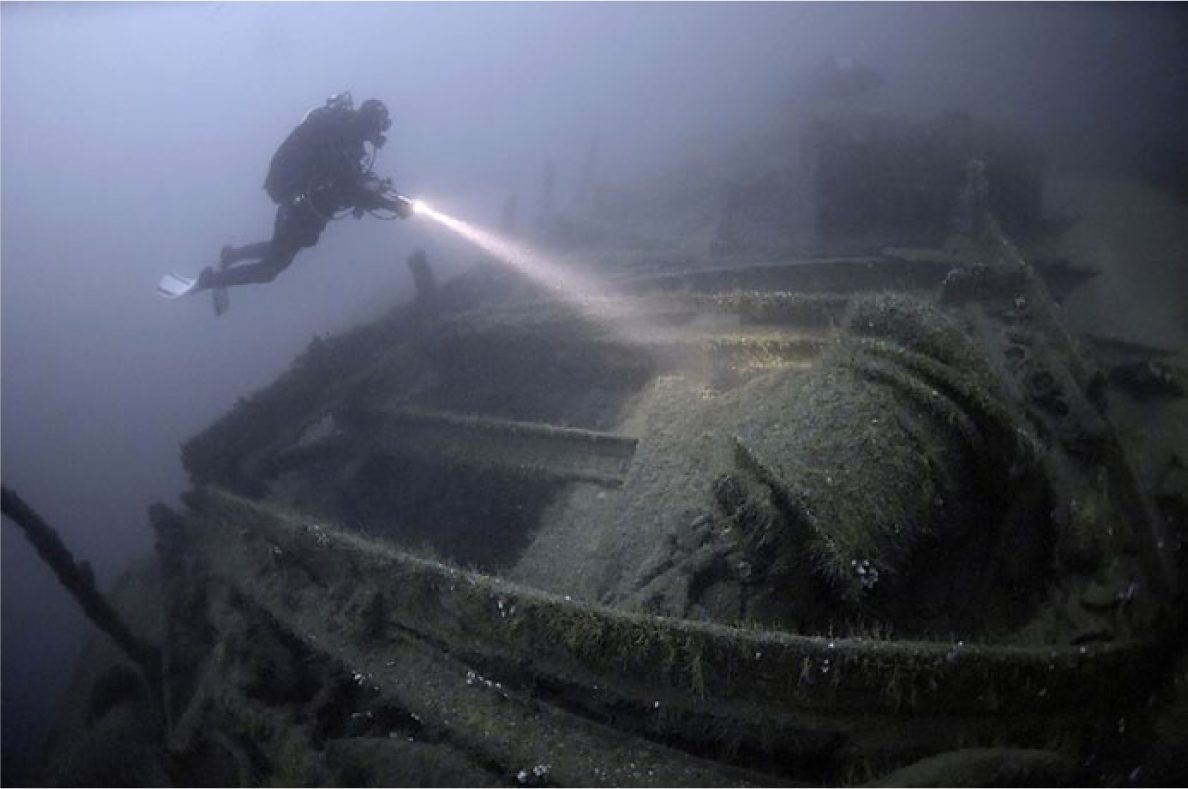
The structure of Smyrna is still relatively intact, with the wreck lying at 55m off the Isle of Wight (used with permission from Steve Jones).

Reconstructed interior of square-rigger Balclutha in San Francisco harbour, including reproduction early twentieth-century berths for Chinese passengers (photograph: Peter Hobbins).
When integrated with textual sources, such encounters facilitate our understanding of the historical communitas shaped by the material boundaries of the ship itself. If its tenuous embrace was driven home when crew or passengers were lost overboard, trepid travellers may have been comforted by Samuel Plimsoll’s ‘costly fittings, solid brass belaying pins and highly-burnished, brass-covered rails and spotless decks’. 22 Conversely, emigrants from humble circumstances were perhaps bemused by such alien comforts as a water distilling apparatus, double-pan flushing toilets, and separate male and female hospitals. Moreover, as archaeologist Michael Moloney suggests, the ‘diversity of integrated and secluded spaces’ aboard sailing vessels ‘[lent] itself well to a physical structuring of social hierarchies and social relationships’. 23
Social and structural segregation
Without doubt, the most profound structures shaping emigrant experiences in the age of sail were the conjoint physical and social barriers that rigidly segregated passengers. These divisions operated at multiple levels, including the vessel’s basic design, surveillance by a hierarchy of shipboard authorities, and the internalisation of British social customs and pretensions.
As early as the 1830s, emigrant vessels were fitted out to maintain discrete living spaces for all souls on board – even the animals. 24 Seamen occupied the drafty foc’sle in the ship’s bow, while single men were accommodated below them in the for’ard compartment. Married couples and their children occupied the ‘tween decks space amidships, while single women remained aft beneath the officers’ and surgeon’s quarters. Internal bulkheads and three discrete stairways minimised the risk of accidental or surreptitious communication between gendered compartments. The consequences for families – and especially children – could be profound. While the UK Passengers Act of 1855 deemed any traveller over the age of 12 to be an adult, manifests from the Smyrna and Samuel Plimsoll reveal that single ‘men’ or ‘women’ included children as young as nine if accompanied by older siblings. 25
Shipboard gendered impediments were more than simply structural, as Samuel Plimsoll passenger Will Sayer noted in 1876: ‘theare is boundaries on deck or notice boards which say single men not allowed abaft this . . . so the single men and single women cannot speak to onanother only them that are brother and sister [sic]’. 26 The only singles permitted to transgress these boundaries were the mess captains, elected within each mess group of eight, who collected supplies from the storehouse and cookhouse amidships in order to prepare meals. 27 The sole occasion during which assisted emigrants could freely mingle was during weekly church services, performed on deck whenever conditions permitted. Cabin passengers – those who fully paid their own way – were allowed more liberties than assisted emigrants, but they comprised a tiny minority of the thousands who sailed to Sydney on Samuel Plimsoll and Smyrna. 28
Further conventions governed interactions between passengers and crew. The large volume of sail carried by clippers made for rapid transits, but necessitated a hefty complement of sailors. For immigrant voyages, Smyrna and Samuel Plimsoll typically employed around 45 men – a tenth of the shipboard population. While ordinary seamen lived above the single men and might socialise with them, contact with women was expressly prohibited. In practice, however, fraternisation was permissible in the open air. After putting their children to bed on 1 April 1879, for instance, emigrants Fanny and Alf Allbon joined many fellow adults on Samuel Plimsoll’s deck. While one sailor auctioned a flying fish, another played the violin, and others sang, danced or orated with commendable eloquence. 29 Thus for passengers who spent on average 80 days sailing from Plymouth to Sydney, the open deck represented more than a salubrious breath of fresh air. It also marked a tangible shift in the social relations so fastidiously observed ‘tween decks.
That enclosed space itself was believed to contribute directly to the passengers’ communal health, and hence how the journey was inscribed upon their memories. Through the nineteenth century, notes medical historian Elise Juzda Smith, ‘the principles of preventive medicine at sea revolved around maintaining a clean, dry, and well-ventilated environment within spaces that were invariably overcrowded, damp, and enclosed’. 30 Upon its first arrival in February 1874, for instance, Sydney advertisements lauded Samuel Plimsoll’s ‘lofty ‘tween decks and large side ports’, suggesting ample airflow. 31 This was not mere puffery implying comfort when transiting the tropics: adequate ventilation was considered essential to maintaining vitality and clearing out disease during extended sea voyages.
Yet while Smyrna and Samuel Plimsoll were effectively of identical design, operated by the same company to carry comparable passenger populations, the sister clippers displayed one profound difference in their naval architecture (Figure 3). Lloyd’s survey reports reveal that although the ‘tween-deck height in Samuel Plimsoll’s emigrant quarters measured an ample 7 feet 4 inches (2.23 m), Smyrna merely met the minimum regulation height of 6 feet 4 inches (1.93 m). 32 Indeed, Smyrna’s quarantine on 19 August 1878 highlighted contradictions in Imperial regulations governing the internal space required per passenger. These acts, complained Robert Pockley, the New South Wales surveyor for passenger ships, ‘appear to designedly leave to the discretion of the Emigration Officer the proportion of space for air, light, and ventilation [in] each compartment carrying emigrants’. 33
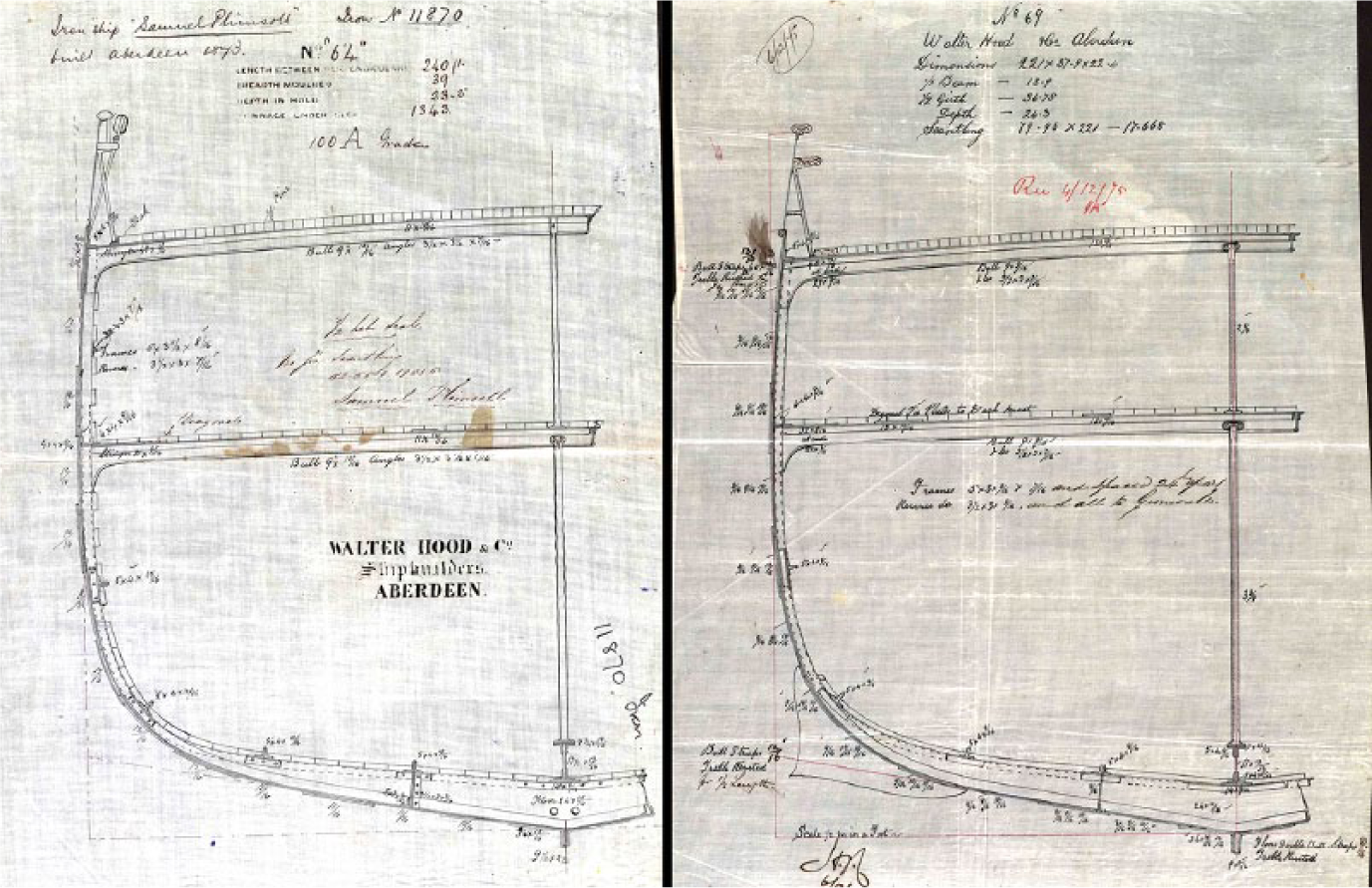
Lloyd’s survey sections of Samuel Plimsoll (left) and Smyrna (right) (used with permission from the Heritage and Educatin Centre, Lloyd’s Register Foundation: LSR IRN 11870 [Iron], LSR IRN 17385 [Iron]).
This spatial differential directly affected passengers’ perceptions of their vessel, perhaps explaining why Smyrna was less frequently memorialised than the famed Samuel Plimsoll. Certainly in 1878 both the New South Wales Agent for Immigration and Smyrna’s surgeon-superintendent concurred that although measles and scarlet fever probably came aboard before embarkation, ‘the malignancy of some of the cases . . . [could] only be attributed to the neglect in making proper provisions for the supply of a sufficient quantity of pure air and light’. 34 Yet illustrating Pockley’s point, on its final emigrant voyage to Sydney in 1883 – during which only one toddler died – it was noted that Smyrna’s ‘ventilating arrangements are very satisfactory’. 35 Indeed, of the pair, Smyrna was arguably the healthier ship. Compared with its sole detention, Samuel Plimsoll was quarantined at the conclusion of three emigrant voyages – on 19 August 1876, 12 June 1879 and 9 July 1880. Ironically, its cleanliness, comfort and general arrangement were praised each time the ship entered North Head Quarantine Station at the entrance to Sydney Harbour. 36
While vessels deemed healthy upon arrival soon disgorged their passengers at Sydney’s bustling wharves, passing into quarantine was typically a less abrupt experience than might be presumed. 37 Emigrants like Sayer could readily read the signs when disease dogged the final weeks of their journey: ‘we are in quaranteen on account of the sickness or feavor theare is the yalow flag flying at the top of the royal mast and the white star line flag on the fore mast and the union jack on the top of the spanker boom [sic]’. 38 Once vessels moored in Spring Cove, off North Head, the transition from ship to shore remained a gradual physical, cognitive and affective process. After disembarkation, detainees were nevertheless subject to another set of physical and statutory boundaries that structured their relationships in quarantine. These conventions not only echoed shipboard divisions; they remain legible in the maritime landscape of North Head today. 39
Arrival also created another community: one awaiting death, recovery or release. Emigrants who landed ill or convalescent were sent to the male or female hospital within the ‘sick ground’. This zone also contained an isolation area for still-healthy individuals who had been in close contact with passengers believed to be carrying infectious diseases. While a hospital hulk moored in Spring Cove often served as a hospice for the desperately ill, the fit arrivals were allowed some liberties within the larger ‘healthy ground’, which ironically also encircled the capacious cemetery. 40 Moreover, through the 1870s steerage passengers were housed in primitive accommodation that echoed the gendered structures of their ship, being allocated respectively to single men, families, and single women. Allbon’s account, for example, concluded with coming ashore at North Head on 13 June 1879 to find ‘four large rooms built separate like pretty Swiss Cottages outside but worse than the ship a great deal inside’. 41 She was at least spared the tents that were still regularly erected to cope with a mass influx of detainees.
Nevertheless, the potential for unsupervised liaisons between men and women – and between sick and healthy arrivals – governed who came ashore and where they were held. A further contributor was the cost of quarantine, which was borne by the shipping company. When Samuel Plimsoll dropped anchor in Spring Cove in 1876, Sayer remained on board, alongside nearly 120 other single men not prostrated with fever. As sick patients were landed, followed by single women and families, he chirped that ‘we are not going ashore yet, but never mind as I am as hapey as ever as A lord and live like A fiteing cock [sic]’. 42 Indeed, the healthy single men never left the vessel which – along with the relatively short detention of 10 days – may help explain the absence of carvings at North Head directly attributable to this quarantine. 43 Such inscriptions, as detailed below, provide lasting insights into how and why specific voyages were commemorated.
Strata of superintendency
Another pronounced contributor to how emigrant voyages came to be inscribed in journals, infant names and quarantine carvings was the subtle and interwoven hierarchies of command and control aboard each vessel. Written accounts suggest that passengers’ informal affiliations were bounded by connections of kinship, class, locality, gender and religion, alongside the often-uneasy companionship enforced via shared messes, dormitories and water closets. Yet all of these spaces and routines were overseen by layers of formal and peer authority that shaped the distinct character and memory of each voyage.
The remit of the ship’s permanent complement – the master, his chief officer, the second and third officers, and the purser – extended far beyond steady seamanship. Emigrants repeatedly praised Samuel Plimsoll’s captain, Richard Boaden, for his adroit handling of the vessel, especially on the 1879 voyage when the ship lost its mainmast in a squall. 44 The passengers furthermore raised three cheers on the 1878 passage when, after crossing the equator, ‘our Captain he did treat us all to a glass of beer’. 45 But the master and his officers also had a vested interest in the health and welfare of their charges. Subject to the testimony of passengers and the report of the ship’s surgeon-superintendent, officers received per-capita payments for every immigrant landed safely. Regulations governing this system had been revised on 1 June 1873, just prior to Samuel Plimsoll sailing for Sydney on its first emigrant voyage. Although altered again on 19 September 1876, this system of gratuities was ‘always found to work very well ensuring thereby more careful conduct on the part of the Master and Officers of the ship towards the Female Emigrants in particular’. 46
The officers’ oversight ranged from testing the preservation of perishables and dispensing sweets to tremulous children, to handcuffing belligerent passengers. Such was the case aboard Samuel Plimsoll on 7 April 1879 when, just two days after the dismasting, impoverished Lancashire labourer James Clemmet was briefly manacled after exchanging blows with fellow steerage passenger Jane Wrightson. Prompted by a mere misunderstanding about soup, this incident illustrated how readily passions and enmities could fester in the enforced maritime neighbourhood ‘tween decks. 47
Undoubtedly the most complex relationship aboard emigrant vessels comprised the overlaid and often competing responsibilities of the captain and the surgeon-superintendent. 48 Since 1815 it had been mandatory for government-chartered vessels conveying more than 50 souls to carry a doctor, a quota subsequently reduced to 30 via the 1855 Passengers Act. 49 By the 1870s the surgeon-superintendent’s task had shed some of its moralising and disciplinarian overtones from the convict and gold-rush eras. 50 Nevertheless, his position was no sinecure: as specified in the sailing orders for Samuel Plimsoll’s first voyage to Sydney in 1874, the surgeon was to ‘exercise general control and superintendence over the Passengers’. 51 This role, reiterated by a New South Wales government instruction of 1883, encompassed the ‘treatment of the sick, the maintenance of cleanliness and order in the Emigrants’ compartments of the ship, and . . . attention to the many matters which concern their health and comforts’. 52
In practice the surgeon’s remit translated into overseeing the nutrition, hygiene, wellbeing, suffering, moral character and general order among a motley community of 450 emigrants, many sharing an ocean voyage, intimate quarters and enforced sanitation for the first time. On Samuel Plimsoll’s 1875 voyage, for instance, surgeon-superintendent William Arthur was praised by emigrant Richard Stead for being ‘very attentive’. Arthur not only advised sending Stead’s feverish and delirious son Sam to the ship’s hospital, but administered cod liver oil and cough mixture to his ailing daughters, Lizzie and Emma. 53
In matters of accommodation, cleanliness, victualling and propriety, however, the potential for clashes of authority, responsibility or personality between the master and the surgeon-superintendent remained ever-present. Aboard Samuel Plimsoll and Smyrna it was bread, rather than disease, which laid bare the apportioning of blame. As a shipboard staple, passengers were entitled to 2½ lbs (1.1 kg) of bread per week. Complaints about its supply were taken very seriously by the colony’s powerful Agent for Immigration and highlighted in his reports to the New South Wales Parliament. 54 En route to Sydney in 1879, Samuel Plimsoll’s emigrants twice reported bad flour and sour bread to surgeon-superintendent Pringle Hughes. After inspecting the flour, supervising the baking of fresh loaves, and seeking advice from the ships’ baker and storekeeper, Hughes attributed the sourness to inclement weather. 55 He also informed captain Boaden, who ordered that the flour casks be opened; finding that one had been exposed to the air, it was cast overboard. 56 Although contrite, Boaden had already been called to account for the poor quality of bread on two previous voyages. 57 The sour aftertaste of complaint thus lingered with this otherwise popular master.
The relationship between the surgeon-superintendent and his matron could likewise be fraught. Usually an older single woman or widow, her responsibilities included regular inspection of all children aboard, establishing a daily girls’ school and reading aloud to illiterate emigrants. She also supervised the single females ‘to prevent any irregularity’ – primarily consorting with men. 58 Yet there was no doubt that the matron remained subject to the authority and judgement of the ship’s surgeon-superintendent. Following Samuel Plimsoll’s 1878 passage to Sydney, Eliza Kent received a severe reprimand after being ‘unfavourably reported upon by the Surgeon-superintendent, chiefly on account of disobedience of orders on various occasions and a want of a proper control over her temper’. 59 Conversely, when Smyrna sailed into quarantine only a few weeks later, surgeon-superintendent Charles Gibson urged that Elizabeth Bant receive £10 superadded to her £40 matron’s gratuity and £30 return fare. This sum, he felt, would recompense her ‘great deal of extra work and anxious responsibility, owing to the excessive amount of sickness’, plus her ‘attention and personal care of a very trying case of mania . . . [and] an extra month of arduous and trying duty in quarantine’. 60
Alongside the majority of the crew, the surgeon-superintendent and matron were employed anew for each voyage. They likewise earned a gratuity for every emigrant landed alive, paid on a scale which increased with the number of passages supervised. Indeed, many doctors and matrons undertook multiple journeys, often on the same vessel. Familiarity with shipboard life did not, however, guarantee a healthy transit. When Samuel Plimsoll was first quarantined in 1876, it represented William Arthur’s thirty-third trip as surgeon-superintendent and Mary Jones’ second as matron. 61 When next quarantined in 1879, Jones was again its matron while the surgeon-superintendent, Pringle Hughes, was completing his fourth voyage, including the vessel’s uneventful 1877 passage. 62 The emigrant community’s gratitude for their skills and solicitude at sea meant that many failings were forgiven or downplayed once a fraught voyage had ended. Even where disease was rife, it was typical for passengers to report that the matron and surgeon had performed their duties ‘in a most satisfactory manner’. 63
Surgeon-superintendents also selected passengers to fulfil various shipboard roles throughout each voyage. 64 Key posts included the baker (£3 and free passage), plus a schoolmaster, cook, water-closet constable and supervisor for the Graveley’s apparatus, which distilled brine into potable water (£5 each). Their remuneration can be valued against the December 1878 wage scales prepared by the Agent for Immigration, suggesting that blacksmiths in New South Wales earned 1s 2d to 1s 6d per hour, bricklayers 10-12s per day and cobblers £1 15s-to £2 10s per week. 65 Women disembarking Samuel Plimsoll in 1880, meanwhile, were hired as domestic servants at an average wage of 8s 8d per week. 66
Further appointments varied with the needs of each voyage. For Samuel Plimsoll’s sickly 1876 passage they included a hospital nurse and assistant (£3 each), plus two sub-matrons, three mess-constables and eight ordinary constables (£2 each). 67 Assisted by temporary nurses and sub-matrons, constables were primarily appointed to maintain good order and health among their peers within each section of the ship. Despite the sums offered, however, not all emigrants relished these positions, especially if it brought them into contact with the sick, dying or dead. 68 Indeed if a vessel was quarantined, higher subsidies were paid for employment as special nurses (£6), surgeon’s assistants, quarantine constables and lamp constables (£3 each), or as gravediggers (whose remittance frequently included alcohol to ease their disquiet). 69
Whether at sea or ashore, the appointment of fellow passengers to positions of nominal authority or tender duty further contributed to the amities and enmities that developed ‘tween decks and in the segregated spaces at North Head. These relationships, in turn, were commemorated in distinct textual traditions that perpetuated emigrant voyages into the decades that followed.
Textual traces of ephemeral passages
Sailing to the antipodes prompted a specific literary culture that sustained many emigrants through their uninterrupted three- to six-month journeys. Reading, suggests literary scholar Bill Bell, became ‘for thousands of seaborne passengers a practical necessity, the profundity of three months in cultural isolation engendering for many the most intense relationship that they would ever have with the printed word’. 70 Indeed the voyage itself, notes Andrew Hassam, ‘was seen as a narrative whether or not it was written down, because all emigrants knew about beginnings, middles, and ends; it was a part of a common way of seeing the world’. 71
A central element in this emplotment was the mere fact that emigrants’ destinations were well defined and described. The certainty of their goal and the regularity of their shipboard lives stood starkly against accounts penned through the preceding centuries, which had flouted ‘the scarcely expressible intensity of sensations experienced by the single voyager alone in the presence of things utterly new and unparalleled’. 72 While nautical novelties such as flying fish and sharks were certainly stock features of many emigrant journals, these documents primarily encapsulated the domestic mundanities of shared meals, climate, gossip and relationships forged at sea. 73
Many journeys indeed passed without major incident. As noted by the colonial Immigration Board, Samuel Plimsoll’s passengers offered ‘no complaints’ for its two 1874 arrivals, nor its voyages to Sydney in 1875, 1877, 1878, 1880, 1882 or 1883. 74 Their communal satisfaction should be interpreted with caution, however. In 1875 the clipper collided with another vessel, resulting in three drownings, while in 1880 it was quarantined and suffered the death of 15 of its own passengers. Seaborne victims were overwhelmingly children: of the 34 emigrants who died en route to Sydney in 1880, just two were aged over 12 years. 75 At an individual or family level, moreover, some voyages proved so singular that passengers inscribed enduring epigraphs into the colonial landscape or their own lineage.
Exploring how protracted ocean voyages shaped both ideas of the self and of global Britishness, historian Tamson Pietsch attends to the shifting scales of identity formation, from internal reflection to profound cultural dislocations on shore. ‘Words,’ she argues, ‘proved a fragile device for containing the self in the midst of so much water.’ 76 As Pietsch admits, however, the experiences of highly literate saloon passengers, travelling from port to port in the enclosed cabins of 1880s steamships, differed profoundly from the enforced community of steerage emigrants at the height of sail. 77 All voyagers, nevertheless, were subject to the shared flux of the climate and the seas when composing accounts such as diaries or shipboard newspapers. 78 Indeed, Sayer’s 1876 journal comprises water-stained pages scrawled with meandering lines that evoke Samuel Plimsoll’s heaving and rolling across the Atlantic and Indian Oceans. 79
Words also governed encounters with seaborne disease and quarantine in Sydney Harbour. The duration of emigrant voyages and their passengers’ often-humble circumstances directly shaped how illness was reported and recorded at sea. ‘For impoverished people who were desperate to find employment and a better life in a new land,’ acknowledges quarantine historian Jean Foley, ‘there was a strong temptation to conceal sickness.’ 80 Examining their unpublished diaries and letters, Krista Maglen proposes that healthy passengers condemned to weeks in quarantine also dealt better with its traumas, inconsistencies and frustrations if they considered their incarceration simply an extension of the voyage. This narrative continuity, she asserts, led emigrants ‘to adhere meticulously to shipboard routines and class structures . . . to tolerate their protracted internment’. 81
These social imperatives therefore shaped how oceanic journeys were formally narrated, as well as who could author such accounts. In her impressive analysis of the 1872 quarantine of the steamer Hero in Sydney, Katherine Foxhall explores the complex tensions of medical detention. In particular, she argues, a satirical periodical published through the ship’s six long weeks at North Head projected ‘the mental universe of a group of privileged, highly mobile men at a moment of personal vulnerability . . . [and] an externally imposed immobility’. 82 Indeed, despite claiming to represent the Hero’s voyage and its irksome interruption, Loganiana omitted the voices of women, children, steerage passengers and lower-ranked crew. Likewise, a contemporaneous inscription incised into the local sandstone – ‘S.S. HERO. / MACARTNEY. / 1872.’ – could be read as a communal commemoration of joint adversity. 83 Yet in carving his own moniker noticeably larger than the ship’s name, Dr George Macartney – the former Attorney-General to the Fijian Government – clearly foregrounded his own august presence into perpetuity.
The tenuous experience of quarantine also highlighted the tension between the finite duration of an emigrant voyage and the intensity of its lived experience. Indeed the conclusion of the journey, notes Hassam, was often ambiguously inscribed. While some shipboard diarists allowed accounts to peter out en route, most completed their narratives either once the ship dropped anchor or within a few days ashore. At this point, he contends, immigrants felt that they had earned ‘the right to presume that the gap between the point of departure and the point of arrival not only has been bridged but has been abolished’. 84 For instance, police constable Richard Stead’s Samuel Plimsoll diary closed once he had ‘first set foot on Australian Shores – Monday 25th October 1875, 430 p.m. North Shore’. 85 The following year, Sayer’s last line also awaited embarkation, eager to ‘tred [sic] on land for the first time since we left Plymouth’. 86 Initially penned while still aboard Samuel Plimsoll, Allbon’s ultimate entry seamlessly extended to 27 June 1879, when her family were finally released from quarantine and disembarked in Sydney. The narrative cycle of the voyage was borne out in her concluding line: ‘We had fourteen deaths & four births’, the latter including her own newborn daughter, Clara. 87
Yet Allbon’s maternity gestures to how other textual traditions commemorated rather than elided the emigrants’ experience of months under sail. Transits to the antipodes regularly delivered a handful of births en route. While convicts were routinely branded with their transport’s name as a permanent administrative postnomial – such as ‘Jones, Mangles’ – a wider maritime tradition saw infants born at sea christened after their vessel or its officers. 88 Samuel Plimsoll Bone, for instance, was ‘Born on the Voyage’ that saw Samuel Plimsoll tie up in Sydney for the first time on 1 February 1874. 89
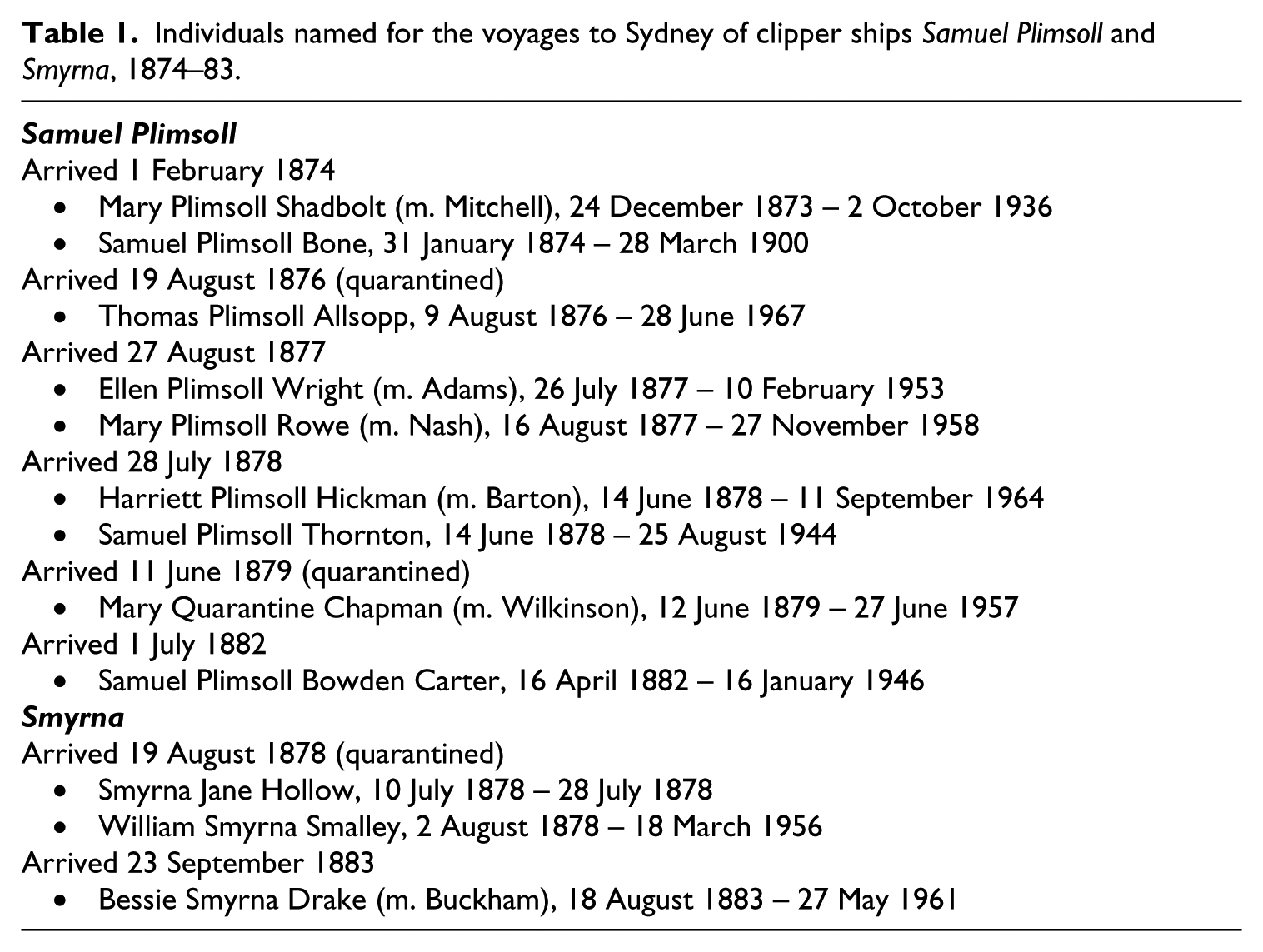
In contrast with ships’ newspapers, which were almost exclusively targeted at the ‘closed community’ of first- and second-class travellers, naming offspring after vessels proved a decidedly demotic form of maritime textual culture. 90 Table 1 details children’s names located by reviewing passenger lists for Samuel Plimsoll and Smyrna, and cross-referencing them against digitised Australian newspapers on the National Library of Australia’s Trove service; the New South Wales Births, Deaths and Marriages database; and the UK Registers of Births, Marriages and Deaths at Sea on the Ancestry genealogy website. 91 The results reveal that over 1874–83, at least nine children bore names directly derived from their parents’ passage to Sydney aboard Samuel Plimsoll, alongside another three for Smyrna. Curiously, although both quarantined and non-detained voyages are represented, these nominal proportions directly reflect the two vessels’ 3:1 ratio of sojourns at North Head. Unsurprisingly, given that the vast majority of parents were assisted emigrants, their occupations were predictably plebeian, including miners, millers, bricklayers, labourers, joiners and servants.
Individuals named for the voyages to Sydney of clipper ships Samuel Plimsoll and Smyrna, 1874–83.
Arguably the most definitive example of this vernacular tradition was Samuel Plimsoll Bowden Carter, delivered half-way through the clipper’s 1882 passage. While the surgeon-superintendent noted ‘Boy born on voyage 16th April to be named “Samuel Plimsoll” Carter’, his parents James and Isabella went one better. 92 Samuel’s third name, ‘Bowden’, was almost certainly a mis-spelled tribute to the ship’s long-serving master, Richard Boaden. Not to be outdone, young Samuel Plimsoll Thornton – born on board in 1878 – was re-christened upon visiting his three-masted namesake when it first hauled freight to Sydney in 1884. Samuel Plimsoll’s new captain, John Henderson, ‘drew a bucket of sea-water out of the harbor [sic], and took the opportunity, in the name of Father Neptune, of baptising the lad “Samuel Plimsoll”’. 93 A more maudlin commemoration was bestowed by Richard and Mary Ann Hollow on Smyrna’s 1878 emigrant passage. Their infant daughter, who was born aboard but then died at sea of ‘Marasmus’ (malnutrition), was christened Smyrna Jane Hollow. 94 It was, perhaps, an attempt at not only ‘emotionally processing and containing the experience but also in making profound spiritual sense of it’. 95
This novel form of inscribing the ephemeral shipboard community might also persist well beyond the individual’s death. Perhaps the most enduring example commenced with Thomas and Margaret Smalley, caught up in Smyrna’s 1878 quarantine at North Head. Although they were not directly afflicted by the many maladies aboard, it was clearly a traumatic voyage. Margaret’s 1929 obituary – printed over half a century after their arrival in New South Wales – noted that the ‘vessel experienced a terrific storm of [sic] St. Paul’s Island’ (Île Saint-Paul in the Southern Indian Ocean). 96 Settling in the New South Wales township of Penrith, they named their home Smyrna – a moniker that the cottage apparently bore until its demolition in 1970. 97 Furthermore, their son, born aboard on 2 August 1878, was christened William Smyrna Smalley. Not only was this unusual nautical association noted in his 1956 obituary; his brother Tom – born in Penrith in 1882 – passed down the tradition to his own son. 98 Born in 1914, Darcy Smyrna Smalley died only in 2004, his plaque at Sydney’s Pinegrove Memorial Park concluding a direct 126-year association with a remarkable emigrant voyage (Figure 4).

Memorial plaque for Darcy Smyrna Smalley, 1914–2004, Nature Grove, Paradise 2, Pinegrove Memorial Park, Sydney (author photograph).
Carving out communities in quarantine
In 1879 another family coined a unique living memento of their emigrant journey while contributing to a materially different textual tradition. John and Jane Chapman became parents just a day after Samuel Plimsoll was detained at North Head on 11 June. Although their daughter remained unnamed until the family’s release, her birthplace proved no impediment to longevity. Mary Quarantine Chapman lived until 1957, although sadly her unprecedented middle name seemingly died with her.
Mary’s father also etched out another monument to the family’s month at North Head. Carved into a profuse ‘gallery’ wall of inscriptions created by detainees is a small framed panel bearing four lines of text. While the second and fourth entries have been effaced by time, the legible lines read ‘J CHAPMAN’ and ‘T H CLAИK’ (note the reversed ‘N’). 99 Chapman is a relatively common surname; indeed, in 1879 Samuel Plimsoll conveyed James Chapman and his wife Mary Ann, their daughter Jane, plus son John and his wife, also named Jane. Thus there were four possible authors for ‘J CHAPMAN’ aboard this one emigrant ship – not to mention the passengers or crew from any one of the approximately 580 vessels quarantined at North Head over its operational life from 1835 to 1984. 100
Nevertheless, a combination of documentary and archaeological evidence suggests that this panel was indeed incised by Mary Quarantine Chapman’s father. While the 1879 arrival manifest for Samuel Plimsoll records Lancashire coach smith ‘Thomas M Clark’ and his wife Sarah, the vessel’s departure record lists him as ‘Thomas M Clank’. 101 The very fact that the author of this inscription made the surprisingly common error of carving his ‘N’ backwards arguably affirms his unusual surname. As a married couple, the Clanks would have shared the clipper’s family compartment with John and Jane Chapman. Since Thomas was aged 27, the age and gender dynamics of the era suggest that he and 23-year-old John Chapman created this framed panel together during their June 1879 detention. A similar triangulation of archaeological and archival evidence argues that the families of miner John Waugh and labourer Richard Hodge also shared ‘tween-decks married quarters on Smyrna’s 1878 voyage to Sydney. Perhaps advertising both their arrival and their literacy, the men’s carvings were etched in close proximity on 20 August – a day after the clipper’s entry into quarantine. 102
Such inscriptions, often created at the moment in which emigrants became immigrants, represented both an act of place-making and an enduring memorial to their ephemeral maritime community. North Head Quarantine Station boasts nearly 1,600 such carvings, with a pronounced cluster crafted by travellers detained in the 1870s. 103 They were engraved by an increasingly literate passenger community. Of the 3,516 assisted emigrants who arrived in Sydney aboard 13 sailing vessels over 1874–76, exactly two-thirds claimed that they could read and write – an impressive proportion given that the total number included infants and young children. 104
The quarantine setting was also significant. ‘Mark-making in institutional contexts,’ note archaeologists Anne Clarke and Ursula Frederick, ‘can operate simultaneously as intensely private declarations of presence, remembering and commemoration, and as public utterances to be seen, shared, read, copied, and re-interpreted.’ 105 In this sense, the North Head assemblage differs from other informal textual traditions such as the carved trees and inscribed water tanks that dot inland Australian stock routes. Signifying waystations in eternally mobile lives, they exchange greetings, jokes or recriminations aimed primarily at fellow pastoral workers. 106 This conversational context is shared by many maritime sites, including Booby Island off Queensland, Angel Island in San Francisco and the twentieth-century quarantine inscriptions in Sydney, commonly crafted by the crews of ships that circuited the Pacific Ocean. 107 North Head’s nineteenth-century assemblage, however, functioned primarily as monodirectional ‘postcards’ passing from a historical present into the future. 108
Naturally, the vast majority of detainees hoped never to return to the Quarantine Station. Many nevertheless retained intense associations with their voyage, and most of all the vessel. Having survived its 1879 detention, for instance, in July 1880 Fanny Allbon wrote to her siblings that ‘The Samuel Plimsoll has arrived safely at Sydney again came in 70 days was unfortunate enough to lose 15 this voyage was put into quarantine for two weeks [sic].’ 109 Although some inscriptions were updated by crews of vessels quarantined more than once – such as the China Navigation Company steamer Taiyuan (1894/1912) – former emigrants rarely returned to survey their carved mementoes. 110 A rare exception was the survivors of the emigrant ship Constitution, quarantined in 1855. Jubilee reunions were held after 50 and 75 years at the elaborately carved obelisk that marked its visit. 111 ‘Somebody said that there were some engravings on the rock behind the carpenters’ shop, which would interest the “Constitutionists”,’ observed Sydney’s Evening News in 1905, ‘but the rocks had been overgrown with moss and other foliage.’ 112
From 1855 such communal commemorations of the voyage became a standard motif at North Head. A damaged 1878 memorial to Smyrna, for instance, once adorned the Quarantine Station’s cliff face until it fell out to form a hefty free-standing boulder (Figure 5). 113 This elaborate inscription would have served as a virtuoso piece for its creator, whilst ostensibly recording the essence of the voyage. Iterating the vessel, date, days at sea and tally of 455 emigrants, the panel also lists the key authority figures on board: captain Robert Jamieson; surgeon-superintendent Charles Gibson; chief officer Thomas Spalding; second officer George Espie and – apparently – matron Elizabeth Bant. While it omits the third officer and purser – whose role was to distribute provisions – the panel nevertheless remains an enduring monument to the shipboard community of emigrants and those who oversaw their welfare.
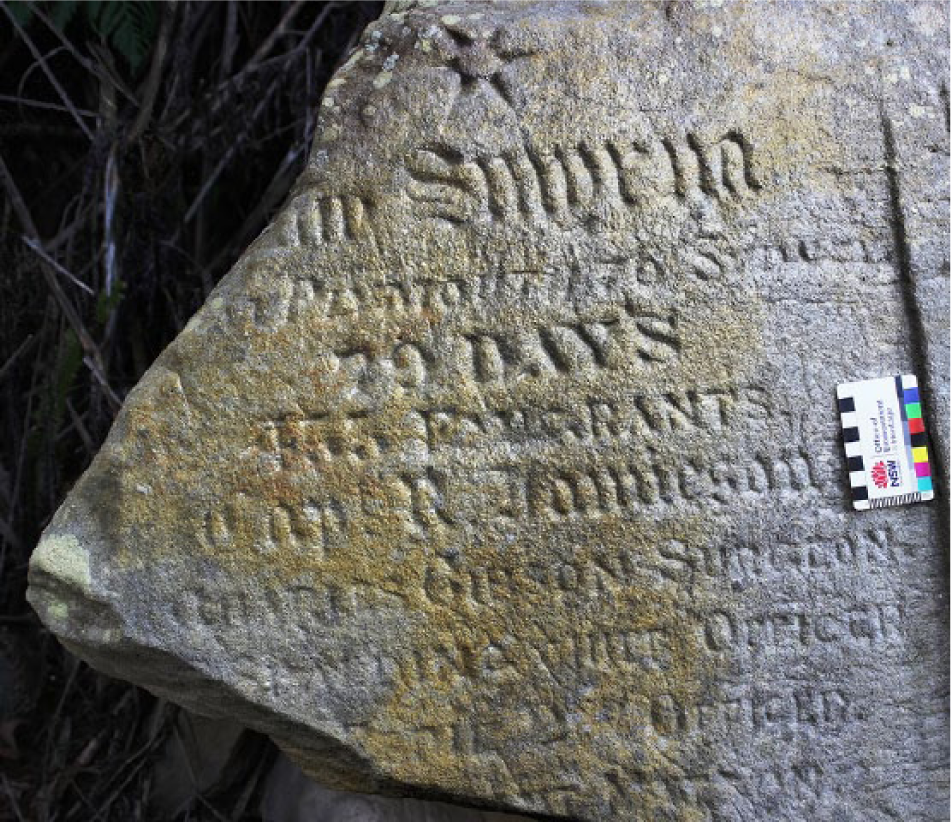
Inscription at North Head Quarantine Station attributed to Benjamin Leyson, commemorating the 1878 voyage of Smyrna from Plymouth to Sydney (photograph: Ursula K Frederick. Photographed on location at Sydney Harbour National Park).
Given its impressive quality, the carving is curiously anonymous. Evaluation by modern monumental masons concludes that the ‘design of the panel and the choice of fonts strongly suggests that the practitioner had a background in monumental masonry’. 114 Smyrna’s manifest records only one likely candidate – Benjaman [sic] Leyson, a monumental mason of Glamorganshire, Wales, whose prior commissions included the railway arch in the Swansea suburb of St Thomas. 115 Leyson travelled to Sydney with his wife Hannah and four children, plus infant Catherine who was apparently born at sea then ‘Died during voyage’. 116 The ship had embarked with 453 passengers, to which four births were added and nine deaths subtracted, leaving 448 souls arriving in Sydney. 117 Perhaps – like the bereaved parents of Smyrna Jane Hollow – Leyson chiselled ‘455 EMIGRANTS’ into the sandstone both to acknowledge and to mourn Catherine’s fleeting oceanic existence.
Just a year later, Lanarkshire mason John Howie created an even more impressive bas-relief panel for the 1879 quarantine of Samuel Plimsoll. 118 Naming himself at the foot of the inscription, Howie followed the Smyrna template to list the ship’s name, arrival date, emigrant count and shipboard authority figures. Almost, that is: in Howie’s monument, purser John Roberts is named but surgeon-superintendent Pringle Hughes is not. Given that Captain Boaden bore the brunt of the blame for the clipper’s sour bread fiasco, this omission seems puzzling. Indeed, throughout the same voyage Fanny Allbon praised Hughes for his attendance upon her family’s constant ailments and her own pregnancy and delivery. 119
But the doctor’s ministrations had not saved John and Agnes Howie’s first son. William Howie, aged 1, died from ‘Diarrhoea’ on 10 June – just a day before the ship moored. 120 His father, pointedly and into perpetuity, excluded Hughes from this engraved testament to the floating community that the surgeon-superintendent had tended for 82 days. 121 As with Hero’s quarantine seven years earlier, authorship conveyed selective privileges. Howie’s bereavement furthermore remained emblazoned in his memory – as did the ship that brought him to Sydney. John’s next son, born in Sydney in 1880, was named William after his deceased brother. Moreover, despite a lengthy and successful career in Sydney, Howie’s 1917 obituaries prominently recalled the ‘long series of misfortunes’ that characterised his 1879 voyage aboard Samuel Plimsoll. 122
Whilst Howie was not the only mason aboard Samuel Plimsoll, he was certainly the most prolific. 123 Another carefully shaped inscription from 1879 records ‘MARY HOWIE. / A. HOWIE. / WM FAIRFOULL. / ANDW REID. / JOHN HOWIE.’ (Figure 6). 124 Presuming that John was the author, did ‘A. HOWIE’ represent his wife Agnes or brother Archibald? Also a mason, Archie had travelled in the single men’s compartment, while their sister Mary, aged 16, sailed as a single woman. The carving furthermore captures two male heads of families who joined John and Agnes Howie amidships: labourer Andrew Reid of Edinburgh, who sailed with his wife Christina and two children, plus William and Amelia Farefoot [sic] from Linlithgow. Thus, 140 years later, this neatly lettered list continues to unite a group of Scots whose emigrant voyage spanned all three ‘tween decks compartments.
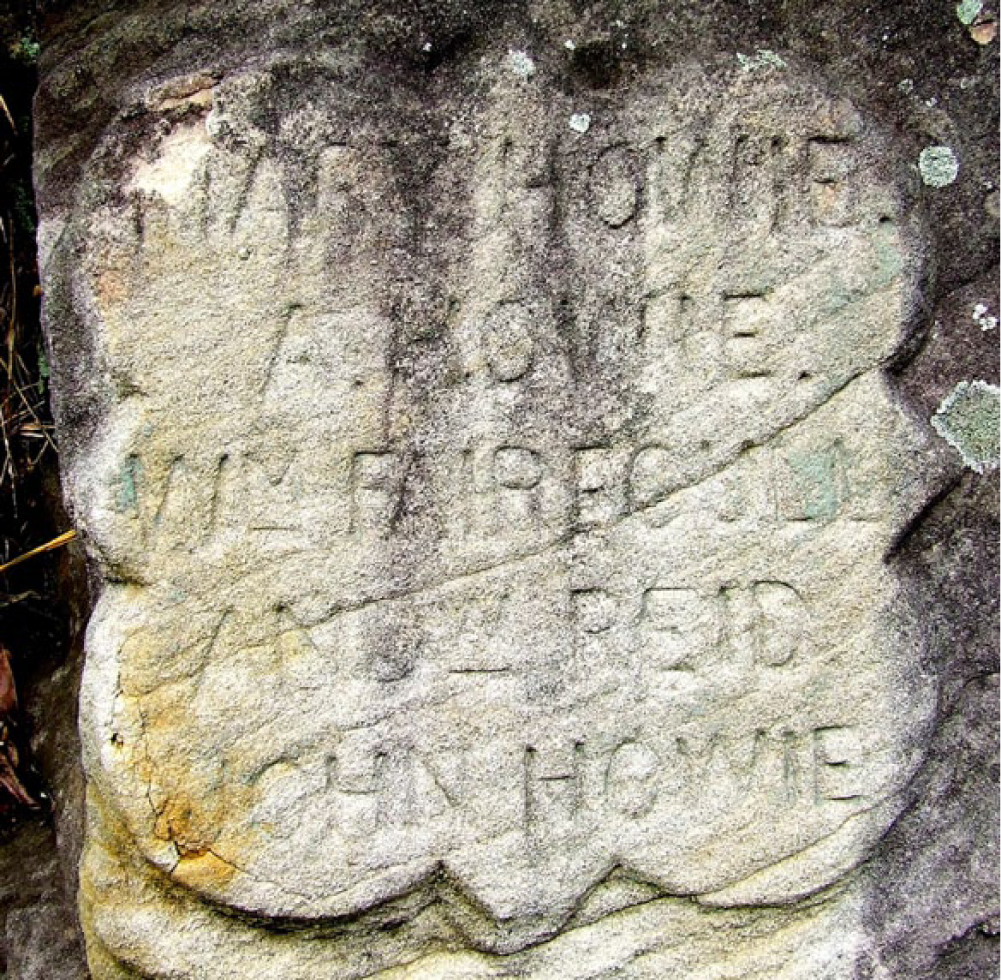
Inscription at North Head Quarantine Station attributed to John Howie, listing members of his family and fellow immigrants on the 1879 voyage of Samuel Plimsoll from Plymouth to Sydney (photograph: Peter Hobbins. Photographed on location at Sydney Harbour National Park).
In contrast, a third inscription attributed to Howie tantalisingly alludes to a long-forgotten schism within this enclosed community. Nestled at ground level on a sloping pathway is ‘SHIP / SAML PLIMSOLL / J. GENTLEMAN / SCOUNDREL.’. 125 The voyage and passenger are clear: Samuel Plimsoll indeed carried John Gentleman and his wife Betsy in 1879. While this wheelwright from Stirling shared the family compartment with the Howies, Reids and Fairfoulls, none of the written accounts of the voyage report any confrontation between these passengers. Despite Howie’s diligence in creating this lasting damnation, his motivation remains elusively private. Perhaps as an ironic riposte, ‘J. GENTLEMAN’ left his own well-preserved graffito on the cliff face, sited directly below Howie’s detailed memorial to Samuel Plimsoll’s 1879 voyage. 126
Collectively, this assemblage of inscriptions represents an enduring if fragile memento of Smyrna’s 1878 quarantine and Samuel Plimsoll’s 1879 detention. Yet both their content and spatial clustering drive home a critical point: these carvings commemorate the shared community of the voyage, rather than the onerous process of quarantine. 127 In general, the segregations imposed and enforced aboard ship were perpetuated within Sydney’s Quarantine Station – at least until numbers dwindled to a critical level. 128 Yet despite the fractious circumstances that resulted in fat archival dossiers surviving for both of these protracted detentions, the carvings were created just days or weeks after the emigrants came ashore, when memories of their enclosed oceanic life remained vivid.
In the 1870s, release from quarantine was a piecemeal and often tardy process. 129 Smyrna landed its passengers at North Head on 19 August 1878. By 27 September, 78 still remained, although neither the Hodges, the Waughs nor the Leysons were among them. 130 By 7 October the quarantine had dwindled to nine passengers, a doctor, two police constables and two nursing attendants. 131 Despite the tedium of their eight-week incarceration, nobody from this small community can be linked to inscriptions now visible at the site. Likewise, although 50 passengers were retained at North Head nine days after Samuel Plimsoll was quarantined in 1879, both the Howie and Gentleman families had already departed. John, Jane and Mary Quarantine Chapman were among the 35 additional arrivals released on 20 July. The residual 15 immigrants were not, however, freed until 8 October – almost four months after disembarking. 132 In the meantime a sexual scandal had riven the small community. Although beyond the scope of this article, its lurid archival documentation is not matched by commemorations or accusations carved into the local sandstone. 133
Two final engraved relics remain from these memorable voyages. In the Quarantine Station’s largely cleared second burial ground, a lonely headstone marks the remains of Smyrna passenger Isaac Lowes, who died at North Head on 25 August 1878. 134 Recorded as five years old in the manifest but ‘AGED 6 YEARS’ on his monument, Isaac’s father Joseph had been appointed one of the ship’s three married quarters constables. 135 As such he would have nominally exerted authority over fellow emigrants Charles and Maria Convoy, plus their nine children. Joseph’s supervision was not sufficient to prevent another tragedy, however: four-year-old Thomas Convoy barely made it ashore before dying on 21 August. It seems that the families were united in their grief, as a historic photograph reveals that the two boys were buried beside each other. Yet Thomas’s headstone was removed in 1928 when the cemetery was cleared and is now displayed as an item of movable heritage. 136 There is a sad irony in its migration half-way across the site to the present-day Q Station Visitor Centre. Given North Head’s isolated location and administrative function, it is unlikely that their families ever visited Isaac or Thomas again. Thus, ‘from beach to burial ground, arrival to departure, the historical and archaeological records of quarantine also evocatively embrace the cycle of life itself’. 137
Elision and commemoration
Literary analyses of accounts penned or published at sea tend to suggest that writing merely marked off an oceanic interlude. Once the covers were closed or envelopes were sealed, passengers simply relegated the voyage to a forgotten chapter in their life history. In such readings both the vessel and its ephemeral community were soon forgotten amid the challenges of prospering in a new land. 138
Yet as this paper demonstrates, writing remained only one textual tradition for recording emigrant journeys in the twilight of sail. Passengers who christened their sea-born children after the vessel generated a living legacy, perpetuating the voyage through their lineage and evoking the ship’s name down the decades via houses, stories, obituaries and headstones. Likewise, carvings incised by individual passengers – or on behalf of their ship – marked out a unique one-directional tradition at Sydney’s North Head Quarantine Station. Crafted rapidly as a record of their passage and arrival, the creators hoped fervently never to see their work again. Nevertheless, their engraved mementoes preserve the social and spatial aspects of the voyage that brought them into the maritime landscape of quarantine. While both this place and period of detention has also been rendered as ‘liminal’, the relative physical permanence of emigrants’ inscriptions suggests that they were reluctant to see their experiences simply sidelined. 139 Rather, their informal inscriptions participated in an evolving tradition to create a more egalitarian ‘landscape of memory’, both distinct from yet overlapping with local shipwreck memorialisation practices. 140
Indeed, these textual traditions pose a key question: when did the voyage end? Once emigrants disembarked and refashioned themselves as colonists, perhaps their very process of becoming was engraved into the sandstone of North Head. Arguably, the quarantine carvings conjointly record old identities left behind and new personas emerging at the entrance to Sydney Harbour. Yet many could not cast off the connection they felt to their voyage, nor to individual vessels. Lasting long after Smyrna and Samuel Plimsoll slipped beneath the surface, emigrants’ journals, children’s names and informal inscriptions still evoke the intimate and unique communitas of shared months at sea under yards of sail.
Footnotes
Acknowledgements
This research was undertaken as part of the Quarantine Project supported by the Australian Research Council. We wish to acknowledge our Linkage Industry Partner, the Mawland Group, who generously contributed both funds and in-kind support. We thank the School of Philosophical and Historical Inquiry at the University of Sydney for supporting our research. Our colleague and Partner Investigator, Professor Alison Bashford from the University of New South Wales, urged us to address the importance of Australia’s global connections throughout the nineteenth century. Dave Wendes and Steve Jones of the Maritime Archaeology Trust kindly provided information and images on the wreck of Smyrna, and Myra Stanbury at the Western Australian Museum supplied pictures of Samuel Plimsoll’s figurehead. Lady Jean Foley shared her unpublished data on the Quarantine Station and its burial grounds, and the Q Station guides assisted with further site-specific information. The recordings and photographs were made in Sydney Harbour National Park, with the permission and generous assistance of the National Parks and Wildlife Service (New South Wales).
Funding
The author(s) disclosed receipt of the following financial support for the research, authorship, and/or publication of this article: This work was supported by the Australian Research Council Linkage Grant LP120200259.
1.
J. W. Holmes, ‘Fifty Years in Sail’, in Clarence Winchester, ed., Shipping Wonders of the World (London, 1937), 1231.
2.
Frances Steel, ‘Re-Routing Empire? Steam-Age Circulations and the Making of an Anglo Pacific, c.1850–90’, Australian Historical Studies, 46, No. 3 (2015), 363–72.
3.
Peter Hobbins, ‘Union Jack or Yellow Jack? Smallpox, Sailors, Settlers and Sovereignty’, Journal of Imperial and Commonwealth History, 45, No. 3 (2017), 6–7.
4.
Robert Kubicek, ‘The Proliferation and Diffusion of Steamship Technology and the Beginnings of “New Imperialism”’, in David Killingray, Margarette Lincoln and Nigel Rigby, eds., Maritime Empires: British Imperial Maritime Trade in the Nineteenth Century (Woodbridge, 2004), 100–10.
5.
Cindy McCreery and Kirsten McKenzie, ‘The Australian Colonies in a Maritime World’, in Alison Bashford and Stuart Macintyre, eds., The Cambridge History of Australia, Volume 1: Indigenous and Colonial Australia (Port Melbourne, 2013), 560–84.
6.
Robin Haines, Life and Death in the Age of Sail: The Passage to Australia (Sydney, 2003), 38–46.
7.
Frances Steel, ‘Women, Men and the Southern Octopus: Shipboard Gender Relations in the Age of Steam’, International Journal of Maritime History, 20, No. 2 (2008), 285–306.
8.
Roland Wenzlhuemer and Michael Offermann, ‘Ship Newspapers and Passenger Life Aboard Transoceanic Steamships in the Late Nineteenth Century’, Transcultural Studies, 3, No. 1 (2012), 89.
9.
10.
Marjorie Harper, ‘Pains, Perils and Pastimes: Emigrant Voyages in the Nineteenth Century’, in Killingray, Lincoln and Rigby, eds., Maritime Empires, 163–7.
11.
Anne Clarke and Ursula Frederick. ‘“Rebecca Will You Marry Me? Tim”: Inscriptions as Objects of Biography at the North Head Quarantine Station, Manly, New South Wales’. Archaeology in Oceania, 47 (2012), 84–90; Andrew Hassam, No Privacy for Writing: Shipboard Diaries 1852–1879 (Melbourne, 1995), xv–xvi, 93.
12.
Malcolm Tull, ‘The Interdisciplinarity of Maritime History from an Australian Perspective’, International Journal of Maritime History, 29, No. 2 (2017), 336–43.
13.
James William Holmes, Voyaging: Fifty Years on the Seven Seas in Sail (Lymington, 1965), 54.
14.
David Savill and Duncan Haws, The Aberdeen and Aberdeen & Commonwealth Lines of George Thompson (Hereford, 1989), 50–3.
15.
For instance, as children under 12 years of age were considered half a statute adult, the 456 souls who landed in Sydney at the conclusion of Samuel Plimsoll’s 1879 voyage translated to just 380.5 statute adults: SARNSW, ‘Samuel Plimsoll, arrived 12 June 1879’, Reel 2141, 4/4803.
16.
Peter Worsley, ‘The Samuel Plimsoll’, Maritime Heritage Association Journal, 6, No. 4 (1995), 3–5; Nick Burningham, ‘Some Excursions on the Clipper Samuel Plimsoll’, Maritime Heritage Association Journal, 7, No. 2 (1996), 13–16; David C Wendes, South Coast Shipwrecks: East Dorset and Wight 1870–1979 ([S.l.], 2006), 43.
17.
The Times (London), 28 July 1888.
18.
Maritime Archaeology Trust, ‘Smyrna’,  (accessed 21 December 2018); Richard A. Gould, Archaeology and the Social History of Ships, 2nd ed. (New York, 2011), 248–67; David Wendes, personal communication with author, 25 February 2014; Michael J. Moloney, ‘Re-Imagining Shipboard Societies: A Spatial Approach to Analysing Ships of the British Royal Navy during the Eighteenth and Nineteenth Centuries’, International Journal of Maritime History, 30, No. 2 (2018), 315–42.
19.
Laurie Williams, ‘The Dalgoma Incident’, World Ship Society Fremantle Branch Newsletter (1996), 642–3; Western Australian Maritime Museum, Fremantle, ‘[Cuttings and Photographs of Ship Samuel Plimsoll, Especially after Wrecking]’ (n.d.); National Archives of Australia, ‘Damage Caused to HMAS Cairns & HMAS Mary Cam – Collision with Sunken Coal Hulk Samuel Plimsoll’, Series MP1049/5 Control 2026/14/652, 1945.
20.
Aberdeen Art Gallery and Museums, ‘Bridge bell from Clipper Ship Samuel Plimsoll’, ABDMS091205, 1873; Australian National Maritime Museum, ‘Medicine chest from the Samuel Plimsoll’, 00033620, 1899; Western Australian Museum Shipwrecks Galleries, ‘Samuel Plimsoll figurehead’, CH 680, 1873.
21.
See National Park Service, ‘Balclutha’, (accessed 11 January 2019). For phenomenological method, see for instance Phillip Vannini, ‘Material Culture Studies and the Sociology and Anthropology of Technology’, in Phillip Vannini, ed., Material Culture and Technology in Everyday Life: Ethnographic Approaches (New York, 2009), 15–26; Christopher Y. Tilley, Interpreting Landscapes: Geologies, Topographies, Identities (Walnut Creek, 2010), 25–40.
22.
Quoted in Basil Lubbock, The Colonial Clippers (Glasgow, 4th ed., 1975), 204. For passengers falling overboard, see Papers of Anne Pine, ‘The Diary of Will Sayer’, 26 July 1876; this diary has also been transcribed and corrected as Will Sayer and Parkes & District Historical Society, The Diary of Will Sayer (Parkes, 1989).
23.
Moloney, ‘Re-Imagining Shipboard Societies’, 332.
24.
D. E. Charlwood, The Long Farewell (Ringwood, 1981), 104–31.
25.
United Kingdom, An Act to Amend the Law Relating to the Carriage of Passengers By Sea (1855), Schedule B.
26.
‘The Diary of Will Sayer’, 25 August 1876.
27.
‘The Diary of Will Sayer’, 1 June 1876.
28.
For instance, 1,699 passengers on board a sample of four voyages included just two paying passengers, both aged over 50 and hence unlikely to receive assistance to emigrate as useful labour: SARNSW, ‘[Report of Immigrant Ship Samuel Plimsoll]’, Series 905 Container 1/2492 item 80/6454, 1880; ‘The Agent for Immigration to the Principal Under Secretary reporting the arrival of the Ship “Samuel Plimsoll” and disposal of the immigrants by that vessel’, 905 1/2492 80/6454, 1880.
29.
National Library of Australia (hereafter NLA), Canberra, ‘Diary of Elizabeth Allbon’, MS 1966, 1879.
30.
Elise Juzda Smith, ‘“Cleanse or Die”: British Naval Hygiene in the Age of Steam, 1840–1900’, Medical History, 62, No. 2 (2018), 178.
31.
Lubbock, The Colonial Clippers, 202, 204.
32.
The Heritage & Education Centre, Lloyd’s Register Foundation, London, ‘First Entry Lloyd’s Survey Report (and Any Plans) for the Samuel Plimsoll (1873) Built by Walter Hood & Co, Aberdeen’, LSR IRN 11870 (Iron), 1873 and ‘First Entry Lloyd’s Survey Report (and Any Plans) for the Smyrna (1876) Built by Walter Hood & Co, Aberdeen’ LSR IRN 17385 (Iron), 1876.
33.
Legislative Assembly New South Wales, Votes and Proceedings of the Legislative Assembly During the Session 1878–9, With the Various Documents Connected Therewith, vol. VII (Sydney, 1879), 410. See also Smith, ‘Cleanse or Die’, 185–6.
34.
New South Wales Legislative Assembly, Votes and Proceedings, 409.
35.
SARNSW, ‘[Report on Immigrant Ship Smyrna]’, 905 1/2538 83/9132, 1883.
36.
For example, SARNSW, ‘[Immigration Agent’s Report on Samuel Plimsoll, Arrived 12 July 1879]’, 905 1/2460 79/9022, 1879.
37.
Krista Maglen, ‘Quarantined: Exploring Personal Accounts of Incarceration in Australian and Pacific Quarantine Stations in the Nineteenth Century’, Journal of the Royal Australian Historical Society, 91, No. 1 (2005), 3.
38.
‘The Diary of Will Sayer’, 20 August 1876.
39.
Peta Longhurst, ‘Quarantine Matters: Colonial Quarantine at North Head, Sydney and Its Material and Ideological Ruins’. International Journal of Historical Archaeology, 20, No. 3 (2016), 589–600.
40.
Jean Duncan Foley, in Quarantine: A History of Sydney’s Quarantine Station, 1828–1984 (Kenthurst, 1995), 10–1.
41.
‘Diary of Elizabeth Allbon’, 13 June 1879.
42.
‘The Diary of Will Sayer’, 25 August 1876.
43.
SARNSW, ‘[Report of Immigrant Ship Samuel Plimsoll]’, 905 1/2341 76/6554, 1876.
44.
See Cyril L. Hume and Malcolm C. Armstrong, The Cutty Sark and Thermopylae Era of Sail (Glasgow, 1987), 79–81.
45.
NLA, J. R. Ward, ‘Papers’ – ‘Lines as Composed by a Passenger on Board of the Ship Samuel Plimsoll May 3rd 1878’, MS 7419, 1878.
46.
SARNSW, ‘Reports by Immigration Board on Condition of Immigrants and Ships on Their Arrival, 1837–1896’ – ‘Report on Immigrant ship Samuel Plimsoll’, NRS 5255 Container 4/4625, 12 February 1874.
47.
SARNSW, ‘Samuel Plimsoll – Inquiry by Immigration Board into Conduct of Surgeon’, notes of testimony by James Hamilton, John Bell, Jane Wrightson, Mary Ann Chapman and James Clemmet, 906 4/817.2, 1879; SARNSW, ‘[Mrs Clemmett – Samuel Plimsoll]’, 905 1/2446 79/4976, 1879.
48.
Kathrine M. Reynolds, ‘Surgeons’ Journals: An Underused Source for Australian Convict History, 1817–1843’, Journal of the Royal Australian Historical Society, 101, No. 2 (2015), 194–204; Robin F Haines, Doctors at Sea: Emigrant Voyages to Colonial Australia (New York, 2005), 1–16.
49.
Charles Bateson, The Convict Ships, 1787–1868, 2nd ed. (Sydney, 1974), 47–52; Passengers Act 1855, Section III. Two surgeons might be carried if the number of souls exceeded 400.
50.
R. V. Jackson, ‘Sickness and Health on Australia’s Female Convict Ships, 1821–1840’, International Journal of Maritime History, XVIII, No. 2 (2006), 65–84; David Hastings, Over the Mountains of the Sea: Life On the Migrant Ships, 1870–1885 (Auckland, 2006), 197–222; Robin Haines, ‘Ships, Families and Surgeons: Migrant Voyages to Australia in the Age of Sail’, in David Boyd Haycock and Sally Archer, eds., Health & Medicine at Sea, 1700–1900 (Woodbridge, 2009), 172–94.
51.
SARNSW, ‘[List of Immigrants on Board Ship Samuel Plimsoll]’ – ‘Sailing orders’, 905 1/2248 74/729, 19 November 1873.
52.
SARNSW, ‘[Instructions to Matrons of Emigrant Ships]’ – ‘Instructions to Surgeon-Superintendents of Emigrant Ships of the Government of New South Wales’, 905 1/2536 83/7976, 1883.
53.
State Library of New South Wales (hereafter SLNSW), Richard James Stead, ‘Diary of Voyage Plymouth to Sydney on Samuel Plimsoll’, MLMSS 4226,16–17 September 1875.
54.
SLNSW, ‘Passengers’ Contract Tickets (2) Issued to Jonathan Jones and Family on the Samuel Plimsoll, No. 9, 1 April 1882’, MLDOC 2331, 1882.
55.
SARNSW, 905 1/2460 79/9022, Pringle Hughes to G. F. Wise, 4 July 1879.
56.
SARNSW, 905 1/2460 79/9022, Richard Boaden to G. F. Wise, 4 July 1879.
57.
SARNSW, ‘[Report of Immigrant Ship Samuel Plimsoll]’, 905 1/2443 76/6967, George F Wise to Richard Boaden, 31 August 1876; Katherine Foxhall, Health, Medicine, and the Sea: Australian Voyages, c.1815–1860 (Manchester, 2012), 91–112; Sydney Morning Herald, 6 February 1874.
58.
SARNSW, ‘Matron’s instructions’, 905 1/2248 74/729, 19 November 1874.
59.
SARNSW, ‘[Report of Immigrant Ship Samuel Plimsoll]’, 905 1/2417 78/6968, 1878; Jan Gothard, Blue China: Single Female Migration to Colonial Australia (Carlton South, 2001), 142.
60.
New South Wales Legislative Assembly, Votes and Proceedings, 409. For a similar case on Samuel Plimsoll, see SARNSW, ‘[Bridget McCormick – Samuel Plimsoll]’, 905 1/2491 80/6088, 1880.
61.
SARNSW, 905 1/2443 76/6967.
62.
SARNSW, ‘[Report of Immigrant Ship Samuel Plimsoll]’, 905 1/2382 77/7417, 1877 and 905 1/2460 79/9022, 1879.
63.
SARNSW, 906 4/817.2, George Wise, memoranda concerning Miss Jones, 4 July 1879, and Pringle Hughes, 1 September 1879.
64.
Haines, Doctors at Sea, 118–32.
65.
SARNSW, ‘Immigration Correspondence – Letters Received 1878’ – ‘Statement authorized by the Government of New South Wales of the current rates of wages of labouring people in the Colony of New South Wales’, 5239 9/6253 1878, December 1878.
66.
SARNSW, 905 1/2492 80/6454, 1880.
67.
SARNSW, 905 1/2443 76/6967, ‘Report by Agent for Immigration to Principal Under Secretary’, 15 September 1876.
68.
Ernest Molesworth and Thomas Heath, The Voyage of the Collingwood, 1875: Told by a Ship’s Apprentice and an Emigrant, ed. Bob Molesworth (Auckland, 2000), 61–3.
69.
SARNSW, 5239 9/6253 1878, ‘Abstract and acquittances of the gratuities authorized by the Agent General to be paid to the undermentioned persons’, 1878.
70.
Bill Bell, ‘Bound for Australia: Shipboard Reading in the Nineteenth Century’, in Robin Myers and Michael Harris, eds., Journeys Through the Market: Travel, Travellers, and the Book Trade (New Castle, 1999), 138.
71.
Andrew Hassam, Sailing to Australia: Shipboard Diaries by Nineteenth-Century British Emigrants (Manchester, 1994), 53.
72.
Jonathan Lamb, Preserving the Self in the South Seas, 1680–1840 (Chicago, 2001), 23.
73.
Lucy Sussex, ed., Saltwater In the Ink: Voices From the Australian Seas (North Melbourne, 2010), xi–xv.
74.
SARNSW, ‘Reports by Immigration Board on Complaints of Immigrants About Their Passage, 1862–1879’, 5257 4/4703, 1874–83.
75.
SARNSW, ‘Reports by Immigration Board on Condition of Immigrants and Ships on Their Arrival, 1837–1896’ – Agent for Immigration annual report for 1880, NRS 5255 Container 4/4627,17 February 1881.
76.
Tamson Pietsch, ‘Bodies at Sea: Travelling to Australia in the Age of Sail’, Journal of Global History, 11, No. 2 (2016), 219.
77.
Tamson Pietsch, ‘A British Sea: Making Sense of Global Space in the Late Nineteenth Century’, Journal of Global History, 5, No. 3 (2010), 423–46.
78.
Wenzlhuemer and Offermann. ‘Ship Newspapers and Passenger Life Aboard Transoceanic Steamships in the Late Nineteenth Century’, 83–91.
79.
‘The Diary of Will Sayer’.
80.
Jean Duncan Foley, ‘Maritime Quarantine Versus Commerce: The Role of the Health Officer of Port Jackson in the Nineteenth Century’, Journal of the Royal Australian Historical Society, 90, No. 2 (2004), 165.
81.
Maglen, ‘Quarantined’, 7.
82.
Katherine Foxhall, ‘White Men in Quarantine: Disease, Race, Commerce and Mobility in the Pacific, 1872’, Australian Historical Studies, 48, No. 2 (2017), 250.
83.
Quarantine Project, inscription QS-260.
84.
Hassam, Sailing to Australia, 196.
85.
SLNSW, MLMSS 4226, 25 October 1875.
86.
‘The Diary of Will Sayer’, 29 August 1876.
87.
NLA, MS 1966, 13–27 June 1879.
88.
John Pearn, ‘Surgeon-Superintendents on Convict Ships’, Australian and New Zealand Journal of Surgery, 66, No. 4 (1996), 254; Robin Haines, Greg Slattery and Judith Jeffery, Bound for South Australia: Births and Deaths on Government-Assisted Immigrant Ships 1848–1885 (Modbury, 2004), 269.
89.
The child was originally named ‘Peter Plimsoll Bone’: SARNSW, ‘Passenger List for Samuel Plimsoll, Arrived 1 February 1874’, 5317 2486, 1874.
90.
Wenzlhuemer and Offermann. ‘Ship Newspapers and Passenger Life Aboard Transoceanic Steamships in the Late Nineteenth Century’, 104; Foxhall, ‘White Men in Quarantine’.
91.
In addition to documents held at State Archives and Records New South Wales, these sources include Mary-Anne Warner, Mariners and Ships in Australian Waters, http://marinersandships.com.au; NLA, Trove, https://trove.nla.gov.au; New South Wales Department of Justice, Registry of Births, Deaths and Marriages, https://www.bdm.nsw.gov.au/Pages/family-history-research/family-history-research-nsw.aspx and Ancestry, UK, Registers of Births, Marriages and Deaths at Sea, 1844–1890, [all accessed over December 2018 – January 2019].
92.
SARNSW, ‘Passenger List for Samuel Plimsoll, arrived 1 July 1882’, 5317 2493, 1882.
93.
Daily Telegraph (Sydney), 19 May 1927.
94.
SARNSW, Charles H Gibson, ‘Nominal Roll of Births and Deaths on Board the Smyrna’, 5239 9/6253 1878, 30 September 1878; New South Wales Legislative Assembly, Votes and Proceedings, 410.
95.
Kirsty Reid, ‘Ocean Funerals: The Sea and Victorian Cultures of Death’, Journal for Maritime Research, 13, No. 1 (2011), 50.
96.
Nepean Times (Penrith), 4 May 1929.
97.
Nepean Times (Penrith), 2 October 1920; Ann-Maree Bonner, Penrith City Library, personal communication, 31 December 2018.
98.
Nepean Times (Penrith), 29 March 1956.
99.
Inscription QS-40.
100.
Papers of Jean D. Foley, ‘Ships by Arrival Date’, 31 May 2013.
101.
SARNSW, ‘Nominal List of the Emigrants on Board the “Samuel Plimsoll”, Despatched from Plymouth for Sydney, New South Wales’, 906 4/817.2, 1879.
102.
Inscriptions QS-09 and QS-90.
103.
Ursula Frederick and Anne Clarke, ‘In Loving Memory: Inscriptions, Images and Imagination at the North Head Quarantine Station, Sydney, Australia’, in Ing-Marie Back Danielsson, Fredrik Fahlander and Ylva Sjöstrand, eds., Encountering Imagery: Materialities, Perceptions, Relations (Stockholm, 2012), 62.
104.
SARNSW, ‘Reports by Immigration Board on Condition of Immigrants and Ships on Their Arrival, 1837–1896’ – Agent for Immigration’s annual reports, NRS 5255 Container 4/4625, 1874–76.
105.
Anne Clarke and Ursula K. Frederick, ‘”Born to Be a Stoway”: Inscriptions, Graffiti, and the Rupture of Space at the North Head Quarantine Station, Sydney’, International Journal of Historical Archaeology, 20, No. 3 (2016), 524.
106.
Darrell Lewis, ‘The ‘Outback Archive’: Unorthodox Historical Records in the Victoria River District, Northern Territory, Australia’, Australian Archaeology, 78 (2014), 69–74.
107.
Jane Fyfe and Liam M. Brady, ‘Leaving Their Mark: Contextualising the Historical Inscriptions and the European Presence at Ngiangu (Booby Island), Western Torres Strait, Queensland’, Australian Archaeology, 78 (2014), 58–68; Alison Bashford and Peter Hobbins, ‘Rewriting Quarantine: Pacific History at Australia’s Edge’, Australian Historical Studies, 46, No. 3 (2015), 392–409; Alison Bashford, Peter Hobbins, Anne Clarke, and Ursula K. Frederick, ‘Geographies of Commemoration: Angel Island, San Francisco and North Head, Sydney’, Journal of Historical Geography, 52 (2016), 16–25.
108.
Anne Clarke, Ursula Frederick and Anna Williams, ‘Wish You Were Here: Historic Inscriptions from the North Head Quarantine Station, Manly, NSW’, Australasian Historical Archaeology, 28 (2010), 77–84.
109.
NLA, ‘Papers of Judith Woods Relating to Elizabeth Allbon, between 1879 and Approximately 1888’, Fanny Allbon to her sister and brother, MS Acc11.033, July 1880.
110.
Inscription QS-105.
111.
Rob Wills, ed., Humin Hopes: The 1855 Diary of Charles Moore: English Immigrant to Australia on the Constitution (Point Lookout, 2005), 128–31.
112.
Evening News (Sydney), 25 May 1905.
113.
Inscription QS-25; SLNSW, Arthur Ernest Foster, ‘Quarantine Station – Inscriptions, Presumably at Quarantine Station, North Head, Relating to Arrivals of Ships, Smyrna (Partly Obliterated), Nineveh, November 10, 1876, Annie Wilson, April 8, 1862 and Forest Monarch, August 25, 1858’, ON 30/Box 105/1158, 1916–47.
114.
Sach Killam and Matthew Johnson, ‘Stonemason Report: North Head Quarantine Station Inscriptions’ (Unpublished heritage report, Rookwood General Cemeteries Reserve Trust, 2015), 63.
115.
116.
SARNSW, ‘Passenger List for Smyrna, Arrived 19 August 1878’, 2141 [4/4802], 1878.
117.
SARNSW, ‘Recapitulation Table’, 2141 [4/4802], 1878.
118.
Inscription QS-192.
119.
NLA, MS 1966, 1879; SARNSW, unaddressed memo from Charles N Lacey, 906 4/817.2, 14 October 1879.
120.
SARNSW, ‘Surgeon’s Report of Arrival [First Copy]’, 906 4/817.2, 15 June 1879.
121.
Frederick and Clarke, ‘In Loving Memory’, 67–9.
122.
Blue Mountain Echo (Katoomba), 19 October 1917; see also Sydney Morning Herald, 15 October 1917.
123.
SARNSW, ‘NSW Shipping Record: Samuel Plimsoll, 12.6.1879’, 2141 [4/4803], 1879.
124.
Inscription QS-109.
125.
Inscription QS-112.
126.
Inscription QS-173.
127.
In contrast, see Kelly Bezio, ‘The Nineteenth-Century Quarantine Narrative’, Literature and Medicine, 31, No. 1 (2013), 71–3.
128.
Maglen, ‘Quarantined’, 6–7.
129.
Krista Maglen, ‘A World Apart: Geography, Australian Quarantine, and the Mother Country’, Journal of the History of Medicine and Allied Sciences, 60, No. 2 (2005), 200–1.
130.
SARNSW, ‘Smyrna – Names of People to Remain on Shore’, 5239 9/6253 1878, 27 September 1878.
131.
SARNSW, John Carroll to the Agent for Immigration, 5239 9/6253 1878, 7 October and 9 October 1878.
132.
SARNSW, 905 1/2460 79/9022, George F Wise to the Principal Under Secretary, 13 November 1879, ‘List of People on Quarantine from July 18th 1879’ and ‘S. Plimsoll Emigrants from Quarantine’, 8 October 1879.
133.
Peter Hobbins, Ursula K. Frederick and Anne Clarke, Stories from the Sandstone: Quarantine Inscriptions from Australia’s Immigrant Past (Crows Nest, 2016), 83–5; Hassam, No Privacy for Writing, 206.
134.
Local lore at the site holds that an enduring bequest led to Isaac’s headstone remaining in place while almost all other monuments were cleared and broken up or stored in the 1950s, but no documentary trail could be located.
135.
SARNSW, ‘Abstract and Acquittances of the Gratuities Authorized by the Agent General to be Paid to the Undermentioned Persons’, 5239 9/6253 1878, 1878.
136.
Q Station Photographic Collection, Patricia Tardif, ‘Second Cemetery’, QS2008.501, 1949; Foley, In Quarantine, 133.
137.
Anne Clarke, Ursula K. Frederick and Peter Hobbins. ‘Sydney’s Landscape of Quarantine’, in Alison Bashford, ed., Quarantine: Local and Global Histories (Basingstoke, 2016), 178.
138.
For example, Wenzlhuemer and Offermann, ‘Ship Newspapers and Passenger Life Aboard Transoceanic Steamships in the Late Nineteenth Century’, 89.
139.
For instance, Alison Bashford, Imperial Hygiene: A Critical History of Colonialism, Nationalism and Public Health (Basingstoke, 2003), 40.
140.
Derek H. Alderman and Joshua F. J. Inwood, ‘Landscapes of Memory and Socially Just Futures’, in Nuala C. Johnson, Richard H. Schein, and Jamie Winders, eds., The Wiley-Blackwell Companion to Cultural Geography (Chichester, 2013), 273–89; Kate Fielding, ‘A Pane in the Past: The Loch Ard Disaster and a Few Bits of Glass’, Journal of the Australasian Institute for Maritime Archaeology, 27 (2003).