




Abstract
This study draws attention to the very large number of British merchant vessels, and their crews, which traded or acted as supply vessels through to the end of the Second World War, in contrast to those which succumbed to enemy action. Normal commercial trading between Western Australia and Java/Malaya until the fall of Singapore is contrasted with military supply ship operation between Eastern Australia and New Guinea. This is set in the context of trading before the war, and the developing political scene in south east Asia. The ships’ crews, the dangers faced, protective measures, and cargoes, including human cargoes, are considered. With one vessel surviving the war unscathed, another continuing service after war damage and repair, and one torpedoed and sunk, the article concludes that the examples fully represent the experiences of the mass of merchant shipping which ended the war in the western Pacific military supply chain.
Keywords
On the outbreak of the 1939–1945 war between the United Kingdom and Germany (3 September 1939), British-registered merchant ship masters were sent radio messages instructing them to open the sealed envelope which had been deposited in ships’ safes as much as a year previously. 1 With only two decades since the ending of the Great War most serving shipmasters would have been at sea during that war and hardly needed telling what the envelopes presaged: the imposition of national control over the whole British merchant fleet, the disruption of peacetime commercial operating arrangements, the introduction of ship routeing and convoys, and much else which impinged on the decision making which shipmasters exercised under normal circumstances. 2 The impact would have been felt differently from one ship to another depending on their current voyage patterns, where they were in the world, and the existence of any local authorities exercising similar arrangements. The three vessels selected as case studies here were among numerous ships registered in United Kingdom ports but employed permanently on overseas trade routes. For the route where they operated, the waters were overseen severally by the British colonies then referred to as the Straits Settlements (including Singapore and parts of Borneo), the Dutch island colonies known as the Dutch East Indies including most of Borneo and half of New Guinea, and Australia (including half of New Guinea, and the Solomon Islands). 3
The deployment of Centaur (built 1924), Gorgon (1933) and Charon (1936) is of particular interest because the three ships spent the first half of the war continuing their pre-war trading patterns between the East Indies and Western Australia, with Singapore and Fremantle as terminal ports; and the second half of the war as naval-requisitioned support vessels running between Australian east coast ports and the islands north of Australia, principally New Guinea. 4 The three ships may also be regarded as representative of many similar sized vessels originally serving East Indies/Australia waters, mostly British or Dutch owned, which were also deployed to the east and north of Australia in the war effort by mid-1942. These would be augmented by a vast influx of United States merchant supply vessels once it was drawn into the war by Japan.
The principal source used here for an understanding the experiences of the three ships, together with their crews, between 1939 and 1945, are the ‘World War II Merchant Ship Movement Records – Australia’. 5 These give, in chronological order, the radio messages received by the authorities, noting the arrival and departure places and times of all merchant vessels in the Australian command sphere. 6 While they are less useful for movements in East Indies waters from which the Australian authorities may not have been in receipt of messages, incomplete data is shown on the record cards presumably added to reports when vessels reached Australian ports. Additional annotation includes daily message numbers, notes about routeing and convoys, and descriptions of each vessel, including painting and armament. The movement records have been supplemented with convoy data from the Convoy Web. 7 In particular, the TN series from Townsville to New Guinea of over 200 convoys has been analysed in detail to reveal the scale of that supply route and national merchant ship contributions. A further analysis has been undertaken of incoming passenger arrivals at Fremantle, which reveal numbers and ports at which passengers boarded the three small cargo/passenger liners, though dates of boarding are not given. 8 Sources such as these allow us to examine the operation of merchant ships throughout the war years in some detail from the shipboard perspective and offer a balance to the accounts of merchant ships which relate only the attacks by the enemy, the sinkings and the fate of the crews. In such writings Charon, which came through the war unscathed, is mentioned only as one of the vessels in the West Australian service; Gorgon briefly for the attacks leaving Singapore and in New Guinea; but Centaur, sunk in 1943, is the subject of a complete book. 9
There is a massive literature on the Second World War, within which there is considerable coverage of merchant shipping; but noticeable is the emphasis on enemy vessel attacks, merchant ship losses, and survivor experiences. 10 Much of this is understandably focussed on the Atlantic Ocean, as is most of the treatment of convoys. Indeed, the two are heavily intertwined. Although it is not neglected, allied merchant shipping in support of the War in the Pacific appears not to have been subjected to the same level of treatment as that in the Atlantic. One study of the war in the Pacific Ocean offers a detailed statistical analysis of Japanese merchant ship support, but confines itself to a passing mention of allied merchant shipping in the supply route from the United States via New Zealand to Australia. 11 Another, admittedly a junior level multi-volume, deals with the sequence of sea actions and island landings without any mention of merchant ship support. 12 However, Roskill’s monumental study, The War at Sea, 1939–1945 (in three volumes), includes merchant shipping and seafaring in his ‘transport element’, the third of his three essential elements in prosecuting war. 13
The first part of this study sets a context with brief discussions of the development and nature of the pre-war trade between Western Australia and Singapore, and the capability of the ships and their crewing. It also addresses political developments in south east Asia in the first half of the twentieth century. The second section deals with the operation of the three ships between 1939 and 1942, effectively terminated by the fall of Singapore and the subjection of the East Indies archipelago to Japanese forces. The third part of the study addresses the transfer of the ships eastward and their movements as support vessels with Sydney as the southern base port. While the experiences of the crews of the ships may only be inferred using the sources noted above, an underlying purpose of this study is to set a context for insights into what those serving in the ships experienced, especially those whose service spanned the whole of the war.
The Singapore/Fremantle trade and its wider context
By the 1930s, sea trade between Australia and the East Indies (including the Malay peninsula), was a well-established product of European colonial expansionism, which had created the important hub of Singapore. The Netherlands and Britain had long agreed (since 1824) their spheres of influence, with the Dutch holding almost all the islands of the East Indies and most of Borneo, though Portugal held part of Timor. The British controlled much of the Malay peninsula and the remainder of Borneo. To the north east, France controlled Indo-China (from 1859) and the United States had acquired the Philippines from Spain (1898). China, by the 1930s struggling to emerge from a long period of civil war, had ceded small coastal enclaves to Britain, Portugal, and Germany of which Britain’s Hong Kong (1842) was the most significant. To the north and west, Siam (Thailand) was independent, while Britain held sway over Burma, India and Ceylon (Sri Lanka).
Japan had begun to emerge from its long, self-imposed period of isolation by the 1870s, and had set about catching up with western powers in industrialisation and extension of its territory. 14 It gained control of Formosa (Taiwan) in 1895 and Korea in 1910, while wars with China and Russia furthered Japan’s importance in the area. During the First World War Japan extended its influence in Manchuria and in the former German enclaves in China. Willmott argues that ‘the First World War brought Japan a local supremacy in the Far East that was all but unchallengeable except by full-scale war’. 15 In 1920 it was granted a mandate over several island groups in the western Pacific Ocean, previously held by Germany. Taking advantage of China’s internal weaknesses, Japan extended its presence in Manchuria and China in the early 1930s and by 1937 was engaged in a full-scale war furthering its interests. Willmott asserts that 1937 may be regarded as the start of the Second World War in the Far East. In 1940 the fall of France removed French control over Indo-China, only to be replaced by Japan, thus furthering its dominance closer to the Malay peninsula and the East Indies. 16 Control of those areas’ resources was an important factor behind Japanese expansionism.
The half century and more of Japanese advance was also a period in which the Liverpool shipping company, Alfred Holt & Co., was seeking to expand. It had pioneered steam ship services between Europe and the far east from its formation in 1865. By the 1890s, its cargo liner routes to the East Indies, China and Japan were well established and its ships, with their trade mark blue funnels, were a familiar sight throughout the region. Holts were also developing their direct trading between Europe and the Dutch East Indies, and investing in local feeder services in those waters. 17 Investigation reports encouraged the idea of developing a ‘cross service’ between Western Australia and locations in the East Indies. The sea links between Fremantle, the port for Western Australia’s capital at Perth, and the developing ports in north west Australia needed improvement for moving supplies to settlers, carrying their produce such as sheep, cattle, grain, wool and pearl shell, and supplying the need for regular passenger services. Further, there was a market for Australian produce in places like Singapore. The cross-service also provided an alternative route via Singapore between Britain and Australia for British products and passengers.
This was a trade requiring small multi-purpose vessels with the ability to carry live cattle and sheep, general cargo and passengers; to be strengthened to lie unsupported alongside in ports such as Broome and Derby, where the exceptional tides dried out at low water; had high levels of manoeuvrability; and had general navigational self-sufficiency for operation in coastal areas that were ill-surveyed and ill-provided with navigational marks. Holts went into partnership with Messrs. Trinder, Anderson and Bethell, who had pioneered the west Australian coast route to Singapore in 1884 and soon after had established the West Australian Steam Navigation Company (WASN) to operate its vessels. Holts’ contribution was the financing and building of new ships designed to suit the needs of the trade, doubling the number of vessels in use (see Table 1). 18 Indeed, the success of their investment soon led to four vessels operating the service. This arrangement continued into the 1930s, with both partners providing replacement vessels when required. It was the loss if its last ship in 1935 that led to WASN withdrawing from the partnership, leaving Holts to carry on with Centaur, Gorgon and Charon. Throughout, Holts had placed the management of the vessels in its wholly-owned agency in Singapore, Mansfield & Co., so that the ships were manned, supplied, and maintained in Singapore. Routine drydocking, survey, maintenance and repairs all took place there, with technical spares being sent there from the United Kingdom. Voyages were all seen as commencing in Singapore. Cargo and passenger bookings, through local appointed agents, were co-ordinated through Mansfields at the northern terminal port, Singapore, and by Dalgety & Co., at Fremantle, the southern terminal port. Table 2 provides schedules immediately prior to the outbreak of war.
Vessels Deployed on the West Australia-East Indies Service, 1883-1964 by Alfred Holt & Co. and West Australian Steam Navigation Co.
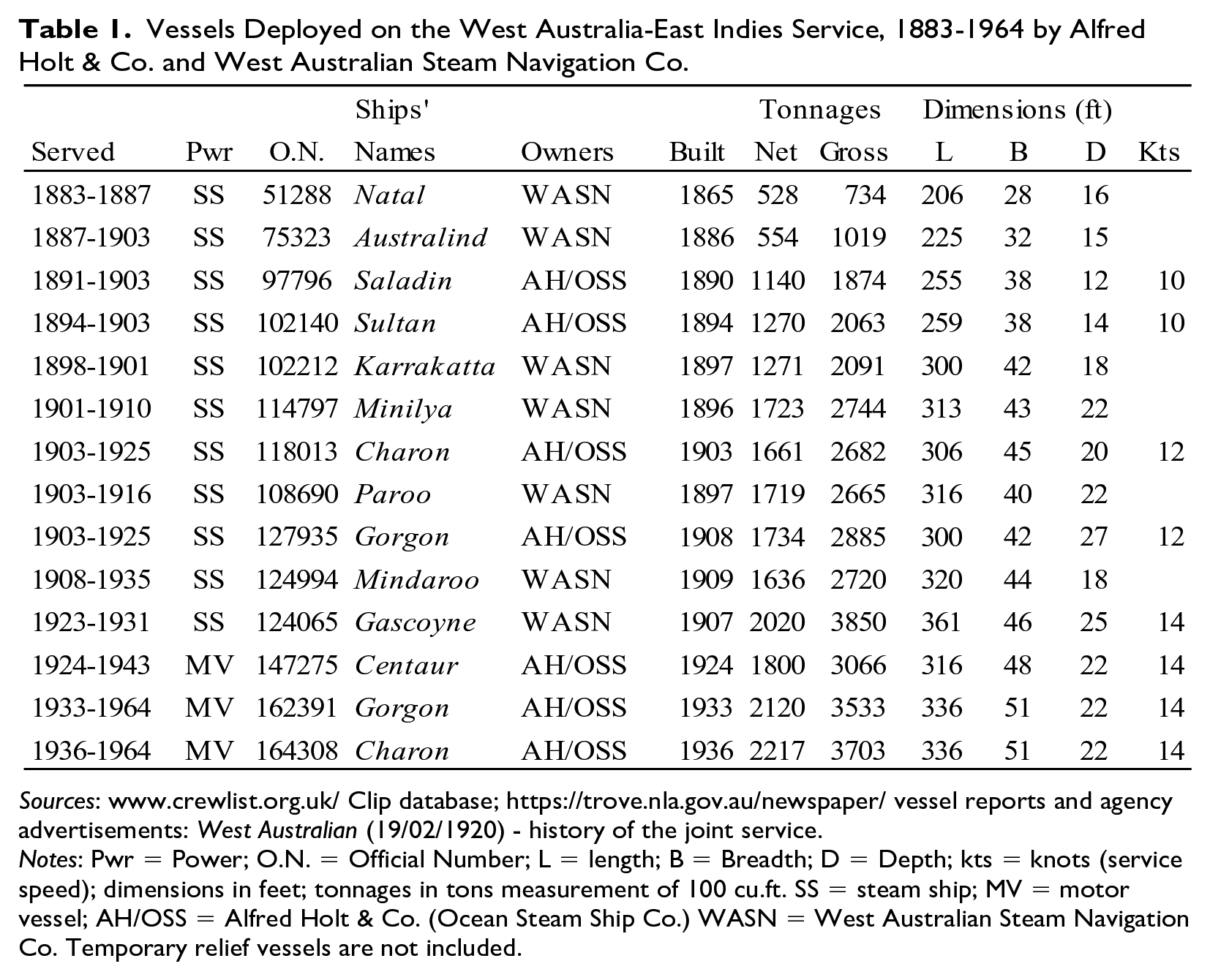
Sources: www.crewlist.org.uk/ Clip database; https://trove.nla.gov.au/newspaper/ vessel reports and agency advertisements: West Australian (19/02/1920) - history of the joint service.
Notes: Pwr = Power; O.N. = Official Number; L = length; B = Breadth; D = Depth; kts = knots (service speed); dimensions in feet; tonnages in tons measurement of 100 cu.ft. SS = steam ship; MV = motor vessel; AH/OSS = Alfred Holt & Co. (Ocean Steam Ship Co.) WASN = West Australian Steam Navigation Co. Temporary relief vessels are not included.
Ports of call schedules of Centaur, Gorgon and Charon July to September 1939.

Source: www.trove.nla.gov.au/newspaper/ Daily Commercial News and Shipping List [Sydney], [weekly] “Shipping Review”, sub heading “Blue Funnel Line (W.A. Service)”, page 7 in each issue (26 June 1939; 5, 12, 19, 26 July 1939; 2, 9, 16, 23, 30 August 1939).
Notes: L = left; D = due; these terms or similar prefixed the dates given in the listing. As the majority of calls at intermediate ports lasted only a few hours the distinction is not material in this record of the schedule followed by the three ships. Shipping movement data disappeared from the newsopapers on the outbreak of World War II.
Clearly the agencies in the various ports and the ships they were managing needed to be in communication with each other, and certainly the movements of the ships facilitated the exchange of documents, while delegated authority could cope with most routine matters. But with a radio room keeping at least a listening watch, and the quite well-developed network of medium-wave wireless stations ashore in the East Indies and Western Australia, the ships were able to report progress and untoward events, and receive instructions to make unplanned port calls. 19
The manning comprised European (mainly British including Australian) officers, lascar (Malay) deck ratings, and Chinese catering and engine room hands. 20 The officers, unless resident in Australia, were sent out by Holt’s in Liverpool for transfer in Singapore, and could normally expect to serve for at least 12 months before replacement. The ratings were supplied by manning agencies in Singapore, the Chinese coming as a group from southern China. The provision of ratings, in particular, to the ships, became a major issue with the growing power of the Australian seamen’s unions which agitated for all shipping serving Australian ports to be manned by Australians. 21 As both a colonial legislature and a state legislature (after 1901), the government in Western Australia had promoted coastal shipping services with grants, for example to WASN, and by funding a state-owned shipping service. The State government also passed a measure requiring Australian manning in coastal ships. Thus, the Holts/WASN service was not without competition, and there were fears that complying with Australian rates of pay and conditions would render the service to Singapore unprofitable. In the event, management representatives were able to negotiate an exemption for the joint service ships, but introducing replacement ships could lead to a flare up of agitation from the seamen’s unions. In 1938 Holts entered into an agreement with the State Shipping Service of Western Australia for the joint operation of the coastal trade. 22
Despite the distance between Singapore and Fremantle (about 2,230 nautical miles direct), which defined the passages as ‘foreign-going’, there were many features of the service which were not unlike the coastal services around the British Isles in waters defined as ‘home-trade’. 23 As in British waters, the crew were engaged on running crew agreements which were renewed every six months, normally in January and July. There were numerous intermediate port calls, often of short duration (see Table 2). Small ports might not offer a pilotage service and larger ports offered pilotage exemption for regular use, so masters had to be self-sufficient in ship-handling and pilotage in shallow, tidal waters. 24 Nor could they rely on tug assistance. The deck crew needed to be proficient in lowering and raising the ship’s motor boat used in mooring operations, and often the hand-lead would be used when negotiating shallow waters. There was little opportunity for engine maintenance, except at the terminal ports where longer stays, for example, might allow the changing of diesel engine piston rings. Passages at sea demanded the normal watch keeping on any ship, with the mates navigating and fixing positions at regular intervals, attending to lookout, collision avoidance, and steering; and in the engine-room the watch on duty overseeing the working of the engine, the recording operational data, as well as giving attention to subsidiary motors maintaining the ship-board services. With three ethnic groups aboard ship, three separate galleys were attending to the feeding arrangements, and the ‘hotel’ crew were providing for the needs, especially, of the first-class passengers. 25
In port, cargo loading might be worked at the same time as unloading, and cargo handling might have to be performed by the crew. Though shipments might be relatively small and the ship rarely empty or full, officers still had to give due attention to cargo stowage and calculate changes in the stability of the vessel (see Figure 1). Livestock, loaded and discharged ‘on the hoof’, imposed requirements for which special deck hands were carried. The refrigerated cargo spaces demanded special details of stowage, and the attention of a refrigeration engineer, and of the deck officers in recording and maintaining temperatures. In 1939, export cargoes to the East Indies included regular shipments of sheep and cows in milk, flour in considerable quantities, wheat, oats, barley, lucerne, hay, straw, chaff, and bran. 26 Chilled cargos included grapes, peaches, plums, apples, pears, buttermilk, butter, pork, lamb, crayfish, and a wide variety of vegetables. General cargo included soap, biscuits, Weetabix, wool, sandalwood, mother of pearl, tantalite ore, asbestos, a generator, castings and firebricks.
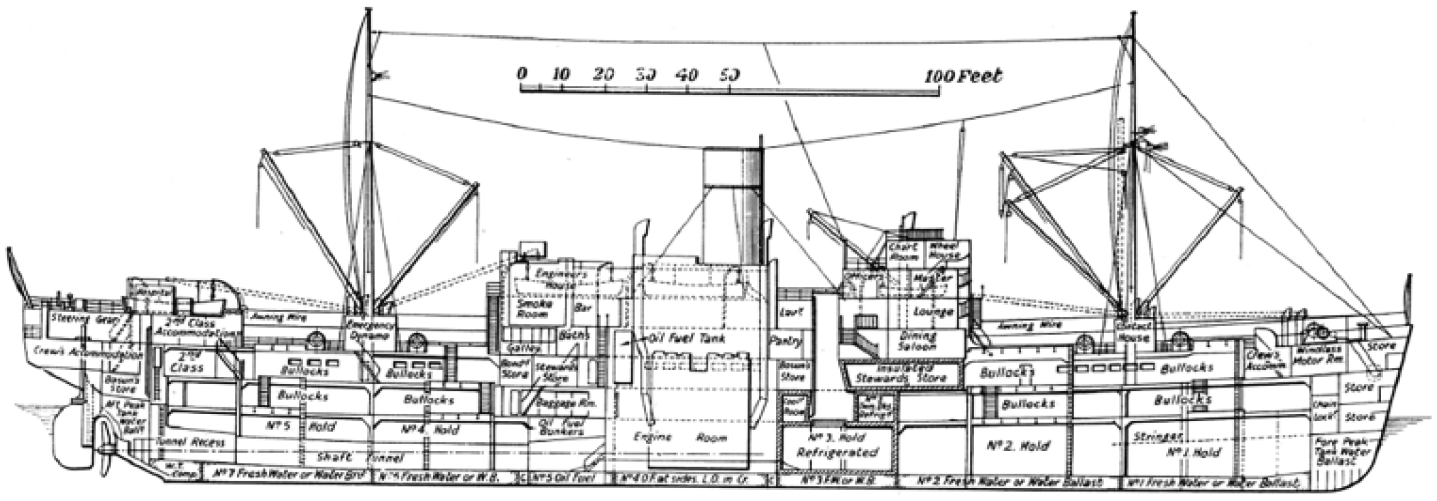
General arrangement plan of MV Gorgon, built 1933.
Maintaining the Singapore/Fremantle trade in war conditions (Sept. 1939 to Sept. 1942)
On 3 September 1939, Centaur was in Singapore, Gorgon was in Broome southbound, and Charon (Figure 2) arrived at Fremantle – so obeying the instruction in the war orders to proceed to the nearest British or allied port was instantly covered. Given the move to a war footing, this section commences with an examination of the protective measures put in place, progressively, aboard the three ships, as given in the Merchant Ship Movement Records’ card headings. 27 Analysis of the arrival and departure records then demonstrates the high level of compliance with a regular schedule of port calls prior to Japan’s attacks and invasions from December 1941. The inevitable breakdown of the trading cycle compounded by the requisitioning of the ships as naval supply vessels without immediate use planning, concludes this section.
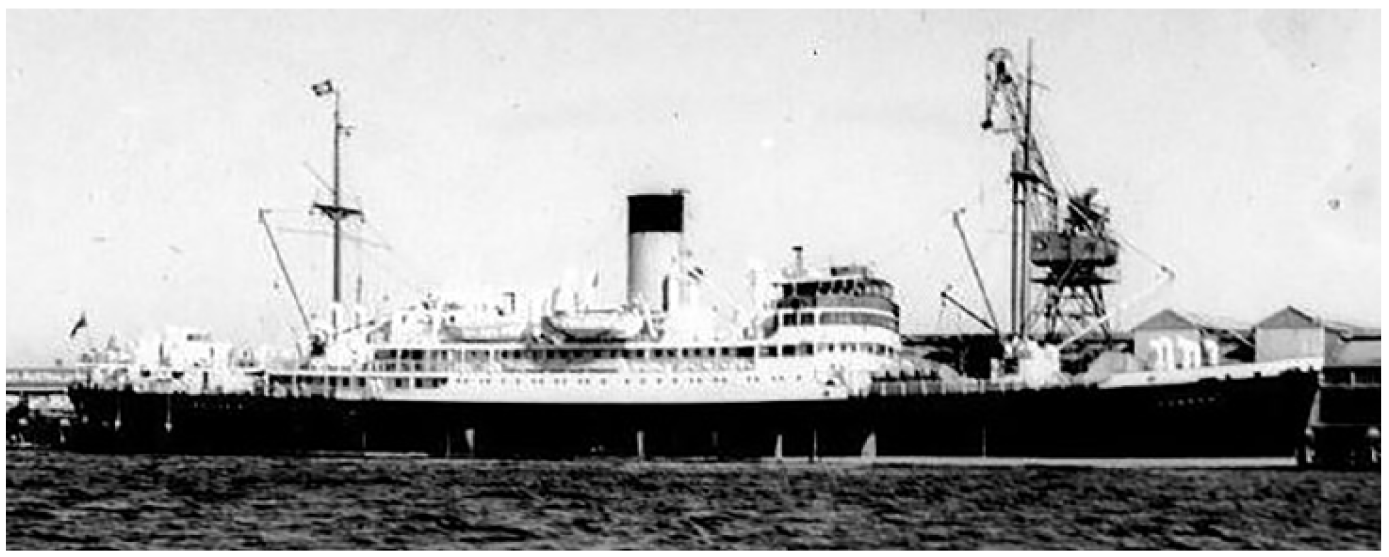
Charon at B shed, Fremantle, December 1959 (Alston Kennerley).
With a large number of merchant ships in East Indies/Australian waters, it would have been impossible to fit them all out for war immediately. 28 Most likely, supplies of weaponry and preventative devices would need to be sent out from Europe, and probably local stocks of paint for making the ships less conspicuous were not up to the sudden demand. Centaur, Gorgon and Charon were to some extent fortunate in having two terminal ports where there were naval bases, though Singapore certainly ought to have had the greater capability. It is clear that the white superstructures and funnels of the vessels were painted dark grey first (before 1941?) and that the black hulls did not receive their coating until some time later. Defensive armament seems to have commenced with the fitting of 4” LA (low angle) guns in Singapore to Gorgon and Charon and a 4” Mark RL IX gun to Centaur, quite early in the war. Later additions to Gorgon and Charon were Oerlikons and Vickers weapons. DG (degaussing, anti-magnetic mine) apparatus was provided during 1942, and anti-aircraft devices, PAC (parachute and cable rockets) and kites (barrage balloon kites) in the same period. 29 Gorgon was fitted with a signal yard on the foremast, and ‘square box crow’s nests’ on both masts, though those additions are not listed for the other ships. Special equipment also had to be provided for convoy sailing: special lights, fog buoys, improved signalling apparatus, zig-zag clocks, and improved communication between bridge and engine room. 30
External safety measures included the routeing and convoying of ships by the naval authorities. Being routed appears as early as mid-October 1939 for all three vessels. 31 Vessels sailed independently but followed prescribed tracks linking specified way points, which could be varied for subsequent vessels. Guidance could also be given as to which channel between the East Indies islands to take to pass into and out of the Java Sea. The ships had always varied their routes depending on the locations of the ports in their schedules. There were convoys operating in the waters concerned here, but very rarely did any of these ships join one. As relatively fast vessels they qualified for being allowed to sail independently; however, Gorgon did join Convoy MS1 (Melbourne to Singapore) arriving 1 February 1942, and Charon is listed in MS3 (Fremantle to Palembang) arriving 8 February 1942. 32 Given their port calls, these ships would have been in convoy for only part of the convoy route.
In Table 3 ports of call in the East Indies are separated from those in Australia (see also Figure 3), but, together with the example of the schedule in Table 2, the intensity of the service provided following the outbreak of war may be understood: a total of over 700 port calls over the three years to September 1942. It must be borne in mind that the East Indies was closed to allied commercial shipping after February 1942. The locations served correlate closely with those in the schedules before the outbreak of war (Table 2), with the exception of calls at Bangkok and Saigon, which seem to have been omitted. Given that the data on East Indies calls is somewhat less certain than those in Australia, it is possible that there was insufficient commercial inducement to justify including those ports in their schedules.
Centaur, Gorgon, Charon: port/location calls made while operating mainly as commercial ships running between Australian west coast ports and ports in the East Indies, September 1939 to September 1942.
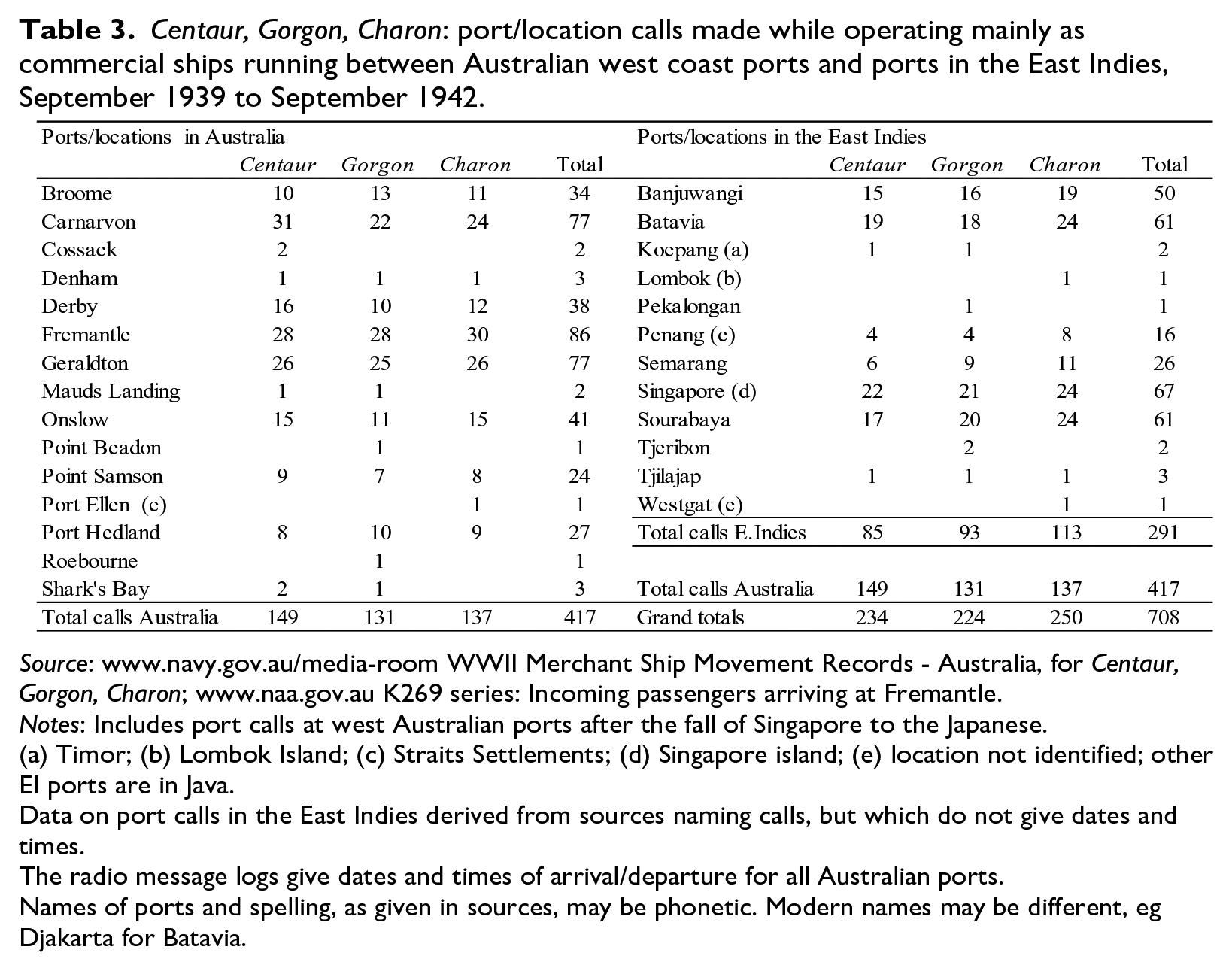
Source: www.navy.gov.au/media-room WWII Merchant Ship Movement Records - Australia, for Centaur, Gorgon, Charon; www.naa.gov.au K269 series: Incoming passengers arriving at Fremantle.
Notes: Includes port calls at west Australian ports after the fall of Singapore to the Japanese.
(a) Timor; (b) Lombok Island; (c) Straits Settlements; (d) Singapore island; (e) location not identified; other EI ports are in Java.
Data on port calls in the East Indies derived from sources naming calls, but which do not give dates and times.
The radio message logs give dates and times of arrival/departure for all Australian ports.
Names of ports and spelling, as given in sources, may be phonetic. Modern names may be different, eg Djakarta for Batavia.
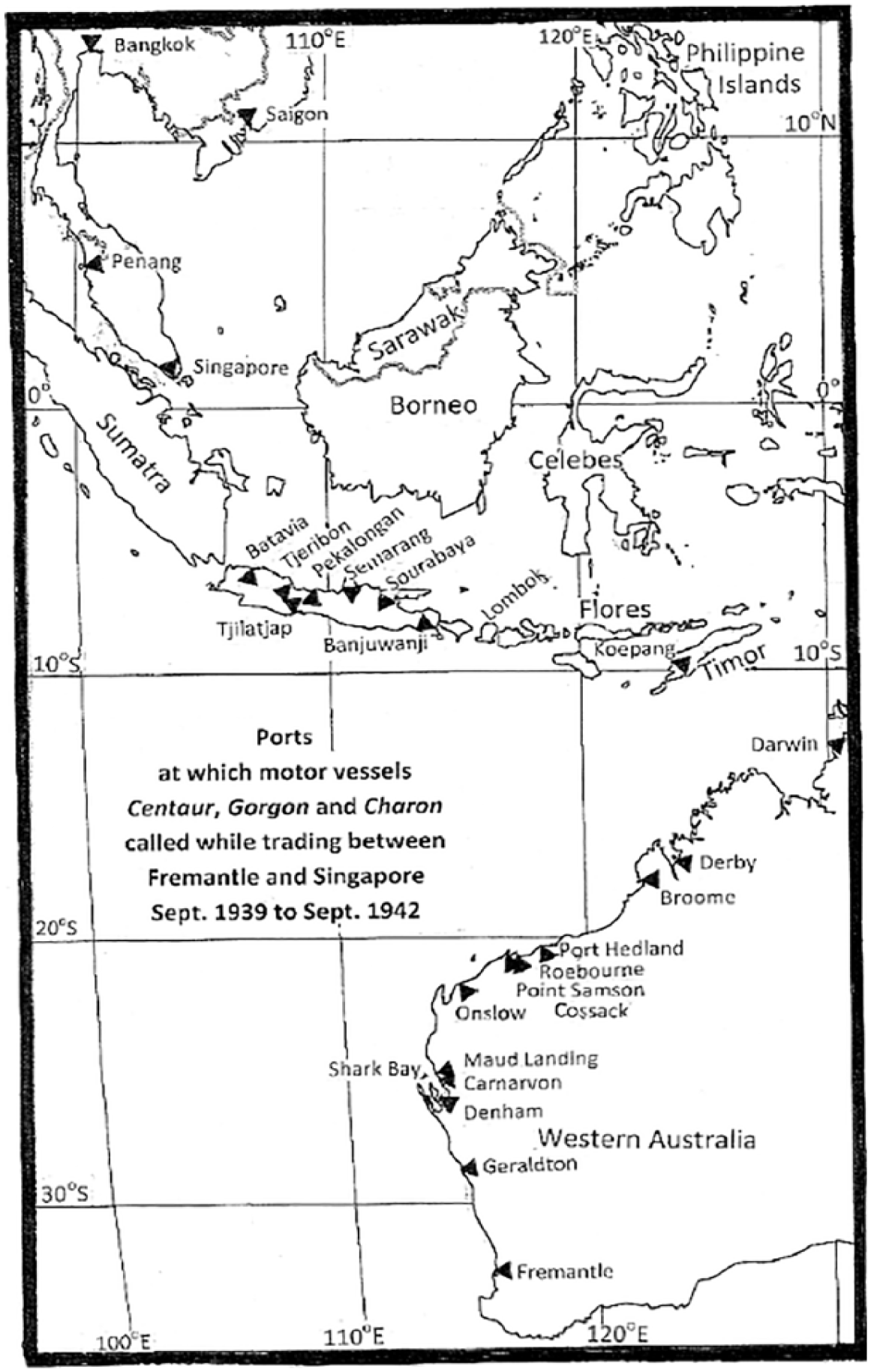
Ports in the East Indies and Western Australia.
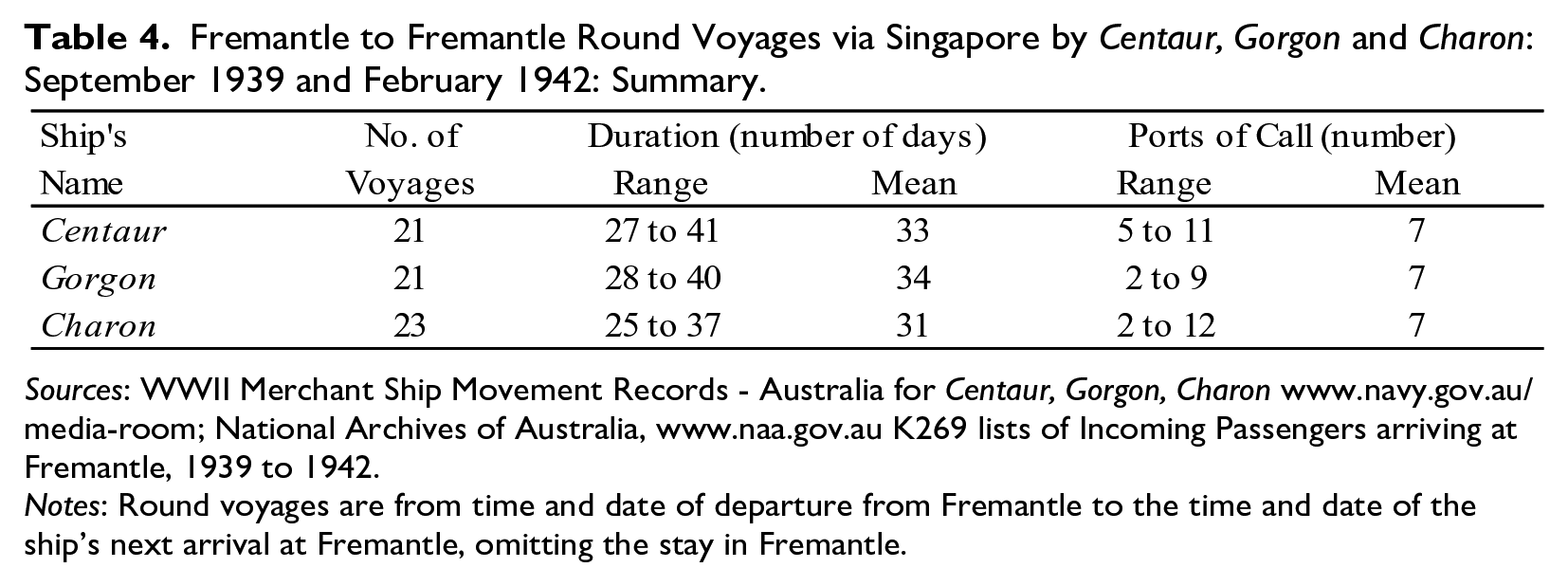
An alternative way of assessing the commercial service of the three ships in the first half of the Second World War is to analyse their absence from one of the terminal ports. There is insufficient precise data for Singapore but it is available for Fremantle. Table 4 shows that on average the ships were about 33 days on their round voyages, and typically made seven port calls. As under normal circumstances the stay in Fremantle could last a week; repeated arrivals at, or departures from, Fremantle were at most 40 days apart.
Fremantle to Fremantle Round Voyages via Singapore by Centaur, Gorgon and Charon: September 1939 and February 1942: Summary.
Sources: WWII Merchant Ship Movement Records - Australia for Centaur, Gorgon, Charon www.navy.gov.au/media-room; National Archives of Australia, www.naa.gov.au K269 lists of Incoming Passengers arriving at Fremantle, 1939 to 1942.
Notes: Round voyages are from time and date of departure from Fremantle to the time and date of the ship’s next arrival at Fremantle, omitting the stay in Fremantle.
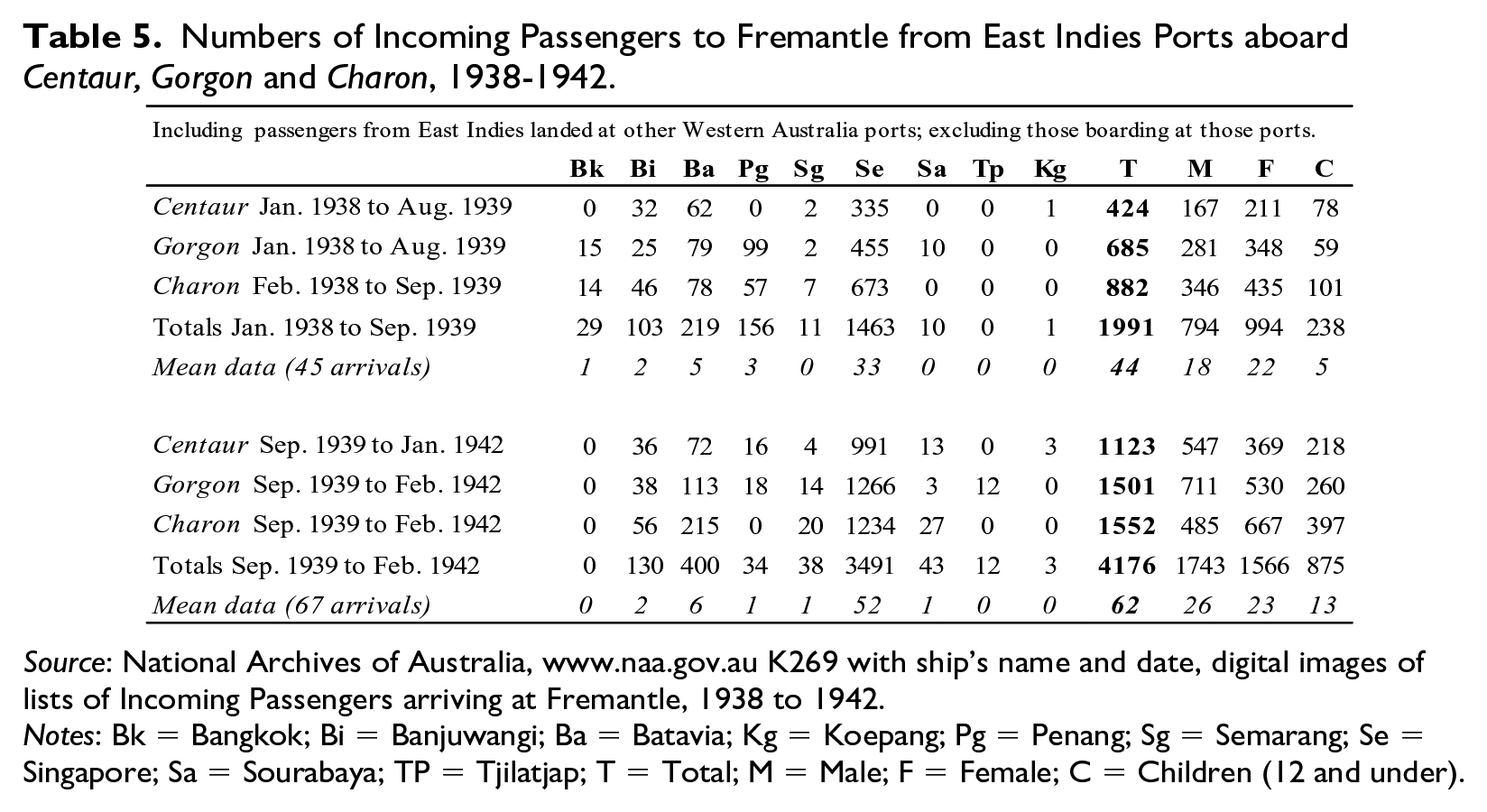
While it is possible to name what was carried typically as cargoes in Centaur, Gorgon and Charon, data is not available for arriving at a quantification. But Australian immigration listings provide data for their passengers. Table 5 compares south-bound passenger numbers for the 20 months before the outbreak of war with the 29 months from September 1939 to the fall of Singapore. The data clearly show that the ships’ passenger accommodation was used more intensively in the war period than in the preceding peacetime period. The main embarkation port was clearly Singapore, but almost all ports of call yielded some passengers. The accommodation was in first class, second class and deck (also described as First Class, Second Class A and Second Class B). Deck did not mean the open deck, but might be very basic conditions in a ‘tween deck. A number of underlying patterns contributed to the data. Long before the war the service was marketed in Australia as a cruise service, with some passengers taking the round voyage, and others spending time in East Indies locations and returning on a later voyage. The practice of ex-patriot Europeans in the East Indies of sending their children to boarding school in Australia led to north-bound passages being heavily booked with children at the start of the long school Christmas holiday in December, and afterwards in January to passages similarly heavily booked south-bound. 33 A third dimension was connected with merchant ship crew exchange arrangements for the Asiatic segments of ships’ crews. Blue Funnel had many ships which, like Centaur, Gorgon and Charon, employed Chinese ratings as cooks and stewards and in the engine rooms. Some also had Chinese deck hands. Ships in Holt’s far east service always called at the crewing hubs, Singapore and Hong Kong, but ships so manned in their Europe/Australian service relied for exchanges on men being sent south (or returned) via the west Australian service ships. The crews travelled as deck passengers. For example, Gorgon arrived in Fremantle on 23 May 1940 carrying 37 firemen for the Blue Funnel ship Philoctetes. 34 But this is only one of several other examples of crewing exchanges for Holts’ ships. Undoubtedly, a factor in the growth in numbers of passengers, was the increasingly serious war situation, leading to the exodus of Europeans from the colonies. Large numbers of deck passengers could easily lead to there being well over 100 passengers aboard. But Gorgon’s departure from Singapore on 12 February 1942, with 357 passengers, including an army unit of 43 soldiers, reflected the desperate conditions then prevailing. 35
Numbers of Incoming Passengers to Fremantle from East Indies Ports aboard Centaur, Gorgon and Charon, 1938-1942.
Source: National Archives of Australia, www.naa.gov.au K269 with ship’s name and date, digital images of lists of Incoming Passengers arriving at Fremantle, 1938 to 1942.
Notes: Bk = Bangkok; Bi = Banjuwangi; Ba = Batavia; Kg = Koepang; Pg = Penang; Sg = Semarang; Se = Singapore; Sa = Sourabaya; TP = Tjilatjap; T = Total; M = Male; F = Female; C = Children (12 and under).
The ship movement records offer no insights into the impact of defensive measures on these three ships’ crews and any training in the use of guns and other equipment. Defensively Equipped Merchant Ships (DEMS) might be augmented with a few DEMS gunners, while their civilian crews might be allowed a few additional hands, for example to help with the much more intensive lookout expected and the extra demand that convoys imposed. Centaur’s crew list arriving Fremantle on 24 September 1941, shows 27 deck hands and six winchmen, ample for maintaining the extra lookouts and the routine tasks of deck hands aboard power-driven vessels at sea. 36 She carried three wireless operators to maintain the continuous listening watch demanded in war-time. There was also a supernumerary master on board who might simply have been taking passage to a ship in Fremantle or had a role as vice-captain relieving the appointed master to rest. In peacetime it was standard practice in Holts’ ships for deck officers to move from the normal three watch system, a single (four hours on and eight hours off) officer of the watch, to double watches, two officers of the watch (four hours on and four hours off watch), when in congested waters such as the waters around the British Isles or in the inland sea of Japan. Normally Centaur, Gorgon and Charon carried three deck officers and one master. An extra officer of the watch or master would allow a double watch system. But 12 hours a day watch-keeping is physically draining. Although Japan did not enter the war until December 1941, it must not be forgotten that from the earliest days of the war, British and allied shipping was at risk from German raiders operating in the Indian and Pacific oceans. 37 A particularly sensitive case was the sinking, on 11 November 1940, of Blue Funnel’s Automedon by the German raider Atlantis, north of Sumatra, in which top secret briefing data for the British far east command fell into German hands. 38 In November 1941, Centaur, north-bound off Carnarvon, encountered survivors from the German raider Kormoron following that ship’s encounter with HMAS Sydney in which the ships sank each other. 39 The laying of minefields in the autumn of 1940, off New South Wales, Tasmania, Bass Strait and Adelaide, by the Pinguin, using a captured Norwegian tanker renamed Passat, presented a sleeping danger to Centaur, Gorgon and Charon making the passages between Australia’s west and east coasts in 1942. 40
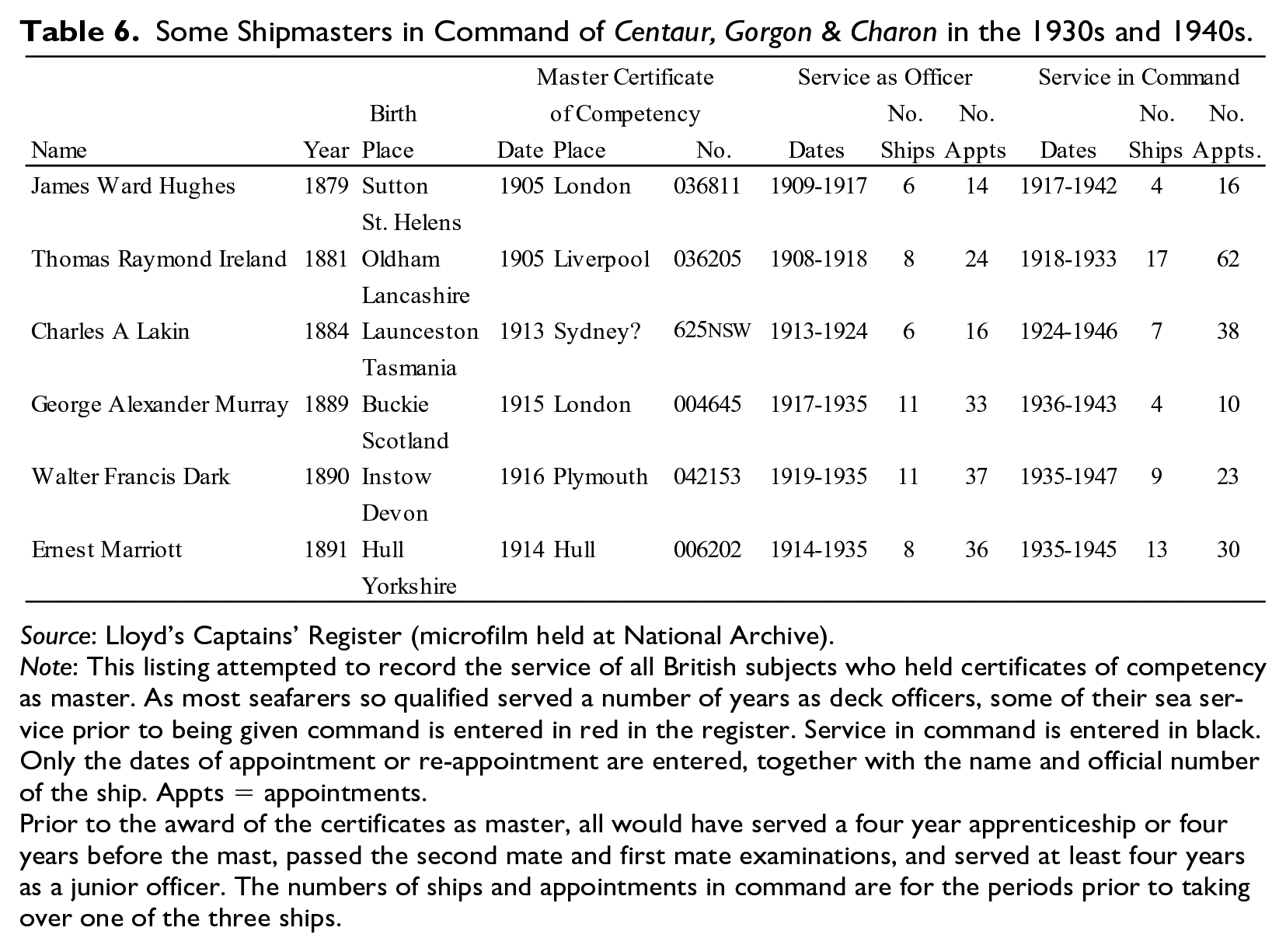
War brought an increase in the number of abnormal incidents affecting merchant shipping, testing in particular the calibre of their officers in command. Holts, Blue Funnel’s owners and managers, had an enviable reputation as good employers, which was reflected in the exceptional length of service of many of its sea staff. Often future masters joined the company as junior officers, after they had obtained their Board of Trade certificates of competency as master of a foreign-going ship. By that time, they had, say, 10 years sea-time behind them including four or five years as an officer in ships of other companies. Once accepted by Holts, they then served over 10 years as second and first mates in a variety of the company’s ships, before being elevated to command (Table 6). 41 Even then, being appointed to ships in the West Australian service only came after similar periods of experience commanding a variety of the company’s other ships. These shipmasters were among the longest serving and most experienced of all Blue Funnel masters.
Some Shipmasters in Command of Centaur, Gorgon & Charon in the 1930s and 1940s.
Source: Lloyd’s Captains’ Register (microfilm held at National Archive).
Note: This listing attempted to record the service of all British subjects who held certificates of competency as master. As most seafarers so qualified served a number of years as deck officers, some of their sea service prior to being given command is entered in red in the register. Service in command is entered in black. Only the dates of appointment or re-appointment are entered, together with the name and official number of the ship. Appts = appointments.
Prior to the award of the certificates as master, all would have served a four year apprenticeship or four years before the mast, passed the second mate and first mate examinations, and served at least four years as a junior officer. The numbers of ships and appointments in command are for the periods prior to taking over one of the three ships.
With Japan’s declaration of war on 7 (8) December 1941, and her military take-over of the whole eastern archipelago, came attacks and destruction or seizure of large numbers of merchant vessels of all sizes, in ports, rivers and straits between islands, particularly through aerial attack in locations as far apart as Singapore and Port Darwin, Labuan (Borneo) and Banka Strait (west of Java). Gorgon, in Singapore from 1 February 1942, was attacked heavily without serious damage, and finally sailed south on 12 February in a small convoy, which was subjected to heavy aerial attack in the Durian Straits, surviving through her high degree of manoeuvrability. 42 North-bound, Charon went no further than Batavia where she collected 100 passengers. Arriving back in Fremantle, there was insufficient call on the three ships services, or those of the State Shipping Service, for so much capacity. After February, 1942, all three ships made a number of short voyages to north-west ports, interspersed with lengthy periods of idleness in Fremantle. By March 1942, if not earlier, the ships had been requisitioned as ‘naval store ships’ and were ordered from Fremantle to Melbourne by the Shipping Control Board. 43 Charon was sent to Noumea in New Caledonia, while the other ships were sent on short local passages. Meanwhile Western Australia’s north west seem to have been almost denuded of shipping services. An appeal by the Premier of Western Australia secured the return of all three ships which resumed coastal trading until called east again at the end of September 1942. 44 The naval administration of Centaur, Gorgon and Charon certainly seems to have contributed to the long periods of idleness noted here, but that cause cannot be distinguished from excess of shipping capacity as factors. Taking seven days in Fremantle as the typical commercial duration of call at that terminal port in normal trading with the East Indies, Centaur spent 124 days idle in Fremantle in six stays exceeding seven days; Gorgon was idle there for 108 days in eight stays, and Charon spent 89 days in nine stays – 321 days in all. 45
War effort support: Eastern Australia northwards (October 1942 to December 1945)
By October 1942 Centaur, Gorgon and Charon had been withdrawn again from the coast of Western Australia and were about to join the mass of merchant shipping along the eastern coast of Australia which had been assembled to convey personnel, war supplies of every description, fuel, food and water, to wherever they might be required. This section first draws on the ‘World War II Merchant Ship Movement Records – Australia’ to establish where the ships were sent. It then moves on to examine shipping in the TN (Townsville to New Guinea) convoy series (December 1942 to March 1944), to reveal the scale of the supply route of which the ships were a part, to consider their contribution to the war effort and to relate their movements to the progress of military operations such as landings, particularly in New Guinea. 46
The locations to which Centaur, Gorgon and Charon were sent as support ships between October 1942 and February 1946 are set out in Figure 4 and Table 7, separating those in Australia, which might be considered departure locations, from those in New Guinea and elsewhere, which might be considered destinations. ‘Locations’ has been used here in preference to ‘ports’ because some of those listed may have been outside commercial port limits. Ships which were to sail in convoys had to be assembled and possibly held at anchor in convoy departure locations, and merchant ships supporting military landings may well be positioned away from established ports. The sequence of the arrival messages in the MSMRA show clearly that Port Moresby (Papua New Guinea’s capital) and Milne Bay (also labelled Fall River and East Cape) were hub destinations, and that, particularly along the north east coast of New Guinea, succeeding destinations drew the ships increasingly north-westward in the wake of military landings. Although the ships went to a quarter more locations than during the early years of the war, they made less than half the number of port calls (see Table 3). A part of this difference must be due to the tragic sinking of Centaur in May 1943 off Brisbane, and the bombing, towage and time under repair of Gorgon (April to December 1943). 47
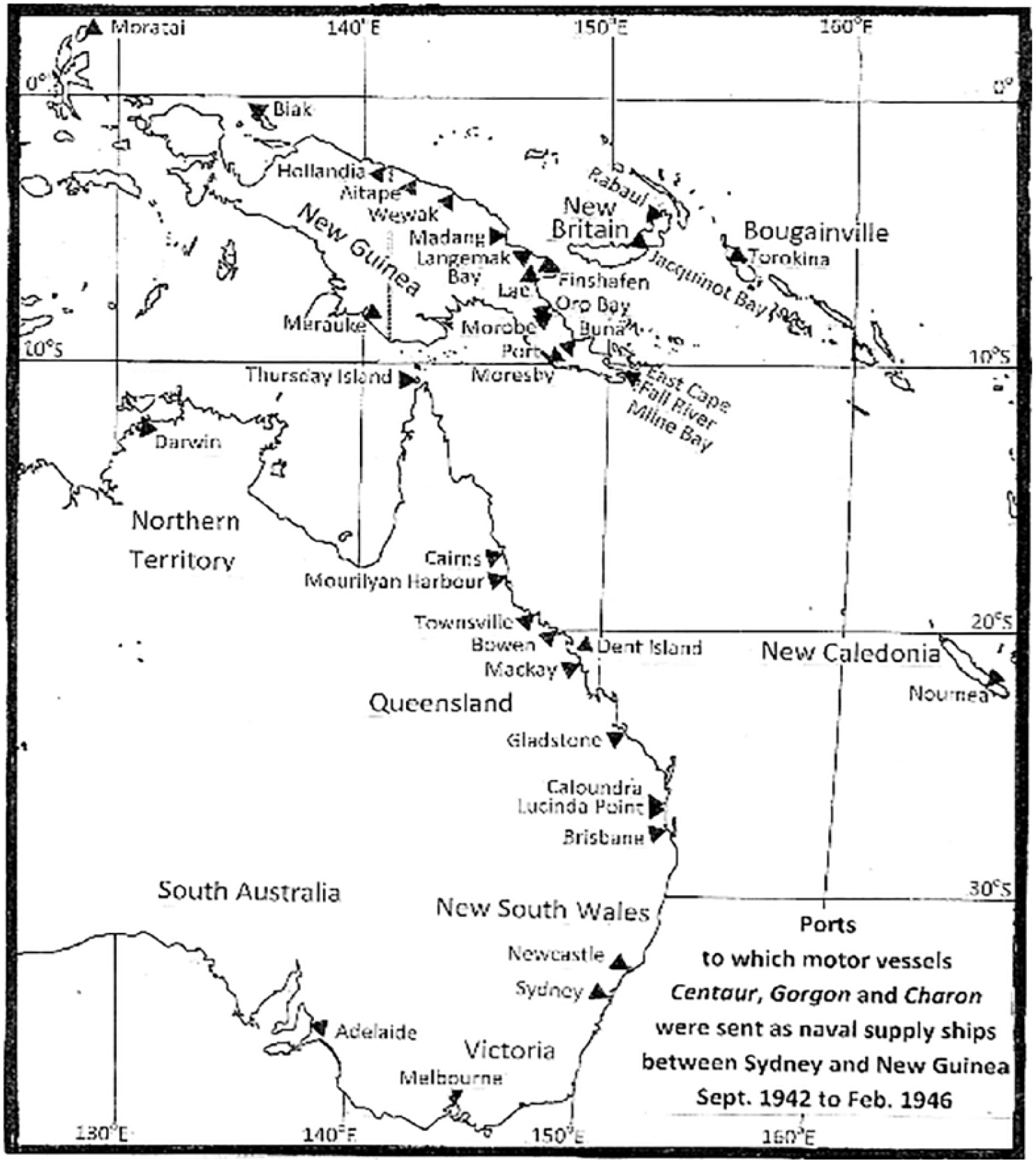
Ports in Eastern Australia and New Guinea and other islands.
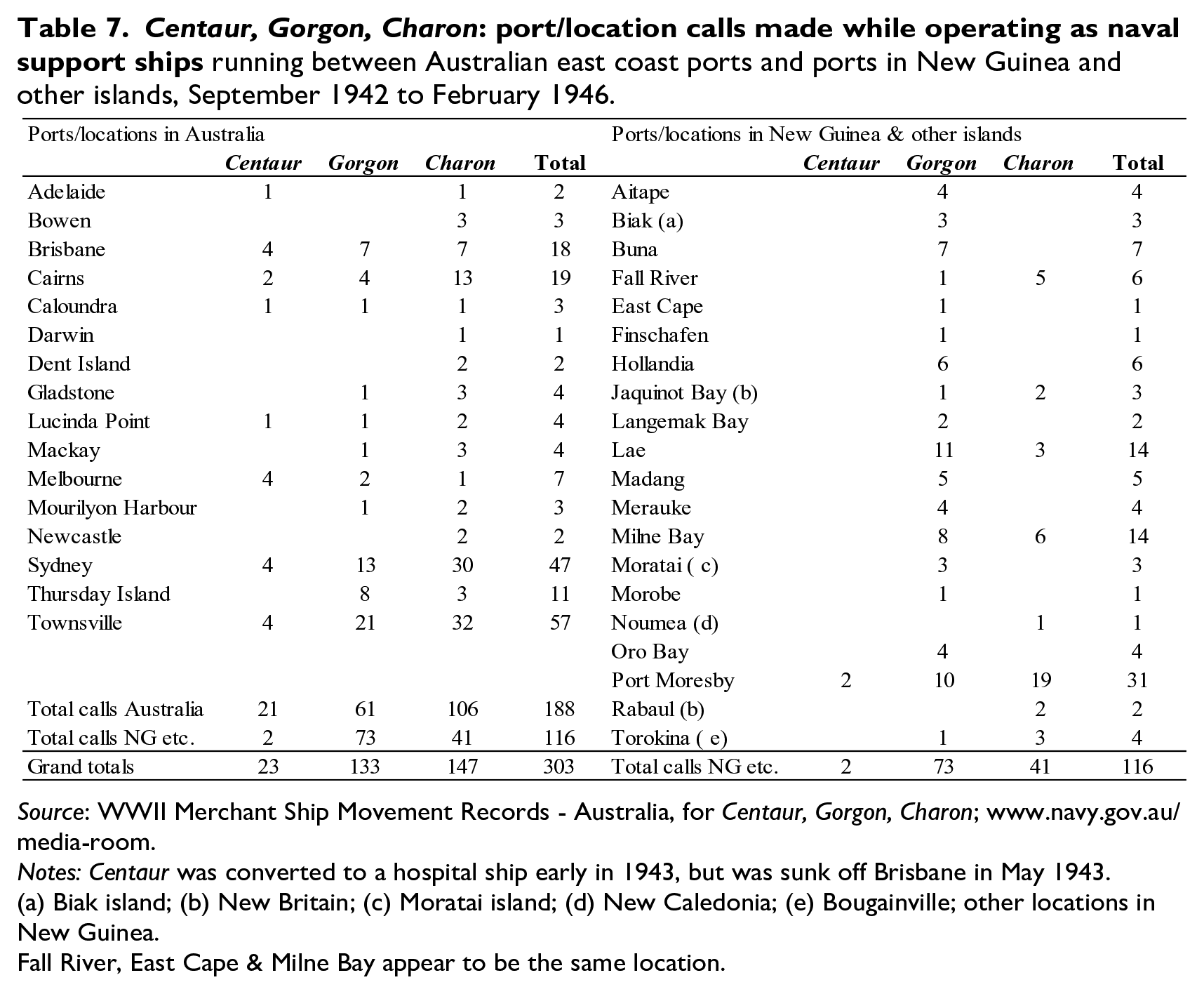
Source: WWII Merchant Ship Movement Records - Australia, for Centaur, Gorgon, Charon; www.navy.gov.au/media-room.
Notes: Centaur was converted to a hospital ship early in 1943, but was sunk off Brisbane in May 1943. (a) Biak island; (b) New Britain; (c) Moratai island; (d) New Caledonia; (e) Bougainville; other locations in New Guinea.
Fall River, East Cape & Milne Bay appear to be the same location.
Although the ships in the supply chain made repeated voyages northwards and many calls at hub locations, they were not operating within a scheduled service such as that of Centaur, Gorgon and Charon in the early years of the war. Where and when they were sent and what they carried probably had more similarity to tramp ship operations where often a passage was completed and cargo unloaded before the next cargo and destination became known. Centaur’s operational time on the east coast, turned out to be extremely limited as she only completed one visit to New Guinea as a general carrier and one as a hospital ship (both to Port Moresby), before she was torpedoed and sunk on 14 May 1943. The movements of Gorgon and Charon are summarised in Table 8 where the round voyage device, with Sydney as the base port, is used over a slightly more restricted range of dates than those adopted for Table 7. As Gorgon was only sent to Sydney on half the number of occasions compared to Charon, the methodology has its limitations. Indeed, Townsville must have been more of a base port for Gorgon for much of her time on the east coast. But the methodology works very well for Charon which returned to Sydney quite regularly. On average her round voyage from Sydney and back lasted 28 days of which thirteen days were spent on passage between ports of call and fifteen were spent in port (excluding time in Sydney). Gorgon’s time on round voyages is exaggerated by her being bombed at Milne Bay, her slow tow back to Australia and the 161 days she was under repair. Engine breakdown and essential repair and maintenance would also have increased the ships’ total time in port. 48
Sydney to Sydney Round Voyages mostly via New Guinea Locations by Centaur, Gorgon and Charon: October 1942 to December 1945 - Summary.
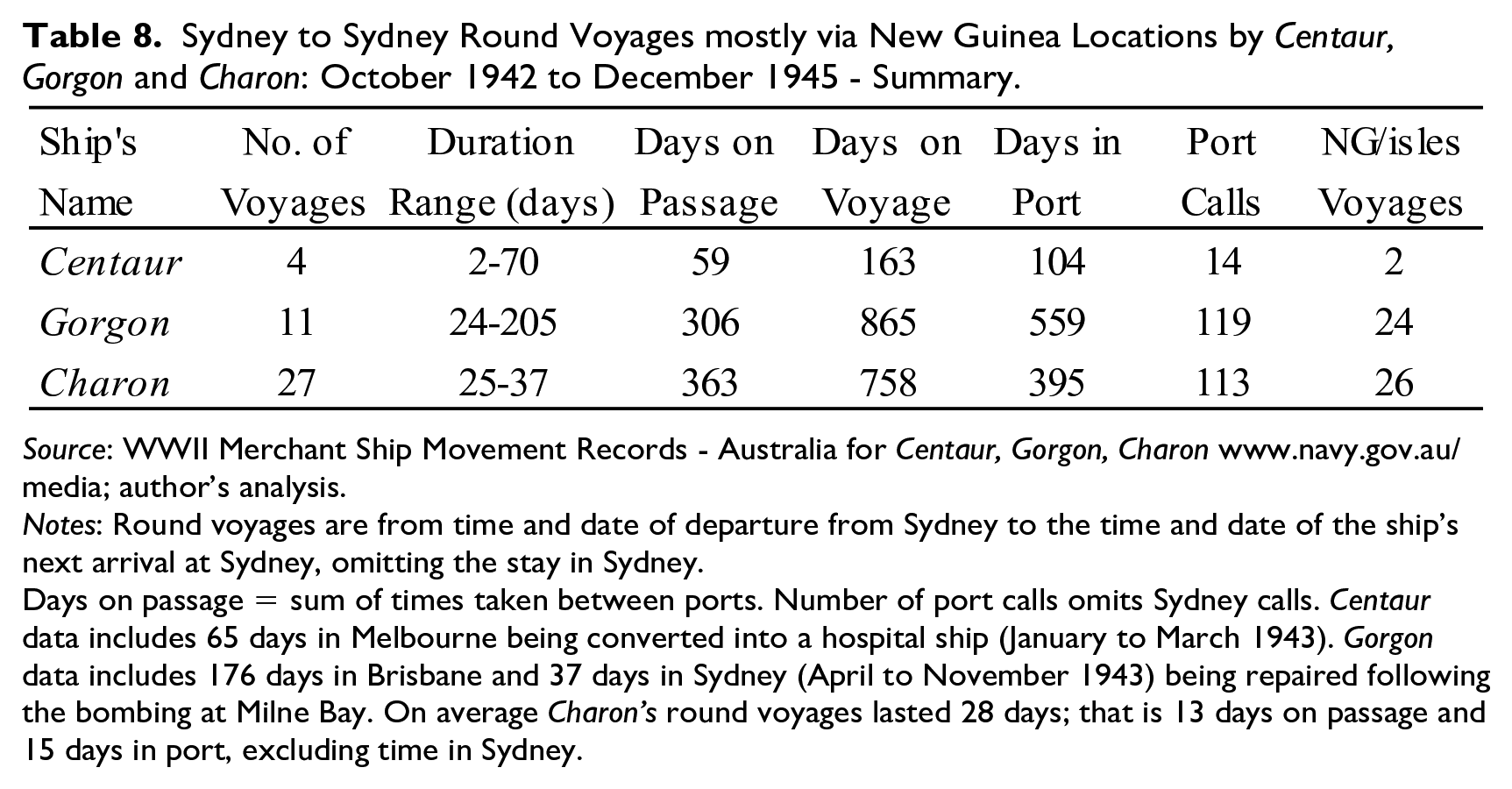
Source: WWII Merchant Ship Movement Records - Australia for Centaur, Gorgon, Charon www.navy.gov.au/media; author’s analysis.
Notes: Round voyages are from time and date of departure from Sydney to the time and date of the ship’s next arrival at Sydney, omitting the stay in Sydney.
Days on passage = sum of times taken between ports. Number of port calls omits Sydney calls. Centaur data includes 65 days in Melbourne being converted into a hospital ship (January to March 1943). Gorgon data includes 176 days in Brisbane and 37 days in Sydney (April to November 1943) being repaired following the bombing at Milne Bay. On average Charon’s round voyages lasted 28 days; that is 13 days on passage and 15 days in port, excluding time in Sydney.
Another dimension of time in port was delays caused by assembling ships to join convoys, and the provision of naval vessels to act as escorts. These were not the long drawn out convoys of the North Atlantic theatre, but assemblies of two to four days’ duration, which operated along the whole of the east and north coasts of Australia and along the north-east coast of New Guinea. Perhaps the most significant of the numerous convoy series in the area was the series between the port of Townsville in Queensland and Port Moresby (capital of Papua New Guinea on the south coast) or Milne Bay (south eastern extremity of New Guinea), labelled TN. With over 200 convoys in this series which ran between December 1942 and March 1944, the great majority of ships carrying military supplies northwards across the westward portion of the Coral Sea will have joined a TN convoy with either Port Moresby or Milne Bay as the destination, or en route to other destinations.
Using the listing presented in the Convoy Web (ships’ names, nationality, gross tonnage, locations and dates), Tables 9 and 10 offer summaries at monthly intervals and by tonnage grouping, respectively. The gross tonnages given, the same in both tables, indicate the volume of space which the ships, including repeated passages, offered for moving supplies, apparently five and a quarter million tons. 49 However, as gross tonnage includes propulsion, fuel, water, stores and crew spaces, this data ought, perhaps, to be reduced by as much as 40 per cent to represent the real volume available. Nevertheless, the proportion provided by the United States once its war economy had developed, at 52 per cent of the shipping movements and 61 percent of the tonnage over this period, is impressive. Also clear is the period of real build-up in the autumn/winter of 1943. Table 10 arranges the data in tonnage groups where again US ships in the 7,000 to 7,999 tonnage group stands out. Indeed the 150 different US ships making 488 passages in the TN series far outstrips the handful of other nationality ships in that group. Centaur, Gorgon and Charon fall into the 3,000 to 3,999 gross tonnage group, which, with 2,000 to 2,999 group, perhaps represent the main contribution of British and Dutch inter-island shipping of the pre-war era. Centaur appears in only one TN convoy, Gorgon in six and Charon in nine, but these ships also made other passages between Australia and the islands to the north, and Gorgon’s 24 and Charon’s 26 (Table 8) passages northwards, match the 24 TN convoy passages by Canberra (British, 7,710 tons) and the 27 by Duntroon (British, 10,346 tons), vessels which most frequently appear in the TN data. In contrast, US ships made on average three to four repeated passages in TN convoys. But particularly noticeable among the US vessels are the number of wartime standard ships, notably the over 100 Liberty ships. Almost all of these will have made the south-west trans-Pacific passage from the US to New Zealand waters and then northwards along the Australian coast to join a TN convoy towards the end of their passages. A few were lost en route to enemy action.
Aggregate Ship Movements in TN (Townsville - New Guinea) Convoys: Numbers & Gross Tonnage.

Source: www.convoyweb.org.uk/ Arnold Hague data base; accessed in 2018: TN convoy series listing, comprising convoy code, departure date, ships names and gross tonnages, destination, arrival date, escorts.
Notes: Ship movements numbers includes named ship repeated passages in TN convoys. Gross tonnage (measurement tons of 100 cubic feet) includes multiple named ship listings. G = Greek: N = Norwegian; P + Panamanian; Ts = tonnage (gross). TN convoy series commenced 1 December 1942 with convoy TNII, ending with TN232 24 Mar 1944. Six convoy numbers were not used or comprised excort ships only. With the exception of one passage to Oro, convoy destinations were to Port Moresby or Milne Bay. Early Milne Bay Convoys were labelled Fall River, a military operation code term.
Ships in TN (Townsville to New Guinea) Convoys: Numbers of Different Vessels, and Vessel Movement Aggregate Gross Tonnages.
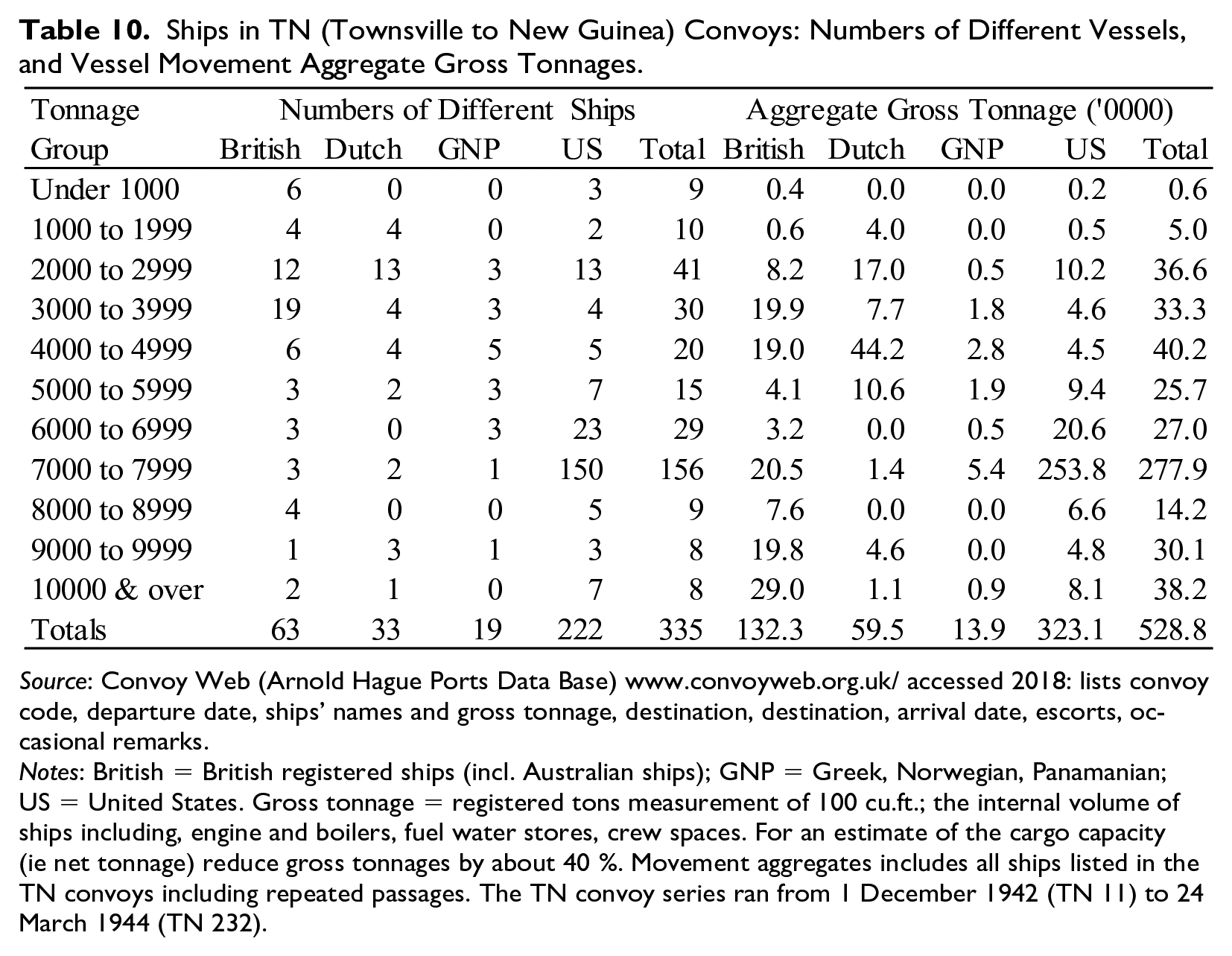
Source: Convoy Web (Arnold Hague Ports Data Base) www.convoyweb.org.uk/ accessed 2018: lists convoy code, departure date, ships’ names and gross tonnage, destination, destination, arrival date, escorts, occasional remarks.
Notes: British = British registered ships (incl. Australian ships); GNP = Greek, Norwegian, Panamanian; US = United States. Gross tonnage = registered tons measurement of 100 cu.ft.; the internal volume of ships including, engine and boilers, fuel water stores, crew spaces. For an estimate of the cargo capacity (ie net tonnage) reduce gross tonnages by about 40 %. Movement aggregates includes all ships listed in the TN convoys including repeated passages. The TN convoy series ran from 1 December 1942 (TN 11) to 24 March 1944 (TN 232).
The MSMRA and Convoyweb were not designed to offer information about cargo carried by military support shipping, but a few important notes in the TN convoy series mention ships towing one or more landing craft. With so many islands to be cleared of Japanese forces, landing and patrol craft were vital equipment in the numerous landings undertaken by allied forces. 50 There were several different types and sizes designed by Higgins Industries of New Orleans, which also built the great majority, some 20,000 deployed worldwide by the end of the Second World War. Some were for complete military units of soldiers with their equipment, while others were designed for vehicles including tanks. As well as towing landing craft, some ships in the TN convoys would have carried them as deck cargoes or in pieces ready for rapid assembly. Army trucks were also carried as deck cargo, while one US origin vessel was carrying a full cargo of beer in cartons. 51 Gorgon was loaded with live sheep and a part cargo of ammunition when she was bombed in Milne Bay. 52 Gorgon was also fitted for carrying troops, having on board 580 on one occasion in 1945. 53
Charon’s movements offer the best representation of the three vessels considered here, in terms of supply vessel usage between eastern Australia and the active war zone in the archipelagos to the north, during the second half of the war. Perhaps fortuitously, her Sydney to Sydney round voyage data, given above, is not that much different from the Fremantle to Fremantle data in the first half of the war. Between round voyages she averaged 11 days in Sydney (Tables 4 and 8). Calls elsewhere were of the most variable duration of stay, but her calls at the convoy origin port, Townsville, another much frequented location, averaged two and a half days (Table 7). 54 Her numerous calls at Milne Bay also averaged two and a half days, but those at Port Moresby averaged five and a half days. Ships in port, whether at anchor or alongside a quay, were particularly vulnerable to air attack, whereas underway in open waters they could use their manoeuvrability to dodge attacks. 55 The Japanese air raids on Darwin demonstrated Japan’s reach in early 1942, while repeated raids on Port Moresby and Milne Bay meant that most allied supply ships must have experienced air attacks, even if they were not damaged, as was Gorgon in April 1943. 56 It is not clear that Charon and Gorgon were present at any of the locations when allied troops made their first landings at numerous locations in New Guinea, or nearby islands such as New Britain, or Bougainville, but they were certainly in the supply chain later. While Charon mainly served Port Moresby and Milne Bay, with occasional calls elsewhere, Gorgon made most of the calls at successive north east coast of New Guinea locations, and eventually found itself making three calls at Moratai, in the Moluccas (Table 7, Figure 3). 57
All the ships in the Australia east coast to New Guinea and beyond supply chain were certainly always at risk from various forms of enemy attack, both German and Japanese. Enemy minefields had been laid in October/November 1940 off Adelaide, in the Bass Strait between Tasmania and Victoria, off the east coast of Tasmania and off the New South Wales Coast. These dormant weapons were a hazard long after their deposit, and certainly took their toll of allied shipping. This, together with submarine attacks and torpedo sinkings, produced a concentration of casualties along the seaway between Victoria and Queensland, including that of Centaur, noted above. 58 There were submarine attacks in East Indies waters, but as was shown by the bombing of Darwin (put out of action for several months) and the raids on Port Moresby and Milne Bay, aerial attack probably posed the greater threat to allied supply ships, such as Gorgon and Charon, when in the war zones. 59
Whether the conditions in Gorgon and Charon in the second half of the war were more arduous than before 1942 is hard to say. Certainly, the Australian west coast and the Java Sea waters were familiar territory, and control of movement was in the hands of commercial managers, while in the east control lay with the naval authorities, unfamiliar with merchant shipping and manning capabilities. In harbour there was probably much more goods handling by the ships’ crew, and between the ships and smaller vessels such as landing craft, much more station keeping in convoy, much more visual signalling, much more adjusting engine revolutions, and certainly much more intensive lookout. But all the routine tasks noted earlier still had to be carried out. Periods in harbour in forward locations could not have been restful. Yet seafarers were likely to be rather more tied to their ship than before. The European masters and officers were already, as far as leave was concerned, partially catered for through reliefs already based in Australia, though some of these may well have served in the same ships throughout the war with only occasional relief. T.E. Kennerley, for example, served continuously as a wireless operator of Charon from 23 January 1940 to 13 March 1943, and from 10 July 1943 to 24 January 1945, with just one, four-month period of leave. 60 Captains Lakin and Marriott were also connected with their ships throughout. It is certainly possible that the Malay and Chinese ratings served continuously, but it is not yet known how they were treated. There was certainly much unrest among Chinese ratings in British ships generally, but the sources do not address the scene in Australia. 61
The loss of Singapore and the East Indies islands destroyed the engagement and relief arrangements, particularly for the ratings: the Malay deck crew and the Chinese catering and engine room hands. There were no means by which hands could be returned to Singapore or China or replacements obtained from those locations. Yet the ships were theoretically bound by an agreement made in April 1942 with the then Chinese Government guaranteeing Chinese seamen continuous employment and repatriation on completion of their one-year contract period. The additional clauses to the ‘Agreement and Account of Crew’ for the Charon in January 1946 (see Appendix) offer a method of handling the problem from the shipowners’ perspective, and included some financial incentives. The war bonus of £10 was the same as granted to British ratings, and the continuous service provision follows similar continuous service measures introduced for British seafarers in 1941. But the monthly basic salaries were still far lower than those for British seafarers.
Conclusion
The merchant ships which had been requisitioned to join the military supply chain were not returned to their owners immediately on the surrender of the Japanese forces. The allied forces were scattered across the whole East Indies archipelago guarding Japanese troops and restoring order among the civilian population. Local economies had been seriously disrupted, and ships in the supply chain not only supported the troops, but also fed the indigenous populations. Nevertheless, Gorgon and Charon experienced some lengthy stays in Australian ports before they were finally released in 1946 to resume commercial trading. After refitting in Singapore, they resumed the pre-war service to Fremantle via the north west Australia ports, though the calls at Java and beyond Singapore were discontinued. In 1960 they underwent a further refit, and served until 1964, when they were replaced by a larger, faster single vessel named Centaur. 62
The principal primary sources used in this study have been digitised and are available freely to everyone. Without that facility the analysis of ship movements and the differing contexts in which they were operated during the Second World War could not have been attempted without extensive travel. The relatively ordered world of cargo/passenger liner services in peacetime and the early years of the war has been contrasted with the variability of the naval supply service, in which the three vessels of the case study were small though significant players in a much large operational workforce. Nevertheless, it is suggested that the selected ships adequately represent the experiences of all the commercial vessels in the supply chain, and the loss and damage to two of them certainly reflects the war risks to merchant ships in western Pacific zone. No doubt more can be found about crew turnover and untoward events were the surviving ‘Agreement and Account of Crew’ documents (ships articles or crew agreements) and official logbooks similarly offered in digital form. But that must await further research; meanwhile this essay ends with the observations of the official historian of the war at sea on the contribution of merchant ships to the allied war effort in the region. In the New Guinea campaign the chief problem of the maritime services was to provide adequate and suitable sea transport for the support and supply of the troops. The naval forces. . . were very slender and almost wholly lacked the light craft so essential to combined operations. . .. The solution was found in using Dutch and Australian coasting vessels, whose crews were familiar with those waters. . .. Their services were of great value in ferrying troops along a coast which had only been inadequately surveyed many years previously. . . they proved adequate, if extemporised, substitutes for specially designed and properly equipped landing craft.
63
Footnotes
Appendix
Service Conditions for Chinese Ratings in Blue Funnel Line Ships During World War II.
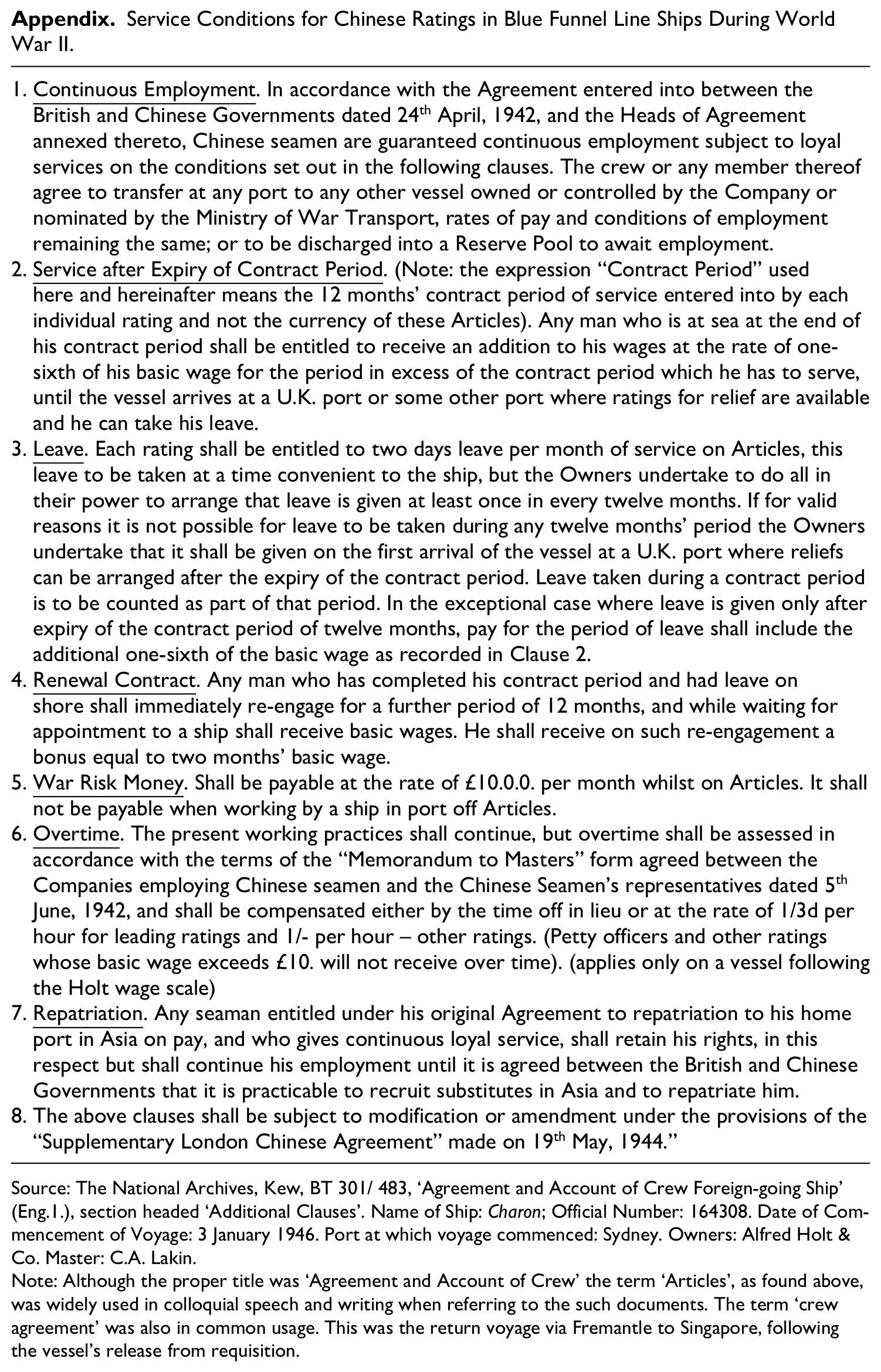
| 1. 2. 3. 4. 5. 6. 7. 8. The above clauses shall be subject to modification or amendment under the provisions of the “Supplementary London Chinese Agreement” made on 19th May, 1944.” |
Source: The National Archives, Kew, BT 301/ 483, ‘Agreement and Account of Crew Foreign-going Ship’ (Eng.1.), section headed ‘Additional Clauses’. Name of Ship: Charon; Official Number: 164308. Date of Commencement of Voyage: 3 January 1946. Port at which voyage commenced: Sydney. Owners: Alfred Holt & Co. Master: C.A. Lakin.
Note: Although the proper title was ‘Agreement and Account of Crew’ the term ‘Articles’, as found above, was widely used in colloquial speech and writing when referring to the such documents. The term ‘crew agreement’ was also in common usage. This was the return voyage via Fremantle to Singapore, following the vessel’s release from requisition.
Acknowledgements
The author is indebted to Professors P.N. Davies and G.H. Bennett who kindly reviewed an earlier version of this paper.
1.
D. Wilson MacArthur, ‘The Merchant Navy in Wartime’ in Archibald Hurd, ed., Britain’s Merchant Navy (London, 1944), 77–110. This takes the reader with a ship’s master through naval-run encounters from arrival off a port inwards to his departure in a convoy outwards.
2.
S. W. Roskill, The War at Sea, 1939–1945 Volume I: The Defensive (London, 1954), 45: Naval Control Service.
3.
Roskill, War at Sea, I, ‘Map 2, Naval Command Areas. . . September 1939’, 42–3, delineates British areas: ‘East Indies’ with headquarters at Trincomalee (Ceylon/Sri Lanka); ‘China’ – Hong Kong, later Singapore; ‘Australia’ – Sydney; ‘New Zealand’ – Auckland.
4.
For detailed descriptions of Centaur, Gorgon and Charon see ‘The Cargo and Passenger Ship “Centaur”’, The Motor Ship (October 1924), 226–30; ‘Blue Funnel Motorship “Gorgon”’, The Marine Engineer, 57 (January 1934), 27–30; ‘Blue Funnel Line Motorship “Charon”’, The Marine Engineer, 60 (February 1937), 37–9.
6.
Roskill, War at Sea, I, 549, emphasises the importance of the Naval Control Service knowledge of the location of all merchant ships at all times.
8.
9.
S. W. Roskill, A Merchant Fleet at War: Alfred Holt & Co., 1939–1945 (London, 1945), 88, 152, 155–6, 280–3; Malcolm Falkus, The Blue Funnel Legend: A History of the Ocean Steam Ship Company, 1865–1973 (London, 1990), 191, 218, 235, 245–6, 326. John Slader, The Fourth Service: Merchantmen at War, 1939–45 (Wimborne Minster, 1995), 158, 160, 162–3, 171, 173; G. H. and R. Bennett, Survivors: British Merchant Seamen in the Second World War (London, 1999), 124; Peter Elphick, Liberty: The Ships that Won the War (London, 2001), 368; Christopher S. Milligan and John C. H. Foley, Australian Hospital Ship Centaur; The Myth of Immunity (Nairana, Queensland, 1993).
10.
Examples include Slader, Fourth Service; Bennett, Survivors; Elphick, Liberty; Roy V. Martin, Merchantmen in Action: Evacuations and Landings by Merchant Ships in the Second World War (Stroud, 2010); Richard Woodman, The Real Cruel Sea: The Merchant Navy in the Battle of the Atlantic, 1939–1943 (London, 2004).
11.
H. P. Willmott, The Second World War in the East (London, 1999).
12.
Trevor Nevitt Dupuy, Illustrated History of World War II. Volume 8 Asiatic Land Battles: Expansion of Japan in Asia; Volume 9 Asiatic Land Battles: Japanese Ambitions in the Pacific; Volume 10 Asiatic Land Battles: Allied Victories in China and Burma (New York, 1963).
13.
Roskill, War at Sea, I; Volume II: The Period of Balance (1956); Volume III: The Offensive – Part I (1960); Volume III – Part II (1961).
14.
Geoffrey Barraclough, ed., The Times Atlas of World History (London, 1978); Willmott, The Second World War in the East, Chapter 1, ‘The Road to War’.
15.
Willmott, The Second World War in the East, 29.
16.
Roskill, War at Sea, I, 41–3, 353–4, 563, 539–40; observations on Japan’s negative attitude to Britain, its expansionism, and Britain’s awareness that Japan was a potential enemy.
17.
Francis E. Hyde, Blue Funnel: A History of Alfred Holt & Company of Liverpool, 1865–1914 (Liverpool, 1957), 92–8; Falkus, The Blue Funnel Legend, 39–47.
18.
Falkus, The Blue Funnel Legend, 44. A history of the trade by the Manager of Dalgety’s, Holt’s Fremantle Agents, is given in his evidence to the Navigation Commission and quoted in The Daily News (Perth, 16 October 1923), 5, 8. See also Malcolm Uren, Trinders Pioneers: being the story of the story of the historic association of Trinder, Anderson & Company with the State of Western Australia and flourished in concert (London, n.d. [circa 1941]); Gordon L. Simner, ‘“Arabella”, a woolship of the nineties’, Journal of the Honourable Company of Master Mariners (April 1951), 372–4.
19.
George Philips, ed., Philips Mercantile Marine Atlas (London, 12th Edn. 1927): Map 37 ‘Cables and Wireless Stations’, and Supplement ‘Wireless Stations’, 8.
20.
See for example NAA, PP1/1,356/9/1941, List of Crew on MV Centaur Arriving Fremantle 24 Sept. 1941.
21.
William Walker, ‘Western Australia’s Coastal Shipping: Government Versus Private Enterprise, Part Two: 1908–1914’, The Great Circle, 30/2 (2008), 77–101. See also Walker, ‘Western Australia’s Coastal Shipping: Part One’, The Great Circle, 30/1 (2008), 18–40.
22.
Walker, ‘Western Australia’s Coastal Shipping: Part Two’, 101.
23.
This paragraph is based on the author’s personal experience at sea in the 1950s, especially his service as Third Mate in Charon in 1959/60. See also Max D. Bell, ‘Gorgon – Memories of a Blue Funnel Liner’, Ships Monthly (March 1987), 32–3.
24.
The coastline between Darwin and Point Samson is subject to some of the largest tidal ranges in the southern hemisphere. At Broome for example it can reach 10 meters (33 feet) and generate tidal streams of five knots; see Hydrographi Department, Admiralty Tide Tables for the Pacific Ocean (London or Taunton, any year), and Hydrographuc Department, Admiralty Sailing Directions: The Australia Pilot, Vol. 1 (London or Taunton, any edition).
25.
That this pattern of manning was continued after the outbreak of war is confirmed by NAA, PP1/1, 356/9/1941, 312701 Form M and S14, List of Crew in MV Centaur arriving Fremantle, 24 September 1941 (digitised image).
26.
Daily Commercial News and Shipping List (Sydney), ‘Overseas Export Manifests’ [regular feature] (2 March 1939, 5 July 1930), 5.
27.
This section is largely based on data in MSMRA. The three ships were very similar to each other, Gorgon and Charon particularly so. The notes on weapons do not detail types.
28.
Roskill, War at Sea, I, 21–2, 110, 139–41, 363, comments on the great shortage of suitable defensive equipment including weaponry for merchant ships in the early part of the war, the great variability of what could be found, and large demand for weapon-trained manpower, whether seafarers or soldiers. The need led to a government Department for Anti-Aircraft Weapons and Devices, a Maritime Regiment of the Royal Artillery, an Inspector of Merchant Navy Gunnery, and short gunnery courses for merchant seafarers. Defensively Equipped Merchant Ship (DEMS) gunners were important for merchant ship crew morale.
29.
Roskill, War at Sea, I, 99–101, 326–7. In addition to contact mines, magnetic and acoustic mines were deployed by the enemy early in the war, and the British had an ongoing programme of research into, and provision of, counter-measures.
30.
Martin Doughty, Merchant Shipping and War: A Study in Defence Planning in Twentieth-Century Britain (London, 1982), 50.
31.
Doughty, Merchant Shipping and War, provides a detailed examination of inter–war planning for control of merchant shipping in a future war.
32.
Convoyweb.
33.
See Juliet Ludbrook, Schoolship Kids of the Blue Funnel Line West Australian Service (Perth, WA, 1998).
34.
NAA, K269, Passengers arriving Fremantle in MV Gorgon 23 May 1940.
35.
NAA, K269, Passengers arriving Fremantle in MV Gorgon 20 February 1942.
36.
NAA, PP1/1, 356/9/1949.
37.
Roskill, War at Sea, I, 542–51. The activities of German surface raiders, both naval vessels and disguised merchantmen, are treated in detail by Roskill, including mapping of the routes taken: ‘Map 24: The Operations of Disguised German Raiders Jan–Dec 1940’, 278–9; ‘Map 29: The Operations of Disguised German Raiders Jan 1941–May1941’, 382–3. These show the activity in the Indian Ocean, with Kormoran and Komet coming closest to the West Australian coast, and Komet briefly present near the track of British coastal ships in the latitude of Onslow (May 1941). They also show the activity of other raiders in the western Pacific Ocean between New Zealand and the Solomon Islands, and off the Tasmania and New South Wales.
38.
Eiji Seki, Mrs. Ferguson’s Tea-Set, Japan and the Second World War: The Global Consequences Following Germany’s Sinking of the SS Automedon in 1940 (Folkestone, 2007). Lat. 4o18’N Long. 89o20’E; British Vessels Lost at Sea, 1939–45.
39.
Roskill, A Merchant fleet at War, 87–8; Milligan and Foley, Australian Hospital Ship Centaur, 19–24.
40.
Roskill, War at Sea, I, 278–9, 286, 382–3.
41.
Lloyd’s Captains’ Register must have been fed data from the Marine Department of the Board of Trade, which attempted to keep a record of the service of seafarers, especially those granted its certificates of competency. But it is clear that there are omissions, and this was especially likely for mates and masters serving in ships that did not return to the UK. Ward-Hughes was in command of Memnon in May 1919, when she collided with Paulsboro. After appeal Memnon was exonerated. Having settled in Western Australia he retired about 1942. Ireland was in command of Diomed in fog off Felixstowe in March 1932 when she was in collision. Lakin commanded Charon for most of the war, except for an occasional voyage off, giving his Launceston, Tasmania, address. By the 1950s he had retired to London, when this writer met him. Murray, in command of Centaur in May 1943, lost his life when the ship was torpedoed by a Japanese submarine. Dark was in command of Titan in November 1940, when she was torpedoed and sunk. He was awarded a commendation. In command of Ixion when torpedoed and sunk in May 1941, he was awarded Lloyd’s War Medal. Marriott in command of Gorgon escaping from Singapore in February 1942, was awarded the OBE, and received a commendation for his service in Gorgon in New Guinea in April 1943.
42.
Roskill, A Merchant Fleet in War, 155–6; for narrative of escapes from Singapore mentioning Gorgon see also Colin Smith, Singapore Burning: Heroism and Surrender in World War II (London, 2005), 521–2, and H. M. Tomlinson, Malay Waters: The Story of Little Ships Coasting out of Singapore and Penang in Peace and War (London, 1950), 151.
43.
MSMRA. The message sequence for Charon is annotated ‘Now a naval store ship’ after the Sydney 1 May 1942 arrival message. The ship description panel for Centaur is annotated ‘NCS per phone 31/1’ [1942], and that for Gorgon ‘NCS Melb 30/3’ [1942]. Possibly NCS may be an abbreviation for ‘naval control service’.
44.
NAA, MP 150/1, 674/201/3131; Milligan and Foley, Centaur, 25–6.
45.
MSMRA analysis. Times in port have been calculated in days, hours and minutes derived from the dating and timing of the arrival and departure radio messages, rounded to the nearest whole day for the purposes of these statements. The data here excludes the 94 days (stays in excess of seven days) the ships spent in east coast ports, and ignores the passage times and costs of the passages between Fremantle and east coast ports.
46.
Convoyweb. The data derived from this source depends on the accuracy of the work of volunteer transcribers. A few typographical errors have been encountered, but overall the data is sufficiently robust for making the generalisations drawn from Tables 9 and  . For Roskill’s treatment of the war in the Pacific see War at Sea, II, 5–42, 219–58, 413–25; III (I), 213–40, 331–58; III (II), 187–233, 321–35, 337–63.
47.
MSMRA for Centaur and Gorgon; Roskill, A Merchant Fleet at War, Chapter 13, 279–98; Milligan and Foley, Centaur.
48.
MSMRA for Gorgon and Charon.
49.
Elphick, Liberty, Chapter 20, describes a selection.
50.
Roskill, War at Sea, II, 93, 322–4 (Map 33), 235.; III (I), 13, 225, 226; III (II), 401–5. See also Jerry E. Strahan, Andrew Jackson Higgins and the Boats that Won World War II (Baton Rouge and London, 1994), 2–4. Models of landing craft are on display at the Imperial War Museum in London. See also Elphick, Liberty, 378.
51.
Elphick, Liberty, 374, 363.
52.
Roskill, A Merchant Fleet at War, 280–2.
53.
MSMRA, Gorgon, May 1945. The entry has been corrected to May, leaving the date uncertain.
54.
MSMRA, Charon.
55.
Roskill, A Merchant Fleet at War, 280.
56.
Roskill, A Merchant Fleet at War, 280–3; this offers a concise description of the attack on Gorgon. For mapping of Japanese air raids and airfields, see Willmott, The Second World War in the East, 90–91, 112–3, 132–3. Willmott also offers a Chronology of events in the western Pacific Ocean during the war, 10–5.
57.
Roskill, War at Sea, III (II), 199, 15 September 1944.
58.
For British vessels (including Australian) see British Merchant Vessels Lost or Damaged by Enemy Action.
59.
Roskill, A Merchant Fleet at War II, 12, 19, 27.
60.
‘Continuous Certificate of Discharge’ book, T. E. Kennerley, No. R212664, engagements and discharges. (Author’s collection). T. E. Kennerley (1911–1991), was the author’s father.
61.
Tony Lane, The Merchant Seamen’s War (Liverpool, 1990), 162–74. Unfortunately this refers to, but does not discuss, the agreement cited in the , or address the scene in Australia. C. B. A Behrens, Merchant Shipping and the Demands of War (London, 1955), 154–87 attempts to quantify Asiatic seafarers in British ships, without discussion.
62.
‘Centaur – a holiday cruise ship’, Illustrated London News (18 January 1964), 8; ‘Blue Funnel’s latest ship ties up at Liverpool Landing Stage’, Liverpool Echo (8 January 1964) ; ‘Versatile Centaur’, The Sphere (18 January 1964), 106–9.
63.
Roskill, War at Sea, II, 235.