



Abstract
This article establishes and examines the shipping losses of the British East India Company between the middle of the eighteenth century and 1813 when it lost its trade monopoly with India. This was the most important period in the history of the East India Company because it greatly expanded its trade with India and China and established what became a very large territorial empire on the subcontinent. It was also a time when Britain was often at war with France. This is the first publication to present full information on all of the East India Company’s shipping losses. They are set out in the Appendix, which presents details of the names of every ship lost, the date of loss, the cause, and whether the ship was sailing to or from Asia. This information, discussed in the article, shows that 105 ships were lost on 2,171 voyages, a rate of loss that stood at just under 5%. The causes were primarily wrecking, foundering and enemy action, which contributed to far higher shipping losses on voyages outward to Asia than homeward. The East India Company did little itself to rectify this situation because the ships they used were hired from private owners, but some specialists within the Company did take it upon themselves to improve some navigational aids and shipbuilding techniques, although with little overall effect upon the rate of shipping losses. This meant that the East India Company was plagued by shipping losses throughout the period, and this had a very negative effect upon its commercial affairs and profitability.
For 234 years, shipping operations lay at the very heart of the East India Company’s affairs as it conducted long-distance transoceanic trade with Asia and, from the mid eighteenth century onwards, created a large territorial empire on the Indian sub-continent. During each ‘sailing season’, which lasted from November to April, ships were dispatched to the East from London, with the number rising from three in 1600–1601 to 81 in 1813–1814. In all, between 1600 and 1834, 1,577 ships made 4,563 voyages from London carrying to Asia people, cargoes and despatches. Most of them returned laden with commodities destined for sale in Britain and Europe, with the volume of exchanges increasing considerably as the ships grew in size from 499 tons to 1,200 or 1,400 tons burthen during the late eighteenth century. 1 Until the mid-1650s, the Company owned vessels built at its dockyard at Blackwall, but thereafter it relied upon freighting East Indiamen from consortia of investors headed by a Principal Managing Owner. Only a small number of packet vessels and larger ships continued to be owned by the Company, with the vast majority of the East Indiamen that sailed to Asia belonging to private owners. Even so, any loss of these ships was disastrous for the Company despite the fact that they were not owned or insured by it. 2 With any shipping catastrophe, the Company directly lost crews, passengers and troops, as well as cargo – again not insured – which had a significant negative impact on its commercial activity and profitability. 3 And, of course, multiple losses of the ships despatched to Asia in any one sailing season had an even deeper effect upon trade and the maritime supply system that provided the lifeblood of a far-distant empire. In view of this, it is hardly surprising that shipping always took precedence in the Company’s internal affairs, and directors and officials kept the closest of eyes on the passage of East Indiamen to and from Asia and were deeply unsettled by any losses. Indeed, beyond the Company, many of the wider public always regarded the loss of any ship as a national maritime disaster.
What was the total number of shipping losses during the most important period of the Company’s history, from 1750 to 1813 when it lost its Indian monopoly trading privileges? Unfortunately, modern historians have not addressed this important issue very effectively, with most examining individual ship losses or specific events. Hence, for example, Geoffrey and David Allen have studied the loss of Doddington in Algoa Bay in 1755 and how it was salvaged in 1977–1978; Alethea Hayter has produced a study of how Earl of Abergavenny was wrecked in Weymouth Bay in 1805, with its commander John Wordsworth being the younger brother of the poet William; Stephen Taylor has examined the loss of Grosvenor off the shore of Pondoland in south-east Africa in 1782, as well as producing a study of the heavy loss of Company shipping in the Indian Ocean that occurred in 1809. 4 These books are all important because they shed light on how some East Indiamen were lost and what the consequences were, but they do not establish whether they were typical, and do not paint a broader picture by establishing the overall number of losses.
The only study to offer an aggregation of losses is an article that examines the wrecking of Henry Addington on Bembridge Ledge off the Isle of Wight in December 1798. 5 In addition to chronicling the events that surrounded the wrecking of this particular vessel, James H. Thomas’s article sheds light on how the East India Company responded to the potentially damaging loss of important commercial and maritime assets. As a study in institutional crisis management, therefore, the article not only explores the complex interrelated problems of pilotage, security, rescue and salvage, but Thomas also advances some observations on the general shipping problems that confronted the Company as it endeavoured to manage an expanding trade with India and China. He duly acknowledges the complexity of the issues arising from shipping losses, and comments favourably on an overall level of performance that allowed the Company ‘to both cope [with the consequences of losses] and continue pursuit of its multifarious objectives’. Indeed, Thomas’s final conclusion is that the Company’s ‘achievements should perhaps be considered with an even greater degree of acclaim and respect’. 6 He is able to do this because in an Appendix he sets out total Company’s shipping losses, and details dates and locations between 1750 and 1799. 7 This is done on the basis of information derived from a website, 8 which at the time of writing this present article was either temporarily out of action or no longer in existence. But, whatever the case, Thomas’s Appendix is far from accurate even though the total number of losses between 1750 and 1799 are calculated as being 66 as opposed to the 67 that actually occurred in those years. This is because the Appendix contains a number of omissions, 9 some details or years of loss are incorrect, 10 and several ships are noted as having been lost in Company service when this was not in fact the case. 11 As a result, the Appendix has to be treated with a considerable degree of caution despite the strengths of the rest of the article arising from the case study of the loss of Henry Addington.
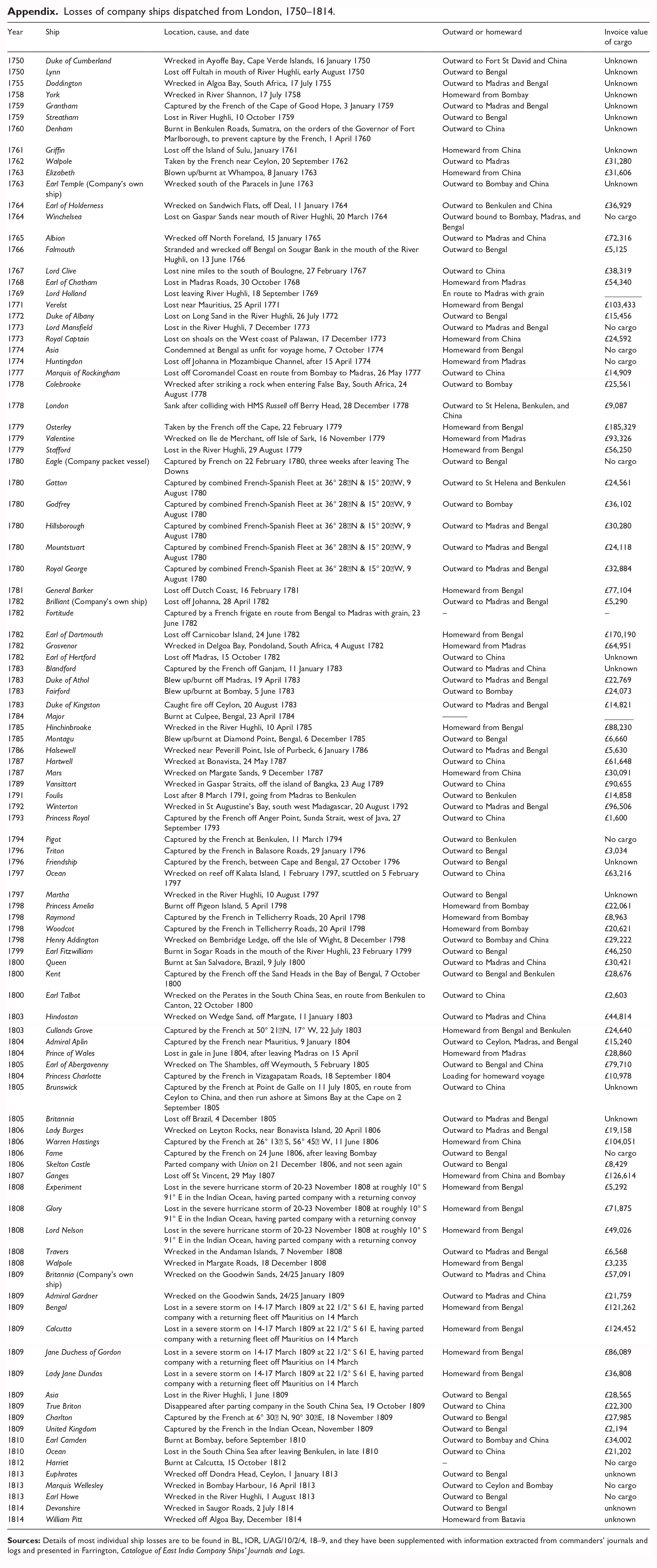
In order to establish a fuller and much more accurate assessment of the Company’s shipping losses, it is possible to use the Company’s own records and cross-check them with other sources, which also allows an estimate to be made of cargo losses. Full details of the East India Company’s shipping and cargo losses for the years between 1750 and 1814 are set out in the Appendix. They reveal that 105 ships were lost in that period. Since the total number of sailings made by Company ships to Asia between seasons 1749–1750 and 1813–1814 (inclusive) was 2,171, this represents an overall loss rate of just under 5%. As Table 1 shows, losses were not spread evenly across the period, however, and unsurprisingly, as the percentage figures show, they were most heavily concentrated in periods when Britain was at war with rival European powers, notably during the 1770s, 1780s and 1800s.
Shipping losses of the East India Company, 1750–1814.
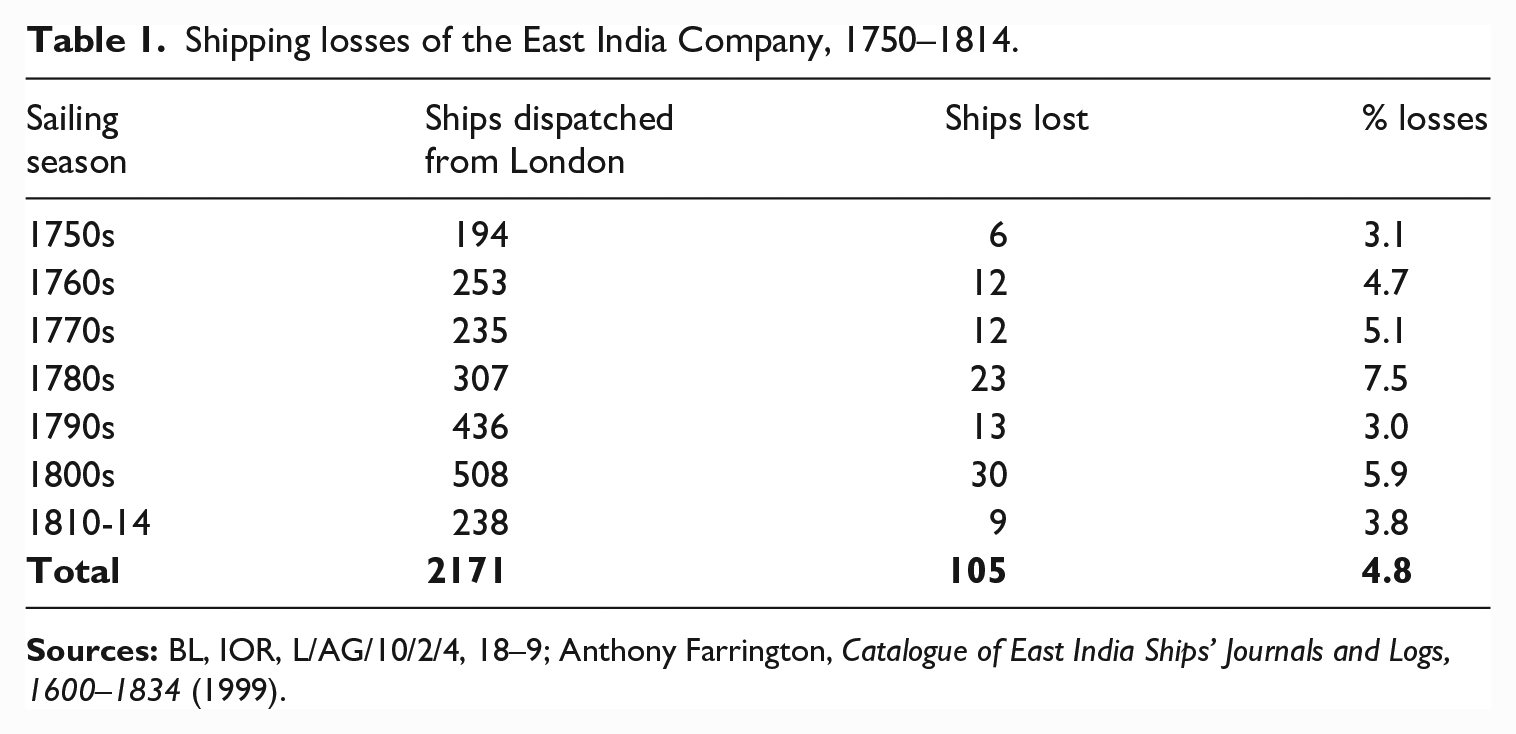
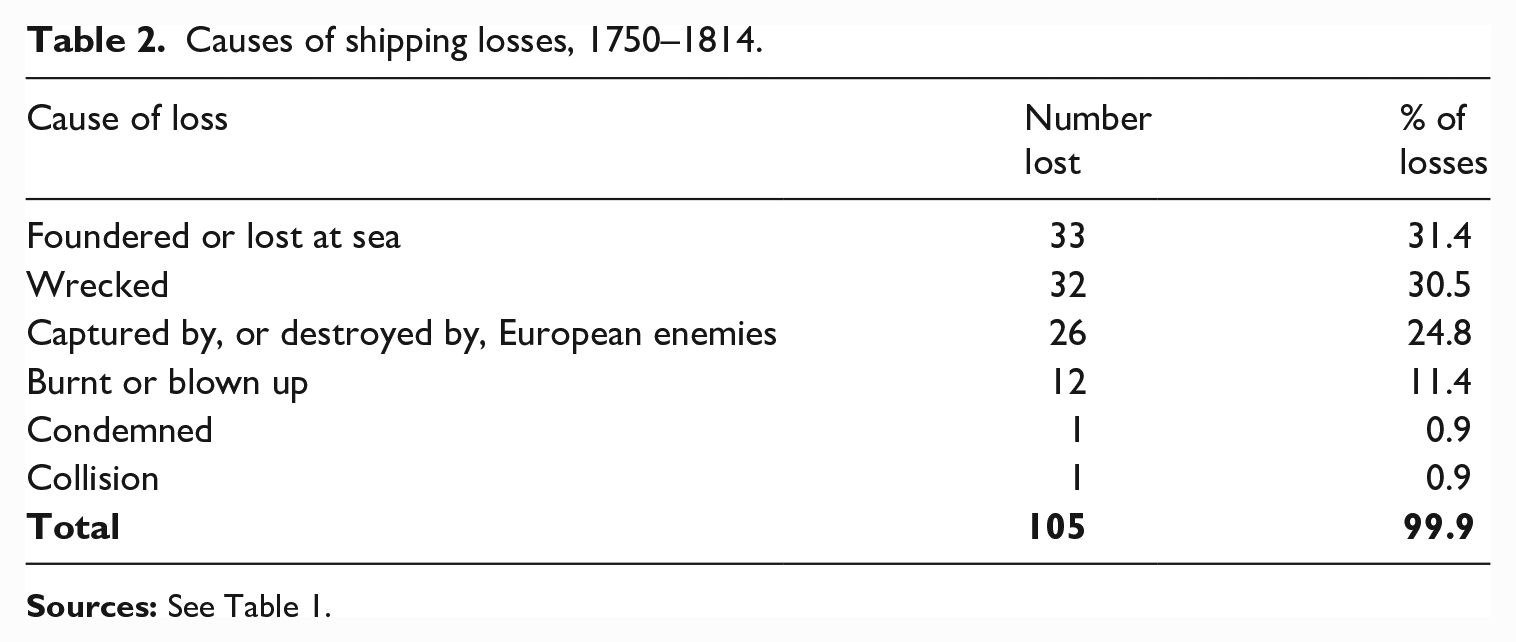
Across the period as a whole, 26 ships (24.8% of the total lost) were captured or destroyed by European rivals (mainly French ships), and the periods 1778–1782 and 1803–1809 were very bleak indeed for the Company because of enemy action. The years 1779 and 1780 were especially bad because nine ships were lost in total, with seven of them taken by the French or a Franco-Spanish combined fleet. Then, between 1803 and 1809, the French took eight ships. Yet the relationship between times of war and shipping loss was not as straightforward as it might appear at first sight. This was the case in 1808 and 1809 when the primary cause of heavy losses was not enemy action, but the fact that ships returning to Britain from South Asia encountered uncommonly ferocious hurricanes in the Indian Ocean. This unfortunate climatic circumstance accounted for the loss of seven ships, and the fact that Britain was at war with France at the time can be said to have had only a marginal bearing on the situation. Subsequent Company enquiries into these heavy losses examined whether war-related factors such as the pressing of the ship’s crews in India by the Royal Navy, or the need for the vessels to sail in convoy, had contributed to the foundering of the ships. Several of the commanders of surviving vessels from the returning fleets of 1808 and 1809 were of the opinion that some of the lost ships were very poorly manned because the navy had pressed the most experienced seamen, but even they conceded that it was the violence of the storms that was the overriding reason for the disaster. 12
As Table 2 indicates, a large majority of the shipping losses were attributable to three causes: foundered at sea, wrecked or enemy action.
Causes of shipping losses, 1750–1814.
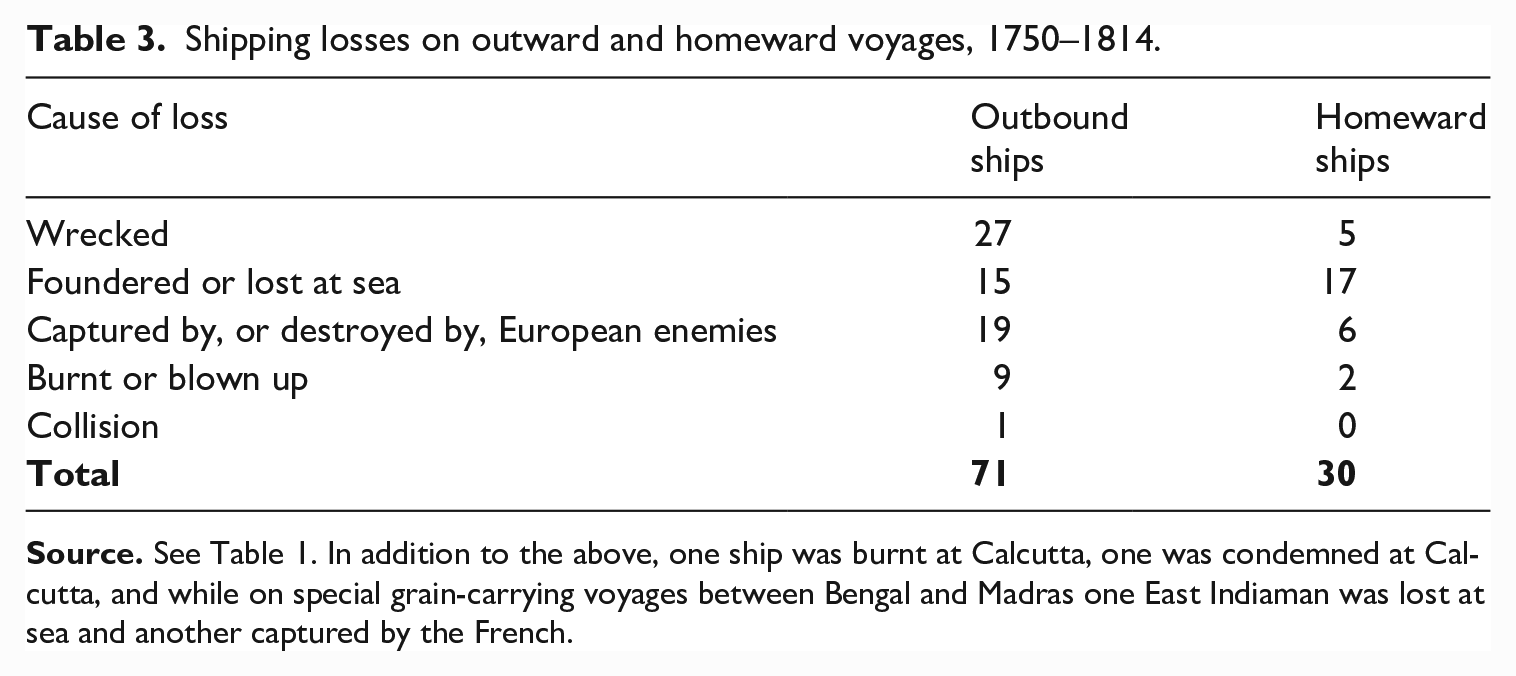
Yet moving beyond this general picture, it becomes apparent that many more ships were lost on outward voyages than on homeward ones. As can seen from Table 3, more than twice as many ships were lost en route to Asia than on return voyages to London. It is difficult to explain this striking difference. However, the commanders and crews of outbound East Indiamen did have to confront two acute problems that challenged their navigational skills. First, they had to negotiate the English Channel during the winter months when conditions were at their worst and made any safe passage difficult, so much so that nine East Indiamen were wrecked on the southern English coastline at the very beginning of their voyages. Then, near the end of their voyages, ships bound for Calcutta had to enter the mouth of the River Hughli at the north end of the Bay of Bengal, a process that was deeply difficult because of the presence of small islands and treacherous ever-shifting sandbanks. This was an extremely hazardous passage and 13 vessels were lost in the area between 1750 and 1814. It is also the case that three times as many outbound East Indiamen were lost to European enemies than homeward bound ships during wartime. The reason for this is that homeward ships usually sailed in convoys in conflicts and this offered them some degree of protection offered by British naval vessels. On the other hand, East Indiamen still largely sailed individually to the East during wartime, which meant that the French could more easily intercept them. Moreover, when convoy arrangements were attempted during an outbound sailing season, they sometimes failed in disastrous fashion, as was the case on 9 August 1780, when five ships heading for India and Benkulen were captured by a combined French-Spanish fleet.
Shipping losses on outward and homeward voyages, 1750–1814.
Whereas far more outbound East Indiamen were lost than ships returning from the East, the opposite was the case as far as cargo losses were concerned. Cargoes lost en route to Asia were valued at £1,333,879, but those that vanished on voyages from India and China were worth £1,824,879. The reason for this lack of correlation between the distribution of shipping and cargo losses is that vessels sailing from London often carried little cargo, and occasionally none at all, which meant that they were in ballast. This was because the Company found it extremely difficult to sell bulk goods such as woollen textiles and metals in India and China where there were limited markets, which meant that its warehouses on the subcontinent were often full to capacity with unsold items. By contrast, returning East Indiamen were usually fully laden – sometimes overladen – with commodities for which there was strong demand in Britain, Europe and North America: that is, tea, cotton textiles, silk, ‘drugs’ and saltpetre. Unsurprisingly, the loss of any of these cargoes was a setback to the Company, and at times simultaneous multiple losses were a considerable blow to the Company’s commercial and financial affairs. This was notably so in 1808–1809 when the Company claimed that it had lost homeward cargoes with an estimated invoice value of £1,048,077. 13 This meant that the Company’s position was always weakened more by the loss of cargoes rather than ships, because the former were part of its property, or capital, while the latter belonged to the private owners.
Confronted with these at-times heavy losses of East Indiamen and their valuable cargoes, the Company itself took surprisingly few steps to address the problem. It was only at the beginning of the nineteenth century that it began to conduct detailed enquiries into the loss of ships. As this happened, officials identified a number of basic factors that could contribute to disaster: poor levels of manning, overloading, sailing at an inappropriate time or season, selection of an incorrect course, and the condition of weather and sea. Determining most of these problems was the seamanship, skill and judgement of the ships’ commanders, and it is abundantly clear that human errors and failings could play a very significant part in the sequence of events leading to the loss of a vessel. Yet the Company had done little in practical terms to minimise the loss of East Indiamen, largely because the procurement of navigational instruments and charts was the sole responsibility of commanders who were answerable to the private owners of their vessels. The ships were sailing through dangerous waters and unpredictable ecosystems and the commanders had at their disposal only sketchy information about tides, currents, winds, monsoons, hurricanes, coastlines, islands, rocky outcrops, archipelagos, shoals and sandbanks. Much basic information was missing from the charts used by commanders. Their navigational instruments were also fairly rudimentary – compasses, chronometers, telescopes and sextants – and thus much depended upon the experience and sound judgement of the commander, his officers and crew.
Some official support was given to those within the Company who promoted the gathering and publication of hydrographical information, and those who advocated improvements to the specifications used in the building and fitting out of East Indiamen. However, commercial considerations meant that there were always limits to Company (and shipowner) support for such ventures, and much depended upon the actions and initiatives of a small group of committed specialists who worked to ensure that vessels were better able to undertake the long and difficult voyages to and from India and China. The tragic loss of Colebrooke in False Bay, southern Africa, in the summer of 1778 acted as a particular spur to navigational advances. These were largely based upon the work of Alexander Dalrymple who began to process and analyse the vast amount of maritime information held at East India House, which housed a large collection of journals and logs deposited by all commanders on their return to London. But the Company and shipowners were very reluctant to sanction surveying voyages. When they very occasionally did so, things sometimes went disastrously wrong as happened when the commander of Vansittart was instructed to undertake navigational work on a voyage to China, a mission that resulted in the ship being wrecked in August 1789 as it attempted to survey a treacherous bank in the Gaspar Strait, east of Bangka. So instead, Dalrymple had to rely upon track charts and harbour plans sent to him by the commanders of East Indiamen when they returned to London. From these sources, he prepared a selection of printed charts and plans for distribution to commanders with a view to making voyages safer, faster and more predictable, and this work was continued by James Horsburgh during the early nineteenth century. 14
At more or less the same time, as a result of energetic interventions by Gabriel Snodgrass, the Company’s long-serving Surveyor of Shipping, significant improvements were made to the construction of East Indiamen during the last quarter of the eighteenth century, which were intended to enhance safety, speed and handling. In the late 1770s, Snodgrass secured the use of round headed rudders in place of those with coats which were recognised as being dangerous. He introduced the fastening of the outside and inside planks with bolts, and those planks and other timbers underwent much better seasoning. Most notably, perhaps, he encouraged the builders of East Indiamen to use iron for pillars and hooks, and to replace wooden hanging knees with iron ones. The only improvement that the builders were slow to introduce was the use of copper sheathing. The navy had started this practice in 1761, but the private owners of East Indiamen baulked at the cost to them, so much so that by 1790 only 22 ships had been coppered. Notwithstanding this, the directors of the Company certainly believed that the Snodgrass-inspired improvements were extending the lives of the ships they hired. Initially, Company ships were restricted to making four voyages to Asia, but in 1790 this was extended to six, and then to eight in 1810. 15
Does the overall pattern of loss suggest that the performance of the Company’s maritime service and shipping improved over time as result of improvements to navigational information and shipbuilding? In some ways, this is an impossible question to answer because at a time of successive shifts from peace to war, and vice-versa, there is no way of establishing what was a typical year or period, and heavy losses such as those incurred in 1808 and 1809 serve significantly to distort the picture. However, a couple of general observations can be made in an attempt to address this issue. First, shipping losses proved to be a regular occurrence and the threat of loss was certainly ever-present; hence the near-obsessive desire for shipping news and information within the Company. In only 20 of the outward shipping fleets dispatched between 1750 and 1815 were there no losses of shipping at all, and it was rare for the Company to go for more than a year or two without losing at least one vessel. Second, however, the longest run without a loss came at the very beginning of the period, between 1750 and 1755, although, as can be seen from Table 1, it has to be noted that the size of the annual fleet dispatched to the east was then very much smaller than was to be the case in later years when the Company’s trade had greatly expanded in volume. Even so, in the seasons 1750–1751 to 1753–1754, 77 ships were sent to Asia and all of then returned safely to London, which by any standard is a highly impressive record.
These observations are valuable, but do not directly address the question posed at the beginning of the previous paragraph. Accordingly, by taking out of the calculation all of the losses that can be attributed to enemy action, it is possible to establish whether routine levels of safety, construction, navigation and seamanship were improving. If this is done the overall loss caused by nature and human error falls to 79, or 3.7%, of the total number of ships that sailed to and from Asia during the period under review. It is also the case that over time there was some improvement in performance. After only 2.6% of East Indiamen were lost to non-enemy action during the 1750s, the percentage loss rate rose to between 4.4 and 5.0% during the 1760s, 1770s and 1780s. But thereafter the initiatives pursued by Alexander Dalrymple and Gabriel Snodgrass appear to have had some effect. Only 1.5% of East Indiamen were lost during the 1790s, 4.2% in the 1800s, and 3.8% between 1810 and 1814. Of course, disasters still occurred on a semi-regular basis, but voyages were not quite as hazardous they had been, leaving to one side the threat posed by enemy action in times of war.
The Company’s overall loss of just under one in twenty of its ships during the period under review might be considered respectable in the light of the many maritime difficulties that existed in conducting trade with Asia. But, by comparison, the Dutch East India Company lost only just under three percent of its vessels across its entire lifetime. 16 The British Company only infrequently achieved that rate of loss and it had to assume that any losses would be higher, which had a negative impact on its trade, finance and imperial affairs. The nature of the shipping system was such that the Company was reluctant to sanction improvements through the development of better navigational aids and shipbuilding techniques, and when these were introduced to the privately-owned East Indiamen by individual Company specialists working closely with commanders and builders the results were slow and far from decisive. As a result, the Company remained a prisoner of far from perfect maritime affairs and at times this had a profound effect upon its overall performance. Losses of ships could at times be considerable and because of this the Company could never guarantee the smooth running of its commercial affairs. Foundering, wrecking and losses of ships to enemy action all combined to make the conduct of long-distance trade with Asia unpredictable and extremely hazardous, a state of affairs that always made the Company vulnerable to maritime disasters. Each East Indiaman lost represented a heavy blow, and in overall terms to lose almost five per cent of them undermined significantly the Company’s position as the world’s most important trading and imperial organisation.
Footnotes
Appendix
Losses of company ships dispatched from London, 1750–1814.
| Year | Ship | Location, cause, and date | Outward or homeward | Invoice value of cargo |
|---|---|---|---|---|
| 1750 | Duke of Cumberland | Wrecked in Ayoffe Bay, Cape Verde Islands, 16 January 1750 | Outward to Fort St David and China | Unknown |
| 1750 | Lynn | Lost off Fultah in mouth of River Hughli, early August 1750 | Outward to Bengal | Unknown |
| 1755 | Doddington | Wrecked in Algoa Bay, South Africa, 17 July 1755 | Outward to Madras and Bengal | Unknown |
| 1758 | York | Wrecked in River Shannon, 17 July 1758 | Homeward from Bombay | Unknown |
| 1759 | Grantham | Captured by the French of the Cape of Good Hope, 3 January 1759 | Outward to Madras and Bengal | Unknown |
| 1759 | Streatham | Lost in River Hughli, 10 October 1759 | Outward to Bengal | Unknown |
| 1760 | Denham | Burnt in Benkulen Roads, Sumatra, on the orders of the Governor of Fort Marlborough, to prevent capture by the French, 1 April 1760 | Outward to China | Unknown |
| 1761 | Griffin | Lost off the Island of Sulu, January 1761 | Homeward from China | Unknown |
| 1762 | Walpole | Taken by the French near Ceylon, 20 September 1762 | Outward to Madras | £31,280 |
| 1763 | Elizabeth | Blown up/burnt at Whampoa, 8 January 1763 | Homeward from China | £31,606 |
| 1763 | Earl Temple (Company’s own ship) | Wrecked south of the Paracels in June 1763 | Outward to Bombay and China | Unknown |
| 1764 | Earl of Holderness | Wrecked on Sandwich Flats, off Deal, 11 January 1764 | Outward to Benkulen and China | £36,929 |
| 1764 | Winchelsea | Lost on Gaspar Sands near mouth of River Hughli, 20 March 1764 | Outward bound to Bombay, Madras, and Bengal | No cargo |
| 1765 | Albion | Wrecked off North Foreland, 15 January 1765 | Outward to Madras and China | £72,316 |
| 1766 | Falmouth | Stranded and wrecked off Bengal on Sougar Bank in the mouth of the River Hughli, on 13 June 1766 | Outward to Bengal | £5,125 |
| 1767 | Lord Clive | Lost nine miles to the south of Boulogne, 27 February 1767 | Outward to China | £38,319 |
| 1768 | Earl of Chatham | Lost in Madras Roads, 30 October 1768 | Homeward from Madras | £54,340 |
| 1769 | Lord Holland | Lost leaving River Hughli, 18 September 1769 | En route to Madras with grain | _________ |
| 1771 | Verelst | Lost near Mauritius, 25 April 1771 | Homeward from Bengal | £103,433 |
| 1772 | Duke of Albany | Lost on Long Sand in the River Hughli, 26 July 1772 | Outward to Bengal | £15,456 |
| 1773 | Lord Mansfield | Lost in the River Hughli, 7 December 1773 | Outward to Madras and Bengal | No cargo |
| 1773 | Royal Captain | Lost on shoals on the West coast of Palawan, 17 December 1773 | Homeward from China | £24,592 |
| 1774 | Asia | Condemned at Bengal as unfit for voyage home, 7 October 1774 | Homeward from Bengal | No cargo |
| 1774 | Huntingdon | Lost off Johanna in Mozambique Channel, after 15 April 1774 | Homeward from Madras | No cargo |
| 1777 | Marquis of Rockingham | Lost off Coromandel Coast en route from Bombay to Madras, 26 May 1777 | Outward to China | £14,909 |
| 1778 | Colebrooke | Wrecked after striking a rock when entering False Bay, South Africa, 24 August 1778 | Outward to Bombay | £25,561 |
| 1778 | London | Sank after colliding with HMS Russell off Berry Head, 28 December 1778 | Outward to St Helena, Benkulen, and China | £9,087 |
| 1779 | Osterley | Taken by the French off the Cape, 22 February 1779 | Homeward from Bengal | £185,329 |
| 1779 | Valentine | Wrecked on Ile de Merchant, off Isle of Sark, 16 November 1779 | Homeward from Madras | £93,326 |
| 1779 | Stafford | Lost in the River Hughli, 29 August 1779 | Homeward from Bengal | £56,250 |
| 1780 | Eagle (Company packet vessel) | Captured by French on 22 February 1780, three weeks after leaving The Downs | Outward to Bengal | No cargo |
| 1780 | Gatton | Captured by combined French-Spanish Fleet at 36° 28′N & 15° 20′W, 9 August 1780 | Outward to St Helena and Benkulen | £24,561 |
| 1780 | Godfrey | Captured by combined French-Spanish Fleet at 36° 28′N & 15° 20′W, 9 August 1780 | Outward to Bombay | £36,102 |
| 1780 | Hillsborough | Captured by combined French-Spanish Fleet at 36° 28′N & 15° 20′W, 9 August 1780 | Outward to Madras and Bengal | £30,280 |
| 1780 | Mountstuart | Captured by combined French-Spanish Fleet at 36° 28′N & 15° 20′W, 9 August 1780 | Outward to Madras and Bengal | £24,118 |
| 1780 | Royal George | Captured by combined French-Spanish Fleet at 36° 28′N & 15° 20′W, 9 August 1780 | Outward to Madras and Bengal | £32,884 |
| 1781 | General Barker | Lost off Dutch Coast, 16 February 1781 | Homeward from Bengal | £77,104 |
| 1782 | Brilliant (Company’s own ship) | Lost off Johanna, 28 April 1782 | Outward to Madras and Bengal | £5,290 |
| 1782 | Fortitude | Captured by a French frigate en route from Bengal to Madras with grain, 23 June 1782 | – | – |
| 1782 | Earl of Dartmouth | Lost off Carnicobar Island, 24 June 1782 | Homeward from Bengal | £170,190 |
| 1782 | Grosvenor | Wrecked in Delgoa Bay, Pondoland, South Africa, 4 August 1782 | Homeward from Madras | £64,951 |
| 1782 | Earl of Hertford | Lost off Madras, 15 October 1782 | Outward to China | Unknown |
| 1783 | Blandford | Captured by the French off Ganjam, 11 January 1783 | Outward to Madras and China | Unknown |
| 1783 | Duke of Athol | Blew up/burnt off Madras, 19 April 1783 | Outward to Madras and Bengal | £22,769 |
| 1783 | Fairford | Blew up/burnt at Bombay, 5 June 1783 | Outward to Bombay | £24,073 |
| 1783 | Duke of Kingston | Caught fire off Ceylon, 20 August 1783 | Outward to Madras and Bengal | £14,821 |
| 1784 | Major | Burnt at Culpee, Bengal, 23 April 1784 | ——— | _______ |
| 1785 | Hinchinbrooke | Wrecked in the River Hughli, 10 April 1785 | Homeward from Bengal | £88,230 |
| 1785 | Montagu | Blew up/burnt at Diamond Point, Bengal, 6 December 1785 | Outward to Bengal | £6,660 |
| 1786 | Halsewell | Wrecked near Peverill Point, Isle of Purbeck, 6 January 1786 | Outward to Madras and Bengal | £5,630 |
| 1787 | Hartwell | Wrecked at Bonavista, 24 May 1787 | Outward to China | £61,648 |
| 1787 | Mars | Wrecked on Margate Sands, 9 December 1787 | Homeward from China | £30,091 |
| 1789 | Vansittart | Wrecked in Gaspar Straits, off the island of Bangka, 23 Aug 1789 | Outward to China | £90,655 |
| 1791 | Foulis | Lost after 8 March 1791, going from Madras to Benkulen | Outward to Benkulen | £14,858 |
| 1792 | Winterton | Wrecked in St Augustine’s Bay, south west Madagascar, 20 August 1792 | Outward to Madras and Bengal | £96,506 |
| 1793 | Princess Royal | Captured by the French off Anger Point, Sunda Strait, west of Java, 27 September 1793 | Outward to China | £1,600 |
| 1794 | Pigot | Captured by the French at Benkulen, 11 March 1794 | Outward to Benkulen | No cargo |
| 1796 | Triton | Captured by the French in Balasore Roads, 29 January 1796 | Outward to Bengal | £3,034 |
| 1796 | Friendship | Captured by the French, between Cape and Bengal, 27 October 1796 | Outward to Bengal | Unknown |
| 1797 | Ocean | Wrecked on reef off Kalata Island, 1 February 1797, scuttled on 5 February 1797 | Outward to China | £63,216 |
| 1797 | Martha | Wrecked in the River Hughli, 10 August 1797 | Outward to Bengal | Unknown |
| 1798 | Princess Amelia | Burnt off Pigeon Island, 5 April 1798 | Homeward from Bombay | £22,061 |
| 1798 | Raymond | Captured by the French in Tellicherry Roads, 20 April 1798 | Homeward from Bombay | £8,963 |
| 1798 | Woodcot | Captured by the French in Tellicherry Roads, 20 April 1798 | Homeward from Bombay | £20,621 |
| 1798 | Henry Addington | Wrecked on Bembridge Ledge, off the Isle of Wight, 8 December 1798 | Outward to Bombay and China | £29,222 |
| 1799 | Earl Fitzwilliam | Burnt in Sogar Roads in the mouth of the River Hughli, 23 February 1799 | Outward to Bengal | £46,250 |
| 1800 | Queen | Burnt at San Salvadore, Brazil, 9 July 1800 | Outward to Madras and China | £30,421 |
| 1800 | Kent | Captured by the French off the Sand Heads in the Bay of Bengal, 7 October 1800 | Outward to Bengal and Benkulen | £28,676 |
| 1800 | Earl Talbot | Wrecked on the Perates in the South China Seas, en route from Benkulen to Canton, 22 October 1800 | Outward to China | £2,603 |
| 1803 | Hindostan | Wrecked on Wedge Sand, off Margate, 11 January 1803 | Outward to Madras and China | £44,814 |
| 1803 | Cullands Grove | Captured by the French at 50° 21′N, 17° W, 22 July 1803 | Homeward from Bengal and Benkulen | £24,640 |
| 1804 | Admiral Aplin | Captured by the French near Mauritius, 9 January 1804 | Outward to Ceylon, Madras, and Bengal | £15,240 |
| 1804 | Prince of Wales | Lost in gale in June 1804, after leaving Madras on 15 April | Homeward from Madras | £28,860 |
| 1805 | Earl of Abergavenny | Wrecked on The Shambles, off Weymouth, 5 February 1805 | Outward to Bengal and China | £79,710 |
| 1804 | Princess Charlotte | Captured by the French in Vizagapatam Roads, 18 September 1804 | Loading for homeward voyage | £10,978 |
| 1805 | Brunswick | Captured by the French at Point de Galle on 11 July 1805, en route from Ceylon to China, and then run ashore at Simons Bay at the Cape on 2 September 1805 | Outward to China | Unknown |
| 1805 | Britannia | Lost off Brazil, 4 December 1805 | Outward to Madras and Bengal | Unknown |
| 1806 | Lady Burges | Wrecked on Leyton Rocks, near Bonavista Island, 20 April 1806 | Outward to Madras and Bengal | £19,158 |
| 1806 | Warren Hastings | Captured by the French at 26° 13′ S, 56° 45′ W, 11 June 1806 | Homeward from China | £104,051 |
| 1806 | Fame | Captured by the French on 24 June 1806, after leaving Bombay | Outward to Bengal | No cargo |
| 1806 | Skelton Castle | Parted company with Union on 21 December 1806, and not seen again | Outward to Bengal | £8,429 |
| 1807 | Ganges | Lost off St Vincent, 29 May 1807 | Homeward from China and Bombay | £126,614 |
| 1808 | Experiment | Lost in the severe hurricane storm of 20-23 November 1808 at roughly 10° S 91° E in the Indian Ocean, having parted company with a returning convoy | Homeward from Bengal | £5,292 |
| 1808 | Glory | Lost in the severe hurricane storm of 20-23 November 1808 at roughly 10° S 91° E in the Indian Ocean, having parted company with a returning convoy | Homeward from Bengal | £71,875 |
| 1808 | Lord Nelson | Lost in the severe hurricane storm of 20-23 November 1808 at roughly 10° S 91° E in the Indian Ocean, having parted company with a returning convoy | Homeward from Bengal | £49,026 |
| 1808 | Travers | Wrecked in the Andaman Islands, 7 November 1808 | Outward to Madras and Bengal | £6,568 |
| 1808 | Walpole | Wrecked in Margate Roads, 18 December 1808 | Homeward from Bengal | £3,235 |
| 1809 | Britannia (Company’s own ship) | Wrecked on the Goodwin Sands, 24/25 January 1809 | Outward to Madras and China | £57,091 |
| 1809 | Admiral Gardner | Wrecked on the Goodwin Sands, 24/25 January 1809 | Outward to Madras and China | £21,759 |
| 1809 | Bengal | Lost in a severe storm on 14-17 March 1809 at 22 1/2° S 61 E, having parted company with a returning fleet off Mauritius on 14 March | Homeward from Bengal | £121,262 |
| 1809 | Calcutta | Lost in a severe storm on 14-17 March 1809 at 22 1/2° S 61 E, having parted company with a returning fleet off Mauritius on 14 March | Homeward from Bengal | £124,452 |
| 1809 | Jane Duchess of Gordon | Lost in a severe storm on 14-17 March 1809 at 22 1/2° S 61 E, having parted company with a returning fleet off Mauritius on 14 March | Homeward from Bengal | £86,089 |
| 1809 | Lady Jane Dundas | Lost in a severe storm on 14-17 March 1809 at 22 1/2° S 61 E, having parted company with a returning fleet off Mauritius on 14 March | Homeward from Bengal | £36,808 |
| 1809 | Asia | Lost in the River Hughli, 1 June 1809 | Outward to Bengal | £28,565 |
| 1809 | True Briton | Disappeared after parting company in the South China Sea, 19 October 1809 | Outward to China | £22,300 |
| 1809 | Charlton | Captured by the French at 6° 30′ N, 90° 30′E, 18 November 1809 | Outward to Bengal | £27,985 |
| 1809 | United Kingdom | Captured by the French in the Indian Ocean, November 1809 | Outward to Bengal | £2,194 |
| 1810 | Earl Camden | Burnt at Bombay, before September 1810 | Outward to Bombay and China | £34,002 |
| 1810 | Ocean | Lost in the South China Sea after leaving Benkulen, in late 1810 | Outward to China | £21,202 |
| 1812 | Harriet | Burnt at Calcutta, 15 October 1812 | – | No cargo |
| 1813 | Euphrates | Wrecked off Dondra Head, Ceylon, 1 January 1813 | Outward to Bengal | unknown |
| 1813 | Marquis Wellesley | Wrecked in Bombay Harbour, 16 April 1813 | Outward to Ceylon and Bombay | No cargo |
| 1813 | Earl Howe | Wrecked in the River Hughli, 1 August 1813 | Outward to Bengal | No cargo |
| 1814 | Devonshire | Wrecked in Saugor Roads, 2 July 1814 | Outward to Bengal | unknown |
| 1814 | William Pitt | Wrecked off Algoa Bay, December 1814 | Homeward from Batavia | unknown |