




Abstract
This article reappraises the experience of the civilian crews aboard Manx personnel vessels engaged in Operation Dynamo, and the contested aftermath. More than 20,000 troops were retrieved by nine ships of the Isle of Man Steam Packet Company, three of which were sunk in and off Dunkirk. There is more than enough material for a heroic narrative to emerge, yet a sense of scandal seems to cling to these particular civilian crews. Various political, social and cultural forces foster distinctly separate narratives between the United Kingdom and Isle of Man. However, empirical research in Manx and UK archives, including access to a hitherto closed file, reveals a different story: that the official Admiralty narrative of Operation Dynamo was intentionally weaponized against the Manx civilian crews for political reasons. This was achieved through the creation of reports that were false, misleading or unsupported by evidence, the provocation of the Isle of Man’s Lieutenant Governor into acts of reprisal, and through the work of an unseen editorial hand in Admiralty archives. The influence of this hostile narrative, which continues to be reinforced, has obscured the contributions of the true civilians of Dunkirk.
Introduction
‘The sudden shock of Dunkirk,’ Joshua Levine argues, ‘was the spark for the creation of modern Britain.’ 1 It was certainly the spark for extraordinary myth-making: the indelible image of civilians manning little ships is powerful enough to displace the Royal Navy sailors that commanded the majority of these vessels, 2 and sideline the destroyers and civilian-manned personnel vessels that lifted most of the troops. 3 It was a necessary myth, enabling the British people to make sense of the disaster. 4 But when hard reality collides with the idealism of heroic myth-making, one can lose out to the other: the idea of civilians at Dunkirk is dominated by the little ships – it is rarely framed by the experience of the civilians who took part in Operation Dynamo, from beginning to end, aboard the personnel vessels.
Requisitioned along with their ships, these crews were forced to continually operate in waters so dangerous it led the Admiralty to withdraw its best destroyers.
5
The outcome was akin to a major sea battle, with the 46 personnel vessels proportionately suffering heavier losses than any other class of ship.
6
According to the official Admiralty account,
7
eight personnel ships refused to sail at some point – four of them Manx – with naval parties placed aboard several others to prevent trouble.
8
It is an uncomfortable idea: the fabled ‘Dunkirk Spirit’ weighs heavily, retroactively imposing an idealised template of expected behaviour. But the mythology has the effect of stigmatising, rather than recognising, the participants: these civilians endured conditions in which otherwise stout and decorated mariners, including Royal Navy and RNLI personnel, were snapping through exhaustion, stress and trauma.
9
The refusals are part of the story. They are not most of the story. In the case of the Manx vessels, however, certain parties ensured that it was the only story. Compare the treatment of the steamer St Seiriol with that of the Manx ships in Martin Mace’s, The Royal Navy at Dunkirk: alongside St Seiriol’s report is a glowing tribute by the Minister for Shipping
10
that, in Mace’s account, ‘inspired the nation’:
11
These men worked till they dropped . . . without sleep, often without proper meals, for days on end . . . under attack from enemy batteries on the coast with bombs and machine-guns, by enemy submarines and motor torpedo boats.
The reader might never know that the crew refused to sail after one trip. 12 Accompanying the report by Manxman’s master, however, Mace presents an anonymous Admiralty document that nakedly intends to taint every Manx crew: 13 at best, it contains major errors; 14 at worst, it includes active fabrications designed to support a certain narrative. From the same basic materials of heroism and controversy, two different narratives emerged – one of glory, one of scandal – which endure in the literature to the present day. Mace notes that the anonymous document, which emerged from closed Admiralty files in 1994, is ‘unfortunately unsigned and undated’. However, through careful research in Manx and Admiralty archives, this document can be understood and contextualised. Understanding its origins is the Rosetta Stone that unlocks this entire story. This article contends that the official narrative of Operation Dynamo was intentionally weaponised against the Manx civilian crews, and considers the political reasons behind this action. This study evaluates the political, social and cultural factors that have combined to create a separate narrative, in particular the divergence in cultural memory between the United Kingdom, where 1940 confers powerful narratives of national identity, 15 and the Manx variant, which is dominated by memories of internment. 16 At the heart of the divergent narrative, however, is a deliberate effort to discredit the Manx civilian crews. Though at first glance this may appear to be a response to the refusals to sail, the story is profoundly more complex and politicised than it appears, and amounts to nothing less than a stolen history.
This article offers the first scholarly assessment of a subject that is controversial, neglected and polarised. It presents analysis and interpretation based on a combination of Admiralty documents and sources available in the Manx National Heritage archive, and the Isle of Man Public Record Office. 17 The trials of the personnel vessels, and the frictions created by the conflicting traditions of the Royal Navy and Merchant Marine, are considered in part 1, which focuses on the events that led to the most notorious refusal, coordinated between three ships at Folkestone on 2 June, and demonstrates that issues of exhaustion and shock amongst the all the participating crews were clearly understood and carefully managed by the Admiralty. This understanding was entirely ignored in the creation of the anonymous report, which is analysed in detail in part 2. A combination of sources reveals its intended recipient and guides us towards an answer to the question of why it was necessary to create this hostile narrative. Its influence branched in two directions: firstly, it was laundered wholesale into one of the touchstone reports in Dunkirk scholarship. Secondly, as considered in part 3, it formed the basis for a series of reprisals against the Manx crews. Though the Admiralty distanced itself from many of its original claims, the work of an unseen editorial hand in the archives has ensured that the original narrative is the only version of this story that was allowed to stand. Part 4 takes a broader view, evaluating how Dunkirk is refracted through political, social and cultural lenses. It argues that cultural expectations and competing narratives combine to transfigure some participants and exclude others, a process that is amplified by the divergent myths and memories of the Second World War between the United Kingdom and the Isle of Man.
It is no surprise that, in Walter Lord’s words, ‘the books on Dunkirk could fill a warehouse’. 18 The sheer weight of sources and perspectives is a burden: with hundreds of thousands of people involved in a dynamic and multifaceted operation, even the most comprehensive treatment must choose its threads carefully. But Dunkirk is equal parts historical event and mythology, and the power of the myth appears to have had a profoundly distorting effect on the historiography. Public demand for popular narrative histories ensures that they dominate a self-referential field, in which there is little room for historians to address each other’s work. Errors are repeated in the service of narrative expediency: for example, several authors end Operation Dynamo a day early, usually with William Tennant’s famous signal ‘BEF evacuated. Returning now’. 19 In many cases, it is impossible to know where any specific information may be coming from: some authors include helpful bibliographies, 20 but surprisingly few volumes include notes or references to archive documents. 21 Levine directs the reader to an essay on sources on his website, but no such document can be found, 22 while Nicholas Harman and Walter Lord 23 each list an impressively diverse array of primary sources, but the reader is left guessing about how they are being used, and how each author has assessed the value of the material.
The most prominent debate, over the role and significance of the little ships, depends largely on whether a historian is more concerned with operations or symbolism: whereas maritime specialists like Eric Grove argue that their role has been overplayed to the detriment of the Navy, 24 generalists such as Levine emphasise their symbolic power and note that the revisionist view, that they have been vastly overplayed, could be ‘equally misleading’. 25 Both arguments are persuasive within their own frameworks, but the debate only underscores – and reinforces – the power of the mythology, and leaves certain aspects chronically understudied, not least the personnel vessels. The ferries and steamers might have been known as ‘Queens’ and ‘Belles’, 26 but caught between the little ships and the Royal Navy, ‘bridesmaids’ might be more appropriate.
Operation Dynamo lends itself to a particular type of chronological account, with each day acting as a convenient chapter. The refusals to sail frequently appear, but the narrative demands of a general history usually confine the subject to a few paragraphs. The combined refusal of three personnel vessels in Folkestone on 2 June is perfectly timed to fit the template of a ‘hero’s journey’, acting as the low point before the final rally and culmination. However, authors virtually always use these events to illustrate the exhaustion and strain of the whole enterprise, a more sensible – and empathetic – conclusion than the oddly vindictive narrative created by the Admiralty reports. Authors’ efforts to draw a veil over these events, however, fall short of mounting a serious challenge. Mace offers the best recent treatment of the trials of certain personnel vessels, providing balance, context and sensitivity to two ships – St Seiriol 27 and Malines 28 – that each refused one of their trips.
With the reports of several ships buried in closed files and the survivors residing outside the UK, Manx stories are easily overlooked. Until the files were opened in 1994, The Work of Personnel Vessels report (WPV) 29 was virtually the only document relating to ships Ben-my-Chree, Tynwald or Manxman that researchers encountered. 30 Even this did not come easily: before Vice-Admiral Ramsay’s papers became available in 1987, 31 diligent researchers had to unearth one of the copies held by the Admiralty and certain shipping companies. The authors that cleared this hurdle produced the most important Dunkirk literature through time – David Divine, Richard Collier, Nicholas Harman and Walter Lord all quote directly, and independently, from WPV. 32 In both scholarly and general understanding of the personnel vessels of Dunkirk, the influence of this report cannot be overstated. Through it the Admiralty has framed, shaped and distorted our understanding of these events from the outset: WPV is dominated by refusals to sail and ensures that when the personnel vessels do appear, it is frequently for all the wrong reasons. Given that the alternative route requires reviewing thousands of inconsistent and contradictory source documents, 33 WPV continues to act as the gatekeeper of this entire story in some of the most authoritative recent works. 34
Based on the same archive material used by other scholars, 35 the Naval Staff History is an invaluable reference that focuses on the chronology, signals and minutiae that would be best suited to an internal audience for training purposes. However, for an internal document that ‘pulls few punches’, 36 there are some fascinating omissions: it mentions only two refusals in the gentlest possible terms, 37 and specifically cites WPV as a source, despite conspicuously ignoring all of its findings. It seems that the historiography of Operation Dynamo is heavily influenced by a report that, for some reason, the Admiralty chose to ignore. Perhaps understandably neither of the Isle of Man Steam Packet Company's recent official histories 38 – nor any published local literature – addresses the controversies, though two unpublished manuscripts by W. H. Sleigh 39 and Ray Kenna, 40 tackle the issue head-on. Sleigh’s three-volume rebuttal is more polemic than academic enquiry, and both authors’ arguments tend to be lost in a counter-productive level of detail. More importantly, each separately misunderstands the timing, intended audience and reach of the Admiralty reports, and therefore miss the overall picture chronicled in this article. Both are convinced of an injustice; the absence of any published work, however, leaves a significant gap in the historiography and enables a particular narrative to be continually reinforced.
Two stewards: Operation Dynamo aboard the personnel vessels
The triumphs and tragedies of Dunkirk
From the ashes of a catastrophic defeat came a ‘miracle of deliverance’ 41 that was transfigured into a biblical scene: the seas parted and a people was saved. A week of calm weather in the English Channel might be considered a miracle; the evacuations of May and June 1940, though, were a human achievement, and a human tragedy, foreshadowed in Churchill’s first appearance before the House of Commons as Prime Minister: 'I have nothing to offer but blood, toil, tears and sweat.’ 42 The legend of Dunkirk, later sold by Churchill, obscures the staggering logistical operation masterminded by Dover Command under Vice-Admiral Bertram Ramsay. A large scale evacuation of the British Expeditionary Force had only been mooted on 19 May; when Dynamo commenced on 26 May, it was expected to last two days and hoped to lift 45,000 troops from the shrinking perimeter around Dunkirk. 43 Nine days later, ‘history’s strangest armada’ 44 had retrieved 338,226 Allied troops. 45 A total of 39 Royal Navy destroyers carried 96,197 troops during the evacuation, more than any other type of ship. Not far behind, though, were 46 personnel vessels, a combination of cross-channel ferries, liners and paddle steamers manned by their civilian peacetime crews, which lifted 87,810 troops from Dunkirk harbour. 46 They were sailing for Dunkirk before Dynamo had officially begun, 47 and were the last ships to leave the East Mole on 4 June. 48 Nine of these vessels were sunk over the course of the evacuation, while eight others were so severely damaged that they had to be withdrawn from service. 49 Of the nine Isle of Man Steam Packet Company (IOMSPCo) vessels that participated in the evacuation, seven were classed as personnel ships – Mona’s Queen, Manxman, Tynwald, Manx Maid, Fenella, Ben-my-Chree and Lady of Mann. 50 These virtually unarmed and unarmoured ships, which in peacetime had carried holidaymakers back and forth across the Irish Sea, lifted 21,010 British and French troops from Dunkirk, and 42,343 in total during the Dynamo, Cycle and Aerial evacuations of May and June 1940. 51 One day is inexorably wedded to Manx history. On 29 May, 45 men were killed, 28 of them Manx, aboard steamers Mona’s Queen, Fenella and King Orry; the former was blown apart by a magnetic mine, the others sunk by air attack. 52
The clashing cultures of the Royal Navy and Merchant Marine
Ramsay’s frustration with the personnel vessels was barely concealed in his despatch: once they set off, Dover Command usually had no idea of their whereabouts; 53 he noted their Masters’ habit of waiting outside until it was light enough to proceed into the harbour; 54 their crews personally remonstrated with him and questioned the instructions of his officers. 55 By 1 June, at least according to Ramsay’s Despatch, he had placed naval ratings and an officer aboard every personnel ship to prevent trouble. 56 The naval authorities’ impersonal, uniform, rules-based system of operational discipline consistently collided with the personalistic, relational authority – underpinned by reciprocity and trust – that was available to the masters of the Merchant Marine. But nobody could change what these crews were, nor the consensual means by which they operated. They had been chartered by the Ministry of Shipping and were crewed by civilian employees who were not subject to naval discipline. These distinctions are profound: masters were personally responsible for the welfare of their ships and crews and were limited in the orders they could give, while their authority did not extend beyond the end of any particular voyage. 57 Thus a major component of Dynamo’s lifting capacity was in the hands of civilian freelancers: their officers were making their own decisions in the middle of an unprecedented logistical operation, while their crews were expected to volunteer for every trip.
If the civilians did not endear themselves to the naval authorities, the feeling was certainly mutual. The Admiralty withdrew its best destroyers following the losses of 29 May;
58
seen from the promenade decks of the holiday steamers, the RAF was not the only service that was constantly letting them down. As they prepared to cast off after hours of loading at the Mole, the crew of Manxman were crestfallen at the arrival of one of the remaining destroyers, which took their complement and vanished: Troops were naturally swarming down on board her. She took nearly all of them, in fact she had to cast off or she would have been overwhelmed . . . I told the destroyer commander what I thought about it all, the way he had upset my crew after what they had just been through. Now had to wait alongside for hours again . . . This destroyer left us, the only vessel in, nothing even outside the pierheads; so we were alone with no protection, not even a pop-gun, not a single tin hat amongst us.
59
Even in the most troubling moments, however, the cultural differences between the two services appear to have been understood and respected. Lieutenant Commander Bushell, ordered aboard Tynwald following the combined refusals at Folkestone on 2 June, presented these issues as matters of management and logistics: It was emphasised that I was not to consider myself in command of the ship but to employ all possible means to get her to sail for Dunkirk as a number of the officers and crew were apparently unwilling to do so. Owing to the efforts of the company which owns the ship, and their agent in Folkestone, this presented no difficulty whatsoever . . . all men unwilling to sail had been replaced by others not only willing but eager to sail.
60
The true civilian experience of Operation Dynamo
With Admiralty files closed, and the survivors’ accounts hidden in regional archives, it has fallen to the personal accounts of the troops to offer a glimpse into the Manx experience. Humphrey ‘Bala’ Bredin’s encounter with the Steward of Ben-my-Chree, having asked him for a glass of beer, has passed into legend: He said, “Yes sir, by all means. But of course you do know the rules – I can’t supply you with any alcohol until we’re three miles out.” I thought to myself “we can’t lose the war with people like this around”.
61
This story merits special attention as a ‘great tribute to the extraordinary spirit’ of Dunkirk in Levine’s Forgotten Voices volume and represents a rare moment in which the Manx crews are placed at the centre of an heroic narrative.
62
But there is another story to be told – and another Steward – glimpsed by a Naval Lieutenant before he jumped from the stern of the sinking King Orry: It was an appalling sight . . . the harbour littered with blazing wrecks . . . as the ship heeled feebly to starboard . . . a steward, his mind broken by the bombing, sweeping slivers of glass over and over from the wardroom floor.
63
Dunkirk is inextricably associated with an overarching narrative of heroism. But to understand the experience of the civilian crews, unprepared for warfare aboard the personnel vessels, it must be viewed through the lens of trauma. As the evacuation continued beyond all predictions, medical personnel confirmed the deteriorating condition of the crews: two Manx masters examined on their return home were diagnosed with shell-shock by IOMSPCo’s doctor.
64
The original first mate of Manxman had a nervous breakdown on the first trip over; by 1 June, the medical contingent reported, things were hanging by a thread as the remaining crew succumbed to shock: The first mate was suffering from shock and exhaustion, and found unfit for further duties. Other members of the crew were suffering from various degrees of shock . . . [they] were treated and others advised, and we were able to sail for Dunkirk that evening.
65
Watching the air raids from the deck or bridge was one thing; it took a particular type of courage to work below the waterline, where ‘the thin steel plates might burst open at any moment, the sea come pouring in, and the familiar workplace be reduced to a torture chamber of superheated steam, burning oil, choking coal dust and torn metal’.
66
Wilf Duggan, a fireman aboard Manxman, joined first mate Thomas Corteen on deck just in time to see a troopship repeatedly bombed and reduced to a burning wreck as it escaped Dunkirk harbour: Duggan was very, very agitated and I told him not to go below again, but to stay up on deck. He replied “I’ve got to go below, I cannot let my mates down.” He left me, his nerves badly shattered, and went down again to the stokehold.
67
Walter Lord’s account of the gradual collapse of morale, culminating in several refusals to sail, is by far the best treatment of the issue and underlines the fact that, despite the Admiralty’s best efforts to treat these as isolated incidents, the issues were by no means confined to personnel vessels: ‘There was something different about Dunkirk – the continuing danger, the inability to control events, the reality of being under fire. Such factors could undermine the resolve of even the staunchest men.’
68
After an attempted suicide in the mess deck, a dozen men ran from the destroyer HMS Verity on 30 May, saying they could not ‘stand it’ any longer. Verity’s commander reported: This situation was caused by lack of rest and the fact that our ‘chummy ships’ of the Dover Patrol had been damaged by enemy action causing casualties, and the steadily-growing belief that ‘Verity’s’ turn was certain to come.
69
The sight of ‘friendly’ casualties, from the same shipping line or patrol, is a common feature of the ships that went on to refuse or required relief crews. Even one of the Royal Marines sent to ‘stiffen’ the crew of Ngaroma after they had refused to sail, ‘was removed to hospital in a demented condition as a result of the intense shelling and bombing and the sight of the casualties’ after two of his party were killed. 70 However, an essential point has never been made: the loss of three IOMSPCo ships on 29 May had a demonstrably profound effect on every Manx crew. The crew of Manxman witnessed the destruction of Mona’s Queen at close quarters, 71 while the burned-out wreck of Fenella at the East Mole, and the sunken remains of King Orry outside the harbour, acted as a grisly warning to the crew of every Manx ship to subsequently make a landing. The crew of Ben-my-Chree knew the fate of Mona’s Queen before they first arrived in Dunkirk on 31 May, where they passed the remains of King Orry and saw Fenella sunk at her berth: ‘Three ships lost out of the small Manx fleet on war service that we knew of,’ recalled Junior Engineering Officer Thomas Cannell, ‘what about the other ships? The morale of the crew was badly shaken.’ 72 This was the beginning of two days of the most intense bombing at the Mole, the scale of which caused the suspension of daylight operations. 73 ‘We were a sitting duck, like an aunt sally at a fairground, not even a machine gun with which to fire back . . . the ship would be at least three hours taking troops aboard.’ 74
1 June and the crisis in Folkestone
While 29 May has a particular Manx significance, 1 June marked the height of conflagration. The Luftwaffe destroyed 31 ships, including personnel vessels Prague, Scotia and Brighton Queen, in repeated bombing attacks with multiple waves of up to 40 aircraft. The RAF, Ramsay noted in his Despatch, was barely to be seen: ‘Rightly or wrongly, full air protection was expected, but instead, for hours on end the ships offshore were subjected to a murderous hail of bombs and machine-bullets.’ 75 The aerial attacks were only part of the story: by late afternoon on 1 June, all three channels were under accurate shore artillery fire. 76 Even the crew of Royal Sovereign, considered one of the best performing personnel vessels, turned back, 77 while Ben-my-Chree diverted from the channel to avoid the guns. Judging that the tide was high enough to clear the sandbanks, the officers of Manxman disregarded the navigable channels and steamed straight out to sea, with two of the crew manning a Lewis gun that had come aboard with the troops. ‘Without that gun,’ Corteen wrote, ‘I am sure we would never have got out of Dunkirk.’ 78
Morale under such stress, particularly among civilians, was an unknown variable. The Naval Staff History offers essential insights, particularly that the strain aboard personnel vessels was a continually escalating issue that the Admiralty clearly understood.
79
Luck certainly played a part. The Chief Engineer of Tynwald had been at home on leave; when his second collapsed through exhaustion, the engine room was left in the hands of two junior officers. Ben-my-Chree arrived on cue at the start of two continuous days of bombing. ‘Bala’ Bredin’s first impression of Ben-my-Chree was one of disbelief: ‘At first I thought “I don’t know how on earth it’s got here, and I doubt it’ll be able to get back”.’
80
Corelli Barnett posed the decisive, unknowable question: How long could the ships’ companies keep going without sleep; keep on returning to the bombs, the shells, the machine-gun bullets and the vengeful scream of the diving Stukas?
81
The answer, when it came, triggered a sequence of events that left two historical narratives on divergent tracks. By nightfall on 1 June, the crews of Malines, Tynwald and Ben-my-Chree had made seven trips between them in four days. They had all been exposed to the full onslaught of 1 June and considered it ‘hopeless’ to return, ‘the situation at Dunkirk being much worse than is generally known’. 82 The Admiralty had withdrawn its best destroyers three days before, 83 but was willing to keep sending the unarmed, unarmoured civilian ships. Masters could only act in ways consistent with the scope of their authority, their conscience and the circumstances of the moment. The choice was horrifying: ask an exhausted, traumatised and panicking crew to volunteer – once again – to sail into the worst conditions imaginable, or answer to the Marines on the quayside. With their crews on the edge of revolt, the masters discussed their options and agreed to collectively refuse further instructions. The combined refusal represented a dangerous example of organised resistance, but documents in the Admiralty archive suggests that there were particular local circumstances at work. The Royal Naval Reservist acting as PSTO Folkestone forbade the crews any contact with the shore, 84 and appeared unmoved at the Masters’ pleas for relief, even as their crews were collapsing in a state of nervous exhaustion. ‘Our crew have been continually on their feet,’ wrote the Master of Tynwald, ‘I myself have had four hours sleep for the week and at present physically unfit for another trip like what we have had.’ 85 The STO’s management style appears to have been a factor in triggering a collective act of defiance by three masters nearly twice his age.
Indeed, the contrast between the treatment of the Royal Navy crews and their civilian counterparts is revealing. Compare the crisis in Folkestone with events in Dover, aboard Royal Navy minesweeper HMS Hebe on 1 June, described by the ship’s commander: One officer and 28 members of the crew collapsed due to shock and were sent to Sandhurst for treatment. I reported this fact to Vice Admiral Dover who ordered me to sail for Portsmouth at 0900 on June 3 and give leave.
86
The crew of HMS Hebe had the personal attention of Vice-Admiral Ramsay, afflicted cases were hospitalised and the remainder of the crew was relieved. The officers of Ben-my-Chree, Tynwald and Malines, by contrast, were simply refused any contact with authorities on shore. The next day most of the crews of Ben-my-Chree and Tynwald signed off from their ships and were replaced by relief crews; Malines departed for Southampton. These events would subsequently be recast in the worst possible light. The officer who boarded Tynwald, however, offered a more sympathetic assessment: I feel it right to remark that most of the officers and ratings of Tynwald who declined to sail for Dunkirk were elderly men who had already been there and were possibly shaken by the sight of their sister ship Fenella, sunk at the end of the east pier.
87
‘Beyond the limit of human endurance’ – Vice-Admiral Ramsay’s refusal
In The Nine Days of Dunkirk, David Divine set the tone in dealing with vessels that refused or turned back: ‘. . .these things were small, hardly to be discerned in the tremendous vigour and sweep of the movements . . . they have no significance except inasmuch as they serve to light the courage and sacrifice of those who went.’
88
There is a strange dichotomy at work: it has been simultaneously argued for years that these vessels were an insignificant minority and that the entire fleet was on the verge of collapse through exhaustion. If these things were ‘hardly to be discerned’, Ramsay evidently disagreed by 3 June: After nine days of operations . . . commanding officers, officers and ships companies are at the end of their tether . . . I consider it would be unfortunate, after the magnificent manner in which officers and men of the surviving ships have faced heavy loss and responded to every call made upon them, that they should be subjected to a test which I feel may be beyond the limit of human endurance. If therefore evacuation has to be continued after tonight I would emphasise in the strongest possible manner that fresh forces should be used for these operations, and any consequent delay in their execution should be accepted.
89
Operation Dynamo depended on civilian efforts to a degree that is little understood, but they were not aboard little ships. It took the combined efforts of the Royal Navy and Merchant Marine to deliver an army. Though there was little love lost between these two services, their boundaries were, for most part, respected, even under the most intolerable pressure. Dynamo had been expected to last two days: Ramsay’s signal to his superiors, that every crew must be relieved, was effectively a refusal to sail on behalf of the entire fleet. These issues were endemic, inevitable and seen with a clear eye by Dover Command. It was only after the fact, discussed in the next section, that they were reframed into something considerably more hostile.
The ‘unnecessary myth’: Discrediting the Manx crews
The race to create reports
With the successful outcome of Operation Dynamo, Dover Command faced their next herculean task. Preparing for an expected invasion was one thing; making sense of what had just taken place was quite another. Ramsay’s Despatch, issued two weeks after Dynamo ended, represented another remarkable feat of logistics and manpower. His staff had compiled the reports of thousands of participants, hundreds of ships, and attempted to account for the role of services as diverse as the Royal Navy, RAF, Merchant Marine and an unknown number of civilian vessels. While modern researchers can unpick these confused and contradictory accounts at their leisure, Ramsay’s exhausted staff had to do it in haste.
The Dover Despatch was the culmination of a series of reports created in the aftermath of the evacuation. Two documents that specifically address the personnel vessels warrant analysis and interpretation. The most widely cited, and apparently authoritative, is the Work of Personnel Vessels (WPV) report, which was issued alongside Ramsay’s Despatch. However, another document emerged from the Admiralty archive in 1994: an unsigned, undated report that is solely concerned with the Manx ships, opening with the phrase ‘none of these 7 came through with a clean sheet’. 90 To ensure clarity between two similar reports, WPV is used to refer to the 18 June Work of Personnel Vessels report, while the unsigned document is termed the ‘clean sheet’ memo. 91
These reports formed the basis of the entire official and establishment response to Dunkirk in the Isle of Man, and have set the tone for the subsequent historiography. The first task is to clarify their sequence. Reproducing the clean sheet memo verbatim in The Royal Navy at Dunkirk, Mace notes that it is ‘unfortunately unsigned and undated’. In fact, it is possible to fill in both of these blanks: given the subject we can be virtually certain that this report was created by the staff of the Sea Transport Office, based in the Lord Warden Hotel in Dover. Better still, we can definitively date the memo through the existence of another copy in ADM 199/796B, with a covering letter from Ramsay dated 11 June 1940. This confirms the sequence of the two reports: in his ‘Douglas to Dunkirk’ manuscript, Manx researcher Ray Kenna mistakenly concludes that the clean sheet memo is a derivative of the WPV report. 92 In fact it is the other way round – WPV is the derivative version of the 11 June clean sheet memo.
Analysing the 11 June ‘clean sheet’ memo
While there are grains of truth, the 11 June clean sheet memo is a troubling document. At best, it is a muddle of contradictions, obfuscations, exaggerations and errors; at worst, it is a deliberate attempt to discredit the Manx personnel vessels as a specific group. One hesitates to ascribe to malice that which can be explained by the inevitable confusion of the immediate aftermath of the evacuation. However, confronted with the range of devices used here – from factual errors and rhetorical flourishes to questionable metrics and double standards – it is difficult to conclude that this document was prepared in good faith. The memo reads like the personal appraisals we make of one another – sometimes justly, sometimes with prejudice – and there is good reason for this: PSTO Dover, Commodore Jukes-Hughes, had requested a report from the Master of every vessel on 5 June. By the time the clean sheet memo was issued on 11 June, only a fraction of these had arrived. The accounts of Ben-my-Chree and Tynwald are at least partially based on two batches of documentary sources: correspondence at Folkestone during the combined refusals of 2 June, 93 and the report of Lieutenant Commander Buthy, whose detachment of Marines responded to trouble aboard the personnel vessels. 94 There is little to argue with in Buthy’s report: removed from the politics and group-think of Dover Command, it is business-like, detailed and gives equal coverage to every ship that refused or gave trouble. The inclusion of these sources, however, belies the absence of evidence relating to the other ships concerned: many claims either cannot be corroborated, or are flatly contradicted, by the available documentary sources. Alongside the two definite refusals of Manx ships in Folkestone, the memo conjures up two more in its accounts of Manxman and Manx Maid. Based on the existing evidence, however, these supposed refusals are at best considerably exaggerated, at worst entirely invented, in service of a weaponised narrative.
The memo is characterised by the invocation of a series of metrics that are framed as baseline measures of acceptable conduct, but they are moving targets, applied selectively. The phrase ‘None of these 7 came through with a clean sheet’ suggests that being destroyed by enemy action is enough to tarnish one’s record; it then acknowledges the fate of Fenella and Mona’s Queen and discounts them. 95 The entry for Ben-my-Chree illustrates the use, and misuse, of these impromptu metrics: ‘transported 408 troops in two trips; she should have completed 4’. The true total of 4,080 was an order of magnitude higher, 96 while the reason the vessel missed one trip is omitted – the Admiralty had ordered the vessel to Southampton for repairs to the Holman Projector, a crude anti-aircraft weapon, at the time of her first scheduled sailing. 97
The account of Manxman is a case study in errors, omissions and misrepresentations: ‘Manx Man Transported 233 troops in 3 voyages. Should have completed 5.’ In fact Manxman carried 2,330 troops and completed four voyages. 98 ‘On her fourth trip, due 2115/2, Manx Man refused to sail from Folkestone. New crew was put on board, the engineers remaining. She started a trip but failed to make Dunkirk.’ The ship ‘failed to make Dunkirk’ because it was turned back by a destroyer. The crew may have refused at Folkestone, though no other documentary source supports this claim, and the vessel departed barely two hours later than scheduled. 99 The Master reported by telephone to IOMSPCo’s Marine Superintendent that he, along with some officers and crew, had been relieved for 24 hours by PSTO Dover; 100 his account is corroborated by the report of Surgeon Commander Fitzpatrick. 101 The memo’s version of 2 June – ‘refused to sail from Folkestone. New crew was put on board’ – is a considerable oversimplification. The events of 3 June, when insufficient crew could be mustered, appear to be correct, but the claim that the Master and crew disembarked was pure fiction, as the Admiralty eventually conceded. 102 Based on this account, discussed in section 3, Manxman’s Master was suspended by the Company, only to be exonerated and Mentioned in Despatches six months later.
In some instances, the memo bears no relation to a ship’s log, the testimony of its Master or that of witnesses. The ‘hopeless’ Manx Maid ‘Never completed a trip. Should have sailed on 3 separate occasions. On the last occasion, at 1745/2, she produced an engine breakdown as excuse.’ According to the Master’s report, though it may not be objective, the vessel was not called upon and stood at anchor for days while attempting to obtain provisions and oil from the Naval authorities. If the Master had turned a Nelsonian eye to Admiralty signals, he put up a brave front in his report, praising the fortitude of his crew, ‘left at anchor so long in the direct path of German raiders’. 103 Moreover, at the moment of Manx Maid’s supposed third refusal, the vessel was entering Dover harbour for oil. The ‘excuse’ of engine breakdown might stem from an accident that appears to have occurred in the harbour. The damage was confirmed by IOMSPCo’s Marine Superintendent, who reported to the Board: ‘the vessel’s machinery having sustained serious damage, as a result of which her departure had been cancelled. No blame could, therefore, be attached to the Master.’ 104 There are grains of truth, with a hastily scribbled hostile narrative sketched around it.
Furthermore, the metrics of the memo were inconsistently applied in order to condemn some participants and elevate others. Lady of Mann was the beneficiary: ‘Carried out 4 trips and transported 2902 troops. One trip was abortive through no fault of the Master, as the ship was ordered back from Dunkirk before entering that harbour.’ The ship had been turned back by a destroyer, like Manxman, which had ‘failed to make Dunkirk’, under the same circumstances. In fact, Lady of Mann landed twice, and was turned back twice, 105 but the report gracefully concedes that ‘there is no suggestion that the Lady of Mann did not attempt to play her part’. The other vessels are pointedly overlooked.
Contesting the basic facts is only part of the equation. The memo obfuscates a fundamental truth of the evacuation – that Masters were personally responsible for their vessels, and the civilian crews had to volunteer for every trip. The Admiralty had been careful in respecting this distinction during the evacuation; this is the moment where issues of logistics, and limits of endurance, were recast as moral failings. It is an impressive sleight of hand: all these so-called ‘refusals to sail’ are, at best, ‘refusals to volunteer’ – something of a contradiction in terms. Jukes-Hughes was not ignorant of these complexities; he had personally boarded Canterbury, the first ship to refuse a trip, on 28 May. The Master explained that he could not vouch for his exhausted crew; Canterbury’s Chief Officer was declared medically unfit and relieved. Reporting these events to Ramsay on 4 June, Jukes-Hughes revealed his understanding of three crucial issues: the limits of his own authority, that of a ships’ Master over its crew, and the medical impact of the work being undertaken by the civilian crews. All of this was known to him; all of it was ignored in the creation of the clean sheet memo. 106
The process of analysing, interpreting and contextualising this document raises more questions than answers. Between the cultural differences of the Royal Navy and the Mercantile Marine and the fog of incomplete information in which Dover Command compiled its initial reports, it is easy to see how errors and misinformation might creep in. But essential questions remain: to what audience was this report intended, and what purpose did it serve? Why was it necessary to discredit the Manx civilian crews with a hastily assembled weaponised narrative in the immediate aftermath of the evacuation?
Introducing Earl Granville
With the dramatis personae of Operation Dynamo extending to more than half a million souls, many individuals have escaped the notice of historians. One of the absentees, who has played a hidden, but crucial, role in our understanding of the personnel vessels of Dunkirk, is Vice-Admiral William Spencer Leveson-Gower, fourth Earl Granville. 107 After a 30-year career in the Royal Navy, Granville was placed on the Retired List, becoming Lieutenant Governor of the Isle of Man in 1937, and retaining the post until the end of the war. His close ties to the royal family were both professional and personal: Granville was naval aide-de-camp to George V, and his wife’s younger sister, Elizabeth, had married the Duke of York in 1923. With the abdication of Edward VIII, Granville became brother-in-law to the Queen of the United Kingdom and Dominions. 108 This combination of executive authority, ‘royal’ status and his network of naval influence made him a formidable figure. Sir Charles Little, the Second Sea Lord, was certainly grateful for his patronage: ‘Thank you again for the immense support you are always giving us which has been of such inestimable value.’ 109 Though Granville is relatively obscure, he is the singularity around which this saga orbits: the Lords of the Admiralty, Ministry of Shipping and IOMSPCo all bent to his influence. Whether intentionally or not, his interference ensured the reports of the Manx crews were buried in closed archives, while his actions changed the historical trajectory of the personnel vessels of Dunkirk.
Various archival sources reveal that Granville was directly responsible for creating the clean sheet memo. Bad news had travelled fast: Granville wrote to the Admiralty on 3 June, while Dynamo was still underway, to make his own enquiries regarding the events in Folkestone the day before. 110 This essential letter is not physically present in any archive, but it is repeatedly referenced by Richmond Walton, Head of Military Branch, in ADM 199/796B. This leads us to the closed file in the Isle of Man Public Record Office, which contains a copy of the clean sheet memo, with a handwritten cover note from Ramsay dated 11 June 1940. This confirms the theory that Granville was the intended recipient of the memo and the document was prepared at his request.
Interpreting the clean sheet memo of 11 June
This discovery allows us to work our way towards answering our core question: why was it necessary to hastily discredit the Manx civilian crews? There are no easy explanations to be found in documentary sources: we are confronted with a whiplash-inducing swing from empathetic understanding in the moment to overwrought condemnation in the aftermath. Ramsay understood the issues involved: he had privately decried the horror of sending men ‘into what I know to be an inferno’; 111 and he had warned his superiors against a task that was ‘beyond the limit of human endurance’. Barely a week later, claiming the ‘facts are as stated’, 112 Ramsay signed off the clean sheet memo. It is difficult to reconcile these two men – Granville’s intervention was clearly the trigger, but what was being achieved? Dover Command were certainly not trying to hush up the refusals to sail; the exact opposite was true, as they had been amplified beyond reason. Taken at face value, the memo is perplexing. However, the timing, framing and content becomes clearer when considered within the febrile world of political positioning, patronage and inter-service rivalries. Revisiting the memo with the knowledge that it was intended for Granville, it appears cynically calibrated against the values of a retired Flag Officer.
Ramsay’s position in the Admiralty was surprisingly precarious. In his early career he had exemplified a younger generation of professional officer, until his clashes with the old guard led him to resign from the Navy in 1935. 113 His logistical brilliance did not impress His Lordships: Ramsay delivered Dynamo and the Allied invasions of North Africa and Sicily, yet they only grudgingly removed his name from the Retired List in March 1944 as he planned his masterpiece, the D-Day landings of Operation Neptune. It was the Allies’ most irrevocable gamble of the war, yet patronage nearly trumped talent – Churchill had to personally intervene to ensure that Ramsay was given Neptune over a rival flag officer, a certain Sir Charles Little, regular correspondent of Granville. 114 With the arrival of the Governor’s letter of 3 June 1940, Ramsay found himself navigating a network of throwback officers, the likes of which had derailed his career the first time around.
Ramsay had no problem with the unflattering portrayal of rival services. His despatch condemned the ‘puny efforts’
115
by the RAF and noted the disorder of the army, quickly restored when ‘Naval Officers appeared in their unmistakable uniform’.
116
But when Granville got involved, Dover Command knew they had a problem: their most truculent crews, who had not been shy in telling the authorities what they thought and had little sense of protocol, had gone home to the Isle of Man. The experience of Operation Dynamo, seen from the decks of the civilian vessels, was almost as damning of the Royal Navy as it was the RAF. A hint of their version of events is found in a private letter to the Admiralty from the Editor of the Isle of Man Times: They stated that they were given no protection by the Navy or the Air Force and that they had no relief . . . they said it was quite impossible for them to carry on any longer.
117
Now Granville, a man with more influence than anyone directly involved in the evacuation, began asking awkward questions about the previous day’s events in Folkestone. The clean sheet memo solved two problems at once: it undermined the accounts of the civilian crews and guaranteed that Granville would fall in on their side of the argument. In the absence of documentary evidence, this interpretation must be speculative, and is only partially satisfactory. However, even the most generous explanation – that its authors did their best with the few documents they had to hand, and hastily filled in the blanks in good faith – demonstrates an underlying political motivation in the urgent need to respond to Granville. Ramsay’s covering letter to Granville is marked ‘personal and confidential’; although a copy was sent to the Admiralty, the memo may have been intended for an audience of one. Nevertheless, almost as soon as it was written, the influence of the clean sheet memo branched in two directions: it formed the basis of WPV, considered below, and triggered a campaign of reprisals in the Isle of Man.
The 18 June ‘Work of Personnel Vessels’ report
With a detailed schedule of vessels engaged and troops lifted for each, WPV is a noticeably more professional document than its predecessor, but there are several conflicting currents at work. The first is a considerable moderation of tone: ‘there was no doubt that the Captains and crews of these ships were feeling the strain when operation Dynamo started’. It is augmented by the newly arrived accounts of certain ships’ Masters: Manx Maid may have still been considered ‘hopeless’, but the report at least acknowledges that the crew, when asked, volunteered for other vessels. Notably, while seven joined Manxman, 18 had joined Lady of Mann – the line between supposedly ‘worthy’ and ‘unworthy’ participants was gossamer thin. 118 This moderating influence, however, is sharply counteracted by the rip current of the 11 June clean sheet memo. The content for each of the five Manx ships discussed in the 11 June memo – errors, obfuscations, metrics and all – was simply copied from one report to the other. 119 This ready-made content disproportionately emphasised Manx vessels over the others: Malines, which sailed away without orders, is covered in 31 words, while Tynwald has more than 300. Thus, the weaponised narrative was laundered and legitimised by its wholesale inclusion in WPV. However, it was not just the content that was imported – the basic narrative and format of the 11 June memo has had a poisonous effect on the entire fleet. The only acknowledgement of the ‘outstanding ships’ appears in the penultimate paragraph, wherein nine of the 13 paragraphs concern themselves entirely with refusals to sail or perceived troublemakers. Crucially though, the summaries of these other ships – Canterbury, St Seiriol, Malines, St Helier and Princess Maud – are all based on verifiable documentary sources and are presented with no exaggeration or embellishment. They might be distilled, but they are not distorted. 120
A bayonet to the heart
There is, however, one vital exception. One new claim against a Manx vessel arises in WPV: that the crew of Ben-my-Chree was faced with fixed bayonets. Buthy’s report has been amended to add three words – ‘advance up the brow with fixed bayonets’ – recasting a scene of disorder into something considerably more explosive. Of all the allegations levelled at the Manx crews by the Admiralty, the ‘bayonets’ charge is the most stinging. All Dunkirk narratives are a kaleidoscope of cherry-picked details: accordingly, in the UK, the evacuation is defined by the heroism of the little ships, whereas the Manx version is in danger of being defined by bayonets. The regular appearance of the bayonets claim in Dunkirk literature underlines the profound influence of this report. 121 In the available documents, however, no witnesses on either side of the gangway made such a claim. The first reference to ‘bayonets’ emerged in Dover several days after the fact, in a letter from Jukes-Hughes to Ramsay. 122 Indeed, this is the only reference to bayonets in any archival source until it was repeated in WPV. This letter predates Buthy’s report of 6 June, suggesting that Jukes-Hughes was not simply interpolating from the more neutral account of the Marines. But the absence of any other documentary source leaves a gap in our understanding. Buthy or another official may have contemporaneously reported these events in person; alternatively, exaggerated hearsay may have reached Dover following the crisis at Folkestone. Both readings are plausible, but neither can be corroborated.
Researching his robust defence of the Manx crews, Sleigh achieved an extraordinary scoop: he traced the last surviving eyewitness, Thomas Cannell, who had been a 21-year-old Engineering Officer aboard Ben-my-Chree. In his account, the discharged crew simply walked off the ship and waited on the quayside. He flatly rejected any claims of Marines rushing the gangway as ‘malicious nonsense’, though he admitted that ’a murmur did indeed go up when we saw a machine-gun being carried on to the ship – there had been no machine gun for us’. 123 Sleigh takes Cannell’s account as decisive, believing that the passage of decades makes his account more credible, not less. Kenaa, to his credit, is quick to note that eyewitness accounts recorded decades after a confused and traumatic event can be misleading, even when given in good faith. 124 There appears to be no way to reconcile these conflicting versions. Two contemporaneous documentary sources suggest that a collision was coming: Cannell’s Certificate of Discharge was properly signed off by the Master of Ben-my-Chree at Folkestone on 2 June, 125 and the vessel came alongside to allow the crew to disembark. Unbeknownst to those on board, the Marines had instructions that ‘no-one was to leave the ship under any circumstances’. 126 What happened next might never be conclusively known. It is easy to imagine something more than a ‘murmur’ arising as an anti-aircraft gun came aboard with the relief crew. After all, the regular crew would have had no such protection had they unquestioningly proceeded. This moment may have confirmed either side’s worst suspicions about the other: the naval authorities believed, with some justification, that the civilian crews were unruly and unmanageable, whereas the civilians believed, with some justification, that the Admiralty had little regard for their lives.
The question of what really happened on that gangway, based on sparse and contradictory sources, can obscure the essential point. Whether true or not, this detail was added to WPV, escalating a hostile narrative that was already steeped in disinformation. Even where the reports do not make direct accusations, there is a great deal to be inferred. Where Ramsay saw a ‘damned nuisance’, the outraged Granville saw something much more serious: ‘If one of the mutinous masters had been shot at Dover and another at Folkestone there would have been no further trouble.’ 127 Here, then, is the true story of the civilians of Dunkirk: their ruling classes would have seen 60-year-old Masters gunned down on the quayside. The authors of the two reports, and the authorities that signed them off, were playing a dangerous game.
Stolen history: The collapse of the narrative and the cover-up
The aftermath of Operation Dynamo in the Isle of Man
Confirming the date and origins of the clean sheet memo, and its relationship with WPV, is the key to understanding the aftermath of the evacuation in the Isle of Man. A combination of Admiralty archives, and the Minute books of the IOMSPCo Board of Directors, enable the creation of a reasonably accurate timeline, slightly complicated by the need to keep track of two similar reports. It reveals important misunderstandings in Sleigh and Kenna’s research: both argued that the crews of the Manx vessels had been tarred, decades after the fact, by unpublished drafts of internal Admiralty documents. In Sleigh’s account, WPV ‘was confined to the Dover Headquarters only due to its various uncorrected and unacceptable major numerical mistakes’. 128 In reality, a copy reached Granville alongside Ramsay’s Despatch of 18 June, while a slightly modified version was sent to the IOMSPCo Board, via the Ministry of Shipping, on 1 August. 129 But things were worse than either researcher had suspected: not only had Granville received a copy of the 11 June clean sheet memo, he was personally responsible for its creation. When copies arrived in certain hands, the two reports triggered distinct chains of events. Between June and August 1940, the aftermath was defined by the clean sheet memo that remained in Granville’s possession at Government House. After 1 August, when the Ministry’s version of WPV reached IOMSPCo’s Board of Directors, the situation changed dramatically.
Reprisals, June-August 1940
The clean sheet memo did not remain ‘personal and confidential’, as Ramsay appears to have intended; it was read aloud to IOMSPCo’s Manager at Government House on 14 June. 130 The masters of Ben-my-Chree and Tynwald were suspended on 21 June, without a hearing, for leaving Company property in the hands of strangers, as were numerous other officers and engineers – even the Second Officer of Ben-my-Chree, who had lost a brother aboard Mona’s Queen, was suspended for three months. 131 Combining multiple sources exposes the true extent of Granville’s outrage, and his influence: his interventions, condemnations and demands for official enquiries took in the Ministry of Shipping, the Lords of the Admiralty, Vice-Admiral Ramsay, IOMSPCo and the War Consultative Committee of Tynwald. He was included in all Ministry and Admiralty correspondence with Manx parties, using his role to act as an agitator, rather than intermediary. Granville personally vetoed any moderation to the report that was sent to the Board of IOMSPCo on 1 August by the Ministry of Shipping. The Ministry’s draft included a conciliatory note: ‘The Department appreciates the dangers and the arduous and almost unceasing work which were involved.’ Leveraging his executive authority and professional credentials, Granville objected: ‘Both as Lieutenant Governor and as a retired Flag Officer, His Excellency considers that paragraph to be too mild, and he would be glad if it could be strengthened.’ 132 The line was duly removed from the final version sent to the Company on 1 August.
Most of the Company’s punitive actions against its employees took place under pressure from Government House, before the Board had a single document to hand. When the ‘facts’ arrived in the Ministry’s letter – based solely on extracts of WPV and personally approved by Granville – the Master of Manxman was also suspended by the Board. The Governor’s determination to separate the ‘sheep from the goats’ led him, in turn, to demand official enquiries of the Admiralty, Ministry of Shipping and the IOMSPCo Board. Heavily influenced by the report and under intolerable pressure from Granville, the Board capitulated and supplied a list of names. 133 Declining their own enquiry, the Ministry had presciently warned about the inevitable injustices that might result. Before long Granville was accusing officers who had taken no part in Operation Dynamo of having refused duty, and insisting that only ‘loyal’ officers were employed by the Company. 134 IOMSPCo was forced to reject his accusations; soon they would be consistently pushing back against his relentless interference.
The narrative unravels, August–December 1940
Within two weeks of receiving the report, however, questions were being raised by the Board about the enormous discrepancies between the claims of the Admiralty and the accounts of their own officers. On 19 August, the Ministry conceded that the Admiralty figures for Ben-my-Chree and Manxman were wildly inaccurate. 135 The ‘excuse’ of engine breakdown was vehemently denied by the Master of Manx Maid. 136 On the defensive and apparently unable to substantiate the allegations, the Admiralty changed tack: ‘whenever she was required there was always something wrong’. 137 Week after week, the directors were slowly emboldened to challenge the Admiralty and resist the demands of Granville. The spell of WPV was comprehensively broken during a fateful Board meeting on 3 October, at which the suspended Masters of Ben-my-Chree, Tynwald and Manxman were allowed to make their cases in person. It appears to have been the first time that members of the Board collectively heard credible witnesses describing the true nature of the operation. There is no record of what was said – presumably ‘bayonets’ were mentioned – but the outcome was decisive: all three Masters were promptly reinstated. 138 The dam had burst, but crucial time had been lost. With the Admiralty, War Office and Ministry of Shipping deferring to Granville, IOMSPCo had not received its report until two months after the evacuation. It then took another two months before the company gave their own masters a proper hearing. But for Granville’s influence, things might have been different. Witness the letter of support from the owners of St Seiriol on June 7: according to Buthy’s Marines, the ships’ Master had been placed under open arrest having refused to sail. 139 Nevertheless the Company backed their man: ‘No praise is too high for the gallantry of Captain Dobb in the opinion of my Directors.’ 140
The Board was late in starting, but quietly persistent in pushing back. It dared to tell Granville, who flew into a predictable rage, that their staffing decisions were a ‘domestic matter’.
141
Given that he was charged with defending Dover from invasion, Ramsay had better things to do, but as late as 31 December he was still responding to the questions of the Board, and walking back the claims of the Admiralty with a familiar compassionate touch, as recorded in the Company’s minutes: Regarding the conduct of Captain Cowley, of the “Manxman”. Admiral Ramsay states that in his previous report he did not intend to convey an impression that the Master had failed personally, his attitude was correct and the difficulties he had to contend with in respect of some of his Engineers and other members of his crew were considerable and may have been outside his control.
142
Within weeks Cowley was entirely exonerated, belatedly Mentioned in Despatches and offered a personal letter of apology. Granville had to be pacified by the Second Sea Lord: ‘. . .it appeared that an injustice might have been done, possibly through misunderstanding on the part of the Sea Transport Officer . . . for some months the mistake has cost Captain Cowley not only his employment but also his reputation.’
143
The Company’s fightback produced important results beyond Cowley’s exoneration. The process of investigating these claims, then walking them back, appears to have led Ramsay to doubt the validity of the reports, as he privately admitted to Granville: The difficulty about the whole subject of . . . personnel ships has been that I have had to depend on the advice of the S.T.O.’s and after the operation they all dispersed, and it was only with difficulty that I obtained such reports as I did.
144
Framing these reports as the result of misunderstandings may have been convenient, but is unpersuasive: Ramsay was certainly dependent on the word of his staff, and likely to uncritically accept their testimony. The staff of the Sea Transport Office, however, had displayed wilful ignorance of issues that they demonstrably understood. They were distancing themselves from a political crisis that they had created. Official doubts are also suggested by the total absence of any discussion of refusals in Roskill’s official history, while the battle summary of Operation Dynamo mentions only two – Canterbury and St Seiriol – in the gentlest possible terms. 145 The latter volume, intended for internal use as a training manual and only published in 2000, is particularly telling: of all the lessons that might be learned from the evacuation, managing the complex dynamics at the intersection between these two services would surely have been one of the most useful. It seems unlikely that the Admiralty’s desire to spare the blushes of the Merchant Marine would take priority over the training of its officers. Yet the hostile narrative had vanished, almost as quickly as it had arisen. By reinstating their officers and daring to question the official narrative, the Board had risked the wrath of the British wartime state. The establishment had blinked. Or had it? An unseen hand in the Admiralty archive has ensured that this sequence of events has all but disappeared from the historical record.
The hidden hand in the Admiralty archive
Unpicking these events has been a gradual process, effectively working backwards in time as documentary sources emerge: WPV appeared in 1987; the ‘clean sheet’ memo was revealed in 1994, alongside the Masters’ reports that had been previously closed. Finally, this author has seen the last remaining closed file, in the Isle of Man Public Record Office, which reveals the extent of Granville’s influence. In combination the Manx archives tell an unmistakable story: a busy editorial hand in the Admiralty’s Dynamo archive has created a taxonomy of ‘worthy’ and ‘unworthy’ participants and ensured that the narrative of the clean sheet memo has never been challenged. The archive gives the appearance of neutrality, as every participating vessel gets its turn in filing a report. But some are more equal than others: the file for St Seiriol, having come to the nation’s attention, contains letters and a supportive note from the shipping company. The treatment of the Manx vessels, however, is exceptional. This is achieved through the selective inclusion of contextual material, the ‘burying’ of certain reports in closed archives, and one very convenient absence. Where St Seiriol is supported by glowing references, the reports of the Manx ships are accompanied by the clean sheet memo and letters from Granville demanding a tribunal.
The inclusion of supplementary information is only part of the picture – the next issue is one of access. Closed files were only employed in the case of particular Manx vessels. 146 This is revealing in itself: ADM 199/788A, opened with the rest of the Dynamo files in 1971, includes several ships that refused a trip, including personnel vessels Canterbury and St Seiriol. Also present is Buthy’s report of the Royal Marines, which discusses every vessel that his detachment attended. Even the Master of Malines, which took part in the combined refusal at Folkestone and sailed home without orders, is able to state his case. Which poses an essential question: if refusals were not off-limits, including those involved in the crisis at Folkestone, why were the reports of Manxman, Tynwald and Manx Maid closed to researchers? When considered alongside the various Manx sources, an obvious answer presents itself: what differentiated these crews was not their behaviour, but the interventions of Granville. The corresponding closed file in the Isle of Man Public Record Office tells a similar story: despite the ominous title – ‘Refusal of certain employees of the Isle of Man Steam Packet Company to proceed to Dunkirk’ – the file has little to do with the actions of the crews. It has much more to do with the Governor’s actions in the aftermath, in which he was only too willing to exert his executive authority and professional influence. 147
Furthermore, there are strong hints of selectivity at work in the Admiralty archives. Any correspondence that contradicts the Admiralty’s hostile narrative is missing from ADM 199/796B, even though these documents are known to have existed. Ramsay’s 31 December letter to the IOMSPCo board was one of several that exonerated the Master of Manxman; 148 the only hint that it ever existed is found in the Company’s minutes. No other correspondence between IOMSPCo and the Admiralty, or Ministry of Shipping, has been preserved or included, despite there being a significant amount of both as the company dared to question the unravelling official narrative. Meanwhile, correspondence in the closed Manx PRO file confirms that Granville continued to interfere until the summer of 1941, using his influence to elevate certain crews and denigrate others, even after their officers had been exonerated and belatedly honoured. The contrast between the archives is striking; the ADM files simply stop at the high-water mark of the Admiralty’s influence, before the tide began running the other way. They contain no hint that it subsequently walked back many of its claims.
Finally there is one notable absence – the report of Ben-my-Chree, the subject of the most stinging allegation, does not appear to be present at all. 149 This is not an unknown phenomenon: crucial documents were absent when the files relating to the loss of HMS Glorious were opened, 150 explained by the Ministry of Defence with the loaded phrase that ‘no surviving copy exists in the archives’. 151 In that instance, an eyewitness had taken matters into his own hands and ‘defaced’ the documents with his own account, overriding the Admiralty’s editorial control and setting Roskill on course to gradually reveal the truth. 152 In the Dynamo archives, however, there are no such tantalising hints. The report of Ben-my-Chree is simply gone: given the sudden appearance of the ‘bayonets’ claim after the fact, one wonders if this oversight is merely coincidental. The result is that any contemporary account from the other side of that fateful gangplank is lost to history, only the Admiralty version is allowed to stand. The entire archive is calibrated towards the same purpose.
My claim of a ‘stolen history’ is not made lightly. But any knowledge of the events described in this section depend entirely on Manx archival sources: as far as the Admiralty archives are concerned, they simply never happened. The hostile narrative of the clean sheet memo has never been challenged because, it seems, efforts were made to ensure that it never could be. The next section considers the political, social and cultural factors that encourage separate narratives through the selective transfiguration of certain aspects of Dunkirk, and the distinctive cultural memories of these events between the UK and Isle of Man.
Two Nations: The divergent myths and memories of Dunkirk
Breaking the news of the evacuation
Whether in politics or popular memory, in isolation or as a component of the narrative of Britain’s national rebirth in 1940, Dunkirk has been a kaleidoscope of politically constructed stories since the moment the evacuation was made public. The Ministry of Information held back news of the evacuation until 31 May: ‘From the moment the press were given the green light . . . the propaganda machine was cranked relentlessly and, line by line, the epic of Dunkirk began to pass into the realms of myth and legend.’ 153 Newsreel footage was ‘like a parody of blinkered, partisan triumphalism’; 154 according to the BBC, 'they have come back in glory . . . cheering crowds were there to greet them’. 155 By 3 June, the Daily Mirror was reporting ‘How Little Ships Rescued the BEF’. The myth of Dunkirk emerged fully formed and was introduced into a tightly-controlled information environment, characterised by a sophisticated diet of propaganda disseminated through the press, radio and cinema. 156
For the most part, Manx reporting followed a similar heroic pattern. Though official reporting was forbidden, the fate of Fenella was common knowledge. It is important to note, however, that the subsequent local scandal was not purely an Admiralty creation: rumours about the crew of ‘a certain steamer’ – though it is unclear which one – were circulating on the island within days of the crew’s return. But these rumours appear to have been amplified and legitimised by the Admiralty reports, even though their contents were supposedly confined to Government House. In his correspondence with the Admiralty, Isle of Man Times editor George Brown seems remarkably well-briefed, and he was confident enough to publish a damning editor’s note alongside a readers’ letter in support of the crew on 2 July: ‘Someday there will be such an enquiry, and the charge will be cowardice, the penalty for which is death for men in the Services.’ 157 Such editorialising would have been impossible in the UK press, under the eye of the Ministry of Information. Granville, in an astonishing contrast, invited the editors of five Manx newspapers to read the clean sheet memo, off the record, on 2 January 1941. 158
In the UK, at least, it was in everyone’s interests that certain particulars were overlooked, resolved or explained. The most obvious example is the effort to restore the tarnished reputation of the RAF: ‘Soldiers, after all, had eyes in their heads, and bitter tales to tell’ about the lack of air support, 159 and they were not the only ones. Churchill was forced to make the case for the RAF in the House of Commons, while a special addendum was provided as a response to Ramsay’s criticisms in the Gazette 1947. No reporting or official pronouncements contained any true sense of Britain’s real situation. 160 Official panic over the contents of The Twenty Five Days, John Masefield’s account of the BEF campaign and retrieval, led to a personal intervention by Churchill to ensure it was not published. According to the War Office, it gave the impression of ‘general chaos redeemed by occasional gleams of individual bravery’, a summary that certainly rings true enough to require suppressing. 161 Instead, the indelible image of civilians manning little boats was milked for it was worth; it was a political construct, but a necessary one for a people trying to make sense of the disaster. Moreover, this essential component of the myth is more a question of emphasis than unreality: the little ships did play a vital logistical role, which is not reflected in the official figures, ferrying troops from the beaches to larger vessels offshore. And there were some civilian volunteers among them, even if the vast majority of these vessels were in Royal Navy hands.
Wartime myths and memories in the UK
The little ships offered a perfect exemplar of ordinary people rallying to the military cause; in Smith’s words, it constituted ‘a “super-reality” about Britain in crisis’.
162
Much of its power derives from its place in the pantheon, alongside the Battle of Britain and the Blitz, as part of a story of Britain’s national rebirth in 1940. Though revisionist scholars like Harman, Calder and Ponting
163
might demolish the mythology with an endless series of counterfactual details, the myth of 1940 is a distinctive historical event in its own right.
164
The name ‘Dunkirk’ is absorbed via cultural osmosis, alongside ‘Spitfire’ or ‘Blitz’, as a totemic signifier in a narrative of national identity that is powerful enough to withstand or explain away counterfactual details.
165
The mythology became the carrier of immensely powerful discourses on British national identity. The war was both an emphatically national event, and a defining personal event for many families, leading to endlessly diverse and complex interactions between personal stories and publicly created narratives.
166
There are two versions of ‘Bala’ Bredin’s story of the Steward aboard Ben-my-Chree, for example,
167
and it appears to have heavily influenced another tale that emerged from the Falklands War, recounted by Admiral Lord West in 2011: One of the things that shows what Brits are like – we were already on fire and we had two Mirages coming over the sea towards us shooting cannon – suddenly I was aware, by my side, was a Steward with a silver salver and a mug of tea. I said, “what on earth are you doing?”, and he said, “It’s tea time sir.” I thought at that stage, “Well, we probably can’t lose.”
168
All three Steward stories, each recounted decades after the event, share a distinctive kicker: some variation on ‘we can’t lose the war with people like this’. Each of these accounts can be both entirely true and heavily influenced by mythology; indeed, the ‘Steward’ story appears to be gradually settling into its most distilled version – a transfigured archetype of British national character that can be repackaged in different contexts.
The tension and interplay between different narratives of Dunkirk began the moment the evacuation was made public: the Ministry of Information sold an army that had ‘come back in glory’, but the troops ‘had eyes in their heads, and bitter tales to tell’. Where Churchill spoke for the nation in his tributes to the armed forces to the House of Commons, broadcaster J. B. Priestley spoke to the people, emphasising the civilian efforts via the BBC Home Service. 169 These competing narratives of 1940 are continually claimed and reclaimed for political purposes in the UK. The retrospective construction of the idea of Britain ‘alone’, as a self-sufficient island nation – which arose in the post-war consolidation of the British nation state 170 – tends to displace the contributions made by soldiers, sailors and airmen of many allied nations. During the Thatcher government, Smith notes, the ‘domestic political meaning of 1940 was effectively rewritten’ 171 against the backdrop of the Falklands War, in which Britain stood, alone, against a dictator. In the twenty-first century, as the events of 1940 pass from living memory into history, the competition between highly politicised, heavily mythologised narratives has, if anything, become more untethered. The Eurosceptic press can invoke Churchill after MPs voted to trigger Article 50 and leave the European Union, 172 citing the man who had proposed an Act of Union with France in May 1940. 173 Churchill’s Dunkirk speech has the power to bring a modern audience to its feet, 174 though it was met with stony silence by the MPs of his own party. 175 Meanwhile the Labour Party’s recent manifesto slogan, ‘For the Many, Not the Few’, is both a reply to Churchillian rhetoric and an invocation of ‘people’s war’ solidarity, which is as much of a political construct of the Left as the Churchillian version is of the Right. 176 Calder wrote in 1991: ‘I am reassured that the negative effects of the Myth on British societies have almost worked themselves out.’ 177 In 2020, faced with another hasty and largely improvised British retreat from Europe, this time inflected with nostalgia, his words ring strikingly hollow.
Wartime myths and memories in the Isle of Man
By contrast, modern history is neither a political, nor a politicised, force in the Isle of Man. There are particular structural reasons for this: the Manx political system is not divided along party lines, and therefore not fettered to intergenerational ideological frameworks or competing stories about the past. While the Isle of Man is self-governing and autonomous, as a Crown Dependency it is limited in its international scope by constitutional settlement, as the UK Government is ultimately responsible for its external relations and defence. 178 Basic geography nurtures a sense of ‘otherness’, and rather than being overtly political, discourses of Manx national identity take place in a cultural setting, woven from diverse threads of history, folklore and reclaimed cultural traditions, illustrated by the revival of the Manx language. Indeed, the search for a sense of unique identity, above all measured against that of the UK, has been the key driving force in Manx culture since the mid-nineteenth century, when a generation of antiquarians aimed to preserve the Manx way of life in the face of creeping anglicisation. 179 Though 1940 became ‘a site of quiet ideological struggle’ in the UK, 180 it did represent an undeniable break with the past. The Isle of Man has no convenient date on which to hang cultural, social or political narratives. The fitful transition to self-governance took more than a century. 181 The Second World War produced some significant milestones along this road, notably the formation of the War Consultative Committee of Tynwald, which presaged a permanent Executive Council to advise the Lieutenant Governor, while the 1945 UK Labour Government committed itself to a major transfer of power from Westminster to Tynwald. But it took more than a decade to bear fruit. The Lieutenant Governor remained sole executive authority in the Isle of Man, and President of the Legislative Council and Tynwald, until 1958. Though the post-war consequences were profound, their impact was diffused over decades. 182
The Manx nation can make a legitimate claim to a ‘people’s war’, with a popular grassroots movement achieving landmark social and political reform. But it took place during the ‘wrong’ war, in 1918, when a successful General Strike led the reactionary Lieutenant Governor Lord Raglan to retire. 183 The disruption and hardships of the Second World War were real enough, but they represented an interruption rather than a profound break with the past. No bombs fell in anger, while the potentially disastrous collapse of the tourist industry was offset by two very different kinds of visitors. 184 Firstly, the island hosted tens of thousands of servicemen as they passed through wartime RAF and Royal Navy training camps. The second group became the dominant Manx memory of the wartime experience: between 1940 and 1945 the island was home to over 14,000 German, Italian, Finnish and Japanese internees, spread across 10 dedicated camps and billeted with local families. 185 Such a disruptive experience inevitably formed the backbone of Manx wartime memories. However, the subsequent emphasis on internment in literature and heritage institutions, as Travers and Heathorn argue, also speaks to the conflicted-but-dependent Manx relationship with the United Kingdom and the urge to maintain a distinctive cultural identity. 186 In internment, the Manx found an aspect of the home front that was distinctively theirs. One nation has thus become an inverted mirror of the other: in the UK, the myth of 1940 marginalises and obscures many uncomfortable truths. In the Isle of Man, one of these truths has been appropriated and emphasised to the point where it, in turn, marginalises and obscures the Manx contribution to the ‘finest hour’.
Measuring an absence – the ‘missing’ Manx history of Dunkirk
These political, cultural and social forces encourage Manx historical narratives that intentionally stand apart from those of the ‘adjacent isle’. 187 Therefore it is impossible to meaningfully measure the impact of the political machinations that followed the evacuation. It is not possible to account for the variables: Manx history is not consistently taught in local schools, which adhere to UK examination boards. There is no profitable cottage industry in challenging, or reinforcing, the myths of the Second World War, and the Isle of Man’s military history has generally been neglected in favour of social and cultural histories. 188 However, the Manx experience of Dynamo appears to have disproportionately suffered. The 29 May 1940 represents one of the most costly days in modern Manx history in terms of men and assets lost. Yet these facts are notably deemphasised in literature, and presentations by state-funded institutions, Manx National Heritage and Culture Vannin. There is an unmistakable tendency for local authors to avoid any controversy: despite the indelible image of beloved local steamers and their civilian crews playing their part in the ‘finest hour’, most settle for generalised version of Operation Dynamo before swiftly turning the page. There are no books dedicated to the subject, nor has any scholarly work been published to date. 189 The maritime history display in the House of Manannan, a Manx National Heritage site in Peel, largely focuses on the Manx contribution to Nelson’s Navy; cutting an odd figure amongst the Napoleonic rigging is Harry Kinley of IOMSPCo vessel Viking, which evacuated over 2,000 children from Guernsey, but did not directly participate in Operation Dynamo. 190 The choice of subject is telling: by using Kinley to embody the Manx contribution to the evacuations of 1940, Manx National Heritage can pay basic tribute while maintaining a wide berth from any potential controversy. The case is circumstantial, but the Admiralty’s narrative appears to have acted as a powerful deterrent to academic and popular representation. The scene is not desolate, however. Barely a week goes by without some story of IOMSPCo, in peace and war, being shared in the ‘Nostalgia’ pages of the local press. The Manx sense of ‘otherness’ cuts both ways: while it offered the Admiralty the opportunity to create an exclusionary narrative, it has fostered an insulated strand of remembrance. On the 70th anniversary of the ship’s destruction, with the cooperation of French authorities, one of the anchors of Mona’s Queen was retrieved, having become detached from the untouchable war grave. It now forms the centrepiece of a dedicated memorial to the IOMSPCo’s wartime service, and all those lost at Dunkirk aboard Manx vessels. Since the site’s dedication on 29 May 2012, an annual service has created a focal point for commemorations, with the Lieutenant Governor placing one of the wreaths.
The competing narratives of Dunkirk in popular culture
Though morale-boosting political hay was made from the idea of patriotic civilians jumping into little boats, this particular vision of Dunkirk came to eclipse the others through cultural representation. The myth of little ships universalised and sanitised the real events, and the most significant works were American imports: Paul Gallico’s The Snow Goose 191 suggested spontaneous civilian participation and introduced Dunkirk to generations of readers. 192 Though the evacuation takes place offscreen, the propaganda film Mrs Miniver 193 (1942) effectively set the template for future cinematic portrayals, in which it remains impossible to tell a mainstream Dunkirk story without including civilians aboard little ships. The various narratives of Dunkirk compete, intersect and diverge in the celluloid treatments. The 1958 version of Dunkirk, 194 a joint venture between Ealing Productions and the War Office, succeeded despite being a contradictory muddle of bitter lived experience and propaganda-infused myth-making–something it would have in common with the 2017 film of the same name. 195 Recent film interpretations Their Finest, 196 Dunkirk 197 and Darkest Hour, 198 each pay homage to, or challenge, the myths of 1940. Darkest Hour leans most heavily on the mythology, while Their Finest explicitly foregrounds the extent to which the idea of Dunkirk was a carefully-tuned propaganda creation. Christopher Nolan’s intentional framing of Dunkirk as a survival story, witnessed from the point of view of self-interested characters with only a partial grasp of the general situation, is an effective means of conveying the lived experience. But even he is forced to operate within a narrow channel of audience expectations: Nolan might be willing to tell his audience certain facts through expository dialogue – that the little ships were mostly in the hands of the navy, or the importance of the Mole – but he must show them something else by following a civilian crew aboard a motorboat, and heavily implying that these vessels rescued more troops than the Royal Navy or Merchant Marine. For every myth Nolan is able to challenge, he is condemned to reinforce another. The true experience of the civilian personnel vessels – continual round trips, day upon day of mass aerial attacks, the harbour littered with burning wrecks – are so far outside of common understanding, and cultural frames of reference, that they cannot be easily included in even the most historically-literate cultural artefact. It is, however, a reasonable representation of where the various political and cultural projects have left us to date: the little ships sail on, the RAF has soared, the personnel vessels have sunk.
Conclusions
Dunkirk is equal parts historical event, mythology and narrative of British national identity, in which fact and fiction, memory and myth, run parallel courses, intersecting and diverging on various political, cultural and social planes. The transfiguration of certain versions came at the expense of many others. The ‘Dunkirk Spirit’ embodied by the unflappable, incongruous Steward – wherever he may appear next, in his new guise as a folk hero to be summoned in moments of national crisis – is an aspirational ideal, rather than a historically observable quality of British national identity. Ironic, then, that our transfigured Steward once formed part of the Manx crew that was pilloried more than any other. Presenting Dunkirk as a trial of horrifying proportions that took its participants ‘beyond the limits of human endurance’ might stand in stark contrast to the cosy simplicity of the mythology. But the nuance does not detract from the story: if anything, it elevates the achievements of those who endured it.
The search for a unique Manx identity, in politics and culture, encourages historical narratives that intentionally stand apart from those of the UK and undermine the Isle of Man’s role in the ‘finest hour’. This study has revealed, however, that this is only part of the story. The Admiralty framed, shaped and distorted our understanding of the ‘true’ civilians of Dunkirk from the outset. It is long past time to challenge this story. Detailed study of the evidence reveals how inadequate, self-serving and politicised the simplistic ‘refusal’ narrative really is – it represents a profoundly regressive lens through which to view these extraordinary stories. The truth is as complex as might be expected when repeatedly sending civilians into a warzone, and the chasm between supposedly ‘worthy’ and ‘unworthy’ participants is much narrower than political narratives or popular memory might like to admit. Instead, this saga pivots on the amplification of a hostile narrative by institutional power structures, and the suppression of dissenting voices. We are where these projects have left us – mining unreliable archives to piece together stories that have been intentionally suppressed.
These events were a culmination of a process that remains understudied, and this neglect continues to resonate through popular understanding and scholarship. If we can take some of the misconceptions, obfuscations and venom out of this debate, we might be able to look at this issue with a greater degree of honesty. The refusals were the inevitable endpoint of a process that was clearly understood in the moment; yet Granville’s intervention caused the Manx civilian crews to be hastily singled out, with lines of acceptable behaviour being drawn and redrawn as necessary to support this narrative. The clean sheet memo was used as the basis for reprisals against the Manx crews, and was imported wholesale into the longstanding official version, with its errors, obfuscations and barely-concealed opinions elevated into certainties.
This argument has certain limits, which should be acknowledged. It cannot be definitively known what motivated PSTO Dover to create, or Vice-Admiral Ramsay to sign-off, the hostile narrative of the clean sheet memo. All we have is a theory that happens to fit the known evidence – that the timing, framing and content of the memo makes little sense outside the febrile world of political positioning, patronage and inter-service rivalries. The civilian experience of Dunkirk, as seen from the decks of the personnel vessels, was almost as damning of the Royal Navy as it was the RAF. Whether the memo intended to bury these dissenting voices, neutralise the threat of Granville’s meddling or some combination of the two, an underlying political motivation was evidently at work.
Dunkirk in all its facets is a particularly British, even English, phenomenon. The Manx nation may have had the raw materials to construct its own version, but there was no political incentive to do so. Dunkirk is not a ‘necessary myth’; indeed, from the point of view of the complicit Manx establishment, these events were better forgotten. Yet these were the most violent and desperate days in modern Manx history: their true scope hidden by secrecy, the crews’ achievements denied by the establishment, their stories sealed and replaced with a weaponised narrative that continues to be reinforced. These men could no more defend themselves against the official onslaught than they could the Luftwaffe. After enduring a harrowing trial, a reputation of shame and scandal was forced upon the survivors by establishment forces that ensured the evidence of their own actions – and the men’s own stories – were hidden from scrutiny in closed archives. In the idea of Dunkirk, and the restored reputation of the RAF, we see history as a political project; in the elevation of the little ships we see history as a cultural project. In the stolen stories of the Manx civilian crews, we see history as a weapon.
Footnotes
Appendix 3. Report of Lieutenant Commander Buthy
Officer in Charge No. 3 Party, Royal Marines
Lieutenant Commander R.H. Buthy RN, 6 June 1940: I have the honour to report that this party left R.N. Barracks, Chatham at 0415, 29th May 1940 for Dover, where it arrived at 0630.
Appendix 4. The 11 June ‘clean sheet’ memo
Two copies of this unsigned report are present in the Admiralty archives: it appears once in isolation in TNA, ADM 199/788B, from which it was reprinted by Martin Mace in “The Royal Navy at Dunkirk”; it is also present in TNA, ADM 199/796B with a covering letter dated 11 June 1940, from Vice-Admiral Ramsay to the Lords of the Admiralty. An additional copy of the 11 June clean sheet memo, with a covering letter from Vice-Admiral Ramsay addressed to Earl Granville, appears in S17/1/1850 (see Appendix 7 for extracts of the covering letter).
Appendix 5. Report on the Work of Personnel Vessels
Appendix 6. Stewards’ stories
Anecdote transcribed below is on reel 2, from 20.00. Full audio is here: https://www.iwm.org.uk/collections/item/object/80011874
“This was an Isle of Man paddle steamer called the Ben My Chree. When I saw it at first I thought ‘I don’t know how on earth it’s got here, and I doubt it’ll be able to get back’; it didn’t look terribly seaworthy. However, it did get back. After I’d been sitting in one of the saloons in this ship, I saw a man in a white coat walking about and stepping over these myriad people who were sitting or lying there, and thought to myself ‘I wonder if this is by any chance a steward?’ I beckoned him and I said, “Excuse me, are you a steward?”. He said, “Yes sir, can I do anything for you?”. I said, “Well, would it be possible for you to produce a glass of beer for me? Or if you can’t produce a glass of beer, a glass of water. . .”. He said, “Yes sir, by all means. But of course you do know the rules - I can’t supply you with any alcohol until we’re three miles out.” He was as good as his word and by the time I’d remembered myself I thought I must get him to get the soldiers something as well. We all got something eventually. But I thought this business-as-usual attitude is one of the hallmarks of a reasonable soldier. This chap was simply a steward in a ship.”
“When, against a background scene of death and destruction, I boarded the BEN-MY-CHREE at the East Pier, I was feeling very weary but even more thirsty . . . Behind the bar a steward was serving cups of tea to the few souls still awake . . . He showed no reaction when the ship shuddered violently as another stick of bombs fell across the harbour. It was after my third cup of tea that, prompted by a sudden urge, I asked: “Have you any whisky?” He gave me an old-fashioned look. “Well, Sir,” he said, “we have, but we are not allowed to open the bar while the ship is in port.” On reflection, that reply was to convince me, if conviction was needed, that
I think one of the things that shows what Brits are like – we were already on fire and we had two Mirages coming over the sea towards us shooting cannon – suddenly I was aware, by my side, was a Steward with a silver salver and a mug of tea. I said, 'What on earth are you doing?,’ and he said, 'It’s tea time sir.’ I thought at that stage,
Appendix 7. Notes on closed file S17/1/1850
This file, held by the Isle of Man Public Record Office, remains closed to researchers at the time of publication. With the kind permission of the Isle of Man Government Cabinet Office, I was able to view the file. I have been granted permission to make the following statements based on the contents of the file, and to directly quote from particular documents as described below. Note: every individual request was approved.
Appendix 1.
Operation Dynamo: British and Allied ships employed, troops lifted.
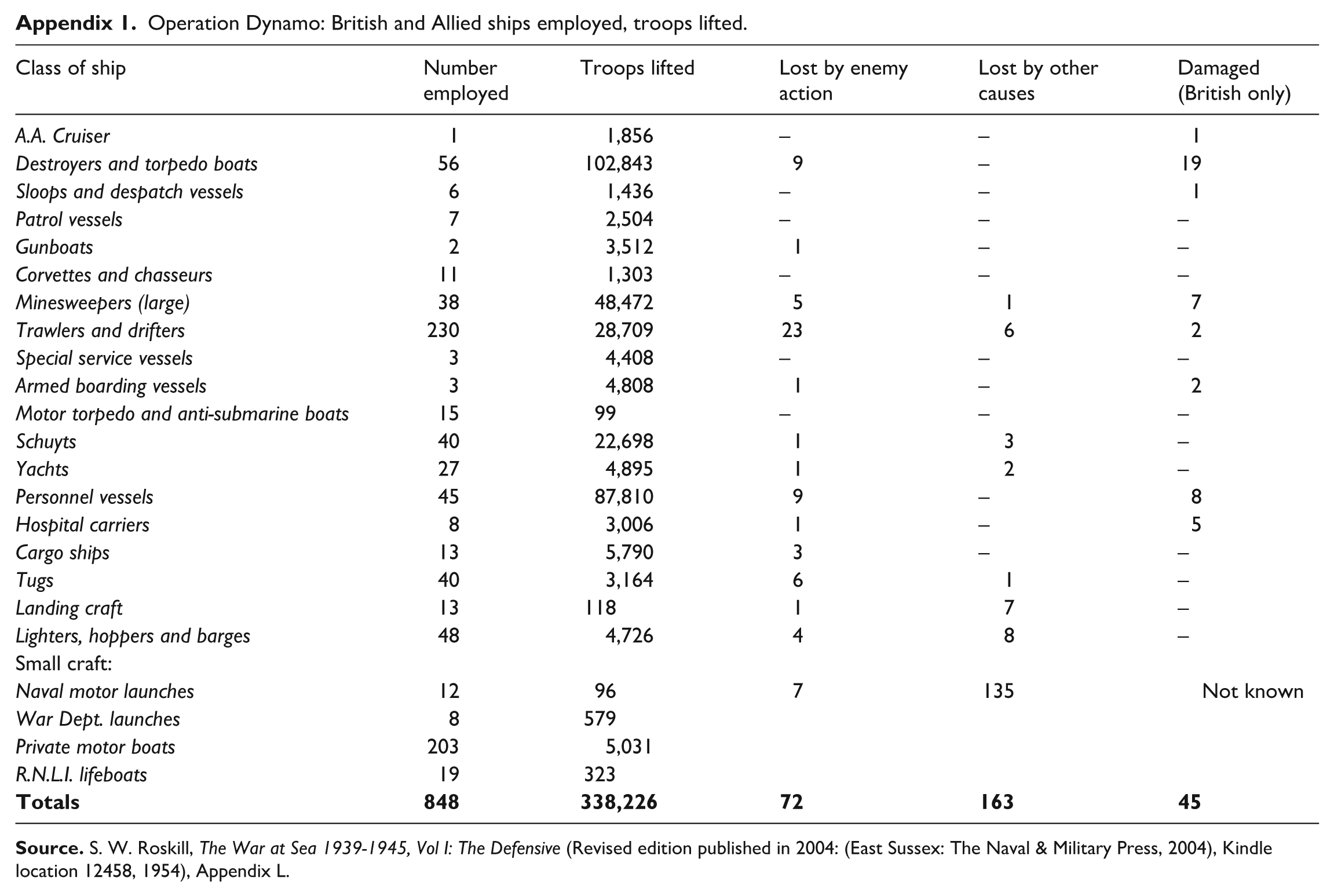
| Class of ship | Number employed | Troops lifted | Lost by enemy action | Lost by other causes | Damaged |
|---|---|---|---|---|---|
| A.A. Cruiser | 1 | 1,856 | – | – | 1 |
| Destroyers and torpedo boats | 56 | 102,843 | 9 | – | 19 |
| Sloops and despatch vessels | 6 | 1,436 | – | – | 1 |
| Patrol vessels | 7 | 2,504 | – | – | – |
| Gunboats | 2 | 3,512 | 1 | – | – |
| Corvettes and chasseurs | 11 | 1,303 | – | – | – |
| Minesweepers (large) | 38 | 48,472 | 5 | 1 | 7 |
| Trawlers and drifters | 230 | 28,709 | 23 | 6 | 2 |
| Special service vessels | 3 | 4,408 | – | – | – |
| Armed boarding vessels | 3 | 4,808 | 1 | – | 2 |
| Motor torpedo and anti-submarine boats | 15 | 99 | – | – | – |
| Schuyts | 40 | 22,698 | 1 | 3 | – |
| Yachts | 27 | 4,895 | 1 | 2 | – |
| Personnel vessels | 45 | 87,810 | 9 | – | 8 |
| Hospital carriers | 8 | 3,006 | 1 | – | 5 |
| Cargo ships | 13 | 5,790 | 3 | – | – |
| Tugs | 40 | 3,164 | 6 | 1 | – |
| Landing craft | 13 | 118 | 1 | 7 | – |
| Lighters, hoppers and barges | 48 | 4,726 | 4 | 8 | – |
| Small craft: | |||||
| Naval motor launches | 12 | 96 | 7 | 135 | Not known |
| War Dept. launches | 8 | 579 | |||
| Private motor boats | 203 | 5,031 | |||
| R.N.L.I. lifeboats | 19 | 323 | |||
|
|
|
|
|
|
|
Appendix 2.
Acknowledgements
First, a note of immense gratitude to Dr Cathryn Pearce, my supervisor at the University of Portsmouth, for her boundless patience, kindness and enthusiasm.
I am also indebted to Matthew Richardson, Curator of Social History with Manx National Heritage, who assisted in conceptualizing this project and was a constant source of advice and encouragement.
Particular thanks are due to Eleanor Williams at the Isle of Man Public Record Office, and Debra Heaney at the Isle of Man Government Cabinet Office, whose dedicated efforts, over several months, enabled me to access the closed files that unlock this story.
Thanks also to David Kinrade and Juan Watterson, Speaker of the House of Keys, for their help in obtaining permission to publish extracts from the closed file, and for the support of John Watt and Richard Hird of the Isle of Man Steam Packet Company.
Thanks to Wendy Thirkettle and the team at the Manx National Heritage Library and Archive, the archivists at the Isle of Man Public Record Office, and the helpful staff at the National Archives at Kew.
A final note of thanks to the British Commission for Maritime History for recognising the importance of this story.
1.
Joshua Levine, Dunkirk: The History Behind the Major Motion Picture (London, 2017), 305.
2.
Martin Mace, ed., The Royal Navy at Dunkirk: Commanding Officers’ Reports of British Warships in action during Operation Dynamo (Barnsley, 2017), Kindle Edition location 76.
3.
Captain S. W. Roskill, The War at Sea 1939-1945, Vol I: The Defensive (First published 1954, Kindle Edition (East Sussex: The Naval & Military Press, 2004); Kindle location 12458), Appendix L: Operation ‘Dynamo’ – Summary of British and Allied Ships Employed, Troops Lifted, British Ships Lost or Damaged. See  .
.
4.
Malcolm Smith, Britain and 1940: History, Myth and Popular Memory (Oxford, 2000), 29.
5.
W. J. R. Gardner, ed., The Evacuation from Dunkirk: ‘Operation Dynamo’, 26 May – 4 June 1940 (Oxford, 2000), 55.
6.
Gardner, Evacuation, 99.
7.
8.
9.
Walter Lord, The Miracle of Dunkirk (New York, 2016 [first published 1982]), 197–8.
10.
Broadcast by Minister for Shipping Richard Cross, quoted in Mace, Royal Navy at Dunkirk, Kindle location 5712.
11.
Mace, Royal Navy at Dunkirk, Kindle location 5725.
13.
14.
15.
Jeff Hill, ‘A War Imagined’, in Nick Hayes and Jeff Hill, eds., Millions Like Us?: British Culture in the Second World War (Liverpool, 1999), 324–5.
16.
The Isle of Man was home to 14,000 Germans, Italians, Finns and Japanese across 10 camps around the island between 1940 and 1945. See Daniel Travers and Stephen Heathorn, ‘Collective Remembrance, Second World War Mythology and National Heritage on the Isle of Man’, in National Identities, 10 (2008), 443.
17.
With the kind permission of the Isle of Man Government Cabinet Office, I have been able to review the contents of a previously closed file – S17/1/1850 – in the Isle of Man Public Record Office I have been granted permission to make certain statements based on the contents of the file, and to directly quote from particular documents. See .
18.
Lord, Miracle, 246.
19.
James Holland, The War in the West – A New History: Volume 1: Germany Ascendant 1939-1941 (London, 2015), 359; Peter Hore, The Habit of Victory: The Story of the Royal Navy 1545 to 1945 (London, 2005), 363. Sean Longden, Dunkirk: The Men They Left Behind (London, 2008), 1.
20.
Wilson and Levine’s are most helpful. See Patrick Wilson, Dunkirk: From Disaster to Deliverance (Barnsley, 2002); Levine, Dunkirk.
21.
Thompson’s Dunkirk: Retreat to Victory (London, 2008); Correlli Barnett’s Engage the Enemy More Closely (London: Hodder & Stoughton, 1991); and Hugh Sebag-Montefiore’s Dunkirk: Fight to the Last Man (London: Penguin, 2007) are notable exceptions.
23.
Nicholas Harman, Dunkirk: The Necessary Myth (London, 1980); Lord, Miracle.
24.
Eric J. Grove, The Royal Navy since 1815: A New Short History (Basingstoke, 2005), 187; Mace, Royal Navy at Dunkirk, Kindle location 111.
25.
Levine, Dunkirk, 266.
26.
J. B. Priestley, Postscript, broadcast 5 June 1940, BBC Home Service.
27.
Mace, Royal Navy at Dunkirk, Kindle location 5671.
28.
Mace, Royal Navy at Dunkirk, Kindle location 5380.
30.
TNA, ADM 199/788B, which contains the reports of the Masters of Manxman, Manx Maid and Tynwald, was opened to researchers in 1994.
31.
RMSY 8/5, was gifted to Churchill College, Cambridge and made available to researchers in 1987.
32.
David Divine, The Nine Days of Dunkirk (London, 1959); Richard Collier, The Sands of Dunkirk (London, 1961); Harman, Necessary; Lord, Miracle.
33.
A significant proportion of the reports from participating vessels contain at least one error in times or dates, which only become apparent when placed alongside a jigsaw of other sources. This is inevitable when considering the complete exhaustion of their authors, and the tendency for later actions to take place overnight.
34.
WPV has heavily influenced the narrative in John De S. Winser’s definitive B.E.F. Ships before, at and after Dunkirk and Barnett’s account of Dynamo in Engage the Enemy More Closely.
35.
TNA, ADM 1/12441; ADM 199-96; ADM 199/667; ADM 199/786-794; ADM 199/795; ADM 199/796.
36.
Gardner, Evacuation, Preface.
37.
Canterbury (28 May) and St Seiriol (29 May), Gardner, Evacuation, 29, 48.
38.
Connery Chappell, Island Lifeline (Merseyside, 1980); Miles Cowsill and John Hendy, eds., Steam Packet 175: The Official Anniversary Book of the Isle of Man Steam Packet Company (Ramsey, Isle of Man, 2005).
39.
MNH, MS 09538, Research papers written by W. H. Sleigh appraising the role of IOMSPCo vessels during Operation Dynamo and associated operations, in three volumes: Vol I (September 2000); Vol II (June 2001); Vol III (August 2002).
40.
MNH, MS 11924, Drafts of research by Ray Kenna variously titled ‘Douglas to Dunkirk: Isle of Man Steam Packet Company Ships and Men at Dunkirk 1940’ (2012) and ‘Notes on the Manx Fleet at Dunkirk – 1940’ (2008).
41.
Winston Churchill, speech to the House of Commons, 4 June 1940. Quoted in Richard Toye, The Roar of the Lion: The Untold Story of Churchill’s World War II Speeches (Oxford, 2013), 51.
42.
Winston Churchill, speech to the House of Commons, 13 May 1940. Quoted in Toye, Roar, 13.
43.
Gardner, Evacuation, 15–6.
44.
Daily Express, 31 May 1940.
47.
Gardner, Evacuation, 16.
48.
Tynwald was the last to leave the Mole on 4 June, with a record lift of 3,000 troops. See Gardner, Evacuation, 118.
49.
Julian Thompson, Dunkirk: Retreat to Victory, Kindle Edition location 5056.
50.
King Orry and Mona’s Isle were fitted as Armed Boarding Vessels, flew the White Ensign and were manned by naval crew and civilians acting as reserves. See Chappell, Island Lifeline, 108–9.
52.
Figures from the Dunkirk memorial at Kallow Point, Port St Mary, Isle of Man.
53.
TNA, ADM 199/792, June 18 Dover Despatch, Narrative of Events, paragraph 43.
54.
TNA, ADM 199/792, June 18 Dover Despatch, Narrative of Events, paragraph 52.
55.
MNH, MS 11514, Papers of Captain Tom Corteen.
56.
TNA, ADM 199/792, June 18 Dover Despatch, Narrative of Events, paragraph 71.
57.
G. H. Bennett and R. Bennett, Survivors: British Merchant Seamen in the Second World War (London, 1999), 30.
58.
Gardner, Evacuation, 55.
59.
MNH, MS 11514, Papers of Captain Tom Corteen.
60.
TNA, ADM 199/788A, report of Lieutenant Commander W. C. Bushell, Commanding Officer HMS WIVERN, dated June 19 1940.
61.
62.
Introduction by Peter Snow in Joshua Levine, Forgotten Voices: Dunkirk (London, 2011), vii-viii.
63.
Account of Lieutenant Jonathan Lee. Quoted in Collier, Sands, 129.
64.
MNH, MS 9694/1/15, Minutes of the Full Board Meeting of the Isle of Man Steam Packet Company, Friday, June 21, 1940.
65.
TNA, ADM 199/788A, Surgeon Commander W. G. Fitzpatrick, report on Medical Contingent from Royal Naval Barracks, Chatham, dated June 8, 1940. Report of Surgeon Lieut. Stutter aboard Manxman.
66.
Bennett and Bennett, Survivors, 63.
67.
MNH, MS 11514, Captain Tom Corteen’s account of “Manxman” at Dunkirk, addressed to Connery Chappell, 1980.
68.
Lord, Miracle, 198.
69.
TNA, ADM 199/786, report of HMS Verity, dated June 1, 1940.
70.
TNA, ADM 199/788A, report of Lieutenant Commander R. H. Buthy RN, Officer in charge No. 3 Party, Royal Marines, dated June 6, 1940.
71.
TNA, MS 11514, Papers of Captain Tom Corteen.
72.
MNH, MS 10016, Memoirs of Thomas Cannell, Junior Engineer Officer aboard Ben-my-Chree, written 1993.
73.
‘The scale of enemy air attack on the 31st and 1st was primarily responsible for the suspension of daylight evacuation from the 2nd June’. TNA, ADM 199/792, June 18 Dover Despatch, Section 7 – ‘Enemy efforts to frustrate operation’.
74.
MNH, MS 10016 Memoirs of Thomas Cannell.
75.
TNA, ADM 199/792, June 18 Dover Despatch, Section 8, ‘Air co-operation’.
76.
Vice-Admiral, Dover to Admiralty, signal 2329/1. Quoted in Gardner, Evacuation, 185.
77.
Divine, Nine Days, 205–6.
78.
MNH, MS 11514, Papers of Captain Tom Corteen.
79.
Gardner, Evacuation, 29, 48, 113.
81.
Barnett, Engage, 144–7.
82.
TNA, ADM 199/788A, supplementary report by G. Mallory, Master of MALINES to PTSO Southampton, dated June 2, 1940.
83.
Gardner, Evacuation, 55.
84.
TNA, ADM 199/788B, STO Folkestone to George Woods, Master, BEN MY CHREE, dated June 2, 1940: ‘I may mention that VA Dover has given instructions that you must not, at the moment, have any communication with the shore.’
85.
TNA, ADM 199/788B, W. Qualtrough, Master TYNWALD, to STO Folkestone, dated June 2, 1940.
86.
TNA, ADM 199/786, report of Lieutenant Commander J.B.G. Temple, Commanding Officer HMS HEBE, dated June 7 1940.
87.
TNA, ADM 199/788A, report of Lieutenant Commander W.C. Bushell, Commanding Officer HMS WIVERN, dated June 19 1940.
88.
Divine, Nine Days, 289.
89.
Vice-Admiral, Dover to Admiralty, Monday, June 3 1940 – 1344/3. Quoted in Gardner, Evacuation, 188.
90.
91.
The use of ‘memo’ for one, and ‘report’ for the other, conveys no meaning other than to ensure clarity for the reader.
92.
Ray Kenna, Douglas to Dunkirk, 96–7.
93.
TNA, ADM 788/B.
94.
95.
The vessels that sailed under naval command, Mona’s Isle and King Orry, were not included.
96.
De Winser’s calculations have subsequently reduced this to 3,845, but 4,080 was the corrected figure that was later supplied by the Admiralty.
97.
MNH, MS 10016, letter from Thomas Kelly Cannell, dated 11 April 1999.
98.
It seems that Manxman was not credited with her sailing during the evening of 1 June – the other personnel vessels were turned back but Manxman was not intercepted, and proceeded into Dunkirk harbour alone.
99.
100.
MNH, MS 9694/1/15, Minutes of the Full IOMSPCo Board Meeting of Friday, 21 June 1940.
101.
TNA, ADM 199/788A, Surgeon Commander W.G. Fitzpatrick, report on Medical Contingent from Royal Naval Barracks, Chatham, dated 8 June 1940: ‘Part of the officers and ships company had to be relieved for 24 hours.’
102.
TNA, ADM 199/796B, C.E.W. Justice (for Director for Sea Transport) to Isle of Man Steam Packet Company, dated October 9, 1940.
103.
TNA, ADM 199/788B, Supplementary report of J. T. Collister, Master Manx Maid, to PSTO Dover, dated 8 June, 1940.
104.
MNH, MS 9694/1/15, Minutes of the Full IOMSPCo Board Meeting of Friday, 21 June 1940.
105.
Had Lady’s performance been judged by the same measures as the Manxman, the memo could have been phrased ‘Carried out 2 trips and transported 2902 troops. Should have completed 4.’
106.
TNA, ADM 199/788A, Jukes-Hughes (PSTO Dover) to Ramsay (VA Dover), dated 4 June 1940.
107.
Vice-Admiral William Spencer Leveson-Gower succeeded his elder brother George as the fourth Earl Granville in 1939. For clarity, he is referred to as ‘Granville’ throughout this paper.
108.
Derek Winterbottom, Governors of the Isle of Man since 1765 (Douglas, 1999), 189–90.
109.
110.
TNA, ADM 199/796B, Inter-agency correspondence between Richmond Walton (Head of Military Branch), C. W. Justice (for Director of Sea Transport, Ministry of Shipping), S. H. Phillips (Under Secretary of State, War Office) and Director of Press Division between 11 June and 9 September 1940. Entries dated 18 June and 18 July.
111.
‘It’s hateful having to order ships . . . into what I know to be an inferno.’ Vice Admiral Ramsay to his wife, 23 May 1940. Quoted in Barnett, Engage, 144.
112.
TNA, ADM 199/796B, Vice Admiral Ramsay to Secretary of Admiralty, 11 June 1940. No. G19/908/40. Covering letter to copy of the clean sheet memo.
113.
Barnett, Engage, 142.
114.
Barnett, Engage, 753–4.
115.
TNA, ADM 199/792, 18 June Dover Despatch, Section 8, ‘Air co-operation’.
116.
TNA, ADM 199/792, 18 June Dover Despatch, Section 11, ‘Control of Allied Troops’.
117.
TNA, ADM 199/796B, George A. Brown, Editor, Isle of Man Times, to Secretary of the Admiralty, dated 11 June 1940.
118.
TNA, ADM 199/788B, Supplementary report of J. T. Collister, Master MANX MAID, to PSTO Dover, dated 8 June, 1940.
119.
The formulation ‘Completed x trips . . . should have completed y’, for instance, is preserved but not extended to other participants.
120.
Each account is taken from Buthy’s report except Canterbury, which was personally attended by Jukes-Hughes.
121.
Collier, Sands, 228; Winser, BEF Ships, 29; Lord, Miracle, 197; Barnett, Engage, 159–60; Bennett and Bennett, Survivors, 27–8.
122.
TNA, ADM 199/788B, PSTO Dover to Vice Admiral Dover, dated 5 June 1940.
123.
Signed statement of Thomas Cannell, dated 7 August 2000, cited in Sleigh Vol I (September 2000), Annex 6.
124.
Kenna, Douglas to Dunkirk, 10.
125.
A copy of Cannell’s Certificate of Discharge is in MNH, MS 10016, Memoirs of Thomas Cannell.
128.
Sleigh Vol III (August 2002), 45.
129.
The August 1 letter to the Board of IOMSPCo from the Ministry of Shipping is based entirely on extracts from WPV.
130.
MNH, MS 9694/1/15, Minutes of the IOMSPCo Board for Saturday, 15 June 1940.
131.
MNH, MS 9694/1/15, Minutes of the Full Board Meeting of Friday, 21 June 1940.
132.
133.
MNH, MS 9694/1/15, Minutes of the IOMSPCo Board for Saturday, 17 August 1940.
134.
MNH, MS 9694/1/15, Minutes of the IOMSPCo Board for Saturday, 7 September 1940.
135.
MNH, MS 9694/1/15, Minutes of the IOMSPCo Board for Saturday, 24 August 1940.
136.
MNH, MS 9694/1/15, Minutes of the IOMSPCo Board for Saturday, 24 August 1940.
137.
TNA, ADM 199/796B, C.E.W. Justice for Director for Sea Transport, to Isle of Man Steam Packet Company, dated 9 October 1940.
138.
MNH, MS 9694/1/15, Minutes of the Full Board Meeting of Thursday, 3 October 1940.
140.
TNA, ADM 199/788A, H. Ian MacIver, Chairman of Liverpool and North Wales Steamship Company, to Ministry of Shipping, dated 7 June 1940.
141.
MNH, MS 9694/1/15, Minutes of the IOMSPCo Board for Saturday 21 September 1940.
142.
MNH, MS 9694/1/15, Minutes of the IOMSPCo Board for Saturday 11 January 1941.
145.
Canterbury (28 May) and St Seiriol (29 May ). See Gardner, Evacuation, 29, 48.
146.
The reports of Lady of Mann and Mona’s Isle are present in TNA, ADM 199/788A. King Orry is present in TNA, ADM 199/789. Three of the others – Manxman, Manx Maid and Tynwald – are to be found in TNA, ADM 199/788B, which remained closed to researchers until 1994.
147.
IoMPRO, S17/1/1850 contains the list of names and addresses that was supplied to Granville by IOMSPCo; the information contained in this document this may account for its continued closure, rather than any political motivation.
148.
There was correspondence with Granville, the IOMPSCo Board and a personal note of apology to the Master. No copies of these documents – nor any evidence of the internal investigation – is present in the Dynamo archive.
149.
There is the possibility that the report has been misfiled, but the report is certainly not where it should be. It is not present in the Admiralty files which cover the reports for Destroyers, Minesweepers, Personnel Vessels and other ships engaged in Operation Dynamo: TNA, ADM 199/792; ADM 199/786; ADM 199/787; ADM 199/788A; ADM 199/788B; ADM 199/789. Moreover, it appears to have never been seen: no author has made reference to such a document in the historiography of Operation Dynamo.
150.
TNA, ADM 199/478, released to Public Records Office in 1973. Tim Slessor, Ministries of Deception: Cover-ups in Whitehall (London, 2002), 216–7.
152.
Slessor, Deception, 190–1.
153.
Jon Cooksey, Introduction to John Masefield, The Twenty Five Days (Barnsley, 1994), 6.
154.
Robert Mackay, Half the Battle: Civilian Morale in Britain During the Second World War (Manchester, 2013), 143.
155.
BBC Home Service news bulletin, 31 May 1940.
156.
Mark Donnelly, Britain in the Second World War (London, 1999), 69–83.
157.
‘The Men Who Did Not Go To Sea’, Isle of Man Times, 2 July 1940.
158.
IoMPRO, S17/1/1850, five separate documents, all dated 2 January 1941.
159.
Calder, Myth, Kindle location 2159.
160.
Mackay, Half the Battle, 144.
161.
A sanitised, much-reduced version, The Nine Days Wonder, appeared in April 1941. Jon Cooksey, Introduction to John Masefield, The Twenty Five Days, 22.
162.
Smith, 1940, 46.
163.
Clive Ponting, 1940: Myth and Reality (London, 1990).
164.
Smith, 1940, 6.
165.
Hill, ‘A War Imagined’, 324.
166.
Lucy Noakes and Juliette Pattinson, eds., British Cultural Memory and the Second World War (London, 2014) Kindle location 445.
169.
Penny Summerfield, ‘Dunkirk and the Popular Memory of Britain at War, 1940–58’, Journal of Contemporary History, 45 (2010), 790.
170.
Edgerton, Rise and Fall, 26–7.
171.
Smith, 1940, 125.
172.
‘We Have Lift Off’, Daily Mail, 2 February 2017.
173.
Winston S. Churchill, The Second World War, Volume II: Their Finest Hour, Kindle Edition (London, 2013 [1949]), Kindle location 2879
174.
175.
Toye, Roar, 53–4.
176.
David Edgerton, The Rise and Fall of the British Nation: A Twentieth Century History (London, 2018), 71.
177.
Calder, Myth, Kindle edition location 91.
178.
David Kermode, Ministerial Government in the Isle of Man: The First Twenty Years 1986-2006 (Douglas, 2008), 53.
179.
The best account is John Belchem, ‘The Little Manx Nation: Antiquarianism, Ethnic Identity, and Home Rule Politics in the Isle of Man, 1880-1918’, Journal of British Studies, 39 (2000), 217–40.
180.
Smith, 1940, 7.
181.
The best account of this is Kermode, Ministerial Government, 31–46.
182.
Kermode, Ministerial Government, 33.
183.
Robert Fyson, The Struggle for Manx Democracy (Douglas, 2016), 251–4.
184.
Derek Winterbottom, ‘Economic History 1830-1996’, in John Belchem, ed., A New History of the Isle of Man. Vol V: The Modern Period 1830-1999 (Liverpool, 2001), 254–60.
185.
Connery Chappell’s 1984 volume, Island of Barbed Wire, has been the definitive local history for decades.
186.
Daniel Travers and Stephen Heathorn, ‘Collective Remembrance, Second World War Mythology and National Heritage on the Isle of Man’, National Identities, 10 (2008), 444.
187.
The ‘adjacent isle’ is a common Manx term for the UK, invoked in Manx politics in the same way that Members of the House of Commons might refer to the House of Lords as ‘the other place’.
188.
Travers and Heathorn, ‘Collective Remembrance’, 442.
189.
For the best account of Operation Dynamo through Manx eyes, see Matthew Richardson, Isle of Man At War 1939-45 (Yorkshire: Pen and Sword, 2018), pages 11–32.
190.
MNH, MS 12837, Evacuation of Guernsey Schoolchildren, June 1940.
191.
The first version of The Snow Goose was published in New York’s Saturday Evening Post, December 1940.
192.
Summerfield, ‘Popular Memory’, 792.
193.
‘Mrs Miniver’, MGM Studios, 1942. Dir: William Wyler.
194.
‘Dunkirk’, Ealing Productions, 1958. Dir: Leslie Norman.
195.
S. P. MacKenzie, ‘Victory from Defeat: The War Office and the Making of Dunkirk (Ealing Films, 1958)’, War, Literature & the Arts, 15 (2003), 251–2.
196.
‘Their Finest’, Lionsgate, 2016. Dir: Lone Scherfig.
197.
‘Dunkirk’, Warner Bros, 2017. Dir: Christopher Nolan.
198.
‘Darkest Hour’, Working Title, 2017, Dir: Joe Wright.