



Abstract
This article examines maritime trade litigation tied to a typical New England jurisdiction – New London County, Connecticut – to reveal two important eighteenth-century trends. First, decision-makers prioritized honouring contract promises – a critical shift from earlier Puritan ideals that privileged fairness in agreements. This transition was essential to developing what became the will theory of contract, in which promise and performance replaced equity as the measures of valid agreements. This shift appeared in Connecticut nearly a century before scholars have suggested it did in the United States. The second trend involves litigants’ choice of court. Despite the availability of several tribunals for pursuing maritime-based legal actions, parties regularly chose the county court to resolve their issues. In an expanding and increasingly impersonal Atlantic marketplace, parties preferred the flexible and familiar proceedings of the local court because judges and jurors treated mariners as if they carried Connecticut's legal protections with them on their distant travels.
Keywords
In 1737, Noah Miller of New London, Connecticut, sued Jonathan Chester of neighbouring Groton for failing to make a full accounting of his delivery of 23 hogshead barrels. According to the court records, Chester took Miller's barrels and sent them by sloop to James Rogers in Newport, Rhode Island. Rogers even testified to receiving and paying for them. Chester, however, did not return receipts for the expected amount, so Miller sued him for £20 in damages. In the county court, Chester pleaded to end the suit on a technicality, noting that the copy of the receipt presented in court failed to specify that the barrels were new. The judges refused to treat the omission as an ‘essential variance’ from the contract's terms and ordered the action to continue. They assigned the case to a panel of arbiters – three local merchants familiar with trading customs. The panel took testimonies from the involved parties and audited their accounts. The arbiters determined that although Chester delivered the barrels as contracted, he was still in arrears for £12 18s. The judges accepted their findings and ordered the defendant to pay Miller the outstanding amount. 1
Miller's rather unremarkable suit offers an apt illustration of Connecticut's litigated maritime economy during the colonial period. Here, a merchant turned to the local trial court to uphold a contracted promise. Routine matters, however, should not be dismissed as unimportant. What follows is an examination of localized maritime trade litigation tied to an archetypical colonial New England jurisdiction – New London County in south-eastern Connecticut. This study reveals two important trends that emerged in the eighteenth century. First, by the early years of the century, Connecticut judges and jurors prioritized the importance of honouring promises – an important shift away from earlier Puritan ideals that privileged fairness in economic agreements. This transition was essential to developing what became the will theory of contract, in which promise and performance replaced equity as the measures of valid agreements. This shift appeared in Connecticut nearly a century before scholars have suggested it did in the United States. The second trend involves litigants’ choice of court. Despite the options to pursue maritime-based actions in a variety of tribunals, including colonial assemblies and imperial admiralty courts, participants regularly chose the entry-level forum at home – the New London County Court – to resolve their issues. In an expanding and increasingly impersonal Atlantic marketplace, parties appeared to prefer the flexible and familiar proceedings of the local court. They put faith in home institutions because judges and jurors treated masters, pilots and sailors as if they carried Connecticut's legal protections with them on their coastal and Atlantic travels. Altogether, these cases show that Connecticut law and courts helped merchants develop a colonial legal culture that promoted predictability and economic growth. With profit at stake, Connecticut-based merchants and mariners pursued local options to secure prosperity.
This article uses Connecticut's trial-level maritime suits – in particular, actions for failed shipping performance and accounting pleas – to challenge the long-held understanding that the will theory of contract was the exclusive product of nineteenth-century forces, such as marketplace expansion and the formalization of impersonal law. The will theory of contract measures the validity of agreements on the basic principles of promise and performance. It is guided by two simple questions: ‘Did the parties wilfully agree to a promised exchange?’ and ‘Did the parties perform as they agreed?’ Will theory eclipsed the traditional policy of measuring contracts on the grounds of fairness – a popular legal norm in colonial America, especially in Puritan settlements like Connecticut. In the seventeenth and early eighteenth centuries, profit was acceptable, provided that it benefited the commonwealth and did not unduly victimize one's neighbours. This was especially important when most exchanges transpired in tightly knit communities, where people were generally familiar with each other's businesses, motivations and reputations. But as colonists increasingly traded with strangers, as the marketplace expanded beyond the local, measures of fairness were difficult to discern. Merchants needed objective standards to assure them that their businesses and investments were safe as they transpired across longer distances and within differing cultures. The will theory of contracts offered predictable objectivity, and judges throughout the British Atlantic littoral increasingly embraced it (see Table 1). 2
Measures of contract validity.

The timing of the transition from equitable contracts to will theory is a matter of dispute. Morton Horwitz, a pioneer in early American legal and economic history, established the generally accepted timeline: only in the nineteenth century did judges and jurists finally reject the longstanding belief that the justification of contractual obligation is derived from the inherent justice or fairness of an exchange. In its place, they asserted for the first time the source of the obligation of contract is the convergence of the wills of the contracting parties.
Scholars have challenged this iconic book's claims that will theory had no roots prior to the 1790s. 4 This article joins these dissenters, but does so in a unique way. As a medium, maritime cases offer a necessary double challenge to the Horowitz thesis, revealing an American legal and economic culture shifting much earlier than he suggests. Colonial-era Connecticut riverine and oceanic contract cases not only rewrite the timeline of the supposed rise of will theory, they do so at the very times and places that demonstrate the expansion of marketplace trade. Instead of using maritime trials, the other dissenting scholars rely on treatises, statutes and appellate rulings to show the general presence of will theory. This article looks at lawsuits involving maritime trade at the entry-level county court, which were closer in time and place to the actual breakdowns of promise and performance. Merchants and mariners travelled far from home with the protections of Connecticut law in hand and they returned to their local trial court to enforce broken promises in the growing Atlantic marketplace.
As early as the late seventeenth century, court records show that damages for non-performance had little to do with equity and fairness. In fact, there is no evidence that the court even considered fairness. With a few exceptions, Connecticut judges and jurors rendered decisions on the bases of promise and non-performance. Excepting special circumstances that warranted forgiveness, defendants who failed to carry out promised expectations were ordered to pay damages for that non-performance. Moreover, their private settlements, if they did occur beyond our view from the courtroom, do not necessarily preclude will-theory considerations. The same objective principles might have guided merchants’ actions – they just did so outside of court. As we will see, even the colonists’ use of arbitration – which Horwitz characterizes as a by-product of the traditional fairness doctrine – was consistent with will theory. Parties did not voluntarily submit themselves to arbitrators in Connecticut because courts did not respond to their needs. They were legally bound to have judges or jurors determine whether the breach of promise existed first. If so, the bench then assigned the dispute to an arbitration panel. If these maritime cases tell us anything, the foundations of modern contract law are not born of the peculiar developments in the marketplace and legal culture of the United States. They were already sewn into legal practices in colonial America, particularly in Connecticut.
Connecticut's expanding transatlantic marketplace
Horwitz describes a world where market expansion did not really happen until the early decades of the nineteenth century. But that was not the case. The rapid rise in maritime litigation in coastal communities, like Connecticut's New London County, illustrates the growing mercantile network. Several factors explain a steady increase in maritime cases. Population expansion is one. Between 1700 and 1730, New England experienced a dramatic 235 per cent population boom. Connecticut's growth for the same period was 280 per cent. By 1730, Connecticut counted 50,000 settlers, rising to reach 65,000 by 1745. This growth was stimulated by successful trade with West Indian colonists, the marriage of nearly all the colony's women (at an average age of 22), declining infant mortality rates and lengthened life expectancies. 5 As more families settled along the coast, they needed more resources shipped in from Britain and its colonies. The growing population also meant more social and commercial contacts, thereby generating more opportunities for maritime-related conflict. These people played diverse roles tied to the sea – mariners, merchants, warehousers, stevedores, retailers, shipwrights, blacksmiths, distillers, and, later in the colonial period, bankers and insurers – all with legally protected interests worth defending in court. In addition to population, the increase in paper debt may have redefined investment risks associated with long-distance trading. As people relied less on reputation-based book debts with distant debtors, some merchants embraced more formalized, predictable and objective forms of debt – such as bonds and promissory notes – which carried penalties for failing to uphold contracted obligations. 6
A final factor fuelling a rise in maritime cases was the increase in the number of riverine and ocean-going vessels. The Coits, one of New London's founding families, had a shipbuilding yard that locally dominated the craft into the eighteenth century. By the 1720s, however, they faced significant competition from their entrepreneurial neighbours. For example, John Jeffrey opened his own shipyard across the Thames River in Groton, at the mouth of Long Island Sound. The size of the ships increased by the 1730s, as more three-masted vessels especially designed for distant oceanic travel came in and out of New London Harbor. The growth in shipbuilding and ship size would easily explain any spike in the county's maritime litigation, as larger ships allowed for heftier burdens, enabling merchants to send horses, cattle, sheep, fish, tobacco, lumber, barrels and cloth goods to the Caribbean in exchange for molasses, cane sugar and rum. With increased business came greater risk and more opportunity for litigation. 7
The law of colonial mercantile trade
Colonial Connecticut's efforts to regulate maritime matters had their roots in European legal traditions. In the seventeenth century, English merchant Gerald Malynes compiled centuries of Europe's customary rules of the sea in his digest titled Lex Mercatoria, or, The Ancient Law-Merchant. Some scholars have questioned Lex Mercatoria's legal authority, suggesting it was merely a collection of non-binding usages and practices. Surely Malynes hoped his volume would carry legal weight. As the title pages to his treatise suggest, he thought it was ‘Necessarie for All Statesmen, Judges, Magistrates, Temporall and Civile Lawyers, Mint-men, Merchants, Marriners, and all others negotiating in all places of the World’. Judges legally validated Lex Mercatoria, however, when they embraced its precepts in their own rulings. Copies of the digest are known to have made their way to the colonies, in Virginia, and closer to Connecticut's admiralty orbit, in New York and Massachusetts. Malynes' digest offered a helpful resource for managing maritime traditions within the shadows of law and global commerce. 8
In the 1660s, Massachusetts drafted a maritime code, which drew substantially from Lex Mercatoria. The Massachusetts law codified owner–master and master–servant relations, and echoed the varied circumstances that mariners could face at sea, such as shipwrecks and insubordination. In 1673, Connecticut formally adopted Massachusetts' maritime code into its own statutes. The colonial assembly reprinted it with only minor stylistic changes in each of its subsequent compiled codes. Notably included in the Connecticut version was one of the few clauses that hinted at universal imperial principles – that masters provide all necessities ‘according to the laudable Custome of our English Nation’. Beyond the maritime code, the assembly drafted cognate provisions addressing three related areas: outfitting ships for commerce or defensive wars; regulating travel and goods carried aboard ships; and adjudicating matters arising at sea. Taken together, the maritime measures supported the general precepts of promoting commerce and protecting mariners’ legal and economic interests. 9
With transplanted laws and customs in place, magistrates were charged with deciding maritime matters in the colonies. Where this adjudication should take place, however, was not legislatively clear. At the turn of the eighteenth century, Parliament created a system of vice-admiralty districts in its North American colonies to make Atlantic trade more uniform. Connecticut's admiralty court was shared with New York and East Jersey, later New Jersey. These tribunals reserved jurisdiction over three matters: prize, instance and Navigation Act violations. Prize jurisdiction covered cases in which a ship's goods were captured at sea or on land. Instance jurisdiction was much broader, addressing matters arising on the high seas, including contracts, sailors’ wages, salvage, insurance and criminal conduct. Finally, unlike England's admiralty courts, the North American admiralty courts could address violations of the Navigation Acts – the series of parliamentary statutes designed to promote imperial commerce, reduce foreign competition and improve customs collections. 10
Even with the establishment of admiralty courts in the colonies, Parliament did not clearly settle questions of maritime jurisdiction. Colonial customs officials could still choose whether to pursue Navigation Act violations in Crown or colonial courts. In Connecticut, officers usually filed in the county courts. The strength, stability and proximity of entrenched New England courts encouraged their use and, in some cases, outright resistance to admiralty alternatives. New England codes did not offer much more clarity on exclusive maritime jurisdictions. Except for Rhode Island, American colonial governments resisted building special admiralty courts of their own. Instead, assemblies placed maritime matters within the authority of their already-established courts. The preface to the Massachusetts code championed a need to promote general welfare through ‘navigation & maritine affaires’. Connecticut initially adopted this preface. Beginning with the code's 1702 reprinting, however, the assembly no longer included the original verbiage that demanded ‘there may be one rule for the guidance of all Courts in the proceedings in distribution of justice’. This deliberate omission suggests that Connecticut officials did not want to bind themselves to just one code or one tribunal to determine navigation issues. This gave Connecticut judges greater latitude in resolving seaborne matters. More pointedly, Connecticut lawmakers held the door open for local authority in coastal and Atlantic disputes. 11
The General Assembly's various definitions of Connecticut's admiralty jurisdiction reflected this flexibility. The assembly informed the Privy Council in 1678 that Connecticut had ‘little traffique abroad and small occasion for’ a limited maritime court. 12 Instead, it assigned admiralty jurisdiction to several tribunals. In 1681, the General Assembly indefinitely empowered its supreme council, the Court of Assistants, ‘to be a court of admiralty, for the future’. 13 The Court of Assistants, however, did not reserve exclusive authority for itself. In March 1715, Daniel Apply complained to the Court of Assistants that New London collector Robert Shackmaple had seized his ship the previous October but had yet to bring Apply to trial or return his vessel. When Shackmaple appeared before the Court of Assistants, he argued that Apply, en route from New York, neglected to register his ship when he landed in Saybrook. Shackmaple claimed that he could not file charges because the sitting vice-admiralty judge had recently died. The Court of Assistants rejected his defence. It ruled that he should try Apply immediately because ‘his Majesites courts of common pleas in this Colony have cognizance of seizures of any vessels made within the same, and that [he] might have brought this information to any of them’. Thereafter, local courts had definitive authority to handle matters tied to the sea as they arose. 14
Despite the variety of judicial options, maritime litigants had ample reason to prefer Connecticut's county courts over vice-admiralty actions. First, the county courts offered greater substantive flexibility. Whereas the admiralty court's subject-matter jurisdiction was limited to three prescribed areas, county court jurisdiction was much broader. Local authority included more relevant issues not covered in the maritime codes, such as ship conversion and rental disputes. Second, locally based litigants would find their own courts more intimately responsive. Although admiralty courts were not prohibited from impanelling juries, they rarely did. Instead, they relied principally on the discretion of royal judges, who often treated colonial defendants with a presumption of guilt and earned commissions from their punitive rulings. In comparison, county court litigants regularly found comfort in the judgment of their peers – whether they be jurors or judges – who tended to be more familiar with their family, community, business reputations and local norms. Initiating process in the county courts was also more personal and accessible. Complainants in admiralty courts initiated in rem proceedings by attaching the ships or cargo at issue. In the county courts, litigants initiated in personam proceedings, which allowed plaintiffs to secure proceedings by attaching property or the opposing parties themselves. This could hold alleged violators more directly answerable for their actions, especially because they were prohibited from leaving the jurisdiction. Finally, local courts offered the obvious benefit of proximity. The admiralty court usually sat in New York, and only rarely in Connecticut. In fact, the first time the admiralty court sat in New London was in 1753, when a wounded Spanish ship fell victim to local plundering. In contrast, Connecticut's county courts sat three times annually, at regularly scheduled times and no farther than a day's travel. With such advantages, it made practical sense for litigants to sue in the county courts rather than in admiralty courts. The remainder of this article examines litigants’ deliberate choice to entrust their affairs to local judicial proceedings, particularly in contested matters of failed deliveries and accounting. 15
Cases for failed or insufficient deliveries
The largest number of litigated maritime cases in the New London County Court addressed civil disputes over unsatisfactory performance in coastal and Atlantic commercial shipping. Delivery contracts demanded that a master wear several hats while serving an owner or merchant: employee, employer, labour manager, maritime technician, partner, bailiff and commercial agent. 16 Above all, he was charged with protecting investments in the ship and cargo, deftly navigating turbulent waters and marketplaces. In most cases where merchants sued for failed deliveries, the Connecticut county courts upheld the expectation that masters deliver the goods as arranged. The docket is replete with examples of this basic understanding. Joseph Lothrope Jr loaded pork, hog fat and 240 bushels of corn aboard William Whitney's sloop to ship to Boston. Whitney delivered all the pork and lard, but only 100 bushels of the corn. Lothrope suspected that Whitney withheld at least 43 bushels for ‘his own use’. The court assessed £7 10s 6d in damages against the shipmaster for failing to deliver the corn as promised. 17 In July 1764, Saybrook merchants John Pettitt and Morris Smith contracted Samuel Mack to deliver 225 barrels of ‘Good marchantable fish Commonly Called Manhadens’, a species generally prized in the colonial era as a nutritive fertilizer. In consideration for his shipment, the merchants promised to build him a 60-ton schooner, half of which they would own with Mack. The following year, Pettitt and Smith sued Mack because they built the bargained-for vessel yet Mack never arrived with the fish. Upholding the plaintiffs’ expectations, the court awarded the merchants £200 in damages. 18
Sometimes, the loss of cargo prevented masters from fully delivering their payloads. Timothy Bradley contracted Ebenezer Brockway to carry a hogshead of ‘Good Rhum of his own Proper Estate Containing 100 Gallons’ from the Caribbean to Connecticut. 19 Two months later, Brockway's Polly arrived in Saybrook Harbor but continued up the Connecticut River without stopping at the coastal custom house to report its cargo. He made it as far as the eponymous landing at Brockway's Ferry, roughly eight miles north of the coast. When his crew unloaded the freight, they found that nearly 70 gallons of Bradley's rum had spilled along the way. 20 Brockway offered to replace the rum within four weeks in exchange for Bradley's promise not to file a complaint with the king's attorney or report him to the custom house. Bradley agreed, but when Brockway was unable to procure the replacement rum, Bradley sued. The jury found Brockway responsible for the lost rum, awarding damages of £9 3s.
The court's treatment of the parties’ bargain speaks volumes for colonists’ economic priorities. Brockway clearly violated colonial and imperial law in bypassing customs inspection. His cargo made the violation even more troubling. Connecticut officials had long been concerned with the rum trade. In 1659, the General Assembly placed officers at the colony's nine ports to monitor imports of ‘kill-devil’, or Barbados rum. 21 Connecticut's compiled code of 1715 outlined even stricter provisions. The assembly authorized each county court to appoint one collector to oversee trade, specifically with the profitable drink in mind. If a ship entered any port or river from the Sound with rum aboard, the master had 24 hours to ‘make Report to some Naval Officer of this Government’, pay the appropriate duty and swear an oath as to the ship's contents. 22 If he failed to pay customs, the law commanded him to forfeit the rum, with half going to the colony and the other half going to the informer. Under the colour of the law, Bradley had an incentive to report Brockway for smuggling the alcohol. However, he chose not to report it. Perhaps Bradley worried that he might call attention to the fact that he was smuggling rum through Brockway. Or, maybe the informer's share of the reported rum was worth less than the damages he might get in court. Regardless, the court's reaction is more telling. Surely, any court official could have reported the more serious customs infraction. But in this case the judges, jurors and parties downplayed customs protocol. Instead, they pursued a path that better preserved local commercial growth and more profitable business practices.
Only occasionally did judges decline to hold shipmasters responsible for lost goods. In May 1746, an ownership group hired Jedediah Dudley to pilot their sloop, Dolphin, from Barbados to Connecticut. He was supposed to pick up 97 bushels of salt in Anguilla and carry them directly to Lyme. Dudley set sail from Barbados on the expected date but he arrived in Lyme without the salt. The owners sued Dudley for the failed delivery. The judges, however, dismissed the case because the owners were unable to show that Dudley had embezzled the salt, as they had charged in their complaint. 23
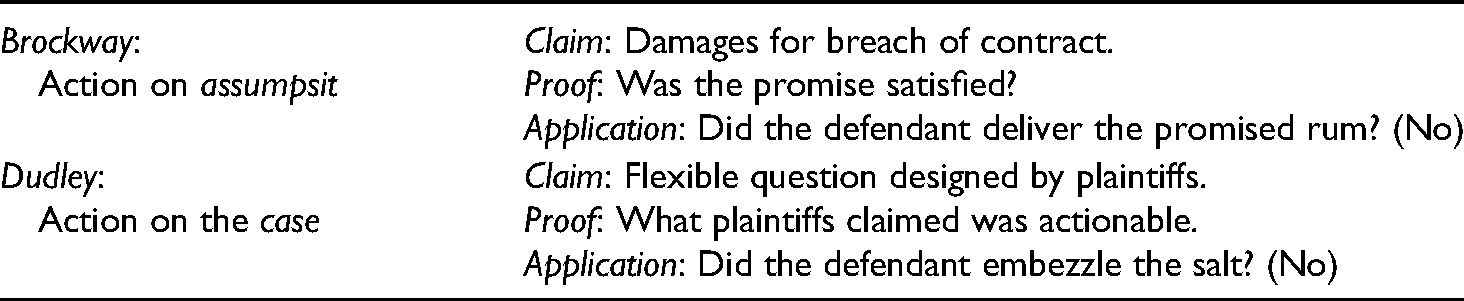
Side by side, the Brockway and Dudley cases look similar – the plaintiffs accused shipmasters of losing cargo and keeping some for their own use. Yet the cases ended with different results. Explanations for the discrepancy rest in the types of actions the plaintiffs filed and their associated burdens of proof. In Brockway's case, the plaintiff's attorneys filed an action on assumpsit to recover damages for breach of contract. At the heart of a contract breach is the foundational promise. If a promise was made, any non-performance would be measured against that promise. Thus, one burden of proof for the plaintiff would be whether the defendant made such a promise. Brockway made two promises: one to deliver the rum in its arranged quantity and another to replace the lost rum. The plaintiff showed that Brockway made the first promise in the written shipping agreement, testified to the existence of the second oral promise, and demonstrated that Brockway failed to satisfy both in full. The jury therefore had grounds to find Brockway responsible for breaching those promises.
In contrast, the plaintiffs in Dudley's case filed an action on the case, a more flexible pleading that allowed claimants to outline more specific charges in the writ. To account for the missing cargo, the owners accused Dudley of embezzling the salt he was supposed to deliver. Thus, their case did not turn on any promise. Instead, the plaintiffs’ burden was to prove the alleged embezzlement. Finding that the owners’ complaint failed to demonstrate that Dudley had illegally taken the salt for his own benefit, the bench dismissed the case before it ever went to trial. Had they filed a writ of assumpsit, the owners would have gone to trial and would have only had to show that the defendant failed to deliver the salt as promised. But they poisoned their claim with accusations that were far more difficult to prove. Dudley might have failed to satisfy the owners’ shipping needs, but his failure did not constitute a fraudulent theft. Taken together, these outcomes show that the choice of pleadings could dictate a plaintiff's success in failed delivery cases, especially when proving the existence of a written promise was an easy task (see Table 2).
Failed performance: comparison of legal claims and applications.
The Dudley case is even more notable for the court's description of its long-arm jurisdiction. Here, the court clerk wrote that the owners appointed Dudley master of the Dolphin ‘in the Island of Barbadoes which Barbadoes is in the County of New London’.
24
The pleadings also identified Anguilla as part of New London County. While these island colonies were separate parts of the greater British Empire, this commonly used phrasing shows that the court saw all mariner ventures originating in, or returning to, New London within its jurisdiction – as if all local ships carried Connecticut law wherever they travelled. This formulaic term of art was likely boilerplate language, but it reflected the court's confidence in managing maritime disputes effectively. That confidence is even more notable in that it challenged traditions laid out in Lex Mercatoria, which insisted: All controversies and differences of sea-faring Actions or maritime causes ought to be decided according to the Sea Lawes, which tooke their beginning from Customes and Observations; and from them is the interpretation of the said Law to be taken.
25
Instead, Connecticut judges claimed their fitness to address extra-colonial maritime contract claims.
Although the court aimed to uphold shipping promises, it was generally sympathetic to shipmasters when the exigencies of war disrupted their accountability. Gurdon Saltonstall, son of the former Connecticut governor of the same name, sued Stephen Clancy for failing to follow their shipping contract. In November 1766, Saltonstall loaded goods aboard Snow Fox and arranged with Clancy to ship them under the following orders: deliver and dispose of the cargo in Suriname, return ‘bills of in Order to have Insurance’, and make frequent reports on the circumstances of shipping, cargo and travel. Once en route, Clancy found it impossible to follow the orders because of sailing disruptions lingering from the Seven Years' War, as Britain and France still jousted for control over Atlantic channels of trade. Instead of following the exact contract terms, Clancy altered course to Barbados and other West Indies ports ‘by Stress of Weather’. Once in the West Indies, he disposed of all of Saltonstall's cargo. The following May, Clancy finally arrived in Newport, Rhode Island, but did not send notice of his return to Saltonstall until five days had passed. Insulted by the lack of regular communication and his breach in delivery orders, Saltonstall sued Clancy for £150 in damages. Clancy pleaded not guilty, arguing that it was not feasible to uphold Saltonstall's expectations, ‘it being A time of War & open Hostilities between the Subjects’ of the two empires. The bench was clearly moved, not by the letter of the contract, but with the realities of its unjust enforcement. They compassionately ruled that Clancy's plea was sufficient to halt Saltonstall's action. 26
Cases for fraudulent shipping performance only rarely appeared in the county court. In one example, Joseph Ely agreed to sell John Beckwith ‘thirteen barrells of Good Merchantable Small fish well Salted and Repact for a Market’ in exchange for a ‘good Natural pacing Gelding horse’ worth £85. Beckwith received the fish in Lyme and, believing them to be in good order, shipped them to Boston without inspection. A few days later, the Boston merchants found the fish ‘Rotten and Unsound [and] unfit for Market’, and sent them back to Lyme. The bench ruled for Beckwith – accepting the likelihood that the fish had already spoiled before being shipped north – and it ordered Ely to pay £120 in damages for the fraudulent sale. 27
In an expanding Atlantic commercial culture, one might expect to see more allegations of fraud. After all, it was common for shipped goods to change hands with little inspection, especially before Parliament and the Board of Trade clamped down on smuggling because of the Seven Years' War. The absence of shipping fraud claims, however, suggests two important points. On its face, it indicates a general level of reliability in market trade. It was good business to satisfy contracted obligations. Court rulings like Beckwith's signalled the importance of fair trade. It made better business sense to admit failure openly, rather than deceive fellow merchants. The occasional failed performance was expected and accepted as a matter of course. Weather, accidents, war and piracy assured such inevitabilities. In such cases, subsequent successful trade agreements could repair business relations. However, in a somewhat self-governed marketplace, partnerships were less likely to be fixable after outright fraud or trickery. In the web of Atlantic commerce, a trustworthy reputation could open doors and hold them open for years thereafter. Merchants were therefore discouraged from breaking promises and defrauding each other.
A second explanation for the dearth of fraud cases lies beyond the record. Merchants accused of fraud would have been eager to settle out of court. Any jilted plaintiff could surely single-handedly ruin a merchant's reputation. The merchant, however, could better shield accusations of fraudulent behaviour (whether valid or not) from the greater marketplace if he kept the matter out of court. Few would want to convert their private dealings into public conversations about alleged shortcomings. It could be even worse if these allegations were recorded. As such, quiet settlement would be helpful for newer merchants who were still building professional cachet and clientele. So, there might have been more instances of fraud, but they were kept from recorded memory. With accusations of fraud out of the public record, merchants had a better chance of controlling the broader perception of their own business reputations.
Cases for pleas of account
Another category of shipping cases in the litigated maritime economy appeared in pleas of account. These were writs from merchants who hired masters to carry and sell their goods to distant markets but had yet to see any sales receipts. Once a merchant loaded his goods aboard someone else's ship, he was at the mercy of the mariners to deliver his products to distant parties and sell those goods for specie, bills of credit or other goods. Then, he had to wait for the master to return and present any proceeds garnered at sale. Long voyages exposed vessels and cargo to increased risks, such as weather, distractions aboard the ship, spoiled goods, pilfering, poor prices and inadequate communications. These circumstances required masters to use their discretion in managing shipping arrangements, all the while keeping their employers’ best interests in mind.
The county court heard several pleas of account for distant trades. Joseph Truman hired Stephen Hempstead to sell a parcel of beaver hats in the West Indies valued at £29 5s. Seven years later, the patient Truman successfully sued Hempstead for never accounting for the sold hats’ value. 28 Winthrop and Rosewell Saltonstall faced similar circumstances when they hired Theophilus Fitch to deliver brown sugar, rum, molasses and ‘Clove Spirits’ to Nova Scotia aboard The Bachelor. The Saltonstalls contracted Fitch to trade the sugars for cash, flax seed, peas or oats. Although they gave him more than two years to render any account for the delivery, they had to sue to recover £40. 29 Stephen Gardiner and John Mumford separately sued William Potter for failing to render satisfactory receipts on a delivery of ‘Good Merchantable Pork’, bacon, cheese and butter. 30 Unlike most defendants in these account cases, Potter appeared in court to defend himself, claiming he had already submitted his accounts well before they filed suit. Confident of his performance, Potter even requested a jury, which, to his disappointment, found that he failed to make a full account to the plaintiffs. The court ordered him to pay £18 7s 9d in outstanding receipts. 31 These cases show that the county court was a responsive forum for plaintiffs looking to settle outstanding accounts.
Pleas of account were not limited to distant deliveries. Some mariners, such as Joseph Chester, seemed no more reliable with deliveries closer to home. One such example opened this article. Another suit appeared a year later when Thomas Newcomb sued Chester for failing to hand over proceeds on deliveries he was supposed to make in Albany and Newport. According to the shipping contract, Chester agreed to carry to Albany an assortment of goods that included molasses, bridle bits, paper, guns and ammunition. He was to stay in Albany for 12 days to receive more goods – including planks and beaver skins – and ship them to Newport, where Newcomb would be waiting. Chester carried out the first stage of the delivery in Albany. But rather than head directly to Newport, he stopped in Poughkeepsie, where he sold the boards and furs. Because Chester failed to carry out the contract as instructed, Newcomb sued Chester for £1,000 for the lost goods and proceeds. The judges sympathized with Newcomb, but not to the extent he had asked. The judges held Chester responsible for his breach, but reduced the amount to a less onerous £137 16s. For the bench, the issue was the degree of performance. The judges did not fully punish Chester by saddling him with the contract's full value. Instead, they reduced the damages to reflect Chester's partial non-performance. To preserve his reputation and financial standing, Chester countersued Newcomb for £1,000 for satisfying the agreement as he understood it, including the successful unloading and loading in Albany. The court agreed that he deserved some payment for his service and reduced his claim to £100. Taken together, the two cases resulted in Chester paying a balance of £37 16s in damages for breach of covenant and for failing to render fully satisfactory accounts. Thus, in the two cases, the promises made by both parties were the measurable foundations for relief. 32
Account cases feature a practical mode for measuring damages in colonial Connecticut. Excepting the Newcomb–Chester dispute, county courts typically assigned outstanding receipts to auditors for settlement. As an alternative form of dispute resolution, the court entrusted panels of experts who were more familiar with mercantile matters to recommend restitution. This reliance on auditors is consistent with the spirit of arbitration already practised among merchants in colonial Connecticut. Hoping to promote steady streams of profit, merchants regularly submitted their affairs to arbitrators because of their speed, flexibility and low cost. Extra-judicial resolutions also helped reinforce commercial relationships. Not only did arbitration and auditing reduce the potentially contentious tone of in-court proceedings, but the merchants themselves enforced the awards. With merchants present at each judicial step, whispers of contractual breach could close off future trading opportunities. Audits grew in importance as colonists increasingly ventured into the marketplace with little knowledge of – or respect for – the well-established norms of merchant communities. More importantly, as some judges and jurors might have been less familiar with market values and customs, arbitration empowered merchants to secure profitability on their own terms. 33
The Connecticut General Assembly formalized this merchant spirit in 1724 by requiring audits on pleas of account. If a defendant was found delinquent, the bench did not need to mire itself or the jury in determining the remaining balances. Instead, the General Assembly authorized the county courts to empanel ‘three able, judicious and indifferent men … to hear, examine and adjust the account’. The law granted auditors significant legal and procedural authority. They could establish the time and place of hearings, administer oaths and compel testimonies to investigate accounts. As the most powerful expression of their authority, the panellists could award the merchant ‘the whole of his demands’ if a defendant failed to appear at the auditors’ hearing. In essence, the assembly extended the judicial power of the county courts to merchants with experience in marketplace practices. In doing so, it allowed county courts to preserve mercantile interests without burdening less knowledgeable judges and jurors with the task of mastering the full bundle of commercial customs. 34
Conclusion
Connecticut's county courts played a central role in regulating the growing riverine and Atlantic marketplace during the colonial period. Contrary to leading scholarship, nebulous notions of fairness did not handcuff eighteenth-century merchants. Nor were traders limited only to neighbourly modes of exchange. Merchants came to rely on promises to measure damages for breaches of contract. The will theory of contracts was well entrenched in colonial-era transactions, and was not the result of forces unique to merchants and mariners a century later in the United States. Connecticut colonists relied on their home tribunals – their county courts – to enforce promised behaviours throughout the expanding British-controlled marketplace. While they could have turned to vice-admiralty courts, and even the colonial government, men of the rivers and seas found great convenience and comfort in the proximal familiarity of their local courts.
Footnotes
Declaration of conflicting interests
The author declared no potential conflicts of interest with respect to the research, authorship and/or publication of this article.
Funding
This work was supported by the Mary Boder Charitable Trust.
