



Abstract
Commercial cruising began around 1880. Underlying factors were the iron steamship that enabled scheduled sailings and larger, more comfortable vessels and growing incomes in industrialising countries that increased the potential market for tourism. Britain took the lead in cruising development. This article examines a pioneering enterprise, The North of Scotland, Orkney and Shetland Steamship Navigation Company – the name reflects its sphere of operation. In 1886, the company began providing cruise voyages out of Aberdeen and Leith. It offered a new product, cheap and short cruises to the Norwegian fjords. The success of the first season led to the ordering of a new vessel, the St Sunniva, specifically designed for cruising and arguably the first cruise ship. The Company operated cruises chiefly to the fjords, but also to the Baltic and the Mediterranean, completing a total of 224 cruises between 1886 and 1908. Such sustained participation was due to imaginative and efficient organisation. Press advertising, the employment of travel agents, block bookings and private charters were used to gain business. The Company's vessels employed local pilots and from early on carried ‘conductors’, who were forerunners of the ‘cruise director’. The Company's success and innovations encouraged other firms to enter the cruising market, notably large liner companies such as P&O, Union Castle and Royal Mail after 1900. These used much larger vessels with better, more luxurious facilities. The North of Scotland Company, with its smaller and older vessels, could not compete and it withdrew from cruising in 1908.
Commercial cruising, in the sense of vessels undertaking voyages dedicated to pleasure and companies promoting the same, commenced around 1880. Underlying this development was the revolution brought about by the iron steamship, which permitted scheduled sailings and the construction of larger, more stable and comfortable vessels. At the same time, the growth of incomes in industrialising countries increased the numbers of those with the time and money to partake of a holiday. Britain took the lead in the promotion of cruising, partly because of her highly developed merchant marine and growing middle class, but also because Britain's geographical position and the many ports around her shores meant that she was ideally situated to undertake cruises on a variety of routes. Unlike in other sectors of shipping activity, there are no official statistics of cruise departures, hence the growth of cruising cannot be precisely determined. Even so, it is clear that cruises grew in popularity with both passengers and shipping companies and although cruising represented only a miniscule part of overall shipping activity, it had established itself as a definite niche market on the eve of the First World War. 2
Cruises were organised by shipping companies and, to a lesser extent, by travel agencies. The shipping companies comprised a mixture of new ventures specially formed for the purpose (often single-ship companies) and established shipping companies who saw cruising as a means of generating additional income or of utilising excess capacity in times of seasonal shortfall and cyclical downswing. 3 For established shipping companies, cruising was only a subsidiary element of their overall business; nevertheless, they undertook it seriously and often demonstrated considerable initiative and invested heavily in this new area.
This article focuses on the activities of one such company, The North of Scotland, Orkney and Shetland Steam Navigation Company (hereafter, the Company), which played a significant role in the beginnings of cruising. The Company was a pioneer of popular commercial cruises from Britain and operated cruises for 23 consecutive years. It was also the first company to offer cruises to the fjords of western Norway, the most popular cruising destination before 1914. 4 More surprisingly, the Company commissioned the construction of the first vessel designed for the specific purpose of cruising; in a sense, this was the first cruise ship. These aspects alone make the Company's activities of considerable significance, but perhaps as interesting is the way the Company entered and operated in what was effectively a new market. How were cruises organised? What were their characteristics? Of special interest is how a small, relatively insignificant company engaged in coastal shipping services based in the extreme north of Britain could market its product and gain its clients. From the standpoint of embarking on a new business venture into cruising, the Company would seem a strange candidate operating from an unlikely and unpromising location.
Answering these varied questions and examining the activities of the Company would be relatively straightforward were a full set of business records available. Sadly, this is not the case. The bulk of the Company's records were destroyed in a bombing raid on Aberdeen in the Second World War. 5 Nor is anything to be found in the archives of Coast Lines, which took over the Company in 1961, or those of P&O (which, a decade later, took over Coast Lines), both of which are deposited with the National Maritime Museum. 6 Notwithstanding the absence of house archives, a surprising amount can be gleaned on the activities of the Company from other contemporary material. This includes press reports, advertising, publicity and sailing schedules produced by the Company. Of particular interest is the existence of a number of published accounts of early cruise voyages undertaken on the Company's ships. These, besides offering much valuable material, also testify to the novelty of cruising and the enthusiasm of early cruise passengers to record and recount their experiences.
The North of Scotland, Orkney and Shetland Steam Navigation Company was inaugurated in June 1873, having previously been the Aberdeen, Leith, Clyde and Tay Shipping Company. 7 The new Company's name reflected its sphere of operation. Company headquarters were in Aberdeen but there was also a close association with Leith, which served as the southern terminus for its services. Why the Company in 1886 decided to offer a cruise, in the absence of company records, must remain a matter for speculation. It has been suggested that in the early 1880s, consequent on the reorganisation of their schedules, the company was ‘looking around for additional business’. 8 The company's fleet at this time comprised five vessels, one of which can be described as a ‘relief’ or ‘special duties’ boat. 9 The presence of this ‘additional’ vessel permitted voyages to be made outside of the Company's normal scheduled activities. However, what made the Company consider offering a cruise voyage, for in doing so, it was contemplating a venture into a virtually new business?
The novelty of the Company's initiative is apparent when the very limited development of commercial pleasure cruising before 1886 is reviewed. Although the idea and practice of sea voyages undertaken for pleasure may have arisen earlier, the development of commercial voyages, specifically and regularly organised for pleasure cruising and no other purpose, did not begin until the early 1880s. In 1882, the Ocean Steam Yachting Company was formed with the express purpose of operating cruise voyages. 10 It acquired the Ceylon, an ex-P&O liner, and from 1882 included some voyages to North Norway in its programme. These were expensive and very exclusive cruises. 11 From 1883, the two leading Norwegian coastal shipping companies, the Bergen and Nordenfjeldske Steam Ship Companies, which had a working agreement, commenced special cruise voyages from Bergen to Trondhiem and the North Cape during the summer. 12 In 1885, the Wilson Line, which operated regular North Sea services out of Hull, began to offer occasional cruise voyages in its steamer, the Domino. 13 Thus, in 1886 when the North of Scotland Company considered entering cruising, commercial cruising had been in existence for four years and there were effectively only three operators already in the field. 14
It is reasonable to suppose that the Company was aware of these developments. However, how far the Directors closely analysed the market and the nature of existing provision is uncertain. Was there recognition that the services provided were limited and that the companies already in the field all focussed on north Norway, a route that involved a voyage of three weeks? Whatever their deliberations, the Company decided to enter the market. In the Scotsman newspaper of Tuesday 8 June 1886, a notice appeared. It announced that: ‘the fast and commodious steamship St Rognvald is intended to make a special trip with a limited number of cabin passengers on Thursday June 24 ex Leith and Aberdeen to Bergen and some of the principal fiords and places of interest on the west coast of Norway’. 15 There are many aspects of interest in this statement, not least that the voyage was not advertised as a ‘cruise’. This reflects the infancy of the market; early cruise voyages were often promoted as a ‘sea tour’ or ‘pleasure voyage’ or, as in this instance, ‘a special trip’. The term ‘cruise’ did not become the standard appellation until the early 1890s. In fact, the Company advertised its cruises as ‘summer trips’ or ‘summer holidays’ until 1890. 16 Another feature of the first notice is the attempt to convey a sense of comfort. Compared with the experience of the days of sail, the steamship offered speed, reliable schedules and infinitely better facilities, yet amongst passengers, there was still a residual concern about a sea voyage. Hence the stress on ‘fast and commodious’, ‘a limited number of cabin passengers’ and the use of the St Rognvald, the newest and most modern vessel in the company's fleet. Such features of the Company's first public announcement aimed to tempt and reassure potential passengers. They reveal that the Company had thought seriously about its attempt to woo the public, but what is most remarkable is that, deliberately or unwittingly, the Company was offering the public a ‘new’ product. In this respect, the significant feature of the advertisement is the stated destination. Given earlier comments on how far the Company may have considered the market, of great importance is the fact that the proposed cruise was to west Norway and the fjords, an area not served by previous entrants to the market. Previous cruise ventures had gone north to the dramatic North Cape and the phenomenon of the Midnight Sun; the Company, in contrast, offered the scenic grandeur of the fjords – where ‘mountains meet the sea’. 17 Novelty apart, this was important, for it represented a shorter and therefore cheaper cruise. The cruise offered was of 10 days’ duration with a lowest cost of 10 guineas. 18 This compared with longer cruises to Norway of 25 days as offered by the Ceylon, 19 and that offered by the Wilson Line's Domino of three weeks, the latter being costed at 30–35 guineas. 20 Intentionally or not, the Company was offering a ‘new’ product with a potentially wider customer base.
One question that might be posed – possibly one that might appear hypothetical in the absence of Company records – is did the Company have any wider conception of the new, leisure market they were entering? They chose to enter that market with cruises to the fjords; were there any other leisure opportunities open to the Company? The answer is in the affirmative: the Company recognised the broader ‘pleasure sailing’ market and the attractive, scenic potential of their standard service to the North of Scotland and the Shetland Isles. Thus, in the same year as they embarked on fjord cruises, the Company introduced ‘special tourist tickets’, basically round trips, tours or, in a sense, ‘cruises’ on the routes to the Isles. 21 Hence, the Company's actions in 1886 represented a recognition of the new leisure trade, both on their standard route and, more so, in their highly innovative fjord cruises.
The Company's first cruise promotion was a considerable success. Ninety passengers made the voyage and this is likely to have represented a full complement, because the vessel had berth accommodation for 114 passengers, and the Company had stressed its intention of limiting numbers. By the standards of the day, 90 passengers represented large-scale, cruise tourism. Earlier cruises had far more limited numbers and the Wilson Line's Domino cruises of 1885–86 had only around 60–65 passengers. 22 Shorter and cheaper cruises opened up a new market. Indicative of the potential of the new venture is that the demand for the first cruise was such that, on the very day of the first sailing, the Company advertised a second trip and soon three further trips were advertised. What had begun as an experiment had soon proved itself and five cruise voyages were made in what can be termed the Company's opening cruise season.
If the first advertisement had represented an imaginative initiative, the Company's response to the success of the first season was bold indeed. In the autumn of 1886, a new vessel was ordered. The St Sunniva, built by Hall, Russell and Co. of Aberdeen, was designed specifically for the new cruise market. There was much in the new vessel's design that set her apart from a normal steamship of 960 tons.
23
Externally, she resembled a steam yacht, with a clipper bow, bowsprit and figurehead. Such features displayed her function as a cruise vessel, for cruising was associated with yachting. Indeed, the first voyages for pleasure were made in private yachts and the term ‘yachting voyage’ was often used to describe, and promote the attractiveness of, commercial cruises.
24
Internally too, the St Sunniva was different, as it was purely a passenger vessel with no cargo space. Accommodation was on both main and lower decks and comprised a total of around 130–140 berths. Bathrooms and toilet facilities, although very sparse by today's standards, represented ‘ample provision’ in contemporary eyes,
25
while the saloon, used as a dining room, could seat a maximum of 132 people. A passenger's description of the St Sunniva in the early 1890s, albeit with a hint of advertiser's puff, read as follows: She is little short of a floating first class hotel; she is elegantly fitted up with a ladies boudoir and gentleman's smoking room on deck, and is lighted throughout by electricity. The state rooms are luxuriously fitted up and well-ventilated; hot and cold sea-water baths are obtainable at any moment; and as she carried neither mails nor cargo she was as much at our disposal as a private yacht. After our arrival at our first landing-place in Norway, she steered through all the inside passages, thus insuring calm water the entire cruise.
26
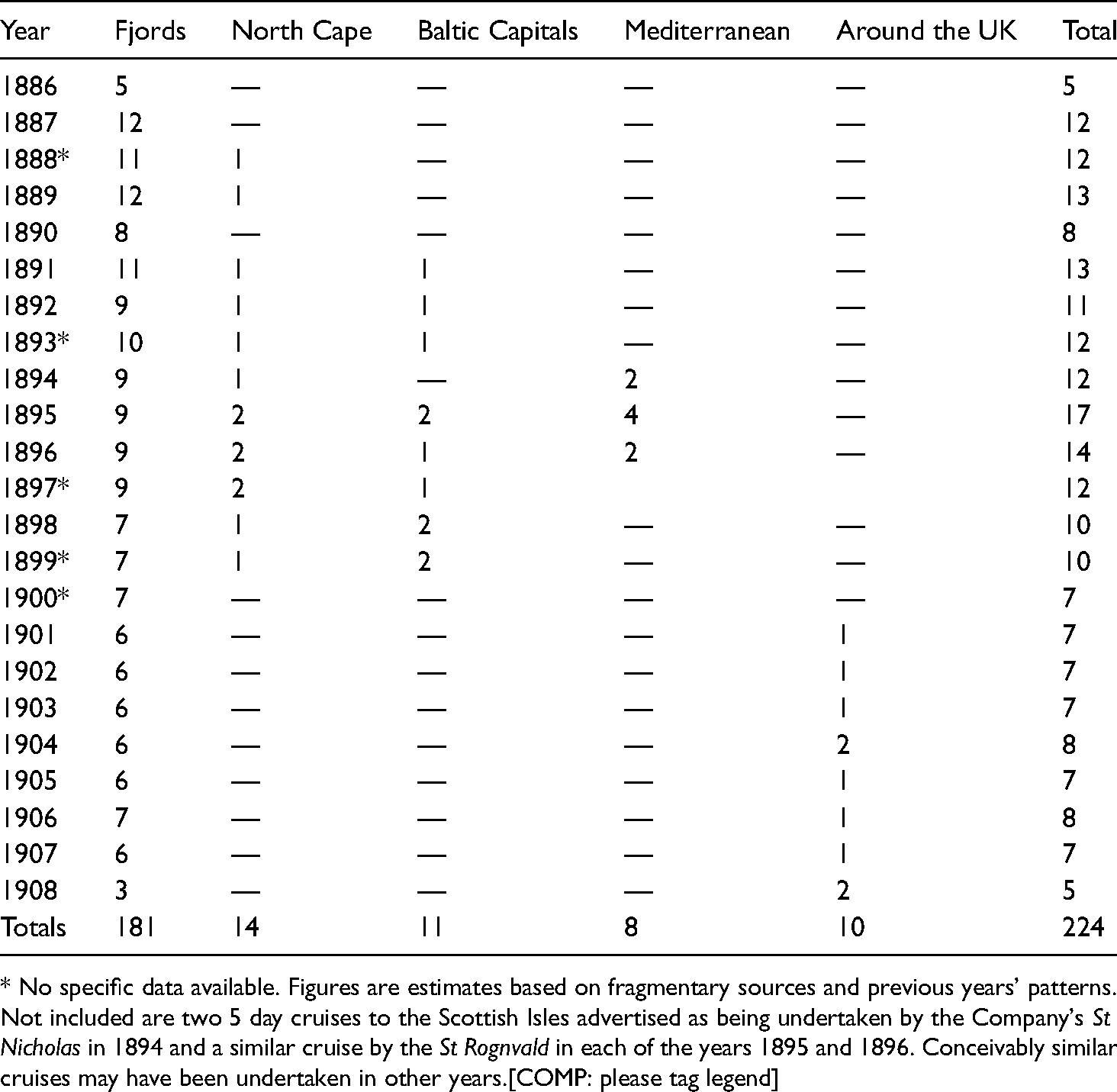
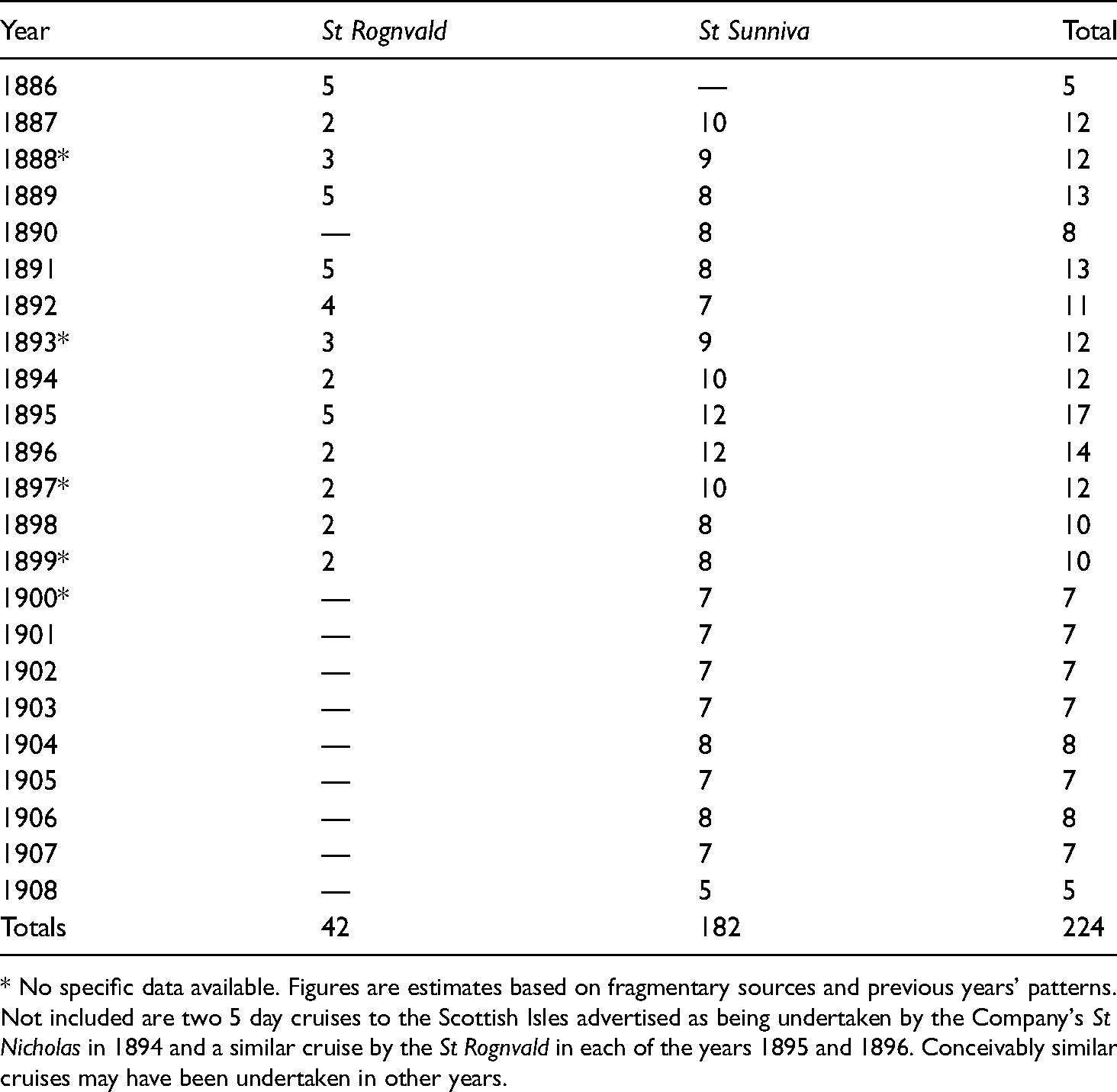
The Company's commitment through its capital investment in the St Sunniva proved well placed. The vessel was to operate on cruise routes for the next 20 years, while the St Rognvald, which undertook the pioneering cruise voyage, was also deployed in cruising and during the 1890s underwent alterations to enhance its passenger facilities. 27 Tables 1 and 2 indicate (as for as is possible, given the limitations of the sources) the extent and pattern of the Company's cruising activity during the period 1886–1908. Sources for Tables 1 and 2 are The Times; Cook's Excursionist and Traveller's Gazette; McRobb, ‘The Centenary’; Donaldson, Northwards by Sea; and Company handbooks and brochures.
Cruises undertaken by vessels of The North of Scotland, Orkney and Shetland Steam Navigation Company, 1886–1908.
* No specific data available. Figures are estimates based on fragmentary sources and previous years’ patterns. Not included are two 5 day cruises to the Scottish Isles advertised as being undertaken by the Company's St Nicholas in 1894 and a similar cruise by the St Rognvald in each of the years 1895 and 1896. Conceivably similar cruises may have been undertaken in other years.[COMP: please tag legend]
Cruises undertaken by the St Rognvald and the St Sunniva, 1886–1908.
* No specific data available. Figures are estimates based on fragmentary sources and previous years’ patterns. Not included are two 5 day cruises to the Scottish Isles advertised as being undertaken by the Company's St Nicholas in 1894 and a similar cruise by the St Rognvald in each of the years 1895 and 1896. Conceivably similar cruises may have been undertaken in other years.
A number of observations can be made on the material presented in Tables 1 and 2. The first is that of the Company's regular and continued participation in the business of cruising for 23 years. From 1887, when the St Sunniva came into service, until 1900, when the St Rognvald was lost, the Company averaged over 10 cruising voyages per year. The bulk of cruises were undertaken by the purpose-built St Sunniva, but every year the St Rognvald assisted in the tight schedule of fjord cruises, which at its peak saw weekly departures. In most years after 1889, the St Rognvald undertook one much longer cruise to the North Cape. What is more remarkable is that the Company sustained its involvement in the face of considerable competition. The success of short cruises to western Norway and the fjords was quickly recognised and other new operators soon, and regularly over the next two decades, offered a similar product. Some of these, notably the Aberdeen Steam Navigation Company, which briefly entered the market in 1890, and the Norwegian Royal Mail of P.G. Halvorsen, which operated cruises in 1891, quickly disappeared from the scene. Other short-lived cruising firms included the Ocean Yachting Company, which ran an over-ambitious and financially calamitous fjord cruise programme in 1893, and the Ocean Cruising Company, which entered and withdrew in 1894. However, much more serious and ongoing competition came from other entrants to the fjord cruise market. The Norwegian Bergen and Nordenfjeldske Steamship Companies operated fjord cruises out of Newcastle from 1887, only a year after the Company commenced its cruise business, while the Polytechnic Touring Association and the Albion Steamship Co. (with it famous vessel, the Midnight Sun) entered the market in the early 1890s. All of these firms were to operate well beyond 1900. Moreover, apart form such companies who were in direct competition with the North of Scotland Company in short fjord cruises, a range of other operators offered cruises to Norway and the Baltic. Hence, the Company's 23-year involvement represented sustained participation in a competitive market.
A second feature of the table is that it embraces cruises outside of the original destination, western Norway and the fjords. This highlights one of the features of the cruise industry (both in the 1880s and today), namely that the season for cruising in any area is limited. Weather and temperature – and this could be too hot or too cold – prescribed the season for particular routes. Ice and climate meant that the fjord route was restricted to late May through to mid/late-August at best, while the period for cruises to the North Cape was even more restricted. The Company, which had invested heavily in the St Sunniva, sought to extend its cruise business by offering a Baltic cruise – advertised as the ‘Northern Capitals’ and embracing the major cities of Oslo, Copenhagen, Stockholm and St Petersburg – immediately after, or very occasionally before, the fjord season was over. After 1900, when cruising was confined to the St Sunniva, the Company abandoned the longer Norway and Baltic cruises and followed up the fjord season with ‘Around the United Kingdom’ cruises in September. 28 Yet such expedients to extend the fjord cruising season at either end at best accounted for only half the year. In the winter and early spring, any potential cruise traffic lay in southern destinations, that is, the Mediterranean, Atlantic Isles or West Indies routes, which had all been pioneered by earlier participants in the cruise market. 29 From the standpoint of Company, the West Indies was not an option, as Caribbean cruises were long and expensive – hence, a limited market – and were catered for by larger and more spacious vessels than the St Sunniva. However, the Mediterranean was a possibility, although it meant sailing from ports other than the home bases of Leith or Aberdeen. The St Sunniva made some Mediterranean cruises, chiefly through being chartered out to travel agents or tour operators. However, to all intents and purposes, the Company confined its cruising ventures to northern waters and thus to a five-month period during the year. In consequence, in most years the St Sunniva spent more time laid up than at sea. The vessel's lack of cargo space inhibited her from engaging in the Company's core business – yet it would appear that her seasonal earnings rendered her viable until 1908.
The initial and continued success of the Company in operating cruises lay in the novelty and attractiveness of it new product, the short, cheap cruise, but also stemmed from imaginative and efficient organisation. It is interesting to enquire how the Company set about organising cruises that were a very different exercise from its normal coastal and island services. The general shipping aspects posed no problems, nor did the matter of accommodating and catering for passengers afloat, for this was part of day-to-day Company business. However, sailing in unfamiliar waters along the coast of Norway and up into the fjords required local expertise, and so too did the business of organising shore trips. From the outset, the Company showed considerable planning and organisational ability – more so than a number of other early and later entrants into cruising. To meet the need for local shipping knowledge, it engaged Norwegian pilots. Amongst the first to be engaged was Jacobsen, who had some celebrity status, as he had been the pilot on Lord Brassey's famous yacht, the Sunbeam, when William Gladstone had been a guest on private yachting cruise. Jacobsen became a great favourite with early cruise passengers and required little persuasion to parade the personal letter of thanks and commendation presented to him by Gladstone. 30 While the appointment of a pilot might seem an obvious prerequisite to ensure a safe and successful cruise, it showed a foresight far in advance of some much bigger and later entrants into the cruise business. The first cruising venture of the mighty Union Castle Steamship Company, undertaken with the 6,000 ton Dunvegan Castle in July 1904, got off to a very bad start with the vessel having to lay off Bergen for six hours as no pilot had been engaged, resulting in the abandonment of shore visit arrangements! 31
Another area in which the Company was far sighted in its organisation was in the matter of shore visits. These were an integral element of the cruise: once the initial novelty of the sea voyage had passed, the key attraction for passengers was the experience of life in a foreign country, viewing historic and scenic locations, meeting local inhabitants and purchasing souvenirs. Vital to any visit was the ease of going ashore, the transfer from the vessel. In most early cruises this was undertaken in the ship's boats rowed by members of the crew, but this could be a time-consuming exercise. 32 In this respect, the Company showed remarkable foresight. The St Rognvald, on her very first cruise, was provided with a steam pinnace to facilitate transfers. 33 So too was the St Sunniva; indeed, her steam launch was advertised as one of the attractions of the vessel. 34
Once ashore, it was important that passengers enjoyed their experience. Sometimes these were simply visits to ports of call where passengers could be disembarked for a few hours to view the local sights. Yet even then there were questions of what to see, how to get there and how to meet the challenges of changing currency and foreign languages. These were magnified when the locations to be visited were some distance away and required transport, refreshment and, on occasion, an overnight stay. Such problems could be greatly eased if shore visits were organised and accompanied. Again the Company recognised this, and from early on a ‘Conductor’, who was responsible for shore activity, accompanied each cruise. 35 The Conductor's role was recognised and appreciated by early cruise passengers as contributing greatly to their experience. 36
Making arrangements to ensure successful visits ashore – as was achieved by the Company – would nowadays seem to represent obvious provision. This was far from the case in 1886 when the Company entered the market; thus its role in this facet of cruising should be regarded as innovative. A passenger who enjoyed a cruise on the St Sunniva in 1890 took delight in comparing his shore experience with the lot of counterparts on the much more prestigious Orient Line's Garonne, who were in Odde at the same time. The Garonne's passengers were tediously conveyed ashore in the ship's boat, and once landed were abandoned to their own devices. 37 Later on the same cruise, the Garonne was encountered at another location. Here the St Sunniva's conductor, a Mr Lamb, booked all the available carriages for a visit to a local beauty spot, while the Garonne's cruising party were left without transport. 38 Before long, however, the efficient organisation of shore visits was appreciated and other operators in the market followed suit – the cruises of the Polytechnic Touring Association, which commenced in 1891, were especially well organised – yet the reputation established by the Company must have stood it in good stead.
In stressing the importance of the ‘Conductor’, it should be noted that his role was largely confined to shore visits; he was not a ‘cruise director’ in the modern sense and had little hand in activity aboard ship. Entertainment afloat was largely up to the passengers to arrange for themselves. On many cruises in the St Rognvald and the St Sunniva, passengers, as was the case on most other cruises, with typical Victorian organisational enthusiasm, assembled ‘Entertainment Committees’ soon after embarkation. These took on the organisation of concerts, musical evenings, competitions and sports. The Company recognised this aspect of pleasure cruising, and at various times their vessels had an organ, harmonium or piano, as well as facilities for such rudimentary pastimes as deck quoits, deck cricket, tug-of-war and card and board games. As time went by, however, the Company's on-board recreational provision probably lost out to that provided by larger vessels, which often had bands or orchestras and offered greater deck space and promenades.
In any business, the success of an innovative venture and, once established, the continuance of its operations depends on custom. That, in turn, depends initially on the attraction of novelty, but very soon on the ‘ability to deliver’ in the sense of the product proving itself worthwhile with a good reputation. The business of cruising, unlike many other maritime activities that rely on regular custom, is constantly seeking new customers. Obtaining these places a premium on advertising and publicity. How did the Company publicise and market its cruises? Initially, as has been seen, it was through advertisements in the Scotsman, which regularly carried the Company's adverts. From 1889, it advertised in the Times, although by no means with the regularity of other cruise operators. Indeed, the paucity of its advertisements – given that it operated a very full programme of cruises – was remarkable: it merely inserted a cluster of adverts at the commencement of the fjord season. After 1895, it ceased even these notices and the only Company advertisement in the Times after this date appeared in 1896 and related to a special Baltic Yachting Cruise, which included shore excursions to Moscow for the ‘Grand Coronation Ceremonies of Czar Nikolas’. 39 Rather than direct advertising, the Company seems to have made use of travel and shipping agents. As early as 1889, the Company had widespread national exposure through the use of agents in London, Liverpool, Manchester, Birmingham, Sheffield, Leeds, Lincoln, Bradford, Glasgow, Dundee, Belfast, Leith and Edinburgh. 40 Then, and at various times thereafter, the Company used such major firms as: J.A. Clinkswell, W.A. Malcom, Henry Gaze and Sons, W. Beattie and Sewell & Crowther in London; McIver & Co. and Guion and Co. in Liverpool; W.H. Hayward in Birmingham; and Thomas Coles in Manchester. 41 Besides these, regular use was made of the firms of Thomas Cook and Henry Gaze, both of whom had branch offices across the country. In the years when the Company used press advertising, such agents were often cited as addresses where the Company's handbook and later brochures could be obtained. In the early years, when it was vigorously promoting its new product, the Company published a substantial annual guide/handbook that, while listing the season's cruises, was primarily a travelogue promoting at length the sights and highlights of the fjord routes. Agents, of course, generated their own literature, which featured the holidays and operators they represented. Often this was a seasonal catalogue, but some bigger agents published what were effectively regular magazines. Amongst these were Henry Gaze and, above all, Thomas Cook, whose Excursionist and Traveller's Gazette had a long and distinguished history. 42 Cook's was an agency that served the Company very well by providing publicity from the late 1880s through to 1908.
While advertising – whether directly or indirectly through the press or agents – was one way to obtain custom and fill berths, another was through chartering vessels fully or taking block bookings through travel agents. The extent to which this was part of the Company's business is uncertain – there are no house records – yet secondary sources not only reveal that it did occur, but also provide the earliest evidence of these practices in the cruise business. An early example was the St Sunniva's first voyage to the fjords in June 1892. The vessel had been block booked or chartered by the Birmingham travel agent, E. Mundye, who, as part of the holiday package, had arranged a special train from New Street Station, Birmingham, to Leith. Mundye advertised similar arrangements for another such cruise in 1893. 43 Early in 1894, the St Sunniva enjoyed charters from two contrasting clients. The first was Lord Rothschild, who chartered the vessel for his Mediterranean cruise; immediately after, the St Sunniva was host to the Co-operative Travel Association for a lengthy cruise to the eastern Mediterranean. 44 Co-operative Travel, a body that operated under various names, is an organisation about which little is known. 45 One of its leading figures was Woolrych Perowne, who was the named charterer of the St Sunniva for its 1894 Mediterranean cruise, and likewise of the St Rognvald for four cruises to Norway in June, July and August 1894, and then the St Sunniva for a Baltic cruise in September of that year. 46 Perowne also operated in his own name and in this capacity chartered the St Sunniva in the winter/spring of 1894–95, basing her at Marseilles for a series of four Mediterranean cruises. 47 Perowne was active throughout the 1890s, but he appears to have only occasionally chartered the Company's vessels after 1895. 48 Further evidence of the Company chartering out its vessels is sparse, but there can be no doubt that this practice offered employment without the administrative chore of directly filling berths.
The experience of the Company reveals much about the conduct of the early cruise business. It was a pioneer in the business and innovative in the product it offered and in the way it organised its cruises. At the same time it was perceptive in its marketing, using outside agents, which was more economical than direct advertising, even though it incurred commission charges. In so doing, the Company relied very much on its reputation and the representation of the same by its agents. Yet there was a limit to how long the Company could continue with its cruising operation. That limit was reached when the innovation that it had inaugurated had been widely copied by others and when the market had moved on. Over time, other operators came to offer a product that was increasingly more attractive in the eyes of prospective customers.
The end of the Company's involvement in cruising came in 1908 when the St Sunniva undertook her last cruise. The cessation had been imminent for a number of years, although not because of the deterioration of the Company's product. That was still the same – the St Sunniva provided cheap, short cruises to west Norway and the fjords. Throughout the 1890s, the Company's ‘cheap and cheerful’ cruises had proved able to compete with others who offered a similar product despite utilising larger vessels. However, from the turn of the century, new entrants to the market appeared. These were large liner companies such as P&O, Union Castle and Royal Mail, who, having seen the cruise market develop, now recognised its potential. The absence of records and accounts makes any judgement on costs speculative, but it is likely that the Company was forced out of cruising not because the new entrants were more efficient on a cost basis but rather because it could not compete in terms of facilities. The new vessels employed on Norwegian cruise routes, such as P&O's Vectis (advertised as ‘6,000 tons, 6,000 h.p.’), 49 were so much larger and much more spacious than the now dated St Sunniva. Whereas the latter was 864 tons and carried up to 130 passengers, the Vectis (previously the SS. Rome before conversion to cruising) was designed to carry a complement of just 150 cruise passengers. 50 Likewise, the Union Castle's Dunvegan Castle was 6,000 tons and carried only a ‘good 200’ passengers’ on her maiden cruise in northern waters in 1904. 51 Such vessels had more and grander public rooms and greater promenade decks. Again they were better equipped and had more spacious cabins, with beds rather than berths. Even Cook's, who continued to list the St Sunniva along with other cruise vessels, seems to have felt the need to comment on the humbler, more rudimentary provision of the company's vessel, noting that ‘the accommodation, though limited, is very comfortable’. 52 Besides the facilities offered by the new entrants, the size of vessel was also significant. Big vessels were regarded as safer and more reliable and there was the belief that larger vessels would ride better in rough seas. Increasingly, smaller vessels were derided and a cruise passenger on the Dunvegan Castle in 1904 referred to his ‘exclusive yacht trip’ and compared the size and grandeur of his vessel with the ‘usual Cockleshell of a Tourist Tramp’! 53 Contemptuous though this may seem, the fact is that in 1908 no other British vessel making cruises to Norway was of less than 3,000 tons, while the Amazon of Royal Mail was 10,050 tons. 54 Moreover, the great shipping companies, and in many cases their ships, were household names that embodied Britain's maritime greatness and imperial splendour. To travel on them and, perhaps even more so, to recount that one had done so, gave added lustre to the novelty of a cruise. To cruise on the P&O's Vectis departing from London, or a Union Castle liner from Southampton, created a different image from that of travelling up to Leith or Aberdeen to board the St Sunniva.
Withdrawn from cruising, the St Sunniva underwent a considerable conversion. Passenger accommodation was removed from her lower deck and cargo hatches were put in. She entered the Company's core business and for the next 22 years was employed on the Leith, Aberdeen and Lerwick route carrying passengers, mail and cargo. She was wrecked in 1930. 55 The withdrawal of the Company from the fjord cruise routes that it had pioneered, and the St Sunniva's conversion, marked the end of an era. The Company's involvement in holiday and recreational travel was retained, but both the international and specialist cruise dimensions were abandoned. 56 Attempts to revive cruising after 1945 were spasmodic, largely confined to excursions and not attended by any great success. The Company's contribution to the history of cruising lay in the pioneering years when its innovative product, efficiently organised and promoted, proved profitable. That success led to emulation by larger international liner companies which before, and more so, after the First World War, came to dominate the cruise market.
Footnotes
Declaration of conflicting interests
The author declared no potential conflicts of interest with respect to the research, authorship, and/or publication of this article.
Funding
The author received no financial support for the research, authorship and/or publication of this article.