




Abstract
Late-medieval Flanders was a patchwork of jurisdictions. Especially in terms of maritime plunder, different prosecutors and different courts could claim competency. However, where these plunderers appeared or where the plundered claimed their damages mattered significantly. This article investigates how these landlocked courts tried to claim competency over the events happening at sea. What were the consequences of the litigation strategies relating to maritime plunder, and how did plunderers and the plundered deal with these? Especially in medieval Bruges, there was a pragmatic approach towards favouring some of the important merchant communities while using princely institutions to chastise other (deemed harmful) plunderers.
In 1422, Portuguese merchants in Flanders suspected the Genoese shipmaster Francesco De Caffa of participating in the maritime plunder of Portuguese vessels. Maritime plunder, or an event where the sailors of one ship seized another ship and its merchandise for themselves, could lead to capital punishment, or at least compensation, when determined as unjustified. The question for medieval Flanders was who decided what was unjustified and when it was unjustified.
The Zwin area in Flanders was a patchwork of jurisdictions. Plunderers could be arrested by officers of the Count of Flanders in Damme, Sluis, Bruges or the Liberty of Bruges (the rural area surrounding Bruges), or the water bailiff, who specialized in handling events ‘on the water’. The municipal courts in Sluis, Mude, Bruges and the Liberty were all eager to try these pirates as it demonstrated to their inhabitants that they would assume a strong stance against maritime plunder. In addition to these courts, princely courts like the Council of Flanders (covering the County of Flanders) and the Great Council of the Duke of Burgundy (covering the Nederlandish dominions of the Duke of Burgundy) often considered cases of maritime plunder. 1 The problem was that none of these courts had exclusive competency for the assessment of maritime plunder, which prompts the questions of whether this web of courts gave litigants the ability to choose between courts (forum shopping), what choices could be made, and what limits were placed on this forum shopping. As we will see, no court had sole jurisdiction over maritime events, so various courts could accept these cases or even bring the cases before them.
Bruges, in particular, had an acute interest in maritime conflicts. In the case of De Caffa, the Portuguese had asked the bailiff of Sluis to apprehend the shipmaster once he was in the port of Sluis and make sure that justice prevailed. The bailiff arrested and incarcerated him with the intention of summoning him before the aldermen of Sluis. 2 However, the Genoese merchant community in Bruges intervened. The Genoese argued that they had privileges, stating that Genoese merchants were only liable for their own debts. 3 They claimed that the merchant Leonardo de Rapallo was responsible in this case, and that De Caffa worked for De Rapallo. In brief, the Portuguese had arrested the wrong man. To make matters worse for the Portuguese, the Genoese sought the help of the aldermen of Bruges, who believed that Sluis was within their sphere of influence, even though the aldermen of Sluis had a different opinion on the matter. 4 As the bailiff’s accounts mention, the aldermen of Bruges and Sluis had some serious disagreements. The reason for the quarrel between Bruges and Sluis is not mentioned, but an educated guess would be that it involved competency. Sluis was proud of its own jurisdiction and court, whereas Bruges envisioned a far more submissive role for Sluis. The Duke of Burgundy and Count of Flanders sent ducal commissioners to calm the situation down, but the bailiff of Sluis anticipated a stalemate and proposed a deal. 5 De Caffa or the Genoese nation would pay a sum of money and he would drop the charges against De Caffa – a financial arrangement known in Flemish law as a ‘composition’. 6
For the bailiff of Sluis, the matter was a simple one. When justice was unlikely because of the lack of evidence or something else, he often proposed a deal and terminated the case with it. For the city of Bruges and the Portuguese, it is unlikely that the matter was resolved as easily. Although we do not know how they solved this particular problem, the case illustrates how quickly maritime plunder became a web linking different stakeholders. By the fifteenth century, Bruges was one of the most important commercial hubs in the County of Flanders and, by extension, northern Europe. Merchants from the Hansa, England, Scotland, Portugal, Castille, Aragon, Genoa, Venice, Florence and Lucca all visited the city. However, together with their merchandise, these merchants sometimes robbed each other on the open seas, which was an area without clear jurisdiction. As these merchants came together in Bruges, their enmity had the potential to destabilize the city.
Yet maritime plunder was a fact of life in late-medieval Flanders. From low-born fishermen to high-born noblemen, taking a ship, its merchandise and even its sailors could be both an honourable and a dishonourable enterprise. It was up to the court to determine which it was. 7 However, for medieval Flanders before 1488, there was no court that was solely competent to conduct this assessment. 8 From 1488 onwards, Maximilian founded the admiralty at Veere, which assessed the taking of ships. 9 Before this, it was open to a plethora of courts. Several princely officers could arrest plunderers and several courts could determine their guilt. As cases of maritime plunder were often considered high stakes, several courts tried to bring such cases within their competency and out of the sphere of influence of others. This gave merchants the rare opportunity to play the courts against each other and make the system work for them.
Most princely officers summoned the people they arrested before their provincial court. For example, the bailiff of Sluis would bring plunderers before the aldermen of Sluis. In these cases, the trial would be a criminal procedure. However, there were more stakeholders interested in the plundering at sea. Bruges and, by extension, the Four Members (an assembly of the three biggest cities of Flanders and the Liberty of Bruges), the Council of Flanders and the Great Council of the Duke – could assess the guilt of these plunderers. 10 The same crime could be assessed before these courts in a civil procedure. If this was the case, the procedure would not deal with the crime but with the inflicted damages, since the courts wanted to restore and appease relations. However, this only happened if one of the parties (the plunderer or the plundered) believed that this was probably in their interests. In contrast to the lower aldermen benches, these courts had no ducal officer who summoned either party to court, and thus relied on one of the parties to initiate a case. In addition, the aldermen, for example, could try to hinder the criminal procedure before the water bailiff and the aldermen of Mude, a small town in the Zwin area. The obvious questions are: How, in such an unsystematic web of courts, did merchants and plunderers try to reach the most profitable judgement? How did they use these courts to their advantage? What parameters did they take into account? And to what extent could they forum-shop within these courts? Forum shopping is the ability to choose between the different forums available with the purpose of obtaining a favourable decision. This may certainly have been prevalent in late-medieval Flanders for the stakes in maritime plunder were often very high. Robbed merchants sought compensation for their losses. The robbers wanted to outrun any penalties – be that paying compensation, being hanged at the gallows or being put to death by the sword or at the stake. Whether or not someone went to the gallows was a consequence of the qualification of the delict.
This contribution adds to the debate on how the municipal courts classified and determined their relations with events happening at sea. The historical literature points to the concept and perception of piracy in the late-medieval period. 11 Being classified as a ‘pirate’ was probably the worst-case scenario for a robber. Pirates were framed as an unwanted menace to the common people, and were often punished in a harsh manner. According to Pierre Prétou, the prince (in this case the king of France) displayed his power in piracy cases and was determined to set an example. 12 However, as Gregor Rohmann, Philipp Höhn and Thomas Heebøll-Holm have shown, piracy was a mouldable concept that could be used to stigmatize other merchants or places. 13 In addition to the complicated web of courts, there was a complicated system of classifications that could be used before a court in the late-medieval period. This meant that different strategies could be used. This article argues that, in late-medieval Flanders, there was an ambiguous position among merchants, pirates and the groups in between. The specific context gave way to a diversified framework through which these maritime plunderers were perceived. This classification, and how a court reacted to it, was important for litigation strategies for both the robbers and the robbed. In this article, we will explore the different types of piracy and determine the importance of this for the courts of aldermen (notably, Bruges) and the princely courts (notably, the Council of Flanders and the Great Council of the Duke of Burgundy).
Troublemakers, sea roamers and pirates
The act of attacking a ship, assaulting its crew and taking its cargo was not necessarily repugnant in the eyes of society. 14 Maritime plunder could amount to lawful or unlawful violence. The former was born out of necessity, the latter out of opportunity. 15 In pre-modern times, princes could not rely on organized fleets and had recourse to entrepreneurial sailors. These fishermen attacked enemy vessels, took their cargo and, in the process, harmed the enemy on a far larger scale. 16 When war erupted between two states, their subjects were allowed to take their enemies’ cargo as a rightful prize. The assessment of whether or not a prize was lawfully obtained was in the hands of a court. A variation of this was a letter of marque or reprisal letter. By the end of the seventeenth century, a letter of marque was a licence issued to privateers to operate against enemy vessels in war. 17 Before this, the term referred to a licence to arbitrarily apprehend merchandise as compensation for a previous injury. In several cases, these letters were issued as retribution for maritime plunder. As maritime plunderers operated in international waters, they could not be caught easily. Owing to this lack of justice, reprisal letters were a useful device for a prince to appease his subjects. Once issued, the victims of maritime plunder could seize the goods of the, in most cases innocent, compatriots of the maritime predators. 18 It was a form of retaliation that only a prince could issue.
An arrest could be executed at sea by attacking foreign vessels, but, especially in medieval Flanders, these arrests were mostly executed in the ports. With all their valuables amassing in a port like Sluis, it was tempting to distrain the cargoes of the compatriots of the wrongdoers instead of catching the maritime predators themselves. Most merchant communities were aware of this threat and obtained privileges protecting them from such arbitrary arrests. 19 When threatened by reprisal letters, they called on their charters, which granted them specific protections, commonly known as ‘privileges’. A prince, however, did not always heed these privileges and, once these letters were issued, they could lead to long legal procedures. For the Flemish cities, reprisal letters were a nuisance. Princes intervened in what they believed was their sphere of influence. The princes disturbed existing relations, and many merchants complained vehemently before their courts when reprisal letters had been issued. Not unsurprisingly, in 1453, the Duke of Burgundy, Philip the Good, issued a formal promise to the cities not to issue any letters of marque. 20 In effect, these letters largely disappeared until the end of the fifteenth century, when Maximilian of Austria was less scrupulous. When he wrote to the Scottish King James III to seek compensation for the taking of the ship La barge (sic), he did not hesitate to threaten him with a reprisal letter. 21
When war and/or reprisal letters were absent, the violence committed was illegitimate. However, even here, these plunderers appear in the sources in several variations. In Middle Flemish, we most commonly see the term seeroomers or seeschuimer (‘sea roamers’). 22 In Middle French, these same people were designated as écumeurs du mer. There is a difference between a sea roamer and being designated a sea robber. The former did not comprise an existential threat, whereas the latter was seen as a harmful brigand. 23 To some degree, sea roamers were seen as a fact of life. Pillaging at sea was not a top priority but was considered a nuisance that had to be dealt with occasionally. 24 Even when these people were designated as rovers or robbeurs du mer (‘robbers’), the authorities spoke about a legal offence that was punishable with a public execution by the sword. 25 People who were designated as ‘sea roamers’ or ‘sea robbers’ could be executed by the local bailiff. However, even if ‘sea robber’ was a slightly more pejorative term, it did not call for large-scale action to eradicate the threat to commerce.
On the other hand, likedeelers (‘equal distributors’) were something else. There was nothing honourable about their profession; they were a threat to society. This category appeared in the early 1400s in Flemish waters and they were seen as an existential threat that had to be dealt with. It called for action. The sailors who came from the Baltic Sea provoked a spike in the piratical activity in the North Sea and caused the cities to complain vehemently about their activities. 26 From the second half of the fifteenth century, the term likedeeler changed to the familiar denomination of ‘pirate’ – a term that is often used in connection with something that is a menace. 27 Historians have often contextualized the concept of medieval piracy with Cicero, who stated that a pirate ‘was the enemy of mankind’. 28 The pirate was a universal enemy who presented an existential threat to everyone. Prétou has argued that the Parliament of Paris was inspired by this notion, which gave the King of France an excuse to pursue pirates beyond his jurisdiction and, by so doing, enlarge it. 29 Often, when piracy was alluded to, it was either in the sense that the activities were harmful or to provoke other parties into action to deal with the problem. 30
In the sources from medieval Flanders, we see badly behaved merchants, harmful seeroomers and loathed pirates. The major question, of course, is: Who is who? There is a very curious division to be noted – namely, the difference in the leverage that these sailors had over medieval Bruges. For example, although the Portuguese, Castilian, Genoese and Hanseatic merchants committed acts of maritime plunder, they were never called pirates. The category of ‘sea roaming’ was often used to describe French and English maritime predators. There is a reason for this. As the English and French were close neighbours of Flanders, they were the usual suspects of maritime plunder. Both had close access to the English Channel, and numerous fishing villages saw these merchants’ ships filled with cargo heading to Bruges. The Counts of Flanders were often involved in the conflict-ridden politics between France and England in the fourteenth and fifteenth centuries, and maritime plunder unfolded alongside the wars that followed. Even when there was peace between Flanders and these kingdoms, the English Channel was full of predators acting on their own. 31 For example, after King Charles VII reconquered the Norman coastal cities of Dieppe (28 October 1435), Harfleur (1 January 1450) and Honfleur (18 February 1450), he almost immediately provided the perfect conditions for entrepreneurial seamen to take the war to the English at sea. The result was uncontrolled violence, which was greatly damaging to commerce in the Low Countries. 32 Despite peace between France and Flanders, several vessels sailing to Sluis and Bruges were attacked. The Hansa complained several times about the unsafe nature of the Flemish waters and the maritime predators operating in the Zwin area. 33 Nevertheless, the people who were arrested in this context were often described as seeroomers. If captured, they could be executed, but their presence did not entail any existential threat for Bruges.
The political context was essential. Let us consider the anonymous English sailors who were captured by the water bailiff, the comital officer responsible for the safety of the Flemish waters. He had to arrest these predators and bring them to justice via the aldermen of Mude. The aldermen of Mude described these sailors as ‘people who had committed sea-roaming’. However, they were not immediately condemned because of the specific circumstances at that time. In 1471, England and Burgundy were at war, but not entirely. In the context of the Wars of the Roses, Edward IV had lost his throne and had to seek refuge with his brother-in-law, Charles, the Duke of Burgundy. The King who had regained his throne, Henry VI, declared his predecessor a traitor. Formally, the Duke of Burgundy supported, according to him, the rightful King of England, Edward IV. The latter reclaimed the throne in 1471, but it is unlikely that these unfortunate Englishmen were staunch supporters of Edward IV. The aldermen of Mude shared this doubt, and after the examination of the English sailors, four of them were executed by the sword. 34 What the aldermen should do with the other eight was unclear and the city of Mude asked the Duke for advice. 35 Their doubt highlights the diplomatic sensitivity in these cases. Even those who were executed by the sword received relatively honourable treatment. Robbers could also be broken on the wheel. 36
The use of words like ‘piracy’ may not have been as frequent, but when they were used, it was for a reason. In 1478, Bruges obtained a charter from Maximilian of Austria. In this charter, the Bruges aldermen complained about the plundering conducted by ‘pirates’ from Groningen and East Frisia. The Bruges aldermen asked the Archduke to take action against these pirates, and proposed a solution. The real problem was not the pirates per se, but the ports of Holland and Zeeland, which harboured these pirates and condoned their activities. Therefore, the city of Bruges asked the Archduke to send letters to the ports of Holland and Zeeland to ban these pirates and forbid the provision of any form of help to them. 37 Although this was, at first glance, a legitimate concern, the aldermen of Bruges were devious. Whereas Holland and Zealand were prominent members of the Burgundian Netherlands, Groningen and East Frisia were not. Maximilian could safely condemn these sailors as pirates, while this was impossible for its own subjects. The action that was taken was not against these pirates but against the ports supplying these pirates. The ports of Holland and Zeeland were affected and had to limit their commerce with those suspected of piracy. How Bruges planned to enforce this is uncertain, but it must have been quite a symbolic statement.
While the threat from these coastal towns along the Dutch shore was real, the use of the term ‘piracy’ had political implications. 38 As the Hanseatic merchants sailed along the coast of Holland and Zeeland, it was mostly Dutch fishermen who attacked their vessels as they passed by. 39 The Hansa saw merchants from Holland and Zeeland sailing into the Baltic as competition. They branded these merchants as pirates and felt justified in acting against them. The Hansa expected Bruges to protect its economic interests and passed on the message. 40 Nevertheless, Bruges may also have nurtured its commercial interests by branding these cities as ‘criminal’. As is apparent from the sixteenth century, this network of towns in Holland and Zeeland was also booming, with its own industry in textiles, and thus becoming an increasing existential threat to the industries of Flanders. 41 Branding them as pirates was not a bad strategy to curb the economic activities in these towns. The Duke could not directly curb the growth of these merchant towns, but could surreptitiously hinder their economy if Bruges could prove that they were pirates’ nests.
This never succeeded. However, curiously enough, if sailors were branded as pirates, they often came from Holland and Zeeland. For example, in the case of the aldermen of Bruges, sailors from England and France, once captured, were often executed by the sword as seeroomers. If the water bailiff captured sailors from Zeeland or Holland, they were brought to Bruges to be burned publicly at the stake. 42 From the fifteenth century, the Bruges aldermen started describing them as ‘pirates’ in the sense of them being illicit, unwanted and very dangerous. 43 It also brought these people into an unwanted legal category. For most of the Middle Ages and the pre-modern era, people accused of piracy were also tried in the most violent way. 44
Bruges made a statement by branding these sailors as pirates. They were unwanted and the prince had to intervene by actively hunting these pirates and bringing them to justice in order to safeguard commerce in Bruges. This was a highly hypocritical approach to maritime plunder. Although each case was different, there was a rough divide between political enemies from France and England, who were punished but not stigmatized, and Dutch-speaking sailors, whose fate was less enviable. The question is how both used this situation to their advantage in the litigation strategies they spun.
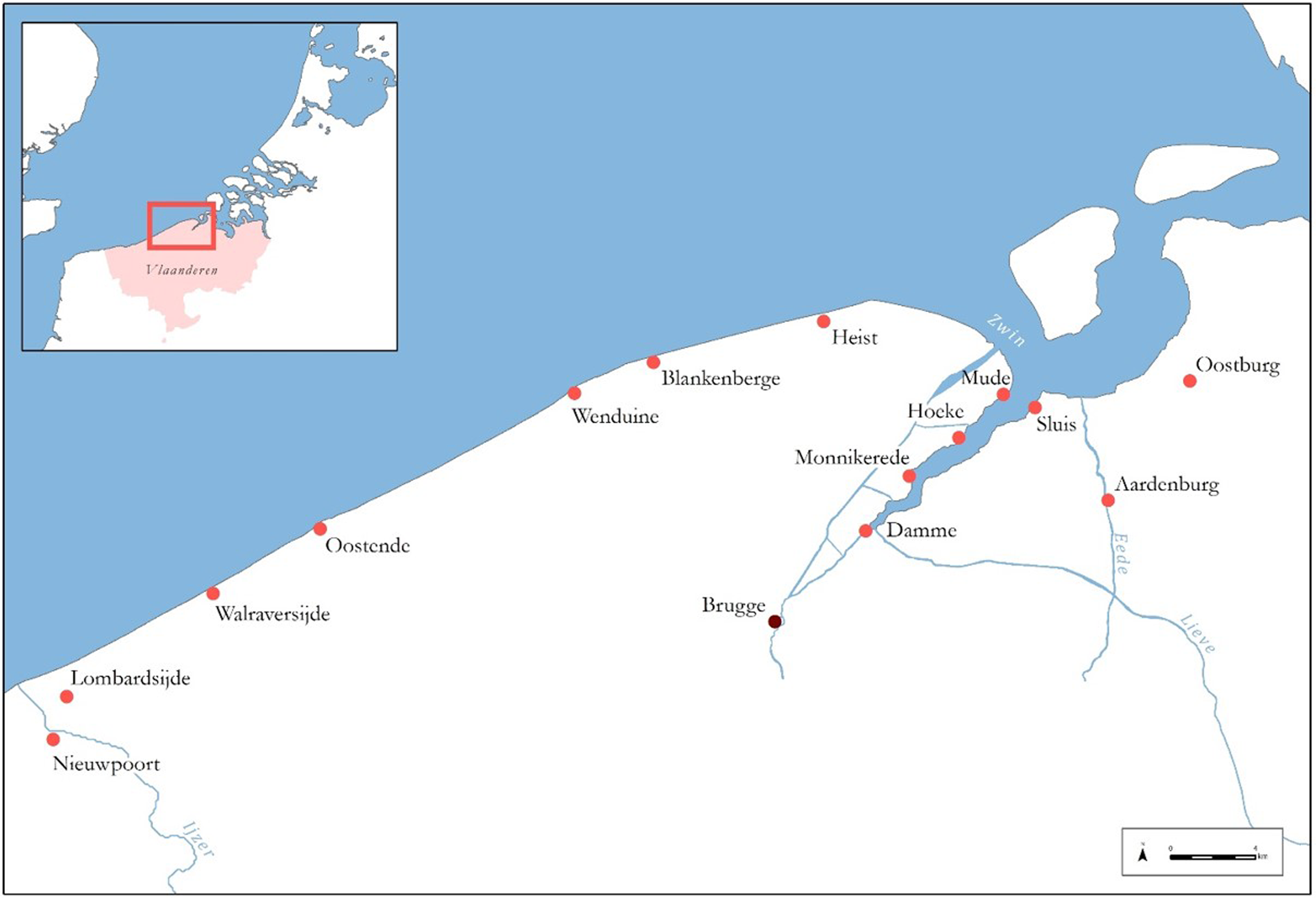
The Zwin area and outports of Bruges.
Litigation strategies before the aldermen court of Bruges
The competence of the Bruges aldermen court to handle cases of maritime violence was hazy at best. On the issue of ratione materiae, it was competent to deal with cases like manslaughter or robbery, but had no competence on matters that happened at sea. 45 There, the water bailiff could capture and bring culprits before the aldermen of Mude. On the issue of ratione personae, they could not claim jurisdiction over these maritime violators. In almost all cases, foreign merchants and fishermen from the coast were involved in violence at sea. However, the unwanted consequences were borne by Bruges. As all merchants sailing through the English Channel and the North Sea traded their wares in Bruges, it was not uncommon that they settled their scores once they were in the city. They could attack, sabotage and possibly kill people in Bruges. 46 Therefore, it was in Bruges’s best interests to deal with these cases as swiftly as possible (Figure 1).
International merchants knew this. Merchants coming from the open waters first docked at Sluis before they disembarked their wares into smaller vessels and sold them in the Bruges market. The first officer of justice these merchants encountered was often the water bailiff residing in the port city of Sluis. He was responsible for the defence of the princely rights in the Flemish streams, rivers and territorial waters before the Flemish coast. Not only was he an important and powerful figure, but his responsibilities also included arresting people who committed violence at sea. 47 He arrested and incarcerated people who had committed maritime plunder, and initiated criminal proceedings before the aldermen of Mude. However, both the water bailiff and the aldermen of Mude were within the sphere of influence of Bruges. Officially, Bruges was the chef de sens or legal head of Mude. In cases of doubt vis-à-vis legal matters, the aldermen of Mude had to consult the Bruges aldermen. 48 This gave Bruges at least an unofficial right of supervision over the actions of the aldermen of Mude. The aldermen of Mude also depended on the yearly ‘subsidy’ that Bruges gave them. 49 Although they considered this a right, Bruges used it as leverage to pressure them into doing their bidding.
The water bailiff was closely associated with Bruges. The aldermen of Bruges tried to maintain a good working relationship with him. 50 Gifts were sent to the water bailiff, who enjoyed a position of prominence in Bruges. 51 This was exacerbated because most water bailiffs already had strong connections with the Bruges magistrate before they entered office. 52 He was a very powerful figure, who was able to drop a criminal procedure and allow the aldermen to discretely solve matters in a civil procedure. Tellingly, when the cities were able to dictate policy in 1477, the Flemish cities tried to increase their control on the office of the water bailiff. 53 The water bailiff had an interest in maintaining a good relationship with the Bruges aldermen. He arrested merchants but could not try them himself. He had to bring them before the aldermen of Mude, who were, as indicated above, under the sphere of influence of Bruges. 54
Merchants from the Hansa, Portugal and Castile knew that they were of vital importance to Bruges. The Hansa had received privileges that exempted its merchants from any persecutions resulting from maritime violence. If they were arrested by the water bailiff and criminal proceedings followed, the members of its community often demanded that the aldermen of Bruges intervene. The aldermen reacted in sensitive cases and sent messengers to ‘discuss some people who were captured on the water’. 55 Although it is impossible to know exactly what these people did or what the aldermen planned to do about it, they negotiated with the bailiff on ways to handle these merchants. This sometimes resulted in merchants being let off the hook, despite clearly crossing any reasonable lines.
For example, when Pedro Sanches (Pierre Senses) was travelling in 1400 towards the County of Flanders, he bumped into a German vessel transporting pilgrims to Santiago de Compostela. Not aware of their holy mission, Sanches boarded the ship, killed the pilgrims and then sank the ship. When he arrived in Bruges, word had reached the water bailiff, who decided that such actions should be punished. As there was no war between the Hansa and Castile, the attack was unjustified. The bailiff arrested and imprisoned Sanches. However, Sanches, as the bailiff claimed in his accounts, said that he was not aware of the pious mission of the vessel but believed that they were Portuguese, with whom the Spanish were at war. The water bailiff concluded that this was an honest mistake and suggested a financial arrangement. Sanches paid 28 Flemish pounds groot (lib.) 19 Flemish sterlings (s.) and the bailiff did not pursue the case. 56 Although it is unlikely that the German Hansa would have been pleased with this, the right of composition offered a handy way out of violent cases. 57
By penalizing these perpetrators without executing them publicly, merchant communities did not suffer any damage to their honour. The water bailiff mediated between justice and diplomacy when he did not condemn them as pirates. The same can be observed for the bailiff of Sluis. Although he often arrested important merchants, he chose to give them a composition, while sailors from Holland and Zeeland were executed. In 1421, Bartolomeo of Venice was accused of stealing wine, but after the intervention of the ‘honourrable gentlement from Bruges', he was acquitted with just a fine. In the same year, Estene John of Portugal was accused of robbing Gauthier Roedbeen, but was offered a composition at the request of Jan van Aertrijke, a member of one of the leading hosteller families, and Pieter de Langhe of Bilbao in Biscaye was released after he paid the bailiff, at the instigation of the Spanish nation and the aldermen of Bruges. 58 Conversely, Jan Wulfert of Zeeland was executed in 1427, and Coenraet Wijs and Diederic van Gisterle followed suit in 1431. 59
Not all international merchants were acquitted. The financial arrangement with the water bailiff only entailed the promise not to move forward with any criminal proceedings. The victims of these actions could nevertheless still demand compensation for the harm that was done. Bruges handled these cases through legal fiction. First, these cases were not dealt with as ‘piracy’ cases or even seeroome. When dealing with cases of maritime violence, Bruges used euphemisms, such as that there had been ‘a capture on the sea’ (‘eene prise gedaan up zee’) or ‘a ship was taken’ (‘schip ghenomen’), or that ‘commodities were seized on the sea’ (‘goed op zee ontvremdt’). 60 Bruges classified these actions as simple seizures and assessed whether or not the people arresting these goods were justified in doing so. There was a logic to this. This damage could be dealt with as a debt and thus appear before the aldermen court. They lost the criminal side and tried their best to make both parties reconcile.
The task of the aldermen of Bruges was to find a solution between the merchant communities without offending either of them. Nations – notably, the Hanseatic – that felt their merchants were too vulnerable to piracy threatened to leave Bruges on multiple occasions if the city did not compensate them. 61 Therefore, it was vital for the aldermen to find a workable solution as quickly as possible. One example is the relationship between the Hanseatic and Castilian merchants. In 1466, the Hansa was in conflict with some Spanish captains. The Spaniards had attacked some English vessels and brought their merchandise to the harbour of Sluis. However, the German Hansa claimed that these goods included Hanseatic merchandise. While the case was first brought to the Great Council, both parties agreed to bring it before the aldermen of Bruges, who acted as arbiters. 62 All parties involved preferred the rapid solution of the aldermen of Bruges over the long and costly procedure of the Great Council.
The solution that the aldermen found speaks volumes about their behaviour towards the privileged nations. They prioritized finding a workable solution and affirmed that the merchandise did indeed belong to the Hanseatic merchants, who had no connections with the enemies of Castile. 63 The aldermen thus concluded that the merchandise should be returned to the Hanseatic merchants. However, the aldermen considered the damages that the Spaniards had incurred. The Hanseatic merchants had caused some ‘commotion’ in Bruges and had to pay an indemnity of 200 Flemish pounds groot 4 Flemish sterlings. 64 In the end, nobody was happy. The Spaniards had to return the stolen merchandise and the Hanseatic merchants had to indirectly pay for it. 65 This case shows us how the aldermen tried to contain these highly volatile situations as they put the law to one side (and thus all accusations of piracy) and dealt with the matter as a win–win situation for both parties (or maybe a lose–lose situation), in which they found a compromise.
The aldermen had a good reputation in dealing with matters of piracy. They had a policy of no naming and no shaming. When their clerks described in the registers the action and violence that went with it, they used terms like ‘troublemakers’ committing ‘brutalities’ or ‘irregularities’. If ‘sea roamers’ from important nations were arrested by the local bailiffs, the aldermen would quickly send a delegation to deal with these cases. 66 Given that the aldermen had a good working relationship with the water bailiff, it can be assumed that they could often force a compromise between the bailiff and the arrested maritime predators.
Litigation strategies before the princely courts
The complex system in medieval Flanders meant that different courts and people considered themselves competent in assessing piracy claims. Bruges could not keep all of the cases within its sphere of influence. Merchants could appeal against the (civil) decisions made by the aldermen and try their luck before a princely court like the Council of Flanders, the Great Council of the Duke of Burgundy or even the Parliament of Paris. All three were competent in the County of Flanders and, as they all protected the Count of Flanders or, in the case of the Parliament of Paris, the King of France and his prerogatives, they could assess cases of maritime plunder. The Great Council of the Duke of Burgundy was often looked on as the prime court where prize cases appeared but, as we will see, the Council of Flanders was also able to assess these cases deep into the fifteenth century. All of this depended on the litigation strategy of the merchant, the leverage he had and, of course, the attitude of the court towards the merchant.
The case of Jean Marchant of Dieppe illustrates this ambiguous position. Marchant was a cunning captain who sailed under the French flag and had an unruly opinion on whom to attack and how. He was accused of using false flags and other deceitful methods to trick his opponents, but also proved to be a real menace to trade in the Zwin area. 67 With a fleet of about four warships and 500 sailors, in the 1450s, he made the English Channel unsafe by seizing merchants and gaining loot. 68 In October 1455, he and his sailors were gathering provisions in the Zwin area when they were all seized in a raid by Charles, Count of Charolais and the future Duke of Burgundy. 69 Owing to Charles’ intervention, a unique situation arose where the victims of Marchant could claim damages against these French maritime plunderers. Unfortunately for these merchants, the King of France petitioned the Duke and said that he wished to bring Marchant to justice before his court. The Duke of Burgundy, Philip the Good, accepted, but demanded that the French provide pledges and compensate his subjects if they had been victims. To ensure that this was handled properly, Marchant was incarcerated in Bruges, and everyone with a claim was able to swear an oath on his honour and demand compensation before the aldermen of Bruges. 70
There were several victims, but Lauwers Claiszone is perhaps the most interesting among them. Claiszone claimed that he was a shipmaster who had started his journey in Southampton and was unfortunate enough to encounter Marchant and his ships on their way to Flanders. Marchant and his fellow culprits boarded his ship, took all the valuables and even threw sixpassengers overboard. 71 Claiszone claimed that he was left behind on his own, and his vessel, half submerged, floated without a course for three days and nights. It was only by a stroke of luck that he eventually reached Sandwich. Once there, he heard that Marchant and his accomplices had been arrested by the Count of Charolais. He hurried back to Flanders to swear that he had suffered damages and demand compensation for his losses.
The aldermen considered his oath insufficient. They asked Claiszone to find certificates confirming his losses. Despite Claiszone’s initial indignation and claims that this was impossible, he succeeded in obtaining two letters stating that his claims were valid – one from Amsterdam and one from Haarlem. 72 When Claiszone came to the aldermen court claiming compensation, he found that the aldermen had released Marchant from prison without offering any form of compensation to the unfortunate shipmaster. Claiszone sued the aldermen before the Council of Flanders. Before the Council, the aldermen explained that they had evaluated every claim that had been presented to them. In concreto, these were claims from merchants from both Holland and Mechelen. 73 The claims from Mechelen were accepted, whereas those from Holland were dismissed. 74 Claiszone was too late to claim damages and he provided, or so the aldermen claimed, very sketchy documents. 75 The Council of Flanders agreed with the aldermen and dismissed the case after condemning Claiszone to pay the costs of the proceedings.
This case illustrates two points. First, the aldermen acted in a restrained manner when they settled the case of a notorious maritime predator like Marchant, who robbed and killed people. He was imprisoned, but the aldermen did not consider him an outlaw. 76 The aldermen assessed the claims and did not accept them immediately. When the merchants from Mechelen claimed their damages, Marchant said that he believed that they were carrying German soldiers and were thus rightful bounty. 77 The shipmasters of Mechelen had their claims accepted and Marchant had to pay. 78 Second; the aldermen distrusted Claiszone. It may have had something to do with the documents Claiszone presented. The claims from the merchants of Holland were dismissed, as were the letters that Claiszone provided from the cities of Holland. Nevertheless, Claiszone did not shy away from bringing his claim before the princely court. He stood a reasonable chance, but the case was dismissed on a procedural error.
There was a group of merchants who did not believe in the due diligence of the aldermen, and were keen to avoid the Bruges court altogether. One such person was the mayor of Gouda, Willem Dapper. Dapper was in the wrong place at the wrong time. When he was in Bruges, some ships from Holland had stolen a net worth 350 Flemish pounds groot from the wealthy merchants Lazarro Lomellini and Jenoit Spinola, both of whom were from Genoa. When they arrested Dapper in 1479 for this act of plunder, he was stunned. The Genoese believed that Dapper, as the mayor of Gouda, was responsible for the maritime predators who came (or so they claimed) from Gouda. The Genoese hoped that the aldermen would recognize the mayor's liability for his citizens. If that was the case, the aldermen would have to make Dapper compensate the Genoese merchants for their losses. 79 The claims were far-fetched and it is unlikely that the aldermen of Bruges would have accepted this arrest.
Nevertheless, Dapper was determined not to find out. He fought the competence of the aldermen as the court to discuss the problem. He claimed that the aldermen of Bruges could not take notice of the case because, first, he was a citizen of Gouda and hence had to be brought before the princely central Court of Holland and, second, neither Lomellini nor Spinola was in possession of a reprisal letter and could therefore not arrest him based on his nationality but only his personal debts, and Dapper had none. Notwithstanding these reasons, the aldermen of Bruges decided that they were the competent court and Dapper had to answer to the demands that both Lomellini and Spinola made. This was only an interlocutory sentence, but it was enough for Dapper to appeal against it before the Council of Flanders, where he maintained that he should be tried before the Court of Holland and that he should at least be held without damages from the previous arrest. 80 As appeals against interlocutory arrest had not been allowed since 1459, the Council members condemned Dapper for a frivolous appeal and fined him 60 pounds parisis. 81 Dapper proceeded to the Great Council of the Duke of Burgundy, but had no success. The Great Council declared that Dapper should answer before the aldermen court of Bruges to the claims made by Lomellini and Spinola. 82
The complexity of the case leaves one wondering why Dapper was so eager to escape the jurisdiction of the aldermen of Bruges. He had to appear in a civil proceeding to answer for the damages inflicted by his citizens. It was not confirmed that the damages were inflicted by citizens of Gouda, or that Dapper was responsible for them. Still, Dapper went so far as to escape the jurisdiction of Bruges by litigating before the princely courts, starting with the Council of Flanders, while probably investing hope in the Great Council of the Duke of Burgundy. Before the Great Council, as a subject of the Count of Holland, he would see his case discussed by a court that had jurisdiction in the counties of both Flanders and Holland. It was not unlikely that they would decide that Dapper should appear before the Court of Holland. His rashness and flagrant disrespect for the lower courts did not benefit him and the Council members decided that the aldermen of Bruges should have at least the chance to consider the case.
The desire not to be tried by these aldermen was strange to say the least. It was probably Dapper's intention to escape the narrow-minded enmity of Bruges against Dutch-speaking seafarers and petition his court – namely, the Court of Holland – for fair treatment. As we have seen, Dutch sailors plundering on the routes to Bruges were the cause of many meetings between the Flemish cities, where they were sometimes even branded as ‘pirates’. When these plunders were arrested, they received no help from the aldermen, and suffered cruel executions. No special interventions were made, and Dapper was probably not counting on any future help from the aldermen. Instead, he tried (in vain) to move the case to the Court of Holland.
The higher courts had a different view on piracy than Bruges. Some merchants had limited opportunities to appear before these princely courts and, sometimes if they were captured, were hanged quite quickly. For example, the souverain-bailli of Flanders was such a powerful figure that he could be the questioner, judge and executioner. If sailors or merchants were arrested by him, their options for litigation were limited. 83 However, the merchants that could litigate would use it to their advantage. 84
Yvon Lorens was a merchant who faced the odds and achieved compensation through his litigation strategy. On 24 July 1472, this Breton merchant decided to bring his claim to the Great Council of the Duke of Burgundy. He had been attacked and robbed by Dunkerque pirates, who had brought their bounty to the Lord of Veere, who was one of the Duke of Burgundy’s admirals. Lorens went immediately to Veere to claim his goods back ‘because he was a good merchant’. Once he was in Veere, he was quickly disappointed as the Lord of Veere claimed that the Duke of Burgundy was at war with the Duke of Brittany and, as a consequence, the prize was legitimate. 85 The Lord of Veere was a very influential member of Burgundian society, but also had a questionable reputation in matters of maritime violence, sometimes having committed it himself. 86 Lorens brought the case before the Great Council. By doing so, he not only escaped the jurisdiction of the aldermen of Veere but also brought his case before university-trained lawyers and the Duke of Burgundy. This was not a bad call because the Breton merchants did not enjoy concrete privileges like the other nations. These lawyers were better trained in the ius commune than the aldermen of Bruges. 87 Lorens delivered a moving speech on how it was impossible for the Duke of Burgundy and his subjects not to be associated with the ‘pirates’. 88 The argument stuck. The Great Council deemed it a sensible argument that the Lord of Veere was associated with the Dunkerque pirates and ordered the restitution of Lorens’s property. 89
The discourse of piracy was used consciously in these higher courts by litigants. We will end with a case between the water bailiff and the bailiff of the Liberty of Bruges. The water bailiff was notified by some merchants about, according to him, ‘vicious pirates harassing the Zwin’. 90 As a faithful officer of justice, he gathered his men and they boarded their vessels and started pursuing these pirates. The pirates ran once they saw this show of force and docked at Cadzand. Unshaken, the water bailiff followed the pirates and claimed that he personally arrested two while his men arrested five others. 91 Satisfied, he returned to Sluis, incarcerated the pirates, and wanted to initiate proceedings before the aldermen of Mude. To his indignation, the bailiff of the Liberty of Bruges showed up and claimed that these sailors should be tried by him. According to the latter, the arrests were made on the island of Cadzand, which was within his jurisdiction. According to the bailiff of the Liberty, the water bailiff had not followed these pirates in the heat of the moment, but only disembarked because he lacked success on water. They had to be brought to him and their guilt had to be assessed by the aldermen of the Liberty of Bruges. 92 The water bailiff stated that the arrests of such ‘pirates’ had to be made without any regard for jurisdiction. The Council of Flanders decided that the bailiffs should form a composite court and, if these sailors were guilty, the bailiff of the Liberty could execute four of them and the water bailiff three. However, with his claim that these men were pirates and therefore ‘harmful’, and ‘speed’ was necessary ‘without regard for jurisdiction’, the water bailiff spoke prophetically. 93 The Admiralty of Veere was formed eight years later and was (theoretically) competent in the assessment of prize cases for the entire Burgundian Netherlands.
Conclusion
What happened at sea did not stay at sea. Several courts could assess maritime plunder. The Great Council of the Duke of Burgundy was the most logical solution, as piracy was closely related to the safe conduct of the Duke of Burgundy. The competency of the Great Council was not institutionalized and most coastal towns had long traditions of prosecuting cases of maritime plunder and assessing prize claims. This diversified landscape allowed merchants to choose the courts that best served their interests. If apprehended by the water bailiff, most cases were referred to the aldermen of Mude. Bruges could, however, intervene and bring a case before its court – something the aldermen did for high-profile merchants. We do not have records of the criminal proceedings in Bruges, but the evidence suggests that the court frequently turned a blind eye in matters of violence and was keen to keep the peace between the powerful merchant nations. The French, English and poorer townspeople from the nearby areas in Holland and Zeeland fell outside this scheme. The first two were considered a nuisance, where diplomatic realities barred the Bruges aldermen from taking action. In a way, they were part of the daily dangers of life. The maritime Dutch-speaking predators operated on a more than occasional basis in the Zwin area, and were thus a bigger problem. These sailors were branded as pirates and met with violence. The hostile attitude of Bruges made these pirates avoid the Bruges aldermen court. The Bruges aldermen tried to petition the Duke of Burgundy to take resolute action against these alleged pirates. Although it went unmentioned, these economic competitors were hurt in the process. For the robbers, those who had been robbed and the aldermen, the site of litigation mattered significantly.
Footnotes
Acknowledgements
The author would like to thank Jan Dumolyn, Dave De ruysscher and Louis Sicking for their helpful suggestions.
Declaration of conflicting interests
The author declared no potential conflicts of interest with respect to the research, authorship and/or publication of this article.
Funding
This work was supported by the Fonds Wetenschappelijk Onderzoek.

Notes
Author biography
Niels Fieremans is a doctoral student working at Ghent University and the Vrije Universiteit Brussel. His PhD research is entitled ‘Litigation Strategies in Late-Medieval Bruges’ and is being conducted under the supervision of Jan Dumolyn, Dave de Ruysscher and Dirk Heirbaut.