




Abstract
This article aims to highlight the characteristics of women’s labour participation in fisheries in the communities of the maritime periphery of the city port of Trieste. In the period in question, Trieste’s Maritime District was a strip of shoreline that extended from Grado (present-day Italy) to Savudrija (now Croatia). Apart from a few relevant cases, it had hardly been touched by the capitalist system of production. In this context, fisheries sometimes represented a significant source of wealth and employment for the populations of the local maritime communities. The women involved in fisheries were mainly factory labourers, fishmongers and owners of fishing boats. Their marginality (or marginalities) can be understood as ‘structural’ and a ‘social role’, and was articulated on different levels. Nevertheless, it seems necessary to go beyond the mere recognition of their liminality and, more generally, the traditional binarism characterizing gender studies in maritime contexts.
Maddalena, the ‘marine trumpet/waterspout’
Reading the first pages of Reliquie ladine, one can imagine the first meeting between the well-read glottologist Jacopo Cavalli and the illiterate fisherwoman Maddalena Frausin, which took place over lunch in a tavern in the sailortown of Trieste in the late 1880s. At that time, Maddalena was a sightless octogenarian who, ‘with a real marine trumpet/waterspout [tromba marina] voice’, described to him her ‘strenuous seafaring life and many troubles’.
1
At her age and after a life at sea, Maddalena found even short conversations – today, we would say interviews – tiring. In Cavalli’s work, her biographical portrait starts with these direct words: ‘I spent my life at sea. … I started boating at 13. My father taught me his trade. He was a fisherman’.
2
In her narrative, Maddalena talked about the first times she went out by boat with her father and about the time when, along with 23 other girls, she participated in a rowing race in honour of Emperor Ferdinand I when he visited Trieste in 1844. She told Cavalli about having married a good man and how he passed away, and that fate had left her with only two children out of 10. Finally, she informed Cavalli of the circumstances in which she had lost her sight. At a certain point in her story, she noted: ‘I have gone through a lot of rough waters!’.
3
Despite her age, Maddalena succeeded in painting a lively portrait of her work in fishery: One morning it was so cold that even the sea was frozen. My father said: ‘My dear, go to the prow and, with a piece of wood, break the ice so we can pass with the boat.’ We had four buckets of oysters that we covered with our coats so they wouldn’t freeze to death. It was so windy that we could hardly reach the coast to save our lives. … Then the weather cleared up, and we went to Trieste to sell the oysters. Once my father and I were off the coast of San Bartolomeo – where Miramare is now – we fished eight buckets of oysters with the net. The Slavs of Contovello arrived to settle on a price, but my father refused because they offered too little. So, we went to Trieste by boat, and my father settled with the dealer for 31 Florins. Once my mother and I were fishing in the bay. We take the lines and throw them into the sea, and shortly after, the fish begin to bite, and we pull them into the boat. At the best part, we ran out of bait. So, I cut a piece of my white skirt and put it on the lines, and we caught 50 pounds of fish that day. Then we went to Trieste to sell it and collected 21 Florins.
4
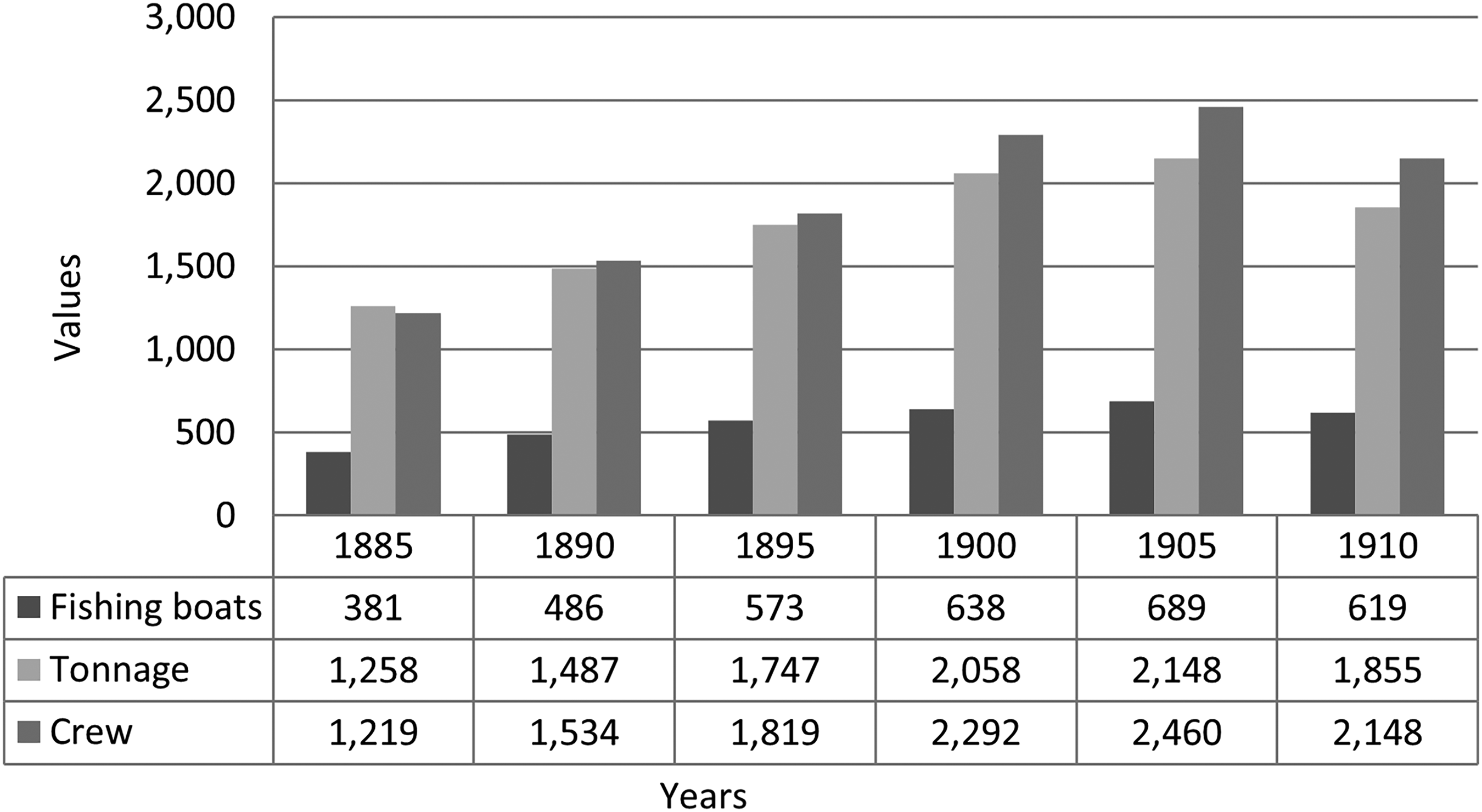
General assets and employment situation in the fisheries in the Maritime District of Trieste, 1885–1910.
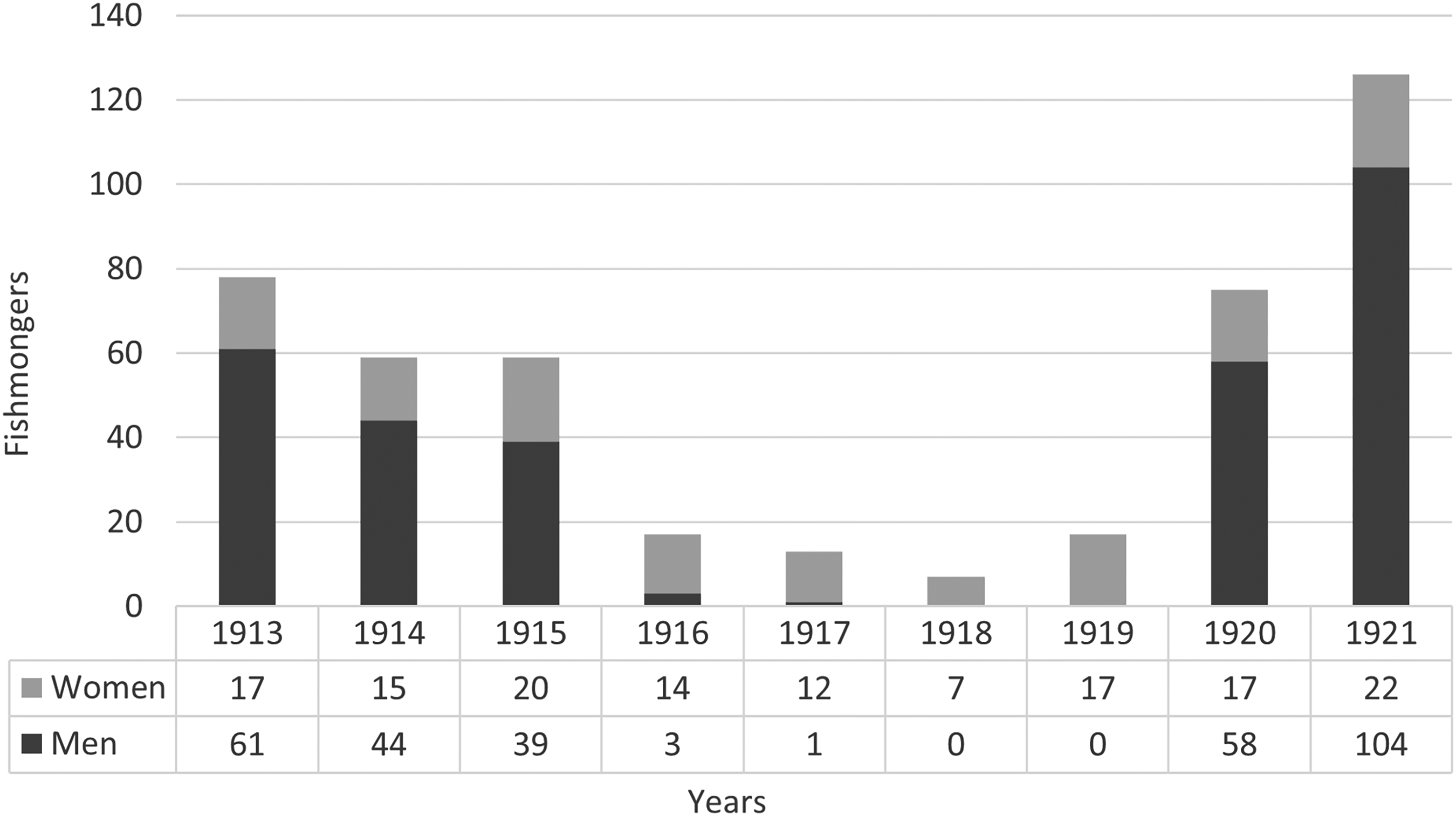
Number of male and female fishmongers in the Trieste fish market, 1913–1921.
The fact that Maddalena’s words have reached us today is a minor miracle. Furthermore, the case of Maddalena represents an exception in at least two respects. Fishing societies adhere to a very rigid division of labour between the sexes; in this context, fishery is almost exclusively a matter for men. When women are involved in fishery, their job is to look after the fishing household, and they are more involved in the social aspects of the business ashore.
6
However, Maddalena does not represent an exception only because she practised her trade on board. Maddalena is also an anomaly because she identifies herself as a seafarer, with the whole cluster of gender connotations that the term entails. This is crucial to understanding how labour and gender combine and operate within maritime contexts. As Dona Lee Davis and Jane Nadel-Klein point out, often gender is articulated as the separation (either oppositional or complementary) of male and female domains of activity or spheres of influence. … In the maritime framework, domestic and public dichotomies may often be seen to overlap or reflect those of land and sea.
7
One does not have to be Paul Thompson to appreciate Maddalena’s premodern oddity in a broader context where, at that time, the involved actors – individual and collective – were running their social, economic, labour and gender relations race towards modernity and progress. 9 However, Thompson’s words are enlightening as they contextualize her unconventional gender and labour schemes since ‘their existence helps us to see beyond the “naturalness” of a male stereotype’; moreover, ‘these very exceptions are also a striking illustration of … the importance of local variations in the position of women, and of the historical roots of these variations’. 10
As for the ‘local variations’ in the Upper Adriatic (that is, the power relations between the sexes and classes in the urban context and rural-maritime communities) in the period straddling the First World War, suffice to say that no one has addressed the issue directly – an investigation that would require the combination of micro and macro levels of analysis. 11 However, the works of Matteo Scartabellati and, especially, Marina Cattaruzza, who analyse Trieste’s subordinated social classes – the characteristics of their urban drift from the city’s rural and maritime peripheries and then their schemes of living – are of pivotal importance. 12 Regarding the issue of the ‘male stereotype’ (that is, masculinity/masculinities) and borrowing Hugh Campbell and Michael Mayerfeld Bell’s analytical paradigm for rural masculinities, 13 we do not know anything about the ‘masculine in fishery' (that is, how masculinity was constructed through, and thanks to, fishery practices) and ‘fishery in the masculine' (that is, how fishery elements contributed to the construction of masculinities) in the Upper and Eastern Adriatic basin in modern times. In short, regarding the symbolic space where fishery (and, more broadly, rurality) intersects with gender in the environment under examination, we can say hic sunt leones. 14
As already noted, not many historical works on women in fishery exist. 15 This is probably because ‘common sense’ does not consider the pre- and post-fish-catch phases – those in which women are more involved – as proper fishing. 16 In this article, which is intended to be a first contribution to the issue of women in fishery, and fishery in general terms, in the Upper and Eastern Adriatic in the nineteenth and twentieth centuries, I will focus on women owners of fishing boats, factory labourers and fishmongers – all women among ‘those of little note’. 17 Their marginality (or marginalities) – the formulations of which, according to Janet Mancini Billson, can be defined as both ‘structural’ and a ‘social role’ 18 – was articulated on at least three different levels. The first is represented by the fact that they belonged to the geographical, social and economic periphery of a specific economic core (in this case, Trieste) and, more specifically, were from the immediate ‘maritime periphery’ of the most important maritime port of the region and, what is more, of the Austro-Hungarian Empire. Another dimension of their marginality expressed itself because of their labour: despite the fact that Marilyn Porter defines fishers, and those involved in fishery, as ‘the most developed segment of the working class’, they were and remained in a state of subordination to other socio-economic classes. 19 Finally, the third dimension of their marginality can be stated as in their labour since their trades were an almost male domain.
Trieste’s maritime periphery
From 1885 to 1923, Trieste’s Maritime District extended approximately from Grado (present-day Italy) to Savudrija (now Croatia). In this coastal segment, two types of maritime settlement were present: the port city of Trieste and a constellation of around 14 maritime communities.
In this article, Trieste as a port city – with its specific functioning and balance of power – will remain in the background. For the aims of this article, it is enough to say that Trieste was a socio-economic and labour environment with a huge specific weight, which (not unlike a black hole) had a powerful centripetal force that was capable of attracting and swallowing everything within its radius: goods, capital and, last but not least, the workforce. Then, there were the maritime communities. Like the satellites of a planet, they gravitated around Trieste’s orbit and were able to find some ‘gravitational compromise’ in order not to be devoured by it. Moreover, they had their own specific ‘fundamental forces’ (that is, socio-economical processes), which, undoubtedly, were influenced by the proximity of Trieste but were not shared with it. Trieste’s maritime periphery presented a varied and constantly evolving socio-economic and labour fabric during the period in question. In this context, fishery could represent a significant source of wealth and employment for some of these communities. Figure 1 presents the assets and employment situation in fisheries in the maritime periphery of Trieste at the turn of the twentieth century.
‘The fish is naked, and so is the fisherman’ 20 : the wealth and assets of the fisherman class before the First World War
The Austrian monarchy’s first efforts to organize fisheries date back to the 1830s. In 1835, a general fishing regulation was introduced in the maritime provinces of the monarchy. 21 The norm established that offshore fishing was open to everyone; conversely, fishing activities within a mile of the shore were the exclusive prerogative of the coastal inhabitants of the local communities. The regulation did not introduce any innovations. It simply formally integrated the old fishing customs dating back to the Venetian domination into the Austrian juridical and administrative system. 22 It is possible to affirm that the fishing regulation of 1835 was one of the ways through which the Restoration (in our case, the Vormärz) and the imperial Staatlichkeit entered into the daily lives of the kleine Leute (ordinary people) of the Austrian Adriatic. 23 So, in the words of Egidio Ivetic, what was peeping out ‘was modernity and it was travelling rapidly along the routes of the Serenissima’. 24
In this framework, the year 1884 represents a key moment. The order of the Ministry of Commerce dated 5 December 1884 completely systematized fisheries in Austrian waters, representing the juridical baseline on the matter even many years after the annexation of the former imperial territories to Italy in the aftermath of the First World War. Although the text of the ordinance is wealthy, for the purposes of this article, it is enough to say that, besides preserving the ancient prerogatives of the coastal locals, it made it a legal requirement for every owner to register their fishing boat in a special register where all the salient features of the vessel were noted.
According to a Trieste harbour master’s report of 1903, in the Maritime District of Trieste, about 1,595 persons (in the source, it is assumed that they were all men) were practising the profession of fishery. 25 Table 1 presents data on the population, the number of professional fishermen, the value of the assets and the annual turnover in relation to fishing in each locality.
Fishery wealth and assets by locality of Trieste’s maritime periphery in 1903.
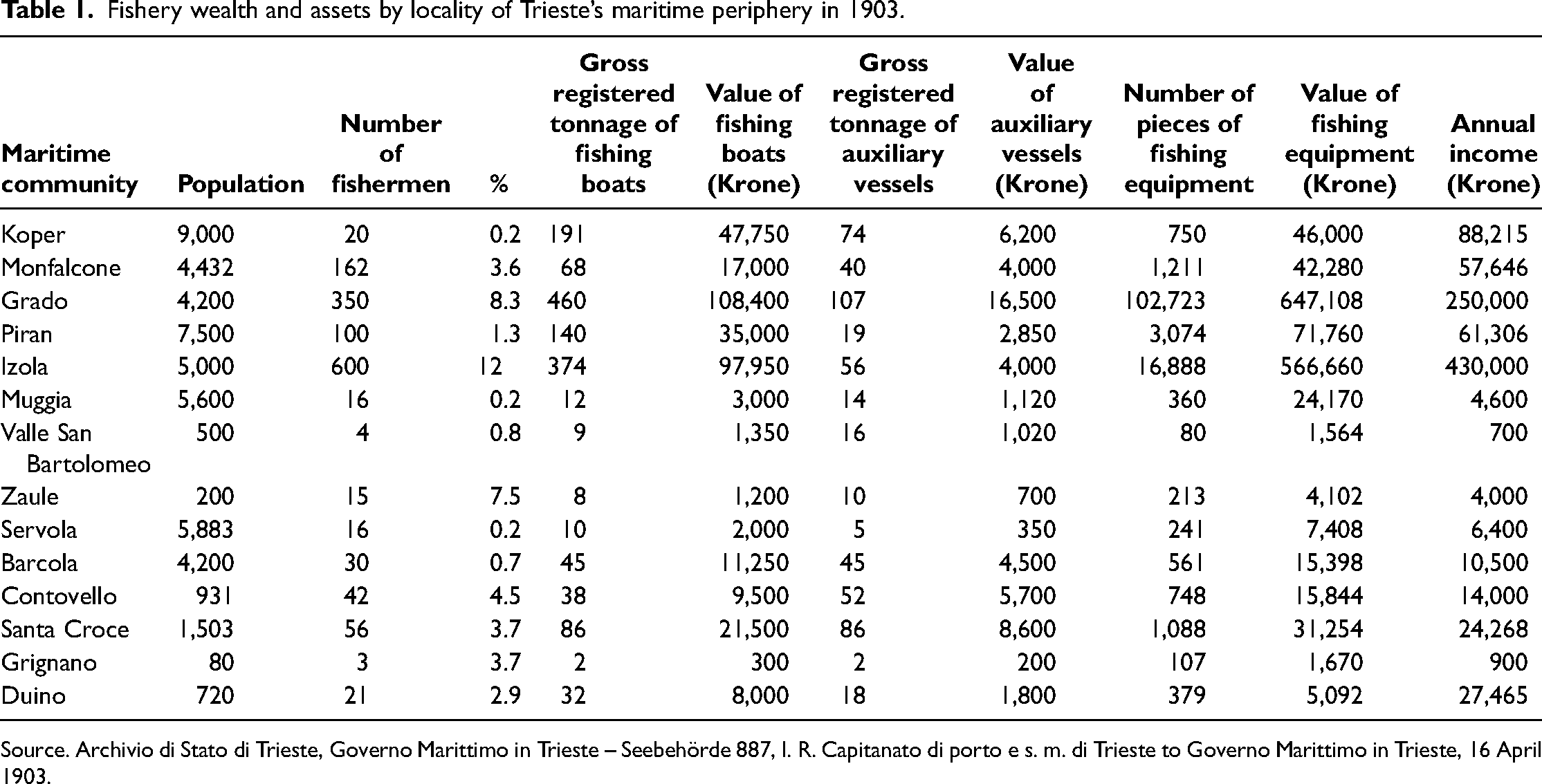
Source. Archivio di Stato di Trieste, Governo Marittimo in Trieste – Seebehörde 887, I. R. Capitanato di porto e s. m. di Trieste to Governo Marittimo in Trieste, 16 April 1903.
As is evident from the data, although fishing was practised throughout the territory of the Maritime District of Trieste, the returns of wealth and employment varied enormously between the various maritime communities.
Working as a fisherman: at a glance
Fishermen and crew members were typically recruited by fishing boat owners or captains. The most common length of employment was an entire fishing season or a working week. Crew members were hired for the day only in sporadic cases. Regarding payment, workers were not rewarded with a fixed salary but with partitions of the catch. It seems that the practice was to deduct common expenses from the total value of the catch. From a ‘net’, the shares of the catch were as follows: a part for the nets, a part for the equipment, a part for the boat (therefore, three parts of the cath were for the fishing boat owner) and, finally, a part for each crew member. If the crew included juveniles, they would be paid half or a quarter of the partition of an adult worker. 26
Seasonality (and a cluster of related aspects) plays a pivotal role in fishery. The type of fishing determines the hiring, its duration and also the potential income of the fisherman. From April to October, sardine and anchovy fishing, which represented the most important and profitable type of fishing, involved more than 2,200 fishermen and 170 juveniles. In the summer months, blotched picarel and mackerel fishing was also practised by 150 to 180 fishermen. From mid October to the end of February, about 160 fishermen carried out the harvest of mussoli (Noah’s Ark shells). In the winter season, 650 to 680 fishermen were committed to brill, sole and flounder fishing. Finally, about 200 fishermen were also involved in the offshore trawl fishery.
Nevertheless, fishery and its related work activities are not limited to ‘hunting’ practices. Fish breeding was mainly undertaken in the 100 Grado lagoon ‘fishing farms’ (valli da pesca). In spring, about 2,000 juvenile mullet and orata were led into each water field. Large fishing farms had an annual income of about 20,000 Krone and smaller ones about 10,000 Krone. Regarding oyster farming, the two most profitable farms were in Zaule and Servola, where fishermen cultivated oysters using oak stakes. Here, the annual incomes ranged from 1,000 to 1,500 Krone. Finally, in Grado, two farms managed by the Società austriaca di pesca e piscicultura marina carried out oyster farming. Most of the annual crop was sent to the oyster-farming plants of Cres and Punat to continue the cultivation process. 27
Fishery was – and still is – one of the most dangerous professions. Moreover, it is a trade that is characterized by a considerable degree of precariousness, a circumstance that constantly exposes the fisherman and his family to the risk of poverty. Until 1913, there were no laws to protect Austrian fishermen in the event of illness or injury in the workplace. Thus, turning to a charitable foundation during one’s working life was expected, and it became necessary when one stopped working due to old age. As for seafarers’ and fishermen’s families, seeking help from this kind of institution was an almost unavoidable fact in the event of the death of the head of the household. 28
Fish-canning factories
In fishery, a sort of ‘dichotomy of sexual geography’ exists, where the ‘sea’ is an almost exclusively male domain and the ‘shore’ a female one. 29 The problematic aspect of this circumstance is that the pre- and post-catch phases, which take place on the shore and where women’s work is of primary importance, are not considered proper fishing. We know that women are mainly engaged in activities that precede and follow the actual fishing. So, basically, women deal mainly, although not exclusively, with all the activities that allow men to ‘put a fishing operation into practice’. 30 The work of fish-canning factories – mainly female labour – refers to the activities mentioned earlier. Moreover, in fishery, it seems that there is another gender dichotomy, which concerns the means of production (that is, what acts as an intermediary between labour and nature). In this context, the industrial, unfree wage labour seems to be predominantly a feminine attribute, while the free self-employment of ‘proper’ fishery seems to be a masculine prerogative. Also, in terms of the geography we are examining, it is essential to mention the social and economic role these production plants have in maritime communities during transitional phases. 31 In this regard, the cases of Banjole’s fabrika (factory) and of the plants in Lošinj and Cres in a twofold transition process – that is, from a socialist to a market system, and from industrialization to deindustrialization – and the case of Izola (Ampelea and Arrigoni) during the post-Second World War period are emblematic. 32
Before the outbreak of the First World War, there were at least 12 fish-processing plants in the Maritime District of Trieste: four in Grado, five in Izola, and the other three in Koper, Barcola and Duino.
In Grado, the four factories devoted their production almost exclusively to preparing anchovies in oil and only partially to preparing salted sardines. The total quantity of fish processed in the four factories in 10 years amounted to approximately 3,000 tons. Each factory employed about 30 men and 100 women. 33 At the turn of the twentieth century, Izola’s plants employed about 200 men and 600 (in winter) to 800 (during summer) women labourers, and their production was more diversified than in Grado. 34 In the Istrian town, the plants produced anchovies in oil and salted sardines, tuna and mackerel in oil, and marinated eels. 35 The products of the Grado factories and the Izola plants were mainly destined for export. Most of the cans went to the American and Russian markets, while the smaller production volume designated for the home market remained in the Austrian Littoral or was delivered to Upper and Lower Austria and Bohemia. 36 Also, the Giovanni Depangher factory in Koper offered consumers salted anchovies, or anchovies in oil and tomato sauce, and marinated sardines. In Duino, Carlo Warhanek produced anchovies in oil, salted sardines and marinated eels. The Semler & Gerhardt factory in Barcola produced only marinated eels caught in the Comacchio Lagoon. Factories were not the only places where fish were processed in Trieste’s Maritime District; fish-processing ‘workshops’ also existed in Izola and Piran. In the latter locality, there were no fish-canning plants, but there was local small-scale production of salted fish packed in barrels. 37
The First World War, the industrialization and enclosure of marine commons in the post-war period
At the outbreak of the First World War in 1914, the Austrian military authorities expressly prohibited fishing and the hiring of fishermen. The following year, the situation was drastic. By the end of March 1915, in Koper, 300 fishermen and their families were in severe economic difficulty; in late May, in Piran, 2,000 fishermen and their families had nothing to live on. 38
By mid July 1915, Trieste’s Maritime District had lost the communities of Grado and Monfalcone, which fell under Italian control, and because of the ban on fishing, about 1,500 fishermen and their families (a total of approximately 4,500 people considering an average of three people per household) were in a severe state of poverty. 39 All the fish-processing factories had closed at the beginning of the First World War and remained inactive immediately following the post-war transition as they had been severely damaged and there was no ‘surplus’ of fish to be stolen from the market destined for industrial processing. 40 When the war was over, the fishing industry of Venezia Giulia (Julian March) was on its knees. Fishermen, and the communities they lived in, needed subsidies, new boats and equipment, and the end of wartime fishing restrictions. 41
However, some went a step further and proposed an ambitious and sophisticated plan to thoroughly reorganize the fishing sector and industrialize the valuable and plentiful marine commons of the Upper Adriatic. At the core of the proposal was the creation of a ‘Fisherman’s House’ (Casa del Pescatore), where the main goal was ‘to economically link to Italy those who deal with fisheries in Istria and Dalmatia’.
42
The ‘Fisherman’s House’ was to have its headquarters in Trieste, with branches in Pula, Rijeka and Zadar, and was to serve as a multipurpose hub for the Upper Adriatic fisheries. Established as a foundation, it would have functioned as an intermediary body between fishermen, wholesalers and fishmongers, industrialists, and, finally, local political and maritime authorities to optimize the production, commercial and logistical processes of the Julian March fishing sector. Of course, the issue relating to efficiency for a ‘better’ and more rational exploitation of marine resources did not emerge only in the aftermath of the First World War. As early as 1906, the aulic Councillor Krish stressed the need for a profound sector reform in the interests of fishermen and the Austrian national economy.
43
However, in the post-war period, a mix of drives to maximize the productive capacity of the marine commons, Italian nationalistic demands and a civilizing mission occurred: It is from the Royal Government and the capitalists that the first step is expected. In the economic and political interest of Italy, this is the most suitable time to economically conquer the Adriatic, demonstrating to the world that no one better than Italy can protect and guarantee the interests of those peoples who, from Rome and Venice – and no one else – have inherited the beautiful and good things that Istria and Dalmatia have. So, Trieste’s ‘Fisherman’s House’ – for the increase of fishing, trade and the fish industry in the Adriatic – would be a harbinger of civilization and rebirth [risorgimento] in the redeemed territories [paesi redenti], if we really want them to be called that [that is, ‘redeemed’], both politically and economically.
44
Fringers, ‘like fish in water’
Maddalena, our fisherwoman and fishmonger, was a ‘fish out of water’ in many respects. However, there were other misfits like her – more or less informally, other women practised fishery in Trieste’s Maritime District during the period in question. For example, in Grado, fishery involved all members of the household. At the beginning of the twentieth century, the professional lagoon (male) fishermen numbered approximately 400; nonetheless, fishing operations involved at least 1,200 people since each fisherman householder was helped in the profession by his wife and children, the latter often underage. In Piran and Monfalcone, women were involved in the trade less informally and with more specific tasks. In these localities, about 30 women – 20 in Piran and 10 in Monfalcone – were employed in mullet fishing in the brackish waters of the Piran and Panzano bays. 47 However, it was in other roles that women were more involved in fishery.
Women owners of fishing boats
The fishing communities of what I have defined as the maritime periphery of Trieste share many traits with other maritime communities – for example, the Newfoundland and Labrador rural outports. In both cases, we are dealing with riparian communities that made their livelihoods through traditional inshore fishery, practised with small fishing boats by men brought together by patrilineal ties. In this type of social environment, the economic unit is the household; the head of the unit is the man (that is, the fisherman); and a rather strict sexual division of labour can be observed. 48 Regarding the latter, Porter notes that ‘studying gender relations and the sexual division of labour in Newfoundland’s rural communities raises certain problems’. 49 The same can be said for the fishing communities in the Maritime District of Trieste, especially if we analyse the distribution by gender and locality of fishing-vessel ownership. In the official logs of the fishing boats of Trieste’s Maritime District for the period 1885–1923, the names and owners of about 2,610 vessels are recorded. 50 Among them, only 111 boats (approximately four per cent) had a woman as the sole owner or one of the owners. Considering all the cases of co-ownership and all the changes in ownership, for those 111 boats, we have the names of 114 women and 149 men as owners or co-owners. Thus, there is no doubt that female ownership of fishing boats represents a marginal occurrence within the overall picture. However, the details, nuances and peculiarities of this marginal affair tell an interesting story.
The first element of interest in this minor story concerns the distribution of female ownership according to home ports. In this regard, the first point to note is that Trieste, the large port city that had always had a marked fishing vocation, was not affected by the female ownership of fishing boats. Including the suburbs of Barcola and Servola, only 10 per cent of boats with female ownership pertained to Trieste. Conversely, almost 74 per cent of those fishing boats were registered at the port office of only three maritime communities: Grado (25 per cent), Izola (31 per cent) and Piran (18 per cent). 51 Those were also the places of residence, and often of origin, of the female owners. It is possible that the concentration of female-owned fishing vessels in Grado and Izola was somehow connected to the fish-processing factories in those localities, which mainly employed women. However, this circumstance does not explain the percentage of occurrence in Piran, where there were no fish-canning plants.
The second aspect of interest I will highlight here concerns the ownership shares. In the vast majority of cases, female boat owners were the sole owners of the vessels or equal partners with another person, who was usually male – most likely a husband, brother or son. Otherwise, no cases of female administrators of vessels can be found. This indicates that women were ‘allowed’ to own the means of production but did not have the capacity to dispose of them. This circumstance fits perfectly into the more general picture of the female patrimonial and legal situation in the Austrian Empire. According to Austrian law, a man did not have any ‘marital power’ (potestas maritalis) over his wife. The Austrian General Civil Code of 1811 guaranteed women, and wives in particular, the separation of property (Paragraph 1233), the partition of assets (Paragraph 1237) and full rights to dispose freely of their properties (Paragraph 1238). Nevertheless, the husband was still entrusted with leading the household and striving for the family’s well-being. Therefore, as noted by Ute Gerhard, a married woman could find herself in competition with her husband in managing her businesses or disposing of her properties. It is from this circumstance that the assumption of the tacit transfer from wives to husbands of the administration of women’s properties arose. 52
A peripheral (genderless) proletarization process? The case of Izola in 1903
In the Austrian monarchy, the economic value of fisheries, and of the related processing activities, was understood before anywhere else in Europe. The pioneer was Empress Maria Theresa, who, as early as 1761, took an interest in the characteristics of the fisherman profession and mackerel fishing in the riparian areas of her empire. 53 Before many others, she understood the economic potential of fish-processing activities. However, Maria Theresa lived at a time when capitalism as we know it was still in its infancy, and the proletariat and related proletarianization processes were still an unknown matter.
As in other contexts and despite the presence of processing plants, in Trieste’s maritime periphery, small-scale inshore fishery was mainly a family-based trade finalized to petty primary production. However, it seems that the scenario was changing at the turn of the twentieth century. As for the 111 fishing boats mentioned in the previous section, 28 of them took out a lien with a canning company between 1898 and 1920. Among them, 20 vessels gravitated towards the production area of Izola. By looking at this occurrence more closely, and regardless of the gender of the fishing boat owners, one can observe that, in certain maritime communities, modes and relations of production were turning towards a proletarization of the rural domestic mode of production. In this scenario, the year 1903 seems crucial as this is when approximately 52 Izola and 22 Piran fishermen and fishing vessel owners stipulated a five-year lien for the supply of oily fish with four Izola canning factories. 54 The contracts do not specify the quantity of fish to be supplied or the benefits the fishermen would have enjoyed. Nonetheless, it is reasonable to assume that the supply would have been paid for in cash, and maybe in the form of a salary. On the other hand, the agreement clearly provided the factories with the right of withdrawal before the five-year deadline, and it made explicit the properties that constituted the lien: the fishing boats, the nets, all the equipment and also the certificates of registration (certificati di registro). 55 Although the numbers in this story may seem trivial, it is important to highlight that 74 fishing boats corresponded to approximately 42 per cent of the Izola fishery’s means of production and 32 per cent of that of Piran. Moreover, considering an average of four workers per fishing vessel, 29 per cent of Izola’s and 48 per cent of Piran’s fishery workforce aboard were in the service of Izola’s canning factories. 56
In addition, the four canning factories in question employed local labourers – especially women – for the fish-processing phases. The data in Table 2 shows that more than two-thirds of the workforce were women. Therefore, similarly to Grado, women accounted for more than 70 per cent of Izola’s industrial working class (which represented a remarkable 8.5% of the total population) 57 and earned half as much as their male colleagues.
Workforce and wages of four of the canning factories in Izola, 1902–1903.

Source. Archivio di Stato di Trieste, Governo Marittimo in Trieste – Seebehörde 891, I. R. Agenzia di porto e s. m. di Isola to Governo Marittimo in Trieste, 10 February 1904.
Overall, it is possible to state that between industrial (wo)manpower and the (male) fishery workforce aboard, in 1903, nearly 13 per cent of Izola’s population depended directly on four fish-canning factories to make a living. So, in this context, the ‘typical’ maritime community household labour pattern in modern times, where wives earn wages while their husbands are able to maintain their freedom from the constraints of capitalism, seems to fail. Conversely, in the case of Izola, it appears that the whole (re)productive family unit depended on a handful of employers and the dynamics of the same market. 58
On/out of the market
Trieste was the most important emporium for fish products in the Austrian territories (Cisleithania) of the Hapsburg Empire. Fresh fish arrived in the Austrian port city thanks to approximately 355 fishermen and traders – among the latter, only 15 were women – and from more than 40 Mediterranean localities. In 1908, about 2,800 tons of fish products were placed on the Trieste market at a value of almost 3,500,000 Krone. 59 In this context, fish as a foodstuff also played an important social role. As a ‘working-class city’, 60 Trieste was undoubtedly a city with a great appetite and, as far as the lower classes were concerned, with little economic means. So, fresh fish and other seafood represented a high-quality, cheap and accessible source of protein for everyone. Given the situation in Trieste, this was a big deal. The business was governed by both the official rules of the authorities and the mechanisms of more or less fair competition among market operators. Therefore, the City Council often received motions from the local fishmongers, ‘all family men’, who complained of the presence and unfair competition of Istrian and Chioggia hoarders, fishermen and fishmongers ‘in Trieste, where everyone runs to as a great mother’. 61
In Trieste, there were two modes of foodstuff retailing. The first concerned mainly the sale of vegetables, fruit and flowers, but also cheese, butter, meat, drinks and sweets, which was managed through a robust network of neighbourhood street markets, where female peddlers (venderigole) took the lion’s share. The second regarded the sale of fresh fish, which was centralized in the city’s fish market building. In 1913, the architect Giorgio Polli completed the construction of the so-called ‘basilica’ ‘Saint Mary of the Gobies’ (Santa Maria del Guato), Trieste’s fish market, which would represent the core of retail, wholesale and fish auctions in the north-eastern Adriatic region until the early twenty-first century.
The city’s fish market was an actual temple and, like all temples, an eminently masculine space. In addition to representing the majority of the sellers, men were entrusted with selling the ‘proper’ and ‘major’ seafood: fresh fish – in other words, fish with scales and fins that had been caught by a ‘real’ fisherman. The few female fishmongers had to settle for selling ‘improper’ and ‘minor’ seafood, such as crustaceans and shellfish (which they were able to fish by themselves from the shore), dried and salted cod (which they had bought from wholesalers) and salted oily fish (which they processed with their own hands). 62 As the Figure 2 shows, this picture did not change even during the First World War: the space left by the men at the front was not occupied by women, who, probably also due to the wartime ban on fisheries, continued to sell their ‘minor’ fish products.
So, in summary, it is possible to say that, in Trieste, the fish trade on the official market was the domain of fish-husbands.
The male fishmongers of the ‘proper’ fish market were not the only fresh-fish sellers in Trieste’s Maritime District. Between the nineteenth and twentieth centuries – but certainly even earlier – in some maritime communities such as Santa Croce, Contovello, Duino and Barcola, that task was entrusted to certain women who, in the local Slovenian dialect, were called peškadorke. They were fishermen’s wives, widows, daughters or sisters, and they peddled fish. As soon as the sun rose, these women came down from their villages on the Karst Plateau, down the cliffs to the seashore to collect fish from the fishermen. They arranged the fish in baskets, placed the 10–20 kilogramme load on their head and began their daily itinerary. In Trieste, they went door to door, selling the fish to families and taverns. Inland, they offered their goods to the villagers of the Slovenian hinterland. There, the fish were often not sold but traded for eggs, chickens and other farm products. In the interwar period, in Santa Croce, there were about 70 women who dedicated themselves to this activity. Peddling fish by peškadorke was widespread until the last years of the post-war Anglo-American military administration in the 1950s. From the second half of the twentieth century, the practice began to die out, before disappearing completely. 63 The last two peškadorke, Johanca Švab (or Ivanka Semec) and Marija ‘Miljana’ Bogatec, from Santa Croce, continued their ‘nomadic’ fish trade until the 1970s–1980s.
The very last peškadorka, Marija ‘Miljana’ Bogatec, who passed away at the age of 94 in 2020, explained her work in the following words: Every fisherman had to have someone to sell fish for him. … If he had no wife to take his catch, he had to give it to someone else. It was always a woman. My brother Stanko owned a six-metre fishing boat [ščifa], named Vida; he wasn’t married and I was selling the fish he caught. The men went to sea in the evening, they spent the whole night in the boat, they fished with a lamp. We already knew if there were any fish, and we went down [to the seashore] before dawn, since we had to be in town by eight.
64
I had to have documents of all kinds. I still keep them. Every year they renewed my sales licence. We used to go to Trieste and offer fish at the buildings’ entrances, where the caretakers were. The caretaker called the women to come. ‘The girls have this and that. Which one will you take?’ The women came down and that’s how we sold. The most [of us sold the fish] around the church of St. Antony; my marketplace was St. Catherine and St. Lazarus streets. Each one took her own quarter, her own space. … The fish was so good! The sea was still in good health.
65
Conclusion, or beyond the (Marxist) gender binarism in fisheries
The death of the peškadorka Marija ‘Miljana’ Bogatec marked the definitive end of an era and, perhaps, of a certain female anthropology and a peculiar type of gendered power/hierarchical relations too. At this point, however, one could ask: What anthropology? What femininity? What is, or maybe was, the nature – Thompson has used the term ‘roots’ 67 – of those specific power/hierarchy patterns? 68
Faced with these questions, whoever belongs to my scholarly tradition would first turn to Karl Marx’s work. In The German Ideology, one can read: Men can be distinguished from animals by consciousness, by religion or anything else you like. They themselves begin to distinguish themselves from animals as soon as they begin to produce their means of subsistence … . By producing their means of subsistence men are indirectly producing their material life.
69
As already mentioned, fishing is an environment where very strict gender segregation occurs in social and working practices. This was also the ‘norm’ in the maritime periphery of Trieste. The first dichotomy relates to geography. As in other contexts, in the Upper Adriatic maritime communities, ‘sea’ and ‘shore’ were not genderless social and labour environments. The second concerns the capacity to dispose of the means of production and relations with the capitalist economy, where the ‘free’ (that is, autonomous) and archaic labour seems to have a masculine character. At the same time, the ‘unfree’ (that is, waged) and industrial – thus, the modern par excellence – labour is female. The third and final binarism concerns the very nature of labour. As we have seen, in Trieste’s fish market, the few working women represented, in a sense, the ‘improper’ and ‘minor’ version of the dominant and ‘legitimate’ male working component.
All of the aforementioned polarities are true, valid and convincing. Still, they do not seem to be enough, or maybe they are ‘too much’ (that is, too performative), for the case of these ‘fringers’. I wish to clarify that I share Gayle Rubin’s concern with respect to disregarding the Marxist approach and that ‘the failure to engage important ad vital issues of Marxist thought has weakened social and political analysis’ today. 71 However, I am also aware that there are ‘closets’ everywhere, 72 especially in (male) normative power relations and gender-performative environments such as fisheries.
There is no doubt that the women owners of fishing boats, factory labourers and fishmongers who we have encountered in Trieste’s maritime periphery comply in all senses with the Marxist portrait of ‘peripheral women’, as elaborated by Porter for the case of Atlantic Canada. 73 Nevertheless, to be content with the simple recognition of their marginality and liminality could be reductive, since they were not ‘simply’ symmetrically opposed to their male counterparts or urban working-class women. What if, instead, we put the question on an alio plane?
Notwithstanding all possible considerations, our ‘fringers’ appear to be a paradox – relevant enough to represent the subject of a study but not significant enough to constitute an exception to the ‘norm’. They do not provide a standard or a ‘positivity’ in any respect. It is not even the case to say that they do not have any hegemonic ambition. Nevertheless, they were not a strange occurrence in the historical records, nor were they just ‘bare life’. Before them, Hamlet would have observed: ‘There are more things in heaven and earth, Horatio, / Than are dreamt of in your philosophy’. 74 One wonders how many other similar cases existed – or exist right now – in other contexts. Showing us that our knowledge of the maritime past and activities is limited and conformist, they represent evidence that the maritime is not as ‘normal’ – and masculine – as one might imagine. In short, Maddalena and Miljana could face the authoritative standard, hold their own, and do not represent any alternative to any master narrative.
Footnotes
Declaration of conflicting interests
The author declared no potential conflicts of interest with respect to the research, authorship and/or publication of this article.
Funding
This article was written within the European Union’s Horizon 2020 research and innovation programme as part of the Marie Skłodowska-Curie Project ‘We Can Do It! Women’s Labour Market Participation in the Maritime Sector in the Upper Adriatic after the World Wars in an Intersectional Perspective’ (WeCanIt), hosted by the University of Ljubljana (grant no. 894257), and within the NextGenerationEU Project ‘Ondine: Women’s Labour and Everyday Life on the Upper and Eastern Adriatic Waterfronts, Mid-19th Century–Mid-20th Century’, hosted by the Department of History, Humanities and Society at the University of Rome Tor Vergata (CUP E53C22002420001).

Notes
Author biography
Erica Mezzoli holds a PhD in Eastern European History from the Università degli Studi di Trieste (2011). Her research interests include gender, economic, social and labour history from Early Modern to Modern times.