




Abstract
Encounters with whales in early modern (seventeenth- to nineteenth-century) Japan were often memorialized through artwork such as scrolls or woodblock prints, permanent monuments such as steles or grave sites, and even in ritual practices such as annual Buddhist memorial ceremonies. Whaling groups used the commemorations of their interactions with whales to teach hunting techniques, display their prowess to outsiders, and atone for the Buddhist sin of killing another living creature. Non-whaling communities, which usually encountered whales through limited beachings or strandings, also found those situations worthy of commemoration. Their memorials celebrated the spectacle of the whale from the observer's viewpoint, or expressed gratitude for the financial windfall the dead whale brought to the community. This article examines how a community's relationship to whaling determined how it memorialized the encounter. These early modern memorial practices inform commemorations of whales even to the present day.
Introduction: Memory and whaling
On 26 November 1813, an unnamed Japanese sailor set off from Nagasaki to hunt whales. 1 He kept a diary of his two-month voyage west of Kyushu, in which he marvelled at the fact that, in the past, English and Dutch sailors lived on the same island of Hirado that he overnighted on and recorded his frustration at initially finding only tuna, not whales, off the coast of Ikitsuki Island. Finally, he and his shipmates, while waiting near the shore, spied what whalers most desired – a plume of smoke from a mountain lookout signalling that a whale was close by. They rowed towards the whale, soon surrounding and trapping it with nets ‘dropped like a curtain’ in the ocean. 2 The harpooners swung into action. The anonymous diarist could not suppress his excitement even in his journal, recording that moment with an exclamation: ‘The boat gets close. Ah, the harpooner [leaps on] the whale's back!’ 3 Having stabbed the beast near the blowhole, the sailors ultimately succeeded in their whale hunt and towed the carcass back to shore for processing. While our diarist does not explicitly say that it was a lucky expedition, he ends his account with a discussion of the New Year's Day decorations and meal he enjoyed on Ikitsuki Island, likely implying the good fortune accrued by the hunt and an auspicious start to the coming year. 4 His notes include sketches of his observations throughout his journey, ranging from a temple bell said to have come from China, which he noticed in his travels, to the tense moment when the harpooner leapt upon the whale's head, to people onshore carrying the dead whale's vertebra away from the processing station. Whaling diaries such as this are relatively rare, but our diarist must have recognized the significance of the whale hunt and worked to memorialize it in his own writing. He was not alone in this, as others throughout the Japanese archipelago memorialized whales and whaling, but for different reasons.
Nearly a century later and a thousand miles away, orcas chased a whale into the harbour in Rikuzentakata, in the modern Iwate prefecture in northern Japan. People from two adjacent villages to the harbour recognized what a financial windfall this was, and competed for the rights to raise the beached whale. The winning village claimed two-thirds of the profit, giving the remaining third to the losing side. Later, the winning village commemorated this event by erecting a stele in memory of the whale, placing one of the vertebrae next to it, and also putting additional vertebrae at the entryway to a local Shinto shrine. 5 They, too, recognized this momentous encounter as one worthy of remembering far into the future.
These two stories are typical of whale encounters in early modern (seventeenth- to nineteenth-century) Japan. They generally fell into one of two categories: deliberate, repeated and sought out, usually by hunting groups such as the one our diarist accompanied, or unexpected and unique, as in the case of beached or ‘drifting’ whales, such as the one the villages competed for. While both types of interaction were often memorialized or commemorated, the two types correlate roughly with what historians of memory term ‘collective memory’ and ‘individual memory’. Individual memory comes from personal experiences but is shaped by its social uses, and makes a contribution to social knowledge and understanding. 6 Collective memories establish a ‘mutuality of understanding’ within a particular group, often influenced by a variety of social practices. 7 These are, of course, not mutually exclusive – individual memories come together to form a collective memory, and collective memories are created by the individuals within a group. The question of identity comes into play here as well. I argue that, in the cases discussed below, an individual memory could also represent a singular standout experience that was perhaps shared by multiple people but did not always define their identity as a group. In contrast, those whose identities were shaped by how they defined themselves as a community – for example, those who were members of an organized whaling group – were more likely to be shaped by collective memory in their memorializations of whales. This study makes use of both types of memorialization to consider the different portrayals of whaling in early modern Japan and how those commemorations shaped the general perception of whales. Collective memory, representing both a larger number of people involved and the repeated nature of frequent whaling interactions, largely drove the memorializations created by whaling groups. On the other hand, commemorations created by people not affiliated with whaling groups were more likely to represent individual memory, showcasing a particular whale interaction or a personal perspective.
The Japanese methods of memorializing whaling varied, encompassing printed materials, physical memorials (mnemonic sites) and ritual practices. All of these largely fall into ‘communicative memory’, practised in the vernacular and impacting a finite number of generations as traditions and histories are disseminated in various informal manners. 8 Print was one medium that helped shape the popular conception of whales, and, especially in Japan's early modern period, woodblock printing was booming, and information on and depictions of whales were circulating widely. 9 Artwork can pack a particularly visceral punch by presenting a visual argument as well as a written one. 10 Artistic prints showing whales were one subgenre of the woodblock print medium. Print-based memorializations helped preserve the memories of whaling and whale encounters for future use. This was evident in the range of artwork produced, from scrolls commissioned by whaling groups to teach about and commemorate their feats, to popular prints celebrating the whale as an unusual spectacle. 11
Objects such as whale gravestones, shrines or temples are particularly long-lived memorials that are publicly visible and last for generations, forming a mnemonic site. 12 They serve as a repository of memory of an individual (human or whale) and their significance, ensuring the longevity of the memory itself. Intangible memorials, which often take the form of religious rites or secular performances, can potentially ensure just as long-lasting a memory of an individual or event if they are practised regularly. In the case of whaling, these ritual practices often took the form of kuyō (memorial rites at a Buddhist temple). Performing these rites ensured periodic revisiting of the whale encounter and reiterated the hope for the whale's rebirth in a Buddhist paradise. All of these types of commemoration helped shape the collective memory of whales in early modern Japan and, in some cases, those memories impact commemorations of whale encounters even today.
This range of memorial practices was unusual when compared to other interactions with animals and the natural world in early modern Japan. Fewer memorializations exist, for example, of boar hunting or bonito fishing – other common practices of the time. Some of the earliest identified whaling memorials date to the early seventeenth century. 13 The next comparable types of animal memorials appear nearly a century later, with some memorial mounds for hunted bears dating to the 1730s and some for livestock (most notably horses) from around the 1750s. 14 One of the earliest stone markers for a cat is dated 1766. 15 The sheer size of whales was, of course, on a different scale from most other living beings, but there was also an implicit recognition that these animals were somehow different. They were not fish, with their lungs and live births, but they were unlike any mammal on land. 16 As such, there seems to have been a relatively widespread desire to take note of human–whale interactions and actively work to commemorate those encounters.
This article argues that the types of memorialization of human–whale interactions depended on the affiliations of the people encountering the whales. Members of whaling groups and fishing communities tended to create memorials of whales and whaling that highlighted the commercial benefits, but also acknowledged the deaths of hundreds, if not thousands, of whales over an individual's lifetime. Those memorials were more likely intended to be a long-lasting commemoration, often taking the form of a mnemonic site or ritual practice. They are largely concentrated geographically in western Japan, as that is where organized whaling groups mostly operated in the early modern period. 17 People who had more limited experience with the leviathans – particularly with deceased whales – focused more on the spectacle of the whale interaction and its impact on the community. They relied nearly equally on rapidly produced memorials such as woodblock prints to suggest a quick commemoration of a one-off encounter and on mnemonic sites to indicate the significance of that encounter to the local community. These might include coastal communities that did not rely on whales as a regular source of direct income, unlike the organized whaling groups, but acknowledged the deaths of stranded whales out of sorrow or gratitude for the financial windfall that sometimes accompanied a stranding event. These memorials were more likely to be found in north-eastern Japan. 18 The format of commemorations shaped the memories of whales and whaling, and demonstrates how a collective memory of whales was created in early modern Japan.
Early modern Japanese whaling
Most artwork involving whales depicts some form of the hunting process. Unlike most American and European whaling, which was known more for harvesting multiple whales during months-long voyages, Japanese whaling was based off the local coastline. As our anonymous diarist recounted, when a whale was spotted, multiple small boats would launch from the shore and surround the whale. Whalers used harpoons and spears, thrown by hand from the chase boats, to wound the animal. Once the whale tired, the killing blow was delivered by a handheld spear, wielded by a harpooner who would have leapt onto the whale itself to dispatch it. 19 In the early seventeenth century, whaling groups began using massive nets in their endeavours. Sailors rowed net boats out in a manner similar in some ways to dragnet fishing, and caught the whale in the net to slow it down and tire it out while the whalers in the chase boats worked to kill the whale. The nets also helped in recovering the whale carcasses, especially as grey whales and humpback whales tended to sink after death, so this allowed the whalers to target those species more effectively. 20
After a successful kill, the carcass was towed back to shore. Flensing – the removal of the skin and blubber – was conducted either in the shallows or after the whale had been fully pulled onto the shore. Special winches placed on the shoreline were used both to pull the whale onto shore and to pull layers of blubber off the carcass itself. As Jakobina Arch eloquently details in her book Bringing Whales Ashore, villages used every part of the whale for food, oil, fertilizer, gut strings, and even sword-hilt wraps or construction materials. 21 A successful whale hunt was a major endeavour for a whaling village, and celebrations ensued after the work was done. It is small wonder that these scenes would be recorded in scrolls, woodblock prints and other kinds of artwork, preserving memories of whale hunting and its environment.
The ‘in-group’: How whalers memorialized whales and whaling
Whaling communities in early modern Japan were groups directly or indirectly involved with whale-related activities (hunting, flensing, and so on), and those activities helped define their self-identity. 22 Memory in a society such as a whaling community relies on the ability to exchange and remember communicated information, and helps both represent and strengthen the networks of those social relationships. 23 It is unsurprising, then, that in the five geographic regions where organized whaling groups endured over generations, efforts were made to commemorate both the whalers and their prey. As Arch points out, fishing and whaling were not seen as unclean operations, like butchering land animals was in early modern Japan. This was likely due to Buddhist prohibitions, which allowed the killing of fish but not terrestrial creatures. Whalers thus had a different social standing than their hunter counterparts on land. 24 This may have been one of the many factors that led to the commemoration of whaling, unlike other game animals. Those commemorations manifested in quite specific ways, including artistic representations and religious or ritual practices memorializing both the whalers and the whales themselves.
Scrolls detailing the whaling process were probably the most common way for whaling groups to highlight their activities. Commissioning such works allowed these whaling groups to display the economic benefits of their craft, and showed the usefulness of whales as an economic resource. Arch notes that one of the most complete scrolls, Isanatori ekotoba (1829), was commissioned by the head of the wealthiest whaling group in early modern Japan with the cooperation of the local daimyō, a provincial lord. 25 One of the earliest of these, titled in the New Bedford Whaling Museum's collection as Shōni no moteasobi kujira ikken no maki, was finished in 1783 as one volume in Pictorial Explanations of the Products from Hizen, Kyushu. 26 Although this was written against the wishes of the whalers, who wanted to keep their practices secret, it set the tone for a typical recounting of the whaling process. 27 Later whaling scrolls patterned themselves on this one with varying degrees of detail. 28 Deliberate creation of these kinds of memories could also serve as a means of advancing the social status of one's own group, and thus the creation of these sometimes very elaborate scrolls was a way of establishing the whalers’ status in wider society. 29 Artists chose scenes that represented some of the critical information and features prized by the whaling community. Through this, not only did they commemorate the whalers’ experiences, but they also helped to create the communal memory of the whaling process. In doing so, they taught proper techniques and solidified their own identity as a whaling community by highlighting a process only they could do. 30
Scrolls could be as long as approximately 10 metres, though many were shorter. In the 17 scrolls viewed for this study, many begin with a brief textual introduction followed by the first scene, consisting of a whaleboat, a harpoon and a spear – effectively introducing the tools of the trade. This is often followed by drawings of several types of whale – likely the ones most easily or commonly hunted in that region. Some scrolls include more detailed depictions of whale anatomy, providing diagrams of how to butcher a whale. Still others include scenes of the whale hunt itself, from the chase to the kill, then towing it back to shore for flensing, and in rare cases even showing the celebrations after a successful hunt. Our anonymous whaler followed roughly this same narrative pattern in his diary, suggesting that perhaps he had been aware of the usual practices recorded in the scrolls. 31
Depictions of whales themselves are a key component of most of these scrolls. The images are often accompanied by brief comments, ranging from simply naming the species with short notes – the Kumano kozaura kujirakata onyakusho zaikinchu (1856), for example, annotates its image of a North Atlantic right whale with ‘the white dots here [on its tail and fins] are oysters’ 32 – to the detailed descriptions in the Isanatori ekotoba of the size, colour and use of the whale as a product. Occasionally, these scrolls also include information about other unusual marine life that might be found in the vicinity, including hammerhead sharks, sunfish (mola mola) or manta rays. Nine scrolls take these descriptions one step further and include information on whale anatomy and butchering, reinforcing the idea that these scrolls were meant as a teaching tool and also to show off the benefits of catching whales. 33
The scrolls’ focus on infrastructure – boats, harpoons and spears, nets, lookouts and signalling, and other tools – may be of even greater value in understanding the mindset and values of whaling communities. It suggests that the whalers recognized whaling as a complete system, involving the terrestrial community for things like net weaving and flensing, as well as the technology needed specifically for whaling at sea. Fifteen scrolls depict stand-alone boats – that is, not being used ‘in action’ for whaling activities but simply presented as a representative boat out of context (Figure 1). The most commonly depicted vessel is the ‘chase boat’ (seko-bune), and some scrolls also include ‘net boats’ (ami-bune or sōkaibune). Many images include a hashtag (#) on the stempost, indicating that they were affiliated with the Taiji whaling fleets. 34 The importance of the vessels themselves is highlighted in one undated scroll, Illustrations of Whale Boats in Taiji, which is nothing but boats. Thirty-nine boats are depicted, including chase boats, net boats, and others likely used for towing and float retrieval. The scroll includes notes indicating how many people should be in the boats or what signalling flags should be used. 35 Each boat is colourfully decorated, some with flowers, shrimp or trees. These may have been patterned after auspicious designs in Chinese legends in order to bring luck to the whale hunt, or possibly to evoke Buddhist imagery in the hopes of atoning for the sin of killing a whale. 36 The net boats are labelled with numbers on the side, presumably to indicate their position when spreading the net. Taking the time to create a scroll solely for boats, in addition to the usual practice of beginning a scroll with the boat itself, suggests the high regard in which the boats were held.
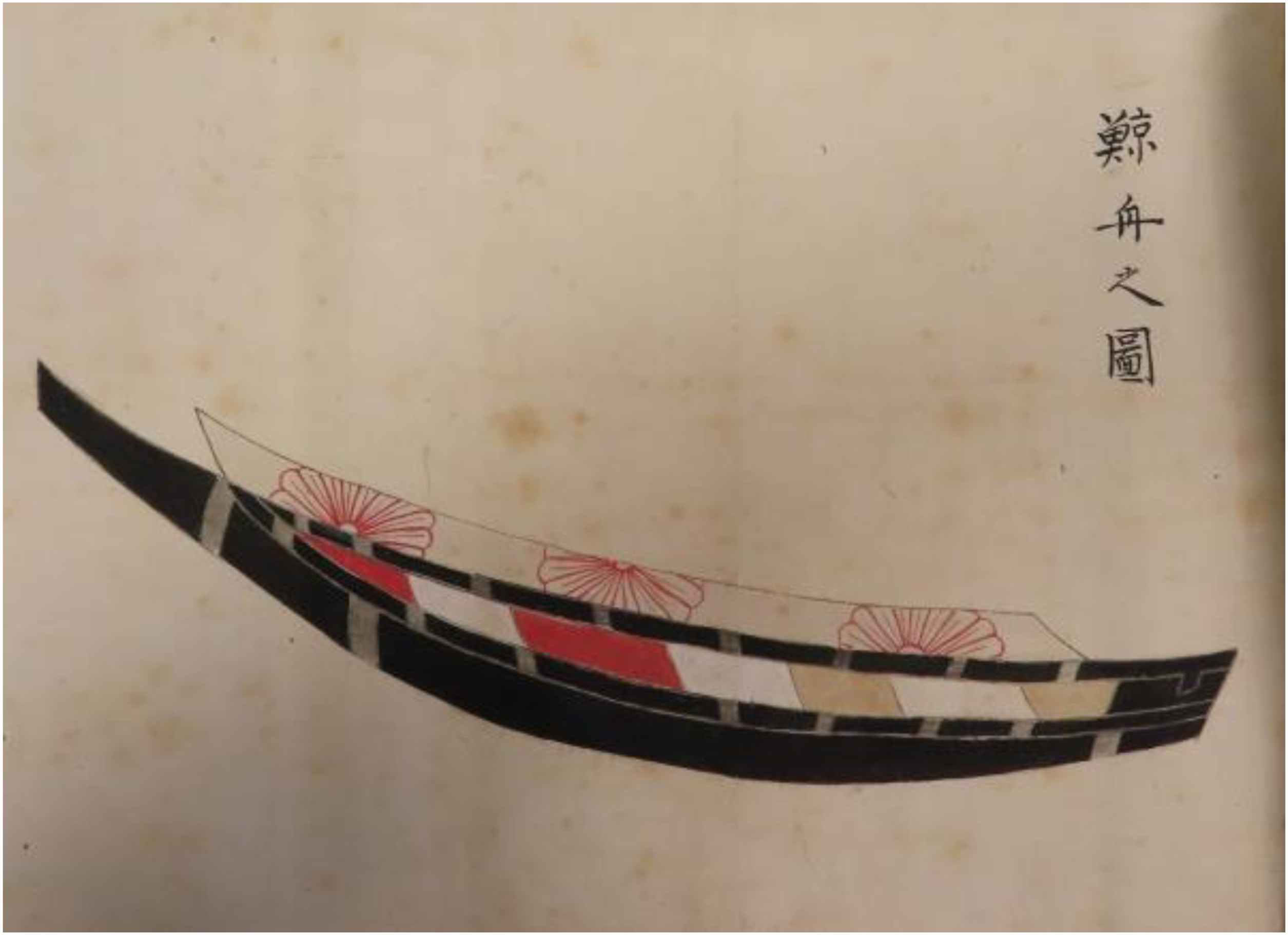
A typical representation of a chase boat. ‘Maker once known’ (Japanese). Geigyo Hinshu Zukan, [Fourteen Varieties of Whales], 1760. Watercolour on paper, 20.25 feet x 10.5 inches (26.7 × 6.2 metres). New Bedford Whaling Museum, Gift of the Kendall Whaling Museum, Accession No. 2001.100.4426.
Harpoons and spears held a similar place of pride in the written records. As noted above, most scrolls at minimum included the whales as well as the boat and harpoons. Even our anonymous diarist, who only drew stylized examples of boats, included detailed depictions of the harpoons and spears. 37 In many cases, only the blade is shown, omitting the wooden handle to which it would have been attached, likely because the blades were the more specialized part of the weapon and required more specific instruction. One such example appears in a scroll from 1798 called Whales Caught at Kumano-ura (Ki Peninsula), which has labels indicating the holes in the tang and saying ‘the handle should be attached through this hole’. The scroll Shōni no moteasobi kujira ikken no maki notes the hole in the base as the point to thread the rope through. 38 These are the exceptions rather than the rule, however, as most scrolls have minimal text associated with the tools beyond a brief description of the ideal length. The Isanatori ekotoba also displays a remarkably detailed range of rope knots used to secure the harpoon and allow for its recovery. Both Isanatori ekotoba and Illustrations of Taiji Whaling and Whales (1861) 39 even have scenes showing the boats being constructed, as well as the harpoons and other weapons being forged. The prioritization of these tools in the scrolls may be related to the role of the harpooner in the whale hunt itself. As we have seen, after the whale was tired out in the net, the lead harpooner leapt onto the beast and stabbed it to ensure the kill. This was a role of honour and responsibility, and perhaps that is reflected by highlighting these tools in the scrolls. 40 While these descriptions are, of course, integral to the scrolls’ function as a teaching tool, it also speaks to the ways in which whalers formalized the creation of memories of the whaling process, prioritizing boats and edged tools along with the whales themselves.
Juxtaposed with the near constant presence of boats and harpoons, the relative absence in the artistic record of another critical tool for early modern whaling – nets – is striking. As noted above, the introduction of nets revolutionized coastal whaling and allowed rarely caught whales to be targeted. Yet only five scrolls highlight the nets and weaving techniques, including how to attach the nets to their wooden floats. An additional three show the nets also being deployed to catch a whale. Most depict how to knot or fasten the ropes to weave the net, and two even provide dimensions for the floats as well. The Isanatori ekotoba (Figure 2) and Illustrations of Taiji Whaling and Whales both include a scene where villagers are weaving the net onshore. While the latter is less detailed, in the former, over 20 people are involved in uncoiling the individual ropes and spreading the net out as they weave it. Based on the spectators viewing the process – people are shown looking out of the windows of a nearby house, and two people seem to have taken a seat on a bench explicitly to watch the labourers – even weaving the nets appears to have been a major endeavour in the town. It is unclear why the nets are not more universally depicted as an integral tool for the whaling endeavours, since by the time most of the scrolls were produced, net whaling was the predominant practice. However, one possibility may be that they were simply less flashy than the harpoons, with their dramatic whale kills, or colourful boats. It also may be related to the idea that when creating a collective memory, it can be more important to develop a coherent account than to create a comprehensive and detailed picture. 41 While nets were critical to the success of a whale hunt, commemoration of the whaling process as seen in the scrolls often omitted a weaving scene in favour of focusing on the account of the hunt itself.

Net weaving. ‘Maker once known’ (Japanese). Scroll of Isanatori ekotoba, circa 1829 (reproduction). Watercolour on paper. New Bedford Whaling Museum, Accession No. 2001.100.4706.
If the active creation of a collective memory focused more on a cohesive storyline to make that memory more impactful, religious practices and rituals may have reinforced memories within a group in a more diffuse yet still inclusive manner. 42 Within fishing communities, one of the most prominent ritual practices was devotion to Ebisu. Ebisu's origins and connections to whaling are not always clear, but one legend from the fifteenth century holds that the first offspring of Japan's divine creators, Izanami and Izanagi, who was set adrift as a ‘leech-child’, grew up and returned to Japan as a strong adult and was worshipped as Ebisu. 43 Fishermen prayed to Ebisu for wealth and good catches, and whales and other marine creatures were seen as avatars or envoys of Ebisu. 44 One reason for this was, of course, that the whales themselves could be a financial bonanza for the fishermen. Another, however, was that other fish were known to follow whales. Bonito, a staple for Japanese fishermen, followed whales so often that, in an area near modern Miyagi prefecture, they were called variants of kujira-ko or ‘whale children’. 45 One eighteenth-century chronicler noted that whales would drive herring towards fishing boats. 46 Indeed, the historian Fynn Holm argues that in the northern and eastern areas of Japan, especially in non-whaling communities, whales were more prized for the fish that followed them than for their own economic benefits. 47
The fishing and whaling community was connected with and memorialized Ebisu in other ways as well. At least one net-maker in the Hiroshima area called the wooden floats the net was tied to Ōdama Ebisu for luck. 48 There are multiple examples of whalers repairing or building Shinto shrines to Ebisu, creating a physical connection. The Isanatori ekotoba notes that the Ebisu shrine in Ebisu Harbour, Iki Island, was donated by whalers from Kishū. 49 Ebisu statues can be found at several sites in Saga prefecture that were oil-processing factories and, on Fukue Island in the Gotō archipelago, folklore holds that a new statue was to be carved every time the islanders went fishing. 50 Holm notes that, in northern Japan, fishing communities viewed whales as sacred and appreciated migratory whales for the fish that accompanied them, rather than hunting the whales directly. Commemorations therefore took on a different tone, as those communities tended to memorialize successful catches of the fish that accompanied whales or, alternatively, stranding events, with the placement of an ‘Ebisu stone’ at a local shrine. 51 In Mayumi Itoh's study of whale memorials, of the 28 memorials that predate 1899 and commemorate a stray whale stranding or single whale catch, 15 are located in northern Japan. 52 In western Japan, where the organized whaling groups operated, sometimes even the graves or souls of prominent whalers were enshrined at Ebisu shrines. In Arikawa, the Hatsuka Ebisu Shrine commemorates Eguchi Jinzaemon, the Kumano innovator who introduced harpoon hunting of whales in the early seventeenth century, and on Uku Island in the Gotō archipelago, the graves of the founding fathers of the Uku whaling group can be found at the Ebisu shrine. 53 These types of tangible memories of the community's encounters with whales represent another form of transmitting memory, thus creating a mnemonic site. 54
Devotion to Ebisu may be at the heart of one of the more unusual woodblock-print depictions of whaling. As we will see below, most woodblock prints depicting whales were associated more with non-whaling groups, but there were a few exceptions. The Gotō archipelago and Kii Peninsula regions were most often shown in woodblock prints of whale kills, almost certainly reflecting the volume of such activity in those areas. 55 One of the earliest such prints, by Nishimura Shigenaga, dates to 1720 and is unique in its depiction of the whale's capture. 56 Four boats are alongside the whale, each with three men rowing and one harpooner in the bow. Reminiscent of the Taiji boat decorations, each boat flies a flag with a number on it, and the men in the third and fourth boats are readying their harpoons, while the empty-handed ones in the first two boats gaze at their harpoons already protruding from the whale's body. From the whale's mouth comes a torrent of water, and other small marine animals, including shrimp, fish and an octopus, are swept along in that wave. It seems likely here that Shigenaga has chosen to evoke the whale in his incarnation as Ebisu, bringing the smaller marine life associated with whales to the fishermen as well.
If Shinto shrines to Ebisu were meant to commemorate successful hunts and to pray for good catches prior to a journey, Buddhist temples often became the location for memorials for dead whales, and Ebisu was never present at Buddhist sites. 57 In areas with major whaling communities, mostly located in western Japan, Buddhist-related whale memorials generally were collective endeavours, commemorating long-term commitments to whaling. Whaling groups usually sponsored or created memorial stones, had gravesites (usually for foetal whales), and had memorial rites performed at a Buddhist temple (kuyō). This was done to atone for the Buddhist sin of killing a living creature and to pray for the whales’ souls. In her comprehensive study of the mourning culture of whales, Itoh lists a total of 156 whale graves and related monuments in Japan, 77 of which predate 1899. 58 Of these nineteenth-century and earlier monuments, 35 are in areas that had major whaling groups, and cumulatively represent thousands of whales. In every instance of a memorial created to atone for the sin of killing whales or to pray for the soul of the whale, they are located in western Japan. While not a universal trait of the memorials in this grouping, many of them seem to have been erected to commemorate milestones in the whaling community. For example, the founder of the Ukitsu whaling group began to erect memorial stupas (a dome-shaped structure, sometimes containing relics, erected as a Buddhist memorial) every time the group caught 35 whales, and villagers attended the services for the whales. In 1837, after the group had killed 1,000 whales, the descendant of the founder donated a bell to the temple. 59 There is another memorial stele for 1,000 whales in Uku. 60
Mnemonic significance can be tied to a spatial arrangement and physical space as well. 61 Elsewhere in the Gotō Islands, in Arikawa, a stele records the 1,312 whales taken between 1691 and 1712. It rests on a mountain called Kujirami-yama or ‘Mountain for Seeing Whales’. The stele lies near the lookout site for whales and at the base of the mountain is the Kaidō Shrine, which uses a pair of whale jawbones as its gate and is dedicated to the Shinto god Ebisu. 62 The choice of location is particularly interesting here, as not only does it separate the death memorial done in the Buddhist style from the Ebisu shrine precincts, but anchoring it to the lookout point reinforces the idea that this is where the hunting process began, and where culpability for the whale kills also lies. The need to atone for whaling deaths is unlike how nearly any other animal in Japan is memorialized, demonstrating how it was a real concern for the whalers.
Nowhere was that desire to atone more evident than in the case of capturing a foetal whale, and the best representative of this practice is on Ōmi Island in Kayoi (Nagato, Yamaguchi prefecture). Itoh refers to Kayoi as the ‘mecca’ of mourning for whales, as the Kōganji Temple there has conducted annual memorial services since 1692. The temple keeps a ‘death register’ for whales, recording over 1,000 whales that have been given a Buddhist posthumous name in an effort to pray for their souls in the afterlife. 63 As noted above, this type of memorial is largely unique to whales – no contemporary records exist of memorializing other game animals or domesticated pets. One pragmatic reason for this was likely financial. Purchasing a posthumous name from a temple was a costly endeavour and, unlike a single household memorializing a beloved pet, whaling groups that were profiting from the creatures had more financial flexibility to devote to these commemorations. 64 But there also seems to have been genuine regret and a desire to atone for the Buddhist sin of killing a living creature. The death register includes the names of the guilds that caught the whales, suggesting that they are acknowledging responsibility and asking forgiveness for their role in the deaths. 65 Yet it is the foetal whale grave that is the most striking. The inscription reads: ‘Your life ended with the death of your mother. We did not intend to catch you. We wanted to release you into the ocean if we could, but we knew that you would not survive without your mother’. It ends with the hope that the whales’ souls will attain Buddhist enlightenment. 66 As many as 75 foetal whales themselves were buried on the temple grounds, each individually wrapped in a straw mat. 67 The fact that the foetal whales were not consumed but instead interred and memorialized highlights the reverence with which they were held, and the desire to commemorate their deaths.
Although the memorialization process with kuyō, stele and graves was clearly important to whaling groups, few whaling scrolls detail the process of commemorating whales. Even though the anonymous diarist describes in detail – including drawings – a temple he visits at the beginning of his whaling journey, there is no indication that he or his cohort gave any prayers or created a memorial for the whale they killed. 68 One of the very few examples that does exist is the Ogawa-jima hogei gassen scroll (1840), which depicts several priests undertaking a kuyō ritual and throwing a memorial tablet into the sea. 69 It is unclear why more scrolls do not explicitly show this type of ritual. It may be that the creation of the scroll itself was enough of a way to commemorate the whales and the whaling process. In addition, as Arch notes, the scrolls were sometimes commissioned by local lords or produced by natural history scholars, whose focus may have been on showing off the economic benefits of whales or the knowledge gained by studying them. 70 Such a focus placed less of an emphasis on the whalers’ moral responsibilities. Those messages of atonement and commemorating long-term success were instead left to be passed down via the physical memorials in the whalers’ spaces. The scrolls were left to celebrate the collection of whales and, indeed, several scrolls show a final scene of the whalers performing the hazashi-odori (‘harpooner's dance’) while the townspeople are relegated to peering through the windows from outside to catch a glimpse of this ritual.
The ‘out-group’: When non-whaling communities encountered whales
In other areas of Japan, usually away from the whales’ migration paths, whale encounters were less frequent. Without organized whaling groups, encounters usually consisted of ‘drift whaling’, when an animal would find itself trapped in a bay or beach itself onshore, such as the leviathan chased by orcas in Rikuzentakata. These were no less celebrated, however, as usually the whales were at the very least an economic boon for the village. 71 Multiple accounts throughout the Japanese archipelago describe how a village on the verge of famine was saved by a drifting whale. 72 In several of these instances, local people preserved the memories of these whale encounters in multiple ways. The use of whale memorials and graves, in particular, set the stage for an enduring tradition that has lasted to the present day. These memories, however, took different forms than those created by the whaling communities. While whaling communities used the memories to shape and reinforce their identities, non-whaling communities that encountered whales often personalized the experience or made it into a spectacle. On the one hand, they were isolated memories, as non-whaling communities’ interactions with whales were less frequent than those of communities with organized whaling groups. Yet they were still communal memories, as multiple individuals experienced that singular encounter as a community. 73 Thus, those communities as a whole devised means of commemorating these occasions.
People in slightly inland communities had far more limited opportunities to encounter whales. Travel for pleasure was increasing during the early modern period, however, so sometimes even an inland resident might see a whale from afar during their journey, or they might travel specifically to view a beached whale. Such instances took on a tone of the exotic, a spectacle to be commemorated and the people involved to be celebrated. Woodblock prints became one medium to memorialize these encounters. One print by Kuniyoshi, titled Kishū kujira (Kishū Whale, circa 1833), depicts a woman and three small children on the shore in modern Wakayama prefecture (Figure 3). 74 The print is part of a series highlighting ‘Every Kind of Notable Product of the Mountains and Seas’, functioning in part as an advertisement for local goods to promote interest in the region, but unlike several other prints in this series that focus on local products, the whale is almost secondary in this image. While this was indeed an area known for its organized whaling, the focus here is on the people in the foreground observing the far-off spectacle of the whale on the horizon, surrounded by stylized whaleboats mostly visible due to their raised flags. Instead of depicting a flensing scene or a close-up of the whale being caught and killed, Kuniyoshi puts the viewer onshore with the mother and children, gazing out at a spectacle that they cannot be part of, but still commemorate. In this case, perhaps the woodblock print's focus on the people privileged the travellers more than the whale itself – commemorating the experience of encountering the whale as just one part of the overall memory of the journey. 75 It may have been easier for travellers in the area to appreciate such a viewpoint, likely allowing them to recall their own glimpses of a whale spout offshore as they journeyed in the region. This idea is evoked in another Kuniyoshi print, Shiojiri, in the series ‘Sixty-Nine Views of the Kiso Road’ (1852). 76 A traveller and his family look out at Lake Suwa, apparently watching a whale in the distance, again surrounded by whaleboats. As Shiojiri, Lake Suwa and the Kiso Road are nowhere near the ocean, however, they appear to be simply remembering seeing whales elsewhere. The memories of the whales are so impressive (at least in the artist's mind) that they resurface as the travellers journey past another large body of water.
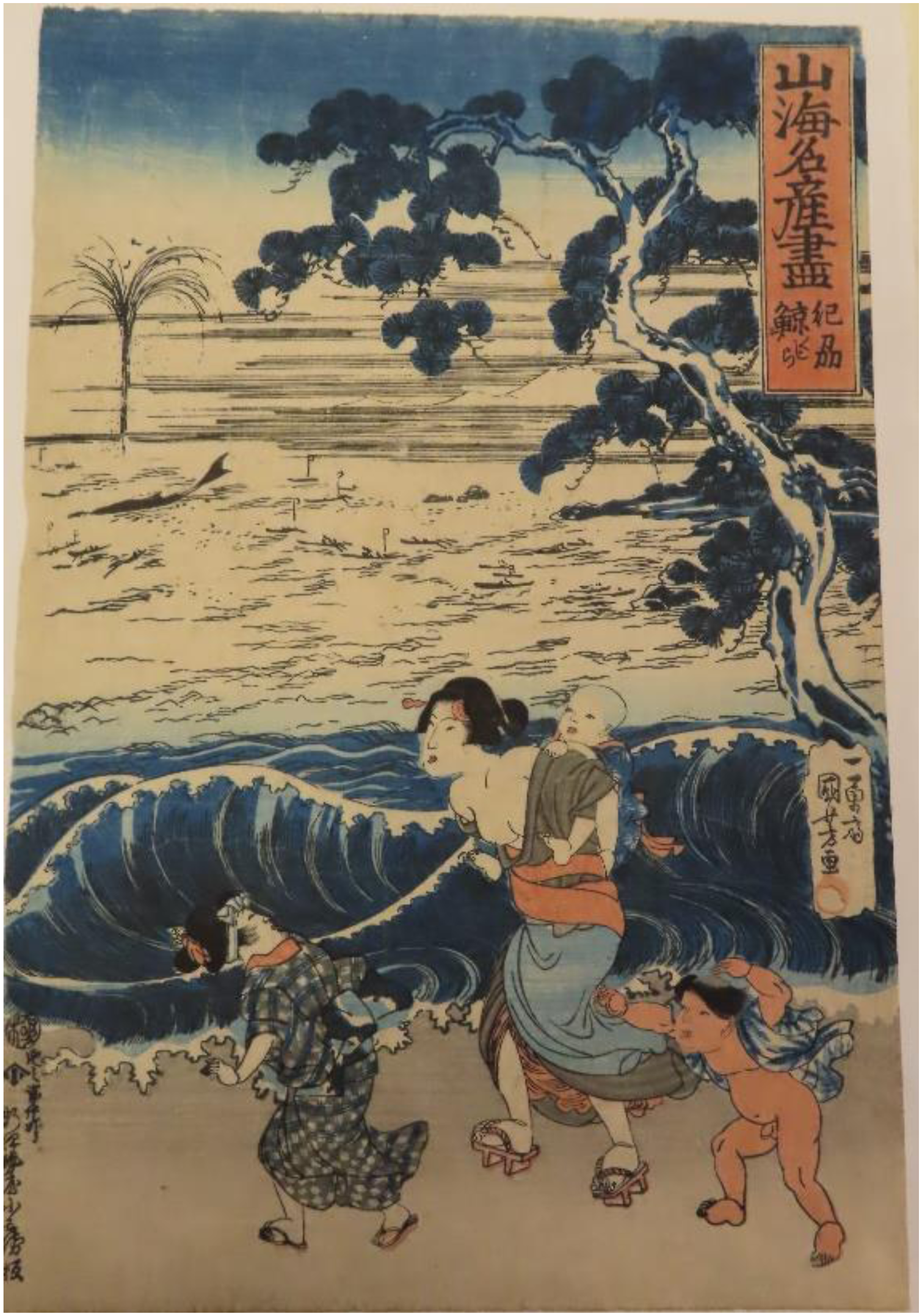
Ichiyūsai Kuniyoshi, Kishū kujira (Kishū Whale), circa 1833. Woodblock print. New Bedford Whaling Museum, Accession No. 2001.100.8950.
Woodblock prints also highlighted the other types of whaling infrastructure found on land, again commemorating the types of locations and people that casual observers would be more likely to encounter on their individual travels. It might be more likely, for example, for a traveller to witness a whale carcass being towed onto shore rather than for them to observe a whale hunt at sea. Winches were critical tools for whaling, set up onshore and used both to tow whales in from shore and to strip layers of blubber from the animal itself, and those winches were the highlight of at least three different woodblock prints. All three versions – all by different artists – focus on the men pushing the winches, some with facial expressions indicating the effort expended to haul the massive whale. Another woodblock print shows a small, permanent lookout structure atop a shoreline hill or mountain, and depicts a man frantically swinging long white paper strips on a pole to signal the presence of a whale. 77 This type of memorialization puts the focus back on the people involved in whaling, not just the whales themselves – indeed, in some of these prints, whales are not even visible at all. As Geoffrey Cubitt notes: ‘Individuals who remember do not do so as isolated agents, but as social beings, constantly engaged in interactions with other such beings, enmeshed in networks of social relationship’. 78 Making people the focus of the artwork not only humanizes the whaling process to outsiders, but possibly, even more importantly, allows them to imagine themselves in that role as well, anticipating the thrill off spotting a whale from afar or straining to haul in the leviathan.
Near cities, whale encounters sometimes took on more of the tenor of a festival. While these encounters were with individual whales, their memorials became more of a communally shared experience. As Arch suggests, the people who went to view these strandings were akin to people who went to view other unique scenes or famous places (meisho) within Japan, and the experience should be commemorated. 79 Occasionally, whales would beach themselves near Edo (modern-day Tokyo) and, in at least one case in 1798, a whale was towed inland to the Hama Detached Palace so the shogun could view it. Later, it went on display for the public to view. 80 It is extremely likely that this is the scene being depicted in Katsukawa Shuntei's triptych, Shinagawa oki no kujira Takanawa yori mita zu (Seeing the Whale in Shinagawa Bay at Takanawa, 1798), though the artist depicts two whales in the bay instead of one (Figure 4). 81 But the festival atmosphere is unmistakable – crowds gathered onshore and on pleasure boats to view the behemoths, with children and even puppies frolicking in the foreground. One woman is shown clapping her hand to her forehead as if in disbelief at the sight (or perhaps at the stench). In the rightmost print, there is a ‘resting place’ onshore where tea is being served and observers can relax on raised tatami mats to view the whales. A large pleasure boat, often used for longer afternoons with large parties aboard, pulls up to shore in the leftmost print. 82 Smaller boats draw closer to the whale itself. The size of the beast is obviously exaggerated as the eye alone is depicted as even bigger than the four-person vessel approaching it, but this suggests the perception of the massive whale from the shoreline. The novelty of the whale sighting is clearly depicted in the scene, and the memory becomes an extension of the experience itself. 83
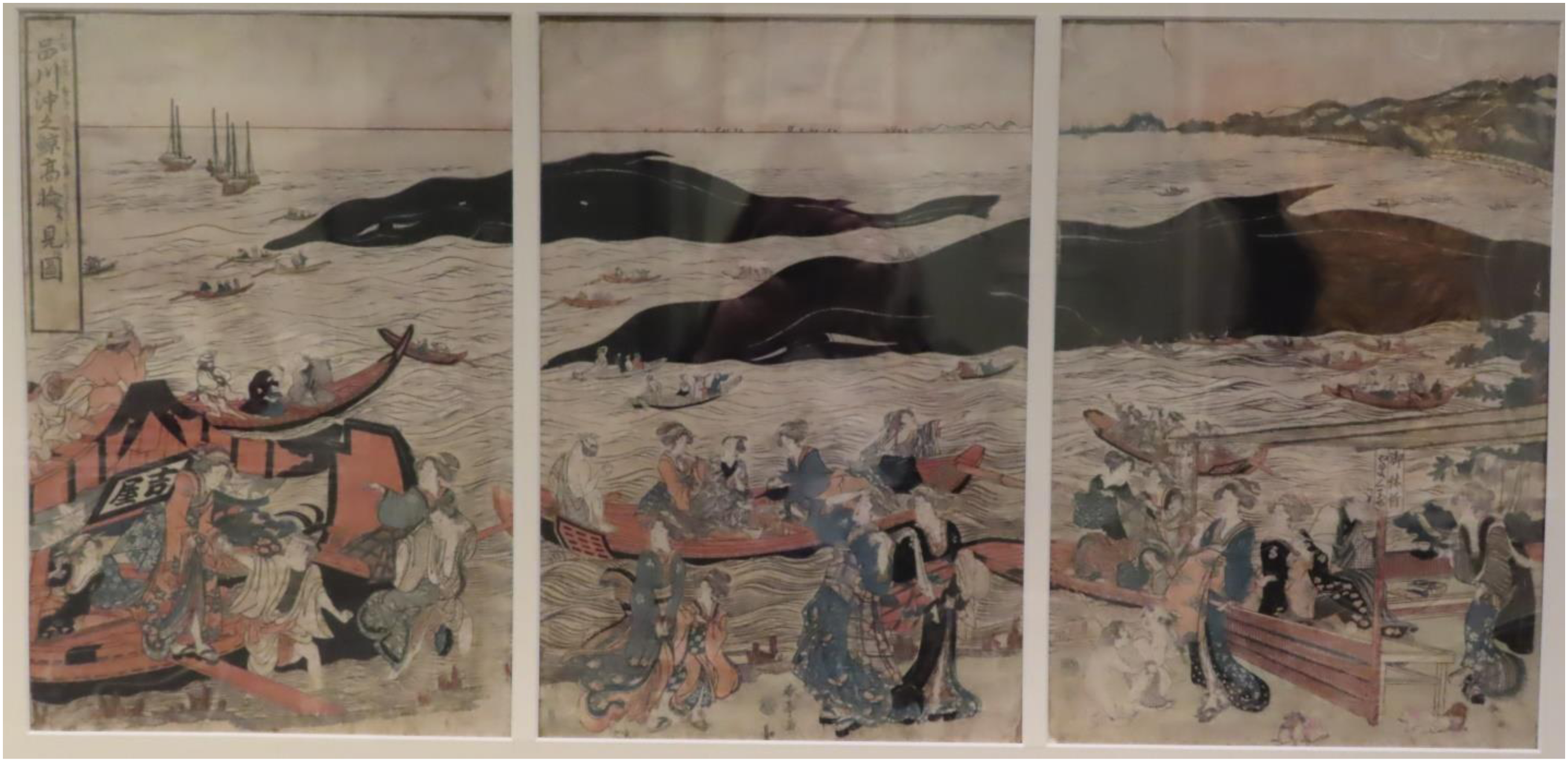
Katsukawa Shuntei, Shinagawa oki no kujira Takanawa yori mita zu (Seeing the Whale in Shinagawa Bay at Takanawa), circa 1798. Woodblock print. New Bedford Whaling Museum, Accession No. 2001.100.6683.
The Shinagawa whale's impact lasted far beyond its limited time in the bay, however. Multiple artists portrayed the same scene as much as 50 years after the actual event. A Kuniyoshi triptych circa 1847–1852 shows one whale (unlike Shuntei's pair) surrounded by multiple smaller pleasure boats filled with gawkers.
84
Ippusai Yoshifuji, a pupil of Kuniyoshi, also produced a similar print (circa 1850), with multiple roofed pleasure boats venturing out to look at the behemoth in the bay.
85
Some of the longevity of this whale memory may also not only be due to the inherent rarity of the incident, but also because there is an unusual tangible remnant of the whale itself. In 1798, fishermen took some of the bones of the whale and buried them at Suzaki-Benten Shrine (now renamed Kagata Shrine) in Shinagawa. A pyramid-shaped rock marked ‘Whale Memorial Stone’ rests in the shrine precincts, and an auxiliary monument describes the incident. As Itoh translates, the monument reads in part: Erected by fishermen of Tennōzu, Shinagawa Bay … Whales are the kings of the fish. They are abundant in the sea in southwestern Japan, but rare in the sea in the northeast … People heard about it and flocked to see the whale for several days.
86
A haiku written by Tani Sogai (1717–1809) ends the engraving, saying: ‘A summer whale, drifting into Shinagawa, earned a great fame in Edo June 1798’. 87 The fishermen recognized the relatively unique nature of the Shinagawa whale and made efforts to preserve its memory. The engraving and haiku on the stone suggest that this was not necessarily for the repose of the whale's soul or other religious reasons, but because this particular whale was famous. This is another instance where the mnemonic site reinforces the memories preserved in the artwork.
There is one other example of a whale near the modern Tokyo area that became memorialized in similar ways, reinforcing the idea of the whale-as-spectacle in the region. In 1875, two fishermen caught a whale outside of Urayasu and sold it to be towed to Fukagawa in Edo proper. 88 It is highly likely that this scene was commemorated in Yoshitoshi's Whales Exhibited at Fukagawa, dating to that same year. 89 This scene is quite unlike the Shinagawa whale scenes, which showed the masses going to the sea to view the whale. Here, the whale is onshore in an enclosure. The eyes are not visible (though there appears to be a tag on the carcass indicating where the eye is, as well as an area where a layer of blubber has been removed), and people press up closely to the fence surrounding the whale. It suggests a closer proximity than the Shinagawa whale, where people could only approach by boat. More than a few observers in the image are depicted as holding their noses, suggestive of the odour in the pavilion. Posters are hung around the enclosure describing the encounter with ‘Mr Large Whale’ (ōkujira-san). There do not seem to be any later artistic representations extant of the Fukagawa whale. But in this case, too, a shrine was created to memorialize the whale, though the bones do not appear to be at the shrine. According to Itoh, the two fishermen who had originally killed the whale were treated as heroes and were distracted from their work by the plaudits. To refocus their minds on their work, they took the advice of an elder and donated a whale shrine and memorial stones for the whale to the local Inari shrine. 90 Similar to the Shinagawa case, the creation of the shrine was less focused on honouring the soul of the whale than it was a response to the whale's earthly fame.
There are records of two other whales that had been caught and paraded as a spectacle, but neither seem to have been commemorated in art or in a shrine. In 1884, a drifting whale was caught and exhibited in Maejima near Ushimado in the Inland Sea, and in 1892, again at Urayasu, a whale was captured and exhibited at an amusement park in Aksakusa (Tokyo). The bones of both were buried and monuments were erected, although that of the latter is no longer extant. 91 While it is unclear why these seem to have been less celebrated in woodblock prints or even photographs, it is possible that the rapid technological and social changes in Japan during the last decades of the nineteenth century made the vision of the dead whales less spectacular. Electricity, trains, telegraphs and other modern marvels were becoming more commonplace, and memorializing a whale carcass – which, however unusual, was still a known entity – may have had a lower priority as a subject for artists.
Of course, not all beached or drifting whales were made into spectacles to be viewed by hundreds of people. Of the 77 whale graves and related monuments in Itoh's study that predate 1899, 42 (including the gravesites for the Shinagawa and Fukagawa whales) are located in areas where organized whaling groups were not active. In other words, these are monuments for beached or drift whales in areas that either did not regularly encounter them or, in the case of some coastal communities, did not rely on whale hunting for sustained economic benefit. 92 The monuments include steles erected to commemorate the whale's existence without interring any remains and sites where the whale (in part or in its entirety) was buried. The motivations seem to be twofold: gratitude for the financial windfall granted by the whale's stranding or genuine sadness at the whale's demise and a wish for the repose of its soul. Both cases, however, seem to have merited the creation of a transgenerational tangible mnemonic site. In one example of expressing gratitude, in modern Usuki city (Saga prefecture), a stele dated to 1871 overlooks the port of Otomari. The town's Board of Education has installed signage detailing the story behind the stele's construction, recounting how the town renovated the port in around 1868 but went into staggering debt purchasing the materials. A whale chased by orcas entered the bay and the villagers were able to capture and sell it, financing the debts from the port. The monument was erected in gratitude to the ‘saviour of the village’. 93 In 1969, the village even commemorated the one-hundredth anniversary of the whale's death. 94 Multiple similar accounts exist, including whales saving villages from famine or crushing debt. 95
Creating a monument simply to memorialize sadness at the death of one of these behemoths is rare among all of the memorials in non-whaling communities, and seems to correlate with extenuating circumstances – a slow death on a reef or the loss of a juvenile. In 1806 or 1846 (the date is unclear), a whale caught itself on a rock reef near Mijishima (Uwajima city, Ehime prefecture). The fishermen failed to rescue it and the whale perished, so they erected a gravestone because they pitied it. 96 Also, in Ehime prefecture in 1870, a grave was constructed for a whale calf. The inscription here clearly shows the emotion experienced when catching a young whale, as it has unusual wording, including a cry of grief: ‘1870, Ah! Grave for a Calf of a Large Whale, erected by the community’. 97 On the majority of steles or graves, however, expressions of grief are usually secondary to expressions of gratitude for financial gain.
Memorials for individual encounters with whales, then, tended to draw on the idea of whale-as-spectacle or whale-as-windfall as the impetus for commemoration. For the former, especially, people wanted to put themselves on the scene with the whale. Artists who depicted people glimpsing a whale from afar or the strongmen involved with hunting whales invited the viewer to imagine themselves in that moment with the whale. Beached whales that were promoted as a sight to see became memorialized in artwork and shrines, partly because of their rarity but also because the whales themselves became famous, and it was exciting to envision oneself there in the moment with everyone else experiencing this sight. In the latter case, usually when whales were encountered further from the cities, the memorials relied less on artistic depictions and celebratory imagery than more austere monuments and gravestones. Commemoration in these cases was more austere and honoured the whale's ‘sacrifice’ more than its fame.
Conclusion: memories then, memories now
The sustained creation of whaling memories over the centuries has enabled whaling towns and sites of beached whales even in the modern era to continue to promote and commemorate encounters with whales. Even though clearly much more is known now about whales than in the early modern period, past memorial practices inform and shape modern experiences with whaling. 98 The different types of historical memorializations practised by traditional whaling communities and by non-whaling communities have helped shape how those groups commemorate whales today.
As we have seen, historical whaling communities have largely practised memorialization styles that lend themselves to multigenerational longevity, through scrolls that were passed down and circulated, the creation of mnemonic sites and ritual practices. In those areas today, we still see the tendency to create tangible sites or carry out both sacred and secular rituals. One is likely to find a whaling museum in these communities, showcasing the tools and boats used in whaling from the premodern to modern eras. 99 Arikawa, in the Gotō Islands area, has even reconstructed a lookout spot, inviting the modern viewer to once again place themselves in the footsteps of the early whale spotters. 100 Festivals, too, are common in former whaling areas. The most famous of these is the annual Nagasaki Kunchi festival, which numbers among its parade floats fishing boats and a whale spouting as harpooners surround it while it is pulled through the streets, and highlights the ‘whale-spouting dance’. 101 There is an annual Kayoi Whale Festival in Nagato city as well, where they recreate early modern whaling techniques and sing whaling songs, 102 and other locations such as Muroto are trying to keep whaling culture alive through activities such as seko-bune (‘chase boat’) races. 103 Both of these take place on or near Marine Day (20 July), a national holiday. Taiji's whaling dance has even been designated an intangible cultural prefectural treasure. 104 Also, in Kayoi, the ‘mecca’ of whaling memorials, the Kōganji Temple continues to perform the annual Buddhist memorial rites even today. In these ways, historical whaling communities continue to honour their long association with whales and endeavour to sustain that long-term connection.
On the other hand, non-whaling communities still show the same tendencies to commemorate the whale-as-spectacle or to celebrate the economic benefits of whales. Modern memorializations can be easy to conflate with tourism and its economic benefits. Itoh notes 35 monuments or whale graves erected in the twentieth and twenty-first centuries. Of these, eight were in traditional whaling communities, while the remaining 27 were in non-whaling communities. The most recent of the latter was built in Shimonoseki in 2002 to commemorate a meeting of the International Whaling Commission, and bears the inscription ‘In Appreciation of Whales’. 105 Four years previously, a whale had beached itself in the same region, and the townspeople buried one of its eyes on the beach and brought the other to a Yakushi temple on the riverside for burial and a kuyō ritual. 106 Perhaps that earlier encounter helped spur the people in the region to celebrate their connection with whales and to bring the International Whaling Commission (along with the economic and political benefits of hosting an international conference) to Shimonoseki.
These modern practices echo the patterns set in place from the early modern period. Whether interactions with whales were sought out and sustained or were unexpected and fleeting, they were worthy of commemoration. The form those memorializations took was largely dictated by the type of encounter and the relationship the community had with the whales. Sustained interactions, such as those of whaling communities, often resulted in near permanent commemorations, particularly with the creation of mnemonic sites that would stand the test of time or commissioning rites to be held in perpetuity. Commemorations for more unpredictable, one-off encounters usually invited the external observer to imagine the spectacle more fully, sometimes even literally or figuratively drawing them into the memorialization. Alternatively, the creation of longer-lasting memorials such as monuments or shrines in areas not known for whaling usually acknowledged the windfall gained from those fortuitous beachings. The fascination with these leviathans and human encounters with them, repeated or singular, has perhaps not entirely diminished, even with modern knowledge and understanding of their lives – and their deaths. Even our anonymous diarist seemed awed as he ended his account of the successful whale hunt. He described the whale pulled up onshore at night in the light of the full moon, saying: ‘you could see the whole thing. It's a rare sight’ – one worthy of memorialization indeed. 107
Footnotes
Acknowledgements
I must thank Jordan Berson, Emma Rocha and Mark D. Procknik at the New Bedford Whaling Museum and the staff of Princeton University’s Marquand Library for their help in accessing their collection materials. The University of Wisconsin-Whitewater provided research funding, which was critical for travel to the museum and research time there. A very preliminary version of this research was presented at the 2023 Asia-Pacific Regional Conference for Underwater Cultural Heritage at Gwangju, South Korea, where I received useful feedback. Finally, I am very grateful to Dr T. Kurt Knoerl for always being a sounding board and for his input into this work.
Funding
This work was supported by Research Travel Funds from the College of Letters and Sciences at the University of Wisconsin-Whitewater.
