




Abstract
During Britain's conflicts between 1793 and 1815, the Royal Navy changed markedly. New classes of smaller warships were introduced, with numerous vessels built to Admiralty (King's Yard) designs in private shipyards rather than the Royal Dockyards. Many were sloops-of-war, flush-decked and unrated vessels, carrying 20 guns or fewer, that proved versatile in operations around the world. After 1815, the size of the fleet was reduced. Initially many vessels were kept in reserve, but eventually most were sold for mercantile service or breaking, some of the latter also then being resold for merchant use. These vessels proved attractive to long-established whaling owners and new entrants to the whaling trade alike. Such warship-to-whaleship transitions are examined through vessels entering the British southern whale fishery in the post-Napoleonic period between 1815 and 1845.
Keywords
Introduction
The period of the French Revolutionary, American and Napoleonic wars from 1793 to 1815 arguably represented a high point in British maritime power in the later years of the early modern era. Naval and mercantile affairs thus are prominent in the historiography of the period, with many scholarly studies of broad intent and scope. 1 Other sources address more specific regional, national, thematic or temporal topics. 2 While the military and naval events of these conflicts and related political, diplomatic, legal and economic aspects have been studied extensively, other contextual perspectives also are relevant. These include studies of naval administration; logistics, dockyards and port towns; leadership and manpower; and medical and cultural issues – all essential factors enabling naval power to be developed and exercised effectively over time and distance. 3
During these wars, Britain's Royal Navy grew significantly in size, scale and reach. New classes of warships evolved to take the war at sea to the enemies of the day. In the later stages of the wars and afterwards, many ships and their crews were paid off and the ships placed in often extended reserve as the Royal Navy reorientated itself to peacetime contingencies. 4 Over time, many vessels were sold into merchant service or for breaking, with some of the smaller vessels then being repaired and also resold for mercantile employment. The fates of such vessels often are less evident in the post-war historiography as ‘Peace never generates as much historical interest in navies as war, and most naval history has been primarily concerned with seizing or maintaining dominance by war’. 5 In the mercantile context there were ‘special opportunities for bargains in second-hand vessels … when ships formerly in naval service came onto the market in large numbers and prices were exceptionally low’. 6
This article examines the extent to which smaller, unrated warships found post-war mercantile employment. 7 The setting for this is a study of vessels that, either directly or indirectly, entered the British southern whale fishery (BSWF) in the three decades from 1815. 8 A research approach is outlined, the whaling industry's growth and the role of whaleship owners and shipbreakers as purchasers of vessels are highlighted, and the main classes and identities of former naval vessels entering the South Seas fishery are examined. 9
Approach
A structured approach addressing the main research issues was adopted. First, to identify the types and classes of ships available for potential employment in the South Seas fishery after the Napoleonic Wars. Second, to characterise the contextual situation of the whaling industry that influenced demand for repurposed vessels. Third, to establish the companies or persons involved as intermediaries in the buying of vessels or as whaling ship owners. And, fourth, to identify individual vessels entering the trade as exemplars of warship-to-whaleship transitions from 1815 onwards.
A preliminary scoping exercise identified new British southern whaling voyage starts and vessels newly entering the South Seas trade on an annual basis from 1815 until it ceased in the late 1850s. 10 Potential vessels of interest were identified by reference to their type, class and size and the dates they were sold out of naval service, registered as commercial vessels or entered whaling. 11 Established whaling owners and new entrants to the trade were identified together with shipping industry intermediaries, such as ship builders, repairers and breakers, all as potential buyers for vessels sold out of naval service.
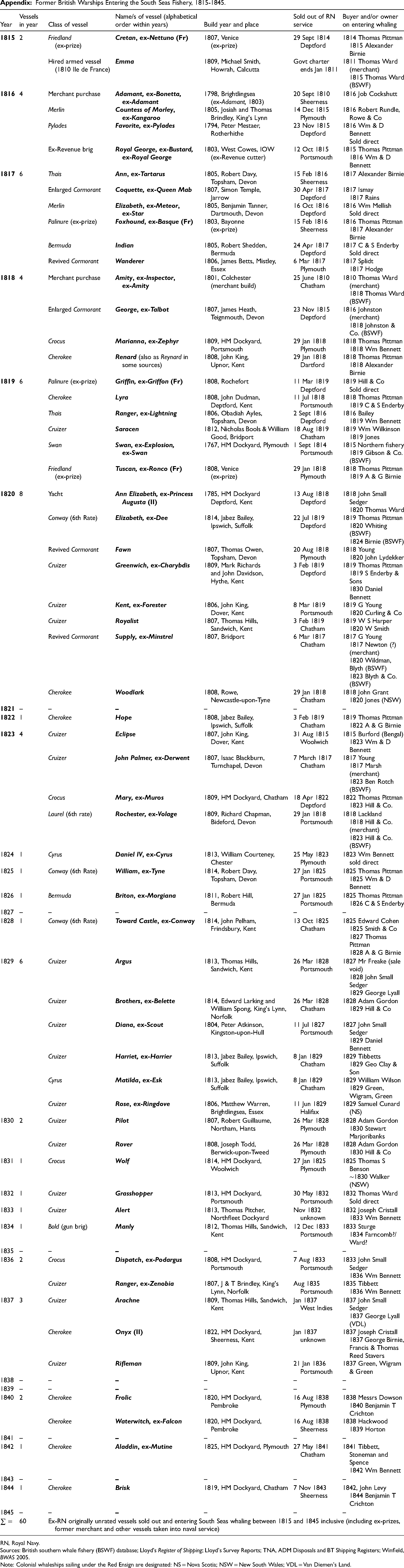
Information on individual vessels was validated, where possible, by cross-reference to primary sources and official records. 12 Candidate vessels were qualified by reference to naval, shipping and whaling sources. Secondary sources, such as arrivals and departures records and newspaper shipping reports, were also utilised. 13 Vessels were categorised by class and origin, together with available profiling, the more numerous classes of warships thus providing ‘lenses’ through which the disposal of vessels and their re-employment in whaling could be examined. While records of individual warships or whaleships may identify their later or previous ‘careers’ respectively, the transition paths from naval to commercial employment are less well examined. A list of former naval vessels entering the southern whale fishery under the British flag between 1815 and 1845 thus provides a sample of vessels for examination (see the Appendix).
The Royal Navy in context
The wars of the late eighteenth and early nineteenth centuries saw Britain emerge as the pre-eminent global power, reaching the peak of its maritime power that became central to the country's identity. 14 Britain's position as a ‘seapower’ state was a cultural construct based on its thriving merchant class and commercial activity, its political institutions and a strong navy. 15 The naval historiography of the French Revolutionary, American and Napoleonic wars emphasises the role of British warships in fleet- or squadron-level actions, in blockading enemy ports, in expeditionary operations and raids ashore, harrying enemy forces and supply lines, supporting changing coalitions of allies and protecting seaborne trade. Many engagements, however, were smaller in scale and lower in profile or effect, involving individual warships or a few vessels acting in consort. 16
In these long periods of conflict, significant numbers of smaller, but fast, well-armed warships were required for employment in diverse operations. 17 This resulted in a substantial increase in naval shipbuilding. Through most of the eighteenth century, the main centres for British warship building had been the Royal Dockyards at Woolwich, Deptford, Chatham, Sheerness, Portsmouth and Plymouth. Established private shipyards close to naval dockyards on the River Thames, River Medway, The Solent and south coast were also engaged in warship building. Such geographical proximity facilitated the supply of shipbuilding materials, the supervision of vessels under construction and their movement to a nearby naval yard for fitting out. 18
During the wartime period, the naval dockyards and adjacent commercial yards came under pressure in terms of capacity and skilled labour for building new warships and the repair of existing vessels. From the late-1700s, therefore, many smaller warships were built in numerous small commercial shipyards around the country with a proven merchant shipbuilding capability, a trend that accelerated in the early nineteenth century. 19 Between 1793 and 1815, over 85% numerically and more than 70% by tonnage of the Royal Navy's new ships, mostly smaller vessels such as sloops, gun brigs and bomb vessels, were built in private shipyards to ‘King's Yard’ designs. 20 Despite numerical discrepancies, both earlier and more modern authors highlight the importance of unrated vessels in the active list, accounting for over half of all vessels in service during the American and Napoleonic wars. 21 During this period, various classes of sloops were maintained of different sizes, rigs, armament and numbers constructed. From 1793 to 1815, the most numerically significant unrated warships, the Cherokee, Conway, Cormorant, Crocus, Cruizer, Cyrus, Merlin and Seagull classes, all comprising 10 or more vessels, provided the majority of Britain's small warships 22 (Figure 1 overleaf).
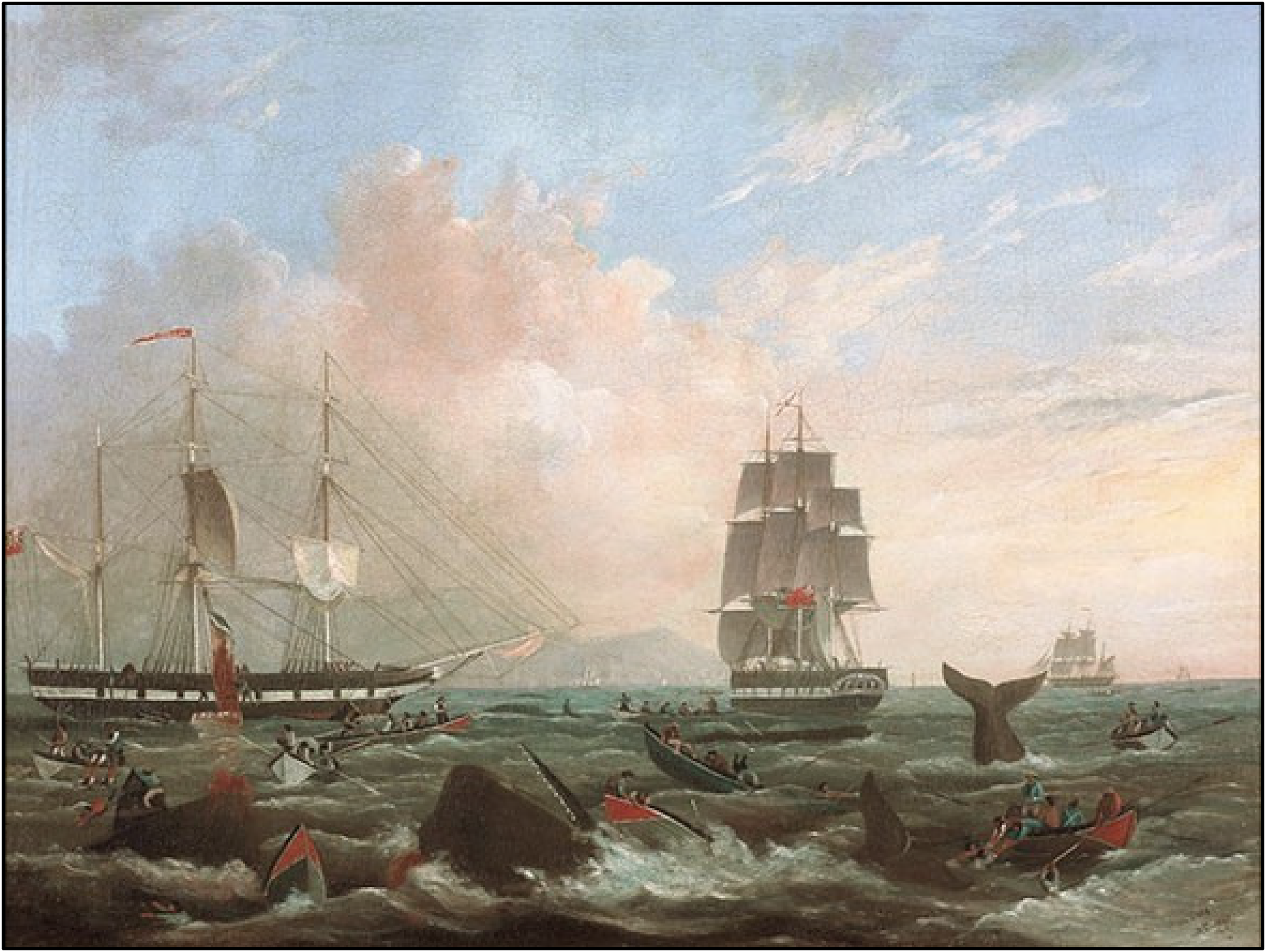
‘Offshore whaling with the Aladdin and Jane 1849’. The Aladdin was the former Cherokee-class brig-sloop HMS Mutine (built 1825, Plymouth, 235 bm) sold out of naval service in 1841, converted as a barque and entering whaling for William Bennett in 1842, before being sold to Tasmanian whaling interests in 1846.
The ending of over 20 years of conflict in 1815 presented new administrative challenges for the Board of Admiralty and the Commissioners of the Navy. 23 The country was in a dire situation, where ‘The public debt was as large relative to the size of the economy as at any point in British history, and interest payments crippled budgets’ and ‘The navy's exhausted ships overwhelmed the dockyards, which were suffering from drastic budget cuts’. 24 One priority was to assess ‘the state of the Ships of His Majesty's Navy, with the purpose of making all the reduction of expense in time of Peace which may be consistent with an adequate preparation for the event of War’. 25 Consequently, the Navy Board identified vessels to be kept in commission or ‘in ordinary’ in a state ready for active service, to be retained for harbour service with or without repairs, and to be sold or ‘taken to pieces’. 26 By the end of 1815, the larger, manpower-intensive, first- and second-rate warships of 90 or more guns had been paid off into reserve. 27 The numbers and types of unrated vessels required were assessed to decide whether the more than 70 existing 18-gun brig sloops of about 380 tons should be subject to ‘large repairs’ or replaced by new builds. 28
As a result of this process, large numbers of smaller warships in sound or remedial condition became available for disposal. 29 Their size, utility and low prices found a ready market in mercantile trades that valued their speed and sailing qualities, their potential as cargo carriers, and their low manning requirements. 30 This contributed to a rapid peacetime expansion in the whaling trade as existing owners and new entrants began to exploit whaling grounds discovered in the previous decades. 31
The sales process
With the large number of ships to be sold, surplus vessels were disposed of through a regular programme of Navy Board sales by tender or by auction. These events, held at the Navy Board offices at Somerset House, were advertised in The London Gazette and the principal newspapers of the day, with lists of named vessels for sale, their type and tonnage, and their location for inspection before sale, often at the outlying naval dockyards. 32 In the tender process, the highest acceptable offer received for an individual vessel was successful in its purchase. In a ‘Dutch’ auction, a ‘set-up’ price was based on an internal valuation; bids were invited from those attending and successive reductions (or abatements) were made until a buyer cried ‘Mine’. The presiding Commissioners had undisclosed ‘stop’ limits and if an ‘open cry’ had not been made by the time the ‘stop’ figure was reached, a vessel would be ‘taken-in’ and re-offered for sale again, some requiring several attempts before a successful sale was made. 33
Some purchasers, whether from the ship building, repair and breaking industries, or those merchant owners buying on their own account, can be identified from archive and newspaper records. Buyers of larger, rated vessels, such as ships of the line and frigates, were required to provide financial sureties not to resell or dispose of their purchases and to undertake to break them within 12 months. 34 Smaller warships were not subject to these restrictions and could be resold, even if sold out of naval service at a price commensurate with breaking. Thus, ship repairers and breakers figured prominently as purchasers of such vessels and, if not broken-up, in reselling them to new owners after repairing, refitting or rebuilding.
Once a bid was won, an immediate deposit of 25% of the sale price was required, the balance to be paid within two months. A declaration was required that the buyer had not given any fee, reward or inducement to Navy Board employees to gain unfair advantage in the sale, and that they were acting solely on their own account. Vessels were not released without a certificate of full payment from the Navy's Paymaster General. Ships' fixtures and fittings, including those bearing the government's ‘broad arrow’ mark, were to be returned to the nearest dockyard by the purchaser, with fixed prices paid for copper and mixed metal articles.
British southern whale fishery
British whaling in the southern seas commenced from London in 1775 when the supply of oil from the American colonies came to a halt owing to the American War of Independence. With a political desire to make Britain independent of foreign-caught oil, southern whaling attracted government support and developed into one of considerable importance, occupying ‘a political and economic priority out of all proportion to its size’. 35 However, the trade has also been described more critically as ‘an indulgence that has few parallels in British economic history’. 36 It was to continue for almost 85 years and involve over 900 ships undertaking more than 2500 whaling voyages 37 (Figure 2).
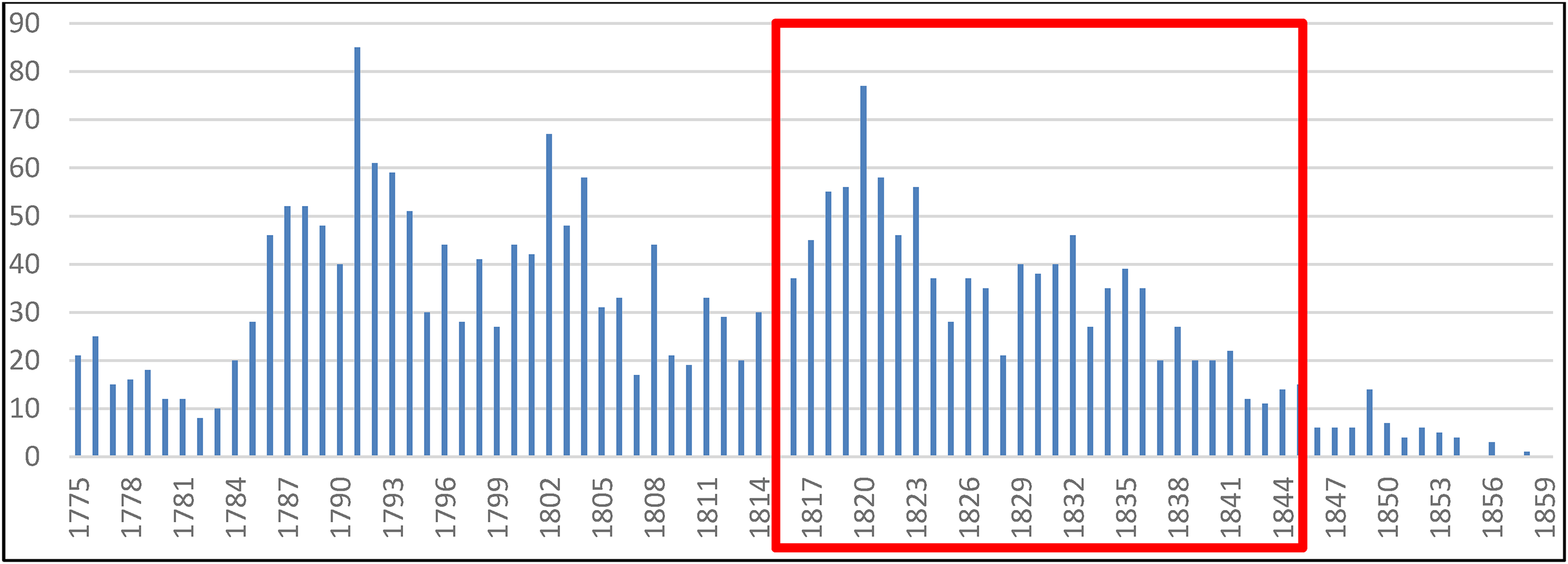
Ships departing for the British southern whale fishery, 1775–1859, with the research period of focus from 1815 to 1845 inclusive indicated.
Some 300 primary whaling owners were active over the life of the trade and these fell into three main categories. 38 The first established owners, both intergenerational family enterprises and individuals, engaged substantially in the trade over many years and operating many vessels. 39 The second those engaged less actively in the trade for a shorter, but still significant, period of 8–10 years or more and operating fewer whaleships. 40 Third those owners who participated in the trade for a shorter period, with only one or a few ships or for only a few voyages. 41 Many owners did not concentrate purely on whaling but had diverse maritime-related business interests, including as general merchants, contractors for government transports or providing convict and settler transports, mast and block manufacturers, rope, canvas and sail makers, provision merchants, and oil processors. 42
The American whaling trade had been devastated by the War of Independence and, following the collapse of their market, several Nantucket whalers moved first to Nova Scotia and then to Britain. These displaced former American colonial whalemen formed the core of the British southern fishery in the early years and the majority of ships in the first decades were constructed in America. 43 Other ships then entered the trade with most being mercantile conversions, along with ex-naval and mercantile prizes captured in the many wars in which Britain was involved. These prizes were mainly vessels of American, French, Spanish, Dutch and Danish origin, condemned by Admiralty courts and sold directly into commercial service rather than first being taken up for naval duties. 44 A number of ships were redundant Royal Navy vessels, decommissioned and then sold out of service, but prior to 1815 these were very few in number. 45 Overall, these types of ships proved generally suitable for whaling and specialist built whaleships only started entering the trade in any numbers after 1825. 46
Initially, the British southern whaleships continued to use the grounds familiar to the American whalemen. 47 The industry flourished and by 1815 whaling had spread to include the whole of the Pacific and parts of the Indian Ocean. 48 This general expansion of the South Seas fishery is reflected in the figures of almost 1400 voyages commencing between 1775 and 1814 and over 550 vessels as new entrants to the trade in that period. 49 However, these figures camouflage a number of issues. The growth of the trade was seriously affected by the wars with France and damaged further when war broke out with the Americans in 1812 and the result was that, by the end of the French Wars, the southern fleet was smaller than it had been 10 years earlier. 50 After 1815 it quickly began to recover, driven not only by the ending of conflict, but by the earlier relaxation in 1813 of the East India Company (EIC) monopoly to allow British ships north of the Equator under licence. In 1819, it was encouraged further by the effective removal of all EIC restrictions, enabling the expansion to move into new areas and their associated whaling grounds to be exploited. In the post-war years whaling to the South Seas appeared to offer financial opportunities and entrepreneurial whaling owners provided a ready market for ships sold out of naval service in sound or remedial condition and with conversion potential. The period starting in 1815 thus provides a changing context in which to examine the post-war southern whaling trade and the vessels engaged therein.
Records of whaleships in the southern whale fishery can be fragmentary, and mapping transitions from warship to whaleship and linking individual named vessels to their future or past careers problematic. Research issues arose across naval, mercantile and whaling sources. These included: matching ships’ names, origins, dates and tonnage across transactions; ships supposedly sold for breaking, but then resold; multiple vessels with the same name or the conflation of two separate vessels of the same name into one record; the changing and misspelling of ship and owner names; and other recording and transcription errors. Despite these difficulties, 60 post-war warship-to-whaleship transitions can be identified between 1815 and 1845, representing approximately one in six of all new entrant vessels to the trade in those years. While still a numerical minority, these vessels were a significant addition to the British southern whaling fleet in that period (see the Appendix).
From ‘peace dividend’ to ‘profit prospects’
The coming of peace in 1815 saw a quickening of the rundown in both ships and manpower. The most numerous sloop classes in service at the end of the Napoleonic War were also the newest from the wartime building programmes. While some had been worked hard in war service, and were more subject to disposal owing to their depleted condition, others continued in active service or in reserve for another decade or more.
In addition to the numerically larger classes of sloops, other types of smaller warships found their way into the whaling trade in this period. These included gun-brigs, schooners, bomb vessels, fireships and yachts. Armed merchant vessels purchased for naval service during the conflicts and ex-prizes that had been condemned and taken up by the Admiralty for naval duties also entered whaling in the post-war era. 51 The various classes and types of vessels for disposal, their sea-keeping capabilities and size, a ready pool of prospective purchasers, and a well-developed infrastructure and expertise for the repair, conversion and resale of vessels provided a nexus of driving factors. This resulted in warship-to-whaleship transitions into the British southern whale fishery on a significant scale in the three decades following the Napoleonic Wars.
The Navy Board disposal of vessels surplus to requirements is evidenced by official notices of public auctions or sales by tender. Where whaleship owners made purchases directly on their own accounts, these tended to be the larger, longer-established operators in the trade, with diverse shipping interests and the necessary background, experience and finance. Such capabilities enabled synergies to be exploited from regular purchases, the equipping of vessels and established relationship networks. 52 Many sales, however, were made to ship-building, rather than ship-owning interests, at least in the first instance; some purchasers were engaged primarily in new construction, while others had ship repair and breaking interests. Some smaller warships sold ostensibly for breaking were then resold, the rebuilding or refitting, repair and conversion of a warship as a whaleship representing a saving to future owners compared with building a new vessel. 53
One group of regular purchasers was located in the contiguous areas of Bermondsey, Rotherhithe and Deptford on the south banks of the River Thames. In the 1820s, those in Rotherhithe included the names of, inter alia, George Bayley, Joseph Cristall, Thomas Pittman and John Small Sedger. 54 These operated small- to medium-scale enterprises, generally with limited dock and yard facilities and small workforces; their activities included buying in vessels for breaking and salvaging timbers for reuse or onward sale, repairing existing vessels for clients and refurbishing or converting vessels for resale. Such activities provided important business opportunities late in the conflict and in the post-war period. At this time, Thames shipbuilders in particular suffered from the 1813 ending of the EIC monopoly on India trade, with fewer orders for new ships and repairs, followed by Navy Board contracts being cancelled. From 1813 to 1814, the number of shipwrights employed in Thameside yards halved to just under 700 men. 55
The larger Thames shipbuilders downstream from Rotherhithe, with their focus on new construction and the repair of larger naval and merchant vessels, including large East Indiamen of some 1400 tons burthen, are well represented in the literature. 56 The small ship repairers and breakers have received less historiographical attention, and the relationship networks between smaller ship yards and their ship owner clients are less well understood. The examples of Thomas Pittman as a ship repairer and breaker in Rotherhithe and his client Alexander Birnie as a merchant and whaling owner thus provide illustrative cases of the scale, nature and temporal aspects involved. That both men were active in their respective professional fields over several decades and did business together between 1814 and 1827 is evident from diverse sources.
Case – Thomas Pittman, ship repairer
A member of a prominent seafaring and shipbuilding community centred on the Bermondsey and Rotherhithe area of Surrey, Thomas Pittman (1764–1831) spent his early career in the South Seas fishery. He is known to have served as a harpooner on two whaleships between December 1787 and August 1790, and between 1791 and 1803 was master on seven successive whaling voyages for Daniel Bennett. 57 Thereafter, Pittman appears to have ‘come ashore’, forming business partnerships as a whaleship owner and becoming involved in ship repairing and breaking activities. Another Rotherhithe whaling master in this period was George Quested, in command of six ships for Samuel Enderby on seven voyages between April 1791 and late 1804/early 1805. 58 As co-owners, George Quested and Thomas Pittman operated the whaleship William Fennings on two voyages between August 1807 and June 1813. 59
In, or shortly after, 1805, a partnership of Ann Younger, Thomas Pittman, George Quested and John Mews was formed as shipwrights to undertake repair and breaking work from premises at Fountain Stairs, Rotherhithe. Ann Younger was the widow of a master shipwright, Thomas Preston Younger, who had died in August 1805. 60 John Mews (Meux in some records) was himself a master shipwright. 61 The combination of a shipyard owner by inheritance, a master shipwright and two successful whaling masters evidently provided a synergistic rationale for a mutual business venture. However, in May 1810 a press notice announced that the partnership was dissolved and henceforth would be ‘carried on by Messrs Mews and Pittman only’. 62 One co-signatory of the press notice was ‘Ann Pittman (formerly Younger)’, the wording suggesting that Thomas Pittman and Ann Younger had married. 63 The dissolution of the four-way partnership did not impact the Pittman–Quested whaling partnership, the William Fennings continuing in the South Seas fishery until June 1813. 64
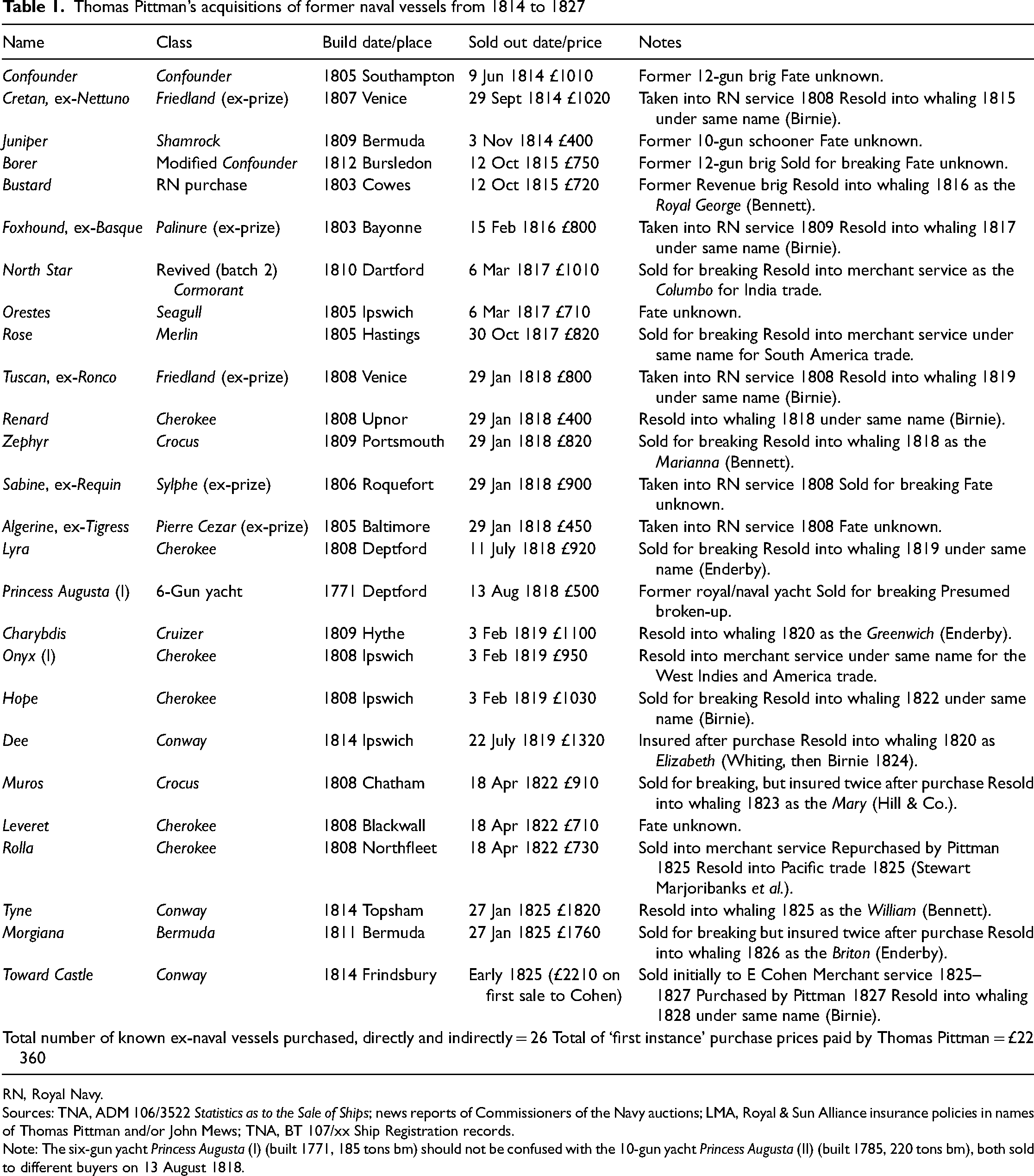
From May 1810 onwards, Mews and Pittman continued the ship repair and breaking operations, seemingly with Ann Pittman (formerly Younger) holding the assets of the business under the terms of her first husband's will. 65 By 1813, the business employed 32 workers of whom 20 were skilled shipwrights. 66 Between 1814 and 1827, they became prominent buyers of ex-naval vessels, as well as other government service and merchant vessels. Some 40 vessels in total can be identified, of which at least 25 were ex-naval vessels bought directly and for which over £22 000 was paid (Table 1). 67 Many vessels were insured by Pittman and/or Mews for sums in excess of what had been paid, presumably in anticipation of a follow-on sale. 68
Thomas Pittman’s acquisitions of former naval vessels from 1814 to 1827
RN, Royal Navy.
Sources: TNA, ADM 106/3522 Statistics as to the Sale of Ships; news reports of Commissioners of the Navy auctions; LMA, Royal & Sun Alliance insurance policies in names of Thomas Pittman and/or John Mews; TNA, BT 107/xx Ship Registration records.
Note: The six-gun yacht Princess Augusta (I) (built 1771, 185 tons bm) should not be confused with the 10-gun yacht Princess Augusta (II) (built 1785, 220 tons bm), both sold to different buyers on 13 August 1818.
In a related venture, Mews and Pittman became co-owners of the snow Horatio in 1819, two whaling voyages being made subsequently between September 1820 and July 1824. 69 The last Mews and Pittman records located are dated 1827, when the merchant ship Toward Castle, the former Conway-class vessel of the same name sold out of naval service in October 1825, was purchased from a previous merchant owner. 70 This vessel was insured by John Mews on 5 July 1827, the deed of sale being completed on 7 August 1827 and the ship registered 10 days later. 71 The Toward Castle was sold subsequently by Thomas Pittman into whaling under Alexander Birnie's ownership. 72
Described as ‘a respectable shipbuilder’, John Mews died at his home in Rotherhithe on the 17 August 1827, the same day the Toward Castle was registered. 73 Two months later a ‘valuable stock of new ship timber and ship building implements’ was advertised to be sold ‘with the consent of Mr Pittman’ at auction at the Fountain Dock premises on Bermondsey Wall. 74 Thomas Pittman evidently then retired, the Fountain Dock premises being taken over by another shipwright; he died in November 1831 aged 67 years, and his wife Ann Pittman (formerly Younger) died in April 1835 75 .

Detail from a scrimshaw plaque circa 1839 of a whale hunt with the barque Tuscan, the former prize Ronco (built 1808, Venice) taken into Royal Navy service as HMS Tuscan in 1808, sold in 1818 and rebuilt by Thomas Pittman for the South Seas fishery with Alexander Birnie & Co. from 1819 until condemned in 1840.
Case – Alexander Birnie, merchant and shipowner
Alexander Birnie (1763–1835), who became one of the larger South Seas whaling owners, was born in Aberdeen and is believed to have started his career as a merchant in London in the late 1700s. In the early years, he acted as a general merchant and shipowner, consigning goods to Australia and South America and importing commodities such as whale oil, wool and other materials on the return voyages. By the early decades of the nineteenth century, his standing had led to him becoming the London agent for several prominent colonial officials in Australia as well as continuing his own commercial interests. 76
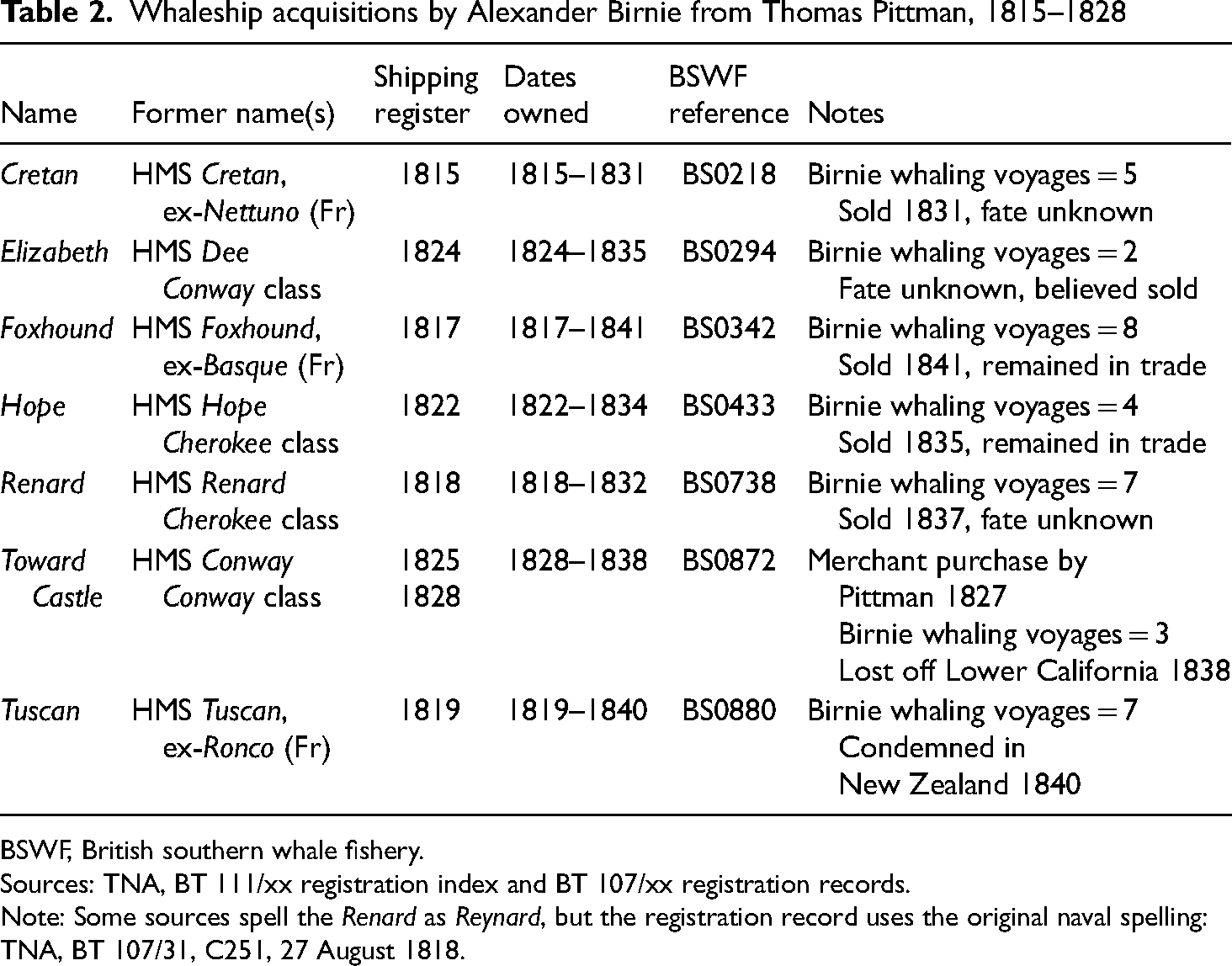
Also in this period, Birnie entered the southern whaling trade with his older brother James (1761–1844), who had served as master of four whaleships for various owners from 1788 to 1801 and from 1808 to 1810. 77 Between 1803 and 1808, James was master of the whaleship Star under his brother's management, but from 1812 settled in Australia to represent the Birnie business interests. 78 Alexander's son George (1786–1863) moved to Prince Edward Island, Canada, representing the company in a similar role from 1809 to 1813, before returning to London to join his father in business. Between 1803 and 1844, the Birnie family interests operated 20 whaleships and undertook almost 80 voyages. Seven of the Birnie whaleships between 1815 and 1828 were purchased from Thomas Pittman, all being ex-naval vessels in their earlier careers (Figure 3) (Table 2). 79
Whaleship acquisitions by Alexander Birnie from Thomas Pittman, 1815–1828
BSWF, British southern whale fishery.
Sources: TNA, BT 111/xx registration index and BT 107/xx registration records.
Note: Some sources spell the Renard as Reynard, but the registration record uses the original naval spelling: TNA, BT 107/31, C251, 27 August 1818.
By the late 1830s the fortunes of the South Seas whaling trade had begun to deteriorate, with growth slowing on account of several compounding factors. 80 First, over-fishing led to reduced catches and diminishing financial returns. Second, competition increased from lower-cost colonial whaling owners, with the ability to tranship catches onto merchant vessels at Sydney or Hobart and avoid the long voyages to and from England to the South Seas whaling grounds. Third, the use of kerosene and paraffin as whale oil substitutes increased in domestic, commercial and industrial use and the use of piped coal gas (town gas) grew in urban areas for lighting, cooking and heating. Fourth, British Government subsidies were withdrawn.
After Alexander Birnie's death in 1835, Birnie & Co. under George Birnie's management found itself in financial difficulties, and some of the remaining whaleships were mortgaged to keep the business solvent. 81 The temporary saviour of the Birnie fleet was Elhanan Bicknell, a wealthy whale oil merchant, refiner and tallow chandler. 82 Between 1835 and 1840, two vessels were sold (Hope and Renard) and two were lost (the Toward Castle striking a shoal off California in 1838 and the Tuscan being condemned in New Zealand in 1840). 83 By the early 1840s, the last of the Birnie whaleships, the Foxhound and the Onyx (II), had returned to London and by then the South Seas fishery was in terminal decline. 84
Commentary
Studies of warship-to-whaleship transitions in the post-Napoleonic period can be characterised by fragmentary, ambiguous or contradictory information. The research issues are varied in nature, necessitating a pragmatic, structured approach. The term ‘River’ is used in some records to indicate a shipbuilder's location (i.e. the River Thames or adjacent river estuaries) and the term ‘King's Yard’ to indicate Admiralty-designed ships built on contract in private shipyards: both terms can mask, and often present uncertainty about, the actual origins of vessels.
At different times, some classes of small warships carried the same names for different designs, while some vessels perpetuated the same names within the same or different classes. Thus, builder names and locations, the order, keel laying, launch or fitting-out dates, quoted tonnages, dates entering or leaving naval service, sales and resale dates, initial and subsequent purchasers, commercial registration and first merchant voyage dates, and any subsequent survey reports all assisted in tracking vessels sold out of naval service.
In some warship-to-whaleship transitions, vessel names remained unchanged in commercial ownership, a helpful trait probably arising from administrative convenience in insuring or registering newly acquired vessels. Conversely, renamed vessels often lacked a paper trail linking their former and new identities in the naval and commercial contexts respectively. Differences in tonnage before/after refit or reconstruction, in the tonnage conventions used and in rig descriptions also complicated vessel validation. 85
Other issues encountered included stylistic and spelling differences between sources, date inconsistencies and delays between a naval sale and mercantile employment. Moreover, family names, given names and initials of owners and masters were subject to varying interpretations of contemporary handwriting and between sources, especially with multi-generational ownerships as trading names or business entities evolved. 86 Errors in transcription, or lack of appropriate reference or primary details in some derivative sources, also contributed to research challenges.
Archive sources, such as Admiralty records, were found to be limited in respect of the process of disposal and the vessels sold-out up to and including 1818 and appear largely absent thereafter, although some contextual information was available in Navy Board papers and in contemporary newspaper reports. 87 Vessels listed for disposal were found in official notices, but the sales and purchaser details proved more elusive in published sources. 88 Insights in respect of some vessels purchased by Thomas Pittman or John Mews for resale were obtained from insurance policy records. 89 Once candidates were identified, official ship registration, change of owner or master records were sought to confirm the place and date of building. 90 In addition, the BSWF database provided corroboration of some vessel details, voyage dates and owner or master data, but also highlighted the absence of others.
As a trade, the British southern whale fishery lasted for eight decades from 1775 until the late 1850s, its principal features and trends being outlined in recognised whaling sources. 91 In the aftermath of the Napoleonic Wars, there was still growth potential in the industry, arising from changes in the external business environment and as evidenced by new entrant owners and vessels. In this period, there was some fluidity in the employment of merchant vessels, with whaling voyages interspersed with government transport or convict and settler voyages and trading voyages to or from other areas. Prominent owners with large fleets were actively involved in complementary shipping trades as well as whaling. 92 During the post-war period, the role of intermediaries such as ship repairers and breakers in the purchase and resale of former naval vessels became a feature of the shipping market. Some intermediaries had experience as whaling masters and thus practical knowledge of the requirements of such vessels, as well as well-developed relationships within the whaling trade.
The cases of Thomas Pittman, a purchaser of former warships from the Commissioners of the Navy, and of Alexander Birnie, a purchaser of such vessels for South Seas whaling from Thomas Pittman, illustrate warship-to-whaleship transitions in a specific business network. Within a 14-year period from 1814 to 1828, Pittman and his business partners purchased numerous former warships, some built ab initio as warships, others being merchant vessels bought for naval service, and several ex-prizes taken into British wartime naval service. 93 On several occasions, multiple purchases were made by Pittman on the same day. 94 The likely reasons for purchases arguably included: the suitability, condition and anticipated purchase price of individual vessels; the availability of facilities (e.g. dry dock, berth, gridiron, foreshore, workshops) at Rotherhithe and the requisite labour; work allocation and scheduling for breaking or for repair and resale; the volume and types of timber that could be salvaged and either reused or sold from breaking a purchased vessel; and a ready buyer for a vessel repaired or converted for mercantile use.
The prices paid by Pittman reflected demand and inflation factors in a post-war economy, with higher prices paid for newer vessels with more resale potential. The fact that some vessels were insured for sums exceeding their purchase price and with cover lasting some months suggests a clear assessment of their resale potential before purchase and the costs and time needed for repair or conversion. Conversely, the absence of insurance evidence may not indicate that a vessel, ostensibly sold for breaking, was actually broken up, but rather that its fate has not been established from the records available and thus remains unconfirmed.
From Alexander Birnie's perspective, his purchase from Pittman of seven vessels for the whaling trade between 1815 and 1828 accounted for a third of the whaleships the family business employed between 1803 and 1844. 95 It suggests the existence of well-established business and personal relationships and confidence in the yard's ability to adapt former naval vessels for whaling. This situation would have been helped by Pittman's experience as a whaling master and as a small-scale whaling owner himself, coupled with the shipwright skills of John Mews. The Birnie business also purchased other ex-prizes (with or without naval service) and other ex-warships. 96 During the same period, Mews and Pittman made similar sales of ex-naval sloops to three other prominent whaling owners, namely Bennett (Pittman's own former employer), Enderby and Hill. 97
Conclusions
The wars conducted by Britain and its coalition allies against the forces of France and its allies between 1793 and 1815 comprised long-running campaigns at sea and on land. In the historiography of the period, the naval aspects are emphasised by well-documented, larger-scale fleet or squadron actions. However, Britain's naval strategy in taking the war to the enemy involved many lesser actions by smaller, generally unrated warships. With the end of over two decades of warfare in 1815, the Royal Navy was faced with major changes. While some ships were kept in reserve, often for a lengthy period, many were sold directly into merchant service. Others were sold ‘for breaking’ but some with remaining life and rebuild potential were bought by astute shipyards, to be refitted and resold into mercantile service.
This research has extended the scope of an earlier single-ship case study represented by a naval brig that became a whaling bark. 98 It has considered the extent to which this single example was representative of a wider trend of former warships entering the British southern whaling trade in the three decades from 1815. Contextual transitions from war to peace and from naval to commercial employment have been examined, and historical aspects considered from naval, ship-building and ship-owning perspectives, as well as mercantile, whaling and trading sources. The cases of Thomas Pittman, the Rotherhithe ship repairer and breaker, and of Alexander Birnie and his son George, as whaleship owners and merchants, have highlighted the mutual dependencies between such intermediaries and owners. These factors have been situated in the patterns of continuing growth in the South Seas fishery in the 1820s and 1830s and the decline that followed from the late 1830s until the British South Seas trade ended in the late 1850s.
Sixty ex-Royal Navy vessels have been identified as having entering the British southern whale fishery between 1815 and 1845. 99 This number is almost certainly an underestimate on account of fragmentary records, with other, as yet unidentified, vessels likely to be found within the research parameters. The vessels identified highlight the significant role of the larger, longer-established owners in the whaling trade, as well as the presence of smaller owners and new entrants. The role of third-party intermediaries in the buying of former Royal Navy vessels is highlighted by the vessels resold to British whaling owners between 1815 and 1845 and the main types and classes of vessel involved. Among the Royal Navy's smaller warships, the Cherokee, Conway, Cormorant, Crocus, Cruizer and Merlin classes of sloops all proved attractive to commercial whaling owners operating in the southern fishery. The large number of wartime Cherokee- and Cruizer-class vessels built and then sold is reflected proportionately in the whaling fleets of the 1820s and 1830s, these being the most numerous of the naval sloops in service, with both classes eventually amounting to over 100 vessels.
Avenues for further research also are evident. These include searching for further Navy Board papers that cover the retention or disposal of vessels after 1815 until the Board's abolition in 1832 and thereafter by the Board of Admiralty. Former naval vessels sold into the colonial whale and seal fisheries in New South Wales and Van Diemen's Land (Tasmania) and the seasonal northern whale fishery (Arctic and Greenland waters) offer scope for research. New owners entering the whaling trade in the 1820s and 1830s also warrant attention from business and economic history perspectives, as well as maritime history.
The wartime roles of the Royal Navy's smaller warships, and particularly sloops, highlighted the versatility of these types and classes of vessel. Transitions from wartime naval service into peacetime mercantile trades, including whaling, occurred as vessels were released from active service or reserve and sold. This period of three decades and the utility of these vessels in different employments emphasise the intrinsic links between seapower and naval history in wartime and the broader realms of mercantile and maritime history in peacetime.
Footnotes
Acknowledgements
The authors would like to thank the following: Maritime Museum, Hull, East Yorkshire and the Tasmanian Museum and Art Gallery, Hobart, Tasmania for permission to reproduce illustrative material; the BSWF database project (A. G. E. Jones, Dale Chatwin and Rhys Richards, hosted at whalinghistory.org) for the use of whaleship and voyage data; and the two anonymous reviewers for their comments and suggestions.
Funding
The authors received no financial support for the research, authorship, and/or publication of this article.

Author biographies
Julie Papworth is an independent maritime and medical history researcher, a member of the Society for Nautical Research and several medical history societies, and a Past-President of the History of Medicine Society at the Royal Society of Medicine. She studied for an MA in the History of War at King's College London, UK. In her professional career, she practised as a dentist.
Roger Dence is an independent maritime history researcher and a member of several maritime history societies, including the Society for Nautical Research. He studied for an MA in the History of War at King's College London, UK. Previously he worked in technical journalism, in high-technology fields in public relations, marketing and management roles, and as a lecturer in management education.
Notes
Appendix
Former British Warships Entering the South Seas Fishery, 1815-1845.
| Year | Vessels in year | Class of vessel | Name/s of vessel (alphabetical order within years) | Build year and place | Sold out of RN service | Buyer and/or owner on entering whaling |
|---|---|---|---|---|---|---|
|
|
2 | Friedland (ex-prize) |
|
1807, Venice (ex-prize) |
29 Sept 1814 Deptford |
1814 Thomas Pittman 1815 Alexander Birnie |
| Hired armed vessel (1810 Ile de France) |
|
1809, Michael Smith, Howrah, Calcutta | Govt charter ends Jan 1811 |
1811 Thomas Ward (merchant) 1815 Thomas Ward (BSWF) |
||
|
|
4 | Merchant purchase |
|
1798, Brightlingsea (ex-Adamant, 1803) |
20 Sept 1810 Sheerness |
1816 Job Cockshutt |
| Merlin |
|
1805, Josiah and Thomas Brindley, King's Lynn | 14 Dec 1815 Plymouth |
1816 Robert Rundle, Rowe & Co |
||
| Pylades |
|
1794, Peter Mestaer, Rotherhithe | 23 Nov 1815 Deptford |
1816 Wm & D Bennett Sold direct |
||
| Ex-Revenue brig |
|
1803, West Cowes, IOW (ex-Revenue cutter) |
12 Oct 1815 Portsmouth |
1815 Thomas Pittman 1816 Wm & D Bennett |
||
|
|
6 | Thais |
|
1805, Robert Davy, Topsham, Devon |
15 Feb 1816 Sheerness |
1817 Alexander Birnie |
| Enlarged Cormorant |
|
1807, Simon Temple, Jarrow |
30 Apr 1817 Deptford | 1817 Ismay 1817 Rains |
||
| Merlin |
|
1805, Benjamin Tanner, Dartmouth, Devon |
16 Oct 1816 Deptford | 1816 Wm Mellish Sold direct |
||
| Palinure (ex-prize) |
|
1803, Bayonne (ex-prize) |
15 Feb 1816 Sheerness |
1816 Thomas Pittman 1817 Alexander Birnie |
||
| Bermuda |
|
1805, Robert Shedden, Bermuda |
24 Apr 1817 Deptford |
1817 C & S Enderby Sold direct |
||
| Revived Cormorant |
|
1806, James Betts, Mistley, Essex | 6 Mar 1817 Plymouth |
1817 Splidt 1817 Hodge |
||
|
|
4 | Merchant purchase |
|
1801, Colchester (merchant build) |
25 June 1810 Chatham |
1810 Thomas Ward (merchant) 1818 Thomas Ward (BSWF) |
| Enlarged Cormorant |
|
1807, James Heath, Teignmouth, Devon |
23 Nov 1815 Deptford | 1816 Johnston (merchant) 1818 Johnston & Co. (BSWF) |
||
| Crocus |
|
1809, HM Dockyard, Portsmouth | 29 Jan 1818 Plymouth |
1818 Thomas Pittman 1818 Wm Bennett |
||
| Cherokee | 1808, John King, Upnor, Kent |
29 Jan 1818 Dartford |
1818 Thomas Pittman 1818 Alexander Birnie |
|||
|
|
6 | Palinure (ex-prize) |
|
1808, Rochefort | 11 Mar 1819 Deptford |
1819 Hill & Co Sold direct |
| Cherokee |
|
1808, John Dudman, Deptford, Kent |
11 Jul 1818 Portsmouth |
1818 Thomas Pittman 1819 C & S Enderby |
||
| Thais |
|
1806, Obadiah Ayles, Topsham, Devon |
2 Sept 1816 Deptford | 1816 Bailey 1819 Wm Bennett |
||
| Cruizer |
|
1812, Nicholas Bools & William Good, Bridport | 18 Aug 1819 Chatham |
1819 Wm Wilkinson 1819 Jones |
||
| Swan |
|
1767, HM Dockyard, Plymouth | 1 Sept 1814 Portsmouth |
1815 Northern fishery 1819 Gibson & Co. (BSWF) |
||
| Friedland (ex-prize) |
|
1808, Venice (ex-prize) |
29 Jan 1818 Plymouth |
1818 Thomas Pittman 1819 A & G Birnie |
||
|
|
||||||
|
|
8 | Yacht |
|
1785, HM Dockyard |
13 Aug 1818 |
1818 John Small Sedger |
| Conway (6th Rate) |
|
1814, Jabez Bailey, |
22 Jul 1819 |
1819 Thomas Pittman |
||
| Revived Cormorant |
|
1807, Thomas Owen, |
20 Aug 1818 |
1818 Young |
||
| Cruizer |
|
1809, Mark Richards |
3 Feb 1819 |
1819 Thomas Pittman |
||
| Cruizer |
|
1806, John King, |
8 Mar 1819 |
1819 G Young |
||
| Cruizer |
|
1807, Thomas Hills, |
3 Feb 1819 |
1819 W S Harper |
||
| Revived Cormorant |
|
1807, Bridport | 6 Mar 1817 |
1817 G Young |
||
| Cherokee |
|
1808, Rowe, |
29 Jan 1818 |
1818 John Grant |
||
|
|
– | – |
|
– | – | – |
|
|
1 | Cherokee |
|
1808, Jabez Bailey, |
3 Feb 1819 |
1819 Thomas Pittman |
|
|
4 | Cruizer |
|
1807, John King, |
31 Aug 1815 |
1815 Burford (Bengal) |
| Cruizer |
|
1807, Isaac Blackburn, Turnchapel, Devon | 7 March 1817 |
1817 Young |
||
| Crocus |
|
1809, HM Dockyard, Chatham | 18 Apr 1822 |
1822 Thomas Pittman |
||
| Laurel (6th rate) |
|
1809, Richard Chapman, Bideford, Devon | 29 Jan 1818 |
1818 Lackland |
||
| 1824 | 1 | Cyrus |
|
1813, William Courteney, |
25 May 1823 |
1823 Wm Bennett |
| 1825 | 1 | Conway (6th Rate) |
|
1814, Robert Davy, |
27 Jan 1825 |
1825 Thomas Pittman |
| 1826 | 1 | Bermuda |
|
1811, Robert Hill, |
27 Jan 1825 |
1825 Thomas Pittman |
| 1827 | – | – | – | – | – | – |
| 1828 | 1 | Conway (6th Rate) |
|
1814, John Pelham, |
13 Oct 1825 |
1825 Edward Cohen |
| 1829 | 6 | Cruizer |
|
1813, Thomas Hills, |
26 Mar 1828 |
1827 Mr Freake (sale void) |
| Cruizer |
|
1814, Edward Larking and William Spong, King's Lynn, Norfolk | 26 Mar 1828 |
1828 Adam Gordon |
||
| Cruizer |
|
1804, Peter Atkinson, Kingston-upon-Hull | 11 Jul 1827 |
1827 John Small Sedger |
||
| Cruizer |
|
1813, Jabez Bailey, Ipswich, Suffolk | 8 Jan 1829 |
1829 Tibbetts |
||
| Cyrus |
|
1813, Jabez Bailey, Ipswich, Suffolk | 8 Jan 1829 |
1829 William Wilson |
||
| Cruizer |
|
1806, Matthew Warren, Brightlingsea, Essex | 11 Jun 1829 |
1829 Samuel Cunard (NS) | ||
| 1830 | 2 | Cruizer |
|
1807, Robert Guillaume, Northam, Hants | 26 Mar 1828 |
1828 Adam Gordon |
| Cruizer |
|
1808, Joseph Todd, Berwick-upon-Tweed | 26 Mar 1828 |
1828 Adam Gordon |
||
| 1831 | 1 | Crocus |
|
1814, HM Dockyard, |
27 Jan 1825 |
1825 Thomas S Benson |
| 1832 | 1 | Cruizer |
|
1813, HM Dockyard, Portsmouth | 30 May 1832 |
1832 Thomas Ward |
| 1833 | 1 | Cruizer |
|
1813, Thomas Pitcher, Northfleet Dockyard | Nov 1832 |
1832 Joseph Cristall |
| 1834 | 1 | Bold (gun brig) |
|
1812, Thomas Hills, Sandwich, Kent | 12 Dec 1833 Portsmouth | 1833 Sturge |
| 1835 | – | – |
|
– | – | – |
| 1836 | 2 | Crocus |
|
1808, HM Dockyard, Portsmouth | 7 Aug 1833 |
1833 John Small Sedger |
| Cruizer |
|
1807, J & T Brindley, King's Lynn, Norfolk | Aug 1835 |
1835 Tibbett |
||
| 1837 | 3 | Cruizer |
|
1809, Thomas Hills, Sandwich, Kent | Jan 1837 |
1837 John Small Sedger |
| Cherokee |
|
1822, HM Dockyard, Sheerness, Kent | Jan 1837 |
1837 Joseph Cristall |
||
| Cruizer |
|
1809, John King, |
21 Jan 1836 |
1837 Green, Wigram & Green | ||
| 1838 | – | – |
|
– | – | – |
| 1839 | – | – |
|
– | – | – |
| 1840 | 2 | Cherokee |
|
1820, HM Dockyard, Pembroke | 16 Aug 1838 |
1838 Messrs Dowson |
| Cherokee |
|
1820, HM Dockyard, Pembroke | 16 Aug 1838 |
1838 Hackwood |
||
| 1841 | – | – |
|
– | – | – |
| 1842 | 1 | Cherokee |
|
1825, HM Dockyard, Plymouth | 27 May 1841 |
1841 Tibbett, Stoneman and Spence |
| 1843 | – | – |
|
– | – | – |
| 1844 | 1 | Cherokee |
|
1819, HM Dockyard, Chatham | 7 Nov 1843 |
1842, John Levy |
| 1845 | – | – |
|
– | – | – |
| ∑ = | 60 | Ex-RN originally unrated vessels sold out and entering South Seas whaling between 1815 and 1845 inclusive (including ex-prizes, former merchant and other vessels taken into naval service) | ||||
RN, Royal Navy.
Sources: British southern whale fishery (BSWF) database; Lloyd's Register of Shipping; Lloyd's Survey Reports; TNA, ADM Disposals and BT Shipping Registers; Winfield, BWAS 2005.
Note: Colonial whaleships sailing under the Red Ensign are designated: NS = Nova Scotia; NSW = New South Wales; VDL = Van Diemen's Land.