




Abstract
Local governments own and operate most large US commercial airports. They have long considered air traffic development and airport expansions as essential tools to support regional economic growth. This literature review investigates the validity of this claim. Recent econometric studies estimated airports’ economic benefits, while geographers cautioned that airport expansions cannot trump macroeconomic trends. The burgeoning knowledge on the economic and environmental risks of airports and air service sheds critical light on airport-based economic development strategies. Planning scholarship should investigate airport planning practices, analyze the variations of airports’ economic effects between metropolitan areas, and measure the impacts of airport expansions.
Keywords
Planning literature has long acknowledged the importance of transportation infrastructure for regional economic development. Airports are a major piece of transportation infrastructure, but planning scholars have rarely focused on the role of airports in regional economic development. Although airports’ metropolitan impacts are diffuse, they are very significant over time for the United States’ largest metro areas, New York City and Los Angeles (Erie 2004; Bloom 2015). Smaller metropolitan areas engaged in a domestic and international competition for talent and business location also consider airport investments as a key element of their growth agenda (Nunn, Klacik, and Schoedel 1996; Johansson 2007). Whether cities and regions can use their airports to bolster economic growth is an important question for small and midsize metropolitan areas in the United States; the significance of airports in robust economies is an important question for larger cities.
The belief that airports are unique generators of regional economic benefits prevails despite radical changes in the aviation system from its conception to modern day. The literature regarding airports and regional economic growth is still emerging. The last truly comprehensive review on this topic does not cover the substantial progress made in empirical research over the last twenty-five years (Cooper 1990). The most up-to-date economic literature clearly sheds doubt on the role of the airport as an economic growth engine for many metropolitan areas (Sheard 2014; Bilotkach 2015). In parallel, geographers investigated how airports influence the ranking of cities within regional and global hierarchies. Planning scholarship, however, focuses more on access to the airport and the spaces immediately surrounding it. Planning scholars could broaden their scope of research regarding airports to the regional scale. As of now, they are missing a comprehensive understanding of airports’ regional economic benefits to complement their more advanced knowledge of airports’ local effects and planning, which relies on seminal pieces like Freestone and Baker’s (2011).
Most studies by economists and geographers take an aggregate, systemwide look at aviation and economic development. However, the practice of planning for airport investments and air service often relies on case-by-case evidence from other airports, because such large projects are so contextual that general lessons are not appropriate (Ryerson and Woodburn 2014). The tension between large cross-sectional models and the idiosyncratic character of airports and metropolitan areas remains an obstacle to investigate how regions can use their airports for enhancing economic development. Typologies and more in-depth case study approaches can build on econometric studies’ average effects to investigate variations between metropolitan areas and ultimately identify the regional strategies that make the best from airports and air traffic connectivity.
At the same time, planning researchers also lack a synthetic review of the risks of airports and air service for metropolitan areas, which is indispensable to gain a holistic view of the role of airports for regional economic development. Aviation’s negative environmental externalities, noise nuisance and atmospheric pollution, primarily affect communities living close to the airport which often consist of minorities or underprivileged populations (Sobotta, Campbell, and Owens 2007; Rissman et al. 2013). Additionally, airports trigger economic risks related to keeping air service levels, while real estate values of properties located around airports and/or in flight paths are also in jeopardy. Economic development strategies using the airport as a key element must take into account all of these risks.
This article aims to fill these gaps by bringing to planning scholarship the progress in the urban economics, environmental justice, and geography literatures. Its goals are (1) to review the scholarly literature on airports and regional economic development from the fields of planning, economics, and geography; (2) to synthesize the literature on the risks of airports and air service expansion for metropolitan areas; and (3) to articulate a research agenda exploring under what circumstances cities and regions can use large commercial airports as tools for regional economic growth while taking into account these risks. Such research would help planners become effective brokers between the progrowth aviation industry and the critics of the negative environmental impacts caused by airport growth (Freestone 2009).
To identify relevant literature, we used backward and forward snowballing by sector: economics, geography, planning, and aviation. According to Wee and Banister (2016), forward snowballing involves finding citations to a paper and backward snowballing is finding citations in a paper. We found more than 130 relevant references, which we synthesize with the goal of establishing a foundational understanding of the extent to which scholars understand and quantify the links between airports and economic development. The evidence that the existing literature provides so far is that the links between air service and the economic structure of metropolitan areas require more thorough understanding. In turn, more advanced knowledge could lead to more informed debates on airport and air traffic investments.
The first section of this article provides a brief overview in the roles of airports for regional economic development since commercial aviation emerged in the 1920s. Then, we articulate what local leaders mean by presenting the airport as a growth engine, how they attempt to bolster this growth engine, and what arguments they bring forward to garner support. Next, we review why local leaders harness the airport to serve economic growth: to make their city more competitive globally and to enhance airport-based economic development. The following section reviews the empirical analyses of airports’ actual economic effects, which decision makers should weigh against the risks of airport-based regional economic development described in the last section.
A Short History of Airports and Metropolitan Economic Growth
The aviation system underwent radical changes from its conception to modern day, which shaped airports and their economic impacts. However, the literature exploring the influence of these changes on local and regional economic development remains limited, except for a few city and airport-specific monographies.
Local governments have owned and operated most of the US airports since the 1920s (Bednarek 2001). Of the 4,000 US airports, city ownership accounted for 38 percent in 2003 (according to the most recently comprehensive survey by Airports Council International–North America) followed by regional at 25 percent, single county at 17 percent, and multijurisdictional at 9 percent (Reimer and Putnam 2009). Major airports are more often owned by a local authority (39 percent), followed by city (33 percent) and county (13 percent), state and regions making another 12 percent (Nichol 2007).
Governments have considered air traffic as an essential tool to boost metropolitan area economic vitality since the beginnings of aviation. Historians largely attribute the rapid development of municipal airports in the 1920s to urban competition. In her unique and detailed history of early US airport development, Bednarek writes that “a city had to have [an airport] in order to achieve its ‘destined’ growth and development to match or, better, overwhelm its urban rivals” (2001, 7). Cities were striving to build airfields to attract traffic and competing for postal routes: air traffic quickly became part of their strategic decision-making geared toward economic growth. After the war, cities started reusing military airports for commercial and freight traffic.
The advent of commercial jets in the 1950s and the subsequent deregulation of air traffic in the 1970s revolutionized air transportation in the United States and its influence on the economy (Bailey 1985; Meyer 1987; Sinha 1999; Dierikx 2008; Vietor 2011). Air transportation growth put more pressure on airports and greatly increased airport congestion. Cities and airport authorities reacted by building new runways, while airlines grew their existing hubs and established new ones; they connected these hubs to small airports with frequent flights on small regional jets (Brueckner and Pai 2009; de Neufville and Odoni 2013). Airlines use a hub as a “central transferring facility” with “concentrated banks of flights from various departure points […] enabling a single airline to service a wide range of markets” (Szyliowicz and Goetz 1995, 354).
However, some airlines expanded their hubs more quickly than demand necessitated (and their balance sheets could handle). As a result, they closed some of their hubs in the 1990s and 2000s. Airline mergers further cemented the trend of airlines closing hubs in the 2000s and 2010s (Ryerson and Kim 2013). The airline’s decision to stop using a given airport as a hub for transferring passengers between large numbers of flights serving numerous destinations is often called de-hubbing (Redondi, Malighetti, and Paleari 2012; Bilotkach, Mueller, and Németh 2014). The airline industry also rationalized operations by limiting seat capacity or cutting service all together in marginally profitable markets, increasing aircraft occupancy and phasing out less efficient regional jets (Derchin and Shim 2012). Raleigh–Durham International Airport, for instance, hosted a short-lived hub in the 1990s, before losing significant connectivity when American Airlines closed its hub operation there. The economic effects of these different waves of hub losses have only received limited interest from scholars until very recently (McGraw 2015a). The effects of this rationalization on economic activity are unclear. While airlines may become profitable again, it is unclear whether transportation costs, that is, airfares will remain steady in the long term (Hüschelrath and Müller 2014): higher long-term airfares could negatively affect regional economies.
Contemporaneously with the tumultuous 1990s to 2010s for “legacy” or “network” airlines that operate hub-and-spoke networks, low-cost carriers partly filled the gaps left by these legacy carriers (Gillen 2006). Some airports regained commercial service (e.g., Trenton Mercer in New Jersey), thus adding air service to a broader metropolitan region. Tourist destinations, first and foremost Orlando and Las Vegas, enjoyed increased connectivity from these secondary airports.
Most recently, cities have strived to attract coveted international long-haul routes. As economic growth has shifted to Asia, direct flights to China, in particular, have gained in importance. Assessing the regional economic effects of these changes over time is difficult, since limited literature tackles systematically how a changing air transportation industry and ever-evolving airports and air transportation service affected US cities’ economic development. Nevertheless, some monographies about specific cities provide information about the influence of their airports on economic growth over time. While large airports played an important role for major US cities throughout the twentieth century, some cities that became major metropolises during the twentieth century were heavily dependent on air transportation. Southeast Airlines and subsequently Delta Airlines may have helped Atlanta to become the capital of the south (Braden and Hagan 1989). New York City strongly benefited from the primary role of Idlewild Airport (later John Fitzgerald Kennedy) in international traffic with Europe in the decades of regulated air traffic after World War II, as the city was converting from a manufacturing center to a services one (Bloom 2015). Las Vegas could not have become a major tourism center without the development of commercial aviation, on which the city still heavily depends (Bubb 2012). Other monographies on cities discuss the importance of the airport for economic growth in relationship with the development of the aeronautics industry, in particular, in Los Angeles (Erie 2004; Storper et al. 2015).
US cities and regions are now in the mid of another phase of significant airport investments. The airline industry has changed dramatically, leading recently to a much greater market power of airlines. The questions of what airport investments governments should make and what they hope to gain from them are as important as ever.
Using the Airport as a Driver for Regional Economic Development
This section investigates three aspects of the airport as driver for regional economic development. First, we review the foundations of local governments’ conception of airports as growth engines for their regional economies. Then, we investigate the initiatives that governments use to bolster their airports’ growth engines. Finally, we provide a critical interpretation of the planning documents that local governments produce with regard to airports’ roles for the economy.
The Airport as a “Growth Engine”
Cities and regional government entities (counties or port authorities) often describe their local airport as a region’s growth engine (Green 2007; Bilotkach 2015), regardless of its size and degree of economic impact. The pervasiveness of growth-oriented agendas helps understand the optimistic view that many cities and regions’ governments hold regarding the economic effects of their airports (Ryerson and Woodburn 2014). The fact that airport owners and local governments make claims that their local airport is a growth engine, whatever its size, suggests that the meaning of the phrase varies considerably. Green reviews how local media subscribe to the narrative of the airport as a growth engine of a region (2007).
The phrase growth engine conveys an implicit theoretical basis in layman’s terms. Like other infrastructure projects, building or expanding an airport generates construction and operating jobs, which constitute direct economic benefits, and in turn trigger indirect and induced benefits. A recent economic report on Washington Metro’s airports defined the components of an airports’ growth engine (Louis Berger Group 2009). The authors defined direct benefits as the “change in economic activity, in the industry under study, resulting from a particular project, investment, or business operation. The impact can be quantified by examining the revenues or expenditures involved including sales, disbursements to vendors, wages paid, and taxes and fees paid.” Indirect benefits consist in “the effect of increased economic activity in those sectors that supply services, materials, and machinery necessary to support the study industry,” while induced benefits stem from the “increased consumer spending by wage earners in the study industry and other supporting industries” (Louis Berger Group 2009, 6). Claiming that the airport is a growth engine for the local economy adds another dimension of economic benefits spillover effects—sometimes called catalytic—to direct, indirect, and induced economic benefits.
Several academic papers describe these theoretical spillover effects. Scholars use these effects either as assumptions (Hewings, Schindler, and Israilevich 1997) or as a backdrop against which they situate their research (Green 2007). Both researchers and consultants present three main mechanisms that explain how these spillover effects happen. Good-quality air service and connectivity lead the region to attract new businesses (Airport Cooperative Research Program [ACRP] 2008; Bilotkach 2015), to stimulate the tourism industry (Hewings, Schindler, and Israilevich 1997), and most importantly to increase existing businesses’ productivity. This higher productivity for existing businesses might be due to easier contacts between collaborators and intercity agglomeration economies (Brueckner 2003). Beyond the urban economics literature, scholars of the international economics and mobility fields find that business air travel supports in-person contacts that are essential for trade and innovation (Hovhannisyan and Keller 2015; Cristea 2011; Strengers 2015). Government entities use the existence of these spillover effects as an argument to support airport expansion and air service improvements.
Local governments often call their airport a growth engine while arguing that expanding airport capacity will magnify airports’ economic spillover effects. In their view, since existing airports indisputably provide benefits to the local economy, a higher quality of air service occurring because of investments in additional airport capacity should lead to even larger economic benefits. The quality of air service at a given airport stems from its connectivity (a measure of the number of destinations served directly by airlines at the airport and of the frequency of those services) and its timeliness (the fewer and the shorter delays are, the better; Anderson and Kraus 1981; Allroggen, Wittman, and Malina 2015; Allard and Moura 2016). Importantly, connectivity is especially high at hub airports.
Airport infrastructure investments might improve air service quality by supporting increases in both connectivity and timeliness. An analogy with the highway system helps clarify the mechanisms through which these increases may happen. With respect to connectivity, building the interstate highway system improved the ability to travel to and from American metropolitan and rural areas, integrating previously isolated areas of the south and the west in the United States and the world economy (Fishman 2007). With respect to delays, local governments expand highways within metropolitan areas to limit congestion, because they adhere to the belief that congestion ultimately hurts competitiveness of their areas (Sweet 2011). Scholars nevertheless debate the validity of this comparison between airport and highway capacity investments (Cohen and Coughlin 2003). Local governments often believe that airport investments will generate significant economic spillover benefits, thanks to a higher quality of air service, even though doubts remain on the validity of this belief.
Conversely, if the quality of air service at the airport diminishes, local governments believe that airports’ economic benefits are likely to dwindle and deem investments necessary (Zou and Hansen 2012). Some scholars found that a lack of good air service reduces the competitiveness of local businesses under strong assumptions (Hewings, Schindler, and Israilevich 1997). However, the economic impacts of degradations of air service quality’s two dimensions presented above are likely to be quite different. Significant delays at an airport are a sign of high flight supply, supporting strong economic activity: only excessive delays might deter further growth in flights and perhaps eventually in the economy. In contrast, lower connectivity suggests that airlines do not see enough demand to support the provision of flights to many destinations perhaps because of a weaker local economy. In addition, city officials and some scholars argue that the lack of investment in airport capacity suppresses or displaces growth (Hewings, Schindler, and Israilevich 1997). This hypothesis seems to be pervasive in the reports and nonacademic papers that Freestone and Baker quote on the economic aspects of airport-based development models (2011) and in controversial popular books (Kasarda 2011). Regardless of the empirical validity of these claims, qualifying the airport as a growth engine constitutes a key justification for making investment decisions that support the airport’s growth and impact on the region.
Supporting the Airport’s Growth Engine
Cities have several tools at their disposal to support the vision of the airport as a growth engine: airport expansion projects, initiatives to attract more airline service, and enhancements to ground access to the airport.
Airport investments are part of the growth-oriented agenda of many US local governments, particularly large cities, because of the belief that the airport acts as a growth engine for the region. The literature about progrowth movements in cities and their influence on urban politics is abundant and well documented. Scholars have generally agreed since Molotch’s groundbreaking article on the topic (1976) that growth is an essential concern of most local governments (Logan, Whaley, and Crowder 1997). As an urban sociologist summarizes, these growth coalitions “stressed physical improvements such as downtown revitalization, sports complexes, modern airports, new hotels and convention centers, and opulent office towers” (Gotham 2000, 293). Local governments’ engagement in favor of infrastructure investments is not unique to airport projects, which the broader megaproject literature has emphasized (Flyvbjerg 2007). Nevertheless, few scholars explored in depth the role of growth coalitions in airport investments. Johansson’s study of Nashville found that the “active […] agents of entrepreneurialism [had been] the Metropolitan Nashville Airport Authority, the city and the mayor, and the Chamber of Commerce and other business interests” (Johansson 2007, 377). While some mayors opposed airport expansions, like Boston Logan’s, because of their impacts on the surrounding populations (Marchi 2005), many others wholeheartedly supported such projects in order to support economic growth, as in the case of Atlanta (Stone 1989). Local officials mostly justify their support for airport investment by arguing that the airport bolsters economic growth.
Airport expansion projects in particular come in many different shapes and guises from runway additions to terminal renovations: most of them aim to improve the quality of service at the airport. These projects imply significant capital investments aiming to increase aviation outputs (Nunn 2005). Airside improvements consist of additions or expansions of runways and taxiways. Full-length runway additions are the most significant investments to add to airport capacity (Altshuler and Luberoff 2003). Such investments have been increasingly frequent among major US airports: of the top thirty-five airports by flights, nineteen airports expanded or started to plan expanding their runway capacity (with either new runways or extensions) between 2000 and 2014 (Ryerson and Woodburn 2014). While these investments in additional capacity support future growth, one of their main goals is to reduce delays, thus improving the quality of air service (Cohen and Coughlin 2003).
Groundside improvements include terminal additions, expansions or renovations, investments in new baggage handling capacity, transit within the airport for travelers (people movers, etc.), and rental car facilities. Their impact on the airport capacity to handle more flights and passengers is less obvious, except for enhancing terminal capacity by adding gates. A 2013 presentation of the Tampa Airport Master Plan argues that the rationale for investing US$400 million in a people mover is “capacity enhancement,” because it increases the airport’s capacity to move passengers within and between terminals (Lopano et al. 2013). However, such an investment does not affect airfield capacity. Customer service is a major preoccupation for this type of investment, which also contributes to attract airline service to the airport. Other expansion strategies supporting airport-based economic development include more specific airport investments, especially in maintenance facilities (Nunn and Schoedel 1995; Nunn, Klacik, and Schoedel 1996).
Cities also strive to attract more air service at their airport beyond infrastructure investments in order to improve air connectivity. Under certain conditions, the Federal Aviation Administration (FAA) allows airports to support airlines’ service development, especially regarding marketing expenditures (A. Graham 2013). This support comes in the form of federal grants to very small or rural airports as well as in the allowance given to airports to use certain revenues to sponsor specific routes. The FAA has provided federal grants for airports to generate and fund airline incentive programs through the Small Community Air Service Development Grant program since 2002. Eligible airports have low connectivity and few passenger movements, that is, generally less than 0.25 percent of annual US passenger boardings (Wittman 2014). The Department of Transportation began the Essential Air Service (EAS) subsidy program to provide grants for airlines willing to serve airports in rural locations with low connectivity. While numerous studies find EAS to be inefficient both economically and in terms of spatial coverage (Grubesic, Matisziw, and Murray 2012; Grubesic, Murray, and Matisziw 2013), the program continues to exist today (US Department of Transportation 2015).
As of the early 2000s, municipal airport owners are permitted by the FAA to use municipal monies and/or landside revenues (e.g., from parking fees, rental car fees, and concessions) to incentivize new air service, that is, an airline launching a new route or increasing frequency on an existing route (FAA 2010). A municipal airport owner may choose to incentivize specific routes, which can be domestic or international, or instead provide support for any new destination. An airport looking to diversify its air carrier mix may provide incentives for new entrant carriers only. These incentives can include waived landing fees and/or facility fees, as well as marketing funding support. Between 2012 and 2015, major airports such as those of Denver, CO, and Dallas/Fort Worth, TX, provided incentives for over 15,000 flight departures while midsized airports such as St. Louis, MO, Las Vegas, NV, and San Diego, CA, provided incentives for 8,000 to 10,000 flight departures (Ryerson 2016).
Finally, the main cities of US metropolitan areas also consider access to the airport as a way to enhance their airport’s economic benefits. In particular, city governments attempt to build fixed-rail and highway links to the airport in order to bolster their airports and downtowns’ connectivity. The building of the toll-highway serving Washington Dulles International Airport is an older example of investing in access to the airport. The need for a one-seat ride from New York to John Fitzgerald Kennedy airport is a frequent conversation in New York transportation planning circles (Zupan, Barone, and Lee 2011). Most recently, the Mayor of Chicago advocated for the building of a high-speed link between Chicago’s Loop and O’Hare, despite the fact that a subway line already links these two destinations (Hilkevitch 2015). These access investments are traditionally more in the purview of urban planners than aviation-related ones, be they infrastructure or service support.
Arguing for Investing in the Airport and Air Traffic
Only a few studies so far analyzed how the view of an airport as an economic engine influences planning documents supporting airport expansions and economic reports on airports’ impacts. Local governments produce and use several categories of documents to defend and support the airport-based economic development strategies. Federal legislation requires entities governing airports to prepare airport master plans to receive federal funding, and Environmental Impact Statements (EIS) for major projects to comply with the National Environmental Policy Act (NEPA; Ryerson and Woodburn 2014). In addition to these mandatory documents, local governments often commission consulting firms to evaluate the economic impacts of their airports and in particular those of capacity expansion projects. Only few scholars analyzed such documents and practices in depth, suggesting avenues for future research. In particular, it would be worth studying the influence that the belief in the airport as an economic engine exerts on planning documents and economic reports.
The literature on airport master plans is relatively scarce and either focuses on the critique of the master plan as an inadequate tool for airport planning or provides guidance to preparing such plans without analyzing in-depth plans already in use. Scholars have long insisted on the potential obsolescence of airport master plans in an increasingly volatile aviation market (de Neufville and Barber 1991). Along those lines, others focused more recently on the problematic nature of the master plan, which proposes only one scenario for the future, more likely to generate significant opposition than more open plans (Wijnen, Walker, and Kwakkel 2008). In that sense, the debate on the airport master plan is similar to the larger debate within planning on the current and future role of the plan (Neuman 1998). Many of the books written on airport master planning seem to target learning practitioners (see, for instance, Caves and Gosling 1999). The practice and outcomes of airport master planning require more research, particularly regarding the master plans that articulate an economic growth strategy based on the airport’s growth.
As a recent study on managing air traffic demand as an alternative to expanding capacity makes clear, NEPA documents generally reflect the progrowth philosophy of the FAA and the local government entities seeking to expand their airports (Ryerson and Woodburn 2014). The FAA is the federal party responsible for the EIS of large airport construction projects (FAA 2015). The FAA’s objective, as its statutes define it, is to grow the national aviation system while increasing efficiency, maintaining safety, and reducing congestion delays (Morrison and Winston 2008). The growth agenda that the FAA pursues at the US level is consistent with local progrowth agendas regarding airports, as seen above. Consistently with this growth agenda, the EIS section on economic development impacts often seems to convey an optimistic view of the economic consequences of airport capacity expansion (Ryerson and Woodburn 2014). The EIS for Washington Dulles’ capacity expansion, for instance, boasts that the project will “generate new employment” and “attract new industry to the region” (FAA 2005). Studying how NEPA documents reflect the belief in the airport as a growth engine would add to the literature that challenges the practice of EIS in the United States.
Finally, a synthesis study for the ACRP includes a survey on the motivations of local governments to commission reports on their airport’s economic impacts (ACRP 2008). According to the results of this survey, local governments primarily order these reports to justify investments in airport infrastructure. The majority of these reports present the results of input–output models, which include descriptions of direct, indirect, and induced economic effects. For a critical review of these models, the reader can refer to Miller and Blair (2009) and more generally to Banister and Berechman (2000) on the methods to study the links between transportation infrastructure and economic development. A few of these reports, for example, for Boston Logan or Teterboro in New Jersey, also use qualitative information from local firms on how they use the airport to make the case for catalytic effects of the airport. Such reports are more likely to shed light on the objectives of local governments that opted for airport-based regional economic development strategies. Econometric empirical literature, which we review in a later section of this article, provides some fodder for planners to analyze the claims of airport-based economic development with a more critical lens.
Why Use the Airport for Growth?
At metropolitan area level, airports play an important role for world and global cities, even though it is unclear whether they can support cities’ progress toward higher hierarchical ranks within the world city hierarchy. They can also spur local growth, even though these local benefits might stem from business relocation rather than creation.
Airports for World and Global Cities: The Benefits of Connectivity
An extensive geographic literature investigates how airports and air connectivity in particular reflect the hierarchy of world cities. Airports are but one instance for cities to compete with each other. By developing their airports, city and regional leaders hope to reach a higher ranking in the global hierarchy of cities. Geographers and sociologists have proposed an explanation of the link between airports and global competition: cities covet the location of headquarters and subsidiaries of multinational firms, including in particular global professional services firms, which air connectivity supports (Sassen 2009, 2012; Goetz 2015). This economic planning style relies on supporting and developing the most advanced sectors of the economy (Sassen 2009). Nevertheless, case studies show that airport investments are not enough to counter larger macroeconomic trends, offering a cautionary tale; such investments are no panacea for struggling regional economies.
Air transportation networks and connectivity reflect the hierarchy of world cities (Derudder, Witlox, and Taylor 2007; Derudder and Witlox 2008; Liu, Derudder, and García 2013). City officials are aware of the position of their city within the hierarchy of cities competing globally (Bowman and Pagano 1992). As a result, they strive to maintain their airport during economic hardship and often to improve it under better economic conditions. Beyond city government, organized groups such as the business community may seek to improve their city status. Business communities have long financed and led city and regional planning efforts (Vitiello 2013). Several scholars noted the important role that airports play for cities in this endeavor (Cidell 2006; Boschken 2008). Nunn, Klacik, and Schoedel argue that “some of the most heated recent battles among cities have been over airports” (1996, 427). Political economists shed a critical look on airport building as a megaproject to support metropolitan area growth and to compete globally. In the non-US case of Mexico City, Davis and Dewey analyzed how city officials feel the “need” to build an airport (2013).
At a megaregional rather than global scale, scholars analyzed through case studies the historical importance of airport investments in competition between pairs of cities in North America. Bowen presents the cases of Atlanta and Birmingham in his synthesis on the economic geography of air transportation (2010). The comparison between those previously similar cities’ economic histories offers some clues to understand the importance of the airport in regional economic development. Bowen argues that Atlanta won the competition to become the South’s transportation center against Birmingham thanks to investment at Hartsfield Airport. However, he also emphasizes the fact that Birmingham was the Pittsburgh of the South, with heavy manufacturing serving as a base for the economy. Such an industrial makeup gradually became a liability rather than an asset after World War II. Hence, Birmingham was facing macroeconomic trends that would have been hard to overcome anyway, while Atlanta’s investment at Hartsfield was supporting an easier shift to the postindustrial era because of its different economic makeup. In Canada’s urban system, which is comparable to the United States, a couple of studies underline the fact that investments cannot trump a difficult economic context in the metropolitan area, or even a shifting dynamic in the competition between two cities. Discazeaux and Polèse describe how the structural trends in Canada, with the shift of economic power from Montreal to Toronto and western Canada, made the investment in a second airport in Montreal less justified than when it was initially planned in the 1960s (2007). The long distance between Mirabel and downtown Montreal only made it more difficult for Mirabel to operate, but was not the only defining factor for Mirabel’s demise (Laurin 2012).
Planning for Airport-based Development
Many local governments deem that growth in air traffic supported by airport investments is a backbone of their regional economic growth. A number of local and regional leaders have also become interested in supporting local development around the airport. The popular concept of aerotropolis (defined below) has triggered significant planning initiatives that attempt to use airport’s proximity as a driver for developing a major job center. Such plans could possibly bring more economic growth to the region as a whole. Planning scholarship describes the models of planned development around airports and investigates some enablers of economic growth, such as the access to the airport, traditionally a focus of city planners’ interventions regarding airports. However, few studies investigated the impacts of those planning interventions—many of which might be too recent to allow analysis.
Freestone and Baker completed a comprehensive review of academic and planning practice literature on airport-based development models (2011). An abundant practitioner-oriented and popular literature proposes models of economic development relying heavily on airports such as airport corridors, aerotropolis, and airport cities (Schaafsma 2003; Kasarda 2011; Appold and Kasarda 2013). The aerotropolis, one of the most popular models, “consists of a core ‘airport city’ at the epicenter of a wider metropolis and interconnected by dedicated motorways and high-speed rail links with outlying aviation oriented business precincts such as e-commerce fulfillment centers, business and logistic parks, retail complexes, hotels, and free trade zones” (Freestone and Baker 2011, 268). The lack of scholarly literature constrains Freestone and Baker to cite mostly practice-focused references when describing the economic impacts of models like the aerotropolis (2011). This might be due to the lack of a “mature aerotropolis born of premeditated planning strategies” (Peneda, Reis, and Macário 2011, 4). Since then, Appold and Kasarda (2013) have found the concentration of employment around airports to be significantly higher and argued that airports generate secondary employment nodes in metropolitan areas. However, Cidell (2015) finds that airports are not necessarily stronger generators of economic development compared to other major municipal infrastructures. Airport investments may simply hasten growth that would have occurred anyways rather than generating new growth, similar to local business incentives (Wassmer 1994; Lee 2015).
Thus, a divide appears between the often not peer-reviewed publications proposing airport-based development models and the empirical economic studies summarized in the next section of this article. For instance, the American Planning Association (APA) sponsored a few practitioner-oriented case studies that investigate economic development in close proximity to airports (see, for instance, Johnson 2011). These studies aim to help planners to support local economic development around the airport for their cities and regions, rather than to shed a critical light on such efforts.
Empirical Analyses of the Regional Impacts of Airports and Air Traffic
Empirical evidence from econometric studies mostly suggests that airports and air traffic positively influence economic activity within US metropolitan areas, though not in all sectors (see Table 1 for a summary of these studies). Airport expansions, however, seem to have mixed impacts. Only few studies analyze whether airport and air traffic actually created additional economic activity or only triggered the relocation of activity from other metropolitan areas or sectors within the same metropolitan area. These results, despite methodological limitations that we present briefly, call into question the narrative of airports as growth engines and airport investments as supporting bolstering this growth. It would be very valuable for planners and local governments to understand under what circumstances investing in the airport is most likely to generate the desired spillover effects.
Major Econometric Studies on Airports’ Effects in the United States.
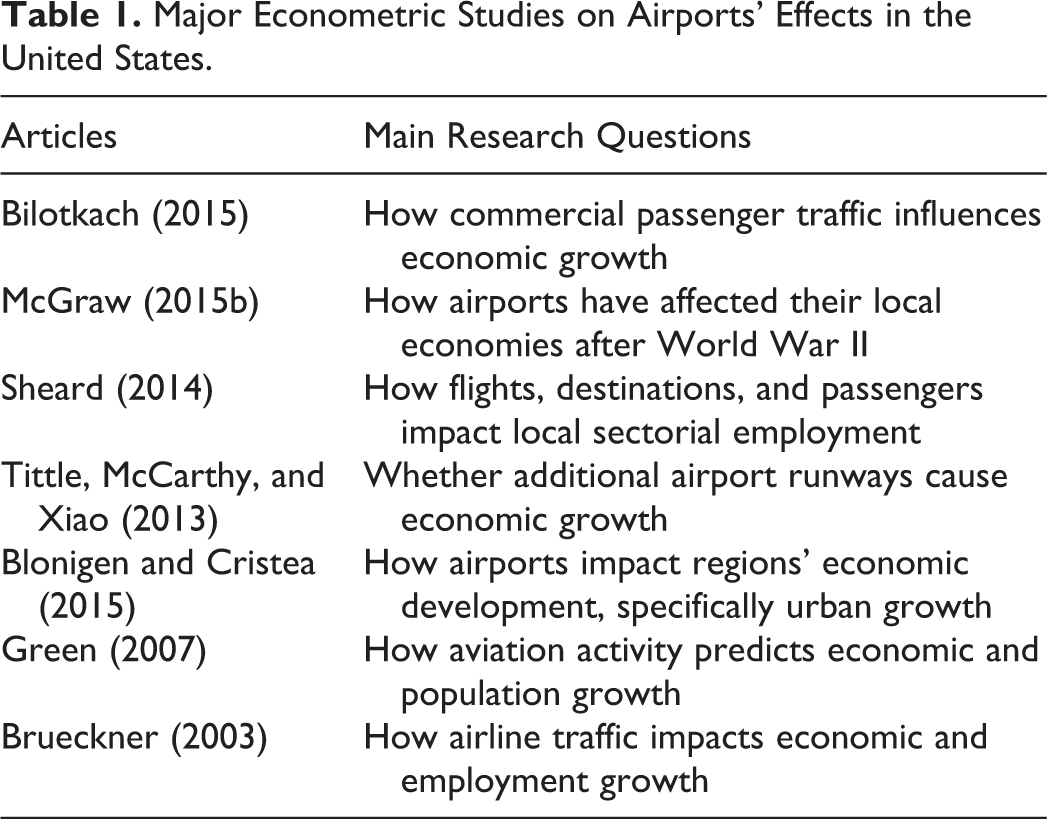
Effects of Airports and Air Traffic on Employment
Airports and air traffic seem to have positive effects on metropolitan employment overall. In general, communities with an airport seem to enjoy faster economic growth than those lacking one, albeit the relationship between economic growth and airports may consist of correlation rather than causation (Green 2007). Nevertheless, the average effects across metropolitan areas are rather limited and do not hold across all types of employment and traffic. The sectors of the economy most likely to benefit from airports and air traffic are professional services (Sheard 2014). Freight traffic, in contrast, might affect economic growth less than passenger traffic (Button and Yuan 2013). However, since most studies focus either on passenger or on freight traffic, it is difficult to compare their results. Most recently, scholars found positive impacts stemming from adding additional flights if they connect an airport to a new destination (Bilotkach 2015). Most crucially, for cities’ strategies to enhance their situation in the global competition, international destinations may influence headquarter location (Bel and Fageda 2008), but their effects on employment are less known.
These studies face specific econometric challenges, which scholars and economists in particular try to overcome in different ways. Investigating the links between airports, air traffic, and economic development with econometric tools presents three main problems: defining the geographical unit of study, tackling causality issues, and assessing the usability of findings. Regarding the first problem, most regional economic studies use the metropolitan area as the geographic scale where most of the airports’ economic impacts occur. This geographic level seems to be the most meaningful, even if it does not always capture an airport’s entire catchment area. The second issue, endogeneity, stems from the fact that the relationship of causality between the growth of air traffic at a given airport and the economic development in the metropolitan area runs both ways. Endogeneity requires either using sophisticated statistical techniques such as the use of lagged (Tittle, McCarthy, and Xiao 2013) or instrumental (Brueckner 2003; Sheard 2014) variables or strictly bounding the explanatory power of the statistical model to correlation (Green 2007). It is worth noting that economists produced relatively few studies of airports’ impacts on metropolitan economic development until recently, in contrast to other types of infrastructure like stadiums: Green explains this relative scarcity by the complexity of solving the endogeneity issue (2007). A recent stream of papers since Green’s study significantly added to this body of knowledge, which we review in this section: we also offer a brief discussion of their authors’ methodological choices. Finally, when studying a limited number of large infrastructure systems like airports and metropolitan areas, the contextual differences and idiosyncratic character of cities and airports challenge the replicability and usability of findings consisting of average effects across metropolitan areas. Researchers use different approaches to deal with those three issues, scope, causality and power of findings, leading to distinct results.
The impact of passenger air traffic on the total number of jobs in the US metropolitan areas seems overall positive. Brueckner finds that in 1996, a 10 percent increase in enplanements triggered an average increase of 0.9 percent in the total number of jobs within metro areas (2003). Nevertheless, the author’s strategies to solve the endogeneity problem and to use this result suggest caution. In contrast to other papers, the study assumes a simultaneous link between economic growth and air traffic rather than a lag, which is difficult to reconcile with traditional economic theory on the impacts of transportation investments particularly in terms of firm decision-making and job creation. Urban economists generally assume that the effects of transportation investments or additional transportation supply happen in the long term rather than in the short term. Additionally, as the model’s coefficients are by definition averages across a large number of geographies, it might be preferable that model results serve general recommendations rather than a single specific airport context.
Another important study aims to predict job growth using air transportation data, instead of claiming a causal relationship (Green 2007). Green finds that boardings and originations per capita in 1990 accurately predicted job and more surprisingly population growth from 1990 to 2000. In addition, hub cities grew much faster than nonhub cities. Green’s study adds significantly to Brueckner’s in that it also analyzes the impact of cargo, which is valuable to determine planning strategies and evaluate investment decisions. However, cargo activity does not appear to be a good predictor of economic development, which Green attributes to the fact that warehouses employ low-skilled, low-paid workers. Other scholars found that freight positively influences job growth, but their study focused on determining whether a relation of causality exists rather than estimating effects (Button and Yuan 2013). Overall, these studies suggest that airports and air traffic might influence total job creation in metropolitan areas. Understanding what sectors benefit the most from air traffic is of great importance to make policy and planning choices regarding airports.
Blonigen and Cristea measure the impact of airports on regions’ economic development, and specifically urban growth, by using a quasi-experimental method based on the deregulation shock that affected commercial aviation activity in 1978 (2015). The authors find “robust evidence that regional growth, as measured by population size, is directly affected by the availability of air services” (Blonigen and Cristea 2015, 138), and stronger effects for employment growth. They contend that the “estimated effects may be taken as a lower bound” since they have to use periods of much lower commercial aviation traffic to calculate them (Blonigen and Cristea 2015, 146). The authors use instrumental variables to address the issue that the changes in air service to communities after the exogenous deregulation shock are partly endogenous, that is, that air service reductions affected small communities the most.
Other studies focus on the economic effects of airports and passenger traffic on job growth in given sectors, especially professional services and manufacturing. Sheard (2014) measures the effects of flights, destinations, and passengers on local sectorial employment. He finds that air traffic most strongly impacts tradable services: finance, insurance, and real estate industries (an industry is considered to be “tradable” if a substantial proportion of its output can feasibly be produced in one location and consumed in another). His elasticity is higher than Brueckner’s, at 0.18, but it applies to the share of tradable services jobs within the metropolitan area rather than to the total number of those jobs. In contrast, Sheard finds no effect of air traffic on manufacturing or nontradable services. Like other recent reference urban economics studies on the impacts of transportation infrastructure (Duranton and Turner 2011), he uses data from a decades-old infrastructure plan, the 1944 National Airport Plan, as an instrumental variable. The National Airport Plan offers a satisfying instrumental variable for the shares of employment by sector: however, endogeneity exists between this variable and total employment levels, which effectively limits the scope of the results.
Several older studies concluded that airports and enhanced air service in North America positively impacted the manufacturing sector. Albeit at the state scale, which might be less relevant than the metropolitan area scale to measure airports’ impacts, as mentioned earlier, scholars found that “manufacturing costs are lower in hub states with greater own-state airport infrastructure stocks, implying cost saving benefits from airport improvements” (Cohen and Morrison Paul 2003, 471). In a study on the Carolinas, Debbage observed a similar correlation between passenger volumes and employment in the manufacturing sector (1999). However, the study does not control for other factors. Overall, effects of air traffic on services jobs seem higher than on manufacturing jobs, but these studies predate changes in manufacturing since 2000.
Within professional services, international passenger traffic might play a specific role for corporate networks and headquarters. Two hypotheses coexist. The first is that corporate and aviation networks strongly influence each other. The second is that the number of nonstop flights directly influences headquarters location. In the first hypothesis, corporate and aviation networks tend to reinforce each other without a clear direction of causality (Liu, Derudder, and García 2013). In the second hypothesis, regarding headquarters more specifically, economists found evidence of a clearer causal relationship, albeit in the European context. They found that “a 10% increase in the provision of intercontinental flights involves around a 4% increase in the number of headquarters located in the corresponding urban area” (Bel and Fageda 2008, 488). Whether these results have policy implications remains unclear: headquarters relocations, though sometimes used by large firms as a negotiation tool with local governments, are rare and cases where air service was a primary motivation remain anecdotal.
The evidence regarding high-tech jobs is relatively scarce. One team of scholars published a few articles on the effects of hubs on high-technology industry location in the late 1990s. The hypothesis that hubs provide a stimulus for high-technology jobs to grow in the region is not entirely convincing, since four case studies only provide loose evidence of hub effect (Button et al. 1999). The authors suggest that high-tech industry requires many interpersonal contacts, which in turn require high-quality transportation (Button and Stough 2000). This argument, however, is highly disputed. On one hand, the developments in communication technology replaced some face-to-face contacts. At the same time, the need for such contacts for negotiating deals and other essential business activities did not decrease (Aguilera 2008). On the other hand, urban economists suggest that the trend of high-tech industry toward ever greater clustering is due to the importance of interpersonal contacts in a daily manner, rather than occasionally by traveling large distances (Moretti 2012). Finally, the value of a well-connected airport as an amenity for attracting talented or “creative” workers remains unexplored, even in Richard Florida’s work on airports and economic development (Florida 2004; Florida, Mellander, and Holgersson 2014).
Effects of Infrastructure Stock Changes: Airport Capacity Expansion
The effects of airport capacity expansions on regional growth are very controversial and require further empirical research to help planners design appropriate regional economic development strategies relying on such projects. Some scholars advance arguments supporting that airport capacity expansions generally provide economic benefits, even in otherwise adverse economic conditions. Others suggest that airport expansions may trigger growth only when they meet relatively stringent conditions, and that even then, the effects remain unclear.
The economic effects of airport capacity investments are complex. Like other major infrastructure investments, airport capacity expansion projects are lumpy (Swaroop et al. 2012), which is inherently problematic in a changing industry where the demand and supply for flights constantly evolve. Nunn finds that airport investments are not necessary when metro areas are already successful, while they cannot offer a panacea for sustainable regional economic growth in other cases (2005). Different types of areas seem to influence the success or failure of airport investments: peripheral or central, midsize or large, metropolitan or not. Within the US context, Johansson concludes from a case study on Nashville that midsize cities “have the greatest incentive to engage in entrepreneurial policy in the air transport area” (2007, 377). He finds that air service levels do not necessarily match the population of midsize cities, in contrast to smaller (below 700,000 residents) and larger metropolitan areas (above 1,800,000). Therefore, midsize metros might benefit from air transportation investments the most.
Tittle, McCarthy, and Xiao investigated whether airport runway additions cause economic growth (2013). They use a panel data analysis of airports in thirty-five Metropolitan Statistical Areas (MSAs) and analyze specific cases of runway additions at several airports. The authors use lagged value instruments to solve the endogeneity issue. Their “results suggest that the addition of a runway may have unintended consequences whose net effect may hinder rather than spur economic development.” The authors consider that runway investments can contribute to “reducing airport costs per passenger,” which in turn can increase “air traffic volumes that facilitate metropolitan development and growth” and reduce congestion (Tittle, McCarthy, and Xiao 2013, 230). However, adding runways would certainly increase average costs per passengers, unless there is enough additional air traffic to lower average costs, in which case airport congestion might be back (Zou and Hansen 2012). Therefore, it is unclear how airport capacity expansions could contribute to economic growth in the metropolitan area by lowering the cost of using the airport.
Finally, a concern emerges that expanding and improving an airport may simply shift business development intraregionally or interregionally rather than spur new development (B. Graham and Guyer 2000). At national level, developing airports may be a zero sum game for business development.
The Risks of Airport-based Regional Economic Development
Airport-based regional economic development presents three types of risks. Economic risks can affect the entire region, since they stem from the nature of the air transportation industry, where airlines’ decisions can be at odds with public investments and policies. Equity and real estate value risks are local: air traffic and airport growth generate negative impacts for populations residing near the airport, especially in the flight paths, raising the question of environmental justice. Finally, airport development threatens property values, which is of primary importance for municipalities close to the airport striving to spur economic development and preserve their tax base.
Air Transportation Changes and Economic Risks
Airlines determine the service (flights, destinations) they provide at each airport: as a result, planning is mostly limited to air service incentives and airport investments aiming to attract airlines. Airlines are private actors that aim to maximize profits for their shareholders. This profit maximization objective is often at odds with the wished-for air service of local governments. As a result, regional economic development relying on air traffic is at risk if the main airline serving an airport decides to de-hub or even simply deemphasize their service at that airport. The literature is much less definitive on this topic, which stands at the edge of the research on airports’ economic impacts: as a result, this section is more exploratory. First, we summarize the extent of the literature on de-hubbing. Then, we review the state of research on the causes of de-hubbing, before suggesting some research directions on the economic consequences of de-hubbing and on the possible interventions cities can plan to mitigate the risk of de-hubbing or spur recovery.
The literature is relatively scarce on de-hubbing, which happened at several midsize US metropolitan areas’ airports including Cleveland, Pittsburgh, Memphis, Cincinnati, St. Louis, and to a lesser extent, Memphis and Orlando. A limited number of papers do review the impact of de-hubbing on European airports. Some scholars argued that air traffic losses after de-hubbing were both dramatic and irreversible (Redondi, Malighetti, and Paleari 2012). However, low-cost airlines sometimes come in after a de-hubbing, contributing to a partial recovery in seats offered (Bohl 2013). Other scholars suggest that de-hubbing impacts on business travelers might differ significantly from those on tourists: while business travelers might suffer from a loss of service to important economic centers, tourists might gain access to secondary airports serving vacation destinations (Bilotkach, Mueller, and Németh 2014). Nevertheless, the application of these findings to US cases might be problematic: European countries’ main airports are generally located near capital cities of centralized, primacy urban systems (Goetz 2015). The loss of a hub in a given US metropolitan area does not preclude access to or from the country, and presumably opens fewer opportunities for low-cost airlines.
Research on the factors of de-hubbing suggests that cities affected share some economic and geographic similarities and that airline mergers play an important role. Pioneering work in aviation scholarship long identified that the most stable hubs are those with very strong origin–destination markets, typically located in the largest US cities (Hansen 1990). In turn, a strong origin–destination market tends to make airlines’ hubs more sustainable over time and more likely to resist cyclical economic crises. Midsize cities, a group to which most de-hubbed cities belong, have the greatest variation in air service (Johansson 2007). De-hubbed cities also tend to be located in the Midwest; scholars noted the concentration of hubs within 500 miles of Cincinnati in the 1990s (Bania, Bauer, and Zlatoper 1998). Nevertheless, such research seems to have remained outside of the purview of urban scholars and economists, despite its strong implications for cities where the local market did not seem to warrant strong hub service. Beyond metropolitan area characteristics, however, de-hubbing seems to depend on major aviation industry trends toward mergers, service rationalization and cost cutting, as seen above. While these trends might suggest which remaining hub airports are at risk of de-hubbing, the complexity of airline decision-making and the individual characteristics of each airport and metropolitan area make it difficult to observe the full set of causal factors behind a de-hubbing decision. Significant terminal investments by a hub airline like Delta in Atlanta might also contribute to maintain their “fortress hubs” (Zhang 1996).
Should cities fight against or attempt to mitigate de-hubbing? Presumably, responses to de-hubbing should only happen when disruptions in connectivity significantly affect the competitiveness of local businesses, causing an increase in transportation costs for the local economy. If de-hubbing is a simple response of airlines to lower local demand, then it can either simply reflect the consequences of local economic decline or further that decline by increasing the costs of doing business. Unfortunately, the literature is scarce on the economic implications of de-hubbing on the US metropolitan areas. Attempts at analyzing these effects are rare (McCormick 2015). A recent unpublished study considers the effect of hub closures since the 1990s and finds overall limited effects of such events (McGraw 2015a). However, scholars face significant challenges because of the limited number of cases, which prevents the use of many statistical methods. As a result, the regional economic implications of de-hubbing are generally unknown, which limits the ability of cities to find the adequate strategy to respond to a threat or an actual occurrence of de-hubbing.
It is not clear how cities can mitigate this risk, beyond negotiating gradual de-hubbing and obtaining service continuation guarantees from airlines after a merger (Shaw and Ivy 1994). Journalistic accounts make clear that cities exert little influence on the aviation economic factors leading to de-hubbing, in the cases of Cleveland or Memphis (Sheeran 2014; Risher 2013). Thus, a better understanding of the hub location literature or the airline planning process more generally would hardly help cities to prevent de-hubbing. Scholars investigating European de-hubbing cases argue that airports subject to supply shocks should have the tools and the freedom to react to such shocks (Bilotkach, Mueller, and Németh 2014). In effect, two strategies seem to emerge, luring low-cost airlines and increasing freight traffic. Both strategies have limits. The former cannot bring the level of connectivity prior to de-hubbing with certainty, let alone add coveted international traffic. The latter opens up opportunities for economic development, but those are quite different from passenger hub traffic and their effects are potentially less significant. The lack of influence of cities and metropolitan areas on airline behavior suggests that at the very least, midsize urban areas should be careful when they try to enhance economic development-based thanks to air traffic growth.
Equity Risks
Bolstering air traffic for economic development generates negative environmental externalities that raise important equity risks. Air and noise pollution bear heavily on populations living near the airport. Local populations may also suffer from displacement while not necessarily benefiting from the job creation triggered by increased air traffic and airport expansion.
The fact that some populations tend to bear disproportionately the negative impacts of air traffic and airport growth, especially when they live in the flight paths, raises the question of the environmental justice (Sobotta, Campbell, and Owens 2007; Bloom 2015; Goetz 2015). Local governments and airport authorities may compensate residents for this unequal distribution of environmental costs, financially or materially (by soundproofing programs financed by passenger fees, for instance). However, scholars note that soundproofing does not solve all the noise exposure problems, in particular for children’s reduced access to outside spaces (Sobotta, Campbell, and Owens 2007). In some dense areas like Queens, around New York’s John Fitzgerald Kennedy Airport, the Port Authority of New York and New Jersey invested much less in soundproofing than other airport authorities (Bloom 2015). In addition, expanding the airport is not the only intervention that can increase the impact of these negative externalities. Even a sheer modification of the airport’s plan can alter the noise contours by relocating runways and modifying approaches. These alterations can increase the exposure to pollution for population segments that air traffic was not affecting prior to the change. In the worst-case scenario, the modification of noise contours can force displacement of residential communities through eminent domain (Cidell 2013; Bednarek 2014). Displacement can create issues of affordable access to similar housing, as in the case of Chicago’s western suburbs (Cidell 2013). It can also result in losses of community belonging, social capital and quality of life that are ultimately hard to compensate, as documented within the urban renewal literature (Gotham 2001; Ammon 2016). Historians highlight the parallels between displacement caused by highway building and that triggered by airport expansion. In cases like St. Louis, the consequences of historical displacements bear heavily today on the socioeconomic differences within and between suburban communities surrounding the airport: some of the poorest communities received waves of population displaced by the airport expansion, aggravating the contrasts between different suburbs and neighborhoods (Bednarek 2014).
The seemingly irreversible losses caused by airport expansion add on to long-term issues of exposure to noise and air pollution, which recent literature investigated. Geographers and aviation scholars reviewed the public health and medical literature showing negative impacts of aviation noise pollution: sleep disturbance and stress (Sobotta, Campbell, and Owens 2007; Cidell 2013). Aircraft noise also seems to affect schoolchildren’s performance negatively (Haines et al. 2001). Three studies investigate specifically the environmental justice impacts of, respectively, airport noise and air pollution. They all find that these forms of pollution disproportionately affect minorities. Nevertheless, these studies analyze specific cases (Phoenix, Atlanta, and Boston), which limits the replicability of their findings to other airports in terms of environmental justice, even though the pollution impacts themselves are likely to be similar across large airports (Sobotta, Campbell, and Owens 2007; Ogneva-Himmelberger and Cooperman 2010; Rissman et al. 2013). Sobotta, Campbell, and Owens emphasize that the current knowledge of the spatial distribution of noise pollution impacts is lacking, which potentially limits the ability and effectiveness of policy interventions to mitigate these impacts. The process of delineating noise contours and deciding noise strategy reductions seems to be complex and fraught with many potential biases, which tend to underestimate the geographic extension of noise pollution. In fact, many noise complaints come from outside the noise contours (Sobotta, Campbell, and Owens 2007). Regarding local air pollution, recent studies attempted to quantify the intensity and the geographic dispersion of fine particulate matter (PM2.5). This type of air pollution is especially problematic, since individuals cannot perceive such air pollution directly (Rissman et al. 2013). This form of air pollution affects the respiratory system of adults and children, increasing the likelihood of asthma and respiratory diseases. Airports belong to the unwanted land uses in the impact area of which minorities are more likely to locate because of their socioeconomic conditions (Bullard 2007). Thus, expanding the airport and increasing air traffic can reinforce systemic inequality and its impacts within a metropolitan area, under certain circumstances.
Scholars also observed two different geographies of air traffic growth impacts within metropolitan areas, that of job creation and that of environmental costs. In addition, while neighboring populations endure most of the costs of development, the type of jobs created by air traffic growth may neither match the employment centers those populations can access (thus triggering another occurrence of spatial mismatch) nor their skills, as highlighted in another recent paper by Cidell (2015). These discrepancies led to conflicts between regional economic growth and negative local impacts in the settings of Chicago and Boston, in particular (Cidell 2013; Marchi 2005).
Risks for Real Estate Values
City-level economic development strategies aim to increase the value of taxable property to support municipal expenditures on services, among other objectives. While proximity to airports generate negative externalities for households, which are capitalized in discounts on real estate prices, access to the airport also creates additional value capitalized in premiums on those prices. Ultimately, the combination of air traffic growth and airport expansions may lead more and more property to be located in in flight paths, which diminishes real estate prices. Theoretically, however, a well-connected airport should increase property values within the metro area, as it provides an additional amenity and reduces the costs of doing business.
Hedonic pricing offers a powerful tool to evaluate these costs and benefits (Cohen and Coughlin 2008). The lack of information on firm rents for commercial buildings, nevertheless, constitutes a major limitation of this literature. As a result, while the literature is relatively abundant on the impacts of airports on residential prices, we know relatively little on their impact on commercial real estate, except for a few descriptive analyses of specific cases, especially for airports outside of the United States, in the Netherlands or in Australia (Hakfoort and Poot 2001; Walker and Stevens 2008).
Studies estimating the values of the noise discounts and access premiums found conflicting evidence. A pioneering investigation of the case of Manchester airport, in the United Kingdom, concluded that the airport access premium was greater than the noise discount, but even there, mixed effects occur. Winners and losers emerge, which generates additional equity issues: communities within the higher-level noise contours do not benefit as much from home value increases as communities close to the airports but outside of the noisiest areas (Tomkins et al. 1998). Subsequent studies by Cohen and Coughlin on Atlanta and McMillen on Chicago confirmed both these dual effects and the fact that the premium for access to the airport more than offsets the noise discount (McMillen 2004; Cohen and Coughlin 2008). The range of effects is 7 percent to 20 percent for the noise discount within the noise contour zones. Home values also decrease as the distance to the airport increases, with an elasticity of 0.15 for Cohen and Coughlin’s study and a 2.5 percent decrease per mile for McMillen’s. However, studies analyzing how the impact of airports on residential property values changes over time foster less optimism. McMillen found that noise-reduction technology improvements suggested that the impacts of future airport expansions in Chicago would be lesser and lesser on property values. In contrast, other studies found increasing discounts of noise over time, between the 1990s and the 2000s (Cohen and Coughlin 2009). In addition, the announcement of a regional air-cargo hub at Greensboro/High Point/Winston Salem metropolitan airport in the mid-1990s significantly decreased home values within a four-mile radius around the airport (Jud and Winkler 2006). Disclosure of airport noise around Charlotte International Airport had similar effects (Pope 2008).
Conclusion
A gap exists between (1) policymakers’ views and hopes on the role of airports as drivers of metropolitan areas’ economies and empirical analysis and (2) the lack of scholarly knowledge about the balance between the benefits and the costs of airports. Recent econometric literature makes clear that airports generate on average significant economic benefits for their metropolitan areas, between 0.9 percent (for all sectors) and 1.8 percent (for tradable services sectors) additional jobs for 10 percent additional enplanements (Brueckner 2003; Sheard 2014). However, the scale and magnitude of these economic effects vary according to the study’s method, period and sample. The value of investing in the airport as an economic development strategy remains unclear. Airports clearly play an important role in the global urban competition, even if they do not trump larger economic trends leading to cities’ decline or growth. Some areas around airports show strong local economic development, but there is no agreement on whether such development stems from actual economic activity creation rather than relocation within the metropolitan area.
However, researchers clarified the risks of the initiatives aiming to bolster air traffic and economic development. Airport expansion and air traffic growth have negative impacts and externalities that are highly concentrated, in contrast to potentially widely distributed benefits. While airport and air traffic development may have an overall positive impact on real estate values and generate economic growth throughout a region, such development negatively affects air quality, housing values, and the overall quality of life in zones surrounding the airport. The discrepancy between costs and benefits raises issues of environmental justice.
This article provides a starting point for planning researchers to enter and take the lead in the conversation about the future place of airports in the US metropolitan areas. Planning scholars are in a good position to adopt the interdisciplinary perspective needed to provide a synthetic view of these risks, which requires weaving together several fields of expertise. This article presents a four-pronged research agenda that can bring planning with the airport for economic growth, rather than sheer airport planning, to the fore of planning scholarship.
The first prong of this research agenda regards the state of the practice: systematic research would help understand whether and how airport, city, and regional plans adopt and support the often optimistic vision of airports’ economic impacts. Such research can question and inform the practice of airport planning.
Second, planning scholars should investigate the variation of airports’ roles and effects between metropolitan areas to identify airport and air traffic strategies that lead to economic growth. Such research would help planners to play the role of brokers between the progrowth aviation industry and the critics of the negative environmental impacts caused by airport growth (Freestone 2009).
The third research direction focuses on the impacts of airport capacity expansions. The literature is scarce and does not offer clear estimates of airport expansions’ economic effects. More empirical research is required to help planners understand how regional economic development strategies can capitalize on such projects. It is also necessary to introduce place-specific complexity within this topic through case study research, as well as ex post studies analyzing medium and long-range effects of airport expansions.
Finally, planners need to become more aware of the fiscal impacts of airports beyond the financing of airport projects. They would greatly benefit from further research on the impact of a well-connected airport on real estate values within the entire metropolitan area, since property values directly influence the tax base that cities rely on to provide urban services to their residents.
In sum, research on airports and economic development has made significant progress over the last few years. Much remains to be explored to provide a better understanding of these links that would lead to economic development strategies that capitalize on a growing airport infrastructure, while acknowledging its environmental costs.
Footnotes
Declaration of Conflicting Interests
The author(s) declared no potential conflicts of interest with respect to the research, authorship, and/or publication of this article.
Funding
The author(s) received no financial support for the research, authorship, and/or publication of this article.