



Abstract
In view of the demographic profile of the older adults in the United States, in the next two decades, cities and communities need to adapt the form, environment, and transportation systems to accommodate the growing aging population. In this article, I review two streams of literature in the mobility among the older population: the mobility/living environment and wellbeing; the relationship between living environment and mobility. I argue that two streams of literature should be combined to inform an interdisciplinary dialogue and a new agenda for future research.
Introduction
The global population is aging, with increases in the number of seniors in almost every country in the world, a phenomenon that is dramatically shaping future cities, suburbs, and countryside (United Nations 2017). In 2015, there were 617.1 million people older than sixty-five years old in the world, consisting of 8.51 percent of the global population. Further, their share in East Asia and Europe is even higher. For example, in Japan, Germany, and Italy, people aged sixty-five and plus constitute more than 21 percent of the population (He, Goodkind, and Kowa 2016).
According to the national census, the United States shares this picture with 49.2 million people aged sixty-five and plus, making up 15.2 percent of the whole population. Older persons will have a greater dominance in the United States. In 2035, the nation’s 78 million older people (sixty-five years and older), largely baby boomers (born between 1946 and 1964), will outnumber those under eighteen for the first time in US history (US Census Bureau 2018). It is equally notable that there are evident variations among seniors in the States. According to a report from Administration of Community Living (2017), 6.4 million among the seniors in 2016 are older than eighty-five years old. As the average longevity of the older population increases, the proportion of the old–old are steadily increasing in the United States. Moreover, 20 percent of the older men and 34 percent of the older women in the United States live alone and thus need additional social support and assistance. Around 35 percent of them reported to have some extent of disability. It cannot be ignored that many older people are disadvantaged in race, income, and language (Administration for Community Living 2017). African Americans and Asians constitute 9.1 percent and 4.3 percent of the older population. Additionally, 9.3 percent of the older population are living in poverty. What is worse, 26.2 percent are not US citizens. Nearly 15 percent could not speak English. In terms of geography, more than half of the older population live in ten states, including Florida, California, Texas, New York, and Pennsylvania.
In view of the demographic profile of the older adults in the United States, in the next two decades, cities and communities need to adapt the form, environment, and transportation systems to accommodate the growing aging population.
According to a report by the American Association of Retired Persons (AARP 2018), nearly 80 percent of older adults hope to stay in their homes and communities as they age. However, only 59 percent believe they can stay in their communities as they age. Many seniors experience driving cessations and would find it much more difficult to access various destinations (Rosenbloom 2009; Taylor and Tripodes 2001). It is also increasingly difficult for them to maintain and move around in large-sized single-family dwellings, especially for those with functional mobility difficulties. There are many challenging questions facing scholars in various disciplines targeting older adults on how to help them age healthily and happily: is staying in their own homes or communities the best way for every senior in their later life? How to evaluate whether it is the best strategy? How could the public policy makers help the seniors to live in the most desirable places?
This review aims to answer the above questions from the perspective of the living environment and transportation. Living environment and transportation are two important components in seniors’ daily life determining their accessibility to opportunities and social networks. An aging-friendly environment means a place with proximity to aging-friendly amenities such as parks, activity centers; and living close to their fellow friends and/or families. However, if the older adults have the capability to control multimodal transportation resources including driving, public transit, and walking, they could still enjoy a happy later life with better mobility than others. Therefore, the living environment and transportation should be linked together, and we hope that every senior could live in an environment with desirable accessibility to fulfill their needs and help them to maintain their quality of life (QoL). From the policy perspective, we aim that policy makers could identify those with unmet needs and improve their living environment and transportation to enhance their QoL.
The above discussion shows that the final goal of creating aging-friendly communities is to improve the QoL in seniors’ later lives. Therefore, promoting aging-friendly living environment and promoting the mobility among older adults have the same overarching goal: improving their wellbeing.
Since the 1990s, scholars from various disciplines including urban planning, transportation, social work, gerontology, and public health developed their works under the wellbeing umbrella. However, these works are not well integrated into a single conversation. Although many public health scholars, housing scholars, and social work scholars in this field conducted many empirical works exploring the neighborhood environment and wellbeing (Yen, Michael, and Perdue 2009; Golant 2015; Kerr, Rosenberg, and Frank 2012), they simply failed to consider the seniors’ capabilities to control multiple transportation resources. For other scholars in the above fields and most transportation scholars (Nordbakke and Schwanen 2014; Rosenbloom 2009; Taylor and Tripodes 2001), they rarely considered the solutions on retrofitting the living environment. The failure to consider either part renders local governments and communities unable to come up holistic strategies to help the seniors to improve QoL.
Some recent publications identify these gaps and aim to consider the living environment and transportation together to come up with future planning strategies involving various stakeholders (Molinsky and Forsyth 2018; Scharlach and Lehning 2015; Warner and Zhang 2019). Nevertheless, there exists no literature review to systematically address the knowledge gaps among the living environment, mobility, and wellbeing among the seniors.
This review embraces this interdisciplinary dialogue on how to improve the QoL for seniors with an integrated strategy of the living environment and mobility. Our definition of living environment is broad: it includes housing units where seniors live, the available social support in the units, and the social and built environment of the units at the community and local level. Mobility in this study is not equivalent to functional mobility as in public health. Instead, it measures the ability to move around to attend daily activities with various means of transportation.
Bridge Living Environment, Mobility, and Wellbeing among Seniors
In this section, I lay the theoretical foundations for my review framework. I argue that living environment and mobility are intertwined under the umbrella of wellbeing. Moreover, the firm connections between living environment and mobility are implicit in the gerontology literature early in the 1980s and have some progress since then. Therefore, this article calls for an agenda to bridge living environment, mobility, and wellbeing among seniors. The first subsection articulates the theoretical foundation for this interdisciplinary dialogue and the review framework. The second subsection narrows down the measurements of wellbeing in this review.
A Timely Interdisciplinary Dialogue
The interaction between people and environment under the wellbeing umbrella stems from Lawton (1982)’s person–environment fit theory. He argues that older adults interact themselves with the surrounding environment. Only when the environment and the person abilities have a good fit, the overall physical and mental health of the seniors could maintain.
Lawton’s seminal work raised an important question: how seniors adapt themselves to the surrounding environment? Baltes and Baltes (1990)’s successful aging model provides three ways how seniors could better fit the environment with their potentially declining and losing functions: (1) selection: seniors may rescale their goals to more manageable ones. (2) Optimization: seniors may engage and invest in goal-related actions. (3) Compensation: seniors may also invest in compensatory means to battle the functional loss.
Living environment and mobility are two important components for the older adults to age successfully. Where older adults live is critical for the older adults in various means: it determines how many social activities and social networks they could reach. Also, owning a house in the later life usually means the control of environmental privacy and pride in the properties (Golant 2015). However, living in the original house or community in their younger times usually mean that they have to be sound in health and finance to maintain and use the house, especially for American seniors most of whom live in rural and suburban single-family houses (Golant 2015).
Mobility is a means to help the older adults to cope with environmental risks successfully. Daily mobility, especially the motorized vehicles, could enlarge the options of accessing daily opportunities and help the seniors to be more involved in social activities, maintain and enlarge their social networks. However, many seniors may have difficulties in their daily lives to control transportation resources, of which driving cessation is the largest challenge. Many previous studies found that driving is very important for the older adults in the United States to maintain self-confidence and the sense of self-achievements (Ziegler and Schwanen 2011; Baldock et al. 2006). Those who experience driving cessations may have a higher risk of having mental and physical health problems and need additional interventions (Marottoli et al. 1997; Taylor and Tripodes 2001).
Seniors may select, optimize, and compensate living environment and transportation resources to achieve a new person–environment fit. For example, for those who lose the ability to drive, they could move to places with a closer proximity to urban opportunities and everyday needs or ask their family members, friends, or neighbors to help. For those who are healthy and have enough financial resources to live in their original place and be able to drive, they could live in their original house and community and reach the social destinations by car.
Wellbeing is a framework to measure how well the seniors adapt themselves to the environments and mobility resources. Although there is not a well-developed definition of wellbeing, scholars from different disciplines including psychology, public health, economics and medicine believe that wellbeing is a multidimensional concept with two main streams: (1) hedonic wellbeing which measures the happiness and positive affect; (2) eudaemonia wellbeing which focuses more on human development and the ability to achieve one’s goals (Dodge et al. 2012; La Placa, McNaught, and Knight 2013). These two streams of works are both important to understand the success of aging. However, the wellbeing framework has not been well established to examine the fit between the living environment and mobility among the older adults.
One obstacle of this integration is the lack of understanding of wellbeing among the transportation scholars. In the last decades, some pioneer transportation scholars argue that travel behavior measurements, such as mode choice and car use are vague metrics to evaluate the role of transportation system in individual development. Instead, individual-level wellbeing measurements, widely used in psychology and public health and measuring QoL in a more direct way, should be used as measurements to evaluate the role of transportation resources and systems (De Vos et al. 2013; Morris 2015). To our knowledge, only one paper reviews the progress in wellbeing measurements among seniors from the mobility perspective (Nordbakke and Schwanen 2014). Their review summarized ten approaches framing the relationship between mobility and wellbeing among seniors. However, this review did not pay much attention to the empirical findings.
Another obstacle is the lack understanding of mobility in the living environment research. The residential location choice is one important perspective to understand the relationship between living environment and mobility. There is a large amount of research in sociology, social work, gerontology and public health linking the living environment of older adults and their wellbeing (Yen, Michael, and Perdue 2009); however, the role of mobility in residential location choice is not well established.
The importance of mobility in residential location choice in later life is implicit in the classical residential location choice models. Sociologists and gerontologists have developed several theories to explain the mechanisms of seniors’ residential relocation. For example, Litwak and Longino (1987) analyzed the residential relocation process using the life-cycle theory. They identified three stages in seniors’ residential relocation: at the first stage, they move to places with better amenities, weather, and locations after retirement. The second stage happen when they perceive the decline in physical function and mobility and move to places near children or friends. At the third stage, they would move to others’ houses or senior institutions. Meyer and Cromley (1989) developed the model by adding the fourth stage, when people anticipate seeking new assistance network. The seniors’ residential relocation processes are achieved by reevaluating “their residential location according to their needs, desires, resources, and the potential residential locations and potential outcomes” (Haas III and Serow 1993). In the model and relocated model, the second, third, and fourth stages are all related to the declines of physical and functions, which would directly influence the ability to control transportation resources and driving cessation. However, the attempt to bridge the living environment and mobility among the older adults is very recent in urban planning (Molinsky and Forsyth 2018; Scharlach and Lehning 2015).
In view of the above gaps in existing literature, the aim of this review is to bridge an interdisciplinary dialogue of the living environment, mobility, and wellbeing among seniors by critically summarizing the literature in different disciplines intersecting living environment, mobility and wellbeing. As shown in Figure 1, I review two streams of works: the relationships between living environment/mobility under the wellbeing umbrella, and the research intersecting mobility and living environment. The figure also shows the disciplines which most of scholars focusing on different topics belong to.
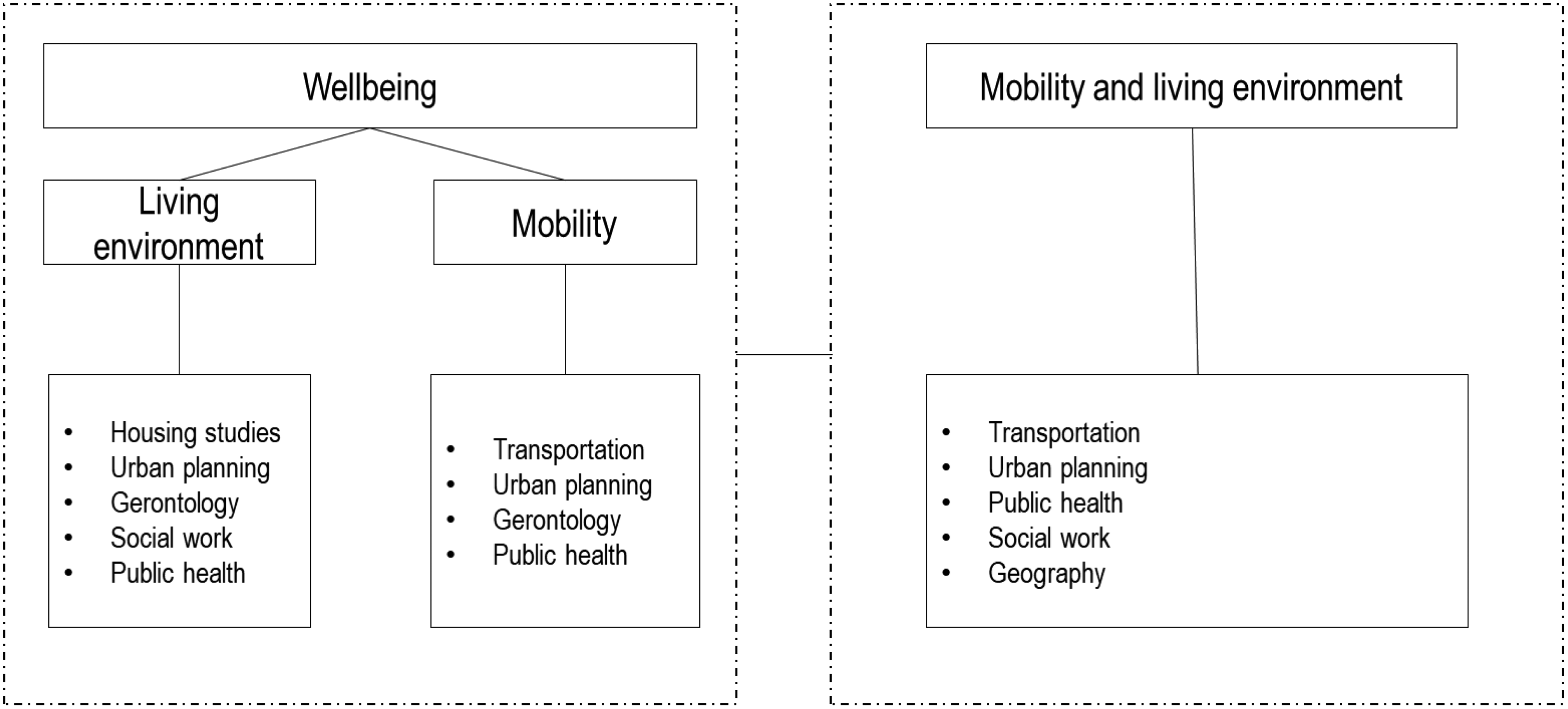
The review framework.
Wellbeing Measurements
In this literature review, I review three streams of work most relevant to aging-friendly planning: (1) Heath QoL and subjective wellbeing (SWB), all of which are quantitative indexes developed to examine the human development, life satisfaction, and health status of the older population. (2) Basic needs and capability approach, which analyzed to what extent older population’s mobility preferences, desires, and the capability match their mobility needs from the individual perspective. (3) Travel and residential satisfaction, two subfields investigating seniors’ satisfaction over the transportation system and travel experiences.
The first category of measurements includes composite indicators and single indicators. While composite indicators, mainly QoL (Gill and Feinstein 1994; Drummond 2001) and SWB (Steptoe, Deaton, and Stone 2015; Diener 1984; Okun and Stock 1987), could holistically measure the individual-level evaluation of life and could be better used as an indicator in policy evaluation, single indicators, such as more specific aspects in physical health (such as self-reported health), mental health (such as loneliness and depression) or mortality, could target on one aspect of life more accurately and better inform public health and policy interventions. Among the composite indicators, QoL is a comprehensive indicator using different methods to measure people’s perception of their position in life and their overall satisfaction. SWB, similar to QoL, measures the elements of self-realization, including independence, self-acceptance, and relationships with others (Nordbakke and Schwanen 2014). One of the most widely used measurement of SWB is PANAS. PANAS is comprised of two subsets of measurements, “PA” representing positive mood and “NA” representing the negative mood (Watson et al. 1988). While health status could also be captured by SWB and QoL, they are more widely measured by single indicators listed above.
One limitation of the above quantitative measurements is that they are unable to explain why different factors such as environmental, behavior, and policy interventions contribute to people’s wellbeing. Instead, basic needs and capability approach provide frameworks to explain why these factors matter in seniors’ later lives.
Basic need method explained seniors’ wellbeing from a need perspective. American psychologist Abraham Maslow proposed the hierarchy of needs (Maslow 1943). In his theory, transportation and housing are both survival needs, serving as the premise to pursue higher needs in one’s life.
Notably, the basic needs theory discussed above identifies types of needs but does not identify the ways to achieve different levels of needs. Economist Amartya Sen’s (1993) capability approach proposed that people’s abilities determine their potentials and their actual position in society. In Sen’s theory, wellbeing is the freedom to live a desirable life and achieve different functions in the society. Sens’ capability approach encompasses people’s ability in controlling the transport system and responding to environmental risks to meet their daily social, economic, and psychological needs in their later lives.
Finally, in transportation and housing studies, some scholars used the travel satisfaction and housing (residential) satisfaction as tools to evaluate urban transportation and housing programs.
Method
Based on the above review framework and the measurements of wellbeing, I conducted a search in Web of Science and Scopus using the following combinations of key words:
Key words A denote seniors including seniors, elderly, 65 plus or older adults/population.
Key words B denote transportation-related terminologies including transport, car, automobile, travel, mobile, transportation, active travel, walking and physical activity.
Key words C denote living environment-related terminologies including housing, living, resident, physical environment, social environment and built environment.
Key words D denote wellbeing including QoL, wellbeing, wellbeing, health, capability approach, need, and satisfaction.
At the first stage, I searched the literature on the relationship between mobility and living environment on wellbeing using a combination of key words A, B/C, and D; and the literature intersecting living environment, transportation, and wellbeing among the seniors using all four sets of key words.
After that, I searched the literature on the interrelationship between housing and transportation among seniors using key words A, B, and C. I only included papers published since 2000. I included studies not limited to the United States because studies from other aging societies may also be helpful to inform future research and policies in the United States. Though automobile cultures in developing and developed countries are quite different among the seniors, I still included a few studies from developing countries because some factors influencing travel and housing choices, such as cultural traditions and family structures are rarely explored in the American studies.
At the second stage, I identified the review articles and the most recent and relevant papers published since 2015 to identify the important studies and authors that I did not cover in the search.
At the final stage, I read the abstracts of the selected articles in the above two stages and screened the papers based on the following criteria: (1) the article’s focus should be seniors. (2) The article needs to clearly intersect at least two elements among living environment, transportation, and wellbeing in their methodology. (3) For papers on wellbeing, they should have clear measurements on wellbeing and the measurements should be one of those in my framework in the third section. (4) I also excluded those papers whose concept of mobility was not consistent with my definition, including those focusing exclusively on the functional mobility, social mobility, and tourism mobility.
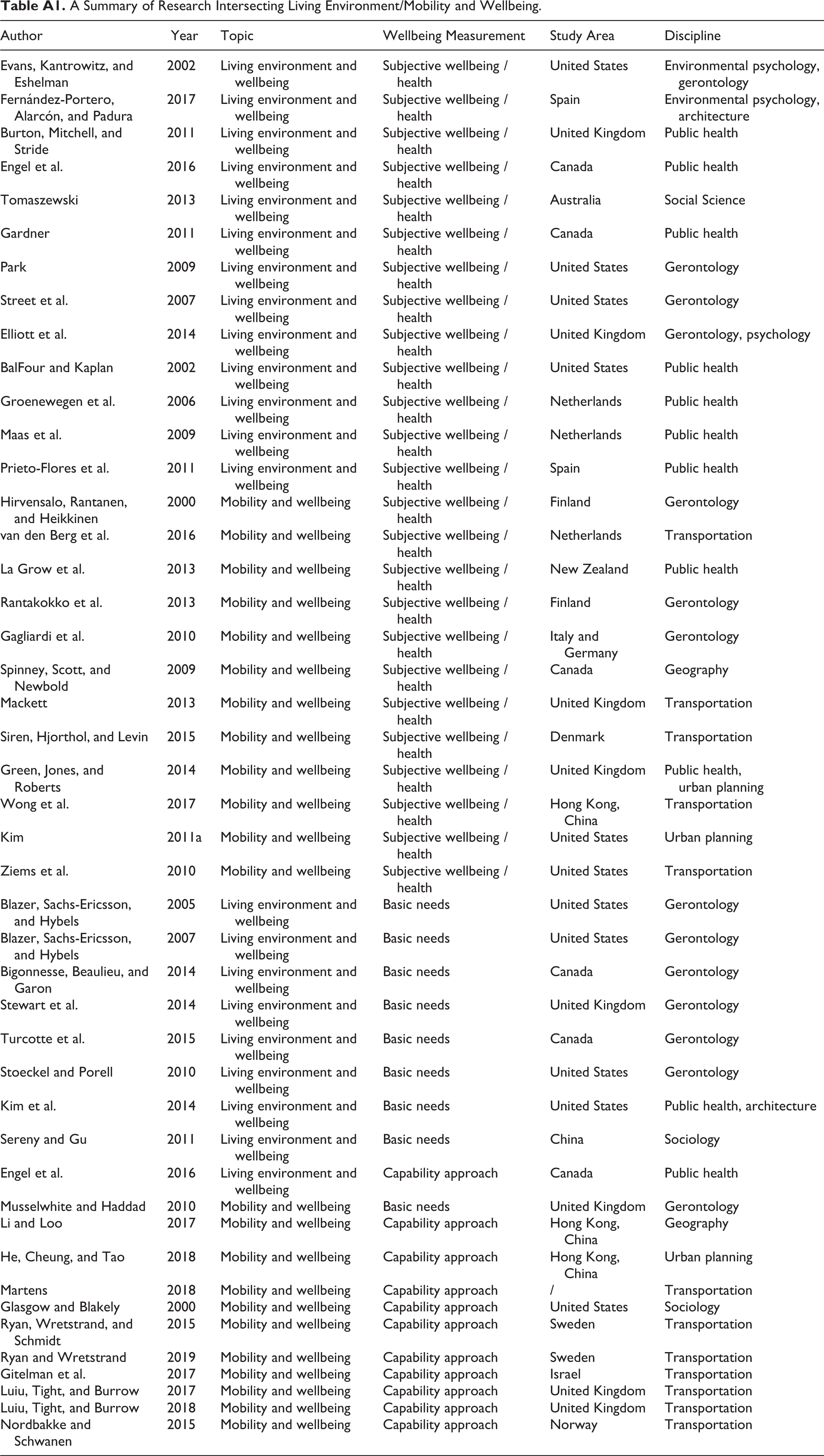
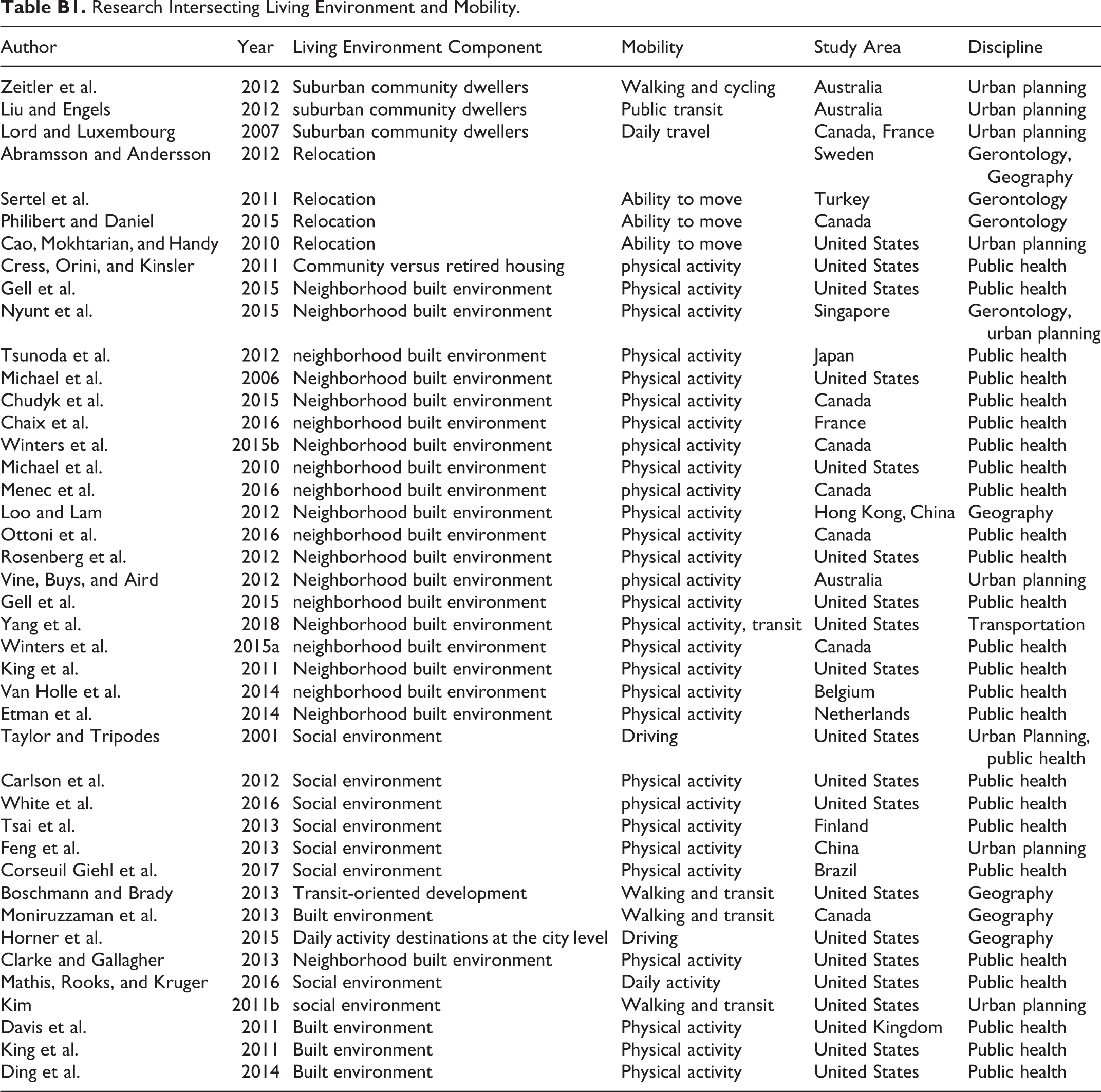
In the end, I reviewed eighty-seven papers. Appendices A and B shows the summary of these papers. Forty-five papers examined the living environment and mobility under the umbrella of wellbeing framework, while another Forty-two papers examined the relationship between the living environment and mobility. Among these studies, only thirty of them were conducted in the United States and only thirty-four of them were conducted or co-authored by urban planning scholars or scholars in related fields (transportation and geography). Only one paper examined the relationship between living environment, mobility, and wellbeing (Cuignet et al. 2020), so we did not list it in the review but discuss it later in the paper. A preliminary survey of the results show that this review is timely and critical to help scholars in urban planning and related fields to learn the academic progress bridging living environment, mobility, and wellbeing.
Findings
I organize my findings into the following two parts. The first section summarizes the wellbeing applications on mobility and living environments among seniors. The second section looks at existing studies intersecting living environments and mobility of seniors.
The Application of Wellbeing in Mobility and Living Environment Studies
The wellbeing framework is relatively new in mobility studies. However, various approaches are widely used in mobility studies. In contrast, wellbeing is an important approach in living environment analysis in gerontology, social work, and public health since Lawton’s seminal work on environment–person relationship (Lawton 1982). Quantitative measurements, especially SWB and residential satisfaction, are the most widely used framework in this field. Studies using basic needs and capability approach remain rare in living environment studies.
SWB, QoL, Satisfaction, and Health
As the most widely used approaches examining living environment and overall QoL, fourteen studies used quantitative measurements, SWB, residential satisfaction, and health indicators as measurements to explore the role of living environment in overall wellbeing. Existing studies agree that the aging-friendly living environment has at least three levels of characters: having interior amenities for seniors (such as bathroom on the first floor), having aging-friendly physical environment and social environment, and having stable social relationships and attachment in the community (Evans, Kantrowitz, and Eshelman 2002; Fernández-Portero, Alarcón, and Padura 2017; Burton, Mitchell, and Stride 2011; Forjaz et al. 2011). A recent study argues that an aging-friendly living environment design should also consider how information communication technology and smart devices at home and in the community could serve as care interventions in seniors’ daily life (Wahl, Iwarsson, and Oswald 2012).
Four studies focus on the impacts of the general living environment on wellbeing and residential satisfaction among seniors. Three of them found a positive relationship between aging-friendly environment and residential satisfaction (Evans, Kantrowitz, and Eshelman 2002; Fernández-Portero, Alarcón, and Padura 2017) and wellbeing (Fernández-Portero, Alarcón, and Padura 2017; Burton, Mitchell, and Stride 2011). Only one study found that the aging-friendliness of the residential environment is not related to wellbeing among the low-income residents (Engel et al. 2016).
Five studies focusing on the social environment and wellbeing found consistently that aging-friendly social environment is associated with higher SWB. Two focusing on the community-living seniors found that a social environment characterized by higher income and education of the neighborhood residents (Tomaszewski 2013) and community social networks (Gardner 2011) are associated with higher wellbeing. Two studies focusing on seniors living in the assisted living environment found that living with friendly residents and staff are positively related to their wellbeing (Park 2009; Street et al. 2007). Another study focuses on the roles of social environment on wellbeing among different age groups (Elliott et al. 2014). They found that the relationship between social cohesion and wellbeing is stronger among older cohorts of the aging.
Three studies focus on the physical environment’s role in seniors’ wellbeing. All found that a better physical environment is associated with higher wellbeing. One study found neighborhood problems such as noise, traffic, and lighting are associated with greater loneliness among seniors (Balfour and Kaplan 2002). The other two studies found that more green spaces in the house and community could contribute to seniors’ mental and physical health (Groenewegen et al. 2006; Maas et al. 2009).
Some scholars argue that the relationship between the living environment and wellbeing is still vague. Two studies focus on the mediating factors of living environment and wellbeing. Evans, Kantrowitz, and Eshelman (2002) found that place attachment is a mediating factor of wellbeing. After including place attachment as an indicator of belongingness and ownership of the house in the model, the role of living environment on wellbeing is no longer significant. Two studies stated that residential satisfaction could play as a mediating factor to positively influence wellbeing (Fernández-Portero, Alarcón, and Padura 2017; Prieto-Flores et al. 2011).
In terms of the relationship between mobility and wellbeing, two studies explored the role of mobility in various physical and mental health-related indicators, functional mobility (Hirvensalo, Rantanen, and Heikkinen 2000), and loneliness (van den Berg et al. 2016). Both studies found that seniors who drive frequently in their daily routines have better health outcomes.
Seven studies used QoL and SWB measures to examine the relationship between mobility and wellbeing. Existing studies intersecting mobility and QoL consistently found that higher levels of physical activity (La Grow et al. 2013) and larger activity space (Rantakokko et al. 2013) are positively related to QoL. Using this indicator, several previous studies found consistently that driving (Gagliardi et al. 2010), taking public transit using free passes (Mackett 2013), participating in outdoor activities (Rantakokko et al. 2013) and increasing the level of daily travel in general (Spinney, Scott, and Newbold 2009) all contribute to better SWB among seniors.
These quantitative studies using composite measurements, however, could not explain the mechanisms how seniors’ daily mobility experiences transform into their individual-level wellbeing. Two studies started to use qualitative methods to investigate the role of daily mobility experiences on seniors’ wellbeing. Siren, Hjorthol, and Levin (2015) found that utilitarian travel, such as shopping and access to health care is important for seniors to maintain independence. Green, Jones, and Roberts (2014) analyzed the experience of travelling by bus and found that bus travel is a meaningful social interaction in which the older population are exposed to the public space, develop the sense of belonging and reduce loneliness.
Travel satisfaction is an emerging field. Only three studies concern the transportation system and wellbeing among seniors. Wong et al. (2017) found that seat availability and the condition of the stations or stops were the most influential factor in overall evaluation toward public transit for the seniors. Kim (2011a) found that neighborhood walkability rather than the access to transit stops matters most in seniors’ evaluations on suburban neighborhoods’ transportation systems. Only one study connects the mobility satisfaction and the indoor environment. Ziems et al. (2010) argue that unsatisfactory outdoor activities could be compensated by gains in indoor activities.
Basic needs and capability approach
Compared to the applications using above quantitative metrics, studies using basic needs and capability approach as analytical frameworks are relatively new. Most studies on living environment and wellbeing mainly use the basic needs framework, while it is a trend to incorporate basic needs and capability approach in mobility studies.
The living environments for later lives need to accommodate their health conditions and meet their social needs. Two studies found that unmet basic needs in living environment are associated with a higher mortality (Blazer, Sachs-Ericsson, and Hybels 2005) and depression (Blazer, Sachs-Ericsson, and Hybels 2007). Three papers argue that community-based living settings are not necessarily good for seniors’ wellbeing. For those who live in community settings, especially those who live in suburban single-family houses, despite its cost effectiveness, seniors’ social interaction needs and assisted living are hard to achieve (Bigonnesse, Beaulieu, and Garon 2014; Stewart et al. 2014; Turcotte et al. 2015). Three studies focus on how living environments meet the health conditions of seniors. They documented that for seniors with functional impairments or health deterioration, their needs to relocate (Stoeckel and Porell 2010) and have home modifications (Kim et al. 2014) increase as they age. Another study found that as people age and their health conditions deteriorate, those living in community settings are more likely to experience wellbeing decline than those living in institutionalized facilities, whose basic needs are more easily fulfilled (Sereny and Gu 2011).
It is surprising that capability approach is rarely used to explore the relationship between the living environment and wellbeing. It is intuitive that not all seniors could move to a new place or modify their home if their basic needs are unmet. Only one study used ICEpop CAPability index which is based on Sen’s capability approach to explore the relationship between the living environment and wellbeing among the seniors. They found that aging-friendly built environment and social environment provide capabilities for seniors to get more involved in the society (Engel et al. 2016). However, some important capabilities in controlling the living environment, such as affordability and the capability to use various transportation resources, are rarely explored in the existing studies.
In the mobility studies, the ability to move around is considered as both basic needs for daily routines and the prerequisite to improve the QoL. Based on the original basic needs theory, Musselwhite and Haddad (2010) outlined three levels of mobility needs for seniors: the first level, “everyday needs” focuses on utilitarian needs, such as going to an appointment or shopping and travel to social services. They label the second level, “affective needs,” referring to those that support independence and control such as driving cars to travel without any others’ help. Their third level, “aesthetic needs,” serves the seniors’ spirit such as the enjoyment of nature.
Seven studies adopted the capability approach to explore the role of controlling transportation resources in the wellbeing of seniors’ daily lives. Among these studies, three used it as an approach to evaluate how well seniors could get included in society. Two empirical studies found that the capability to get around is associated with seniors’ activity participation and life satisfaction (Li and Loo 2017; He, Cheung, and Tao 2018). From a policy perspective, Martens (2018) suggests that strategies aiming to redesign existing transportation, including adding elevators in stations, extension of the sidewalks, and providing subsidized wheelchairs, scooters, and walking escort help seniors better use urban space and get included in the society.
Four studies focus on the declining capability in controlling vehicles as people age and their coping strategies. Though their capability to drive decline as they age (Glasgow and Blakely 2000), the capabilities to use alternative modes, such as public transportation (Ryan, Wretstrand, and Schmidt 2015; Ryan and Wretstrand 2019) and scooter (Gitelman et al. 2017) improves their wellbeing.
In mobility studies, an increasing number of studies combined the basic needs theory and capability approach to analyze the unmet needs of seniors. They argue that if the seniors do not have the capabilities to utilize transportation resources to fulfill their basic needs, unmet needs occur and would adversely influence the seniors’ wellbeing. The increasing discussions among the seniors show a trend to consider the capability to use mobility resources as a multifaceted outcome of transportation, nontransportation, and other factors (Luiu, Tight, and Burrow 2017, 2018; Nordbakke and Schwanen 2015). For example, Luiu, Tight, and Burrow (2017) illustrate that various transportation options, including car ownership, the public transit service, and responsible-demand services could mitigate the elderly’s unmet needs. They also emphasized that improving neighborhood design and accessibility to various activity destinations enhance the satisfaction with mobility needs.
The above findings show that driving cessations, lower physical activity, and living in the houses which do not match the health conditions and social needs of the older adults are associated with lower wellbeing. However, existing studies show that few studies consider the living environment and mobility under the umbrella in one single study. Neither living environment nor mobility is the only available spatial approach for older adults to improve the quality of later life. For example, for a person who experience driving cessation, moving him or her to the senior apartment with proximity to various daily needs and fellow seniors may promote his or her individual wellbeing. In the next section, I review the existing literature intersecting the living environment and mobility to show the necessity and the ways to bridge mobility and living environment under the umbrella of the wellbeing framework for future studies.
Bridge the Living Environment and Mobility Research
This section reviews two streams of literature intersecting the living environment and mobility: the roles of mobility and living environment in the residential choice of older adults and the association between living environment and mobility.
Living environment, mobility, and residential choice
Two studies focus on the mobility challenges for seniors who live in the suburban single-family houses. They show that the suburban environment is not suitable for alternative modes to driving due to the lack of sidewalks and bicycle lanes (Zeitler et al. 2012) and poor public transit services (Liu and Engels 2012), which reinforce driving.
However, why do not seniors move to other places? A study argues that many older adults adapt to the suburban environment by adjusting their residential situation and mobility patterns as they age, since they do not want to lose their social networks. As they age, they would reduce or cancel their outings or seek assistance from their social networks (Lord and Luxembourg 2007).
Another strategy to respond to the mobility and living environment challenges is to relocate to a more pleasant living environment. Four recent studies explored the correlation between mobility and residential relocation. However among these four studies, only one study focused explicitly on the role of social and physical environment. Abramsson and Andersson (2012) found that seniors in Sweden may move from the single-family houses to the co-op apartments for the sake of amenities and social networks. People who were born in the 1940s have higher possibility to move due to their less attached living environment and the reality of living without children.
Two studies show that the deteriorating health conditions, which are related to lower mobility among the seniors, are main drivers of relocation. Sertel et al. (2011) found that seniors with cognitive and mobility problems are more likely to move to the nursing houses. Philibert and Daniel (2015) found that the health condition rather than individual-level health condition is the most important predictor of relocation in the later life. Cao, Mokhtarian, and Handy (2010)’s study shows that older population who have more difficulties in moving around and driving may be more likely to relocate to places with better proximity to social facilities and living amenities.
Only one study focuses on the differences of mobility among the retired community residents and those who live in their original houses. Cress, Orini, and Kinsler (2011)’s study found that retired community residents take 3,000 steps less every day.
Living environment and mobility
This section reviews studies answering the question: do where seniors live relate to the mobility level? We focus mainly on the studies relating physical and social environments and mobility. Although two literature reviews have summarized the studies on the built environment and walking (Kerr, Rosenberg, and Frank 2012), and the role of proximity to recreational facilities and social support in daily mobility among seniors (Levasseur et al. 2015), these reviews have two limitations: first, they focus mainly on the walking behavior. Additionally, they did not pay enough attention to the mediating factors of the living environment and mobility, such as age and health. Rather than repeating the findings reviewed in the above two studies, we mainly review the main arguments related to future works in three aspects: the relationship between physical environment and mobility, the relationship between social environment and mobility, and the role of mediating factors.
Physical environment and mobility
The physical environment in the existing literature mainly includes the proximity and density of amenities and the walking environment of the neighborhood. Most studies found that seniors living in neighborhoods with higher population density (Gell et al. 2015; Nyunt et al. 2015), higher land use mix and higher density of living amenities (Tsunoda et al. 2012; Michael et al. 2006; Chudyk et al. 2015; Chaix et al. 2016; Winters et al. 2015b) have more physical activities. Only one study that found no association between the density of amenities and physical activity (Michael et al. 2010). However, a survey found that a large proportion of people do not think it is important to have amenities within walking distance (Menec et al. 2016).
In terms of the walking environment, previous studies identified the important characteristics of walking-friendliness which promotes physical activity include aesthetically pleasing surroundings (Tsunoda et al. 2012; Nyunt et al. 2015; Loo and Lam 2012) such as green space and benches (Ottoni et al. 2016), curb ramps and sidewalks (Rosenberg et al. 2012), good traffic safety (Tsunoda et al. 2012), and desirable street connectivity (Nyunt et al. 2015). One study identified the characteristics of walking-unfriendliness from a bigger picture of competing travel modes: reliance on vehicles, competing rights among the cyclists and pedestrians on the paths, and the lack of the pedestrian infrastructure (Vine, Buys, and Aird 2012).
Most studies found that neighborhood walkability is positively associated with physical activity (Gell et al. 2015; Chudyk et al. 2015; Yang et al. 2018; Winters et al. 2015a; King et al. 2011). Most of them use WalkScore as a measurement of the overall walking friendliness. Among these studies, only one study relates the walkability to transit ridership and found the positive relationship between them (Yang et al. 2018).
Two studies found that the relationship between walkability and mobility may vary among trips with different purposes and walking environments with different scales. Van Holle et al. (2014) found that the walkability is associated with transportation walking but not recreational walking among seniors. Etman et al. (2014)’s analysis shows that different elements in walking environment design may have divergent maximum limit to influence walking trips.
Social environment and mobility
Only a few studies concern social environment and mobility. The most important factor in social environment related to mobility is social support. Only one study since 2000 found that social support could mitigate the mobility difficulties for people who experience potential driving cessations (Taylor and Tripodes 2001).
Six studies relate seniors’ physical activity to social networks (Carlson et al. 2012; Tsunoda et al. 2012; White et al. 2016; Tsai et al. 2013; Corseuil Giehl et al. 2017; Feng et al. 2013). Most studies found that living with others, which implies that a senior has more social connections in their daily travel, have a higher-level mobility. The findings of three studies are relatively new. The first observation is that owning a pet is positively associated with more physical activity (White et al. 2016). Another observation is that social support could also create more leisure walking on top of encouraging the seniors to use active modes in daily utilitarian trips (Corseuil Giehl et al. 2017). Only one study in China found that co-residence may be negatively related to mobility. Feng et al. (2013) found that seniors living with their children generally have fewer active trips than their counterparts.
Mediating factors between living environment and mobility
The relationship between physical and social environments may vary among different groups. Therefore, it is worthwhile to explore the factors mediating their relationship. These factors include travel mode, age, socioeconomic status, and health condition.
Two studies found that the physical environment is more related to walking trips but not transit trips (Cao, Mokhtarian, and Handy 2010; Yang et al. 2018). Yang et al. (2018) study even found that the proximity to the nearest park is associated with more active travel but less transit ridership.
Age is another important factor mediating the relationship between physical environment and mobility. Two studies found that the probability of using public transit and walking decrease when people age, given the similar living environment (Boschmann and Brady 2013; Moniruzzaman et al. 2013). However, one study exploring the age variations in accessing opportunities found that the oldest seniors have the best accessibility among all senior groups by automobile (Horner et al. 2015).
The role of income and other socioeconomic attributes in mediating the relationship between the living environment and mobility are mixed. Two studies found that the relationship between neighborhood walkability and walking intensity only holds true in high-income neighborhoods (Chudyk et al. 2017; Michael et al. 2010). One study found that older adults living in walkable neighborhoods have more outdoor activities in low-income neighborhoods (Clarke and Gallagher 2013). Another study found no evidence of income in moderating the relationship between walkability and outdoor physical activities (Winters et al. 2015a).
Not directly related to the discussion, three studies focusing on the socioeconomic factors and mobility also have mixed conclusions. Tsunoda et al. (2012) claimed that low-income seniors depend more heavily on walking. Mathis, Rooks, and Kruger (2016) found that Black seniors are less likely to participate in social activities. Another study found that the male, high-income and urban dwellers are more likely to walk and take transit after driving cessation (Kim 2011b).
The mediating factor of health is more consistent. People who are more functionally mobile, not needing walking assistance and in the normal weight, show higher level of active travel (Davis et al. 2011). In contrast, the mobility-impaired adults living in more walkable neighborhoods have similar physical activity compared with those living in less walkable neighborhoods (King et al. 2011). Only one study examined the mediating role of driving status, which is firmly related to health. Scholars found that almost all physical environment attributes were positively and significantly with physical activity among the senior drivers, but not those gave up driving (Ding et al. 2014).
Living Environment, Mobility and Wellbeing: Where Are We Now?
This review intersects the literature on the living environment and mobility of the seniors under the umbrella of wellbeing, and the relationship between the living environment and mobility. The above findings show that these two streams of literature have many interactions, but are not integrated well. The following discussion shows some observations of my findings and how they inform the future research.
A New Interdisciplinary Dialogue
The first observation is that different disciplines have different focus on the living environment, mobility, and wellbeing among the seniors. In the future research, different disciplines should learn from each other to inform a more integrated conversation. For example, transportation scholars focus disproportionally on the relationship between mobility and wellbeing, without enough consideration of the living environment. Gerontologists, in contrast, focus mainly on the living environment, especially the housing from the basic need perspective. Research on living environment and mobility in most cases separates from each other. Public health scholars contributed the most in bridging the relationship between the living environment and physical activity but did not integrated their works well with wellbeing. In all above areas, urban planners have much room to promote the understanding of the complex relationships of living environment, mobility and wellbeing among older adults. Recently, a group of researchers in Europe published their work bridging living environment, mobility, and wellbeing among older adults (Cuignet et al. 2020) and show the great potential of developing a holistic framework to understand the complex relationships between living environment, mobility, and wellbeing among seniors via interdisciplinary collaboration.
A More Holistic Measurement of Successful Aging
The second observation is that different wellbeing measurements are more popular in certain fields. Future research needs to develop more integrated measurements to better measure “aging successfulness.” From my findings, the SWB and QoL measurements are the most widely used measurement in all fields. However, these measurements could hardly demonstrate why and how the living environment/mobility relates to the wellbeing of seniors. In contrast, capability approach and basic needs theories could address the variations in the needs and capabilities of the older population with different ages, health conditions, driving status, and wealth. Nevertheless, they are weak in quantifying wellbeing. While capability approach is rarely used in gerontology, it is widely used with basic needs theory in transportation studies. These two theories are also helpful to understand how people’s unmet needs vary across different groups. Therefore, more future studies may benefit from combining the SWB measurements and more theoretical measurements (basic needs and capability approach) for a hybrid of the theory and measurements to understand better the wellbeing variations among seniors.
A further implication of the findings is that the development of the integrated wellbeing measurement needs further works on four directions. First, we need a better understanding of the complex process of living environment and mobility in older adults’ later life. Mobility or living environment is only a part of the story in which older adults fit themselves with the environment. As Yeoh et al. (2018) suggested, the neighborhood design needs to consider the proximity to the amenities and various mobility choices. Akhavan and Vecchio (2018) provide a profile of elderly housing design with the consideration of accessibility and mobility. They classified the communities with different mobility and accessibility elements into open neighborhoods with good accessibility and mobility, dependent neighborhoods with good mobility but bad accessibility, self-contained neighborhoods with good accessibility but bad mobility, and isolated neighborhoods with both bad mobility and accessibility. A further understanding of these typologies could help to better understand the residential and mobility needs and preferences among the older population and inform future urban planning policies toward better QoL for the older population.
Additionally, the findings shed light on the necessity to consider broader “living environment” and “mobility” concepts. Although it is a consensus in gerontology that “living environment” includes the housing unit, the social and physical environment and the community, the existing studies exploring the social environment and the community are still rare. As for mobility, despite the studies intersecting mobility and wellbeing started to research all types of travel modes, the studies on the mobility and living environment still mainly focus on the physical activity. Without thinking other travel modes such as driving and public transit, the studies may underestimate how many opportunities a senior could access. Additionally, although new mobility services such as ride hailing (Vivoda et al. 2018) and mobility as a service (Mulley et al. forthcoming) show potentials to improve the mobility of older adults, there exist no studies examining their roles in shaping the complex relationships between the living environment, mobility, and wellbeing among the older adults.
The third direction is the causal relationship between the living environment and mobility and relocation. The existing literature shows that how the mobility changes affect later life of the seniors is also far from clear. Although some previous studies explored the role of mobility in residential relocation, empirical studies exploring how residential relocation influences the daily mobility among the seniors over time remains rare. Understanding this process helps us to learn whether relocation helps them to age more successfully and respond to the environmental risks better.
The fourth direction is to better understand the older adults’ attitudes and preferences of their desired lives and the current status (Levasseur et al. 2015). Without this stream of work, it is difficult to match the policies with seniors’ basic needs. A big gap in this direction is that the older population’s self-selection on the residential locations according to their travel preferences is largely ignored (Cao, Mokhtarian, and Handy 2010). Seniors’ residential location processes may be more complicated than the younger social groups, since their decisions may be a mixture of the travel preferences, past experiences, proximity to their friends and children, and their health condition (Van Acker, Van Wee, and Witlox 2010; Gitelman et al. 2017). What is worse, they may have fewer financial resources to move around, so they may have higher possibility of residential dissonance, implying that their living and travel needs do not match their desires and preferences. It is important to understand these mediating or confounding factors between the living environment and mobility (Guan, Wang, and Cao 2019). For example, social network may influence mobility and indirectly influence wellbeing through social capital and spatial cognition (Schwanen et al. 2015), but it was not investigated by the scholars before. This stream of work also helps to understand the extent to which the seniors’ travel and living preferences could be met and why, which could be combined with the theories in the wellbeing research such as unmet needs and capability approach.
More Diverse and Human-oriented Methods
Finally, more advanced and mixed methodology could help to better understand the mobility pattern and its relationship with various factors among the seniors. While quantitative approaches could make comparisons between wellbeing across different individuals, they are not strong enough to understand the mobility experiences of the seniors. Additionally, contextualized cultural and traditional customs may influence seniors’ mobility experiences in different ways (Feng 2017). Thus, more studies combining qualitative and quantitative methods should be used in the future research to understand the mobility experiences of the seniors and the underlying obstacles and motivations more deeply. For example, while Geographic Information System (GIS) and Global Positioning System (GPS) technology are widely used in the existing literature, the spatial data are not well combined with the activity content. In my review, Vine, Buys, and Aird (2012) proposed that GIS and GPS technology could be combined with qualitative research methods to better understand the outdoor activities. Chaix et al. (2016) presented a GPS-based method to segment individuals’ daily mobility into activities and trips, which enables life-segment investigations and case-crossover analysis. As the seniors’ mobility experiences may be more complicated due to more interacted factors of mobility in their later life, future studies could use geocoded mobility experiences to explain activity patterns of seniors.
Conclusions
Since the population of the United States is aging neighborhood design and transportation planning needs to become more age-friendly. Wellbeing is used as the overarching framework to measure whether the seniors have a good fit with themselves and the surrounding environment. In this review, we aim to show how the research on living environment/mobility and wellbeing and the research on the relationship of living environment and wellbeing could engage together to inform a new research agenda by reviewing the findings of eighty-seven papers in Web of Science and Scopus since 2000.
I argue that future studies should do a better job to bridge the two streams of works together and better understand the complex relationships between living environment, mobility and wellbeing among the older adults. The review found that the scholars from different disciplines only pay attention to one aspect of the bigger picture depicting how to measure the successful aging in terms of living environment and mobility. Scholars also focus on different types of wellbeing measurement. Additionally, though the researchers agree on the broader definition of “living environment” and “mobility,” existing research still disproportionally focus on the built environment and physical activity among seniors. All these limitations prevent us from developing a holistic understanding of how to measure the fit of the living environment and mobility and seniors’ heterogeneous basic needs.
This article also has important implications for policy implications. First, it shows that to promote the aging-friendly communities, we need a collaboration of transportation and housing agencies, communities and private, public and nonprofit sectors targeting on seniors. Our understanding of whether the older adults’ needs on living environment and mobility are met and why are limited despite the consensus that creating aging-friendly communities and cities are critical in the next decades. Urban planning practitioners need to involve in this conversation more and learn more knowledge from other disciplines. They also need to consider how their jobs could be better integrated with the other related sectors such as health service and social work agencies. Second, interdisciplinary research is needed to develop a wellbeing measurement which incorporates the subjective feeling and the self-development of seniors. This wellbeing measurement, as a policy tool, will help the communities and local governments assess to which extent the mobility and living environment needs of seniors are met. Finally, future policies need to pay more attention to the special needs of seniors with difficulties in health, wealth, health, and driving abilities.
Footnotes
Appendix A
A Summary of Research Intersecting Living Environment/Mobility and Wellbeing.
| Author | Year | Topic | Wellbeing Measurement | Study Area | Discipline |
|---|---|---|---|---|---|
| Evans, Kantrowitz, and Eshelman | 2002 | Living environment and wellbeing | Subjective wellbeing /health | United States | Environmental psychology, gerontology |
| Fernández-Portero, Alarcón, and Padura | 2017 | Living environment and wellbeing | Subjective wellbeing /health | Spain | Environmental psychology, architecture |
| Burton, Mitchell, and Stride | 2011 | Living environment and wellbeing | Subjective wellbeing /health | United Kingdom | Public health |
| Engel et al. | 2016 | Living environment and wellbeing | Subjective wellbeing /health | Canada | Public health |
| Tomaszewski | 2013 | Living environment and wellbeing | Subjective wellbeing /health | Australia | Social Science |
| Gardner | 2011 | Living environment and wellbeing | Subjective wellbeing /health | Canada | Public health |
| Park | 2009 | Living environment and wellbeing | Subjective wellbeing /health | United States | Gerontology |
| Street et al. | 2007 | Living environment and wellbeing | Subjective wellbeing /health | United States | Gerontology |
| Elliott et al. | 2014 | Living environment and wellbeing | Subjective wellbeing /health | United Kingdom | Gerontology, psychology |
| BalFour and Kaplan | 2002 | Living environment and wellbeing | Subjective wellbeing /health | United States | Public health |
| Groenewegen et al. | 2006 | Living environment and wellbeing | Subjective wellbeing /health | Netherlands | Public health |
| Maas et al. | 2009 | Living environment and wellbeing | Subjective wellbeing /health | Netherlands | Public health |
| Prieto-Flores et al. | 2011 | Living environment and wellbeing | Subjective wellbeing /health | Spain | Public health |
| Hirvensalo, Rantanen, and Heikkinen | 2000 | Mobility and wellbeing | Subjective wellbeing /health | Finland | Gerontology |
| van den Berg et al. | 2016 | Mobility and wellbeing | Subjective wellbeing /health | Netherlands | Transportation |
| La Grow et al. | 2013 | Mobility and wellbeing | Subjective wellbeing /health | New Zealand | Public health |
| Rantakokko et al. | 2013 | Mobility and wellbeing | Subjective wellbeing /health | Finland | Gerontology |
| Gagliardi et al. | 2010 | Mobility and wellbeing | Subjective wellbeing /health | Italy and Germany | Gerontology |
| Spinney, Scott, and Newbold | 2009 | Mobility and wellbeing | Subjective wellbeing /health | Canada | Geography |
| Mackett | 2013 | Mobility and wellbeing | Subjective wellbeing /health | United Kingdom | Transportation |
| Siren, Hjorthol, and Levin | 2015 | Mobility and wellbeing | Subjective wellbeing /health | Denmark | Transportation |
| Green, Jones, and Roberts | 2014 | Mobility and wellbeing | Subjective wellbeing /health | United Kingdom | Public health, urban planning |
| Wong et al. | 2017 | Mobility and wellbeing | Subjective wellbeing /health | Hong Kong, China | Transportation |
| Kim | 2011a | Mobility and wellbeing | Subjective wellbeing /health | United States | Urban planning |
| Ziems et al. | 2010 | Mobility and wellbeing | Subjective wellbeing /health | United States | Transportation |
| Blazer, Sachs-Ericsson, and Hybels | 2005 | Living environment and wellbeing | Basic needs | United States | Gerontology |
| Blazer, Sachs-Ericsson, and Hybels | 2007 | Living environment and wellbeing | Basic needs | United States | Gerontology |
| Bigonnesse, Beaulieu, and Garon | 2014 | Living environment and wellbeing | Basic needs | Canada | Gerontology |
| Stewart et al. | 2014 | Living environment and wellbeing | Basic needs | United Kingdom | Gerontology |
| Turcotte et al. | 2015 | Living environment and wellbeing | Basic needs | Canada | Gerontology |
| Stoeckel and Porell | 2010 | Living environment and wellbeing | Basic needs | United States | Gerontology |
| Kim et al. | 2014 | Living environment and wellbeing | Basic needs | United States | Public health, architecture |
| Sereny and Gu | 2011 | Living environment and wellbeing | Basic needs | China | Sociology |
| Engel et al. | 2016 | Living environment and wellbeing | Capability approach | Canada | Public health |
| Musselwhite and Haddad | 2010 | Mobility and wellbeing | Basic needs | United Kingdom | Gerontology |
| Li and Loo | 2017 | Mobility and wellbeing | Capability approach | Hong Kong, China | Geography |
| He, Cheung, and Tao | 2018 | Mobility and wellbeing | Capability approach | Hong Kong, China | Urban planning |
| Martens | 2018 | Mobility and wellbeing | Capability approach | / | Transportation |
| Glasgow and Blakely | 2000 | Mobility and wellbeing | Capability approach | United States | Sociology |
| Ryan, Wretstrand, and Schmidt | 2015 | Mobility and wellbeing | Capability approach | Sweden | Transportation |
| Ryan and Wretstrand | 2019 | Mobility and wellbeing | Capability approach | Sweden | Transportation |
| Gitelman et al. | 2017 | Mobility and wellbeing | Capability approach | Israel | Transportation |
| Luiu, Tight, and Burrow | 2017 | Mobility and wellbeing | Capability approach | United Kingdom | Transportation |
| Luiu, Tight, and Burrow | 2018 | Mobility and wellbeing | Capability approach | United Kingdom | Transportation |
| Nordbakke and Schwanen | 2015 | Mobility and wellbeing | Capability approach | Norway | Transportation |
Appendix B
Research Intersecting Living Environment and Mobility.
| Author | Year | Living Environment Component | Mobility | Study Area | Discipline |
|---|---|---|---|---|---|
| Zeitler et al. | 2012 | Suburban community dwellers | Walking and cycling | Australia | Urban planning |
| Liu and Engels | 2012 | suburban community dwellers | Public transit | Australia | Urban planning |
| Lord and Luxembourg | 2007 | Suburban community dwellers | Daily travel | Canada, France | Urban planning |
| Abramsson and Andersson | 2012 | Relocation | Sweden | Gerontology, Geography | |
| Sertel et al. | 2011 | Relocation | Ability to move | Turkey | Gerontology |
| Philibert and Daniel | 2015 | Relocation | Ability to move | Canada | Gerontology |
| Cao, Mokhtarian, and Handy | 2010 | Relocation | Ability to move | United States | Urban planning |
| Cress, Orini, and Kinsler | 2011 | Community versus retired housing | physical activity | United States | Public health |
| Gell et al. | 2015 | Neighborhood built environment | Physical activity | United States | Public health |
| Nyunt et al. | 2015 | Neighborhood built environment | Physical activity | Singapore | Gerontology, urban planning |
| Tsunoda et al. | 2012 | neighborhood built environment | Physical activity | Japan | Public health |
| Michael et al. | 2006 | Neighborhood built environment | Physical activity | United States | Public health |
| Chudyk et al. | 2015 | Neighborhood built environment | Physical activity | Canada | Public health |
| Chaix et al. | 2016 | neighborhood built environment | Physical activity | France | Public health |
| Winters et al. | 2015b | Neighborhood built environment | physical activity | Canada | Public health |
| Michael et al. | 2010 | neighborhood built environment | Physical activity | United States | Public health |
| Menec et al. | 2016 | neighborhood built environment | physical activity | Canada | Public health |
| Loo and Lam | 2012 | Neighborhood built environment | Physical activity | Hong Kong, China | Geography |
| Ottoni et al. | 2016 | neighborhood built environment | Physical activity | Canada | Public health |
| Rosenberg et al. | 2012 | Neighborhood built environment | Physical activity | United States | Public health |
| Vine, Buys, and Aird | 2012 | Neighborhood built environment | physical activity | Australia | Urban planning |
| Gell et al. | 2015 | neighborhood built environment | Physical activity | United States | Public health |
| Yang et al. | 2018 | Neighborhood built environment | Physical activity, transit | United States | Transportation |
| Winters et al. | 2015a | neighborhood built environment | Physical activity | Canada | Public health |
| King et al. | 2011 | Neighborhood built environment | Physical activity | United States | Public health |
| Van Holle et al. | 2014 | neighborhood built environment | Physical activity | Belgium | Public health |
| Etman et al. | 2014 | Neighborhood built environment | Physical activity | Netherlands | Public health |
| Taylor and Tripodes | 2001 | Social environment | Driving | United States | Urban Planning, public health |
| Carlson et al. | 2012 | Social environment | Physical activity | United States | Public health |
| White et al. | 2016 | Social environment | physical activity | United States | Public health |
| Tsai et al. | 2013 | Social environment | Physical activity | Finland | Public health |
| Feng et al. | 2013 | Social environment | Physical activity | China | Urban planning |
| Corseuil Giehl et al. | 2017 | Social environment | Physical activity | Brazil | Public health |
| Boschmann and Brady | 2013 | Transit-oriented development | Walking and transit | United States | Geography |
| Moniruzzaman et al. | 2013 | Built environment | Walking and transit | Canada | Geography |
| Horner et al. | 2015 | Daily activity destinations at the city level | Driving | United States | Geography |
| Clarke and Gallagher | 2013 | Neighborhood built environment | Physical activity | United States | Public health |
| Mathis, Rooks, and Kruger | 2016 | Social environment | Daily activity | United States | Public health |
| Kim | 2011b | social environment | Walking and transit | United States | Urban planning |
| Davis et al. | 2011 | Built environment | Physical activity | United Kingdom | Public health |
| King et al. | 2011 | Built environment | Physical activity | United States | Public health |
| Ding et al. | 2014 | Built environment | Physical activity | United States | Public health |
Acknowledgments
This paper is part of my doctral dissertation work, which is supported by a four-year fellowship from Weitzman School of Design at the University of Pennsylvania. This article was selected to present at the 99th Transportation Research Board Annual Meeting. Kleinman Center for Energy Policy at the University of Pennsylvania supported me to attend the conference. Thanks for the great comments from Professors Genie Birch, Erick Guerra from University of Pennsylvania and Professor Donggen Wang from Hong Kong Baptist University. Thanks for the great work of the editor and three anonymous reviewers. Thanks for the writing assitance from Pete Kimchuk.
Declaration of Conflicting Interests
The author(s) declared no potential conflicts of interest with respect to the research, authorship, and/or publication of this article.
Funding
The author(s) disclosed receipt of the following financial support for the research, authorship and/or publication of this article: This research is funded by a four-year fellowship from Weitzman School of Design and Kleinman Center for Energy Policy at the University of Pennsylvania.
