



Abstract
Residential displacement impacts the quality of life, health, and economic outlook for households. Yet, there is little evidence on how housing policy works to prevent displacement. This literature review examines how 12 housing policies, encompassing household/neighborhood stabilization, affordable housing preservation, and housing production, mitigate displacement. We conclude that stabilization strategies have the most direct and immediate effect on mitigating direct displacement, while housing production and preservation strategies can decrease indirect and/or exclusionary displacement. However, production policies typically require strong markets and longer time spans. Though more research is needed, local governments can still leverage housing policies to prevent displacement.
Introduction
Residential displacement negatively affects the quality of life, health, and economic outlook for households, not just by disrupting housing stability but also by forcing some residents to move to less advantaged neighborhoods (Desmond and Kimbro 2015; Ding, Hwang and Divringi 2016; Marcus and Zuk 2017). Whether concerned with the efficiency of service delivery or preventing homelessness or furthering fair housing goals, planners need to understand where and how displacement occurs. Moreover, public agencies and policymakers should have a good understanding of the unintended consequences of public investments to ensure that they benefit rather than harm low-income communities. Yet, the extent of displacement remains poorly understood, in part because of challenges in measuring displacement (Easton et al. 2020). With little known about who is moving in and out of neighborhoods, anti-growth (or “Not in My Backyard”) activists often seize on the threat of displacement to block new housing development (Monkkonen 2016).
Some municipal governments have adopted different housing strategies to help communities respond to displacement pressures. However, there is a dearth of evidence on how such approaches reduce or prevent displacement either directly or indirectly, and even less research comparing how housing policy works to prevent displacement across approaches, contexts, or timeframes.
This article hopes to start filling this evidence gap. We first give a brief review of literature that defines and describes various types of displacements, their causes, relationship to gentrification, and the challenges of measuring it. We then summarize the academic and professional (gray) literature on anti-displacement strategies and examine how various studies assess existing anti-displacement strategies by local governments. In what follows, we first explain our methodology for undertaking this literature review. We then proceed to discuss our findings of our review of 12 different anti-displacement strategies, classified into three categories: Policies that lead to (1) production of new housing; (2) preservation of existing affordable housing; and (3) stabilization of households and/or neighborhoods (keeping residents in place). 1
Displacement Types and Measures
Displacement occurs when households are forced to move out of their housing unit or are prevented from moving into a neighborhood for reasons that are beyond their ability to control or prevent (Finio 2021; Grier and Grier 1978; Marcuse 1986; Authors). Displacement can thus be direct (e.g., when homes are demolished or destroyed), indirect (e.g., as landlords increase rents to capitalize on market demand), or exclusionary (e.g., due to lack of housing options). Displacement may occur due to either investment or disinvestment; however, apart from researchers working on eviction (e.g., Desmond 2016), most of the scholarly focus has been on gentrification-induced displacement, i.e., displacement that occurs in disinvested neighborhoods due to the influx of high-income, high-educated residents and/or capital. Interestingly, quantitative and qualitative gentrification researchers generally disagree about the breadth of its impacts on displacement (Brown-Saracino 2017; Easton et al. 2020). Further, though displacement may occur before, during, or after gentrification, the majority of literature only examines the latter (Easton et al. 2020; Grier and Grier 1978; Marcuse 1986; Chapple and Loukaitou-Sideris 2019).
We examine here the various local housing policies, programs, and laws that intend to counteract displacement pressures felt by some households, whether due to investment or disinvestment. These include approaches that try to prevent direct displacement (e.g., demolition controls or rental assistance), as well as those that aim to reduce displacement more indirectly (e.g., rent stabilization), and those that may reduce exclusion (e.g., housing production).
Though we define displacement as forced moves or exclusion, there is rarely data available to measure these phenomena, and thus little evidence to indicate whether moves are voluntary or involuntary (except in the case of eviction, which we presume to be involuntary, or when survey or panel data is available, as in Freeman 2005 or Newman and Wyly 2006). This creates a challenge in studying how housing interventions mitigate displacement; if we want to understand whether housing policy is working, we would need to identify instances where, but for the policy, the resident would have moved out unwillingly, or would not have been able to move in (in the case of exclusionary displacement).
Thus, with the exception of those analyzing displacement in the form of evictions, very few studies measure a policy's effect on displacement directly. Much more common are examinations of indicators that are closely related to displacement, such as a policy's effect on rent prices or property values, which we call “proxies for displacement.” While these proxies are by no means perfect metrics of displacement pressures caused or prevented by these policies, we included them in our analysis because they are prevalent in the literature and can be reasonably associated with displacement. Other proxies that appear in the literature include move-outs, move-ins, loss of low-income households, or loss of naturally occurring affordable housing; these are also imperfect proxies because they rarely account for whether moves were involuntary (Carlson 2020). Studies also use the production or preservation of subsidized units as a proxy for reduced out-migration, so we include some of these mechanisms as well, even though they do not necessarily mitigate local displacement unless units are reserved for local residents (local preference).
Whether examining data on involuntary displacement per se or these proxies, we still generally lack counterfactuals to assess the effectiveness of policies. Rarely do studies adopt a quasi-experimental research design that can attribute success in preventing displacement to a particular policy. Thus in this review, we adopt a more modest goal of reviewing the literature to identify how it describes a housing policy's role in mitigating displacement.
Methodology
We began this review by examining 16 different anti-displacement strategies identified in previous research as affecting displacement. We should note that these strategies do not represent the universe of strategies potentially preventing displacement. For example, omitted are strategies to increase resident incomes, despite the fact that in some cases mitigating income inequality might be the most direct approach to preventing displacement (Chapple 2017). Additionally, there are practices that may prevent displacement, such as community organizing, which we did not include because of the challenges of either implementing as a one-off policy or measuring their specific impacts on mitigating displacement (e.g., community organizing may include a broad array of activities, not just housing policy). However, multiple studies attribute the success some neighborhoods have seen in avoiding gentrification (such as Fruitvale in Oakland and East Palo Alto) to the “years of organizing and planning” of local residents (Crispell, Harris Rockefeller, and Cespedes 2016; Louie 2016). Because of our focus on local mechanisms, we did not include all of the strategies available to produce subsidized housing (e.g., low-income housing tax credits).
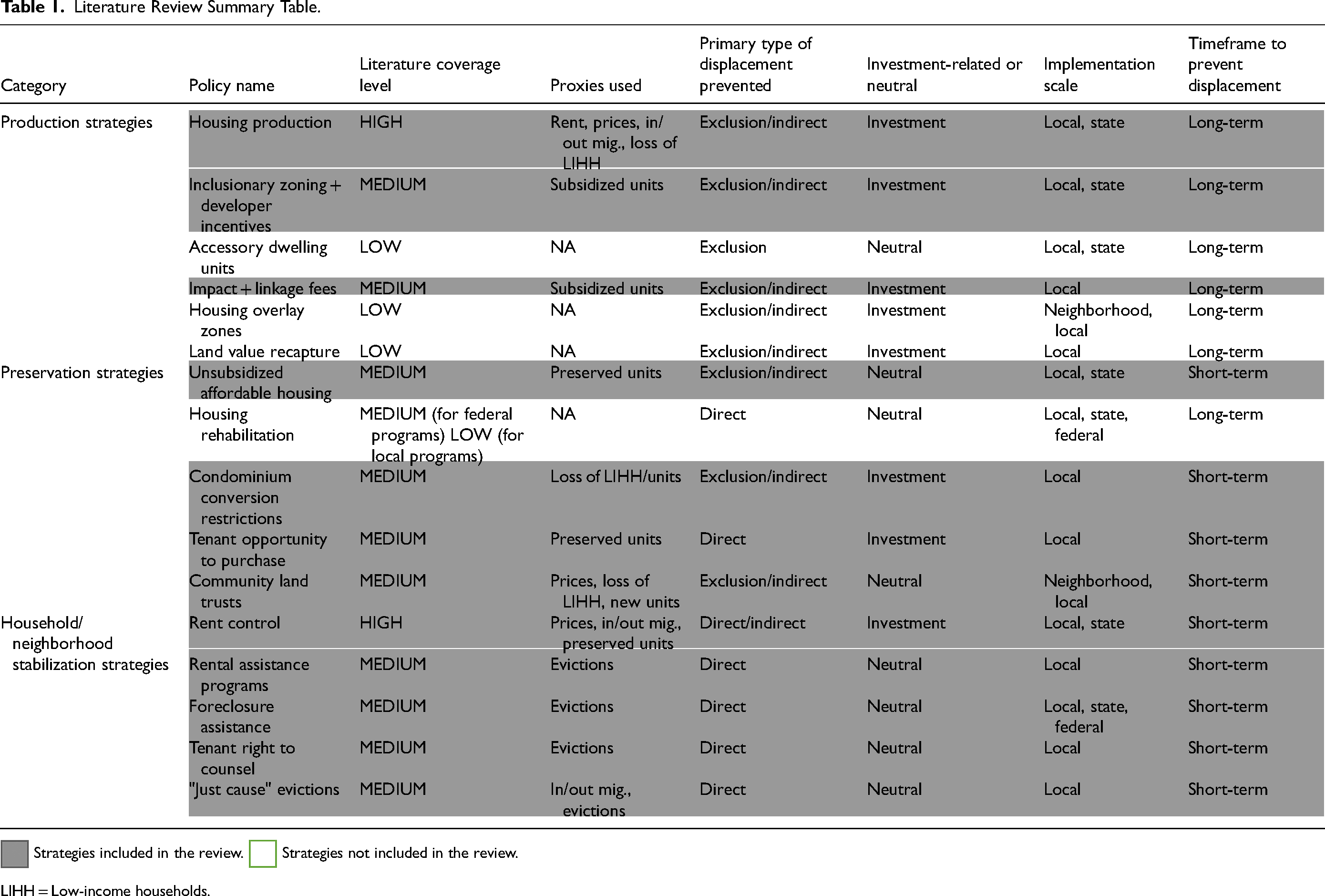
To give readers a sense of the relative amount of literature available on each policy's role in preventing displacement, we also created three categories of literature coverage (Table 1):
LOW indicates that there are essentially no articles that rigorously examine the policy's effect on displacement. There may be descriptive work and/or research examining the policy's effect on other issues, but not displacement or proxies for displacement. MEDIUM indicates that there is at least one article that rigorously examines the policy's effect on displacement or proxies for displacement, in addition to a fair amount of descriptive research on other elements of the policy. HIGH indicates that there are multiple works that rigorously examine the policy's effect on displacement or proxies for displacement, which allows us to come to a clearer determination of when and how the policy is effective at preventing displacement.
Literature Review Summary Table.
 Strategies included in the review.
  Strategies not included in the review.
LIHH = Low-income households.
We used two criteria to select which of the 16 strategies to review. First, to maintain the relevance for city planners, we focused on policies and programs that are local in scope and directly instigated or supported by local governments (albeit occasionally with state or federal support), rather than state or federal governments (e.g., project-based Section 8 units) or market-driven mechanisms. Some of these strategies try to prevent direct displacement (e.g., demolition controls or rental assistance), while others aim to reduce displacement more indirectly (e.g., rent control), and others address exclusion. Second, we examined strategies or policies for which we could find research on their effect on a displacement or on proxies for displacement, such as loss of affordable units or increasing rents or land values. Strategies we did not review because of a lack of literature on their relationship to displacement or lack of a local focus included accessory dwelling units, housing overlay zones, local rehabilitation programs, land value recapture (LVR), general obligation bonds and housing trust funds. 2
Following the aforementioned eligibility criteria, we identified 12 strategies (Table 1) and undertook a search for both peer-reviewed and gray literature that discusses the role of these strategies in avoiding displacement. We used five academic search engines (Google Scholar, Microsoft Academic, Bielefeld Academic Search Engine, ResearchGate, and Semantic Scholar) and also resorted to Google's standard search when we failed to identify relevant articles. In total, we reviewed 138 articles (59 gray literature, 59 academic journal articles, 15 media reports, four books, and one thesis) covering 12 distinct strategies. For each policy, based on the literature, we assessed how it works to prevent displacement, the type of market necessary to make it effective (strong or neutral), the implementation scale (local, state, or federal), and the likely timeframe in which it works (short- or long-term). A caveat is that specific contextual characteristics, as well as the concurrent implementation of multiple policies may affect their effectiveness.
Findings
Production Strategies
Production of either market-rate or affordable housing may combat displacement by increasing the housing supply. We reviewed the literature on three strategies, Housing Production, Inclusionary Zoning, and Impact and Linkage Fees. The first directly produces new units, while the other two represent policy or planning mechanisms that may increase production through fees, mandates, and/or incentives. One common characteristic of production strategies is that they typically require several years, from planning to construction and development, for their effects on displacement to be measurable. Another common characteristic of these strategies is that they require a strong market to be effective. Production strategies generally lack a clear timeline of effectiveness, and long-term impacts may differ dramatically from those in the short-term. This is in contrast to household/neighborhood stabilization strategies, and to a lesser extent, housing preservation strategies, which are typically implemented through legislation and have clear “start” and “end” dates that enable easier measurement of their outcomes.
Does new housing production help moderate housing costs and avoid displacement? The general economic argument in the peer-reviewed research is one of supply and demand: the more housing available, the more prices will decrease (Asquith, Mast, and Reed 2019; Been, Gould Ellen, and O’Regan 2018; Rosenthal 2014). But serious caveats apply. New market-rate production may actually result in rent increases in lower-priced residential buildings nearby (Damiano and Frenier 2020) and may not alleviate displacement over the long-term as low-income newcomers cannot move in (Chapple et al. 2022; Pennington 2020).
The effect of new housing production on displacement is also debated. Most studies focus on the effect of market-rate housing production on proxies for displacement such as nearby rents or home prices. Effects occur through two mechanisms: (1) “filtering,” when rents for new housing fall over time as units age, decline in quality, and become affordable to lower-income renters and (2) “migration” that happens as higher-income people move from lower-rent housing to new market-rate housing, freeing up their units for lower-income renters.
Rosenthal (2014) quantifies the rates of income filtering, finding that across the country, rental units transition to lower-income households at an average rate of approximately 2.2% per year. Liu, McManus, and Yannopoulos (2020) find that filtering rates vary widely by geographic area and over time: while downward filtering can be rapid in certain cities, cities with serious affordable housing shortages, such as Los Angeles and Washington, DC, have experienced upward filtering—namely, housing going to higher-income people as it ages. Policies that encourage the creation of more housing can ease demand pressures and allow downward filtering to occur (Liu, McManus, and Yannopoulos 2020). Some researchers, however, find that this is not always the case: though filtering rates are estimated at 1.5% annually for the Bay Area, rents are only declining at about 0.3% annually, a process that may be too slow to help low-income households (Zuk and Chapple 2016). An additional problem with filtering may be that by the time rents decrease enough to become affordable to low-income renters, landlords may have stopped maintaining units, leaving them virtually uninhabitable (Immergluck, Carpenter, and Lueders 2018). Thus, those skeptical of market-rate housing production argue that it can be a driver of displacement at a local scale, that filtering is too long-term a process to address the needs of low-income people today, and that land in high-cost cities is so constrained that market-rate production suppresses affordable housing production. Additionally, producing more market-rate housing can create “induced demand” (attracting more higher-income people to an area), and new neighborhood amenities that may trigger further displacement (Jacobus 2018).
Some research has examined the shorter-term migration patterns induced by market-rate housing production. In a study utilizing address-level migration histories, Mast (2019) identified 686 new market-rate buildings in central cities across the country and tracked 52,000 residents back to their previous residences. He found evidence that when new housing is built, some higher-income households occupying relatively low-cost units move into the newer, more expensive units, allowing people from lower-income areas to move into their original units. Mast (2019) conservatively estimates that 100 new market-rate units can free up about 45 units in below-median income areas and 13 units in bottom-quintile areas. In another study that examines new market-rate buildings in 11 US cities between 2013 and 2018, Asquith, Mast, and Reed (2019) find that they lower nearby rents by 5–7 percent, increase in-migration from low-income areas, and slow local rent increases by absorbing many high-income households. The authors caution, however, that their findings are specific to large market-rate apartments in strong market cities and only follow outcomes for three years after building construction. Moreover, these studies suffer from an ecological fallacy: they only establish that residents of low-income census tracts are moving into these filtered units, not that it is actually low-income renters who are moving in. This means that high-income (rather than low-income) households could be moving from low-income gentrifying areas to higher-income neighborhoods.
Looking at new housing construction and displacement in San Francisco, Pennington (2020) finds that building new market-rate housing reduces rents, displacement to poorer areas, and evictions for residents within a 500-m radius. At the same time, the new construction attracts relatively wealthier newcomers and more new construction nearby, which may gradually create more exclusion. Looking at high-rise building construction in New York City, Li (2019) finds that for every 10% increase in housing supply, there is a 1% decrease in rents within 500 ft. Damiano and Frenier (2020) also examine the effects of new market-rate construction in Minneapolis on the rents of nearby apartments for five years after building completion. They find that the effects of the new construction depend on the “submarket” of nearby buildings (i.e., proximity, price, and size). For adjacent buildings on the higher-end of the housing market, new market-rate construction is associated with lower rents but for adjacent buildings on the lower-end of the housing market, new construction raises rents by an average of 6.7 percent. Using fine-grained data on market-rate housing production and household mobility, a recent study of the San Francisco Bay Area finds that the new construction causes minor churn, increasing both out- and in-migration rates across income levels (Chapple et al. 2022). The increase in in-migration is generally higher than in out-migration, and when out-migration rates exceed in-migration, the difference is small: for example, the construction of 100 new market-rate units might result in 13 extremely low-income households moving out, as opposed to 11 if there was no new construction.
While much has been written about inclusionary zoning (IZ), most of the peer-reviewed literature focuses on its ability to produce affordable housing, not its ability to prevent displacement. However, affordable housing production can be an important displacement-prevention mechanism, and therefore, it is worth examining how effective IZ programs are at generating affordable units. The literature establishes their ability to produce affordable units (Dawkins, Jeon, and Knaap 2017; Thaden and Wang 2017), but the extent of their effectiveness depends on the presence of a strong market and the particular terms of each program (mandatory or voluntary, length properties should remain affordable, stringency of requirements, etc.; Bento et al. 2009; Brunick 2004; Hickey, Sturtevant, and Thaden 2014).
IZ policies can be applied to both rental and for-sale units. In a national study of 886 jurisdictions with IZ policies in 25 states, Thaden and Wang (2017) found that 581 of these jurisdictions reported creating since their inception 122,320 affordable units. While the authors caution that these figures may significantly undercount the number of affordable units created, the typically low share of affordable units required by IZ programs (usually 10–15 percent of the total units produced) results in very modest numbers of new affordable units (Schuetz, Meltzer, and Been 2011). Indeed, the number of units created by IZ policies is low: For example, San Francisco's production of IZ units amounted to only 2–3 percent of the total housing production over the last 25 years (Schetz, Meltzer, and Been 2011). There are also concerns that in the absence of legislation to the contrary, affordable units developed through IZ programs will not remain affordable in perpetuity (Mast 2019).
IZ is one of the most prevalent affordable housing production strategies (e.g., by 2007, 68 percent of Bay Area municipalities had adopted IZ policies; Meltzer and Schuetz 2010). While places with less affordable housing were more likely to adopt IZ policies, political factors were even more significant in these decisions (ibid.). Examining the effects of IZ policies in California between 1988 and 2005, Bento et al. (2009) find that cities with IZ policies witnessed increases in their shares of multifamily housing, and in the prices and sizes of their single-family homes. Comparing IZ policies in Boston and San Francisco, Schuetz, Meltzer, and Been (2009) note that variations in the structure of these policies affect the amount of affordable housing produced and their effect on market-rate housing prices.
A community's profile may also impact the amount of affordable housing it receives through IZ. Mukhija et al. (2010) find that moderate and above-moderate income communities with IZ produce almost three times as many affordable units than jurisdictions without IZ. However, about one-quarter of the affordable units created in California between 1999 and 2007 served people at the very low-income threshold, half at the low-income threshold, and about one-fifth at moderate incomes; in other words, people on either income extreme were not served well by these units (Mukhija et al. 2010). Reviewing the literature on IZ, Mukhija et al. (2015) find that while IZ has the ability to increase the number of affordable housing units, it may also lead to some trade-offs and adverse market impacts, such as developers switching to housing types exempt from IZ rules.
The ability of IZ strategies to reduce displacement depends on local policy. For example, regional IZ programs, such as that in Montgomery County, Maryland, may result in greater dispersion across neighborhoods than those managed by municipalities (Kontokosta 2015), realizing significant equity gains (Dawkins, Jeon, and Knaap 2017) and potentially addressing displacement in communities that lack other anti-displacement policies. While critics of IZ programs warn that such programs may result in higher prices of market-rate housing, preliminary research does not substantiate such claims, possibly because the required percentage of affordable units is low in the United States. Nevertheless, we need more research to understand what share of affordable housing may be the “tipping point” in different contexts and housing markets.
Affordable Housing Impact Fees and Linkage Fees represent a production strategy that municipalities can add to their toolkit, which allows them to collect a fee from developers of market-rate housing and commercial development, which can be used for the construction of affordable housing. Since this policy represents a stick rather than a carrot for developers, it requires a strong real estate market. Some jurisdictions may be hesitant to impose linkage/impact fees, fearing they might push development to nearby communities without them, thus reducing other revenue streams such as sales taxes. In general, such development fees on residential construction raise housing prices, thereby increasing displacement inadvertently. Nevertheless, studies of cities that have enacted such programs, such as Sacramento (Levy, Comey, and Padilla 2006), Boston (Boston Planning and Development Agency 2018), and San Francisco (BAE Urban Economics 2016) find that they were able to collect significant funding towards the construction of affordable housing units, which directly and indirectly mitigate displacement pressures. For instance, since 2014, over $30 million in linkage fee revenue leveraged over $500 million in public funds to support the development of 1,268 new affordable housing units and the preservation of an additional 548 existing affordable units in Boston (Boston Planning and Development Agency 2018).
While there is a sizable amount of literature on linkage fees and on impact fees, studies largely focus on their legality, economic impact, and comparisons with related policies (e.g., IZ). Only a few studies explicitly connect fee policies to displacement, though some limited empirical research assessing this relationship exists. Publications with an explicit focus on displacement discuss linkage/impact fees as a mechanism to produce or preserve affordable housing, but do not specifically try to quantify or enumerate the benefits of specific policies (Keating 1986).
Affordable Housing Preservation Strategies
Since housing production strategies are costly and require strong real estate markets and long-term horizons, strategies that preserve affordable rental units in older buildings may be more effective and feasible for counteracting displacement in some neighborhoods (Beaumont 1996; Brennan et al. 2013). We reviewed the literature on four preservation strategies: Protection of Unsubsidized Affordable Housing, Condo Conversion Restrictions, Tenant Opportunities to Purchase, and Community Land Trusts (CLTs). 3 One common characteristic of preservation strategies is that they operate in a shorter term than the previously discussed production strategies. Additionally, since they are dealing with existing housing units, they do not need to rely on a strong real estate market.
The Harvard Joint Center for Housing Studies estimates that about three-quarters of Americans dwelling in affordable housing live in unsubsidized affordable units (also called Naturally Occurring Affordable Housing—NOAH) (JCHS 2020). Therefore, Protection of Unsubsidized Affordable Housing is critical in ensuring housing affordability, and policies that help preserve NOAHs can be particularly effective in avoiding displacement. Different cities have instigated a variety of programs to protect this housing stock, based on priority criteria such as estimated rehabilitation cost, gentrification potential, proximity to transit, property size, property age, distance from hazards, etc. (Abdelgany 2016; LA County Affordable Housing Acquisition Fund 2020).
A series of papers focusing on the preservation of affordable housing primarily in Washington, DC, (Howell 2016a, 2016b, 2018) but also in Chicago, IL and Austin, TX (Howell, Mueller, and Wilson 2019), examine the importance of interaction among different stakeholders—government entities, affordable housing advocates, and grassroots organizations—in facilitating the preservation and preventing displacement of low-income households. These studies emphasize that effective strategies require the collaboration of multiple city- and state-agencies, deep knowledge of local contexts, and availability of flexible policies and funding sources. Some municipal programs aim at acquiring and rehabilitating housing units, while others give financial incentives and technical assistance to their owners to do so (Minnesota Preservation Plus Initiative 2013). Programs aiming to upgrade private units may lead to resident displacement, unless strict policies are in place to prevent it. Our literature scan for studies that evaluate such programs, found very little information about the role of local programs in preventing displacement, likely because many of these programs are relatively recent.
Condo Conversion Restrictions are a protective strategy, initiated by cities aiming to protect existing tenants of multifamily buildings that could be displaced, if the building owner converts rental units into condos. Such restrictions enact eligibility criteria for condo conversion and restrict the total number of units that can be converted in a year. There is little empirical evidence on the effect of either allowing or restricting condo development on displacement. While condominium conversions can directly displace existing tenants, recent research challenges the idea that the presence of condominiums causes displacement by encouraging wealthier residents to move into urban centers (Boustan et al. 2019). Examining a range of local policies that either allow or restrict condo production and conversion in central cities across the United States, the study finds that while restrictive policies do in fact reduce the number of condos in an area (as intended), there is no relationship between the number of condo units and area resident demographics (Boustan et al. 2019).
In 1980, Washington, DC, initiated the Tenant Opportunity to Purchase Act (TOPA), that gives income-qualifying tenants the first right and financial and technical assistance to purchase their unit, if it is converted into a condominium. A study examining DC's TOPA program finds that it helped 58% of tenants in the sample purchase their units (Gallaher 2016). The Washington, DC experience shows that, with low-cost financing to low-income tenant associations, and the requirement that cooperatives remain limited-equity for the lifetime of their loan, even very low-income tenants can purchase their homes (Huron 2018). Thus, condo-conversion restrictions may not only help limit somewhat the numbers of displaced households but also if accompanied by TOPA-type programs, they may effectively help some tenants purchase their units. However, such programs require significant financial resources from municipalities.
Community Land Trusts (CLT) and similar policies that give tenants control of the land they reside on offer collective ownership and effectively remove this land from the private market. Such policies require coordinated tenant action and economic resources. While public entities are usually not involved in CLTs, local governments can actively pursue the acquisition of abandoned or tax-delinquent properties and the development of land banks that would allow them to put these properties into affordable housing uses. When considering disposition strategies for excess land, local governments can work with CLTs to identify sites with the greatest potential. For example, providing land in high-cost central areas or transit-oriented neighborhoods may be effective not only in facilitating accessibility but also in increasing the potential for home equity growth (Manweller 2020).
The most well-studied example of a CLT is the Dudley Street Neighborhood Initiative in Boston, which has had notable stabilizing effects on the residents of the neighborhood, mitigating impacts of the Great Recession of 2007–2009 (Louie 2016). Choi, Van Zandt, and Matarrita-Cascante (2018) constructed logistic regression models to examine the impact of CLTs on 124 gentrifying and non-gentrifying neighborhoods in 22 US states, seeking to understand if CLTs were able to counteract the negative effects of gentrification, such as removal of affordable housing and displacement. The researchers found strong evidence that CLTs can slow the gentrification process, with the presence of CLTs decreasing the odds of gentrification by 70 percent.
In general, however, CLTs have been found to serve more moderate-income than lower-income households, which may limit their ability to prevent displacement of communities most at risk. In a 2011 survey of CLTs by Grounded Solutions Network, an organization that promotes affordable housing, researchers found that 55 percent of CLTs served households at 80 percent of the area's median income (AMI), another 30 percent served households at 120 percent AMI, and none served those below 50 percent AMI (Thaden 2012).
Thus, research on CLTs points to their potential to reduce displacement through their protective affordability requirements and long-term commitment. While these policies have not yet been broadly replicated and do not currently cover people at all income levels, they have the potential to work in concert with other anti-displacement strategies to preserve affordable housing and reduce displacement (Jackson 2017).
Household/Neighborhood Stabilization Strategies
Arguably, neighborhood stabilization strategies that offer tenants protections, allowing them to stay in their changing neighborhoods, are a more direct form of anti-displacement policy than housing production or preservation. Additionally, most of these protections require only a brief rollout period. We reviewed the literature on five stabilization strategies: Rent Control, “Just Cause” Evictions, Tenant Right to Counsel, Rental Assistance Programs, and Foreclosure Assistance.
Rent Control policies restricting the number of annual rent increases in certain (not new) buildings represent a common mechanism that US cities have used to stabilize rents. Given their long history, rent control policies have been under much academic scrutiny, and there exists a large body of peer-reviewed studies available about their effectiveness in reducing displacement. The majority of these studies do not measure displacement directly, instead using proxy measures such as housing costs or rent prices to estimate the effect on existing tenants.
The conclusion that rent regulations are effective at stabilizing neighborhoods and preventing displacement is commonplace in this research. A literature review of research on the effects of rent regulation describes it as an “anti-displacement tool” that successfully keeps tenants in their homes longer (Pastor, Carter, and Abood 2018). Examining rent control impacts in San Francisco, Diamond, McQuade, and Qian (2019) find that it has limited the displacement of tenants and allowed them longer tenure in their units, having an especially strong effect among minority and elderly communities. Overall, the authors estimate that tenants in rent-controlled units are 10 to 20 percent more likely to remain at their original address in San Francisco. However, they also find that the policy has led to the removal of units from the rental market, through condo conversions. Thus, rent control protects current tenants, while potentially harming lower-income residents who do not currently occupy a rent-controlled unit. A study of the nine-county San Francisco Bay Area essentially confirms these findings, showing reduced outmigration rates for lower-income households, along with reduced in-migration rates (Hwang et al. 2022). Another study of rent decontrol in Cambridge, MA, looked at the unexpected removal of rent control in that state in 1995, when property values increased by 16 percent, on average, for units that were no longer subject to rent regulations (Autor, Palmer, and Pathak 2014). These increases do not directly predict displacement, but ostensibly led to the displacement of some tenants who had been previously protected by rent control. A study of the 1995 end of rent control in Massachusetts finds that units subject to rent control were slightly more likely to become rental units after rent control was removed, suggesting that landlords had been keeping thousands of units off the market (as ownership units) due to these regulations (Sims 2007).
Since rent control policies generally contain exemptions for newer units, they have not been found to affect the rate of new building construction (Pastor, Carter, and Abood 2018). On the other hand, studies also find that owners of units subjected to rent control are likely incentivized to pull them off the rental market, renovate them so that they are no longer covered by rent control, or let them deteriorate (Asquith 2019; Diamond, McQuade, and Qian 2019; Sims 2007). Because of uncertainty about rent control's impact on local markets, Pastor, Carter, and Abood (2018) warn that rent control policies are not a “silver bullet” and must be part of a slate of anti-displacement policies (such as preventing landlords from removing units from the rental market, or “Just Cause” eviction regulations) to be effective in the long-term.
Just Cause Eviction Programs forbid property owners from evicting tenants except under certain specified circumstances, such as nonpayment of rent, violation of lease terms, or permanent removal of a dwelling from the rental market. The limited literature that has evaluated some of these programs finds evidence that they contribute to the decline of evictions and displacement. Cuellar (2019) uses a natural experiment to examine the incidence of eviction filings before and after implementation in four California cities with similar characteristics but with or without these protections; those with “Just Cause” protections saw the incidence of evictions and eviction filings decline. A more recent study of “Just Cause” in the San Francisco Bay Area confirms that these ordinances are associated with lower outmigration rates, particularly for lower-income residents (Hwang et al. 2022). Another study, focusing on health impacts, finds that eviction is associated with short- and long-term health issues, and evicted households are often forced to relocate to substandard, hazardous dwellings that harm physical health (Blanco 2016). In effect, “Just Cause” eviction protections would mitigate stressors and harms associated with residential instability (ibid.).
Tenant Right to Counsel Programs offer renters access to legal representation in eviction cases. In contrast to most other policies considered in this review, right to counsel provides a direct metric to evaluate incidence of displacement—whether unlawful detainer actions were filed, and the outcome of those filings. A number of jurisdictions have recently established such programs; some are offered only to tenants below certain income thresholds. Because of the relative recency of these programs, there is a limited amount of literature that explicitly measures how they mitigate displacement. Nevertheless, studies in Boston, New York, and San Francisco find that in all cases these programs are helping to keep threatened residents at their homes (Boston Bar Association 2012; Fracassa 2020; Miranova 2019). Accordingly, the existing studies offer preliminary insights into how such a policy can reduce displacement pressures.
Much of the literature on the right to counsel has originated in law schools and public interest legal clinics engaged in pilot programs for tenant representation in court. For example, a one-year pilot program offered pro bono legal services to tenants with incomes below 200 percent of the federal poverty level, enabling 27 percent of almost 700 tenants to remain in their dwellings (John and Terry Levin Center 2014). The Boston Bar Association also rolled out randomized controlled trials in a handful of cities in Massachusetts, in which a treatment group that received legal representation was twice as likely to remain in their homes than those without representation (Boston Bar Association 2012). More recently, San Francisco issued findings related to the city's right-to-counsel law that was approved by voters in 2018. Over the course of six months in 2019, the new program helped approximately 730 residents remain in their homes (Fracassa 2020). Two-thirds of the tenants receiving full-scope representation retained possession of their dwelling units, while four out of five African Americans receiving legal representation in an unlawful detainer action were able to remain in their homes (Fracassa 2020).
To evaluate the efficacy of New York City's new right-to-counsel policy in mitigating eviction, the Community Service Society of New York compared eviction filing records in 2017 (before the law was implemented) to its first year of operation in 2018, looking at how zip codes where right to counsel had been implemented performed in relation to demographically comparable zip codes. Over 22,000 residents benefitted from representation, of whom 84% were allowed to remain in their homes. Evictions in pilot zip codes declined by 11 percent between 2017 and 2018, compared to just 2 percent for non-piloted zip codes (Mironova 2019). While preliminary and not peer-reviewed, the aforementioned findings point to the effectiveness of right to counsel as a potential anti-displacement tool.
The literature finds that small sums of unpaid rent account for a large share of filings against tenants (Desmond 2016). For this reason, Rental Assistance Programs offering low-income tenants emergency funds to pay rent during moments of economic hardship can be very effective in staving off eviction pressures and displacement. Such programs proliferated during the COVID-19 pandemic when states and localities sought to provide emergency assistance to renter households affected by lost income because of lockdowns and business closures (Dillon 2020; Greene and Batko 2020). These policies are not limited to economic downturns, however, and have been used in the past to support renters who have experienced sudden rent increases. For instance, in late 2019, prior to the implementation of a state law that capped annual rent increases, tenants in Los Angeles saw their rents spike as landlords attempted to bypass the impending restrictions on future rent adjustments and the LA City Council established an emergency fund for renters (Chandler 2019).
Although limited research exists on the efficacy of rental assistance programs, some research on eviction prevention does address rental assistance funds as a stopgap displacement remedy. For instance, a study compared the cities of Jacksonville, Florida, Hennepin County, Minnesota, Seattle-Tacoma-Everett, Washington, and San Antonio, Texas, which have programs offering emergency grants to households at risk of eviction (Aghayev, Feng, and Wiens 2017). It finds that resident familiarity with these programs is highly limited, with two-thirds of respondents in eviction court reporting that they did not apply or were unaware of rental assistance programs. Additionally, the process of confirming program eligibility greatly undermines its efficacy, as it lasts longer than the eviction process itself (Aghayev, Feng, and Wiens 2017).
While rental assistance programs target renters, Foreclosure Assistance Programs aim at assisting homeowners by offering them different means of financial and counseling support to avoid displacement. Such programs can be initiated at the municipal and state levels. Existing literature indicates that these programs can benefit vulnerable homeowners. In particular, a large study by the Urban Land Institute finds that households who received counseling about troubled loans during the Great Recession were significantly more likely to avoid default at various stages, prevent completed foreclosures, benefit from loan modification, and subsequently remain current on their mortgages relative to households not receiving counseling. Although this study does not explicitly discuss displacement, the outcomes assessed—such as loan modification, avoiding delinquency, and remaining current—suggest that foreclosure counseling programs may promote residential stability (Mayer et al. 2012). Another analysis by the Urban Institute conveys the benefits of mortgage counseling programs as piloted by a program in Washington, DC, where a local nonprofit housing counseling organization engaged in outreach with over 400 households facing the threat of foreclosure between 2011 and 2012. Nearly half of the participating households were able to become current on their mortgages through their assistance, with only five counseled households reporting foreclosure (Urban Institute 2013). Another example is a pilot program run by Boston Community Capital, which acquired more than 60 housing units at discounted rates and resold them to existing occupants across several low-income neighborhoods (Cherry and Hanratty 2010). 4
In conclusion, household/neighborhood stabilization policies have the most direct and immediate effect on mitigating displacement. Given that most households with affordable housing live in unsubsidized units, housing preservation programs have the most potential for significant impact. Such policies can become even more effective when used simultaneously, in association with one another. On the other hand, housing production strategies can help indirectly in decreasing displacement by retaining or adding to the market-rate and affordable housing stock. However, housing production policies typically require strong markets, and longer time spans.
Literature Gaps
As we combed the literature on anti-displacement strategies, we also became aware of what is missing. We discuss our findings about these literature gaps below, which also pinpoint to need for future research.
Promising strategies with no literature coverage. The impacts on abating displacement of some promising strategies, such as the building of ADUs and the establishment of Housing Overlay Zones (HOZs), have received little scholarly evaluation. ADUs have dramatically increased over the last years, especially in California (Chapple et al. 2020). They represent a relatively low-cost way to produce new housing (Woetzel et al. 2016), but may potentially lead to gentrification by adding to the value of the original property. However, we found no research that examines the direct impact of ADUs on displacement. HOZs are another promising strategy that may help counteract displacement effects of public investments within a specific district. HOZs offer developers density bonuses, relaxed development standards, and streamlined permits or environmental reviews for projects in designated districts, in return for a certain amount of below-market housing. HOZ minimums are significantly higher than those of IZ programs, frequently ranging from 25 percent to 100 percent of the proposed project's units. Jurisdictions can strategically choose the designation of these zones to protect the displacement of low-income communities, which can result from upzoning near transportation and employment hubs (Calavita and Wolfe 2014). On the other hand, Ryan and Enderle (2012) in their San Diego study find that density bonuses for the production of affordable housing incentivize developers to provide such housing only for the lower-value land markets of Latino and Black neighborhoods. However, there is no evaluative literature on the impact of HOZs on displacement.
Dearth of policy effectiveness literature. Very few studies measure a policy's impact on displacement directly. Most existing literature examines certain indicators that may be related to displacement (proxies for displacement), but not the actual numbers of households that were able to stay or enter a neighborhood as a result of a particular anti-displacement policy. For example, three strategies based on different forms of taxation that have been used by local governments to produce affordable housing are land value recapture, which taxes landlords for the value of their land, if this has witnessed a significant increase because of a public-sector investment or governmental action (e.g., rezoning); local government-issued general obligation bonds, repaid by the general fund or a dedicated tax; and housing trust funds that receive dedicated funding for the production or preservation of affordable housing. However, we found no studies examining the relationship between these strategies and displacement prevention.
Selective use of displacement indicators. Additionally, the literature tends to use some more easily found proxies for displacement than others that are more difficult to identify or calculate. Many studies examine a policy's effect on rent prices or property values, but fewer studies collect data on evictions, move-outs, or loss of naturally occurring affordable housing.
Relationship between displacement and public investments. Recent studies have started examining the relationship between certain types of public investment (in particular transit infrastructure) and displacement risk. But not all types of public investments lead to displacement. More studies are necessary to examine the impact of diverse public investments on displacement, and importantly, the type of safeguards that should accompany public investments in order to avoid displacement in different contexts (Zuk et al. 2018). Additionally, while empirical evidence pinpoints to unintended displacement effects of public investments, there is insufficient research about the most effective mitigation for such adverse impacts.
Dearth of inquiry on racial impacts of policies. A number of studies clearly show that communities of color have historically borne—and continue to bear—a disparate impact of displacement pressures. Therefore, it is surprising that we find a dearth of studies on the effects of anti-displacement policies disaggregated by race and a lack of inquiry into how particular policy interventions have (or have not) prevented the displacement of communities of color, and which are effective policies to offer such protection. Without explicitly disaggregating policy effectiveness by race, the existing literature seemingly assumes that policies work equally well for all communities, which is problematic.
Isolated examination of policies. Most studies examine the effectiveness of a particular policy in isolation rather than in coordination with other policies, legislation, or community action that together may be effective in preventive displacement. A description of the local policy context would help clarify how policies are working.
One size often does not fit all. Studies consistently advise caution in extrapolating results from one housing market to another. Due to the local nature of housing policy, municipalities are quite different from one another. Politics, housing market strength, population, demographics, history, and geography are just some of the factors that play a role in how policies are designed and implemented.
Dearth of literature on contextual characteristics. Despite the importance of context in the effectiveness of policies, very few studies address how specific contextual characteristics may shape the effectiveness of particular policies. Yet, factors such as local politics, housing markets, history, or demographics of a jurisdiction may make it easier or more difficult to implement certain policies and ensure their effectiveness. Some policies require a strong market to be effective, and other may be effective only in particular metropolitan areas, or even parts of these areas.
Dearth of literature on small metropolitan, exurban, or rural areas. Most studies have examined strong-market metros like San Francisco, Boston, or New York. Little is known about how anti-displacement policies would work in weaker markets, exurban, or rural areas. In many of these areas, displacement may be induced by disinvestment in addition to investment. Thus, more research is needed to understand the effectiveness of some anti-displacement policies in these contexts.
Lack of analysis of barriers to implementation. There is very little written about the different barriers (economic, institutional, social, and political) affecting the implementation of anti-displacement strategies. Certain policies may require a long-term horizon to become effective, and others may be effective only if complemented with particular provisions or other policies. Although we did not examine community organizing specifically, case studies suggest that it can facilitate implementation and reduce displacement (e.g., Crispell, Harris Rockefeller, and Cespedes 2016). Community organizing seems to be an effective means to win the implementation of certain types of policies and tenant protections. However, it has also been used effectively to stop new housing production or initiate tenant protections. It would be helpful to understand more about what policies have required significant organizing to establish and be meaningfully enacted.
Lack of a review of best practices. While particular anti-displacement policies or legislation may not fit all geographic contexts equally well, the lessons and impacts from the application of particular policies in jurisdictions of different states or even other countries could be useful to other jurisdictions. However, the literature is generally lacking a discussion about best practices.
Role of Policies and Public Sector Actions
Communities have long demanded that planners address the displacement of residents, whether induced by gentrification or public investment. Although the debate is ongoing about the extent of such displacement, there is widespread agreement that it occurs. Yet, policymakers under pressure to take action are faced with a dearth of evidence about what policies to adopt to mitigate displacement.
Our review of the literature finds that there has been very little systematic evaluation of the role of different local housing policies in mitigating displacement by producing housing, preserving affordability, protecting tenants, and stabilizing communities. Hundreds of studies exist, but they tend to be too limited in terms of context, timeframe, measurement, and other factors for policymakers to draw definitive conclusions about how they work. The sparse literature on housing policy and displacement contrasts sharply with the rich evaluation literature on areas such as health (e.g., the effectiveness of prevention), the economy (e.g., the minimum wage), or even land use (e.g., growth controls).
What should state or municipal agencies do to protect vulnerable households against displacement pressures in their jurisdictions? We will start by saying that were these agencies to mandate anti-displacement policies in some form, they would certainly need to account for their particular contexts and variation in sub-markets across their jurisdictions.
Most of the strategies described in the literature are at least somewhat effective at mitigating displacement. Nevertheless, based on available evidence from different geographies, we are fairly confident that the following strategies are likely effective at stabilizing communities across different market contexts: production of subsidized housing, preservation of naturally occurring affordable housing, and foreclosure assistance. On the other hand, some other strategies have a lower level of effectiveness because they are too indirect (e.g., impact and linkage fees). Although market-rate housing production will alleviate displacement in tight markets, it can also spur more involuntary outmigration, creating a need for concurrent mitigation in certain contexts.
Overall, based on our review of the literature, we find that neighborhood stabilization and tenant protection policies have the most direct and immediate effect on mitigating displacement. Indeed, the COVID-19 crisis has both educated the public about the challenges of displacement and also presented an opportunity to implement some neighborhood stabilization policies. Anecdotal evidence from different cities suggests that temporary eviction moratoria and rental assistance have largely succeeded at keeping families in their homes (Raajkumar 2022; Reina et al. 2021; Tsai et al. 2022). This raises questions about how we can make these policies more permanent, perhaps in the form of an expanded rental assistance fund and just cause eviction policies in jurisdictions across the state. Given that most households with affordable housing live in unsubsidized units, housing preservation programs for naturally occurring affordable housing have the most potential for significant impact. Housing production strategies can help indirectly in decreasing displacement by retaining or adding to the affordable housing stock. However, housing production policies typically require strong markets and longer time spans, and may best mitigate displacement once stabilization and preservation policies are already in place.
Thus, we suggest that municipal agencies may best prevent displacement by prioritizing housing preservation and tenant protection policies where possible, whether in incentive programs or planning documents. However, these agencies’ direct power to curb displacement also lies in the long-term, in how they strategically channel investments and dispose their public land to spur affordable housing production. Local governments should also monitor displacement trends over time across their jurisdictions. It would be helpful if metropolitan planning organizations could compile a comprehensive inventory of anti-displacement policies and programs in their areas. In the absence of rigorous research on which policies are most effective, it could be valuable to survey local officials and advocates about which are most successful on the ground. Such empirical knowledge of how approaches have worked in different geographies could help local agencies decide which to incorporate into their guidelines for investment. State and federal governments might also enact guidelines that strongly encourage jurisdictions to adopt anti-displacement policies. On their end, local governments may consider a prioritization scheme for anti-displacement policies in their jurisdiction to incorporate into applications for state and federal funding. Additionally, local governments may collaborate and help build capacity in local communities through ongoing education about displacement issues and support for community organizing and community-based institutions fighting displacement. During periods when housing prices and land costs dip, states and municipal governments should take advantage of the moment to purchase private multi-family buildings and convert them to permanent affordability. The period after the Great Recession showed that the private sector was poised to make a profit on housing; next time, the public sector also needs to be prepared to ensure that displacement does not destabilize individuals, communities, and neighborhoods.
Footnotes
Declaration of Conflicting Interests
The author(s) declared no potential conflicts of interest with respect to the research, authorship, and/or publication of this article.
Funding
The author(s) disclosed receipt of the following financial support for the research, authorship, and/or publication of this article. This work was supported by the California Air Resources BoardAgreement (grant number 19RD018).
