




Abstract
This study examines how family history interviews reveal achievement within families, while highlighting Black accomplishments often excluded from social studies education. Grounded in curricular and pedagogical resuscitation (CPR) and building on critical family history (CFH), this research explores how personal narratives can better inform historical curiosity and questions. Employing autoethnography and photo/artifact elicitation, this study centers a family history interview with Charles Thomas—a former student-athlete, HBCU graduate, ex-NFL professional football player turned educator, and uncle—revealing how Black education, institutions, and achievement intersect with broader social, political, and historical contexts. Findings demonstrate that CPR’s tenets of body, spirit, and mind serve as a vital framework for embedding Black experiences into social studies instruction, challenging historical omissions, and cultivating a more accurate and engaging curriculum. This study offers both theoretical and practical applications for classroom instruction.
Keywords
Introduction
On a hot, humid afternoon in Houston, Texas I visited my uncle, Charles Thomas. I walked into the house to see him searching through a hallway closet. He pulled out a collection of faded photographs and an old high school yearbook. These artifacts were emblematic of the rich, often negated stories of accomplishments and everyday life within the Black community. This personal exploration, bridging family histories with broader academic themes underscores the potential of employing family history, oral history, and Black history within social studies education.
In the United States, curriculum standards are determined at the state level rather than nationally. Each state establishes its own standards, although national organizations such as the National Council for the Social Studies (NCSS) provide voluntary frameworks. This decentralized approach means historical narratives—including Black histories—can vary significantly. The fight for curriculum to incorporate both past and present accounts of Black life is not new. Warnings of inauthentic attempts to empower Black citizenry through education have endured (Watkins, 2001). Currently, parts of the United States are experiencing an expansion of Black education such as in California, whereby beginning in the 2025 to 2026 academic year high schools must offer ethnic studies; yet, in states such as Florida, an African American studies Advanced Placement course was rejected (Rozsa, 2023). Research indicates social studies standards have marginalized Black narratives and adhered to a portrayal of Black people confined to binaries of oppression and liberation or as messiahs who became martyrs (Alridge, 2006; Busey & Walker, 2017; Duncan et al., 2023; Johnson, 2022; Johnson & Thomas, 2022; Journell, 2008; Swartz, 2013).
Utilizing family history in social studies to unearth Black accomplishments confronts erasure within curricula. Critically engaging personal and communal stories assists students to comprehend history more accurately (Levstik, 2000). By employing the framework of critical family history—CFH (Sleeter, 2008, 2020) to advance curricular and pedagogical resuscitation—CPR (Johnson & Nicol, 2020) along with autoethnography (Ellis et al., 2011) as methodology, this study addresses a gap and provides a model for empowering students to explore and present histories they are directly tied to. It also provides families with a sense of belonging as their experiences become integral to the educational narrative.
The purpose of this study is to forward CPR as a framework to illustrate how Black histories, acknowledging accountability standards, can be better implemented into social studies education. The research question guiding this work is: “How can teachers effectively incorporate Black histories into social studies curricula through more empowering and engaging means?” Following this introduction is a literature review intertwining Black history, social studies, and family and oral narrative. Next, Sleeter’s (2008, 2020) CFH and CPR (Johnson & Nicol, 2020) as theoretical frameworks are outlined. Then, autoethnography (Ellis et al., 2011) combined with photo and artifact elicitation (Clark-Ibanez, 2004) as methodology along with the analytical process is highlighted. The results section presents photos and segments of my interview with Uncle Charles beginning with a photo of his high school yearbook cover, college photo, then professional photo. Lastly, limitations are noted, a recommendation of practical application is offered, a discussion explaining the significance of CPR is presented, and a conclusion offering key insights is provided.
Literature Review
Black History and Social Studies
The inclusion of Black histories in social studies curricula has faced systemic barriers and a Eurocentric focus that marginalizes the contributions and experiences of Black individuals. Scholars such as King (2017) argue the traditional curriculum focuses narrowly on oppression and liberation, overlooking complexities of Black agency and achievements. This limited approach perpetuates stereotypes and fails to provide a comprehensive understanding of Black contributions. The education system has disregarded the cultural heritage and intellectualism of the Black community (Giroux, 2024; Martell, 2017; Wilson, 1978; Woodson, 1933). Despite progress spurred by the Civil Rights Movement from 1954 to 1968 (King, 2014), Black history remains inadequately represented, often reduced to superficial coverage.
To address these instructional shortcomings, scholars advocated various approaches. Modifying pedagogical approaches was needed due to the disconnect between culture, education, and learning. Afrocentric (Karenga, 1986), multicultural (Banks, 1995), culturally relevant (Ladson-Billings & Tate, 1995), sustaining (Paris, 2012), and responsive (Gay, 2018) pedagogies aimed to improve outcomes for Black students. King (2020) advocated teaching Black history through the lens of Blackness, not simply about Black history. The study, dissemination, and celebration of early Black history efforts have long served as tools of collective resistance (Snyder, 2018).
Black educators and communities historically utilized social studies to foster civic participation and strategies of resistance. Social studies in Black communities was tied to civic engagement and institution building, with the teaching of democratic principles, promotion of Black patriotism, and cultivation of activism (King, 2020; Murray & Woyshner, 2017; Snyder, 2018; Woyshner, 2023). For example, the Supplementary Units for the Course of Instruction in Social Studies, a K-8 Black history curriculum introduced in Chicago in the 1940s, was a notable innovation countering the state’s narrative of Black inferiority (Hines, 2017). Early efforts such as these laid the groundwork for Black/African American studies, which rejected narratives of insignificance (Fairclough, 2001; Hines, 2017; James-Gallaway, 2020). Black social studies education also extended beyond the classroom, involving community members, organizations, and institutions in the learning process. Those advancing this field viewed social studies as a powerful tool for Black societal transformation (Hall, 2023; King, 2020; Snyder, 2018).
Family and Oral History
The field of family and oral history has received significant academic attention, particularly in understanding the experiences of Black families (Broussard, 2011). Oral history enables the conservation and distribution of personal accounts frequently lacking in official documentation. This is particularly relevant for Black families, whose histories have often been excluded or distorted in standard accounts (King, 2020; Nickson, 2022; Portelli, 1997). Hamilton (2013) emphasized that oral history in Black households functions as both storage of memories and a means of upholding cultural heritage. Oral traditions offer perspectives on sociocultural and political environments influencing the structure and dynamics of the Black family and communal life. These histories are imbued with cultural significance essential for comprehending the real-life encounters of Black folk (Hamilton, 2013). In certain cases, Black oral histories are embedded in curriculum development through school–museum partnerships, community oral history nights, and classroom projects where students interview elders to build local archives. These efforts use oral narratives as historical sources and pedagogical tools connecting family, community, and national stories (Oral History Association, 2023; Wise et al., 2023).
Furthermore, oral history plays a crucial role in questioning prevailing historical accounts. Thompson (2022) argued that practicing Black family oral histories challenges one-sided representations by highlighting a range of perspectives and refuting monolithic tropes. This method aligns with Black intellectual tradition (Grant et al., 2016), which unifies experience and thought “to trouble and deconstruct enduring questions of culture, difference, and curriculum” (p. xxi). Scholars argue it is imperative for Black Americans to redefine narratives depicting them as subpersons who contributed nothing intellectually, socially, aesthetically, or culturally to American society (King, 2020; Mills, 1997; Smith et al., 2022).
Within the framework of many Black families, stemming from traditions of West Africa, the griot or storyteller is a key conveyer of collective wisdom and assumes a key role in shaping the self-image and concept of a family and community. According to Grele (1991), the narratives of endurance, opposition, and communal togetherness shared across Black families played a significant role in shaping one’s sense of self and ongoing communal connection. These narratives provide an alternative perspective to the widespread misconceptions and unfavorable depictions of Black family life (Grele, 1991; Shabazz, 2001, 2005; Thomas et al., 2025). In fact, Baker (2014) found that children of African American parents who participated in shared book reading and cultural heritage discussions at home had higher social studies scores. Additionally, oral history initiatives that specifically concentrated on Black families, such as the Federal Writers’ Project during the 1930s, Rawick’s (1972) work of Black existence in the South during Jim Crow and the Civil Rights movement, along with more popularized accounts of Black genealogy by Haley (1973) and Gates (2017), uncovered the profound and distinct nature of Black existence in America. These studies emphasized the significance of testimonies and storytelling in capturing the subtleties of daily living and the influence of wider socioeconomic factors on Black families.
The incorporation of oral history in Black households is not just a methodological decision but also a political act. It confirms the significance of Black experiences and ensures the preservation of these narratives for future generations. By giving priority to oral histories, teachers can enhance not only the inclusivity and accuracy of historical representation but also Black students’ sense of belonging in educational spaces (Hamilton, 2013; Portelli, 1997).
Theoretical Framework
This study utilizes CFH (Sleeter, 2008, 2020) to advance CPR (Johnson & Nicol, 2020) as the conceptual frameworks guiding this project. Sleeter’s model invites us to delve into family histories and situate these narratives within broader sociocultural and political landscapes. CPR, through social studies, invites a more rigorous knowledge of Black American experiences that enriches, expands, and challenges the exchange of ideas toward culturally relevant education.
Critical Family History
Sleeter’s (2008, 2020) critical family history-CFH, drawn from critical pedagogy, is a framework for investigating one’s own family history within the context of larger sociopolitical processes. Locating one’s ancestry and examining how it shapes present-day identity in terms of race, class, gender, and other identities tied to nationhood are essential tenets. According to Sleeter (2020), there are long-lasting effects on individuals and communities due to the interconnectedness of family histories with broader historical events, cultural transitions, and power relations. Gardner (2003) suggested that Haley’s (1976) epic series, Roots, reignited the purpose of exploring family heritage to recover forgotten Black family history. King (2024) offered critical family history as way of feeling like, with, and for research participants to “write histories that are inaccessible through conventional archival methodologies” (p. 403). This comprehension via research and classroom practice helps one become cognizant of the ways family history is entwined with systemic frameworks of power, social interactions, and institutional norms. Its goal is to develop a more critical awareness of one’s identity and role in society by dismantling simplistic assumptions about one’s own history and family history.
Curricular and Pedagogical Resuscitation
An empowering, nuanced understanding of Black history is provided through building off CFH with curricular and pedagogical resuscitation-CPR (Johnson & Nicol, 2020). Stemming from the theorization of BlackCrit (Dumas & Ross, 2016), which points to how (anti)blackness contributes to the scorn of Black bodies in academic settings, CPR similar to BlackCrit, “invite[s] a broader imagining of the significance of blackness in our everyday lives” and “to love being Black, to embrace it as a conscious act of care, power, and healing” (Dumas & Ross, 2016, p. 418). Three basic principles form the foundation of CPR, which seeks reclaiming of Black bodies, spirits, and minds in social studies and history. First, CPR drives us to re-member and place Black persons in our cultural memory through curriculum and pedagogy. Secondly, CPR addresses the spiritual aspect of Black education essential to care, community uplift, and countering the “spirit murdering” (Love, 2016) of children in schools. Thirdly, CPR, as a mental strategy, provides a search for the link and relevance of history to contemporary and future challenges, given the tendency for social studies and history to be reduced to arbitrary and disparate themes. Operating as an extension of Black intellectual thought (Grant et al., 2016), CPR exists to better analyze the past and forge improved routes to scholastic achievement, affirmation, and justice in today’s educational spaces.
While CFH emphasizes re-examining family narratives, CPR calls for revitalizing them within social studies to counter erasure. CFH helps to reveal unrecognized stories and accounts, while CPR transforms them into instructional content that resists reductionist, binary representations of Black history.
Methodology
Autoethnography
As a research methodology, autoethnography combines individual personal narratives with sociocultural analysis to obtain an in-depth understanding of subjective realities, social phenomena, and cultural dynamics from an insider’s perspective (Ellis et al., 2011). Researchers engage in self-reflection and narration, drawing on their own experiences and observations. This approach acknowledges the researcher’s position as both subject and analyst, emphasizing the intertwining of personal experiences with larger social processes (Chang, 2008). The researcher’s accounts serve as primary data sources, and narrative analysis is used to uncover patterns, meanings, and insights via the systematic analysis of themes, structures, and contextual factors (Riessman, 2008). Autoethnography recognizes the researcher’s subjectivity yet situates their background as useful for deeper understanding of the research topic. Moreover, autoethnographic accounts or Othered stories work against hegemonic forces to engage in critical self-reflexivity—to speak rather than being spoken for and to make visible what often is excluded (Griffin, 2012), particularly regarding Black accomplishments within social studies curriculum and instruction (Brown & Brown, 2020).
Researcher Positionality
I grew up within a loving family and community. I had a healthy understanding and admiration of my family’s achievements—hearing them as stories and, if lucky, seeing pictures that carried Black accomplishments unheralded to others but sacred amongst us. For instance, my uncle, Gaylord Davis, was a basketball star at Texas Southern University. A friend of Aunt Laffie was a nurse who cared for President John F. Kennedy after he was shot. My grandmother, Flossie Mae Hubbard Johnson, made one of the bravest decisions I know—leaving home at 14 years old to join her sister in Houston, TX, unwilling to accept a future confined to others’ expectations.
This journey of uncovering my family’s history took on deeper meaning in 2018 when I witnessed Uncle Charles and his Phyllis Wheatley High School basketball teammates honored at the Texas University Interscholastic League (UIL) State Championship for the 50th anniversary of their 1968 championship—the first year desegregation was implemented in Texas athletics (McDonald, 2018). Seeing my uncle and his teammates recognized made me reflect on how much of our history remains untold or undervalued. This moment planted the seed to learn more about his experiences, leading to this study.
My father’s recollections of the aftermath of Martin Luther King Jr.’s (MLK) assassination further shaped my understanding of history as lived experience. He shared how, just days after MLK’s death, my father reported for duty in the U.S. military, entering Army bootcamp at a time when racial tension and grief was palpable. His story reminded me that historical moments are not detached events in textbooks. They can be deeply personal, shaping the trajectories of individuals and families in ways curricula and instruction often fail to acknowledge. These family experiences, whether in sports, military service, or acts of personal agency, taught me that history is not merely studied; it is lived—thus needing to be remembered and reclaimed. These historical accounts fuel my commitment to presenting CPR into social studies education to ensure these realities are preserved and included in historical analysis.
Photo and Artifact Elicitation
This study utilized photos as the centerpiece of gleaning details of Uncle Charles’ stories. As a methodology, photo and artifact elicitation provided an engaging approach to family history. Photo and artifact elicitation involves using photographs/artifacts as a catalyst during interviews to elicit more in-depth, detailed, and structured responses and (Abildgaard, 2018; Harper, 2002). Because participants feel empowered by making their own choices and “explain[ing] as opposed to needing additional prompting and prying from the researcher” (Richard and Lahman, 2015, p. 15), photo and artifact elicitation evokes deeper elements of consciousness.
When applied to family history research, this method provides a way to access memories, experiences, and emotions that may not emerge through conventional interviews (Clark-Ibanez, 2004). By sharing family photographs and artifacts, participants can discuss stories, relationships, and historical contexts. These discussions can reveal family dynamics, generational shifts, traditions, and even sociocultural change (Rose, 2016). Presenting a visual or material stimulus provokes engagement, evokes narratives, and deepens understanding of family histories (Jenkins et al., 2008; Nickson, 2021). This enriches data and facilitates a closer relationship between researcher and participants due to its collaborative nature (Johnson, 2019; Phelps et al., 2023).
Analytic Process
Numerous methods exist for photo elicitation (Jenkings et al., 2008). The specific approach of autodriving (Heisley & Levy, 1991) was implemented—as the participant, Uncle Charles, was the subject and the photos were participant-driven, meaning chosen by him. Autodriving allowed perspectives significant to the participant to be raised. Through our reflexive exercise, choosing photos and sharing anecdotes, the participant expressed himself via his past. This approach situated and informed the present in the past as well as the past in the present. The procedure was fluid and cyclical (Creswell & Poth, 2016). There were two rounds of interviewing: (1) the first presentation and introduction of artifacts and photos (informally and in-person); and (2) a more in-depth interview and reflective discussion about the yearbook cover (artifact) and photos (one college and one professional) consisting of more context (semi-structured and virtual).
When I arrived at my uncle’s house, he was cleaning a closet and going through pictures and memorabilia. He presented certain items to show me. Tapping into my researcher trait, I began asking questions about the photos and artifacts. Eventually, I obtained clearance via institutional review board (IRB) and set up a Zoom videoconference meeting a couple months later to further discuss and formally interview my uncle about specific things he showed that day. The second meeting consisted of interview questions that were specifically crafted with the theoretical tenets of CFH but primarily CPR in mind. For example, the table below illustrates this study’s methodological approach to ensure cohesiveness (Table 1).
Examples of Interview Question Alignment.
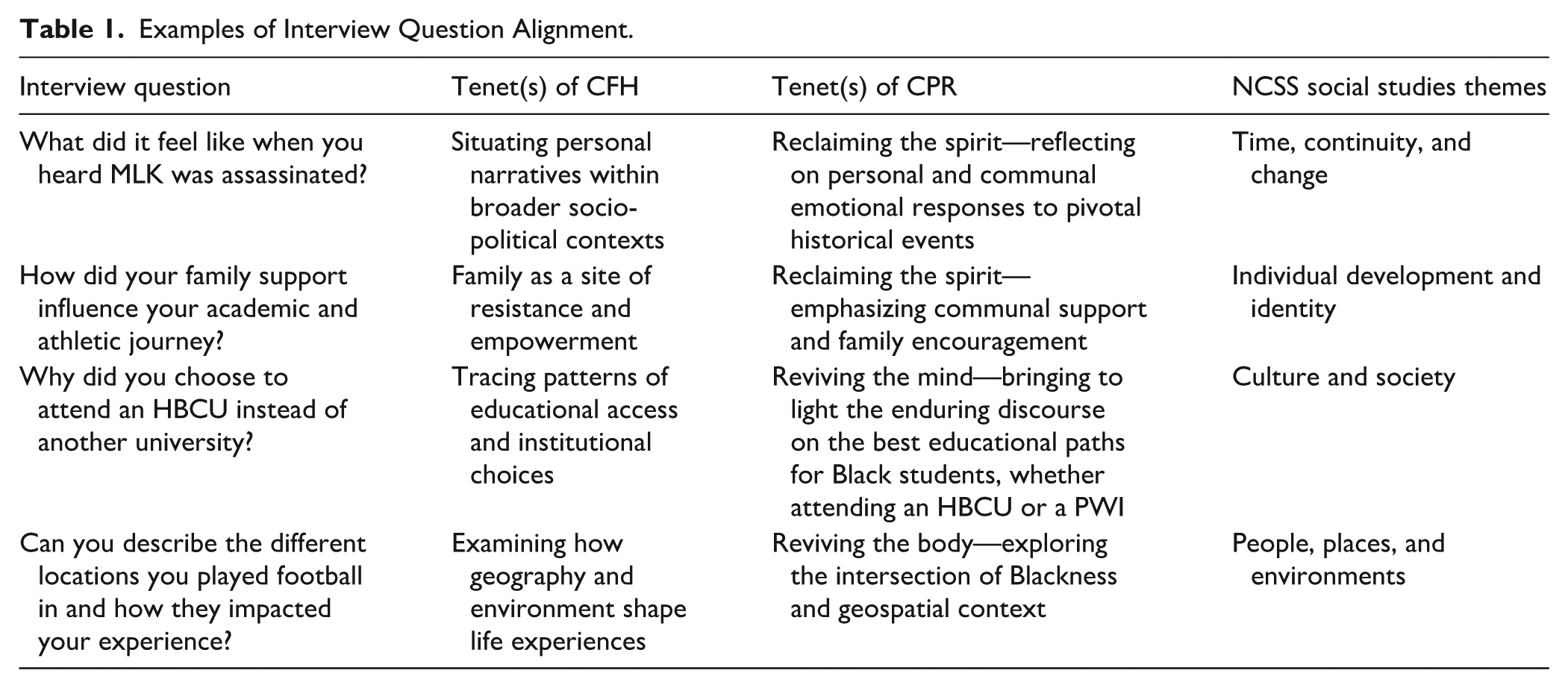
The researcher progressed through each question and reexamined aspects of the stories. The strategy described combined form and content. With the steps taken to explicate the data given, the following section details the results of this study.
Results
The results of our in-depth family history interview accompanied by participant-chosen artifacts and photographs are presented. This documented evidence, depicting epochs of Uncle Charles’ life, served as catalysts for eliciting discussions about his educational and professional experiences. His narrative includes personal anecdotes and reflections spanning high school years, college transitions, and professional life. These narratives provide a personal account and a reflection of broader sociocultural dynamics at each stage.
High School Yearbook Cover
The first part of our discussion centered around my uncle’s yearbook, particularly the color of its front cover (Image 1).

Phillis Wheatley High School Yearbook Cover (1968).
So the first picture we have is the Wheatley Wildcat yearbook. And you told me a little bit about the yearbook. Why was it black . . . 1968 . . . what’s going on?
Okay, the reason my yearbook was black back in 1968 was because . . . it was Martin Luther King who got killed that year. It was April 4th, 1968. That’s when like I say a whole lot of turmoil was going on back then. Texas Southern University had a riot the year before 1967. That’s why the yearbook was black because a whole lot of politicians got killed that year.
What’s interesting is it took me to get to college and years in college before I learned what happened at Jackson State as far as like in the 60s, it might’ve even been in the early 70s but around that time where students got shot at a dorm and all that stuff. But I didn’t know about the riots at Texas Southern University. What was that about?
It was some racial misunderstanding, but I really don’t know. It some Black and White thing but I never got the whole story. It was some policemen over there beating on students because it was on TV, I remember seeing that. It was major.
Uncle Charles’ high school yearbook serves as a powerful example of CPR’s spiritual tenet of historical understanding, with its black cover symbolizing collective memory and the enduring legacy of MLK, a historical figure frequently covered in social studies standards. Learning of events such as the riots at Texas Southern University added greater depth to historical context.
So MLK is assassinated . . . what else is going on?
I was being recruited, matter of fact from a school called Texas A&I (presently Texas A&M Commerce). A scout came to talk to me and Eldridge Smalls. He told Smalls, “I want you because you have good height.” But he told me, “You could go back to class because you a little too short.” It made me frustrated and at the same time better because I wanted to show him that I was talented.
So you were motivated by that?
Yeah, because that really pissed me off. But I was really good my whole career, especially when my mother and family come see me play—I was gonna score about 2 or 3 touchdowns that game. I was motivated because they came to see me play. Benny (brother) would drive the bus and Gil (niece), Delvin (nephew), and Larry (nephew) and all them was on the bus and I wanted to perform and have a good game.
Gotcha. How were the teachers Unc?
Oh man, there were some good teachers who really cared about you at that time. I remember Mr. Crawford, Jackie Carr (basketball coach), Frankie Walker (football coach). But I went to class, I didn’t want to be no dumb person because I had a career goal in mind. I wanted to go further. I wanted a scholarship . . . because at the same time my mother and father didn’t have no money to send me to college, so I had to work upon a scholarship.
Did you feel any type of pressure or motivation because you were the baby boy?
There was a little pressure because they put their career on hold and the backburner and was pushing me because every game I played pretty much all my brothers and sisters were at the game if they could make it. And that pushed me further and further.
Uncle Charles’ storytelling exemplifies CPR’s tenet of “re-membering” bodies by repositioning family members, teachers, and coaches as vital figures in his personal and cultural history, transforming them from forgotten participants into essential actors in his success and motivation. Scholars such as Swartz (2013) and Lemons (1997) regarded teaching re-membering in which African American narratives unearthed significant legacies.
What did it feel like? Like, do you remember where you were and how you heard that MLK was assassinated? How did you take that in? How did it feel at the time when that happened?
Personally, to me, was in shock. I was at a standstill. At the time, race riots were going on but I didn’t know at the time they was going to do that to him because I know that he was a powerful man. It took me a while to react to that . . . just knowing this world could be so treacherous and so bad to people who were trying to motivate other people. That day will always stand out in my mind.
College Photo
The second part of our discussion focused on a college photograph prompting dialogue about his transition to higher education and the decision to attend an HBCU (Image 2).
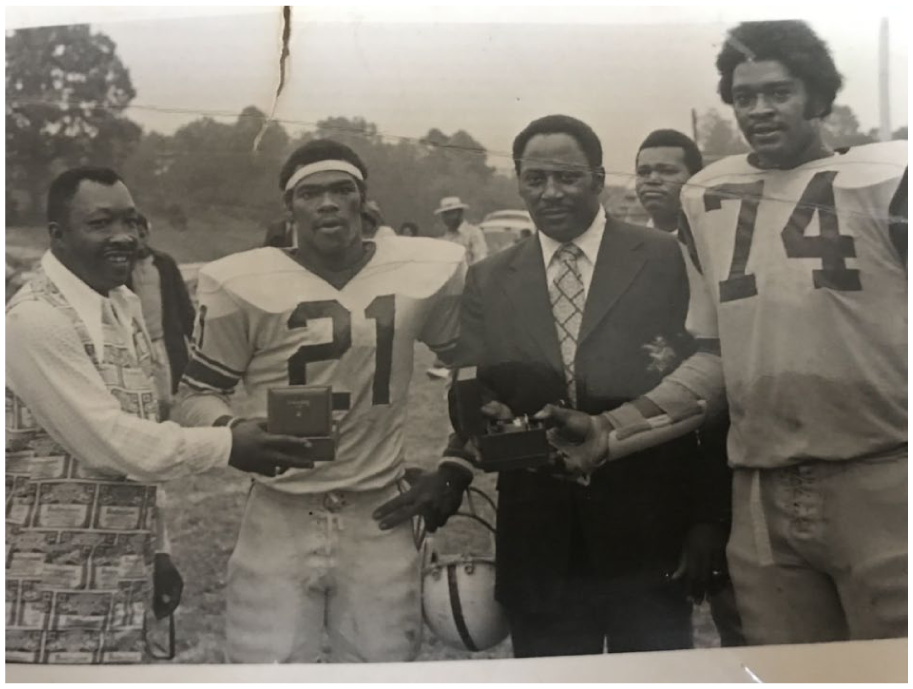
Charles Thomas #21, Tennessee State versus Grambling University post-game (1970).
So hold on . . . I’m making a connection. So, we go from this being the reason for the first time ever that Wheatley yearbook is not purple, but it’s black. And you about to carry your behind to the state and. . ..
Yeah! Right. And I was scared about that. I was kinda confused. I said—well man, should I wait? Should I go to another school? But Tennessee was so powerful man. That’s why I’m glad I went to an Historically Black College or University (HBCU) school. I had a scholarship to go to Wisconsin, but I wanted to go to an HBCU school, which was an all-Black school. At first it was Tennessee A&I my first year then my sophomore year they changed it to Tennessee State.
So at this time, Tennessee State is a powerhouse?
Yeah, cause we had one of the best quarterbacks at that time, his name was Eldridge Dickey. You never heard of Eldridge Dickey? He’s from Houston. He went to Booker T. Washington. Down in Tennessee State, they use to call him, “The Lord’s Prayer.”
(Laughing out loud).
Eldridge Dickey was playing Grambling 1 year, I seen this on film. They were down 35–0 at halftime. They came back to win 38–35.
And that’s how he ended up getting the nickname?
Yeah, he was super talented man. He was the #1 draft choice of the Oakland Raiders. Man, we had so many talented that came through Tennessee State to it was unbelievable.
Uncle Charles’ decision to attend an HBCU and his reflections on Tennessee State’s powerhouse status exemplify CPR’s tenet of the mind. His story challenges persistent misconceptions about HBCUs juxtapose Historically White Institutions (HWIs; Cooper, 2016), reinforcing their continued role in cultivating Black talent, leadership, and legacy amid ongoing debates about the best higher education paths for Black students.
So let’s start off with the number 21. Why you pick 21?
That was just a lucky number to me. I had it high school. I was so good in it that I just kept it when I went to college.
So who is #74 that’s in the picture with you?
I don’t know his name. He was about 6’ 6”, 6’ 7”. He was from Grambling.
I had won Most Valuable Player [MVP] that game. My mother was there. My niece was there. Your mother was there too. Tennessee State would always look forward to my mother coming because she would bring some food with her. And they loved her, even the Head Coach, Big John . . . John Merritt.
My mom told him, that if I miss up to get on him. One day I was fooling around in practice and he said, “Remember what your mother told me!” In other words, be my dad when I was at Tennessee. And that he was. He would let me drive his Cadillac and everyone else would ride the bus. He was a smooth talker. He stayed at Tennessee State a while til bout 1993 . . . 94. He told me “Hell baby, if you come to Tennessee State, you’re going to be a champion.” And he didn’t lie. Our record was like 58–2. I lost just two games in my college career.
So where would yal play your championship games? What conference did yal play in at the time?
We were independent. We were undefeated in 1970 and played McNeese State. A lot of family came down for that game. It was in Lake Charles, LA. It was a good game and we won 25–26. I ran a punt return back 95 yards.
So family show up, you gonna clown?
Yeah, I gotta show out in front of my people man. But see, the fun is not during the game. The fun is during the practice. You win in practice.
Uncle Charles embodies the role of the griot by imparting wisdom that success is forged in preparation, reinforcing the lesson that victory is won before the game. This knowledge ties into concepts of citizenship, a theme of social studies.
Okay, so one of the last things about this picture is that I see Uncle Benny in the background.
You don’t see nobody else.
Let’s see . . . nah.
Look to the left of that picture. That’s Larry (our cousin).
So that speaks to the importance of family being there to support you.
That bus would be jammed packed with all my nieces and nephews and my sisters and brothers, my mommy. They gave me a watch. I got a watch because they were from the Budweiser Company. They gave me one and big boy one.
The family presence, from sharing food to attending games, illustrates how spirit and community transform educational experiences, reinforcing the need for curricula that celebrate these dimensions.
Professional/Career Photo
The third part of our interview pertained to a photograph from his time in the NFL where we examined his experiences in professional athletics (Image 3).
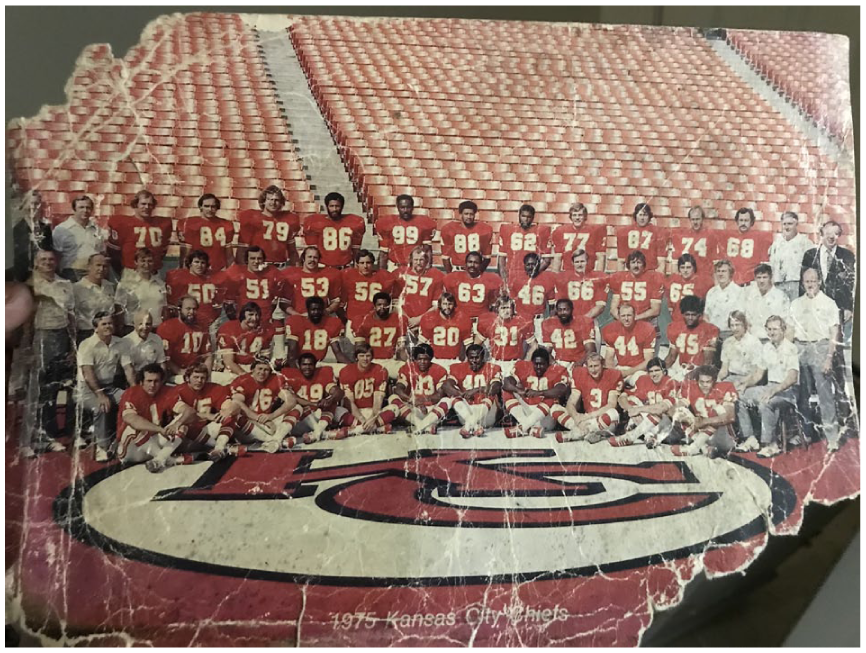
Charles Thomas #49, Kansas City Chiefs football team photo (1975).
The last one is a picture of you as #49 in 1975 with the Kansas City Chiefs. Tell me Unc about this process. Did you go up for the draft or do free agency? How did you get to the Kansas City Chiefs?
I was at Miami. It was August the 18th 1974. It was a preseason game and I was with the Miami Dolphins. We were playing the New Orleans Saints. They kicked off to us first. I took it back 95 yards on a kickoff. That same game they punted to me and I took it back 85 yards. (Laugh).
(Laugh)
Then I had about 3 or 4 players that came with me there from Tennessee State. I was there with Mercury Morris, Paul Warfield, Zucker, and Cook. And then there were a couple more.
So, hold on Unc. You got there (to the Miami Dolphins) right after their undefeated run.
Right, I got there that next season.
CPR’s focus on reviving history surprisingly revealed my uncle’s connection to a legendary sports legacy of an undefeated season.
So, Miami was the first team you end up going to after Tennessee State?
Right. I was a free agent. It was Nat Moore—he went to Florida. He was a high draft choice, but he wasn’t no better than me. I could run circles around him. He was pretty good though but because he came from a White school they thought he was all that. They had cut me, and Kansas City pick me up.
Now you go from Miami, which at the time ain’t no telling how much partying, beaches, sunshine, and everything else going on. . .
Man, Key West, Florida was off the chain!
So you go from that to middle America, Kansas City. What was Kansas City and the team like?
I made lots of friends in Kansas City. In 1975, Hank Stram wasn’t there. They had got this coach from Stanford, I’ll never forget his name, Paul Wiggin. He liked me though. He would call me Charlie “Red Shoes” Thomas because during that time they were calling Billy Johnson, “White Shoes.”
But I made a lot of friends like, MacArthur Lane——came from the Green Bay Packers. He was down-to-earth. He was an older player who had been in the league about 10 to 12 years. There was Buck Buchanan, Emmitt Thomas, and Otis Taylor. Them three there . . . they were my patnas! They would always come to my apartment to play cards, shoot the stuff, and play dominoes. Otis Taylor even had a club at the time . . . Lord have mercy . . . Lord have mercy!
Like that?
Them three right there man . . . every Monday they were over at my house. I had so much fun with them man. And I’m sorry I couldn’t go to Otis’ funeral. He just passed a couple of months ago.
CPR’s connection to the body and social studies’ theme of human geography is evident in how my uncle’s experiences in Miami and Kansas City were shaped by their distinct cultural landscapes—Miami, with its beaches and nightlife, contrasted sharply with the midwestern camaraderie of Kansas City. His journey reflects how geography influences Black experiences, shaping opportunities, relationships, community ties, and cultural identity.
Last but not least, I remember you saying you went to Buffalo right?
Yeah, I went to Buffalo. What happened in Buffalo was a guy by the name, Keith Moody, he was their punter returner. He was hurt but he could still play. They were playing the New York Jets. I went there something like a Thursday or Friday. Ed Sagler, I think he was the coach. He showed me a contract for $40,000 for only half of the season—only 7 weeks to play. He told me when the team got back he was going to sign me to that contract. First of all, they lost to the Jets and Keith Moody ran a punt return back. When they got back and I woke up that Monday morning, the first thing I saw, “The Head Football Coach of Buffalo, Ed Sagler, Fired.”
The new head coach decided not to not sign Uncle Charles. Unc stated, “Man I was on that plane crying like a little baby.” Buffalo is the stop where Uncle Charles encountered OJ Simpson as a teammate. Uncle Charles recalls OJ being “cocky and arrogant, but really good” and smoking a cigar during film study with his feet on the table.
Uncle Charles had experiences with the Miami Dolphins, Kansas City Chiefs, Buffalo Bills, New Orleans Saints, and Detroit Lions. Notably, Unc did not shy away from addressing discriminating practices occurring in the NFL for example, stating, “If you had too many Black players, they would get rid of you.”
So, how did you know it was all over?
I knew it was over because I had to find me a job man! I was blessed and lucky that I graduated. That was 1977—I start using my degree. So I went to North Forest Independent School District [ISD] and got a job.
Uncle went on to teach physical education and coached football and basketball at North Forest High School for over 20 years before retiring, then returned to his alma mater, Phillis Wheatley High School, where he is now a special education teacher.
How does it feel now . . . doing almost a whole 360? How do all these experiences inform how you move about your day?
I think I did pretty good especially compared to my size. Some people 6’5”, 6’6” didn’t even make it to the league. At least I got to see the inside of it for a little while. I’m blessed I made my family happy. I wanted to play a little longer so I could buy her (mom) a house but that didn’t happen though. It’s all good though.
Do you feel like a role model or leader to young men? Someone they can talk to?
I feel more like a role model. Cause those kids . . . I’m telling you Marc. They different. What made me really laugh is that this boy Googled me. And they all said, “You played for the Kansas City Chiefs!?” I said, “Yeah.” They said, “You got to be kidding as little as you are.” And that’s when I broke it down to ‘em and said, “It’s not the size of the sea ship that make you seasick, it’s the motion of the ocean. I came back to pass the torch to yal, that if I can make it, you can make it.”
The findings reflect Uncle Charles’ personal journey and underscore the significance of representation, legacy, and the proximity of Black American experiences to social studies themes.
Limitations
One limitation of this study is it primarily focused on one family’s history, which may not fully capture the broader spectrum of Black experiences. Another limitation was the selective use of photos and artifacts, as certain images were chosen to create a chronological narrative, potentially omitting other meaningful aspects of the participant’s experience. Despite these constraints, the study advances a model for implementing CPR into social studies education.
Discussion
This study exemplifies how CFH (Sleeter, 2008, 2020) serves as an extensional framework for CPR (Johnson & Nicol, 2020) by demonstrating how personal narratives, such as Uncle Charles’ journey, are embedded within wider historical, social, and political contexts. CFH reveals how individual and family experiences are shaped by systemic forces, while CPR moves beyond recognition to reposition these narratives within social studies education. Through Uncle Charles’ reflections, this study uncovers his milestones and the overlooked contributions of family members, educators, and peers missing from national narratives. By combining CFH’s historical interrogation with CPR’s emphasis on restoring Black bodies, spirit, and mind to educational spaces, this study provides a framework for incorporating family histories into social studies curricula in ways that are transformative, humanizing, and relevant to contemporary discourse.
This study specifically demonstrated how CPR’s key principles: body, spirit, and mind–engage “Black American experiences as a cornerstone for better understanding peoples, societies, and environments” (Johnson & Nicol, 2020, p. 1895). First, CPR revives Black bodies by placing them there and establishing their stories as central to the study of society and the past. This action recognizes the value of Black cultural memory through personal remembrance. Illustrations of this tenet are the revealing of countless individuals, both within my family and beyond, whose contributions shaped history but remain unrecognized in traditional curriculum and instruction. Mr. Crawford, Coach Frankie Walker, players such as Eldridge Dickey, Otis Taylor, and multiple family members—even my mom—literally showed up in history. This helps assuage the mistrust of Black students toward U.S. history curricula (Toney & Brooms, 2025) as too often they do not see themselves represented. This study also illustrated how traveling and residing in different areas produced distinct experiences. One example was Uncle Charles’ distressing concern of attending college in Tennessee, where MLK Jr. had been assassinated only months before. Another was how Uncle Charles lit up describing Key West, FL. as “off the chain” during his time playing for the Miami Dolphins. His articulation of experiences grants attention to the importance of Black human geography in revealing complex interactions of place, space, and sociocultural dynamics.
Secondly, Uncle Charles’ portrayals of family support could have been bound to their physical presence at his games, but a deeper understanding points to its spiritual component. CPR revitalizes a spiritual dimension of Black educational spaces often overlooked in schooling. Communal and familial support have been found integral to Black spirituality (Witherspoon-Arnold et al., 2014; Wynter-Hoyte at al., 2022). “All my sisters and brothers were behind me . . . them being there (for me) pushed me further and harder” Uncle Charles stated, referring to not only their physical presence but also as an internal incentive. His drive to succeed was also personal. After being told that he was “too small” by a coach from Texas A&I University, Uncle Charles stated he worked even harder to receive a scholarship. Furthermore, Uncle Charles’ return to his alma mater as a teacher and role model embodies CPR’s spiritual tenet by signifying communal uplift and the impact of Black educational legacies. CPR aligning with Black-centered epistemologies, captures spiritual aspects of educational and professional journeys.
Thirdly, this study adheres to CPR’s principle of invigorating the mind by “providing a connection and relevance of the past to present-day issues” (Johnson & Nicol, 2020, p. 1892). Following the murder of George Floyd, attending and supporting HCBUs became a focus in social discourse but Coach Deion “Primetime” Sanders’ hiring at Jackson State University in 2020 felt like the ultimate jolt HBCU advocates had recently longed for (Collins, 2023). Higher education is regarded to improve life outcomes, but whether Black students should attend HBCUs or HWIs is frequently presented as binary choice. Uncle Charles stated, “I’m glad I went to an HBCU school . . . man we had so many talented come through Tennessee State ‘til it was unbelievable.” Unc’s identity, connection, and pride tied to a setting cultivating Black talent is comparable to studies emphasizing HBCUs as environments of care, welcoming, and celebratory of Black racial identities and strivings (Cooper, 2018; Foster et al., 2023). The discussion of where Black student-athletes would be better served, at an HBCU or HWI, therefore is not a contemporary moment of Black historical contention (King, 2020), but an enduring question. Uncle Charles’ experience at Tennessee State produces a counternarrative to the notion of HBCUs as substandard institutions and programs. As Nobles and Adeleke Nobles (2011) insist, “it is our responsibility to define the contours, contexts and content of being, becoming (and belonging)” to Black excellence.
Recommendation
To guide students in uncovering achievements through family history, teachers can incorporate oral histories into social studies using CPR’s principles. Students choose a family member (or someone who they trust) to interview, focusing the conversation around three photos. Each image invites exploration of: (a) body: the presence of the family member at particular times and places; (b) spirit: support and resiliency within culture, family, or community; and (c) mind: connection between past and present events. Students, family, and teachers can highlight accomplishments through these interviews, discovering topics such as innovations, civic participation, education, and institution-building. This method helps students understand how personal histories contribute to local, state, national, and global narratives while aligning with National Council for the Social Studies principles (NCSS, 2013).
Conclusion
To address the guiding research question, “How can teachers effectively incorporate Black histories into social studies curricula through more empowering and engaging means?” this study advances several practical steps. First, through curriculum development—volunteering for state social studies standards committees, auditing and publicizing where Black histories appear and gaps persist, and designing job-embedded professional learning and certification around CFH and CPR. Second, via outreach and partnerships—as educators can collaborate with museums, libraries, and community centers to host Black oral history events. Third, by way of safeguarding and advocacy—publishing accessible explanations of targeted concepts, countering misconceptions of Black history such as it being unpatriotic, requesting entities like the National Council for Social Studies (NCSS) to endorse Black history projects, and supporting school- and district-level advocates (e.g., librarians, principals, superintendents), as well as community organizers who are already doing this work and face pushback. Also, protecting one’s energy is vital, understanding that bigotry often lies not in ignorance of Black historical facts, but in fear of their transformative power. Finally, with utilizing digitization–equipping students to record, transcribe, and archive interviews ethically using readily available tools and university/library support. These actions connect CFH’s historical inquiry to CPR’s emphasis on body, spirit, and mind, offering teacher educators and classroom teachers tangible ways to center Black agency, achievement, and belonging in day-to-day instruction.
The battle over what is included and what is deliberately omitted in our children’s education has once again reached a fevered pitch. As states continue to debate, expand, or restrict how certain histories are taught, the necessity of capturing, honoring, and amplifying Black stories is not a matter of preference but one that is essential. To remove history is not simply to withhold facts, but to erase a piece of the human mosaic that constitutes our collective past. This study demonstrates that CPR building off CFH is not merely a theoretical framework; it’s a channel to quench a thirst for truth that standard curricula have long neglected. By centering personal narratives like Uncle Charles’ within larger historical and social landscapes, this research urges students and educators to see those closest to us as epistemic agents who actively shaped and participated in history. This study advances CPR as a viable approach to moving beyond tokenized representation to a pedagogy that breathes life into history.
Footnotes
Acknowledgements
I will like to express my gratitude for U.S. Army Retired Airborne Ranger Calvin J. Turner, MEd - who is the inspiration of the title of this article.

Declaration of Conflicting Interests
The author declared no potential conflicts of interest with respect to the research, authorship, and/or publication of this article.
Funding
The author received no financial support for the research, authorship, and/or publication of this article.