



Abstract
The current study analyzed strategies for coping with gender-based violence described in the diary accounts of 20 women residents of Kibera, Kenya, the largest slum in sub-Saharan Africa. Three distinct strategies are reported: endurance and faith, escape, and limited partnership. Previous qualitative studies of this population report acceptance of gender-based violence, based on lack of education and patriarchal social norms. The current study indicates that coping strategies may sometimes be agential choices made by women negotiating a complex web of structural oppression. Implications for practice are discussed.
Introduction and Literature Review
Recent national surveys and reports by nongovernment organizations have provided important data for research on gender-based violence in Kenya. For example, in 2003, the Kenya Demographic and Health Survey (KDHS), a United States Agency for International Development (USAID)-funded survey of 11,000 randomly selected Kenyan households, became the first survey in Africa to include a module on domestic violence. That survey revealed that 40% of married women had experienced some form of domestic or intimate partner violence (Kenya Demographic and Health Survey [KDHS], 2003). Five years later, the percentage (39%) was only slightly down (KDHS, 2008).
Nevertheless, some general surveys among segments of the Kibera population have emerged. In 2002, the African Population and Health Research Center (APHRC) conducted a cross-sectional survey of Nairobi’s four major slums and informal settlements, which yielded the first comprehensive report on specific slum conditions often correlated with gender-based violence, such as risky sexual behavior, drug and alcohol abuse, the spread of HIV/AIDS, and sanitation (African Population and Health Research Center [APHRC], 2002). In 2007, a survey of adolescents in Kibera (Erulkar & Matheka, 2007) reported high rates of violence among married and cohabiting young people. One of the six partnered girls reported being beaten or hit within the past 3 months, mostly for “talking rudely” to their male partners, disobeying them, or failing to adequately fulfill domestic duties (Erulkar & Matheka, 2007, p. 19). Surveys conducted among 200 Kiberan women (Swart, 2011, 2012) reported a dramatically higher level of gender-based violence in Kibera (86%) than was reported among the general population (39%) in KDHS (2008). Although these data have provided vital information on gender-based violence and its correlates in the general Kenyan population, the KDHS does not adequately describe slums and informal settlements, which have grown considerably since the 1999 census on which the KDHS sample of slum communities is based (Davis, 2006; KDHS, 2008; UN Habitat, 2003). Consequently, little is known about the experience of gender-based violence in Kibera, a sprawling mega slum adjacent to the city of Nairobi, where there are no municipal services, such as electricity, sanitation, or running water (Davis, 2006).
In 1999, a qualitative study (Lutomia, 1999) used interviews with Kiberan women to describe their experience with gender-based abuse. The study stressed that existing social norms encouraged acceptance of violence. In 2008, another qualitative project used 15 in-depth interviews and 6 focus groups to describe women’s experience with gender-based abuse, concluding that more education is needed about social norms and women’s legal rights in Kibera.
Literature on multicultural feminism is also useful in helping describe and analyze individuals’ experience of gender-based violence. Collins (2000) has called the wide range of overarching and interlocking inequalities within which women organize their lives a “matrix of domination” (Collins, 2000, p. 246). Others have pointed to the relational nature of dominance and subordination, as well as the “interplay of social structure with women’s agency” (Baca Zinn & Dill, 1996, p. 27), as women negotiate lives for themselves and their children in oppressive situations. Furthermore, multicultural feminism acknowledges that multiple oppressions are socially constructed in women’s communities and societies (Shohat, 2001) and that these structural inequalities are mediated through local and personal realities (Collins, 2000). In particular, Mohanty (2003) expands this relational theory by discussing the importance of where that theory is situated and from whose perspective we orient our vision. Mohanty maintains that feminists should anchor our “analyses in the poorest of women’s communities, arguing that their standpoint helps reveal the totality of power relations” (Kennedy & Beins, 2005, p. 9). Mohanty’s theory has clear and profound implications for the current study, which attempts to ground its perspective in that of Kiberan women by understanding the narratives they construct about their own lived experience of gender-based violence.
Closely connected to the idea of constructing narrative within webs of interlocking oppressions is West and Zimmerman’s (1987) concept of “doing gender” as an interactive process. Gender construction theory is particularly helpful in explicating Kiberan women’s strategies for coping with gender-based abuse, viewing that interaction as a dramatic overlay of performance and expected gender norms (Fenstermaker & West, 2002; West & Zimmerman, 1987). Highlighting women’s “performances” or strategies enables us to see women as active agents in their own lives.
The current study draws on North American multicultural feminist theory and the ongoing discourse on gender construction to understand how women “do gender” in Kibera, thus expanding the discourse into a unique context in the Global South. The study asks, “What strategies do women use to cope with gender-based violence? How useful are these strategies? Do these strategies represent agential choices for women as they negotiate terrains of interlocking oppressions?”
Authorial Reflexivity
It was impossible for me (a White Western woman) not to be perceived as a person with power and privilege in Kibera. However, several factors mitigated a power relationship that could not be entirely neutralized. First, I initially entered Kibera with a Kenyan friend who taught at a local elementary school. Through her, I gained access to and credibility with the community. Subsequently, I visited Kibera frequently as a volunteer social work practitioner before beginning research there, during which time I built friendships with many Kiberan women.
During my involvement with the diary project, I understood that I needed to attend to my own perspective and how it was “situated” (Bettie, 2003; Harraway, 1988). Diary analysis, for example, required that I interpret and attach meaning to diary data, giving me the potential power to overarch the journal entries with my own cultural assumptions. Because it was my earnest desire to present these diaries from the writers’ point of view, I was constantly attentive to the need to unpack my “knapsack” of White Western privilege (McIntosh, 1989). First, I avoided making the assumption that Kiberan women shared my views on gender issues or that they wanted to be “liberated” from an unjust patriarchal order. Second, I was aware that the population of diarists was not homogenous. That is, I avoided “feminist essentialism,” through which I might have been tempted to see the diarists as “all the same” or as “eternal victims without agency” (Bettie, 2003, p. 23). I also viewed the project through a “partnership ethic” (Cram, 2009, p. 308), through which I acknowledged “the need to create meaningful relationships with the people and communities affected by the research” (Cram, 2009, p. 221). Such a partnership led to research that was “for” not “on” the women diarists and to an understanding that was situated in the knowledge base of the participants. At the conclusion of my involvement in the diary project, it was turned over to the women themselves—that is, “decolonized”—and has continued under the diarists’ own control and creativity (Swart, 2011).
Methodology
The Study
Data for this project were in the form of daily and weekly diaries by 20 women between the ages of 18–30 who are residents of Kibera, Kenya. Diaries chosen for inclusion in the project were chosen on the basis of consistency of narrative—in that, each diarist’s work represented, at the inception of the project, at least 6 months of continuous accounts. The other selection criterion was density of narrative, in that each selected diary showed a degree of engagement with the work that constituted more than a simple listing of daily activities. The diaries were begun in March, 2007 and continued through April, 2010. The “diary project” was originally presented to young women by leaders of a Kibera youth group (the Kibera Santiago Resource Cooperative—KISREC) in which they regularly participated. The group is registered with the Kenyan government as a self-help organization. The diary project was inspired by the group leaders’ desire to enlist young women in positive activities and to provide a forum through which they could practice and hone their language skills.
Procedure
The journal project came to my attention in 2007 while I was working on a study related to street youth and social networks in another part of Kibera. After returning to the United States, I created a study design and research protocol through which to analyze the journals. When these documents were approved by the institutional review board, I returned to Kibera, met with the diarists, and asked their consent to do a study of their journals. The project began with 6 diarists and, by 2008, 20 diarists had been recruited. All diarists signed consent forms, giving permission for their work to be used in this study. Journals were turned in weekly to the office of the Kibera Youth Resource Project (KISREC), where they were kept in a locked filing cabinet. I visited Kibera twice annually during the study and collected diaries personally. During months when I was not in Kibera, diaries were shipped to me on a bimonthly basis. At the end of the study, all participants had the opportunity to review what had been written about their work. Diaries were returned to the women at the end of the project.
Participants
Participants in the study, referred to herein by pseudonyms, were all born in Kibera and have lived in the slum for their entire lives. During the course of this study, five women lived with male partners, either serially or permanently. All other participants were partnered with boyfriends, to whom they were not married. These women often considered their primary abodes to be with dependent family members (children/siblings), making the support from the boyfriend a lifeline not only for the diarist but for her dependents (Table 1).
Characteristics of Diary Project Participants.
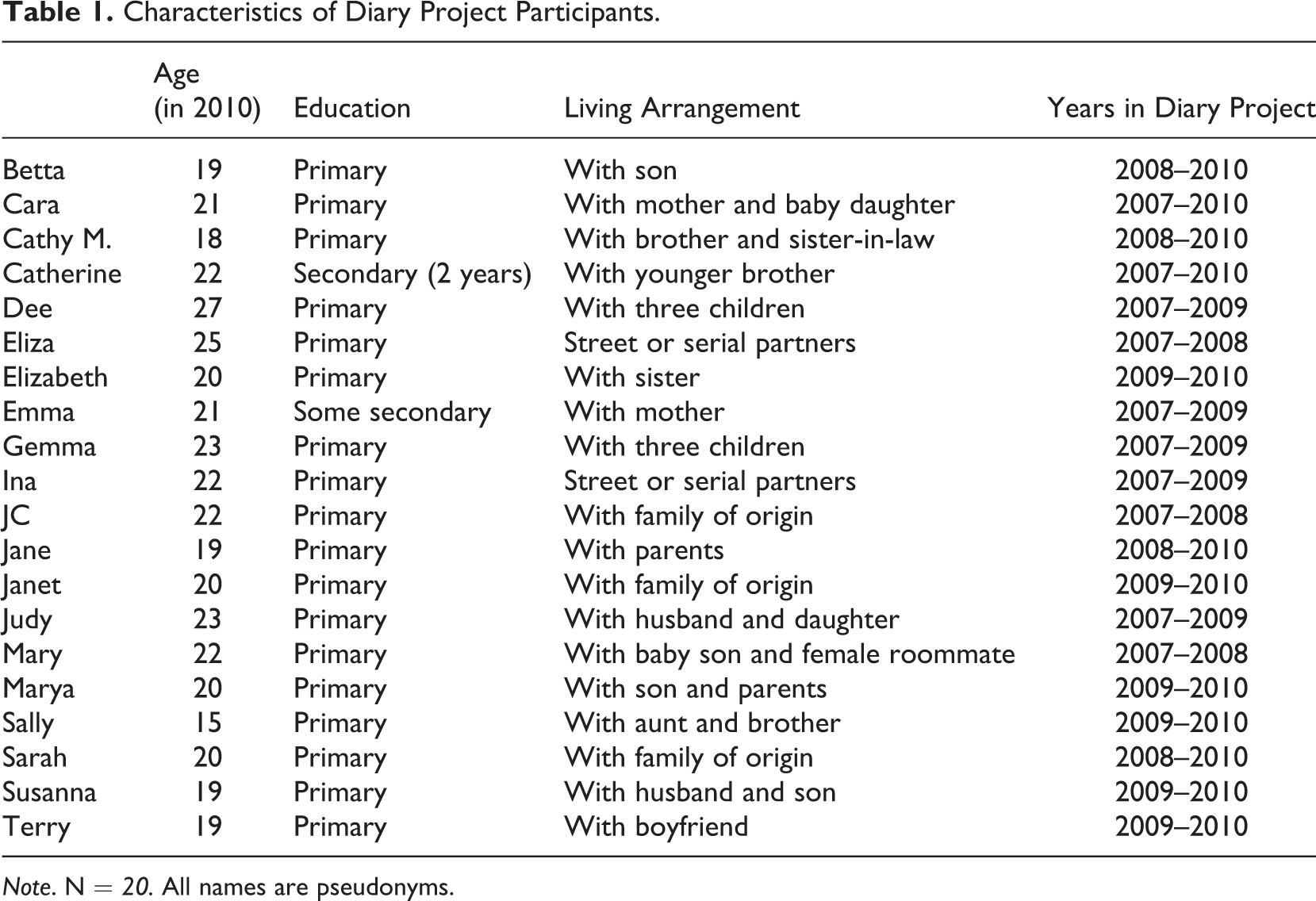
Note. N = 20. All names are pseudonyms.
Data Coding and Analysis
The diaries were transcribed verbatim. The final analysis was performed on 431 single-spaced pages of diary data, comprising 205,104 words. Analysis was done by hand. Diaries were analyzed using inductive coding techniques and according to the guidelines for culturally competent field research (Strauss & Corbin, 1998). Diaries were reviewed and coded to identify patterns and emerging themes as seen through the diarists’ eyes, first in regard to the general context of the daily experience of each writer and later in regard to specific themes diarists shared (Swart, 2009; Swart, 2011). Analysis revealed seven common themes among the diarists: economic need, gender-based violence, work, family, spirituality, female support, and hope/dreams. To better understand the extent to which common themes were stressed among the diarists, a frequency analysis was performed to ascertain how many times per week each diarist mentioned each of the common themes. Gender-based violence was the second most commonly reported theme after economic need (Swart, 2011). Women were given no guidance about what themes to include in their writing. The overwhelming prevalence of the theme of gender-based violence may indicate that it is a major social problem in Kibera. All conclusions about the importance of themes and the efficacy of ongoing coping strategies are conclusions drawn by the women themselves and not the point of view of this author.
Results
The current study revealed three main strategies used by women to cope with gender-based violence. Those strategies were endurance and faith (used by 12 women), escape (used by 4 women), and limited partnership (used by 3 women). One diarist (Judy) reported no gender-based violence in her adult relationships with men, although she had been rescued from a violent family relationship as a child. Strategies were surprisingly mutually exclusive. All women but one had—by the time of the project—adopted a preferred strategy which she used during the time of her project participation. Only one participant (Catherine) reported using a variety of strategies at different times with different partners during the duration of the project. Although others may have mixed strategies in the past, they did not write about them during the time they wrote for the project.
Endurance and Faith Strategy
The most commonly mentioned strategy among diarists for coping with gender-based violence was the strategy of endurance and faith, which was defined as pragmatic acceptance of violence, with recourse to religious faith as a palliative measure. This strategy was described as a practical understanding of a current unsatisfactory reality (gender-based abuse)—not as a passive acceptance of violence as a deserved or permanent condition. Women using this strategy frequently relied on their faith in God to help them endure a violent relationship. This “endurance” differs somewhat from that of the many women around the globe who are likewise economically trapped in abusive relationships. In Kibera, the baseline is subsistence-level poverty. Women eke out one meal a day on pennies earned in the street. Water, too, must be purchased. At this level of poverty, economic support from an abusive partner might provide the only possibility of daily food and water.
For example, JC stressed a reluctant acceptance of an abusive relationship, noting that it was brought on by lack of educational and job opportunities and that it was better than other possibilities. She wrote: “My problems began because of lack of school fees. No school, no job” (JC, January 2009). She described life with her boyfriend, who took care of most of her economic needs: “I have him or I don’t eat. That’s it. I can’t stand how I am treated now but I know some men are worse (than mine). I am watching for my opportunity to better my life and I pray that God will help me find a safer future” (JC, January 2009). Marya wrote that she “got a boyfriend when I could not get a job” (Marya, March 2010). She hoped to marry him but, when she became pregnant, she wrote, “he rejected me and said I have a lot of guys and I am a prostitute and he beat me. We women all live through such hardships here in Kibera. We must have help to make ends meet and sometimes find the wrong man” (Marya, March 2010). She went on to describe her recourse to religious faith, “All we have is God and Jesus who died for us on the cross . . . God bless us all and give us a better future” (Marya, March 2010). Similarly, Terry wrote in her journal about being beaten by her male partner when he was drunk or when she refused to have unprotected sex. She wrote that “I wanted to go to school (secondary). But life is not always just the way you want it to be. Anyway, we thank God that we have a life . . . and every day we wake up and pray to our living God that things will be better tomorrow (Terry, April 2010).
Women employing the endurance and faith strategy understood that they needed the economic support of a male partner, whether that partner was a husband or a boyfriend. Therefore, they stayed in abusive relationships because those relationships provided food, shelter, and other economic necessities. Very limited job opportunities exist for women in Kibera and this strategy (having a male partner and enduring his abuse) both supplemented and became a substitute for a regular job. Indeed, many diarists referred to the process of having a “man” almost as though it were a job, reflecting their dissatisfaction with the inevitability of the relationship but agreeing that—like a job—“you’ve got to have one” (Terry, March 2010). Among the negative attributes associated with this strategy was the possibility that it might enforce complacency in the face of gender-based violence. Nevertheless, many women expressed only tentative or temporary compliance with their plight as well as the constant need to continue searching for a means of individual economic empowerment.
Escape Strategy
Another strategy for coping with gender-based violence in Kibera was the escape strategy. This strategy was defined as a quick, usually unplanned, exodus from a current living situation. Such escapes might happen early, for example, from a woman’s home of origin. Or they might occur later, once a woman had already embarked upon a married or partnered life, which became untenable. Women often described escape strategies as unsuccessful because, although they propelled the escapee to a different setting, the gender-based violence she experienced there was often similar to—or worse than—that which she escaped. Sometimes women returned to the relationships they had escaped, where they were often punished for their escape attempts. For example, Dee wrote, “I tried to get away but I didn’t make a go of it” (Dee, January 2009). Thus, the strategy usually offered no long-term relief from gender-based violence but only a circular or repetitive movement from one kind of abuse to another.
A typical cycle was reported by Susanna in the following passages. She reported, “ . . . in the evening, we had the same silly usual fights. I had to sleep outside again. What kind of life is this” (Susanna, January 2010). She described waking up in the street because her husband had locked her (and her baby son) out for the night. She made an emotional decision to bolt from the relationship:
My son’s voice woke me up . . . I was shivering with cold. We had slept out. I was sick and tired of always waiting for a man who will never change and neither shows love and affection toward his wife. I took John (son) and ran off. I didn’t know whether to go right or left—all I knew (was) I had to run away from that home. We had a long way to go. We didn’t even know where we were going . . . (Susanna, January 2010) I was woken up by slaps and insults from (husband) . . . I received a donkey beating. He left me lying unconscious on the bed. I later woke up. My son John was crying and asking me why does his daddy all the time resemble the devil’s image? (Susanna, January 2010)
The escape strategy was considered by participants to be unsuccessful in removing them permanently from situations of gender-based violence. Escapes were often impulsive and, therefore, had little chance of becoming permanent since the financial, social, and psychological means to support such escapes did not exist. This was not, however, to say that Kiberan women were particularly foolhardy or intrepid. Escape was often a preferable strategy to staying put, especially when a woman risked death in her own home. The escape strategy sometimes saved a woman’s life, if the violence she faced from a partner was life threatening. Otherwise, escape provided neither palliative remedy nor long-term cure for the cycle of violence inherent in many abusive relationships.
Limited Partnership Strategy
The third strategy for coping with gender-based violence was one that expressed a woman’s decision to establish only a limited partnership with a man or men in her life. The strategy was utilized by three participants in the current study, making it a unique and provocative—albeit minority—coping strategy among the diarists. The limited partnership strategy was defined as a pragmatic decision to engage in partnerships with men for economic support (with or without love and friendship) but to refrain from both marriage and childbearing with these male partners. The purpose of the limited partnership strategy was to avoid male power and control in a relationship, which often resulted in violence to the female partner.
The limited partnership strategy was clearly defined by Elizabeth, whose terse, succinct, even severe journal entries clearly articulated the long-term goal of this strategy. She wrote:
I don’t always feel good about this beast called men. I call them beast because they ruin my life. I sleep with them and (they) give me money but no one (is allowed) to say I am his woman. When he thinks that you are, he just start having jealousy. When he meets others then he will even start commanding you or even beat you thinking he owns you. That’s why I tell every (man) that I have someone (else). So he will not have any say on (my) self even when they meet together . . . They will fear each other. It’s another way of surviving here . . . (Elizabeth, March 2010) My (plan) these days is to get with older men who have family at home . . . because of their life at home, they have no (ability) to leave . . . and live with me. (so I am protected; Sarah, March 2010)
The limited partnership strategy was deemed by diarists to be moderately and temporarily successful at the microlevel (their daily life and home situation). That is, engaging in limited partnership provided women with a degree of economic security at the same time that it limited the male partner’s ability to exercise control over them or abuse them. However, the strategy was only successful if the women who employed it remained childless. If women did become pregnant, there was little likelihood that the fathers would marry them or continue to support them. Many men distanced themselves from women with whom they had fathered children, even if they knew that woman did not seek marriage, because they would not or could not pay to support a child. When this happened, abortion was one (dangerous) option. If, however, the woman bore the child, the limited partnership strategy was no longer effective for her. Having children rendered mothers more economically dependent on men than childless women were, making it less likely that mothers could control what kind of partnerships they engaged in with men (Kimuna & Djamba, 2008). Indeed, women with children often had to accept whatever partners they could get and on whatever terms.
Thus, limited partnership was actually a risky strategy and one with high stakes. It was subject to failure if pregnancy occurred, in which case, women could opt to abandon the strategy or risk death through abortion. The strategy was only viable if combined with a female-controlled family planning regime, which was rare due to the expense of contraceptives and/or the inaccessibility of clinics (Amnesty International, 2007).
Discussion
Study Limitations
The study was limited by its small sample size, which did not enable the generalization of results beyond the parameters of the particular Kiberan women participating in the research. The diary data used in the current study reflect extremely personal and individual points of view, which limited what it was possible to know and see about the diarists’ lives and their strategies for coping with gender-based violence. However, any limitations were far outweighed by the ability of these data to provide a rich and detailed insiders’ perspective into the unique subculture of Kiberan women.
Prevalence and Efficacy of Coping Strategies
The current study shed important light on what kinds of strategies women used to cope with gender-based violence. Women using endurance and faith appeared to consolidate the benefits of their current situation (home, food, stable neighborhood relations), while minimizing the risks that would come with leaving those things. Unlike women who chose the escape strategy, they appeared to favor staying with an abusive partner rather than risking unknown circumstances and possible economic destitution. If social services existed in Kibera, the strategies of escape and limited partnership would likely be more appealing to women, as they would provide a safety net for women seeking nonconventional solutions to gender-based violence. But, since there is no safety net for women who try to escape violence—and since the reproductive control needed to underpin limited partnerships is difficult to access—the endurance and faith strategy appeared to provide the best option for women trying to protect themselves and their children from gender-based abuse.
But, although endurance and faith was the most widely used strategy, diarists did not appear to choose this strategy out of passive acceptance or a belief that they deserved abuse. Instead, the endurance and faith strategy was chosen out of economic necessity, not preference. If conditions existed to give them what one diarist called a hand up (Sally, March 2010), they would likely take it and not look back. Unfortunately, at the time of this writing, there are insufficient social services in Kibera to help the many women who need help with problems of gender-based violence. For example, police do not take gender-based violence seriously, nor do courts of law. There are no shelters in Kibera and only a handful in the country of Kenya. Clinics are available in Kibera but women are often unable to access their services because of distance, wait time, or cost.
“Doing” Survival
Global feminist theory encourages us to inspect the webs of domination that affect women and to analyze the intersections of various types of oppression (Baca Zinn & Dill, 1996; Collins, 2000). Applying such a theoretical construct provides a unique way of understanding the choices of coping strategy made by women in Kibera.
All of the diarists experienced the intersection of gender-based violence and the structural conditions of extreme poverty. The web of oppression was difficult to circumvent, given that there are few social services in Kibera and that patriarchal norms govern the macro, mezzo, and micro levels of their lives. Indeed, there are few chinks in the armor of domination. Yet, women made choices, exhibited agency, and lived their lives within these constraints. The current study suggests that they did so by consciously “doing” gender in the way they saw as most self-serving and self-protective. Thus, each of their strategies was an interaction ritual—a way of “doing gender” (West & Zimmerman, 1987) that women hoped would work to their advantage.
Women who chose endurance and faith, for example, tried to sidestep gender-based violence by playing the role of the good and patient woman—a preferred role for women in Kenyan society. In such a way, they “did” gender to ameliorate gender-based violence by performing the appropriate socially acceptable female role, calling only on God for help. Such a choice provided them with familial support (from both their own and their partner’s family); with support from a church or faith-based community; and with sympathy, a kind of social capital emanating from the community’s understanding that women are conforming to social norms and appropriate gender roles.
Women who chose escape as a strategy, on the other hand, attempted to find an opening in the web of oppression and to use it. But it often backfired, taking women to worse situations than those they had escaped.
Women who chose limited partnership as a strategy chose to “do gender” in a subversive manner, by co-opting the institutions that held them down—for example, marriage, motherhood. They were determined not to marry or bear children. They hoped not to fall into the trap, so aptly described by Sarah, of the battered woman with no education and an increasing number of children every year (Sarah, March 2010). However, because this seemingly intelligent and forward-thinking strategy was not supported by female reproductive control, it actually was nothing more than endurance and faith under a more progressive guise.
Nevertheless, each diarist chose a strategy for “doing gender” that was congruent with her perceived options and opportunities. In this way, women negotiated the web of domination by constructing gendered interaction rituals that enabled them to traverse the complicated terrains of their daily lives. As they were “doing gender” they were also “doing survival.”
Conclusion
The current study found three strategies used by women in Kibera to cope with gender-based violence. Of these, endurance and faith was the most commonly used. However, choice of this strategy should not be confused with acceptance of violence. Although socialization of patriarchal gender norms is still common, women are wise enough to eschew these norms when their survival and that of their children is at stake. Therefore, it must be underscored that women in the current study accepted gender-based violence mainly for economic and structural reasons.
Implications for Research and Practice
It would be both useful and fascinating to obtain a larger picture of women’s lives in Kibera by expanding the current study to a larger population within the slum. It is hoped that the current study will provide a platform for such future research, which would enable us to understand whether variables such as age, tribal affiliation, and geographic location within Kibera change the experience of gender-based violence.
Results of the current study differ from those reported in previous studies (Lutomia, 1999), which found that women did not have sufficient information about health/reproductive care and legal rights and that more education was necessary. While it is, indeed, true that education is warranted, economic empowerment appears to be a more urgent necessity. Education about health and rights without a means of economic empowerment to access those rights may not be enough to lift women out of abusive relationships.
A previous study has indicated that micro loans and other “interventions to improve income . . . access to health care, education and skill development” are needed in Kibera at the individual, community, and macro levels (Swart, 2009). The current study indicates that specific interventions should be developed which are tailored uniquely to postprimary girls immediately upon graduation from primary school. Many young women in Kibera cannot attend secondary school. Therefore, social work professionals should be aware that economic empowerment must begin at a very young age in order to prevent abusive relationships from becoming job substitutes (Swart, 2012).
Women in Kibera use their agency to negotiate complex webs of oppression in unique, thoughtful, and often innovative ways. But women need help to achieve economic empowerment in a situation of subsistence poverty where gender violence is structurally embedded. Many women in Kibera are emotionally and psychologically ready to abandon violent relationships. They await the “hand up” in order to do so.
Footnotes
Acknowledgments
The author thanks Liz Grauerholz and Jana Jasinski, Sociology Department, University of Central Florida, for their comments on previous drafts of this article.
Declaration of Conflicting Interests
The author declared no potential conflicts of interest with respect to the research, authorship, and/or publication of this article.
Funding
The author received no financial support for the research, authorship, and/or publication of this article.