




Abstract
Social work field education is strained often resulting in a shortage of quality sites; thus, demanding innovative approaches to securing practicum placements for social work students. Additionally, sexual health is rarely grounded in most social work curricula. A sexual health field education practicum placement provides an approach to address this chasm in social work pedagogy in an effort to create sexually literate social workers, and in turn, sexually healthy individuals and communities. Using queer theory, this collaborative autoethnography paper explores five social worker student practicum experiences in a sexual health field education placement. Thematic analysis was used to organize the data, identify themes, define themes, and identify relationships between themes resulting in five themes: (1) Professional Grounding, (2) Sexual Well-being is Social Work, (3) Cheerleaders and Antagonist, (4) Practicum Audit and (5) Knowledge Acquisition. This research demonstrates that a field education site specializing in sexual well-being can not only address the pedagogical challenge of little to no sexuality education in the social work academy but can facilitate student acquisition of professional knowledge, values and skills that are necessary for practice. Further, sexual health placement sites may help address an ongoing shortage of social work field education placement sites.
A chasm exists within social work, specifically its obfuscated approach to prepare sexuality-informed practitioners. Arguably a sex negative cloud shrouds much of our global discourse, but more specifically in the U.S.A. there are explicit anti-sexual health attacks on reproductive justice (Totenberg & McCammon, 2022) and HIV prevention (Poidevin, 2025) as well as misinformation campaigns against the gay community (Lamba Legal, 2022) including drag entertainers (GLAAD, 2022). Alarmingly, this vitriol has escalated to increased violence against transpeople (Human Rights Campaign, 2023). In response to this problematizing and politicizing of human sexuality there is an urgent need to provide social work students with sexual health learning opportunities from a critical feminist perspectives.
To contextualizing the importance of sexual health, it is important to first note that sexual health is a human right (United Nations, 2008). Research has contributed to our increased understanding of the importance regarding the intersection of sexual literacy, social determinants, and individual sexual health (Vakili et al., 2025). But in a shift away from a historically myopic focus on sexual health as merely disease, disaster, and dysfunction, studies highlighting pleasure positive messaging demonstrate improved sexuality knowledge and attitudes, increases safer sex behaviors as well as improved communication with sexual partners (Ford et al., 2019; Zaneva et al., 2022). Yet, there exist barriers in our health care system such as lack of training among healthcare professionals (Byrne et al., 2013), staff attitudes that sexuality is not a priority (Richards et al., 2016), and lack of privacy for sexual health conversations with service users (Auger et al., 2023).
Social workers “value the importance of human relationships” (CSWE, 2015a, 2015b, p.8) often approaching human functioning from a biopsychosocial lens, which Turner (2020) has argued must be expanded to explicitly include a sexuality-informed component to this lens. Further, researchers have noted that social work students want more comprehensive sexuality education within their programs (Klinner et al., 2024). In particular, this study noted students’ concern over a lack of content around sexual and reproductive justice, LGBTQI + human rights issues, and the right to sexual expression. Increasingly social work scholars are calling for sexuality integration within professional practice highlighting this critical aspect within specific populations such as women with cancer (Montanes-Muro et al., 2023), the LGBTQI + community (Willis et al., 2011), and aged-care (Le et al., 2024).
Unfortunately, human sexuality is poorly presented in most HBSE textbooks (Prior et al., 2016) and perhaps unsurprisingly few social work programs have a free-standing human sexuality course (Velez et al., 2022). Overall, scholars (Bay-Cheng, 2010; Swank & Raiz, 2010 have noted social work education lacks teaching around the necessary clinical skills to support the sexuality of persons served. Fortuitously, the impact of even a simple sexuality reflective activity has been discussed by scholars (Turner & Pelts, 2022). Sexuality inclusive social work curricula do make an impact, and while researchers have demonstrated the benefits of a“Queer-affirmative disposition” from students taking a Queer elective course, (Argüello et al., 2025, p. 01), we contend that a critical clinical sexuality competency is relevant to a wide range of client populations warranting a more comprehensive and holistic sexuality-informed approach across the curricula. To meet this call to action sexuality podcasts have been suggested to augment content and more importantly bridge the capacity of educators who contend they are uncomfortable or unfamiliar with sexuality content (Turner & Joseph, 2023).
While it may be argued that comprehensive sexual health is absent in social work discourse, it is crucial to contextualize this landscape. A major challenge as noted previously is that there is currently a major sex-negative campaign globally but in particular in the USA that has dramatically impacted sexuality teaching (Lavietes, 2025), sexuality research (Friedrich-Karnick et al., 2025), reproductive policy (Totenberg & McCammon, 2022), and human rights of sexually marginalized communities (Lamba, 2022). Unfortunately, social work is not immune as this weaponization of sexuality as it has directly impacted doctoral student research (Hayoun, 2015) and practitioners delivering sexual health practice (Gershman, 2014). This sexuality politicized landscape has been fueled since the early 1980's in the USA by conservative restrictive and oppressive sexuality beliefs – an evangelization preaching pseudo sex education programs, abstinence-only-until-marriage (AOUM) and anti-LGBTQI + propaganda (Burrows, 2002; Santelli et al., 2017). Further, there has been a lack of social work engagement around sexual and reproductive justice (O’Neale et al., 2025; Turner, 2024) despite our anti-oppressive an social justice foundation. These organized and explicit attacks have not only benefited from a missing sexuality rights discourse in social work but also by what Turner (2024) states is social work's myopic focus on sexual risk and sexual abuse or a reductive catch-all conceptualization of sexuality as merely sexual orientation. Finaly, in examining why sexuality discussions have been absent from social work, this later cultural humility focus on sexual orientation has seemingly absolved social workers from acknowledging that the LGBTQI + community engages in sexual activity and requires comprehensive sexuality-informed practitioners (Turner, 2020).
This gap presents an opportunity for social work which according to Bogo and colleagues (2017), is progressively facing barriers within field education, the signature pedagogy of social work education, specifically a shortage of quality practicum sites for social work students (Council on Social Work Education, 2015a, 2015b; McConnell, 2016). Field education, also known as practicum or practice learning is the hallmark teaching in social work education integrating theory with practice (Council on Social Work Education [CSWE], 2015a, 2015b) and allowing students to encounter unique experiences they would not typically discuss in the classroom (Bogo, 2015). With field education being stretched, there is an increased interest and need to consider and nurture more creative alternatives for student placements (Wiebe, 2010). Researchers have begun expanding the field education discourse by examining a variety of innovative placements such as remote rural settings (Hall, 2018), arts-based programs (Averett & Hall-Spence, 2017), public libraries (Johnson, 2022), simulated sites (Harris & Newcomb, 2023), policy and political advocacy (Boys et al., 2022), as well as in-house research placements (Calderwood & Rizzo, 2023)
The Current Study: A Sexual Health Field Education Practicum
To address both of these pressing issues, the current study adds to the field education discourse by examining sexual health placements. Social work practicum students were challenged to consider social work through a sexuality-informed practice lens involving elements of sexual justice (Turner, 2024), sex positivity (Belous & Schulz, 2022), sexuality from a strength's perspective (Turner, 2020) and including sexuality rights as defined by the World Association of Sexual Health (WAS) such as access to sexual healthcare, sexuality agency, freedom of sexual expression, and the pursuit of sexual pleasure (Ford et al., 2021). Students engaged in critical reflection around how sexuality intersects with social work values. Guided by their practicum supervisor, they routinely processed topics such as their own sexual identity, their sexuality education, and the origin of their sexuality values. This included exploration of their ability to hold space for diverse cultural and sexual representations and potential taboo topics discussed by service users (clients) such as open relationships, kink, porn negotiations, sexting, infidelity, and pregnancy termination). Didactic learning and clinical supervision anchored learning, allowing for meaningful integration of new information and clinical experience. Supervisory discussions were structured around a myriad of shareable client resources like, It's Not the Stork (Harris & Emberley, 2006), a youth sex education book series. To shape the learner's clinical skills, they critically reviewed and discussed a classic sex therapy text, Sexual Dysfunction: A Guide for Assessment and Treatment (Wincze & Weisberg, 2015). Further, practicum learning was enhanced by tailoring to each co-author's interests and needs. For example, field education experiences were curated to include authoring blogs on sex education for parents, facilitating community movie screenings on body shaming, offering training to nurses on sex after cancer, speaking about transgender health, identifying community resources like free condoms, and attending sexuality conferences. A key clinical tool utilized was having co-authors shadow master clinicians during sex therapy and then discussing the clinical merits of the case. Client consent was obtained prior to field education observations.
While a previous article (Turner et al., 2021) examined the author's experience specifically in regards to being placed in a private psychotherapy practice, the goal of this research was to explore through qualitative methods the sexuality-focused field education experience of the seven authors (five former practicum students and two field education supervisors). They examined the research question: Utilizing a queer theory lens, what are the experiences of Masters of Social Work Students placed in a a sexual health social work field education site ?
First, the paper explores sexuality in social work literature subsequently presenting the research design, followed by the findings. Finally, a discussion section is presented including implications for social work education and research.
Human Sexuality and Social Work
The discourse around sexuality and social work continues to expand (Bochicchio et al., 2023; Brandon-Friedman, 2019; Kattari et al., 2019; Lee et al., 2018, Mason et al., 2022). In particular Turner has written extensively on the critical nature of sexuality-informed practice within social work education in preparing students for best-practice including the use of student reflection around sexuality (Turner & Pelts, 2022), podcasting as a tool for exploring sexuality within subjects (Turner & Joseph, 2023), the use of the Circles of Sexuality model as part of a strengths perspective approach (Turner, 2020), and framing sexuality justice within a social justice discourse (Turner, 2024). This attention on human sexuality by social workers is justifiable since social work students are poorly prepared around human sexuality (Laverman & Skiba, 2012; Logie et al., 2015). It may be argued that if “the purpose of the social work profession is to promote human and community wellbeing” and “the enhancement of the quality of life for all persons….” (Council on Social Work Education, 2015a, 2015b, p.5), social work education is remiss in meeting this purpose by neglecting its responsibility to prepare students who can address the sexuality questions and concerns of service users. As Willis and colleagues (2016) noted, “the social work profession can struggle to engage with sexuality, as it can with other sources of social difference and identity, such as ethnicity, class and gender” (p.2163). Despite Dodd and Tolman (2017) noting “sexuality is not an invisible dimension within social work,” (p.227) social work students often feel illprepared in regards to the sexuality of service users (Logie et al., 2015). However, there currently is a lack of sexual health content being taught in social work programs (Ballan, 2008; Sloane, 2014) and what content there is in textbooks it is often not sex positive, according to Prior and colleagues (2016). Sex positivity evolved out of the feminist body-positive movement and espouses “the radical, all-inclusive belief that each person's body belongs to that person.” (Nagoski, 2019, p.104). Williams et al. (2013) further articulated sex positivity as, being open, communicative, and accepting of individual's difference related to sexuality
and sexual behavior… a sex-positive approach is about allowing for a wide range of
sexual expression that takes into account sexual identities, orientations, and behaviors;
gender presentation; accessible health care and education; and multiple important
dimensions of human diversity. (p.273).
Research Design
The paper drew from de Lauretis’ (1991) queer theory, providing an opportunity for authors to pivot away from a normalized social work practicum narrative to a more disruptive, disordered, and deconstructed social work education hegemony (Mule, 2016). Queer theory is a field of post-structuralist critical theory that allows for the challenging and destabilizing of traditional assumptions, such as social work field education placements. It is this “queering” of established placement ideas that allows us to imagine new possibilities such as a sexual health student practicum (Hicks & Jeyasingham, 2023). It might be argued that a sexual health social work practicum is outside the normative field education experience; thus, mirroring feminist theory, a queer theory lens provides scope for a critical audit whereby authors “question norms, hegemonic perspectives, and socially constructed discourses” (Mule, 2016, p. 23). Holman Jones and Adams (2016) contend autoethonography is a queer method due to being embedded in the messiness of life and that it resists generalizing individual findings. Queer Theory provided a pragmatic paradigm to guide the study design and a constructivist lens for the analysis which included sensitizing concepts for the themes developed. Utilizing multiple researchers to develop multiple narratives, known as collaborative autoethnography (CAE) approaches (Ngunjiri et al., 2010), the seven writers of this article collected data and co-constructed knowledge to explore a shared experience. Chang and colleagues (2013a, 2013b) define CAE as a “pooling of stories” (p.17) whereby we crtically examined them for similarities and variability in the pursuit of meaning making. This co-constructive autoethnographic model (Ellis et al., 2010) allowed authors to collaboratively explore their collective lived experience from 2009–2017 of their practicum experiences in a psychotherapy private practice that specialized in sex therapy. Autoethnography provides researchers the chance to contemplate and find meaning in significant life events (Richards and Morse, 2013), Each of the co-authors answered questions about their experiences of a sexual health field education practicum and then shared stories with each other and the two field instructors, who then shared reactions to each other's stories (Table 1).
Author Demographics.
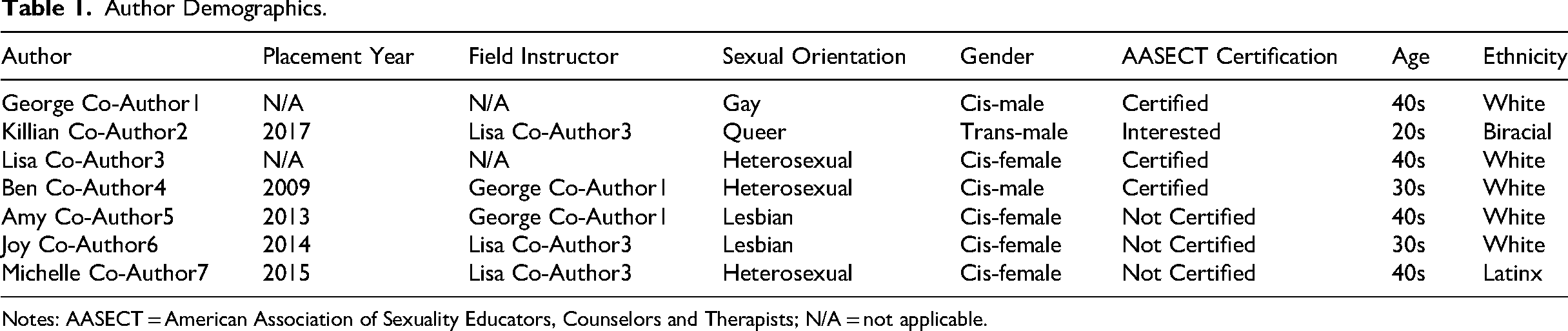
Notes: AASECT = American Association of Sexuality Educators, Counselors and Therapists; N/A = not applicable.
Positionality
Initial student advocacy positioned the sexual health field education practicum referenced here in becoming a placement site. Two licensed clinical social workers, George, Co-author1 and Lisa, Co-author3 -the owners, were affiliated with one of the universities; George, was a professor of practice, and Lisa was a field liaison. The placement site, a psychotherapy private practice specializing in sex therapy located in a large urban area in the US Midwest, was the only such setting of its kind in the area. In addition to addressing a full range of mental health issues, sexuality topics included sexual challenges associated with arousal, desire, orgasm, and pain. Additional sexuality issues included infertility, infidelity, rape/ trauma, sexual orientation, sex education, menopause, the intersection of sexuality and disability, chronic illness, ageing, faith or religious practices, as well as cultural and social messaging. Common issues centered around shame, guilt, grief, and social stigma. While clients often present with a pathology concern, sex therapists generally bring a sex-positive focus, including a pleasure-centered and strengths-based approach, making it compatible with social work values.
Co-author3 shared with Co-author1 that Co-author2 was interested in engaging in research during their practicum, so this study idea was presented to him for consideration by Co-author1. The other authors, all previous graduates from prior years and the practice co-Owner were then approached and all agreed to participate in a collaborative process to co-construct reflections related to the research question.
We acknowledge that our collective positionality informed our data interpretation/ analytic meaning-making, negotiations, and understandings of the experiences shared. A reflexive examination (England, 1994; Sinha, 2024) highlights that at the time three of us were certified sex therapists in private practice with doctoral training specializing in sexuality scholarship. This speaks to advanced sexuality clinical and research skills including perhaps a comfort with the topic which influenced and guided this research. Further, four of us identified as part of the LGBTQ community with the others having an established history as allies; this lived-experience as Queer/ Ally was a palpable aspect of the practicum. Another group dynamic that merits consideration is that the majority of us were over thirty. This seasoned practice approach most-likely contributed to a flexibility, tenacity, and composure that enabled us to navigate the uncertainty of a private practice practicum site client load and needed self-motivation. Finally, all co-authors except the at-the-time current student, Killian, had established working relationships post practicum with one another such as routine conference attendance together. This collegiality and respect impacted our willingness to engage in this research.
Data Collection
In order to capture the practicum experience, George, Co-author1 and Killian, Co-author2 drafted a discussion guide and emailed it to their fellow co-authors. Questions included items such as: (1) What motivated you to choose this site? (2) How was this placement unique? (3) How did others react to your placement? (4) How did this practicum impact your development as a social worker? (5) How did this practicum prepare you for sexuality-informed social work? The goals of the questions was to help co-authors to elucidate their field education learning but more importantly to prompt a deeper rich reflection as it had been eight-years for one of the participants since their practicum. Co-authors attended a 1.5-h meeting. The meeting was a hybrid face-to-face/ video call with one person attending via Zoom. The authors reviewed the guiding questions as well as new topics suggested by the team. At this time, we explained the research process as collaborative knowledge development and gained verbal consent to video record the group discussion that would follow, based on the questions we had revised and agreed to use.
The qualitative data included: (a) video recording of the group discussion, (b) notes from the discussion and (c) additional responses to guiding questions. George conducted the meeting while both George and Killian captured key points through notetaking which included quotes and narrative descriptions. After summarizing the notes both co-authors used the video transcripts to ensure accuracy. Quotes were pulled from the video recording transcripts and added to the notes. Member checking entailed sending to the meeting participants this summary and a copy of the meeting questions. As part of addressing trustworthiness (e.g., rigor), co-authors were provided the opportunity through a written response to elaborate on questions or address questions that they missed during the meeting.
Analysis
As a first step, we generated ‘descriptive themes’ through open coding of the data line-by-line. Next, codes were added through an inductive technique -whereby codes were developed using a “ground-up” approach. (Strauss & Corbin, 2014). This exploratory, non-linear process involved multiple reviews by George (Co-author1), Killian (Co-author2) and Lisa (Co-author3). This allowed for expanding codes and combining as well as creating new categories as needed. Themes emerged using a constant comparative method (Denzin & Lincoln, 2017), where newly gathered data is compared to previously gathered data to develop categories.
Themes were initially developed by the first two authors examining the descriptive themes as part of data synthesis. Emails were subsequently used to reexamine themes with members, asking each to enrich themes with relevant personal stories or thoughts. After co-authors had an opportunity to comment on the themes, they agreed upon a final draft. In an effort to polish identified themes and examine their relationships, thematic analysis was the final step (Richards & Morse, 2013) resulting infive main themes, as presented below.
Consistent with collaborative autoethnography, the authors engaged as equals in this process, contributing their lived experiences, deciding what was included in the paper and weighing in on conclusions reached. All co-authors, were co- participants, co-subjects and co-inquirers. As noted by Roy and Uekusa (2020), “CAE research does not generally require institutional review boards (IRB) review” (p.389) and social work scholarship supports this line of thinking (Pryer et al., 2023; Sevillano et al., 2025; Shree Chhetry et al., 2024; Turner et al., 2021). While there is ongoing debate (Lapadt, 2017) on the necessity of an ethics review for autoethnography research, “currently, there are no definitive answers” (Chang et al., 2013b, p.33).
Findings
This research aimed to examine a social work field education site focused on sexual health by highlighting learning barriers and facilitators and key lessons-learned from a group of MSW field education students and their field educators. Rich descriptions and illustrative exemplars, were extracted from transcripts. Five themes emerged from the inductive analysis: (1) Professional Grounding, (2) Sexual Wellbeing is Social Work, (3) Cheerleaders and Antagonist, (4) Practicum Audit, and (5) Knowledge Acquisition. Sub-themes bolstered these themes. Cross-case thematic analysis results are described in this section. To explicate points, co-authors’ voices are introduced into the research through quotes, to support themes as they are introduced.
Professional Grounding
The student co-author cohort unanimously shared that they felt prepared for a social work career as a result of their field education experience in sexual health, with three out of five co-authors noting that their current employment hired them due to their interest/ experience in human sexuality. One co-author noted a pivotal social work lesson, “making mistakes and being imperfect, my learning on this issue started here.” Two sub-themes were illuminated and included: (a) positive experience, (b) integration to current work.
Positive Experience
The practicum co-authors described the placement as “great,” “autonomous,” and “filled with opportunity.” Michelle (Co-author7) recounts the experience sharing, “I felt my overall experience in this practicum was empowering. It was a challenging opportunity … it illuminated all facets of social work. I believe that I grew leaps and bounds in this year and it solidified my confidence that I can do clinical social work.” Joy (Co-author6) stated that the practicum gave her “confidence to discuss concerns or issues dealing with sexual health and trauma in a competent and empathetic way.” Ben (Co-author4) shared, “I learned that I have to carve out my own path as sexology professional. When I cannot find what I need, I create it”. Amy (Co-author5) summarized the experience as: I’m just so grateful for the experience…even though we all had a similar experience, there was nothing the same. This practicum enhanced my expectations for a holistic assessment approach and made me see people in their environment in a way that no other experience had before. I am more well-rounded as a clinician, better equipped to address intimacy, relationships, and sexual disorders as a result. While I have some experience working with marginalized groups, the language I learned as part of this practicum enhanced my ability to work with very diverse groups. Simply being given permission to have open conversations as well as the opportunity to learn from sexual health experts is a life changing experience.
Integration in Current Work
Reflecting on practicum aspects that they would take forward into future practice (e.g., peer-to-peer sex education), practicum co-authors assessed the barriers and facilitators of the field education experience in preparing them as social workers. In their reflections, an emphasis on sexual health competence and its use in practice was noted. Killian (Co-Author2) shared, “I plan on using [tools] I have learned about in my future practice, such as the ‘Six Principles of Sexual Health’ and the ‘Circles of Sexuality’…for explaining sexual health practices to clients.” Finally, Amy (Co-Author5) stated, “The diversity of experience I received, …encouraged me to ask questions in assessments that I never would have prior to this experience.”
Sexual Wellbeing is Social Work
They all operated from an integrative model of sexual health social work within their current employment. Amy (Co-author 5) stating, “if we as social workers do not address our clients’ sexuality when assessing their wellbeing, we are ignoring a primary dimension. How can we possibly assess, and ultimately assist, people while ignoring their sexual health needs?” Three sub-themes surfaced, including: (a) centrality to clients, (b) positive sexuality and social work values, and (c) disenfranchised sexuality.
Centrality to Clients
To support the argument that sexual wellbeing should be a social work field of practice, the co-authors were asked to share their opinions on the matter. Killian (Co-Author 2) stated “Sexual health is a large part of people's lives. One cannot separate themselves from it; therefore, these issues must be discussed in a mental health setting. [Social Workers] need to ask clients about sexual health to treat clients holistically.” Michelle (Co-Author 7) added “To fail to address sexual health is failing basic needs of the person and could be a significant detriment to a person's recovery/journey.”
Positive Sexuality and Social Work Values
To further strengthen the argument that sexual well-being/ health is social work, the co-authors were asked to reflect on the values of social work. Amy (Co-Author 5) noted, “Social justice practices and advocacy were evident in my practicum through the LGBTQ community served, the emphasis of working with [other] disenfranchised and marginalized groups, within the community at large.” Other values that were noted included: dignity and worth of a person, cultural competence, self-determination, and importance of human relationships. Elaborating, Ben (Co-author 4) shared, “These concepts were wrapped into how I addressed sexuality in clinical contexts. I was taught to operate with a presumption of sex positivity and to view this as an issue of social justice.”
Disenfranchised Sexuality
Many marginalized populations were served in this practicum, including clients of color, transgender and gender non-conforming clients, lesbian, gay, bisexual and queer clients, people with physical and intellectual disabilities, people living with HIV, older adults, adolescents, sex workers, immigrants, clients with low socio-economic statuses, and people with severe and persistent mental illness. Ben (Co-author 4) expanded on this by sharing his experience working with a client who was an adult gay man with Down syndrome, sharing, “He was learning how to see himself as a sexual being, and [I witnessed] how to discuss sexuality in a therapeutic context with a client with intellectual disabilities.” Killian (Co-Author 2) shared that he worked with transgender and gender nonconforming individuals, providing him an opportunity to address coming-out, trans relationships, self-advocacy skills around pronoun and name assertion, as well as safety planning.
Cheerleaders and Antagonists
Co-authors noted both support (i.e., Cheerleaders) and barriers (i.e., Antagonists) during their practicum placements. Overwhelmingly, they felt supported by various stakeholders but identified challenges they encountered as well. Three sub-themes emerged and included family, peers, and school
Family
The students’ familial support was reported unanimously as unconditionally supportive. One student discussed what it was like to share sexual health knowledge learned from her practicum with her family, stating, “…some of the discussions around pleasure, especially with my husband and our kids was uncomfortable; but opened up dialogue for us to get out of the comfort zone.”
Peers
The co-authors reported a variety of feelings and responses from their classmates. Co-authors reported their peers being jealous, in awe, and scared of their practicum placement, as well as sadly never hearing about sex therapy prior to the co-author's experience. Additionally, Ben (Co-author 4) noted, “They were very intrigued and supportive. Occasionally, friends had misconceptions about what sex therapy involves (e.g., that we use hands-on/in work with clients) that I had to confront.” Shockingly, Joy (Co-author 6) added, “many classmates stated they would never ask about a person's sexuality or relationship issues.” Additionally, the co-authors reported that a few peers expressed disgust towards the co-authors’ practicum.
Social Work Faculty & School
Killian (Co-Author 2) recalled a negative reaction he experienced from a faculty member while engaging in a class activity. “[During] a roleplay activity in class where we demonstrated how we do initial sessions at our practicums, my teacher stated she did not want me to go because she thought the roleplay would get weird due to my agency.” The first few co-authors who asked to be placed in the sexual health practicum experienced many obstacles. They reported feeling as if their university did not want to be associated with a sexual health practicum site. Ben (Co-author 4) described his experience applying to university #1 social work program and how his application was not successful due to his interest in human sexuality, stating, “I was rejected from [my university's] advanced standing MSW program. In my application, I strongly asserted my desire to be a sex therapist, and I was told that my interest in sexuality ‘probably counted against me.’ Ben (Co-author 4) also discussed feeling dissonance due to seeing how integrated sexual health and social work could be in his practicum, but then experiencing a lack of exposure to sexual health discussions in class. Amy (Co-author 5) recounted having to send in an appeal [to university 1] just to get approved for the practicum.
Practicum Audit
Co-authors noted both assets (strengths) and liabilities (challenges) during their practicum placements. The student-authors capacity to openly discuss the challenges experienced in the practicum may be interpreted as a shared power between the co-authors and a student-authors’ willingness and perceived investment in making meaningful contributions to the research. Student-authors robustly evaluated their experience noting significant unique benefits, but also noted major challenges with the practicum. Two sub-themes emerged and included assets and liabilities
Assets
The results from the meeting discussion highlighted many advantages offered by a sexual health practicum, such as learning how to stage an office with sexual well-being materials such as books, sex models, etc. to convey an openness to clients. Additionally, a co-author noted, “having a language to address sexual issues and health is enlightening and fantastic.” These co-authors discussed being drawn towards the practicum due to the inclusivity and possibility to work with LGBTQ clients. Three of the practicum co-authors identified as being sexual minorities, one, Killian (Co-author2), also identifies as transgender. The practicum being a relatively small for-profit, psychotherapy private practice did not experience the same bureaucratic levels of a larger agency placement which afforded co-authors the ability to tailor the experience to their interests, making it possible for co-authors to work with this population, among others.
Another positive of the practicum is the access to sexual health education, theories and practices with sexuality, and regular collaboration with other sexual health professionals that social work programs often lack. However, it is important to note that one co-author stated, “there was no sexual health education provided at my first practicum.” Killian (Co-Author2) shared, “The practicum allows for students to engage in sexual health topics that they would not get exposed to or encouraged to discuss in other practicums.” In contrast, Ben (Co-author 4) had to create an independent study just to address the topic of sexuality. Another co-author weighed in on the kinds of topics that were discussed in class. Amy (Co-author 5) stated, “there were discussions about diversity and acceptance, [mostly around] the LGBT community and social workers’ responsibility to fight for the rights of marginalized and disenfranchised groups. Sexual health in and of itself was not a specific topic.”
Liabilities
Among the assets of the practicum, there were also disadvantages. One of the most common drawbacks reported among the co-authors was the struggle to build a caseload early in the practicum, making it difficult to get clinical hours. Other inconveniences included the need for additional guidance and having difficulty working with sexual issues in the beginning. Amy (Co-author 5) shared, “the biggest weakness is the learning curve that must take place to effectively work with [clients with sexual health-related presenting issues]. It is a shame that social workers are not trained in sexuality issues as part of their training”.
Knowledge Acquisition
The last theme illuminated by the practicum co-authors centered around their learning. They reflected that the sexual health field practicum positively impacted their development as social workers. Four sub-themes emerged from the data: (a) learning from masters, (b) customized learning, (c) unique learning, and (d) experiential learning.
Learning from Masters
Practicum co-authors discussed facets of the setting that set it apart from their previous practicums or from the experiences described by their peers. A reoccurring theme in the data was the uniquely high quality supervision. Practicum co-authors recall supervision as being prioritized and different from other students. Specifically students noted the tutoring included how to prepare a biopsychosocial case presentation. Of note was the discussion and detail outlining the importance mastering elements such as the requisite clinical (e.g., evaluating, diagnosing, and treating) elements for consultation with medical team members and insurance billing departments. Students commented that their peers rarely had access to this level of medical/ clinical exposure. Also, noteworthy was the practice's explicit integration of both sexuality and spirituality into the traditional biopsychosocial lens. These and other crucial social elements such as cultural and family values were highlighted in intensive didactic supervisory discourse whereby students were mentored to lead clinical case consultations that include both oral and written presentations. Beyond cases supervision integrated reviewing relevant scholarship, training videos, and hallmark sex therapy text books.
The practicum co-authors also discussed the unique advantage of having sexual health experts as supervisors, such as being able to assess or ask specific sexual health questions and feeling safe to be out as an LGBTQ student. Killian (Co-Author 2) shared, “Having a sexual health expert as a supervisor made me feel comfortable with discussing sexual health topics. I felt competent knowing that if a client wanted to discuss these issues, my supervisor could provide me with proper supervision.” Amy (Co-author 5) added, “I am an out lesbian with little concern for what others may think of me, but as a student there are concerns about discrimination or subtle judgments (microaggressions) from [your practicum]. I was comfortable at all times here and am grateful for the safe space that was created for me”.
Customized Learning
Perhaps one of the most unique opportunities provided in this practicum is autonomy. One practicum co-author with an interest in working with gender minorities created a caseload in which half of the clients were transgender or nonbinary. Another practicum co-author's interest was in the ageing population and parenting. Many of the activities she engaged in during her practicum were related to these interests, such as a psychosocial group with older adults on sexual health and ageing and a parenting blog. The impact of this was that students shaped their practicum experience according to their clinical interests. By driving their own learning they took responsibility for their professional development assessing their own skill levels and needed areas of improvement.
Unique Learning
This practicum also exposed practicum co-authors to a variety of sexual health activities and topics that are not available in other practicum sites. Topics that practicum co-authors reported learning about include: Sex therapy (Binik & Hall, 2014), Sexual dysfunction (Lieblum, 2007), Treating Out of Control Sexual Behavior and Six Principles of Sexual Health (Braun-Harvey & Vigorito, 2016), Circles of Sexuality (Dailey, 1981), Good Enough Sex (Metz & McCarthy, 2007), Pleasure vs Performance (Vernacchio, 2014), Female Orgasm (Barbach, 2000). Amy (Co-author 5) noted a unique learning opportunity, attending the ASSECT Conference in Miami, Florida, sharing, “[This] was a fantastic opportunity to meet experts in the field as well as hear lectures on education, counselling and training in the field. The whole experience just opened a new world of learning, which was enlightening.” Practicum co-authors reflected on the other unique activities and experiences during their practicums, including facilitating a couple's retreat, visiting a pelvic pain clinic, sexual health-related movie screenings, and speaking on sexual health panels. The impact of this approach was that practicum co-authors described these experiences as “eye-opening,” “groundbreaking,” “phenomenal,” and “powerful.” Michelle (Co-author 7) elaborated by sharing, “Writing for the [agency's] blog allowed me to express my personal experiences with sex and parenting. This opportunity also allowed me to personally evolve, break down bias, and open-up communication with clients, family, friends, and children.”
Experiential Learning
In addition to learning about sexual health issues, practicum co-authors had the ability to observe clinicians engaging in sex therapy. Practicum co-authors agreed that having the ability to observe clinicians in clinical work was memorable and useful. A few practicum co-authors reported that their peers did not have the ability to observe clinical work throughout the practicum. More importantly, practicum co-authors appreciated the opportunity to practice what they had observed shadowing master clinicians or skills they discussed in supervision. The impact of having supervisors observe their work and then provide feedback on their clinical skills was invaluable. Killian (Co-Author2) reflected on how much he grew professionally as one of his first clients explored topics such as performance anxiety, healthy sexual communication, and healing from sexual trauma.
Discussion
The current study explores an innovative field education placement in sexual wellness, specifically in a sex therapy private practice setting. This is timely given the ongoing weaponizing of sexuality – the explicit attack on sexual rights, reproductive choice, bodily autonomy, and access to sexual health particularly in already-disenfranchised communities. This study is a call-to-action for a more critical feminist approach incorporating sexual health and wellness field education opportunities into social work education. As recently noted by Turner (2024), “this would enable social work …to explore sexuality-informed practice in the nascent, yet emerging, consciousness of sexual wellness, sex positivity, pleasure-activism, and physical intimacy” (p. 02).
Social work field education is strained to find quality placements, leading scholars to recommend a radical redesign of field education, including alternate and creative placement sites (Walsh et al., 2023). Queer theory helped facilitate a questioning discussion to the notion of field education; at times this queering lens felt revolutionary, rebellious, and resistant for the authors as they engaged with the traditional practicum discourse of the university, student peers and social work faculty. This study uniquely adds to the current body of social work field education research by illuminating the benefits experienced by the practicum co-authors as well as articulating the overall alignment with social work values and how learning was generalizable, preparing them for social work practice. From a research standpoint, this article is particularly important because it expands the social work discourse around social work adopting a sexuality-informed practice lens as a fundamental approach for all social workers, not just those interested in going into sexual health practice. On the whole, results suggest that a sexual wellness field education site is feasible and merits more consideration across social work programs. Overall, results suggest that a sexual wellness field education site aligns with social work teaching and values as a student practicum site. More specifically, social work students afforded the integration of “no-fee” and “reduced-fee” service tiers into a private practice setting, expanding the breadth of programs and reach of clinical services to more vulnerable and underserved communities. This approach merits consideration within social work discourse concerned with a neoliberal practice scope creep and as a counter to more traditionalist views of student practicum settings. Key findings included students acknowledging that their participation in a sexual wellness practicum provided positive learning, which impacted future career options as a sex therapist for one and provided solid social work values and skills for the others seeking more traditional social work employment.
Practicum placements that offer diverse skill-building opportunities are ideal according to Poulin and colleagues (2006). Further Rossi and Maci (2023) noting that COVID-19 has highlighted the need to redesign our traditional views of what constitutes a social work placement (Rossi & Maci, 2023). While there are social work programs (e.g., Widener University) that do an exceptional job offering sexuality within their curricula, it may be argued that typically social work practicums that implicitly address human sexuality are rare. Additionally, sexual health is currently not in the CSWE (2015a, 2015b) educational policy and accreditation standards, leading to a patch-work academic approach by sexual health advocates within scattered schools. And, while some states require training in human sexuality for licensure, this is yet another example of a serious gap since not all social workers seek this level of professional distinction. Without direction, many social work program curricula lack comprehensive, medically accurate, sex positive sexuality training (Ballan, 2008; Kattari-Katz & Turner, 2017). This research demonstrates that a field education site specializing in sexual wellbeing can not only address this pedagogical challenge but demonstrates learning applicability to the overall development as a social worker.
Of particular relevance in the findings was the practicum co-authors’ assessment of their Professional Grounding or “preparation for social work.” Similar to Lomas and colleagues (2023) this research confirmed that a sexual-wellbeing placement like other non-traditional placements “can address practice standards and prepare students for a range of roles in social work” (p. 1157). Thus, just as students are placed in a wide range of other programs (e.g., battered women's shelter, disability vocational training, community mental health) without specific career interests in those settings, placements within sexual wellbeing should be part of a routine roster and not reserved for those who solely have an interest in sexuality. Practicum co-authors reported not only did they feel the sexual health field education site prepared them for social work but put them at an advantage by teaching them to be competent sexual health professionals, providing unique learning opportunities to increase their sexual literacy, instilling a sex positive lens to their practice in which to more holistically view clients, and providing services to a diverse client population.
A second finding, Sexual Wellbeing is Social Work, was also significant given Dodd and Tolman's (2017) call-to-action for social workers to to “address the ways that sexuality is woven into the fabric of people's lives” (p. 232). Sub-themes that solidified this for practicum co-authors included: the centrality of sexuality to clients, the ability to integrate marginalized groups within their practice, an alignment between sex positivity and a strengths-based practice, and the acknowledgement and practice throughout the practicum of social justice and self-determination- key social work values -. Mirroring Anzaldua's work (1999), practicum co-authors negotiated these borderlands between social work and sexual wellbeing resolving this contested territory was both/and. This is particularly relevant, given social works own marginalization of sexuality to only disease, disaster or dysfunction (Turner, 2020). Social workers need to claim our place in sexual wellbeing services and note the radical and political implications of a sexually healthy community.
The third finding, Cheerleaders and Antagonists, reinforced that sexual health topics are absent in social work curricula (Ramseyer-Winter et al., 2016). Further as noted, one practicum co-author was initially denied access to the sexual wellbeing practicum placement and while these university reservations may speak to overall concerns about a for-profit, psychotherapy private practice setting to provide social work practice learning, it may indicate a more concerning sex negativity prevalence. Social work applications include shifting the social work culture beyond merely acknowledging human sexuality or supporting selective sexual issues such as marriage equality or reproductive freedom but to celebrating the breadth and complexity of human sexuality. Integrating a more balanced discussion throughout our curriculums with case studies and speakers could be a viable first step. Legitimizing it as a field of practice within other established offerings such as aging, child welfare, mental health, addictions with supporting elective courses and advanced training opportunities is another suggested improvement.
The fourth finding, Practicum Audit, highlighted the practicum co-authors identified strengths and weaknesses of the practicum placement. Though the practicum site's focus was on sexual wellbeing the practicum co-authors noted that the field education experience provided the fundamental learning that a student would find in traditional field education sites, such as professional identity development, adoption of social work values, seeking supervision, expanding clinical experience, and working with marginalized populations. Analysis of this finding means field education offices should consider sexual health placements, not just for a select few interested students focused on sexual health, but as valuable learning sites for all practicum students. The generalizable learning opportunities have real-world social work implications and transferability to future social work roles. Equally important is noting the liabilities students discussed, such as the uncertainty of building a client load. This need for better marketing of student availability and building a larger referral stream mirrored the study by Briggs and Fronek (2023).
The fifth finding, Knowledge Acquisition, illuminated a significant point in that practicum co-authors noted sex positive examples within their practicum experience, echoing Dodd and Tolman's (2017) sentiment that “supporting positive sexuality is consistent with social work values and ethics” (p. 232). We would argue that all practicum settings could work toward a more sexuality-informed approach, prioritizing sex inclusivity and sex- positivity that potentially could drastically impact student learning. Furthermore, a second significant point is acknowledgement that the practicum setting, a private practice, provided opportunities perhaps not available to a larger, more traditional social service agency. While it is difficult to tease out the influence or impact of the private practice setting, it is important to note this difference. We maintain that other practicum settings might take-away the importance of the highlighted student-authors’ four subthemes: learning from masters, customized learning, unique learning, experiential learning. These were significant in the student-authors’ narrative and should be considered for all placements striving to maximize student learning.
Such experiences include learning from experienced sexual health educators, having access to a plethora of sexual health resources, having an environment that is welcoming of varying gender and sexual identities, and having the flexibility and ability to customize one's caseload to allow for more specialized learning around sexual health. The relevance to social work is that just as there are specialized practicum sites in areas such as disability, religious-based community supports, and aging, a practicum site focused on sexual wellbeing provides yet another niche for social workers to infuse client best practices that are guided by our profession's values and informed by our expertise. It provides our students with a practice option and expands our field education offerings to them. That said, all placements have limitations or missed learning opportunities. Missed learning included students not having access to medical staff and public health approaches to issues such as STI testing found in a community clinic.
Limitations
This exploratory study utilized no interventions and relied on the experience of only five MSWs. Further, this small sample sized consisted of students interested in human sexuality. Of note, was the length of time between practicum completion and the study – one co-author completed their field placement eight years prior to taking part in the group discussion. As noted by Patton (2015) “qualitative inquiry is rife with ambiguities… Nowhere is this ambiguity clearer than in the matter of sample size” (p.242–3). While generalizability is limited, autoethnography centers personal narratives that may elucidate larger cultural meanings (Muncey, 2010). Furthermore, it is important to note potential power imbalances. By queering our research, we attempted to mitigate the power imbalances as participants were also researchers; this acknowledged the expertise and lived experience of the authors (Wagaman et al., 2018). All authors were former students with the exception of Killian who was finishing their practicum at the start of this research, thus there was no fear of grade impact. However, the potential of social desirability, peer pressure, and response bias must be considered. To help mitigate dominance or authority imbalances, the two authors who were clinical supervisors (George and Lisa) attempted to continue the spirit of critical self-reflection that guided the practicum experience by initiating the discussion on areas of improvement. Additionally, we prioritized student-author contributions first, prior to voicing our thoughts. Implications for Social Work Practice.
There is a need for continued discourse around the intersection of social work, private practice, and sexual health. Salient and convincing arguments continue to emerge positioning social workers as sexual health practitioners and leaders (Klinner et al., 2024; Turner et al., 2026). Within this discourse, there is space for more exploration of how private practice sex therapy clinicians could partner with more public-health organizations, expand services to marginalized communities and engage with more community-led sexual health approaches. Our student practicum efforts included discussing hidden knowledge biases in the sex therapy literature regarding marginalized communities, addressing social inequalities by partnering with the local free-health clinic to offer long-term intensive sex therapy options, and providing free psycho-educational outreach to marginalized community groups.
Implications for Social Work Education
Pushback to adding human sexuality into a curriculum may take the tone that specialized training is needed, and social work curricula are already stretched. And while an argument can be made that social workers should be askable, scholars have noted that you don’t have to be a sex therapist or sex expert to engage clients in work around sexual wellbeing (Turner et al., 2023). Further, a case can be made for situating sexuality within human rights discussions within social work (Turner, in press). As noted by Lee and colleagues (2018), social work qualities such as a non-judgmental attitude, sexuality knowledge, openness to address sensitive topics, and trust represent fundamental social work skills; thus, suggest an “enhancement rather than change” (p. 10). Generalizable learning opportunities have real-world social work implications and transferability to future roles.
Implications for Social Work Research
As noted by other scholars, (Abram et al., 2000; Kittle & Gross, 2005) there is scarce research on nontraditional practicum placements. Future research could examine field education faculty as well as field liaison and field instructor views of human sexuality to uncover bias and systemic barriers in regard to soliciting and developing sexual health practicum sites. It would also be informative for studies to highlight the various learning opportunities beyond a sex therapy private practice such as more traditional sexual health clinics, such as reproductive health, sexually transmitted infections or county health departments as well as more targeted programs such as teen parenting classes or sex education for people with intellectual disabilities.
Conclusion
A sexual health gap in social work education presents a significant challenge and may be argued negatively impacts the quality preparation of social work student practitioners. To address a growing crisis of field education placement shortages and in an effort to develop a body of knowledge on sexual well-being field education, this study documents the field education experiences of five MSWs placed at a sex therapy practice site. Embracing a sexuality-informed practice approach in social work might help address a sexuality discourse steeped in a dominant pathological cultural narrative that contributes to sexual health disparities. In order for the social work academy to meet student training needs, innovative training opportunities in field education specializing in human sexuality merit consideration.
Footnotes
Author's note
Killian Derusha is now affiliated with the Colorado State University, Fort Collins CO, USA; Lisa Meyers is now affiliated with the Veterns Administration, Melbourne, FL, USA; Ben Snyder is now affiliated with the Covex Therapy, St Paul Minn, USA; Michelle Asby is now affiliated with the Psych Pros of Kansas City, Kansas City, MO, USA.

Funding
The authors received no financial support for the research, authorship, and/or publication of this article.
Declaration of Conflicting Interests
The authors declared no potential conflicts of interest with respect to the research, authorship, and/or publication of this article.