




Abstract
Very little is known in critical feminist social work research and praxis about how to support meaningful behavior change among racially marginalized immigrant men who use family violence in Global North contexts. Significant gaps remain in understanding how immigrant men navigate their positioning within intervention systems designed to end their use of family violence. Overlooking this work diminishes efforts to safeguard women and children affected by men's use of family violence. This article uses thematic narrative analysis of qualitative data from 11 semi-structured, in-depth interviews with racially marginalized immigrant men. Grounded in critical feminist, intersectional, and postcolonial approaches, we examine how participants’ intersectional subjectivities and broader social structures shape their experiences with men's behavior change programs (MBCPs) and related legal and service systems. Findings illuminate the complex ways participants navigate power, accountability, vulnerability, and perceived institutional harms within intervention systems. Participants employed discursive strategies of victimhood and resistance to oscillate between institutional regulation and self-repositioning, contesting racialized and gendered constructions of “violent immigrant men.” Implications for critical feminist social work research and praxis emphasize relational, reflexive, and culturally responsive approaches that balance accountability with structural understanding, avoid punitive or collusive responses, and foster conditions for meaningful, transformative change.
Introduction
Since the advent of COVID-19, a growing body of global research and reviews has documented increases in family violence and help-seeking behaviors during lockdowns and across the broader pandemic period (Dlamini, 2021; Kifle et al., 2024; Kim & Royle, 2024; Kourti et al., 2023; Piquero et al., 2021). Global monitoring by relevant agencies has framed this rise as a shadow pandemic, underlining how pandemic conditions intensified pre-existing gendered inequalities and structural drivers of family violence (UN Women, 2021; WHO, 2021). Evidence also highlighted that racialized woman, including Black, Indigenous, immigrant, refugee, undocumented, and other women of color, experienced disproportionate and compounded risks during this period (Khanlou et al., 2022; Treves-Kagan et al., 2025).
These patterns hold significant implications for critical feminist social work scholarship and practice as they highlight that the risk of family violence and help-seeking are shaped by structural violence, including racism, economic marginalization, policing practices, and restrictive immigration systems (Khanlou et al., 2022; Treves-Kagan et al., 2025). Such structural forces also shape the lives of racially marginalized immigrant men who use family violence, both influencing their subjectivities and engagement with state-sponsored intervention systems.
In Australia, as in many other Global North contexts, men's behavior change programs (MBCPs), sometimes termed differently, have become a central component of interventions for men who use family violence (Council of Europe, 2024; Helps et al., 2025; O’Connor et al., 2021). These time-limited, group-based programs combine feminist understandings of gendered power and control with therapeutic psychoeducational approaches (Helps et al., 2025). Despite their implementation across the Global North, evaluation studies consistently indicate that attendance alone does not guarantee meaningful or sustained change among men (Fitz-Gibbon et al., 2024; Helps et al., 2025). These evaluations have made important contributions to improving program quality, fidelity, and facilitator practice. However, there remains limited insight into how men themselves, particularly racially marginalized immigrant men, make sense of their engagement in these interventions or understand their positioning as violent men within a system designed to end their use of family violence.
While feminist scholars have rightly underscored the ethical and methodological challenges of doing research with men who use family violence, including the risk of recentering men in ways that obscure women's safety (Al-Omari, 2025; Boonzaier, 2014; Dheensa et al., 2024), we argue that engaging racially marginalized immigrant men who use family violence remains vital in critical feminist social work scholarship. First, understanding how racially marginalized immigrant men negotiate power, identity, and responsibility within intervention systems stands to strengthen feminist strategies for promoting accountability. Second, critical feminist social work scholarship must more rigorously interrogate the structural conditions that shape racially marginalized immigrant men's lives and underpin their use of family violence. This examination is key to informing culturally safe, anti-racist interventions that confront both patriarchal and colonial harms without reproducing racialized criminalization.
Using New South Wales (NSW), Australia as a case study, this article employs critical feminist, intersectional, and postcolonial approaches to analyze data of qualitative interviews with racially marginalized immigrant men known to use family violence. We examine how participants interpret their encounters with MBCPs and related legal and service systems to understand how intersectional experiences and broader social structures shape their responses to state-sponsored family violence interventions. The article first introduces the study's theoretical framework, then provides a critical overview of relevant literature, followed by a description of the methodology and participant demographics. Findings are then presented and discussed, with particular attention to implications for critical feminist social work praxis, anti-racist intervention design, and future research.
Theoretical Framework
This article draws on a critical feminist, intersectional, and postcolonial framework to examine lived experiences of racially marginalized immigrant men who use family violence in Australia. This provides the analytical lens through which key concepts in this article are defined and guides the epistemological stance of the study by foregrounding how knowledge is shaped by relations of gender, race, and colonial power.
Critical feminist scholarship provides the primary conceptual grounding for this article, with an emphasis on emancipatory, justice-focused and intersectional approaches to knowledge production that resists binaristic constructions and center the lives of marginalized communities, particularly women (Diaz et al., 2024; Goodkind et al., 2021). Emerging from feminist theory and critical social theory, critical feminist approaches interrogate the socio-economic, political, and epistemic forces that sustain patriarchal power relations and other forms of oppression (Katsiampoura, 2024). This includes systems of violence that shape both family violence dynamics and institutional responses.
Accordingly, in this article we adopt a definition of family violence as a pattern of violent, threatening, or coercive behaviors that is deliberately employed by men within intimate or familial relationships to exert control over women, causing them to feel entrapped in fear and helplessness (Dutton & Goodman, 2005; Stark, 2009, 2012). We also privilege the phrasing “using family violence” to emphasize men's responsibility for their harmful actions, while recognizing that attention to the intersectional structural conditions underpinning men's violence must not obscure individual accountability.
Intersectional feminist scholarship is central to this analysis. Originating in Black feminist traditions and critical legal scholarship, intersectionality conceptualizes systems of power such as patriarchy, racism, and colonialism as mutually constitutive rather than separate forms of oppression (Collins, 2000; Crenshaw, 1989, 1991; hooks, 1981, 1984). An intersectional lens highlights how gendered violence intersects with racialization and migration regimes, acknowledging that some men may simultaneously experience gendered privilege and racialized marginalization.
Building on this intersectional understanding, we use the term racially marginalized immigrant men throughout this article to reference a heterogeneous nonwhite, non-European, and non-Indigenous Australian men who have migrated, or whose families have migrated, from countries commonly grouped within the Global South. While often the Global South is used in the literature to mark global histories of Christian colonialism, neo-imperialism, and uneven development (Dados & Connell, 2012; López, 2007), we use the term here to foreground how race, migration, and postcolonial histories shape men's identities and social positioning within white settler-colonial nation states.
In the Australian context, this term includes men whose familial origins derive from South Asia, Southeast Asia, the “Middle East”, Oceania, and the African continent. We argue that lived experiences of such populations have been shaped by colonial histories and remain subject to ongoing processes of racialization. The concept of racial marginalization draws on critical feminist scholarship examining how relations between center and margin organize social power (hooks, 1984). Within this framework, racialized subjects are often positioned at the margins of dominant socio-political and knowledge systems structured by whiteness. This concept informs how participants’ positioning within Australian racial hierarchies is interpreted.
Postcolonial scholarship further informs this analysis by situating contemporary racialization within the enduring legacies of colonialism and global power relations. Postcolonial theory examines how knowledge production, representation, and institutional practices continue to be shaped by colonial histories and Eurocentric assumptions (Said, 1978, 1993). In white settler-colonial contexts such as Australia, we draw on this scholarship to interrogate how migration governance, racialization, and coloniality shape both the construction of racially marginalized immigrant men and the institutional responses directed toward them. A postcolonial approach is pertinent, as it underpins critiques of culturally reductive accounts of family violence and exposes the influence of broader power structures.
To support this enquiry, we also locate ourselves within power relations that shape this research. Given that critical feminist and postcolonial approaches emphasize that knowledge is produced through situated perspectives, our positionalities also inform the epistemological stance through which this research is conducted.
I, Rakan, am a migrant settler of Jordanian descent who is racially marginalized within Western contexts as “Middle Eastern”. As a man living and working on First Peoples’ stolen land, he acknowledges the privileges afforded through masculinity and colonialism. His social work practice, teaching, and scholarship are informed by pro-feminist and anti-racist commitments that seek to challenge gendered and racialized violence and inequality.
I, Belinda, am a cisgender white Anglo-European settler on unceded First Peoples’ lands, positioned within Christian colonial, racialized, and gendered systems of power that privilege her and require ongoing critical interrogation. Her work in gender-based violence, masculinities, and forced migration is grounded in a critical feminist and decolonial commitment to centering community and lived experience as expertise while resisting dominant gendered and racialized narratives and practices that produce interpersonal and structural violence.
Literature Review
Research on racially marginalized immigrant men in the Global North has advanced understandings of masculinities as multiple and contested (Charsley & Wray, 2015; Donaldson et al., 2009; Hondagneu-Sotelo, 2017; Wojnicka & Pustułka, 2019). Scholars have examined how men negotiate gendered identities in migration contexts within the family, work, and public spaces, highlighting tensions, ambivalence, and strategies of adaptation, segregation, and resistance, including at times the use of violence against women, children, and other men (Hibbins & Pease, 2009). While some attention is given to structural conditions such as labor markets, legal status, and settlement policies, the primary focus remains on men's everyday practices, contributing to what Connell (2014, p. 219) refers to as the “ethnographic moment” in masculinities research. Consequently, broader systemic, institutional, and racialized forces that shape immigrant men's opportunities, vulnerabilities, and enactment of family violence are often under-theorized, revealing a critical gap in the literature.
This gap is evident in scholarship that relies on knowledge systems privileging Global North epistemologies, reproducing what Connell (2014, p. 220) calls the “theoretical hegemony of the North,” where masculinities are largely defined and measured through Global North paradigms. Connell's (2007, 2014, 2016) postcolonial critique highlights how gender theories frequently universalize Northern experiences, overlooking how colonial histories, Northern imperial hegemony, and neoliberal governance shape gendered authority and power relations, including among migrant populations from the Global South. Building on this critique, we note that existing studies pay little attention to how racially marginalized immigrant men who use family violence navigate power, accountability, vulnerability, and institutional harms in settler-colonial states such as Australia, structured by white supremacy, racism, and neoliberalism.
These epistemic limitations are mirrored in research on men who use family violence in intervention programs across the Global North, where gendered analysis predominates and attention to racialized and intersectional factors remain limited. Such scholarship has highlighted how some intervention programs can invertedly reinforce “dominant masculinities, reproducing the gendered discourses underpinning and enabling men's violence” (Seymour et al., 2021, p. 884). Other studies show that although cultural and institutional narratives of family violence are gendered feminine, men who use family violence have negotiated and combined competing discourses of hegemonic masculinities, victimization, and recovery (Anderson & Umberson, 2001; Durfee, 2011; Hearn, 1998, 1999; Mullaney, 2007), while simultaneously re-asserting their power, control, and the patriarchal dividend of the social order (Hearn, 1998; Seymour, 2018a, 2018b). These studies illuminate how men engage with, and sometimes contest, intervention program assumptions, but largely overlook the experiences of men who simultaneously inhabit both the margin and the center (hooks, 1984).
Existing studies also draw attention to how men who use family violence construct narratives that position themselves as victims of broader institutional frameworks, including perceived biases in justice systems and intervention programs (Anderson & Umberson, 2001). While men who use family violence may position themselves as victims in ways that seem at odds with feminist analyses of men's violence, victimology shows that victim status depends on more than the experience of harm alone (Marshall, 2024). Critical scholarship has highlighted that the assignment of victim status is both interactional and relational (Holstein & Miller, 1990; Marshall, 2024), finite and transient, while binaristic constructions of victims and perpetrators have been problematized as more fluid (Jacoby, 2015). These insights suggest that men's narratives of victimization warrant critical examination, particularly in understanding how such narratives are formulated in relation to patriarchy, racism, classism, and other intersecting structures of power.
Relatedly, studies of intervention programs, including MBCPs, have highlighted the limitations of essentialist binaries in understanding men who use family violence. Punitive approaches that rely on rigid, didactic framing of men as either perpetrators or non-perpetrators and position them as the inventors of dominant male behavior has also been problematized (Jenkins, 2009; Moss, 2016). We further argue that such binaries obscure the institutionalized social divisions and power relations embedded within these programs, limiting critical analysis of how men navigate, resist, and reproduce power in these contexts. This is particularly salient for racially marginalized immigrant men, whose lived experiences encompass both oppression and privilege, and whose subjectivities, histories, and material realities shape their engagement with family violence intervention systems.
Building on this critique, the forthcoming study pays close attention to how participants engage in discursive strategies of victimhood and resistance to navigate structures of oppression and privilege embedded within intervention systems, particularly when they perceive intervention systems as denying their intersectional lived experiences. By doing so, we seek to advance a more nuanced, structurally informed understanding of participants lived experiences to extend critical feminist scholarship and praxis in this field, while finding new frontiers for genuine behavior change and accountability among men who use family violence.
Methodology
This article draws on findings from the doctoral study of the first author (Rakan), examining the lived experiences of racially marginalized immigrant men who use family violence in Australia. Situated within an interpretive paradigm, the study rested on an understanding that reality is socially constructed and can only be comprehended through the lens of human consciousness and interpretation (Pulla & Carter, 2018). This epistemological stance reflects a critical feminist commitment to prioritizing participants’ subjective meanings and experiences, rather than reducing their accounts to data to be verified or invalidated. Instead, the study sought to understand how participants interpreted their experiences within sociohistorical context shaped by racialization, migration, gendered expectations, and the surveillance of marginalized communities.
Recruitment occurred through collaboration with MBCPs and family intervention services across metropolitan Sydney and regional NSW. Engagement with 22 MBCPs and 17 additional services facilitated access to participants who met eligibility criteria, including identification with “Middle Eastern”, African, South Asian, Southeast Asian, or Oceanic ancestry; being over 18; and having had contact with NSW intervention systems such as MBCPs, the legal system, or family violence services. To ensure interviews could be conducted without compromising rapport, participants were required to possess sufficient English proficiency to participate in extended conversations.
Data were generated through 11 semi-structured, in-depth interviews lasting 30–60 min. Open-ended questioning encouraged participants to narrate their experiences with intervention systems, reflect on helpful or harmful aspects of service engagement, and offer recommendations for improving practice with immigrant and racialized communities. Consistent with feminist qualitative inquiry, interviews were approached as co-constructed spaces that center participants’ voices while acknowledging how race, gender, class, and migration shape their interactions with family violence systems (Denzin & Lincoln, 2018; Hesse-Biber, 2013; Tuhiwai-Smith, 2021).
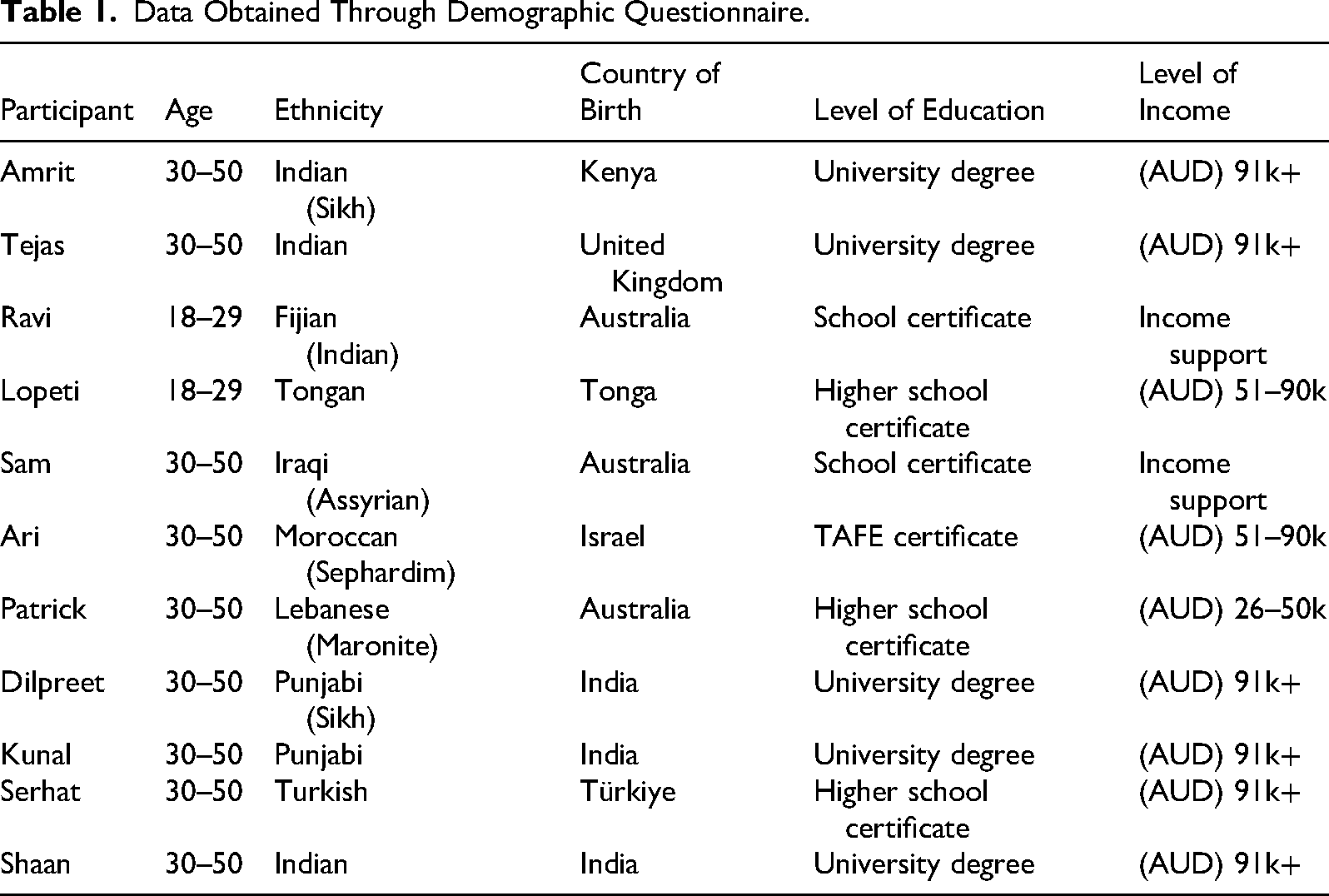
Demographic questionnaires contextualized the heterogeneity within the sample (see Table 1 below). Collectively, participants had used gendered violence in 16 intimate relationships, were connected to 19 children or stepchildren, and had experienced child protection involvement, Family Court proceedings, and legal sanctions such as Apprehended Domestic Violence Orders (ADVOs), most of which included exclusionary conditions.
Data Obtained Through Demographic Questionnaire.
Data were analyzed using thematic narrative analysis (Riessman, 1993, 2008). Analysis proceeded through multiple stages: iterative reading of transcripts, independent inductive coding by each author, analytic and collaborative theme development. Dialogic comparison of codes allowed the research team to refine emerging concepts, identify divergences in interpretation, and return to transcripts to ensure the final thematic structure was grounded in participants’ stories. Trustworthiness was strengthened through maintaining a detailed audit trail, ongoing reflexive discussions about researcher positionality and analytic decisions, and sustained attention to preserving the contextual integrity of participants’ narratives.
A key limitation of the study was its reliance on English-mediated data collection, which may have constrained participants’ expressive capacity and filtered their experiences through Anglophone epistemological frames. While interpreters might have enhanced linguistic authenticity, they were not used to avoid concerns about confidentiality, mistrust, and misinterpretation of sensitive disclosures (Davis et al., 2016; Edwards, 2013).
Ethical approval was granted by the University of Sydney Human Research Ethics Committee (No. 2023/613), and participants received a $50 grocery voucher in accordance with NHMRC (2023) guidelines. Reflecting feminist ethical commitments, a distress and disclosure protocol was implemented to ensure the safety of participants, and, critically, the women and children connected to them.
Findings
The forthcoming findings are synthesized into several distinct but conceptually related thematic discursive categories, following the conventions of thematic narrative analysis (Riessman, 1993, 2008). Discursive strategies encompass the ways language and narrative practices are used to construct social realities, shape meaning, and position subjects within broader structures of legitimacy and knowledge (Hall, 2001 as cited in Willey-Sthapit et al., 2022). In this study, participants adopt discursive strategies of both victimhood and resistance to interpret their encounters with intervention systems and construct social realities that afford them power and respectability. All quotes presented here use pseudonyms to protect participants’ anonymity.
Theme 1: Discursive Strategies of Victimhood
Most participants narrated experiences in which they felt victimized by discriminatory, oppressive generic, risk averse, alienating, and marginalizing practices, which reportedly had both material and affective impacts on their identities and family relations. The following sub-themes illustrate how participants make claim to victimization while navigating their positioning within institutional structures.
Institutionalized Discrimination
Seven participants described intervention systems and related practices as being discriminatory against them. Participants perceived intervention systems to uphold assumptions about family violence and children's safety that prioritized women. Tejas reflected: “Well, maybe if you were sitting here with the children's mother, that would be a longer answer. There's not a lot that worked well, to be honest, for me.” Similarly, Shaan argued: “They [women] just get an easier exit. They get the children, and he has to give her all the money and property. I don’t think it's fair, and they also get revenge, I think!”
Ravi described the material and affective impacts of perceived institutionalized discrimination, including carceral practices: I think it's very disgusting when they [women] do it because when this person comes out [of prison], and he's got nothing left, he is suicidal; he lost his house, he lost all his property, all his retirement fund or whatever, and the kids gone too.
Shaan also recounted his male friend's arrest, where police reportedly handcuffed his friend based on his wife's account of violence: “without asking any questions”. From Shaan's perspective, this incident reflects discriminatory policing practices, in which men involved in family violence incidents are often presumed guilty by default, while women are perceived as more credible.
While most participants explicitly perceived intervention systems as gender-biased, some accounts also contained subtle, implicit racial undertones to perceived institutionalized discrimination. For example, Dilpreet marked his ethnic difference while aligning with discourses that frame men as victims of gendered disadvantage, illustrating how participants negotiate both racial and gendered identities to emphasize their vulnerability. I cannot say that because I come from an ethnic background, so that's why I’m not getting fair treatment. I have gone to so many different groups, and they are crying the same thing. So, I guess the system is more or less kind of treating all men pretty much same.
Similarly, Shaan drew on a Global North/South binary to assert his perception of institutionalized discrimination of Australian intervention systems: “India and Dubai are better, because at least they listen to the man. Women in this country are taking advantage of the system”. By contrasting institutional responses in India and Dubai with those in Australia, he reverses the perceived global hierarchy that positions Australia as more advanced, portraying it instead as comparatively discriminatory. Shann's comparison speaks to the intersection of race and gender to reinforce his claim of institutionalized discrimination.
Oppressive Generic and Risk-Aversive Policing
Nine participants described their encounters with police, particularly regarding ADVOs, as generic and risk-averse, often noting a “low bar” for such enforcement. Participants reported that these practices restricted their sense of justice and heightened their feelings of victimization.
Amrit observed: “The police applied a template to a situation without understanding the context and it's easy for them to place the ADVO without doing the homework.” Tejas added: “The bar seems to have been set so low for the police to put an ADVO in place. That unfortunately leaves it open to manipulation, in cases where there is not a genuine need for protection.”
Participants also perceived such generic and risk aversive practices infringed on their rights. Amrit explained: “That had significant impacts on my liberties.” Similarly, Sam observed: “These types of things are very intrusive. I can’t visit my parents’ house without supervision from an independent agency, because my children reside there now. That is freedom that has been taken away from me.”
While Tejas critiqued the generic and risk-aversive nature of intervention systems, he also aligned himself with institutional reasoning, saying: What I found distressing is the quickness with which the police acted; and even speaking to a friend who's a police officer; he said, it's not a surprise, we act very quickly out of an abundance of caution, it is an ass-covering exercise.
This alignment appears to also temper potential racialization. By foregrounding his proximity to institutional, white reasoning, Tejas implicitly resists being positioned as a risky racialized other, which was evident in Patrick's account: “My appearance doesn’t help at all; being Middle Eastern!”, showing how racialized men are often presumed to be inherently risky.
Oppressive Temporalities of Punishment and Relational Alienation
Eight participants described the procedural delays of court proceedings, and extended duration of orders as forms of oppressive temporal punishment that reportedly created a sense of relational alienation from intimate partners and children. Tejas described how such delays directly constrained his parental role: “The police put our children on the ADVO! There's no reason for them to be on that. For the last six months, my access to my children was severely limited.” Similarly, Amrit reflected on the long-term relational consequences, noting: “There is still an ADVO in place! That was the onset of the breakup of my relationship with my wife.”
Sam also highlighted how such temporal constrains disrupt opportunities for relational repair, illustrating his perceived sense of alienation: “Think about that, I can’t now go and make up with this person and show them how I feel, or they can’t come to see me and show me how they feel after the incident.”
While Dilpreet's account further emphasized the broader, multidimensional impact of delayed court processes: The family court system is very slow! If it takes five years or more, you can imagine the kind of impact it's going to have on that kid. The kind of impact it's going to have on both parents and everyone else, like you know, financial, emotional, and in every manner.
His account also drew on Global North/South binary to denounce Australia's “first world” justice system in order to reinforce his sense of victimization as result of court procedural delays: “That's not what I was expecting from a first world country's justice system; and as they say, justice delayed is justice denied.”
Gatekeeping, Carceral Residue, and Sustained Marginalization
Seven participants reported practices perceived as gatekeeping by practitioners, unilateral decision-making, and ongoing entrapment linked to criminal records. They described such practices as reinforcing a sense of marginalization and, thus, limiting opportunities for meaningful engagement or support.
Reflecting his experience of MBCP intake, Kunal recounted forms of gatekeeping practices that seemed to enforce conformity, particularly the expectation that participants express acceptable beliefs. He described this aspect of the intervention system as exclusionary: If, let's say that if you don’t have the belief system already in place, you will not be accepted. So, in my opinion, I felt that they were only accepting people who are already converted, you know what I mean, who are already on that wavelength.
Echoing these concerns, Sam highlighted how he experienced decision-making processes as unilateral and dismissive of his perspectives, which reinforced a sense of marginalization: “They’re just coming to you, hearing one side of the story, and making a decision! Would you rather just keep your mouth shut! They don’t care. They’re gonna do what they want anyways.”
Sam further reflected on how criminal records were used to reinforce his marginalization. He described these records as persistent markers, often exaggerated or misrepresented within institutional processes, with lasting consequences: When they find out that you have a record. That record that has been written on you, whether it be fact, fictional, made-up facts, exaggerated facts, which is what they will do now. They exaggerate facts. They stretch them out. They make everything bigger and worse than it is, so it looks worse off in court. Those facts stick.
Kunal's account offers an insight to the perceived long-term impact of such experiences, highlighting how repeated systemic scrutiny can erode men's engagement and hope: Like, I even have a few people in the group who’ve been burned out so badly by the police, by the law system, by the lawmakers to a point where they like couldn’t give a fuck, and I don’t think there's coming back for them, because of all the things that have happened to them. And I’m sure at one point they had hope of coming back from that sort of mental garbage but not anymore.
Alienation and Tone Policing in MBCP Spaces
Five participants reported practices in MBCPs that they perceived as curtailing their lived experiences, framing them solely as perpetrators of violence, and controlling how they could speak during sessions. They described these practices as contributing to a sense of alienation and disengagement.
Tejas reflected on how men's claims of victimization in MBCP were routinely curtailed, leaving participants feeling dismissed and shut down: So, I understand that my former partner is a victim of family violence. And that is my fault. And I have to take responsibility. But I also feel that I have been a victim to some extent as part of the process, like for example, with police involvement. But whenever any of the participants talks about being a victim, it's almost as if the facilitators go straight back into their textbook and their training, and they cut it short. It feels very much like a bit of a put down, you can’t be victim; we’re going to dismiss that.
Amrit further highlighted what he perceived as a reductive framing of participants solely as perpetrators of violence: It's the old saying, if you have a hammer, and you look around you, all what you’re going to see is a nail. At times, I felt as if the program would try pigeonhole me without understanding the context, or kind of trying to paint a brush that applies to everyone in that room. Like, that's not me! You haven’t taken the time to understand my circumstances. That perspective is not true.
Ari's account suggests facilitators have ultimate authority and control over how participants should speak during MBCP sessions: You cannot use the F word! Sometimes when there is heated discussion, when there is a confrontation, or if we are discussing a subject, and there is light bulb, someone because of the excitement, they say, oh, my bitch, my lady did this, you know. And then they [group facilitators] stop them. And then you see a confrontation between the facilitator and that man. And it's not comfortable. Let it be a bit more open, you know, and let us speak. Most of the time they [group facilitators] are cutting us off. That is what I saw from the inside.
Theme 2: Discursive Strategies of Resistance
Feeling cast primarily as violent men in need of reform, participants described forms of resistance that operated within, not against the intervention system. Rather than outright refusal, participants engaged in strategic navigation of institutional expectations. Their resistance involved carefully balancing compliance with the preservation of agency. This included selectively taking up program discourses to re-author themselves, while performing civility to temper perceptions of threat and maintain a sense of respectability.
Strategic Compliance and Civility Politics
Several participants framed their attendance of MBCPs as evidence of reform and cooperation to regain respectability and institutional trust. As Tejas explained: “I know that a number of other men are there because court ordered them to be there. I’m there on a voluntary basis to demonstrate to the court that I take these allegations seriously.” Others described the program as a system requirement, a box-ticking exercise that is needed to prove their nonviolent status. Shaan commented: “I think the system is such that the onus is on me to prove that I’m good, I’m not a bad guy. So, I have to do things to show that; that's all.”
For Tejas and Shann, the MBCP served primarily as a space to secure credentials by performing compliance rather than engaging therapeutically. This illustrates a mode of resistance through legibility, in which civility is strategically performed to contest racialized constructions of the “violent immigrant man” and assert alternative, respectable identities.
Through their engagement with intervention systems, participants not only sought to signal reform but also to assert their proximity to normative ideals of civility and self-control through their intersubjective encounters with professionals. Tejas also uses this strategy to recalibrate a police encounter: The first thing the officer said, I want you to know that I’ve got my body cam switched on; And we’ve only been speaking for about a minute, when he said to me, I’m gonna switch my body camera off. And I suspect it's because he would have realized I’m not a threat to him. And it probably wasn't the color of my skin; it was probably related to the way that I conducted myself. He didn’t feel threatened and we could have a civil conversation.
Here, Tejas’ account can be read as an attempt to negotiate racialization by attributing the officer's response to Tejas’ performance of civility. In doing so, he enacts a dual strategy that acknowledges the normative gaze while simultaneously accommodating it, positioning himself as non-threatening through alignment with dominant expectations of self-control and respectability.
Self-Presentations and “Playing the Game”
Some participants also reported carefully managing their self-presentation and deliberately navigating institutional expectations. Kunal reflected on his experience during the MBCP intake process: I’m gonna be honest. I didn’t know what they were looking for, if I should present myself that I’m fully healed, that they’re going to reject me. Or if I say I’m in need of help, and they’re going to reject me then. So, I was on the fence with my answers, and I gauged so they pushed me back on a couple of my potential. So, you want me to answer this way to get into the program? Okay, So I had to play the game. Some of the things that I said I didn’t believe in the interview, because that was the process.
Kunal's reflection underscores the strategic self-presentation that racially marginalized immigrant men often employ to align with institutional norms, revealing the tension between authentic expression and perceived institutional expectations. Such performances illustrate how intervention processes mandate conformity, reinforce mistrust, and obscure the lived realities of participants.
Re-Authoring the Self Through Therapeutic Discourses
Some participants embraced their engagement with MBCP and its discourses to re-cast themselves as learners developing emotional literacy. As Amrit reflected: There were a lot of ideas that were quite foreign to me, I was like, oh, never thought of that; I’ve never used to think like that. So, there was a lot of information and there were a lot of things that challenged my pre-existing notions, my pre-conceived ideas about just human nature.
Similarly, Serhat shared his learnings: “I’ve learned more about my emotions, how my behavior looks toward the person that you say that you love. That behavioral change program actually teaches you those behaviors.” Serhat also highlighted acquiring new terms, such “gaslighting” and “triggers”, while aligning himself with norms of self-regulation and care.
Participants’ engagement with therapeutic discourses can be interpreted as a means of developing emotional literacy and self-regulation while navigating institutional norms that often de-racialize differences. In this way, engagement represents a strategic form of resistance, enabling participants to assert agency and negotiate their racialized positioning within the program.
Discussion
Previous scholarship in Australia on racially marginalized immigrant men has highlighted that they often perceive intervention systems as threatening to both their masculine status and family cohesion (Fisher, 2013; Khawaja & Milner, 2012; Muchoki, 2013; Rees & Pease, 2007; Satyen, 2021; Satyen et al., 2020). The findings of this study extend this scholarship by illuminating the complex ways in which racially marginalized immigrant men navigate power, accountability, vulnerability, and perceived institutional harms within family violence intervention systems.
Participants employed discursive strategies of victimhood and resistance to manage persistent tensions between being regulated by intervention systems and actively asserting alternative identities. They described themselves as victimized by institutional processes through perceived discriminatory, oppressive, generic, risk averse, alienating, and marginalizing practices, that produced material, relational, and emotional harms. At the same time, participants resisted institutional framings through strategic compliance, performances of civility, selective engagement with program discourses, and self-presentation tactics designed to re-author themselves as responsible, respectable, and non-threatening subjects. Overall, these findings illustrate how racially marginalized immigrant men oscillate between institutional regulation and self-repositioning, using both victimhood and resistance as intertwined discursive strategies to contest racialized and gendered constructions of “violent immigrant men.”
Participants’ accounts further demonstrate that resistance is often enacted through accommodation to institutional expectations. Some participants sought to renegotiate their positioning within intervention systems by aligning with dominant norms and distancing themselves from racialized stereotypes. This involved adopting normative emotional and behavioral performances, such as presenting cooperative, engaging with therapeutic discourses, and demonstrating self-control, to regain credibility. We argue that such practices also reflect the heightened expectations placed on racialized subjects to exhibit rationality and “good behavior” to counter assumptions of inherent risk (Stuart & Benezra, 2018).
Moreover, participants’ use of the Global North/South binary highlights how postcolonial subjectivities are shaped through enduring global hierarchies, revealing the ambivalence and duality that characterize racialized identities (Bhabha, 1994). As such, these comparisons suggest that racialized dynamics are embedded within family violence intervention systems, shaping both institutional responses and the ways racially marginalized immigrant men construct themselves. We argue that these accounts point not only to individual defensiveness but also to the structural forces of racialization, migration regimes, and institutional governance that shape how participants account for their harmful behaviors. In this context, the possibilities for communicating reform and accountability for racially marginalized immigrant men remain constrained by narrow, institutionally defined pathways. This reflects broader patterns of stratification, in which intersecting forms of privilege and marginalization operate across public and private spheres (Few-Demo & Allen, 2021). Participants’ accounts also highlight that men's claims to victimhood and accountability can coexist in complex and nuanced ways. While feminist scholarship has long cautioned that men's discursive strategies may serve to elicit sympathy, deflect responsibility, or downplay harm (Coates & Wade, 2004, 2007), our findings show that such claims persist alongside men's acknowledgement of their use of family violence. For participants in this study, discursive strategies of victimhood and resistance did not only serve as tactics to evade responsibility, but they were also central to making sense of their experiences of intervention systems. These strategies reflect attempts to navigate the tensions between personal accountability, institutional expectations, and the structural conditions of racialization, migration, and patriarchal norms, including the limited supports available to disengage from violence and misogyny. In this light, the men's dual positioning as vulnerable and accountable cannot be solely understood within gendered frameworks. It must also be interpreted through the interlocking institutional, social, and racial hierarchies and resultant power relations.
Considerations for Critical Feminist Social Work Research and Praxis
Findings raise important considerations for critical feminist social work research and praxis. The persistent assumption that men cannot simultaneously be both vulnerable and harmful risks shaping inquiry in ways that oversimplify men's experiences and constrain the scope of research. Aligned with a critical feminist reflexive stance, we urge future research with racially marginalized immigrant men who use family violence to: first, avoid reproducing hierarchical or deficit narratives (Rogers & Allen, 2024); second, resist binary frameworks (Moss, 2016); and third, attend to the ambivalent and contradictory self-perceptions held by men who use family violence (Whiting et al., 2014). Drawing on Ma's (2023) intersectional and postcolonial analysis, we suggest that migration histories, racialization, and colonial legacies shape how participants engage with research, thus, emphasizing the need for culturally responsive, relational approaches that attend to structural inequities.
With regards to praxis, previous justice orientated and emancipatory pro-feminist practitioners have warned against inadvertently reproducing coercive or hierarchical dynamics when rigid frameworks of risk, accountability, or program compliance overshadow clients’ intersectional positioning and lived realities (Moss, 2016; Scott & Jenney, 2023). A critical feminist approach requires practitioners to acknowledge their own institutional power while ensuring that interventions do not replicate the oppressive dynamics they aim to dismantle (Jenkins, 2009). Considering this, meaningful engagement with racially marginalized immigrant men, must be grounded in reflexive and collaborative practices that recognizes their capacity for insight and change, rather than positioning them as passive recipients of expert intervention.
A critical feminist, intersectional, and postcolonial praxis therefore requires working with, rather than against, men's narratives in ways that foster ethical responsibility, deepen relational awareness, and support transformative change (Augusta-Scott & Maerz, 2017). This includes recognizing complexity without collapsing into collusion, challenging harmful masculinities without reinforcing racialized stereotypes, and creating spaces where men can meaningfully reflect on both their experiences of oppression and their capacity to cause harm. Such an approach aligns with transformative feminist social work that seeks to balance accountability with structural understanding, creating pathways for change that do not rely on punitive or racialized logics (Cocker & Hafford-Letchfield, 2022).
Footnotes
Acknowledgements
The authors are grateful for the feedback received through the anonymous review process, which has strengthened the article.

Ethical Considerations
This study received approval from the Human Research Ethics Committee (HREC) at The University of Sydney (No. 2023/613, granted October 13, 2023) and adhered to ethical guidelines set out by the National Statement on Ethical Conduct in Human Research 2023.
Consent
All participants provided informed written consent in line with the study's HREC approval.
Authors Contributions
RA collected the data as part of their PhD research. RA and BG conceptualized the study, conducted the analysis, and co-wrote the manuscript. Both authors reviewed and approved the final version.
Funding
The authors disclosed receipt of the following financial support for the research, authorship, and/or publication of this article: The first author acknowledges the support of The University of Sydney Postgraduate Award during the course of this research.
Declaration of Conflicting Interests
The authors declared no potential conflicts of interest with respect to the research, authorship, and/or publication of this article.