




Abstract
This study explored risk factors for adolescent dating aggression (ADA) among Brazilian street youth. Forty-three adolescents, between the ages of 13 and 17 years, were recruited at services centers in Porto Alegre, Brazil. Simultaneous multiple regression revealed that ADA was significantly predicted by adolescent dating victimization (ADV), and that this relationship was moderated by peer involvement in dating aggression. Results also revealed that peer involvement in dating aggression did not significantly predict ADA. These findings suggested that having peers who are involved in dating aggression exacerbates the effects of dating victimization on ADA among Brazilian street youth. However, ADV might be a stronger risk factor for dating aggression in this population, because when controlling for the effects of victimization in dating conflicts peer abuse toward romantic partners did not uniquely contribute to ADA.
Keywords
Adolescent dating aggression (ADA) is a form of interpersonal violence that is prevalent among street youth. A recent study conducted in the United States revealed that 65% of street youth have abused their dating partners and that dating aggression among these youth was predicted by dating victimization (Tyler, Melander, & Noel, 2009). Several authors have found that among the general youth population dating aggression is predicted by peer involvement in ADA (Arriaga & Foshee, 2004; Sears, Byers, & Price, 2007). A similar relationship between aggression and peer involvement in violence was found among street youth (Baron, Forde, & Kennedy, 2007). Hence, dating aggression may also be predicted by peer involvement in ADA among street youth.
According to the social learning theory of aggression (Bandura, 1973, 1978; Bandura, Ross, & Ross, 1961), people exposed to violent environments are more likely to imitate aggression than people exposed to nonviolent environments. Imitative behaviors are first acquired at an early age when children copy the behaviors of their caretakers and are rewarded for it (Hovell, Wahlgren, & Adams, 2009; Hovell, Wahlgren, & Gehrman, 2002). Over time, children learn that there is a contingency of reinforcement for imitation and that copying the behaviors they observe is functional in their survival (Hovell et al., 2002, 2009). Consequently, children generalize their imitative skills to different situations and begin to copy a range of models in their environment creating a repertoire of behaviors from which to choose (Baer, Peterson, & Sherman, 1967; Hovell et al., 2009).
Among street youth this behavioral repertoire may be composed primarily of violent behaviors, as they are exposed to a wide range of violent acts (Morais, Neiva-Silva, & Koller, 2010; Paludo & Koller, 2005; Raffaelli, 1997; Raffaelli et al., 2000, 2001, Raffaelli, Koller, & Morais, 2007). On the streets, for instance, these youth experience dating victimization and witness peer abuse toward dating partners (Baron et al., 2007; Tyler et al., 2009). Consequently, when faced with conflicts such as those in dating relationships street youth may resolve them in a violent manner, as they may have been rewarded for modeling such behaviors in the past (e.g., avoided injuries from dating victimization, obtained what she wanted from dating partners, praised by peers).
It is unclear, however, whether witnessing peer abuse toward dating partners exacerbates the effects of adolescent dating victimization (ADV) on ADA among these youth. It is important to explore whether peer involvement in dating aggression moderates this process of ADA among street youth, because these youth spend most of their time on the streets with their peers (Lusk, 1989; Raffaelli, 1996). Several authors have argued that affiliation with peer groups is important in street youth culture, because these groups protect their members from street victimization (Baron, 1997a; Baron et al., 2007; McCarthy, Hagan, & Martin, 2002; Smith, 2008). Affiliation with peer groups may depend, however, on whether youth comply with their group norms (Smith, 2008). If youth do not follow their group norms they may be socially excluded from the group and left vulnerable to street victimization (Baron, 1997a, 1997b; Smith, 2008). In other words, street youth may be pressured to imitate their peers’ behaviors, as compliance to peer norms is functional for survival on the streets (Baron, 1997a, 1997b; Smith, 2008).
The studies that have explored ADA among street youth have been conducted primarily in non-Latin American countries. Jackson (1999) argued that dating aggression should be explored among youth in different countries to increase its generalizability. An interesting country in which to explore ADA is Brazil, because Brazilian street youth experience high levels of unemployment (Raffaelli et al., 2007), and low-income Brazilian youth are exposed to high rates of violence (Dowdney, 2003; Macedo, Paim, Da Silva, & Costa, 2001; Soares, Bill, & Athayde, 2005). A previous study conducted among these youth demonstrated that 80% of them have witnessed intimate partner violence in their communities, 49% have witnessed it in their family, and 46% have witnessed it in their peer group (Ruzany, Taquette, Oliveira, Meirelles, & Ricardo, 2003).
Given that low-income Brazilian youth such as those on the streets are exposed to high rates of violence (Dowdney, 2003; Macedo et al., 2001; Ruzany et al., 2003; Soares et al., 2005), they may have built a collection of behaviors comprised primarily of aggressive acts. That is, Brazilian street youth may have a limited range of behaviors to choose from when faced with disputes such as dating conflicts and may, therefore, be at risk for ADA. Because dating victimization predicts dating aggression among American street youth (Tyler et al., 2009), the present study specifically examines whether ADV predicts ADA among Brazilian street youth. Given that peer abuse toward dating partners is prevalent among low-income Brazilian youth such as those on the streets (Ruzany et al., 2003), and that compliance to peer norms is functional for survival on the streets (Baron, 1997a, 1997b; Smith, 2008), the present study also explores whether peer involvement in ADA moderates the relationship between dating victimization and dating aggression among Brazilian street youth.
Method
Participants
A cross-sectional convenience sample of 43 street youth (26% were girls), aged between 13 and 17 years (M = 15.37, SD = 1.18), was recruited at services centers located in Porto Alegre, Brazil. In this study, street youth was defined as minors who spent part of their day at services centers for street youth and the night on the streets, who engaged in survival activities such as sale of food and small objects, and who wandered around the city when they were not at these services centers.
Procedures
Assessment
With Institutional Review Board approval from San Diego State University and Universidade Federal do Rio Grande do Sul (UFRGS), research students affiliated with UFRGS spent several days with street youth at daytime services centers to build rapport. Research students introduced themselves and described the study to these youth. Research students informed youth that the study has asked for sensitive information (e.g., sexual abuse) and that interviews would take approximately 45 to 60 min. Furthermore, confidentiality and freedom to withdraw from the study were emphasized, and youth were encouraged to ask questions before, during, and after the interview.
Research students read assent form to youth interested in participating in the study, and those who were available to be interviewed were asked to sign the form. In Brazil, consent forms are not required if youth do not have legal or regular contact with or if they have been neglected and/or abused by their parents or guardians (Conselho Federal de Psicologia, 2000).
Translation
Using cross-cultural translation techniques (Brislin, 1970), interview materials were translated from its original language (English) to the target language (Brazilian Portuguese) by a person fluent on both languages. Next, another person fluent on both languages back-translated the materials from Brazilian Portuguese to English. Finally, the back-translated materials were compared against their original English version for discrepancies. Only minor discrepancies were identified.
Measures
To assess ADA and ADV, the present study used the dating violence scale of the Conflict in Adolescent Dating Relationships Inventory (CADRI; Wolfe et al., 2001). The CADRI’s dating violence scale consisted of 24 pairs of items, each assessing ADA and ADV and employing a 7-point scale that ranged from 0 = 0 times to 7 = 6 or more times. The scale assessed physical abuse (“I pushed, shoved, or shook my dating partner,” “My dating partner kicked, hit, or punched me”), verbal–emotional abuse (“I blamed my dating partner for the problem,” “My dating partner insulted me”), sexual abuse (“I kissed my dating partner when he or she didn’t want me to,” “Dating partner touched me sexually when I didn’t want it”), relational abuse (“I tried to turn friends against,” “My dating partner spread rumors about me”), and threatening behaviors (“I threatened to hit my dating partner or throw something at him or her,” “My dating partner threatened to hurt me”). The English version of the ADA subscale had acceptable internal consistency (α = .83; Wolfe et al., 2001). 1 The Brazilian Portuguese version of the ADA subscale and the ADV subscale also had acceptable internal consistency (α = .87 and α = .87).
In this study, the sexual abuse items (“I touched my dating partner sexually when he or she didn’t want it,” “I threatened my dating partner in an attempt to have sex with him or her,” and “I kissed my dating partner when he or she didn’t want me to”) were dropped from the ADA subscale, because they were either negatively related or not related to the other items in this subscale. One physical abuse item (“My dating partner threw something at me”), one verbal–emotional abuse item (“My partner did something to make me jealous”), and one sexual abuse item (“My dating partner threatened me in an attempt to have sex with me”) were dropped from the ADV subscale, because they were either negatively related or not related to the other items in this subscale. The final ADA and ADV subscales had 21 items each, and acceptable internal consistency (α = .88, and α = .88).
To assess peer involvement in ADA, the present study used six items adapted from the CADRI’s dating aggression scale. These items assessed the proportion of peers who physically (“Hit their dating partner,” “Pushed or shoved their dating partner”), verbally-emotionally (“Yelled at their dating partner,” “Insulted their dating partner”), and sexually abused (“Kissed their dating partner when the partner did not want it,” “Touched their dating partner sexually when the partner did not want it”) their dating partners. This measure employed a 5-point scale that ranged from 0 = none of them to 4 = all of them. In this study, the peer involvement in ADA scale had an acceptable alpha (α = .85).
Data Analysis
The present study used the social learning theory of aggression framework (Bandura, 1973, 1978; Bandura et al., 1961) to understand the propensity for ADA among Brazilian street youth. In this framework, the process of aggression is argued to be temporal and to begin when people witness and/or experience violence. Following the temporal process of aggression proposed by this model, the present study explored the moderating effects of peer abuse toward dating partners by regressing ADA on ADV, peer involvement in dating aggression, and their interaction term.
Prior to analysis, unweighted sum of scores for the ADA and ADV subscales and mean scores for the peer involvement in dating aggression scale were computed. These scores were transformed into z scores and inspected for outlier values; no outlier values were found. Next, assumptions of regression were tested by regressing ADA on ADV, peer involvement in dating aggression, and their interaction term. As shown in Figure 1, the regression model met assumptions of normality, linearity, and heteroscedasticity.

Scatter plot of regression standardized residual values by regression standardized predicted values
Results
Correlations
Table 1 shows the descriptive statistics for ADA, ADV, and peer involvement in dating aggression. Table 2 shows the correlations among these variables, and as it is shown, ADA was significantly related to ADV, r(42) = .65, p < .05, and peer involvement in dating aggression, r(42) = .39, p < .05. In addition, ADV was significantly related to peer involvement in ADA, r(42) = .37, p < .05.
Descriptive Statistics for ADA, ADV, and Peer Involvement in ADA
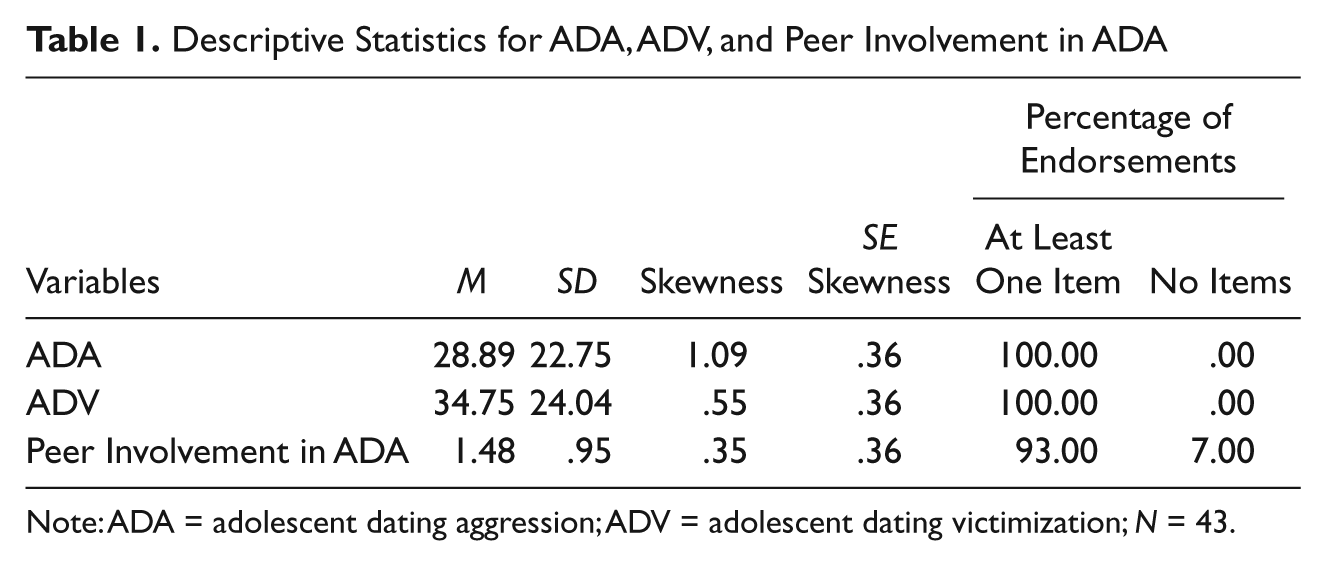
Note: ADA = adolescent dating aggression; ADV = adolescent dating victimization; N = 43.
Correlations Among ADA, ADV, and Peer Involvement in ADA

Note: ADA = adolescent dating aggression; ADV = adolescent dating victimization; N = 43.
Significant at the .05 level.
Simultaneous Multiple Regression
Table 3 shows the moderation model for the relationship between ADV and ADA. Collinearity diagnostics was performed on mean centered ADV, mean centered peer involvement in ADA, and their interaction term. Multicollinearity was determined by variance inflations greater than 4.0 (Bickel, 2007) and tolerance and eigenvalues lesser than .01 (Jeeshim & KUCC625, 2003). No multicollinearity was found in this model. 2
Summary of Simultaneous Multiple Regression Analysis for ADA, ADV, and Peer Involvement in ADA
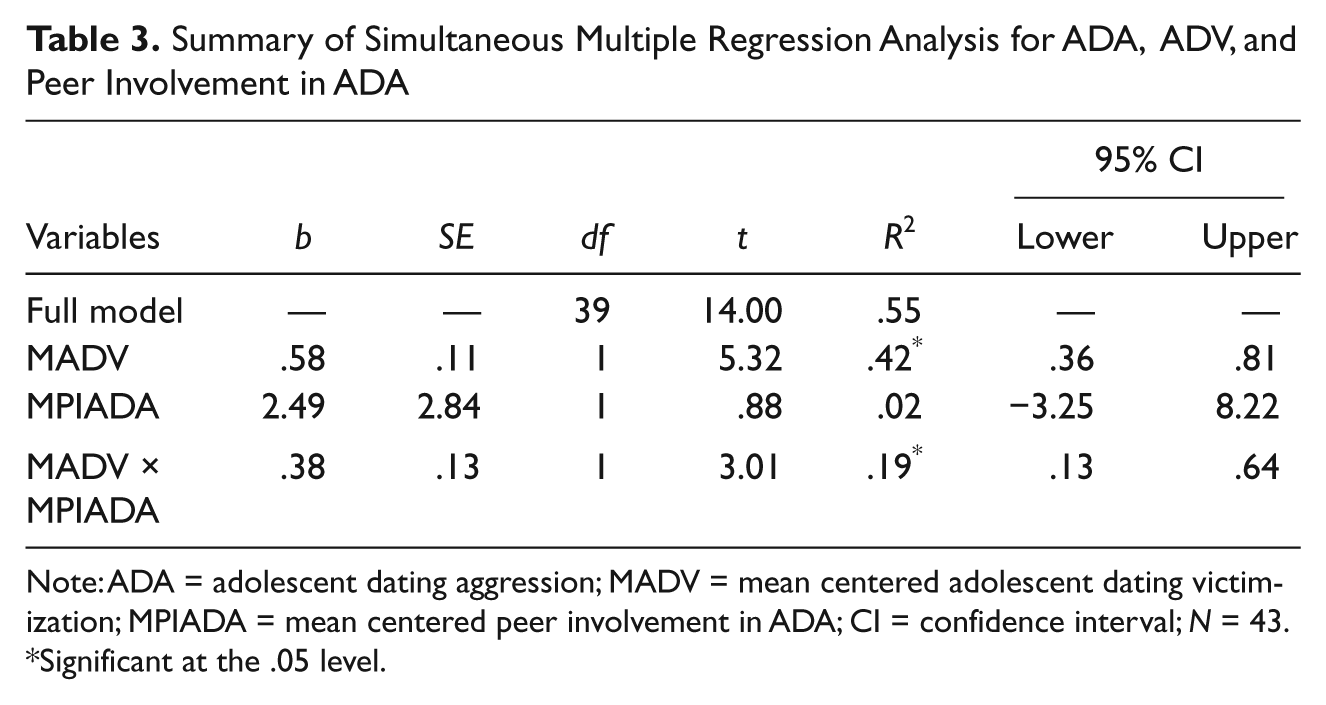
Note: ADA = adolescent dating aggression; MADV = mean centered adolescent dating victimization; MPIADA = mean centered peer involvement in ADA; CI = confidence interval; N = 43.
Significant at the .05 level.
As shown in Table 3, ADV significantly predicted ADA, t(39) = 5.32, r2 = 0.42, p < .05. Moreover, peer abuse toward dating partners significantly moderated the effects of ADV on ADA, t(39) = 3.01, r2 = .19, p < .05. 3 There were no other significant predictors of ADA.
Discussion
The present study revealed that ADV significantly predicted ADA among Brazilian street youth. This finding is consistent with those of a previous study on dating aggression among street youth (Tyler et al., 2009), and a previous study on dating aggression among the general youth population (Champion, Foley, Sigmon-Smith, Sutfin, & DuRant, 2008). The relationship between ADV and ADA may be explained by the proximal processes experienced by developing street youth. According to Bronfenbrenner (2005), proximal processes are interactions or bidirectional relationships across time between a developing person and objects and symbols in her or his immediate environment. Participation in proximal processes allows a developing person the “ability, motivation, knowledge, and skill” to interact with other people (Bronfenbrenner, 2005). Among developing street youth, proximal processes such as caretaker abuse and ADV (Tyler et al., 2009; Tyler & Johnson, 2006) may have shown them that violence is the primary way to relate to loved ones. Furthermore, these proximal processes may have hindered emotional and behavioral regulations among these youth (De Bellis, 2001) which may have led to posttraumatic stress disorder symptoms and in turn, to self-defensive aggressive acts (Wekerle et al., 2001, 2009).
The results of the present study also revealed that the more frequently Brazilian street youth were victimized in dating conflicts the more frequently they abused their dating partners, and this relationship was intensified as the proportion of peers these youth had who abused dating partners increased. Unfortunately, this finding may not be compared with those of previous studies, because the present study was the first to explore the moderating effects of peer involvement in dating aggression on the relationship between ADV and ADA. As argued earlier, the exacerbating effects of witnessing peers abuse toward dating partners on this process of ADA may be the result of fear that youth victims of dating aggression experience of being socially excluded—and consequently victimized again—if they do not comply with the norms of aggression among their peers (Baron et al., 2007; Smith, 2008).
Finally, contrary to previous studies on dating aggression among the general youth population (Arriaga & Foshee, 2004; Sears et al., 2007) and a study on aggression among street youth (Baron et al., 2007), increased number of peers who abused dating partners did not predict increased frequency of abuse in dating conflicts among Brazilian street youth. The nonsignificant relationship between peer abuse toward dating partners and ADA could be attributed to the small observed power (.14) revealed by post hoc power analysis. It is also possible that peer involvement in dating aggression did not predict ADA, because involvement with peers who abused their dating partners was positively related to dating victimization among these youth. Thus, when controlling for the effects of ADV on ADA, peer abuse toward dating partners did not add anything to the prediction of dating aggression that was different than the effects of dating victimization. In other words, among Brazilian street youth the unique contribution of peer abuse toward dating partners to ADA is very small and overshadowed by the effects of ADV.
The present study had three major limitations that need to be considered when evaluating these results. First, the present study used a small convenience sample of southern Brazilian street youth. Therefore, these results may not be generalizable to street youth in other regions of Brazil and to street youth in other countries. Furthermore, the small sample of Brazilian street youth could explain the small observed power for the nonsignificant relationship between peer abuse toward dating partners and ADA found in the present study. Second, the present study was cross-sectional and, therefore, does not allow for causal inferences. Third, the ADA and ADV measures used in the present study were piloted and validated among nonstreet high school Canadian youth (Wolfe et al., 2001), and may not have been appropriate for Brazilian street youth. Furthermore, because the peer involvement in ADA measure was adapted from the CADRI’s dating violence scale, it may also not have been appropriate for youth in the present study.
To address these limitations, future studies should replicate the present study with a larger and longitudinal sample of street youth from southern, northern, eastern, western, and central Brazil. Future studies should also validate the CADRI’s dating violence scale and the peer involvement in ADA measure among Brazilian street youth by exploring the types and severity of dating aggression that Brazilian street youth have used and experienced during dating conflicts, and the types and severity of peer abuse toward dating partners that they have witnessed. It is important to validate these measures among these youth, because street youth may use, experience, and witness more severe forms of dating violence than those assessed by the CADRI. This argument is grounded on evidence that on the streets these youth are physically abused with objects and weapons (Tyler & Johnson, 2006), that youth exposed to violence are prone to imitate aggressive models (Bandura et al., 1961), and that such exposure to violence teaches street youth to generalize the use of violence to various situations (Baron et al., 2007).
The results of the present study suggest that intervention programs for Brazilian street youth are needed, as ADA (100%), ADV (100%), and peer involvement in dating aggression (93%) were prevalent among these youth. Given that witnessing peer abuse toward dating partners intensified the relationship between ADV and ADA, but it did not predict dating aggression when controlling for dating victimization, intervention programs for ADA should not focus solely at reducing peer involvement in dating aggression. Rather, intervention programs should be sensitive to the ADV experienced by youth perpetrators of ADA and should help those youth who witnessed peer abuse toward dating partners leave the street life by connecting them with a temporary shelter or a transitional living facility. While in a shelter or transitional living facility, these youth could attend counseling sessions focused at helping victims of dating violence cope with the trauma that they have experienced on the streets.
Footnotes
The authors declared no potential conflicts of interest with respect to the research, authorship, and/or publication of this article.
The authors disclosed receipt of the following financial support for the research, authorship, and/or publication of this article: The project was funded by a grant from the National Center on Minority Health and Health Disparities, Minority Health and Health Disparities International Research Training program at San Diego State University (5 T37 MD001442-11). The project was also supported in part by the National Institute of Mental Health, Career Opportunities in Research program at San Diego State University (MH-65183), and the Conselho Nacional de Desenvolvimento Científico e Tecnológico (302039/2007- 4).