



Abstract
The present study provides the first available evaluation of how violence with the mother and siblings during adulthood is associated with the occurrence of partner violence in young adults. Because a pattern of reciprocal partner violence is well documented, the authors hypothesized that reciprocal violence would also be found for adults and their mothers and for adults and their siblings. The authors also hypothesized that reciprocal violence with the mother and sisters would explain variance in partner violence even when controlling for other known predictors (poverty, poor family support, stress, anger, low self-esteem). Study participants included 377 college adults (114 men, 263 women; mean age = 24.4 years) who completed questionnaires to report their present violence to and from their mothers, sisters, brothers, and romantic partners. Violence is measured with a modified Conflict Tactics Scale. No sibling gender differences are found in violence reported as adults. Factor analysis confirms good fit for three clusters of reciprocal violence for adults: violence with the mother, violence with siblings, violence with the romantic partner. Violence with the mother and siblings significantly explains variance in partner violence even after controlling for other contextual variables, but only for women. One interpretation of present results is that because women receive less socialization than men to use violence, these two within-family models of violence have more significance for increasing their risk of partner violence. Partner violence prevention programs could include participation of mothers and siblings to enhance development of more peaceful conflict resolution patterns within and outside the family.
Research suggests that more than 20% of men and women report violent behaviors received from and given to romantic partners, often in a pattern of reciprocal violence (Archer, 2000; Breiding, Ziembroski, & Black, 2009; Hendy et al., 2003; Riggs & O’Leary, 1996; Sims, Dodd, & Tejeda, 2008; Straus, 1990; Straus, Gelles, & Steinmetz, 1980). Unfortunately, despite 30 years of research to identify predictors of such partner violence, human service agencies and interventions developed to reduce it, and public service campaigns designed to educate communities about its patterns and consequences, the prevalence rates for partner violence have remained constant, which suggests that some components in the development of partner violence may have been missed or understudied. The present study adds a consideration of violence with the mother and siblings in adulthood as possible predictors of partner violence reported by young men and women.
According to social learning theory (Bandura, 1977) and the cycle of violence hypothesis (Fagan, 2003; Straus et al., 1980; Widom, 1989), the risk for partner violence would increase if violence is modeled by and experienced with powerful others (such as parents) and with similar others (such as siblings) within the family of origin. Most of the available research on within-family predictors of partner violence uses recollections from childhood and adolescence, with the finding that violence received from parents is a better predictor of partner violence than is violence observed between parents (Hendy et al., 2003; Noland, Liller, McDermott, Coulter, & Seraphine, 2004; Sims et al., 2008). Past research has also found that partner violence for both men and women is explained more by violence received from the mother than from the father (Hendy et al., 2003), perhaps because the mother is typically the primary caregiver, and therefore, the most frequent model for conflict resolution style within the family. Although limited research is available on the somewhat taboo topic of child-to-parent violence, the available studies suggest that it is more likely to occur from sons to mothers, especially once the son is older than 17 years of age and larger and stronger than his mother (Edenborough, Jackson, Mannix, & Wilkes, 2008; Kethineni, 2004; Walsh & Krienert, 2007). No known research has examined child-to-parent violence in adulthood as a possible predictor for partner violence.
For both men and women, parental violence and sibling violence during childhood are strongly correlated (Eriksen & Jensen, 2006; Finkelhor, Turner, & Ormrod, 2006; Hoffman, Kiecolt, & Edwards, 2005), but they each appear to explain a unique portion of the variance in partner violence (Noland et al., 2004; Sims et al., 2008). It is surprising that sibling violence has so rarely been considered as a predictor of partner violence when it is the most prevalent violence experienced within the family. For example, one study found that 21% of adolescents reported violence from parents and 42% reported violence from siblings (Button & Gealt, 2010). As with partner violence, siblings tend to display a pattern of reciprocal violence (Noland et al., 2004; Sims et al., 2008). Sibling violence usually decreases across age from prevalence rates of 75% to 85% during childhood to 40% to 65% during adolescence (Button & Gealt, 2010; Goodwin & Roscoe, 1990; Hoffman et al., 2005; Straus et al., 1980), typically with reductions in sibling violence occurring around the time of puberty (Buhrmester & Furman, 1990). Sibling gender has not been consistently found related to violence during childhood and adolescence, with some studies finding few differences between brothers and sisters (Duncan, 1999; Goodwin & Roscoe, 1990) and other studies finding that both men and women report more violence with their brothers than with their sisters (Button & Gealt, 2010; Hoffman et al., 2005; Noland et al., 2004; Straus et al., 1980). No available research has examined sibling gender differences in violence reported during adulthood.
Besides models of violence found within the family from mothers and siblings, the bioecological model (Bronfenbrenner & Ceci, 1994) suggests that successful adult relationships would be less likely in the context of greater social, environmental, and personal strains experienced by the individual. For example, past research has found that increased risk for partner violence is associated with the contextual variables of neighborhood poverty (Neumann, Barker, Koot, & Maughan, 2010), poor family support and cohesion (Aceves & Cooston, 2007; Casper, 2011; Neumann et al., 2010; Piotrowski, 2011; Sellers, Black, Boris, Oberlander, & Myers, 2011), high levels of stress (Randle & Graham, 2011; Rhatigan, Shorey, & Nathanson, 2011), high levels of anger (Hines et al., 2011; Randle & Graham, 2011), and poor self-esteem (Casper, 2011; Piotrowski, 2011).
Gender socialization theories (Maccoby, 1998) also propose that men experience more socialization from a variety of sources (e.g., media images, parents, peers) to use violence to resolve conflict. For example, boys typically receive more overt instruction in physical fighting than do girls, with girls only being taught to fight if they participate in special sports or military service (White, 2009; Zurbriggen, 2008). Boys and girls also vary in the encouragement of violence received from their respective gender “peer cultures” (Maccoby, 1998), which can deliver severe social sanctions of homophobic or misogynistic teasing for individuals who stray from the expected peer gender norms (Wolfe, Crooks, Chiodo, & Jaffe, 2009). For boys, these peer gender norms usually include playing in large groups, ignoring rules and models of behavior set by adults, and using violence to resolve conflict. For girls, these gender norms usually include playing in small or dyadic groups, complying with models of behavior by adults, and using understanding or withdrawal to resolve conflict (Black, 2000). Because women receive less peer socialization outside the family to use violence (Chesney-Lind & Jones, 2011), they may require more experience than men with family models of violence (such as mothers and siblings) to increase their risks for partner violence, even when controlling for other contextual variables often associated with partner violence.
Purpose of the Present Study
The purpose of the present study was to provide the first available evaluation of how violence with the mother and siblings during adulthood is related to the occurrence of partner violence in young adults. College students were chosen as the study participants because they are primarily young adults, with a high percentage of them involved in romantic relationships. Although they are pursuing education and career goals that will eventually make them financially independent of their parents, many of them are still living with their families to reduce costs during their college years. Because college adults often straddle environments both within and outside the family, their patterns of conflict resolution with romantic partners may be expected to be influenced by models of violence experienced both within and outside the family (such with mothers, siblings, romantic partners) and by contextual variables both within and outside the family (such as neighborhood poverty, poor family support, stress, anger, low self-esteem).
Because past research has consistently documented reciprocal patterns of violence between child siblings and between adult romantic partners (Archer, 2000; Breiding et al., 2009; Hendy et al., 2003; Noland et al., 2004; Riggs & O’Leary, 1996; Sims et al., 2008; Straus et al., 1980), we hypothesized that we would also find patterns of reciprocal violence in the relationships between adult siblings and even between adult study participants and their mothers. Because gender socialization theories suggest that men receive more encouragement from many sources to use violence during conflict, we anticipated that within-family violence with mothers and siblings would be less significant as a predictor of partner violence for men than for women.
Method
Participants
Study participants included 1,199 college adults 18 years of age and older who were sampled from 5 university locations in eastern and central Pennsylvania. Students at these universities come from rural areas, small towns, and big cities primarily in Pennsylvania, New York, and New Jersey (407 men, 792 women; mean age = 24.4 years, SD = 8.9; 82% Caucasian, 9% African American, 3% Asian American, 3% Hispanic; 46% had family incomes less than US$50,000; and 72% lived with the mother, 34% with a sister, 37% with a brother, 34% with the romantic partner).
Of the 1,199 adults who returned questionnaires, 377 (31.4%) provided violence information for the full set of relationships with the mother, siblings, and romantic partner considered in the present study (114 men, 263 women; mean age = 24.4 years, SD = 8.2; 88% Caucasian, 6% African American, 2% Asian American, 2% Hispanic; 43% had family incomes less than US$50,000; and 69% lived with the mother, 30% with a sister, 35% with a brother, and 42% with a romantic partner). For men and women, these final study participants with all three relationships did not differ significantly from study participants without these three relationships in demographic variables (age, number of sisters, number of brothers, and household size) or in other contextual variables often associated with partner violence (neighborhood poverty, family support, stress, anger, and self-esteem).
Procedures
During class time, college student 18 years and older completed an anonymous questionnaire on “predictors of conflict style in the close relationships of adults,” sealed it in the envelope provided, and dropped it in a locked box in exchange for a “thank you gift” of a colorful pencil and later access to study results. The response rate was 95%. The questionnaire asked for demographic information such as gender, age, ethnicity, household size, family income, number of brothers, and number of sisters.
Measures of Relationship Violence
Relationship violence was evaluated in eight present adult relationships: mother to participant, participant to mother, sister to participant, participant to sister, brother to participant, participant to brother, romantic partner to participant, and participant to partner. For each relationship, violence was measured with the six-item Violence subscale from the modified Conflict Tactics Scale (CTS; Caulfield & Riggs, 1992; Straus et al., 1980), with participants asked to use a 3-point rating (1 = never, 2 = once or twice, 3 = many times) to report how often the six violent actions occurred: threatened to hit the person, hit or kicked something, threw something at the person, pushed or grabbed the person, slapped the person, kicked or hit the person with a fist. Although the modified CTS developed by Caulfield and Riggs originally used a 6-point rating to estimate the number of instances that each violent actions occurred, the present study used the simpler 3-point ratings to encourage completion of the questionnaire by reducing the respondent burden of asking participants to recall 6 behaviors for 8 relationships, for a total of 48 ratings. The sum of the six behavior ratings was used as the measure of violence in each of the eight relationships. The six items from the Verbal Aggression subscale of the modified CTS were also included in the questionnaire to help preserve the reliability and validity of the original measure, but these data were not analyzed in the present study. Although the CTS has been criticized for asking participants to report the occurrence of violence without consideration of the context in which it occurs (such as initiation of violence, self-defense), it remains the most frequently used measure of interpersonal violence because its brevity and the general nature of its behavioral items allows it to be useful in comparisons of violence across a number of types of relationships (Schafer, 1996; Straus, 1990).
Measures of Contextual Variables
Neighborhood poverty was measured using an eight-item scale from Miller and Miller (1997), with participants rating how much each condition is a problem in their neighborhood using a 5-point scale (from 1 = almost never to 5 = almost always), with the sum of ratings used as the score. The eight items included vandalism, substance abusers, traffic, abandoned houses, burglaries, rundown buildings, assaults, and children afraid to go to school.
Family support was measured with the 23-item Family subscale from the Social Support From Family and Friends Scale (Procidano & Heller, 1983) for which participants used a 5-point scale (from 1 = almost never to 5 = almost always) to rate each item, with appropriate items reversed in their ratings, then with the sum of ratings used as the score for family social support. A sample of items from the scale includes the following: “They give me the moral support I need,” “They share many of my interests,” “They come to me for emotional support,” “They seek me out for companionship,” “They seem to like to make me mad,” “They enjoy hearing about what I think,” “When they are nice to me I wonder what they want,” “We are very open about what we think about things.”
Stress was measured with the 18-item scale developed by Straus et al. (1980), with participants asked to rate how much they were bothered by each stressful event using a 5-point scale (from 1 = almost never to 5 = almost always), with the sum of the 18 ratings used as the score for stress. A sample of items from the scale includes the following: “troubles with boss or teacher, death of someone close to you, serious illness or injury, sexual difficulties, increased arguments with partner, moved to a new neighborhood, increased responsibilities at work or school, worse off financially.”
Anger was measured with the 16-item Anger Expression Scale (Spielberger et al., 1985) for which participants used a 5-point scale (from 1 = almost never to 5 = almost always) to rate how often they showed each behavior, with the sum of ratings used as the score. The scale includes items of externalized and internalized anger such as “slam doors, argue with others, hold grudges, say nasty things, lose my temper, pout or sulk, boil inside, withdraw from people, make sarcastic remarks.”
Self-esteem was measured with the 10-item Rosenberg (1965) Self-Esteem Scale for which participants used a 4-point scale (1 = strongly disagree, 2 = disagree, 3 = agree, and 4 = strongly agree) to rate how much they agreed with each statement, with appropriate items reversed in their rating, then with the sum of ratings used as the score. A sample of items from the scale includes the following: “I feel that I have a number of good qualities,” “At times I think I am no good at all,” “I take a positive attitude toward myself,” “I certainly feel useless at times,” “I am able to do things as well as most people.”
Data Analysis
To examine how violence with the mother and siblings in adulthood might explain variance in the risk for partner violence for men and women, even while controlling for other contextual variables often associated with partner violence, the present study used four steps:
We calculated descriptive statistics and internal reliability scores for all our study variables (with means, standard deviations, Cronbach’s alphas) to provide appropriate data for future meta-analyses (as suggested by Stith et al., 2000) and to verify that our measures provided enough reliability for statistical power to detect significant variable relationships if they existed. These study variables included violence in eight relationships (mother to participant, participant to mother, sister to participant, participant to sister, brother to participant, participant to brother, partner to participant, participant to partner) and other variables often associated with partner violence (poverty, family support, stress, anger, and self-esteem).
Because only a subset of participants were expected to have all eight relationships considered in the present study, and to keep samples and statistical power as large as possible, we planned to define sibling violence as being from either the oldest brother or the oldest sister if no sibling gender differences were found in violence given and received. Our focus was on the oldest brother or sister because they would be expected to have the greatest physical strength and potential dominance over the study participant. For participants who reported their experiences of violence with both a brother and a sister, we used one-way repeated-measures ANCOVAs to compare brothers and sisters, with age serving as a covariate because of past research showing associations between age and sibling violence (Buhrmester & Furman, 1990; Button & Gealt, 2010; Goodwin & Roscoe, 1990; Hoffman et al., 2005; Straus et al., 1980). These ANCOVAs were conducted separately for male and female study participants and separately for violence received from and given to the siblings.
If no sibling gender differences were found in Step 2, we would define sibling violence as that reported with either the oldest brother or the oldest sister, whichever had the higher violence score. We planned confirmatory factor analyses (separately for men and women) using AMOS 17.0 software with SPSS 17.0 to examine goodness of fit for three clusters of relationships we hypothesized would show similar levels of reciprocal violence. One cluster of reciprocal violence proposed was that from mother to participant, and participant to mother. Another cluster of reciprocal violence proposed was that from oldest sibling (of either gender) to participant, and participant to sibling. The third cluster of reciprocal violence proposed was that from partner to participant, and participant to partner. The five commonly used goodness-of-fit values of NFI (normed fit index), CFI (comparative fit index), TLI (Tusker-Lewis Index), relative chi-square, and RMSEA (root mean square error of approximation; Byrne, 2008; McDonald & Ho, 2002) were used to see whether data for men and women in our sample matched these proposed three clusters of reciprocal violence. In these goodness-of-fit evaluations, NFI, CFI, and TLI values above 0.90 were considered good fit, relative chi-square values below 5.00 were acceptable fit and values below 2.00 were good fit, and RMSEA values below 0.10 were acceptable fit and below 0.05 were good fit. In addition, we calculated Pearson correlation coefficients between each possible pair of violence scores for men and women to check multicollinearity, which we expected with the proposed reciprocal patterns of violence.
If no sibling gender differences were found in Step 2, and if Step 3 found goodness of fit for reciprocal violence between study participants and mothers, siblings, and romantic partners, we planned to calculate a “reciprocal violence score” for each relationship as the sum of violence to and from that person and the study participant. However, first we planned t tests to compare participants with and without the complete set of reciprocal relationships to see whether they differed in four demographic variables and contextual variables, using p < .01 to reduce the risk for Type 1 errors for the large number of t tests with large samples. We then planned to conduct hierarchical multiple regression analyses to see whether reciprocal violence with the mother and siblings explained variance in reciprocal violence with the romantic partner, after taking into account the five other contextual variables often associated with partner violence: neighborhood poverty, family support, stress, anger, and self-esteem. These regression analyses were made separately for men and women, and only for the subset of study participants who provided data for all three relationships and all five contextual variables (95 men, 192 women).
Results
Descriptive Statistics, Internal Reliability, and Bivariate Correlations
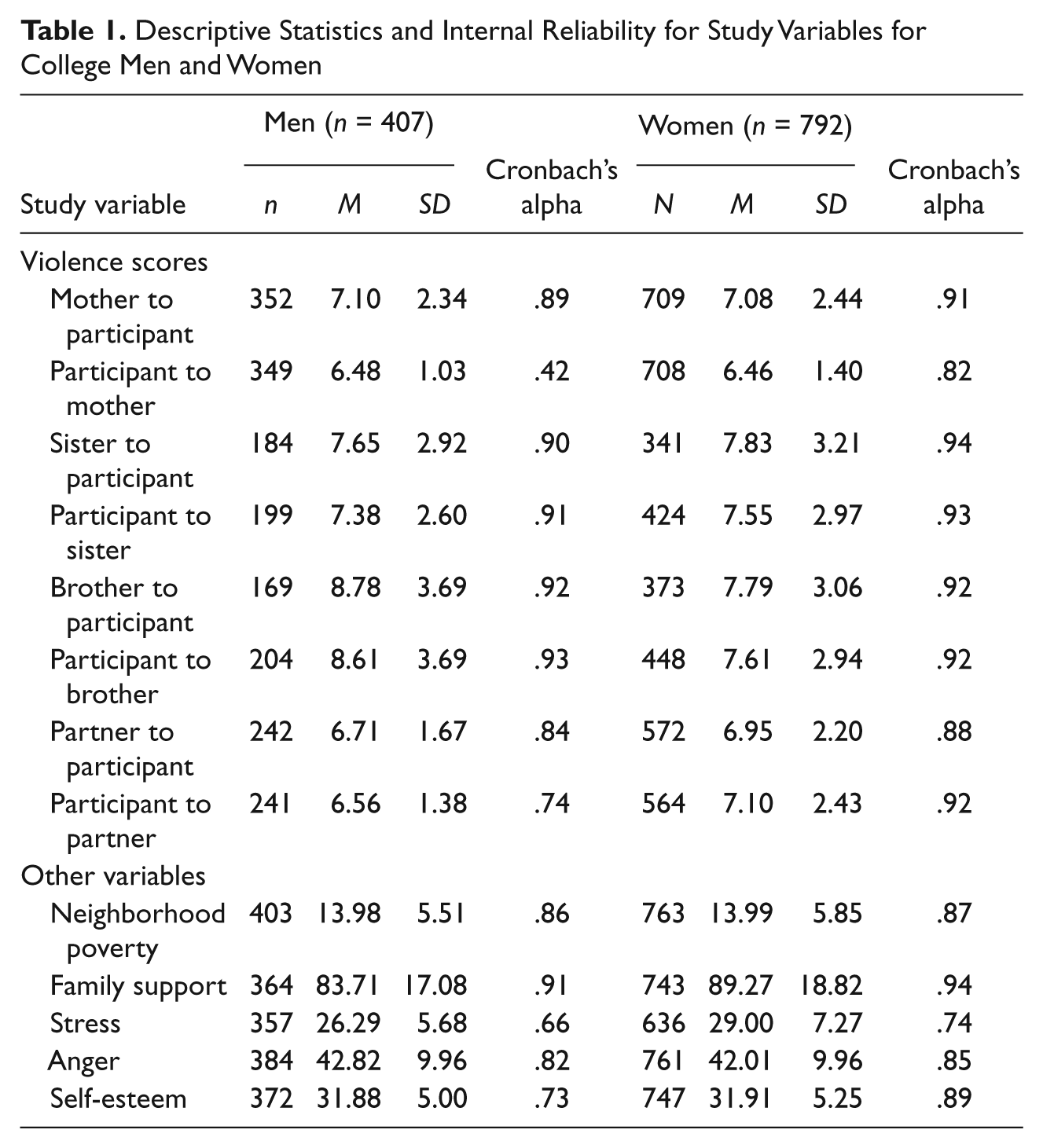
Table 1 shows means, standard deviations, and internal reliability (Cronbach’s alphas) for study variables, separately for men and women. Measures of violence in all relationships examined showed the recommended .70+ internal reliability values, except for the .42 value found for men when reporting violence to their mothers. Measures of all strain variables also showed .70+ internal reliability values, except for the .66 value found for men when reporting their stress levels. (These low values for men’s self-report of stress and violence to their mothers may reveal some reluctance to admit to these two behaviors due to strong male socialization pressure to be “tough” and “respect your mother.”)
Descriptive Statistics and Internal Reliability for Study Variables for College Men and Women
Sibling Gender Differences for Violence in Adulthood
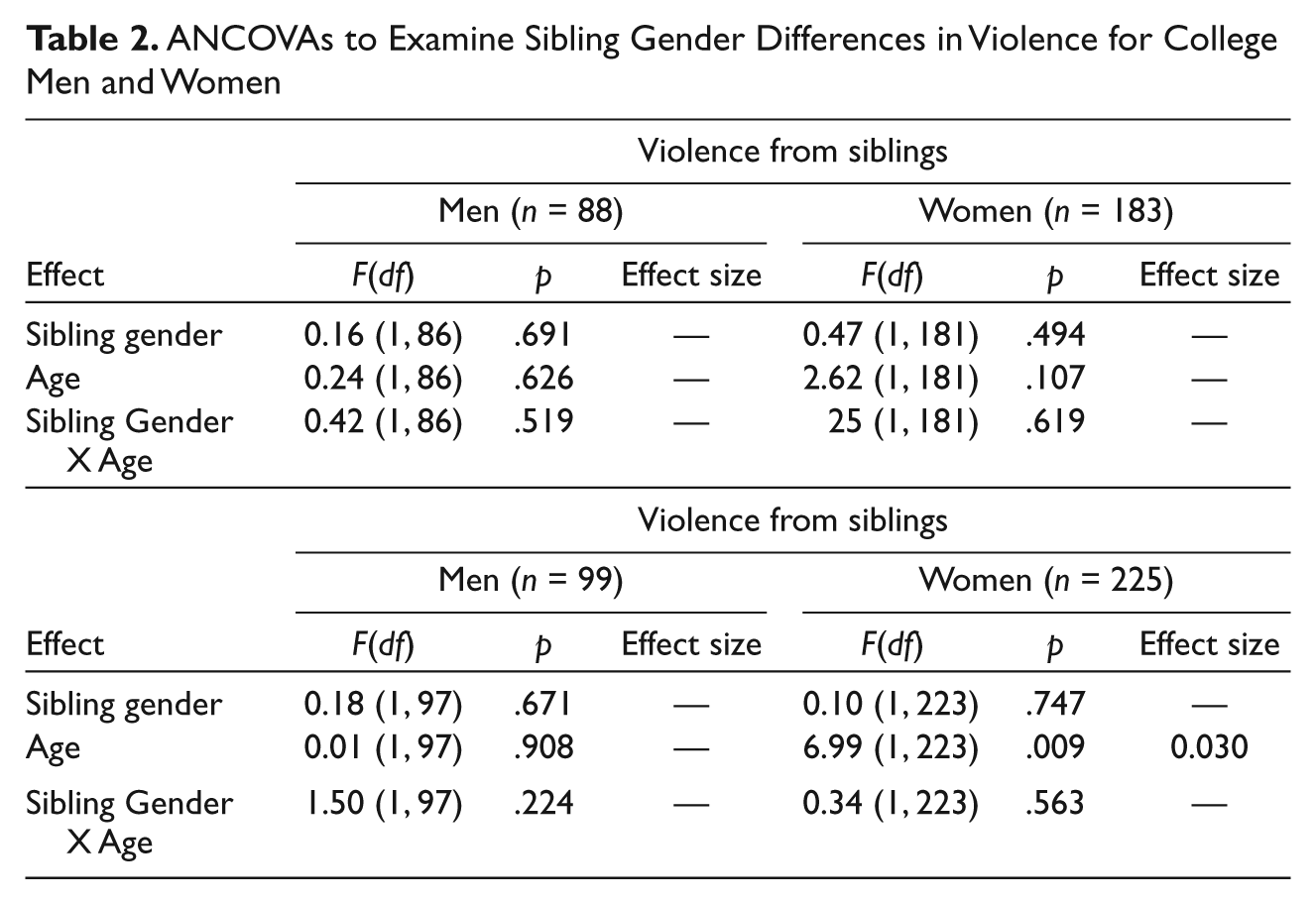
Table 2 shows ANCOVA results that found no significant sibling gender differences in violence from siblings to participants for the 88 men (p = .691) or the 183 women (p = .494) who had both brothers and sisters. Also, no significant sibling gender differences were found in violence from participants to siblings for the 99 men (p = .671) or the 225 women (p = .747) who had both brothers and sisters.
ANCOVAs to Examine Sibling Gender Differences in Violence for College Men and Women
Goodness-of-Fit for Reciprocal Violence With Mothers, Siblings, Partners
Figure 1 shows diagrams of the confirmatory factor analysis results for three clusters of reciprocal violence for men and women. It includes five goodness-of-fit values (Byrne, 2008; McDonald & Ho, 2002) for 114 men and 263 women that support the three proposed clusters of reciprocal violence with the mother, siblings, and romantic partner. Results for men and women show good fit with CFI values above 0.90, TLI values above 0.90, and NFI values above 0.90. Results for men and women show acceptable to good fit with relative chi-square values below 5.00 and RAMSEA values below 0.10.

Confirmatory factor analysis diagrams for three clusters of reciprocal violence for college men and women with mothers, siblings (of either gender), and romantic partners
Table 3 shows bivariate correlations between each possible pair of violence scores for the six relationships considered in the confirmatory factor analysis for three clusters of reciprocal violence. For both men and women, the strongest correlations are shown between sibling-to-participant and participant-to-sibling violence (.863 for men, .767 for women), and between partner-to-participant and participant-to-partner violence (.618 for men, .652 for women), as expected with the proposed reciprocal pattern of violence. However, although women also show a strong correlation between mother-to-participant and participant-to-mother violence (.577), men show a lower correlation score (.364), which suggests less reciprocal violence with mothers for men than for women.
Bivariate Correlations for Violence in Six Relationships of 114 Men (Above Diagonal) and 263 Women (Below Diagonal)
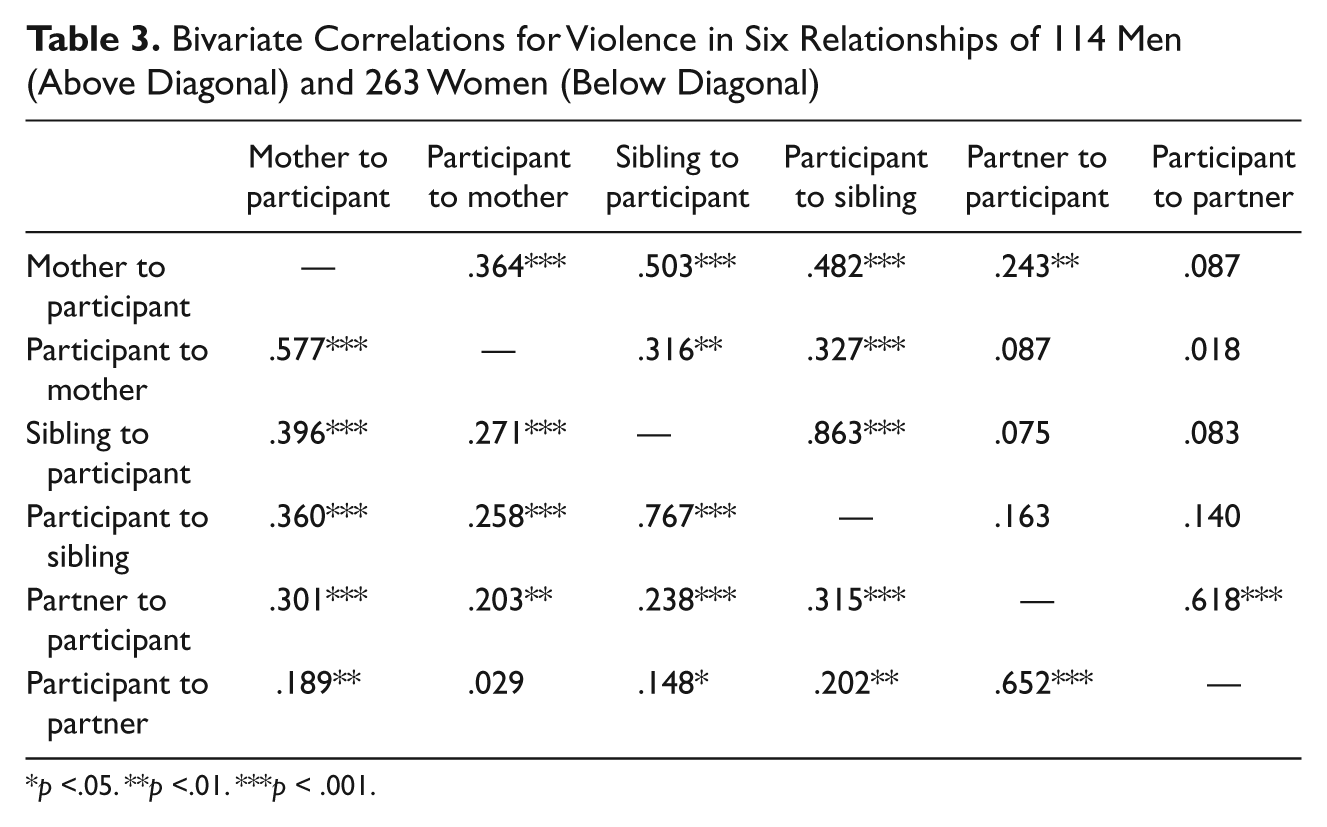
p <.05. **p <.01. ***p < .001.
Reciprocal Violence With Mother and Sibling as Predictors of Reciprocal Partner Violence
The t tests with p < .01 found that the 114 men and 263 women with all three reciprocal relationships (mother, siblings, partner) and the 407 men and 792 women without these relationships did not differ significantly in the four demographic variables of age (p = .369 for men, p = .382 for women), number of sisters (p = .280 for men, p = .064 for women), number of brothers (p = .718 for men, p = .086 for women), and household size (p = .044 for men, p = .080 for women). For both men and women, the two groups also showed no significant differences in the five strain variables of neighborhood poverty (p = .891 for men, p = .210 for women), family support (p = .049 for men, p = .305 for women), stress (p = .245 for men, p = .288 for women), anger (p = .885 for men, p = .126 for women), and self-esteem (p = .818 for men, p = .489 for women).
The hierarchical multiple regression analyses revealed that for both men and women, the contextual variables of neighborhood poverty (p = .057 for men, p = .013 for women) and anger (p = .004 for men, p = .040 for women) were associated with increased risk for reciprocal partner violence. However, only for women were high levels of reciprocal violence with the mother and siblings (p = .007, p = .041, respectively) associated with and increased risk for reciprocal partner violence (see Table 4).
Hierarchical Multiple Regression to Examine Reciprocal Violence With the Mother and Siblings as Predictors of Reciprocal Violence With the Romantic Partner, After Other Contextual Variables Have Been Considered

Note: For men R2 = .20**, F(7, 87) = 3.07, p = .006.
For women, R2 = .20***, F(7, 184) = 7.08, p = .000.
Discussion
Interpretation of Gender Differences in Present Results
The results of the present study revealed many similarities for men and women in their patterns of violence displayed in their close relationships in adulthood. As hypothesized, both men and women showed strong patterns of reciprocal violence with their mothers, siblings, and partners. Also, both men and women showed no sibling gender differences in violence to or from siblings in their present adult relationships. In addition, both men and women showed increased risk for reciprocal partner violence with the contextual variables of neighborhood poverty and anger, as found in past research (Hines et al., 2011; Neumann et al., 2010; Randle & Graham, 2011). However, only for women were high levels of reciprocal partner violence also significantly associated with reciprocal violence with mothers and siblings, even after controlling for the contextual variables. One interpretation of these gender differences is that because women usually receive less socialization than men to use violence during conflict (Maccoby, 1998; White, 2009; Wolfe et al., 2009), within-family models of violence with the mother and siblings have greater impact on the risk of partner violence in women than in men.
Another gender difference that may have appeared in the results of the present study was a possible reluctance of men to admit violence displayed to their mothers. As seen in Table 3, the bivariate correlation between the violence men reported they received and gave to their mothers was lower than that reported for women with their mothers (.364 for men, .577 for women), despite past research documenting that the greatest risk for violence to mothers from children is from late adolescent sons, not daughters (Edenborough et al., 2008; Kethineni, 2004; Walsh & Krienert, 2007). One explanation for these results may be that men are particularly reluctant to admit to violent actions toward their mothers (such as throwing objects, slapping, kicking, hitting them with a fist) because such behavior violates gender norms to “respect your mother.”
Possible Applications of Present Results
Fortunately, violence within the family does not always generalize to violence outside the family. Although approximately 80% of young adults report that they have shown violence to close peers at some time in their lives, less than 6% develop a lasting pattern of violence in these peer relationships (Smith, White, & Moracco, 2009; White, 2009). Results from the present study suggest that violence intervention programs might include participation of mothers and siblings of adult participants, especially women, to focus on their present patterns of conflict resolution rather than the more traditional focus on family relationships they experienced as children. However, when it is not possible for individuals from all these relationships (mothers, siblings, romantic partners) to participate in therapy sessions, then workshops could be developed to explore how each relationship’s pattern of violence contributed to the individual’s learned expectation that violent behaviors “are what people do when angry with someone they love.” Such workshops could also include (a) discussions of antecedent conditions that increase the risk of violence during conflict such as money problems, fear of threats from outside the home, cluttered or broken-down house, noisy environments, sleep deprivation, alcohol consumption, too many things scheduled in too little time, lack of exercise or good nutrition, frequent use of swear words or name-calling; (b) discussions of the rewarding and punishing consequences of using violence during conflict such as feeling powerful, getting others to back off their complaints, and passionate reunions, but also injury, shame, arrest, divorce, and children being traumatized; and (c) discussions of alternative methods for conflict resolution such as a basic plan to express concerns about another person’s behavior without accusation of motives, with respect for the other person’s perspective, with a request for changes in the future. (For example, “When you do A, I believe that your intention may be B. However, I react to A by feeling/thinking C. My request would be that in the future you avoid A and try to do D instead. Am I missing any issues here? Do you have any concerns about my actions or requests for me to change?”)
Other applications of the present results would be workshops for young families to guide them toward nonviolent means of conflict resolution before their children reach puberty and begin forming romantic relationships. Such “Peace in the Family” workshops could focus on other methods for parents to discipline their children besides corporal punishment (such as use of token economies that specify desired behaviors, with tokens given or taken away to acknowledge appropriate and inappropriate behavior choices made by children, with tokens later traded for small rewards or shared family activities). These workshops could also use role-playing games or video examples that guide children to recognize their own antecedent conditions for using violence, the consequences of such violence, and alternative behaviors to resolve conflict with their siblings and other peers.
Study Limitations and Directions for Future Research
One limitation of the present study is the relatively small subset of 377 (31.4%) of the total 1,199 college students sampled who reported violence in all three relationships considered (mother, sibling, partner), although we have provided evidence that those with and without these three relationships were similar in demographics and other contextual variables often associated with violence. Another limitation is that the sample included mostly young Caucasian college students from the Northeastern United States. Future research could examine whether more diverse samples of adults show similar patterns of reciprocal violence with mothers, siblings, and partners and whether study results again show that only for women is reciprocal violence with mothers and siblings associated with increased risk for reciprocal partner violence. A third limitation of the present study is that the measure of violence we used did not include severe violence (such as threatening or using a knife or a gun), and it did not specify the context in which violence took place such as who initiated it, who was injured, or what other individuals played a role. These contextual details could be added to future research to provide additional understanding of risk factors for violence in the close relationships of adults. Future research on the associations of violent relationships might also add consideration of other close relationships both within and outside the family such as those with cousins, aunts, uncles, grandparents, best friends, roommates, sports team members, neighbors, classmates, and coworkers, to enhance our understanding of the complex predictor variables associated with partner violence.
Future research could also add cluster analysis to provide a more person-centered approach to understanding associations among violent patterns in an individual’s relationship with the mother, siblings, and romantic partners. Cluster analysis would identify “profiles” of individuals with similar violence experience in their lives (such as a “profile” of having high mother violence, low sibling violence, and high partner violence). Future research could examine how such individual “profiles” of interpersonal violence were associated with other variables included in the present study such as gender, age, poverty, family support, stress, anger, and self-esteem.
In addition, because the present report used only cross-sectional and correlational data to examine associations among maternal, sibling, and partner violence, future research could follow individuals longitudinally, for example, to determine whether it is primarily within-family violence that occurs after puberty that is associated with an increased risk for later partner violence. Finally, more experimental approaches could determine whether interventions that teach more peaceful means of adult conflict resolution with mothers, siblings, and partners are more successful than interventions that target only the partner relationship.
Footnotes
Acknowledgements
We also thank Sandra Alderman, Susan Astarita, Courtney Costigan, Nicholas Eckman, Diane Evans, Crystal Felix, Melissa Forde, Amber Hedemann, Claire Ivy, Jonathan Ivy, Wescott Loder, Deirdre Rahn, Ronald Resnick, Lori Stoak, and Damaris Torres.
Declaration of Conflicting Interests
The authors declared no potential conflicts of interest with respect to the research, authorship, and/or publication of this article.
Funding
The authors disclosed receipt of the following financial support for the research, authorship, and/or publication of this article: The study was supported by grants from Penn State University.