



Abstract
Intimate partner violence is endemic in parts of the African continent. A small scale survey (n = 229) was conducted in 2009 in Northern Liberia, West Africa, to determine the prevalence and nature of intimate partner violence, and the cultural beliefs and gender norms that underpin respondent experiences and views towards intimate partner violence. Results show widespread experience of intimate partner violence among the respondent group, including physical abuse, sexual and verbal, and economic abuse. Acceptance of the situation was identified by most respondents as a way of responding to violence, and arises from the lack of financial and legal supports for women within the community. Despite the range of abuses experienced, beliefs about the power position of men in Liberian society provide evidence to reflect the predominance of certain cultural beliefs in framing respondents’ perceptions of gender relations. The article concludes with a discussion on the possible impact of Liberia’s recent conflict in contributing to the perpetuation and normalization of intimate partner violence. Further large scale research in this area is required.
Introduction
This article presents the results of a small scale survey in Lofa County in Northern Liberia, West Africa. The survey sought to explore the prevalence of intimate partner violence in Liberia. No large scale study of the prevalence and nature of intimate partner violence has been carried out in Liberia; this study is an attempt to determine and describe the extent of domestic abuse against women in Liberia, and aims to position abuse within the wider context of gender attitudes towards domestic relationships and familial gender roles. The possible impacts of the 15 years long civil war which Liberia experienced from 1989 to the ceasefire in 2003, on intimate partner violence are also considered.
The impacts of violence against women by their intimate partners have been identified as a major cause of injury to women (Ellsberg et al., 2008). Epidemiological and clinical studies have demonstrated that physical and sexual abuse of women is consistently associated with a broad range of negative health outcomes, such as gynecological disorders, adverse pregnancy outcomes, gastrointestinal disorders and chronic pain syndromes, as well as serious and ongoing mental health disorders (Ellesberg et al., 2008; Loxton et al., 2006; Plichta & Falik, 2001; Romito et al., 2005). While there is considerable debate about the causes of such violence, it is now universally accepted that while there are a range of risk factors, such as poverty (Heise & Garcia-Moreno, 2002) and alcohol and drug use (Fals-Stewart, 2003), the primary underlying factors which facilitates such abuse are beliefs about gender and the respective roles of men and women in society and in family life. This objective of the study was to determine the extent and nature of such violence in Liberia, and the gender norms which may underpin its normativity.
The Prevalence of Domestic Violence—A Review of International Studies
The Intimate Partner Violence prevalence rates for 48 population- based surveys from around the world indicated that between 10% and 69% of women experienced physical violence by an intimate partner, at some point in their lives, while between a third to a half of these abused women also experienced sexual abuse (Heise & Garcia-Moreno, 2002). The more recent WHO multi-country study (Garcia-Moreno et al., 2006) established the prevalence figures for 15 sites in 10 countries internationally. Of those women who reported experiencing either physical or sexual violence by an intimate partner, the highest rate, 71%, was found in Butajira, in the south of Ethiopia, and the lowest rate was found in Japan, at 15%. The only other African country in this study was The United Republic of Tanzania in which the rates in the city were 41.3% and 55.9% in the rural province. As Garcia-Moreno et al. (2006, p. 1265) note, most acts of physical partner violence were part of a pattern of continuing abuse. They also suggest that these figures are likely to be an underestimate as women are commonly stigmatized and blamed for the abuse they receive. Studies in other African countries also report high rates of intimate partner abuse. A number of studies from the sub Saharan African region have found that violence against women is widespread (Mann & Takyi, 2009). These studies have found approximately half of all married women in Zambia, 57% in Uganda, 60% in Tanzania, 42% in Kenya, 67% in Sierra Leone, and 81% in Nigeria have experienced some form of violence in their lives from partners or husbands (Coker et al., 2002; Heise et al., 1999; Kishor & Johnson, 2004; Mann & Takyi, 2009; Speizer, 2010). Studies in South Africa have suggested that violence against women is “endemic” to South African society (Boonzaier, 2008; Vogelman & Eagle, 1991). The South African Police Service estimated that 80% of women living in rural areas are victims of abuse (cited in Boonzaier & de La Rey, 2003). These studies and others referred to from other parts of the African continent, show the overall predominance of intimate partner violence in this part of the world. For example, the International Violence against Women Survey (IVAWS) found that the rates of physical abuse of women in Mozambique were 48%, while 24% had been sexually assaulted since the age of 16. However, the 1 year rate of violence (22%) was twice the rate for Australia, four times the rate for Denmark, Hong Kong, the Philippines and Poland and ten times the rate for Switzerland (Johnson et al., 2008a).
The Impact of Gender Beliefs on Intimate Partner Violence
As Flood and Pease point out, “attitudes have been of central concern in relation to violence against women” (2009, p. 125). These attitudes play a role not only in the perpetration of such violence, but also in both the victims’ and the communities’ responses to this violence. Such attitudes have a long history and are deep seated in many societies. Despite their many differences, both Islamic and Christian traditions both agree on the place of women in the eyes of their male God: “Men are superior to women on account of the qualities with which God hath gifted the one above the other, and on account of the outlay they make from their substance for them” (Koran, Sura 1V, verse 38). St. Paul was probably the most influential apostolic writer in molding the early Christian theological understanding of the roles of women and men with exhortations such as “The head of the woman is the man…forasmuch as he is the image and the glory of God: but the woman is the glory of the man” (1 Corinthians, 11: 3, 7-9).
There is consistent support for this view in research from many parts of the world. Shari’a law may be used to sanction male authority over female relatives and legitimatize the use of physical violence (Hajjar, 2004). In his work with Arab populations in the Palestinian West Bank and in Israel, Haj-Yahia (2003) suggests that “men’s tendency to justify wife beating, blame wives for violence against them, and to some extent also hold violent husbands responsible for their behavior are best explained by their non-egalitarian expectations of marriage, traditional attitudes towards women, and patriarchal beliefs about family life” (2003, p. 194). Religious beliefs have interacted with traditional and local cultural belief systems to define the power relationships between men and women in society. Beliefs about gender are therefore a consistent predictor of attitudes that support the use of violence against women. Men with more traditional and rigid and misogynistic gender-role attitudes are more likely to practice intimate partner violence (Flood & Pease, 2009; Heise, 1998; O’Neill & Haraway, 1997).
A context for the study; conflict in Liberia
Liberia has experienced a long and divisive civil war, beginning in 1989 and ending with the signing of a peace treaty in 2003 (Ellis, 2007). It is estimated that two hundred thousand people (about 8% of the population) were killed in fighting or massacres and more than half the population became refugees (Humphreys & Richards, 2005). The result of this lengthy and devastating war has resulted in a country with little or no infrastructure or functioning economy. In 2005, after 2 years of an interim Presidency, Ellen Sirleaf Johnson was elected as President of Liberia. She is the first female Head of State in Africa and her record since 2005 has been one of commitment to democracy, education and women’s rights. The recent history of Liberia provides a framework in which to the results from this study can be positioned and understood.
Study Methodology
Participants
Selection of interviewers
Permission to undertake the study was obtained from the voluntary organization concerned with providing literacy services, health and nutritional educational services and school counselling services in both Liberia and Sierra Leone. Five staff members in this organization were selected for training as interviewers and were subsequently trained (by the author) in the administration of the survey. These were staff who were experienced in working with the public, giving lectures, and engaging in counseling practice. A pilot phase was conducted with 10 participants to assess the accessibility and usefulness of the survey, and to provide interviewers the opportunity to implement skills learnt during training.
Selection of respondents
There are 16 officially recognized ethnic groups living in the thirteen counties in Liberia, and the population of the large town where the data for this study was gathered is almost evenly divided between Christians and Muslims. At the time of study, there was no available database in Liberia from which to draw a sample relevant to the study topic; instead, potential respondents were randomly selected in the local market by the interviewers and invited to participate. These interviewees were approached by the interviewers on a random basis and potential respondents were not known by the interviewers. As most respondents were illiterate, verbal consent was obtained. A total 229 surveys were completed.
Profile of respondents
Unfortunately, demographic information was not collected on respondents; all respondents were aged between 20 and 50 years. Further, as the divisions in the war were often related to tribal differences (i.e., different factions and armies were related to different tribal areas and groupings) and religious identity is also related to these groupings, it was felt that it would be inappropriate, so soon after the war ended, to ask people to identify either their ethnic or religious affiliations.
Measurements
A pencil and paper survey containing open and closed questions was designed by the author and comprised 15 questions: 10 questions were closed and 5 were open (see appendix). Closed and open questions were used to ascertain the extent of Intimate Partner Violence and the views of the respondents. In closed questions, respondents were provided with a number of responses from which to choose. Closed questions were asked on respondents views about marriage in Liberia, on whether or not abuse exists in Liberia, and on their own experiences of abuse. An “other” option was also provided, and respondents were requested to elaborate further. Open questions were asked on experiences of abuse, what helps women in Liberia to leave abusive relationships, what makes it hard for them to leave, and what these women can do to keep themselves safe. Recommendations were sought on what would help to change marriages in Liberia and keep women safe from abuse. The surveys were intentionally simple in order to make the process of data collection as simple as possible for trained interviewers.
Procedure
Data was collected over a two month period in mid 2009. Because of the prevalence of illiteracy among the group, respondents were asked, face to face, questions from the survey and their responses were filled in by the interviewer on the survey itself. Each completed survey was assigned an ID code and the data from closed questions were inputted into SPSS (Version 18) for analysis. Thematic analysis was conducted on open-ended question, including open responses provided for “other” comments. This involved the development of a coding structure and subsequent themes reflective of the meaning of each response. In a small number of responses, comments were made that did not answer the question in hand or were indiscernible as a result of hand-writing. These are included under the category of “Other comment.” Each theme was subsequently applied a numeric value and then inputted into SPSS. This process made it possible to determine the frequency of particular themes within the respondent group. The results section of this article presents descriptive data on the responses to the closed and open questions.
Results
Cultural Values and Gender Norms: Respondents Perspectives on Marriage in Liberia
The respondents were asked about the cultural norms which govern the marital relationships between men and women in Liberia. Some 87% indicated that no, men and women are not equal partners in marriage in Liberia, while 12% indicated yes. Concerning power relations within the marriage, 96% of responses reported men have more power. Respondents then chose from a list of five reasons why such power relations exist in the marriage, with most respondents choosing more than one reason (Table 1).
Why Men Have More Power in the Marriage
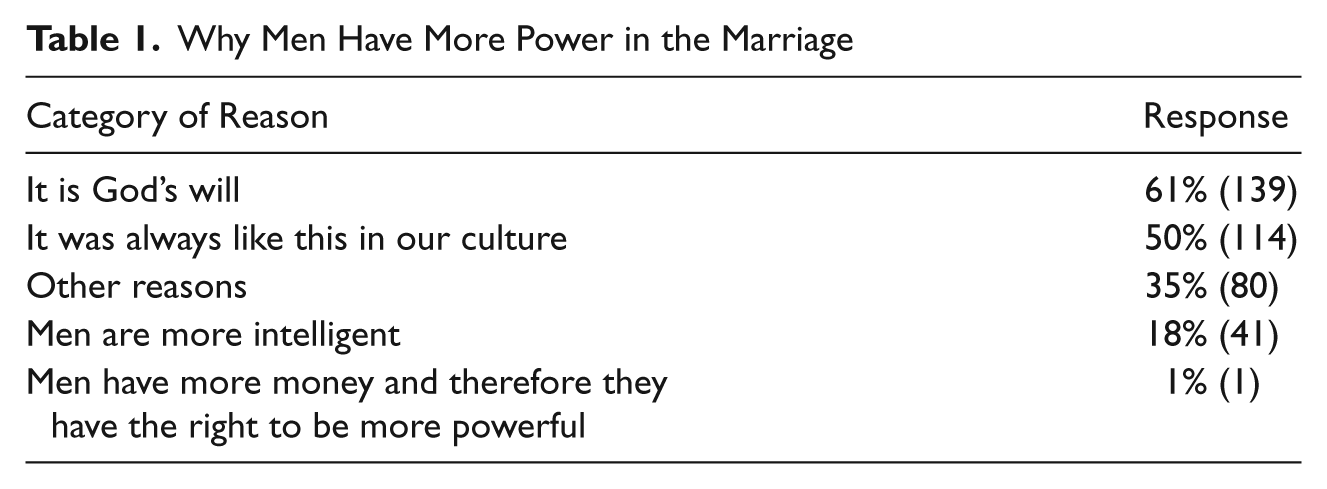
Results show the predominance of cultural and religious beliefs in respondents understanding of why men have more power in the marriage, as reflected in the high number of responses to it is God’s will and it was always like this in our culture. “Other reasons,” reported by 35% of respondents, related to the socialization of inequality between men and women within the context of the family, elders and the community, and through religious doctrine. Economic control was also cited as being an influential factor. Men were cited as authority figures and the male position of power is substantiated by men making the marriage choice. Despite these reports, not all respondents were of the opinion that men and women should be equal in marriage: 62% reported no, while 35% reported yes.
Types of Abuse Experienced by Women in Liberia
Most respondents (92%) indicated yes when asked if they think women are abused by their husbands in Liberia.
Respondents’ Experiences of Abuse
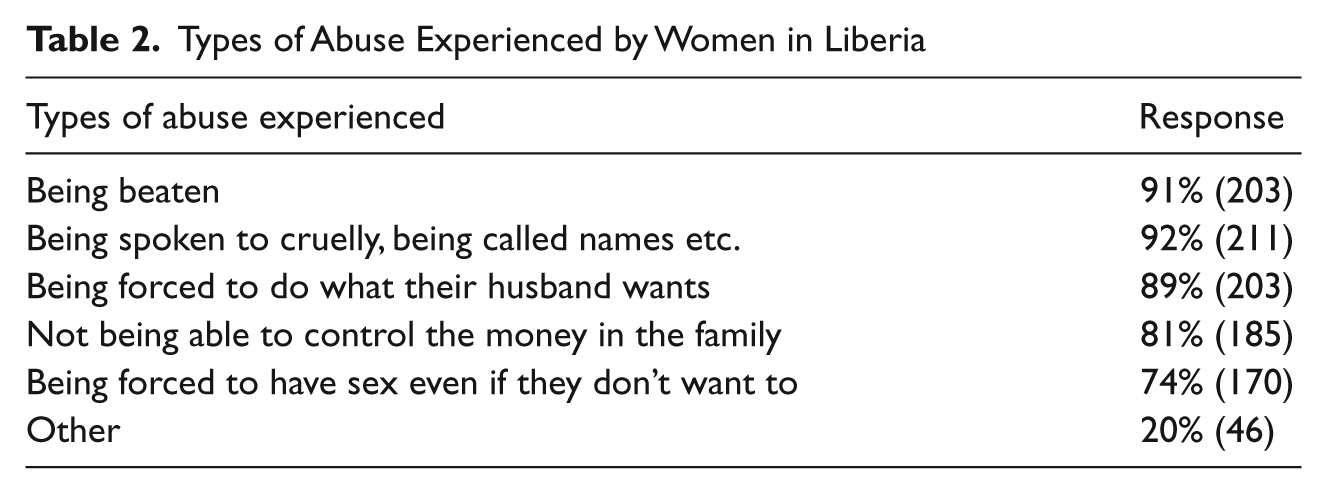
A total of 73% respondents indicated yes, they had been abused by their husband/partner in the ways outlined in Table 2 and just more than half (53%) of respondents reported being injured as a result of abuse experienced; reflecting the frequency of physical abuse experienced.
Types of Abuse Experienced by Women in Liberia
Strategies employed in responding to abuse
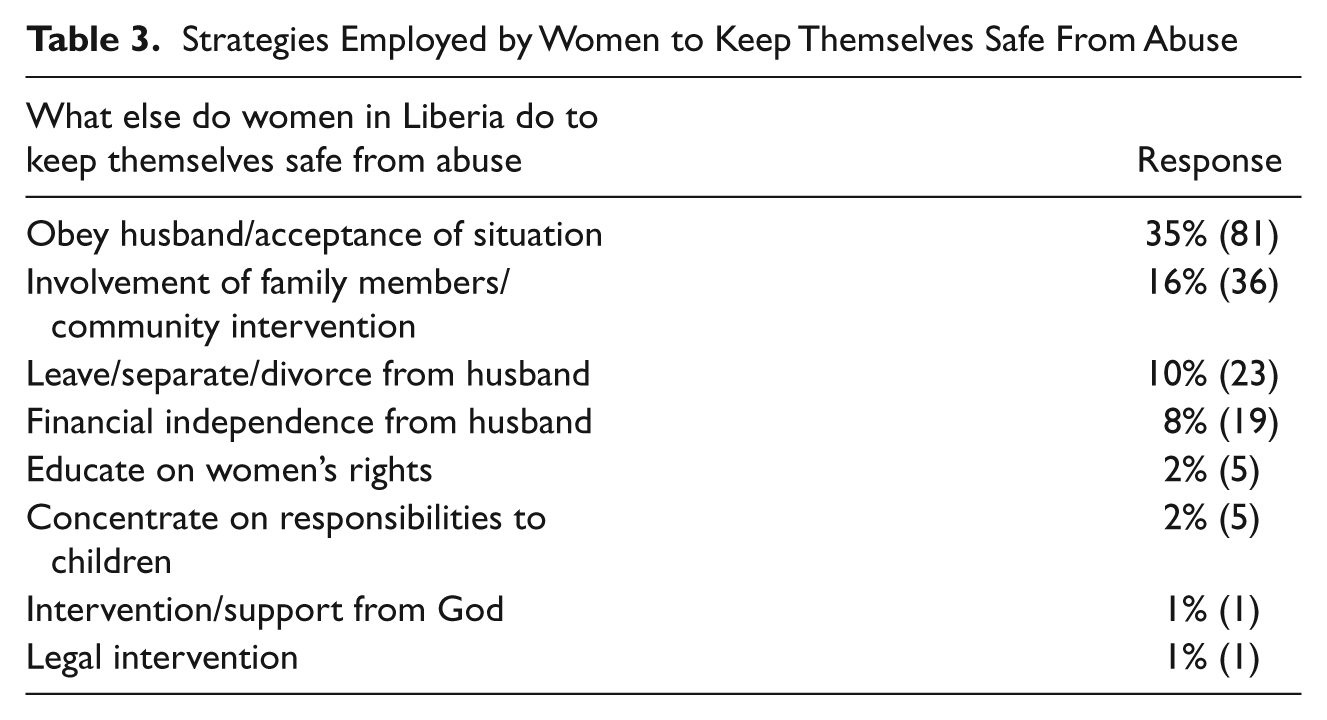
Respondents were asked to report on what women in Liberia do to keep themselves safe from abuse. Analysis of n = 180 (79%) responses showed that obeying one’s husband and accepting the situation were the predominant strategies (reported by some 35% of respondents) as keeping them safe from abuse. Other strategies included the involvement and intervention of the family and/or community (for 16% of responses) and leaving/separating from the husband was a response identified by only 10% (Table 3). Financial independence, legal intervention, concentration on responsibilities to children, and education on women’s rights were the least reported strategies. The low level of reporting on the first of these strategies (financial independence) may reflect women’s economic position in Liberia while the second (legal intervention) is consistent with the lack of available access to legal assistance, as most women live in the rural countryside, may be illiterate and unaware of their rights under Liberian law. The most notable reoccurring themes in dealing with and responding to abusive situations relate to the intervention of community/family and an acceptance of the situation.
Strategies Employed by Women to Keep Themselves Safe From Abuse
What Makes It Difficult for Women to Leave Abusive Relationships?
A total of n = 212 (93%) respondents identified factors that make it hard for women to leave abusive situations. Their responses were categorized (Table 4) and results reflect a combination of religious/cultural, economic and personal values and commitments.
What Makes It Hard for Women to Leave?
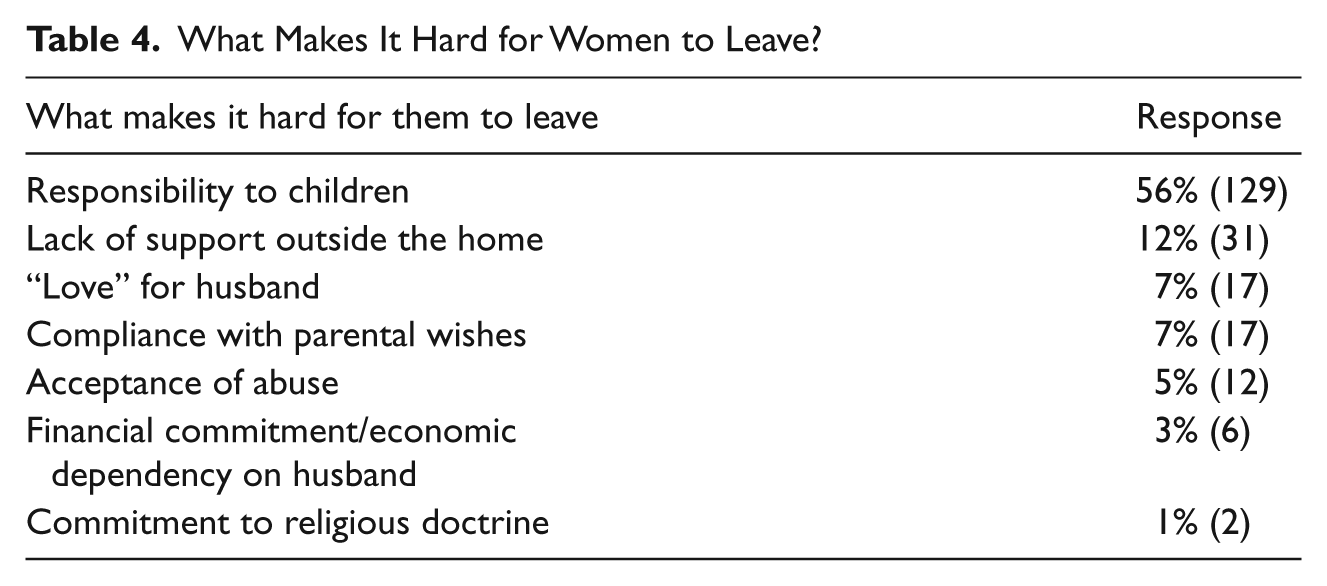
Overall, the range of responses reflects the economic and cultural position of women in Liberia, as evident in their concerns on the lack of legal and social supports outside the home for themselves, and for their children, and the reported lack of mechanisms that foster economic independence for women.
Respondents were invited to identify ways in which marriages in Liberia could be changed so that women are not abused (Table 5).
What Do You Think Would Help to Change Marriages so That Women Are not Abused and Can Be Sure of Being Safe From Abuse?
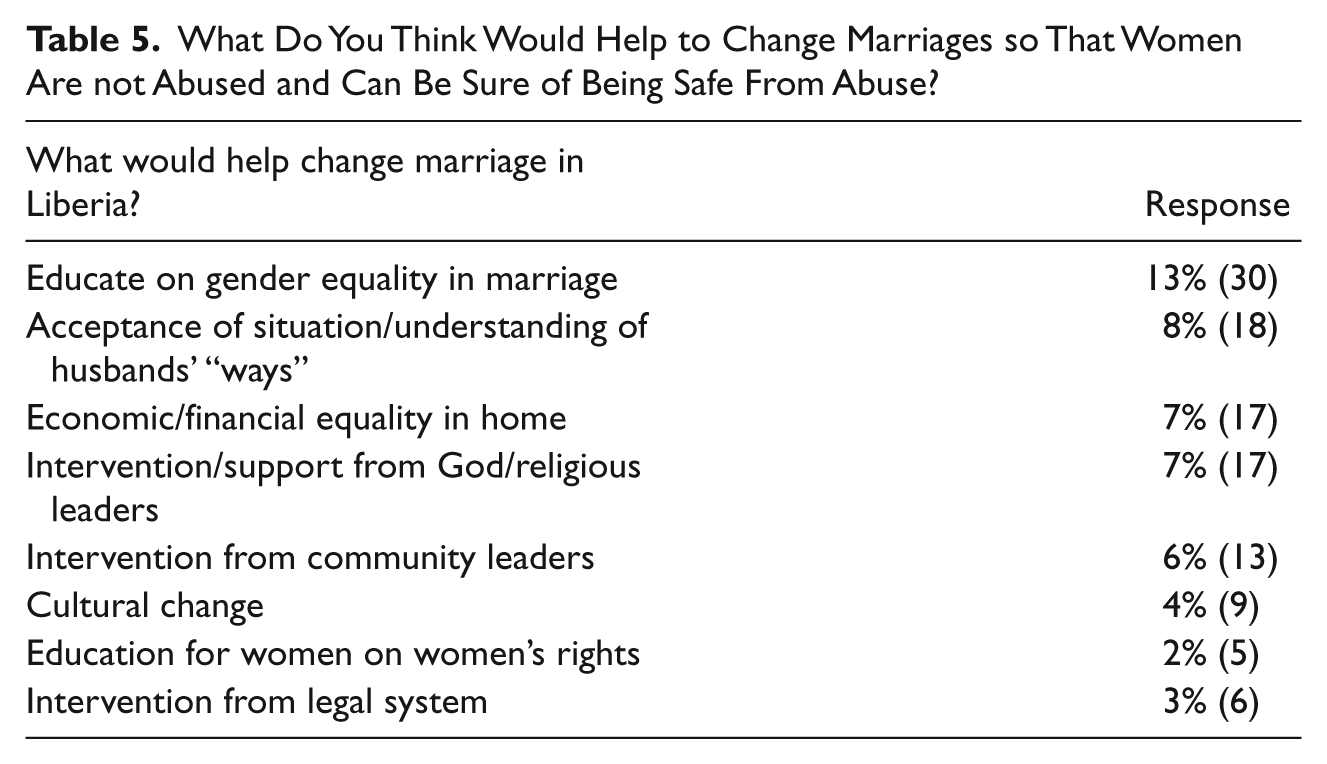
From n = 113 (49%) responses, the most common suggestions related to education on gender equality in marriage and education for women on women’s rights (Table 6). These were followed by greater economic equality in the home, and intervention from external groups from outside the home, including God/religious leaders, and community leaders. This question only obtained a 49% response rate, suggesting that not all respondents (i.e., 50%) were able to identify ways in which marriage can be positively changed. Considering a high percentage of women report that women and men should not be equal in the marriage, for example, the entrenchment of a cultural discourse of gender inequality will influence and limit the extent to which positive social change for women can be effectively identified and realized by women themselves.
Discussion
The Prevalence and Nature of Intimate Partner Violence in Liberia
Results from this study provide an insight into the prevalence and nature of intimate partner violence in Liberia. A high response rate to the study and to questions on experience of such violence reflects a good understanding and awareness among respondents on intimate partner violence. Results from this study are reflective of other studies cited in the literature showing the widespread predominance of abuse and particularly, physical abuse, experienced by women in Sub-Saharan Africa (Coker et al., 2002; Heise et al., 1999; Kishor & Johnson, 2004: Mann & Takyi, 2009; Speizer, 2010; Johnson et al., 2008a). Almost three-quarters of the women surveyed had themselves experienced a form of abuse; a figure closely resembling the figure of 71% reported in the Province of Butajira, in Ethiopia (Garcia-Moreno et al., 2006) and nearly all respondents knew someone who had been abused. Consequently, as found in this study and as well as in other studies (Deyessa et al., 1998; Ellsberg et al., 2008), high incidences of physical injury are also reported.
The Impact of Gender Norms on Attitudes Towards Intimate Partner Violence
The prevalence of abuse, consequent injury and respondents’ views towards abusive situations must be understood within the wider cultural and religious contexts of the community in which these women live. As Klein (1984) points out, violence against women is a behavior that emerges out of the social relations of domination. Its roots are found in culture, law, economics, and the common experiences of everyday life. Results from this study support this perspective
Findings from this study support Flood and Peases’s (2009, p. 128) argument that perceptions of the legitimacy of men’s violence to intimate partners are constituted through agreement with the beliefs that men should be dominant in the household and in intimate relationships, and have the right to enforce their dominance through physical chastisement. Despite recalling their own experiences of abuse, well over half of the respondent group indicated that men and women should not be equal in marriage. The right of men to make the marriage choice and their role as the authority in society further diminishes women’s beliefs in their rights or their sense of equality. This reinforcement of gender beliefs about women’s secondary place in society and the family allows for the perpetuation and normalization of violence against women.
Responding to Intimate Partner Violence
Not surprisingly, given that Liberia is still rebuilding after a lengthy and brutal civil war, legal intervention was not seen as particularly helpful. Lack of access to legal aid, and long journeys to access such legal intervention are also barriers that would prevent women seeing the legal system as something they can utilize effectively. As Johnson et al. (2008a, p. 165) and Green (1999) point out, it may be counterproductive to encourage victims of violence to report to authorities in locations where police are poorly trained, hold negative attitudes or biases towards women, and where women may be in danger of re-victimization by the criminal justice system in the process of reporting such abuse. In Liberia, which is struggling to reinstate a working democracy and state services, this risk may be very real.
Just under half of the respondent group identified ways in which marriage could be changed so that women would not be abused. These included education on women’s equality, legal, religious and community leader intervention. The small numbers who recognize that inequality is the root cause of this form of abuse may be those who have already been exposed to community educational projects, such as literacy or human rights programs. The lack of community services such as help lines and refuges, and access to an effective legal system, also act as barriers to exploring what might change the systems that oppress women in Liberia and results suggest that a lack of financial independence outside the home also serves as disincentive to leave. In view of the current difficulties in Liberian society arising as a result of a long and destructive civil war, women’s groups may be more helpful to victims of violence than state services.
Understanding Results Within the Wider Sociohistorical Context of War in LiberIA
Experiences of intimate partner violence reported in this study exist within the framework of a brutal civil war which drove many women and men from their homes and forced them into refugee camps in neighboring countries. Maynard (1996) suggests that in periods of economic, political and social upheaval and uncertainty that violence against subordinated groups escalates. The study was carried out at a time when Liberia was emerging from a long period of conflict. Therefore, in gaining a better understanding of the results, it is possible to position them within the context of Liberia’s recent history.
Lofa County in which this study was conducted, was reported to have experienced some of the worst abuses in the latter stages of the war. These traumatic experiences of war as well as the normalization of violence cannot be ignored in any exploration of the high level of intimate partner violence. While being part of one of the many warring factions during these wars, boys and young men would have seen the enslavement of young girls and women, who were brutalized by forced domestic labor, sexual labor, and sexual violence (Cain, 1999; Denov, 2010; Johnson et al., 2008b; Lacroix, 2006; Swiss et al., 1998). A WHO study conducted in 1994 found that 61% of people had seen someone tortured, killed or raped, and 77% had lost a friend or relative (Human Rights Watch, 1994). As the various factions depended on plunder and looting to sustain themselves, women were also included in the category of items ripe for plunder, “judging by the frequency with which male fighters committed rape or abducted women as concubines or servants” (Ellis, 2007, p. 125). Exposure to such high levels of sexual and gender based violence, which reinforced the oppression of women within the context of war, may have contributed to the high levels of physical and sexual abuse reported in this small scale study, for example, through the reinforcement of cultural attitudes surrounding gender inequality or as an extension of the violence exerted during the war whereby the traumatization of the young men involved in this war may also contribute to their propensity for violence
The Liberian Government has acknowledged that sexual and gender based violence (SGBV) was a characterizing feature of the war, and still remains a serious problem facing women and children today. Rape is currently the crime most frequently reported to the Liberian Police. The Government of President Johnson Sirleaf has committed itself to reduce this very high incidence of SGBV. There is a National GBV Task Force (2006), a National Plan of Action for GBV (2008) and a 4-year UN/Government Joint Program on SGBV (Office of the Gender Advisor, 2009). However, these plans tend to emphasize rape and sexual abuse of children and young girls and do not address the issue of intimate partner violence to the same extent. However, the development of Human Rights within Liberia must also take account of the rights of women within intimate relationships. The UN declarations on women’s rights insist that state and local biases in the implementation of Convention on the Elimination of All Forms of Discrimination against Women (CEDAW), due to religious or cultural interpretations, be eliminated (Burton et al., 2000). Such restrictions of women’s activities also interfere with development goals in a country which is struggling to recover from a devastating civil war.
This small scale study has highlighted the serious prevalence of intimate partner violence experienced by women in Liberia. The constraints experienced by the Liberian Government in combating SGBV and establishing genuine Human Rights for women, together with the trauma experienced by so many Liberians during the war, and the deeply rooted cultural, religious and patriarchal belief systems that influence both women and men combine to make the elimination of such high levels of abuse an onerous challenge. Developing community capacity to educate both men and women, and the provision of small scale support services for abused women would appear to be necessary at local levels, while the larger challenges of Human Rights, legal and police reform need to be pursued at Governmental level. Further community education of both women and men and insistence on the Human Rights of all women, would appear to offer significant opportunity to changing these levels of abuse. Developing further larger scale prevalence studies, while gathering demographic data on respondent profiles and experiences, would augment the data from this small scale study in one area of Liberia and provide a clearer picture of the levels of such abuse against women across Liberian society.
Footnotes
Appendix
Declaration of Conflicting Interests
The author(s) declared no potential conflicts of interest with respect to the research, authorship, and/or publication of this article.
Funding
The author(s) received no financial support for the research, authorship, and/or publication of this article.