



Abstract
Recently researchers have begun to explore the extent to which children’s cognitive development is influenced by experiences in the family environment. Assessing mother–child dyads exposed to intimate partner violence (IPV), a population at risk for emotional and neurocognitive problems, we examined relationships between maternal emotional regulation, parenting, and children’s executive functioning (including working memory, inhibitory control, cognitve flexibility and set shifting, and planning). Positive parenting practices, as reported by the children, were correlated with children’s planning and problem solving performance. Controlling for children’s own emotion regulation and gender, mothers’ self-reported emotion regulation abilities predicted children’s performance on a task of cognitive flexibility. Girls exhibited superior emotion regulation and executive functioning performance compared to boys, and mothers of girls reported better emotion regulation abilities compared to mothers of boys. These findings add to a nascent literature suggesting that parenting and parental emotional functioning may play important roles in children’s neurocognitive functioning. In addition, they help to explain the mechanisms by which children exposed to IPV experience executive functioning deficits.
In the United States, approximately 15.5 million children a year are exposed to intimate partner physical violence (IPV; McDonald, Jouriles, Ramisetty-Mikler, Caetano, & Green, 2006). Many of the emotional, social, and behavioral consequences of witnessing IPV have been well documented (Wolfe, Crooks, Lee, McIntyre-Smith, & Jaffe, 2003), but relatively little is known about the neurocognitive consequences, particularly executive functioning (EF), in children. EF encompasses a set of higher order processes, such as cognitive flexibility, inhibitory control, working memory, and planning, that govern goal-directed actions (Aupperle, Melrose, Stein, & Paulus, 2011). Because EF is central to many developmental tasks in childhood, from academic performance to social functioning to behavioral control, understanding the pathways to EF deficits in children exposed to trauma is a necessity. The goals of this study are to consider the family environment as one potential predictor of EF deficits in trauma-exposed children while adding to a nascent literature that has begun to examine relationships between family environment variables and children’s neurocognitive functioning.
Trauma exposure and executive functioning
Impairment in EF has been consistently shown in samples of adults exposed to trauma (El-Hage, Gaillard, Isingrini, & Belzunk, 2006; Navalta, Polcari, Webster, Boghossian, & Teicher, 2006; Stein, Kennedy, & Twamley, 2002), with additional studies finding EF impairment to be specifically related to PTSD (Gilbertson, Gurvits, Lasko, Orr, & Pitman, 2001; Koenen et al., 2001; Samuelson et al., 2006; Uddo, Vasterling, Brailey, & Sutker, 1993). In contrast, although studies have documented EF deficits in trauma-exposed children (De Bellis, Hooper, Spratt, & Wooley, 2010; DePrince, Weinzierl, & Combs, 2009), few have found these deficits to be related to PTSD. One exception (Beers & De Bellis, 2002) found that children with maltreatment-related PTSD demonstrated EF deficits (greater impulsivity, distractibility, and difficulties with sustained attention) when compared to healthy children who had not been maltreated. However, the lack of a trauma-exposed control group made it difficult to determine if observed deficits were related to trauma exposure, PTSD, or both.
To address that limitation, we examined neurocognitive performance in IPV-exposed children with and without PTSD and did not find differences in EF performance (Samuelson, Krueger, Burnett, & Wilson, 2010). However, both trauma-exposed groups performed in the below average range, supporting the idea that EF deficits may be due to variables related to trauma exposure but not to PTSD. Alternatively, EF deficits in children exposed to trauma, particularly a trauma that is shared by a family such as the experience and witnessing of IPV, may also be explained by indirect effects of the exposure, such as through the home environment, parenting, and maternal mental health.
Parenting Environment and Children’s Neurocognitive Functioning
The examination of relationships between parent variables and children’s neurocognitive functioning is a compelling focus of study, given the potential of both genetic and home environment factors in shaping brain development (De Bellis, 2001; Schore, 1996). Compared with other aspects of neurocognitive functioning, the executive functions show a protracted period of development and thus are more susceptible to environmental influences (Noble, Norman, & Farah, 2005). This is a nascent area of research, with recent studies of samples not exposed to trauma providing some evidence that children’s neurocognitive functioning is related to aspects of parenting and the home environment. Thus far, these relationships have been examined in samples of young children under the age of 7. In a study of 80 predominantly middle-class mother–child dyads followed longitudinally, Bernier, Carlson, and Whipple (2010) found that mothers who engaged in more sensitive parenting and were supportive of autonomy with their 12- and 15-month-old children had children who performed better on tasks of EF (working memory, set shifting, and inhibitory control) at 18 and 26 months. In a study of mother–child dyads of predominantly lower socioeconomic backgrounds, Hughes and Ensor (2005) found that quality of parenting was related to EF in 2-year-olds, but that this relationship did not hold after controlling for child age and verbal ability. Bernier et al. surmise that socioeconomic status (SES) differences might account for the inconsistency in findings between the two studies; in low-SES, high-risk families with more chaos and stress, there may not be as much opportunity for parents to affect cognitive development. In other realms of neurocognitive functioning, Jouriles et al. (2008) found that positive parenting behaviors moderated the relationship between children’s (ages 4-5) witnessing of IPV and explicit memory functioning. A study published by the National Institute of Children’s Health and Development (2005) found that home environment and maternal responsiveness predicted attention and memory performance, but not planning performance, in first graders. Taken together, these studies provide preliminary support for the link between parent variables and neurocognitive functioning in children under the age of 7. However, to our knowledge, these relationships have yet to be examined in middle childhood or adolescence, and have yet to be examined with a population at high risk for neurocognitive deficits – children exposed to trauma.
Trauma, Maternal Mental Health, and Parenting
In families exposed to trauma, there is a heightened risk of maternal mental health problems (Astin, Ogland-Hand, Coleman, & Foy, 1995; Bogat, Levendosky, Theran, von Eye, & Davidson, 2003; Resnick & Acierno, 1997) and parenting difficulties (Banyard, Williams & Siegal, 2003; Cohen, Hien & Batchelder, 2008; Holden & Ritchie, 1991; Hughes, 1982; Levendosky & Graham-Bermann, 2001; Wolfe, Jaffe, Wilson, & Zak, 1985), and these factors may influence the link between trauma exposure and EF deficits. Women with IPV histories show lower levels of parenting warmth (Levendosky & Graham-Bermann, 2000, 2001) and increased hostility and disengagement (Levendosky, Leahy, Bogat, Davidson, & von Eye, 2006) in interactions with their children. In addition, emotion regulation problems are prevalent in individuals with interpersonal trauma histories (Cloitre, Miranda, Stovall-McClough, & Han, 2005; Cloitre, Scarcalone, & Difede, 1997; Zlotnick, Zakriski, Shea, & Costello, 1996). Dysregulatory responses to trauma can include either the overactivation of emotion in the form of mood lability or deactivation in the form of avoidance and emotional numbing (Frewen & Lanius, 2006; Litz, Orsillo, Kaloupek, & Weathers, 2000). Dysregulated mothers may display underactivated or overactivated expressions of emotion that are confusing and disorganizing to the child. Persistent expressions of negative emotions are thought to increase children’s confusion and frustration, and hinder competent problem solving skills when faced with parental, environmental, and societal needs (Dix, 1991). These findings create a need to examine parenting and emotion dysregulation in IPV-exposed mothers as potential predictors of EF performance in their children.
Summary
The rationale for the present study is drawn from two bodies of literature: first, that the pathway to EF deficits in trauma-exposed children has not been adequately explained by PTSD, and may be explained by family environment influences; and second, that recent studies with non-trauma-exposed, young children have identified relationships between family environment variables and children’s neurocognitive functioning. These relationships have not yet been examined in middle childhood and adolescence, and in trauma-exposed families. We hypothesized the following relationships between family environment variables and children’s EF in a sample of children who had witnessed IPV, ages 7 to 16, and their mothers: (a) mothers’ positive parenting behaviors would be related to children’s EF (attention and working memory, inhibitory control, flexibility and set shifting, and planning); and (b) maternal emotion regulation would predict children’s EF and that this relationship would hold after controlling for children’s own emotion regulation.
Method
Participants
Forty-seven mother–child dyads participated in the study. The mothers had all experienced IPV, defined as physical or sexual abuse by an intimate partner, and the children had all witnessed some degree of that IPV. Mothers and children were required to be living together, and apart from the perpetrator for at least six months. We only recruited children between the ages of 7 and 16 for two reasons: (a) because there is a shortage of research on links between maternal functioning and child functioning in trauma-exposed children in middle childhood and adolescence, and (b) the desire to assess PTSD symptoms from a child’s self-report necessitated the use of semistructured interviews that are validated on children above the age of 7.
Exclusion criteria included factors known to impact neuropsychological test performance such as major birth complications, head injury associated with loss of consciousness, history of seizure disorders, or any other substantial medical illness that could affect the central nervous system. Families were recruited from the community through flyers and online message boards. Flyers were targeted at mothers who had experienced “domestic violence”, who had children between the ages of 7 and 16 who witnessed the violence, and who were no longer in a relationship with the perpetrator of violence. Thirty women were excluded during the screening process: 14 reported that they did not have children or had children outside the age range of the study; 5 were currently in a relationship in which they experienced IPV; 2 denied experiencing intimate partner violence; 7 reported that their children had not witnessed any intimate partner violence; and 1 reported that her child had a history of head injury.
Mothers were between the ages of 25 and 55 (M = 36.1, SD = 6.6), and child participants were between the ages of 7 years, 1 months and 16 years, 11 months (M = 12.3, SD = 3.0). Fifty-three percent of the children were female. The ethnicity of the sample of mothers was 66% African American, 14.9% Latina, 12.8% Caucasian, 4.3% Multiethnic, and 2.1% Asian American. The ethnicity of the sample of children was 66% African American, 17% Multiethnic, 12.8% Latina/o, and 4.3% Caucasian. Mean education level of the mothers was 13.18 years (SD = 1.69) and mean annual income for the families was $24,103 (SD = $20, 843). Sixty-six percent of the women reported being unemployed. The majority of the women (60%) were never married, 28% were divorced, 11% were married, and 2% declined to answer. All of the women reported that their perpetrators were men.
Measures
Background Information
The mother was asked to provide background data about herself and her child, such as age, ethnicity, level of education, and health and trauma history. Mothers and children both provided information regarding trauma history (described more fully in BLINDED FOR REVIEW), including children’s history of maltreatment.
History of intimate partner violence was confirmed through the Conflict Tactics Scale 2 (CTS2; Straus, Hamby, Boney-McCoy, & Sugarman, 1996), a self-report questionnaire that assesses the occurrence and frequency of physically abusive behaviors during interpersonal conflicts. Mothers were asked to answer questions about the perpetrator’s behaviors towards her in the last year of the relationship, and her child’s experience of witnessing those behaviors. All mothers in the sample experienced physical abuse by an intimate partner, and all children witnessed some degree of that abuse.
Mothers completed the Negative Mood Regulation Scale (NMRS; Cantanzaro & Mearns, 1990), a 30-item scale which assesses the mother’s expectancies around tolerating negative mood states. Mothers are asked to rate themselves on statements that begin with the stem, “When I’m upset, I believe that”; no specific time frame is given. The NMRS has been shown to have adequate internal consistency (ranging from .86 to .92) and good test-retest reliability in female samples over 4 and 8 weeks (r = .76 and .78; Cantanzaro & Mearns, 1990). Concurrent validity has been established through studies associating negative mood regulation to emotional reactions to distressing events and coping (Mearns, 1991). In this study, the internal consistency for the NMRS Total Score was .77
The Parent Perception Inventory (PPI; Hazzard, Christensen, & Margolin, 1983) is an 18-item measure consisting of items about positive parental behaviors (positive reinforcement, comfort, allowing independence, assistance, and nonverbal affection) and items about negative parental behaviors (criticism, physical punishment, yelling, threatening, and ignoring). Children were told “we would like to know how much you think your mom does certain things at home” and then read descriptions and asked to indicate frequency of parenting behaviors exhibited by their mothers using a 5-point scale ranging from 0 (never) to 4 (a lot). Both positive and negative practices subscales have good internal consistency (.84 and .78 respectively) and convergent and discriminant validity, established through evidence of a relationship between parenting behavior and children’s behavior problems and the lack of relationship between parenting behavior and children’s achievement (Hazzard et al., 1983). An additional validation study of this measure found that children from distressed families receiving mental health services viewed their mothers more negatively than nondistressed controls (Glaser, Horne, & Myers, 1995). In this sample, the internal consistency for the positive practices subscale was .75 and for the negative practices subscale was .77. The measure yields an overall score, used in the current study, which is generated by subtracting the negative practices subscale score from the positive practices subscale score.
Children’s emotion regulation was assessed through the Emotion Regulation Checklist (ERC; Shields & Cicchetti, 1997), completed by the mother. Mothers are asked to answer questions about their children on a Likert scale, with no specific time frame given. It yields two subscales: the Negativity/Lability scale, which represents negative affect and mood lability, and the Emotion Regulation scale, which assesses appropriate affective displays and emotional self-awareness. Validity has been established through positive correlations with observers’ ratings of children’s self-regulatory abilities (Shields & Cicchetti, 1997). The Emotion Regulation scale was the focus of the current study. Shields and Cicchetti have reported an internal consistency assessed through Cronbach’s alpha of .83; for this sample it was .68.
Executive functioning measures
The Wisconsin Card Sorting Test − 64 card version (WCST; Heaton, 1981) assessed the children’s ability to shift set, monitor, and use feedback. The test consists of a deck of 64 response cards that vary according to color, shape, and number. The child is given four stimulus cards and then asked to sort the remaining deck of cards using feedback provided by the examiner. Following ten correct sorts on a given category, the examiner switches to another category without informing the child of the switch. The child’s performance was scored as the total number of categories achieved.
The Tower of London (Shallice, 1982) assesses the ability to plan and organize a sequence of moves. In this task the child must plan ahead to determine the order of least moves necessary to rearrange three colored balls from their initial position on two of three sticks to a new set of predetermined positions on one or more sticks. The child’s performance was scored as total moves completed.
The Stroop Color-Word Association Test (Golden, 1978; Stroop, 1935) evaluates sustained and selective attention as well as inhibitory control. The child is asked to rapidly read a list of color names in black ink, name colored patches of ink, and finally to name the dissonant color of ink in which a word is printed. This third portion, the color-word portion of the test, was of interest in the present study as it assesses inhibitory control.
The Digit Span subtest of the Wechsler Intelligence Scale for Children – Fourth Edition (WISC-IV; Wechsler, 2003) assessed working memory and attention. The child repeats a series of digits in the same sequence as the examiner presented, both forwards and backwards.
Procedure
The protocol and consent forms were approved by Alliant International University. Mothers provided consent and children provided assent. Mothers and children were assessed separately for three to four hours and completed a larger battery of measures for a project examining relationships between trauma, maternal mental health functioning, parenting, and children’s social, emotional, and neuropsychological functioning. Families were compensated for their participation and received referrals to various local agencies for follow-up support.
Because of the sensitive nature of the interview questions, informed consent included a statement that if it were revealed during the interview that the child had been harmed, the interviewer would contact appropriate authorities. Five reports were made to Child Protective Services based on maternal or child reports of abuse or neglect. Because families were informed of the necessity to report child abuse, data on child maltreatment may underrepresent the actual prevalence in this sample.
Data Analysis
First, bivariate correlations were conducted to determine relationships between demographic and background variables and independent and dependent variables. When background variables were significantly related to both independent and dependent variables and represented a potential confound, they were included as covariates in subsequent analyses. Correlations were then examined to determine significant relationships between maternal emotion regulation, positive parenting behaviors, and the four measures of executive functioning (WCST categories completed, Tower of London move scaled score, Stroop Color-Word T-score, and Digit Span scaled score). In order to adjust for multiple comparisons, a Bonferroni correction was applied to the primary analyses (four EF dependent variables for each research question) and an alpha level was set at .0125. Multiple regressions were conducted to determine the predictive power of maternal emotion regulation on measures of executive functioning, controlling for children’s emotion regulation and any significant covariates.
Results
Table 1 presents correlations between demographic and background variables (age and gender of child, mother’s education level, family income, presence of child maltreatment history) and independent and dependent variables. Gender of child was significantly related to mother’s emotion regulation, child’s emotion regulation, and child’s executive functioning. Girls completed significantly more categories on the WCST (M = 4.52, SD = 1.85) than boys (M = 3.05, SD = 2.22), t(45) = −2.50, p = .02. According to mother’s report, girls had superior emotion regulation abilities (M = 29.31, SD = 3.13) compared to boys (M = 26.57, SD = 3.26), t(45) = −2.92, p = .005. Mothers of girls (M = 3.98, SD = .54) reported better ability to tolerate negative mood states, as exhibited by higher NMRS scores than mothers of boys (M =3.60, SD = .46), t(45) = −2.62, p = .01. Children’s emotion regulation was also positively correlated with mother’s income and education.
Correlations for All Study Variables
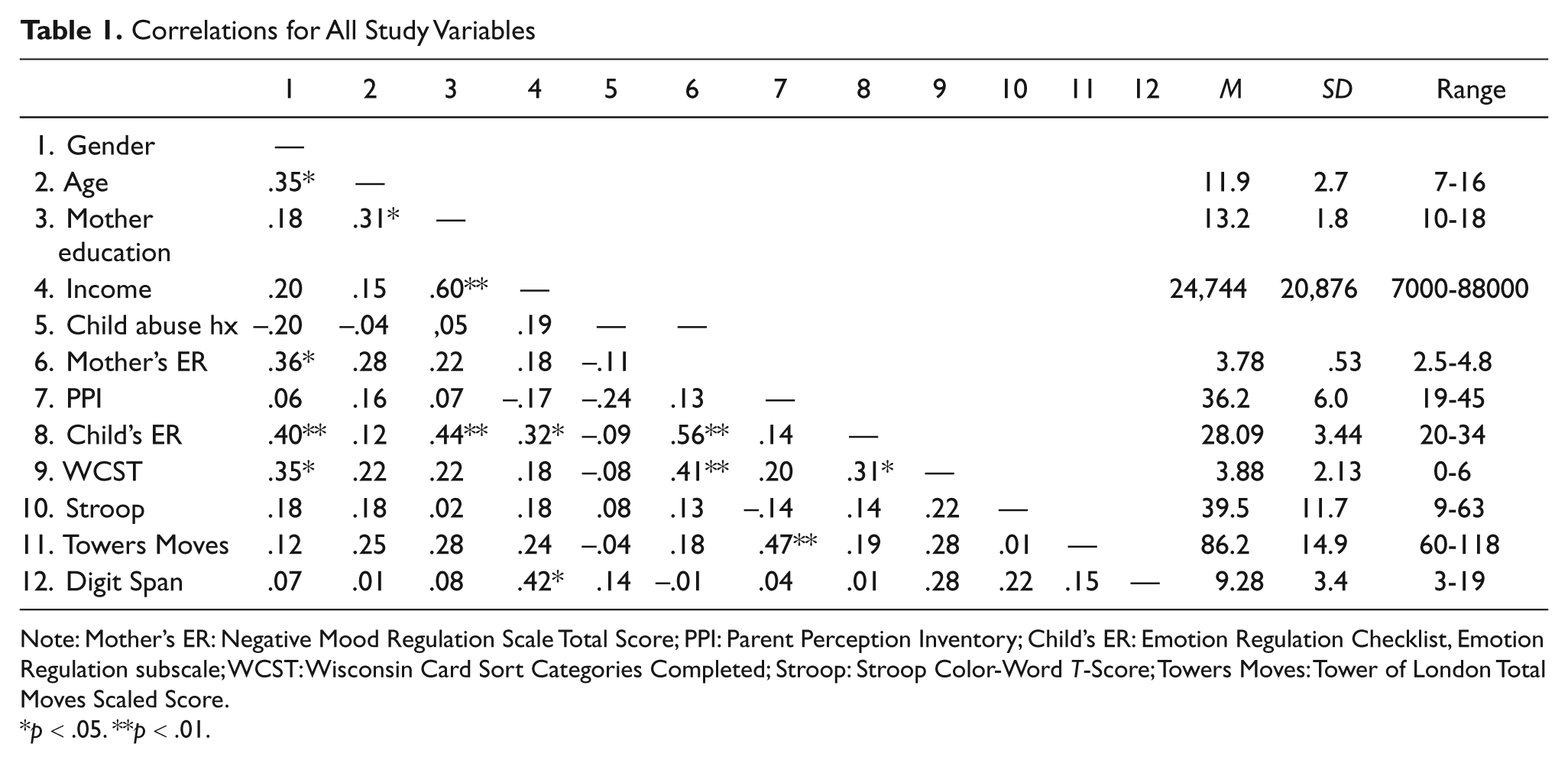
Note: Mother’s ER: Negative Mood Regulation Scale Total Score; PPI: Parent Perception Inventory; Child’s ER: Emotion Regulation Checklist, Emotion Regulation subscale; WCST: Wisconsin Card Sort Categories Completed; Stroop: Stroop Color-Word T-Score; Towers Moves: Tower of London Total Moves Scaled Score.
p < .05. **p < .01.
Positive parenting behaviors were significantly correlated with Tower of London performance (r = .45, p = .002), but not other EF tasks. Mother’s emotion regulation was significantly correlated with child’s WCST performance (r = .41, p = .008), but not other EF tasks. In order to control for children’s own emotion regulation as well as gender differences observed, we conducted a multiple regression analysis covarying for these two variables. These results are presented in Table 2. Examining WCST Total Categories Achieved score as the outcome variable, gender was entered into the first step and was a significant predictor, accounting for 23% of the variance. Child’s emotion regulation was entered into the second step and was not a significant predictor. Mother’s emotion regulation was entered in the third step and was a significant predictor, accounting for 8% of the variance in children’s executive functioning. Multiple regressions with EF variables (Stroop Color-Word score, Digit Span Total Score, and Tower of London move score) yielded nonsignificant results with maternal emotion regulation as a predictor.
Hierarchical Regression Analysis for Variables Predicting Children’s Executive Functioning (WCST Categories Completed)
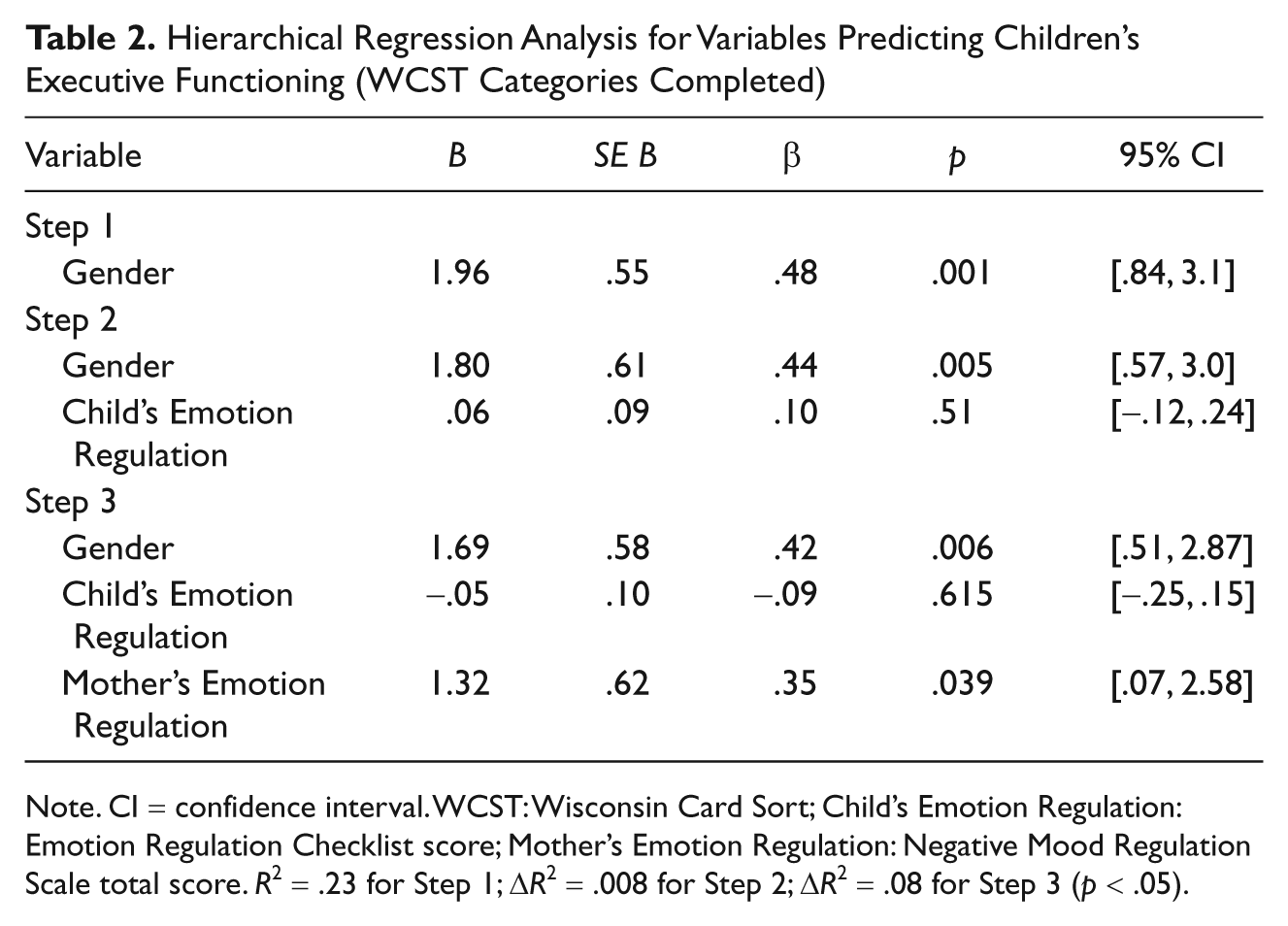
Note. CI = confidence interval. WCST: Wisconsin Card Sort; Child’s Emotion Regulation: Emotion Regulation Checklist score; Mother’s Emotion Regulation: Negative Mood Regulation Scale total score. R2 = .23 for Step 1; ΔR2 = .008 for Step 2; ΔR2 = .08 for Step 3 (p < .05).
Discussion
Recently researchers have begun to explore the extent to which children’s cognitive development is influenced by experiences in the family environment (NICHD, 2005; Bernier et al., 2010). This study examined relationships between maternal emotional functioning, parenting, and children’s EF in a predominantly African American, low SES sample of trauma-exposed families at risk for emotional and cognitive problems. Examining multiple facets of EF, we found that positive parenting behaviors were strongly related to planning performance. Both gender and maternal emotion regulation predicted cognitive flexibility, after controlling for children’s own emotion regulation skills. Maternal emotion regulation was not related to children’s planning, working memory, or inhibitory control performance. Positive parenting behaviors were highly correlated with planning and problem solving performance, as measured by the Tower of London Test. Mothers who are caring and supportive and refrain from criticizing, yelling, or physically punishing their children may be more likely to provide an organized and cohesive environment that facilitates the development of strong organizational and planning skills. Also using a Tower task, NICHD researchers (2005) did not find a relationship between family variables and planning performance in toddlers and preschool age children. The authors noted that young children’s planning skills may not be sufficiently mature enough to benefit from parental input. Given our significant results with an older sample, it is possible that the complex planning skills required by Tower tasks are influenced by parenting behaviors in older children.
Examining four components of EF (attention and working memory, inhibitory control, flexibility and set shifting, and planning), only WCST performance, which measures cognitive flexibility and set shifting, was related to mother’s emotion regulation. The WCST is unique among the EF measures in that it involves feedback from the examiner; the child must shift set and modify his or her categorizing based on feedback. In a home where a mother’s emotional dysregulation has the potential to cause a disorganized or unpredictable environment for a child, children might learn to tune out feedback or ignore environmental cues.
There were several noteworthy gender findings. First, girls were rated by their mothers as having better emotion regulation abilities than boys. Second, mothers of girls reported superior negative mood regulation than mothers of boys, suggesting that emotion regulation is a bidirectional process, where a mother’s emotion regulation impacts her child, and the child impacts her mother’s ability to tolerate negative mood states. Third, girls performed better on the WCST compared to boys.
Girls and boys are socialized differently in regards to the expression and awareness of emotions. Mothers exhibit more emotional expression with daughters than with sons (Garner, Robertson, & Smith, 1997; Malatesta-Magai, 1991). Mothers encourage daughters to express emotions more freely and demonstratively (Belenky, Clinchy, Goldberger, & Tarule, 1986; Saarni, 1989) whereas boys may be encouraged to repress emotional expression in order to conform to gender stereotypes (Chaplin, Cole, & Zahn-Waxler, 2005). Parents tend to promote more aggressive values and control of emotions with sons (Eme & Kavanaugh, 1995; Saarni, 1989) while promoting emotional awareness in their daughters (Belenky et al., 1986; Saarni, 1989). Socialized to be more emotionally attuned, girls may be more affected than boys by emotional variations in their mothers, and these influences extend to cognitive functioning.
Mothers of girls exhibited better emotion regulation skills than mothers of boys. This is an interesting finding, given that the present sample consisted of mothers who experienced IPV from male perpetrators. Mothers’ negative experiences with male intimate partners might influence how they experience and interact with their sons. In addition, mothers of daughters may be more likely to participate in an emotion-focused socialization process which facilitates mothers’ own emotion regulation.
Previous research on gender differences in EF has produced inconsistent findings. Some studies have shown boys to exhibit poorer EF than girls in samples of preschoolers (Berlin & Bohlin, 2002; Carlson & Moses, 2001) and children with ADHD (Newcorn et al., 2001; Rucklidge, 2006). Fewer studies have shown poorer performance in girls (Brocki & Bohlin, 2004) or no differences between girls and boys (Welsh, Pennington, & Groisser, 1991). The few studies examining EF in trauma-exposed children did not report gender differences (Beers & De Bellis, 2001; DePrince et al., 2009). The gender differences found in the present study were limited to only WCST performance, a measure of cognitive flexibility dependent on environmental feedback.
Several limitations of the study should be noted. The first is the small sample size, which limits the stability of results and the ability to achieve statistically significant results. A second limitation is the cross-sectional design, which does not allow for inferences about causality or the directionality or nature of these relationships. It is possible that children with better EF abilities create an environment in which it is easier for mothers to parent and emotionally regulate themselves. In addition, we cannot know if the family environment alters brain structures involved in EF or that a positive family environment provides children with a context to learn and practice EF skills more effectively. A third limitation is the possibility that other maternal variables, or variables unrelated to the mothers, might play a role in the relationships between maternal emotion regulation, parenting, and children’s EF. Although demographic and background variables that might account for results were considered in the analyses, it is possible that some variables not assessed could influence the findings. These variables include maternal substance abuse, physical abuse by the mother, and whether or not the child had ongoing visitation with the perpetrator of the IPV. We also did not utilize a comparison group consisting of mother–child dyads not exposed to IPV. Although we made an effort to employ multiple methods of data collection, including mother report, child report, and neuropsychological assessment, there is still the possibility of reporting bias in the mothers and children. Mothers might have a tendency to portray their emotional functioning more favorably, and children with EF deficits might have a tendency to rate their mothers more negatively. In addition, mothers reported on the emotion regulation abilities of both themselves and their children, making the latter report particularly susceptible to bias and a possible function of their own dysregulation. Ideally, future studies would employ observational measures of parenting and the parent–child relationship to test these research questions.
This research suggests that mothers may mitigate the effects of IPV on children’s EF via their parenting and emotional well-being. Thus, clinical interventions targeting mother–child interactions that have been shown to be successful in modifying child behavior problems in families with IPV (Graham-Bermann, Lynch, Banyard, DeVoe, & Halabu, 2007; Jouriles et al., 2001) might extend to children’s cognitive functioning. Individual therapies targeting emotion regulation for trauma-exposed mothers such as dialectical behavioral therapy (Linehan, 1993) and cognitive rehabilitation training targeting EF in trauma-exposed children with EF deficits (Thorell, Lindqvist, Bergman, Bohlin, & Klingberg, 2008) could be considered as well.
Footnotes
Declaration of Conflicting Interests
The authors declared no potential conflicts of interest with respect to the research, authorship, and/or publication of this article.
Funding
The authors disclosed receipt of the following financial support for the research, authorship, and/or publication of this article: This research was supported by Alliant International University.