



Abstract
Using a sample of 2,838 students from a Southwestern university in the United States, the authors examine the effect of respondent’s gender, the adult’s gender, the age gap between the adult and teen, and the adult’s authority, on students’ perceptions of vignettes describing adult–teen sexual relationships. Specifically, the authors investigate four dependent variables related to perceptions of the crime: the adult offender’s emotional motivation, whether the adult is a sexual predator, whether the adult should have limited interactions with children, and whether the adult should be included on a sex offender registry. ANOVA analysis revealed that a large age gap between the adult and teen, the presence of authority in the relationship, and respondent’s gender were significant predictors of perceptions of the offender as a predator and sex offender. The offender’s gender significantly predicted respondents’ perceived motivations but had no effect on opinions regarding sex offender registration. The authors discuss the implications of these findings for perceptions of statutory rape.
In the United States, defining statutory rape is not always straightforward. From a legal perspective, adolescents under a certain age cannot legally consent to sexual activity with an adult. Statutory rape laws vary across state jurisdictions and are determined primarily by the age of the minor or the age gap between the adult and the minor (Cocca, 2004). Currently, most states employ gender-neutral definitions of victims and offenders as well as age-span provisions to prevent prosecution when the age between the couple is close (usually between 3 and 5 years; Cocca, 2004). Most U.S. jurisdictions also now have mandatory sex offender registries and community notification laws for released sex offenders (Pearson, Cooper, & Brown, 1998).
Legal definitions of sexual offenders (and sexual victims) now emphasize the criminal violation of the act rather than the characteristics of the assailant such as their gender, age, or authority over the victim. Although these changes can be read as legal progress toward more fair treatment of illegal adult–teen relationships, it remains an open question as to whether public perceptions are as neutral in their judgments of sexual relationships between adults and adolescents. That is, despite the value-neutral language of the law, individuals may still judge some adult–teen relationships more harshly than others based on shared cultural understandings of appropriate sexuality and sexual behaviors. Individuals’ perceptions of statutory rape are likely influenced by their understanding of what kinds of sexual behavior are permissible for men and women as well as for boys and girls, which are termed sexual scripts. Using Simon and Gagnon’s (1987) theory of sexual scripts as a guide, we expect that cultural beliefs related to gender and sexuality result in more permissive attitudes about relationships between women and boys compared with those between men and girls. Furthermore, reliance on sexual scripts results in less tolerance for older offenders and offenders in positions of power. Sexual scripts are powerful cultural narratives that define appropriate behaviors that may have biases embedded within them and that may result in individual biases. The effect of these biases about victims and offenders in sexual crimes matter in both social and legal context.
Studies on perceptions of victim credibility and offender guilt with mock juries reveal that bias for or against victims and offenders can affect outcomes in sexual assault cases. Varying the age and gender of both victims and offenders changes mock juror’s evaluations of the harm and criminality of sexual crimes against children (Gabora, Spanos, & Joab, 1993; Haegerich & Bottoms, 2000; Quas, Bottoms, Haegerich, & Nysse-Carris, 2002). In addition to changing legal outcomes, perceptions of sexual relationships between adults and adolescents may relate to individuals’ propensities for identifying and appropriately responding to cases of statutory rape.
As background for this research, we rely on a small number of studies that examine perceptions of adult–teen sexual relationships (Dollar, Perry, Fromuth, & Holt, 2004; Fromuth, Holt, & Parker, 2001; Horvath & Giner-Sorolla, 2007; Smith, Fromuth, & Morris, 1997). These studies measured various dimensions of perceptions of statutory rape scenarios, including the criminality of the adult (Dollar et al., 2004; Horvath & Giner-Sorolla, 2007; Smith et al., 1997), the “normalcy” of the encounter (Dollar et al., 2004), and the emotional damage to the teen (Dollar et al., 2004; Fromuth et al., 2001; Horvath & Giner-Sorolla, 2007; Smith et al., 1997). Recently, Sahl and Keene (2010) showed that respondent’s gender, the age gap between the adult and teen, and the adult’s authority over the adolescent predicted college respondent’s perceptions of the adult’s deserved punishment and the negative impact on the victim.
The present analysis is part of a larger study designed to use a quasi-experimental model to investigate college students’ perceptions of statutory rape. The first paper to come out of this study examined the most conventional aspects of perceptions, focusing on the damage to the adolescent and the appropriate punishment for the adult offender (Sahl & Keene, 2010). Results showed that older adults and male offenders were perceived more negatively overall and given longer prison sentences by respondents and that female victims were perceived to suffer greater negative consequences than male victims. The results provided support for traditional understandings of sexual scripts and their influence on perceptions of sexuality based on gender and age norms. This article uses the same data as Sahl and Keene but expands the concept of punishment to include other perceptions of the criminality of the adult offender, specifically their motivation and their danger to society in terms of their sex offender status.
This study contributes to the research literature about perceptions of statutory rape in two significant ways. First, we use a large data set drawn from a population of students at a large, public university rather than only undergraduate Psychology students, who have typically been the respondent pool in other research in this area. Second, we specifically examine the effect of the respondent’s gender, the offender’s gender, an age gap between the adult and teen, and the adult’s abuse of authority on respondents’ willingness to label the adult as a sexual offender, which, to our knowledge, has not yet been examined in this literature. Sex offender registries in the United States are important in both identifying and tracking a distinct category of offender deemed too dangerous and likely to reoffend to be left unmonitored. For offenders, the consequences of registration often include stringent restrictions on work, housing, and social opportunities (Tewksbury & Zgoba, 2010). Registered sex offenders are frequently subject to severe stigmatization and ostracism as they reintegrate into a community (Tewksbury, 2005). The stigma and restrictions associated with the sex offender label suggest that the factors relating to an individual being identified as a sexual offender merit examination.
The purpose of this study is to examine whether varying the context of a hypothetical, sexual relationship between an adult and an adolescent affects university students’ perceptions of heterosexual statutory rape offenders. Specifically, we are interested in the effects of the respondent’s gender, the gender of the adult, the age difference between the adolescent and the adult, and the apparent abuse of authority on perceptions of the offender’s emotional motivations, whether the adult deserves the label of sexual predator, and the need to register and restrict the adult’s access to children as a sexual offender.
Explaining Perceptions of Adult–Child Statutory Rape Offenders
Sexual Scripts
Sexual script theory suggests that when interpreting and reacting to sexual situations, individuals draw on cultural expectations of appropriate behavior (Simon & Gagnon, 1987). Individuals rely on scripts to help make sense of various experiences of sexual behavior (including their own) within the broader context of cultural norms and values. Expectations of sexual appropriateness can vary depending on factors such as gender or the age of the participants. Studies have shown that laypeople’s responses to illegal sexual encounters between adults and teens are influenced by the context of the relationship (Bornstein, Kaplan, & Perry, 2007; Horvath & Giner-Sorolla, 2007; Sahl & Keene, 2010). Some sexual relationships between adults and adolescents occur in social contexts that are viewed as more acceptable than others. Script theory also emphasizes the interplay between cultural expectations and personal experience in producing scripts among individuals (Simon & Gagnon, 1987). Research suggests that differences in the nature of women and men’s sexual socialization and gender differences in the nature of sexual development and sexual experience produce significantly different scripts (Wiederman, 2005).
Respondent’s Gender
Research on perceptions of sexual crimes consistently finds that women and men interpret sexual abuse scenarios differently. One explanation for these gender differences may be the varied ways in which women and men invoke sexual scripts as they evaluate sexual scenarios. Women are more likely than men to label ambiguous scenarios depicting sexual conflict, intimidation, or aggression as sexual harassment or sexual assault (Bursik, 1992; Dougherty, Turban, Olson, Dwyer, & Lapreze, 1996; Wayne, 2000). When evaluating statutory rape crimes, women are also far more negative than men in their assessments of the criminality of the adult and the potential damage to the teen (Dollar et al., 2004; Fromuth et al., 2001; Horvath & Giner-Sorolla, 2007; Sahl & Keene, 2010; Smith et al., 1997).
Women’s perceptions are also often less affected by the contextual factors of the scenario. For example, Fromuth et al. (2001) found that women judged relationships between adults and adolescents the same, regardless of the gender of the adult, whereas men judged the combination of a female teacher and a male adolescent less harshly than one between a male teacher and female student. The studies by Dollar et al. (2004), Sahl and Keene (2010), and Smith et al. (1997) found similar relationships between respondent’s gender and the gender of the offender in their vignettes, demonstrating that men in particular are more influenced by sexual scripts and assumptions about gender in their perceptions of adult–teen relationships.
Differences in men and women’s perceptions of sexual crimes may be explained by differences in sexual experiences. Studies consistently show that women experience more unwanted sexual attention (from men) as adolescents and as young adults than men (Measor, 2004; O’Sullivan, Byers, & Finkelman, 1998). According to sexual script theory, drastic differences between men and women’s experiences with unwanted or even violent sexual events would produce significant divergences in the cultural reading of sexual situations (Wiederman, 2005).
Gender of the Offender
Research on child sexual abuse demonstrates that the gender of the abuser is strongly predictive of perceptions of offenders with men consistently judged more negatively than women (Bornstein et al., 2007; Denov, 2003; Hetherton & Beardsall, 1998; Rogers & Davies, 2007). When presented with scenarios depicting male or female offenders, respondents’ perceptions are consistent with sexual scripts about appropriate gendered sexuality as they label male offenders as more harmful and deserving of longer prison sentences than female offenders (Dollar et al., 2004; Fromuth et al., 2001; Sahl & Keene, 2010; Smith et al., 1997). Others have found that teenage boys who are abused by women are perceived to suffer less emotional damage compared to teenage girls abused by men (Dollar et al., 2004; Sahl & Keene, 2010).
These previous findings are consistent with cultural standards about gender and sexuality and the sexual scripts that define sexuality for adolescent girls and boys. Sexual scripts typically portray teen girls as fragile and sexual activity for them as potentially damaging and shameful (Aubrey, 2004; Carpenter, 1998; Measor, 2004; Tolman, 1994), while boys should be sexually adventurous to gain experience and maturity (Fromme & Emihovich, 1998; Kimmel, 2008; Measor, 2004). Thus, a sexual relationship between a teenage boy and a woman will likely be interpreted as “natural” or a harmless (or even welcome) step toward sexual maturity. Whereas, since girls’ sexuality is viewed as vulnerable and something to be guarded, relationships between a teenage girl and a man reinforces the notion that the man is a predator and the girl is a victim.
Another explanation for these gender effects may be perceived differences in the motivations of male and female sexual offenders. For example, Denov argues that the dominant sexual scripts downplay women’s sexual desire and instead emphasize their pursuit of love and intimacy in relationships. The notion that women can be aggressive and selfish sexual predators conflicts with these scripts. This conflict is resolved when individuals soften female sexual offenders’ perceived motives and recast their underlying intentions from selfish aggression to misguided love. Recent research supports this idea. Studies conducted among law enforcement personnel and social and psychological service providers indicate that female sexual offenders benefit from a gender bias downplaying their dangerousness and explaining their sexual deviance as misplaced affection (Denov, 2003; Hetherton & Beardsall, 1998; Kite & Tyson, 2004). Thus, just as the sexual double standard increases perceptions of harm against an adolescent female victim compared to a male victim, it also minimizes the perception of criminality and aggression of the female offender compared to a male offender.
Age Gap
Age differences between the offender and victim are reflected in respondents’ perceptions of adult–teen sexual relationships. Several studies established that negative perceptions of child sexual abusers increase as the victim’s age decrease (Back & Lipps, 1998; Horvath & Giner-Sorolla, 2007; Maynard & Weiderman, 1998). In contrast, Fromuth et al. (2001) found that increasing the adult’s age while holding the teen’s age constant had no effect on respondents’ perceptions; however, their focus on only teacher–student relationships may have obscured the effect of increasing the adult’s age. Sahl and Keene (2010) found that respondents recommended longer average prison sentences for 42-year-old adult offenders compared with 22-year-olds who have sexual encounters with 15-year-olds, showing support that the age gap between the adult and the teen influences perceptions. Thus, sexual contact between a very young adult and teen appears to be more socially acceptable than a sexual relationship between a much older adult and teen. Teenagers and young adults are more likely to share the same interests, social circles, and be closer in maturity whereas teenagers and older adults are less likely to have these in common. Through this lens, a relationship between a couple aged 15 and 22 is more normative than one between a 15- and a 42-year-old.
Abuse of Authority
Another factor influencing perceptions of adult–teen relationships is the adult’s authority over the adolescent. The effect of the presence or absence of authority is pertinent since the sexual abuse of children and adolescents sometimes occurs at the hands of an adult placed in a position of trust and influence. A perceived abuse of authority by the adult positively correlates with the perception that coercion or intimidation was used to gain sexual access to the subordinate teen (Winks, 1982). Studies of perceptions of sexual harassment found that respondents were more likely to label the actions of a hypothetical initiator as sexual harassment when the individual was in a clear position of authority (Bursik, 1992; Wayne, 2000). Furthermore, after reading vignettes depicting adult–teen sexual relationships, respondents assigned longer prison sentences to offenders in scenarios that depicted a teacher–student narrative compared with scenarios that outlined no explicit authority relationship (Sahl & Keene, 2010).
Data and Methods
Population and Sample
The population for this study included all students registered in the 2007 spring term at a large, Southwestern university in the United States. University students are ideal for this project since they are typically young adults and are in a unique position to assess the relationship from the perspective of both the adult and the teen. Over 25,000 participants were invited through an email sent through the university email system. The survey was administered through the internet and all data were collected online using a survey web service. Online surveys are gaining credibility among researchers since they have been found to be particularly amenable to internet-savvy student populations (Crawford, Couper, & Lamias, 2001). After 2 weeks of data collection, the final sample totaled 2,838 completed surveys for a response rate of 11.4%. The number of completed surveys for each vignette ranged from 323 to 385. The sample was made up of 63% women and 37% men. In terms of race and ethnicity, 64.5% of the participants reported their race as white, and the other race categories were: 5.4% African American, 10.3% Hispanic, 12.9% Asian, and 6.9% fell into the “other race/ethnicity.” The sample was primarily undergraduate students (75.7%), although 24.3% were graduate or professional students.
Independent Variables
The study used a between-subjects design that randomly presented each participant with one of eight scenarios depicting a sexual relationship between an adult and a teen and indicating that law enforcement was considering legal penalties. Participants were never made aware of the other seven vignettes. Three experimental variables were modified in each scenario: the genders of the adult and teen, the age gap between the adult and teen, and the authority context of their relationship. First, the combination of the adult and teen’s genders was presented as either man/girl or woman/boy. Second, the teen’s age was kept constant at 15 while the age of the adult was either 42 or 22. Third, the authority dynamic between the adult and teen was categorized as either teacher/student or neighbor/neighbor. The vignettes avoided providing details about the inception of the relationship and whether there was any explicit coercion by the adult to begin the relationship. The following vignette is an example of a relationship between a 42-year-old female teacher and a 15-year-old male student.
Joanne Keeler, a 42-year-old woman, was recently arrested for having a sexual relationship with a 15-year-old boy. The teen, who cannot be named, is a student at George Washington High School where Joanne teaches. A police officer discovered the two kissing in Joanne’s parked car. When questioned by the authorities, both Joanne and the boy admitted to dating and having sexual intercourse for over a month. A police spokesperson wouldn’t comment on the investigation but indicated that charges against Joanne would likely come soon.
In scenarios with a man–girl gender dyad, the name of the adult is John. In the scenarios involving a neighbor, the second sentence of the vignette was changed to read: The teen, who cannot be named, lives in the same condominium complex as John. In addition to the three experimental independent variables, we also include a variable measuring the respondent’s gender.
Dependent Variables
After reading the vignette, respondents completed a questionnaire with statements designed to assess their perceptions of the relationship and their propensities for drawing on sexual scripts in their assessments. All four dependent variables are measured on a 7-point Likert-type scale ranging from strongly disagree (coded 0) to strongly agree (coded 6).
Table 1 presents each of the four survey items for the dependent variables in the analysis, as well as their means and standard deviations. The first dependent variable, Intimacy, measures respondents’ perceptions of the offender’s motivations and behavior in the relationship. In contrast to the other three dependent variables, higher values on this scale indicate greater agreement that the offender’s motivation was intimacy, which we interpret as a softer or more positive judgment. The second dependent variable, Predator, measures respondents’ perceptions of the offender as a sexual predator. The third and fourth dependent variables, Register and Restrict, indicate whether or not they would recommend that the adult be legally identified and monitored via a sexual offender registry and respondents’ willingness to restrict the adult’s future contact with children, respectively. For predator, register, and restrict, higher values on the Likert-type scales indicate more negative judgments.
Frequencies and Percentages of Respondents Who Agree or Disagree With Dependent Variables Measuring Respondents’ Perceptions of Adult–Teen Relationships

Note: All scales range from 0 (strongly disagree) to 6 (strongly agree).
Aims and Hypotheses
The goal of this study is to examine the effects of the gender of the offender, the age gap between the adult and teen, the abuse of authority, and the respondent’s gender on perceptions of the offender’s motivations, threat, and sex offender status. To our knowledge, no study has examined the effect of offender’s gender, age, authority, and the respondent’s gender on a lay population’s willingness to assign the label of sexual offender to an adult in a sexual relationship with an adolescent. We argue that these are important contributions because research has not identified factors that have an effect on perceptions of an offender’s emotional motivation and dangerousness in adult–teen sexual relationships. Furthermore, we do not yet know whether these characteristics also affect respondents’ willingness to actually label adults as “sex offenders.”
Based on previous studies of perceptions of adult–teen sexual relationships and statutory rape, and using the theoretical guidance of sexual script theory, we offer five hypotheses about the relationships between our experimental independent variables (adult’s gender, age gap, authority, and respondent’s gender) and the four dependent variables addressing perceptions (intimacy, predator, register, and restrict).
Hypothesis 1: Male offenders will be perceived more negatively than female offenders. Specifically, male offenders will have lower mean scores on the intimacy measure and higher scores on the dependent variables predator, register, and restrict, than female offenders.
Hypothesis 2: Older adults (27-year age gap) will be perceived more negatively than younger adults (7-year age gap). Specifically, older adults will have a lower mean score on the intimacy measure and higher scores on predator, register, and restrict, than younger adults.
Hypothesis 3: Teacher–student relationships will be judged more negatively than those between neighbors. Teacher–student relationships will have a lower mean score on intimacy and higher mean scores on predator, register, and restrict than relationships between neighbors.
Hypothesis 4: Female respondents will perceive all adult–teen relationships more negatively than male respondents. Female respondents will have lower mean scores on intimacy and higher mean scores on predator, register, and restrict, than male respondents.
Hypothesis 5: The effect of respondent’s gender on each of the four scales will be contingent upon the gender of the offender in the scenario. Previous research suggests that respondent’s gender and offender’s gender have interactive relationship vis-à-vis perceptions of sexual offenses. For all four dependent variables, we expect that female respondents will be less influenced by the gender of the offender than male respondents in their evaluations of the scenario.
Results
To facilitate a comparison of our findings across both independent and dependent variables, we conducted a 2x2x2x2 MANOVA (multivariate analysis of variance) to measure the independent variables’ effects on perceptions of the offender’s motivations (intimacy), the offender’s status as a sexual predator (predator), the respondent’s willingness to place on a sex offender registry (register), and the respondent’s willingness to restrict the offender’s future access to children (restrict). MANOVA is an appropriate analytic tool for this study because it allows us to assess interaction effects and how responses across various conditions relate to one another. To control for unequal group sizes as well as violations of assumptions for normalcy and the heterogeneity of variances across the dependent variables, we employ Pillai’s trace, which is the most robust and conservative post hoc test for MANOVA (Tabachnick & Fidell, 2001). We then conducted follow-up ANOVAs on all significant MANOVAs to test for main effects. To test for significant interaction effects identified in the MANOVAs, we used two-way ANOVAs. Finally, to control for Type 1 error, we set family-wise alphas at .05 using the Bonferroni adjustment (since we are testing four scales our corrected alpha is .05/4 = .0125; Tabachnick & Fidell, 2001).
MANOVA Results
MANOVA results showed significant main effects for all four independent variables on the dependent variables. As predicted in Hypotheses 1 through 4, the analysis yielded four statistically significant main effects: the gender of the offender, F(4, 2820) = 78.1, p < .001, Pillai’s trace = .100; the age gap between offender and teen, F(4, 2820) = 38.4, p < .001, Pillai’s trace = .052; the authority dynamic between the offender and teen, F(4, 2820) = 7.67, p < .001, Pillai’s trace = .011; and respondent’s gender, F(4, 2820) = 14.8, p < .001, Pillai’s trace = .021. We also found support for Hypothesis 5 since a MANOVA indicated a significant interaction effect between the gender of the offender and respondent’s gender, F(4, 2820) = 8.44, p < .001, Pillai’s trace = .012.
ANOVA Results
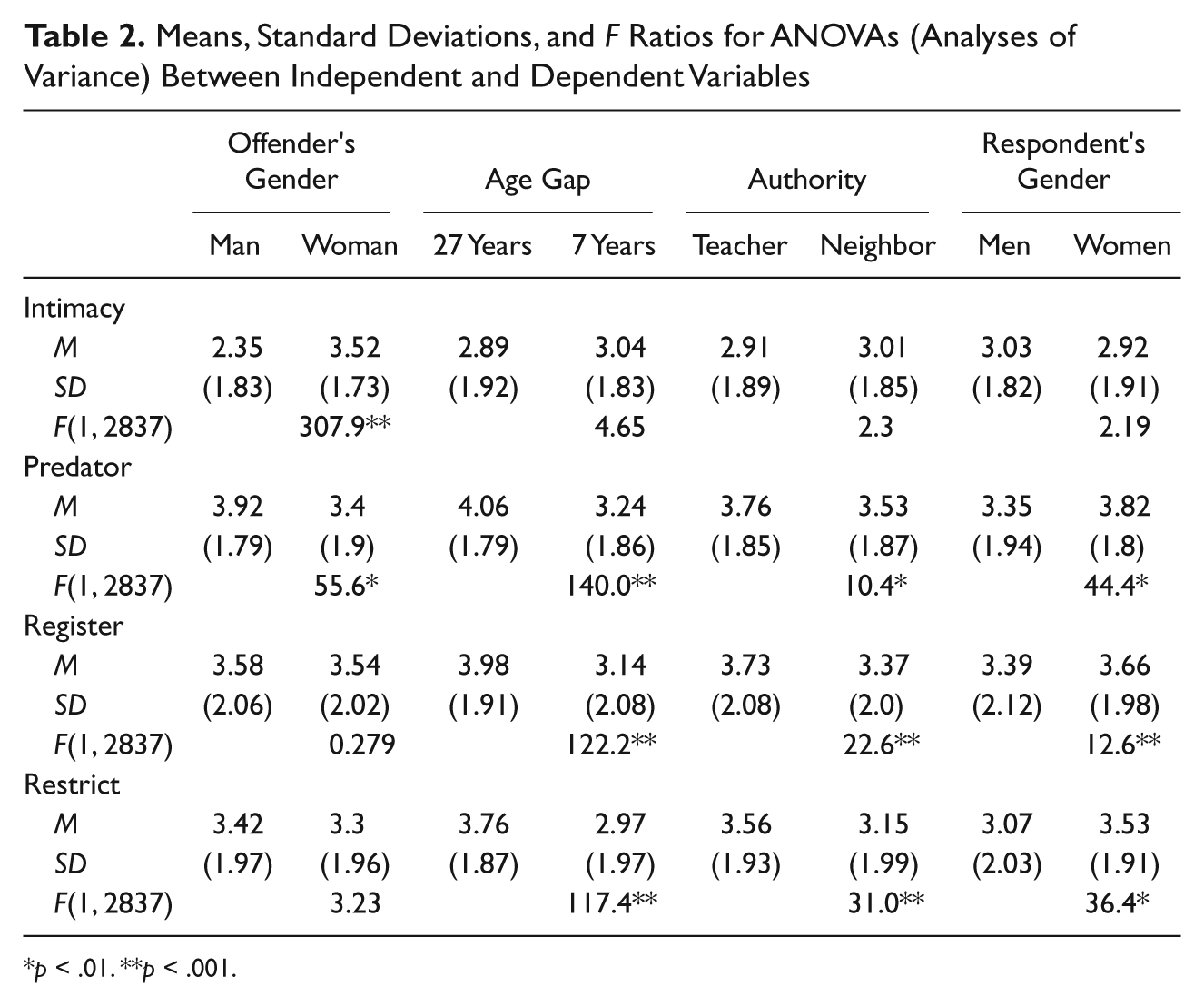
Based on the significant results from the MANOVA, we next conducted four one-way ANOVAs to measure the significant main effects of the four independent variables on the dependent variables. Table 2 presents the means, standard deviations, and F ratios for the four ANOVAs.
Means, Standard Deviations, and F Ratios for ANOVAs (Analyses of Variance) Between Independent and Dependent Variables
p < .01. **p < .001.
We find partial support for Hypothesis 1, which predicted that the gender of the offender would relate to all four dependent variables. Indeed, the gender of the offender matters for respondents’ perceptions of the adult’s desire for intimacy and for identifying the adult as a sexual predator. The mean score for female offenders on the scale measuring intimacy was larger than for male offenders, F(1, 2837) = 307.9, p < .001, indicating that respondents were more accepting of intimacy as a motivation for female offenders than for male offenders. Respondents were also more likely to identify men as sexual predators, F(1, 2837) = 55.6, p < .001.
Regarding Hypothesis 2, we find that older offenders are, indeed, judged more harshly than younger offenders and are more likely to be labeled as sexual predators, required to register as sexual offenders, and restricted in their access to children. For the variable sexual predator, the mean score for older offenders (27-year age gap) was higher than for younger offenders (7-year age gap), F(1, 2837) = 140.0, p < .001. For the variable indicating support for registering the adult as a sex offender, the mean score for older offenders was larger compared with the scores for younger offenders, F(1, 2837) = 122.2, p < .001, and this was also the case for support for restricting the adult’s access to children, F(1, 2837) = 117.4, p < .001.
Hypothesis 3 addressed the authority context of the scenario and predicted that teacher–student relationships would be judged more harshly than those between neighbors. Results only partially support this hypothesis. Adult’s authority slightly increased respondent’s perceptions of the offender as a sexual predator, F(1, 2837) = 10.4, p < .01. The mean scores for teacher–student relationships was larger than for neighbor–neighbor relationships both for registering the adult as a sex offender, F(1, 2837) = 22.6, p < .001, and for restricting the adult’s access to children, F(1, 2837) = 31.0, p < .001. The authority context of the relationship was not significant for the dependent variable intimacy.
Recall that Hypothesis 4 was about the gender of the respondent and predicted that women would overall respond more negatively on all four dependent variables than men. We found support for this hypothesis for three of the dependent variables. On the variable labeling the adult as a sexual predator, women had a higher mean score than men, F(1, 2837) = 44.4, p < .001. Similarly, female respondents indicated statistically significantly greater support than male respondents for registering the adult on a sex offender registry, F(1, 2837) = 12.6, p < .001, and for restricting their access to children, F(3, 2856) = 36.4, p < .001.
Interaction Results
The MANOVA identified a significant interaction between the respondent’s gender and the adult offender’s gender, which supported Hypothesis 5. To identify the specific effects, we conducted four two-way ANOVAs. We found significant interactions between respondent’s and offender’s gender on two of the four dependent variables: intimacy, F(3, 2835) = 18.3, p < .001, and sexual predator, F(3, 2835) = 6.20, p < .01. We found a similar interaction for the variables register and restrict; however, the p values were .19 and .18, respectively, which violates this study’s Bonferroni adjustment and are therefore not considered to be statistically significant. A subsequent Fisher’s test was conducted on the correlation between offender gender and intimacy and offender gender and predator for both male and female respondents. Both tests further confirmed the interactions. A one-tailed Fisher’s test determined that the strength of the correlation between the gender of the offender and intimacy was greater for women (–.364) than for men (–.216; z = 2.3, p < .01). A second one-tailed Fisher’s test determined that the strength of the correlation between the gender of the offender and predator was greater for men (.188) than for women (.101; z = 2.3, p < .01).
To illustrate these significant findings Figures 1 and 2 present the means for women and men on the variables sexual predator and intimacy by the gender of the offender. For the scale measuring the respondent’s perception of the offender as a sexual predator (Figure 1), men and women’s support was more similar when the offender in the scenario was a man (4.01 for men compared with 3.75 for women), than when the scenario portrayed a female offender (3.64 for men compared with 3.02 for women; see Figure 1). Turning to Figure 2, although a significant interaction effect was also found for the scale measuring intimacy, the direction of the effect was the opposite of what we predicted. Women were more influenced by the gender of the offender than were men. Compared with men, women who read about a male offender had a lower mean score indicating less support for the argument that the offender was motivated by a desire for intimacy (2.21 for women compared with 2.59 for men). Conversely, women had a higher mean score when the offender was a woman (3.61 for women compared with 3.39 for men). Although, we did not find a significant relationship between respondent’s gender and intimacy (as tested by Hypothesis 4), these results suggest that the actual relationship was likely obscured by this strong interaction with the offender’s gender.
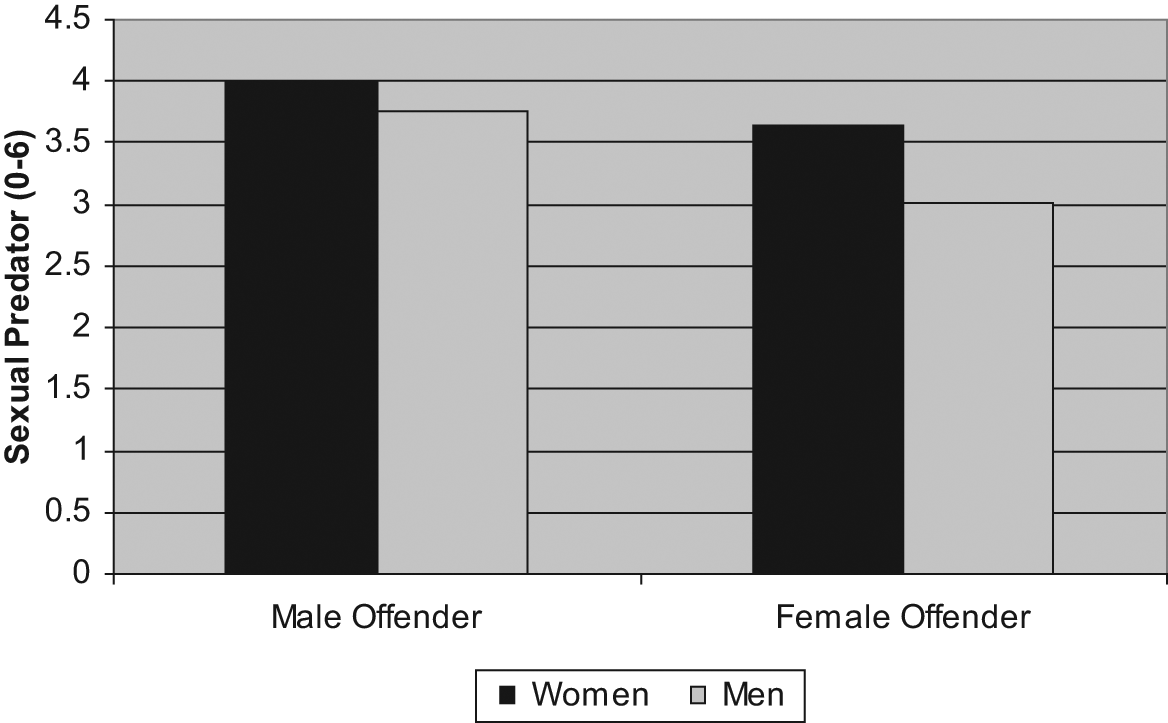
Interaction effect between respondent gender and offender gender for Sexual Predator.
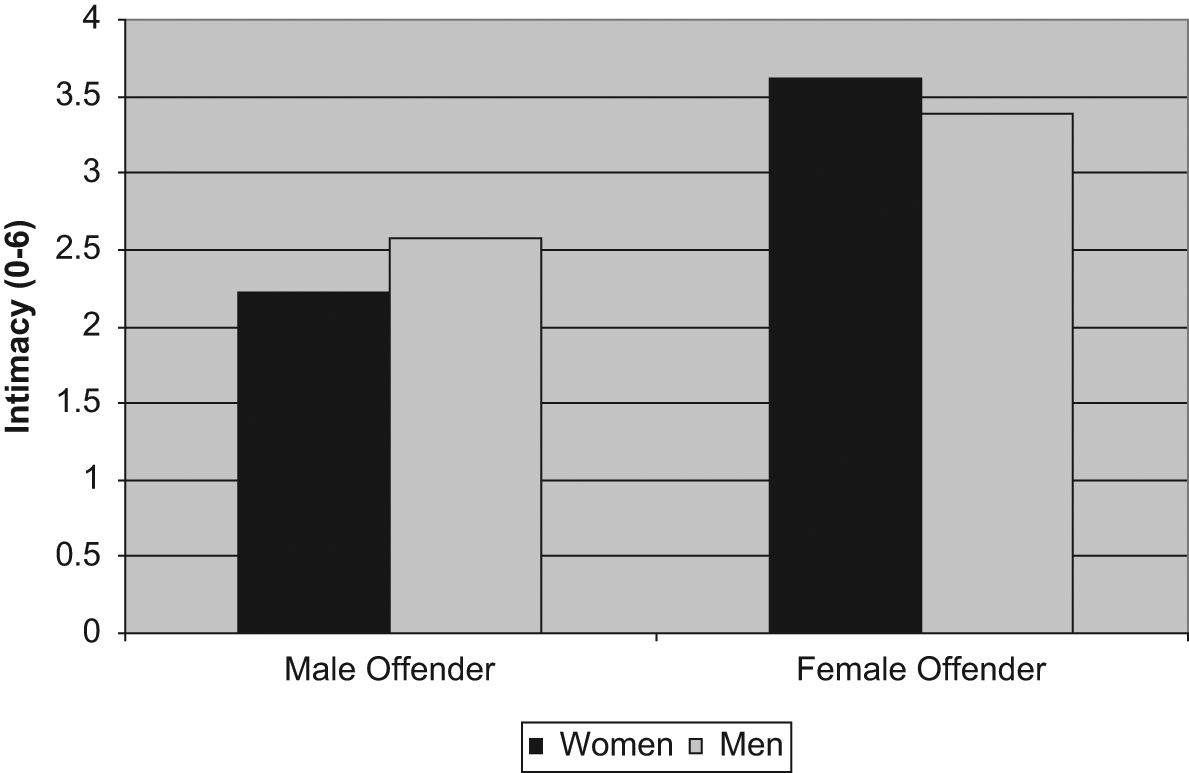
Interaction effect between respondent gender and offender gender for Intimacy.
Discussion
Our analysis demonstrated that characteristics of the offender as well as the respondent’s gender significantly affect college students’ perceptions of the adult’s motivation and their sex offender status. Some of our findings were consistent with patterns established in previous research on perceptions of statutory rape. For example, the age gap and the authority context had significant effects on respondent’s perceptions that mirrored findings from previous research (Horvath & Giner-Sorolla, 2007; Sahl & Keene, 2010). Respondents were much more likely to agree that older offenders were sexual predators and needed to be permanently restricted from children and officially registered as a sexual offender. Holding a position of authority over the teen also increased respondents’ willingness to identify the offender as a sexual predator.
The strong effect of the age gap on both respondents’ perceptions of the adult as a sexual predator and their willingness to place the adult on a sex offender registry raises two points for further consideration. First, it suggests that university students may be less likely to identify young adults who engage in sexual relationships with adolescent minors as dangerous or meriting the label and restrictions of a sexual offender. This raises an important public safety concern: Does a lower likelihood among college students to identify younger adults engaged in statutory rape as sexual offenders translate into lower willingness to report inappropriate activity conducted by their peers to an appropriate authority source? Although this question exceeds the scope of this article, it may be that permissiveness or even approval of illegal statutory rape relationships between younger adult offenders and adolescent minors may create a climate that shields adults who engage in illegal sexual activity with adolescents from appropriate identification and processing through the legal system.
The effects of both respondent’s gender and the genders of the offender and teen in the vignettes yielded some unexpected results. As hypothesized, compared to male respondents, female respondents were more inclined to identify the offender a sexual predator, agree to child-contact restrictions, and recommend placing the adult on a sexual offender registry. Surprisingly, there was no initial effect for respondent gender on the likelihood of agreeing that the adult’s motivation was based on a desire for intimacy. Even more unexpectedly, when we introduced the interaction term between respondent’s gender and offender’s gender the results indicate that the effect of the offender’s gender on the perception of intimacy is greater for women than for men. Compared to male respondents, female respondents were less willing to attribute a male offender’s motivations to intimacy and companionship. A completely opposite pattern emerged for respondents who read about a female offender: compared to male respondents, female respondents were more willing to attribute the motivations of a female offender to intimacy.
This finding is unexpected given that previous studies on perceptions of statutory rape, sexual harassment, and other sexual offences have consistently shown that women are less affected by the genders of the perpetrator and victim when assessing vignettes (Bell, Kuriloff, & Lottes, 1994; Dollar et al., 2004; Horvath & Giner-Sorolla, 2007; Sahl & Keene, 2010). We argue that this does not entirely contradict previous studies. Previous data on women’s perceptions of sexual assault compared with men’s perceptions have shown that women are less influenced by the characteristics of the offender and victim (and are presumably more influenced by the violation itself) when determining blame, punishment, and harm. To our knowledge, no study has asked respondents to comment on how they perceive an offender’s emotional or intimacy needs and desires within the context of statutory rape. We argue that this surprising finding may be explained at least partially through script theory, namely, the differences in the sexual histories of college-aged men and women.
Sexual scripts emphasize the interplay of cultural expectations with personal experience. It is possible that women’s experiences of unwanted sexual attention from men reinforce sexual scripts that minimize the importance that men place on intimacy and companionship. Studies have found gender differences in both the frequency and nature of reported sexual harassment and abuse experiences among adolescents. For example, recent data from the nationally representative National Survey of Family Growth indicate that among sexually experienced teens, 26% of girls compared with only 9% of boys report having had their first sexual experience with an adult who was on average 5 years older than themselves (Moore & Manlove, 2005). Furthermore, teen girls report higher rates of unwanted sexual attention from men than teen boys from women (Measor, 2004). Freel (2003) found that in addition to the increased frequency of unwanted sexual attention, teen girls report greater emotional trauma as a result of sexual encounters with adult men. The increased severity and frequency of unwanted sexual attention from men (both adolescent and adult) that adolescent girls experience may explain why the women in our sample strongly rejected the idea that male offenders are motivated by emotional needs.
Another surprising result was that respondents were not influenced by the adult’s gender when determining whether an offender should be placed on a sex offender registry or be restricted in future access to children. Previous research using similar populations to study the effect of the gender of the offender and victim on perceptions have established that male offenders are judged overall more negatively, attributed more blame, and assigned longer prison sentences (Dollar et al., 2004; Fromuth et al., 2001; Horvath & Giner-Sorolla, 2007; Sahl & Keene, 2010). Our findings also seem to contradict research on perceived differences in motivations between male and female sexual offenders (Denov, 2003; Hetherton & Beardsall, 1998). Even within the present study, the effect of offender’s gender corresponded with previous research and sexual script theory. Respondents were less likely to agree that male offenders were seeking out intimacy and companionship (compared to female offenders) and more likely to agree that they were sexual predators. But the data also suggest that, despite different views on female offender’s motivations and sexual threat compared with male offenders, respondents do not factor in these gender biases when determining whether the offender should be legally categorized and restricted as a sexual offender. Ultimately, our findings challenge the idea that the sexual double standard translates into an actual advantage for female offenders, at least with respect to being formally identified and restricted as a sexual offender. Although we may perceive women and men’s motivations and danger differently, the softening of a female offender’s image does not appear to shield her from the significant and consequential label of sex offender.
This study was limited to an analysis of college students’ responses and therefore may not be generalizable to other populations. It is unclear whether our findings would occur with more diverse samples that are more representative of the general population, a weakness that needs to be addressed in future endeavors. Due to the somewhat low flexibility of using a between-subjects research design, we chose to study only heterosexual relationships; however, attitudes and perceptions of same-sex adult–teen relationships are also valid and important areas for investigation. It is also important to note that our vignettes provided respondents with a purposefully limited description of the sexual encounter and that real assessments of sexual crimes involve a more complex set of facts. Furthermore, although the response rate was reasonable for a web-based survey, there may be selection effects in our sample, since some college students may be more or less likely to respond to a web survey than others.
We also want to caution readers not to overinterpret our results. The goal of this study was to identify how the contextual differences present in statutory rape situations may bias a lay population’s judgments. Although we rely on script theory to explain these observed differences, our study is not designed to address the direct cause-and-effect relationship between the respondent’s interpretation of sexual scripts and the biases inherent in their perceptions. Future research may consider using a within-subjects design to more specifically tease out the relationships between individuals’ biases, the influence of sexual scripts, and perceptions of statutory rape. In addition, data on respondents’ sexual histories, especially regarding sexual assault and harassment, would produce a much more complete analysis of factors influencing the perception of statutory rape.
Our study asked respondents to provide their opinions about the offender’s motivations and conduct but did not measure how their perception might affect how they would choose to act in response to the situations. Future research into this topic would benefit from examining respondents’ reactions to hypothetical vignettes that do not specify that law enforcement is involved and instead ask respondents what steps they would take in response to encountering an adult–teen sexual relationship. For example, some respondents may perceive that some scenarios do not require any action, others may feel that they only need to be reported to the adolescent’s parents, and still others may merit reporting such sexual encounters to law enforcement. The exact factors that influence respondents’ willingness to take action (and how far they’re willing to take it) may also help us understand the gradations between different scenarios and how they relate to reporting of suspicious and possibly illegal adult–teen sexual relationships. There is also a need to specifically identify and understand the assumptions respondents make about the severity, morality, and risk of these adult–teen sexual encounters and how these assumptions affect the response. It would also be fruitful to specifically examine the potential mediating relationships between our independent variables. For example, in a patriarchal society men are assumed to have more power in relationships than women (all else being equal) and older adults are perceived as having greater status than younger adults (Sahl & Keene, 2010). It may be the case that perceptions of power and status between the offender and the victim mediate the relationship between gender and age and perceptions of the offender.
Perhaps this study’s main contribution to research on sexual crimes against children is the surprising finding that the offender’s gender did not affect respondents’ condemnation of the adult as a “sexual offender” and deserving of the sanctions associated with that dire social label. This is significant since conventional wisdom assumes that female sexual offenders are shielded from the harshest judgments because sexual scripts about women’s sexuality reframe their criminal actions as less malicious than those of men. Our data show that other biases that frame female offenders’ perceived motivations are in keeping with sexual scripts defining female offenders as gentler as and less dangerous than male offenders. Despite the advantage that this double standard appears to afford female offenders, women do not appear to be protected from the stigmatizing label of sexual offender, suggesting gender parity in individuals’ recognition of sexual offenders. Perhaps the sexual double standard in perceptions of offenders is more complicated than previously thought.