




Abstract
The application of restorative justice (RJ) with hate crime remains an underdeveloped field of research, policy, and practice. This article aims to advance the understanding of these two areas of inquiry: RJ and hate crime. It is known that while most hate incidents involve minor, punishable offenses, their impact can be long lasting and detrimental to victims and affected communities. The article investigates how RJ is conceptualized within the hate crime context. The findings are based on a 3-year research program, which combined theoretical analysis, literature review, and U.K.-focused field research that was carried out through a combination of qualitative methods. These included semistructured interviews with an expert sample of practitioners and policy makers as well as focus groups with young victims and offenders of hate incidents. Direct observation was also carried out with two RJ practices.
Introducing Restorative Justice and Hate Crimes
Restorative justice (RJ) was reborn in the 1970s to start an unprecedented volume of academic and policy discussions on its potential. The term was coined by Eglash (1977) who distinguished three types of criminal justice: retributive, distributive, and restorative. According to Eglash, retributive and distributive justice focus on the criminal act, are informed and dependent on the law, deny victim participation in the justice process, and require merely passive participation by offenders. However, RJ, he said, focuses on restoring the harmful effects of these actions, it is not dependent on the law, and it actively involves all parties in the restoration process. RJ provides “a deliberate opportunity for offender and victim to restore their relationship, along with a chance for the offender to come up with a means to repair the harm done to the victim” (Eglash, 1977, p. 2).
Braithwaite (1997, 1999), Sullivan, Tifft, and Cordella (1998) and Zehr (1990) spoke about the transformative potential of RJ and its “changing lenses” of how we view crime. Barnett (1977) spoke about a “paradigm shift,” claiming that we are living a “crisis of an old paradigm” and that “this crisis can be restored by the adoption of a new paradigm of criminal justice” (p. 294). Christie (1977) argued that RJ returns conflicts as property to the parties involved, taking them away from lawyers.
A number of definitions have since been developed for RJ, which is now seen by many as an integrated approach rather than as an abolitionist concept. For instance, “RJ is an ethos with practical goals, among which is to restore harm by including affected parties in a (direct or indirect) encounter and a process of understanding through voluntary and honest dialogue” (Gavrielides, 2007, p. 139). Gavrielides argues that RJ “adopts a fresh approach to conflicts and their control, retaining at the same time certain rehabilitative goals” (p. 139).
Gavrielides (2011) argued that by introducing RJ as a radical concept, its proponents were hoping to make the then new concept of RJ appealing and interesting enough for writers and politicians who knew nothing about it. However, once the excitement was over, and while RJ was leaving the phase of “innovation” to enter the one of “implementation,” its advocates (e.g., Braithwaite, 1999) started to talk about the need to combine its values and practices with existing traditions of criminal practice and philosophy.
Therefore, depending on the structure of the criminal justice system, RJ can appear in various forms and at different stages of the criminal process. This is also dependent on public tolerance and the given cultural and historical context (Gavrielides, 2008). RJ practices consist of direct and indirect mediation, family group conferences, healing/sentencing circles, and community restorative boards (Crawford & Newburn, 2003; Walgrave & Bazemore, 1998).
When introduced into the criminal process, RJ practices can be “independent,” “relatively independent,” and “dependent.” They are “independent,” when they divert the criminal case out of the formal process. This occurs at an early stage of the case, replacing any penal response to crime. The outcome usually precludes reentrance of the case in the criminal justice system. Practices can be “relatively independent,” when they are offered as part of the regular criminal procedure. This can take place at any stage of the case, which is diverted and referred to a mediator charged with reaching an agreement between victim and offender. If this is accomplished successfully, it will have an impact on the outcome of the criminal proceedings. Its most common effect is to reduce sentencing, although there have been cases where charges were dropped altogether. RJ practices are “dependent,” when they are situated adjacent to the conventional system. This model is used after the criminal trial has run its course and is mainly used in instances of the most serious crime or in the prison context (Groenhuijsen, 2000).
Bias-motivated violence (hate crime), despite being with us since the first human aggregations (see Michalowski, 1985), is a relatively new area of criminological and legislative interest (see Levin & McDevitt, 1993). Hence, there are still many gaps for academia, policy, and practice (see Chakraborti, 2010; Iganski, 2008). Hate crime is generally defined as any criminal offense committed against a person or property that is motivated by an offender’s hatred of someone because of their race, color, age, ethnic origin, nationality or national origins, religion, gender identity, sexual orientation, or disability (Sibbitt, 1997).
In criminal law and in most jurisdictions, there is no criminal offense of hate crime per se. Hate crime is a legal category, which describes bias-motivated violence. There are a number of specific offenses (i.e., assault, injury, murder) where, if the prosecution is able to prove an element of racial/faith/homophobic/disablism/transphobic/ageist/nationalistic/gender-based aggravation, the accused is liable to receive a higher sentence, if found guilty. Arguably, this is a progressive legal understanding, as many legal jurisdictions do not extend it to equality strands other than race, religion, and sexual orientation (see Gavrielides, 2007, 2010).
For instance, in the United Kingdom, all the aforementioned grounds are acceptable as aggravating factors. Similarly, the law in Canada understands hate crime as “when there is evidence that the offence was motivated by bias, prejudice or hate based on race, national or ethnic origin, language, colour, religion, sex, age, mental or physical disability, sexual orientation, or any other similar factor, . . . shall be deemed to be aggravating circumstances” (see section 718.2. of Criminal Code 1985). In the United States, federal prosecution is possible for bias-motivated violence on the basis of a person’s race, religion, or national origin. In 2009, the Matthew Shepard Act added perceived gender, gender identity, sexual orientation, and disability. In most European countries, only the grounds of race, religion, sexual orientation, and nationality are accepted as aggravating factors (e.g., see Ireland, Italy, Greece, France, and Finland).
To sum up, hate crime law is generally developed to enhance the penalties associated with conduct that is already criminal under other laws. This causes a number of legal and practical challenges. For instance, Chakraborti (2010) said, “Although a number of hate crime scholars have sought to offer a conceptual clarity and coherent framework for criminal justice policy, there are still divisions over what the term [hate crime] really means and what its value is” (p. 3).
Problem Statement
Hate crime has traditionally been treated as a “gray area” for RJ. There are fears among policy makers, politicians, and certain groups within society that the relationship between hate crime offenders and victims is dominated by an irreconcilable power imbalance (Penell & Francis, 2005; Walters & Hoyle, 2010; Yantzi, 1998). For this reason, some feminists and victim advocates dismiss RJ altogether as they believe it can revictimize vulnerable groups (Acorn, 2004; Hopkins & Koss, 2005; Stubbs, 2002). Some others claimed that perpetrators of hate crime fall within a special category of criminological interest, where criminal behavior is examined as a phenomenon that is attributed to deep-rooted causes that can only be dealt with through the strictest laws (McDevitt, Levin, & Bennett, 2002). Racist perpetrators, for instance, might not be easily susceptible to rehabilitative and community-based approaches, whereas victims may be exposed to further victimization if brought in contact with them—irrespective of how remorseful the perpetrator may seem to be.
This area of RJ practice also remains underresearched (Gavrielides, 2010; Koss, Bachar, & Hopkins, 2004; Walters & Hoyle, 2010). Therefore, both advocates and opponents of RJ have called for further investigation (Gavrielides, 2007; Penell & Francis, 2005; Stubbs, 2002; Yantzi, 1998). Based on the premise that the RJ rhetoric should be on the development of RJ’s processes and principles and not on the superiority of its paradigm, this article aims to take the debate on RJ with hate crime cases forward.
It is known that, although most hate crimes involve relatively minor offenses (e.g., graffiti, egg throwing, name-calling, intimidation, and vandalism), the effect of hate crimes can be much greater and long lasting depending on how the victim and the community perceives them (Mason-Bish, 2010). These nuances are not always captured by legal definitions of hate crimes, which tend to be dominant in criminal justice policy and practice (Chakraborti, 2010).
Nevertheless, this did not hinder practitioners within the criminal justice system (e.g., probation officers) and within the community from piloting conferences, mediation, and other RJ programs most of the times without any government support (see, for example, Chakraborti, 2010; Gavrielides, 2007, 2010; Select Committee, 2006).
Therefore, this project questions: What role does RJ have in this debate particularly for hate crimes that are lower on the spectrum and not under the legal definition of “hate crime”? How is RJ conceptualized within the hate crime context?
These questions are timely. From the 1990s and especially after the September 11, 2001, tragic events, hate crimes have become a significant area of concern for public policy internationally. In the search for practices and policies that could bring balance to interpersonal tensions, and address integration issues, RJ principles and practices appear appealing.
In a nutshell, “despite our collective acknowledgement of hate crime, it remains a contested area of study and policy . . . this is because of the ambiguity that surrounds its interpretation” (Chakraborti, 2010, p. 3). This is also true for RJ (Gavrielides, 2008; Pavlich, 2004). It is worth noting that the intention of our research was not to paint a representative picture of evidence, but to collect information that would provide in-depth understanding of the use of RJ with hate incidents.
The article reports on the findings of a project that was carried out in 2008-2011 under the auspices of Independent Academic Research Studies (IARS). 1 The project started with a thorough investigation of the extant literature including a review of case studies where RJ was used for hate incidents. The desk research and case studies informed the primary research that was carried out in the United Kingdom.
Case Studies of Restorative Justice With Hate Incidents
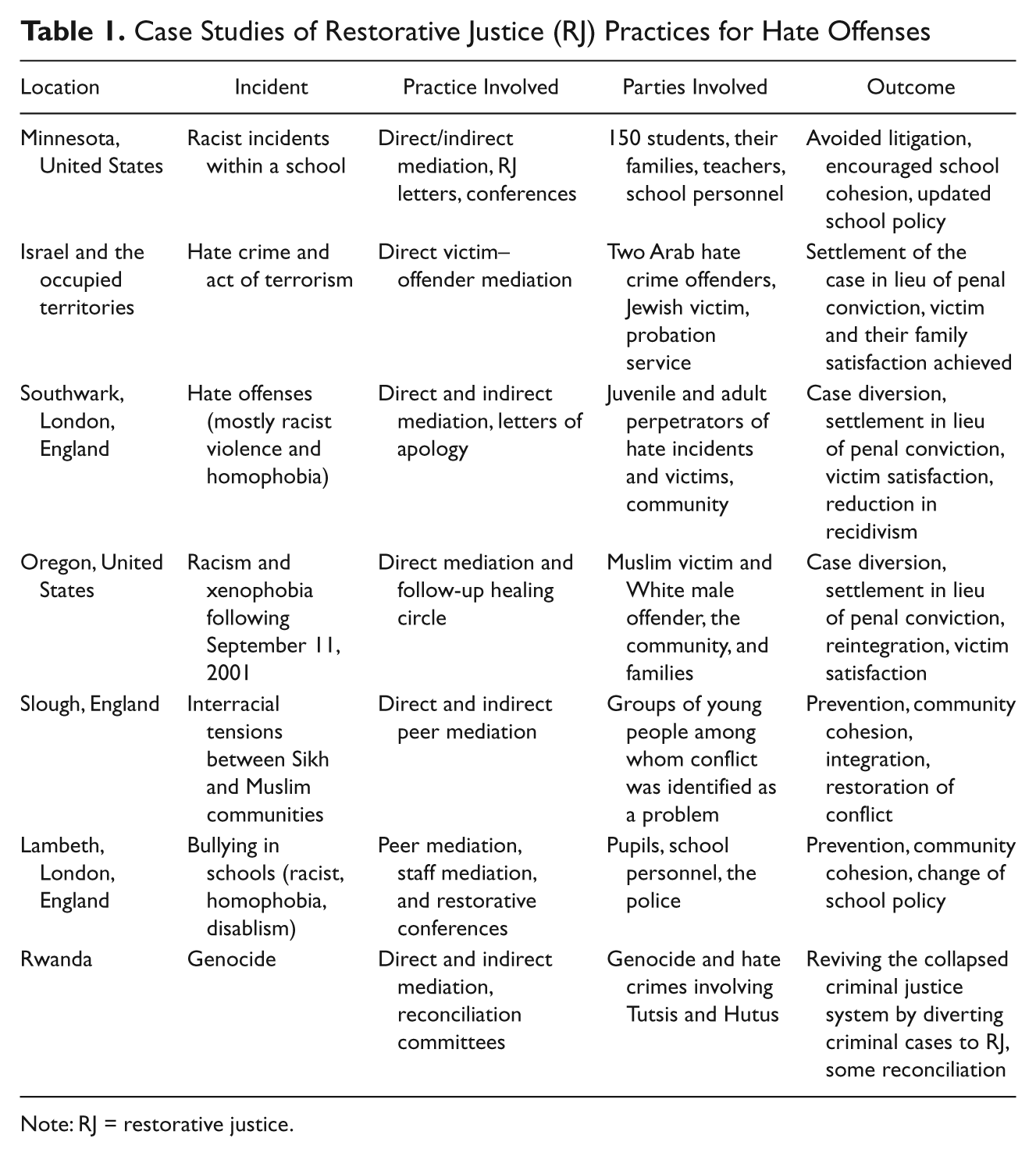
When looking at RJ and hate crime as a topic, the extant literature is scarce. As noted by Walters and Hoyle (2010), “Within the hate debate, there has been little attention paid to the potential efficacy of RJ” (p. 228). To contextualize RJ for hate crimes, our research reviewed case studies that were extracted from the extant, limited literature. The case studies involve conflicts at the interpersonal level. The case of Rwanda is added as an example of intercommunity conflict for illustration purposes (see Table 1).
Case Studies of Restorative Justice (RJ) Practices for Hate Offenses
Note: RJ = restorative justice.
The selection of the case studies and the basis of their success relied on the limited information that was made available through the literature and is measured by the outcome of the cases, their promptness, cost effectiveness, and the extent of the restoration they have achieved for all parties including the community. The cases are meant to be selective and illustrative of RJ’s role with hate incidents. The purpose of their presentation is to help contextualize RJ for hate crimes.
Minnesota, United States case study: This case involved racial tensions that occurred between White and ethnic minority pupils while in school. After several unsuccessful interventions, the school used mediation and restorative conferences/letters between the students, their families, and school personnel. Victims gave their testimonies and everyone shared their experiences and fears. Serious cases were concluded without the need for litigation; a stronger community spirit was encouraged within school, which subsequently adopted mediation as the first official step in dealing with racial conflicts (Coates, Umbreit, & Vos, 2006).
Israel and the occupied territories case study: The case involved two young Arab offenders who committed an armed robbery against a Jewish victim who experienced the offense as hate crime and an act of terrorism. The parties agreed to attend direct mediation. This allowed the victim to explain her fears and understand the reasons behind the actions. The offenders’ families were involved in the process by providing support to their children and the victim. The meeting ended with a settlement, which was later accepted by the juvenile court in lieu of a conviction. All parties expressed feelings of satisfaction and relief, and the families were able to move on (Umbreit & Ritter, 2006).
Southwark, London, England case study: Since 2002, a community-based mediation center in Southwark has been dealing with more than 60 hate offenses per year. These are deemed to have the potential of developing into serious punishable crimes. One typical case involved a Turkish and a White British family living in local social housing estate. Crimes had been committed by both families against one another. The police were about to prosecute when face-to-face mediation was employed. The White British family had committed racist offenses against members of the Turkish family whose son had committed property offenses against the White British family. After a successful process, the police dropped the charges and reconciliation was achieved between the parties.
Oregon, United States case study: This case involved face-to-face mediation between a White male who was arrested for causing terror through prank telephone calls, and a victim from a minority community who answered the calls. These took place after the September 11, 2001, attacks and were made to the Islamic Cultural Centre in Eugene, Oregon. The person who answered the phone was a practicing Muslim, who received the act as hate crime against him and his family. The mediation led to an apology and the adoption of reparatory measures, which diverted the case from the formal criminal process. It was also followed up by a separate healing circle that was attended by community members, who through this process supported both parties (Coates, Umbreit, & Vos, 2006).
Slough, England case study: This is a slightly different case in the sense that it did not involve a crime per se but focused on the preventive and community cohesion side of interracial conflicts within a locality. These tensions involved the settled Sikh and Muslim populations in Slough, who in the mid-1990s experienced antagonism and disintegration. Through peer mediation, young people from these two communities learned to coexist and support each other. Community leaders encouraged community cohesion through face-to-face mediation of the conflicts that occurred and could have been processed through more formal criminal justice processes.
Lambeth, London, England case study: Although not always considered hate crime in the narrow sense, bullying due to racism, homophobia, disablism, or sexism can either develop into a more serious offense or have equal if not more detrimental effect on the victim than hate crime per se. Instead of dealing with bullying incidents in the formal way by calling the police or formal structures, schools in the London Borough of Lambeth divert these cases to peer-mediation programs. Through direct meetings and follow-up conferences with the parents, community cohesion within the school context and ad hoc redress is achieved. The local authority evaluates these practices annually and provides the funding and a dedicated worker to develop them across the borough (Select Committee on Education and Skills, 2006).
Rwanda case study. After the 1994 genocide in Rwanda where some 800,000 people were systematically slaughtered, the international community responded with the creation of the ad hoc “International Criminal Tribunal for Rwanda” (ICTR). In the recitals of the UN Resolution 955/94 establishing the court, RJ is evidently prominent. For instance, it uses the words “national reconciliation and . . . the restoration and maintenance of peace” (Tiemessen, 2004).
However, the Rwandan criminal justice system was hopelessly ill-equipped to detain, prosecute, and try the 200,000 suspects who were held on remand for more than 7 years (Drumble, 2000, p. 1221). In November 2002, an indigenous system of local tribunals called Gacaca was used as the raw material for institutional adaptation in furtherance of a holistic RJ-orientated response to genocide. Gacaca led to the development of a communal judicial system, which aimed to aid reconciliation and speed up the trials.
Gacaca’s success is measured by the level of participation by the Rwandan people, who are being called upon to confess to crimes committed, elect judges, and give testimony to what they experienced during the genocide. According to Tiemessen (2004), “Gacaca justice is meant to be as intimate as the genocide itself” (p. 57). The Gacaca strategy is planned in four phases. The first focuses on raising awareness about Gacaca and increasing knowledge about the law. The second is concerned with the election of Gacaca judges, whereas the third deals with confession, testimony, and reconciliation. The fourth phase focuses on reintegration of prisoners back into society through a work program. “Gacaca represents a model of RJ because it focuses on the healing of victims and perpetrators, confessions, plea-bargains, and reintegration” (Tiemessen, 2004, p. 58).
Project Research Strategy
When considering the research strategy of the fieldwork, qualitative research was thought to be the most appropriate method. It was not the intention of the research to paint a quantitative picture of RJ with hate crimes but to drill down into complex matters that would allow a better understanding of its use within this particular area of conflict.
According to Miles and Huberman (1994), qualitative research can “persuade through rich depiction and strategic comparison across cases, overcoming the abstraction inherent in quantitative studies” (p. 41). The qualitative approach also demanded that an adequate level of freedom was left to the respondents, allowing them to discuss and think at length and in their own terms about issues that are important to them and are related to the discussed topic. This could not have been achieved through the application of a quantitative design mainly because this would have approached the investigated matters not through the examination of the substance of the sample’s responses but of variables (Punch, 2003). In addition, the small-scale project had to allow the possibility of issues emerging spontaneously from the data without being forced through fixed theoretical frames. Although the questions were intended to follow up the preliminary data from the literature, they merely aimed at stimulating imagination, providing an opportunity of identifying the sample’s thoughts, images, hopes, and fears.
The research design aimed to combine various qualitative methods with a view to ensuring that the results were as accurate as possible (i.e., interviews, focus groups, and observation). The interviews and focus groups adopted the “nonprobability sampling” method and the rules governing “convenience sampling.”
According to Gray, this methodology allows the sample to be self-selected. The method of “self-selection” permits “respondents themselves to decide that they would like to take part in the survey” (Gray 2004, p. 56). Bryman (2004) confirms, “Most writers on sampling in qualitative research based on interviews and questionnaires recommend that convenience sampling is conducted . . . the researcher samples on the basis of wanting to interview people who are relevant to the research questions” (p. 333).
Therefore, it was essential that the limitations surrounding this approach were acknowledged. Bryman (2004), for instance, warns that the generated data cannot be used as the only basis for generalized conclusions. The yielded information, he said, “will only provide an insight into the sample’s views and attitudes towards the discussed topics” (Bryman, 2004, p. 100). However, concerns about external validity and the ability to generalize do not loom as large within a qualitative research strategy as they do in quantitative research. 2
Interviews
A total of 27 face-to-face, in-depth, semistructured interviews were carried out with U.K.-based practitioners and policy makers with expertise in the area of hate crime and RJ (see Table 2).
Interviewees’ Demographic Data

Note: RJ = restorative justice; LGBT = lesbian gay bisexual and transgender.
Focus Groups
Two focus groups, aged 16 to 25 years, with 21 unrelated, victims and offenders of hate incidents were conducted. This age group was chosen for two main reasons. First, high rates of hate crime offenses are believed to be committed by people of young age, particularly below the age of 25, while it is also felt that it is at a young age when many prejudices are formed (Chakraborti, 2010). Second, the sample identification of adult offenders proved extremely difficult because RJ practices are rarely used with serious adult offenders.
Of the total participants, 11 self-classified themselves as recent victims of bias-motivated violence, 4 as offenders, and 6 as both victims and offenders. Of them, 19 said they had no experience of RJ, whereas 2 had undergone face-to-face mediation. The concept of RJ was briefly introduced to all of them at the beginning of the sessions by the moderator who remained impartial.
According to Madriz (2000), focus groups might not be appropriate if participants are uncomfortable in each other’s presence. Hence, in our research, the participants were not related to each other, although appropriate mechanisms were employed under research ethics and health and safety legislation. As the research involved vulnerable groups, a research ethics approval was sought from the IARS ethnics committee of its Academic and Editorial Board. 3 The focus groups allowed a fruitful and comfortable discussion as this was recorded in the participants’ evaluation and consent forms. Participation was voluntary and everyone was asked to speak from actual experience.
Observation
Direct observation was carried out at two U.K.-based RJ practices (direct mediation) selected from Table 2. Each observation lasted for 2 days. The findings were recorded through handwritten field notes. The direct observation focused on live RJ intervention with hate incidents that were diverted to the observed program by the criminal justice system. Four cases were observed focusing on collecting information on the specific question identified for the research rather than trying to unravel the entire context and challenges faced when applying RJ. Conceptualizing and contextualizing RJ for hate crimes remained the primary concern of the field research.
Data Analysis
To analyze the qualitative data from the interviews, focus groups, and observation, the study used the method of content analysis. The central characteristic of this approach is that it begins with predefined categories. In particular, it defines the units of analysis and the categories into which these are sorted by reviewing each unit and grouping it according to the predefined categories. The occurrences are then counted and comparisons are made.
Apart from identifying preliminary themes, content analysis also proved to be useful in summarizing the vast amount of information that was included in the respondents’ replies. This was done by counting the frequency of words or codes and by creating patterns of analysis.
Reporting on the Field Research
How Do You Define Hate Crime?
Given their U.K. location, the majority of the interviewees used the definition that arose out of the Macpherson inquiry, 4 that is, “Any incident which is perceived to be racist by the victim or any other person” (Macpherson, 1999). The Scotland-based respondent used the Scottish Executive’s (2004) definition of a “crime motivated by malice or ill will towards a social group.”
All interviewees stressed the elements of prejudice and difference. For example, one respondent said, “Hate crime is normally predicated on difference, something which is not the norm in the perpetrator’s mind.” Someone else said that hate crime is an incident where a “person or group are victimised because of their origin, faith, sexuality and so on.” One respondent classed it as “an irrational hate of people . . . based on misinformation.”
Most interviewees disagreed with the word “crime” in the “hate crime” terminology. One of the respondents whose work involved young people said, “Within schools, the term ‘hate crime’ isn’t appropriate; people would understand prejudice based bullying.” Another respondent commented that it was “difficult to pin down what constitutes a hate-motivated crime.” The respondent, using racial motivation as an example said, “There are blatant and malicious racism, direct discrimination and informal impartiality—for example favouritism.”
Moving on to the focus groups, the participants discussed their experiences having been at the receiving or offending end of hate crime. “Hate crime is when someone has hatred or prejudice against someone else because they are different,” a young Black male said. This and similar other statements that were made by the young participants indicated that their understanding of hate crime was that it “does not come in one form” as someone else put it.
A young Black male said, “I think hate crime as a majority happens among young people . . . generally of that secondary school age up till about the age of going to university. It does go up till about early 30’s and there are people who go past that due to prejudices they have.” Another young Black participant said, “Me personally when growing up I got hate crime from older people, old White people, when you’ve got your hood up, they pick you out stereotyping.”
How Do You Define Restorative Justice Within the Hate Crime Context?
It is worth noting that 19 of the interviewees already had at least a basic knowledge of RJ within the hate crime context. In response to the question, most of them focused on the understanding that RJ can achieve between hate crime victims and perpetrators through different forms of dialogue. One respondent said, “RJ is a process . . . where the parties to a hate crime are brought together to increase levels of understanding about each other.” Another respondent said, “It’s about understanding the impact of what has been done and why it’s been done.”
Some of the interviewees understood RJ as a voluntary process of reaching an agreement between hate victims and offenders. This, they said, may include some reparation for the harm done. One respondent said, “It’s largely about making amends for something that a perpetrator has done.” One practitioner said, “There is a mutual agreement as to how a person can redeem themselves, which the victim sees as appropriate.” Another respondent said, “The victim plays the role of getting some sort of reparation such as an apology or monetary gain, and the sense of knowing that they can move on with their lives.”
A number of interviewees pointed out that RJ for hate crimes must involve not just victims and offenders but also the affected community. One respondent said, “RJ should look at the emotional impact on families, the local community and the wider community—anyone who has an interest in the conflict.” Another respondent said it is an “opportunity to engage with the victim, perpetrator and the community, to enhance community understanding about the causes that led to hate.” Another respondent said, “RJ aims to bring about a more peaceful environment in the community where the hate incident occurred.”
Some participants felt that using the terms victim and offender could be problematic. One respondent said, “If I am to use my own terms, then both parties should be called hate victims. Social circumstances can lead someone to feel that they are not treated the same and they may therefore target somebody else. A lack of resources . . . makes them feel like a victim from their perspective.” One of the respondents working with young people said, “We have to choose our words carefully . . . today’s bully is yesterday’s victim.”
Have You Resolved Any Hate Crimes Through Restorative Justice and What Kind?
Thirteen interviewees answered positively, focusing on race-related hate incidents. This finding correlated with the extant literature on hate crimes both in the United Kingdom and internationally. For instance, in 2009 in England, Wales, and Northern Ireland, 52,028 hate crimes were recorded in which the offense was motivated by prejudice. The vast majority were targeted because of their race—43,426, and the others were classified as sexual orientation—4,805; religion/faith—2,083; disability—1,402; and transgender—312 (Home Office, 2011).
Two interviewees said that they have dealt with incidents of hate crime, but they preferred to name them as “prejudice-based bullying.” They both described a range of restorative approaches, including peer mediation, staff mediation, and restorative conferences. Their key aim, they said, was to develop systems that focus on the interpersonal and social network damage that occurs when bullying takes place. This meant facilitating a number of meetings in a restorative way to support pupils, parents, and staff when in conflict. They added that without the support from the police, Youth Offending Team’s educational psychologists, education consultants and advisors, third-sector organizations, and health specialists their work would not be successful.
Two interviewees who run community-based mediation centers said that cases were referred by local agencies such as housing associations, the local police, and social workers. Someone else said that they dealt with hate incidents through third-party reporting centers.
All 13 interviewees who worked with hate crime through RJ admitted that these cases were not necessarily classified as “hate crimes” when they reached them. Most often, the local police, teachers, social workers, and housing officers would refer the incidents to them before prosecution. They all agreed that the majority of these cases could be prosecutable under the legal definition of hate crime as described above.
Critical Reflections
The phenomenon of hate crime as well as its definitional ambiguity are complex with practical implications. The vast majority of interviewees agreed that the two fundamental components of hate crime are prejudice and difference. There was also consensus that the focus differed between criminal justice interpretations of hate crime at the high end of the scale and small community-level conflicts and discrimination. The sample identified two key differences between these two understandings of hate crime. First, the criminal justice interpretation is codified in the law and attaches a penalty—provided that a hate-motivated element can be proved. The second main difference is one of visibility. The former interpretation is used and recorded by the police whereas the latter is largely not.
This finding chimed with the data from the focus groups. Victims agreed that hate crime comes in different shapes, and although some forms might be punishable, others might go unnoticed by the criminal justice system. The following comment from a young perpetrator draws light on the fact that hate crime does not have to be violent as is often thought to be the case. “What we are taking about falls under the broad umbrella of assault, whether it is verbal assault or physical assault, but beyond that, your prejudice can decide whether you are going to do harm against a certain group, for example burgle someone’s houses . . . because of who the owner is.”
Without exception, all the victim participants thought that although one hate incident may attract a criminal sanction and another may not, their impact may be equally devastating to them. This bore the question whether incidences of hate crime that go unrecorded may need equal attention. The role of RJ in capturing this hidden, but yet important, dimension of hate crime was also raised by the majority of victims. The interviewed practitioners’ admittance that they tend to deal with hate incidents before they are brought to the attention of the criminal justice system or that most cases are referred back to them by the police and prosecution supports this conclusion.
The consensus among the interviewees and focus group participants was that to successfully address hate crime, first there needs to be an acknowledgement of its fluid nature. This is particularly important for preventative initiatives because the underlying reasons that lead to hate incidents (e.g., egg throwing) and serious hate crime (e.g., murder) are often the same. A spectrum idea of hate incidents as opposed to a static legal definition of hate crime was developed (see Figure 1). The spectrum is particularly useful in capturing RJ’s role in the prevention and resolution of incidents not necessarily falling with the high end but could have equally severe trauma and implications for the victim and the community.

The spectrum idea of hate incidents
Concluding Remarks
The application of RJ with hate crimes is an underresearched area of limited practice. In the UK and many other jurisdictions hate crime and RJ remain in the showdown of the law, research and policy. Both terms are faced with definitional ambiguity. This presents challenges for policy makers, practitioners, and researchers. This article has taken a step in conceptualizing RJ for hate crimes. Our research strategy was inductivist, constructionist, and intepretivist, and emphasized words rather than quantification.
In conclusion, to win the battle against hate crime and its consequences, there must be a breakdown of the stereotypes, attitudes, and worldviews that foster it in the first place. As illustrated by the case studies, this battle is being fought on a daily basis not only by criminal justice agencies but also within schools, places of worship, families, person-to-person relationships, and community-based organizations. It is also fought by RJ practitioners. As argued by the article, existing RJ practices are diverse and tend to cover from minor, one-to-one hate incidents to more complex intercommunity conflicts. RJ seems to offer one form of dialogue that may help break down the fears, stereotypes, and causes of hate crime. It has particular appeal with cases at the lower spectrum of hate crime, which could eventually lead to serious and complex hate incidents, while imposing serious consequences and trauma for the victim and the community.
Right from the outset, we accepted that our research aim was not to prove or disprove the superiority of the RJ paradigm in dealing with hate crimes. On the contrary, our research objective was to drill down into the concepts of RJ and hate crime as they have appeared together in both literature and practice. The ultimate objective was to provide the literature with additional qualitative information that may prove useful for understanding RJ for hate crime and indeed encourage further research, evaluation, policy, and practice in this underresearched area.
Footnotes
Declaration of Conflicting Interests
The author(s) declared no potential conflicts of interest with respect to the research, authorship, and/or publication of this article.
Funding
The author(s) received no financial support for the research, authorship, and/or publication of this article.