



Abstract
Emerging evidence suggests that fathers, more so than mothers, socialize emotions in a gender-stereotyped manner. Gender-stereotyped emotion socialization may be particularly pronounced in men perpetrating intimate partner violence (IPV), and may be detrimental to child adjustment, particularly for boys. This study explored the relation between fathers’ socialization of children’s emotions and child adjustment in families where IPV is present. We hypothesized that in families where there is IPV, fathers’ awareness of their children’s sadness and fear will be associated with negative child outcomes. Participants were 74 families recruited for a longitudinal study. Interview and questionnaire measures were used to assess IPV and fathers’ emotional awareness when children were 5 years old. Child adjustment was measured when children were 16 years old. Results suggested that in families where there is IPV, fathers who were more aware of their children’s fear had children who showed lower levels of empathy and higher levels of externalizing problems than children whose fathers were less aware of their fear, specifically for boys. Results are discussed in terms of gender socialization in families where there is IPV.
It is well accepted that parents play an integral role in the emotion socialization of their children, which has widespread impact on children’s psychosocial functioning (Eisenberg, 1998). Although previous studies have largely focused on mothers, fathers’ emotion socialization parenting behaviors also have associations with child adjustment. For example, growing evidence suggests that some fathers parent children, particularly boys, in a gender-stereotyped manner (Lewis & Lamb, 2003), and that this approach may have a unique influence on socio-emotional outcomes (Parke et al., 2004). Fathers are more likely than mothers to engage in physical play with sons, and tend to regard boys as stronger than girls (Parke, 1981). In terms of emotion socialization, fathers tend to be more discouraging than mothers of emotional expression in their sons (Leaper, 2002), less accepting of vulnerable emotions (Lytton & Romney, 1991), and less likely to show affection than with girls (Siegal, 1987).
The available literature suggests a notable impact of fathers’ gender-stereotyped parenting specifically on children’s social-emotional development. For example, fathers’ tendency to demonstrate less warmth and greater anger than mothers, particularly toward male children, relates to increased child behavior problems (Denham et al., 2000). Sons report expressing sadness less often with their fathers because of the expectation that it will be received with teasing or ridicule (Zeman & Garber, 1996). There is also evidence that fathers’ expression of negative affect has a deleterious effect on children’s social functioning. For example, Carson and Parke (1996) found that fathers who respond to children’s negative affect with their own negative affect had children who shared less and were more verbally and physically aggressive.
Gender-Stereotyped Parenting and Meta-Emotion Philosophy
Parenting that demonstrates awareness and validation of emotion and encouragement around emotional expression is integral to achieving effective emotion socialization (Denham, 1997). Children whose parents see the value in emotions tend to demonstrate healthier behavioral adjustment (Gottman, Katz, & Hooven, 1997) have greater peer acceptance and improved social competence (Saarni, 1999). Gender-stereotyped parenting, which seems in part to hinge on the parents’ belief that the experience and expression of vulnerable emotions is a sign of weakness (Jakupcak, 2003), seems in direct contrast with this more accepting approach to emotion.
Whether parents take a more supportive or more dismissive approach to emotion socialization may be captured by their philosophy about emotions in general. Gottman et al. (1997) introduced the notion that parents have an organized set of thoughts, feelings and beliefs about emotion, which they referred to as “parental meta-emotion philosophy” (PMEP). PMEPs also relate to how parents respond to their children’s emotions. Parents who are emotion coaching demonstrate a higher level of awareness, acceptance, and instruction related to emotions, whereas parents who are emotion dismissing tend to be less aware of low-level emotions, ignore or deny negative emotions in their children and respond more punitively (Gottman, Katz, & Hooven, 1996). It may be that fathers who take a more gender-stereotyped approach to parenting do so because of their underlying PMEP. This interplay between PMEP and gender-stereotyped parenting has never been examined empirically. To explicate this relation, it is useful to examine families in which gender-stereotyped parenting is more probable. Because there is evidence that men who show violent behavior may be more likely to have a rigid, gender-stereotyped belief system (Jennings & Murphy, 2000), one relevant microcosm for understanding these processes is homes where intimate partner violence (IPV) is occurring.
Parenting and Gender-Stereotyped Beliefs in Perpetrators of IPV
Although research is limited, available data suggest that perpetrators of IPV tend to parent differently than nonviolent men. For example, based on reports by their female partners, violent men show more anger toward their children, use more physical discipline, and are less likely to use positive parenting practices than nonviolent men (Holden, Stein, Ritchie, Harris, & Jouriles, 1998). Research also suggests that violent men are more likely to show gender-stereotyped beliefs and behaviors. They are typically authoritarian, and tend to be less open than nonbatterers to being mentored by female partners around nurturing parenting behaviors (Bancroft & Silverman, 2002). Gender-stereotyped beliefs in male perpetrators may in part be based on their childhood experiences. Witnessing IPV in childhood has been shown to lead to reduced sex-role egalitarianism in adulthood, and may contribute to why gender-stereotyped beliefs are more characteristic of fathers who perpetrate IPV (Whitfield, Anda, Dube, & Felitti, 2003). Emotion dysregulation has also been shown to be associated with their belief in emotional control and self-reliance and perpetration of IPV (Tager, Good, & Brammer, 2010). This suggests that difficulties in effective emotion regulation, perhaps beginning in childhood, may precede both violent behavior and gender-stereotyped beliefs.
Gender-stereotyped beliefs of perpetrators of IPV may also extend to how they socialize their children around emotion. Perpetrators appear to be punishing of emotional expression in their sons (Pease, 2000), while modeling aggressive patriarchal behaviors (Graham-Bermann & Levendosky, 1998). Manifestations of this gender-stereotyped ideology can include the belief that experiencing vulnerable emotions such as sadness and fear demonstrates weakness (Jakupcak, 2003). These findings raise interesting possibilities for how emotion socialization may operate among perpetrators of IPV. Although parent awareness of children’s emotions is typically conceptualized as a positive parenting characteristic, associated with healthy psychosocial adjustment in children (Gottman et al., 1997), this may not be true for perpetrators. Violent men react to their own vulnerable emotions with aggression, punishment, or dismissal (Jakupcak, 2003), and may be similarly dismissive of their children’s expression of these emotions if they are aware of them. To the extent that this is true, we would expect that in families with IPV, fathers’ awareness of their children’s sadness and fear would be associated with worse child adjustment outcomes. Given the unique impact that gender-stereotyped parenting behaviors and exposure to male-perpetrated IPV may have on male children (Graham-Bermann & Brescoll, 2000; Jankowski, Leitenberg, Henning, & Coffey, 1999), and evidence that fathers in general are less accepting than mothers of boys’ expression of vulnerable emotions (Lytton & Romney, 1991), we would expect that these findings will be unique to boys.
One aspect of child adjustment that may be particularly interesting to examine is children’s empathy. Violent men tend to have a reduced capacity for empathy (Lisak & Ivan, 1995), and IPV has also been associated with decreased empathy in male children (Lamb, 2010). However, there is very little understanding of the mechanisms that may be associated with the transmission of empathy in families with IPV. Perpetrators awareness of and response to their children’s emotions may be one mechanism associated with the development of empathy in children exposed to IPV. It may be that when they are aware of emotions, these fathers respond in an invalidating or punishing way, which serves to model lack of empathy.
This Study
This study examined the relation between fathers’ use of gender stereotyped emotion socialization practices and children’s socio-emotional development. To our knowledge, this is the first study examining the relation between gender-stereotyped emotion socialization in male perpetrators of IPV and children’s adjustment. Given evidence that violent men have more gender-stereotyped beliefs and parenting practices, the presence of IPV within families was examined as a moderator of the relation between socialization practices and child outcomes. Because IPV has been associated with significant internalizing and externalizing problems in children (McDonald, Jouriles, Ramisetty-Mikler, Caetano, & Green, 2006; Fantuzzo & Mohr, 1999, as well as decreased empathy in male children (Lamb, 2010), these child outcomes were examined. These questions were addressed as part of a larger study on family processes in the development of externalizing behavior overtime. In this study, the prevalence of IPV and fathers’ awareness of children’s emotions were measured at age five, and behavioral adjustment at age 16. Evidence suggests that non-clinical levels of externalizing behaviors often remediate without intervention as children get older, particularly in the presence of supportive parenting (Galambos, Barker, & Almeida, 2003). Therefore, given that the sample was overselected for the presence of externalizing problems at time-1, maintenance of symptoms into adolescence would be particularly telling of the effect of even low levels of IPV. In addition, examining outcomes at age 16 allows us to capitalize on adolescents’ perspective on their behavior.
Based on research indicating that how parents respond to their children’s emotions is governed, in part, by their PMEP (Gottman et al., 1996, 1997), fathers’ PMEP will be used to measure emotion socialization. Awareness is a prerequisite for emotion socialization; that is, before any response can be enacted, parents must first be aware of the emotion(s) their child is experiencing. For that reason, awareness was examined as a specific index of emotion socialization. For violent men, gender-stereotyped emotion socialization is likely to be more pronounced around vulnerable emotions (e.g., sadness, fear), which they often view as a sign of weakness (Jakupcak, 2003). As such, awareness of sadness and fear was examined.
Because violent men react to their own vulnerable emotions with aggression, punishment, or dismissal (Jakupcak, 2003), we expect they may act similarly toward children’s expression of such emotions. Therefore, we hypothesize that in families with high levels of IPV, fathers who are more aware of their children’s sadness and fear will have children who show more internalizing and externalizing problems and less empathy. Given the unique impact that gender-stereotyped parenting behaviors and male-perpetrated IPV exposure may have on male children (Graham-Bermann & Brescoll, 2000; Jankowski et al., 1999), it is proposed that these findings will be unique to boys. Finally, to explore whether observed results are specific to the father-child relationship, significant effects will also be examined in mothers.
Methods
Participants and Procedures
One hundred thirty two-parent families were initially recruited using flyers at local community organizations as part of a longitudinal study examining family adjustment and behavior problems in 4- to 5-year-old children living in an urban setting in the Northwest. Inclusion was based on the child’s scores on a telephone version of the Eyberg Child Behavior Inventory (ECBI), assessing whether children demonstrated significant symptoms of conduct problems (CP; Robinson, Eyberg, & Ross, 1980). Families were required to be able to read and write fluently in English. Of the original sample, 62% of families had male children, and 50% met the cut-off for CP. At Time-1, children were approximately 5 years old (M = 4.42, SD = .52). The majority of children were Caucasian (90.6%) and most parents had at least an undergraduate degree. Mean income was between US$35,000 and US$39,999 annually, with families ranging from US$10,000 to <US$70,000 per year. Families were recontacted when children were approximately 16 years old (M = 15.71, SD = .66); 65% of the original study population was successfully recontacted (N = 85); 57% completed all procedures, creating a final sample size of N = 74 for this study, 66% of whom were male. No significant differences were noted on any variable of interest between retained participants and those who dropped out.
Procedures were approved by the University institutional review board, and families were consented at the time of enrollment. At Time-1, mothers and fathers were separately administered questionnaires regarding family functioning and their marital relationship and completed a meta-emotion interview in a laboratory setting. At Time-2, children completed a series of questionnaires in a laboratory setting.
Time 1
IPV
Parents completed the Conflict Tactics Scale-II (CTS-II; Straus, Hamby, Boney-McCoy, & Sugarman, 1996). IPV was assessed using the physical aggression subscale, which asks parents to report on behaviors such as throwing of objects, pushing/grabbing/shoving, kicking/biting/hitting, and threatening with a weapon. The physical aggression subscale has adequate reliability (α ranging from .82 to .88) and construct validity (Straus et al., 1996). To control for the level of underreporting often seen among perpetrators, items endorsed as being perpetrated by fathers were summed across mothers’ and fathers’ reports to form a total violence frequency score (Hamel & Nicholls, 2007). As expected from a community sample, reports of violence in this sample varied widely and were generally low. The majority of incidents involved grabbing, shoving, or throwing something that hit the partner. Twenty-six families (35.1%) reported at least one act of violence in the past year.
Fathers’ emotional awareness
Mothers and fathers were administered the Meta-Emotion Interview, a semistructured interview asking questions regarding their experiences with and attitudes toward sadness and fear in themselves and their children (Katz & Gottman, 1986). The interviews lasted between 45 and 60 minutes, and were audio-recorded and coded using the Meta-Emotion Coding System (Katz, Mittman, & Hooven, 1994). Awareness of their children’s emotions was measured using nine items assessing things such as whether parents noticed the emotion in their children, were descriptive of that discrete emotion, and showed interest in their child’s experience. Items were coded separately for each emotion on a Likert-scale ranging from 1 (strongly disagree) to 5 (strongly agree). Mean replacement was used if a particular question could not be answered based on the fathers’ response. Coders were reliability trained on the Meta-Emotion Coding System (r = .60 or higher). Three coders (two female, one male) coded the data; all were blind to the general study hypotheses. To ensure reliability of the awareness subscales, Cronbach’s α were computed for each emotion (sadness, α = .83; fear, α = .97).
Time 2
Child outcomes
Children completed the Youth Self Report (YSR; Achenbach & Rescorla, 2001) and the Bryant Empathy Index for Children (BEIFC; Bryant, 1982). The YSR measures internalizing and externalizing symptoms in children ages 12 to 18. The internalizing score is composed of the withdrawn, somatic complaints and anxious/depressed empirically-derived syndrome scales. The externalizing score is comprised of the rule-breaking and aggression scales. Responses are recorded on a 3-point Likert scale (0 = absent, 1 = occurs sometimes, 2 = occurs often). The YSR has good test-retest reliability (α = .90), as well as high internal consistency (α = .89 and α = .91, respectively) in male and female children (Achenbach & Rescorla, 2001). The BEIFC is used to assess trait-level empathy in children and adolescents. Statements such as, “It makes me sad to see a boy who can’t find anyone to play with,” and “I think it is funny that some people cry during a sad movie or while reading a sad book” are endorsed on a 9-point Likert scale, ranging from −4 (very strongly disagree) to +4 (very strongly agree). The BEIFC has good test-retest reliability (α = .83), strong convergent validity, and has been shown to detect gender differences in self-reported empathy (Bryant, 1982). As data were only collected from children at Time 2, demographic data on the family are not available.
Results
Descriptive statistics for key variables are presented in Table 1. As the distributions of IPV and fathers’ awareness of children’s fear were outside the bounds of acceptable skewness and kurtosis, they were logarithmically transformed before being analyzed. Correlations were then computed between fathers’ awareness of various emotions in their children (sadness, fear), IPV score, and the relevant indices of child outcomes (Table 2). The only significant correlation identified was between IPV and children’s internalizing problems, with children who were exposed to IPV demonstrating greater internalizing problems.
Descriptive Results for Domestic Violence, Fathers’ Awareness, and Children’s Outcomes

N = 74.
Logarithmic transformation of the variable.
Correlations Between Key Variables
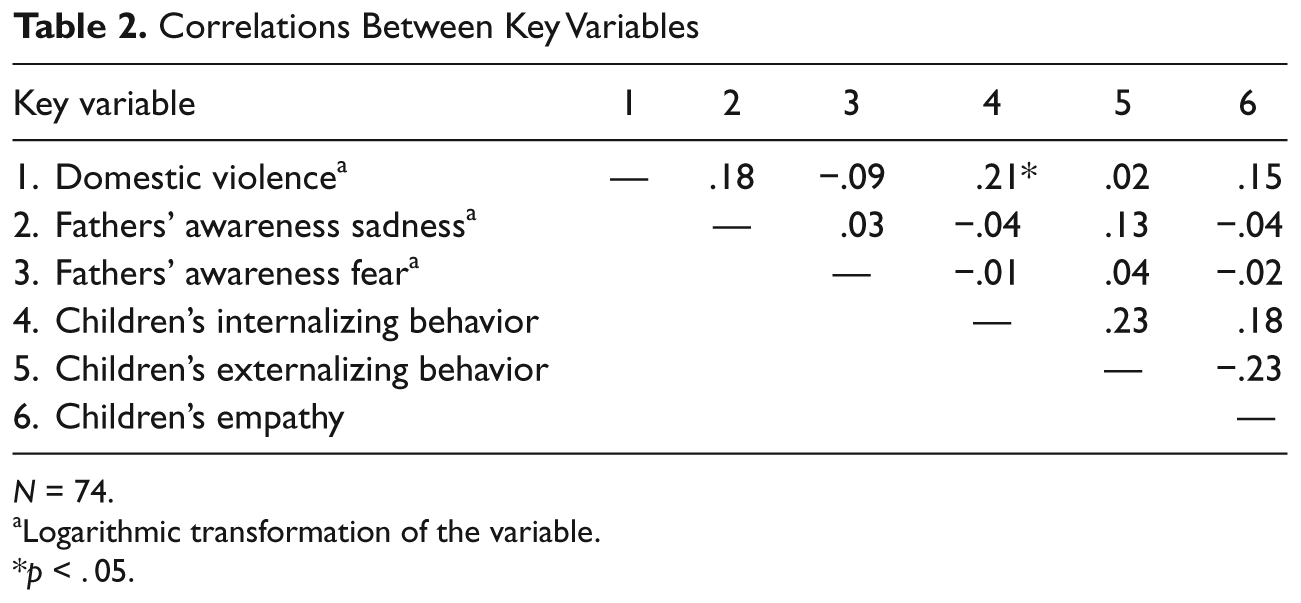
N = 74.
Logarithmic transformation of the variable.
p < . 05.
Given the proposed role of child sex in the relation between fathers’ awareness and children’s outcomes, t-tests were run to see if sex differences existed in self-reported internalizing and externalizing problems and empathy. Girls demonstrated significantly higher scores for both internalizing problems t(71) = −2.55, p < .05, and empathy t(70) = −6.21, p < .01. Results were not statistically significant for externalizing problems.
IPV as a Moderator
IPV was examined as a moderator of the relation between fathers’ awareness of various emotions and children’s internalizing and externalizing behaviors and empathy. Tests of moderation were conducted using hierarchical multiple regression with centered variables (Baron & Kenny, 1986). Six regressions were conducted: three using sadness as the predictor, and three using fear. Child sex was initially entered as the first step, the predictor variable (fathers’ awareness of either sadness or fear) and the moderator variable (IPV) were entered in the second step, and an interaction term, created from the product of the independent and the moderator variables, was entered in the third step. Results indicated IPV did not moderate the relation between fathers’ awareness of children’s sadness and children’s level of internalizing behaviors (p = .21), externalizing behaviors (p = .35), or empathy (p = .65). IPV also did not moderate the relationship between fathers’ awareness of children’s fear and children’s internalizing behaviors, p = .48. However, IPV did moderate the relationship between fathers’ awareness of children’s fear and children’s externalizing behaviors (β = 1.24, p = .003) and empathy (β = −.84, p = .02).
Regression lines were plotted to clarify the nature of the moderation effect (Aiken & West, 1991). Values of ± 1 standard deviation were used to create high and low values for fathers’ awareness of children’s fear. The lines for high and low awareness were plotted in relation to IPV for empathy and externalizing problems and slopes calculated. In homes with IPV (N = 26), as fathers’ level of awareness of their children’s fear increased, children’s externalizing problems also increased, β = 1.038, p < .05 (Figure 1). In homes where IPV was not reported (N = 48), as fathers’ level of awareness of their children’s fear increased, externalizing problems decreased, β = −.359, p < .05. With regards to empathy, in homes where IPV was reported, as fathers’ level of awareness in their children’s fear increased, children’s empathy decreased β = −1.027, p < .01. In homes where IPV was not reported, awareness of fear was not significantly related to empathy, β = .2651.72, p < .1 (Figure 2).

The moderating role of IPV on fathers’ awareness of fear and children’s externalizing problems.

The moderating role of IPV on fathers’ awareness of fear and children’s empathy.
The Unique Relationship Between Fathers and Sons
Given the hypothesis that fathers’ awareness would operate differently between male and female children, the statistically significant moderating models were run separately based on child sex. These results are primarily exploratory because of the small number of female children in this sample. Results indicated that in homes with IPV, as fathers’ awareness of their sons’ fear increased, children demonstrated increased levels of externalizing problems and decreased levels of child empathy β = 1.09, p < .01; β = −.911, p < .01, respectively. These results were not observed for girls. To determine whether the role of fathers’ awareness functioned differently than mothers’ awareness in homes with IPV, two moderating models examining the role of IPV in the relation of mothers’ awareness of children’s fear on externalizing problems and empathy in children were run. No significant results were obtained (p = .71 and p = .75, respectively).
Discussion
Research suggests that parents play a crucial role in child emotion socialization (Eisenberg, 1998). Exposure to IPV may lead to a variety of maladaptive psychosocial outcomes in children, in part because of its role in ineffective or inappropriate socialization around emotions. Emotion socialization may be further impacted by violent men’s gender-stereotyped traits and expectations, which influences intimate partnerships and relationships with their children (Jennings & Murphy, 2000). These gender-stereotyped parenting characteristics may be particularly important in the emotional socialization of male children (Leaper, 2002; Lytton & Romney, 1991). Results presented here provide preliminary evidence to this end, specifically that fathers’ awareness of children’s vulnerable emotions, particularly in boys, interacts with IPV and relates to negative psychosocial adjustment.
The hypothesis that fathers’ awareness of children’s emotions contributes to negative emotion socialization in homes with IPV was partially supported. When IPV is present, as fathers’ awareness of children’s fear increased, children demonstrated less empathy and greater externalizing problems. When IPV is absent, as fathers’ awareness of children’s fear increased, children showed fewer externalizing behaviors. Significant results were not found with regards to child internalizing behaviors or experience of sadness. These findings that fathers’ increased awareness of children’s fear is associated with negative psychosocial outcomes in homes with IPV are contrary to results in normative populations, and may best be interpreted in light of the literature around gender-stereotyped parenting and IPV. Although direct parenting behaviors were not assessed, these results raise the hypothesis that fathers may utilize awareness of vulnerable emotions in punishing or dismissive ways.
Preliminary results related to sex differences support the literature suggesting that fathers’ gender-stereotyped parenting practices may be more detrimental for male than for female children (Jankowski et al., 1999). In this sample, girls did not experience the same negative outcomes in externalizing behavior and empathy as boys, despite similar baseline levels of externalizing behaviors. Fathers who perpetrate IPV tend to be more fearful of their own vulnerable emotions and use aggression as a coping strategy (Jakupcak, 2003). They may communicate this same fear and aversion to their sons, but not their daughters, when teaching them how to handle feelings. Recognition of fear (and potentially sadness) in boys may also cue a fearful or defensive response in fathers in the form of invalidation, trivialization or overt punishment of the emotional experience. Future research on the father-son interaction around specific emotions in households with IPV will be important to tease out how and when fathers are validating and coaching versus invalidating or punishing of emotion.
It is interesting that the findings are not significant for sadness, which is also often conceptualized as a vulnerable emotion. This may be because of a number of factors. First, children report that parent’s socialization strategies vary depending on the specific emotion being socialized (O’Neal & Magai, 2005). Second, it may also be the case that children’s experience and expression of fear may be more pronounced in homes where IPV is present. IPV creates an unpredictable environment, which may lead to increased fearfulness in children (Bancroft & Silverman, 2002). It may be that fathers’ awareness of fear is less about being in-tune with their children’s emotional experience, and more about overt, frequent expression of fear by children.
There are a number of limitations to the study. The limited diversity in the sample did not allow us to explore differences by culture, which is known to exist around parenting practices. Also because this is a community sample, the incidence and severity of IPV are low. Because existing research suggests that even one occurrence of physical aggression can dramatically affect the household milieu, it is likely that the moderating role of IPV observed in this sample would persist in households with more severe violence (Fantuzzo & Mohr, 1999). Replication using a more diverse sample is needed to determine generalizability. In addition, examining alternative social-emotional outcomes such as peer relationships or emotion regulation would be interesting to further explicate the role of fathers’ awareness of emotions in children’s development. Although outside the scope of this paper, there are also biological and/or genetic factors that contribute to fathers’ parenting style (Maccoby, 2000). Finally, although this is a community sample in that none of the children were recruited from a clinical setting nor received formal diagnostic assessment, families were over-recruited for parent-reported CP. This may have impacted externalizing problems being identified as a significant outcome.
Although the study’s longitudinal design is a methodological strength, other factors may be contributing to observed outcomes. Additional data about these households during the intervening nine years, such as changes in the presence or severity of IPV, children’s contact with the perpetrator, and socio-economic status among other risk factors would contribute more to our understanding of these results and help drive prevention-intervention efforts. In addition, results should be interpreted in light of the evidence that IPV and child abuse often co-occur (Edleson, 1999), and that their collect effect on children can be difficult to tease apart.
This study suggests that father’s philosophy about emotion relates to child adjustment. This has implications for intervention with both children exposed to and men who perpetrate IPV, suggesting that gender-sensitive intervention approaches may be warranted with both groups. However, further research is needed to examine how philosophy translates into actual emotion socialization parenting behaviors, and where interventions may be most readily applied. It is likely that gender-stereotyped beliefs fueled, in part, by their discomfort with vulnerable emotions may lead fathers to invalidate, dismiss, or even punish certain emotions in their children. Observational assessments of father’s emotional socialization parenting behaviors will be crucial in addressing this question and constructing clinical interventions.
Footnotes
Acknowledgements
A special thanks to my advisor Lynn Fainsilber-Katz and my secondary advisor Lili Lengua. Additional thanks to Tami Rigterink and Kevin King for their assistance in data analyses, as well as Renay P.C. Bradley and Andrea Maikovich-Fong for insightful feedback on the conceptualization of this manuscript.
Author’s Note
I received my Bachelor’s degree from Bucknell University in 2006, with a degree in both biology and psychology. Upon graduation, I spent 2 years working at the Kempe Center for the Prevention and Research of Child Abuse and Neglect in Denver, Colorado, as a research assistant before beginning the Child Clinical Psychology program at the University of Washington in 2008. I am entering my fifth year of graduate training.
Declaration of Conflicting Interests
The authors declared no potential conflicts of interest with respect to the research, authorship, and/or publication of this article.
Funding
The authors disclosed receipt of the following financial support for the research, authorship, and/or publication of this article: This research was funded through a grant from the National Institute of Mental Health (1 RO1 49141) to the second author.