



Abstract
There are a number of ways that victims of violence informally handle attacks as they unfold. Their responses range in severity from physical resistance, to talking it out with the offender, to running away, to cooperating. Why do victims respond in a more or less severe manner? Cooney (2009) suggests that social distance is part of the answer: the further the relational or cultural distance between offender and victim, the more severe the latter’s response. Using National Crime Victimization Survey data, we test hypotheses derived from this theory and find oppositional findings. Specifically, results indicate that closer social distance predicts more severe responses. We conclude by discussing the implications of this finding for future work, especially as relates to the study of self-protective behavior.
In the course of being attacked, why does a victim react in a more or less severe manner? Why, for example, does one victim fight back but another argues with the offender, runs away, or cooperates? Building on previous work nested in the paradigm of pure sociology (Black, 1976, 1998), Cooney (2009) proposed a new answer to this question: the greater the social distance between victim and offender, the more severe the reaction by the victimized person. In this paper, we test hypotheses derived from this theory using National Crime Victimization Survey (NCVS) data. To our knowledge, this paper provides the first quantitative examination of its kind. We begin by providing a brief overview of social control and Cooney’s (2009) purely sociological theory of it. Then we specify our hypotheses and outline the data, sample, measures, and analytic approach. Finally, we present and discuss our results, including implications for future research and theory development.
Theorizing the Severity of Informal Social Control
Social control is a response to wrongdoing (Black, 1976, 1998, 2011). It may be formal or informal (Black, 1976, 1983), and reflexive or delayed (Jacobs & Wright, 2006). Formal social control refers to governmental responses to wrongdoing, such as arresting, prosecuting, or imprisoning an offender. Responses to deviance not involving the government are considered informal social control. Both formal and informal responses may be enacted reflexively, meaning during the initial transgression, or delayed.
Reflexive informal control includes a plethora of behaviors: self-defense, struggling, ducking, blocking blows, holding onto one’s property, chasing after or holding onto the offender; arguing, reasoning, pleading, or bargaining with the offender; running or driving away and hiding; cooperating or doing nothing. These responses are typologized in many ways. One approach is to divide them into forms of control (Black, 1998) based on who takes action in the course of managing conflict―the victim, the offender, both, neither, or a third-party―and which action is done by each party. Four forms of reflexive information control are considered in this manuscript: self-help, negotiation, avoidance, and toleration. 1 Self-help is a unilateral response by the victim against the transgressor. Negotiation refers to when disputants “talk out” the problem. Avoidance indicates a victim curtailing interaction with the wrongdoer. Toleration occurs when a victim takes no action beyond cooperation with the offender.
Each form of control has received ample academic attention in a variety of disciplines (for a modern-day sociological example, see Anderson, 1999; for historical and anthropological examples, see Black, 1998). Prior work tends to look at these forms of control as distinct behaviors rather than conceptualize and theorize them as distinct levels of a single variable. The questions for such studies are: Why do victims react to offenders with self-help? Or negotiation? Or avoidance? Or toleration? In other words, typically the emphasis has been on explaining individual forms of control one at a time, with different propositions for each. This approach is less than ideal as it reduces a theory’s parsimony (see Popper, 2002 [1959]). An exception to the piecemeal approach is research that groups the forms of control into the broad categories of “forceful” and “nonforceful” (see, e.g., Bachman, Saltzman, Thompson, & Carmody, 2002; Block & Skogan, 1986). This distinction is simple, but maybe too simple as prior research indicates that different kinds of forceful and nonforceful responses have diverse effects on victimization (see Tark & Kleck, 2002: 867). A good typology is simple (Cooney & Phillips, 2002) but should not come at the cost of obscuring important differences (Tark & Kleck, 2002).
Cooney (2009) suggested an intriguing way of conceptualizing the distinct forms of informal control as a single variable with multiple levels. He argues that each form rests at a different spot on a continuum of severity. “The more severe the sanction, the more people and groups shy away from it” (p. 204). Thus, the forms of control can be “arranged in order of how strongly they repel social actors” (p. 10): self-help being the most severe, followed by negotiation (especially that involving compensation), avoidance, and toleration. If valid, this continuum is an important idea because it brings these forms of social control together and thereby facilitates parsimonious explanations. Cooney’s conceptualization raises the question: Why do victims react to offenders with more or less severe informal control?
The Perspective of Pure Sociology
One answer to that question is nested in the paradigm of pure sociology (Black, 1976, 1995, 1998). Although there are many sociological theories of control, what distinguishes purely sociological theory is the unit of analysis (Black, 1995). Typically sociological theories examine groups (see, e.g., Messner & Rosenfeld, 2007) or individuals (e.g., Hirschi, 1969). Yet any given group or individual does not always behave the same way across all of their interactions. For example, even the most violent individuals do not commit retaliation in all of their conflicts (Cooney, 1998, 2009; Phillips, 2003). This suggests there is more to explaining social control than simply analyzing differences between individuals or groups. 2
Pure sociology’s unit of analysis is the social geometry of the case. A case is any given social interaction, such as a violent victimization or act of social control. Each case has a “social geometry” (Black, 1995), which is the social status of and social distance between persons involved in the interaction. For example, violent victimizations include an offender and a victim. Some offenders and some victims have more wealth, employment, family life, education, or respectability than others. The more a person has these things, the higher that person’s status. In addition, some offenders and victims are more familiar or culturally alike than others. The better two persons know each other or the more they share beliefs and modes of expression (e.g., language), the closer is the social distance between them. Pure sociologists explore how variation in the social status of and social distance between persons involved in an interaction―the “social geometry” of the case―influences their actions.
Cooney’s Theory of Informal Control Severity
Cooney (2009) proposed a “purely sociological” theory of why people respond toward offenders with a more or less severe form of control. His goal was to delineate how the handling of violent incidents, specifically homicides, is affected by the social status of and social distance between killers, murder victims, and other persons who could conceivably become involved in the case (e.g., family members). With an eye toward developing a general theory, his explanation is grounded on findings from modern, historical, and anthropological studies that involve a collection of diverse methods: “detailed firsthand observations, experimental manipulations, statistical analyses, historical narratives, in-depth interviews, and the like” (pp. 33-35).
This diversity of information led to a simple theory. Cooney (2009) provided five propositions: informal control is more severe when (1) a low-status person offends against a high-status person rather than vice versa; (2) the victim becomes higher in status; (3) the offender becomes lower in status; (4) the status of the victim and offender increases; and (5) the offense is among less intimate or culturally similar persons. 3
Examples drawn from Cooney’s (2009) secondary research illustrates these propositions. The effect of social status is evident in how “[a]mong groups as diverse as medieval Icelanders . . ., medieval and early modern Irish . . ., Tibetan pastoralists . . ., the Ifugao of the Philippines and the Mae Enga of New Guinea . . ., the wealthier the victim, the more compensation the killer must pay” (p. 58). And “the shooting of a leading gang member—a ‘ghetto star’—elevates not only the probability but the scale of vengeance: the survivors are more likely to kill and kill several times than they would be for the homicide of a rank-and-file member” (p. 85).
The effect of social distance becomes clear when considering that “[i]n the postbellum South, offenses (such as homicide) by whites against whites led to a lynching much less often than offenses by blacks against white. Moreover, when lynched, whites were less often tortured or mutilated than blacks” (p. 151). Similarly, “among the Mataco of the Gran Chaco, . . . located in central South America, the tendency to seek vengeance or compensation for a homicide is abrogated when the victim is a family member” (p. 179). 4
This Study
The goal of this research is to quantitatively test Cooney’s theory of informal control severity as pertains to victims’ reactions toward offenders in the course of a violent victimization. Specifically, the purpose of this research is to better understand why victims reflexively respond to attacks with self-help, negotiation, avoidance, or toleration. We test Cooney’s (2009) proposition that the immorality of offending is a direct function of social distance (i.e., relational and cultural distance). We hypothesize that victims use less severe forms of informal control during a victimization when they are (1) familiar with victimizers rather than strangers and/or (2) of the same race as them rather than different. For methodological reasons, we restrain our examination to the effect of social distance on reflexive informal control. The NCVS cannot be used to fully test the influence of social status on reflexive informal control because this survey does not systematically gather information on offenders’ income, employment, marital status, or formal education. Although this information is gathered for the victim, the lack of data for offenders entails the inability to examine the difference in status between an offender and victim.
Data
We test variants of our hypothesis using 1993 to 2009 NCVS data. These data are gathered continuously, in-person and over the phone from a nationally representative household sample. On average each year approximately 160,000 persons in 80,000 households are interviewed. Historically, response rates associated with the NCVS have been high (in the 90 and greater percentiles for households, and from the mid 80 percentiles and greater for individuals); for details on the NCVS methodology see Rennison and Rand (2007). The data are gathered using a series of screener questions identifying if a respondent was victimized during the preceding 6 months. Additional survey questions collected on an incident form gathers detailed incident characteristics regarding the victim, offender, and incident.
The NCVS offers several advantages for this research. First, it is characterized by a large sample of victimizations over a 17-year period. Second, the data are representative of non-institutionalized victims of crime age 12 or older. Third, the NCVS offers detailed incident-level information including the relationship between the victim and offender, weapon presence and the form of reflexive response enacted by victims during the incident. Finally, NCVS data contain information on victimizations regardless of whether the police were notified.
Sample
Our sample consists of attempted and completed nonfatal violent victimizations in which the victim came face to face with the offender and used reflexive informal control (e.g., attacked offender with a weapon, hid, cooperated, etc.). These victimizations include attempted and completed rape, sexual assault, robbery, aggravated assault, and simple assault. Rape is defined as forced sexual intercourse that includes psychological coercion and physical force, including heterosexual and homosexual rape, committed against both males and females. Attempted rape includes verbal threats of rape. Sexual assault consists of incidents involving attacks or attempted attacks generally associated with unwanted sexual contact between victim and offender. Sexual assaults may or may not involve force and include such behavior as grabbing or fondling; they also include verbal threats. Robbery constitutes property or cash taken directly from a person by use or threat of force, with or without a weapon, and with or without injury. Aggravated assault is defined as an actual or attempted attack with a weapon, regardless of whether injury resulted, or an attack or attempted attack without a weapon when serious injury results. Finally, simple assault involves an attack without a weapon resulting in either minor injury such as a bruise, cut, scrape or scratch or no injury.
However, our analyses are limited to violence involving White and Black victims and offenders (i.e., White-on-White, White-on-Black, Black-on-White, and Black-on-Black violence) as the research requires we identify when victim and offender race is similar or different. While NCVS data provides multiple categories for victim’s race (e.g., White, Black, Asian, American Indian, multiple races) it only provides four offender racial categories (White, Black, other, and unknown). It is unclear if “other” offenders correspond to Asian, American Indian, and mixed race victims, thus only White and Black victims and offenders were retained in the working file. These criteria resulted in a working file of 20,603 violent victimizations (unweighted) occurring from 1993 to 2009.
Measures and Analytic Approach
We model the degree to which different forms of reflexive informal control are used by victims as a function of social distance between the victim and offender. The dependent variable is reflexive informal control engaged in by the victim during the victimization. It is measured using four categories ranked from most to least severe: self-help, negotiation, avoidance, and toleration. Self-help refers to instances in which the victim threatened or successfully attacked the offender physically or with a weapon; it also includes instances when the victim chased off the offender and defended themselves or their property. Negotiation indicates that the victim argued or reasoned with the offender. Avoidance entails when the victim ran away, hid or locked the door to protect them self. Toleration indicates the victim did nothing or cooperated with the offender. Victimizations in which the victim engaged in multiple forms of reflexive informal control were coded at the most severe level.
The independent variable, social distance, is measured two ways. In some models it is measured as a combination of its two components: relational distance and cultural distance. Relational distance describes the closeness of the victim and offender: 0 = known and 1 = stranger. 5 Cultural distance identifies the similarity/difference between victim and offender race. Intraracial violence is considered closer in cultural distance, whereas interracial violence is considered further (0 = intraracial and 1 = interracial). When social distance is presented as a combination of cultural and relational distance, four categories are used: 0 = intraracial, known participants; 1 = intraracial, strangers; 2 = interracial, known participants; and 3 = interracial violence between strangers. In other models, the two components of social distance are analyzed separately to identify the contribution of each.
Additional relevant correlates of informal reflexive control are controlled for in the models. These include measures of the victim’s social status (wealth, employment, marital status, level of formal education), the type of violent victimization, victim and offender gender and age, and weapon presence. 6
To test the hypotheses, binary logistic regression is utilized. 7 Analyses accounted for the complex sample design of the NCVS using Stata’s survey weighting regression procedures (Hosmer & Lemeshow, 2000).
Results
An examination of the working file indicates that during violent victimization, victims were most likely to practice toleration during the attack (41%), followed by self-help (36%), avoidance (14%), and finally negotiation (9%). Most of the victimizations in the sample involved victims and offenders of the same race who knew one another (51%). Thirty-one percent of the violence was characterized by greater social distance (same race, strangers). Six percent of the violence involved known parties of different races. Finally, 12% of the violence occurred between victims and offenders of different races who were strangers. Most incidents were simple assaults (66%) and involve victims who were never married (57%), are male (56%), and residing in a suburban area (47%). See Table 1.
Descriptive Statistics, NCVS 1993-2009, Unweighted N = 20,603

Notes: Statistics are calculated based on weighted data.
In the NCVS, income is measured using 14 categories of unequal size: Less than $5,000 (as category 1), $5,000 to $7,499, $7,500 to $9,999,$10,000 to $12,499, $12,500 to $14,999, $15,000 to $17,499, $17,500 to $19,999, $20,000 to $24,999, $25,000 to $29,999$30,000 to 34,999, $35,000 to $39,999, $40,000 to $49,999, $50,000 to $74,999, $75,000 and over (category 14).
Social Distance and Reflexive Informal Control
The first series of binary logistic regression models presented in Table 2 investigate the influence of social distance on the severity of victims’ reflexive informal control. These models operationalize social distance (the independent variable) using four-categories representing the combination of relational and cultural distance. Three hypotheses are considered:
Reflexive self-help is more likely than negotiation, avoidance, or toleration among offenders and victims who are strangers and/or of different races rather than known to each and/or of same race.
Reflexive self-help or negotiation is more likely than avoidance or toleration among offenders and victims who are strangers and/or of different races rather than known to each and/or of same race.
Reflexive self-help, negotiation, or avoidance is more likely than toleration among offenders and victims who are strangers and/or of different races rather than known to each and/or of same race.
Binary Logistic Regression Models Predicting Type of Self Protection for Total Violence, 1993-2009 NCVS
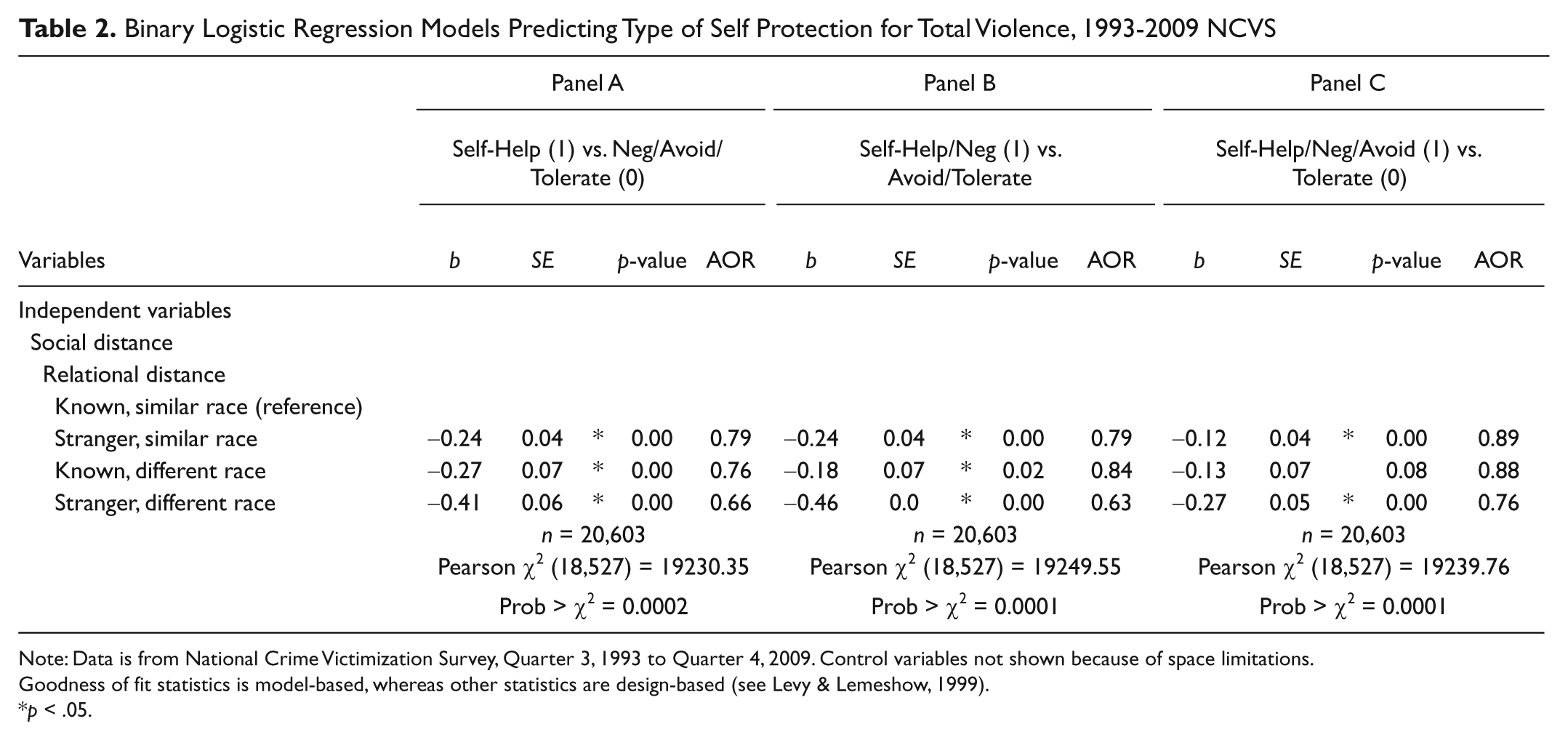
Note: Data is from National Crime Victimization Survey, Quarter 3, 1993 to Quarter 4, 2009. Control variables not shown because of space limitations.
Goodness of fit statistics is model-based, whereas other statistics are design-based (see Levy & Lemeshow, 1999).
p < .05.
Panel A in Table 2 examines the influence of social distance on forms of reflexive informal control measured as self-help (e.g., attacking with a weapon; coded as 1) versus less severe behaviors such as screaming, hiding, running away, or reasoning with the offender (i.e., negotiation, avoidance and toleration; coded as 0). Panel B compares self-help and negotiation (coded as 1) and avoidance and toleration (coded as 0). Panel C compares self-help, negotiation, and avoidance (coded as 1) to the least severe form of informal control, toleration (coded as 0).
Results in all three panels fail to offer support for the social distance—reflexive informal control hypotheses. Specifically, findings show that the greater the social distance between the victim and offender, the less likely the victim will use the most severe forms of informal control. Panel A indicates that reflexive self-help is significantly less likely than negotiation, avoidance, or toleration when offenders and victims have greater social distance. In terms of odds ratios, results show that moving from a known, similar race victim/offender to a stranger, similar race victim/offender reduces the odds of self-help (compared to negotiation, avoidance, or toleration) 21%. Increasing social distance from known similar race victim/offender to known different race victim/offender decreases the odds of self-help 24%, and results show that moving from a known, similar race victim/offender to a stranger different race victim/offender victimization reduces the odds of reflexive self-help (compared to negotiation, avoidance, or toleration) 34%.
Panel B offers similarly unexpected findings. Reflexive self-help or negotiation is less likely than avoidance or toleration as social distance grows. Specifically, reflexive self-help or negotiation is significantly less likely than avoidance or toleration as social distance increases. Findings indicate that moving from a known similar race victim/offender victimization to a stranger similar race victim/offender reduces the odds of self-help and negotiation (compared to avoidance or toleration) 21%. In addition, increasing social distance from known similar race victim/offender to known different race victim/offender decreases the odds of self-help 16%. Finally, the analysis shows that moving from a known, similar race victim/offender to a stranger of a different race victim/offender reduces the odds of reflexive self-help or negotiation (compared to avoidance or toleration) 37%.
Finding in Panel C are similar to those in Panels A and B. Reflexive self-help, negotiation, or avoidance is less likely than toleration as social distance increases. Reflexive self-help, negotiation, or avoidance is significantly less likely than toleration as social distance increases. Adjusted odds ratios show that moving from a known, similar race victim/offender to a stranger similar race victim/offender reduces the odds of self-help/negotiation or avoidance (compared to toleration) 11%. Moving from known similar race victim/offender to known different race victim/offender decreases the odds of self-help 12%. Results indicate that moving from a known, similar race victim/offender to a stranger of a different race victim/offender reduces the odds of reflexive self-help/negotiation or avoidance (compared to toleration) 24%.
Social Distance Disaggregated
An alternative approach to testing the hypothesis is to disaggregate social distance into its two components: cultural distance and relational distance. Presented in combination (as is done in Table 2), each component of social distance’s independent contribution is obscured. Thus, the following three models take the same form as those in the previous section with the exception that relational distance and cultural distance are entered separately. By disaggregating social distance in this way, one is able to examine the relative contribution of each component of social distance in influencing reflexive informal control behaviors.
Results in the three panels in Table 3 do not offer support for the social distance—reflexive informal control hypotheses. In fact, findings in each model indicate that the greater the social distance between the victim and offender, the less likely the victim will use the most severe forms of informal SP. Panel A results show that reflexive self-help is significantly less likely than negotiation, avoidance, or toleration as cultural distance increases. In other words, moving from a similar race to a different race dyad reduces the odds of reflexive self-help (compared to negotiation, avoidance, or toleration) 19%. Similar findings obtain when considering relational distance. As relational distance increases, the odds of reflexive self-help (compared to negotiation, avoidance, or toleration) decreases 21%.
Binary Logistic Regression Models Predicting Type of Self Protection for Total Violence, Expanded IV, 1993-2009 NCVS

Note: Data is from National Crime Victimization Survey, Quarter 3, 1993 to Quarter 4, 2009. Control variables not shown because of space limitations.
Goodness of fit statistics is model-based, whereas other statistics are design-based (see Levy & Lemeshow, 1999).
p < .05.
Panel B offers no support for the hypotheses. As cultural and relational distance increase, the odds of reflexive self-help or negotiation (versus avoidance or toleration) decrease. Specifically, as cultural distance increases, the odds of reflexive self-help or negotiation (compared to avoidance or toleration) decreases 19%. And as relational distance increases, the odds of reflexive self-help or negotiation (compared to avoidance or toleration) decreases 23%.
Finally, Panel C reveals that reflexive self-help, negotiation, or avoidance is less likely than toleration as cultural and relational distance increases. Adjusted odds ratios show that an increase in cultural distance (i.e., moving from same race to different race victim/offender dyad) reduces the odds of reflexive self-help, negotiation or avoidance (compared to toleration) 13%. An increase in relational distance (from known to stranger victim/offender dyad) reduces the odds of reflexive self-help, negotiation or avoidance (compared to toleration) 13%.
Discussion and Conclusion
During an attack, a victim can informally respond in a number of ways: tolerate, avoid, negotiate, and retaliate (Black, 1998). With data from the NCVS and while controlling for relevant correlates, we tested variants of the hypothesis that when victims and offenders are known to each other rather than strangers, or of the same race instead of different ones, they are more likely to utilize less severe forms of informal control (Cooney, 2009). The findings indicate a significant role of social distance in explaining the forms of informal control—but not in the predicted direction. As social distance between victims and offenders increased, the chance of more severe forms of informal control decreased: self-help was more likely than the less severe forms; self-help and negotiation less likely than avoidance and toleration; toleration more likely than the more severe forms. Our findings do not support Cooney’s (2009) theory.
Our research has limitations that may have affected the results and, if possible, should be circumvented down the road. For one, the NCVS does not include victimization of persons under age 12, nor does it offer insight into violence against institutionalized persons (e.g., prisoners) or the homeless. It is possible that the NCVS disproportionately undercounts victimization between intimates (Straus, 1999), which would obviously distort our findings. Finally, it is important to note that the reflexive behavior measures were based on victim responses; it could be that respondents misstate or misremember their behavior.
Regarding limitations in testing Cooney’s (2009) theory, we focused on reactions to a specific kind of conflict―violent victimization―but Cooney’s theory is meant to explain reactions to all kinds of conflicts, from theft to vandalism to adultery and beyond. Another limitation of our analysis is that it focuses on violent crime victims only while Cooney’s theory explains reactions of partisans (e.g., friends, family, and police) as well as victims. Relatedly, Cooney’s propositions also explain settlement, which is when a neutral third-party handles the offense, and praise; inclusion of these forms may change the results. Our measures are not as precise as preferred; relational distance is measured as a discrete rather than continuous variable, and the measure of cultural distance is limited and indirect. Although we included some aspects of social status in our models, we were not able to fully analyze and control for their effects; thus, this portion of Cooney’s theory remains untested.
Conflict as the Unit of Analysis and Self-Protective Behavior
In some respects, another limitation of our paper is it focuses on immediate responses but Cooney’s (2009) theory also explains delayed ones. As described earlier, the unit of analysis for this explanation of social control is the social geometry of conflict. Our unit of analysis has been the victimization situation, which is not exactly the same as conflict. A situation is a self-contained interaction, but “[a] conflict can begin and end in the same situation if the grievance and response occur in the same interaction” or “can involve multiple situations if the disputants continue to engage the grievance across multiple interactions, perhaps even for years on end” (Phillips, 2003, p. 674). At the extreme, a victim may delay vengeance for decades (see, e.g., Cooney, 1998). Thus, the optimum test of Cooney’s (2009) theory would involve following victims for years after the initial affront―up to the point they are dead―to see whether the offense is controlled. Although this is possible to accomplish, it is obviously difficult in practice. Therefore, tests of his theory will out of practical necessity need to restrict themselves to a more restricted timeframe―such as the victimization situation.
On that note, Cooney’s theory and the findings of this paper have implications for another body of research. Studies in “self-protective behavior,” or “SP” for short, are concerned with how and why people respond when being victimized, and the effect of reactions on offending outcomes (see, e.g., Block & Skogan, 1986; Kleck & DeLone, 1993; Melde & Rennison, 2010; Tark & Kleck, 2004). Thus, reflexive control and SP are different terms for the same behavior. This means the results of our analysis―greater social distance leads to less severe SP―deserve future attention from scholars working in this area. Why is it that greater social distance leads to less severe SP actions? Is it simply that greater social distance results in less severe informal SP, despite Cooney (2009) theorizing otherwise? Or are there other perspectives/theories that suggest a mediating factor? Or is it that the continuum of severity proposed by Cooney (2009) is conceptually off the mark?
Our results provide empirical grounding for a theory of SP severity. Although they could be interpreted through multiple frameworks, the predominant one in research on SP is the rationality perspective (see, e.g., Tark & Kleck, 2004). This framework argues behavior is guided by a risk-reward calculation that weighs the benefits and costs of alternative lines of action. The one with the greatest overall utility should be the one enacted (Clarke & Cornish, 1985). When seen through this theoretical lens, SP is concerned with minimizing personal injury or loss of possessions and obtaining retributive benefits by punishing the offender through formal or informal control (e.g., arrest by police). Social distance and SP severity may vary inversely because reputational concerns are at greater stake when being attacked by a stranger than acquaintance, friend, or family member, which results in a less tolerant response. Moreover, in interracial or stranger-on-stranger offenses the victim may feel less able to predict the attacker’s actions (and counter-actions) and, therefore, take a more peaceable approach. Thus, although victims may perceive offenses by strangers or racially different persons to be more immoral and deserving of more severe responses, it may be irrational to act on such perceptions during the course of being victimized. These hypotheses can be tested by analyzing whether (1) victims attribute different levels of utility to the various forms of control, (2) depending on their social distance from offenders, and (3) if this affects which form of control is used by victims toward offenders during victimizations.
Rather than theorize Cooney’s (2009) conceptualization of SP severity, another approach is to question its validity and, if necessary, refurbish it. The value of this conceptualization is it brings the forms of social control together by turning them into an ordered quantitative variable, which allows for more parsimonious theory. But if the conceptualization is invalid then explanations of it will be inherently limited. Although it seems reasonable to rank toleration―the absence of control―as the least severe of all, it is unclear why Cooney ranks self-help as more severe than negotiation, or it as more severe than avoidance (see Moskos, 2011). The only justification is that the severity of a response depends on its repulsion. But how is “repulsion” measured? Is repulsion analogous with deterrence―“shying away” from action for fear of punishment? If so, is it true in fact that self-help repulses more offenders than negotiation or avoidance? Is it, for example, worse to be slapped in the face (retaliation) or divorced (avoidance) than agree to pay a US$1,000 fine (negotiation/compensation)? Cooney (2009, p. 204, footnote 7) himself writes that informal control “does not typically have a system of well-defined stages.”
It is possible that Cooney made a conceptual misstep in rank-ordering the forms of informal control as he did. This is especially important to us because our paper tests his theory of this conceptual ordering. Our analysis resulted in findings that are opposite of what his theory predicts. Perhaps the reason for this contradictory finding is that the four forms of informal control (retaliation, negotiation, avoidance, and toleration) cannot neatly be “arranged in order of how strongly they repel social actors” (Cooney, 2009: 10). Generally, there is contention on whether SP typologies are useful, harmful, or needless. Such classifications are counterproductive if they significantly “obscure differences in the effects of specific victim actions” (Tark & Kleck, 2002: 867). For example, distinct kinds of resistance have been found to have contrasting impacts on victims’ injury (Kleck & Delone, 1993). Other scholars argue that the benefit of typologies resides in their ability to simplify varieties of empirical information (Cooney & Phillips, 2002) and, in turn, allow for greater theoretical parsimony (see Popper, 2002 [1959]; Kuhn, 1977). In our mind, a middle-road to these two approaches is the best path: “less is more” given that “less is valid.” Future work should continue searching for that middle-road. Doing so involves empirically demonstrating or refuting the validity of Cooney’s rank ordering and also developing alternatives to his idea.
Footnotes
Declaration of Conflicting Interests
The authors declared no potential conflicts of interest with respect to the research, authorship, and/or publication of this article.
Funding
The authors received no financial support for the research, authorship, and/or publication of this article.