



Abstract
In line with fear of crime research, schools should be secure places where pupils feel safe in order to function well. Various types of risk and promotive variables at school and pupil level may differently influence a pupil’s feelings of safety in school, the school surroundings, and at home. The aim is to elaborate and test a theoretical two-level model on risk and promotive variables by using national data from an Internet-based survey in all types of Dutch secondary education. The cross-sectional research involves 71,560 pupils from 185 schools. Confirmatory factor analysis and multilevel logistic regression analysis including latent variables are used to analyze the data. The results demonstrate that school size, pupil attainment level in education, and intactness of a pupil’s family have positive effects on a pupil’s feelings of safety in and around school and at home; overall negative effects concern the school’s curricular differentiation and a pupil’s playing truant and not feeling most at home in the Netherlands. A school’s social, teaching, and instructional qualities and a pupil’s being older, being a boy, and being baptized positively affect the feelings of safety in and around school. A school’s safety policy and rules of conduct have no effects. Attending a church or mosque has negative effects on a pupil’s feelings of safety around school and at home. The findings confirm part of the two-level model. The Internet-based data collection and feedback procedure enable each school to longitudinally assess and evaluate own results at school level; in addition, cross-sectional comparison of school results with national benchmarks is possible.
Keywords
Violence within schools receives a great deal of attention because of the complexity of this issue and the negative educational consequences for the pupils involved (see Peguero, 2011). The complexity is shown in research in which the cognitive and social functioning of pupils in schools is demonstrated to be dependent on various types of personal, social, pedagogical, curricular, organizational, and societal characteristics (Collier, 1994; Cronbach, 1983). To function well and feel safe in and around school, pupils should experience schools as secure and safe places where they can establish continuous learning progress without being confronted with antisocial behavior incidents related to bullying and violence, for example (Carbines, Wyatt, & Robb, 2006; Spano, Pridemore, & Bolland, 2012; U.S. Department of Education, 1994; U.S. Department of Health, Education, and Welfare, 1973). These authors demonstrate that different school theoretical and assessment models are used to investigate correlates, or possible causes, of characteristics and variables relevant to understand or explain school security and safety and the corresponding feelings of safety of pupils in and around school (see also Loeber, Slot, Van der Laan, & Hoeve, 2008). At national level, educational policy can regulate or direct the development and use of a variety of programs, projects, and instruments to assess or improve aspects of school safety (see also Cronbach, 1983). Dutch educational policy, for example, provides facilities to monitor school safety and violent incidents, and to apply social pedagogical and educational initiatives to reduce or prevent violence in primary, secondary, and higher education (Ministry of Education, Culture and Science, 2009). Comparable societal concerns and attempts to estimate and improve school safety are evident in countries like Canada (Beauvais & Jenson, 2002), the United States of America (Mayer & Furlong, 2010), the United Kingdom (Cowie & Jennifer, 2007), Australia (Carbines et al., 2006), and New Zealand (Office of the Children’s Commissioner, 2006).
Clear effects of national-level projects and programs on pupils have yet to be established, however (Mayer & Furlong, 2010; Mooij, 2005). A reason may be that too little structuring, consistency, and coordination exist between the support actions chosen at the national level and the real requirements and concrete facilities at the levels of the school board, school, class, and pupil. Another reason seems to be the lack of reliable and valid assessment and implementation of specific social pedagogical characteristics in schools and the consequent assessment of longitudinal safety effects with the pupils (Armstrong, 2011). Ferraro and LaGrange (1987) and Gray, Jackson, and Farrall (2011) discuss the fear of crime research and conclude that measurement of fear of crime should be improved by giving adequate attention to conceptualization issues, tapping of emotional aspects of feelings of safety concerning specific situations, and consistent use of reliable and valid measurement procedures. Mooij, De Wit and Polman (2008) used principal factor analysis to investigate the relationships between social and educational characteristics at school level and various types of social, instructional, and other characteristics of pupils, teachers, and support staff aggregated to school level. They found that, in schools where pupils showed relatively low scores in problem social behavior and high scores in experiencing safety, teachers and support staff had comparable scores. Also, schools characterized by higher levels of problem social behavior were characterized by lower levels of educational attainment and by being smaller in size (see also Klein & Cornell, 2010; Sutherland & Oswald, 2005). Henry, Farrell, Schoeny, Tolan, and Dymnicki (in press) emphasize that more consideration should be given to key school factors beyond the individual level. Social relationships between pupils, their family, peers, school, and the wider society should be positive and respectful, whereas school violence should be addressed as a collective challenge (see Fernández-Montalvo, López-Goñi, & Arteaga, 2012; Lim & Deutsch, 1996).
Comparable approaches become clear in the research of Carbines et al. (2006) and Mooij (1999a, 1999b). These authors use different types of variables in longitudinal monitoring at different educational levels to promote pupils’ safety and the corresponding feelings of safety at school. In this respect “risk factors” and “promotive factors” can be identified. Risk factors are “Factors in the child, family, peer group, school, or neighbourhood associated with an increased probability of disruptive or delinquent behaviour in youth” (Loeber et al., 2008, p. 5). Risk factors may include characteristics related to age, gender, family integration, playing truant, bullying, and other types of violent behavior. On the other hand, promotive factors are “Factors in the child, family, peer group, school, or neighborhood associated with: (a) a low probability of disruptive or delinquent behaviour in the general population of young people; and/or (b) desistance from disruptive and delinquent behaviour in populations of juveniles with such problem behaviours” (Loeber et al., 2008, p. 4). Overviews of risk and promotive variables are given, for example, by Monks et al. (2009) with respect to research on bullying in different contexts, including schools. Chen (2006) focuses on promotive factors in social skills interventions for pupils with various types of emotional and behavioral disorders.
Adequate research in this area then requires systematic study of different contexts and the functioning of individuals within these contexts. Quantitative studies integrating school variables relevant to school security and pupils’ feelings of safety appear to be rather scarce, however (Cowie & Smith, 2010; Office of the Children’s Commissioner, 2006). To improve a school-based approach with respect to experiences of school safety, several issues are at stake. First, theory and research should include variables at different levels, for example, variables expressing school social policy characteristics, curricular characteristics, and social behavior and safety characteristics of school leadership, the teachers and other staff, and the pupils (see Kirk & Gannon-Rowley, n.d.; Wilson, Douglas, & Lyon, 2011). Second, risk and promotive characteristics that are expected to be most relevant in the multilevel school context of pupils should be included, to strengthen the theoretical and practical relevance of the research at pupil level. Third, to demonstrate the potential importance of school social policy for the experiences of school safety of the pupils, theory and assessment should discriminate between feelings of safety with respect to different places, for example, being in school, around school, and at home, as is being emphasized in fear of crime research (see Ferraro & LaGrange, 1987; Gray et al., 2011). To realize some concrete steps into this direction, our first goal is to elaborate a theoretical two-level model concerning promotive and risk variables with respect to a pupil’s feelings of safety in school, around school, and at home. Our second goal is to empirically test this hypothetical model by data of secondary schools and secondary pupils.
Theoretical Model
School-Level Variables
A school can be defined as a complex organization in which various types of professionals, such as teachers and school leaders, collaborate to create and maintain secure and safe educational conditions in order to assist pupils or students in their learning processes, to optimize the learning outcomes. In this school context, curricular differentiation of learning is an organizational procedure used by teachers to adapt the learning processes and outcomes to relevant learning differences between the pupils. For example, learning processes are differentiated according to the level of attainment, the level of comprehension of Dutch language, learning speed, or learning enquiries of the pupils in class. Such curricular differentiation of learning programs in line with learning characteristics of the pupils actually present is expected to support the learning progress and learning results of the pupils and to reduce their negative experiences at school, including their aggression and drop-out rates (Carbines et al., 2006; Monks et al., 2009; U.S. Department of Health, Education, and Welfare, 1973). Compared with a lower degree of teachers’ use of curricular differentiation, a higher degree of differentiation in a school’s teaching and learning processes will provide more cognitive and school-based social support for the pupils and, therefore, promote their feelings of safety at school (Kirk & Gannon-Rowley, n.d.; Sharkey, Shekhtmeyster, Chavez-Lopez, Norris, & Sass, 2011). According to this school research, curricular or instructional differentiation approaches used by teachers in their daily lessons with pupils are then assumed to potentially influence a pupil’s feelings of safety in a positive way (see category 1.1 in Figure 1).
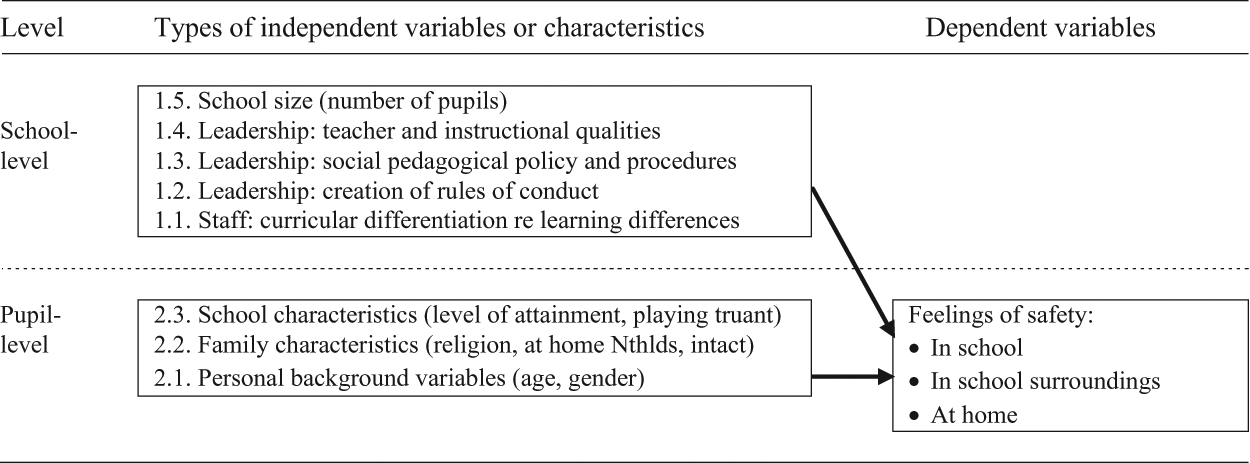
Theoretical model of school- and pupil-level effects on a pupil’s feelings of safety in school, around school, and at home
In addition, school social policy and social behavior strategies, procedures to deal with or prevent violent incidents, and procedures to improve social, teaching, and instructional qualities, as indicated by school leadership, seem to play a role (Mooij, De Wit, & Fettelaar, 2011; Lim & Deutsch, 1996; Parker & Martin, 2009; Sørlie, Hagen, & Ogden, 2008). Qualitative studies such as those by Beauvais and Jenson, and Carbines et al. clarify the close interconnectedness between these school characteristics. School policy aspects are expressed, for example, in activities to increase pupils’ involvement in school, specification of required teaching qualities of teachers, attention to adequate instruction and learning progress of pupils, and collaboration with external pedagogical or educational institutions and the police to supervise the social behavior of pupils in and around school. As suggested in the qualitative research, such social policy aspects may advance the degree of social security and safety of a school and, as a consequence, promote the pupils’ feelings of safety in the school and in the school surroundings (see Beauvais & Jenson, 2002; Carbines et al., 2006; Mayer & Leone, 1999; see Figure 1).
Furthermore, variables directly characterizing the school appear to be relevant. Compared with smaller schools, schools physically larger in size, with a higher number of pupils, are characterized by higher levels of safety felt by pupils (Mooij et al., 2008; Klein & Cornell, 2010). This effect is expected to occur more with respect to feelings of safety in school and in school surroundings, than concerning the feelings of safety at home.
Pupil-Level Variables
In addition to school-level variables characterizing a school, pupil variables directly characterizing the pupil as a person, or pupil variables resulting from a pupil’s interactions with different environmental situations, may differently influence a pupil’s feelings of safety (see also Ferraro & LaGrange, 1987; Gray et al., 2011). From a very young age, personal background characteristics such as age and gender, and environmental characteristics reflecting social, cultural, and educational characteristics of the family, interact with developing personal characteristics and a person’s social behavior characteristics (Moffitt, 1993; Pellegrini, Bartini, & Brooks, 1999). Research demonstrates that adolescents, for example, generally behave more antisocially than other ages, and boys behave more violently than girls (Farrow & Fox, 2011; Loeber et al., 2008; see Figure 1).
A pupil’s family-related variables can be expressed in being religious or not, feeling most at home in the country in which one actually lives or not feeling most at home in this country, or whether or not the family is intact or complete (e.g., parents are not divorced; Beauvais & Jenson, 2002; Carbines et al., 2006; Lee, Borden, Serido, & Perkins, 2009; Peguero, 2011). These researchers demonstrate that in particular feeling most at home in the country in which one actually lives, and intactness of family, can be expected to positively affect feelings of safety in school, in school surroundings, and at home. Their research reveals that not feeling most at home in the country one actually lives in has a negative effect with pupils from various ethnic minorities or immigrant backgrounds. Furthermore, the research illustrates the relevance of religion. Religious people may behave more sociably than nonreligious people and help or support others; however, being religious also appears to be related to more dogmatic and antisocial behavior. Being religious may thus function either as a promotive or a risk variable with respect to feeling safe, dependent on the specific situation, for example, in school, around school, or at home (see Ferraro & LaGrange, 1987; Gray et al., 2011). In addition, educational variables like a pupil’s level of attainment in education are expected to be relevant (see also Boulton, Chau, Whitehand, Amataya, & Murray, 2009). Attaining a higher educational level strengthens the emotional bond between the school as an organization and the pupil’s aims and functioning in school; therefore, attainment of a higher educational level will increase the pupil’s feelings of safety in school. On the other hand, playing truant may (partly) be a product of attending an unsafe school, but will also negatively affect a pupil’s feelings of safety in school (see Figure 1).
Method
National Monitor on School Safety
In 2005 the Dutch Ministry of Education, Culture and Science initiated a two-yearly national survey to investigate school safety in secondary education. Dutch pupils start secondary education around the age of 12. They are usually streamed, or differentiated, into various levels of academic achievement. The levels within a school may range from the lowest level (special education, for pupils with one or more specific needs), to practical education, support education (LWOO), and other variants of junior vocational education (VMBO), to general education (HAVO) and the highest level—university preparatory education (VWO). The Ministry wanted to monitor secondary school security and the pupils’ violence experiences and their feelings of safety once in every 2 years, to be informed about relevant developments at national level.
To realize a first step of this national survey, all 1,642 secondary schools in the Netherlands received a letter explaining the goal of the study and an invitation to participate. This could be done by nominating a “monitor manager” responsible for the organization of the Internet-based data collection within the school. This person was also the contact person for the research institute and was expected to create log-in codes for pupils, teachers and support staff, and school leaders, via a confidential log-in procedure. The digital instrumentation was implemented in three separate questionnaires for school leadership, teachers and support staff, and pupils, respectively. Pilot versions of the instruments were tested at secondary schools for all levels of attainment. This led to adjustments regarding the number and nature of variables, wording, and layout. Data collection took place during January and February 2006 and, after minor modifications of the questionnaires, during the first 2 months of 2008 and in 2010 and 2012.
Multilevel Design
The design of the research is longitudinal at national level and, dependent on the voluntary participation of a school during successive years, longitudinal or cross-sectional at school level. At pupil level data collection is cross-sectional, which implies that secondary analysis to test Figure 1 is also based on a cross-sectional design. As comparable data sources with longitudinal data at pupil level do not seem available, we will verify the empirical relevance of Figure 1 by carrying out secondary analysis on part of the data collected in the year 2008.
Data Collection and Analysis
All pupils and staff were asked to report on a period of approximately 5 to 6 months, that is, from the summer holidays 2007 until questionnaire completion early in 2008. This specification is in line with the recommendations of Ferraro and LaGrange (1987) and Gray et al. (2011). The questionnaires were completed by 78,840 pupils, 6,230 teachers and support staff, and 606 members of school leadership, from a total of 219 secondary schools. As the number of schools in which school leadership participates is 185, analyses in which school leadership scores are involved can be carried out with respect to data of 185 schools. Participation of pupils was representative of level of educational attainment and participation of secondary schools was representative of degree of urbanization in the Netherlands (see Mooij et al., 2008). Data analyses were carried out with the Statistical Package for the Social Sciences (SPSS, version 17.0) and Mplus (version 6.0; Muthén & Muthén, 1998-2010).
Measurement and Reliability of Variables
The personal background variables of pupils were age (in years) and gender (boy = 0, girl = 1). Family variables were being religious (answer categories were, respectively: not religious; baptized but not attending church, mosque, synagogue, or temple; attending church, mosque, synagogue, or temple). Each category was transformed into a dichotomous (0/1) variable. Feeling most at home in a specific country was made dichotomous (most at home in the Netherlands = 0, most at home in another country = 1). Whether the pupil was growing up in an intact or complete family was coded as no = 0 (living with mother, with father, with a step-family, etc.) and yes = 1. Level of attainment in education was a categorical variable with six categories (see the first Method section). Playing truant was measured dichotomously (no = 0, yes = 1). In line with Ferraro and LaGrange (1987) and Gray et al. (2011), the feelings of safety were measured with respect to different specific situations in school, the neighborhood of school, and at home. Moreover, feelings of safety in school referred to specific places (in the classroom, study or work rooms, in the corridors, canteen, bathrooms, hall and lockers, school grounds). The seven items were assessed dichotomously (not safe = 0, safe = 1); their alpha scale reliability is .90 (see Table 1). Feelings of safety around school and at home were each measured by dichotomous items (not safe = 0, safe = 1). These pupil data were included at individual or pupil level in the statistical analyses.
Results of Alpha Reliability Scale Analyses on Data of Pupils, Staff, and Leadership

Staff information about teachers’ degree of curricular differentiation of lessons was classified as four items representing differentiation according to the pupils’ actual learning level, their language level in Dutch, their learning speed, and their interest in learning issues (see Pashler, McDaniel, Rohrer, & Bjork, 2008). Each item was completed by specifying the percentage of lessons that were differentiated accordingly. The reliability coefficient alpha of this scale was .90 (see Table 1).
Members of school leadership were questioned in relation to school size. Furthermore, they completed items about the school’s attention to the involvement of pupils and the educational and instructional qualities and procedures of teachers. Item answer alternatives ranged from never = 0 to always = 9. In addition, they completed items on the school’s social safety policy, procedures to formulate rules of conduct and manage social behavior problems and incidents, and internal and external school measures to counter violent behavior. Item answer alternatives for the conduct items were dichotomous (no = 0, yes = 1) and the other items ranged from never = 0 to always = 7. All leadership items were involved in principal factor analysis followed by alpha scale analysis on each set of items loading high on the same factor. The alpha reliability coefficients vary between .62 and .88. Generally, an alpha coefficient of .60 is considered to be a minimum value and .80 is evaluated as good. Information about the resulting eight scales, the numbers of items per scale, and the respective alpha coefficients can be found in Table 1.
The scores of staff and school leadership were then aggregated at school level (N schools = 185). These school means were included as school data in the multilevel statistical analyses.
Analysis
We first present descriptive results of univariate analysis of the data at pupil level and at school level. In a second analysis step we aggregate school leadership scores at school level, to create school scores. By means of Mplus, the eight aggregated leadership scale scores are included in confirmatory factor analysis (CFA; maximum likelihood estimation) to create “latent constructs” reflecting the information in the observed school mean variables. Gray et al. (2011) emphasize the use of latent variable modeling to statistically explore relationships between multiple variables where some or many of the variables are “unobserved” or “latent.” In the relevant measurement model, observed school-level variables are then explained by one or more underlying latent constructs and, in addition, by specific measurement error (“e”).
In a third analysis step, the latent constructs are integrated in multilevel logistic regression analysis with random intercept using school- and pupil-level data. “Random intercept” means that school means are allowed to vary in the analysis. Mplus is used to carry out a maximum likelihood analysis (MLR procedure, type = two level). According to Muthén and Muthén (1998-2010), the MLR procedure is characterized by logit estimates with standard errors that are robust to non-normality and non-independence of observations. Partial regression coefficients assess the change in an estimated logit (log of the odds ratios) for a unit change in the value of a specific predictor with other variables held constant.
Results
Variables at Pupil Level
Table 2 presents univariate outcomes in percentages of 71,560 pupils without missing scores. The three dichotomous dependent variables are distributed unequally: Most of the pupils feel safe in school, its surroundings, and at home.
Univariate Results in Percentages of Dependent and Independent Pupil-Level Variables
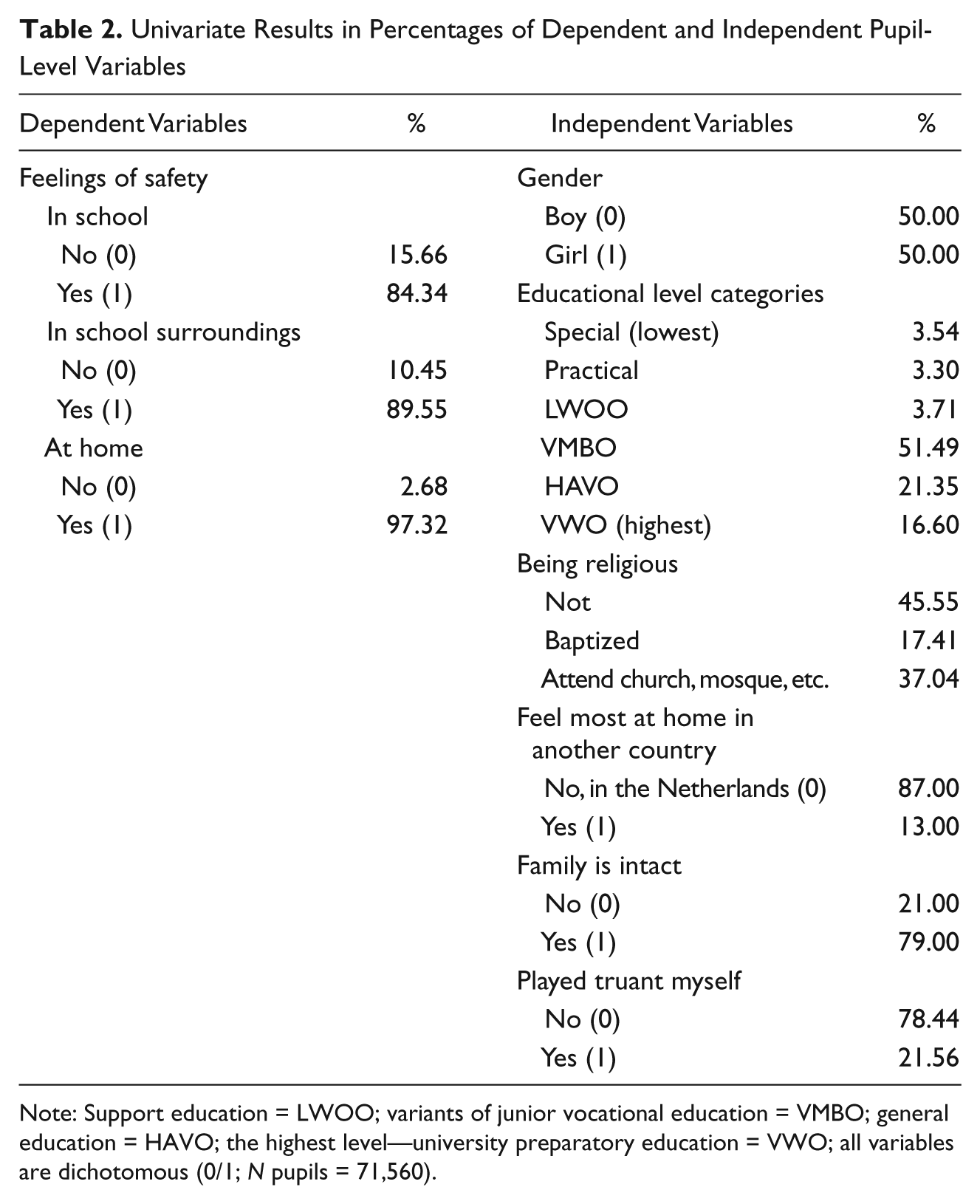
Note: Support education = LWOO; variants of junior vocational education = VMBO; general education = HAVO; the highest level—university preparatory education = VWO; all variables are dichotomous (0/1; N pupils = 71,560).
The percentages of participating boys and girls are the same. The percentages concerning attainment levels differ a lot, which however is in line with variation at national level (Mooij et al., 2008). Being religious is also distributed unevenly: Relatively most pupils are not religious (45.5%), whereas 37% attend a church, mosque, synagogue, or temple. About 13% of pupils state they feel most at home in another country than in the Netherlands. Furthermore, 79% live in an intact family and 21.6% state they played truant during the last half year. Not included in Table 2 is the outcome on age, which varies from 9 to 22 (M = 14.3, SD = 1.5; N = 71,560).
Variables at School Level
Descriptive results of the school-level variables are given in Table 3. Curriculum differentiation used by teachers during their lessons varied around a mean percentage of 66, whereas school size ranged from 21 to 2,336 pupils per school.
Descriptive Statistics of Aggregate Variables at School Level (N Schools = 185)
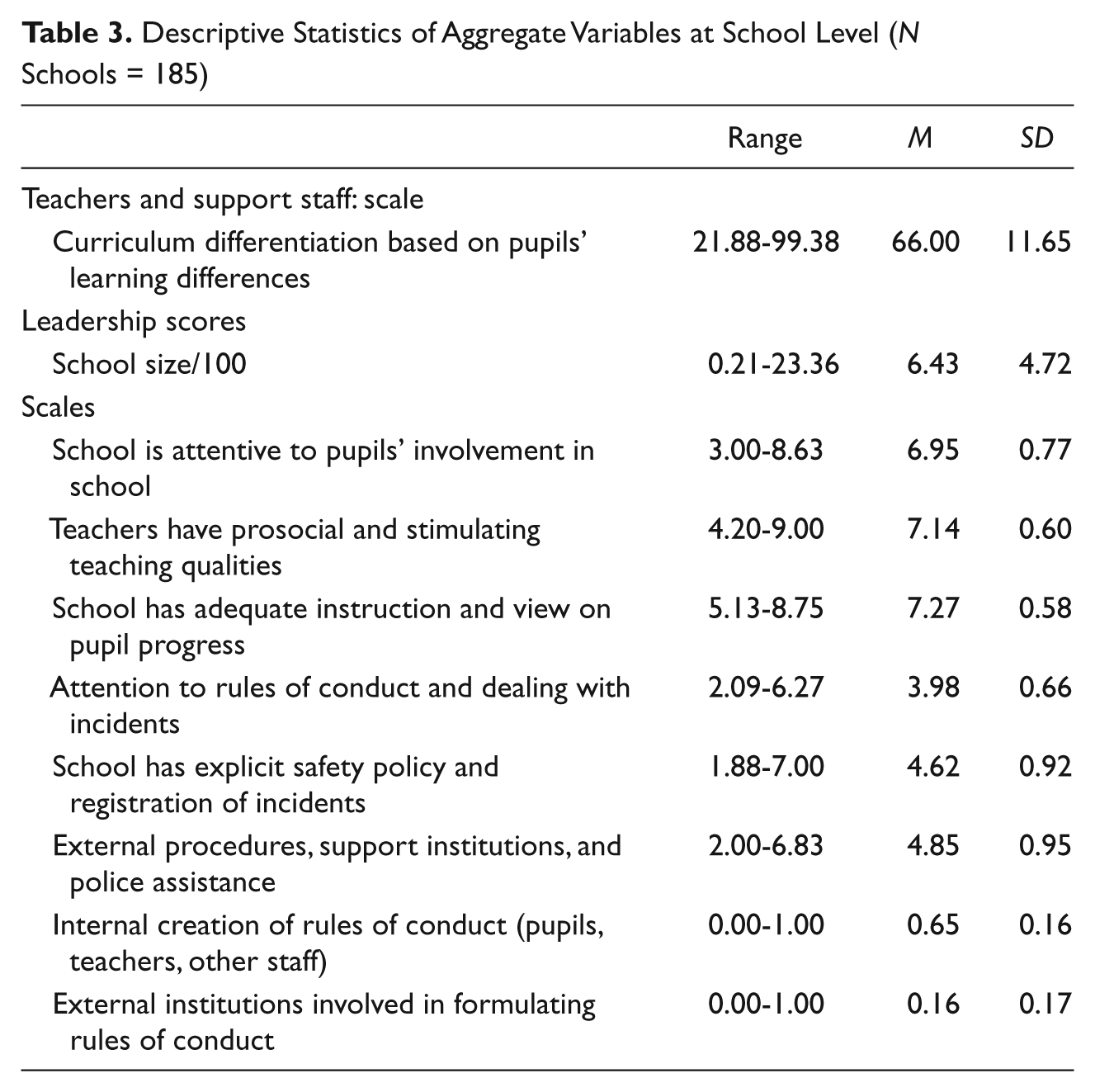
As many as 185 of the 219 schools took part in the leadership survey, so leadership scores were available for this number of schools. The eight aggregated leadership scales of Table 3 were included in CFA, which, after some exploration, showed that a model containing three latent constructs turned out to be relatively optimal (see Figure 2).
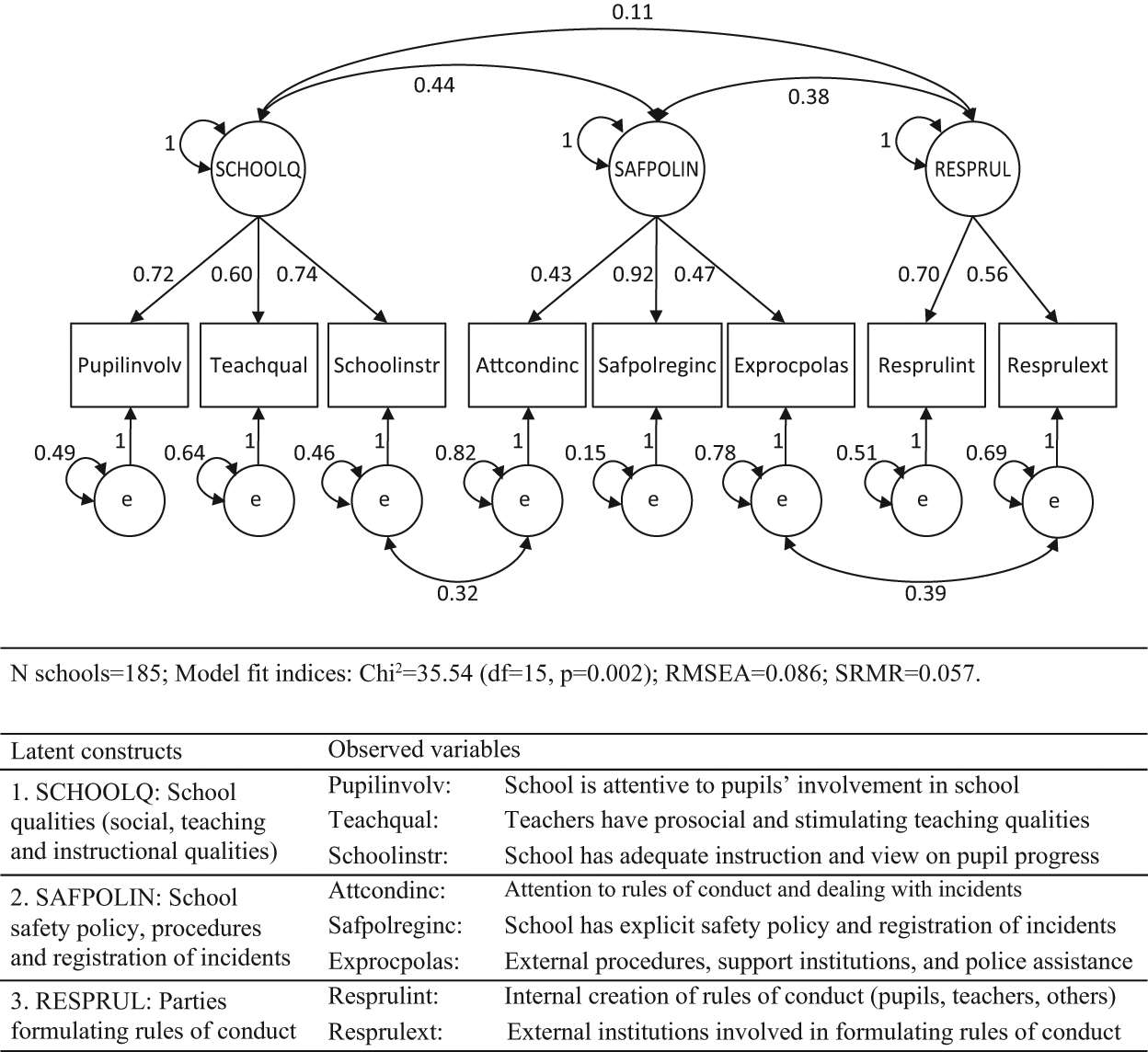
Measurement model of latent constructs (school leadership variables at school level)
In Figure 2, the latent constructs are SCHOOLQ (school qualities: social, teaching, and instructional qualities), SAFPOLIN (school safety policy, procedures, and registration of incidents), and RESPRUL (parties involved in the formulation of rules of conduct). Construct SAFPOLIN implies the functioning of rules of conduct, which are measured explicitly by RESPRUL. This relationship is expressed in their correlation (r = .38). Latent constructs SCHOOLQ and SAFPOLIN (r = .44) both have to do with promotive school aspects like social involvement and social policy to improve school safety. The relationship between SCHOOLQ and RESPRUL (r = .11) is relatively low. It therefore seems that social, teaching, and instructional school qualities do not have much in common with factors like parties involved in and responsible for the formulation and control of rules of conduct. Moreover, some of the measurement errors between the observed variables covary. This covariation has to do with commonalities relating to school instruction and registration, and external institutions or parties involved in the management of incidents and rules of conduct (see Figure 2). All parameter estimates are significant at p ≤ .05, except the covariation between latent constructs SCHOOLQ and RESPRUL. Moreover, all parameters are standardized. The loadings of the latent constructs on the observed scale variables can therefore be interpreted as beta coefficients (Heck & Thomas, 2009).
Various procedures can be used to test whether the overall measurement model of Figure 2 matches the observed survey data on school policies. The χ2 test of the model in Figure 2 verifies whether the null hypothesis of a perfect fit is true. This hypothesis is rejected (p = .002). A χ2 test, however, is usually too strict. Another measure is the “root mean square error of approximation” (RMSEA), in which a perfect fit is not assumed. The value of RMSEA is 0.086, which is closer to a reasonable fit (0.05-0.08) than to a bad fit (≥0.10; Kline, 2005). Because of the relatively low number of cases (N schools = 185), the 90% confidence interval varies between 0.050 and 0.123. A third relevant measure is the “standardized root mean square residual” (SRMR). This indicator presents the mean absolute value of the difference between the real correlations and the correlations predicted by the model. In our case, SRMR is 0.057. According to Kline (2005), values of SRMR below 0.10 refer to a good model. This applies to our results. We attempted to construct some alternative models to the model in Figure 2, but these did not result in improved statistics.
School- and Pupil-Level Effects
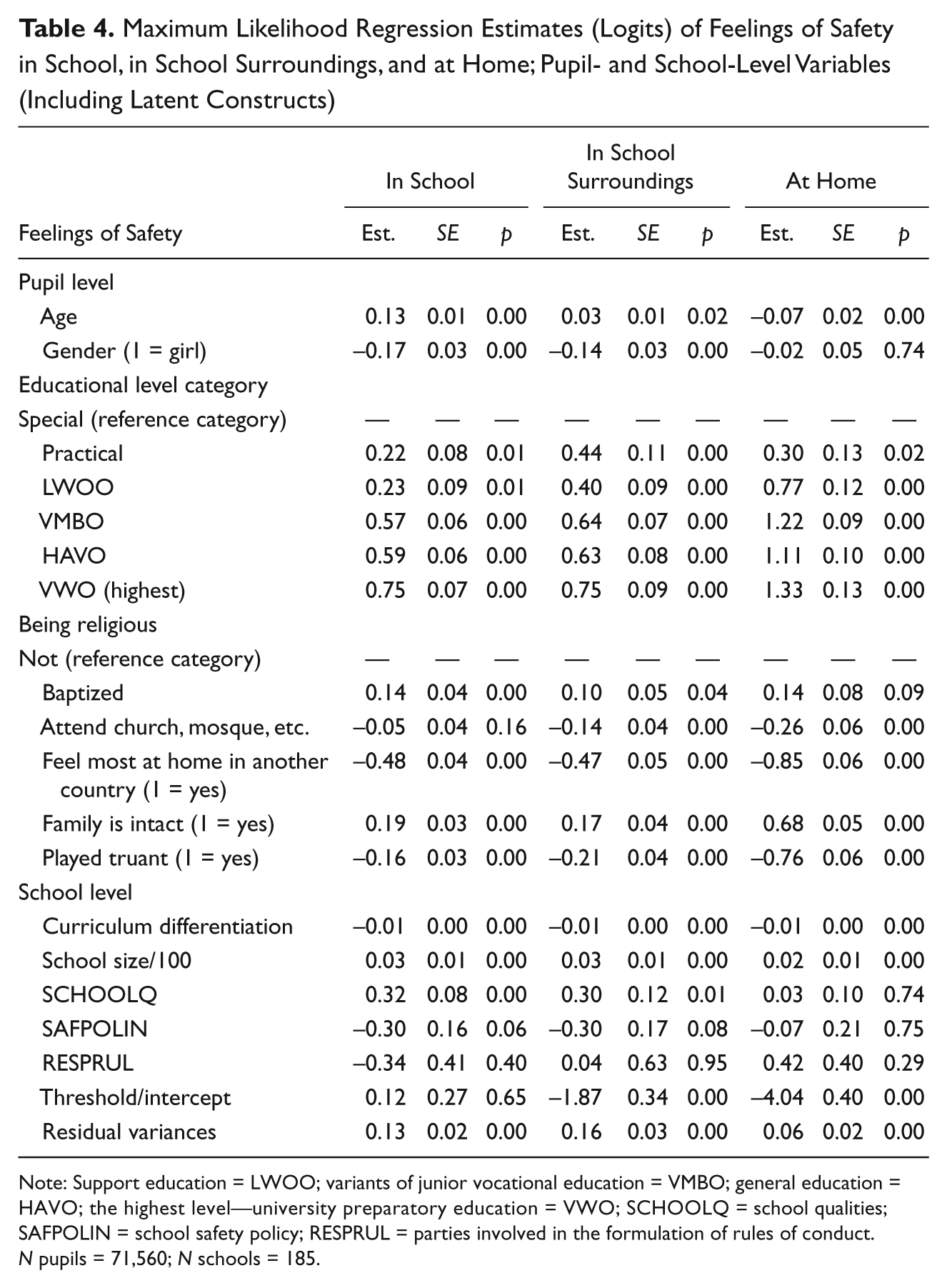
Mplus was used to calculate MLR results with respect to the feelings of safety in school, in school surroundings, and at home, respectively. Details of the outcomes are given in Table 4 and an overview of results is presented in Figure 3.
Maximum Likelihood Regression Estimates (Logits) of Feelings of Safety in School, in School Surroundings, and at Home; Pupil- and School-Level Variables (Including Latent Constructs)
Note: Support education = LWOO; variants of junior vocational education = VMBO; general education = HAVO; the highest level—university preparatory education = VWO; SCHOOLQ = school qualities; SAFPOLIN = school safety policy; RESPRUL = parties involved in the formulation of rules of conduct. N pupils = 71,560; N schools = 185.

Simultaneous two-level influences on a pupil’s feelings of safety concerning different places
The MLR logit results in Table 4 indicate that both school- and pupil-level variables are statistically relevant in affecting a pupil’s feelings of safety, but to different degrees, and differently with respect to the three different places. Overall positive or promotive effects are exerted by the school-level variable “school size” and the pupil-level variables “level of attainment in education” and “intactness of family,” overall zero effects exist in relation to school-level variables SAFPOLIN (school safety policy, procedures, and registration of incidents) and RESPRUL (parties involved in the formulation of rules of conduct), and overall negative effects appear in relation to school-level variable “curricular differentiation with respect to learning differences between pupils” and pupil-level variables “playing truant” and “feel not most at home in the Netherlands.” Very positively significant in school, positively significant in school surroundings, but not or negatively significant at home are SCHOOLQ, and, at pupil-level, “age” (older pupils feeling safer than younger pupils in school; at home this is the other way around) and “being baptized” (positive effects in school and in the school surroundings; no effect at home). “Gender” is negatively significant in school and in school surroundings (boys feeling safer than girls), but this variable does not matter at home. Finally, attending a church or a mosque is not relevant to feelings of safety in school, but this variable negatively affects the feelings of safety in school surroundings and at home (see Table 4 and Figure 3).
Another perspective on the results can be obtained by looking at the odds ratios at individual pupil level and standardized effects at school level (see Table 5). Odds ratios are antilog transformations of logit estimates; for example, in Table 5 the effect for “age” in the column “in school” is 1.14. The interpretation is that, for every additional year, the chance to feel safe in school increases by or is multiplied by 1.14. In school surroundings, the increase is 1.03 and at home 0.94. This last figure thus clarifies that becoming older reduces the feelings of safety at home. At school level, dependent variables in Mplus are continuous latent variables and odds ratios cannot be retrieved. The linear school effects are standardized (see also Heck & Thomas, 2009) and show that, for example, curriculum differentiation has negative effects on the three types of feelings of safety; school size consistently has positive effects; and the effect of SCHOOLQ is discriminative according to the place specified.
Odds Ratios at Pupil Level and Standardized Effects at School Level

Note: Support education = LWOO; variants of junior vocational education = VMBO; general education = HAVO; the highest level—university preparatory education = VWO; SCHOOLQ = school qualities; SAFPOLIN = school safety policy; RESPRUL = parties involved in the formulation of rules of conduct; N pupils = 71,560; N schools = 185.
Discussion
Conclusions
We concentrated on theoretical and empirical elaboration, at both school and pupil level, of promotive and risk variables to explain a pupil’s feelings of safety in school, in the neighborhood of school, and at home. Our theoretical model in Figure 1 illustrates that a school is supposed to function as a complex organization in which various types of professionals such as teachers and school leaders collaborate to promote school security and to assist pupils in their learning processes, to optimize their learning outcomes and corresponding feelings of safety. The impact of these school influences is expected to differ according to situation such as in school, around school, and at home. Curricular differentiation of learning is for example used by teachers to adapt learning to relevant learning differences between pupils; this differentiation is expected to support learning progress and learning results of pupils and to reduce their negative experiences at school, including their aggressive behavior and drop-out rates. An empirical test of Figure 1 was realized by secondary analysis of Dutch national research in secondary education. In 2008, data were gathered by Internet-based questionnaires for pupils (N = 71,560), teachers and other staff, and school leadership (N schools = 185). Data were analyzed by latent construct analysis and two-level maximum likelihood logit analysis.
The results of the empirical verification of Figure 1 show that the expected positive effects of school size and the school’s social, teaching, and instructional qualities on a pupil’s feelings of safety have been found. However, a school’s safety procedures and policy and parties involved in the formulation of rules of conduct have no effects in the context of this research. Contrary to expectation, a school’s degree of curricular differentiation with respect to learning differences between pupils has a negative effect. Simultaneously, at pupil level, being older has positive effects in and around school but negative effects at home. As expected, higher levels of educational attainment, less truancy, intactness of family, feeling most at home in the Netherlands, and being a boy promote or positively affect a pupil’s feelings of safety in school and in school surroundings. Being older and being baptized have positive effects in and around school, but at home these variables have no effects (being baptized) or negative effects (being older). Attending a church or a mosque and feelings of safety in school are not related, but attending a church or mosque negatively affects feelings of safety in the school surroundings and at home.
As we conducted a hierarchical two-level analysis in which both school- and pupil-level data were analyzed simultaneously, the individual effects at pupil-level are corrected for school-level relationships and the school-level effects are corrected for the pupil-level effects. Such multilevel corrections are emphasized also by Gray et al. (2011) and Henry et al. (in press); these last researchers use this approach to improve school-based research with respect to aggression and attitude information of middle school students. Furthermore, our finding concerning the promotive effect of school size is externally validated by comparable research results of Klein and Cornell (2010) and Mooij et al. (2008), whereas the positive effects of the social, teaching, and instructional characteristics are in line with the whole-school model of the Office of the Children’s Commissioner (2006). In addition, our results align the research outcomes on the impact of school connectedness on violent behavior and feelings of safety (Chapman, Buckley, Sheehan, Shochet, & Romaniuk, 2011) and the quantitative results of Kirk and Gannon-Rowley (n.d.). It has to be recognized however that a theoretical model like the one in Figure 1, or a comparable quantitative test of such a model, does not seem to exist. In this respect, theorizing and research on school characteristics, school security, and pupils’ corresponding feelings of safety need further development.
We did not expect to find the overall negative effect of curriculum differentiation. It has to be noticed however that this curriculum differentiation effect occurs while statistical control is exerted for effects of pupil variables such as age, gender, individual level of educational attainment, being religious, feeling most at home in the Netherlands, intactness of family, and playing truant. Our results on curriculum differentiation may then occur because the national monitoring was carried out in schools offering all levels of secondary educational attainment and, therefore, reflect the regular, systematic selection process of primary pupils for secondary educational programs and corresponding schools. This selection process and the programs were elucidated in the first Method section: Dutch primary pupils functioning well are selected to higher secondary attainment levels characterized by larger schools and lower degrees of curricular differentiation, whereas primary pupils functioning in more problematic ways are selected to lower secondary attainment levels characterized by smaller schools and higher degrees of curricular differentiation. Therefore, within lower educational attainment levels, it is still possible that higher curricular differentiation results in improved feelings of safety of the pupils. Field research in school projects supervised by the U.S. Department of Health, Education, and Welfare (1973) in fact demonstrates the existence of this specific educational process. In other countries the validity of this educational process can be verified adequately by carrying out (quasi-)experimental longitudinal curriculum interventions in schools for low types of educational attainment and evaluating the intervention effects on pupils (see also U.S. Department of Education, 1994).
Methodological Adequacy
Our school security and safety instrumentation was implemented in an Internet-based, coherent system to assess school leadership, teachers and other staff, and pupils in a representative way. The internal validity of the multilevel theoretical framework, as developed in Figure 1, is underlined in particular by the differences between the statistical effects on a pupil’s feelings of safety in and around school on the one hand, and the lack of effects, or contrasting effects, concerning feelings of safety at home on the other (see SCHOOLQ; being religious; gender; age). In this respect, the assessment recommendations of Ferraro and LaGrange (1987) and Gray et al. (2011) concerning fear of crime and feelings of safety research are confirmed. In addition, the digital method to collect data resulted in a response that would have been difficult to achieve with paper questionnaires. Moreover, most of the reliability coefficients of the data of school leadership, staff, and pupils are above .70 (see Table 1), which supports the homogeneity of the concepts. Finally, the different relevance of some of the promotive and risk variables in Tables 4 and 5 and Figure 3 lend credibility to the discriminant validity of the concepts assessed (see also Mooij, 2011a, 2011b).
As indicated, however, a limitation of our study is the cross-sectional design, which underlies the pupil level of the national research. Availability of longitudinal results at pupil level would increase possibilities for causal inferences, but as such data are not available we have to use cross-sectional information. The quantitative results therefore clarify the relative importance of school- and pupil-level effects concerning the assessment of feelings of safety of pupils, but they do not allow causal interpretation of the findings. Other limitations concern the specific place of the research, that is secondary education of the Netherlands, and the time (the year 2008) of the data collection procedure. Such limitations are common in concrete research. However, as we already stipulated, our results are generally in line with those from comparable research in other places or countries and at other times (Kirk & Gannon-Rowley, n.d.; Mayer & Leone, 1999; Office of the Children’s Commissioner, 2006; Stevens, De Bourdeaudhuij, & Van Oost, 2000) that supports our research approach and findings.
Further Use and Development
In the national survey of 2008, we returned the main research outcomes digitally to all participating schools. This feedback provided schools with evaluations of their own scores, both in relation to their own earlier assessments of 2006 (if available) and to Dutch national benchmarks of 2008. Within each school, school leaders, staff, pupils, and parents could use these indicators to try to improve their own school security and safety in specific respects by taking appropriate social, instructional, teaching, or behavioral measures. By participating again in the national safety monitor of 2010, schools could evaluate both the realization of school security and safety measures and the longitudinal effects expected with pupils and staff. However, our experiences in 2010 showed that schools need much assistance to adequately interpret and use longitudinal monitor data. In particular diagnostic, data-related expertise seems hardly present in secondary schools, which means that specific facilities should be created to support the required learning and improvement processes in schools. Moreover, it seems that positive effects on pupils will increase as identification and treatment of pupils at risk for emotional and behavioral disorders occur earlier in their school career (Feeney-Kettler, Kratochwill, & Kettler, 2011; Mooij & Smeets, 2009).
From a multilevel educational perspective, the digital information collection, analysis, and feedback procedure as sketched for schools also produces the benchmarks needed to assess, enhance, and evaluate school safety at national level. Trends over time can be used to formulate specific national policy goals and systematic multilevel support strategies, to encourage and facilitate school-level and pupil-level approaches to promote and verify each school’s own security and social safety with teachers and individual pupils. Development and integration of a longitudinal procedure to assess pupil characteristics would also significantly improve effective educational policy in school practice by constructing and evaluating causal multilevel models to promote school security and corresponding feelings of safety (see Astor, Guerra, & Van Acker, 2010; Glover, Gough, Johnson, & Cartwright, 2000).
Footnotes
Acknowledgements
The national school safety monitor study for secondary education was developed at the request of the Dutch Ministry of Education, Culture and Science. Secondary analyses of the data and publication of the results were permitted by the Ministry.
Declaration of Conflicting Interests
The authors declared no potential conflicts of interest with respect to the research, authorship, and/or publication of this article.
Funding
The authors received no financial support for the research, authorship, and/or publication of this article.