



Abstract
While substantial research attention has been paid to the disproportionately high levels of fear of crime among women relative to men, less attention has been paid to the apparent mirror of this: that men have disproportionately more concern for female partners than women do for male partners. The work that does exist on fear for partners has focused exclusively on different-sex partnerships. The present article proposes and explores several explanations for sex differences in fear for partners among different-sex as well as same-sex partnerships. The analysis uses a sample of persons who live with a partner (155 in same-sex and 2,817 in different-sex partnerships) from a Seattle survey that includes measures of altruistic fear, as well as measures of personal, familial, sexual assault, and sexual identity bias victimizations. Results suggest that female partners inspire more fear regardless of the sex of the respondents, that sex differences persist even after perceptions of danger are accounted for, and that personal fears and fears for children are positively associated with fears for partners and do not explain sex differences in such fears. These results are more consistent with explanations rooted in gendered perceptions of vulnerability and the shadow of sexual assault than explanations rooted in the differential gender socialization of men as protectors or of a limited capacity for fear.
Women tend to report higher levels of concern about their personal safety from crime than do men (e.g., Baumer, 1978; Clemente & Kleiman, 1977; Ferraro, 1996; Reid & Konrad, 2004; Stanko, 1992). Such sex differences in personal fear have long been of interest to criminologists, who have proposed a variety of explanations for the phenomenon. 1 Some have suggested that women see themselves as more vulnerable to victimization than do men (Hollander, 2001; May, Rader, & Goodrum, 2010; Rountree & Land, 1996; Skogan & Maxfield, 1981; Warr & Stafford, 1983), or, in a related vein, that women have higher concerns that sexual assault may accompany a wide range of other kinds of victimization (Ferraro, 1996; May, 2001; Warr, 1985). Others have proposed that this difference is the result of differential socialization by gender: that men are socialized to hide fears (e.g., Sutton & Farrall, 2005) while women are socialized in ways that encourage higher levels of personal fear (e.g., Sacco, 1990).
These fears have consequences. Fear itself may have health costs (Dolan & Peasgood, 2007). In addition, those who are afraid may take actions that have ramifications for themselves, their families, and their communities. The fearful may buy extra locks or burglar alarms (Warr & Ellison, 2000). They may withdraw from local social activities, keep their children inside at all times, and even make decisions about moving into or out of neighborhoods (Crank, Giacomazzi, & Heck, 2003; Liska, Sanchirico, & Reed, 1988; Miethe, 1995; Skogan, 1986; Skogan & Maxfield, 1981). As such, it is important to understand the sources and distribution of fears.
In this light, recent work on altruistic fear—concerns directed at others—has changed our understanding of the larger distribution of fear of crime. While women report higher levels of personal fear, Warr and Ellison (2000) discovered that men have much higher levels of fear for their wives than do women for their husbands. In other words, sex differences in personal fears do not necessarily mean that men do not have fears, only that they are less likely to express fears for themselves. Relative to personal fear of crime, sex differences in fear for partners has received less research attention and thus is not yet as well understood (though see Rader, 2009; Trickett, 2009).
The present work seeks to explore several questions related to potential explanations for this sex gap in fear for partners. One major question is whether the explanation for this gap is driven by some characteristic of the possessor versus the target of the altruistic fear. In other words, is there something about being male that leads to higher levels of partner fear, or is it something about having a female partner? Prior work has suggested theoretical reasons for both expectations but has been limited by an exclusive focus on different-sex partnerships in which the relative importance of the respondent versus the partner’s sex is difficult to distinguish. The present work gains insight into this question by examining similarities and differences in partner fears between different-sex and same-sex cohabitating couples. This also affords the opportunity to examine fear for partners among those with same-sex cohabitating partners, a population largely ignored in prior work on altruistic fear.
Beyond this basic question, the present work develops two additional questions based on different potential explanations for the sex gap in partner concerns about crime. First, if the sex gap is a function of the greater perceived vulnerability of women to victimization, then concerns for female partners should exceed perceptions of the local threat of crime. In other words, higher concerns for female partners should not be explained by perceptions of the neighborhood as truly dangerous. Towards this end, the present work compares perceptions of the overall neighborhood safety with personal and partner fears to explore the way that perceptions of vulnerability vary across sex and sexual orientation. Finally, it may be that fears are interdependent—for instance that high levels of personal fear or fear for children limit a person’s capacity to fear for a partner. The present work explores this possibility by examining the interrelationships among fears for different targets, shedding light on the distribution of fear within households.
Personal Fear by Sex and Sexual Orientation
Among the earliest findings on fear of crime was the substantially larger amount of personal fear expressed by women relative to men—often larger than differences based on other demographic characteristics like race, socioeconomic status, or even age (e.g., Clemente & Kleiman, 1977). Early scholars noted that this was the case despite generally lower rates of victimization among women versus men (e.g., Baumer, 1978). Notably, more recent research finds women do have higher rates of some kinds of interpersonal victimizations, suggesting their higher levels of fears of especially interpersonal crimes may not be as unfounded as early research suggested (e.g., Fisher, Cullen, & Turner, 2000; Fox, Nobles, & Piquero, 2009; Gover, Kaukinen, & Fox, 2008; Nobles, Fox, Piquero, & Piquero, 2009; Waldner-Haugrud & Magruder, 1995). Other work suggests female victimization may be underreported in official accounts (e.g., Hale, 1996; Sacco, 1990; Stanko, 1988) and that women may be more likely to experience noncriminal harassments that fall short of official victimization while still producing fear (Stanko, 1995). Women have particularly high levels of fear of personal (or face to face) crimes relative to men (Ferraro, 1996; Fisher & Sloan, 2003; Schafer, Huebner, & Bynum, 2006), and in particular, much higher fears about sexual assault (Fisher & Sloan, 2003).
The majority of work on personal fear has either focused exclusively on heterosexual-identifying populations or has focused on general populations without explicitly considering sexual orientation. Few studies have directly compared personal fears across sexual orientation. Using the Canadian General Social Survey, Beauchamp (2008) reports comparable levels of fear of crime and satisfaction with personal safety across sexual orientation, despite higher levels of victimization among lesbian, gay, and bisexual (LGB) respondents. Laing and Davies (2011) use a less representative opportunity sample but break fears down by crime type; they find higher personal fears and perceptions of victimization risk among homosexual versus heterosexual men for a variety of different crimes, with the largest differences in both being for rape or sexual assault. Victimizations motivated by sexual orientation (bias crimes) appear relatively common among LGB populations, and those who have been a victim of such crimes are more likely to have higher fears of crime and greater perceived vulnerability relative to those who have not (Herek, Gillis, & Cognan, 1999; Herek, Gillis, Cogan, & Glunt, 1997; Tiby, 2001). In general, similar to explanations for heterosexual populations, perceptions of victimization risk among LGB populations appears to be associated with prior experiences with victimization and perceptions of the local area (Otis, 2007).
Fear for Partners
Recent work has expanded our understanding of the kinds of fears people possess by examining fears for others—in particular fears for members of one’s immediate family, including partners and children (Ferraro, 1995; Warr, 1992). In general, people tend to express more fear for others than they do for themselves (Heber, 2009; Warr & Ellison, 2000). As with personal fear, one of the most striking findings from this research is a difference along the lines of sex: Men tend to possess higher levels of fear for their female partners than women do for their male partners (Gilchrist, Bannister, Ditton, & Farrall, 1998; Snedker, 2006; Warr & Ellison, 2000). Some disagreement exists on the matter of fear for children, with some work suggesting higher levels of fear among mothers (Gilchrist et al., 1998; Warr, 1992), while others find little or no difference between mothers and fathers (Tulloch, 2004; Warr & Ellison, 2000). To date, research on altruistic fear has largely been limited to studies of different-sex-partnership households.
The following sections draw on prior work to develop expectations about fear for partners along three major dimensions. The first section asks whether partner fear is associated with the sex of the respondent versus the sex of the partner. 2 The second section asks whether sex gaps in personal fear and fear for partners persist after cognitive assessments of the local threat of crime are accounted for. Finally, the third section asks how fears for partners are related to other fears, such as fear for oneself or one’s children.
Characteristics of the Respondent Versus the Partner
While prior work has consistently reported higher levels of fear for partners among men with female partners relative to women with male partners (e.g. Warr & Ellison, 2000), the explanation for this gap is less clear. In fact, even the source of this gap—as rooted in being male or in having a female partner—is as of yet unclear. Prior work on both personal and altruistic fear suggests a variety of potential explanations, each of which emanates from one of these two sources: Fear for partners as rooted in the characteristics of the respondent versus the characteristics of the partner.
Explanations rooted in the sex of the respondent
One possible explanation for the sex gap in fear for partners is differential gender socialization. For instance, it may be that men are more likely to be socialized to see themselves as the protector of their partner and family (Connell, 1987; Goodey, 1997). Snedker (2006) and Rader (2009) both find evidence of this in interviews, reporting that men expressed a gendered obligation to serve a protector role for their families and framed their concerns about their female partners’ safety in these terms. If men, on average, are more likely to have received such socialization, higher levels of fear among men for their female partners would not be surprising.
Another potentially relevant and related component of differential gender socialization is the suggestion that men may be more likely to be discouraged from expressing fears for their own safety. Sutton and Farrall (2005) found that men’s reports about fear of crime are associated with a “lie scale” measuring a willingness to give socially desirable answers. In this sense, at least some of the observed gender differences in personal fear of crime may be men “doing gender” by acting tough and not admitting their fears (e.g., Goodey, 1997; Messerschmidt, 1993). In this case some of men’s fears for their partners may be displaced personal fears. Recent research has suggested that men may use altruistic fears as a safe way to talk about their own fears without violating these gender norms (Rader, 2009; Trickett, 2009).
Women, on the other hand, may be more likely to be socialized in ways that encourage higher levels of concern for their own safety. For instance Sacco (1990), drawing on power control theory (Hagan, 1988), suggests that differential socialization by gender, specifically greater control over daughters, encourages higher levels of fear among women. If people have a finite capacity for concern, high levels of personal fear among women may help explain lower levels of concern for their partners (Warr & Ellison, 2000). Similarly, women may also hold concerns about their children, especially their daughters, in ways that draw their attention away from male partners.
In a sense, then, it may be that men are socialized in ways that discourage the expression of personal fears, but encourage taking responsibility for protecting and being concerned about the safety of their partners, while women are socialized in ways that encourage greater concern for themselves and their children but not their partners. These explanations have in common a focus on the potential differential gender socialization received by the respondent and possessor of the fears. The present work uses both same- and different-sex cohabitating partnerships to explore differences based on both the sex of the partner and respondent.
Hypothesis 1a: Fears for partners will be highest among men and lowest among women, regardless of the sex of the partner. In particular, among respondents with female partners, male respondents will have higher levels of partner fear than female respondents.
Explanations rooted in the sex of the partner
Other potential explanations focus on the sex of the partner rather than the respondent. For instance, it may be that women are perceived as more vulnerable to crime victimization relative to men. This may be a perceived physical vulnerability—the perception that women will be less likely to be able to resist and will experience more traumatic outcomes of victimization than men (e.g., Hollander, 2001; Skogan & Maxfield, 1981; Warr & Stafford, 1983)—or a perceived social vulnerability rooted in their social status as women (e.g., Gordon & Riger, 1989; Nellis, 2009). Prior work has suggested this may be the case in explaining higher levels of personal concern among women relative to men (e.g., Baumer, 1978; Hilinski, Neeson, & Andrews, 2011; Nellis, 2009), but this may also be true of other fears for which women are the target, including partner fears.
Related to this, one explanation proposed for sex differences in personal fear is the idea of perceptually contemporaneous offenses, in particular that sexual assaults may accompany other kinds of victimizations such as robberies or nonsexual assaults. In this sense, a fear of sexual assault may drive higher concerns among women about other crimes because of the potential of a nonsexual crime (say a burglary or robbery) to escalate to sexual assault—a phenomenon referred to as the shadow of sexual assault (Baumer, 1978; Ferraro, 1996; Warr, 1985). A substantial body of research has suggested that fear of sexual assault drives an overall fear of crime (Ferraro, 1996; Fisher & Sloan, 2003; Fox et al., 2009; Hilinski, 2009; Hilinski et al., 2011; Lane, Grover, & Dahod, 2009; May, 2001). 3 While fear of sexual assault is predictive of overall fear for both men and women (May, 2001), women have higher fears of sexual assaults and such fears appear more important in determining overall levels of fear (e.g., Hilinski, 2009; Lane et al., 2009). For men, overall fears are more the product of demographics, including race and class (Schafer et al., 2006), as well as fears of gang assault (Lane & Meeker, 2003), possibly suggesting a complementary “shadow of powerlessness” explanation (May, 2001). Interestingly, despite a higher likelihood of sexual victimization by an acquaintance, fears of sexual assault by a stranger are both higher and more important in determining overall levels of fear than fear of sexual assault by an acquaintance (Wilcox, Jordan, & Pritchard, 2006). The effect of a fear of sexual assault appears largest on interpersonal or face-to-face crimes (Fisher & Sloan, 2003), posing a potential explanation for the fact that these types of crimes exhibit the largest sex differences in fear (Ferraro, 1996; Lane et al., 2009). While this work has predominantly focused on women’s fears for themselves, Trickett (2009) found that men talked about worrying about sexual victimization when their wives went out at night, suggesting the shadow of sexual assault may extend to partner fear (see also Snedker, 2006).
Whether rooted in a more general perceived vulnerability or more specifically in a particular vulnerability to sexual assault, these explanations are associated with the sex of the target of the fear, rather than its possessor. Thus, the expectation is the opposite of the first hypothesis: that sex differences in partner fear will be driven by the sex of the partner rather than the respondent.
Alternative Hypothesis 1b: Female partners will inspire the highest levels of fear regardless of the sex of the respondent.
Perceptions of Vulnerability
As discussed above, one potential explanation for the sex gap in fears is vulnerability: that women are perceived as especially vulnerable to victimization relative to men. Prior work has suggested that perceptions of vulnerability may play a role in explaining sex differences in personal fear of crime (Baumer, 1978; Gordon & Riger, 1989; Reid & Konrad, 2004; Sacco, 1990). In fact, perceptions of vulnerability may be more strongly tied to sex than personal fear: Gilchrist et al.’s (1998) work finds that among all those who reported being fearless, men were much more likely to believe they could handle a situation in which an assault was being threatened, while among those who reported being fearful, men were less likely than women to suggest a personal vulnerability.
The present work is interested in concerns or fears for persons within specific contexts: how much a person worries about their own safety and the safety of their partner in their neighborhood. Concerns for the safety of a person, in this sense, can be thought of as being roughly composed of two factors. The first is the degree to which the local context is truly threatening or dangerous. A second component, however, will be a function of the perceived vulnerability of a particular individual independent of the overall safety of the neighborhood. If the disproportionate amount of concern for female partners relative to male partners is a function of the perceived vulnerability of that partner, then this gap should persist after accounting for the first source of concern: more general assessments of the threat of crime in a neighborhood.
Hypothesis 2: Female partners will be the target of higher levels of concern relative to male partners even after perceptions of the local threat of crime are accounted for.
Interrelationships Among Fears
The interrelationships between fear for partners and fear for oneself and others may be helpful in sorting out the meaning of sex differences in fear for one’s partner as well as adding to a larger understanding of the gendered division of fear within households. As suggested in the previous section, those who believe they live in more dangerous neighborhoods may be more likely to possess fears for all members of their household. Conditional on this, however, two major and competing expectations can be developed about the relationship between fear for one’s partner and other kinds of fear.
One possibility is based on the notion that people will have something of a finite capacity for concern. In this case, greater concerns for one’s own safety may limit a person’s ability to engage in fear for others. If women are socialized to perceive themselves as more vulnerable to crime (e.g., Sacco, 1990), they may have less energy left to feel concern for their partners. Warr and Ellison (2000) suggest this may be the case: “Women, much more than men, are often acutely concerned with their own safety, a fact that may leave less room for worry about a husband” (p. 574). Similarly, people may prioritize their fears along a gendered division of household fear hierarchy, with women being expected to fear for the children while men fear for their partners. If high fears in one arena do limit a person’s capacity for concern in other arenas, we would expect higher levels of personal fear as well as fear for children to be associated with lower fears for one’s partner. It is possible then, that higher levels of personal fear and fear for children among women help explain sex differences in fear for partners.
Hypothesis 3a: Conditional on the perceived safety of neighborhoods, high levels of personal fear and fear for children will be negatively associated with fear for partners, and accounting for these fears will help explain sex differences in fear for partners.
However, some research suggests women hold concerns about a much wider variety of people outside the immediate household than do men (Snedker, 2006), casting some level of doubt on the idea that women do not fear for male partners because of a limited capacity for fear. Alternatively, such fears may be complementary, and some individuals may simply be more likely to hold fears for members of all groups overall—even if they hold different levels of concern for persons from different groups. In other words, a fearful person may be very concerned for their children and somewhat concerned for their male partner, while a less fearful person is only somewhat concerned for their children and not at all for their male partner. In this case, fears for oneself and for one’s children would be associated with increased fears for one’s partner. This explanation implies fears for oneself and one’s children will not be helpful in explaining sex differences in fear for partners.
Alternative Hypothesis 3b: Conditional on the perceived safety of neighborhoods, high levels of personal fear, and fear for children will be positively associated with fear for partners, and this process will not explain sex differences in fear for partners.
Data, Measures, and Methodological Considerations
Data to test these propositions come from the Seattle Neighborhood Crime Survey (SNCS), a 2002-2003 survey (Matsueda, 2003) of Seattle residents, which included measures of personal and altruistic fear. This survey was stratified over census tracts, allowing the integration of contextual data from the U.S. Census and Seattle Police Department. The benefit of this design is that it allows the construction of hierarchical models that simultaneously predict individual-level variation in fear of crime as a consequence of individual-level characteristics and neighborhood-level variation in fear as a consequence of contextual conditions. The following sections describe the data, the specific measures employed, and a variety of methodological issues and analytic strategies.
Data
The SNCS is a survey of 5,812 residents of 123 Seattle census tracts conducted in 2002 and early 2003, with an AAPOR cooperation rate of 97% and a response rate of 51% (the first number reflects the proportion who participated among eligible contacted units, while the second reflects participation among all eligible units—see the American Association for Public Opinion Research, 2011). Four separate sampling schemes were used in data collection. These include two simple random samples stratified by census tracts—one drawn from within the white pages and one from without, a sample designed to be comparable to Miethe’s (1991) survey of Seattle residents, 4 and a sample disproportionately targeting blocks with the largest proportions of ethnic and racial minorities. Analyses employ weights adjusting for unequal probabilities of selection into the sample and include a control identifying those respondents who completed paper versus telephone versions of the survey. Analyses using subsamples based on the sex of the respondent and partner use weights that are scaled to preserve appropriate numbers for the four subgroups. More detailed information on the survey can be found in Guest, Kubrin, and Cover (2008). Information on local context for use in multilevel models was constructed from the 2000 U.S. Census for each census tract targeted by the survey. Information on local crime events was acquired from the Seattle Police Department, which publishes crime counts at the census tract level for the city of Seattle.
Seattle provides an interesting setting in which to examine perceptions of neighborhood crime. Compared with cities like Chicago, New York, or Los Angeles—which have frequently been the focus of sociological and criminological work on neighborhoods—Seattle is smaller, more affluent, less poor, and has less racial residential segregation. Of particular relevance to an examination of evaluations of safety from crime, Seattle has somewhat lower violent crime rates than the country as a whole and much lower violent crime rates than other major urban areas. However, property crime rates, particularly motor vehicle theft rates, are somewhat higher. To the degree that the consequences of property victimization are less severe than violent victimization, we might expect Seattle residents to have lower evaluations of the dangerousness of their neighborhood. Prior work, in fact, has found relatively low rates of fear of crime in Seattle (Warr & Stafford, 1983). Seattle also provides the opportunity to examine differences along the lines of sexual orientation, with about 13% of the population identifying as lesbian, gay, or bisexual in the 2000 American Community Survey, second only to San Francisco among major American cities.
Measures
Table 1 presents descriptive information for the various measures employed in the analysis. Following Warr and Ellison (2000), respondents were asked about altruistic fears for members of their household: “As far as crime in your neighborhood is concerned, how much do you worry about the safety of each of the following persons currently living in your household?” Respondents were then prompted with four cases: “you, yourself,” “your spouse or companion,” “your oldest son,” and “your oldest daughter.” Responses were recorded on a 4 item Likert-type scale from not at all concerned to very concerned. To capture cognitive assessments of the general threat or risk of crime in one’s neighborhood, respondents were asked how safe they felt their neighborhood was from crime and criminals (on a 4-item Likert-type scale).
Demographic, Biographic, and Structural Characteristics.
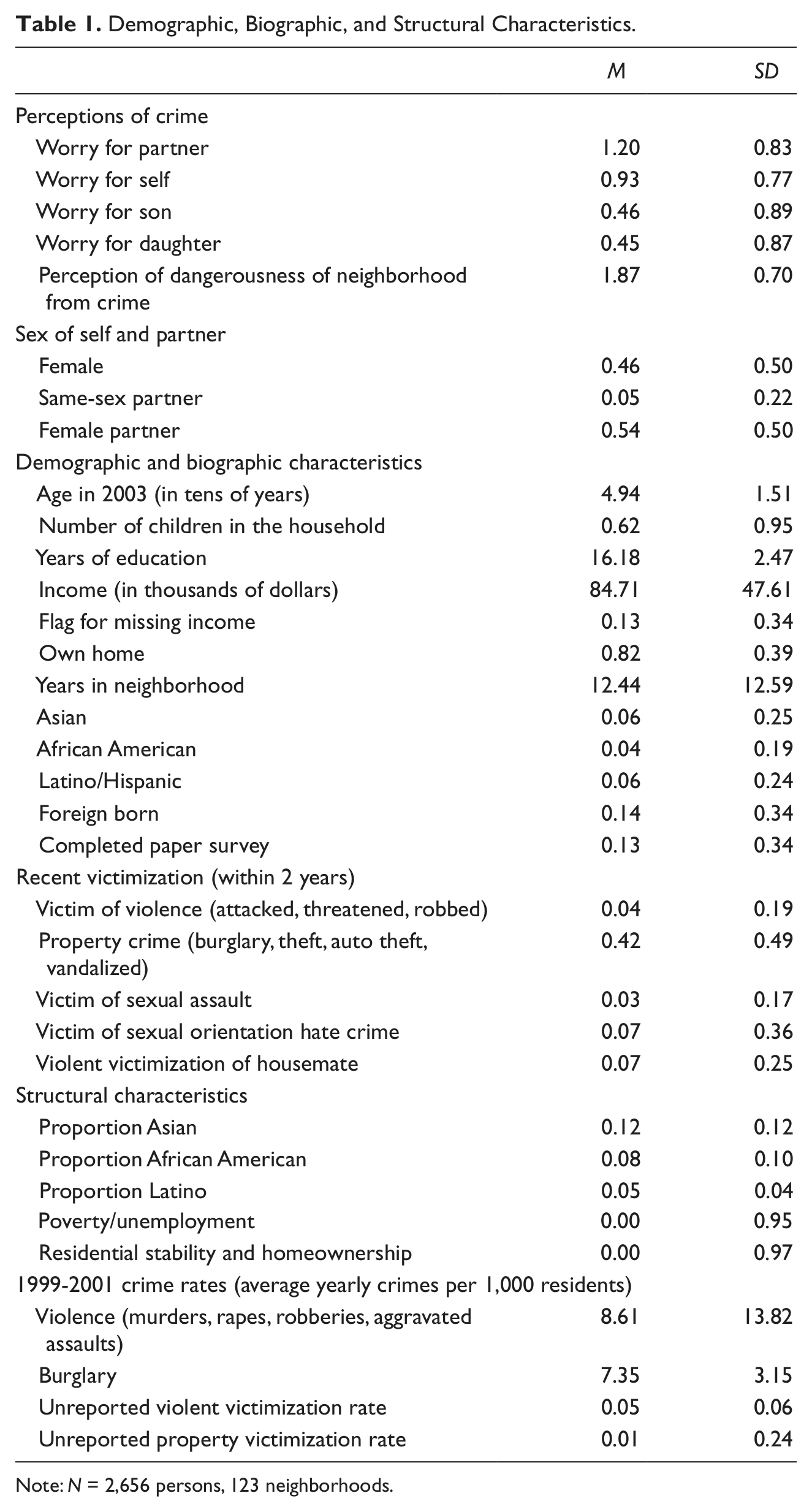
Note: N = 2,656 persons, 123 neighborhoods.
The key interest of the article is differences along the lines of sex and sexual orientation. To this end the article includes measures of self-reported sex (male or female) and self-reported sex of partner. The survey did not directly ask respondents about sexual orientation. However, as the current study is interested in exploring fear for cohabitating partners, within this information we are able to identify those respondents reporting a same-sex cohabitating partner. As the survey is a general survey of Seattle’s population, there are of course substantially more different-sex cohabitating partnerships than there are same-sex cohabitating partnerships. The sample includes 75 women with female cohabitating partners and 80 men with male cohabitating partners in addition to 2,817 respondents with different-sex cohabitating partners.
A variety of individual-level covariates of perceptions of crime are included in analyses to control for possible alternative explanations for fear for partners, especially alternatives that may help explain differences along the lines of sex or sexual orientation (Table 1). For instance, if same-sex couples experience higher rates of victimization or live in higher-crime neighborhoods, their “true” level of fear for partners, independent of exposure to crime, may in fact be lower. To this end, basic demographic and biographical characteristics are included, many of which have been shown to be relevant to concerns about crime in prior work. Included are measures of age, household composition, education, income, residential tenure, and race and ethnicity.
Two measures of recent personal victimization (the event must have occurred within the past 2 years), and one measure of the violent victimization of other members of the household are included. Thus, the models will account for victimizations experienced both by the respondent and by the potential targets of their altruistic fears. In addition, two measures of specific victimizations are included that may have special relevance for explaining differences in concerns about crime along the lines of sex and sexual orientation. First, if women experience sexual assaults at higher rates, it is possible that these victimization experiences will increase personal fears within this population. Notably, however, Wilcox et al. (2006) find an effect of acquaintance sexual assault victimization on fear of acquaintance sexual assault but no effect for stranger sexual assault on fears of sexual assaults by strangers, while Fox et al. (2009) find sexual assault victims to be less fearful (both of these studies are restricted to samples of college women). Alternatively, same-sex-oriented men may be sexually assaulted at higher rates than same-sex-oriented women (Tiby, 2001). Second, prior work has suggested that those with same-sex partners often experience victimizations perceived to be motivated by their sexual orientation and that such bias victimizations are associated with higher levels of fear within same-sex-oriented populations (Herek et al., 1999, 1997; Tiby, 2001). If this is the case, higher rates of bias victimization on the basis of sexual identity may help explain differences in fears of crime between same- and different-sex couples. Of course, the motivations for a crime are not always clear, so this measure captures whether respondents believed any of their victimizations were motivated by dislike for their sexual orientation (their responses were coded as 0 for no, 1 for maybe, and 2 for yes). 5
Table 1 also presents descriptive information for a variety of measures of the local context that may play a role in perceptions of crime. Of course, the actual presence of crime is likely to play a role in perceptions of crime. Several measures of the crime context of the neighborhood are included. First, measures of local violent crimes and burglaries known to the Seattle Police Department are included—captured as the average number of crimes per year per thousand residents, averaged over a 3-year period from 1999 to 2001. Second, also included are measures of unreported violent and property crime rates to reflect the possibility some neighborhoods may have higher numbers of crimes that potentially influence perceptions of safety but do not show up in official statistics. These are captured from self-reported violent and property victimizations that have occurred in the previous 2 years and at the current address, but for which the respondent indicates they did not contact the police. These reports are recorded as counts of victimizations and they are based on a variable number of respondents within different neighborhood, so they are captured as neighborhood-level empirical Bayes residuals from a generalized linear mixed model with a Poisson link, such that extreme values for neighborhoods with fewer respondents are shrunk relative to those with greater reliability.
Acknowledging prior work suggesting a role for the local racial composition in perceptions of crime (e.g., Quillian & Pager, 2001), measures capturing the proportion Asian, African American, and Latino are included. Two highly related measures of economic disadvantage, the proportion in poverty and the unemployment rate, were combined into a single measure as the average of standardized scores. Similarly, two highly related measures of residential stability, the proportion owner-occupied homes, and the proportion of residents living in the same home for at least 5 years, were also combined as the average of standardized scores.
Methodological Issues, Analytic Strategy, and Limitations
Several methodological issues deserve brief consideration. First, while the hypotheses are interested in basic differences along the lines of the sex of the respondent versus the sex of the partner, it is important to examine these differences conditional on a variety of person- and neighborhood-level characteristics. As discussed in the measures section, if those with same-sex partners live in more dangerous neighborhoods, we would expect higher fears for partners regardless of sexual orientation.
Second, respondents’ perceptions of their neighborhood are not independent: They are clustered in neighborhoods and reacting to the same contextual conditions and crime rates. This dependence makes it possible to distinguish variations in perceptions of crime at different levels as the consequence of different processes. For example, both people who have been victims of crime and people who live in high-crime neighborhoods are likely to perceive their neighborhood as unsafe. To accomplish this, simple random intercept multilevel models are used to model the variability among individuals within neighborhoods as a product of individual characteristics and the variability between neighborhoods as a product of neighborhood characteristics.
It is also possible that perceptions of crime in one neighborhood will be related to perceptions of crime in the surrounding neighborhoods. This may result either from a substantive spatial processes like contagion, or from a mismatch between the administratively defined census tract boundaries and the behavioral boundaries within which individuals truly experience their local area. To investigate this possibility, the potential for spatial dependence in the residuals from neighborhood-level models predicting each outcome was investigated. The results suggested no spatial dependence in fear for partners or oneself once the individual and neighborhood covariates are accounted for. As such, spatial models are not reported.
Finally, several methodological limitations are worth noting. First, as this is a general sample of Seattle residents, the number of respondents in same-sex partnerships is considerably smaller than the number of respondents in different-sex partnerships. Future work used a targeted-over-sample of same-sex partnerships would lend greater statistical power to the between-group comparisons. Second, it is possible that several of the self-reported survey measures may be underreported due to the sensitive nature of the questions. It is possible, for instance, that respondents were reluctant to report same-sex domestic partnerships, though this may be less of a problem in Seattle—a city with a large and established same-sex-oriented community—than in other places. More concerning, it is possible that respondents underreported victimizations generally and sexual assaults and victimizations motivated by dislike of sexual orientation in particular. If this is the case, the present work may underestimate the importance of these victimizations in personal and partner fear.
Results
The results are presented in three major sections. The first explores basic differences in fear for oneself and one’s partner by sex and sexual orientation, first by examining raw scores and then conditional on a variety of person- and neighborhood-level characteristics. The final two sections explore two specific potential explanations for sex differences in fear for partners. The first of these investigates the idea of perceived vulnerability by examining sex differences in concerns for oneself and one’s partner holding more general perceptions of danger constant. Finally, the last section considers the idea of a limited capacity for fear by examining the interrelationships among personal fear, fear for children, and fear for one’s partner.
Fear for Self and Partners by Sex and Sexual Orientation
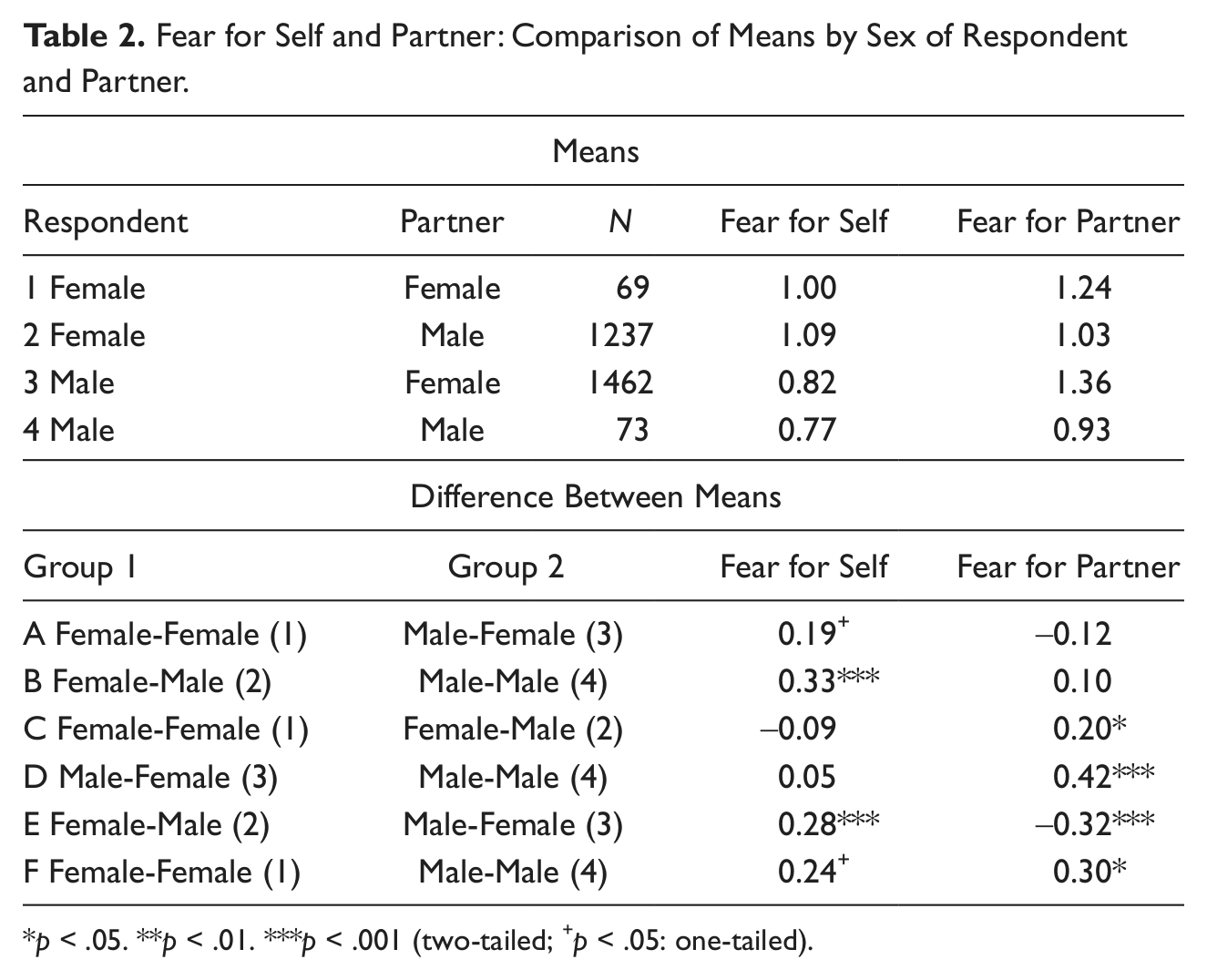
Table 2 presents and compares means for each of four groups: women with female partners, women with male partners, men with female partners, and men with male partners. For comparative purposes, the table presents results for both fear measures that have previously shown sex gaps in reporting: fear for oneself and for one’s partner. The results for those with different-sex partners (Rows 2 and 3) mirror prior findings (e.g., Warr & Ellison, 2000): Women have higher levels of personal fear than men, and men have higher levels of fear for their female partners than women do for their male partners. 6 The story among those with same-sex partners adds an interesting dimension to the story. 7 Men with male partners (Row 4) appear to have levels of personal fear similar to men in different-sex relationships, but fear for their male partners at levels similar to those women who have male partners. Similarly, women with female partners (Row 1) express personal fear similar to other women and fear for partners similar to others with female partners.
Fear for Self and Partner: Comparison of Means by Sex of Respondent and Partner.
p < .05. **p < .01. ***p < .001 (two-tailed; +p < .05: one-tailed).
A comparison of means supports this interpretation (Table 2). Rows A and B (second column) suggest no significant differences between same-sex and different-sex couples in fear for partners, conditional on the sex of the partner. Similarly, Rows C and D (first column) suggest no significant differences between same-sex and different-sex couples in personal fear, conditional on one’s own sex. Rows C and D (second column, also see E and F) suggest significantly more concern for female partners regardless of the sex of the respondent. Similarly, Rows A and B (first column) suggest higher levels of personal fear among women relative to men—though this difference appears somewhat larger among those with different-sex partners. Partner fear, then, appears driven largely by the sex of the partner and target of the fear rather than the sex of the respondent.
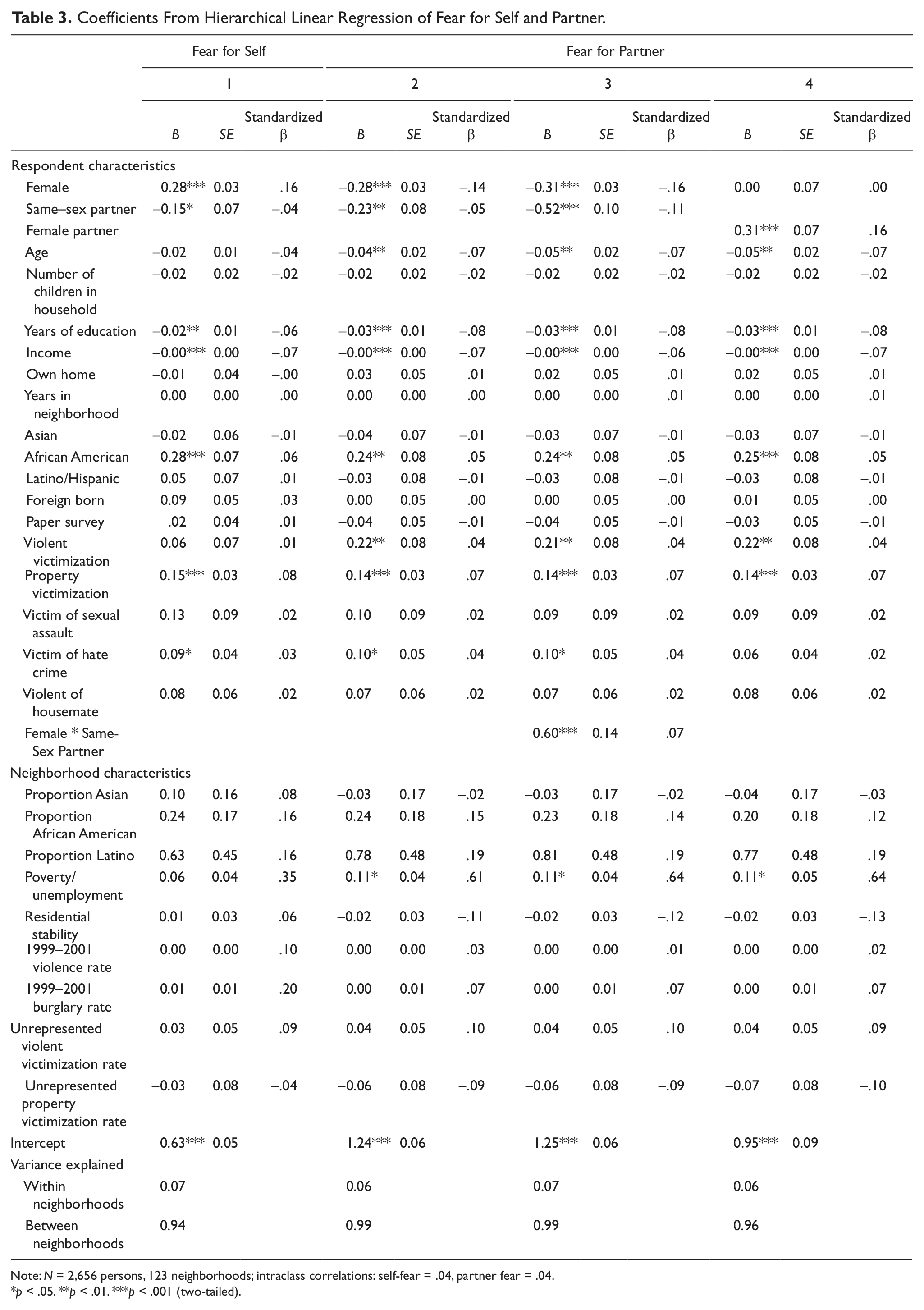
It is possible, however, that the findings from Table 2 were influenced by differential personal or neighborhood characteristics between same-sex and different-sex couples. It is possible, for instance, that different levels of fear between same-sex and different-sex partners are a function of living in different kinds of neighborhoods or experiencing different levels of victimization. Table 3 compares the roles of the sex of the partner and the respondent in determining fear for one’s partner conditional on a variety of individual and neighborhood characteristics. For comparison, Column 1 presents a model for personal fear. As expected, women reported substantially more personal fear than did men (standardized coefficient of .16). Respondents with same-sex partners reported slightly less personal fear than did those with different-sex partners. 8 Among the other covariates, those with more years of education and higher incomes were less likely to report personal fear, while African Americans reported higher levels of fear, as did victims of property crimes and those who believe they were victimized as a result of their sexual orientation. Not surprisingly, given weak or contradictory findings in prior work (e.g., Fox et al., 2009; Wilcox et al., 2006), sexual assault victimization does not appear relevant to personal or partner fears. Interestingly, conditional on the person-level covariates, personal fear was not associated with any contextual characteristics. In fact, for both personal fear and fear for partners, only about 4% of the total variation occurred between rather than within neighborhoods.
Coefficients From Hierarchical Linear Regression of Fear for Self and Partner.
Note: N = 2,656 persons, 123 neighborhoods; intraclass correlations: self-fear = .04, partner fear = .04.
p < .05. **p < .01. ***p < .001 (two-tailed).
Columns 2 through 4 present three different models predicting fear for partners (Table 3). As expected, Column 2 suggests that men are substantially more likely than women to be concerned about their partners. Among the other covariates, older respondents and those with a greater number of years of education and higher incomes were all less likely to express concern for partners, while African Americans, those who had experienced violent or property victimization, and those who believed their victimization was motivated by their sexual orientation expressed higher levels of fear for partners. Conditional on all this, Column 2 also reports a small negative role for same-sex partnership on fear for partner, though, as Column 3 suggests, this effect is conditional on the sex of the respondent. This interaction in Column 3 suggests support for the story suggested in Table 2: Men and women with female partners held the highest levels of concern for their partners (predicted values of 1.34 and 1.12, respectively), while men and women with male partners expressed less concern for partners (predicted values of 0.83 and 1.04, respectively). The final column in Table 3 summarizes these results in a different way: when considered together, the sex of the partner—but not the sex of the respondent—is relevant in determining levels of fear for one’s partner (female partner has a standardized coefficient of .16).
Perceptions of General Danger Versus Vulnerability
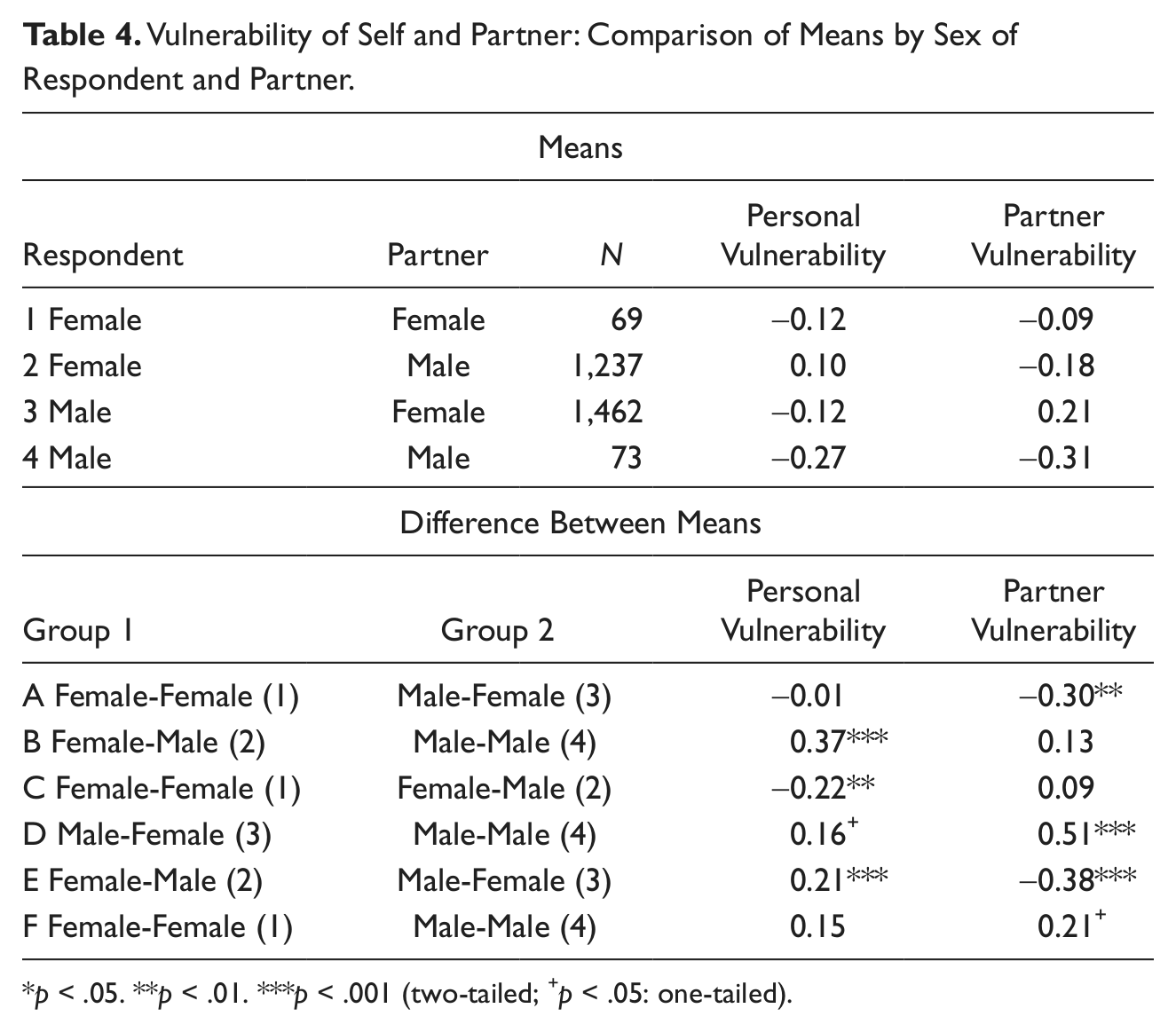
Personal concerns can be thought of as roughly composed of two dimensions: concerns rooted in an overall assessment of the dangerousness of the context and concerns rooted in perceptions of an individual as particularly vulnerable. If sex differences in concern for partners are a function of perceived vulnerability, such differences should still exist even when the portion of the concerns related to more general perceptions of danger is removed. To this end, Table 4 presents a comparison of means for the residuals of simple models in which personal and partner fears are modeled as a function of more general perceptions of danger—the residuals in this case representing the portion of the variation in personal and partner fears not explained by more general perceptions of the local threat of crime. 9 Though Table 4 is identical in structure to Table 2, the results suggest a somewhat different story. As in Table 2, women with male partners have higher perceptions of their own vulnerability than do men (Rows B and E, first column), who had relatively low levels of perceived personal vulnerability regardless of the sex of their partner (Row D, first column). However, women with male partners rated themselves on average as more vulnerable than those women with female partners (Row C, first column), and women with female partners rated themselves as similarly vulnerable to men with either male or female partners (Rows A and F, first column).
Vulnerability of Self and Partner: Comparison of Means by Sex of Respondent and Partner.
p < .05. **p < .01. ***p < .001 (two-tailed; +p < .05: one-tailed).
A similar story exists for partner fears. As in Table 2, men perceive female partners as more vulnerable than those with male partners, regardless of the sex of the respondent (Row D and E, second column). However, distinct from more general concerns for partners, men also perceive female partners as more vulnerable than do women their female partners (Row A, second column). In other words, women with male partners are perceived as disproportionately vulnerable by their partners relative to other groups—but also perceive themselves as more vulnerable than other groups.
However, just as described in the previous section, differences between groups in perceived vulnerability may be a product of differential characteristics or experiences between groups. To this end, the models presented in Table 3 were replicated with the addition of a control for perceptions of danger. Selected coefficients from this model are presented in Table 5 (the full models are not repeated for the sake of space). The results are consistent with the idea of vulnerability. Perceptions of danger are strongly positively associated with both personal and partner fears (standardized coefficients of .28 and .27, respectively). Conditional on this, female respondents still report higher personal concerns (Column 1) while those with female partners report higher levels of concern for those partners (Column 4). The interaction of sex and same-sex partner in Column 3 supports the story described in Table 4: Women in different-sex partnerships inspire the highest levels of partner fear (predicted value of 1.36), followed by women in same-sex relationships (1.09), men in different-sex relationships (1.01), and finally men in same-sex relationships (0.87). Thus, women are disproportionately the target of personal and partner fears even after general perceptions of threat are accounted for, but women in different-sex relationships appear to both be perceived and perceive themselves as particularly vulnerable.
Selected Coefficients From Hierarchical Linear Regression of Fear for Self and Partner.
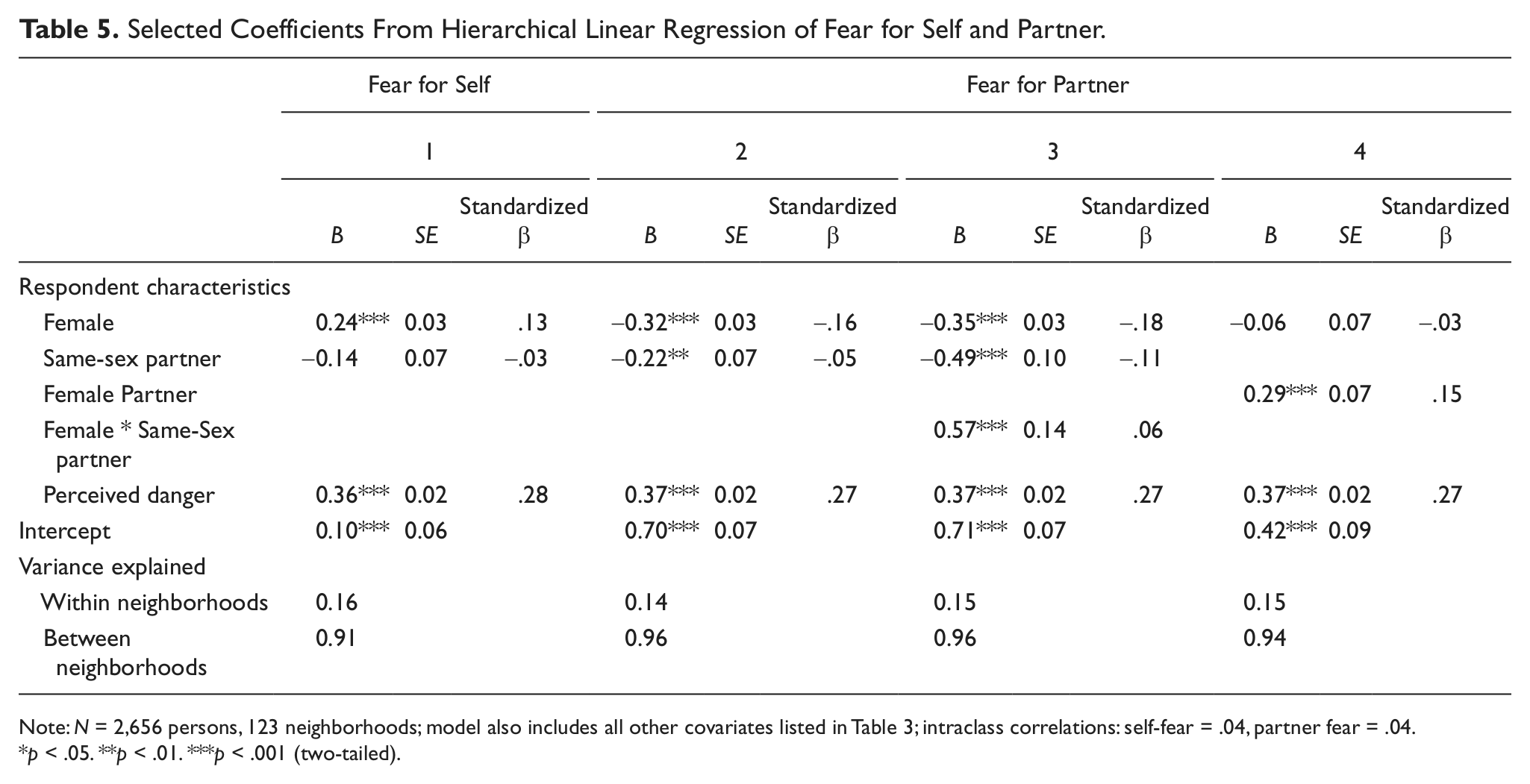
Note: N = 2,656 persons, 123 neighborhoods; model also includes all other covariates listed in Table 3; intraclass correlations: self-fear = .04, partner fear = .04.
p < .05. **p < .01. ***p < .001 (two-tailed).
Interrelationships Among Fears
The final section of results explores the interrelationships among fears and thus the distribution of fear within households, in particular asking whether high levels of personal concerns or concerns for children limit a person’s ability to express concerns for their partner. Of course, if a person perceives their neighborhood as particularly dangerous they are more likely to express concern for all members of their family. Thus, just as in the last section, these models control for overall perceptions of danger to focus in on the portions of concerns that are not a function of these more general perceptions of threat. Table 6 presents selected coefficients from models that include fears for oneself and one’s children but are otherwise similar to the models of fears for partners reported in Table 3.
Interrelationships Among Fears: Selected Coefficients From Hierarchical Linear Regression of Fear for Partner.
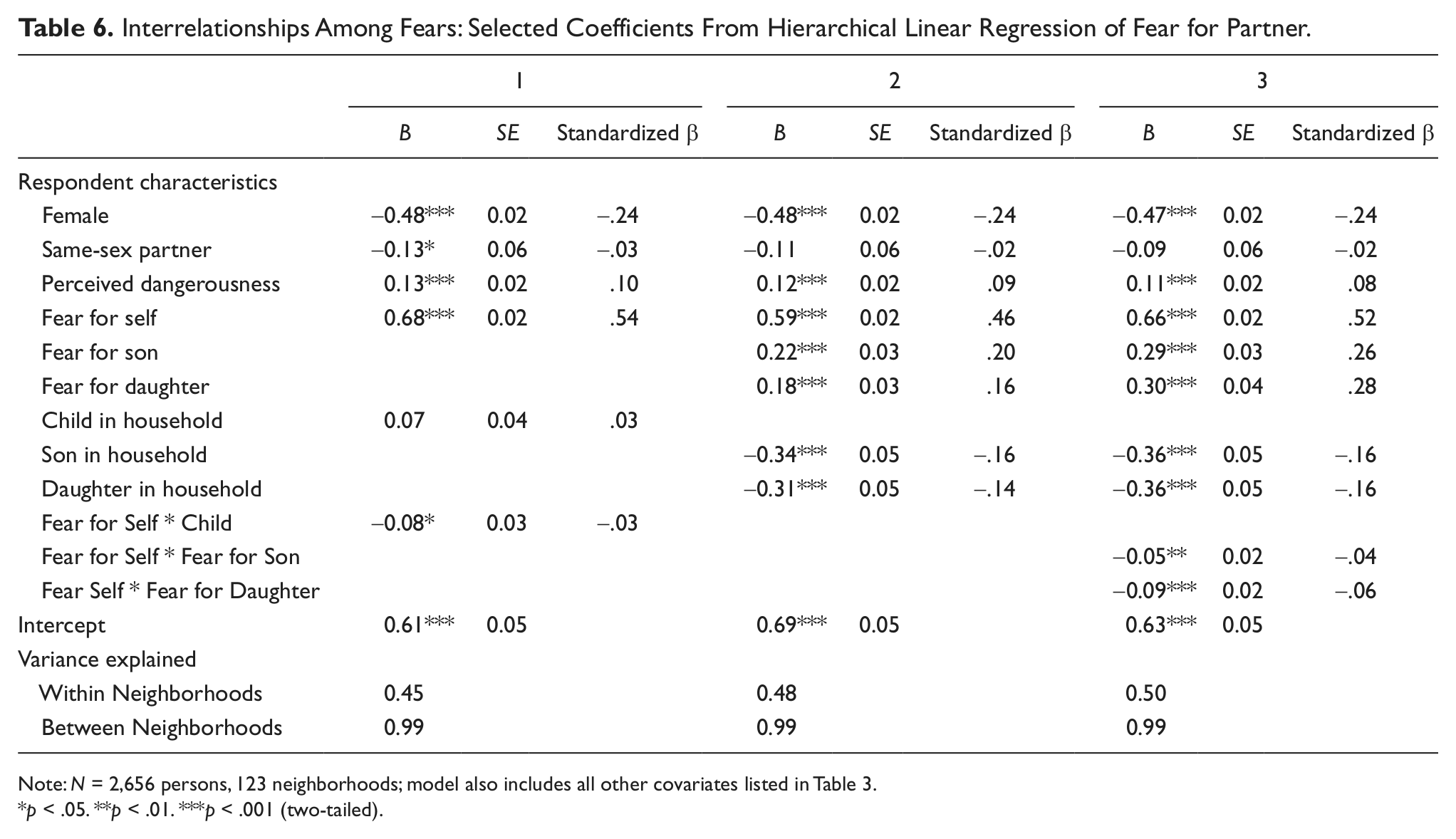
Note: N = 2,656 persons, 123 neighborhoods; model also includes all other covariates listed in Table 3.
p < .05. **p < .01. ***p < .001 (two-tailed).
Table 4 suggests that the mere presence of children in the household is not relevant to either personal fears or fear for partners. Column 1 of Table 6, however, asks whether the presence of children may condition the relationship between personal and partner fears. Overall, higher levels of personal fear are always associated with higher levels of fear for partners, even conditional on perceived safety. However, the significant interaction between personal fear and the presence of children suggests the relationship is very slightly stronger among those without children relative to those with children in the household. Thus, while those with personal concerns are always more likely to have concerns about their partners as well, this relationship is the strongest among those who do not also have children to be concerned about.
Some parents, however, have particularly high concerns for their children while others are less concerned. The second column of Table 6 investigates the simultaneous effects of personal fears and fears for children on fears for partners to ask whether those with particularly high personal or child concerns have a reduced capacity for fear for their partner. Of course, not all respondents with a partner have children living in the household, so those without children were coded as not being concerned about children and controls were added to the models to distinguish those who truly do not have children versus those who have children but are not concerned for them. The results suggest that high levels of personal fear and fear for both sons and daughters are all strongly positively related to partner fears, even after accounting for overall perceptions of danger, thus casting doubt on the notion of a limited capacity for fear. 10
The third column of Table 6 asks about potential conditional interrelationships among fears. In particular, building on the first column, it asks whether the relationship between personal fears and fears for one’s partner differs between those with greater or lower levels of fear for their children. The interactions suggest personal fears increase partner fears most strongly among those with lower fear for their children, though overall those with higher fears for their children have higher fears for their partners. 11 The results support those from the first column in suggesting a hierarchy of fears in which concerns for children may take precedence over concerns for partners. However, overall higher fears of any kind are associated with higher fears for partners, casting doubt on the idea that personal fears or fears for children limit a person’s capacity to be fearful for their partners. Furthermore, the inclusion of personal fears and fears for children does not explain the differences between sexes in fear for partners. Thus, just as the first section of results cast doubt on explanations rooted in the sex of the respondent, this section suggests sex differences in fear do not appear to be a function of personal or child concerns limiting an individual’s capacity to also hold concerns for partners.
Discussion and Conclusion
While substantial research attention has been paid to the disproportionately high levels of fear of crime among women relative to men, less attention has been paid to the seeming mirror of this among men: that men have disproportionately more concern for female partners than women do for male partners. In addition, partner fears among same-sex partners have similarly received very little research attention. In this light, the present work reports several new findings along these dimensions. First, an examination of fear for partners across sex and sexual orientation suggests that fear for one’s partner appears to be entirely a function of the sex of the partner and target of the fear and not of the sex of the respondent. Second, this also means that there does not appear to be any difference in fear for partners between same-sex and different-sex partners conditional on the sex of the partner. In more simple terms, female partners inspire more concern than male partners regardless of whether respondents are male or female.
The fact that partner fears appear more rooted in the sex of the partner than the respondent lends credence to those explanations rooted in characteristics of the partner—for instance, gendered perceptions of vulnerability and the shadow of sexual assault—over explanations rooted in characteristics of the respondent like the gender socialization of men as protectors or a limited total capacity for fear. Additional analyses support this interpretation. Consistent with a vulnerability explanation, sex differences persist even after overall perceptions of danger are accounted for. Finally, fears for oneself and one’s children do not appear to limit a person’s capacity to fear for their partner; on the contrary, they are associated with increased fears for partners even after accounting for overall perceptions of the local threat of crime, and accounting for such fears does not explain the sex gap in fear for partners.
Beyond this basic support for explanations rooted in the characteristics of the partner versus the respondent, the findings raise several other interesting implications that point to the importance of the household composition and context. First, though the presence of children does not directly influence concern for partners, both the presence of children and one’s level of concern for those children appear to condition the relationship between personal fear and fear for one’s partner. The results suggest the possibility of a hierarchy in which concerns for children trump concerns for partners: High personal fears are associated with high partner fears most strongly among those without children or among those who are less concerned about their children.
Second, interesting differences emerged in the distinction between overall fears and perceptions of vulnerability. Women expressed higher levels of personal fear and elicited more concern among partners. Women also perceived themselves as more vulnerable relative to overall perceptions of the threat of crime than men and were similarly perceived as more vulnerable by their partners than men were by their partners. However, women in different-sex relationships appear to both be perceived and perceive themselves as especially vulnerable. This raises interesting questions about the intrahousehold dynamics of fear. The sex split in personal versus partner fears among different-sex partnerships means that both the men and women in these relationships view the same neighborhood as either safer or more threatening depending on whether they imagine themselves or their partner in it. In other words, they see the same space as dangerous for one of them but safe for the other. The idea of differential vulnerability, then, is necessary to resolve what otherwise may be cognitive dissonance about the true safety of the neighborhood. Within same-sex relationships, on the other hand, the respondent may see themselves and their partner as more similarly at risk in the same context, at least based on sex and excluding other potentially relevant characteristics.
One important implication of this is that although female partners are the target of similarly high levels of concern from both male and female partners, this concern may mean something qualitatively different. Men see their female partners as particularly vulnerable within the context of an otherwise relatively safe neighborhood in which they express fewer concerns for their own safety. Women’s concern for their female partners, on the other hand, is rooted more in an overall view of the neighborhood as a dangerous place in which they also express concerns for themselves. Thus, while the overall levels of personal and partner fear do not vary over household compositions conditional on the sex of the target of the fear, the household context may matter to the meaning of both personal and partner fears.
Footnotes
Acknowledgements
The authors would like to thank Ross Matsueda, Robert Crutchfield, Stewart Tolnay, the anonymous reviewers, and Rebecca Brigham for comments and guidance on earlier drafts of this article.
Declaration of Conflicting Interests
The authors declared no potential conflicts of interest with respect to the research, authorship, and/or publication of this article.
Funding
The authors disclosed receipt of the following financial support for the research, authorship, and/or publication of this article: This research is supported by grants from the National Science Foundation (SES-0004324) and the National Consortium on Violence Research (SBR-9513040).