



Abstract
Prison employees are often confronted with critical incidents and chronic stressors that may lead to trauma or burnout symptoms. However, most of the research on clinical aspects of interpersonal violence in prisons (inmates-to-staff violence, specifically) focuses either on trauma or on burnout. The purpose of the present study is (a) to examine both burnout and posttraumatic stress among prison staff and (b) to examine the influences of inmates-to-staff violent relations on posttraumatic stress in terms of risk profile to develop PTSD. A random sample of French correctional employees has completed various self-reported questionnaires assessing burnout, posttraumatic stress, and stress as well as victimization and demographic characteristics. Correctional employees demonstrated high levels of PTSD symptoms, burnout, and stress. Violent interactions with inmates lead to experienced trauma of all types (PTSD, secondary, or vicarious trauma). Results have highlighted a prison worker’s profile prone to PTSD: he or she expresses high levels of emotional exhaustion, intense levels of stress, high levels of depersonalization, and high levels of intrusion, avoidance, and hyperreactivity. This study contributes to an understanding of the literature by explaining the complex association between burnout and posttraumatic stress after interpersonal violence. These findings suggest a need to support prison workers and to address inmates-to-staff relational dynamics.
Introduction
Interpersonal Violence and Posttraumatic Stress Symptoms
Interpersonal violence in the work place has increased alarmingly in French facilities and workers are chronically confronted with violence and aggressions (Direction de l’Administration Pénitentiaire [DAP], 2009, 2010; Wolff, Shi, & Bachman, 2008). Inmates’ mental disorders and dangerousness are usually considered as a cause of inmate-on-staff assaults (Duburcq et al., 2006). These aggressive and violent situations meet the core features of the traumatic events defined as “stressful event or situation of an exceptionally threatening or catastrophic nature, which is likely to cause pervasive distress in almost anyone” (American Psychiatric Association [APA], 2003). Experiencing such an event associated with an intense emotional reaction often leads to posttraumatic stress disorder (PTSD). Typical symptoms include (a) reexperiencing symptoms: episodes of repeated reliving of the trauma (intrusive memories, dreams, etc.); (b) numbing/avoidance symptoms: a sense of “numbness” and emotional blunting, detachment from other people, anhedonia and avoidance of activities and situations reminiscent of the trauma and (c) hyperarousal symptoms: unresponsiveness to surroundings.
Interpersonal violence and stressful events in the workplace render correctional workers vulnerable to mental disorder such as PTSD (Blitz, Wolff, & Shi, 2008; Boudoukha, Przygodzki-Lionet, & Hautekeete, in press; De Conninck & Loodts, 1999) as well as burnout and stress (Schaufeli & Peeters, 2000).
Burnout and Correctional Staff
Inmate-on-staff assaults increase the level of vulnerability among correctional staff (Sorensen, Cunningham, Vigen, & Woods, 2011). A potential consequence of these violent chronic situations among prison staff is burnout. Burnout is described as a three-dimensional syndrome comprising of emotional exhaustion, depersonalization, and a sense of lack of personal accomplishment (Maslach, Schaufeli, & Leiter, 2001). Burnout is a severe psychological suffering that can lead to depression (Nyklicek & Pop, 2005; Shirom & Ezrachi, 2003). It was initially identified among persons working with patients (Bradley, 1969). However, initial studies on burnout mainly dealt with human services and employees in the educational sector (Freudenberger, 1974; Maslach, 1976). In the past, prison staff’s burnout was less frequently studied than teachers’ or nurses’ burnout.
Shaufeli and Peteers (2000) highlighted four major factors associated with burnout; which are role problems, work overload, demanding social contacts (with prisoners, colleagues, and supervisors), and poor social status. Dowden and Tellier (2004) examined the predictors of job stress in correctional officers. Results indicated three sets of findings. Work attitudes and specific correctional officer problems (e.g., perceived dangerousness) generated the strongest predictive relationship with job stress. Custody orientation (correctional officer attitudes toward inmates) yielded moderate relationship with job stress. Lastly, demographic variables and job characteristics were the weakest correlates of job stress.
These researches have shown that similar prison characteristics may lead either to stress or to burnout. If stress was strongly correlated with organizational characteristics of correctional work, such as work overload, poor social status, role problem or conflict, and lack of resources (Allard, Wortley, & Stewart, 2003; Botha & Pienaar, 2006; Garland, 2004; Schaufeli, Van Der Eijnden, & Brouwers, 1994), the relational aspect of correctional work appeared to be a major factor of burnout among employees. More particularly, everyday contacts with inmates led to higher burnout among workers of correctional institutions (Moon & Maxwell, 2004). Consistent with such findings, Keinan and Maslach-Pines (2007) have shown that stressful contacts with noninmates and inmates are major predictors of burnout among prison workers. Burnout seems to arise when people share stressful, chronic, and violent relations (Kop, Euwema, & Schaufeli, 1999), which are a specific characteristic of inmate-to-staff relations.
Aims and Hypotheses
Interpersonal violence such as inmates-to-staff assaults and stressful events in the workplace may be serious and lead to mental disorders such as PTSD or burnout. Unfortunately, most of the research on clinical aspects of traumatic and stressful events’ repercussions focuses either on posttraumatic symptoms (PTSD) or on burnout distress. Research literature is scarce on these issues. Boudoukha, Hautekeete, Abdellaoui, Groux and Garay (2011) touched these issues slightly. However, these authors focused on prison guards’ burnout and left PTSD aside. The purpose of the present study is thus: (a) to examine both burnout and posttraumatic stress among prison workers, (b) to determine profiles prone to develop PTSD among prison staff through the contribution of demographic characteristics (gender, age, and seniority), seriousness of inmates-to-staff perceived assaults and dimensions of burnout.
A random sample of correctional workers from various French prisons was asked to complete various self-reported questionnaires assessing burnout, posttraumatic stress, stress, as well as victimization. Demographic characteristics were also collected. We expect burnout, stress, and posttraumatic stress to be highly correlated among correctional staff. Given the lack of previous research on the association between burnout and posttraumatic stress, we cannot suggest a specific hypothesis as to the causal association between these two concepts. Finally, we expect that burnout dimensions, seriousness of inmates-to-staff perceived assaults, age, and seniority could probably be associated with PTSD profiles.
Method
Participants
The sample is comprised of 240 correctional staff recruited in French correctional facilities (40 females and 200 males) with job seniority ranging from 6 months to 30 years (M = 12.89 years, SD = 7.25). The mean age is 37.78 years (SD = 7.47). All participants were recruited at their work place with French correctional administration approval.
Most of our prison workers graduated from high school (79%); with the exception of 8% (no degree/diploma).These rates are representative of prison guards, according to the statistics of the French correctional department (D.A.P., 2010). Direct victimizations among our prison guards are very common: that is, 97 % (233) have already experienced an inmate assault (verbal, physical, or with a weapon), and more than 93.3% (224) have been confronted with another type of traumatic event (i.e., attempted inmate suicide, inmate self-mutilation, etc.). Finally, 97.5 % of our participants have already experienced indirect victimization (being witness of violence assaults). Prison workers in our sample can thus be qualified as victimized.
Measures
Impact of Event Scale Revised—IES-R
Posttraumatic stress symptoms were assessed with the 22-item Impact of Event Scale-Revised (French version; Brunet, King, & Weiss, 1998). It is comprised of three subscales: (a) the “Intrusion” subscale (7 items) referring to reexperiencing symptoms such as nightmare; (b) the “Avoidance-Numbing” subscale (8 items) referring to avoidance symptoms such as “trying not to think about the event,” and (c) the Hyperreactivity subscale (6 items) referring to the symptoms of of hyperarousal or overreactivity to event cues. It is a short, easily administered self-report questionnaire. Each item is rated on a 5-point scale ranging from 0 (not at all) to 4 (extremely), reflecting the extent to which the particular symptom was a problem for the respondent during the past week.
The IES-R is a commonly used instrument to assess posttraumatic stress in research and clinical settings (Wang et al., 2011). Reliability and validity of the French version is well documented (Brunet, St-Hilaire, Jehel, & King, 2003; Vaiva et al., 2003). The authors consider that a score between 22 and 36 would characterize an Acute Stress Disorder (ASD); a higher score would be the expression of a Posttraumatic Stress Disorder (PTSD).
Maslach Burnout Inventory—MBI
The French form of the Maslach Burnout Inventory (MBI) was also used in this study (Dion & Tessier, 1994). It is a 22-item scale that is comprised of three subscales (Maslach, Jackson, & Leiter, 1996): (a) “Emotional Exhaustion” refers to a lack of capacity left to offer psychological support/help to others; (b) “Depersonalization” describes a tendency to depersonalize others, that is, negative attitude toward others; and (c) “a lack of personal accomplishment,” which means a diminished feeling of personal self-efficacy. Internal consistencies (Cronbach’s alpha) for the subscales are high: .90 for Emotional Exhaustion, .79 for Depersonalization, and .71 for Personal Accomplishment (Richardsen & Martinussen, 2004). The internal consistency is lower for the personal accomplishment subscale in the MBI French form (Lourel & Gueguen, 2007).
The MBI items are written in the form of statements about personal feelings or attitudes such as “I feel emotionally drained from my work.” Respondents are instructed to answer each time according to the degree to which each MBI statement refers to their feelings related to work on a 7-point Likert-type scale ranging from 1 (never to me) to 7 (happened every day). A high degree of burnout is reflected through high scores on the emotional exhaustion and depersonalization subscales and through low scores on the personal accomplishment subscale (Maslach et al., 2001).
Stress questionnaire
Using scales from prison guards’ stress studies, correctional officers were asked to respond to 12 items regarding employment-related stress. Correctional employees were asked to quote their stress in situation such as “in general”; “before going in prison setting”; or “when going out from the prison setting.” Studies have found that correctional officers had a tendency to underreport their perceived level of stress even though they reported high rates of stress-related illnesses (Cullen, Lutze, Link, & Wolfe, 1989; Pollak & Sigler, 1998; Triplett, 1996). Thus, items are rated on a 10-point scale ranging from 0 (no stress) to 10 (maximum stress) reflecting the extent of stress in each situation.
Victimization and demographic characteristics
Victimization index: inmates-to-staff assaults questionnaire
Inmates-to-staff assaults are assessed through an index of 6 items within two dimensions:
The dimension of “Characteristics of inmates-to-staff assaults” is comprised of 3 items: Item 1 asks if prison workers have been confronted with a traumatic event (yes vs. no); Items 2 and 3 refer to the type of victimizations endured:
>Item 2—Direct assault (verbal vs. physical vs. with weapon), Item 3—Indirect assault (being witness of verbal assaults vs. physical assaults vs. assaults with weapon);
The dimension of “Seriousness of inmates-to-staff assaults” is assessed through 3 items referring to the subjective repercussions of assaults. Participants are asked to evaluate the seriousness of assaults on a 5-point Likert-type scale ranging from 0 (not serious at all) to 5 (very serious). Item 4 (GRAV 1) of the last assault; Item 5 (GRAV 2) of the most important; Item 6 (GRAV 3) since they work in prison.
Participant information sheet
The participant information sheet outlines the purpose of the study, how to take part in the study, and contact details of the researcher. The demographic questionnaire was used to collect participant information such as age, gender, tenure, occupation, and specialty, and experiences of traumatic events’ therapy. Most items were multiple choice questions.
Procedure
An observational cross-sectional study design was adopted for this study. Random sampling was chosen as the procedure for participant recruitment. The written agreements of the National Department of Penitentiary allowed us to access prison facilities. Research took place in all penitentiary regions of France that had previously agreed to participate. Randomly we selected one large-size and one small-size prison in each of the participating penitentiary regions. Files containing our study questionnaires were proposed to the correctional staff employed in these various prisons. In accordance with the CNIL (French IT and Freedom commission) recommendations, we asked the participants to return the files anonymously to a relay person from the university not directly concerned with the research, whose address was mentioned on the last page of the file.
A small battery of questionnaires consisting of a range of self-report measurements was devised. Special consideration was given to questionnaire length, completion time, and readability to potentially increase response rate and reduce the demands made on participants. It was estimated that it would take approximately 30 min to fully complete the entire set.
The response rate was 56% for the total responding prison staff, where 14% was exploitable. This return rate is more or less similar to that of Lourel et al. (2004) who used the same type of procedure.
Data Analysis
The data was analyzed using STATISTICA and SPSS. Preliminary analysis included analysis of gender differences for the variables of the study through correlation analysis. Hierarchical cluster analysis (Hair & Black, 2000) was used for the detection of the optimal number of PTSD profiles in our sample and for the identification of groups of participants that differ on PTSD profiles. Cluster analysis has been used in different studies to determine motivational profiles, or burnout profiles (Gillet, Vallerand, & Rosnet, 2009; Ratelle, Guay, Vallerand, Larose, & Senecal, 2007).
Multinomial logistic regression analyses was conducted to examine the contribution of demographic characteristics (gender, age, and seniority), seriousness of inmates-to-staff perceived assaults (GRAV1, GRAV2, GRAV3) and dimensions of burnout (emotional exhaustion, depersonalization, and personal accomplishment) on PTSD profiles.
Results
The aim of study was (a) to examine burnout as well as posttraumatic stress, (b) to determine profiles prone to develop PTSD through the contribution of demographic characteristics (gender, age, and seniority), seriousness of inmates-to-staff perceived assaults, and dimensions of burnout on PTSD profiles.
Descriptive analysis
Descriptive statistics are shown in Table 1. Correctional staff reported high global scores (M = 23.96; SD = 19.99) of posttraumatic stress (PTS) corresponding to the level of clinical symptoms of patients with Acute Stress Disorder (Brunet et al., 1998; Vaiva et al., 2003). Emotional exhaustion and depersonalization levels are high, whereas personal accomplishment/self-efficacy level is low. These results indicate that burnout could be considered as particularly high among our sample.
Descriptive Statistics and Correlations.
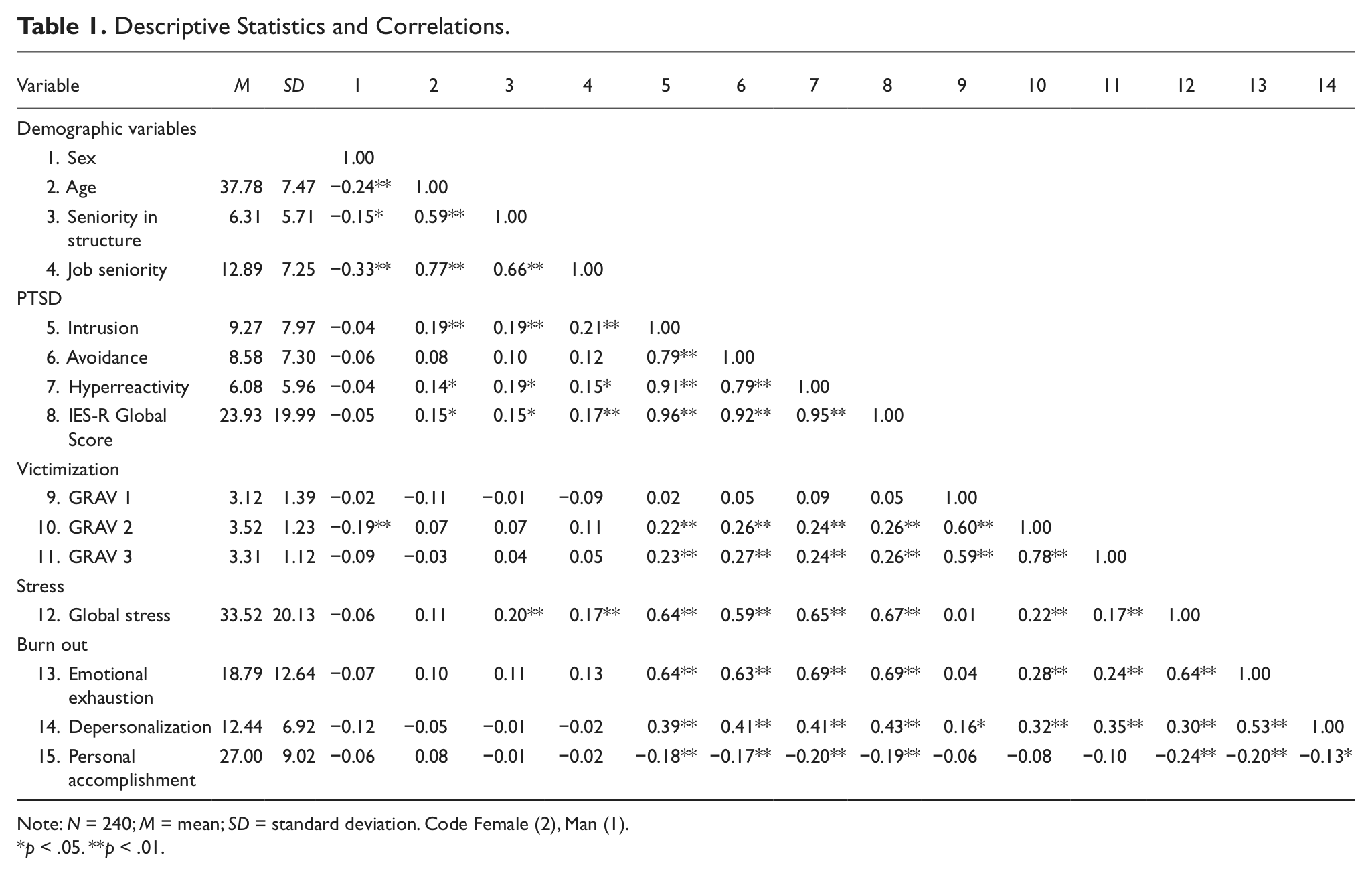
Note: N = 240; M = mean; SD = standard deviation. Code Female (2), Man (1).
p < .05. **p < .01.
Gender differences were tested for all variables. Females were younger as compared to males (t(238)= 3.89; p = .001), reported lower job seniority (t(238)= 5.41; p = .001), and lower seniority in structure (t(238)= 2.40; p = .017). Educational level differed significantly between genders (Pearson’s χ2 (2) = 8.025; p = .018). Females reported lower educational level than males. Concerning traumatic, burnout, and victimization, no significant gender differences appeared except for victimization index (GRAV2; t (238) = 2.98; p = .003), with females evaluating the seriousness of the last assaults lower than males.
Correlations Between Posttraumatic Stress and Burnout
As shown in Table 1, IER-S subscales (intrusion, avoidance, hyperreactivity/hyperarousal) are significantly positively correlated, as well as IES-R global score. Emotional exhaustion and Depersonalization MBI subscales are also significantly positively correlated. These two subscales are significantly negatively correlated with personal accomplishment/self-efficacy. In addition, results indicated (a) a low positive correlation between IES-R global score and demographic variables, except for gender; (b) a moderate positive correlation between IES-R global scores and victimization index, except for GRAV 1; (c) a strong positive correlation between IES-R global score and stress level as well as between Emotional Exhaustion and Depersonalization subscales and (d) a mild negative correlation between IES-R global scores and accomplishment/self-efficacy. This pattern of results could not clearly lead us to determine the variables that contribute to the emergence of high level of posttraumatic stress characterized by high levels of intrusion, avoidance, and hyperreactivity. Thus, identifying subgroups with a high risk of PTSD was necessary.
Risk profile to develop PTSD
A hierarchical cluster analysis was conducted to identify high risk of PTSD and other groups. Cluster analysis allows determining the optimal number of clusters to create groups in a sample. This method allows examining data and determining the number of clusters in the sample with the best fit and their composition (Hair, Black, Babin, & Anderson, 2009). Hierarchical cluster analysis (with the Ward’s linkage method and squared Euclidean distance) was conducted based on three dimensions of IES-R, (a) intrusion, (b) avoidance, and (c) hyperreactivity, to determine the optimal number of clusters. The dendrogram and agglomeration coefficient obtained are in favor of a division into three clusters. A k-means method was conducted to confirm this division into three clusters. Means of the three IES-R subscales are reported in Table 2 and are presented in Figure 1. Cluster 1 (n = 94, “Low Risk of PTSD Profile”) is characterized by the lowest levels of intrusion, avoidance, and hyperreactivity. Cluster 2 (n = 93, “Moderate Risk of PTSD Profile”) is characterized by moderate levels of intrusion, avoidance, and hyperreactivity. Cluster 3 (n = 53, “High Risk Level PTSD Profile”) is characterized by the highest levels of intrusion, avoidance, and hyperreactivity. Clusters 2 and 3 represent more than half of the current sample.
Comparison of Groups Based on PTSD Profiles.
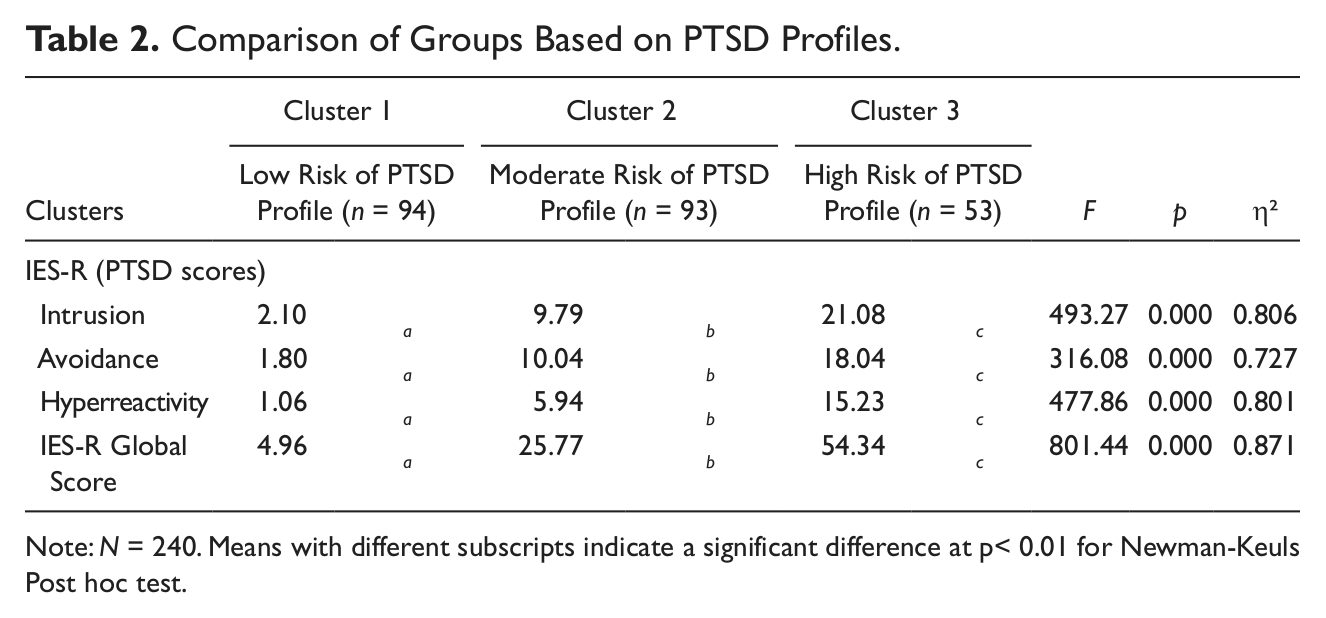
Note: N = 240. Means with different subscripts indicate a significant difference at p< 0.01 for Newman-Keuls Post hoc test.

Posttraumatic stress disorder (PTSD) profiles.
A multinomial logistic regression was conducted with PTSD profiles as the dependent variables (see Table 3). “PTSD Moderate risk” profiles differentiate from “PTSD Low risk” profiles: Emotional exhaustion and stress contribute significantly among “Moderate risk” as compared to “Low risk.” “PTSD High risk” profiles differentiate from “PTSD Low risk” profiles: emotional exhaustion, stress, and depersonalization, contribute significantly among “high risk” as compared to “Low risk” profiles. Gender, age, and seniority do not appear to differentiate between PTSD profiles. Finally, results do not indicate any interaction effect between gender and PTSD risk profiles.
Logistic Regression Analysis for PTSD Profile (“Low,” “Moderate,” “High”) by Demographic Characteristics, Inmates-to-Staff Assaults Perceived Seriousness, Stress And Burnout Dimension (n = 240).

Discussion
Burnout and Posttraumatic Stress Among Prison Staff: Inmates-to-Staff Relations Psychological Weakening Action
The main purpose of the present study is to examine both burnout and posttraumatic stress among those who experience inmates’ violence. As was expected, our results show that burnout and posttraumatic stress are highly correlated: high scores of burnout are associated to high scores of posttraumatic stress in correctional staff. Two mechanisms could explain why inmates-to-staff interactions produce this psychological weakening action. The first refers to a relational stress process leading to burnout. Once that process is activated, a second process can operate by potentiating the action of a traumatic event, leading to posttraumatic stress symptoms such as ASD or PTSD.
Concerning the relational stress process, it is important to describe more precisely the nature of inmates-to-staff interactions as well as prison characteristics. The duty of prison guards is to ensure inmates’ safety as well as their own safety. Given their daily relationship with inmates, they are the first to be exposed to inmates’ frustrations (Porporino, 1986; Serin, 1991). Over time, interactions between prison staff and inmates could sap the well-being of employees thus leading to stress and finally burnout. Emotional exhaustion also arises because of this pervasive relationship. Consequently, depersonalization allows employees to avoid inmates, who become more and more attention seeking (Boudoukha et al., 2011). In addition, French correctional employees suffer from a negative image that may lessen their self-efficacy or their personal accomplishment. As a consequence of these stressful relationships, correctional staff are especially susceptible to expressing signs of burnout. Once burnout starts to develop, a squeal of traumatic events is potentiated.
Participants in our sample frequently reported having experienced or witnessed traumatic events, and they show high levels of posttraumatic stress symptoms. However, if traumatic event exposition is common among high-risk populations, prevalence of PTSD is less frequent (Nemeroff et al., 2006). The strong positive correlations between burnout subscales (emotional exhaustion and depersonalization) and posttraumatic stress subscales (intrusion, avoidance, and hyperarousal) account for this potentiating process.
Among predictor factors for PTSD, individuals who reported problems in psychological adjustment prior to experiencing the target stressor have reported higher PTSD symptoms on average, than those who disavowed prior adjustment problems (Ozer, Best, Lipsey, & Weiss, 2003). We suggest that high emotional exhaustion and depersonalization levels are a form of psychological adjustment problem prior to experiencing the target stressor. Furthermore, suspicious and mistrustful guard-to-inmates relations as well as low accomplishment/self-efficacy level reduces social support in case of need. Social support has a strong association with the development and progression of the PTSD (Guay, Bilette, & Marchand, 2006). Finally, burnout could be seen as a risk factor for PTSD. Results allow us to think that people experiencing both interpersonal violence and stress, are particularly prone to experiencing both burnout and PTSD. This problem needs specific consideration.
Prison Workers’ Profile According to the Risk of Posttraumatic Stress Symptoms Development
The study has also examined how demographic variables, inmates-to-staff assaults, burnout, and stress differentiate between “High,” “Moderate,” and “Low” PTSD risk profiles. We hypothesized that burnout, stress, and victimization could discriminate different profiles of correctional workers according to the risk of development of posttraumatic stress symptoms. We are able to differentiate three profiles of correctional workers at risk of PTSD with the help of burnout (especially emotional exhaustion—EE) and stress scores.
Our results show that high EE or intense stress is associated with higher risk for prison workers to develop PTSD symptoms. This result is particularly interesting because researches investigating the link between PTSD and burnout have started to consider burnout as a “vicarious trauma” or as a “secondary trauma” (Iliffe & Steed, 2000; Jenkins, Mitchell, Baird, Whitfield, & Meyer, 2011; Levin et al., 2011). However, it is surprising because correctional duty is not a “counseling occupation,” prone to secondary-vicarious trauma development (Bride, 2004; Jenkins & Baird, 2002; Ortlepp & Friedlman, 2002; Sabin-Farrell & Turpin, 2003). We suggest that possibly due to the psychological characteristics of inmates, correctional workers are exposed to traumatic experiences (Blitz et al., 2008). Those suffering from that kind of situation could be at risk of developing PTSD following traumatic events such as assaults. Moreover, multinomial logistic regression indicates that the depersonalization burnout dimension differentiates between “PTSD high risk” profile and “Low risk” profile but not between “moderate risk” and “Low risk.” We suggest considering depersonalization (a) as the last mechanism employed by workers to deal with interpersonal violence and (b) as a possible factor of vulnerability to PTSD. When violent interpersonal relations are numerous and not easy to deal with, workers tend to avoid such interactions. But in an environment where avoidance is not possible, it could generate inmates’ fear. Fear in prison modifies interactions and makes the prison workers vulnerable to assaults and finally to traumatic events.
Surprisingly, seriousness of inmates-to-staff perceived assaults (victimization index) does not differentiate between PTSD risk profiles. Studies showed a strong link between traumatic events and PTSD (Bride, 2004; Jenkins & Baird, 2002; Ozer et al., 2003; Ozer & Weiss, 2004; Sabin-Farrell & Turpin, 2003). This result is probably related to the fact that we consider the inmates-to-staff assaults as traumatic events. However, to meet the core feature of the traumatic event, as defined in DSM IV-TR (APA, 2003), a traumatic event must be a situation of an exceptionally threatening nature and provoke an intense reaction of fear. We do not assess the emotional components of inmates-to-staff assaults with precision of subjective experience. It is possible that these types of events are subjectively experienced as traumatic for some workers and not for others (Creamer, McFarlane, & Burgess, 2005). Future research should evaluate with precision the emotional reactions during inmates-to-staff assaults.
Moreover, seniority, age, and gender do differ between PTSD risk profiles. Seniority, age, and gender are correlated to stress and burnout (Cieslak, Korczynska, Strelau, & Kaczmarek, 2008; Cox, Kuk, & Leiter, 1993; Maslach et al., 2001; Neveu, 2007). We postulated that seniority and age would differentiate PTSD profiles because they increase the probability of being exposed to inmates’ traumatic experiences (Neller, Denney, Pietz, & Thomlinson, 2006). We also postulated that gender would differentiate between PTSD risk profiles because of female physical differences. However, results show that these demographic variables do not contribute to PTSD profiles. They are important to consider when addressing the question of burnout (Boudoukha et al., 2011) but not of PTSD.
Finally, the results of the present study highlight a prison worker’s profile prone to PTSD: he or she expresses high level of emotional exhaustion, intense levels of stress, and high levels of depersonalization and expresses high levels of intrusion, avoidance, and hyperreactivity. Consequently, health professionals should pay attention to prison workers and also to people in general living in environments prone to stress, burnout, and interpersonal violence. In these environments, people might express (a) physical pain such as tension, pain; (referring to hyperactivity and stress); (b) cognitive-emotional symptoms such as nightmares, sleep disturbance, or emotional problems (referring to intrusion and emotional exhaustion); and (c) relational symptoms such as cynicism, relational problems with inmates, or prison withdrawal attempt (referring to depersonalization and avoidance).
Conclusion
This study contributes to an understanding of the literature by explaining the complex association between burnout and posttraumatic stress. It also highlights personal and environmental variables moderating this relationship. In fact, correctional employees working in French prisons demonstrate high levels of PTSD symptoms, burnout, and stress. Results highlight a prison worker’s profile prone to PTSD: he or she expresses high levels of emotional exhaustion, intense level of stress, and high levels of depersonalization and shows high levels of intrusion, avoidance, and hyperreactivity. Our results suggest that people living in particular environments prone to stress interactions and interpersonal violence are at risk of developing burnout and PTSD. These findings put forth the need for support among victimized population and suggest addressing interpersonal relational characteristics while creating prevention programs as well as while proposing psychotherapy.
Footnotes
Acknowledgements
The authors would like to thank Anne-Laure Gillet and Safia Mahr-Marty for their help.
Declaration of Conflicting Interests
The authors declared no potential conflicts of interest with respect to the research, authorship, and/or publication of this article.
Funding
The authors received no financial support for the research, authorship, and/or publication of this article.