



Abstract
The authors present a metacognitive approach to influences of rape myth acceptance (RMA) on the processing of rape-related information and rape proclivity. In Study 1, participants (N = 264) completed an RMA scale and subsequently reported the subjective strength (e.g., importance, certainty) of their RMA. Then they read about a rape case, viewed a photograph of the alleged crime scene, and rated the defendant’s guilt on several items. Depending on condition, the photograph contained either RMA-applicable stimuli (e.g., alcoholic beverages) or neutral stimuli. Higher RMA predicted lower ratings of defendant guilt especially when applicable stimuli were present and RMA was strong. Study 2 (N = 85) showed that RMA-related attitude strength also moderated the effect of RMA on self-reported rape proclivity. Results of both studies indicate that the subjective strength of rape-related beliefs may be reliably assessed and serves as an important moderator of effects of RMA. The implications of these findings for prevention programs as well as future directions for research are discussed.
In studies on sexual violence we have often experienced that participants’ reactions vary with regard to the interest they show toward the research they just took part in (e.g., a questionnaire on intimate partner violence). Whereas some participants are highly interested in the topic addressed, tell us about their personal experiences, and want to be informed about the study’s results, others inquire why anyone would bother to investigate such a peripheral issue. Although this discrepancy might be entirely unrelated to the way participants respond to the presented items (i.e., their total level of agreement or disagreement with the scale), it may be relevant in terms of the strength that participants’ attitudes have to influence related thinking and behavior.
Krosnick and Petty (1995) define attitude strength as the degree to which attitudes are durable (i.e., temporally stable) and impactful (i.e., consequential for thinking and behavior). Accordingly, stronger attitudes are more stable and have greater influence on thinking and behavior, thus leading to higher attitude-behavior links, than weaker attitudes (Fazio & Zanna, 1978; Prislin, 1996). Whereas various indicators can be used to assess attitude strength, little consensus has been reached regarding their dimensionality. At the extremes, some researchers view indices of attitude strength (e.g., stability, importance, or accessibility) as representing independent constructs (Petty & Krosnick, 1995), while others argue that attitude strength is one-dimensional (Priester, Nayakankuppam, Fleming, & Godek, 2004; Verplanken, 1989). On the other hand, Bassili (1996) proposes a two-dimensional solution and distinguishes between (a) operative indices that are derived from the judgmental process that caused the attitude response, and (b) metacognitive indices that are based on participants’ impressions of their own attitudes. In the present research, we focus on metacognitive indices of attitude strength such as subjective relevance, perceived accessibility, or importance and investigate their role in effects of rape-related attitudes on information processing and behavior. Considering attitude strength’s dimensionality, we do not have a theory-driven preference for one model over the other. However, aggregating metacognitive indices of attitude strength as proposed by Bassili is a rather parsimonious approach whose adequacy can be empirically supported or disconfirmed (e.g., using reliability statistics). Research in diverse areas, such as voting behavior or attitudes toward capital punishment, has shown that metacognitive attitude strength represents a crucial moderator of biased processing effects (e.g., Pomerantz, Chaiken, & Tordesillas, 1995) as well as the attitude-behavior link (e.g., Farc & Sagarin, 2009). In the following, we briefly review past research on rape myth acceptance (RMA) and outline how the consideration of attitude strength might add to it.
Rape myths are “beliefs about rape (i.e., about its causes, context, consequences, perpetrators, victims, and their interaction) that serve to deny, downplay or justify male sexual aggression against women” (Gerger, Kley, Bohner, & Siebler, 2007, p. 423). Previous research has documented that such stereotypical rape-related attitudes bias information processing both in the laboratory and in nonexperimental settings. The endorsement of rape myths plays an important role in the attribution of responsibility and blame in mock juries (Eyssel & Bohner, 2011; Krahé, 1991; Pollard, 1992), in judging the relevance of rape-related information to oneself (e.g., Bohner & Lampridis, 2004; Bohner, Siebler, & Raaijmakers, 1999; Bohner, Weisbrod, Raymond, Barzvi, & Schwarz, 1993), and in research examining men’s self-reported likelihood of raping (e.g., Bohner, Pina, Viki, & Siebler, 2010; Bohner et al., 1998; Bohner, Siebler, & Schmelcher, 2006). In fact, Ward, Polaschek, and Beech (2006) considered this belief system to be the most prominent, best researched, and theoretically most developed individual factor in the etiology of sexual offending. Since the introduction of RMA into the psychological literature by Burt (1980), research has focused on a variety of issues, including the investigation of correlational links to other constructs of interest (e.g., sexism; see Süssenbach & Bohner, 2011), the analysis of general as well as gender-specific functions of RMA (Bohner, Eyssel, Pina, Siebler, & Viki, 2009), the development of various RMA scales (Burt, 1980; Cowan & Quinton, 1997; Gerger et al. 2007; Payne, Lonsway, & Fitzgerald, 1999), as well as the development and evaluation of intervention programs (e.g., Berkowitz, 2003; Foubert & Marriot, 1996; Kreft, Eyssel, Bohner, & Habitzreither, in press). These efforts are warranted because RMA is indeed prevalent among the general public and likewise among relevant practitioners such as members of the police force, medical examiners, and criminal justice professionals (Feild, 1978; Page, 2010; Sleath & Bull, 2012; Süssenbach & Bohner, 2011; Ward, 1995).
RMA as a Cognitive Schema
RMA has been conceptualized in terms of a cognitive schema that may guide and organize an individual’s processing of information (Bohner, 1998; Bohner, Eyssel, Pina, Siebler, & Viki, 2009). In line with this reasoning, Eyssel and Bohner (2011) have shown that judgmental bias caused by schema-guided processing increased with the perceived amount of information that was available in a mock-jury task. Additional evidence for viewing RMA as a cognitive schema comes from a study by Krahé, Temkin, and Bieneck (2007). In a mock-jury paradigm, they investigated the effect of RMA and prior victim–perpetrator relationship (i.e., ex-partners, acquaintances, or strangers) on judgments of guilt and blame. Krahé and colleagues report that both RMA and type of prior relationship (which is legally irrelevant in Germany) affected the verdicts of law students. Moreover, participants high in RMA were more sensitive to information regarding the prior victim–perpetrator relationship and consequently blamed the victim more, if there had been a more intimate relationship between plaintiff and perpetrator prior to the alleged assault.
Methodological Considerations in RMA Research
Typically, research on RMA using mock-jury paradigms relies on presenting case-related information in a text format to systematically vary aspects of the case at hand. That is, participants are commonly presented with short vignettes. However, as we have argued elsewhere (see Süssenbach, Bohner, & Eyssel, 2012), the vignette method has important limitations. For one, vignettes are usually rather short, thereby diminishing ecological validity. Due to their brevity, the focal pieces of information cannot but draw the attention of the readers and are subsequently integrated in participants’ decision making. In fact, any information given in a short vignette might be interpreted as relevant for the task at hand if participants apply standard conversational norms (Grice, 1975). Furthermore, information contained in vignettes often shows direct overlap in content with rape myths: For example, correlations between level of RMA and judgments of blame attributed to an intoxicated rape victim come as no surprise, considering that many RMA measures (e.g., the Rape Myth Acceptance Scale, Burt, 1980; or the Perceived Causes of Rape Scale, Cowan & Quinton, 1997) include items that directly address victim intoxication.
The format in which information is provided has implications on the type of influence ascribed to a given belief system. As pointed out already by Bartlett (1932/1995), schemata should influence the allocation of attention and the search for information. Biased processing of well-structured and easily accessible information as documented in past studies on schematic influences is thus hardly suited to demonstrate the active role schemata supposedly play (this critique is, however, by no means restricted to research on RMA as a schema). In order to avoid the problems associated with the text vignette method, we propose to use different materials that are less well-structured but at the same time high in face validity to test the social-cognitive functions of RMA. Complex and realistic photographs (e.g., photographs of the crime scene) might be one way to provide participants with additional case-relevant information. In doing so, we are able to manipulate content features of the photographs. Furthermore, the presentation of visual stimuli can be less blatant than the vignette technique, thereby reducing the aforementioned shortcomings related to this method. In line with this reasoning, research comparing written versus video vignettes in a date rape scenario shows that this variation in methodology does indeed have an impact (Sleed, Durrheim, Kriel, Solomon, & Baxter, 2002). Participants who had read about a victim drinking alcohol blamed the victim more and were less likely to define the situation as rape compared to participants who watched a video depicting the same scenario.
Schematic Effects and Attitude Strength
Visual stimuli are less prestructured than textual information and consequently require a more active search for information as well as more spontaneous inferences. Given the necessity for active search attached to a methodology involving visual stimuli, we consider it crucial to take the strength of a schema into account. Considering that some of the participants might think about the topics that are typically addressed in rape myth questionnaires regularly whereas others might do so for the first time when answering the items, it seems plausible to assume that respondents greatly differ concerning the relevance they assign to the beliefs they have just expressed. Because in the latter case these attitudes may have been formed rather on the spot, such beliefs do not constitute a “structured unit of knowledge” (i.e., a cognitive schema; Smith & Queller, 2001, p. 114). Therefore, we assume that schematic processing of information should be less likely given low attitude strength.
The Present Research
To date, attitude strength has not been investigated in relation to RMA. Generally, we propose that schematic effects of RMA highly depend upon the strength of these beliefs. This should be especially noticeable under conditions that minimize demands for consistency or the application of conversational norms and at the same time maximize the effort required to draw inferences based on external information autonomously. We therefore devised a scale for measuring metacognitive aspects of RMA strength. This scale will be introduced in the first study, where we used a large Internet sample to validate the scale and gain first insights into the moderating effects of RMA strength on the effects of RMA on information processing and judgments related to a rape case. In a second study, we turn to the moderating role of attitude strength for the attitude-behavior link, that is, including RMA strength as a potential moderator for the RMA–rape proclivity relationship.
Study 1
In this study we established the feasibility of assessing RMA strength (i.e., metacognitions about the accessibility, nonambivalence, importance, etc. of one’s RMA beliefs) via self-report items and investigated its relationship to RMA as well as social desirability. As another innovation, we also explored the interplay of RMA level and RMA strength in predicting rape-case-related information processing and judgments when use of the case-relevant material required autonomous inferential activity on the part of perceivers. Specifically, we used photographs of the professed crime scene and manipulated their content: The photograph included either myth-applicable cues (i.e., information that can be interpreted to confirm a rape myth) in the experimental condition or irrelevant placeholders in the control condition. In the photograph containing myth-applicable cues participants could see an alcoholic beverage. This manipulation was chosen because it directly addresses stereotypical rape scripts and rape-related schemata. It has been shown repeatedly that alcohol consumption of female plaintiffs is used to mitigate rape claims. Furthermore, a poster was displayed in the living room of the complainant (i.e., the professed crime scene) depicting a nude male torso. We assumed that participants with high RMA would make a dispositional inference about the complainant’s character from this poster (e.g., high sexual interest), which corresponds to the content categories of rape myths, “She asked for it/she deserved it,” proposed by Burt (1991). In prior research (Süssenbach et al., 2012) it could be shown that RMA affected eye movement patterns in the condition with myth-applicable cues but was unrelated to the viewing patterns of the irrelevant place holders. Thus, biased processing is especially likely in this condition. Based on theoretical considerations and the evidence reviewed above, the following hypotheses were examined:
Hypothesis 1: Different aspects of metacognitive RMA strength can be integrated into a scale displaying satisfactory reliability and item-to-total correlations.
Hypothesis 2: The level of participants’ RMA predicts their judgments of the rape case such that higher RMA goes along with more lenient verdicts, greater victim blaming, and less perpetrator blaming.
Hypothesis 3: The strength of participants’ RMA moderates the effects of RMA level on case-related judgments (Hypothesis 2) such that these effects are larger for higher RMA strength, especially when myth-applicable cues are present.
Hypothesis 2 thus predicts a main effect of RMA level on the dependent variables, whereas Hypothesis 3 predicts a three-way interaction between RMA level, RMA strength, and type of photograph. 1
Method
Participants
A total of 264 participants (170 females, 84 males; 10 participants did not indicate their sex) took part in an online experiment that was implemented using EFS Survey (Globalpark, 2007). It was advertised as a short online study investigating judgmental processes in jurors’ decisions and was posted on a social networking site as well as on the web experiment list (Reips & Lenger, 2005). 2 Participants’ mean age was 24.20 (SD = 5.81) years. The majority of the participants (n = 206) were students. Participants’ areas of study were diverse and included business sciences (n = 49), social sciences (n = 47), natural sciences (n = 20), humanities (n = 19), and psychology (n = 33); the remaining participants (n = 38) indicated studying other subjects. The participants were randomly assigned to one of two photograph conditions (see below for detail).
Materials
RMA
All participants completed a German 11-item short version of the Acceptance of Modern Myths About Sexual Aggression (AMMSA) Scale (Gerger et al., 2007). This scale was designed to measure contemporary myths regarding sexual violence (e.g., “Women like to play coy. This does not mean that they do not want sex”; “Many women tend to exaggerate the problem of male violence”). The items for the short form were selected on the basis of their item-to-total correlations, as reported in Gerger et al. 3 Each item was rated on a 7-point response scale ranging from 1 = completely disagree to 7 = completely agree.
RMA strength
Based on suggestions made by Wegener, Downing, Krosnick, and Petty (1995), RMA-related attitude strength was measured with 8 items that were presented immediately after the 11 AMMSA items. These items were designed to assess metacognitive judgments of various aspects of subjective belief strength: (a) thought frequency (“How often do you think about topics mentioned in the last questionnaire block?” Response options: 1 = very rarely to 7 = very often), (b) perceived accessibility/speed of response (“How quickly does your attitude come to mind when you answer questions on these topics?” Response options: 1 = not fast at all to 7 = very fast), (c) nonambivalence (“Would you say that—concerning these topics—you have a clear-cut opinion, or would you say that you meet these topics with mixed feelings?” Response options: 1 = not clear at all to 7 = very clear), (d) importance (“How important is this topic to you personally?” Response options: 1 = not important at all to 7 = very important), (e) certainty (“How certain do you feel about your attitudes toward these topics?” Response options: 1 = not certain at all to 7 = very certain), (f) feeling of informedness (“Do you feel—with regard to the topics of the last questionnaire block—rather well informed or rather badly informed?” Response options: 1 = very badly informed to 7 = very well informed, (g) knowledge (“How much do you know about these topics?” Response options: 1 = very little to 7 = a lot), and (h) personal relevance (“The topics of the last questionnaire block directly affect me”; Response options: 1 = completely disagree to 7 = completely agree).
Social desirability
The tendency to respond in a socially desirable manner was assessed with 14 items taken from (a) the Impression Management subscale (Musch, Brockhaus, & Bröder, 2002) of the German version of the Balanced Inventory of Desirable Responding (Paulhus, 1998), and (b) the Social Desirability Scale-17 (Stöber, 1999), a modified version of the Marlowe–Crowne Social Desirability Scale (Crowne & Marlowe, 1960). Items with the highest item-to-total correlations were selected. Each item was rated on a 7-point response scale ranging from 1 = completely disagree to 7 = completely agree.
Rape case
Participants read a short vignette about an alleged rape case and were asked to take the perspective of a lay juror. The following scenario was given: Defendant and plaintiff had met in a club where they engaged in lively conversation. Later the same night, the defendant offered to escort the plaintiff home. Upon arrival, she invited him into her apartment. Both parties confirmed that they pursued their conversation in the plaintiff’s living room and started kissing there. However, their statements diverge with regard to the subsequent events. Whereas the plaintiff stated that she had been raped, the defendant claimed that consensual sexual intercourse had taken place. 4
Photograph manipulation
After reading the case information, participants viewed additional evidence in the form of a color photograph that had ostensibly been taken by a police officer one day after the incident. Specifically, participants were told that they would view the professed crime scene, the plaintiff’s living-room. More important, conditions differed with regard to two aspects of the photograph (see Figure 1): In the experimental condition, a bottle of wine and two half-empty wine glasses could be seen on the sofa table, whereas in the control condition, a coffeepot and two mugs were displayed in the same spot. Furthermore, on the wall above the sofa, a poster was visible. In the experimental condition, the poster showed the torso of an athletic male, whereas in the control condition it depicted the Eiffel Tower. Participants could control the time they viewed the photograph themselves. The mean viewing time was 8.36 s and did not differ between conditions, F < 1.
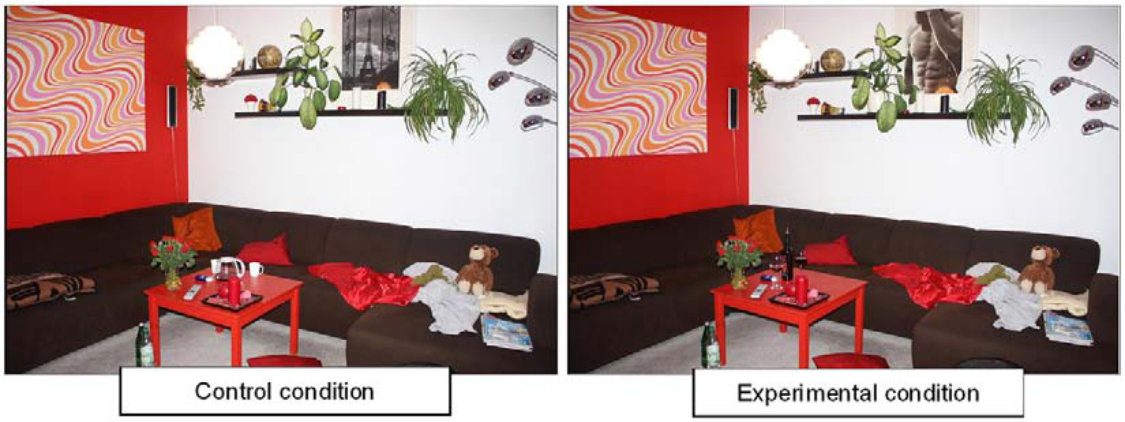
Conditions of type of photograph
Dependent variables
After viewing the picture, participants took the perspective of a lay juror in judging the rape case. Responses to six items were marked on a 7-point scale. Participants first provided a verdict by indicating the likelihood of the defendant’s guilt (“In your opinion, how probable is the defendant’s guilt?” Response options: 1 = not at all probable to 7 = very probable) and subsequently recommending a sentence length (“What sentence length do you consider appropriate?” Response options: 1 = acquittal to 7 = 6 years). Blame attributions for defendant and plaintiff (i.e., victim and perpetrator blame) were assessed separately with four items measuring attributions of responsibility and influence (“How responsible is he/she for what has happened?” Response options: 1 = not at all responsible to 7 = fully responsible, and “How much influence did he/she have on the outcome of the situation?” Response options: 1 = no influence at all to 7 = very much influence).
Results
Properties of the RMA Strength Scale (Hypothesis 1)
Reliability and descriptive statistics
Scores for each scale were computed by averaging across the corresponding items, after reverse-scoring items where appropriate. Table 1 presents internal consistencies, overall means, and standard deviations of RMA, RMA strength, and Social Desirability. Item and reliability analyses revealed that it was useful to compute an overall index of attitude strength because the scale showed high internal consistency as well as satisfactory item-to-total correlations of all items (all rit > .40). A principal component analysis suggested a one-factor solution accounting for 49% of the variance with factor loadings ranging between 0.53 and 0.85. The other measures also showed satisfactory levels of internal consistency, in line with or even exceeding previous findings for these scales (see Table 1).
Descriptive Findings for the Study Variables (Study 1).
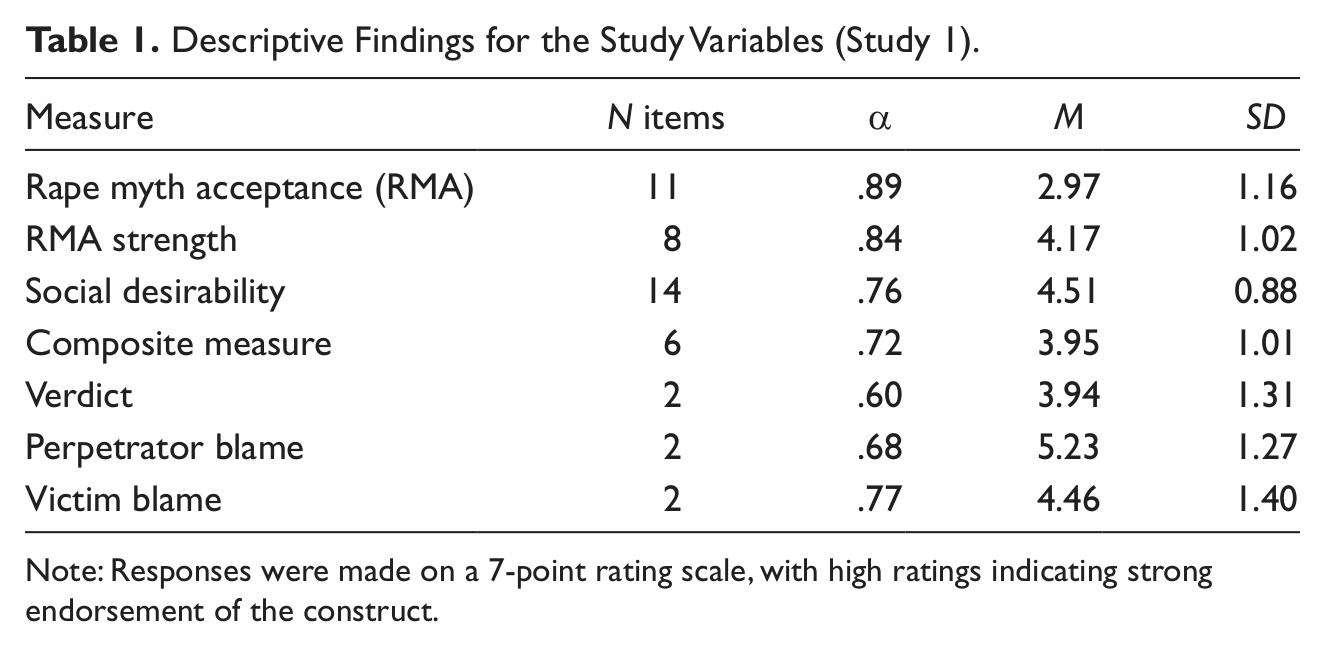
Note: Responses were made on a 7-point rating scale, with high ratings indicating strong endorsement of the construct.
Intercorrelations of self-report scales
RMA strength was negatively correlated to RMA, r(262) = −.30, p < .001. Whereas this relationship was strong for women, r(168) = −.41, p < .001, it was nonsignificant for males, r(82) = −.05, p = .67. Neither RMA, r(262) = −.05, nor RMA strength, r(262) = −.05, were related to social desirability, both ps > .40.
Sex differences
Furthermore, t-tests with sex of respondent as independent variable and self-report measures as dependent variables yielded two significant effects of sex. Men scored higher on the RMA measure than did women (MMales = 3.63, MFemales = 2.67), t(252) = 6.86, p < .001, d = 0.90, but lower on RMA strength (MMales = 3.90, MFemales = 4.27), t(1, 252) = −2.75, p < .01, d = −0.38. No sex differences were found for social desirability.
Effects of RMA, RMA strength, and photograph condition on case judgments (Hypotheses 2 and 3)
Hierarchical regression analyses were performed on participants’ verdict, perpetrator blame, victim blame, as well as on a composite measure that included all six items (α = .72). High values on this composite measure indicate less perpetrator blame, more lenient verdicts, and more victim blame. RMA and RMA strength were z-standardized prior to calculation of product terms and inclusion into the model. In a first step, RMA, attitude strength, and type of photograph (coded –.5 = control condition, .5 = experimental condition) were entered as predictors, and in a second step, product terms of RMA x Attitude Strength, RMA x Type of Photograph, and Attitude Strength x Type of Photograph were included to test for possible two-way interactions. In a third step, the product term of RMA x Attitude Strength x Type of Photograph was entered into the analyses. In line with Hypothesis 2, RMA predicted participants’ judgments in Step 1, β = .44, t(260) = 7.50, p < .001, ΔR2= .17, for the composite measure, whereas RMA strength and condition did not. None of the two-way interactions in Step 2 reached significance (all ps > .60). In Step 3, supporting Hypothesis 3, the three-way interaction for RMA x Attitude Strength x Type of Photograph was a significant predictor of the composite measure, β = .17, t(256) = 2.72, p < .01, accounting for a significant increase in variance, ΔR2 = .02. 5 Figure 2 illustrates the three-way interaction for the composite measure. Subsequently, this pattern was probed for differences between simple slopes (see Dawson & Richter, 2006). According to our theoretical rationale the most straightforward test for schematic processing of myth-applicable stimuli would be a significantly steeper slope for high RMA strength/experimental condition than for high RMA strength/control condition. As hypothesized, this difference was indeed significant, t(256) = 2.23, p < .05, d = .28 (Figure 2). 6

Interaction of rape myth acceptance (RMA), attitude strength, and type of photograph on the dependent variables (composite measure).
It might be instructive to look at the indices that formed the composite measure separately to see whether the effects observed for the composite measure apply to all constituent indices or just to some. An inspection of the hierarchical regressions involving verdict, perpetrator blame, and victim blame revealed that the significance of the composite measure was due to changes on the verdict and perpetrator blame measures, whereas no significant effect was found for victim blame. Table 2 presents the regression results of the three-way interaction in Step 3 for all indices. In neither of these analyses did we obtain any significant two-way interaction for Step 2 (Table 2).
Hierarchical Regression Analyses: Interaction Between Rape Myth Acceptance, Attitude Strength, and Type of Picture as Predictors for Different Dependent Variables in Step 3.

p < .01, two-tailed. *p < .05, two-tailed. †p < .05, one-tailed.
Discussion
The aim of Study 1 was to elucidate the role of attitude strength for the emergence of biased processing. With regard to the validity of the measure employed, our results indicate that different facets of metacognitive attitude strength (of rape myths) might well be combined and add to the explanation of decision making in mock-jury studies. To investigate effects of individual difference variables (i.e., RMA and RMA strength) on active information processing, we provided additional case-related information in the form of a photograph. Visual stimuli demand a more active processing of information and are more open to interpretation, thereby reducing potential demand characteristics and the influence of conversational norms (Grice, 1975), which may be associated with the use of classic text vignette methods. Under such conditions, RMA strength plays a crucial role. More important, and in contrast to other studies, we found no two-way interaction between RMA and the additional information (see, for example, Eyssel & Bohner, 2011; Krahé et al., 2007; Schuller & Wall, 1998), nor did the alcohol cue (and the poster) have a main effect on participants’ judgments (see, for example, Cameron & Stritzke, 2003). Similarly to the results of Sleed and colleagues (2002) and different from studies using textual information, participants in our study did not blame the victim more in the condition featuring the alcohol cue (i.e., we did not obtain a main effect of that cue). Nor did participants with increasing RMA use the additional information to exonerate the perpetrator (i.e., no two-way interaction effect).
Instead, viewing visual stimuli containing RMA-applicable cues influenced subsequent judgments only when RMA strength was included in the analysis. Thus, our theoretical rationale concerning the impact of RMA and RMA strength in conjunction with additional visual information was supported. High attitude strength appears be a prerequisite for schematic effects to occur, at least in cases in which information has to be autonomously inferred. Effects were strongest for the perpetrator blame and verdict measure, whereas no effects were found for the victim blame index. Hence, the additional information regarding the beverage consumption of plaintiff and defendant (alcohol vs. coffee) and the dispositional inferences concerning the plaintiff that could be derived from the poster depicting a nude male torso (vs. Eiffel Tower) resulted in an exoneration of the perpetrator without increasing victim blaming.
In conclusion, we found evidence in support of the assumption that RMA actively guides information processing, in particular when RMA strength is high. In line with research reported by Eyssel and Bohner (2011), participants seem to turn the visual information presented in the experimental condition into subjectively valid evidence with the direction of this interpretation depending upon participants’ level of RMA. However, they only do so if they hold their rape-related beliefs with sufficient subjective strength.
Study 2
Whereas Study 1 focused on the role of attitude strength for the emergence of biased processing, Study 2 addresses the role of attitude strength in the attitude-behavior link. It has been demonstrated that RMA is an important predictor of self-reported rape proclivity (Bohner et al., 1998, 2010; Malamuth, Sockloskie, Koss, & Tanaka, 1991). Because stronger attitudes should be more closely related to actual behavior and because such attitudes are considered to be more stable (Prislin, 1996), measuring RMA strength could prove especially helpful in identifying target groups for intervention purposes. In Study 2, we examine the following hypotheses:
Hypothesis 1: Higher RMA is related to higher self-reported rape proclivity.
Hypothesis 2: The strength of participants’ RMA moderates the effect of RMA level on self-reported rape proclivity (Hypothesis 1) such that the effect is larger for higher RMA strength.
Method
Participants
A sample of 85 students (all male) with an average age of 23.08 years (SD = 4.75) from the University of Bielefeld participated in this study. They studied different subjects: business sciences (n = 17), social sciences (n = 15), natural sciences (n = 14), humanities (n = 11), law (n = 11), psychology (n = 4), other (n = 13). Participants were approached on campus.
Materials
RMA and RMA strength
The scales used to assess RMA and RMA strength were identical to the ones used in Study 1.
Self-reported rape proclivity
Participants were instructed to carefully read five scenarios and to imagine being in the situation of the male protagonist. The scenarios were taken from Eyssel, Bohner, Süssenbach, and Schreiber (2009) and they assess a general proclivity to sexually aggress. The scenarios are specifically constructed for student samples. In four of the scenarios an acquaintance rape is described, whereas the last depicts a less severe case of sexual assault (i.e., groping). Each scenario was followed by three questions with the first item being a filler question (see also Bohner et al., 2006) that asked how sexually aroused the participant would be in the situation (from 1 = not at all sexually aroused to 7 = highly sexually aroused). Subsequently, participants were asked whether they would have behaved like this (from 1 = certainly not to 7 = certainly yes) and how much they would have enjoyed “getting their way” (from 1 = not at all to 7 = very much). The latter two questions were combined across the 5 scenarios to yield a 10-item index of rape proclivity.
Procedure
Participants were approached on campus and led to a lab where they individually completed the questionnaire package. Participants first responded to the self-report measures using MediaLab (Jarvis, 2005). After completion of the questionnaire, participants were debriefed and received 2 Euros for their participation.
Results
Exclusion of Cases
The data of four homosexual participants were excluded because the scenario-based measure of rape proclivity may not provide meaningful behavioral templates for them. Thus, the final data set consisted of 81 participants with heterosexual (n = 79) or bisexual (n = 2) orientation.
Self-report scales and dependent variables
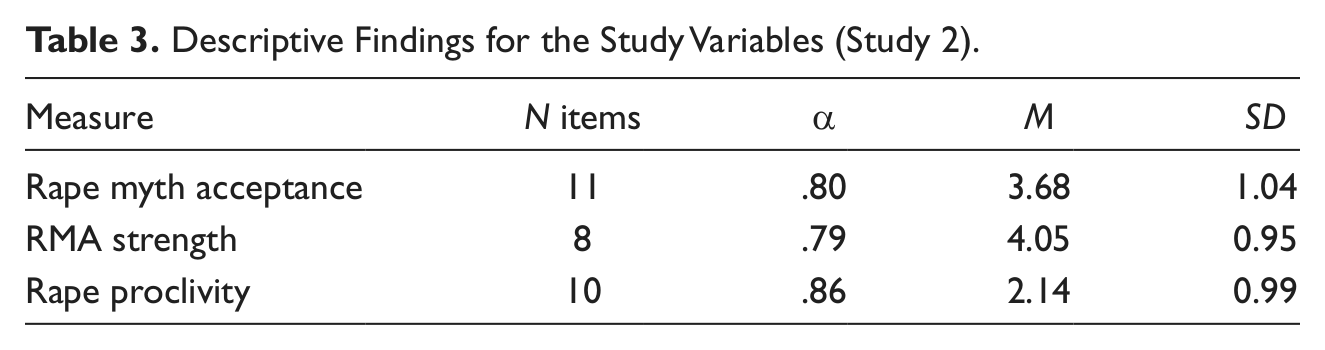
After averaging across the corresponding items, scores were calculated for the self-report scales. In this all-male sample, RMA strength showed a weak-to-moderate positive correlation with RMA, r(79) = .22, p = .05. Table 3 presents the internal consistencies, overall means, and standard deviations. As in Study 1, RMA and RMA strength were z-standardized. A hierarchical regression analysis with RMA and RMA strength in Step 1, and their product term in Step 2 was conducted. In line with Hypothesis 1, RMA predicted rape proclivity, β = .35, t(79) = 3.19, p < .01, ΔR2= .11, whereas RMA strength did not, β = −.07, t(79) = −0.64, p > .50. In keeping with Hypothesis 2, the interaction term between RMA and RMA strength explained a significant increase in variance in rape proclivity, ΔR2 = .05, F(1, 78) = 4.13, p < .05. Thus, RMA strength was a significant moderator of the main effect of RMA on rape proclivity, β = .23, t(78) = 2.03, p < .05. The standardized simple slope for participants 1 SD below the mean of RMA strength was .15, t(78) = 0.85, p > .30, and the standardized simple slope for participants 1 SD above the mean of RMA strength was .54, t(78) = 4.97, p < .001 (see Figure 3).
Descriptive Findings for the Study Variables (Study 2).
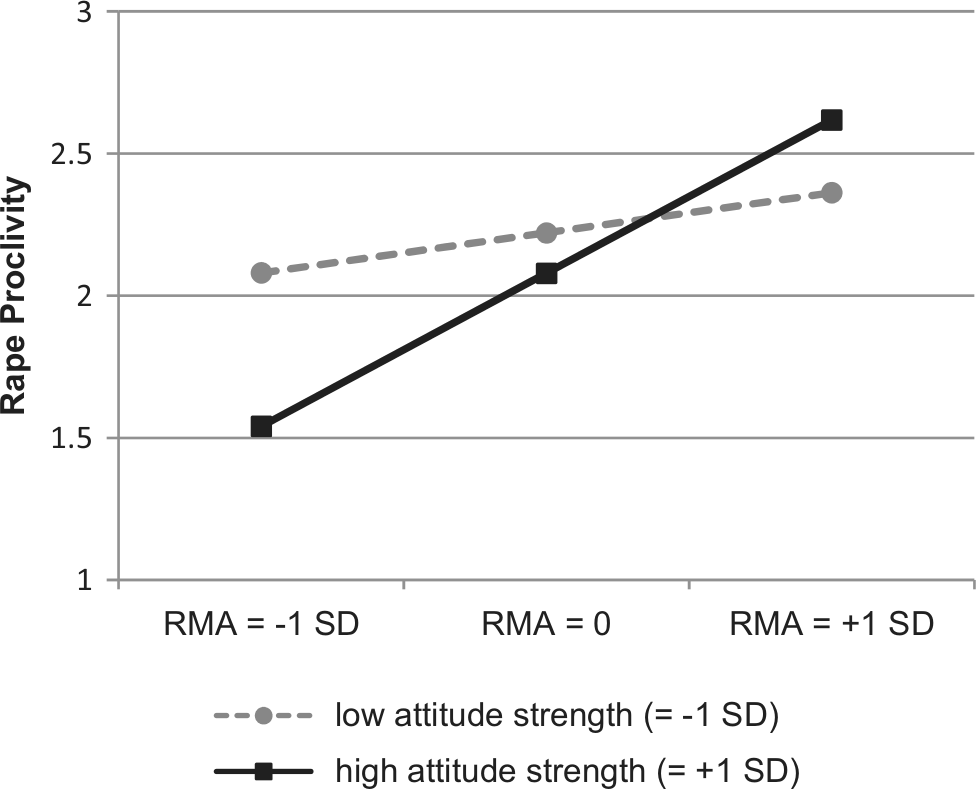
Simple slopes of rape myth acceptance (RMA) predicting rape proclivity for 1 SD below the mean of RMA strength, and 1 SD above the mean of RMA strength.
Discussion
Study 2 extended the findings from Study 1 by showing that the moderating role of RMA strength extends beyond influences on information processing to RMA’s relationship to behavioral intentions. As hypothesized, RMA strength was found to moderate the effect of RMA on self-reported rape proclivity. Especially, participants reporting high attitude strength responded to the scenarios in line with their RMA, whereas for participants indicating weak attitude strength this relationship was less pronounced. This might prove relevant for practitioners as it may help to identify people who are especially likely to act upon their beliefs.
General Discussion
The present studies replicated main effects of RMA on judgments in a mock-jury study (e.g., Krahé et al., 2007) as well as on self-reported rape proclivity (e.g., Bohner et al., 1998, 2006) and focused on attitude strength as an important moderator of these relationships.
With regard to information processing, our results indicate that the integration of additional information (here in a visual format) into the decision-making process need not automatically suffer from biased processing. Providing participants with myth-applicable cues in the experimental condition did not lead to an increase of anti-victim responses, nor did it in interaction with RMA. Rather, the observed interaction pattern involving RMA, RMA strength, and type of information suggests that such an assumption would be overly simplistic, at least when information is not readily available in text form or attitudes are deemed unimportant by participants. Our results indicate that schematic processing of myth-applicable cues is dependent on the strength of one’s rape-related attitudes. Thus, to identify individual cognitive schemata our findings speak to the importance of measuring metacognitive attitude strength also in the domain of rape myths.
Concerning behavioral intentions, the observed moderation of the RMA–rape proclivity relationship by RMA strength has immediate implications for an applied context. Sexual assault prevention programs might benefit from identifying people with high RMA and high RMA strength because it is strong attitudes that are stable (i.e., resistant to change) and that drive behavior (Krosnick & Petty, 1995). Such high-high individuals might be prime candidates for a more tailored and extensive treatment dosage, whereas less intensive programs might be sufficient to promote attitude change among individuals with high RMA but low RMA strength. Taken together, the present research offers evidence that RMA strength constitutes an easy-to-access moderator of effects of RMA on thinking and acting. As such, we are hopeful that metacognitive aspects of RMA will receive further interest from basic as well as applied researchers in the field of sexual violence.
Future research should clarify the relationship between RMA and RMA strength. Whereas we found a strong negative relationship among women in the first study, RMA and RMA strength were uncorrelated for men in the first and mildly positively correlated in the second study. As both studies used a student sample, the relationship between rejecting rape myths and finding this rejection personally important among women might be due to a stronger exposure to feminist ideas in this specific sample. However, the influence of RMA strength on the RMA-biased processing of applicable information was independent of participant sex. Taking into account that the present studies relied almost exclusively on the responses of students, more research is needed before the results should be generalized to the general public or to specific populations such as sexual offenders.
In the present research, we focused on metacognitive indices of attitude strength and hence addressed only one type of strength according to the two-dimensional conceptualization proposed by Bassili (1996). Future research on RMA could thus profit from taking a closer look at operative indices of attitude strength (e.g., response time, attitude extremity) as well and examine whether these add to the explanation of biased processing and rape proclivity. In conclusion, we want to encourage researchers and practitioners to consider assessing metacognitive aspects of the attitudes they are interested in—be they in the area of sexual violence, intimate partner violence, or elsewhere—as they provide an effective way to boost the predictive power of the variables studied.
Footnotes
Authors’ Note
The second and third author contributed equally to this article.
Declaration of Conflicting Interests
The authors declared no potential conflicts of interest with respect to the research, authorship, and/or publication of this article.
Funding
The authors disclosed receipt of the following financial support for the research, authorship, and/or publication of this article: The first author was supported by a scholarship of the University of Bielefeld.
Notes
Author Biographies
He conducts basic and applied research in the areas of social, political and personality psychology. His current research interests cover topics such as sexual aggression, moral decision making, and ideological attitudes.