



Abstract
We examined the relationship between self-reported sexual aggression and implicit and explicit attitudes towards rape in a sample of 86 male heterosexual university students. Large, significant group differences were found between the most sexually aggressive participants and the nonaggressive participants, with the most sexually aggressive group showing less negative implicit and explicit attitudes towards rape (Cohen’s d = 0.76-1.20). Implicit and explicit attitudes provided complementary information such that together they were more strongly associated with sexual aggression than on their own. The current findings suggest that implicit and explicit attitudes towards rape are associated with sexual aggression. In addition to the broader set of cognitions that appear to be assessed by most self-report measures, the narrower construct of attitudes towards rape may be a fruitful avenue of further exploration for research, assessment, and treatment of sexual aggression.
Numerous models and theories of sexual offending hypothesize attitudes towards a behavior mediate the likelihood of engaging in that behavior (e.g., hierarchical-mediational confluence model [HCM; Malamuth, 2003], integrated theory of the etiology of sexual offending [Marshall & Barbaree, 1990], structured risk assessment model [Thornton, 2002], judgment model of cognitive distortions [JMCD; Ward, Gannon, & Keown, 2006]). This is also the case for nonsexual aggression (e.g., Anderson & Bushman, 2002; Andrews & Bonta, 2006; Bandura, 1973) and general behavior (e.g., Ajzen, 1991, 2001; Ajzen & Fishbein, 1980; 2005). Although the influence of attitudes on general behavior is moderated by a number of variables, such as the accessibility and stability of the attitude (Glasman & Albarracín, 2006; Kraus, 1995), the relationship between attitudes and behavior can be strong. Meta-analyses have revealed medium (r = .38, k = 88; Kraus, 1995) to large (r = .52, 95% CI [.49, .54], N = 4,598; Glasman & Albarracín, 2006) average correlations between attitudes and subsequent behavior. In sum, attitudes can be important determinants of behavior.
As noted by others, there has been a lack of clarity and precision in the conceptualization of, and terminology for, various cognitive constructs, including attitudes, in theory and research on sexual offenders (e.g., Gannon & Polaschek, 2006; Gannon, Ward, & Collie, 2007; Hermann, Babchishin, Nunes, Leth-Steensen, & Cortoni, 2012; Mann & Beech, 2003; Maruna & Mann, 2006; Miller, 2010; Nunes & Jung, 2013; Ward, 2000; Ward, Hudson, Johnston, & Marshall, 1997). In the social psychology literature, attitudes are typically defined as summary evaluations (e.g., positive vs. negative) of psychological objects, such as people, things, or behaviors (e.g., Ajzen, 2001; Eagly & Chaiken, 1993; Fazio, 2007). Thus, according to this definition, attitudes towards rape are evaluations of rape. In theory and research on sexual offenders, however, the term “attitude” is often used to refer to a wide range of cognitions that appear to extend beyond evaluation of rape, such as excuses; justifications; rationalizations; hostility towards women; and stereotypes about rape, rape victims, and women in general. For example, consider the following items from various self-report measures of rape-supportive cognition: “A raped woman is a less desirable woman” (Feild, 1978); “One reason that women falsely report a rape is that they frequently have a need to call attention to themselves” (Burt, 1980); “Generally, rape is not planned—a lot of times it just happens” (Bumby, 1996); and “Rape is unlikely to happen in the woman’s own familiar neighborhood” (Payne, Lonsway, & Fitzgerald, 1999). These measures are often interpreted as reflecting attitudes towards rape, but it seems unlikely that endorsement of the items above would indicate or require viewing rape as a positive (or a negative) behavior.
Although many existing measures also include items that seem to more clearly reflect evaluation of rape (e.g., Burgess, 2007), they also include items like the examples listed above, which probably do not reflect attitudes towards rape per se. As a result, the extent to which these scales measure attitudes towards rape versus other cognitive constructs is unclear. Whatever constructs are being assessed by these measures, they generally appear to be relevant to understanding and predicting sexual aggression as evidenced by their observed association with sexual aggression (e.g. Bumby, 1996; DeGue, DeLillo, & Scalora, 2010; Helmus, Hanson, Babchishin, & Mann, 2012; Murnen, Wright, & Kaluzny, 2002). However, the direction of influence remains unclear. Some researchers suggest some rape-supportive cognition may function to facilitate sexual offending, whereas others suggest it may function to excuse offending behavior postoffence (see Maruna & Mann, 2006) or, more generally, facilitate self-deception (Gannon & Polaschek, 2006). It is possible that different cognitive constructs serve different functions. Precision and clarity become important if we wish to untangle the relationship between different cognitive constructs and sexual offending.
Surprisingly little research has focused specifically on attitudes towards rape, as defined above. To the best of our knowledge, only three published studies provide directly relevant data. O’Donohue, McKay, and Schewe (1996) examined the relationship between the expected outcomes of raping a woman, self-reported past sexual coercion, and self-reported likelihood to rape with 167 male undergraduate students. Attitudes towards a given behavior are theoretically based on the aggregate valence of the expected outcomes of that behavior (e.g., Fishbein and Ajzen’s [1975] expectancy-value model of attitudes); thus, outcome expectancies can be viewed as precursors of attitudes. O’Donohue and colleagues (1996) found that lower expectancies of negative outcomes of rape were significantly associated with greater past sexual coercion (r = –.36) and likelihood to rape (r = –.39). Bouffard (2002) also examined the relationship between the expected outcomes of rape and self-reported likelihood to rape with 129 male undergraduate students. Likelihood to rape was generally significantly correlated with the perceived expectancies and evaluation of negative outcomes of rape (respectively, r = –.25 and r = –.17) and positive outcomes of rape (respectively, r = .04 ns and r = .21).
Finally, Widman and Olson (2012) examined the relationship between implicit attitude towards rape and self-reported past sexual coercion with 82 male undergraduate students and 51 male community participants. Implicit attitudes are automatic activations (i.e., without intent or control) of evaluative associations with the attitude object (rape, in this case), whereas explicit attitudes are effortful, deliberative evaluations of the attitude object (e.g., Gawronski & Bodenhausen, 2006; Olson & Fazio, 2009). Implicit attitudes are usually assessed with response latency measures, such as the Implicit Association Test (IAT; Greenwald, McGhee, & Schwartz, 1998), whereas explicit attitudes are assessed with self-report measures (e.g., questionnaires). Widman and Olson (2012) adapted Fazio’s evaluative priming procedure (Fazio, Jackson, Dunton, & Williams, 1995) to assess implicit attitudes to rape. They found in both the student and community samples that less negative implicit attitude towards rape was significantly associated with more past sexual coercion. Furthermore, implicit attitude towards rape was independently associated with past sexual coercion when self-report measures of rape-supportive cognition (Illinois Rape Myth Acceptance Scale, short form; Payne et al., 1999) and hostility towards women (Revised Hostility toward Women Scale; Lonsway & Fitzgerald, 1995) were also entered in regression analyses. These novel results suggest that implicit attitudes towards rape may also play a role in sexual aggression and that they may provide complementary information to self-report measures of rape-supportive cognition.
Widman and Olson’s (2012) findings are consistent with the general social psychological literature, which supports the validity of implicit measures and indicates that implicit and explicit measures can provide complementary information. Results from a recent meta-analysis of the predictive validity of IAT and self-report measures (Greenwald, Poehlman, Uhlmann, & Banaji, 2009) indicate that both implicit and explicit attitudes are associated with relevant criterion variables (average r = .27, k = 184; average r = .36, k = 156, respectively). Moreover, implicit and explicit attitudes generally show small to medium intercorrelations (average r = .24, N = 12,289, k = 126; Hofmann, Gawronski, Gschwendner, Le, & Schmitt, 2005) and empirical evidence suggests that they are distinct constructs (e.g., Nosek & Smyth, 2007). Implicit and explicit attitudes tend to correspond more closely when one is either unmotivated or lacks opportunity to engage in propositional reasoning about the validity or social acceptability of one’s implicit attitudes (Gawronski & Bodenhausen, 2006; Hofmann et al., 2005; Nosek & Smyth, 2007; Olson & Fazio, 2009). Thus, complementing self-report measures with implicit measures would be expected to provide more complete information about the phenomenon of interest. More generally, the validity of research and assessment is improved through multi-method measurement (Kazdin, 2003).
The goal of the current study was to add clarity and focus to the literature by examining the relationship between sexual aggression and implicit and explicit attitudes towards rape. More specifically, we attempted to replicate and extend Widman and Olson’s (2012) findings using different measures of implicit attitudes towards rape (IAT versus evaluative priming), explicit rape-relevant cognitions (attitudes towards rape vs. rape myths and hostility towards women), and sexual aggression (past sexual coercion and likelihood to rape vs. exclusively past sexual coercion). We hypothesized that less negative implicit and explicit attitudes towards rape would be associated with more sexual aggression. We also expected that implicit and explicit attitudes would be independently associated with sexual aggression and that together they would be more strongly associated with sexual aggression than either one alone.
Method
Participants
Participants were 86 heterosexual male undergraduate students at Carleton University who received course credit for their participation. Although 97 participants initially completed the study, 11 were excluded because they (a) self-reported homosexual (n = 3) or bisexual (n = 5) orientation or (b) responded faster than 300 ms on more than 10% of trials on the IAT measure (n = 3; this follows the IAT scoring procedure, which is described in the Measures section). All participants reported that they understood written English. Approximately three quarters of the participants were younger than 22 years: 26.7% were 16 to 18 years old, 45.3% were 19 to 21, 15.1% were 22 to 25, 7.0% were 26 to 29, 2.3% were 30 to 35, and 3.5% were older than 45 years.
Measures
Rape Evaluation IAT (RE-IAT)
The RE-IAT was designed for the current study to measure implicit attitude towards rape. In the RE-IAT, implicit attitudes are inferred from the speed with which one sorts stimulus words (e.g., force, poison) into categories. Respondents must sort each stimulus word into one of four categories by pressing one of two keys on a computer keyboard (d or k). Thus, two categories share one key while the remaining two categories share the other key. Response speed is expected to depend on the extent to which the categories that share one key are associated in one’s memory.
The main task in the RE-IAT was to sort words into one of the following categories: RAPE, NOT RAPE, good, or bad. Participants were asked to indicate whether each word belonged in the RAPE, NOT RAPE, good, or bad category by pressing either d on the computer keyboard with the index finger of the left hand or k with the index finger of the right hand. Each categorization of a stimulus word constitutes one trial. The response latency for each trial was recorded. To make the category pairs distinct from one another, one pair (e.g., RAPE vs. NOT RAPE) and its stimulus words (e.g., FORCE, CONSENT) were presented in upper-case letters, whereas the other pair (e.g., good vs. bad) and its stimulus words were presented in lower-case letters (e.g., paradise, poison).
For someone with a positive implicit evaluation of rape, the configuration of categories in which RAPE and good share a response key would be congruent with the configuration of associations in his memory. More specifically, just as RAPE and good are associated with the same response key, so too are they associated in the memory of someone with a positive implicit evaluation of rape. This categorization task should be relatively easy for someone with a positive implicit evaluation of rape. In contrast, the categorization task in which RAPE and bad share a response key should be more difficult for someone with a positive implicit evaluation of rape because the configuration of the categories would not be congruent with his implicit associations in memory. Conversely, the opposite pattern would be expected for someone with a negative implicit evaluation of rape. A difference score called the IAT effect was computed by subtracting the average response latency for one critical phase (e.g., RAPE and good/NOT RAPE and bad) from that for the other critical phase (e.g., RAPE and bad/NOT RAPE and good), which provided an index of the relative implicit evaluation of rape. The scoring procedure is described in detail by Greenwald, Nosek, and Banaji (2003; see the improved IAT scoring algorithm on p. 214). Positive RE-IAT scores reflect more positive evaluation of RAPE than NOT RAPE, whereas negative RE-IAT scores reflect more negative evaluation of RAPE than NOT RAPE.
In the current study, the internal consistency of the RE-IAT was low (α = .63); however, this is consistent with what is typically found with other IAT measures (Hofmann et al., 2005). Although other information about the psychometric properties of RE-IAT was not available, there is considerable evidence, as noted in the Introduction section, that IAT measures in general have good predictive validity, are correlated but distinct from self-report measures, and can provide independent information to complement self-report measures (Greenwald et al., 2009; Hofmann et al., 2005; Nosek & Smyth, 2007).
Rape Outcome (RO) Evaluation Scale
The RO-Evaluation scale was also developed for the current study to assess explicit attitudes towards rape. It is similar to measures of rape outcome expectancies developed by Bouffard (2002) and O’Donohue and colleagues (1996), as well as a measure of outcome expectancies for general criminal behavior developed by Walters (2003). The RO-Evaluation scale follows Fishbein and Ajzen’s (1975) expectancy-value model of attitudes, in which one’s attitude towards a given behavior is thought to be based on the aggregate valence of the expected outcomes of that behavior. For example, if the expected costs outweigh the expected benefits for a given behavior, one should have a negative attitude towards that behavior.
In the RO-Evaluation scale, three self-generated outcomes of “forcing a woman to have sex with you” are rated on their perceived valence (“How positive or negative would this outcome be for you if it did happen?”). Participants are asked to think of one possible outcome of sexual assault and then rate the evaluation of that outcome on a 7-point scale ranging from −3 (very negative) to +3 (very positive); the midpoint on the scale is 0 (neutral). This is repeated for the second and third outcome. A total score is computed by summing the evaluation ratings of the three outcomes. Total scores can range from −9 to +9, with higher values indicating a more positive evaluation of the outcomes of rape generated by the participant. Although information about the validity of RO-Evaluation Scale scores was unavailable, O’Donohue et al. (1996) and Bouffard (2002), as noted in the Introduction section, both found similar measures of rape outcome expectancies were significantly associated with self-reported sexual aggression.
Sexual Experiences Survey-Male Version (SES-MV)
The SES-MV (Koss & Oros, 1982) is a 12-item self-report questionnaire measuring sexually coercive behavior. Participants indicate whether they have attempted or obtained sexual contact with a woman by using varying levels of coercion. Different items ask about different levels of coercion (from psychological manipulation to physical force) and different sexual acts (e.g., kissing, oral sex, intercourse).
We made slight modifications to the SES-MV in the current study. Specifically, rather than the original yes/no response options, a 3-point scale (0 = never, 1 = once, 2 = twice or more) was used in an attempt to assess frequency. In addition, the wording of questions was modified to include “girls” as well as “women.” This was done to capture sexual coercion against peer-age females, which may have occurred before age 18. The final modification was in the scoring of the SES-MV. Specifically, we excluded Items 1, 2, and 6, using only the remaining nine items to compute the SES-MV total score. The nine items we retained refer to the use of verbal or physical pressure to have sexual contact with a resisting female, whereas the three excluded items do not. Responses on each item were summed to compute a total score. Scores could range from 0 to 18, with higher scores indicating greater sexual coerciveness.
SES-MV scores have demonstrated excellent internal consistency (α = .89) and test-retest reliability over one week (mean item agreement = 93%) with undergraduate students (Koss & Gidycz, 1985). In addition, SES-MV responses have been found to correspond well with information gathered through private interviews with undergraduate students (r = .61; Koss & Gidycz, 1985). In the current study, the modified SES-MV had poor internal consistency (α = .51); however, all participants scored zero for four of the items. Internal consistency improved slightly when these four items were excluded (α = .57).
Likelihood to Rape (LR) Question
On the LR question (Malamuth, 1981) participants rate the likelihood that they would rape a woman if they could be assured of not being caught and punished. This single item is rated on a 5-point Likert-type scale, which ranges from 1 (not at all likely) to 5 (very likely). Higher scores indicate greater likelihood to rape. Gidycz, Warkentin, Orchowski, and Edwards (2011) found male college students’ reported likelihood of engaging in sexually coercive and aggressive behavior were significantly associated with perpetrating future sexually coercive and aggressive behavior during a 3-month follow-up period.
Procedure
Participants completed all measures on a laptop computer while seated alone in a small room. The testing procedure was run with E-Prime 1.1 (Schneider, Eschman, & Zuccolotto, 2002). All participants completed the measures in the following order: (a) RE-IAT (counterbalancing the order in which rape and good vs. rape and bad were paired), (b) RO-Evaluation scale, (c) SES-MV, (d) LR, and (e) demographic questions.
Results
Means, standard deviations, medians, and ranges for all variables are reported in Table 1. The majority of participants reported little to no prior sexual coercion (SES-MV) or likelihood to rape (LR). The negative mean RE-IAT scores indicated that, on average, participants responded more quickly when rape and bad shared a response key than when rape and good shared a response key. This suggests a stronger implicit association between rape and bad than between rape and good; that is, a relatively negative implicit evaluation of rape. Consistent with this finding, the negative mean RO-Evaluation scale scores indicated relatively negative explicit evaluations of rape.
Descriptive Statistics for Measures of Attitudes and Sexual Aggression.
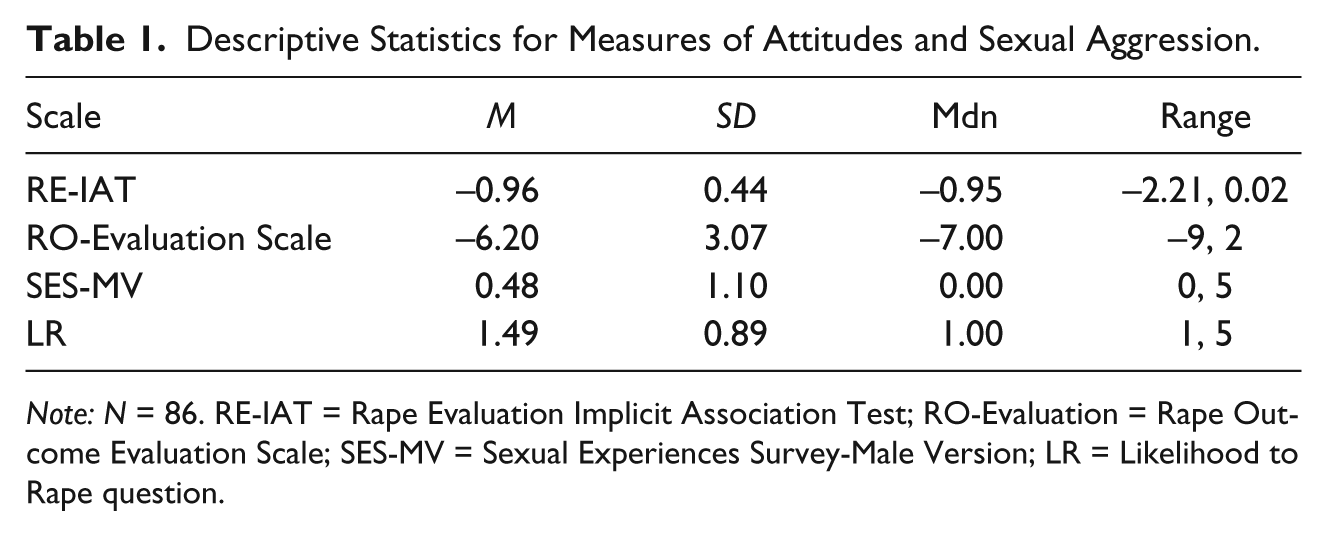
Note: N = 86. RE-IAT = Rape Evaluation Implicit Association Test; RO-Evaluation = Rape Outcome Evaluation Scale; SES-MV = Sexual Experiences Survey-Male Version; LR = Likelihood to Rape question.
As shown in Table 2, all correlations between measures were moderate to large and significant except for the correlation between the RE-IAT and RO-Evaluation Scale (p = .088). Given that the SES-MV and LR were severely positively skewed, we trichotomized the scores on these measures. Specifically, SES-MV scores of 0 were coded as no past coercion (none), scores of 1 were coded as some past sexual coercion (some), and scores of 2 or higher were coded as the most past sexual coercion (most). Similarly, LR scores of 1 were coded as no likelihood to rape (none), scores of 2 were coded as some likelihood to rape (some), and scores of 3 or higher were coded as the most likelihood to rape (most).
Correlations Between Measures of Attitudes and Sexual Aggression.
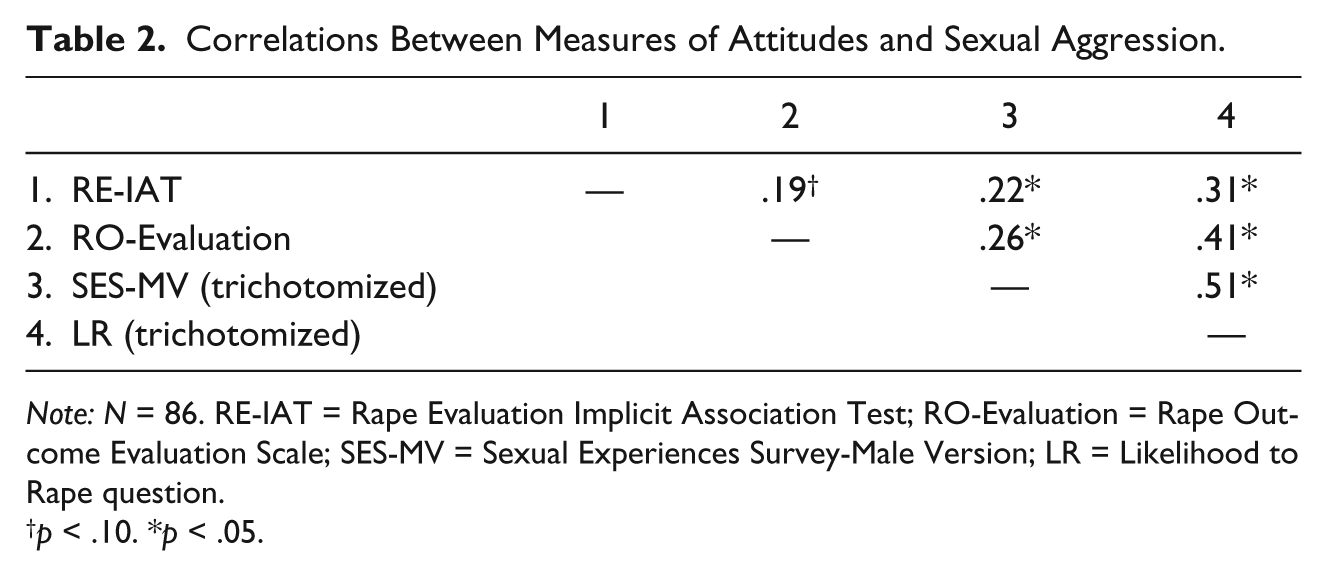
Note: N = 86. RE-IAT = Rape Evaluation Implicit Association Test; RO-Evaluation = Rape Outcome Evaluation Scale; SES-MV = Sexual Experiences Survey-Male Version; LR = Likelihood to Rape question.
p < .10. *p < .05.
Although the mean RE-IAT and RO-Evaluation scale scores indicated that all groups evaluated rape negatively (Table 1), some groups were less negative than others. Tables 3 and 4 show the mean RE-IAT and RO-Evaluation scores for the three groups: none, some, and most past sexual aggression (SES-MV) and likelihood to rape (LR). Large significant differences (Cohen’s d around 0.80 or greater) were found between participants who reported no past sexual coercion or likelihood to rape and those who reported the most past sexual coercion or likelihood to rape. In all cases, the most sexually aggressive group had less negative implicit and explicit evaluation of rape compared to the nonaggressive group.
Implicit (RE-IAT) and Explicit (RO-Evaluation scale) Evaluation of Rape by Past Sexual Coercion (SES-MV).
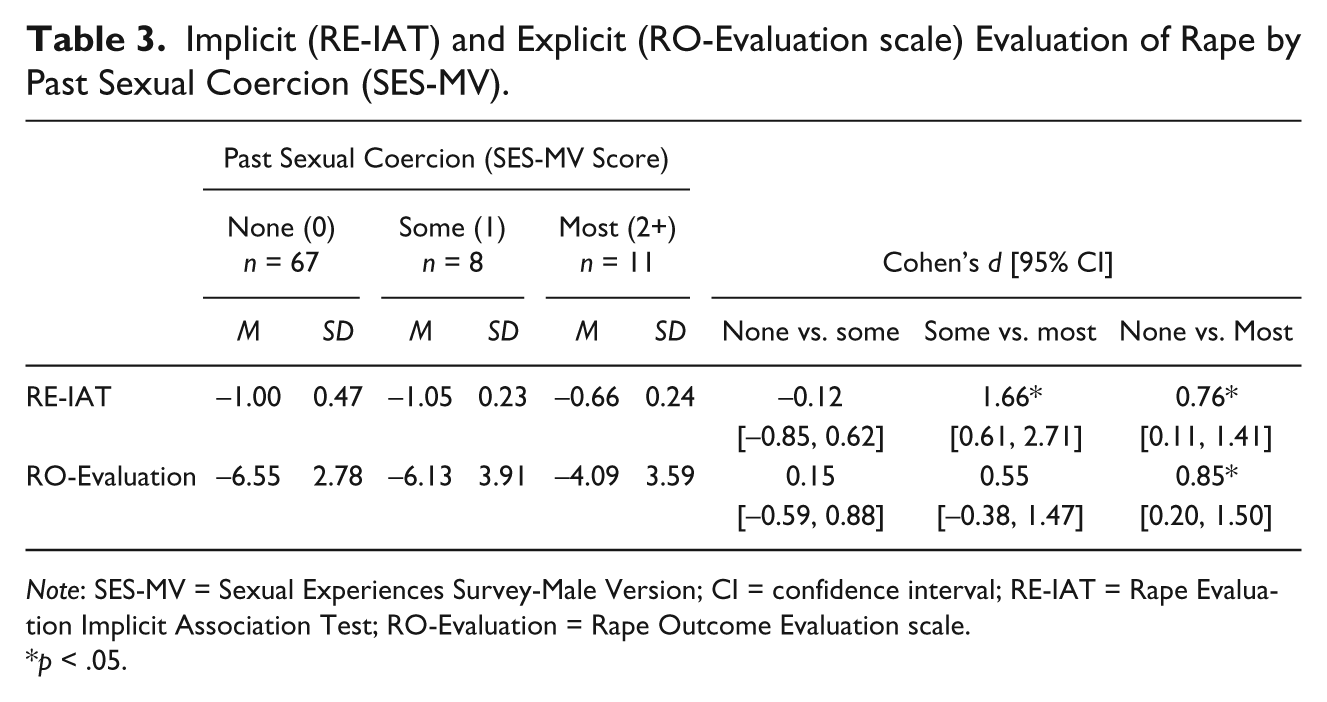
Note: SES-MV = Sexual Experiences Survey-Male Version; CI = confidence interval; RE-IAT = Rape Evaluation Implicit Association Test; RO-Evaluation = Rape Outcome Evaluation scale.
p < .05.
Implicit (RE-IAT) and Explicit (RO-Evaluation scale) Evaluation of Rape by Likelihood to Rape (LR).
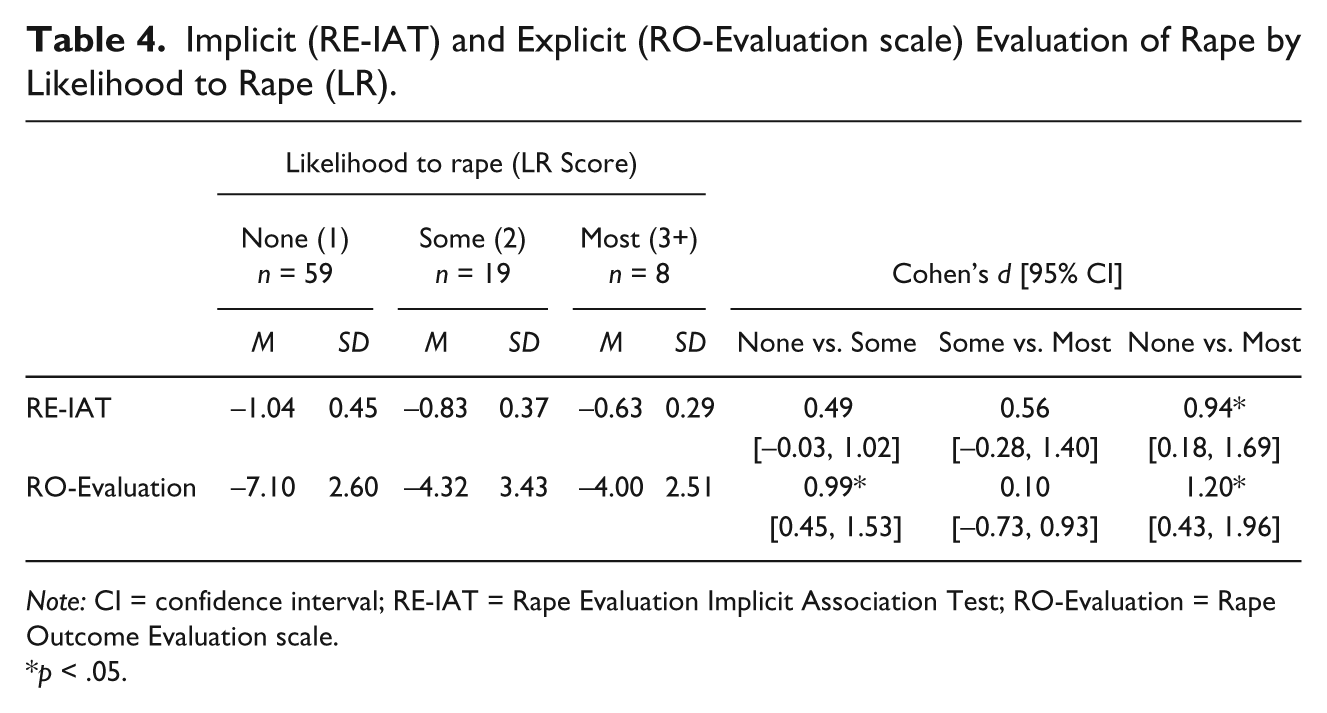
Note: CI = confidence interval; RE-IAT = Rape Evaluation Implicit Association Test; RO-Evaluation = Rape Outcome Evaluation scale.
p < .05.
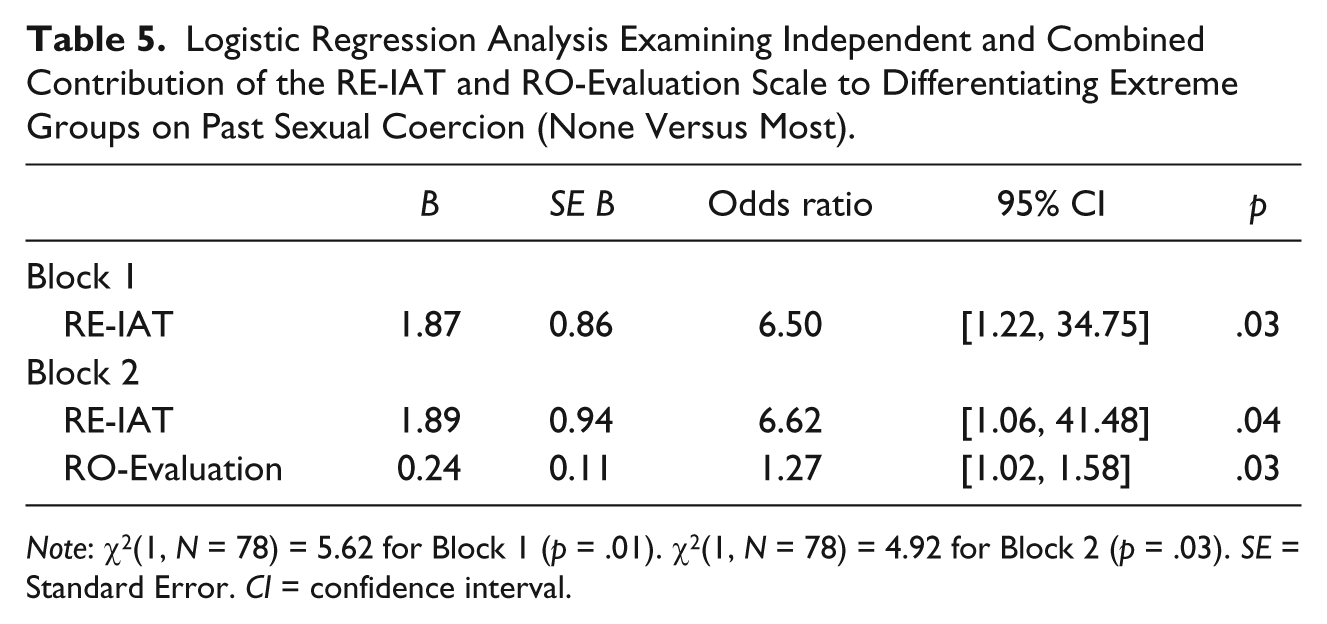
To determine whether the RE-IAT and the RO-Evaluation Scale independently differentiated the most sexually aggressive participants from the nonaggressive participants and whether both measures together could better differentiate these groups than either measure alone, we conducted two sequential logistic regression analyses in which the criterion was the extreme categories (none versus most) on either the SES-MV or the LR. The RE-IAT was entered in the first block and the RO-Evaluation Scale was entered in the second block. The first logistic regression analysis examined past sexual coercion as measured by the SES-MV. As shown in Table 5, both the RE-IAT and RO-Evaluation scale significantly differentiated participants who reported no past sexual coercion from those who reported the most past sexual coercion. Moreover, the RE-IAT and RO-Evaluation scale together differentiated groups significantly better than the RE-IAT alone, as indicated by the significant improvement for Block 2 over Block 1 (reported in the table note). This significant improvement in differentiation for Block 2 over Block 1 (both measures versus one measure) was also found when the RO-Evaluation Scale was entered in the first block and the RE-IAT entered in the second block.
Logistic Regression Analysis Examining Independent and Combined Contribution of the RE-IAT and RO-Evaluation Scale to Differentiating Extreme Groups on Past Sexual Coercion (None Versus Most).
Note: χ2(1, N = 78) = 5.62 for Block 1 (p = .01). χ2(1, N = 78) = 4.92 for Block 2 (p = .03). SE = Standard Error. CI = confidence interval.
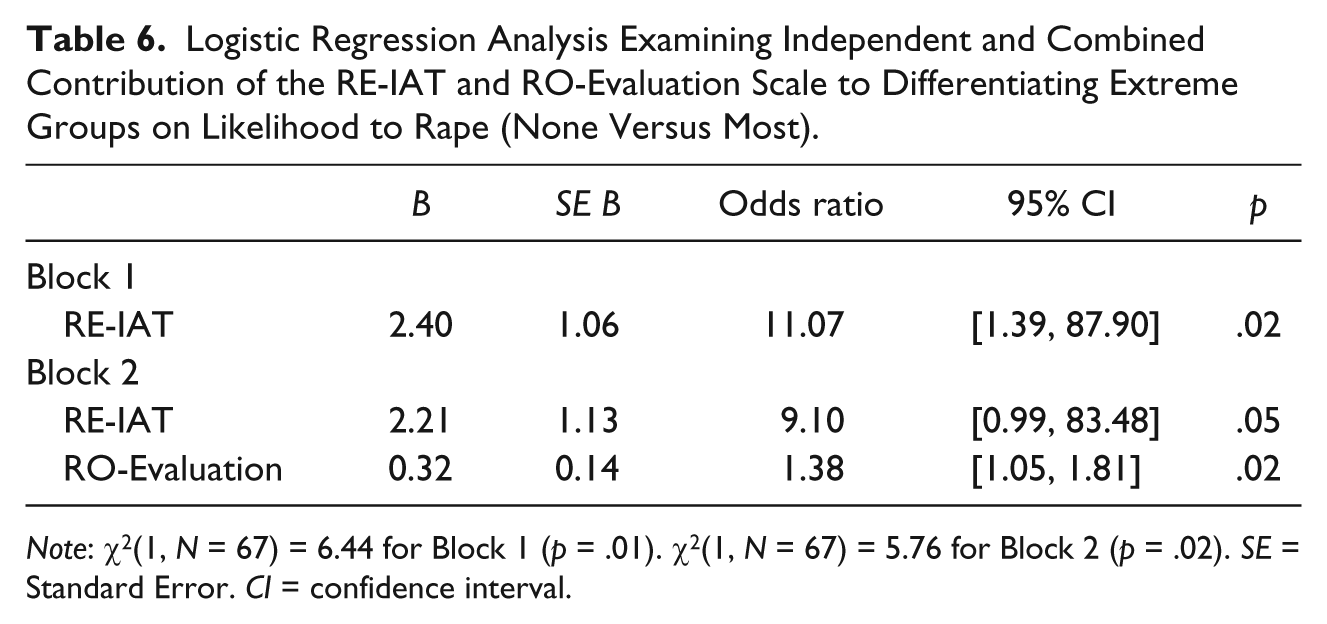
The second logistic regression analysis examined likelihood to rape as measured by the LR. As shown in Table 6, the RO-Evaluation scale significantly differentiated participants who reported no likelihood to rape from those who reported the most likelihood to rape; however, the RE-IAT fell just short of statistical significance (p = .051) after the RO-Evaluation Scale was entered in Block 2. Nevertheless, the RE-IAT and RO-Evaluation scale together differentiated groups significantly better than the RE-IAT alone, as indicated by the significant improvement for Block 2 over Block 1 (reported in the table note). This significant improvement in differentiation for Block 2 over Block 1 (both measures versus one measure) was also found when the RO-Evaluation Scale was entered in the first block and the RE-IAT entered in the second block.
Logistic Regression Analysis Examining Independent and Combined Contribution of the RE-IAT and RO-Evaluation Scale to Differentiating Extreme Groups on Likelihood to Rape (None Versus Most).
Note: χ2(1, N = 67) = 6.44 for Block 1 (p = .01). χ2(1, N = 67) = 5.76 for Block 2 (p = .02). SE = Standard Error. CI = confidence interval.
Discussion
We found large group differences between the most sexually aggressive participants and the nonaggressive participants, with the most sexually aggressive group showing less negative implicit and explicit attitudes towards rape (Cohen’s d = 0.76-1.20). However, only a small nonsignificant correlation was found between implicit and explicit attitudes. Finally, implicit and explicit attitudes provided independent information and together they were more strongly associated with sexual aggression than on their own. Our findings replicate and extend those of Widman and Olson (2012) using different measures of implicit attitude, explicit attitude, and sexual aggression. More generally, our findings are consistent with theories and research indicating a link between attitudes and behavior and the distinctiveness and complementariness of implicit and explicit attitudes in the area of sexual aggression (Bouffard, 2002; Malamuth, 2003; Miller, 2010; Ward et al., 2006; Widman & Olson, 2012) and in other areas of psychology (Ajzen & Fishbein, 1980; 2005; Anderson & Bushman, 2002; Andrews & Bonta, 2006; Bandura, 1973; Glasman & Albarracín, 2006; Greenwald et al., 2009; Hofmann et al., 2005; Nosek & Smyth, 2007).
There are a number of noteworthy limitations in the current study. First, the categories of our RE-IAT may be suboptimal. Specifically, “not rape” is ambiguous and contains the word rape, which may activate associations with rape (Gawronski & Bodenhausen, 2006). It may be better to use a clear and distinct alternative to “rape”, such as “consenting sex.” However, any negative impact using “not rape” may have had, it did not completely invalidate the RE-IAT, as evidenced by its association with likelihood to rape, past sexually aggressive behavior, and explicit attitudes towards rape.
Second, most participants in the current study were generally prosocial, with relatively few reporting any past sexual coercion or likelihood to rape. The extent to which these findings would generalize to populations containing more sexually aggressive men (e.g., prison population) is unknown. Future research should attempt to replicate our finding and extend them by sampling men in the community and men whose sexual aggression has brought them to the attention of the criminal justice and forensic mental health systems.
Third, the use of self-reported sexual aggression may be problematic. Even though participants were informed that their responses were anonymous, they may not have been willing or able to accurately report such information. However, there is evidence that antisocial behavior (e.g., criminal history) can be accurately assessed with self-report measures (Kroner, Mills, & Morgan, 2007; Woods, Hermann, Nunes, McPhail, & Sewell, 2011).
Fourth, although our results are consistent with the notion that implicit and explicit attitudes play a causal role in sexual aggression, the cross-sectional correlational nature of the study leaves the findings open to other plausible interpretations. For example, rather than attitudes causing sexual aggression, it is also possible that the observed correlations instead reflect the influence of past or planned sexually aggressive behavior on attitudes or the influence of other unobserved variables (e.g., early developmental experiences) on both attitudes and sexual aggression (e.g., Knight, 2010). Based on the general social psychological literature, we would expect all three to be true: attitudes influence behavior, behavior influences attitudes, and other forces influence both attitudes and behavior (Albarracín, Johnson, & Zanna, 2005). Future research should explore these issues as well as the distinctions and interplay between implicit and explicit attitudes towards rape and the other cognitive constructs encompassed by various conceptualizations and measures of rape-supportive cognitions (e.g., Hermann et al., 2012). An important next step would be to follow the lead of researchers who have examined the role of general cognitive distortions and rape myths in sexually aggressive behavior with more sophisticated statistical models (e.g., Malamuth, Sockloskie, Koss, & Tanaka, 1991; Thompson, Koss, Kingree, Goree, & Rice, 2011). For example, it would be informative to explore whether past sexual aggression and attitudes towards rape independently predict future sexual aggression and whether attitudes mediate or moderate the relationship between past and future sexual aggression. Unfortunately, sample size in the current study was too small to meaningfully address these questions.
Despite these limitations, the current study contributes to the existing literature in two important ways. First, we focused specifically on attitudes towards rape defined as summary evaluations of rape (e.g., Ajzen, 2001; Eagly & Chaiken, 1993; Fazio, 2007), rather than the broader mix of cognitive constructs (e.g., rape myths, cognitive distortions) that have typically been examined (e.g., Briere, Malamuth, & Check, 1985; Bumby, 1996; Burt, 1980; Feild, 1978; Larsen & Long, 1988; Payne et al., 1999). Second, we examined not only explicit attitudes but also implicit attitudes towards rape using an IAT measure. The current findings suggest that implicit and explicit attitudes towards rape are associated with sexual aggression. More research on the role of attitudes in sexual offending is clearly warranted given the lack of clarity and precision of most attitude research with sexual offenders to date (for reviews, see Gannon & Polaschek, 2006; Gannon et al., 2007; Mann & Beech, 2003; Maruna & Mann, 2006; Miller, 2010; Ward et al., 1997) and the longstanding importance of attitudes and related cognitive constructs in theory (e.g., Gannon, Collie, Ward, & Thakker, 2008; Malamuth, 2003; Ward et al., 2006), assessment (Olver, Wong, Nicholaichuk, & Gordon, 2007), and treatment (McGrath, Cumming, Burchard, Zeoli, & Ellerby, 2010).
Footnotes
Acknowledgements
We are grateful to Mark Baldwin and Anthony Greenwald for help with the design and programming of the IAT. We thank David Baird, Christine Hadjisophocleous, Ian McPhail, Rikki Sewell, and Melissa Staddon for their assistance with data collection. We would also like to thank Kelly Babchishin, Liam Ennis, Sandy Jung, Michael Wohl, and the anonymous reviewers for helpful comments on earlier drafts of this manuscript.
Declaration of Conflicting Interests
The author(s) declared no potential conflicts of interest with respect to the research, authorship, and/or publication of this article.
Funding
The author(s) disclosed receipt of the following financial support for the research, authorship, and/or publication of this article: This research was supported by a Standard Research Grant from the Social Sciences and Humanities Research Council of Canada.