



Abstract
Researching the correlates of men’s sexually aggressive behavior (i.e., verbal coercion and rape) is critical to both understanding and preventing sexual aggression. This study examined 120 men who completed an anonymous online questionnaire. The study aimed to determine the relative importance of two potential correlates of men’s self-reported use of sexual aggression: (a) perceptions that male peers use and support sexual aggression and (b) perceptions of punishment likelihood associated with sexual aggression. Results revealed that perceptions of male friends’ acceptance of sexual aggression were strongly associated with individual men’s reports of using verbal coercion and rape. Perceptions of punishment likelihood were negatively correlated with verbal coercion but not with rape through intoxication and force. Implications for sexual aggression prevention are discussed.
Keywords
Acts of sexual aggression include rape (i.e., nonconsensual sex obtained through physical force, threats of physical harm, or incapacitation such as through alcohol or drugs) and sexual coercion (i.e., sexual acts obtained through verbal pressure or manipulation). It is generally accepted that sexual aggression is most commonly perpetrated by men against women; yet, most sexual aggression prevention programs aim to reduce women’s risk of being victimized rather than to reduce men’s perpetration behavior (Rozee & Koss, 2001). Male-focused sexual aggression interventions represent true, primary prevention programs, unlike risk reduction programs commonly offered to women (Schewe & O’Donohue, 1996). Research on men who use sexual aggression against women provides empirical support and direction for male-focused prevention. Addressing male peer relationships that support or condone men’s sexual aggression has been proposed as one method of reducing men’s sexually aggressive behavior (e.g., Foubert, 2005), but more research is needed investigating the relationship between perceived peer acceptance of sexual aggression and men’s own sexually aggressive behavior. Similarly, some advocate for increasing rates of legal conviction and punishment for sexually aggressive men as a method of deterrence (see, for example, Rozee & Koss, 2001), but there is currently no research examining the relationship between men’s perception of punishment likelihood and their engagement in sexually aggressive behavior.
Peer Acceptance and Sexual Aggression
Peer groups provide members with a shared perspective that can influence attitudes and behaviors (Schwartz & DeKeseredy, 1997). Individuals feel pressure, even desire, to meet these behavioral standards and maintain approval from close, same-sex friends (Godenzi, Schwartz, & DeKeseredy, 2001). What happens, then, when a man’s male friends appear to accept, encourage, or use sexual aggression as a legitimate sexual strategy? Researchers have developed a preliminary understanding of whether and how some social relationships among men serve to support or encourage sexual aggression (see Schwartz & DeKeseredy, 1997, and Murnen & Kohlman, 2007, for reviews).
Schwartz and DeKeseredy’s (1997, 2008) Male Peer Support Model provides a theoretical framework for understanding violence against women, including sexual aggression. In this model, male peer social support refers to attachments between male friends, which serve to encourage and facilitate aggressive behavior toward women. Some groups of male friends develop vocabularies and shared belief systems that support sexual aggression as an acceptable, even desirable, behavior (Schwartz & DeKeseredy, 1997). Several decades of research suggest that there is a relationship between having male friends who use and support sexual aggression and engaging in sexually aggressive behavior (see Schwartz & DeKeseredy, 1997, for a review).
Men appear to be more likely to use sexual aggression if they believe close friends aggress against women and if they believe these friends would react neutrally or positively to information that a man sexually aggressed against a woman (DeKeseredy & Kelly, 1995; Schwartz & DeKeseredy, 1997; Schwartz & Nogrady, 1996). Research based on a large, Canadian college sample demonstrated that explicit support and advice from peers encouraging physical or sexual aggression was significantly related to men’s reports of using sexual aggression (Schwartz & DeKeseredy, 2000). Laboratory studies have demonstrated that manipulating perceptions of other men’s rape myth acceptance affects male participants’ self-reported rape proclivity (e.g., Eyssel, Bohner, & Siebler, 2006). Learning that other men excused, promoted, or minimized rape resulted in participants providing higher ratings of their own likelihood of raping.
Punishment Perception and Sexual Aggression
A less examined factor that also may bear on men’s likelihood of engaging in sexual aggression is punishment perception. Punishments, or negative consequences, for sexually aggressive behavior can vary from none at all, to social ostracism, to decades of jail time. According to deterrence and rational choice theories, individuals choose to offend when perceived benefits outweigh potential negative consequences (see Paternoster, 2010, for a review). Potential negative consequences of offending are most commonly operationalized as perceptions of punishment certainty or likelihood, which is generally found to be a stronger predictor of behavior than perceptions of punishment severity (e.g., Nagin & Pogarsky, 2001). To gauge punishment certainty, researchers ask individuals to estimate the likelihood that they would encounter punitive consequences for a particular offense.
Punishment for deviant behaviors, including sexual aggression, can be formal or social. Formal sanctions typically involve the justice system, incarceration, fines, or expulsion from an institution. Social consequences of offending include shame, loss of friendship, and loss of good social standing (e.g., Grasmick & Bursik, 1990). A moderate negative relationship between perceptions of formal punishments and offending has been established for a variety of transgressions, including theft, assault, drug dealing, drunk driving, delinquency, and internet piracy (Hollinger & Clark, 1983; Horney & Marshall, 1992; Jensen, Erickson, & Gibbs, 1978; Li & Nergadze, 2009; Nagin & Pogarsky, 2001). Research on a variety of offenses also has demonstrated that awareness of potential social consequences, such as disapproval from peers, stigma, and personal embarrassment, also deters individuals from offending (Grasmick & Bursik, 1990; Nagin & Pogarsky, 2001; Schwartz & DeKeseredy, 1997).
Although data consistently demonstrate a moderate negative relationship between perceived punishment certainty and offending, deterrence researchers note that debate exists surrounding the power of punishments to deter offending (e.g., Loughran, Pogarsky, Piquero, & Paternoster, 2012). In addition, the actual legal sanctions for offending may not correspond to an individual’s own perception of his or her likelihood of being punished; for example, a man who commits forcible rape may not know the legal sanctions for that crime or he may assume that he can get away with the crime regardless of the legal sanctions.
There is currently a dearth of research on the effect of punishment perceptions for acts of sexual aggression. Data are available, however, for crimes related to intimate partner violence (IPV) or interpersonal aggression occurring within the context of a romantic relationship. Data collected by Williams and colleagues (see Williams, 2005, for a review) suggest that husbands who perceive arrest certainty as high are less likely to abuse their wives than husbands who perceive arrest certainty as low.
One study examined the relationship between punishment perception and self-reported likelihood to commit forcible rape (Bachman, Paternoster, & Ward, 1992). This study asked men to estimate their propensity to rape, but did not inquire about men’s actual rape behavior. Punishment certainty, particularly for formal sanctions, was negatively associated with self-reported likelihood of rape (Bachman et al., 1992). This study offers preliminary support for deterrence theory’s application to sexually aggressive behavior. A logical continuation of this research involves examining actual histories of sexual aggression in relation to punishment perception.
Current Study
In the current study, we explored the relationship between men’s reports of engaging in verbal coercion and rape through intoxication or force and two variables: (a) men’s perceptions of peers’ attitudes about and use of verbal coercion and rape (termed perceived peer acceptance) and (b) men’s perceptions of punishment certainty for verbal coercion and rape. The hypotheses were that (1) perceived peer acceptance would be positively associated with self-reported history of verbal coercion and rape and (2) perceived punishment certainty would be negatively associated with self-reported history of verbal coercion and rape. On an exploratory level, we examined the relative importance of perceived peer acceptance and punishment certainty on verbal coercion and rape behavior after controlling for participant age and socially desirable responding.
Method
Participants
Heterosexual men between the ages of 18 and 30, inclusive, were recruited though online forums (i.e., Craigslist websites around the country and websites that provide links to multiple online psychological studies) to participate in an online questionnaire “investigating men’s sexual attitudes and behavior.” We selected this age range because data suggest that teenagers and young adults are at the highest risk for sexually aggressive behavior (Tjaden & Thoennes, 2000). Individuals from outside the United States were not eligible as the punishments for and peer perceptions of verbal coercion and rape likely differ substantially across countries. A total of 272 eligible men began the online questionnaire. Of these, 152 men inadequately responded to one or more measures (i.e., completed less than 85% of a measure) and were eliminated from the sample; most of these men discontinued the study early and failed to complete entire measures.
The final sample consisted of 120 participants. Thus, of the eligible participants who began the study, 44% yielded usable data sets. This is consistent with other online studies, which have found response rates of approximately 40% (Cook, Heath, & Thompson, 2000). An independent samples t test revealed that eligible men who did not adequately complete the survey (n = 152) and men in the final sample (n = 120) did not differ in terms of age, t(270) = 1.11, p > .05. Study completers and non-completers also did not differ in terms of ethnicity, χ2(1, N = 268) = 1.66 p > .05; income, χ2(5, N = 270) = 3.03 p > .05; or relationship status, χ2(4, N = 270) = 5.20, p > .05. Men in the final sample were significantly more likely to currently be attending college, technical school, or university (92.5%) compared to eligible men who did not adequately complete the survey (79.3%), χ2(1, N = 270) = 9.16, p < .05.
The average age of participants in the final sample was 21.88 years (SD = 3.54). The sample consisted of 2 men who identified as American Indian (1.7%), 5 men who identified as Asian American (4.2%), 16 men who identified as African American (13.3%), 85 men who identified as Caucasian (70.8%), and 12 (10.0%) participants who selected “Other” or identified as bi- or multiracial. Seventeen participants (14.2%) identified their ethnicity as Hispanic. The majority of participants (92.5%) reported that they were currently attending college, technical school, or university.
Measures
Demographic questionnaire
The 15-item Demographic Questionnaire assessed participants’ basic demographic information, including sex, age, education, religion, income, ethnicity, and relationship status.
Sexual aggression history
History of sexual aggression was assessed with the revised Sexual Experiences Survey–Long Form Perpetration (SES-LFP; Koss et al., 2007). Respondents were asked about their use of coercion, drugs and alcohol, and threats or force to gain sexual compliance for a variety of nonconsensual acts ranging from fondling to intercourse. For the purposes of this study, only sexual acts involving oral, vaginal, or anal sex were considered. Using these data, participants were classified as aggressive or non-aggressive on two distinct variables—verbal coercion and rape through intoxication or force.
Perceived peer acceptance for perpetration of sexual aggression
The perceived peer acceptance measure was modeled after peer influence items used by Pogarsky and Piquero (2003). Participants completed four items assessing perceived peer acceptance for each of the following aggressive acts: verbal coercion, rape assisted by drugs and alcohol, and forcible rape. Ultimately, ratings of peer acceptance for rape through intoxication and rape through force were collapsed into a single peer acceptance for rape rating, because sex obtained through the use of intoxication and force legally qualifies as rape or sexual assault in most states.
The perceived peer acceptance measure included two types of questions: (a) Some questions assessed the degree to which participants’ perceived that their close friends accept or approve of verbal coercion and rape through intoxication or force. As an example, one of these items asked, “If your 10 closest male friends found out that a man they knew had sex with a girl/woman who did not agree to by using force (e.g., holding her down) or threatening to harm her, how do you think that your male friends would perceive that behavior?” These items were rated on a scale from 0 (very negatively) to 10 (very positively). (b) Other questions assessed participants’ beliefs about the frequency with which members of their peer group engage in verbal coercion or rape. An example of this type of question is, “Of your 10 closest male friends, how many do you believe have had sex with a girl/woman after she said no by telling lies, by threatening to end the relationship or spread rumors, by criticizing her, or by otherwise verbally pressuring her?” These items were rated on a scale from 0 to 10, with a rating of 0 indicating that the participant perceived that none of his friends used verbal coercion or rape and a rating of 10 indicating that the participant perceived that all 10 of his closest friends used verbal coercion or rape.
In this study, Cronbach’s alpha for the four verbal coercion items was .86. Cronbach’s alpha for the eight rape items was .83. These results indicate good internal consistency for each of the perceived peer acceptance subscales.
Perceived punishment certainty for sexual aggression
The questionnaire measuring perceived punishment certainty was adapted from a measure of punishment perception related to interpersonal violence (Gelles & Straus, 1988). Participants were asked about their perceptions of punishment certainty for six social punishments and four formal punishments, specific to three types of aggressive behaviors (i.e., verbal coercion, rape assisted by drugs or alcohol, and forcible rape). As with peer acceptance ratings, punishment certainty ratings for rape through intoxication and rape through force were collapsed into a single punishment certainty for rape subscale. For each punishment, participants were asked, “From 0-10 what do you think the chances are for the following?” An example item for a formal punishment is, “You get contacted by the police or other authorities.” An example item for a social punishment is, “Friends and family lose respect for you.”
A rating of 0 indicated that a participant perceived “no chance” of receiving a particular consequence, whereas a rating of 10 indicated that the participant believed that the described consequence would “definitely happen.” The perception of formal punishment certainty scale for verbal coercion contained four items (α = .97), and the perception of social punishment certainty scale for verbal coercion contained six items (α = .92). Cronbach’s alpha for the total 10-item verbal coercion punishment certainty scale was α = .94. The perception of formal punishment certainty scale for rape contained eight items (α = .96), and the perception of social punishment certainty scale for rape contained 12 items (α = .97). Cronbach’s alpha for the total 20-item rape punishment certainty scale was α = .98. These results indicate good internal consistency for each of the perceived punishment certainty subscales.
Balanced Inventory of Desirable Responding (BIDR)
Socially desirable responding was assessed with the BIDR (Paulhus, 1991). The total BIDR score is comprised of two subscale scores—impression management and self-deception. In a variety of studies, the BIDR has demonstrated good internal consistency (α = .83), good test-retest reliability (r = .65 for the impression management scale, r = .69 for self-deception scale), and good concurrent validity based on its correlations to other measures of social desirability (Paulhus, 1991).
Procedure
Participants anonymously accessed and completed the questionnaire online. Three versions of the questionnaire were created to reduce the impact of order effects. The order of the perceived peer acceptance measure, the perceived punishment certainty measure, and the SES-LFP were partially counterbalanced using a Latin Squares design. Data presented here were collected as part of a larger study. At the end of the study, participants were offered an option to enter a raffle for one of six $50 gift certificates. Contact information for the raffle was collected using a separate web-based program, so responses to the questionnaire remained anonymous. The methods of this study were approved by the Institutional Review Board at the University of Missouri–St. Louis.
Results
Preliminary Analyses and Descriptive Statistics
As noted above, participants were removed if they completed less than 85% of any measure used in our analyses (i.e., the peer acceptance measure, the punishment perception measure, the BIDR, and/or the SES-LFP). Missing items on the perceived peer acceptance scale, the punishment perception scale, and the BIDR were replaced using multiple imputation; a total of 22 missing values were replaced. Missing values on the SES-LFP were treated as non-endorsements of verbal coercion and rape. The SES-LFP is a behavioral sampling measure and does not produce a total summed or averaged score; thus, replacing mean values would be inappropriate.
In general, reports of verbal coercion and rape were low. We grouped men, dichotomously, into men who did (n = 25) and did not (n = 95) report using verbal coercion to gain oral, vaginal, or anal sex and men who did (n = 23) and did not (n = 97) report committing a rape (i.e., obtaining oral, vaginal, or anal sex through intoxication or force). Fourteen men reported perpetrating both verbal coercion and rape.
Perceived peer acceptance of verbal coercion scores were created by averaging the four items related to coercion, and perceived peer acceptance of rape were created by averaging the eight items related to rape through intoxication and force; thus, scores on each peer acceptance scale had a possible range of 0 to 10 with higher scores indicating greater perceived peer acceptance. Data for perceived peer acceptance of verbal coercion and rape were not normally distributed (Skewness = 1.89, Kurtosis = 3.10; Skewness = 1.82, Kurtosis = 2.98, respectively). For the purposes of the analyses, perceived peer acceptance of verbal coercion and rape scores were transformed using the square root transformation method, resulting in improved normality (Skewness = 0.72, Kurtosis = −0.48; Skewness = 0.66, Kurtosis = −0.64, respectively). Means and standard deviations for untransformed peer acceptance ratings are provided in Table 1. Higher scores indicate greater perceived peer acceptance for verbal coercion and rape.
Descriptive Statistics for Perceived Peer Acceptance and Perceived Punishment Certainty for Verbal Coercion and Rape (N = 120).
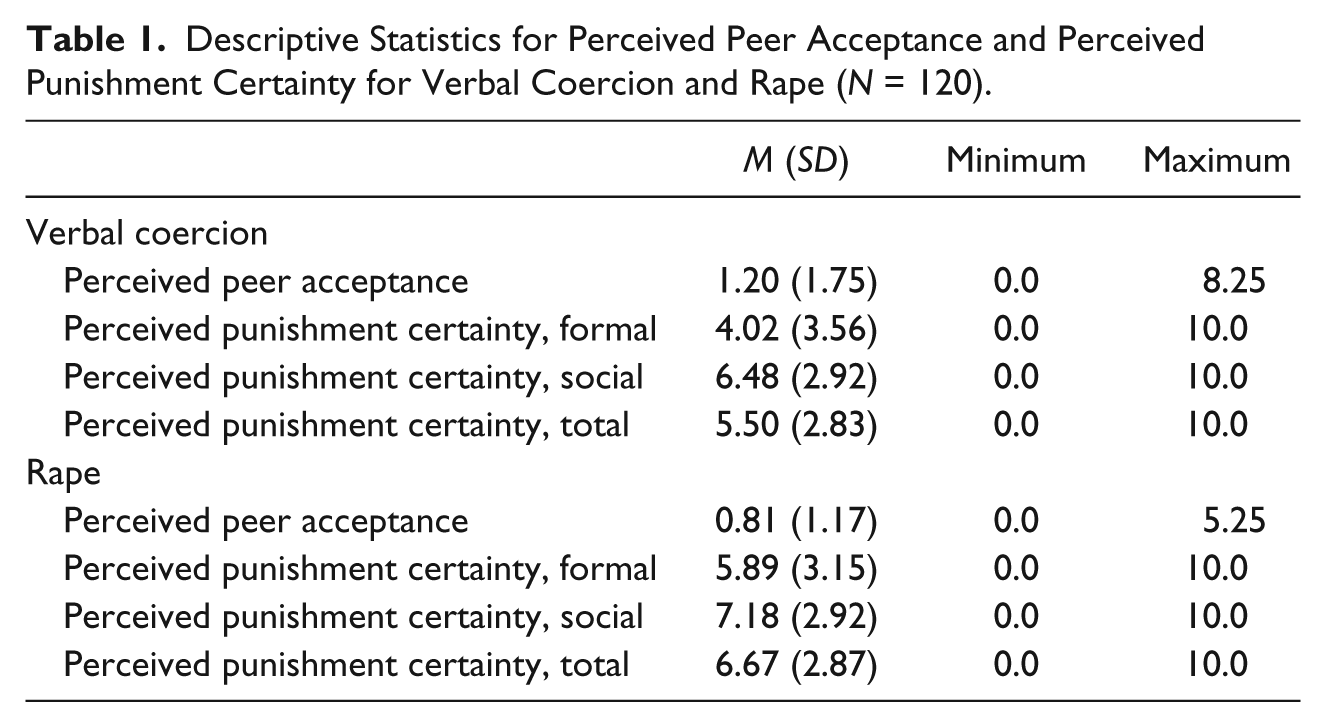
Punishment certainty for verbal coercion was created by averaging the 10 items related to verbal coercion, and punishment certainty for rape was created by averaging the 20 items related to rape through intoxication or force. The possible range of scores on the punishment certainty measures was 0 to 10 with higher scores indicating higher perceptions of punishment likelihood. Both punishment certainty subscales were normally distributed. Descriptive statistics for punishment certainty ratings are provided in Table 1. Scoring for the BIDR followed standard procedures outlined by Paulhus (1991). Scores ranged from 0 to 30 (M = 11.75, SD = 6.85), out of a maximum possible score of 40, with higher scores indicating more socially desirable responding.
Hypothesis Testing
Hypothesis 1: Perceived peer acceptance will be related to verbal coercion and rape
To test Hypothesis 1, we performed two logistic regressions, one with verbal coercion as the dependent variable and one with rape as the dependent variable. Perceived peer acceptance was the independent variable (bivariate correlations are included in Table 2). Perceived peer acceptance for verbal coercion was positively associated with self-reported history of verbal coercion, χ2(1, N = 120) = 13.71, p < .001, odds ratio (OR) = 2.87. Perceived peer acceptance accounted for 16.9% of the variance in reports of verbal coercion. Perceived peer acceptance for rape was positively associated with self-reported history of rape, χ2(1, N = 120) = 21.86, p < .001, OR = 5.67. Perceived peer acceptance accounted for 26.8% of the variance in reports of rape. Thus, Hypothesis 1 was supported.
Bivariate Correlations for Perceived Peer Acceptance, Punishment Certainty, and Sexual Aggression History.
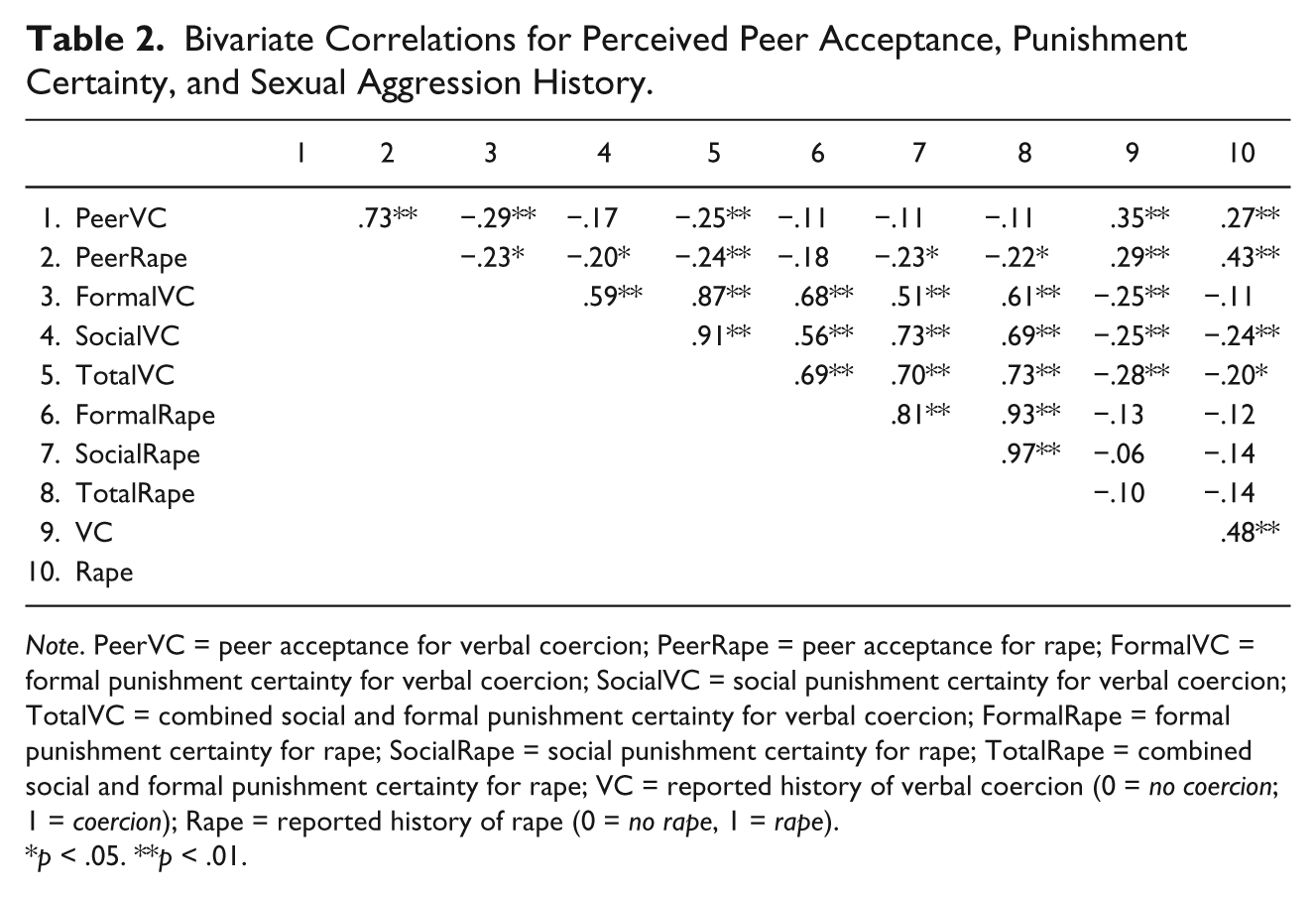
Note. PeerVC = peer acceptance for verbal coercion; PeerRape = peer acceptance for rape; FormalVC = formal punishment certainty for verbal coercion; SocialVC = social punishment certainty for verbal coercion; TotalVC = combined social and formal punishment certainty for verbal coercion; FormalRape = formal punishment certainty for rape; SocialRape = social punishment certainty for rape; TotalRape = combined social and formal punishment certainty for rape; VC = reported history of verbal coercion (0 = no coercion; 1 = coercion); Rape = reported history of rape (0 = no rape, 1 = rape).
p < .05. **p < .01.
Hypothesis 2: Perceived punishment certainty will be related to verbal coercion and rape
To test Hypothesis 2, we again performed two logistic regressions with verbal coercion as a dependent variable in one analysis and rape as the dependent variable in the second analysis. Here, we report results using overall ratings of punishment perception as the independent variable, collapsing formal and social punishments, because social and formal punishment ratings were highly correlated (see Table 2) and because when we initially ran the analyses separately for formal and social punishment, the two sets of results were nearly identical. Perceived punishment certainty for verbal coercion was negatively associated with self-reported history of verbal coercion, χ2(1, N = 120) = 9.78, p < .01, OR = 0.77. Perceived punishment certainty accounted for 12.2% of the variance in reports of verbal coercion. Perceived punishment certainty for rape was not associated with self-reported history of rape, χ2(1, N = 120) = 2.23, p > .05. Thus, Hypothesis 2 was partially supported.
What is the relative impact of perceived peer acceptance and punishment certainty on sexual aggression after controlling for age and social desirability?
We sought to determine the relative strength of the associations between peer acceptance and verbal coercion and rape and between punishment certainty and verbal coercion and rape, after controlling for socially desirable responding and age of the participant. In a model with verbal coercion as the dependent variable, social desirability scores (BIDR) and participant age were entered in Step 1. This step was significant, χ2(1, N = 120) = 13.10, p < .01; the two variables accounted for 16.1% of variance in verbal coercion. Wald criteria demonstrated that social desirability (β= −.11; p = .01; OR = 0.90) and age (β= .15; p = .02; OR = 1.16) were significantly associated with verbal coercion. Next, peer acceptance and punishment certainty for verbal coercion were entered in Step 2. This step was also significant, χ2(1, N = 120) = 27.80, p < .001. The full model accounted for 32.3% of the variance in reports of verbal coercion. Wald criteria demonstrated that social desirability (β= −.09; p = .03; OR = 0.91), perceived peer acceptance (β = .75; p = .02; OR = 2.11), and punishment certainty (β= -.24: p=.02; OR= 0.79) were significant correlates of verbal coercion. Participant age was not a significant correlate in this full model (p > .05). Perceived peer acceptance was the strongest predictor of verbal coercion.
For the model predicting rape, social desirability scores (BIDR) and participant age were entered in Step 1. This step was not significant, χ2(1, N = 120) = 5.87, p > .05. Next, peer acceptance and punishment certainty for rape were entered in Step 2. This step was significant, χ2(1, N = 120) = 24.04, p < .001. The full model accounted for 29.2% of the variance in reports of rape. Wald criteria demonstrated that only perceived peer acceptance for rape (β = 1.60; p < .001; OR = 4.95) was a significant correlate.
Discussion
The current study investigated two potential correlates of young men’s sexually aggressive behavior—perceived peer acceptance of verbal coercion and rape and perceived certainty of punishment for verbal coercion and rape. Although the relationship between using sexual aggression and associating with peers who accept and use sexual aggression seems intuitive, there are fewer data illustrating this link than may be expected. To gauge perceived peer acceptance, we asked men to estimate their male friends’ attitudinal acceptance and behavioral use of verbal coercion and rape. Perceived peer acceptance accounted for a substantial proportion of variance in participants’ own reports of verbal coercion and rape. A scale composed of four questions assessing perceived peer acceptance for verbal coercion accounted for 17% of the variance in reports of verbal coercion. A scale composed of eight peer acceptance questions accounted for nearly 27% of variance in men’s reports of rape through intoxication and force. These results suggest that perceived male social support for verbal coercion and rape may, indeed, be an important correlate of perpetration.
In their landmark text about male peer support for sexually aggressive behavior, Schwartz and DeKeseredy (1997) suggested several ways to reduce rape on campus, including awareness programs and serious institutional consequences for offenders. They argued, however, that these measures are likely not powerful enough to curb rape in the face of rape-supportive social cultures. The current findings support their call for interventions designed to reduce male social support for verbal coercion and rape. Encouraging male friends, as a group, to understand, discuss, and speak out against the problem may be an effective strategy for reducing verbal coercion and rape.
We also investigated the relationship between punishment certainty and reports of verbal coercion and rape. We expected to find a negative relationship between punishment certainty and reports of actual verbal coercion and rape, given that punishment certainty has been shown to be negatively related to perpetrating a variety of delinquent acts. Punishment certainty was negatively associated with reports of verbally coercive behavior, accounting for 12.2% of variation in reports. However, punishment certainty was not significantly associated with reports of rape. Indeed, men who admitted to a rape and men who denied a history of rape did not differ significantly in their perceptions of punishment certainty for rape.
Some suggest that perceptions of punishment certainty may be less relevant to decisions to commit interpersonally aggressive crimes, like physical or sexual assault, than to decisions to commit other kinds of offenses (Carmody & Williams, 1987). Although this study suggests that social factors (i.e., perceived peer acceptance) may be important correlates of verbal coercion and rape, it is likely that personality factors also play a role. Thus, it is possible that men willing to commit severe and illegal acts like rape may be relatively unconcerned with risk, punishment, and social judgment. There is evidence that many men who rape exhibit antisocial personality features (e.g., Zawacki, Abbey, Buck, McAuslan, & Clinton-Sherrod, 2003), which can include a lack of responsiveness to punishment or the threat of punishment (American Psychiatric Association, 2000). In the future, researchers might benefit from considering the interaction between social and personality factors as correlates of sexually aggressive behavior.
Perceived peer acceptance, but not punishment certainty, continued to be associated with acts of rape, after controlling for age and social desirability. This finding supports the idea that peer acceptance is a relatively more robust correlate of rape than punishment certainty. Notably, social desirability ratings were associated with reports of verbal coercion but were not significantly related to reports of committing rape. Although this lack of relationship between social desirability and reports of rape may seem counterintuitive, it is consistent with findings from other studies (e.g., Cook, 2002; Strang, Peterson, Hill, & Heiman, 2013). As noted above, the lack of association between social desirability and rape reporting also may reflect the fact that rapists possess some antisocial personality features that make them less sensitive to social desirability; men who sexually coerce may not possess those same antisocial personality traits, and thus reports of verbal coercion may be more strongly related to social desirability than reports of rape.
Several limitations of the current study are noteworthy. The ratio of survey completers to survey beginners was relatively low. Of the 272 eligible participants who began the questionnaire, 44% completed the questionnaire. This number is consistent with prior research suggesting that completion rates for online research tend to be relatively low (an average of 39.6% in one meta-analysis; Cook et al., 2000). We cannot determine, however, if the sensitive nature of the questionnaire promoted premature drop-out in certain participants.
To assess perceived peer acceptance, we asked participants to report on the attitudes and behaviors of their current 10 closest male friends. The measure of sexual aggression history inquired about lifetime acts of verbal coercion and rape. Thus, some of the verbal coercion and rape behavior reported by the men may have occurred before the men joined their current peer group. It is possible that sexually aggressive peer groups lead, or cause, new members to use sexual aggression. Alternatively, sexually aggressive men may actively seek out other sexually aggressive men. It is also possible that men who engage in verbal coercion and rape may misperceive that their peers accept sexually aggressive behavior, when in fact, their peers would not approve of sexual aggression. Thus, the relationship between perceived peer acceptance and verbal coercion and rape behavior is likely complicated and bidirectional (see Schwartz & DeKeseredy, 1997). Given that the current study is cross-sectional and correlational, we cannot infer a causal relationship between perceived peer acceptance and men’s use of verbal coercion and rape.
Ratings of perceived peer acceptance were surprisingly low in this sample. On average, men perceived almost no peer acceptance for verbal coercion and rape. It is surprising that perceived peer acceptance was so strongly related to men’s reports of using verbal coercion and rape, given the obvious floor effects and the limited range on our scale. The low ratings of perceived peer acceptance are potentially encouraging, suggesting that most men do not perceive their peer groups as supportive of sexual aggression. These data, however, stand in contrast to a body of literature suggesting that peer support for sexual aggression is quite prevalent (Schwartz & DeKeseredy, 1997). Notably, much of that research is over a decade old; thus, it is possible that peer acceptance for verbal coercion and rape is decreasing over time and men are correct in perceiving a lack of acceptance among their peers. Conversely, it is possible that men’s acceptance of verbal coercion and rape has remained high but that men incorrectly assume that their peers do not accept this behavior. It is also possible that men may believe that men in general are accepting of verbal coercion and rape but may believe that their friends are not accepting of this behavior.
The ratings of punishment certainty—including likelihood of formal and social punishment—were fairly high in this study (generally at or above the middle of the scale). This is surprising in light of the fact that most rape is not reported or prosecuted (e.g., Rozee & Koss, 2001) and in light of the fact that verbal coercion is not actually illegal. Based on these ratings, it seems that men may actually overestimate the likelihood of punishment associated with verbal coercion and rape.
Despite limitations, some results of the current study are compelling. Perceived peer acceptance of verbal coercion and rape were strongly associated with actual reports of verbal coercion and rape after controlling for social desirability. Current results also suggest that punishment perception may not deter more serious acts of sexual aggression, like rape. Collectively, these findings support peer-focused interventions for men (e.g., The Men’s Program; Foubert, 2005) and call into question prevention approaches that focus on the negative consequences of sexual aggression. Indeed, peer-focused interventions, particularly, may need to be directed at men who possess certain personality risk factors such as antisocial personality traits, although more research is needed to confirm this. Future research should continue to explore the mechanisms through which perceived peer acceptance influences sexually aggressive behavior and should investigate possible methods for influencing those mechanisms.
Footnotes
Authors’ Note
This project was completed as part of Emily Strang’s graduate thesis under the supervision of Zoё Peterson.
Declaration of Conflicting Interests
The author(s) declared no potential conflicts of interest with respect to the research, authorship, and/or publication of this article.
Funding
The author(s) received no financial support for the research, authorship, and/or publication of this article.