



Abstract
Over the last several decades, an extensive literature has documented the prevalence of dating violence on college campuses. As a result, initiatives to promote awareness of dating violence on college campuses have proliferated and models of “bystander intervention” have been developed. Bystander intervention asserts that by giving all students information concerning the prevalence and warning signs of dating violence, these individuals will “say something” when they see problem behavior. However, a paucity of empirical research exists concerning whether students actually report their observation of dating violence among their peers. In the present study, a sample of college freshman (n = 275) was surveyed regarding their willingness to report dating violence behaviors among their friends. Findings indicate that a slight majority of respondents report that they would report dating violence victimization among their friends to university officials (54%) and/or law enforcement (56%) while fewer indicated they would report perpetration, 38% and 42%, respectively. Importantly, respondents overwhelmingly report that they would attempt to intervene in the dating violence victimization (87%) and perpetration (84%). Implications of these findings for campus safety initiatives and bystander education models are discussed.
Dating Violence on the College Campuses
Research continues to show high rates of intimate partner violence (hereinafter IPV), including physical, emotional/psychological, and sexual violence among college students. In their seminal study, Bogal-Allbritten and Allbritten (1985) demonstrated that one in five college students reported personally experiencing relationship violence while three in five college students reported knowing someone involved in a violent relationship. Recent studies have focused on the widespread problem of IPV in college relationships. Findings suggest that physical aggression occurs in approximately 20% to 30% of college student relationships, psychological aggression occurs in 50% to 80%, and sexual aggression occurs in 15% to 25% of college student relationships (Gover, Kaukinen, & Fox, 2008; Shorey, Stuart, & Cornelius, 2011).
IPV has been associated with a myriad of negative consequences that may impact college student survivors’ overall well-being as well as their ability to be successful in their college career. Problems may include physical health effects such as chronic diseases and headaches (Koss, Koss, & Woodruff, 1991), eating disorders (Ackard & Neumark-Sztainer, 2002), and psychological conditions like Posttraumatic Stress Disorder (Foa & Rothbaum, 1998), depression (Callahan, Tolman, & Saunders, 2003), self-harming behaviors, suicidal ideation (Stepakoff, 1998; Coker et al., 2000), and sleep disorders (Norris & Feldman-Summers, 1981). In addition, survivors may suffer from adverse emotional consequences including feelings of ongoing fear, low self-esteem, self-blame, guilt, and shock (Petrak, 2002).
IPV not only affects the primary victim, but may also impact the broader college community. Research suggests that victims of IPV often disclose their victimization to someone and that many survivors disclose their victimization experience to informal support providers such as family, friends, and significant others (Golding, Siegel, Sorenson, Burnam, & Stein, 1989; Starzynski, Ullman, Filipas, & Townsend, 2005). Few survivors utilize formal support agencies (e.g., police or hospitals) and even fewer utilize only formal support providers (Golding et al., 1989; Starzynski et al., 2005). Research also suggests that victims of IPV may turn to school officials, specifically professors, for support post victimization (Richards, Branch, & Hayes, in press) with the majority of sampled faculty members reporting that they have received numerous student disclosures of sexual assault and/or IPV victimization throughout their careers (Branch, Hayes-Smith, & Richards, 2011). Finally, recent research regarding sexual violence among college students reveals that college student victims may disclose victimization to their friends, and that oftentimes friends do not know how to react to the disclosure (Ahrens & Campbell, 2000; Banyard, Moynihan, Walsh, Cohn, & Wards, 2010; Branch & Richards, 2013), and may therefore sustain secondary trauma in processing their friends’ victimization experience (Banyard et al., 2010; Branch & Richards, 2013).
Despite the high rate of victimization among college students, IPV may go unnoticed in the college community for several reasons. First, college students often arrive on campus with limited life experience and knowledge concerning romantic relationships. As a result, many college students may harbor uncertainty about what constitutes acceptable adult behavior, which contributes to the difficultly in recognizing physically or emotionally abusive/coercive behavior as IPV. In addition, given that college is a time of new-found independence, college students may not want to accept that they have experienced IPV victimization, because it may make them feel as if they have failed at taking care of themselves. To illustrate, results from the National College Women Sexual Victimization Study indicated 44% of sampled female students did not report a completed rape to police or the school because they did not want their family to know (Fisher, Cullen, & Turner, 2000; Fisher, Daigle, Cullen, & Turner, 2003).
There may also be an overall lack of general knowledge about how students can help themselves or others who experience dating violence. Results from a 2011 College Dating Violence and Abuse Poll of 508 college students indicated 38% of students in the sample did not know how to get help for themselves if they were ever the victim of dating violence. Perhaps more troubling, 58% of students stated they did not know how to help someone else who was a victim of dating abuse (Knowledge Networks, 2011). Previous studies indicate that people are more likely to intervene in serious situations (like witnessing dating violence) when they have seen others model this intervention behavior successfully (Bryan & Test, 1967; Rushton & Campbell, 1977; Coker et al., 2011). Bystander intervention programs aim to do just that.
Bystander Approach
The bystander approach suggests that individuals in a community can intervene when faced with situations involving interpersonal violence. Bystander intervention is well established in the field of social psychology, largely to explore individual’s reactions to witnessing medical emergencies (Latane & Darley, 1970). Universities and Colleges began to adopt this approach to address the prevention of campus violence around the 1990s (Coker et al., 2011). Bystander intervention shifts the focus of prevention efforts from potential victims or perpetrators to other individuals in the community (i.e., peers and community members). Specifically, this approach suggests an individual can intervene prior to an assault occurring (primary prevention), during the assault (secondary prevention), or after the assault has occurred (tertiary prevention) (McMahon & Banyard, 2012). In addition, the bystander approach has been utilized in the prevention of sexual violence on college campuses nationwide (Coker et al., 2011; McMahon, Postmus, & Koenick, 2011; McMahon & Banyard, 2012).
In an effort to spread awareness concerning IPV among college students, violence prevention and intervention experts have recently begun to develop models that utilize bystander intervention mechanisms in situations of IPV (Banyard, Plante, & Moynihan, 2004; McMahon et al., 2011). IPV has distinctive characteristics that differentiate it from medical emergencies and sexual assault. Specifically, IPV typically involves a pattern of abusive actions or behavior that is likely to escalate in frequency and intensity over time (Office of Justice Programs, 2011). As a result, there may be multiple opportunities for a bystander to observe abusive behaviors and intervene.
There are also several potential risks associated with bystander intervention. One such risk is the fear of social embarrassment. This fear is typically based in the belief that the bystander is not knowledgeable enough to determine whether the situation at hand is really an emergency that would warrant their intervention or assistance (McMahon & Banyard, 2012; Coker et al., 2011 1 ; Latane & Nida, 1981 2 ). This risk is related to primary and secondary interventions. Fear of social embarrassment may be especially salient in college student populations. For example, according to a recent poll of college students, fear of various social consequences (e.g., that the abuser would make their life difficult, that people would know they were the reporter) was the most commonly cited reasons why students were reluctant to intervene in dating violence situations (Knowledge Networks, 2011). Another inherent risk occurs when the bystander influences the victim to take action before they are psychologically ready to do so. Perhaps this is best evidenced by a commonly cited frustration for law enforcement officers responding to IPV, “the infrequency with which victims prosecute or leave the abusive situation” (Toon, Hart, Welch, Coronado, & Hunting, 2005). Finally, previous research with adults and adolescents suggests that there is the real or perceived risk of physical intimidation or harm to the bystander for their intervention efforts in instances of IPV (Williams & Becker, 1999; Weisz & Black, 2008).
The bystander approach for IPV intervention on college campuses can be informed by the literature regarding the relationship of informal social control and collective efficacy on offending among community residents (Sampson, Raudenbush, & Earls, 1997). Sampson et al. (1997) defined collective efficacy as “social cohesion among neighbors” (p. 918) and scholars assert that such cohesion can be used to regulate community members’ behavior, including interpersonal crime (Sampson et al., 1997) and, specifically, IPV (Emery, Jolley, & Wu, 2010). Frye et al.’s (2012) investigation of informal social control and the prevention of IPV in neighborhoods demonstrated that community residents reported a willingness to reach out to their neighbors who were victims of IPV, make perpetrators aware that the violence was heard, and report victimization to the police. Likewise, the bystander intervention approach relies on harnessing the collective efficacy inherent in the college community to appeal for bystanders to intervene. If the standard becomes a violence-free campus, then bystanders are provided the “permission” to step in on behalf of victims and perpetrators are provided a “rational incentive against perpetration” (Emery et al., 2010).
Bystander intervention programs were designed to help students learn more about dating violence and afford them with examples of how they should intervene. The information these programs provide attempt to accomplish several goals. First, information about the dating violence continuum helps students properly identify dating violence behaviors. Second, bystander intervention campaigns provide students with examples of how to safely and effectively respond or intervene as a bystander to dating violence. Specifically, these campaigns provide students with videos and posters that “model” appropriate intervention behaviors. Another goal is to provide students with information concerning who they can contact for additional help. Education and information dissemination efforts are extremely important in light of the recent poll results that indicate that most students report confusion as to how to help someone experiencing dating violence (Knowledge Networks, 2011).
Present Study
Bystander intervention asserts that providing students adequate information about the prevalence and warning signs of IPV will empower them to “say something” and intervene when they witness such behavior occurring. However, the empirical research concerning a student’s willingness to report their observations of IPV among their peers is lacking. In the present study, a large sample of college freshman (N = 275) was surveyed regarding their willingness to report dating violence behaviors among their friends. The following research questions guided the current analysis:
Method
This study was reviewed and approved by the university’s Institutional Review Board prior to data collection. Participants were recruited through convenience sampling of first-year seminar classes at a private liberal arts university in a southern state from March 2012 to May 2012. A member of the research team contacted all professors (via their university email) who were scheduled to teach a first-year seminar class in the spring of 2012 about administering the survey in their courses. Upon the professors’ approval, a research team member administered the survey during regular class time. Participants were informed that the survey was voluntary and that their responses would remain anonymous; no identifying information was collected from participants. All participants were provided a pamphlet/debriefing sheet concerning IPV and local resources. The questionnaire consisted of 72 questions and took an average of 20 to 25 min to complete.
Results
The sample consisted of N = 275 undergraduate students who were enrolled in a first-year seminar in spring of 2012. The majority of respondents were female (62%) and freshmen (92%). A slight majority of respondents reported being 19 years old (53%), with the remaining sample reporting ages of 17 (<.1%), 18 (40%), 20 (3%), or 21 (1%). In regard to race/ethnicity, 66% of participants reported their race as White, 13% reported Hispanic, 8% reported African American, and 7% reported their race as “Other.”
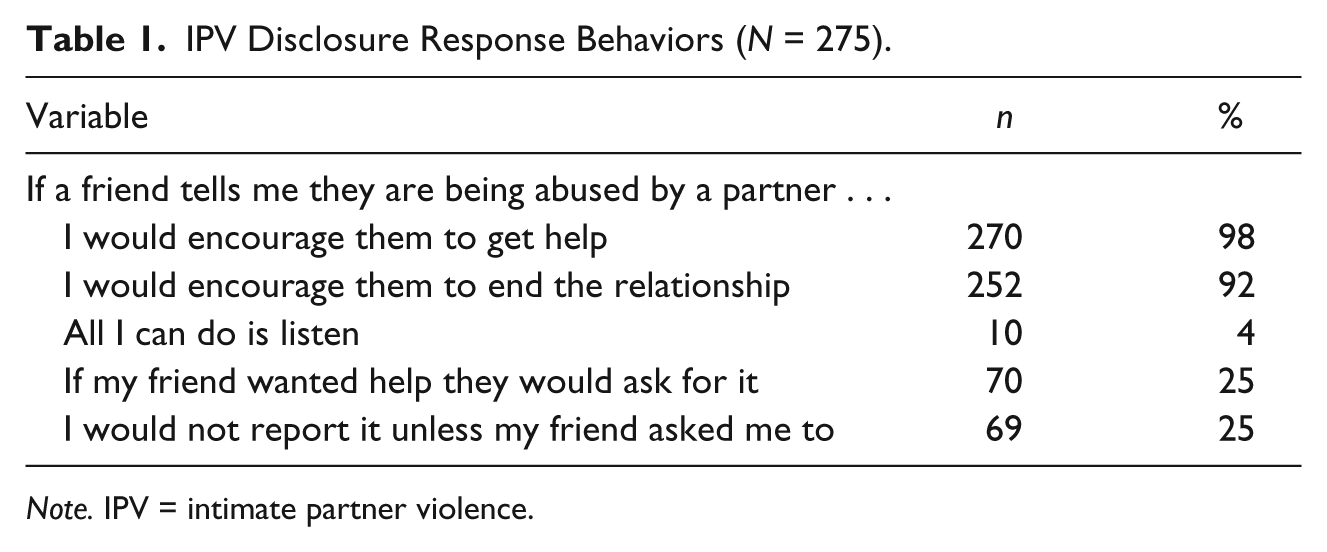
First, participants were asked questions concerning their potential response(s) to disclosures of IPV among their friends. Results are presented in Table 1. Results demonstrate that the majority of respondents (98%) reported they would encourage a friend to get help, while 92% also indicated that they would encourage their friend to end the relationship. Very few participants (10%) agreed that if a friend disclosed IPV victimization, “all they could do was listen.” However, 25% of participants agreed that if a friend wanted help for their IPV victimization, they would ask for it. Finally, 25% of participants reported that they would not report IPV victimization to anyone unless their friend asked them to report.
IPV Disclosure Response Behaviors (N = 275).
Note. IPV = intimate partner violence.
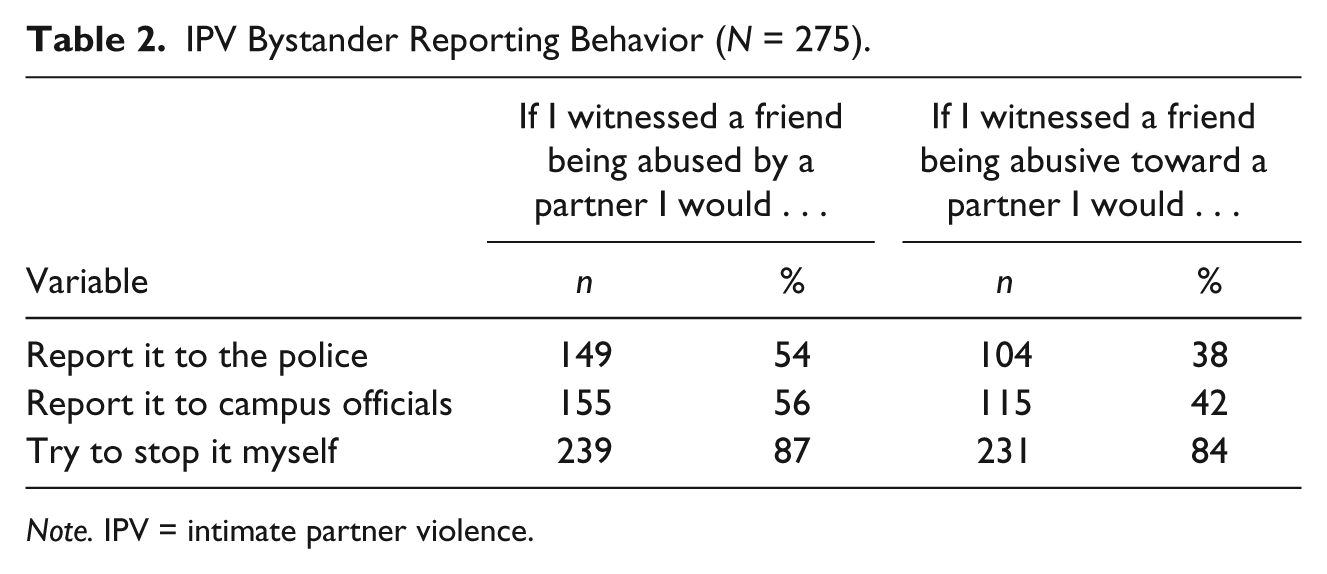
Next, participants were asked questions concerning whether they would report IPV victimization and/or perpetration if they witnessed it among their friends. Results are presented in Table 2. Beginning with IPV victimization, 54% of participants agreed that if they witnessed a friend being victimized by a partner they would report the victimization to the police. Comparatively, 38% of respondents agreed that if they witnessed a friend abusing a partner they would report it to police. Likewise, 56% of participants agreed that they would report IPV victimization among their friends to campus officials but only 42% agreed that they would report IPV perpetration. In addition, 87% of participants reported that they would try to stop IPV victimization themselves while 84% reported they would try to stop IPV perpetration.
IPV Bystander Reporting Behavior (N = 275).
Note. IPV = intimate partner violence.
Discussion and Future Research
IPV has been recognized as a significant problem on college campuses. As a result, universities have begun to implement programming to raise awareness about the issue. Traditional efforts focused on victims and perpetrators of such violence but more recently activists and scholars have begun to explore the potential effectiveness of bystanders in intervening and defusing forms of gendered violence. While bystander models for IPV have proliferated on college campuses, a dearth of empirical literature exists concerning college students’ responses as bystanders. Using a convenience sample of college students, the present exploratory research examined how college students reported they would react to IPV victimization and perpetration among their friends.
When participants were surveyed about their reactions to disclosures of IPV victimization, an overwhelming majority of respondents (98%) reported they would encourage a friend to get help. This finding is especially important given the growing body of literature that demonstrates victims of IPV are more likely to disclose to informal support providers rather than formal sources of support. Such results are encouraging given the years of efforts by scholars and grassroots activists to spread awareness concerning IPV among the college community and to provide students easy access to free, confidential services such as counseling centers, women’s centers, and court advocates to student victims. Clearly, resources must be easily identifiable/accessible so that students who receive disclosures from their friends can locate the resources and help victims navigate the process.
The overwhelming majority of respondents (92%) reported that they would encourage their friend to end the relationship. This is a significant finding given that research has documented that when victims of IPV leave an abuser their risk of deadly IPV increases (Campbell et al., 2003). Bystander intervention models must highlight the careful planning necessary for victims to safely leave an abuser. Safety planning may be even more important in the college community where victims and perpetrators may continue to share common space, such as dining halls, dormitories, and even classrooms, after a victim leaves. Safety planning must include a diverse group of campus officials and may require the cooperation of different campus actors/offices in situations where students need their academic schedules and/or residences altered.
While very few participants (10%) agreed that if a friend disclosed IPV victimization, “all they could do was listen” one quarter agreed that if a friend wanted help for their IPV victimization, they would ask for it. This finding indicates that students must be educated concerning what to do if a friend discloses victimization. Although victims should be empowered concerning their postvictimization behavior, they may not know how to proceed or be aware of the resources available to them. After all, disclosing victimization is often a victim’s first attempt in obtaining help.
Participants were also asked questions concerning whether they would report IPV victimization and/or perpetration if they witnessed it among their friends. A little more than half of respondents (54%) agreed that, as a bystander of IPV victimization, they would report the violence to law enforcement while less than 40% of respondents reported that they would inform law enforcement if they saw perpetration of IPV. In addition, a slight majority of respondents agreed that they would report IPV victimization and roughly 40% would report perpetration to school officials. These findings highlight the importance of educating students about their role as bystanders. Only slightly half indicated that they would report victimization and fewer students indicated they would report perpetration. Therefore, students may be witnessing IPV victimization and perpetration but are not necessarily “saying something.” Research is needed to clarify barriers to “saying something” about IPV that students identify. Such findings also demonstrate the importance of educating university faculty, staff, and administrators regarding local/campus resources for survivors of IPV.
Limitations
Although the present exploratory study adds to the literature concerning college students’ responses as bystanders, it is not without limitations. First, our findings are restricted to a sample of college students from one private liberal arts university in a southern state. Second, the researchers exclusively focused on students enrolled in first-year seminar classes during the spring semester of 2012. Thus, the results may not be generalizable to more senior students. Future studies must attempt to replicate the current study with more representative samples of college students. The prospective nature of the current survey may also present a limitation. More specifically, instead of asking students about past bystander intervention experiences or actions directly, questions were based on hypothetical situations that lent themselves to bystander interventions. Furthermore, students were asked specifically about how they would react to IPV victimization and perpetration among their friends. Future studies should include prospective and retrospective questioning that addresses bystander intervention. These studies should also examine victimization and perpetration among peers in general, in addition to “friends” specifically.
Prior literature has documented that campus officials are often confused as to their role in assisting students with “personal problems” as well as issues of liability in situations where students may be harmed (Hayes-Smith, Richards, & Branch, 2010). Thus, universities must develop clear definitions regarding student conduct as well as procedures for dealing with students who violate such policies. Information concerning such polices/procedures must be widely disseminated using divergent methods including faculty and student handbooks, student orientations, as well as face-to-face forums such as departmental faculty meetings and residential dorm meetings. Using such forums, faculty and students will have reoccurring opportunities to ask questions about the policies and may be consistently informed of any changes.
The current findings also demonstrate that the overwhelming majority of respondents report that they would personally attempt to stop IPV victimization and/or perpetration themselves. This represents a disconnect between “good intentions” by bystanders and proper procedures for campus safety. Universities must develop a chain of command within their campus administration and/or safety office to respond to IPV and disseminate these procedures within their bystander intervention education model.
Conclusion
The bystander approach shifts the focus of prevention and intervention responsibilities from a perpetrator/victim centered model to one that includes peers and the community as a whole. Bystander intervention campaigns attempt to help students assess relationships for IPV by providing information concerning the continuum of dating violence. The continuum describes the range of violence that often occurs in relationships where dating violence in present. With the guidance of such a continuum, opportunities for a bystander to intervene may be more readily apparent because bystanders may repeatedly observe abusive behavior in multiple forms (i.e., physical, verbal, psychological) over time. However, what is the expectation of bystanders in regard to intervention in IPV? The present research indicates that college respondents would be more likely to personally intervene rather than report behavior to a school official or law enforcement if they saw a friend engaging in or experiencing dating violence.
While most campaigns are specifically targeted at reaching college students, effective tools for bystander intervention should be expanded to include the entire college community. It is important to remember that professors tend to receive many disclosures of IPV victimizations throughout their careers (Branch et al., 2011). As such, it is essential that all members of the community know how to respond to reduce the occurrence of IPV on their campuses. Intervention efforts should provide all members of the community with knowledge to help them assess the dangerousness of each situation, as well as essential tools to help them determine the most appropriate level of intervention (primary, secondary, or tertiary). This includes providing them with training that assists them in better identifying abusive behaviors as well as modeling appropriate and safe intervention techniques. Knowing which level of intervention (primary, secondary, or tertiary) is most appropriate may help further reduce the potential risks of bystander intervention efforts.
Footnotes
Declaration of Conflicting Interests
The author(s) declared no potential conflicts of interest with respect to the research, authorship, and/or publication of this article.
Funding
The author(s) received no financial support for the research, authorship, and/or publication of this article.