



Abstract
The present study examined relations between attachment style, age at first sexual intercourse, and dating aggression (DA) victimization. In all, 137 heterosexual female undergraduate students 18 to 25 years of age (M = 20.76, SD = 1.87) completed an online questionnaire that included questions regarding sexual history, attachment style (Experiences in Close Relationships Scale), and DA (Conflict in Adolescent Dating Relationships Inventory). Initial bivariate correlations revealed that women reported higher rates of DA victimization if they were more anxiously attached (r = .30, p = .000), had an earlier age at vaginal sexual debut (r = −.19, p = .015), and had an earlier age at oral sexual debut (r = −.15, p = .046); however, when entered into a predictive multivariate model, neither the addition of anxious attachment nor an early age at sexual debut accounted for a significant amount of variance above and beyond control variables. Although we were unable to affirm anxious attachment and an early age at first intercourse as risk factors for DA victimization, posthoc analyses emphasized the need to control for social desirability when gathering information on sensitive topics in clinical and research settings.
Keywords
Dating is a healthy part of development for the majority of adolescents and young adults, but it may result in unhealthy outcomes for a subset of youth who experience aggression in their early relationships. Dating aggression (DA) has been associated with suicide, substance use, risky sexual behavior, and a heightened risk of revictimization, among other concerns (Silverman, Raj, Mucci, & Hathaway, 2001; Smith, White, & Holland, 2003). The high rate of DA in adolescence and young adulthood coupled with the potential negative consequences underscores the importance of identifying risk factors associated with DA victimization.
One such risk factor is an early age at first sexual intercourse. Recent research has found that an early age at first intercourse not only predicted DA victimization, but also distinguished between individuals who experienced DA solely in adolescence versus those who experienced continued victimization into adulthood (Halpern, Spriggs, Martin, & Kupper, 2009). Anxious attachment style has been linked to both an early age at first intercourse (Bogaert & Sadava, 2002; Gentzler & Kerns, 2004) and a heightened risk of DA (Henderson, Bartholomew, Trinke, & Kwong, 2005; Higginbotham, Ketring, Hibbert, Wright, & Guarino, 2007; Sandberg, Suess, & Heaton, 2010; Tracy, Shaver, Albino, & Cooper, 2003), suggesting that it might both serve as a potential risk factor for DA and influence the relation between age at first intercourse and DA victimization. The purpose of the present study was to further evaluate the relations among attachment style, age at first sexual intercourse, and DA victimization.
Attachment theory purports that positive and negative experiences in one’s family of origin shape the emotional bond between a caregiver and child, and ultimately influence the beliefs a child has about himself or herself and others (Ainsworth, Blehar, Waters, & Wall, 1978; Bowlby, 1973). In a well-known study, Ainsworth et al. (1978) categorized infants as having a secure, anxious, or avoidant attachment based on their reaction to their mother in different scenarios. Bowlby (1973) theorized that attachment patterns are fairly stable from infancy to adulthood and noted that people often attract romantic partners who are congruent with the working models they developed during childhood. Both Hazan and Shaver (1987) and Bartholomew and Horowitz (1991) proposed models of attachment in adult relationships; the former retained the original three-dimensional model, whereas the latter suggested a new two-dimensional model. A review of multiple models of adult attachment and an exploratory factor analysis of items from all available measures of attachment revealed that most models can be reduced to two dimensions, namely, anxiety and avoidance (Brennan, Clark, & Shaver, 1998).
It is suggested that in adulthood, the primary attachment figure shifts from caregiver to peers or romantic partners (Fraley & Davis, 1997) and that early beliefs about oneself and others (i.e., attachment style) can influence thoughts, behaviors, and sexuality in romantic relationships (Diamond & Blatt, 2007). Anxiously attached individuals are characterized by a strong desire for closeness, fear of abandonment, and dependency on others for self-worth, whereas avoidant individuals prefer independence from romantic partners and a fear of closeness (Hazan & Shaver, 1987). Both anxious and avoidant attachment styles (collectively referred to as insecure attachment styles) have been linked to problematic relationship dynamics such as low satisfaction, lack of perceived support, decreased connectedness, and increased conflict; however, there is evidence to suggest that these two attachment styles have differing effects on romantic relationships (Li & Chan, 2012). Given the characterological differences between the two insecure attachment styles, anxiously attached individuals may be more likely to overlook or downplay warning signs that a partner may be aggressive and to use sexual intercourse as a method of securing closeness compared with avoidant individuals. Indeed, multiple studies have found that anxiously attached individuals are more likely to experience DA victimization (Henderson et al., 2005; Roberts & Noller, 1998; Sandberg et al., 2010) as well as an early sexual debut (Bogaert & Sadava, 2002; Gentzler & Kerns, 2004) compared with nonanxiously attached individuals.
A recent meta-analysis on the effects of attachment on romantic relationship quality revealed that anxious attachment was more positively correlated with conflict in relationships compared with avoidant attachment (Li & Chan, 2012). Although some studies have found that an insecure attachment style in general is associated with DA victimization (e.g., Higginbotham et al., 2007), many have noted an important link between anxious attachment and DA victimization. For example, Sandberg and colleagues (2010) conducted a study with 224 college women to determine if attachment anxiety mediated the relation between interpersonal violence and posttraumatic symptomology. As part of their analysis, they determined that anxious attachment was significantly correlated with adult sexual victimization, whereas avoidant attachment was not. In a similar exploration of attachment and DA, Henderson and colleagues (2005) found that men and women (n = 128) with preoccupied attachment styles (i.e., high in anxiety and low in avoidance) were at greater risk of physical and psychological abuse.
An anxious attachment style has also been linked to an early age at first intercourse among women (Bogaert & Sadava, 2002; Gentzler & Kerns, 2004), which has likewise been associated with DA victimization (Halpern et al., 2009; Silverman et al., 2001). Anxiously attached individuals may be more likely to engage in risky sexual behaviors due to their strong desire for emotional intimacy and closeness (Gentzler & Kerns, 2004), whereas avoidant individuals tend to limit emotional intimacy in a relationship by avoiding sexual intercourse or participating in casual sex (Brennan & Shaver, 1995; Cooper, Shaver, & Collins, 1998).
Gentzler and Kerns (2004) examined the relation between attachment and sexual experiences with a sample of 328 male and female undergraduate students. They divided their sample into three groups: those who had had sexual intercourse at the age of 15 years or younger, those who had had sexual intercourse at 16 years or older, and those who had not had sexual intercourse. They found a marginally significant interaction between first sexual intercourse and gender (p < .07), such that women who had an early sexual debut scored higher on measures of anxious attachment than those who had a later sexual debut, and men who had not engaged in sexual intercourse scored higher on measures of anxious attachment than those who had.
The relationship between attachment style and age at first intercourse is of interest because both of these variables have been separately linked to DA victimization. Two recent studies have shown that an early age at first intercourse is related to an increased risk of DA victimization among adolescent girls (Halpern et al., 2009; Silverman et al., 2001). Silverman and colleagues analyzed two waves of data from the Youth Risk Behavior Survey (YRBS; n = 1,977, n = 2,186). Responses indicated that girls who had had sexual intercourse before the age of 15 were more likely to have experienced physical, sexual, or both forms of DA. The association was the strongest for girls who had experienced both forms of violence, suggesting that age at first intercourse may help identify a particularly vulnerable population.
Halpern et al. (2009) extended this line of research by conducting the first known study to prospectively examine the association between DA and early age at first intercourse. Data from 4,134 youth who completed all three waves of the National Longitudinal Study of Adolescent Health were used to compare the prevalence of DA victimization that begins in adolescence versus in young adulthood. They examined the association of individual characteristics, such as age at first intercourse, with victimization that occurs only during adolescence, victimization that occurs only during young adulthood, and persistent victimization from adolescence into adulthood. They found that having intercourse before the age of 16 years was the only variable related to all three of the aforementioned trajectories of DA. Furthermore, an early age at first intercourse reliably predicted persistent victimization when compared with both no victimization experiences and victimization that occurred solely during adolescence. It is noteworthy that both Silverman et al. (2001) and Halpern et al. relied on a small number of items to assess DA victimization, assessed physical and sexual victimization only, did not specify whether first intercourse was consensual, and relied on national data sets that were not designed specifically for the purpose of assessing DA. As such, replication of these findings is warranted.
Last, Tracy et al. (2003) conducted the only known study that has incorporated all three of the present study’s domains of interest: adult attachment style, sexual experiences, and DA victimization. Using Hazan and Shaver’s (1987) descriptions, adolescents’ (N = 2,011) attachments were classified as avoidant, anxious/ambivalent, or secure. Participants were queried on general sexual experiences (e.g., if they had had sexual intercourse), experiences on specific occasions of intercourse (e.g., reasons for having intercourse), and also experiences of sexual DA. Associations between attachment styles and sexual experiences varied by gender, with anxiously attached girls and securely attached males evidencing the most sexual experience. Regardless of gender, adolescents with secure attachments were less likely than those with insecure attachments to report perpetration or victimization of sexual DA. Although the Tracy et al. study is the only known study to include questions pertaining to first sexual intercourse, attachment style, and DA victimization, they did not ask about participants’ age at first intercourse, nor did they explore experiences of physical or psychological DA. Therefore, no known study has explored the relation between age at first sexual debut, attachment style, and DA victimization.
Purposes and Hypotheses of the Present Study
The present study aimed to add to the literature on risk factors associated with DA victimization by elucidating the relations between anxious attachment, an early age at first intercourse, and DA victimization. The primary aim was not only to replicate the reported associations between potential risk factor (age at first intercourse and anxious attachment) and DA v ictimization, but also to strengthen these findings by using multi-item, state-of-the-art measures, while controlling for potential confounds and by assessing oral as well as vaginal intercourse. No known studies to date have specifically examined the relations among age at first oral intercourse, anxious attachment, and DA victimization. A secondary aim was to compare the strength of the relations between the two potential risk factors and DA victimization, and to explore interaction effects between anxious attachment and an early age at first intercourse.
This study focused solely on women due to the fundamental differences in severity and motivations between male-perpetrated and female-perpetrated DA (Bookwala, Frieze, Smith, & Ryan, 1992; Makepeace, 1983). Because of these gender differences in the perpetration of DA, risk factors for DA victimization were also expected to differ by gender. Although exploring the association between attachment and age at first intercourse was only a secondary aim of our study, this relationship has also been shown to differ as a function of gender (Bogaert & Sadava, 2002; Gentzler & Kerns, 2004), and would thus warrant separate analyses. A more in-depth investigation of gender differences in the relations between attachment style, age at first intercourse, and DA victimization would be a worthy endeavor, but was outside the scope of this study.
Based on the review of the literature presented before, the following hypotheses were proposed to better understand the relation between individual characteristics and DA victimization: (a) anxious attachment would be positively correlated with DA victimization, (b) age at first sexual intercourse would be negatively correlated with DA victimization, and (c) anxious attachment would be negatively correlated with age at first sexual intercourse. The literature on attachment style and age at first sexual intercourse as correlates of DA is sparse; therefore, differences in the strength of these relations were examined in an explorative manner. Interaction effects between the two independent variables and DA victimization were also explored, as individuals with both an early age at first intercourse and an anxious attachment style may be at a greater risk of DA than individuals with only one of these characteristics.
Method
Participants
Participants were 158 undergraduate students from a small Canadian university who were able to access the online study if they reported that they were female, 25 years old or younger, had previously been in a romantic relationship, and had previously engaged in consensual intercourse with a male (vaginal or oral). Data from 15 participants were excluded from analyses because they were above the age of 25 years (n = 3), were currently married or engaged (n = 9), reported a sexual orientation other than heterosexual (n = 2), or failed to complete an entire measure (n = 1). For reasons unknown, four women exited the survey prematurely, thus withdrawing their data from the study, and two women chose to withdraw by clicking the “withdraw” button. Therefore, the final data set consisted of 137 women.
Most women were full-time students (89%) majoring in Arts and Social Science (77%) within the age range of 18 to 25 years (M = 20.76, SD = 1.87). Reported ethnicities were White (82%), Black (9%), Chinese (4%), South Asian (4%), Filipino (2%), and Other (1%). Women’s relationship status varied between single (20%), casually dating (4%), or dating exclusively (77%). On average, women reported entering puberty at the age of 13 (SD = 1.42) years, having their first dating relationship at 15 years (SD = 1.65), and having had a total of five dating relationships (SD = 5.48). Reported family incomes in Canadian dollars were $0 to 9,999 (3%), $10,000 to 19,000 (4%), $20,000 to 29,000 (5%), $30,000 to 39,000 (10%), $40,000 to 49,000 (13%), $50,000 to 59,000 (7%), $60,000 to 69,000 (15%), $70,000 to 79,000 (12%), and $80,000 or more (33%). Participation was voluntary and participants received course credit for their involvement.
Measures
The key constructs in this study were attachment style, DA victimization, and age at sexual debut. The measurement of each construct is discussed next.
Attachment style
The Experiences in Close Relationships Scale (ECR; Brennan et al., 1998) is a 36-item self-report attachment measure designed to assess two underlying dimensions of attachment: attachment anxiety (α = .91) and attachment avoidance (α = .94). The two dimensions are uncorrelated with each other (r = .11), have moderate test–retest reliability (α range = .50-.75), and are highly correlated with scales measuring similar constructs (Brennan et al., 1998). Participants rated each item on a 7-point Likert-type scale (ranging from 1 = disagree strongly to 7 = agree strongly) based on how they generally experience relationships. Only the attachment-related anxiety dimension was used in the present study (α = .92). An example item is “I worry about being abandoned.”
DA
The Conflict in Adolescent Dating Relationships Inventory (CADRI; Wolfe et al., 2001) is a 35-item self-report questionnaire designed to measure physical abuse, threatening behavior, sexual abuse, verbal or emotional abuse, and relational abuse among adolescent dating partners. It has demonstrated fair internal consistency with an alpha for the overall abuse factor in the mid-.80s, and test–retest reliabilities for the individual scales ranging from .28 to the mid-.60s. Although participants were between the ages of 18 to 25 years at the time of study, they were asked to reflect on past relationships, which would have likely occurred during the span of early to late adolescence. Thus, the CADRI items were expected to be more developmentally appropriate than measures standardized on adults because the CADRI accounts for differences between adult and adolescent relationships (e.g., commitment level, causes of conflict, frequency of using children or financial support as a threat).
Instructions were modified so that participants estimated how often each item occurred across all romantic relationships rather than prevalence within the last year. Although data from heterosexual individuals only were analyzed in this study, we changed the term boyfriend to partner to be sensitive to participants who identified with a different sexual orientation. Response choices for each item were as follows: (1) never, this has never happened; (2) seldom, this has only happened 1 to 2 times; (3) this has happened about 3 to 5 times; and (4) this has happened 6 times or more. Item scores were summed to create a total score, with higher scores indicative of greater abuse. An example item is “My partner slapped me or pulled my hair.” Only victimization scores were utilized in the present study (α = .88).
Age at sexual debut and demographics
Open-ended questions were included in a 29-item demographic questionnaire to ascertain the age at which participants first had vaginal and oral intercourse. The demographic questionnaire also included questions pertaining to age, sex, ethnicity, family income, level of education, and information regarding romantic and sexual history.
History of childhood maltreatment and social desirability
In addition to the key constructs, two additional measures were included to control for a history of childhood maltreatment and social desirability. Previous research has found an association between childhood maltreatment and later DA victimization (e.g., Wolfe, Wekerle, Reitzel-Jaffe, & Lefebvre, 1998). Moreover, research has shown that individuals who were maltreated at an early age are likely to develop insecure attachment styles, such as an anxious attachment (e.g., see Baer & Martinez, 2006, for a meta-analysis). Social desirability was included because we suspected individuals might respond in a socially desirable manner to questions pertaining to attachment style (i.e., may try to appear to have a secure attachment style), age at sexual debut (i.e., may report an older age at first intercourse), and experiences with DA (i.e., may underreport victimization).
The History of Childhood Maltreatment Questionnaire was created to control for the effect of a history of childhood maltreatment on DA victimization. The questionnaire comprises six questions, two pertaining to childhood physical abuse, two pertaining to childhood sexual abuse, and two pertaining to witnessed domestic violence. The items are specific to adult-to-child abuse, and exclude the possibility of sexual abuse perpetrated by a dating partner. Each item (e.g., did your parents or caregiver slap you in the face, hit, beat, or otherwise physically harm you?) was preceded by the sentence stem, “When you were a child [before the age of 14]. . . .” Participants rated each item on a 5-point Likert-type scale, ranging from 0 = never (0 times) to 4 = always (more than 20 times), based on how often they recalled those experiences occurring.
A principal components analysis (PCA) with orthogonal rotation (varimax) was conducted using questionnaire items and revealed two components that combined to explain 58.87% of the variance. Items pertaining to physical abuse clustered on Component 1, and items pertaining to sexual abuse clustered on Component 2. As described below, the sum of sexual abuse scores did not significantly correlate with the outcome variable; therefore, only the sum of the physical abuse scores was controlled for in this study (see Table 1). Internal consistency for the physical abuse scale was fair, Cronbach’s α = .67.
Correlations Among DA Victimization, Anxious Attachment, Age at First Intercourse, and Potential Covariates.
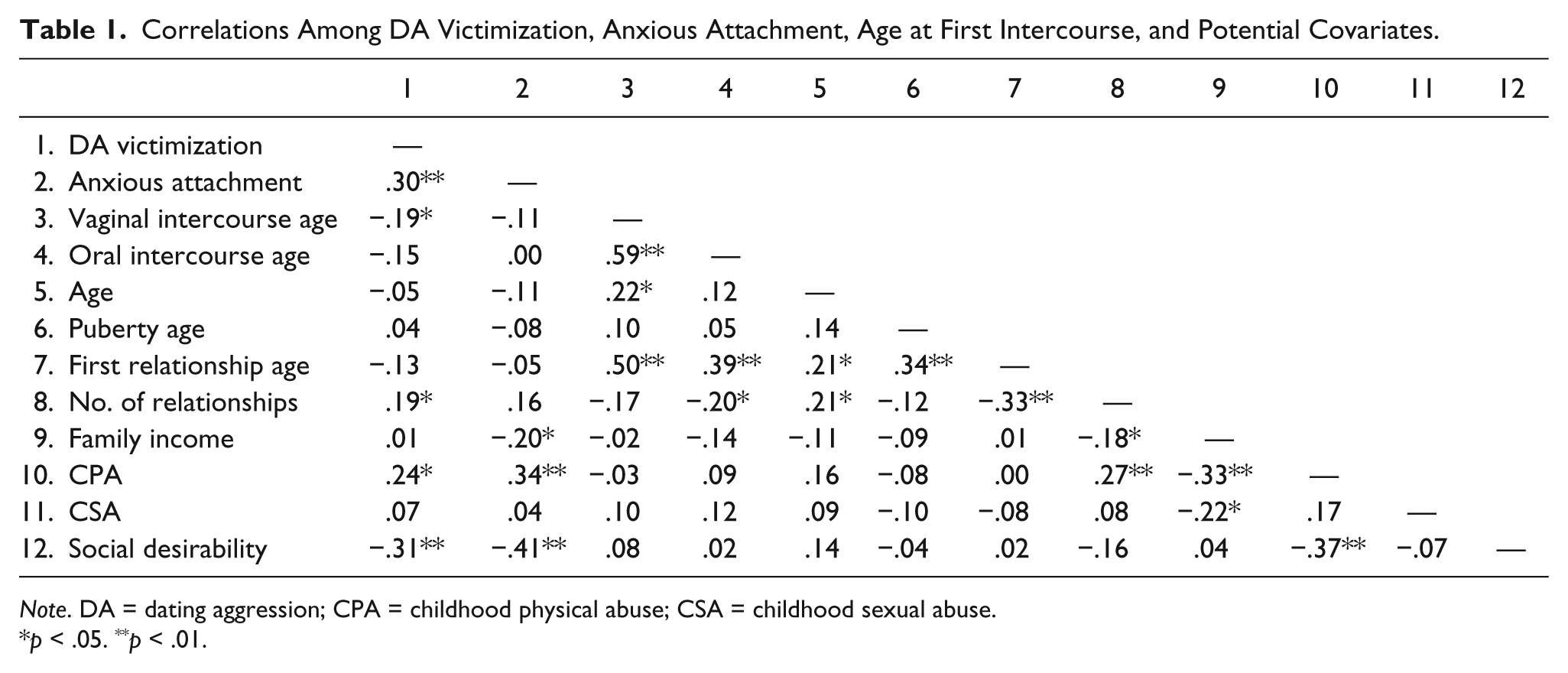
Note. DA = dating aggression; CPA = childhood physical abuse; CSA = childhood sexual abuse.
p < .05. ** p < .01.
The Marlowe–Crowne Social Desirability Scale–Short Form C (MCSDS Form C; Reynolds, 1982) is a 13-item, true/false format, self-report questionnaire designed to measure socially desirable responding. It is a shortened version of the original 33-item Marlowe–Crowne Social Desirability Scale (Crowne & Marlowe, 1960), which is a reliable (Cronbach’s α = .76) and an efficient means of measuring social desirability (Reynolds, 1982). An example item is “I’m always willing to admit it when I make a mistake.” Negatively keyed items are reverse scored and true responses (coded as 1) are then summed to create a total score ranging from 0 to 13. Higher scores indicate a greater degree of social desirability. In the present study, the alpha coefficient for social desirability was .74.
Procedure
The current study was approved by the participating university’s research ethics board. Interested students accessed the study online where they first completed the demographic questionnaire, followed by the remaining four questionnaires in random order. The total time required to complete the questionnaires was approximately 30 min. All participants who started the questionnaire received bonus credit points in a psychology course. On exiting the web-based questionnaire, participants were thanked for their participation and provided with a debriefing letter outlining the purpose of the study. This letter contained a list of community resources and information on Internet security.
Statistical Analyses
All statistical analyses were performed using SPSS (Version 20.0). As a preliminary step, data were examined for missing values and violations against the assumptions of multiple linear regression. Next bivariate correlations were conducted between possible confounding variables and the independent and dependent variables. We conducted descriptive analyses to determine the prevalence rates of DA victimization as well as standard demographic information pertaining to the sample. To test the first three hypotheses, bivariate correlations were conducted between anxious attachment, age at first intercourse, and DA victimization. We conducted two multiple regression analyses (MRAs) using bootstrapped estimates to explore the associative strength of anxious attachment style and age at first intercourse with DA victimization. One MRA specified vaginal as the type of intercourse, whereas the other specified oral. For simplicity, these models will be referred to as the vaginal model and the oral model. Interaction terms were created for anxious attachment and each type of sexual debut, but were removed from their respective models, as they were not significantly associated with DA. The control variables, which differed slightly between the vaginal and oral models, were entered in Block 1 and anxious attachment style and age at first intercourse were entered in Block 2 (see Tables 2 and 3). Consistent with other research on early sexual debut (Gentzler & Kerns, 2004; Halpern et al., 2009; Silverman et al., 2001), age at first intercourse was dichotomized into those who had their sexual debut at the age of 15 years or earlier and those who had their sexual debut at an age greater than 15 years. Finally, MRAs using bootstrapped estimates were rerun without controlling for social desirability to determine the impact of this variable on our results.
Prediction of DA Victimization (Vaginal Intercourse).
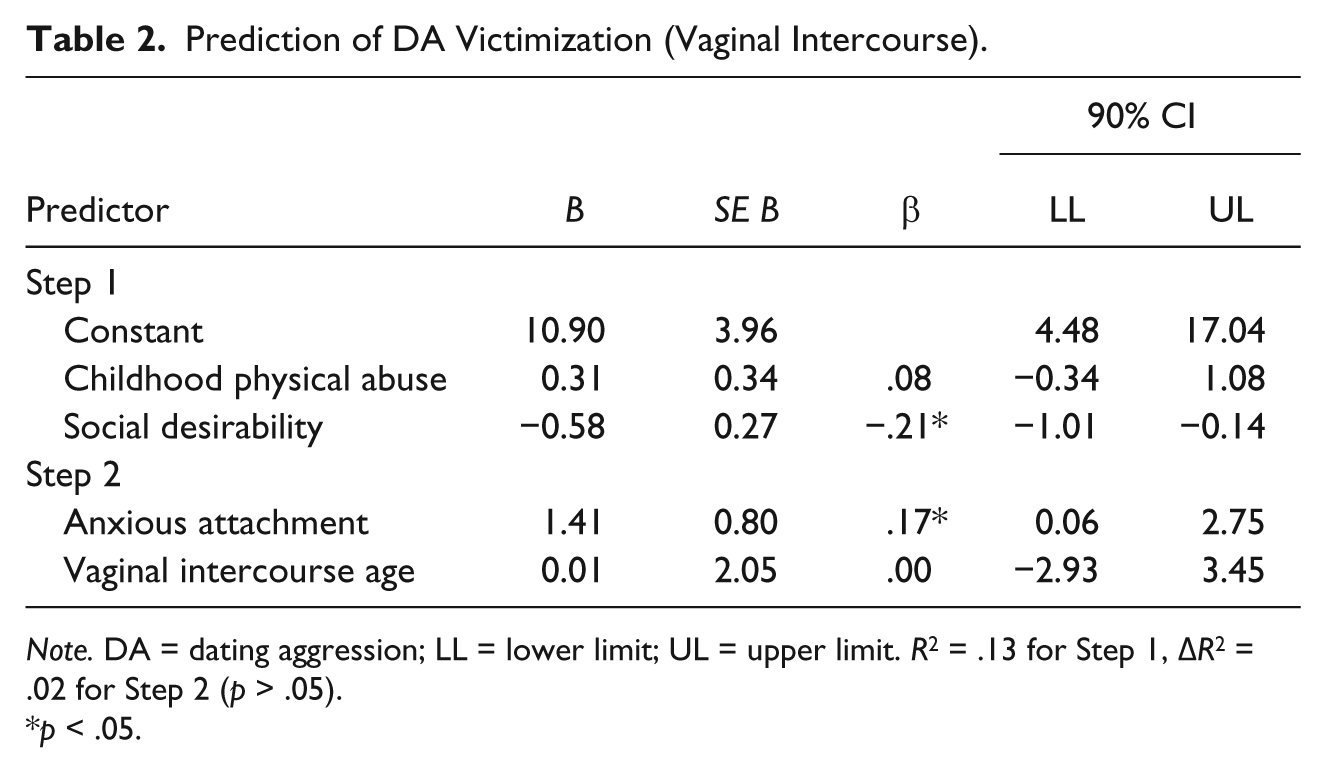
Note. DA = dating aggression; LL = lower limit; UL = upper limit. R 2 = .13 for Step 1, ΔR 2 = .02 for Step 2 (p > .05).
p < .05.
Prediction of DA Victimization (Oral Intercourse).

Note. DA = dating aggression; LL = lower limit; UL = upper limit. R 2 = .16 for Step 1, ΔR 2 = .03 for Step 2 (p > .05).
p < .05.
Results
Preliminary Analyses
We examined data for accuracy and completeness prior to conducting the main analyses. Missing values were randomly scattered throughout the data set and accounted for less than 5% of the data. An expectation maximization method was chosen to estimate missing values. One case was excluded due to data missing from an entire measure.
An examination of standardized residuals, scatterplots, leverage values, and Mahalanobis and Cook’s distances revealed a small number of potentially influential outliers. Regression analyses with and without the outliers yielded negligible differences; therefore, all cases were kept in the data set. Observation of the histograms and P–P plots appeared normal, but a Kolmogorov–Smirnov test indicated that the residuals were non-normally distributed (p < .05). A conservative bootstrapping method of resampling was used in the main analyses to compensate for this violation. All other assumptions of multiple linear regressions were upheld.
A history of childhood physical maltreatment was significantly correlated with anxious attachment (r = .34, p < .001) and DA victimization (r = .24, p = .004; r = −.31). Social desirability was also significantly correlated with anxious attachment (r = −.41, p < .001) and DA victimization (r = −.31, p < .001). Furthermore, childhood physical maltreatment and social desirability were significantly correlated with each other (see Table 1). Although history of childhood maltreatment and social desirability did not significantly correlate with age at vaginal or oral sexual debut (see Table 1), they were controlled for in the main analysis because of their potential effect on the relationship between anxious attachment and the outcome variable. The number of romantic relationships was significantly correlated with both age at first oral intercourse (r = −.20, p = .021) and DA victimization (r = .19, p = .025). It was controlled for in the oral model analysis because it was presumed that individuals who have an early age at first intercourse, and a subsequently larger number of romantic relationships, may be more likely to experience DA simply due to increased probability of encountering an abusive partner rather than specific vulnerabilities associated with an individual who has consensual intercourse at an early age. Other variables were explored as potential confounds (e.g., age at puberty), but correlations with the independent and outcome variables were not significant, and thus these variables were not controlled for in the present study (see Table 1).
Descriptive Statistics
Ninety-six percent of women reported having had vaginal intercourse (n = 131), with 15% reporting first intercourse at the age of 15 years or younger (M = 17.13, SD = 1.60). Ninety-seven percent of women reported having had oral intercourse (n = 133), with 20% reporting first intercourse at the age of 15 years or younger (M = 17.00, SD = 1.69). Anxious attachment scores ranged from 2 to 6, out of a possible 1 to 7 (M = 3.96, SD = 1.03), with higher scores indicating greater anxious attachment. DA victimization scores ranged from 0 to 43 out of a possible 75 (M = 13.59, SD = 8.70). Only one woman reported having never experienced any form of DA victimization. Nearly all women reported experiencing at least one incident of emotional aggression (99%), 19% reported experiencing at least one incident of physical aggression, and 60% reported experiencing at least one incident of sexual aggression.
Main Analyses
One-tailed Pearson correlations without control variables were conducted to test the first three hypotheses. As expected, there were significant correlations between total DA victimization and anxious attachment, r = .30, p < .001; DA victimization and age at first vaginal intercourse, r = −.19, p = .015; and DA victimization and age at first oral intercourse, r = −.15, p = .046. Counter to our hypothesis, anxious attachment did not correlate significantly with age at first vaginal intercourse, r = −.11, p = .097, or age at first oral intercourse, r = .00, p = .481.
Results from the bootstrap regression analyses revealed that the overall vaginal model significantly predicted DA, R = .36, F(4, 126) = 4.70, p = .001, as did the overall oral model, R = .40, F(5, 127) = 4.81, p < .001; however, counter to our hypotheses, the addition of anxious attachment and an early age at first intercourse did not add significantly to either model, ΔR 2 = .02, p = .206 (vaginal model), and ΔR 2 = .03, p = .080 (oral model). Thus, although anxious attachment style emerged as a significant predictor of DA in both the vaginal (β = .17, p = .041) and oral (β = .17, p = .032) models, the addition of this variable did not significantly add to the amount of variance already accounted for by the control variables. The results from these analyses are presented in Tables 2 and 3. Social desirability remained predictive of DA victimization in both the vaginal (β = −.21, p = .016) and oral (β = −.18, p = .029) models, indicating that higher social desirability scores predicted lower DA scores.
Additional Analyses
We ran additional MRAs using bootstrapped estimates to further explore the impact of social desirability in both the vaginal and oral models. Social desirability was removed from Block 1 and all other entries remained the same. The overall models still significantly predicted DA, R = .31, F(3, 127) = 4.55, p = .005 (vaginal model), and R = .37, F(4, 128) = 5.00, p = .001 (oral model), but unlike when social desirability was controlled for, the amount of variance accounted for by the independent variables did add significantly to each model, ΔR 2 = .05, p = .033 (vaginal), and ΔR 2 = .06, p = .019 (oral). Anxious attachment remained a significant variable in both the vaginal (β = .24, p = .005) and oral (β = .23, p = .005) models.
Discussion
The primary aim of this study was to replicate the reported associations between individual characteristics (attachment style and age at first intercourse) and DA victimization with the hope of adding to the literature on known risk factors for DA. Effort was placed on improving methodological limitations of past studies by using multi-item, state-of-the-art measures that assessed multiple forms of DA, by specifying the type of early sexual intercourse (i.e., consensual, vaginal, oral), and by controlling for potential confounds. That is, two out of the five questionnaires used in this study were included for the sole purpose of controlling for suspected confounding variables that are often overlooked in the related literature.
Looking solely at bivariate correlations, it appears that replication of past findings was generally demonstrated when using methodologically rigorous measures. As predicted, women who were more anxiously attached also reported more DA victimization and women who reported an early age at first vaginal and oral intercourse also reported more DA victimization. However, after accounting for control variables in a multivariate model, these individual characteristics did not add significantly to the prediction of DA in young women.
One explanation for the small amount of variance accounted for by anxious attachment and an early age at first intercourse is that these independent variables conceptually cluster with other risk variables. Indeed, we did explore the relation between an anxious attachment style and an early age at first intercourse as a possible cluster, as it has been suggested that an early age at first intercourse may be associated with other individual characteristics that place women at an increased risk of DA. Although the relation between attachment style and sexual debut timing was not significant in this study, other individual characteristics (e.g., substance use, deviant peer group, parental monitoring, family income, childhood maltreatment) or qualities of the sexual debut (e.g., degree to which women consented to unwanted intercourse) may be related to DA and compound the risk of an early sexual debut. It may be more contextually appropriate to explore early sexual intercourse as part of a cluster of other risk variables, such as Jessor’s (1982, 1991) problem behaviors construct, or as a risky romantic relationships cluster (e.g., early sexual intercourse, multiple partners, unsafe sexual practices). Adding an early age of first intercourse to a predictive model as part of a cluster of other risk variables (e.g., by means of a total risk score), may garner different results compared with entering each potential risk variable separately. Thus, despite the nonsignificant multivariate effect, it might be premature to disregard an early age of first intercourse as a risk factor for DA victimization (whether on its own or as part of a cluster of risk factors), especially given that other research has suggested that early intercourse can be a pivotal event that changes young girls in such a way as to place them at a heightened risk of negative outcomes (Armour & Haynie, 2007). Instead, prospective longitudinal research needs to be conducted to determine the antecedents and consequences of an early sexual debut and its potential relation with DA.
As previously mentioned, the overall fit of the multivariate models were significant, but neither anxious attachment style nor age at first intercourse predicted DA victimization above and beyond past childhood maltreatment and social desirability. Anxious attachment style appeared to be a significant predictor in both models, but was unable to account for variance above and beyond that already accounted for by the control variables (most notably, social desirability). In fact, social desirability was the strongest predictor of DA victimization in both the vaginal and oral models (see Tables 2 and 3), indicating that as women became more conscientious about responding in a socially appropriate manner, their report of DA decreased. Especially notable is that this pattern of responding occurred even in the context of an anonymous online survey. Additional analyses revealed that if we had neglected to control for social desirability, anxious attachment would have added significantly to the predictive model of DA. Had we been able to successfully prevent individuals from responding in a socially desirable manner, we may have observed that individuals low in anxious attachment (i.e., securely attached) also may have been low in DA victimization.
Although many authors control for standard demographic variables (e.g., number of partners, age), the present findings reiterate the importance of considering potential confounds a priori so that additional measures can be included into the study’s procedures. In light of the substantial impact that social desirability had on our findings, we recommend that findings from past research on sensitive topics (e.g., DA, sexual behavior) be interpreted with caution unless steps were taken to reduce the impact of biased response styles. Researchers and practitioners should consider the power that perceived societal norms could have on women’s ability to disclose DA—even when using online surveys.
Another indication that reports of DA victimization may not be an accurate reflection of women’s true experience is that the CADRI does not account for the context in which the DA arose. This is a common flaw of many measures of DA, and women in this study, as well as in other studies, may have underreported DA victimization if they confused truly aggressive acts as signs of affection or as play behavior, or overreported DA victimization if they endorsed actual incidences of play and affection that occurred outside of the context of relationship conflict as acts of aggression (Fritz, 2005). The prevalence rates of DA subtypes obtained in this study were consistent with previous research (Muñoz-Rivas, Graña, O’Leary, & González, 2007; Smith et al., 2003), but the confusion between play behavior and aggressive acts, as well as social desirability, may have skewed these estimates. Future research should differentiate aggressive from play behavior, aggressive from defensive behavior, motivations for aggressive acts, and the events leading up to the aggressive incident to determine if the individual’s endorsement of certain behaviors is an accurate representation of DA victimization. Indeed, when seeking to identify risk factors for DA, one hopes to uncover factors associated with true DA victimization and not simply play behavior.
Another limitation of this study was that we did not differentiate women who reported victimization-only from those who reported both victimization and perpetration of DA. Comparisons between women who are mutually aggressive and women who are victims-only would allow for a more comprehensive understanding of the risk factors associated with DA victimization. For example, it may be that anxious attachment is more common among women who are victims-only as opposed to those who are both victims and perpetrators, as anxiously attached individuals are said to be preoccupied with maintaining closeness and intimacy in relationships and use of aggression against a partner would likely increase the risk of separation. Given that adolescents involved in aggressive romantic relationships are often both victims and perpetrators of DA (Avery-Leaf, Cascardi, O’Leary, & Cano, 1997; Gray & Foshee, 1997), it is likely that a large proportion of women’s relationships were mutually aggressive.
Ultimately, prospective research is necessary to provide a more accurate representation of the relation among attachment style, early sexual experiences, and subsequent DA victimization. Assessing attachment style, and other individual characteristics, at multiple time points before and after experiences of first sexual intercourse and DA victimization would help elucidate the cascade of individual changes that lead to an increased risk of experiencing DA. Furthermore, the generalizability of the present findings is limited by including a predominantly White, female, Canadian, university student, convenience sample, which reported a relatively low frequency of DA victimization (the highest DA score reported was 43 out of a possible 75). Replication of this study with a clinical sample may yield significant findings, as those individuals are likely to endorse more severe forms of DA. Due to the sensitive nature of DA and sexuality, increased attention needs to be given to the strong influence of social desirability. These findings add to our understanding of the risk factors associated with DA and stress the importance and utility of refined replication and sound methodology. Although this study did not firmly identify anxious attachment style and early age of first sexual intercourse as risk factors for DA, it did highlight the complexity inherent in studying such a sensitive and important topic.
Footnotes
Declaration of Conflicting Interests
The author(s) declared no potential conflicts of interest with respect to the research, authorship, and/or publication of this article.
Funding
The author(s) disclosed receipt of the following financial support for the research, authorship, and/or publication of this article: This research was supported by the Social Sciences and Humanities Research Council and the Ontario Graduate Scholarship. Nicole Yarkovsky was the recipient of both an Ontario Graduate Scholarship (2010/2011) and a Social Science and Humanities Research Council Master’s Scholarship (2009/2010) during the time period in which she conducted this research. Although these were awards and not research grants, she would like to acknowledge both funding agencies for supporting her while she completed this research.
Author Biographies