




Abstract
This study examined the differences in personality traits between the clusters reflecting the roles in violent interactions among high school students. The sample included 397 students (51.1% male) of Serbian nationality from the first to the fourth grades of different high schools. Based on scores of five dimensions related to peer violence (Physical Aggression, Psychological Aggression, Victimization, Adapted Behavior, and Risky Behavior), three clusters were extracted: Adapted Adolescents, Victims, and Bullies. These three clusters were compared with respect to lexical Big Seven personality traits, and the results indicate that the clusters differ significantly on Aggressiveness, Neuroticism, and Negative Valence. The Adapted Adolescents have the lowest scores on all three dimensions, while the Victims score highest on Neuroticism, and the Bullies on Aggressiveness. The potential importance of certain Extraversion facets for the roles in violent interaction was discussed.
Introduction
Bullying has been the subject of researchers’ interest since the first studies were conducted in Scandinavian countries in the late 1970s (Olweus, 1978, 1993). Although it is very difficult to compare the results of the frequency of violent behavior in different cultures and educational systems, the results of studies in many countries have suggested that the frequency of violent behavior among students had been on the increase (Carney & Merrell, 2001). In addition to that, the results of numerous studies have pointed to the negative and long-term consequences of bullying for all participants (increased depressiveness, anxiety, social exclusion and withdrawal, reactive aggression, and so on in victims; Craig, 1998; Crick & Grotpeter, 1995; Hourbe, Targuinio, Thuillier, & Hergott, 2006; Nansel et al., 2001; Pepler et al., 2006). Such results may be the reason for the unfading interest in the phenomenon of bullying in recent decades.
In spite of the notably rising number of studies since the 1970s, disagreements among authors regarding the definition of bullying have persisted throughout this period (Arora, 1996; Griffin & Gross, 2004). However, despite the differences in defining bullying, certain common elements are present in works of many authors. Price and Dodge (1989) defined bullying as a type of proactive aggression that can be displayed in the form of direct or relational aggressive behavior (Connor, 1988). Therefore, many authors perceived intentional and repetitive infliction of physical pain and/or intimidation not provoked by the victim’s actions as significant determinants of bullying (Olweus, 1993, 2010). However, the power imbalance that exists between the bully and the victim has also been emphasized (Peterson & Rigby, 1999). To conduct a more comprehensive research of the social climate in schools, some studies shifted their focus from the narrowly defined bullying phenomenon to more broadly defined concepts of peer and school violence (Benbenishty & Astor, 2005; Kodžopeljić, Smederevac, & Čolović, 2010; Popadić & Plut, 2007; Thomson, Arora, & Sharp, 2002). In addition to the aforementioned components of bullying, these concepts include individual violent interactions between peers, where an imbalance of power is not necessarily present. However, disagreements over defining the concept have gained or lost importance depending on the goal of the research. Whereas the way of assessment of violent behavior can affect the estimation of the prevalence rate (Cook, Williams, Guerra, & Kim, 2009; Solberg & Olweus, 2003), its effect on determining predictors has not been confirmed (Cook, Williams, Guerra, Kim, & Sadek, 2010). The results of the meta-analytic study (Cook et al., 2010) showed that the predictors of bullying do not differ from predictors of aggressive behavior.
According to the definition, bullying occurs in a social context determined by the individual characteristics of the participants, as well as by different contextual features of the environment (Cook et al., 2010). Bullying appears to be a group activity in which the parties involved participate differently according to their personal characteristics (Salmivalli, Kaukiainen, Kaistaniemi, & Lagerspetz, 1999). Roles in violent interactions tend to remain stable not only throughout elementary school (Salmivalli, Lappalainen, & Lagerspetz, 1998) but also as participants transfer to high school (Paul & Cillessen, 2003). Most authors consider three roles in violent interaction: bully, victim, and bully-victim. Bullies may be considered as children who show intentional and repeated aggressive behavior toward other children. Victims in general may be defined as targets of bullying, while bully-victims are both targets of bullying and aggressors (Griffin & Gross, 2004). In the meta-analysis of 153 studies, Cook et al. (2010) gave a short review of the most important predictors of each role in violent interaction. Even though some of the personal and contextual predictors appeared in all three groups (gender, family and home environment, school climate, poor social skills), bullies were also characterized by a more pronounced externalizing behavior, low school achievement, and negative attitudes and beliefs about others and themselves. Typical victims showed greater tendency toward internalized problems (decrease in self-esteem, increase in anxiety, and depressiveness, etc.) and negative self-related cognitions. In addition to that, they were frequently rejected by their peers and socially isolated. Bully-victim group exhibited a comorbidity of externalized and internalized problems, a negative image of oneself and others, as well as poor social competence, while peer rejection was accompanied by succumbing to negative peer influence. In addition, some authors single out the role of bystanders or witnesses as important group in bullying situations (e.g., Cuadrado-Gordillo, 2012; Gini, Pozzoli, Borghi, & Franzoni, 2008; Salmivalli, 2010). It may be important to make a distinction between bystanders and other participants in bullying. The bystanders do not take active part in violent interactions; however, they can indirectly reinforce the bullies’ behavior, passively support the victims, or behave as observers (Salmivalli, Lagerspetz, Björkqvist, Österman, & Kaukiainen, 1996). Bystanders’ role in violent interaction is important because their behavior can contribute to persistence of violent patterns.
Temporal stability of the role in violent interaction, among other factors, was also shown to be affected by personality traits (Olweus, 1993; Salmivalli et al., 1998). Among studies that have investigated relations between personality traits and roles in bullying incidents, two approaches are noted: variable-centered and person-centered (Grumm & von Collani, 2009). Traditional, variable-centered approach to this problem explored the relationship between personality traits and aggressive behavior or bullying. The Big Five model was used in several studies as the most influential theoretical framework. This model includes five dimensions: Neuroticism, Extraversion, Openness, Agreeableness, and Conscientiousness. The results of numerous studies indicated that Agreeableness had the strongest correlation and emerged as the most important predictor of all roles in violent interactions (Gleason, Jensen-Campbell, & Richardson, 2004; Jensen-Campbell et al., 2002; Sharpe & Desai, 2001; Tani, Greenman, Schneider, & Fregoso, 2003; Trebblay & Ewart, 2005). Low Agreeableness was found in both bullies and victims (Tani et al., 2003), and it was also a significant predictor of victimization increase over time (Jensen-Campbell et al., 2002). Agreeableness also negatively correlated with antisocial behavior and adolescent delinquency (Robins, John, & Caspi, 1994; Van Dam, Janssens, & De Bruyn, 2005). A number of factors contributing to social adaptation, such as peer acceptance (Jensen-Campbell et al., 2002), cooperation in group activities (Graziano, Hair, & Finch, 1997), and self-control in interpersonal relations (Jensen-Campbell, Graziano, & Hair, 1996), also correlated significantly with Agreeableness. Such behaviors may occur as protective factors in bullying situations. Other dimensions, apart from Agreeableness, correlated significantly with different roles in violent interactions. Both victims and bullies scored high on Neuroticism (Maynard & Joseph, 1997; Tani et al., 2003). However, some studies indicated that bullies showed higher positive affect than other participants in violent interaction (Craig & Pepler, 1997). It was assumed that hostility and lack of empathy of the bullies may have been the result of not only low Agreeableness but also of low Conscientiousness. At the same time, social exclusion of the victim can stem from low Extraversion and high Neuroticism (Tani et al., 2003). Substantial correlations between Openness and violent behavior have not been found in most studies. Nonetheless, the results of our research on senior elementary school students suggested that higher Openness is a feature of victims (Smederevac & Čolović, 2011).
The person-centered approach investigates specific trait configurations distinctive for certain groups of individuals belonging to a specific personality type (Grumm & von Collani, 2009). Typology introduced by Block and Block (1980) has often been used in the search for different outcomes of specific personality types. Three personality types, labeled resilient, overcontrolled, and undercontrolled, represent unique combinations of traits that have specific behavioral outcomes. Some of these outcomes are related to bullying. Thus certain findings showed that overcontrolled individuals, characterized by high Neuroticism and low Extraversion, inclined to internalized problems, while undercontrolled ones, characterized by low Agreeableness and Conscientiousness, were more prone to externalized problems (Robins, John, Caspi, & Moffit, 1996; Van Leeuwen, de Fruyt, & Mervielde, 2004). Aggressive behavior as the behavioral outcome of the above-mentioned personality types has also been the subject of research. A longitudinal study by Hart, Hoffman, Edelstein, and Keller (1997) revealed that children who were identified as overcontrolled at the age of seven, showed a greater predisposition to withdraw from social interactions in adolescence, as well as a lower level of self-esteem compared with the other two types. The increase of aggressive behavior during adolescence was noted in children classified as undercontrolled. Considering that the low scores on Agreeableness and Conscientiousness in undercontrolled individuals are sometimes accompanied by moderate and high Neuroticism (Herzberg & Roth, 2006), it is apparent that there is a high level of compliance between the results of variable-centered and person-centered approach to personal characteristics of bullies. The resilient type is characterized by high social competence and emotional stability (Asendorpf & van Aken, 1999). In terms of five-factor model, resilient persons are characterized by moderate Extraversion, Conscientiousness, Agreeableness, and Openness, and low Neuroticism (Van Leeuwen et al., 2004). Therefore, it is less likely that the Resilients will tend to participate regularly in violent interactions.
Besides the studies that investigated relations between personality types and violent behavior, attempts have been made to extract types of adolescents based on self- or peer-reported measures of bullying and/or victimization (Espelage & Holt, 2001; Peeters, Cillessen, & Scholte, 2010). The results suggest that there are three subtypes of bullies in both boys and girls (Peeters et al., 2010), while five clusters are extracted when both measures of bullying and victimization are taken into account (Espelage & Holt, 2001).
Studies concerning personality traits of bullies and victims have, up to now, used the Big Five model framework, regardless of the approach applied. Some traits not included in this model can potentially be significant in describing children displaying violent behavior and children enduring violence. Taking that into consideration, a questionnaire aimed at assessing seven personality dimensions is applied in this study. The questionnaire Big Five Plus Two (BF+2; Smederevac, Mitrović, & Čolović, 2010) was developed on the basis of lexical studies of personality descriptors in the Serbian language. It contains scales for the assessment of Neuroticism, Extraversion, Aggressiveness, Conscientiousness, Openness, Positive Valence, and Negative Valence. The latter two dimensions are referred to by the common term “evaluative dimensions,” because they comprise indicators of positive and negative self-evaluation. Previous studies have pointed to low self-esteem as one of the important characteristics of victimized children (Carney & Merrell, 2001). Therefore, evaluative dimensions, which contain markers of self-esteem, may play an important role in the personality description of both bullies and victims. Victims could achieve significantly lower scores on Positive Valence than other children, and possibly higher scores on Negative Valence, considering the findings pointing to their proneness to depression (Carney & Merrell, 2001). Some thus far findings have spoken in favor of increased Neuroticism and Openness in victims (Smederevac & Čolović, 2011); therefore, such results can be expected in this study. As research on a sample of children aged 11 to 15 indicated elevated scores on Positive and Negative Valence in children who show violent behavior (Mitrović, Kodžopeljić, & Čolović, 2011), similar results can be expected in high school students. Apart from this, Aggressiveness and Neuroticism may be significant for the description of both groups of participants in violent interactions.
This study is based on a somewhat broader definition of bullying which includes Olweus’ criteria (Olweus, 2010), as well as incidental cases of non-repetitive bullying not necessarily including power imbalance. The study uses person-centered approach, which has been previously used in studies regarding adolescents’ violent behavior (Peeters et al., 2010). However, it appears that person-centered studies of self-reported violence in adolescents (Espelage & Holt, 2001; Peeters et al., 2010) are much less frequent than person-oriented studies that are primarily based on personality traits (Asendorpf & van Aken, 1999; Robins et al., 1996; Scholte, van Lieshout, de Wit, & van Aken, 2005; Van Leeuwen et al., 2004), particularly in older adolescents. This study attempts to examine whether self-reported tendencies to participate in violent interactions may serve as a basis for plausible typology of adolescents, and if so, whether adolescents in such clusters differ with regard to personality traits. By using violent behavior as a framework for cluster extraction, this study aims to contribute to a better understanding of different roles in violent interactions among adolescents. At the same time, by using BF+2, this study takes into consideration both descriptive and evaluative personality dimensions, the latter being neglected in studies of adolescents’ violent behavior so far.
Method
Participants and Procedure
The study was conducted in 2011. The sample comprised 203 (51.1%) male and 194 (48.9%) female first- to fourth-grade high school students from Serbia. The participants were White and of Serbian nationality. The average age of the participants was 16.68 (SD = 1.15, range = 15-19). Informed consent was obtained prior to administration of the questionnaires. Participants were told that the study was investigating the frequency of violence in the high school population. In addition, participants were informed that their participation was voluntary and that they could withdraw from the study at any time without penalty. No participants declined to participate in the study.
Measures
Peer Violence Questionnaire (PVQ)
The PVQ (Maksimović, Raković, Jovanović, & Čolović, 2008) was developed to measure the tendency toward different forms of violent behavior. Apart from behavioral indicators of peer violence in the more narrow sense, PVQ includes indicators of some forms of risky behavior which could be related to violent behavior and bullying. PVQ contains five facets: Physical Violence, which assesses a variety of physical forms of violence from direct physical violence toward peers to incitement of physical violence (e.g., “I often take a part in fights”); Psychological Violence, which measures psychological forms of violence such as gossip, mock, disregard, and so on (e.g., “I gossip with my friends about people who deserve it”); Victimization, which measures the exposure to different forms of violence (e.g., “Other students often push me”); Adapted Behavior, which measures behavior such as protecting peers, exemplary behavior, and so on (e.g., “Even when I mess up, I try to set things right.”); and Risky Behavior, which assesses behavior such as substance abuse, risky sexual behavior, theft, and so on (e.g., “I tried marijuana”). The questionnaire contains 59 binary items (Yes/No), of which seven are fillers (e.g., “I have many hobbies”). Fillers are included in the questionnaire to obscure the purpose of the scale.
Higher scores on all the scales in PVQ indicate increased tendency to display certain patterns of behavior labeled by the scale name, while lower scores indicate decreased proneness to these behaviors. The descriptives and reliabilities of scales are shown in Table 1.
Number of Items, Means, Standard Deviations, and Reliabilities for Scales of PVQ and BF+2.

Note. PVQ = Peer Violence Questionnaire; BF+2 = Big Five Plus Two.
BF+2
The BF+2 (Smederevac et al., 2010) is a 184-item measure of seven lexical personality dimensions in the Serbian language. The psycho-lexical study, on which the BF+2 is based, was conducted according to Tellegen and Waller’s non-restrictive criteria (Waller, 1999), which suggest that any personality descriptor can be included in the descriptor list. The items were designed as simple statements in accordance with dictionary definitions, with the 5-point Likert response format ranging from “very false for me” to “very true for me.” The instrument measures 7 higher order and 18 lower order personality dimensions. Seven higher order scales were Neuroticism, Extraversion, Conscientiousness, Aggressiveness, Openness, Positive Valence, and Negative Valence. The Neuroticism scale refers to the tendency to experience negative emotions and contains three facets: Anxiety, Depression, and Negative Affect. The Extraversion scale mostly includes indicators of sociability and positive emotionality and contains the following facets: Warmth, Positive Affect, and Sociability. The Conscientiousness scale includes indicators of persistence and responsible attitude toward obligations and consists of the facets named Self-discipline, Persistence, and Cautiousness. The Aggressiveness scale, for the most part, includes indicators of the display of aggressive impulses and aggressive reactions, and comprises three facets: Anger, Disagreeableness, and Tough-mindedness. The Openness scale refers to a variety of interests and proneness to novelties, and contains two facets: Intellect and Novelty Seeking. The Positive Valence includes two facets: Superiority and Positive Self-Concept. The Negative Valence scale consists of two facets: Manipulative Style and Negative Self-Concept. The descriptives and reliabilities of scales are shown in Table 1.
Data Analysis
To determine types of violent and risky behavior, two-step cluster analysis (with log-likelihood as distance measure) was conducted based on the PVQ scores. Three-, four-, and five-cluster solutions were compared according to their silhouette widths. Silhouette width (Kaufman & Rousseeuw, 2005) was used as a measure of cluster validity. The silhouette is a graphical representation of cluster cohesion or separation. Values of silhouette width span from −1 to 1. Larger values indicate better clustering, and thus they are preferred (Brock, Pihur, Datta, & Datta, 2008; Kaufman & Rousseeuw, 2005).
Results
Descriptives and Reliability
The descriptives and reliabilities for PVQ and BF+2 scales are shown in Table 1. Reliabilities of scales were acceptable to good, except for Psychological Violence, Novelity Seeking, and Cautiousness. Students generally scored higher on Physical Violence, Victimization, and Psychological Violence, and lower on Adapted Behavior.
Cluster Analysis
To identify clusters based on the PVQ scores, a two-step cluster analysis was performed. The silhouette width was the most favorable for the three-cluster solution. One-way analysis of variances (ANOVAs) revealed significant differences at the p < .01 between groups on all PVQ scores: Physical Violence, F(2, 373) = 145.95; Psychological Violence, F(2, 373) = 33.54; Victimization, F(2, 373) = 98.13; Adapted Behavior, F(2, 373) = 82.63; and Risky Behavior, F(2, 373) = 139.13. Scheffe post hoc tests showed that only the differences between the first and the second subgroup on Risky Behavior (p = .94) and between the first and the third subgroup on Adapted Behavior (p = .57) are not statistically significant. Classification results from the discriminant analysis showed that 97.2% of cases for the first subgroup are classified correctly, 100% for the second, and 94.5% for the third subgroup.
Figure 1 shows the mean standardized scores for the three-cluster solution. The first cluster comprised the majority of the sample (n = 250, 66.5%). This cluster was described by relatively low scores on each of the PVQ facets, except for the Adapted Behavior, so the cluster was named Adapted. The adolescents belonging to this cluster scored the lowest on Physical and Psychological Violence and Victimization, while on Adapted Behavior they scored same as the members of the third cluster but significantly higher than the adolescents from the second cluster. Their scores on Risky Behavior were the same as those achieved by the members of the second cluster but significantly lower than in the third cluster. The Adapted cluster comprised 103 boys (41.2%) and 147 girls (58.8%), average age of 16.62 (SD = 1.14). The second cluster comprised 53 participants (14.1% of the whole sample), 27 boys, and average age of students in this cluster was 16.92 (SD = 1.12). This cluster was described by relatively high scores on Victimization and low scores on Adaptive and Risky Behavior, so it was named Victims. The Victims cluster had the highest scores on Victimization and the lowest scores on Adapted Behavior, as well as the lowest scores on Risky Behavior along with the Adapted cluster, while scores on Physical and Psychological Violence were moderate compared with other clusters. The third cluster comprised 73 participants (19.4%), with relatively high scores on Physical Violence and Risky Behavior, and low on Victimization, so this cluster was named Bullies. The Bullies cluster had the highest scores on Physical and Psychological Violence and Risky Behavior, moderate scores on Victimization, and nearly the same scores on Adapted behavior as the Adapted cluster but higher than the Victims cluster. Boys were the majority of the Bullies cluster (n = 58, 79.5%), and the average age of students in this cluster was 16.74 (SD = 1.21).
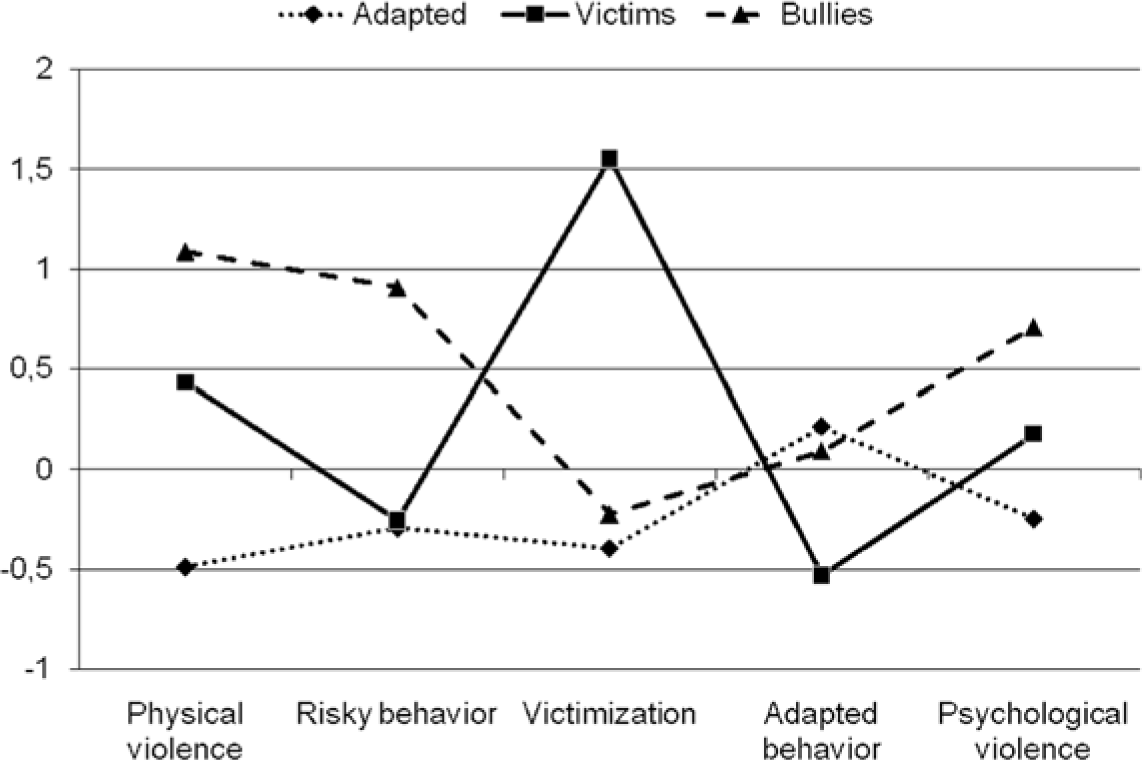
Mean standardized scores for Peer Violence Questionnaire scales in the three-cluster solution.
Results of a Profile (3) × Gender (2) chi-square test indicated that the numbers of male and female students in clusters were significantly different, χ2(2) = 33.09, p < .001. Inspection of crosstabulation suggested that the main difference concerned the group of Bullies, which included mostly male participants.
Clusters and Personality Traits
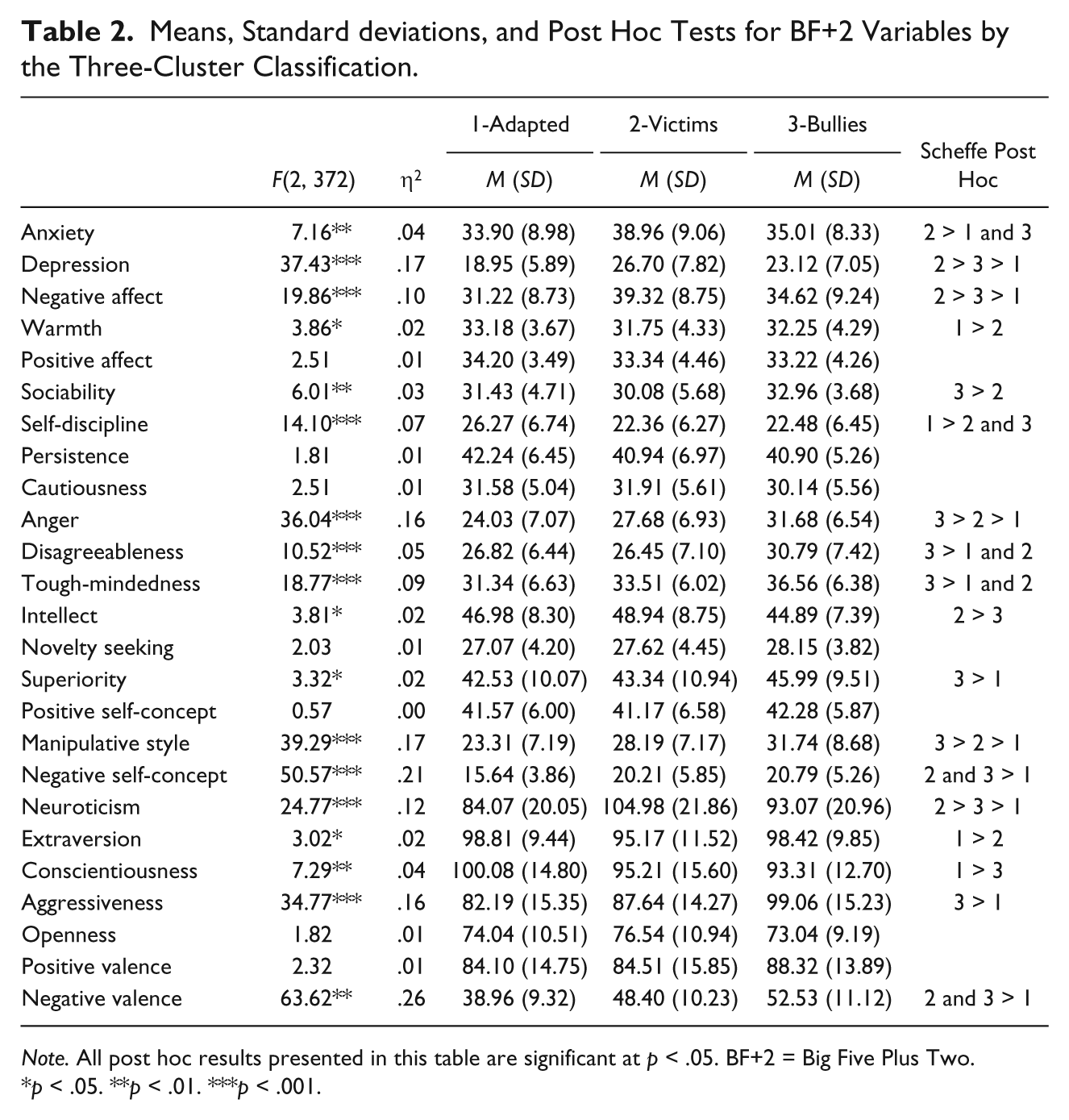
Univariate F tests were performed on all BF+2 variables with the three clusters as the grouping factor, followed by Scheffe post hoc tests (see Table 2).
Means, Standard deviations, and Post Hoc Tests for BF+2 Variables by the Three-Cluster Classification.
Note. All post hoc results presented in this table are significant at p < .05. BF+2 = Big Five Plus Two.
p < .05. **p < .01. ***p < .001.
F tests yielded significant univariate effects of group membership on almost all personality variables (Table 2). Results indicated that the Victims had the highest scores on all facets of Neuroticism, and the Bullies had the highest scores on all facets of Aggressiveness and on Manipulative Style facet of Negative Valence. The Adapted and the Bullies differed significantly on Conscientiousness. However, at the facet level, the only difference was on Self-Discipline between the Adapted and the others, with the Adapted scoring higher. The Bullies scored higher than adapted on Superiority (Positive Valence’s facet). The Adapted scored higher than the Victims on Warmth (Extraversion’s facet). The Bullies scored higher on the Sociability than the Victims. The Intellect (facet of Openness) also discriminated between the Victims and the Bullies, with the latter scoring lower. Eta-squared effect sizes were moderate for domains of Negative Valence, Aggressiveness, and Neuroticism, as well as for Manipulative Style, Negative Self-Concept, Depression, and Anger facets. For the remaining personality variables, effect sizes were small.
Discussion
The first aim of this study was to identify distinct groups of adolescents who differ according to the participants’ roles in violent interaction. Three clusters with the following features were identified: (1) cluster of adapted adolescents who showed lower tendency to participate in violent interaction than other participants; (2) cluster of adolescents who were most often victims in violent interaction; and (3) cluster of adolescents who showed violent behavior toward others.
The cluster named the Adapted was the most numerous (66.5% of sample) and included adolescents who scored lower than others not only on Physical Violence, Risky Behavior, and Psychological Violence but also on Victimization. On the other hand, these participants scored highest on Adapted Behavior, which implies a negative attitude toward violence. Adapted adolescents are more emotionally stable than the other two groups, which is supported by the findings regarding Neuroticism domain and facets. Higher emotional stability is an important basis for resilience and adaptive strategies for facing potentially threatening stimuli from the environment (Robins et al., 1996). Although the Adapted had the highest overall Extraversion score, they did not differ from other groups regarding Positive Affect and Sociability. Thus, it appears that these differences are not predominantly temperament-based. Rather, the Adapted express most prominently those aspects of extroverted behavior connected to the intensity of interest in others, social skills, and socialization, which is reflected in higher score on the Warmth facet. The Adapted, compared with the other groups, scored lower on Negative Valence, which includes Negative Self-Concept and Manipulative Style. This suggests a lower tendency toward manipulative behavior and negative self-evaluation. In addition to that, Aggressiveness scores show that the Adapted are less prone to anger and that they are less stubborn and tough-minded than the Bullies. Self-discipline of the Adapted is high. This most likely contributes to success in carrying out various obligations. Such success, in turn, increases self-esteem and maintains emotional stability. However, the finding that they score lower on Superiority than the Bullies indicates that their self-esteem has sound emotional and cognitive bases. These results correspond to the findings referring to the features of adapted individuals (Asendorpf & van Aken, 1999). Domain and facet configuration in the Adapted cluster, obtained in our research, corresponds with the prototypical features of the resilient type (Hart et al., 1997; Robins et al., 1996).
The cluster Victims (14.1% of the sample) included adolescents scoring extremely high on Victimization, with lower scores on Risky Behavior and Adapted Behavior. However, their proneness to physical and psychological violence is more prominent than in the cluster Adapted. This finding points to a possibility that the cluster Victims also partly incorporates the adolescents who are simultaneously in both the position of a victim and a bully, or the adolescents who react to the exposure to violence using non-adaptive strategies. Therefore, although bully-victims were not identified as a separate cluster, they are most probably included in the cluster of Victims. The scores on the personality dimensions of the BF+2 questionnaire support this. The Victims scored highest on Neuroticism and lowest on Extraversion, whereas their scores on Aggressiveness, Conscientiousness, and Negative Valence are between the Adapted and the Bullies. The Victims’ pronounced reactivity to unpleasant stimuli from the environment, reflected in higher scores on all aspects of Neuroticism (Robins et al., 1994), may partially be a consequence of their frequent exposure to bullying. Moreover, it may be a trigger for Bullies for whom they may represent an easy target. This result corresponds to the findings regarding personality traits of Victims (Maynard & Joseph, 1997; Tani et al., 2003). The tendency toward introvert behavioral patterns (lower Warmth and Sociability scores) probably points to a temperamental predisposition for fewer social contacts (Robins et al., 1994), which implies fewer potential protectors. The results of several studies maintained that the number of social contacts was a protective factor for exposure to violence (Carney & Merrell, 2001; Dinić, Kodžopeljić, & Čolović, 2010; Kodžopeljić, Smederevac, & Dinić, 2010). Bullies scored significantly higher than Adapted on the Aggressiveness, while there was no significant difference between the Bullies and the Victims. However, the Victims scored higher than the Adapted and lower than the Bullies on the Anger facet, but they did not differ significantly from the Adapted regarding the scores on Disagreeableness and Tough-Mindedness. In this context, Anger for Victims can represent the reaction to the inability to establish an adequate social position. In addition, Negative Valence scores suggest that the Victims show a higher tendency to manipulative behavior than the Adapted. This is in accordance with the clusters’ structure, which suggests Victims’ more pronounced tendency toward psychological violence compared with the Adapted group. It is likely that the Victims manifest their aggressive impulses indirectly, avoiding direct confrontations with the others. Although Victims scored similarly to Bullies on Negative Self-Concept, it can be assumed that the quality and the content of this aspect of self-evaluation are considerably different in those two groups, according to the differences in other personality traits—namely, negative self-evaluation may represent a consequence of perceiving oneself as a person less worthy and less capable, which could be the property of the Victims (Cook et al., 2010). On the other hand, the Bullies probably are highly aware of, or even emphasize, their own negative features, as they want to be feared by others. Therefore, these socially inappropriate traits have an important role in their social positioning. However, regardless of the hypothesized source of negative self-evaluation in Victims and Bullies, the meta-analysis by Cook et al. (2010) has shown that negative self-related cognition is a common feature of the victims and bullies that can result in acquiring different positions in violent interactions.
The cluster Bullies (19.4% of sample) included adolescents scoring high on Physical Violence, Risky Behavior, and Psychological Violence, and low on Adapted Behavior and Victimization. External validation showed that these adolescents scored the highest on Aggressiveness and Negative Valence and the lowest on Conscientiousness. While having similar scores to the cluster Adapted on Extraversion, their scores on Neuroticism were lower than in the cluster Victims but higher than in the cluster Adapted. Although Bullies scored lower than the Victims on Anxiety, and did not differ significantly from the Adapted in this aspect, they did differ from the Adapted in the manifestation of Negative Affect and Depression. High scores on Sociability and, in general, Extraversion most likely contribute to the fact that Bullies react to the increase of emotional tension with the overt aggression aimed at other people. Anger, Disagreeableness, and Tough-Mindedness were most pronounced in the Bullies group, which indicates an adopted pattern of social interactions aimed at gaining and maintaining the position of power. Extremely high self-evaluation reflected in higher scores on Superiority, supported by manipulative behavioral patterns and negative self-assessment, also contributes to this. It has already been mentioned that Negative Self-Concept in this context probably refers to the need to make an impression of a strong and dangerous person. This study confirms the findings of many previous studies that have suggested that dimensions Agreeableness (which significantly corresponds to dimension Aggressiveness in the BF+2 questionnaire) and Neuroticism are closely related to different positions and outcomes in violent interaction (Gleason et al., 2004; Jensen-Campbell et al., 2002; Tani et al., 2003). In addition to that, this study points more clearly to the importance of evaluative dimensions in the configuration of the traits of bullies and victims.
Openness did not discriminate between the groups. This dimension refers to the need for stimulation, which, at the adolescent age, probably has only a minor (if any) impact on violent interaction.
The distribution of the gender within clusters has shown that boys were predominant in cluster named Bullies and girls in Adapted cluster, and that there were similar percentage of boys and girls in cluster named Victims, which is in line with the main results regarding gender differences in bullying (Felix & Green, 2010). However, the main indicators of violence in this research included forms of overt violent behavior, which are more typical for violent behavior among boys. Girls are more frequently involved in types of violent interaction that include different forms of relational aggression (Crick & Grotpeter, 1996). Such findings are congruent with assumptions that gender differences are shaped by social roles (Eagly & Wood, 1991), suggesting that overt violent behavior is an acceptable feature of males rather than females.
The results of this study indicate the role of certain temperamental traits in the development and manifestation of specific maladaptive pattern of social interactions (Jensen-Campbell et al., 2002; Tani et al., 2003). In this context, the role of Sociability could be important. The lower Sociability in the Victims group contributes to withdrawal and the development of the submissive attitude, whereas the high Sociability in the Bullies group contributes to the development of the dominant attitude. Considering that these positions in social interactions are compatible, it is unlikely that a spontaneous change of these dysfunctional patterns of communication will take place. Thus, different programs of acquiring social skills are an adequate approach to changing such patterns. Furthermore, the results point to different manifestations of aggressive tendencies with Bullies and Victims. Bullies are more prone to direct attacks, whereas Victims are inclined to indirect forms of aggression. The significance of self-evaluation in this context is reflected in the importance of negative self-perception that contributes to behavioral inhibition with the Victims, while with Bullies it can encourage aggressive tendencies provoking the feeling of awe in persons they interact with.
In general, results of this study confirm the assumption that violent behavior can be a basis for plausible typology of adolescents. This typology is congruent with the dominant approach in research of personality, which proposes three main personality types, named resilient, overcontrolled, and undercontrolled (Asendorpf & van Aken, 1999). The Adapted cluster, which was extracted in this study, has shown the features usually associated with resilient type. Bullies are similar to the undercontrolled, while Victims have shown some of the features of the overcontrolled. In addition to that, the structure of clusters bears similarities to usual roles in violent interaction, a.k.a. victims, bullies, and bystanders. Although there is no evidence that bystanders fit into Adapted cluster, the possibility that adapted adolescents may take the role of bystanders cannot be ruled out. Therefore, the Adapted may also contribute to the circumstances in which violent behavior is exhibited. However, typical bystanders’ behavior is not included in the measures that were applied in this study. Therefore, all conclusions regarding bystanders’ role may be treated as hypothetical.
The results of this research emphasize the general importance of person-centered approach, but also point to its relevance for violence studies. The results confirm that distinctive clusters can be extracted that are related to the roles in violent interaction and that such clusters differ substantially with regard to personality traits. Therefore, in personality assessment, it may be of crucial importance to consider not only separate dimensions but also their configuration. This way, a more thorough understanding of specific roles in violent interaction can be ensured.
Footnotes
Declaration of Conflicting Interests
The author(s) declared no potential conflicts of interest with respect to the research, authorship, and/or publication of this article.
Funding
The author(s) disclosed receipt of the following financial support for the research, authorship, and/or publication of this article: This work was partially supported by the Ministry of Education and Science of the Republic of Serbia (Grants ON179006) and by the Provincial Secretariat for Science and Technological Development.