



Abstract
A population case-control study of domestic violence in China was conducted to examine the relationship between individual- and household-level characteristics and violence perpetration and victimization. Demographic comparisons were conducted between perpetrators and victims (n = 624), perpetrators and matched controls (n = 628), and perpetrator households and control households (n = 620). A multivariate model of demographic risk was tested, integrating individual- and household-level correlates of violence perpetration. Compared with victims, perpetrators were more likely to be older, male, and have lower levels of education. In the final model, violence perpetration was more likely among individuals who earned more income, contributed a lower proportion of the household income, had a family member who was unemployed or lived in households with an authoritarian or independent power structure.
Although extensive research has been carried out on domestic violence in Western countries, the problem is poorly understood in China (Xu et al., 2005). In recent years however, domestic violence has gained more public attention due to greater awareness of its effects on Chinese families. A comprehensive review of the empirical literature in contemporary China, which consisted of 19 papers published from 1987 to 2006, found that approximately 19.7% of women in China had experienced violence perpetrated by their male intimate partners (Tang & Lai, 2008). A separate population-based epidemiological study of child, elder, and intimate partner violence (IPV) found that domestic violence was reported in 16.2% of Chinese households, and nearly 20% of these households endorsed more than one form of domestic violence (Cao, Zhang, & Chang, 2006; Cao, Zhang, Sun, et al., 2006). The prevalence and forms of domestic violence reported (e.g., child, elder, partner violence) also varied by household size, composition, and geographical setting (Cao, Zhang, & Chang, 2006). Although few epidemiological studies of domestic violence in China have been conducted to date, these findings are consistent with a large body of international research that confirms that sociodemographic characteristics are important contextual factors related to domestic violence (Caetano, Vaeth, & Ramisetty-Mikler, 2008), and these characteristics may be potentially useful for identifying individuals at elevated risk for violence perpetration and victimization (Riggs, Caulfield, & Street, 2000). Given the lack of domestic violence prevention and intervention services in China, it is critical that targeted efforts be made to identify individuals and families most at risk so that limited resources may be allocated efficiently (Tang & Lai, 2008). Toward that end, this study examines the relationships between individual- and household-level sociodemographic characteristics and domestic violence in China using population-based samples and a case-control design.
Sociodemographic Correlates of Domestic Violence
Research examining sociodemographic risk factors for domestic violence has generally focused on age, gender, and socioeconomic indicators. Studies suggest, for example, that risk for IPV tends to decrease with age, with older individuals less likely to be victims and perpetrators (Caetano, Ramisetty-Mikler, & Field, 1995). Similar findings have been reported for child maltreatment, with younger parents more likely to report having physically abused or neglected a child than older parents (Egami, Ford, Greenfrield, & Crum, 1996).
As far as gender is concerned, associations with domestic violence have been found to vary across outcomes. Studies of IPV, for example, have found that gender is the primary risk factor. In the U.S., women are 5 to 8 times more likely to experience IPV than men (Rennison, 2001), and the overwhelming majority of IPV victims are women. Similarly, data from the Social Welfare Department of Hong Kong indicated that from January to June 2005, 1,620 new battered spouse cases had been reported and 90% of the victims were female (Tsui, Chan, So, & Kam, 2006). In contrast, studies of child maltreatment generally find that boys are at higher risk of physical abuse and neglect (Sedlak & Broadhurst, 1996), although other studies have failed to find a significant effect of victims’ gender (e.g., Cappelleri, Eckenrode, & Powers, 1993). Research on elder abuse has also been mixed, with some studies showing that women are more likely to be abused than men (Harris, 1996; Lachs, Berkman, Fulmer, & Horowitz, 1994), and others’ reporting no significant gender effect (e.g., Comijs, Smit, Pot, Bouter, & Jonker, 1998; Yan & Tang, 2004). Across outcomes however, the evidence suggests that the men are more likely than women to be perpetrators of domestic violence, particularly its more severe forms (Egami et al., 1996).
Socioeconomic status (SES) has been shown to be a robust correlate of domestic violence, with most studies indicating that low educational attainment, poverty, and employment instability are related to higher risk of violence (Gillham et al., 1998; Kaukinen, 2004; Riggs et al., 2000). In the case of IPV, numerous studies indicate that husbands who are unemployed or report lower levels of education, prestige, and income are more likely to abuse their wives than are other husbands (Fox, Benson, DeMaris, & Van Wyk, 2002; Hoffman, Demo, & Edwards, 1994). Women with low incomes, lower levels of education, or who are unemployed (e.g., housewives) are also more likely to be the victims of IPV than their higher-SES counterparts (Caetano et al., 2008). A similar pattern has been observed for child abuse, with parental poverty and unemployment associated with higher likelihood of perpetuating violence (Gillham et al., 1998; Wolfner & Gelles, 1993). One important exception to this general pattern of findings comes from the National Latino and Asian American Study. Separate analyses of IPV (male-to-female and female-to-male) and parent-to-child aggression in the Asian American sample found that income and education were not consistently related to either outcome (Chang, Shen, & Takeuchi, 2009; Lau, Takeuchi, & Alegría, 2006). In fact, low-income Asian American parents were actually less likely to report minor assault than those with high income.
Theoretical Considerations: The Chinese Cultural Context
The traditional Chinese family, guided by Confucian concepts of filial piety may be described as an authoritarian, patriarchal system of interdependent relationships in which husbands are responsible for their wives, parents for their children, and adult offspring for their elder parents. In recent years however, economic growth, Westernization, and the rise of individualism has changed the nature of Chinese family relationships for better and for worse. On one hand, greater social and economic opportunities have improved the quality of life for many Chinese families and led to greater family egalitarianism, particularly among the growing middle-class. On the other hand, instability in the household economy and power distribution have been associated with increases in family stress and conflict as traditional role relationships are contested and renegotiated. In this section, we apply key theories of family violence to the Chinese cultural context and consider their implications for understanding how individual- and household-level sociodemographic features may relate to a variety of violence outcomes.
Despite mixed findings regarding the gender distribution of family violence victimization, the fact that males tend to be the primary perpetrators of IPV supports feminist theories of IPV as yet another example of gender-based violence caused by unequal distribution of power in patriarchal societies. In such societies, including China, men have greater access to resources and decision-making power and use violence as a means for maintaining power, privilege, and control (Hollander, 2005). The relationship between traditional patriarchal structures and family violence has been noted in several studies conducted in China, including one involving a clinic sample in China which confirmed that female victims of IPV were more likely to endorse traditional gender role attitudes (Xu et al., 2005). Ethnographic data also reveal that many women in rural China view wife beating as an unfortunate but inevitable aspect of married life (Liu & Chan, 1999). Despite a growing trend toward egalitarian spousal relationships, we hypothesize that the patriarchal norms and structures embedded in Chinese family life will produce similar gender differences in domestic violence among our population-based sample, with males generally more likely to be perpetrators than victims.
The relationship between household SES and family violence has been examined from the perspective of two main theoretical paradigms, family stress theory and resource theory. According to family stress theory, violence is likely to erupt in situations where the accumulation of stressors exceeds the availability of coping resources (material, psychological, emotional; Conger et al., 1990). Resource theory, however, treats income, education, and employment as important resources contributed by each member of the family. According to this perspective, individuals whose power base is threatened by resource deficits in general or resource deficits relative to subordinate others in the family are more likely to perpetrate violence as a means of reclaiming one’s authority. Violence is viewed as a resource of last resort, for example in couples in which the female partner contributes as much or more than the male partner to their economic well-being of the household (Goode, 1971).
On the basis of previous findings (Fox et al., 2002), we speculate that low individual- and household-level SES will be associated with domestic violence in China. The spectacular economic transformations that have occurred over the past 20 years have also been accompanied by increases in financial stress associated with widening income disparities, intense job competition, and mounting materialism. Drawing on family stress theories, we predict that how family members perceive their economic status and calculate their financial well-being will be a strong predictor of violence (Conger et al., 1990; Fox & Chancey, 1998). Furthermore, given external challenges to the economic power distribution in the family, we hypothesize that individuals, particularly male individuals, with lower levels of education and employment, as well as those with higher income contributions, may be more likely to be a perpetrator of violence as a means of asserting their power and authority within the family (Fox et al., 2002).
In addition to these socioeconomic factors, interpersonal and behavioral stressors may also increase the family’s stress burden (Comijs et al., 1998; Menard, Bandeen-Roche, & Chilcoat, 2004). Rapid growth and social change in China has been accompanied by a rise in the prevalence of adulterous affairs, substance abuse, gambling, and other behavioral and emotional disorders (Phillips, Liu, & Zhang, 1999). While previous studies have tended to focus on the relationship between such individual characteristics and risks for violence perpetration, the interdependent nature of Chinese families coupled with the stigmatizing nature of these problems suggests that it may be more accurate to view these problems as increasing the household’s stress load as a whole and heightening vulnerability to violence among all of its members (Menard et al., 2004). Because stress and distress generally compromise relationship quality, the presence of these family-level stressors may contribute to abuse when coping resources are overwhelmed.
Finally, studies suggest that some families may be better equipped to handle stressors than others. Authoritarian family systems, characterized by rigid hierarchies of power, may be particularly prone to violence. Within such families, violence may be used as a means of reestablishing homeostatic balance under conditions of stress and disequilibrium caused by transgressions committed by its members. Domestic violence has been theoretically linked to authoritarian family systems such that the more rigid the family system hierarchies, the more severe the expressions of violence within the family (Kornblit, 1994). Drawing on this work, we hypothesize that Chinese households characterized by authoritarianism may be more prone to violence than households in which power is more equitably distributed among its members and family interactions are flexible and responsive to changing conditions.
The Present Study
The present study examines correlates of domestic violence in Chinese families. Research that examines how individual- and family-level risk factors contribute to violence is especially important in the Chinese cultural context, where strong interdependent relationships between family members are culturally reinforced.
A second and related issue is that theory and research on domestic violence typically focuses on only one form, such as IPV, child abuse, or elder abuse, with little crossover in investigations (Tolan, Gorman-Smith, & Henry,2006). However, there is growing recognition of considerable overlap in the occurrence and correlates of these problems, and thus the need for greater conceptual integration (Cao, Zhang, & Chang, 2006). A final concern is that given the challenges in studying this “hidden population,” most data in China are collected from special populations, such as primary care samples, victims presenting in shelter settings, or perpetrators identified through the criminal justice system or victims’ self-reports. Sample selection bias has interfered with efforts to understand subgroups at risk for violence within the general Chinese population.
In an effort to address these gaps in the literature, the present study uses data from a population-based case-control study of domestic violence in China to examine the relationship between individual- and household-level characteristics and domestic violence perpetration and victimization. Demographic comparisons were conducted between perpetrators and victims, perpetrators and matched controls, and perpetrator households and control households. Finally, a multivariate model of demographic risk was tested, integrating various theoretic streams connecting individual- and household-level risks for domestic violence perpetration.
Method
Sample
Data were drawn from the first population-based survey of domestic violence conducted in China (Cao, Zhang, & Chang, 2006; Cao, Zhang, Sun, et al., 2006). The prevalence of domestic violence was assessed in households from urban, rural, and industrial districts in Hunan, China. Hunan is an interior province located in south central China and is the 11th largest of China’s 31 provinces. A multistage sample of residences was drawn following standard procedures for complex samples to select three research sites—Chenzhou City (urban), Yongshun County (rural), and Xiangtan industrial district—which are located in the southern, western, and central regions of Hunan, respectively. The lifetime prevalence of any form of domestic violence was 16.2%, reported in 1,533 of the 9,451 households (Cao, Zhang, & Chang, 2006).
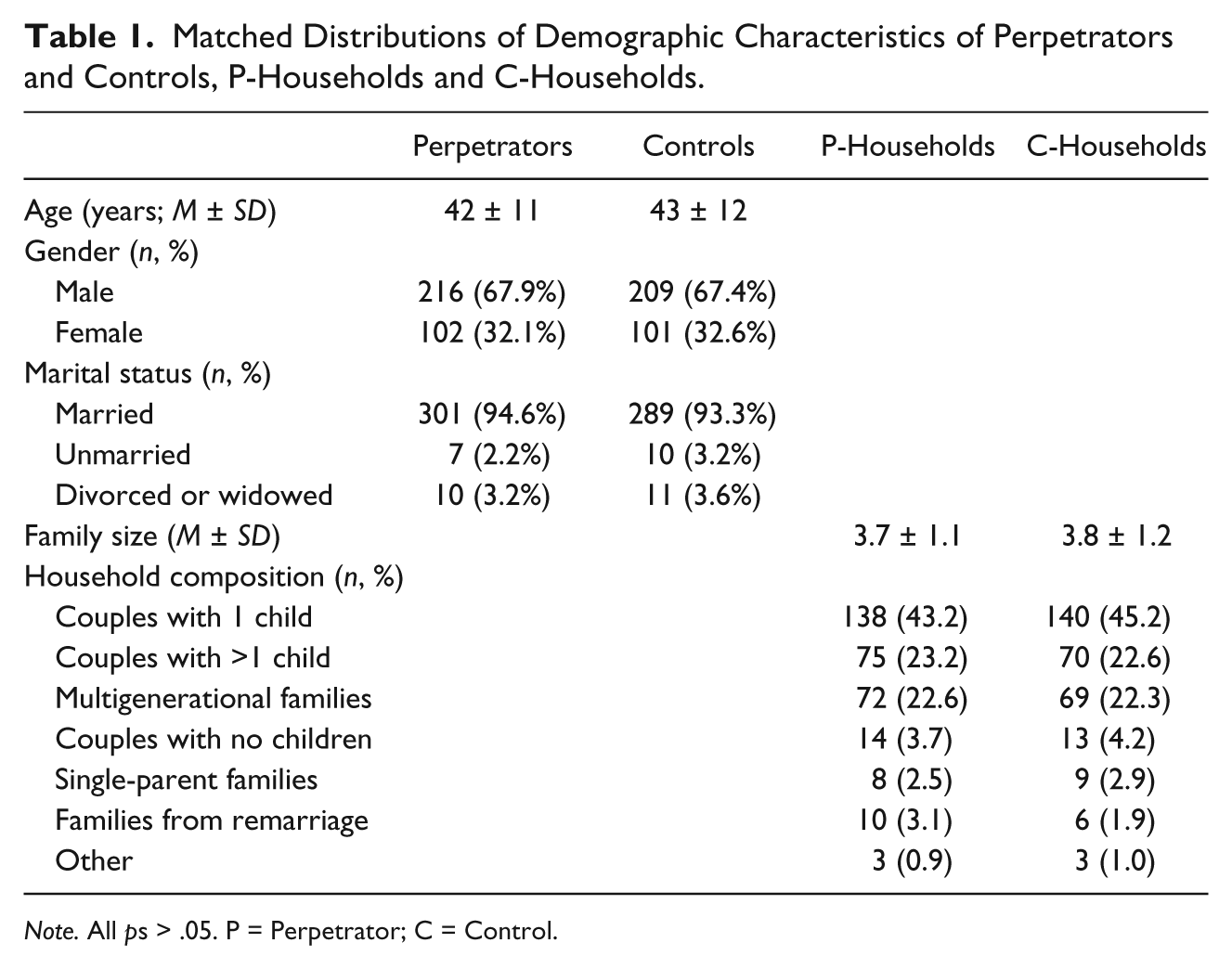
In this study, we further explored the sociodemographic correlates of domestic violence at the individual and household levels. Because domestic violence is very private issue in China, it was very difficult to collect the intensive measures during the large survey. In this study, we used the randomly selected sample from the former large survey. In all, 310 were randomly selected from the positive sample as research households. In these households, 100 came from the urban site, 100 from the industrial site, and 110 from the rural site. A table of random numbers was used to randomly selecting the research households. Our previous research found that the prevalence of domestic violence varied by geographic setting, household size, and household composition (e.g., number of parents, children, and extended family members; Cao, Zhang, & Chang, 2006). To control for these factors, another 310 households with no history of domestic violence were selected as a control group, and matched with the research sample by geographic setting, household size, and household composition. A total of 318 perpetrators and 306 victims from the research households were interviewed for the present study. Four identified victims were unavailable or unable to be located within the 310 research households, resulting in a final sample of 306 victims. A corresponding sample of 310 individual controls was selected from the control households to match the distribution of perpetrators according to age, gender, marital status, and family role (e.g., father, daughter, grandmother). In summary, there are two levels of case control in this study, namely (a) perpetrators and their corresponding controls and (b) perpetrators’ households (P-household) and their corresponding controls’ households (C-household). The final sample consisted of 318 perpetrators and 306 victims drawn from 310 research households, and 310 control cases drawn from 310 control households. Table 1 presents the matched distributions of age, gender, and marital status for the perpetrators and controls, in addition to household size and composition for P-households and C-households.
Matched Distributions of Demographic Characteristics of Perpetrators and Controls, P-Households and C-Households.
Note. All ps > .05. P = Perpetrator; C = Control.
Definition of Domestic Violence
In this study, domestic violence was defined as physical, mental, or sexual abuse occurring between family members, including hitting, slapping, kicking, verbal insults, threats or intimidation, social isolation, deprivation, neglect, and sexual assault, regardless of whether the abuse occurred inside or outside the home. Social isolation included depriving another of freedom, or forbidding contact with individuals outside of the family (Cao, Zhang, & Chang, 2006).
Procedures
Face-to-face interviews were conducted by interview teams consisting of psychiatrists, psychologists, physicians working in the provincial department of public health, and local field officers from the Women’s Federation. The Women’s Federation is a federal agency whose mission is to represent and safeguard women’s rights and interests. Local field officers collaborated with the research team to facilitate access to and gain the trust of the study households by drawing on their status as members of the local community. Interviewers completed 3 days of training. Interrater reliability of the screening questionnaire was excellent, yielding a pairwise agreement rate of 0.97 for 25 interviewers assessing the same 10 respondents.
The study was presented as a survey of family harmony, with implications for improving family relationships in China. Respondents were told that participation was voluntary and confidential. Those who agreed to participate provided oral and written informed consent; illiterate respondents provided only oral consent. To protect respondents’ privacy, interviews took place in a location of the respondent’s choosing, such as a private room, a meeting facility, or in the case of rural respondents, an outdoor field. Perpetrators and victims were interviewed separately to reduce risk of harm as a result of disclosing family violence to the interviewers. Household data were provided by the head of household designated in the city or village registry.
Measures
Lifetime domestic violence
Respondents were presented with a list of abusive acts and asked whether they had ever committed any of them against a family member (perpetration) and/or whether a family member had ever committed any of them against them (victimization). The behaviors listed were as follows: (a) verbal insults; (b) physical beating with bare hands, such as slapping, grabbing, shoving, choking, biting, kicking, punching, or hair-pulling; (c) physical beating with implements, binding, whipping, burning, and so on; (d) destroying furniture or other home furnishings in an expression of anger; (e) causing suffering through such acts as forcing someone to do heavy labor, using threats or intimidation, limiting food consumption and/or adequate clothing, forcibly restricting one’s personal freedom, or forbidding contact with individuals outside the family; (f) physical neglect or abandonment; (g) sexual assault; (h) murder; or (i) other violent behaviors. History of spousal abuse, child abuse, and elder abuse were assessed by victim and perpetrator self-reports and aggregated in the present study.
Individual sociodemographic data
Age, gender, education, employment status, and economic status (monthly income and the percentage of contribution to the household income) were reported separately by perpetrators, victims, and controls. As a condition of inclusion in the study sample, no missing data were permitted. Employment status was based on status at the time of the interview (0 = employed, including any type of paid work; 1 = not employed, including unemployed or laid off and looking for work, and never worked for pay).
Household economic status
The designated head of household provided objective and subjective assessments of household economic status. Objective measures included the total household annual income and size of the household (this refers to actual physical size of the dwelling measured in terms of m2). Subjective measures assessed satisfaction with the household’s financial and living condition (0 = satisfied and 1 = dissatisfied).
Household-level stressors
The head of household was asked if anyone in the family met the following criteria at the time of the interview (0 = no, 1 = yes): unemployed, incarcerated, using illicit drugs, abusing alcohol, gambling, engaged in an extramarital affair, diagnosis of psychotic illness, disease, or disability.
Household power structure
The head of household was presented with three descriptions of families varying in the distribution of decision-making power and asked to select the one that best described their own family system. Authoritarian power structure refers to family systems in which one family member has all of the authority and the other members must obey him or her. Independent power structure refers to family systems in which members are autonomous and independent; no one makes decisions on behalf of others or places limits on another family member. Democratic power structure refers to systems in which members consult each other on key family issues and collaborate in decision making. Households that could not be categorized were classified as “Other.”
Analysis Plan
To test for significant associations between numerical variables, t tests were conducted. Pearson chi-square and Fisher’s Exact tests were used for categorical variables, and to calculate odds ratios (ORs) and 95% confidence intervals (CI). A p value of <.05 was considered statistically significant. Univariate analyses were conducted to compare perpetrators and victims, perpetrators and controls, and P-households and C-households, respectively. Hierarchical logistic regression analysis was performed to estimate the relationship between individual- and household-level characteristics and lifetime domestic violence perpetration. The dependent variable was coded “1” for perpetrator (case) and “0” for controls. Independent variables selected on the basis of significant univariate associations were entered into the model in a stepwise fashion. Statistical significance was based on two-tailed design-based tests evaluated at the p < .05 level of significance. All analyses were conducted using SPSS 15.0.
Results
Comparison of Perpetrators and Victims
Age
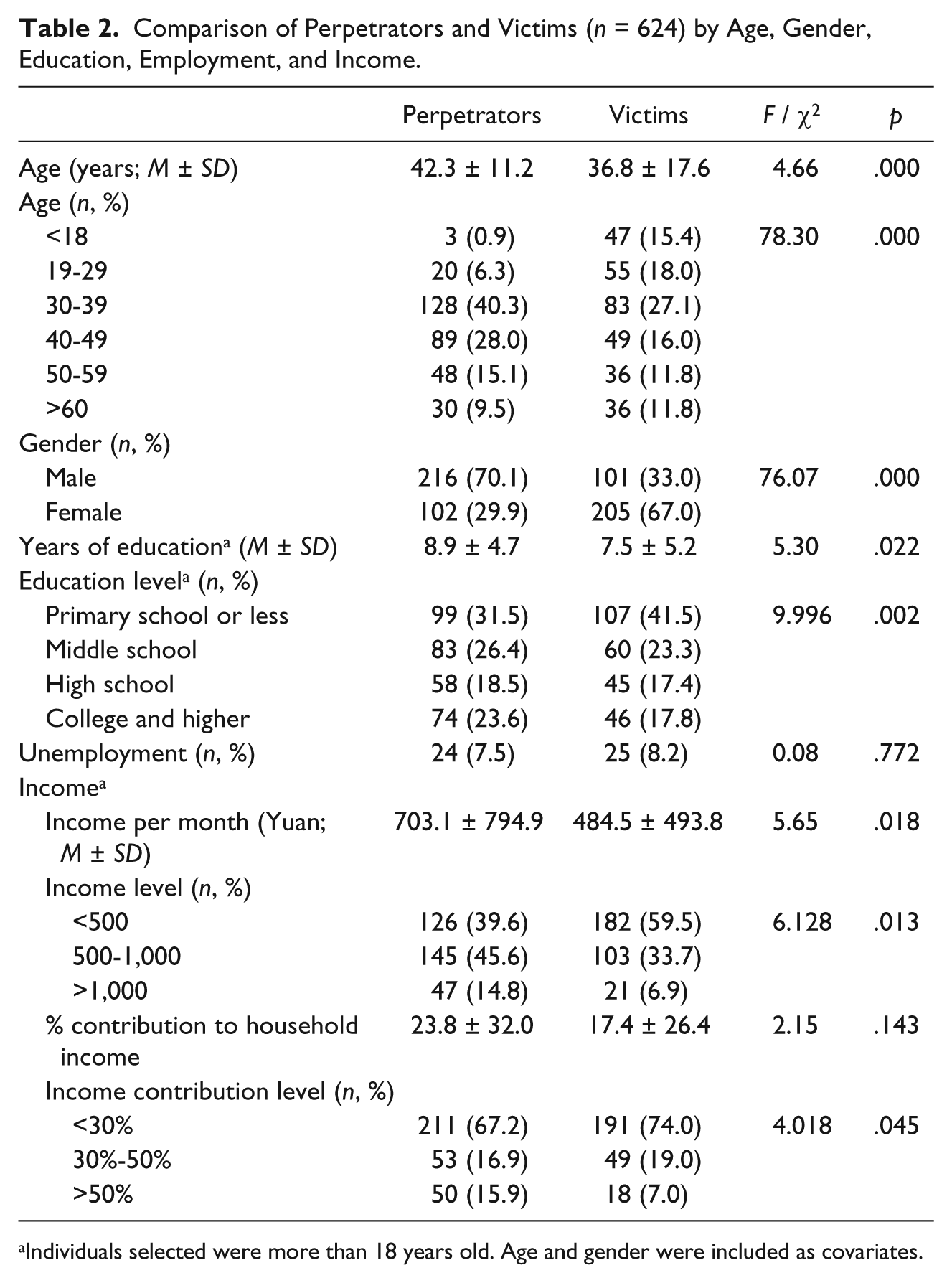
As shown in Table 2, the mean age of perpetrators was older than that of victims (p < .001). We divided age into six groups by 10-year increments. The age distribution differed significantly across groups (p < .001), although perpetrators’ and victims’ period of highest risk was between 30 and 39 years of age. Among individuals who were “less than 18” or “greater than 60,” there were a higher number of victims than perpetrators. In other words, children and the elderly were more likely to be victims rather than perpetrators of domestic violence.
Comparison of Perpetrators and Victims (n = 624) by Age, Gender, Education, Employment, and Income.
Individuals selected were more than 18 years old. Age and gender were included as covariates.
Gender
A total of 70.1% of perpetrators were male and 67.0% of victims were female (see Table 2). The overrepresentation of males in the perpetrator group and females in the victim group were statistically significant (p < .001). Adult males (aged 18 and older) were significantly more likely to be perpetrators than their adult female counterparts (67.8% vs. 32.2%), and adult females were significantly more likely than adult males to be victims of domestic violence (70.2% vs. 29.8%). Specifically, adult males were 5 times more likely to be perpetrators than adult females (χ2 = 81.78, p < .001, OR = 5.0, 95% CI = [3.47, 7.08]). This same comparison was not calculated for child perpetrators (younger than 18 years) because there were only 3 individuals in the perpetrator group. Among child victims of violence, there was no difference between the proportion of boys and girls (51% vs. 49%, respectively).
Education
As shown in Table 2, educational attainment was lower among adult victims than adult perpetrators (p < .05). Individuals with a primary school level of education or less were more likely to be perpetrators and victims. Nearly one in four perpetrators and one in five victims had a college or postcollege degree.
Employment and income
Adult perpetrators and adult victims did not differ in rates of unemployment (p > .05). Perpetrators earned more money per month than did victims (p < .05); however, the difference in the percentage of contribution to household income between perpetrators and victims was not statistically significant (p > .05).
Comparison of Perpetrators and Matched Controls
As shown in Table 3, perpetrators reported significantly fewer years of education and lower income relative to controls (p < .01and p < .05, respectively). Perpetrators also contributed a lower proportion of the total household income (p < .01) and also reported a significantly higher unemployment rate (p < .001). Unemployed individuals were 5 times more likely than employed individuals to be a perpetrator of violence (OR = 5.00, p < .001).
Comparison of Perpetrators and Controls by Education, Income, and Employment Status.

Note. OR = odds ratio; CI = confidence interval.
p < .10. *p < .05. **p < .01. ***p < .001.
Comparison of P-Household and C-Household
Economic status
As shown in Table 4, annual household income did not differ between P-households and C-households (p > .05), although the household size (m2) of P-households was significantly smaller than that of C-households (p < .05). Compared with C-households, a greater proportion of P-households were also dissatisfied with their household income and household size (m2; p < .001 and p < .01, respectively).
Comparison Between Households of P and C.

Note. P = Perpetrator; C = Control; ES = economic status; CI = confidence interval.
Fisher’s exact p value.
p < .05. **p < .01. ***p < .001.
Household-level stressors
Households that included family members with the following conditions were significantly more likely to report a history of domestic violence: unemployment (OR = 2.06, p < .001), alcohol abuse (OR = 1.57, p < .001), gambling (OR = 18.18, p < .001), psychosis (OR = 1.58, p < .001), disease or disability (OR = 2.90, p < .001).
Household power structure
Compared with C-households, a greater proportion of P-households were characterized as having an authoritarian or independent power structure (OR = 4.6 and 1.7, p < .001 and p < .01, respectively). In contrast, a greater proportion of C-households were described as having a democratic power structure compared with P-households (OR = 0.19, p < .001).
Hierarchical Logistic Regression Analysis to Predict Domestic Violence Perpetration
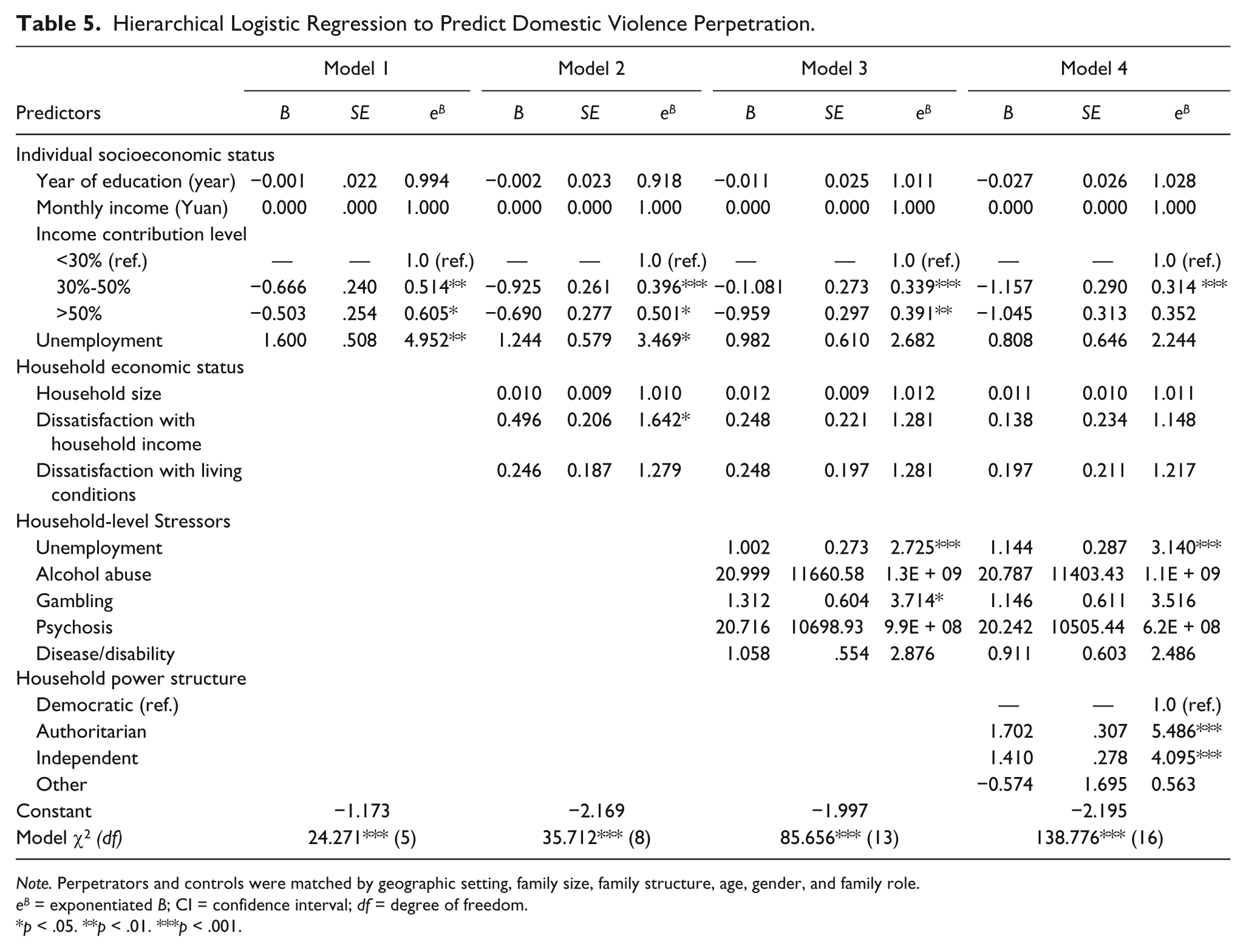
A summary of the logistic regression analysis results is presented in Table 5. The sample consisted of perpetrators and their matched controls (n = 628). The first block of variables to be entered were individual socioeconomic factors, namely, years of education, income, percentage of contribution to household income and unemployment status. In this initial model, χ2(4, N = 628) = 25.584, p < .001, individuals with a higher contribution to the household income were less likely to become perpetrators (OR = 0.74, p < .05). In contrast, individuals who were unemployed were nearly 5 times more likely to be perpetrators (OR = 4.95, p < .01). Education (OR = 0.91) and income (OR = 1.08) were not significantly associated with domestic violence perpetration after taking into account the other variables in the model.
Hierarchical Logistic Regression to Predict Domestic Violence Perpetration.
Note. Perpetrators and controls were matched by geographic setting, family size, family structure, age, gender, and family role.
eB = exponentiated B; CI = confidence interval; df = degree of freedom.
p < .05. **p < .01. ***p < .001.
In the second step, three household economic status variables—household size, dissatisfaction with household income and dissatisfaction with living conditions—were entered into the model, χ2(7, N = 628) = 43.998, p < .001. Only dissatisfaction with household income was associated with domestic violence (OR = 2.01, p < .01). Individuals’ contribution to household income remained associated with a decreased odds of violence perpetration (OR = 0.61, p < .01). Individuals’ unemployment also remained a significant predictor of violence (OR = 3.40, p < .05).
In the third step, household-level stressors were added into the model, χ2(12, N = 628) = 92.28, p < .001. Individuals from households containing an unemployed adult family member or one who gambles were 2 to 3 times more likely to perpetrate violence (OR = 2.52, p < .001, and OR = 3.76, p < .05, respectively). Addition of these household-level stressors increased the significance of income contribution as a protective factor against violence perpetration (OR = 0.53, p < .001), and rendered the association between individual unemployment and violence perpetration nonsignificant (OR = 2.72, p > .05). Dissatisfaction with household income remained significantly associated with violence perpetration (OR = 1.64, p < .05).
In the last step, household power structure was entered into the model, χ2(15, N = 628) = 145.68, p < .001. Individuals from authoritarian or independent families were 5.25 and 3.68 times more likely than democratic families to report a history of violence perpetration (ps < .001). The inclusion of these variables rendered the associations between dissatisfaction with household income and the dependent variable nonsignificant; the presence of a family member with a gambling problem also was no longer a significant predictor of violence perpetration. However, individuals’ income level became significant such that higher income was associated with greater odds of violence perpetration (OR = 1.43, p < .05). All other significant variables in the model were retained in the final model.
In the final multivariate model, violence perpetration was more likely among individuals who earned more income (OR = 1.43, p < .05), contributed a lower proportion of the total household income (p < .001), had a family member who was unemployed (OR = 2.85, p < .001), or lived in households with either an authoritarian (OR = 5.25, p < .001) or independent power structure (OR = 3.68, p < .001) versus a democratic power structure.
Discussion
While domestic violence occurs in all demographic groups (Riggs et al., 2000), the results of this study confirm that some groups are more vulnerable than others. Younger age, male gender, and low individual SES were associated with violence perpetration, whereas younger age, female gender, and low individual SES were associated with violence victimization. Household-level stressors related to finances, living conditions, and problems experienced by family members were also linked to household risk for violence, while democratic family structures appeared to offer some protection against violence risk. These findings suggest that key theories of family violence, namely, feminist, family stress, and resource theories, may be applicable to the Chinese cultural context, particularly as its social and economic structure increasingly reflects the influences of Westernization and globalization.
Consistent with previous international studies showing that younger age is positively associated with domestic violence (Caetano et al., 1995; Dibble & Straus, 1980), results indicated that individuals aged 30 to 39 years old were most likely to report histories of violence perpetration and victimization. Among perpetrators, two in five were within this age range.
Also as hypothesized, adult perpetrators were more likely to be male and adult victims were more likely to be female; in fact, adult males were 5 times more likely to be perpetrators than adult females. These findings lend support to feminist theorizing that male dominance is a key element in violence against women (Dobash & Dobash, 1978; Tang & Lai, 2008). According to Chinese precepts, women should obey their fathers when they are young, serve the needs of their husbands when they are married, and cater to their sons when they are old. Although such traditional gender stereotypes and conservative attitudes toward family roles are still widely endorsed by the public (Tang, Wong, & Cheng, 2002), there are signs that the status of Chinese women is gradually improving. The slogan “Women can uphold half the sky” is frequently cited to promote the concept of gender equality. The finding that nearly 30% of perpetrators in this study were female may be taken as a sign, albeit an unfortunate one, of assertions of female power within the Chinese family context. Another explanation may be that females are fighting back in an abusive situation, which need further study.
As expected, low SES was also a risk factor for domestic violence. Confirming studies conducted in other cultural contexts (Tolan et al., 2006), individuals with low educational attainment were more likely to be perpetrators and victims of violence; this was especially true for individuals whose education was less than primary school. Although violence tended to be concentrated among the lower SES groups in this study, victims’ SES tended to be even lower than that of perpetrators. Specifically, victims had relatively lower levels of educational attainment and income compared with that of perpetrators. Victims also tended to contribute proportionately less to the total household income, which previous research has linked to power inequity and increased dependency (Babcock, Waltz, Jacobson, & Gottman, 1993).
These findings provide some support for resource theories of violence to the extent that low-SES individuals, particularly males, may feel that their family authority is undermined by resource deficits vis-à-vis society at large. However, the relative SES positions of perpetrators and victims in this study, combined with the disproportionate number of male perpetrators, suggest that domestic violence in China is more typically associated with resource-based power distributed along traditional gender and generational lines. A number of Chinese proverbs stress the appropriate balance of power between family members, for example, “Whomever you marry, you must follow despite the way he treats you” and “Beating and scolding help children grow up to become talented people.”
Although household income did not differ significantly between violent and nonviolent households, violent households were more likely to exhibit signs of economic stress such as high rates of unemployment, smaller living quarters, and dissatisfaction with household income and household size. Similarly, studies report strong associations between unemployment and child abuse, with more than 50% of unemployed parents reporting physical aggression toward their children (Wolfner & Gelles, 1993). Risk of domestic violence has also been found to be lower among households reporting a positive sense of their financial well-being independent of actual financial status (Fox et al., 2002). Although additional research is needed to determine the various pathways by which low SES is related to violence in the Chinese context, this pattern of findings at the household level provides some support for the role of stress as a potential mediator of the relationship between low SES and domestic violence. Moreover, these findings confirm the importance of objective and subjective appraisals of household economic status in evaluating violence risk.
A family stress model of violence (Menard et al., 2004) is also supported by the significance of family-level stressors in predicting domestic violence in the present study. Compared with control households, households characterized by violence were more likely to have a family member who was unemployed, abused alcohol or gambled, or was ill with a psychotic condition, physical disease, or disability at the time of the interview. These conditions may exacerbate financial, interpersonal, and psychological stress, which may overwhelm available coping resources and increase risk of maltreatment (Sullivan & Knutson, 2000). For Chinese families in particular, the shame and stigma experienced in response to these conditions would extend to all members of the family given the collective nature of social identity.
Finally, results from our multivariate model demonstrate the importance of the household power structure in determining profiles of violence risk. Adding household power structure to our model diminished the relationship between indicators of household economic status and violence perpetration. In other words, the ways in which families are organized to respond to external and internal stressors, particularly of an economic nature, appears to play a substantial role in determining whether violence will occur. That authoritarian power structures were nearly 4 times more common among violent households compared with nonviolent households suggests that traditional Chinese families may be more prone to violence, particularly under conditions of stress or challenges to established power hierarchies. Increasing Westernization, economic growth, and social mobility over the past 20 years has likely increased conflict among such families seeking to maintain equilibrium against this changing tide.
Another way in which modern Chinese families may be affected by changing social and economic conditions is that with more economic resources, family members may become increasingly individualistic and consequently less likely to offer mutual aid support than in the past. These families, described in this study in terms of an independent power structure, may be less cohesive and more prone to fragmentation under conditions of stress. Indeed, violent households were twice more likely to be characterized by an independent power structure than were nonviolent households.
This study has a few limitations. First, though the sample was drawn following standard procedures from complex sample, the data were drawn only from Hunan, which is only 1 of 31 Chinese provinces. This limitation may influence these findings to extend to other provinces; Second, the basis for domestic violence can be varying, risk factors in different types (such as IPV, child abuse, or elderly abuse) may be diversity, which all need further study.
In summary, this study is the first population-based case-control study in mainland China to examine the relationship between individual- and household-level sociodemographic characteristics and lifetime domestic violence victimization and perpetration. The study represents an improvement over previous studies of domestic violence in China through its use of rigorous sampling and design procedures as well as culturally appropriate assessment and engagement strategies. The results help address a gap in our knowledge base regarding the cross-cultural transferability of key theoretical models of domestic violence. Finally, by identifying specific subgroups that may be most vulnerable to violence, it is our hope that more effective screening, prevention, and intervention programs may be developed to reduce the incidence of family violence in China.
Footnotes
Acknowledgements
We are grateful to the survey staff for their assistance in data collection: Shen Qi Sun, Yan Wei Peng, Li Jie Li, Ji Ping Tian, and Zhen Huang of the Mental Hospital of Yongshun; Zhong Shi, Guang Ning Zhang, Jiang Wei Shi, JianWu Xiao, and JianGuang Li of the Xiangtan Vocational & Technical College; Ding Yuan, Yu Cheng Li, Min Xiao, Li Hong Jiang, Yu Hua Zhu, and Xia Sheng Luo of the Mental Hospital of Chenzhou. We are also grateful to Dr. Doris Chang for her editorial assistance.
Declaration of Conflicting Interests
The author(s) declared no potential conflicts of interest with respect to the research, authorship, and/or publication of this article.
Funding
The author(s) disclosed receipt of the following financial support for the research, authorship, and/or publication of this article: This study was supported by American China Medical Board (Grant 01-749), New York in USA and National Science Foundation (Grant 30670753) in China.