



Abstract
Although malevolent individuals may be willing to use any tactic necessary to obtain sex, not all antagonistic traits will predict coercion or coaxing in all situations. A sample of 447 adult men, collected in two waves, reported their intentions to engage in coercion or coaxing of hypothetical targets. Study 1 provided three hypothetical scenarios that result in sexual rejection: (a) an expensive date, (b) a stranger, and (c) a relationship partner, and Study 2 provided the same scenarios, and three additional scenarios: (d) a rival’s partner, (e) a bet, and (f) a powerful person. A Structural Equations Model indicated that a common antagonistic factor, indicated by Social Dominance and the Dark Triad traits of psychopathy, narcissism, and Machiavellianism, predicted coaxing across all situations, whereas only psychopathy predicted coercion across all situations. In addition, narcissism accounted for additional variance in coaxing when rejected by an expensive date. These findings suggest that across the different scenarios, psychopathy is primarily associated with coercive tactics and the common malevolent core among the traits is associated with coaxing tactics.
The Dark Triad of personality is a cluster of subclinical traits that encompasses the reckless psychopath, the grandiose narcissist, and the strategic Machiavellian (Paulhus & Williams, 2002). The Dark Triad was a term coined by Paulhus and Williams (2002) to describe the three most researched malevolent traits. As Paulhus and Williams point out, unfortunately, most of the research prior to 2002 was conducted on each trait independently. Therefore, the traits have been thought to be deceptively similar in the misbehavior they predict (McHoskey, Worzel, & Szyarto, 1998), when they are actually quite distinct (Furnham, Richards, & Paulhus, 2013). For example, when related to the common core of callousness and deception (Jones & Figueredo, in press), outcomes should be associated with all three Dark Triad traits. However, when an outcome is associated with short-term or impulsive malevolence, psychopathy should be the primary predictor. By contrast, when an outcome is associated with a grandiose identity, narcissism should be the primary predictor, and when an outcome is associated with long-term strategic malevolence, Machiavellianism should be the primary predictor (Jones & Paulhus, 2011a). In sum, all three traits are willing to do harmful things to others, but differential identity focus, or strategies/tactics employed, differentiates the traits behaviorally. These assertions have been supported via research using laboratory, survey, observational, meta-analytic, and behavioral genetic approaches (Furnham et al., 2013).
As aforementioned, the core of the Dark Triad traits consists of high levels of deception and callousness (Jones & Figueredo, in press). However, each trait has unique characteristics beyond this core. For example, psychopathy combines this (callous-manipulative) core with erratic and antisocial behavior. Machiavellianism combines the core plus cynical worldview and long-term strategy. Finally, narcissism combines this core with grandiosity, overconfidence, and entitlement. Taken together individuals high in these traits are likely to use any means necessary to get what they are after. With respect to sex, psychopathy and narcissism are the traits that are primarily associated with promiscuous sexual behavior (Reise & Wright, 1996). Although all three of the Dark Triad traits are linked with permissive sexuality (Jonason, Webster, Li, & Schmitt, 2009), individuals high in Machiavellianism are long-term focused (Jones & Paulhus, 2011a) and appear more interested in instrumental (e.g., monetary) gain they are in short-term gratification (Jones & Paulhus, 2009). It is not the case that individuals high in Machiavellianism would be disinterested in short-term gratification (such as sex) when it does not pose a cost. Moreover, sexual behavior can lead to instrumental gain in certain contexts (e.g., Kelly et al., 2001). Jones and Paulhus (2009) merely argued that long-term interests are generally more central to the Machiavellian mind than is short-term gratification.
Investigations on psychopathy began with the pioneering work of Hervey Cleckley (1976). However, serious empirical work on the subject did not originate until Robert Hare created his Psychopathy Checklist (Hare, 1991). Both Hare (1999) and Cleckley (1976) noted that individuals high in psychopathy engage in glib superficial charm, callous affect, erratic lifestyle, and antisocial behavior for small benefits. In addition, promiscuous sexuality was also part of the definition of psychopathy for both Hare and Cleckley. The most popular instrument for psychopathy is the Psychopathy Checklist–Revised (PCL-R; Hare, 2003). It should be noted that self-report measures for the assessment of psychopathy also exist (Lilienfeld & Andrews, 1996; Paulhus, Neumann, & Hare, in press). Assessment notwithstanding, all empirical definitions of psychopathy include sexual promiscuity, impulsive, and reckless behavior (Newman, 1987), and a lack of concern for others (Hare, 1996).
Research on Machiavellianism, however, began with the work of Christie and Geis in 1970. Machiavellianism is similar to psychopathy because people with both traits engage in the manipulation of others and both lack empathy. Machiavellianism differs from psychopathy in temporal orientation; individuals high in psychopathy are short-term orientated and Machiavellian individuals are long-term oriented (Jones & Paulhus, 2011a). With respect to assessment, Christie and Geis’s, “Mach-IV” remains the most popular instrument for assessing Machiavellianism today (Jones & Paulhus, 2009).
Finally, research on narcissism began with Freud (1914/1957). Although Freud coined the term and started the discussion on the topic, it was Kernberg (1975) and Kohut (1971) who created a resurgence of interest in the concept. These authors debated whether it is devaluing or overvaluing parenting that created the observed behaviors, and the nature of the narcissistic ego. Modern debates have discussed whether narcissism is a disorder or a personality trait with social/personality definitions differing from clinical ones (Miller & Campbell, 2008). We focus on the social/personality definition, which deals with narcissism as a personality trait.
In addition to Kernberg and Kohut, Morf and Rhodewalt (2001) also raised critical questions about whether narcissistic self-love or self-concept fragility was at the core of the trait (Morf & Rhodewalt, 2001). The Narcissistic Personality Inventory (NPI; Raskin & Hall, 1979; Raskin & Terry, 1988) is still the most widely used index of subclinical narcissism. This measure assesses narcissistic traits in a forced choice format, which makes respondents choose whether statements of agentic self-praise or humility and communal values are more relevant to the self. Increased selection of agentic self-praise is indicative of global narcissism (e.g., Roche, Pincus, Hyde, Conroy, & Ram, 2013). Some have argued that the NPI is limited because it does not fully capture the vulnerability or clinical aspects of narcissism (Cain, Pincus, & Ansell, 2008). However, research also suggests it does predict variance above and beyond standard assessments of general personality (Miller, Price, & Campbell, 2012).
Although this trait was not part of the original Dark Triad research, Social Dominance Orientation (SDO; Pratto, Sidanius, Stallworth, & Malle, 1994) is another trait that belongs to this malevolent cluster (Jones & Figueredo, in press). For example, Sidanius et al. (2013) have linked SDO with a lack of empathy, which is a central component of malevolence (Jones & Paulhus, 2011a). As a consequence, behaviors associated with callousness focusing on group oppression (e.g., men over women, majority ethnic groups over minority ethnic groups) would be best predicted by SDO (Jones, 2013).
Not all dark traits—even within the Dark Triad proper—will engage in antisocial behavior in all situations. For example, individuals high in psychopathy and Machiavellianism do not respond aggressively to ego-provocation (e.g., insult or self-esteem threats), whereas individuals high in narcissism do (Jones & Paulhus, 2010; see also Kerig & Stellwagen, 2010). In contrast, Jones and Paulhus (2010) also found that individuals high in narcissism and Machiavellianism do not respond aggressively to direct physical provocation, whereas individuals high in psychopathy do. In sum, narcissistic aggression is driven by ego-threat (Bushman & Baumeister, 1998; Twenge & Campbell, 2003; Bushman, Bonacci, van Dijk, & Baumeister, 2003), whereas psychopathic aggression is driven by direct threat (Jones & Paulhus, 2010) or sometimes, no threat at all (Reidy, Zeichner, & Martinez, 2008).
In the same way, ego-threat has been linked to sexual aggression both theoretically (Baumeister, Catanese, & Wallace, 2002) and empirically (Bushman et al., 2003). For example, Bushman and colleagues (2003) conducted laboratory research showing that individuals high in narcissism, who are deprived of a sexual experience they were promised, become physically aggressive toward the unwilling partner (Bushman et al., 2003). Individuals high in psychopathy, however, merely seize upon (what is perceived to be) sexual opportunities, should they arise at all, and use more antisocial tactics to obtain sexual access to a partner (Camilleri, Quinsey, & Tapscott, 2009; Lalumiere & Quinsey, 1996). Furthermore, individuals high in SDO may also perceive entitlement to sexual contact from a date or steady partner given their misogynistic and oppressive interpersonal views toward women (Sidanius, Levin, Liu, & Pratto, 2000).
Individuals high in psychopathy are likely to favor coercion over coaxing. Individuals high in psychopathy may not be morally opposed to coaxing, but they might lack the patience required, given their poor impulse control (Newman, 1987). By contrast, the overconfident narcissist is likely to favor coaxing over coercion because of the exaggerated sense of self-worth of the narcissistic character (Morf & Rhodewalt, 2001), which would lead such individuals to believe that a gentle prompt is all it would take. In contrast, like individuals high in psychopathy, those high in SDO are likely to favor coercion over coaxing, simply because individuals high in SDO believe in oppressive group structure and would feel that they have “rights” over women.
In contrast to the above descriptions, behaviors that are at high risk, such as sexual coercion, are unlikely to be endorsed by individuals high in Machiavellianism. This assertion stems from the risky nature of these types of behaviors. Unlike individuals high in narcissism (Jones & Paulhus, 2011b; Schoenleber, Sadeh, & Verona, 2011; Vazire & Funder, 2006) and psychopathy (Hare, 1999; Newman, 1987), individuals high in Machiavellianism are not characterized as risk-takers or impulsive (Jones & Paulhus, 2009; 2011b). Instead, individuals high in Machiavellianism are more focused on instrumental gains. One exception to the above, however, should be noted. In situations where a target is groomed or trapped (i.e., sexually abusing vulnerable populations such as insecure partners or children), individuals high in Machiavellianism are likely to be more sexually coercive (see Thornton, 2003).
Summary and Predictions
In sexual situations, men high in narcissism appear to be most aggressive in response to perceived rejection from potential partners; especially those from whom they feel “owed” (e.g., Baumeister et al., 2002; Bushman et al., 2003). Social Dominance is different in that individuals high in this trait are most aggressive when they feel interpersonal propriety or feel they deserve obedience (Sidanius et al., 2000). Last, individuals high in psychopathy are sexually aggressive in general (Lalumiere & Quinsey, 1996; Williams, Cooper, Howell, Yuille, & Paulhus, 2009). As a consequence of these predispositions, we hypothesized that each trait would be related to sexual coaxing or coercion depending on the situation.
Although scenarios are not particularly impactful, and assessing individuals behaviorally in real situations is ideal, such situations are difficult (if not impossible) to reconstruct in the lab. As a consequence, considering few if any scenario studies have been conducted in conjunction with the Dark Triad and sexual coercion/coaxing, the present study might provide some evidence as to how these traits may differ in behavioral intentions across different scenarios. In particular, we predicted (a) psychopathy would predict coercion (but not coaxing) across all scenarios, (b) narcissism would predict coercion or coaxing in situations where they feel unjustly rejected, in this case, by an expensive date, and (c) Social Dominance will be related to coercion over romantic partners.
General Method
Participants were recruited through an online crowd-sourcing website called Mechanical Turk (MTurk). MTurk has a workforce of thousands of adults who search for tasks called Human Intelligence Tasks (HITS), and engage in these tasks for money, pleasure, or both (Buhrmester, Kwang, & Gosling, 2011). Data from MTurk are superior to student data in both fidelity (e.g., reliability, validity, motivation, and attention) and diversity (e.g., age, life experience, education, region) according to many researchers (Buhrmester et al., 2011; Paolacci, Chandler, & Ipeirotis, 2010; Rand, 2012; see also Mason & Suri, 2012).
We recruited men for our survey with a post on MTurk’s website, which read, “Survey on sexual behavior—MEN only.” Given that the online MTurk system is anonymous, and there was no way to verify the actual gender of participants, a final question (at the end of the survey) was asked, which read: “Please indicate your gender again. If you are not a man, we will still pay you and give you full credit, we really need to know your true gender for data analysis purposes, please be honest.” Of the total 274 individuals in Sample 1, only 13 indicated that they were not men on the final page, and of the 188 participants in Sample 2, only 2 indicated that they were not men on the final page. These gender-discrepant participants were eliminated from analyses. As a consequence, we can be relatively certain that all participants were men.
In both samples, participants were presented with a series of scenarios, provided in an order randomized to each participant. It should be noted that controlling for order had no impact on the results. After reading each scenario, participants completed a series of questions, asking about the extent to which they would engage in coercing or coaxing behaviors. In Sample 1, participants were provided three scenarios describing an experience with (a) a romantic partner, (b) a stranger, and (c) an expensive date (see Appendix A). In Sample 2, participants were presented six scenarios, consisting of those provided to participants in Sample 1, and three additional scenarios: (d) powerful other; (e) bet; and (f) rival (see Appendix B). These additional scenarios were provided to add more diversity to the scenarios presented, and to hopefully capture relations between these scenarios with each of the dark traits.
Sample 1
Participants
The first sample consisted of 261 men (M age = 29.95; SD = 9.57; ethnicity: 72% European Heritage/White/Caucasian, 8% East Asian, 4% Black/African Heritage, 3% South Asian, and 15% Other mixed ethnicities). Of the men who participated, however, 16 were homosexual and 12 were bisexual. Inclusion or exclusion of these participants had no impact on the data; as a consequence, they were included. In addition, the order of scenarios had no impact on the overall results. No information regarding their relationship status was gathered.
Measures
Psychopathy
To assess psychopathy, we used the short form of the popular Self-Report Psychopathy (SRP) Scale or the SRP-SF (Paulhus et al., in press; see also Mahmut, Menictas, Stevenson, & Homewood, 2011; Neal & Sellbom, 2012; Williams, Paulhus, & Hare, 2007). This 29-item short form can be obtained by contacting the authors of the larger SRP manual (Paulhus et al., in press). The SRP-SF, like the 64-item SRP, reliably assesses four unique facets: (a) Interpersonal Manipulation, (b) Callous Affect, (c) Erratic Lifestyle, and (d) Antisocial Behavior. Internal reliability, estimated by Cronbach’s alpha, across all four facets, was strong (α = .90).
Machiavellianism
We used the popular Mach-IV to measure Machiavellianism (Christie & Geis, 1970). The Mach-IV is a 20-item Likert-type questionnaire. It was developed by Christie and Geis (1970) and is the most widely used assessment tool for Machiavellianism. In particular, Christie and Geis (1970) worded in the items in such a way as to avoid “I” statements for the very reason that Machiavellian individuals are secretive and private. Christie and Geis (1970) focused on three primary aspects of Machiavellianism: cynical worldview, amorality, and Manipulative tactics. Internal reliability, estimated by Cronbach’s alpha, was strong (α = .81).
Narcissism
Narcissism was assessed with the Narcissistic Personality Inventory–16-Item Version (NPI-16; Ames, Rose, & Anderson, 2006). The NPI-16 consists of items from the full NPI (Raskin & Hall, 1979). Both inventories use a forced choice format where participants select between a narcissistic and a non-narcissistic option. Internal reliability, estimated by Cronbach’s alpha, was moderate (α = .75).
SDO
To assess SDO, we used six items (with a balance of three pro and three reversed scored items) from the full SDO scale (Pratto et al., 1994). Previous research has supported the use of these specific six items (Sidanius et al., 2013). Internal reliability, estimated by Cronbach’s alpha, was strong (α = .85).
Sexual coaxing and coercion
To measure both sexual coaxing and coercion, we included the Tactics for Obtaining Sex Scale (TOSS; Camilleri et al., 2009). The coax subscale is more closely related to persistence and insistence on sexual contact (e.g., “convince partner by making up a story,” “give partner reasons why”), whereas coercion, by contrast, is more related to direct harm or threats (e.g., “hitting or slapping,” “attempt to blackmail). Internal reliability, as assessed by Cronbach’s alpha, across the three conditions was strong (coax partner α = .79; coax stranger α = .86; coax date α = .82; coerce partner α = .77; coerce stranger α = .82; coerce date α = .79).
To reduce response burden in both samples (recall in Sample 2, there were six scenarios, not three), we ran a series of Exploratory Factor Analyses (EFA) on the coaxing and coercion scales separately. Two factors emerged for both scales. We then took the three highest loading items per factor (one of the Coaxing factors had only two items, however) and created a six-item short measure of Coercion and a five-item short measure of Coaxing.
Sample 2
Participants
The second sample consisted of 186 men (M age = 30.56; SD = 11.33; ethnicity: 67% European Heritage/White/Caucasian, 10% East Asian, 4% Black/African Heritage 9% South Asian, and 10% Other mixed ethnicities). With respect to relationship status, 30% of the men were married, 2% engaged, 10% living with partner, 16% had a girlfriend, 5% were seeing this person and others, and 38% were single. In addition, of the men who participated, 10 were homosexual and 1 was bisexual. Once again, inclusion or exclusion of non-heterosexual men had no impact on the data, so these groups were included in the final sample. In addition, the order of scenarios had no impact on the overall results, and neither did relationship status.
Measures
Dark Triad
To assess the three Dark Triad traits, we used the new Short Dark Triad (SD3; Jones & Paulhus, 2013; Paulhus & Jones, 2011). The SD3 uses 27 items (9 items per trait) to assess the three Dark Triad traits. Substantial validity evidence has already emerged for the SD3 (Baughman, Dearing, Giammarco, & Vernon, 2012; Giammarco, Atkinson, Baughman, Veselka, & Vernon, 2012; Lee et al., 2013). The three scales had acceptable or near acceptable internally reliability (psychopathy α = .82; Machiavellianism α = .73; narcissism α = .68). Social Dominance was assessed the same way as in Sample 1 (α = .83).
Sexual coaxing and coercion
To measure both sexual coaxing and coercion, we used the identical set of items from Study 1 taken from the TOSS (Camilleri et al., 2009). The six coax and coerce subscales were again reliable across the six scenarios (coax partner α = .84; coax stranger α = .86; coax date α = .86; coerce partner α = .85; coerce stranger α = .89; coerce date α = .87; coax bet α = .90; coax rival α = .85; coax power α = .85; coerce bet α = .86; coerce rival α = .81; coerce power α = .80).
Results
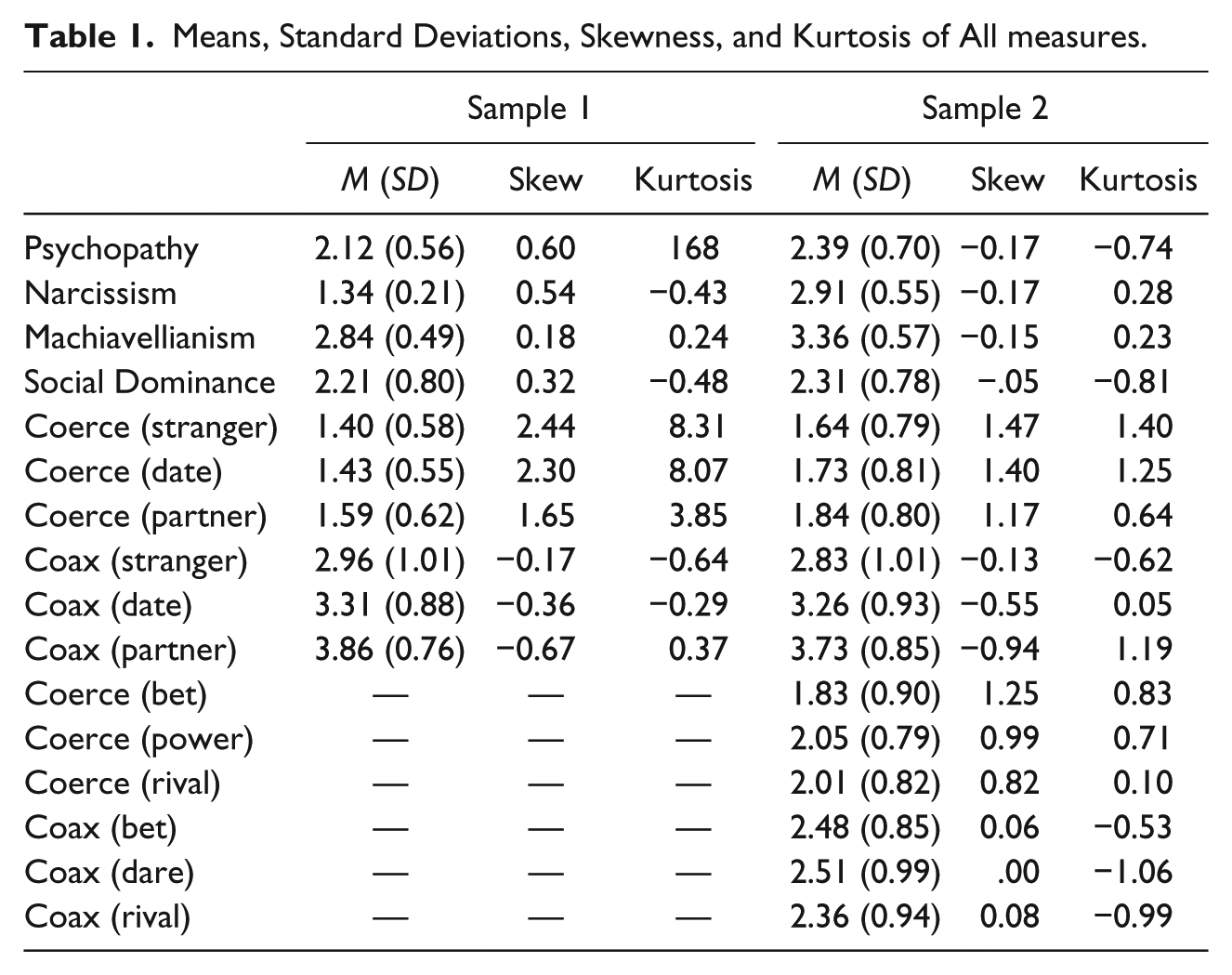
Means, standard deviations, kurtosis, and skew are reported for all variables in Table 1. We first correlated all variables in the present research (see Table 2). Inter-correlations among the predictors (i.e., Dark Triad and Social Dominance) were approximately what would be expected by previous research (Paulhus & Williams, 2002). In fact, correlations among the Dark Triad and Social Dominance were all moderate to strong and positive (i.e., .24-.56) across both samples.
Means, Standard Deviations, Skewness, and Kurtosis of All measures.
Pearson Product–Moment Correlations Between Study Variables.

Note. In the top half of the table, Sample 1 is below the diagonal, Sample 2 is above.
p < .05.
Although we conducted research on two separate samples, the three scenarios used in Sample 1 were also used in Sample 2. However, we used different measures of the Dark Triad across the two samples. As a consequence, we used Multiple Group Structural Equations Modeling (MSEM) to (a) demonstrate that the samples were equivalent, (b) demonstrate that the two approaches to assessing the Dark Triad are equivalent, and (c) properly test our predictions by accounting for the overlap among the observed variables.
In the first (constrained) model, we modeled a common malevolent factor from the four predictors of interest (psychopathy, Machiavellianism, narcissism, and Social Dominance). Next, we modeled a separate Coaxing and Coercion factor, each indicated, respectively, by the three coaxing and coercion scenarios. Last, we included paths according to the appropriate hypotheses. To compare this model on both samples, we first standardized the variables within each sample. Then, we estimated a multiple group SEM in EQS (Bentler, 1995) and imposed configural and weak factorial invariance. Because variables were first standardized, and because we purposely wanted to compare constructs measures by different questionnaires, and in our case, with different measurement scales, we did not impose strong factorial invariance.
The constrained model fit well, χ2(73, N = 431) = 143.64, p < .01; RMSEA = .069(.052 − .085); CFI = .972; NFI = .946; NNFI = .966, suggesting that the relation between measures was structurally equivalent across both samples. We also examined the optimal number of parameters according to predictions. As was expected by the first prediction, psychopathy resulted in a unique and direct path to coercion. In particular, psychopathy did not predict coercion in any one scenario over the other. The second hypothesis received small support as narcissism had a small effect in predicting coaxing in the expensive date scenario. Contrary to the third hypothesis, however, Social Dominance had no unique associations. Finally, Machiavellianism had no unique associations with any of the relevant scenarios for coaxing or coercion (see Figure 1).
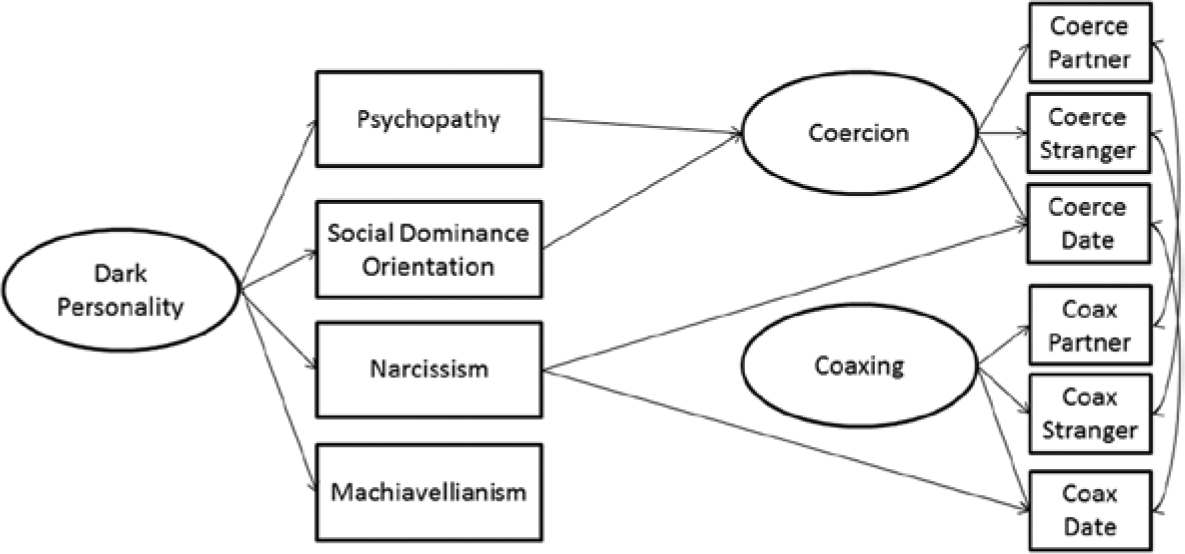
Prediction model.
The second model we tested utilized data from all six scenarios and hence was restricted to Sample 2. The common variance across the three scenarios unique to Sample 2 was too great, causing problems in model estimation. As we did not find situation-specific effects in Sample 1, and because the variables of the first three scenarios (presented to Samples 1 and 2) were highly correlated with one another (see Table 2), as were the second three scenarios (presented to Sample 2), we decided these variables could be combined. We created two composite variables, one that was an average of the participants’ scale-level scores across the three previous scenarios (Coerce-First Set and Coax-First Set), and a second that was an average of the participants’ scale-level scores across the three new scenarios (averaged within each participant; Coerce-Sec Set and Coax-Sec Set). These composite variables were then used to indicate the coaxing and coercion latent factors. Once these composites were created, we then only had two indicators per latent factor. As a consequence, we imposed equality constraints on the two paths from the composite variables indicating that latent factor. Model fit was acceptable, except according to the RMSEA, χ2(16, N = 170) = 40.083, p < .05; RMSEA = .094(.058 − .131); CFI = .966; NFI = .946; NNFI = .941 (see Figure 2). Upon adding these new scenarios, Social Dominance and psychopathy both predicted general coercion (see Figure 3). No other paths were unique. However, it should be noted that Machiavellianism had a weak (but non-significant) negative path to coercion. However, eliminating this path did not significantly change the model fit, hence it was removed.

Multiple group structural equations model using The Dark Triad and Social Dominance Traits to predict coaxing and coercing in the partner, stranger, and dating scenarios (Samples 1 and 2).
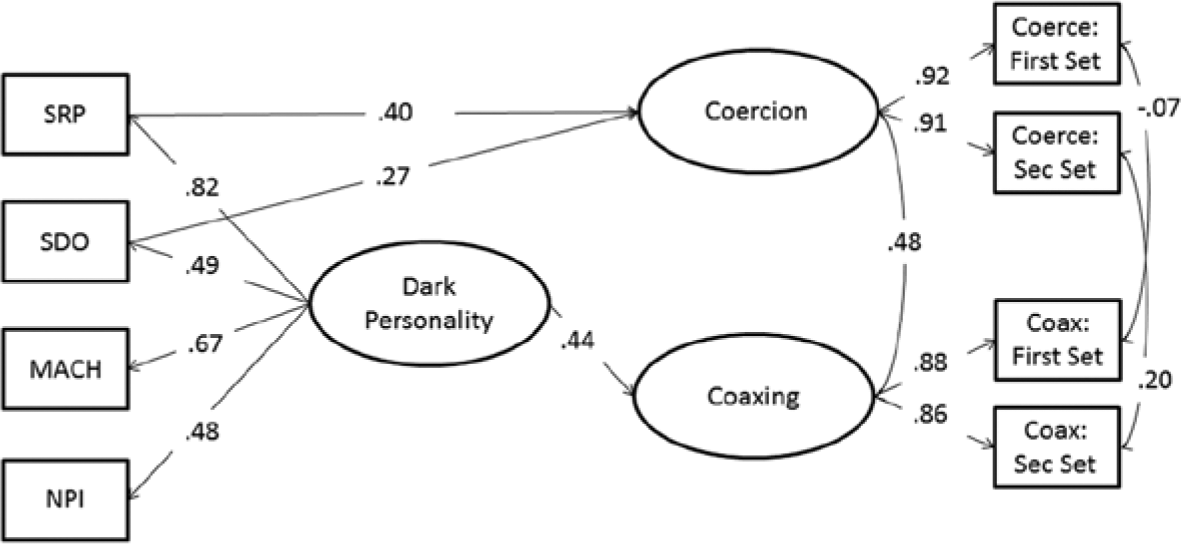
Structural equations model using The Dark Triad and Social Dominance Traits to predict coaxing and coercing in the partner, stranger, dating, bet, power, and rival scenarios (Sample 2 Only).
General Discussion
The present research sought to determine how different dark personalities relate to different tactics to obtain sex. In general, the findings were fairly consistent across conditions. In other words, the scenarios had little impact on the intentions to coerce or coax partners into sex. Overall, psychopathy was the best predictor of coercion across two samples and assessments. When more nuanced scenarios were included (i.e., in Sample 2 only) both psychopathy and Social Dominance uniquely predicted coercion. Finally, there was a small effect for narcissism uniquely predicting coaxing across the expensive date scenario.
One critical piece of research that is added to the literature from the present study is the finding that the core of the dark traits (callousness and deception; Jones & Figueredo, in press) appears to significantly predict to coaxing but not coercion. The acts outlined in the coaxing scale of the TOSS are clearly amenable to those high in deception and callousness. Common core notwithstanding, the acts outlined in the coercion scale require an additional element: Aggression. Similar to previous research by Camilleri and colleagues (2009), psychopathy was the best predictor of sexual coercion. This finding makes sense, given that individuals high in psychopathy are the most aggressive and antisocial of the four dark traits studied (Jones & Paulhus, 2011a). Importantly, psychopathy predicted a likelihood of coercion across all scenarios. This finding highlights the indiscriminate and reckless nature by which individuals high in psychopathy engage in misbehavior. Previous research has shown that only individuals high in psychopathy engage in direct aggression in response to physical provocation (Jones & Paulhus, 2010). In fact, Reidy et al. (2008) have shown that individuals high in psychopathy sometimes aggress for no observable reason. With respect to other dark personalities, however, individuals high in narcissism only aggress when their ego is provoked, and individuals high in Machiavellianism are generally not aggressive (Jones & Paulhus, 2010).
With respect to narcissism, there was also a small but unique path predicting additional variance in coaxing in the expensive date scenario, as predicted. This finding makes sense given that individuals high in narcissism are likely to use coaxing as a first response to sexual rejection, given their overconfidence. Furthermore, men high in narcissism are most likely to be determined to obtain sexual contact when they have invested in a partner because of their sense of entitlement (Mouilso & Calhoun, 2012). In sum, men high in narcissism are likely to believe that they are attractive enough to eventually convince a partner to engage in sex (Holtzman, Vazire, & Mehl, 2010). It is entirely possible, however, that if these attempts fail, such individuals will turn to coercion. Future research should examine this possibility.
As predicted, Machiavellianism had no unique relationship to coaxing or coercion across any of the scenarios or models. Machiavellian individuals think in terms of long-term goals. A single night of sex might undermine long-term goals, and because such individuals are focused on the bigger picture, they are unlikely to engage in impulsive behaviors with future consequences. In fact, there was a marginally significant negative path from Machiavellianism to coercion. We surmise that sexual coercion may be too risky and aggressive for the cautious character found in those high in Machiavellianism, and they are unlikely to be as interested in sexual access as they are in instrumental gain (Jones & Paulhus, 2011a). As a consequence, they are not as motivated to engage in sex at any cost.
It should be noted that there may be an additional reason why Machiavellianism failed to predict coaxing or coercion in any of the scenarios: sex-specific tactics. It is possible that men typically are not in the position of gaining something when engaging in sexual acts. Instead, cultural wisdom would suggest that men usually are willing to pay a price for sex, more than women are willing to pay a price (Baumeister & Vohs, 2004). As a consequence, the scenarios may not have been sex appropriate and asking women high in Machiavellianism these questions across the same scenarios may have yielded different results. Nevertheless, the data suggest that Machiavellianism simply is not uniquely related to coaxing or coercion across any of the scenarios.
Social Dominance had no unique impact on sexual coercion or coaxing when examined across the scenarios common to Samples 1 and 2. However, using all six scenarios found in Sample 2, Social Dominance uniquely contributed to the prediction of coercion. This finding supports the idea that men high in Social Dominance are likely to feel propriety and entitlement over women. In fact, the invariance across conditions suggests that it is not just steady partners that men high in Social Dominance feel propriety over, but all women. The perception of superior group hierarchy, female oppression, and patriarchy, that men high in social dominance possess, make them most likely to perceive women as property. As a consequence, such men may simply believe that women should obey a man’s desires, and perhaps should be forced to comply if necessary. In general, Social Dominance loaded very highly on the common dark factor, which provides further evidence that it should be included in studies of dark personalities or individual differences.
One critical addition to the literature of the present research is the invariance between the two samples. This finding would suggest that the SD3 (Jones & Paulhus, 2013; Paulhus & Jones, 2011) is operating in an identical fashion to the original Dark Triad measures (Paulhus & Williams, 2002).
It is critical to note that although the Dark Triad concept has gained quite a bit of momentum (see Furnham et al., 2013), it is not always the case that these three traits are each uniquely associated with specific outcomes. Theory would predict that outcomes related to impulsive malevolence (such as sexual coercion) would best be accounted for by psychopathy. Similarly, Machiavellianism would account for outcomes dealing with strategic malevolence, and narcissism or Social Dominance would account for outcomes dealing with egotistical or group malevolence (respectively). The scenarios, however, appeared to be unable to differentiate these traits across conditions. Thus, coaxing appears to be a common strategy among dark personalities. Moreover, with respect to sexual coercion, it appears that psychopathy alone accounts for the majority of variance, irrespective of scenario.
Limitations and Future Directions
The present research is not without limitations. The first is the survey nature of the data. Although anonymous research is beneficial for obtaining intentions and willingness to engage in certain acts, future research should study men who are in treatment or incarcerated. Such men would have behavioral profiles (i.e., date rape, stranger rape) that could be examined against the backdrop of the present theory. A second limitation was the weakness of the manipulation. Although three of the four hypotheses were supported, it is clear that asking individuals to “imagine” scenarios is not as effective as putting individuals in the situation (for such a situation, see Bushman et al., 2003). A third limitation is that we did not assess relationship status in Sample 1. Although as a stand-alone sample this might have been a serious problem, we did assess relationship status in Sample 2 and found that it had no impact on the overall results.
One critical direction for this research is to examine the TOSS scales and dark personalities within incarcerated or convicted offender samples. It would certainly be informative to determine if “date rape” is more associated with narcissism, stranger rape with psychopathy, and married partner rape with Social Dominance. Using case files and prisoner interviews, this approach may be able to parse apart dark personality approaches to sexual coercion.
Another critical future direction would be to examine the scenarios (especially in Appendix B) as they pertain to women’s behavior toward rivals, bets, and powerful others. For example, it is entirely possible that women high in Machiavellianism will be more likely than are men to engage in sexual tactics to obtain power or privilege from a powerful or prestigious man. In addition, women high in psychopathy may use sex as a way to deal with a rival. Finally, women high in narcissism may engage in seduction for the purposes of self-promotion or “conquering” a selective individual. Thus, gender differences across the six scenarios found in both appendixes may be critical to examine. Nevertheless, the present research focused on men for two reasons: simplicity and realism. Men are simply more likely to engage in coercion and coaxing for the purposes of sexual access, and we felt that it was important to focus on men initially.
Conclusion
In sum, it appears that men high in psychopathy and social dominance are willing to engage in coercive tactics, regardless of the situation. Men high in narcissism are willing to engage in coaxing tactics in a date rape situation. Future work should determine situations where Machiavellianism may predict coaxing or coercion. As aforementioned, proper motivation may be necessary for an individual high in Machiavellianism, and even then, such men may not engage in either tactic unless they have a helpless victim (e.g., child).
Footnotes
Appendix A
Appendix B
Declaration of Conflicting Interests
The author(s) declared no potential conflicts of interest with respect to the research, authorship, and/or publication of this article.
Funding
The author(s) received no financial support for the research, authorship, and/or publication of this article.