



Abstract
Attitudes about intimate partner violence (IPV) against women are widely surveyed, but attitudes about women’s recourse after exposure to IPV are understudied, despite their importance for intervention. Designed through qualitative research and administered in a probability sample of 1,054 married men and women 18 to 50 years in My Hao District, Vietnam, the ATT-RECOURSE scale measures men’s and women’s attitudes about a wife’s recourse after exposure to physical IPV. Data were initially collected for nine items. Exploratory factor analysis (EFA) with one random split-half sample (N1 = 526) revealed a one-factor model with significant loadings (0.316-0.686) for six items capturing a wife’s silence, informal recourse, and formal recourse. A confirmatory factor analysis (CFA) with the other random split-half sample (N2 = 528) showed adequate fit for the six-item model and significant factor loadings of similar magnitude to the EFA results (0.412-0.669). For the six items retained, men consistently favored recourse more often than did women (52.4%-66.0% of men vs. 41.9%-55.2% of women). Tests for uniform differential item functioning (DIF) by gender revealed one item with significant uniform DIF, and adjusting for this revealed an even larger gap in men’s and women’s attitudes, with men favoring recourse, on average, more than women. The six-item ATT-RECOURSE scale is reliable across independent samples and exhibits little uniform DIF by gender, supporting its use in surveys of men and women. Further methodological research is discussed. Research is needed in Vietnam about why women report less favorable attitudes than men regarding women’s recourse after physical IPV.
Keywords
Introduction
Intimate partner violence (IPV) refers to physical, sexual, or psychological harm by a current or former dating partner or spouse (Saltzman, Fanslow, McMahon, & Shelley, 2002). High global estimates of IPV against women have spurred advocacy for international policies and national laws to address it (Weldon, 2002). By 2006, 109 national governments had or were drafting such laws (UN General Assembly, 61st Session, 2006); yet, the attitudes of women and men about women’s recourse after exposure to IPV are undocumented outside the West. We present the ATT-RECOURSE Scale to measure attitudes about a wife’s recourse after exposure to physical IPV. Designed through qualitative research and administered in a probability sample of 1,054 married men and women 18 to 50 years in My Hao District, Vietnam, the initial scale included nine statements, to which participants could agree or disagree, about four types of recourse: silence or inaction, informal or private recourse, formal or public recourse, and intervention by witnesses. We describe the scale’s development, measurement properties overall and across gender, and prospects for use in surveys, program evaluations, and attitudinal studies of women and men.
Background
Global Prevalence of IPV Against Women, Consequences, and Legal Response
Globally, 11% to 71% of women report exposure to physical IPV (Garcia-Moreno, Jansen, Ellsberg, Heise, & Watts, 2006; H. Johnson, Ollus, & Nevala, 2008; Yount & Carrera, 2006), and physical, sexual, and psychological IPV often co-occur (Garcia-Moreno et al., 2006). Such exposures are linked to behavioral, physical, psychological, and nutritional sequelae (Yount, DiGirolamo, & Ramakrishnan, 2011).
Advocacy about the levels and effects of violence against women, including IPV, has spurred global policy dialogue and legislation (Weldon, 2002). In the 1990s, several forums including the International Conference on Population and Development in Cairo (1994) and the Fourth World Conference on Women in Beijing (1995) called on national governments to address IPV and to prioritize its prevention (Garcia-Moreno & Stöckl, 2009). Concurrent changes in national policies are striking. In 1974, no continuously democratic government (of 36 studied) had taken any action on violence against women; but by 1994, 31 of the 36 had taken some action, most often to address IPV (Weldon, 2002). By 2006, 89 states had laws addressing IPV, and 20 were drafting laws, leaving 102 states without laws on IPV (UN General Assembly, 61st Session, 2006).
Measuring Attitudes About IPV Against Women Globally
National policy on IPV signals its political importance (Weldon, 2002) and offers new meanings about gender and power (Merry, 1995). Specifying IPV in the penal code redefines it as a crime rather than legitimate “discipline.” Thus, in settings characterized by greater gender equality in economic, political, social, and legal domains, attitudes about IPV against women should be less tolerant, and those about women’s recourse after exposure to IPV should be more favorable. In a U.S. city before and after passage of the Violence Crime Control and Law Enforcement Act (1994), public tolerance of IPV declined and public criminalization of IPV intensified (Johnson & Sigler, 2000).
In Western settings, attitudinal surveys about various forms of IPV emerged in the 1970s, when two scales were designed to measure beliefs about rape (Burt, 1978; Field, 1978). Meta-analyses of research over four decades have shown that men consistently report greater acceptance of rape myths than do women (Anderson, Cooper, & Okamura, 1997; Suarez & Gadalla, 2010). In non-Western settings, attitudinal surveys about IPV against women emerged in the 1990s, when the Demographic and Health Surveys (DHS) began including questions about whether wife hitting or beating was justified in specific situations (with the italicized wording being most common; Yount, Halim, Hynes, & Hillman, 2011). Since 1995, 88 DHS in 53 poorer countries have collected national data from women (and often men) regarding their views about IPV against women. Accordingly, women’s tendency to justify wife hitting or beating ranges from 4% to 90% (Yount, Halim, Hynes, & Hillman, 2011). Yet, contrary to gendered attitudinal patterns in the West, women in diverse lower income countries tend to justify such treatment more often than do men (Uthman, Lawoko, & Moradi, 2010; Waltermauer, 2012), even with controls for confounding (Uthman, Lawoko, & Moradi, 2009). No study has assessed in a non-Western setting men’s and women’s attitudes about a wife’s recourse after exposure to physical IPV.
Measuring Attitudes About a Wife’s Recourse After Exposure to Physical IPV
Measuring such attitudes in women and men is important. Such assessments may expose conflicts or synergies between attitudes about IPV against women and their recourse, attitudinal barriers among men and women to the prevention of IPV and forms of redress, and the ideational impact on women and men of laws criminalizing IPV and of preventive programs.
The above uses of such an attitudinal scale require that assumptions about its measurement properties are met for women and men. Social learning theory posits that attitudes develop from personal experiences as well as the influences of family, peers, and cultural norms (Bandura, 1973; Garbarino, Schellenback, & Sebes, 1986). Women and men, thus, should reflect back many of those norms in attitudinal assessments. Accordingly, observed differences in attitudes between women and men should reflect true variation; yet, observed differences also may reflect a lack of measurement invariance (or equivalent measurement properties) across groups.
One conceptualization of the non-equivalence of measurement scales focuses on the presence of statistical item bias or differential item functioning (DIF). DIF refers to the distinct measurement properties of a scale item for different sub-groups, after accounting for overall differences between the sub-groups on the construct being measured (Holland & Wainer, 1993). An item shows DIF if two participants from two different sub-groups who have equivalent levels of the underlying construct being measured also have different probabilities of endorsing each response category for that item (Mellenbergh, 1989). In our case, men and women may interpret specific attitudinal items differently or have divergent motivations for choosing certain response categories, such that men and women respond systematically differently to the same attitudinal item.
In Western settings, a lack of measurement invariance across gender has been observed with non-attitudinal scales (e.g., Cauffman & MacIntosh, 2006; Fletcher & Hattie, 2005; Gelin & Zumbo, 2003) and has affected inferences regarding the magnitude of mean gender differences in attitudes about teen dating violence (Edelen, McCaffrey, Marshall, & Jaycox, 2009). Outside the West, researchers have reported gender gaps in attitudes about IPV against women without assessing the scale for DIF by gender (e.g., Uthman et al., 2010). Ignoring potential imbalances in DIF may result in attitudinal scores with measurement bias (Reise, Widaman, & Pugh, 1993), confounding the interpretation of observed group differences in attitudes. Identifying the sources and extent of non-invariance can improve the accuracy of measurement by removing bias and can clarify the ways in which individuals may interpret or respond to items differently because of group membership.
Here, we describe the development of the ATT-RECOURSE Scale to measure women’s and men’s attitudes about a wife’s recourse after exposure to physical IPV. Vietnam, the study site, was a germane location for scale development. It exhibits a high reported lifetime prevalence of physical IPV against women (31.5%; General Statistics Office of Vietnam [GSOV], 2010), recent legislation to mitigate such violence (National Assembly, Government of the Socialist Republic of Vietnam [NA, GSRV], 2007), a greater tendency among women than men to justify IPV against women (Gender and Community Development Network [GENCOMNET], 2011), and a lack of data on attitudes about recourse for women survivors of IPV.
Method
Vietnam Setting
Vietnam is undergoing rapid social change. In 1986, the government introduced a policy of renovation (Doi Moi) to maintain socialism under an expanded market economy. The policy spurred internal restructuring and greater engagement in the global economy, with mixed implications for gender norms and relations (Gammeltoft, 2002; Khuat, Le, & Nguyen, 2010). For example, the migration of some women for market work has prompted their male partners to assume unpaid family work (Hoang & Yeoh, 2011), but most women still are responsible for such work (Bui et al., 2012; World Bank, 2011). Also, women’s high engagement in market work in 1990 (81.3%) had declined by 2010 (to 78.1%; World Bank, 2013). Women are classified as unskilled workers more often than are men (42.9% vs. 36.2%; World Bank, 2011), and occupational segregation continues (Bui et al., 2012; World Bank, 2011).
Concurrent with Doi Moi economic policy, Vietnam has adopted a legal framework based on the principle of gender equality. In the 1980s, the government outlawed all physical violence against women and children (Law on Marriage and Family [1986], Penal Code of the Socialist Republic of Vietnam [1989]), but enforcement was uneven locally (Rydstrøm, 2003). In 1995, the government endorsed the National Plan of Action for the Advancement of Vietnamese Women (Khiet, 2000), and in 2007, the NA adopted a new law on preventing and controlling domestic violence, including IPV. This law defined acts of psychological, physical, sexual, and economic violence and strategies for prevention and intervention (NA, GSRV, 2007).
Despite economic, legislative, and structural change, inequitable gender norms persist (Bui et al., 2012; Nguyen, Khuat, & Le, 2011; Werner, 2009). In some areas, following Confucian principles, men remain the symbolic and practical pillars of the house (tru cot), maintaining responsibility for certain patrilineal rituals and decisions (Bui et al., 2012; Khuat et al., 2010; Phan, 2008; Rydstrøm, 2006a, 2006b; Werner, 2009). Women in some areas still are expected to adjust their demeanor to changing social situations (Nguyen, 2012; Khuat et al., 2010; Nguyen et al., 2011; Phan, 2008), and apparent failure in this regard may incite blame (Bui et al., 2012; Nguyen, 2012) and the idea that punishment is warranted (Nguyen, 2012; Khuat et al., 2010; Phan, 2008; Rydstrøm, 2003).
Reinforcing Confucian principles of familial gender hierarchy, Taoist ideas about the body link women with coolness (lanh) and men with heat (nong; Horton & Rydstrøm, 2011; Rydstrøm, 2003). Ostensibly, these forces are complementary (Rydstrøm, 2003), but in practice, these ideas reflect expectations about good masculine and feminine behavior, including women’s endurance (chiu) and self-denial (nhuong; Horton & Rydstrøm, 2011). These discourses may justify men’s perpetration of IPV and pressure women to endure it without recourse (Horton & Rydstrøm, 2011).
Thus, economic, structural, and legal changes in Vietnam suggest potential for recourse by women exposed to IPV. Yet, where inequitable gender norms and practices persist, women may still be taught to blame themselves for IPV and other experiences (Bui et al., 2012; Horton & Rydstrøm, 2011; Nguyen, 2012). Pressured to uphold images of femininity and family harmony (Bui et al., 2012; Nguyen, 2012), exposed women may keep silent and avoid recourse. Indeed, about one third of women in rural Northern Vietnam (32.7%) and nationally (34.4%) report lifetime exposure to physical or sexual IPV (GSOV, 2010; Nguyen, Ostergren, & Krantz, 2008), and 41.3% of women nationally justify IPV against women (GSOV, 2010). Qualitative studies from the 1990s and 2000s suggest that neighbors and local leaders also have conspired to hide IPV (Rydstrøm, 2003; Schuler et al., 2006; Vu, Vu, Nguyen, & Clement, 1999). Yet, according to new qualitative data, some exposed women are seeking recourse, and some witnesses are intervening (Schuler, Quach, Vu, & Hoang, 2012). With norms about gender and IPV in flux, measures are needed to capture and compare women’s and men’s attitudes about a wife’s recourse after exposure to IPV.
Study Sites
The study sites were 13 communes of My Hao district in Hung Yen province, 30 km from Hanoi. Mainly rural, My Hao is fairly typical of peri-urban areas in an urbanizing nation. Of the 97,700 residents, many engage in multiple types of work (Table 1). In addition to market work, women perform the bulk of domestic labor. Local People’s Committees (Uy ban nhan dan) govern the communes, and the Communist Party ensures the population’s ideological position. The communes have mass unions (hoi), such as the Women’s Union (Hoi phu nu) and Youth Union (Doan thanh nien). Reconciliation groups (To hoa giai) are also present to resolve conflicts.
Sample Characteristics, Overall and by Gender, Married Men (n = 521) and Women (n = 533) 18 to 50 Years in My Hao District, Vietnam.

Note. IPV = intimate partner violence.
Sample sizes vary due to item non-response.
p values denote significance levels for chi-square tests (categorical variables) and t-tests (interval variables).
One man aged 51 years at the time of interview was included in the sample.
The household belongs to the official list of “poor households” in the commune.
Men received one question and women received multiple questions on exposure to physical IPV.
Men received multiple questions and women received one question on perpetration of physical IPV.
Instrument Development
Survey items to elicit men’s and women’s attitudes about a wife’s recourse after physical IPV were developed entirely through sequenced qualitative fieldwork. Semi-structured interviews with 10 women and 10 men varying in age (18-34, 35-49 years) and schooling (<10, ≥10 grades) elicited opinions about a woman’s responses to being beaten or mistreated by her husband. Responses included fighting back, speaking out, reporting to the head of village, reporting to the police, suing her husband in court, divorcing her husband, going back to live with her parents, keeping silent, and other solutions. Interviewers asked about the contexts in which informants and community members would agree or disagree with each response and words to describe the woman in each scenario. Interviewers also asked about the informant’s own propensity to keep silent after witnessing violence by a neighbor.
Four gender-segregated focus group discussions (eight women, 20-34 years; nine women, 36-46 years; eight men, 26-34 years; six men, 35-44 years) generated lists of responses by a woman who is beaten by her husband. Groups considered the conditions in which community members would agree (and disagree) with each response and the meanings of words elicited in the semi-structured interviews.
In cognitive interviews with 10 men and 10 women of varying ages (18-34, 35-49 years) and schooling (<10, ≥10 grades), interviewers read 13 statements, drawn from prior interviews and group discussions, about a wife’s recourse after exposure to physical IPV (the appendix). Statements pertained to silence or endurance (four items), seeking informal help from family or friends (two items), seeking public or formal help outside the family (four items), and intervention by witnesses (three items). Interviewers read each statement, elicited a response (agree, disagree, ambivalence) and probed for the meanings of words to ensure consistency with our intent. Interviewers also asked about perceived changes in IPV in informants’ communities, attitudes about a woman’s recourse after exposure to physical IPV that varied in severity and intent, and knowledge of legal changes pertaining to IPV and women’s rights.
On reviewing these interviews, we revised some items to enhance clarity and dropped four items that resembled clearer items. The nine items included in the final questionnaire concerned the wife’s silence or inaction (Items 2, 6); disclosure to and assistance from friends or family (informal recourse Items 1, 9); disclosure to and assistance from local leaders or the police (public recourse Items 3, 4, 8), and intervention by witnesses (Items 5, 7; Table 2). Three items had a positive valence (Items 1, 4, 7) and six had a negative valence (Items 2, 3, 5, 6, 8, 9) to balance the tone across items (Shuman & Presser, 1996).
Attitudes About Women’s Recourse in Response to Physical Intimate Partner Violence, Overall and by Gender, Married Men (n = 521) and Women (n = 533) 18 to 50 Years in My Hao District, Vietnam.
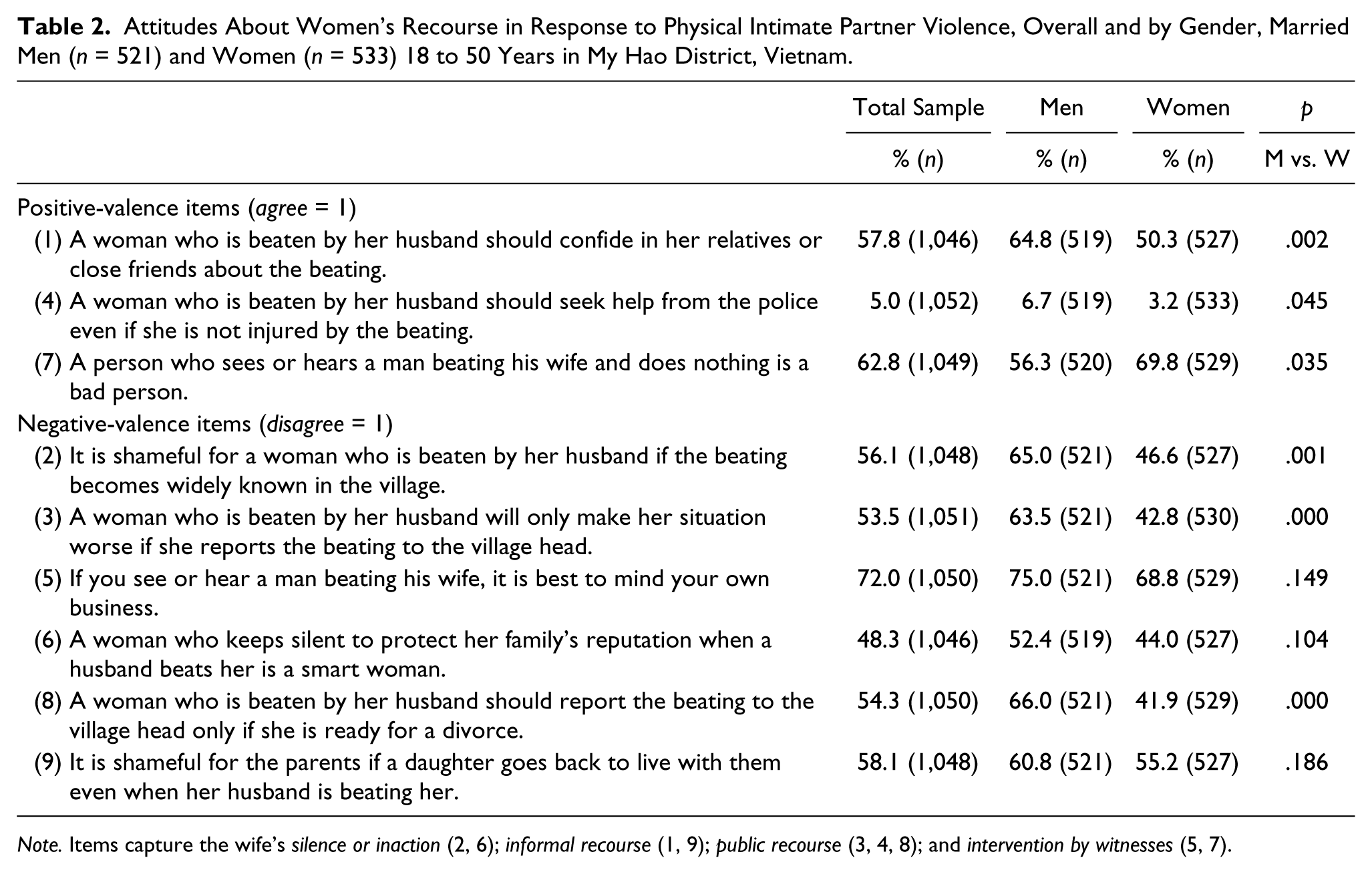
Note. Items capture the wife’s silence or inaction (2, 6); informal recourse (1, 9); public recourse (3, 4, 8); and intervention by witnesses (5, 7).
Participants
The survey sample in which the nine attitudinal items were administered was drawn from a household census of 75 villages in 13 communes of My Hao district, Hung Yen province. Married men and women 18 to 50 years were eligible for inclusion. Given the sensitivity of questions about IPV, men and women participants were drawn from separate villages. To do so, we paired villages by the size of the eligible married population starting with the two largest villages and randomly assigned one village each in the pair to the men’s and women’s samples. The smallest of the 75 villages was excluded because it could not be paired and contained only 36 married persons, fewer than that needed for the sample design. We randomly selected 20 village pairs with probability proportional to the size of the married population in the village pair relative to the total married population in all 74 villages. In selected villages, located in 12 communes, we randomly selected 27 households with at least one eligible participant. In households with multiple eligible participants, one was selected randomly to ensure privacy. Expecting a 93.0% response rate and aiming for 1,000 completed interviews (500 men, 500 women), 1,080 persons (540 men, 540 women) were selected, and 1,069 were located. The final response rate (98.7%) was similar across gender (99.3% women, 98.1% men) and study village (92.6%-100%), yielding 1,055 interviewed participants. One participant with missing data for all nine attitudinal items was dropped from the analysis (see analysis below), for a final sample size of 1,054 (533 women, 521 men).
On average, participants were 35.1 years old, and women were younger than men (34.2 vs. 35.9 years; Table 1). Being in first marriages was nearly universal, and men and women had had two births, on average. All but four participants were of Kinh ethnicity, and 97.0% reported no religious affiliation. Men and women had completed about 9.5 grades of schooling, on average.
Relatively more men than women had always lived in the same commune (95.3% vs. 57.6%) and were living in the same commune as their natal family (94.5% vs. 60.2%). Large minorities of men (37.2%) and women (42.9%) were living in joint households, and most men (92.6%) and women (87.9%) felt they could count on their natal family for support. Relatively more women (50.2%) than men (22.7%) reported attending a formal group or organization at least once per year.
Similarly few men (6.2%) and women (6.9%) were living in households that were on the list of poor households, which fall below the official poverty line (VND400,000/person/month in rural areas) and are eligible for certain government benefits (World Bank, 2012). Almost all men (97.6%) and women (97.2%) had worked for money in the prior year. Participants could report multiple types of work, and men and women who had worked for money in the prior year most often reported farming (59.6%, 69.3%), work in factories (26.9%, 33.7%), seasonal work (26.8%, 20.2%), and selling or trading (20.3%, 26.2%). Forty-two percent of men reported earning more than their wife, and 45.1% of women reported earning less than their husband. Women more often than men reportedly had refused or left a job because their spouse had wished it (21.3% vs. 11.2%) and reported that their spouse had ever refused to give them money for daily expenses (7.7% vs. 1.4%). Still, most men (93.7%) and women (92.0%) felt that, if needed, they could raise enough money to house and feed their family for a month. Women reported more often than men experiencing physical IPV (29.1% vs. 0.5%), and men reported more often than women perpetrating physical IPV (27.9% vs. 1.6%).
Procedures
The questionnaire consisted of three modules with questions on socio-demographic and economic background, followed by one module with attitudinal questions about physical IPV against women and their recourse, and a final module with questions on exposure to and perpetration of IPV, exposure to violence in childhood, and knowledge of laws concerning IPV. (The men’s IPV module included detailed questions on perpetration of psychological, physical, and sexual IPV and a single question on exposure to physical IPV. The women’s IPV module included detailed questions on exposure to psychological, physical, and sexual IPV and a single question on perpetration of physical IPV. Otherwise, the questionnaires were comparable.) The Institutional Review Boards of Emory University and the Center for Creative Initiatives in Health and Population (CCIHP) approved the study, and the study followed international guidelines for research on IPV (World Health Organization [WHO], 2001). Participants and interviewers in the survey were gender-matched to build rapport and to enhance honest disclosure (WHO, 2001).
Descriptive Analyses
The data for the main analysis come from survey responses to the nine agree/disagree statements about a wife’s recourse after exposure to physical IPV (Items 1-9, Table 2). The six attitudinal items with a negative valence were reverse coded, so that 1 indicated disagreement and 0 indicated agreement with the unfavorable statement about a wife’s recourse. Relative frequencies of all nine attitudinal items were estimated overall and by gender to assess their completeness and distributions. Given the binary response options for each item, tetrachoric correlations were estimated in random split-half samples (see below) to assess the level of bivariate association between any two items (Bandalos & Finney, 2010). These correlation matrices were the basis for exploratory and confirmatory factor analyses (CFAs).
Exploratory and CFAs
Exploratory factor analysis (EFA) is recommended to identify the factor structure for a set of items when minimal quantitative research has been conducted regarding a measure (Bandalos & Finney, 2010). In EFA, items are not constrained to load on specific factors so the factor structure for a set of items may be identified. When sample size allows, CFA can be estimated on an independent sub-sample to test the factor structure determined by the EFA (Bandalos & Finney, 2010). Because our total sample size exceeded that recommended for random split-half analyses (Bandalos & Finney, 2010), we performed the EFA and subsequent CFA on random sub-samples. Excluding one participant from the EFA sub-sample with missing data for all nine attitudinal items yielded final split-half samples of N1 = 526 for the EFA and N2 = 528 for the CFA. These sub-samples were similar on most observed attributes, but the CFA sub-sample had lower average household wealth, less often worked in forestry or fishing, and more often disagreed with attitudinal Item 9, pertaining to informal recourse with parents (results available on request).
Using EFA, we examined the data to assess scale dimensionality and item factor loadings. One attitudinal item pertaining to public recourse (Item 4, Table 2) showed little variation, so we removed it and ran sequential one- and two-factor EFA models on the remaining items, examining the factor loadings and model fit indices (root mean square error of approximation [RMSEA], comparative fit index [CFI], and Tucker–Lewis index [TLI]) after GEOMIN or oblique rotation (Muthén & Muthén, 1998-2012). At each estimation, we retained items strongly, positively related to the underlying attitudinal construct and removed items weakly related to it (had a negative loading, a loading < 0.300, or a significant cross-loading > |0.300| on a second factor). As a result, we removed the two items (5, 7) about intervention by witnesses. We chose a final, six-item one-factor model over a two-factor model based on factor loadings, model fit indices (RMSEA close to 0.060 or less; CFI close to 0.950 or greater; TLI close to 0.950 or greater; Brown, 2006; Harrington, 2008), and theoretical interpretation.
We then used the other random split-half sample (N2 = 528) to test the factor structure of the final one-factor, six-item EFA model. We assessed the factor loadings of the CFA model for comparability with those of the final EFA model and assessed the fit of the CFA model using similar criteria for fit indices as those described above.
Tests for Uniform DIF by Gender
After assessing the CFA model, we used the same random split-half sample (N2 = 528) to test the scale for uniform DIF by gender with a single-group Multiple Indicator Multiple Cause (MIMIC) structural equation model. To do so, we added to the CFA model a covariate for gender to test for the invariance of indicator intercepts and factor means. We assessed modification indices (estimated improvements in model fit) for allowing direct effects of gender on the attitudinal items to be estimated freely. We added the direct effect with the largest modification index and kept this effect if it was significant (p ≤ .050) and improved model fit (p ≤ .050 for chi-square test for difference). Iterations continued until adding direct effects of gender on single attitudinal items no longer improved model fit. All models were estimated in Mplus7 (Muthén & Muthén, 1998-2012) using an estimation approach suitable for models with binary data (mean- and variance-adjusted weighted least squares [WLSMV]) and accounting for the complex sampling design.
Generation of Attitudinal Scores and Comparison by Gender
Using single-group MIMIC models to assess DIF allows researchers to account for observed DIF in a final model and to generate DIF-adjusted factor scores. Yet, the impact of identified DIF on the score may be too small to warrant adjustment for it with this more complex scoring approach (Edelen et al., 2009). To assess whether observed DIF altered inferences about gender differences in the attitudes measured here, we computed three scores for the ATT-RECOURSE Scale and used t-tests to compare men and women on each score (Edelen et al., 2009). These three scores included (a) observed scores equal to the sum of the six 0/1 items in the measure (summative scale), (b) factor scores based on MIMIC models ignoring identified DIF (factor score–no DIF), and (c) factor scores based on MIMIC models adjusting for identified DIF (factor score–DIF). All three mean scores were derived from the random split-half sample on which the MIMIC model for uniform DIF was estimated (N2 = 528). Differences in the inferences for gender gaps in attitudes based on the summative scale and the factor score–no DIF would reflect the influence of factor analysis. Differences in the inferences based on the factor score–no DIF and factor score–DIF would reflect the influence of adjusting for DIF.
Results
Attitudes About a Wife’s Recourse After Exposure to Physical IPV
In most cases, half or more participants favored a wife’s recourse after exposure to physical IPV (Table 2). In the full sample, few (5.0%) agreed that a woman beaten by her husband should seek help from the police even if she is not injured. That said, a majority agreed that a beaten wife should confide in her relatives or close friends about it (57.8%) and that a person who witnesses a man beating his wife and does nothing is a bad person (62.8%). Between 48.3% and 72.0% of participants disagreed with the negative-valence items, for example, that a woman is smart to keep a beating silent . . . (48.3% disagreed), a beaten woman will make matters worse if she reports it to the village head (53.5% disagreed), a beaten woman should report it to the village head only if she is ready for a divorce (54.3% disagreed), it is shameful for a woman . . . if the beating becomes widely known (56.1% disagreed), it is shameful for the parents if a daughter who is beaten by her husband goes back to live with them (58.1% disagreed), and it is best to mind your own business if you witness a man beating his wife (72.0% disagreed). No attitudinal items captured relative frequencies in the lower (~10%-47%) and upper (73%-90%) ranges.
Compared with women, men typically more often favored a wife’s recourse after exposure to physical IPV (Table 2). Men more often agreed that a woman beaten by her husband should confide in her relatives about it (64.8% vs. 50.3%) and seek help from the police even if not injured (6.7% vs. 3.2%). Men also more often disagreed that a woman beaten by her husband will worsen her situation by reporting it to the village head (63.5% vs. 42.8%) and should report the beating to the village head only if she is ready for a divorce (66.0% vs. 41.9%). Men also more often disagreed that it is shameful for the wife if the beating becomes known in the village (65.0% vs. 46.6%). For one item, women agreed more often than men that a person who sees or hears a man beating his wife and does nothing is a bad person (69.8% vs. 56.3%). For three items pertaining to silence (Item 6), informal recourse (Item 9), and intervention by witnesses (Item 5), men and women did not differ significantly in their attitudes.
Factor Analyses and DIF by Gender
Table 3 presents the fit statistics and estimated factor loadings for the final, six-item, one-factor EFA model estimated with one random split-half sample (N1 = 526) and for the CFA of the same factor model with the other random split-half sample (N2 = 528). For the final EFA model, fit statistics suggested an adequate fit to the data (RMSEA = 0.047, CFI = 0.959, TLI = 0.931). Retained items pertained to a woman’s silence or inaction (Items 2, 6), informal recourse (Items 1, 9), and public recourse (Items 3, 8). Estimated factor loadings were positive and significant and ranged from 0.316 to 0.686. For the CFA, estimated factor loadings were significant and of similar magnitude (0.412-0.669), and the RMSEA (=0.061) implied an adequate fit to the data (CFI = 0.883, TLI = 0.805).
Random-Split-Half Sample EFA (N1 = 526) and CFA (N2 = 528), and Baseline and Final Fitted MIMIC Models (N2 = 528) With Measures of Model Fit, Married Men and Women 18 to 50 Years in My Hao District, Vietnam.
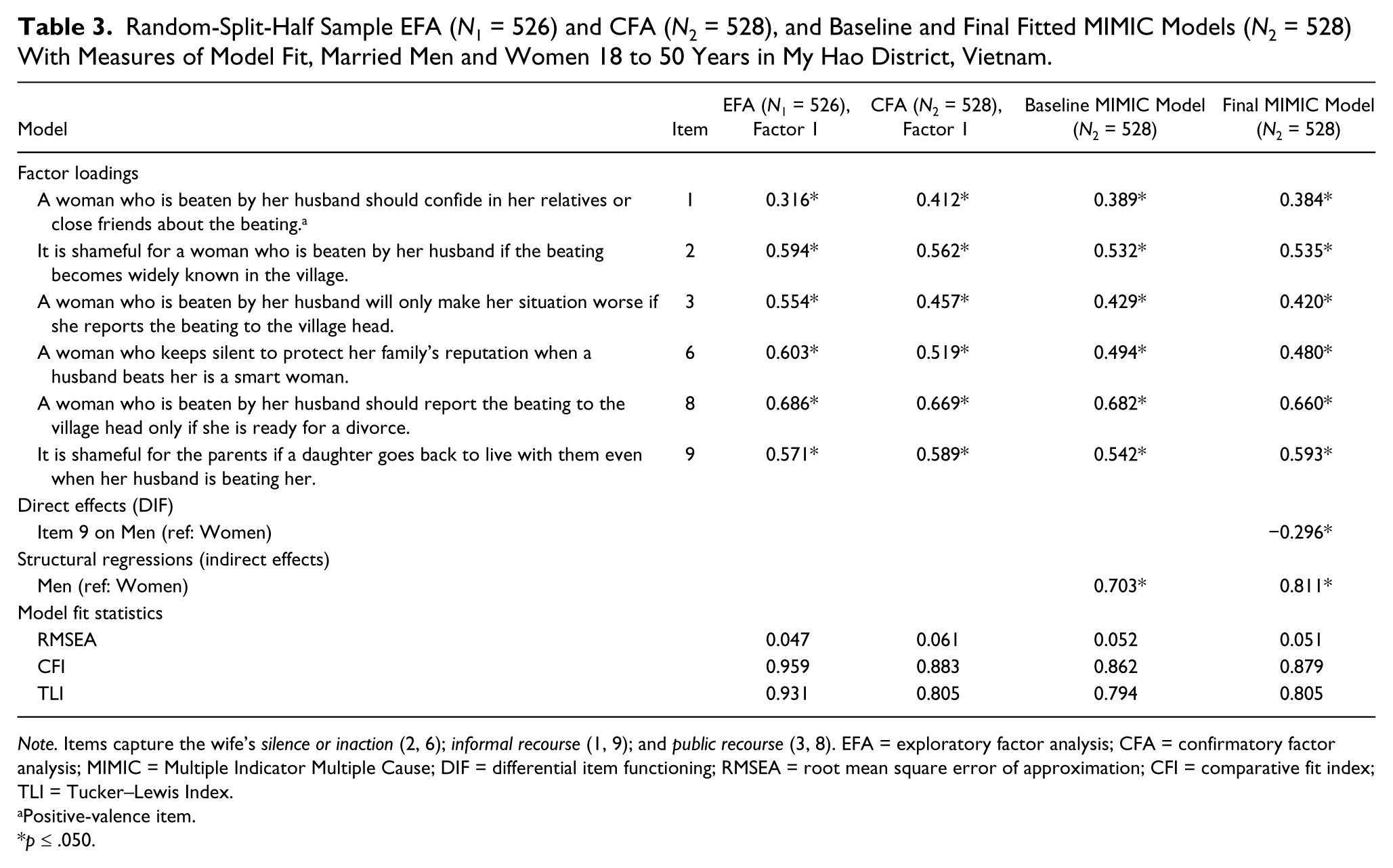
Note. Items capture the wife’s silence or inaction (2, 6); informal recourse (1, 9); and public recourse (3, 8). EFA = exploratory factor analysis; CFA = confirmatory factor analysis; MIMIC = Multiple Indicator Multiple Cause; DIF = differential item functioning; RMSEA = root mean square error of approximation; CFI = comparative fit index; TLI = Tucker–Lewis Index.
Positive-valence item.
p ≤ .050.
Table 3 also includes the analysis of DIF by participant’s gender. According to the baseline structural model that included only the indirect effect of gender on the latent factor (no DIF), men had a 0.703 higher factor mean than women (p ≤ .050). Namely, men had significantly more favorable attitudes than women about a wife’s recourse in response to physical IPV. Estimates in the final column of Table 3 take uniform DIF by gender into account. Given the estimated factor mean difference by gender, men had a significantly lower-than-expected probability than women of disagreeing with Item 9 (it is shameful for the parents if the daughter returns when being beaten by her husband), resulting in a direct path coefficient of −0.296. Accounting for this uniform DIF, the effect of being a man on the factor mean difference increased from 0.703 to 0.811. Namely, the factor mean difference for having favorable attitudes about a wife’s recourse in response to physical IPV was 0.108 higher for men than women after adjusting for men’s unexpectedly lower probability of disagreeing with Item 9. Accounting for uniform DIF by gender for Item 9 improved model fit (chi-square test for difference = 5.62, p ≤ .050). No other scale item showed significant uniform DIF by gender.
Comparison of Men’s and Women’s Attitudinal Scores by Scoring Method
Table 4 shows the derived summative, factor–no DIF, and factor–DIF scores for men’s and women’s attitudes about a wife’s recourse after exposure to physical IPV. Each row shows the overall mean score, mean scores by gender, and difference in mean scores by gender (men–women). The differences in mean factor scores in Table 4 differ slightly from the factor mean differences in Table 3 because of indeterminacy in the computation of factor scores (Grice, 2001). The results in Table 4 show that inferences regarding gender differences in attitudes about a wife’s recourse in response to physical IPV do not differ across the three scoring methods and that the magnitude of the gender difference in attitude does not change substantially across factor scores that do and do not account for uniform DIF by gender. In all cases, men have significantly more favorable attitudes than do women about a wife’s recourse in response to physical IPV.
Scoring Methods for Attitudes About a Wife’s Recourse After Exposure to Physical IPV (N2 = 528), Married Men and Women 18 to 50 Years in My Hao District, Vietnam.

Note. IPV = intimate partner violence; DIF = differential item functioning.
n = 516. The six attitudinal items are summed, for a theoretical score ranging from 0 to 6.
Discussion
This study is the first in a non-Western setting to develop and validate survey items to measure attitudes about a wife’s recourse in response to physical IPV. Item development was strengthened by formative qualitative fieldwork and a combined EFA/CFA/DIF analysis. The development of these attitudinal measures in Vietnam is timely, given recent legal changes to promote gender equity and to criminalize IPV. The government also has recently campaigned to change norms about IPV and to curb its perpetration (GENCOMNET, 2011). Thus, having a valid scale to measure women’s and men’s attitudes about a wife’s recourse in response to IPV enhances the capacity to tailor, target, and track the effectiveness of interventions.
Our findings suggest that six attitudinal items capture adequately a unidimensional attitudinal construct about a wife’s recourse in response to physical IPV. Also, inferences about gender gaps in these attitudes differ little across models that do or do not adjust for uniform DIF by gender. These items would be useful to include in multipurpose or violence-specific surveys in Vietnam and may be suitable for surveys in other settings, pending their cross-cultural validation.
This scale may be elaborated in other ways. First, three of the nine initial items were dropped, and efforts to modify them may enhance their utility. One of these items lacked variability: A woman who is beaten by her husband should seek help from the police even if she is “not injured” by the beating. Based on a different set of questions in the survey, 1.6% of participants said that a wife should report non-injurious, unintentional IPV to the police, whereas 39.4% said that a wife should report injurious, intentional IPV to the police. Thus, variability in the dropped attitudinal item may be enhanced if the beating is described as intentional and injurious. The other two dropped items pertained to attitudes about intervention by oneself or another (gender neutral) person in response to witnessing a wife being beaten. Both items had low loadings on the first factor in our models and may have been capturing a separate sub-domain: intervention by witnesses. Because at least three items are preferred to capture a single domain (Bandalos & Finney, 2010), we were unable to retain these items in a two or more factor model. Also, this analysis suggested some gender differences in attitudinal responses to these items. Whereas women’s responses consistently favored intervention by self and others across differently valenced items (Table 2), men’s responses differed depending on whether they or another (gender neutral) person was the witness and potential intervener. Specifically, men more often favored intervention by self and less often adversely judged someone else for not intervening. More experimentation with items capturing intervention by self versus others and men versus women witnesses is warranted.
A second way to elaborate this scale might be to re-investigate the item with DIF by gender to see whether an alternative item wording would minimize or eliminate DIF. A third way to elaborate this scale would be to develop items that capture the upper and lower ends of this attitudinal construct, as most frequencies ranged from 42% to 70%. Finally, for violence-focused surveys, the number of items might be expanded to capture attitudinal sub-domains about women’s silence or inaction, informal recourse, public recourse, and (as mentioned) intervention by witnesses.
Our findings suggest that attitudes about a wife’s recourse after exposure to physical IPV are measurable in Vietnam with a concise set of items and that uniform DIF by gender can be minimized with careful item development. Whether or not measured, DIF by gender is taken into account, men’s and women’s attitudes about a wife’s recourse after physical IPV differ significantly, with men favoring recourse more often than do women. Assessing the reasons for this gender difference in attitudes is a critical area for further study in Vietnam. Several explanations warrant consideration. First, persistent norms of femininity are grounded in Confucian and Taoist ideas that women are responsible for the family’s happiness (Đàn bà xây tổ ấm) and should hide their husband’s faults to avoid personal shame (xấu chàng hổ ai). The Women’s Union, a group devoted to women’s advancement in public life, still urges women to respect patriarchal hierarchy and to maintain familial harmony (Schuler et al., 2006), which may extend to tolerating IPV and avoiding disclosure. Second, women—as the more frequent victims and witnesses of IPV—may more often see the adverse consequences of various forms of recourse. Experiencing a given recourse as ineffective or even harmful may lead women to disregard it as a real option. Both explanations corroborate women’s tendencies to favor personal inaction while favoring action by others (perhaps because intervention by others is a safer form of recourse for women; Table 2).
Other explanations for these gendered attitudinal differences may lie in the influences on men’s reported attitudes. First, men may view favorable attitudes about women’s recourse after IPV as socially desirable, resulting in systematic over-reporting of this preference. Adding a measure of social desirability bias in future studies would determine the merit of this explanation. Second, local ideas of masculinity may encourage men to idealize certain public acts of protection by men. A local proverb, for instance, asserts that men cannot ignore public injustice (Giữa đường thấy chuyện bất bình chẳng tha). This interpretation corroborates men’s propensity to disfavor personal inaction after witnessing another man beating his wife (Table 2). Finally, men’s participation in mass organizations is an unlikely reason for their reported attitudes, as their attendance is less common than that of women (Table 1). Future research should explore the implications of increasing men’s engagement in organizations that promote gender equity. In sum, careful decomposition analyses are needed to adjudicate the reasons for observed differences in men’s and women’s attitudes about women’s recourse after physical IPV (see Uthman et al., 2009).
Given the promise of the ATT-RECOURSE Scale for research and policy, we advise that it would be expanded to measure relevant sub-domains and validated in urban Vietnam and other countries. We expect that this scale will be useful in diverse settings to identify the determinants of support for a wife’s recourse after physical IPV and the sub-groups where attitudinal change is most needed. Such observational research would inform the design of ideational change interventions to mitigate IPV and to enhance the prospects for recourse among survivors. The ATT-RECOURSE Scale may be useful to assess the attitudinal impacts of such interventions over time.
Footnotes
Appendix
Items Measuring Attitudes About a Woman’s Recourse After Exposure to Physical IPV That Were Tested in Cognitive Interviews
| Attitudinal Item | Type of Recourse |
|---|---|
| 1. A woman should endure beating by her husband. | S |
| 2. Woman who endures beating by her husband, even when the beating causes bleeding, is a brave woman. | S |
| 3. It is normal for a woman who is beaten by her husband to confide in her relatives or close friends. | I |
| 4. It is shameful for a woman who is beaten by her husband if this becomes widely known in the village. | S |
| 5. When a woman is beaten by her husband, seeking help from the village head will only make her situation worse. | F |
| 6. A woman who is beaten by her husband should seek help from the police only if she is injured by the beating. | F |
| 7. If you see or hear a man beating his wife, it is best to mind your own business. | W |
| 8. A woman who keeps silent to protect her family’s reputation when a husband beats her should be admired. | S |
| 9. A person who sees or hears a man beating his wife and does nothing is a bad person. | W |
| 10. A person who sees or hears a man beating his wife should report the beating to the local authority immediately. | W |
| 11. A woman who is beaten by her husband should report the beating to the village head only if she is ready for a divorce. | F |
| 12. It is shameful for a woman, who is beaten by her husband if she divorces. | F |
| 13. The divorced daughter makes her parents feel ashamed if she goes back to live with her parents after divorce. | I |

Note. Responses were agree/disagree/undecided. F = formal; I = informal; S = silence; W = intervention by witnesses.
Acknowledgements
The authors thank Vu Song Ha, Quach Thu Trang, Dang Thi Hong Linh, Nguyen Quoc Phong, and the entire field staff and all participants for their time, effort, and dedication to this project.
Declaration of Conflicting Interests
The author(s) declared no potential conflicts of interest with respect to the research, authorship, and/or publication of this article.
Funding
The author(s) disclosed receipt of the following financial support for the research, authorship, and/or publication of this article: This work was supported by NIH Research Grant 5R21HD067834-01/02 (principal investigators: Kathryn M. Yount and Sidney Ruth Schuler) and the Hubert Department of Global Health, Rollins School of Public Health, Emory University.