



Abstract
The present study examined links between perceived teacher unfairness and bullying behavior in early adolescence, and the potential mediating role of instrumental social goals (specifically, agentic and separate goals). Based on social information processing theory, our model of proactive aggression was evaluated using path analysis in a sample of 662 Italian students aged between 11 and 13 years old (mean age = 12.55, SD = 0.99; 50.6% males). Results showed that perceived teacher unfairness positively relates to bullying, and that this relationship is partially mediated by the endorsement of instrumental goals. Our findings offer promising implications for future research and for intervention programs that aim to prevent school bullying through modifying the classroom context.
Introduction
Bullying is widely recognized as a public health problem given its impact on the lives of thousands of children and adolescents, by causing psychosocial (Reijntjes, Kamphuis, Prinzie, & Telch, 2010), health (Gini & Pozzoli, 2009), and academic problems (Nakamoto & Schwartz, 2009) in victims. Although its prevalence varies widely internationally, the available evidence indicates that among students aged between 9 and 16 years, between 10% and 30% are involved as bullies, victims, or both (e.g., Due et al., 2005). The systematic study of intrapersonal and interpersonal factors that influence bullying behavior has attracted attention in recent years as they support strategies to prevent and reduce the incidence of this form of violence (Beiswenger & Grolnick, 2010). The principal aim of the present study was to test a theoretical model that hypothesizes a direct effect of perceived unfairness at school on bullying behavior among early adolescents, and a mediating role of their social goals.
Bullying is a major form of proactive aggression characterized by an imbalance of power between the perpetrator and the victim (Gini, Pozzoli, & Hauser, 2011; Sijtsema, Veenstra, Lindenberg, & Salmivalli, 2009). It is a relational dynamic in which the bully intentionally adopts an inappropriate social behavior with the aim to reach valued goals, such as dominance and popularity in the peer group (e.g., Peeters, Cillessen, & Scholte, 2010). As such, bullying is an instrumental form of aggression in which attacking another peer is mainly used as a tool to obtain higher levels of power (Sijtsema et al., 2009).
The classroom setting is particularly suitable for the study of interpersonal correlates of bullying because it is a prominent context of adolescent life where a substantial amount of time is spent interacting with teachers and students (Pozzoli, Gini, & Vieno, 2012b; Vieno, Santinello, Pastore, & Perkins, 2007). Many authors have analyzed the social and psychological aspects of learning environments in various educational systems (e.g., Bateman, 2002; Gini, 2008; Pozzoli, Gini, & Vieno, 2012a; Vieno, Perkins, Smith, & Santinello, 2005). Generally, these studies examined how school characteristics, such as school climate or teacher disciplinary practices, influence adolescent bullying (e.g., LeBlanc, Swisher, Vitaro, & Tramblay, 2008; Wilcox & Clayton, 2001). A social climate refers to specific values and norms to which the organization’s members are expected to adhere, and in these studies, school climate refers to quality of discipline, emphasis on academic success, and teachers’ job satisfaction. Inequality and unfair treatment within organizations has emerged as an important domain of study in community and critical psychology (Chia, Foo, & Fang, 2006). Although the school context may be regarded as the “workplace” of adolescents, perceived unfair treatment by a teacher has not been adequately studied as a risk factor for bullying.
Analyzing how school characteristics influence bullying behavior is particularly critical in the Italian context. In a study investigating the prevalence of different forms of bullying within a representative sample of Italian adolescents, the authors found the following prevalence rates of having bullied others or having been bullied at least once in the last 2 months: 11.6% (6.2% bullies, 3.1% victims, 2.3% bullies/victims) for physical, 52% (17.1% bullies, 16.4% victims, 18.5% bullies/victims) for verbal, 47.9% for relational (11.0% bullies, 22.0% victims, 14.9% bullies/victims), 18.5% for sexual (6.1% bullies, 8.2% victims, 4.2% bullies/victims), 19.4% for cyber (5.6% bullies, 8.6% victims, 5.2% bullies/victims), and 9.4% (3.0% bullies, 1.2% victims, 5.2% bullies/victims) for racist bullying (Vieno, Gini, & Santinello, 2011a). The importance of studying bullying in the Italian context, besides prevalence rates, lies in the peculiarities of the Italian school system, where students stay in the same class setting, and with the same class peer group and teachers, throughout the elementary school grades, changing only with school transitions from elementary to middle school at age 11. Moreover, students and teachers stay together for all three middle school years and for 2 or more years of secondary school. Thus, the relationships between students and teachers are likely to be more influential on students’ well-being in Italy than in other countries where classes are reconstituted with different teachers and students each year or depending on the subject.
Teacher Unfairness and Bullying
Although many aspects of the classroom might influence students’ (im)moral behavior, a critical but understudied characteristic is perceptions of fair treatment by teachers (Shapiro, 1990). Different theoretical perspectives posit a positive association between perceived unfairness and bullying. First, the ecological systems theory (Bronfenbrenner, 1979) suggests that a full understanding of individuals’ behaviors must consider multiple systems in which they are embedded because each system contains roles, norms, and rules that influence one another and shape development. Consistent with this theory, perceiving frequent unfair treatment by teachers may facilitate the transmission of social norms that allow disrespectful and dominant behaviors, which adolescents then learn are appropriate in other contexts, such as their relationships with peers. In the end, this might result in unequal peer interactions based on power, dominance, and aggression.
Moreover, teachers’ acts of unfair treatment might also result in their loss of legitimacy as an authority figure (Tyler & Lind, 1992), thus making aggressive and deviant behaviors in schools more difficult to control (Chory-Assad & Paulsel, 2004; Santinello, Vieno, & De Vogli, 2011; Vieno, Gini, Santinello, Lenzi, & Nation, 2011). A desire for fair treatment from the authority can be explained by an instrumental perspective (Leventhal, 1980)—opportunities to perceive that one’s own opinion is heard gives control over one’s life. Therefore, fair procedures and relations serve psychological needs, such as self-esteem, control, and belonging (Cropanzano, Byrne, Bobocel, & Rupp, 2001). When people feel they are treated fairly, they consider the authority as more trustworthy and experience a stronger sense of self-worth (Tyler & Smith, 1999). On the contrary, perceptions of unfair treatment buttress a cognitive state in which individuals evaluate their current situation as discordant with past, desired, or others’ conditions. This can contribute to anger, frustration, and perceptions that dominant behaviors are allowed, or even needed, in that particular context. In the classroom, the perception of unfair treatment by teachers may translate to the belief that disrespectful behaviors at school are allowed, and in the consequent decision to adopt similar behaviors.
Second, according to social-cognitive perspectives (e.g., Crick & Dodge, 1994), proactive aggression (including bullying) relates to a set of cognitive biases in the later social information processing (SIP) steps (Arsenio & Gold, 2006). Briefly, the SIP model describes individuals’ interpretation and understanding of social events as occurring in six sequential steps. Whereas reactive aggression is associated with difficulties in the earlier steps, in which people are assumed to encode and interpret social events, for example, with the tendency to attribute hostility to others’ intentions, proactive aggression appears to be associated with biases in the later steps, which begin with a tendency to value instrumental goals more highly than relational goals. Instrumental goals refer to the tendency to seek higher levels of resource control and power, thus achieving desired and needed resources. Conversely, relational goals are aimed to nurture social relationships with other people, instead of obtaining personal benefits. In other words, in situations entailing potential aggression, proactively aggressive adolescents tend to be more interested in pursuing their goals than in maintaining good relationships with peers (Arsenio, Adams, & Gold, 2009). The biases in SIP that are typical of proactive aggressors may be sought in their system of values rather than in the accuracy of their cognitions (Sutton, Smith, & Swettenham, 1999). A major challenge in this research field is to understand how adolescents develop these morally relevant cognitions.
Consistent with the assumptions of the SIP model, adolescents who are more exposed to social contexts characterized by a lack of fairness, equality, and reciprocity are more likely to develop the belief that everyday life primarily revolves around power and dominance (Arsenio & Gold, 2006; Nation, Vieno, Perkins, & Santinello, 2008). Stated otherwise, adolescents who experience more unfairness and inequality in their daily environments (e.g., hostile or authoritative parenting, unfair treatment at school, socioeconomic deprivation) are more likely to develop a system of idiosyncratic values that aim to reach instrumental goals (Nation et al., 2008). Thus, the tendency to value instrumental goals might derive from a coherent interpretation of the social environments experienced by adolescents. This tendency, in turn, increases the likelihood to resort to bullying to reach desired goals.
One of the factors that favor these biases in early adolescents’ morally relevant cognitions can be perceiving to be treated in an unfair manner by teachers. Students who perceive unfair treatment by the school authorities regularly witness and experience dominant strategies that, in the long run, may contribute to shape students’ moral cognitions. More specifically, students might start to conceive that unfair behavior toward them allows teachers to reach their personal goals (e.g., to freely allocate rewards and punishments). For this reason, to regularly experience an unfair treatment from teachers can contribute to the students’ belief that dominant/aggressive behavior is an easy and effective strategy to gain social resources (Arsenio & Gold, 2006). As a result, perceived unfairness can favor the endorsement of instrumental goals, which in turn makes bullying more likely to occur for the fulfillment of needs, desires, and self-serving goals.
Social goals can be conceptualized along different dimensions, including goals associated with prosocial, social withdrawal, and aggressive and instrumental strategies (Ojanen, Grönross, & Salmivalli, 2005). Given the focus of the current study, we chose to analyze the role of a specific type of instrumental goals, namely, “agentic and separate goals,” that is, the tendency of being in control without interest in others’ opinions (Ojanen et al., 2005). This operationalization was chosen because it is most consistent with the SIP model assumptions to measure a form of dominant values aimed to pursue personal goals regardless of potential negative effects on social relationships. Building on this literature, and considering the lack of research on how social settings influence bullying behaviors through impacting adolescents’ social goals, the current study aims to test a model linking perceived teacher unfairness (defined as relational unfairness, which concerns the perceived quality of interpersonal treatment, whether or not students perceive to be treated with honesty and respect by teachers) to adolescent bullying, directly and through the mediation of adolescents’ instrumental goals. More specifically, consistent with the social ecological theory (Bronfenbrenner, 1979), we hypothesized a positive association between perceived teacher unfairness and bullying behavior, explained by the transmission of social norms allowing and modeling disrespectful behaviors. Moreover, based on the SIP assumptions (Crick & Dodge, 1994), we hypothesized that perceptions of unfair treatment by teachers relate to the tendency to value instrumental goals, which in turn contributes to bullying behavior.
Method
Participants were 662 Italian middle school students aged between 11 and 13 years (36.9% sixth graders, 34.9% seventh graders, 28.2% eighth graders; mean age = 12.55, SD = 0.99; 50.6% boys). Active parental permission was obtained before the administration. A trained research assistant administered the questionnaires during a regular school day, and completion took approximately 30 min. A research assistant assured students of the confidentiality of their answers and instructed them to not put their name in the questionnaire because their information would be analyzed in aggregate form. Teachers were also asked to stay behind the desk during the administration to further ensure confidentiality to students.
Relational unfairness was measured through an adapted version of the Just School Climate Scale (Dalbert & Stöber, 2002) that asked students to rate the degree to which they perceive to be treated fairly and respectfully by teachers. The scale included the following items: “Our teachers interact with students in an appropriate manner,” “Our teachers are respectful,” “Our teachers treat us politely,” “Our teachers treat us fairly” (reversed), “Some teachers try to cheat students,” and “Students are treated too severely by teachers.” Participants responded on a Likert-type scale ranging from (1) completely disagree to (5) completely agree. The Cronbach’s alpha for the scale was .80, 95% confidence interval (CI) = [.78, .84]. To obtain a single measure of perceived teacher unfairness, factor score was computed 1 .Higher factor scores correspond to higher levels of perceived unfairness.
Instrumental goals were measured with items drawn from the “Interpersonal Goals Inventory for Children” (Ojanen et al., 2005). For the purpose of the current study, two items measuring agentic and separate goals were selected, which asked students, “When you are with your friends, how important is it for you (a) ‘to decide what to play’ and (b) ‘that the group does what you say?’” Students responded on a Likert-type scale ranging from (1) not at all to (4) very important. A single measure of agentic and separate goals was created by computing the factor score, with higher factor scores corresponding to a stronger tendency to value instrumental goals. Internal consistency of the two items was acceptable (α = .76; 95% CI = [.72, .81]).
The four-item bullying scale was based on the revised Olweus Bully/Victim Questionnaire (Solberg & Olweus, 2003). After reading a standard definition of bullying, students were asked how often they bullied others during the 2 months before the survey. Items measured physical, verbal, and relational bullying. Students responded to the following questions: “In the last 2 months, how many times you have (a) hit, kicked, pushed, shoved around, or threatened someone; (b) said mean and hurtful things or made fun of or call someone mean and hurtful names; (c) completely ignored or excluded someone from her or his group of friends or left her or him out of things on purpose; (d) told lies or spread false rumors about her or him?” Participants’ responses ranged from (1) never to (5) more than one time a week; the Cronbach’s alpha for the scale was .82 (95% CI = [.78, .86]), and factor score was computed to obtain a single measure of bullying; higher factor scores correspond to a higher frequency of bullying behaviors.
The pattern of relationships specified by our theoretical model was examined through path analysis, using the R (R Development Core Team, 2012) Package lavaan (Rosseel, 2012) and a single observed score for each construct tested in the model. Path analysis is used to describe the directed dependencies among a set of variables; more specifically, it is a straightforward extension of multiple regression. Its aim is to provide estimates of the magnitude and significance of hypothesized causal connections between sets of variables. Path coefficients were estimated using the maximum likelihood method. Next, we performed a bootstrap analysis (based on 2,000 replications) to calculate CIs for path coefficients. To evaluate the goodness of fit of the model, we considered the R2 of each endogenous variable and the total coefficient of determination (TCD; Bollen, 1989; Jöreskog & Sörbom, 1996).
Moreover, considering the central role of gender differences in the study of bullying, we used a multiple group model to explore, without a priori hypotheses, whether the proposed model was consistent between genders. The multiple group model approach simultaneously estimated the same pattern of relations between the variables in boys and girls. In this approach, equivalence between different samples is evaluated by constraints that impose identical estimates for the model’s parameters (Byrne, 1989).
Results
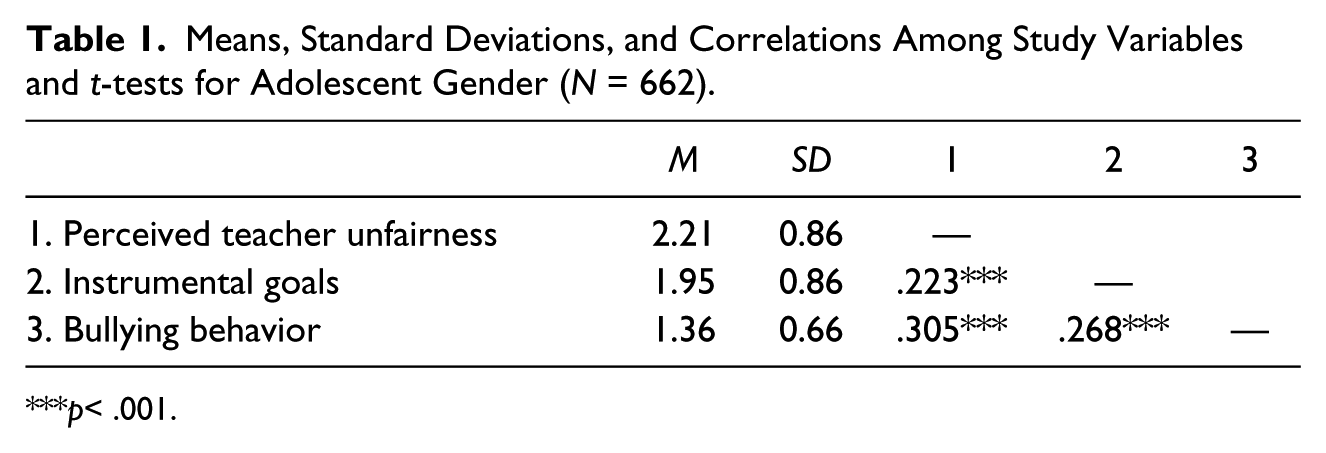
Table 1 shows the means, standard deviations, and bivariate correlations for perceived teacher unfairness, instrumental goals, and bullying behavior. As expected, each of the study variables was positively correlated with the others, although correlations were modest in magnitude.
Means, Standard Deviations, and Correlations Among Study Variables and t-tests for Adolescent Gender (N = 662).
p< .001.
Figure 1 represents the tested model with estimated standardized parameters. The squared multiple correlations for the endogenous variables indicate that the model accounts for 12% (95% CI = [6%, 19%]) of the variance in bullying, and 4% (95% CI = [1%, 8%]) in instrumental goals. The TCD was .10 (95% CI = [.05, .16]). As expected, perceived teacher unfairness positively related to bullying behavior; moreover, perceived teacher unfairness positively predicted adolescents’ endorsement of instrumental goals, which in turn positively predicted bullying. In support of our model, the relation between perceived teacher unfairness and bullying behavior was partially mediated by the importance attributed to instrumental goals (.03, 95% CI = [.01, .05]). Overall, although the TCD was relatively low, the CIs indicate that the estimated parameters are all significant. Although there is not a standard norm to evaluate the strength of the associations between variables, our results indicate that, for example, for every unit increase in instrumental goals, bullying behavior has a corresponding increase of .13. Since the standard error of the parameter is .03, the increase in z score is .13/.03 = 4.333 units. These associations can be considered relevant in explaining the associations between perceived unfairness, instrumental goals, and bullying behaviors.
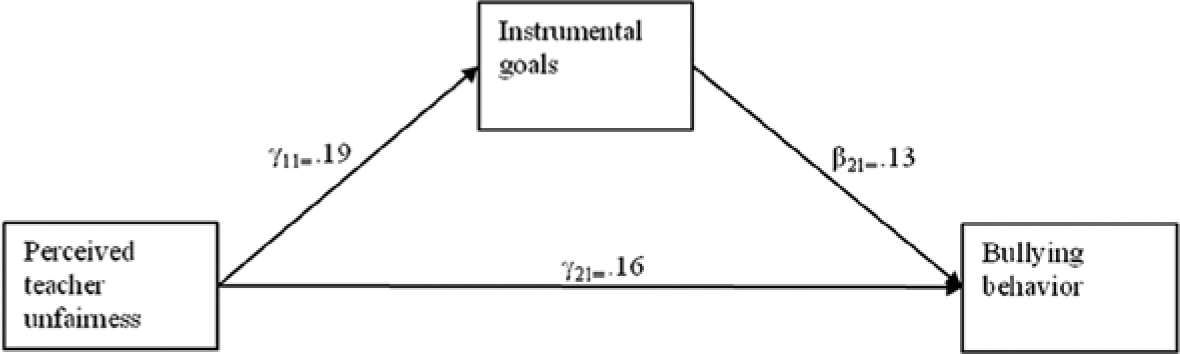
Path coefficients for the proposed model predicting adolescent bullying perpetration.
The results of the bootstrap analysis are presented in Table 2. In the first two columns, the estimated values and the standard errors are shown, whereas in the third one, we reported the biases, computed as the deviation between the bootstrap mean values and the estimated values. In the last column, the 95% CIs based on the “simple bias-corrected” method (Campbell & Torgerson, 1999) are presented. The very low values of the biases indicate that our estimated parameters are sufficiently reliable. Finally, a multiple group model tested the extent to which this model is consistent across gender, in terms of covariance matrices and forms (dimensions, and patterns of fixed, free, and constrained values). There were no statistically significant differences found in the covariance matrices between boys and girls, χ2(3) = 4.85, n.s.
Estimated Parameters and R2, SEs, Biases, and CIs based on 2,000 Bootstrap Replications.
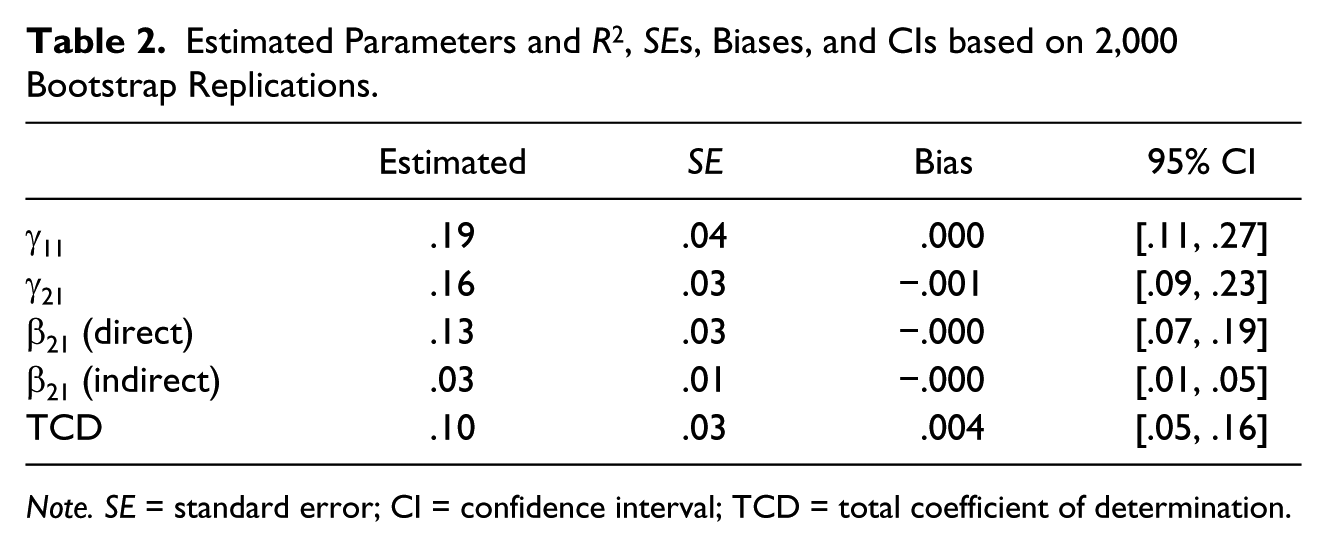
Note. SE = standard error; CI = confidence interval; TCD = total coefficient of determination.
Discussion
We evaluated a possible mechanism through which the perceived characteristics of the classroom setting can shape social goals, thus influencing bullying behaviors in early adolescents. Consistent with previous studies (Santinello et al., 2011; Vieno et al., 2011b) and our hypotheses, perceived teacher unfairness positively related to bullying. This link can be explained according to a social ecological perspective: Perceptions of unfair treatment by teachers may support the notion that unfair and disrespectful behaviors are accepted within the classroom environment.
Thus, adolescents who perceive that teachers treat them unfairly are more likely to adopt similar behaviors toward their classmates. In other words, teacher’s perceived unfairness may contribute to create a context in which other students’ unfair treatment is “legitimized” by the teacher’s behavior, which might promote the belief that disrespectful behaviors at school are allowed and encourage students’ decision to adopt similar behaviors. Moreover, it is possible that teacher unfairness favors a loss of teachers’ authority legitimacy, which makes the occurrence of bullying behaviors more likely to occur; further study is needed to test this specific hypothesis. However, we should also consider the possibility that students who bully others have different, perhaps biased, perceptions of teacher behaviors, and may tend to evaluate them more negatively, or suffer reprimands from teachers as a consequence of their behaviors (and thus report higher levels of teacher unfairness toward them). Moreover, because bullies may be somewhat more likely to show disruptive behavior in class, teachers might be more likely to focus their time and positive attention on students who behave well, and aggressive students may perceive this behavior as unfair. Although only longitudinal studies can clarify the direction of the effects, it is plausible that the relationship between teacher unfairness and bullying is circular.
Furthermore, our results showed a positive association between the perception to receive an unfair treatment by teachers and the tendency to value instrumental goals. Endorsement of these instrumental goals, in turn, positively related to bullying. These results are consistent with the conception of bullying as an effective strategy to reach valued goals, such as dominance in the peer group (e.g., Peeters et al., 2010; Sijtsema et al., 2009). This finding is also consistent with the SIP assumptions (Crick & Dodge, 1994) and highlights a possible mechanism through which perceived classroom norms, in terms of teacher management of relationships with students, may influence adolescents’ socio-moral cognition and encourage or hinder bullying behavior. Our results give empirical support to what was argued by Arsenio and Gold (2006), who posited that adolescents’ idiosyncratic social cognitions, such as the tendency to value instrumental goals, might partly derive from a lack of fairness experienced in different social settings, including the classroom. Perceiving to be treated unfairly by teachers may lead adolescents (e.g., through mechanisms of modeling and imitation) to construct a sort of cynical and negative view of morality as power, which can be exerted in their proximal interactions within the peer group for personal gains. Considering the amount of time that adolescents spend at school (Vieno et al., 2011b), the school climate may influence students’ system of values and thus represent a microcosm of societal mechanisms. It is worth noting that, in our study, perceived unfairness was measured at the individual level, thus hindering the opportunity to consider the influence of school climate at the classroom level. Teacher unfairness may have different effects on bullying when it is diffused among students in the classroom: In a study using multilevel modeling (Vieno et al., 2011b), the relational unfairness at the class level resulted as a protective instead of a risk factor for violent behavior. This result was explained relying on the perceived unfairness model (Jackson, Kubzansky, & Wright, 2006), which posits that when there is a common perception of teacher unfairness among classmates, it might result in a shared sense of helplessness. Researchers have found that targets of group-based unfairness, when characterized by high levels of collective efficacy, may be more empowered to start collective actions (Hobfoll, Jackson, Hobfoll, Pierce, & Young, 2002). For this reason, future studies on teacher unfairness and bullying should consider teacher unfairness at the class level, along with the quality of social relationships among classmates (measured, for example, in terms of students’ sense of community or trustworthiness of friendships), which may represent an important protective factor against the negative consequences of teacher unfairness.
Finally, the multiple group comparison showed that the pattern of relationships among variables was the same in male and female subsamples, underlining how perceiving to be treated unfairly at school may be equally important for boys and girls in terms of their moral and social development.
This study has some limitations. First, the cross-sectional nature of the data did not allow conclusions about the direction of the relations. It is likely that the consequences of bullying behaviors reinforce perceptions of unfair treatment, so longitudinal studies are needed to determine the direction of these relations. Second, in our study, only adolescent self-report measures were used. Multi-informant methods involving peer and teacher assessments of variables may help contribute to a better understanding of the relationships between teacher unfairness, social goals, and bullying. Another limitation of our study has to do with our focus on a unique social setting: the school context. Indeed, the ecological systems theory emphasizes the impact of social contexts on human development and underlines the need to examine multiple systems that affect children and adolescents. Beyond the interaction between the individuals and social contexts, these contexts are also interdependent on each other, so that the impact on bullying behaviors derives from the direct influence of each system, together with the indirect effects of distal systems operating through more proximal systems. Several factors at multiple ecological levels have shown their influence on bullying behaviors, such as socioeconomic inequalities at a national level (Elgar et al., 2013), crime rates at the neighborhood level (Dorsey & Forehand, 2003), and family relations (Vieno, Nation, Perkins, Pastore, & Santinello, 2010). Future studies should analyze how different social contexts may interact in creating a “socially toxic” environment (Garbarino, 1997) and influencing bullying behaviors. Finally, a limitation of the study is that we only measured bullying behavior, without taking into account the experience of being bullied. Future studies should test whether students with an experience of bullying both as a bully and a victim (i.e., bully–victim) are particularly susceptible to school contexts characterized by high levels of unfairness.
These limitations notwithstanding, the results from the present study expand the current knowledge by investigating a possible mechanism through which perceiving to be treated unfairly at school promotes adolescents’ bullying behavior, both directly and through the mediation of instrumental goals. To our knowledge, this is the first study that applied some SIP assumptions (Arsenio & Gold, 2006; Crick & Dodge, 1994) to the understanding of the association between the perceived classroom context, adolescents’ social goals, and bullying behavior. Our results demonstrate the importance of the quality of teacher–student relationships in predicting students’ social goals and bullying behavior, thus supporting the need of developing prevention programs working with teachers to change the school and classroom environments (Vieno et al., 2005; Wendorf & Alexander, 2005).
Footnotes
Declaration of Conflicting Interests
The author(s) declared no potential conflicts of interest with respect to the research, authorship, and/or publication of this article.
Funding
The author(s) disclosed receipt of the following financial support for the research, authorship, and/or publication of this article: This work was partially supported by Research Grant CPDA103978 from the University of Padova to the authors.