



Abstract
The present study examines public knowledge and use of a sexual offender Internet registry in New Jersey. A 20-item random digit dial telephone survey of 1,016 New Jersey residents was completed to determine public awareness and use of the New Jersey Sex Offender Internet Registry (NJSOIR). Approximately 51% of respondents reported knowledge of the NJSOIR, while 17% had accessed the site. Of those who accessed the site, 68% took some preventive measure based on the information they obtained. Logistic regression analyses demonstrate that ethnicity, education, and Internet access were associated with residents’ knowledge of the NJSOIR, while sex, race, education, being the parent/caregiver of a child below 18 years of age, and access to the Internet were associated with respondents’ likelihood to visit the registry website. These results suggest that an intervention that will increase public awareness of sex offender registries and provide specific preventive measures the public can take is needed.
Introduction
Sex offender-specific statutes have been implemented in great frequency within the last two decades, particularly with regard to the registration of sex offenders with law enforcement agencies and the subsequent notification of the community. These laws are largely a reaction to societal perception that the vast majority of sexual offenders will repeat their sex crimes, which served to increase fear of these offenders (Levenson & Cotter, 2005) and prompted state and federal agencies to enact laws that apply only to sex offenders. Examples of such laws include the Jacob Wetterling Crimes Against Children and Sexually Violent Offender Registration Act and two amendments: Megan’s Law and the Prosecutorial Remedies and Other Tools to End the Exploitation of Children Today Act (i.e., the PROTECT Act). The main premise behind these statutes is the assumption that public knowledge of sexual offenders will aid in prevention against sexual victimization. As such, these laws require all states to adopt minimum registration and community notification provisions for persons convicted of a sexually violent offense, including releasing registered sex offenders’ information to the public.
The most recent of these laws, the PROTECT Act, mandates all states to establish and maintain Internet sexual offender registries as the main means of community notification dissemination. Today, every state, including the federal government, has an Internet sexual offender registry. Like other forms of community notification (e.g., press releases, telephone notification, or community meetings), Internet registries are intended to increase public knowledge of sexual offenders in the hope of preventing future sexual abuse. However, unlike other forms of notification, Internet registries place the burden on the public to seek out information about offenders (Levenson, Brannon, Fortney, & Baker, 2007; Levenson & Cotter, 2005; Matson & Lieb, 1996).
There is substantial public support for sex offender registration and notification policies overall, and prior research has shown that the public believes that having access to sex offender information, particularly via the Internet, enhances public safety (Caputo & Brodsky, 2004; Craun, Kernsmith, & Butler, 2011; Levenson et al., 2007; Levenson & Cotter, 2005; Martin & Marinucci, 2006; Phillips, 1998; Vermont Legislative Council, 2005). The public reports feeling safer knowing that sex offenders’ information is available to them (Anderson & Sample, 2008; Edwards & Hensley, 2001; LaFond, 2005; Phillips, 1998). However, research in this area has demonstrated that sexual offender Internet registries are typically not utilized by the public. Although generally in support of and knowledgeable of state sexual offender laws, most people are unlikely to access sex offender Internet registries (Anderson, Evans, & Sample, 2009; Craun et al., 2011; Kernsmith, Comartin, Craun, & Kernsmith, 2009). In addition, some researchers have found that those who view registry sites are unlikely to take any preventive steps to protect themselves and their families from sexual abuse (Anderson & Sample, 2008; Caputo & Brodsky, 2004). This has led to conclusions that Internet sexual offender registries are not useful and that the original goals of such registries are not being met (Kernsmith et al., 2009; Levenson et al., 2007; Sample, Evans, & Anderson, 2011; White & Malesky, 2009). However, it is difficult to generalize these findings to citizen views in more diverse states, given that the majority of research in this area has utilized samples that, although considered representative of the states where they were conducted, are overwhelmingly Caucasian (e.g., Michigan, 82.5%, Kernsmith et al., 2009; Nebraska, approximately 89%, Anderson et al., 2009, and Anderson & Sample, 2008; and 92%, Sample et al., 2011). Furthermore, previous studies have sampled only from households with landline phones (Anderson et al., 2009; Anderson & Sample, 2008; Kernsmith et al., 2009; Sample et al., 2011), effectively excluding a growing proportion of the U.S. population that exclusively use cell phones for communication (Blumberg et al., 2011).
The Present Study
In the present study, we build on the extant literature in this area by examining public knowledge and use of a sexual offender Internet registry in New Jersey (the New Jersey Sex Offender Internet Registry [NJSOIR]). The results of this population-based survey contribute significantly to the literature regarding the public’s utilization of sex offender Internet registries. Furthermore, the present study provides knowledge about the effectiveness of this method of community notification using a sample that is more ethnically, racially, and socioeconomically diverse than those previously studied by researchers.
The NJSOIR is compiled and updated by the New Jersey State Police (NJSP). While all persons who have been convicted of a sex crime or of a predatory crime against children must register with local law enforcement authorities, not all convicted sex offenders in New Jersey must appear on the NJSOIR. For purposes of classification, all convicted sex offenders in the state of New Jersey are placed into three categories following a pre-release hearing—Tier 1, Tier 2, and Tier 3—which takes into consideration factors including the characteristics of the sex offense(s) they have committed, their criminal offense history, and other criteria including response to treatment and availability of community support. Tier 1 offenders are considered to be of low risk, Tier 2 as moderate risk, and Tier 3 as high risk. In New Jersey, only Tier 2 and Tier 3 classified sex offenders appear on the NJSOIR.
The public can access the registry by visiting the NJSP website (njsp.org). Information included in the registry consists of the offender’s name, demographic information (e.g., age, race, sex), an updated picture, tier designation (i.e., Tier 2 or Tier 3), and a description of the sexual offense(s) of which the offender was convicted. Other information available on the NJSOIR includes the make, model, color, year, and license plate number of any vehicles registered to the offender, as well as the street address and municipality in which the offender resides.
To examine public knowledge and use of the NJSOIR, we collected information about respondent knowledge of the NJSOIR, access rates, why the registry was accessed, and measures taken to prevent sexual abuse. Respondent perceptions of the registry were also assessed.
Method
Data Collection and Procedure
Data for the present study were gathered using a 20-item telephone survey. We contracted with an established public opinion survey research firm to conduct the random digit dial (RDD) survey between March 22, 2011, and April 14, 2011. 1 A dual-frame design was utilized so that two separate samples of landline and cell phone numbers were generated and subsequently combined into one. The final surveyed sample was composed of approximately 80% landline and 20% cell numbers (i.e., 813 landline and 203 cell phone completes). This type of dual-frame sample is considered to be the best practice in telephone survey research as the exclusion of cell phones would eliminate cell-phone-only households from the sample, but the response rate from cell-phone-only samples is typically so low that they are cost prohibitive (Hu, Balluz, Battaglia, & Frankel, 2011). Thus, for this study, a mix of cell and landline households was used that maximized the cost–benefit ratio. Quality control measures, which included remote monitoring of interviews by the first author, were implemented throughout the study period.
Surveys were conducted in the English language only due to limited study financial resources and the increased cost associated with conducting RDD surveys in more than one language. For both landline and cell RDD samples, staff interviewed only one randomly selected adult, aged 18 years or above, in each sampled household. This adult was selected by utilizing the modified Trodahl/Carter in-house selection technique (e.g., asking for the youngest male first, then if not available, the youngest female). This method is used to maximize participation by younger people and males who typically are less likely to participate in surveys. Eight attempts were made to reach each landline and seven attempts were made to reach each cell phone line. The average interview took 5 minutes to complete. We planned for a sample size of 1,000 respondents. This estimation was based on minimizing the margin of error while maximizing the study resources. A sample size of 1,000 provides a margin of error of approximately 3%. The final survey sample size of 1,016 exceeded our goal and provided more than adequate power to the study. The response rates were 40.1% for the landline sample and 26.1% for the cell phone sample, and the cooperation rates were 93.7% and 83.2% for the landline and cell phone samples, respectively. 2 These rates are consistent with recent literature on RDD survey response (Greenberg & Babcock-Dunning, 2012; Johnson, Cho, Campbell, & Holbrook, 2006). The response and cooperation rates for this study were calculated using the American Association for Public Opinion Research (AAPOR; 2011) standard calculations. The final sample was weighted to represent New Jersey demographics.
Measures
We measured two key dependent variables: respondents’ knowledge of the NJSOIR and access rates. Knowledge of the NJSOIR was measured by the response (yes or no) to the following question: “Some states have websites listing where sex offenders live. Do you know if New Jersey has one?” (Question 1). Access rate was assessed by the following question: “In New Jersey, this website is called the New Jersey Sex Offender Internet Registry. Have you ever accessed it?” (Question 2), which was also measured using a dichotomous yes/no response. Independent variables (IVs) in the present study included race, ethnicity, age, sex, being a parent or caregiver to a child below the age of 18 (yes/no), regular access to the Internet (yes/no), highest grade of school completed, and income.
For descriptive purposes, additional information regarding respondents’ use of the NJSOIR was collected if a respondent answered “yes” to Question 2. Respondents were asked to indicate the number of times they had accessed the NJSOIR as well as the reasons why they accessed it. Interviewers provided response options for reasons why an individual accessed the registry (i.e., to check out a potential caregiver, curiosity, for work, before moving to a new area, for the safety of one’s children and family, for the safety of other children under one’s supervision, for self-protection), and respondents were also provided an open-ended opportunity to state other reasons not included on the list. Respondents were then asked to provide any preventive measures they took in response to what they learned from the registry. Response options were again read from a list by the interviewer (i.e., changed plans to move to a new home, educated children under my care, improved my home’s security, increased my monitoring or supervision of children under my care, changed my own daily activities, educated my child’s babysitter). Respondents were also provided an opportunity to state other preventive measures taken that had not been listed. Finally, survey respondents were asked whether they felt safer knowing the information they viewed on the NJSOIR.
Statistical Analysis
SAS (Version 9.2) was used for all statistical analyses. The SURVEY procedures (i.e., PROC SURVEYFREQ and PROC SURVEYLOGISTIC) were used to account for sample design and weighting. Frequency tables were first generated for all of the survey variables and descriptive statistics for the demographic variables were reported.
Multivariable logistic regression analysis was used to assess the two key dependent outcomes. The IVs of interest were chosen based on the past literature on this subject. The logistic models were built after bivariate analyses were conducted and it was found that all of the potential IVs were significantly related to both of the outcomes of interest at the p < .05 level with the exception of Hispanic ethnicity, which was not significantly associated with access of the NJSOIR. The process of model building thus began with the inclusion of all of the IVs, including Hispanic ethnicity. However, once all IVs were included in the multivariate model, the majority of these variables were no longer significant. Subsequent decisions about which variables to include in the final models were based on considerations of correlation and collinearly among the IVs and “clinical” importance (Hosmer & Lemeshow, 2000). Race, ethnicity, sex, education, having regular access to the Internet, and being a parent/caregiver of a child below age 18 were ultimately included as covariates in the final logistic regression models. Income was excluded because it was not significantly related to either knowledge or access of the NJSOIR in any of the multivariate models, and a relatively large percentage of respondents (more than 20%) declined to provide their incomes. Furthermore, income was found to be correlated with both education and having access to the Internet. Age was also not included in the final regression models because it was highly correlated with being the parent/caregiver of a child below the age of 18. Model goodness-of-fit was examined using the likelihood ratio. Reference categories for most of the IVs in the multivariable logistic regression analysis were chosen based on the highest frequency of respondents in a category, except in the case of sex and whether respondents were parents/caregivers of children below the age of 18. The final multivariable logistic regression models as well as odds ratios and p values are presented here.
Descriptive statistics are also presented for information related to respondents’ access of the NJSOIR and perceptions of the site. Two of the survey questions for which results are reported allowed the respondent to provide an open-ended response (i.e., preventive measures taken and reasons for accessing the NJSOIR). In both cases, two members of the research team reviewed the responses and decided whether the provided response could be included in one of the interviewer-provided categories. If it was appropriate and the research team members agreed, the response was re-coded; otherwise it was left as “other,” and is reported as such.
Results
Demographics
The study sample consisted of 1,016 adult respondents. As Table 1 indicates, survey respondents were predominately White and non-Hispanic, and 51.7% of respondents were female. Approximately 52% of respondents were above the age of 45, and 36.1% of respondents were the parent/caregiver of a child below the age of 18. High school graduates and those with a General Educational Development (GED) were the single largest group of respondents (30.7%), while slightly more than one in three respondents had a college or an advanced degree (35.4%). Roughly 70% of respondents reported a household income of US$50,000 or more, and approximately 85% of survey respondents reported having regular access to the Internet.
Demographics of Survey Respondents (N = 1,016).
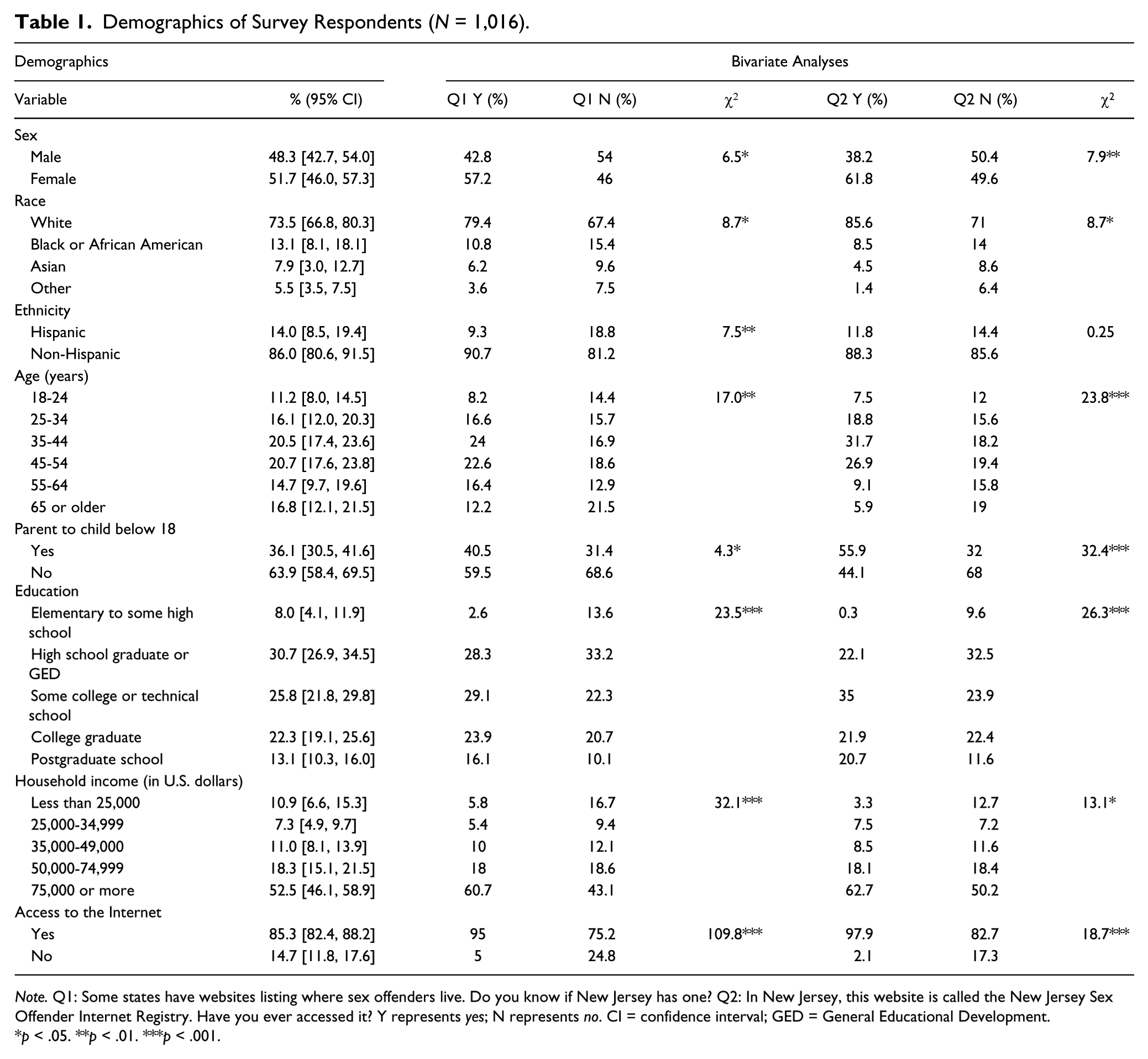
Note. Q1: Some states have websites listing where sex offenders live. Do you know if New Jersey has one? Q2: In New Jersey, this website is called the New Jersey Sex Offender Internet Registry. Have you ever accessed it? Y represents yes; N represents no. CI = confidence interval; GED = General Educational Development.
p < .05. **p < .01. ***p < .001.
Bivariate Analyses
The results of the bivariate analysis can be viewed in Table 1. Chi-square tests indicate that sex (χ2 = 6.5, p < .05), race (χ2 = 8.7, p < .05), ethnicity (χ2 = 7.5, p < .01), age (χ2 = 17.0, p < .01), being a parent to a child below 18 (χ2 = 4.3, p < .05), education (χ2 = 23.5, p < .001), household income (χ2 = 32.1, p < .001), and access to the Internet (χ2 = 109.8, p < .001) were significantly related to respondent knowledge of the NJSOIR. In looking at the chi-square tests for Question 2, sex (χ2 = 7.9, p < .01), race (χ2 = 8.7, p < .05), age (χ2 = 23.8, p < .001), being a parent to a child below 18 (χ2 = 32.4, p < .001), education (χ2 = 26.3, p < .001), household income (χ2 = 13.1, p < .05), and access to the Internet (χ2 = 18.7, p < .001) were significantly related to respondents accessing the NJSOIR; however, ethnicity was not significantly related to accessing it.
Multivariate Analyses
Approximately 51% of respondents knew about the existence of the NJSOIR. Multivariable logistic regression analyses (see Table 2) show that sex, race, and being a parent to a child below 18 were not related to knowledge of the registry. Ethnicity was related to knowledge of the registry, as non-Hispanics were significantly more likely to know about the NJSOIR when compared with Hispanics (odds ratio [OR] = 0.4, p < .01). Education was also related to knowledge of the registry, with high school graduates significantly more likely to know about the NJSOIR compared with respondents without a high school degree (OR = 0.3, p < .05). Finally, those respondents who had regular access to the Internet were significantly more likely to know about the NJSOIR compared with those without regular Internet access (OR = 0.2, p < .001).
Multivariable Analysis of Predictors of Respondents’ Knowledge and Access of the NJSOIR (n = 970).
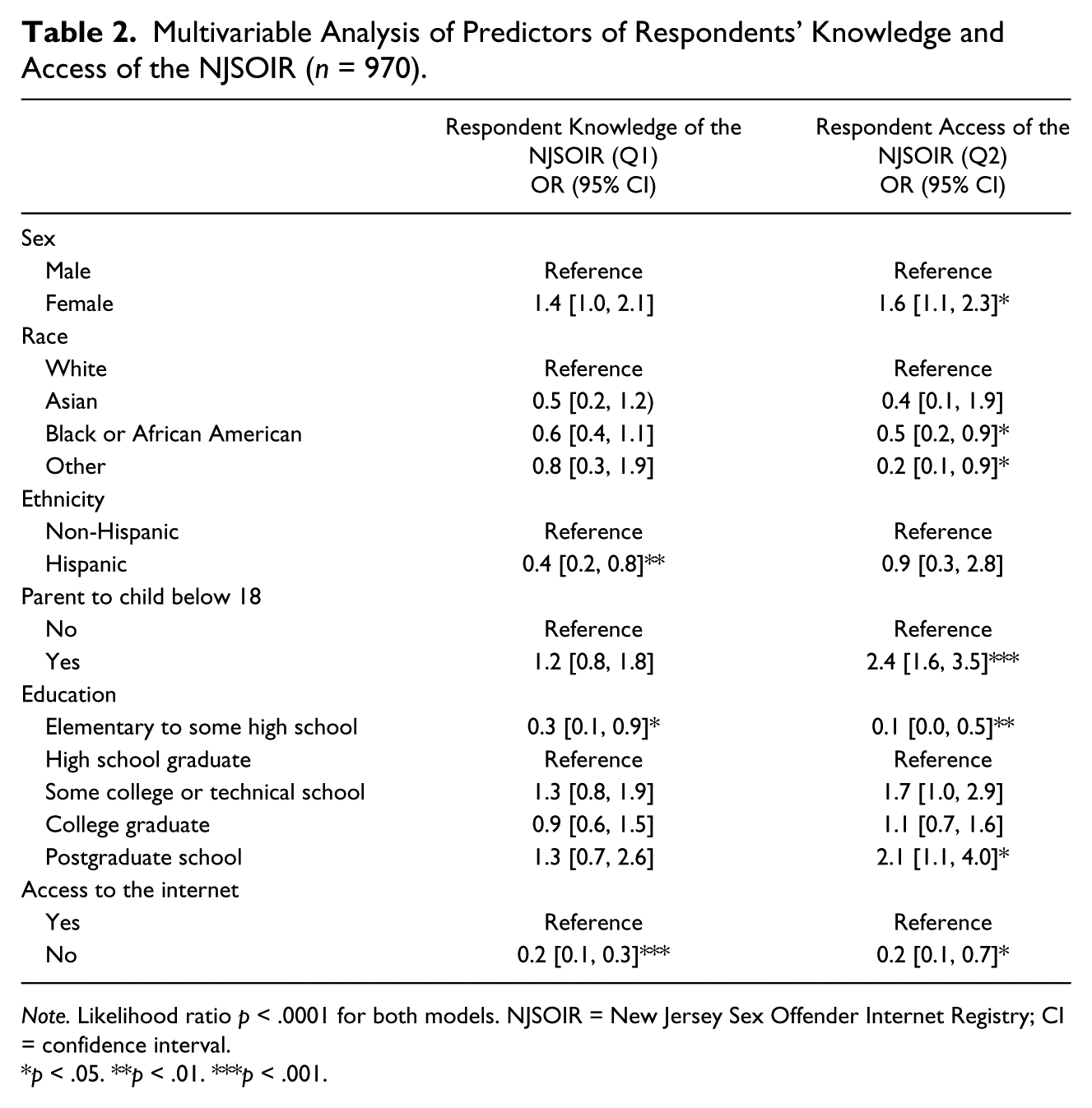
Note. Likelihood ratio p < .0001 for both models. NJSOIR = New Jersey Sex Offender Internet Registry; CI = confidence interval.
p < .05. **p < .01. ***p < .001.
Roughly 17% of all respondents reported that they had accessed the NJSOIR at least once. Multivariable logistic regression analyses (see Table 2) show that women were more likely than men to access the NJSOIR (OR = 1.6, p < .05). Race was predictive of access of the registry; Whites were significantly more likely to access the site when compared with those respondents who classified themselves as Black or African American (OR = 0.5, p < .05) or “Other” (OR = 0.2, p < .05) for the race category. Education level was also predictive of NJSOIR access. Specifically, those respondents with less than a high school degree were significantly less likely to access the site compared with high school graduates (OR = 0.1, p < .01), while respondents who had completed post-graduate school were more than twice as likely to access the site when compared with high school graduates (OR = 2.1, p < .05). Those with access to the Internet were more likely to view the registry than those without (OR = 0.2, p < .05). Finally, parents/caregivers of children below the age of 18 were 2.4 times more likely to access the NJSOIR than respondents without children less than 18 years of age (p < .001). Ethnicity was not associated with accessing the registry.
Survey Descriptives
Descriptive statistics related to respondents’ access of the NJSOIR are displayed in Table 3. Of those respondents who have accessed the registry (n = 172), the majority accessed it 2 to 4 times (52.9%). Most respondents who accessed the NJSOIR did so for the safety of their children and family (77.4%), followed by curiosity (73.5%). Self-protection and the protection of children under respondents’ care were also popular reasons for accessing the registry.
Descriptive Information of Respondents’ Use of the NJSOIR (n = 172).
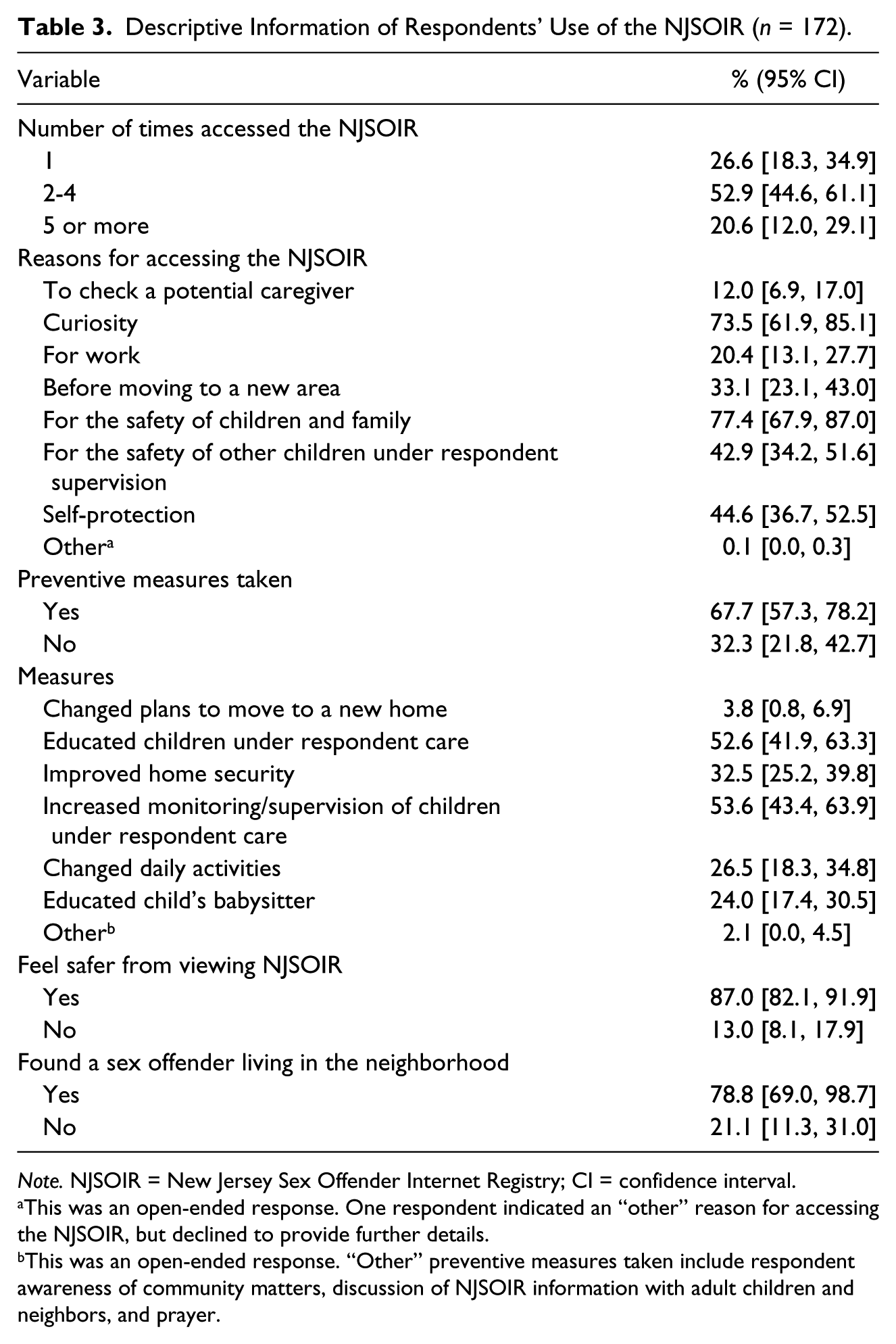
Note. NJSOIR = New Jersey Sex Offender Internet Registry; CI = confidence interval.
This was an open-ended response. One respondent indicated an “other” reason for accessing the NJSOIR, but declined to provide further details.
This was an open-ended response. “Other” preventive measures taken include respondent awareness of community matters, discussion of NJSOIR information with adult children and neighbors, and prayer.
We asked respondents whether they had taken any preventive measures based on what they viewed on the NJSOIR. Nearly 68% of respondents who accessed the NJSOIR stated that they had taken a preventive measure after viewing the registry. The majority of respondents indicated that they educated children under their care about the presence of sexual offenders in their communities (52.6%) while also increasing the monitoring of children (53.6%). Other preventive measures taken were improving home security (32.5%), changing the daily activities of themselves or children (26.5%), and educating a child’s babysitter (24.0%). Changing plans to move to a new location was a rare event and was only reported by 3.8% of those who accessed the NJSOIR.
A large majority of respondents (87%) indicated that they felt safer knowing the information found on the NJSOIR. Approximately 79% of respondents who have accessed the registry reported that they learned of a registered sex offender in their neighborhood.
Discussion
The present study was completed to examine public knowledge and use of a sex offender Internet registry in New Jersey (i.e., the NJSOIR). In a population-based survey of New Jersey residents 18 years of age and older, respondents answered questions related to their knowledge of the state sex offender Internet registry, as well as their access and utilization of the site. We present findings that describe the population of New Jersey residents who know about and have accessed the NJSOIR.
Our results indicate that approximately half of all respondents knew about the existence of a sex offender Internet registry in New Jersey. This percentage is strikingly lower than that found by researchers in other states (i.e., 89.5%, Anderson & Sample, 2008, and 88.6%, Kernsmith et al., 2009). A further examination of survey respondents indicates that that there are groups of persons who are lacking in their knowledge of the existence of the NJSOIR when compared with other residents across the state, particularly, adults who are Hispanic, do not have a high school diploma, and/or do not have regular access to the Internet.
In addition, only 17% of respondents of the present survey accessed the NJSOIR at least once. Like knowledge of the registry, this percentage is significantly lower than other researchers have found (i.e., 34.8%, Anderson & Sample, 2008; 37%, Kernsmith et al., 2009). Our findings indicate that persons who are least likely to access the registry include those who identify as African American and “Other” for race, males, and persons who do not have a high school degree. Expectedly, persons who do not have regular access to the Internet were less likely to access the registry. Despite the lack of use of the NJSOIR by most New Jersey residents, those members of the public who have accessed the registry are doing so with prevention in mind. Nearly 7 out of 10 of such respondents took some sort of preventive measure, predominately related to the safety of children and loved ones. Given these findings, it is not surprising that more than 85% of respondents who accessed the registry reported feeling safer knowing the information they had viewed on the site.
Although the present study did not directly assess the ability of sex offender Internet registries to prevent sexual abuse, our results indicate that sex offender registries like the NJSOIR are capable of increasing public knowledge of sexual offenders in the hope of preventing future sexual abuse. However, their effectiveness in this regard is severely limited by the lack of awareness citizens have of such community notification initiatives. We recommend that public education strategies be implemented to better inform persons about the existence of these registries, with special attention provided to those target populations we have identified as being less knowledgeable of them and less likely to use them. Furthermore, such strategies may be better delivered via a medium that does not involve an Internet connection. For example, in their study evaluating Nebraska’s sex offender community notification legislation, Anderson and Sample (2008) found that some respondents knew about the state registry, and accessed it, after reading about it in the newspaper. Other methods of registry dissemination can include television or through school notifications and parent–teacher events. While we do not advocate the printing or direct reveal of sex offenders’ names and information within such mediums, a notification about the existence of the Internet registry, as well as the appropriate website address, may be practical. Public education campaigns that do not require an Internet connection have been utilized and proven effective at delivering various messages, including lessening lead poisoning (New Jersey Department of Health and Senior Services [NJDHSS], 2010), increasing student attendance at schools (Singh & Carter, 2010), and increasing anti-smoking awareness (Pechmann & Reibling, 2000).
Furthermore, the public should be better informed of preventive measures to take after Internet notification has been achieved. Nearly 68% of respondents of the present study who accessed the registry stated that they had taken a preventive measure based on their findings. While this percentage is higher than the percentage found in prior research (e.g., 37.6%, Anderson & Sample, 2008), ideally all persons who access the registry should be taking a preventive measure, even if it is simply exhibiting increased awareness. While it is difficult to assess why these respondents did not take any preventive measures without a qualitative assessment, persons who view Internet registries may not be taking action simply because they do not know what action to take. It is in our opinion that in addition to informing the public about the existence of these registries, the public must be made aware of the usefulness of these registries as well. For example, parents can be encouraged to discuss sexual abuse with their children and loved ones, or adults can be urged to share their findings with children, babysitters, and other adults in the home.
It is worth noting that while the present study does not evaluate knowledge and access of Internet sexual offender registries by persons who do not speak English, ethnically diverse states should be sensitive to the reality that there are a number of residents who do not speak English as a first language. Some states, such as California, have addressed this issue by adopting registries in various languages (Logan, 2009). Sexual victimization has no language barriers, and non-English-speaking populations would benefit by having information provided to them in their native languages.
Strengths and Limitations
The results of the present survey must be interpreted in light of the study’s limitations. All data collected were self-reported by respondents and are thus subject to survey research pitfalls, including respondent recall error, underreporting, and response bias. In addition, the study was limited to respondents who spoke English; as such, non-English-speaking members of the community were not included in the sample. Non-response bias is another limitation for this study as the response rates for both the cell phone and landline samples were low. This concern is universal to researchers conducting RDD telephone surveys where response rates have been decreasing steadily in recent years. Nevertheless, previous research has shown that RDD samples, even those with lower response rates, tend to be representative of the target population (Curtin, Presser, & Singer, 2000; Keeter, Miller, Kohut, Groves, & Presser, 2000).
The strengths of the present study include the large sample size and the setting in which it was completed—an ethnically, racially, and socioeconomically diverse state. As such, the findings and recommendations from this study may be generalizable to other states with similar populations. An additional strength of the current study is the inclusion of cell-phone-only respondents, representing 20% of the overall sample. The ever-growing use of cellular telephones in society today presents challenges for traditional RDD telephone surveys of households (Hu et al., 2011; Kempf & Remington, 2007). While the majority of cell phone users have an additional landline household phone at which they can be reached, approximately 24% of all U.S. adults are living in a wireless-only household (Blumberg et al., 2011). These individuals are largely at risk of being excluded from telephone surveys, as they are less likely to be contacted compared with those individuals who have both a landline and cell line telephone.
Directions for Future Research
Future research evaluating sex offender Internet registries should focus on the differences that are likely to appear between groups in awareness and use of such registries. For example, the results of the present study indicate that there are certain groups who are more likely to access the registry website than others; however, due to sample size constraints, it is currently unclear whether there is a relationship between group membership and rationale for accessing the registry, or preventive measures taken. Such analyses are necessary to adequately determine whether sex offender registries are successful in providing community notification across all groups.
We also recommend that future research in this area explore the role that sex offender registries play in reducing sexual abuse. Although a sensitive issue, the disclosure of abuse by respondents will greatly impact research in this field, and provide clarity in understanding the role that such registries currently play in preventing sex crimes, as well as how they might be improved in the future. Qualitative studies, using focus groups or anonymous open-ended questions, may more effectively measure this outcome than quantitative ones, and such methodology should not be overlooked.
Conclusion
The PROTECT Act mandates all states to establish and maintain Internet sexual offender registries as the main means of community notification dissemination. These Internet registries place the burden on the public to seek out information about sex offenders; however, our results indicate that residents are lacking in their knowledge and use of Internet registries for this purpose. We propose that strategies should be undertaken to increase public awareness of sex offender Internet registries. In addition, public education campaigns that illustrate preventive actions to be taken after viewing these registries are particularly needed. Only when increased public awareness of sex offender Internet registries is achieved will this form of community notification reach its full potential in aiding in the prevention of sexual abuse.
Footnotes
Declaration of Conflicting Interests
The author(s) declared no potential conflicts of interest with respect to the research, authorship, and/or publication of this article.
Funding
The author(s) received no financial support for the research, authorship, and/or publication of this article.