



Abstract
Despite its consistent and latent appearance in feminist accounts of intimate partner violence (IPV), the characterization of IPV as an elaborately ordered relationship whose norms are backed up by force is notably absent from the empirical IPV literature. Drawing on Emery’s typology of IPV, we hypothesized a curvilinear relationship between order and IPV injury. We developed a measure of relationship order and implemented it in a representative, randomly selected cluster sample of 250 families from Ulaanbaatar, Mongolia. Controlling for the severity of the IPV, higher levels of order, but not lower levels, are associated with higher numbers of reported IPV injuries. Theoretical and practical implications of order as a risk factor are discussed.
Intimate partner violence (IPV) is estimated to kill between 39,000 and 69,000 women around the world every year (Author et al., 2013). Millions of others are non-fatally injured, resulting in long-term physical and mental health impairments (Ellsberg, Jansen, Heise, Watts, & Garcia-Moreno, 2008). Despite the fact that sociological commitments to the study of norms give the field a deep and longstanding concern with the concept of order, sociology of the family has long neglected the concept of order as an important area of inquiry. Neither has any other discipline concerned with the study of IPV compensated for this neglect. Following Emery (2011), we contend that the degree of order in the couple relationship is essential to understanding the social scourge of IPV. Emery’s typology of domestic violence suggests the amount of order in intimate relationships may have important implications for both causes and consequences of IPV. This article constructs a new measure of relationship order, implements it in a representative sample of 250 families from Ulaanbaatar, and tests its relationship with IPV injury.
The concept of order derives its foundation from sociology. In its most general theoretical sense, sociologists have been concerned with the problem of order and how societies can exist at all when the rational short-term interest of social actors suggests a war of all against all (Granovetter, 1985; Hobbes, 1651/1962; Parsons, 1937). For Parsons (1948), order is characterized by the
coordination of the activities of the various members in such a way that they are prevented from mutually blocking each other’s action or destroying one another by actual physical destruction of the organisms, and, on the other hand, they are sufficiently geared in with each other so that they do mutually contribute to the functioning of the system as a whole. (p. 159)
In this view, order is more than the simple absence of “violations of a legitimized normative structure” (Gould, 1987, p. 65). Rather, in an ordered system, norms integrate the actions of individuals to more or less harmoniously sustain the system while assisting in the realization of collective goals (Parsons & Smelser, 1956). An ordered system, then is characterized by both (a) general compliance with social norms and (b) normative regulation of the extent to which individuals may work at cross purposes. If one accepts Durkheim’s (1893/1984) argument that the violation and punishment of norms is necessary for their continued existence (pp. 62-63), order in any system must be a matter of degree. This suggests that order is appropriately measured in a continuous fashion.
The concept of order has been developed at many levels of analysis ranging from entire societies (cf. Parsons, 1948) to neighborhoods in criminological research, where order is more frequently conceptualized in terms of its relative absence (Kornhauser, 1978; Sampson, Raudenbush, & Earls, 1997). The broken windows hypothesis is emblematic of this tradition (Wilson & Kelling, 1982). Despite its profound theoretical significance and its widespread development in other branches of sociology, we find a puzzling absence of conceptualization of order in the family unit in family sociology. All Journal of Marriage and Family title references to order since 1980 refer to chronological order (cf. Blekesaune, 2008); all such references to disorder or disorganization refer to criminological theories about the neighborhood (Browning, 2002), rather than the family as a collectivity. A discussion of family-level order is also generally missing from the literature on IPV. No other discipline has addressed this gap.
Violence within families is a central social concern because it represents extreme behavior in conflict situations, suggests potential dysregulation in family systems, and results in intolerably high costs to its victims and society (Author et al., 2013; Ellsberg et al., 2008). Estimates of the cost of IPV to society range as high as $41 per individual or $12.6 billion for the United States (Chan & Cho, 2010; Waters, Hyder, & Rajkotia, 2004) annually. IPV has been studied from the theoretical perspective of order (cf. Browning, 2002; Emery, Jolley, & Wu, 2011), but social disorganization (absence of order) is both theorized and studied at the level of the neighborhood (Sampson et al., 1997). In other words, when conceptualizations of order are used to understand IPV, the unit of analysis of order is the neighborhood. Existing theories of disorder can be applied at the level of the family rather than the neighborhood. Despite the formal absence of an “order with respect to the family” concept in studies of IPV, there are many indirect connections to the order construct. For example, studies examining the relationship between norm consensus and IPV (Coleman & Straus, 1990; Kim & Emery, 2003) reflect the social disorganization preoccupation with ethnic heterogeneity and residential instability (Kornhauser, 1978; Sampson et al., 1997). However, from Parsons (1948) onward through the criminological tradition of social disorganization (Kornhauser, 1978; Sampson et al., 1997) order is generally conceptualized as desirable while disorder is conceptualized as undesirable and associated with crime. We argue that it is a mistake to conflate order with what is socially desirable.
Unlike the criminological tradition, to the extent that it invokes order, the feminist conceptualization of IPV typically characterizes IPV as an excess of order (Emery, 2011). This excess is implicit in foundational feminist texts on IPV such as Dobash and Dobash (1979) and in rich textual accounts of IPV such as Stark’s (2007). In “the sweatshirt case” (p. 229), a woman’s boyfriend offers her a sweatshirt in an apparent act of concern, but the act is in reality code for a violence backed ultimatum to change her behavior (Stark, 2007). An elaborate set of rules is constructed to control the victim. This control is extended to “mundane areas of everyday life that are not normally thought of as norm- or rule-governed” (p. 229). In short, in some of the most serious cases of IPV, there is an excess of order.
Order Versus Control
The concept of order is also raised indirectly in what is perhaps the most commonly accepted typology of IPV, Johnson’s (2008) concepts of intimate terrorism and mutual violent control. Johnson focuses on control of the victim by the perpetrator. If we assume that perpetrators use increasing control of the victim to harmoniously orchestrate family relationships to the perpetrators’ benefit and self-interest, then increasing control may be reflected in increasing order. However, this connection to order and, as Emery (2011) points out, the connection to the concept of power is lost in Johnson (2008) because he distinguishes his types using a control motive rather than achieved control.
Order is fundamentally concerned with the extent to which social action is rule-governed. It implicates both the extent to which actions are subject to rules rather than individual discretion, and the extent to which those rules are actually followed. Control has at least two different meanings in the literature on IPV. Control motivated behaviors (Johnson, 2008) are used to characterize intimate terrorism or mutual violent control. Control motivated behaviors can also be referred to as attempted control. On the other hand, achieved control is Emery’s (2011) definition of power.
Order, attempted control, and achieved control are related but independent constructs. Attempted control may or may not succeed in achieving control. Even if control is achieved, it may or may not result in a high degree of order. An IPV perpetrator who has achieved control may or may not be interested in creating a highly ordered system. Even assuming the perpetrator desires to create order, achieved control may not result in high levels of order (see, for example, Emery’s [2011] despotic dictatorship type). Emery (2011) argues that in order to create high levels of order in a very unequal relationship, the superordinate partner’s actions must consistently support whatever rules have been established, even when this is inconvenient to the superordinate partner. Indeed, this activity, continued acts of violent control that are consistent with the relationship rule structure, epitomizes Emery’s totalitarian dictatorship construct and differentiates it from despotic dictatorship.
Finally, order remains independent from consistent achieved control because high levels of order may also be achieved by consensus in equalitarian relationships. Emery (2011) uses order to begin to categorize violent relationships. However, high levels of order may exist in non-violent relationships and equalitarian relationships. Emery’s discussion of order is of an order that is established by power backed up by force. As Emery points out, power may also be backed up non-violently by walk-away costs.
Thus, on the one hand, the criminology literature suggests the pathology of too little order, but the feminist literature suggests the potential pathology of too much order (at least, when that order is established by violent control). In a theoretically driven typology of IPV, Emery (2011) argues that the conceptualization of order within the family is fundamentally necessary to developing a sufficient understanding of IPV. At the high end of the order spectrum in IPV is totalitarian dictatorship (Emery, 2011). At the other end is the low order type (anarchic IPV), which Emery characterizes as more than usually unpredictable. In this circumstance, he hypothesizes that children are more likely to be injured (Emery, 2011). Following this logic, we argue that IPV occurring in a very low order context may also place victims at higher risk for injury. On the other hand, both Stark’s (2007) and Emery’s (2011) work suggests that the worst and hence most injury-producing types of IPV are likely to be characterized by a high degree of order. These contentions, together, suggest a curvilinear relationship between order and IPV injury. Injury levels should be highest when levels of relationship order are very high or very low.
IPV in Mongolia
IPV is a serious problem in Mongolia. In a large study of Ulaanbaatar, 17.9% of all households reported physical IPV within the previous 6 months (Oyunbileg, Sumberzul, Udval, Wang, & Janes, 2009). Risk factors for IPV in Mongolia include primary school education or less, low income, living in a rented home, and co-habitation with an unemployed partner who uses alcohol (Oyunbileg et al., 2009). There is some evidence that interventions targeting HIV prevention may also reduce violence victimization for the most vulnerable Mongolian women (Carlson et al., 2012). These findings suggest that IPV is a serious and understudied problem in Mongolia. A Google Scholar search found no studies of IPV injury in Mongolia. More generally, injury from IPV is associated with being female (Tjaden & Thoennes, 2000), reciprocal rather than non-reciprocal IPV (Whitaker, Haileyesus, Swahn, & Saltzman, 2007), and partner’s poor mental health, suicidality, controlling behavior, prior IPV arrest, and longer relationship with the victim (Walton-Moss, Manganello, Frye, & Campbell, 2005).
There are also unique aspects of Mongolian culture and life that may be related to IPV injury. The extreme cold of Mongolian winters may exacerbate the isolation of victims and prevent effective help-seeking. Mongolian culture stems from a nomadic herding culture in which males inherited family resources and females were married out (Oyunbileg et al., 2009). Despite legal prohibitions against wife battering starting in the 13th century and formal legal equality (Oyunbileg et al., 2009), cultural axioms like “a broken or cracked bone is better than lost honor” suggest greater tolerance for violence generally inherent in warrior culture. Other axioms like “kettles can be broken down, but only within the fireplace” (Namjil, 1999) helped people turn a blind eye toward IPV specifically. There are also some potential protective factors. In fear that their daughters might be at a disadvantage in marital relationships, Mongolian families have traditionally concentrated more educational resources on daughters than on sons (Oyunbileg et al., 2009). In modern Mongolia, high unemployment in the transition to a post-socialist state, along with alcoholism, appears to have contributed to a high rate of IPV (Oyunbileg et al., 2009).
Developing a Measure of Order
A measure of order in families or romantic relationships must capture the extent to which ordinary social action is rule-governed (both extent of rules and extent of compliance). Following Stark (2007), we are particularly concerned not with situations for which the actions of almost anyone will be rule-governed, but situations for which there will be variability. Likewise, in this article we attempt to create a measure of order that can be applied to everyday situations that will hold for almost all families. All families must sometimes eat (together or individually), have a (at least somewhat clean) place to live in order to be healthy, wear clothes, and so on. For this reason, we developed a measure of order that captures order in household routines. Relationship order was measured using an eight item scale created by the first author. These items were based on the respondent’s opinion on the following statements about their families: (1) we eat dinner together, (2) we eat dinner at the same time every night, (3) our house/apartment is neat and orderly, (4) our house/apartment is clean, (5) I know the daily schedules of everyone in our house, (6) I know what household chores are my job to do, (7) I know what household chores other people in my family are supposed to do, and (8) when one person in the family is sick or really busy, other family members step in to do that person’s chores. Possible responses were never (1), rarely (2), sometimes (3), and often (4).
Other Potential Confounds
In testing for a curvilinear relationship between IPV injury and relationship order, we sought to control for several critical variables. Disorder may increase IPV injury via unpredictability, but the severity of IPV may also increase disorder, potentially creating bias in the estimate of the relationship between IPV and disorder. This implies that to properly test the hypothesis, the analyses must control for IPV severity as much as possible. For this reason, the analyses controlled for the severity (logged odds of causing injury) of the acts of IPV and (separately) for any reports of violent acts. This approach conceptualizes IPV severity as a control variable, rather than a predictor. Another important potential confound is coercive control (Johnson, 2008; Stark, 2007; Walton-Moss et al., 2005). Although Stark (2007) indirectly invokes order, his central argument is that the worst types of IPV are characterized by coercive control and this control, as we have argued, may be related to order. Browning (2002) has found collective efficacy to be an important protective factor against IPV. Moreover, collective efficacy, insofar as it represents the social disorganization tradition, is arguably an indicator of order at the neighborhood level. If effects of order in the family are simply a reflection of order at the neighborhood level, collective efficacy could represent an important confound in the relationship between relationship order and IPV injury. Mooney (2007) has found neutralizing beliefs to be a risk factor for IPV, and patriarchal beliefs (Emery, Kim, Song, & Song, 2013) are also a known risk factor that may be more salient in East Asia. In addition to measures controlling for the constructs discussed above, the analyses also controlled for respondent’s sex, age, and alcohol abuse, as well as household size, highest level of education, and the presence of minor children in the household.
Method
Data
The Ulaanbaatar module of the Families and Neighborhoods Study is a representative random probability cluster sample of 250 adults in 24 different randomly selected duuregs. A duureg is the smallest administrative unit in the city. A simple random sample of 24 duuregs was drawn first. A randomly selected duureg was discarded from the sample if less than 25% of the area within it was inhabited. Maps of each duureg were obtained and random draws from the uniform distribution were repeated until the Cartesian points randomly obtained fell within the measured confines of the map. An interviewer was dispatched to this random start point and instructed to locate the nearest dwelling, after which units were selected using a random protocol. Refusal conversion techniques were used to raise the response rate from an initial 50% to 63%. Refusal conversion involved repeat visits to those who were not at home or who initially refused. A subset of the participants who refused initially were offered additional incentives to participate. The questionnaire was translated from English into Mongolian, then back-translated to check for accuracy.
A total of 58 cases were lost to analysis from item non-response. The Conflict Tactics Scale (CTS) measure for IPV had a total of 32 cases (12.8% of the sample) which were omitted; failure to fill out the education variable accounted for another 25 cases omitted (10%). The remaining 1 case lost to analysis occurred because of a missing response in household size. This left 192 cases in the analysis (77% of the original sample). However, when education and household size are dropped from the analysis (allowing for an analysis of 87% of the sample), statistical inferences (coefficient signs and significance) drawn from the models remain unchanged.
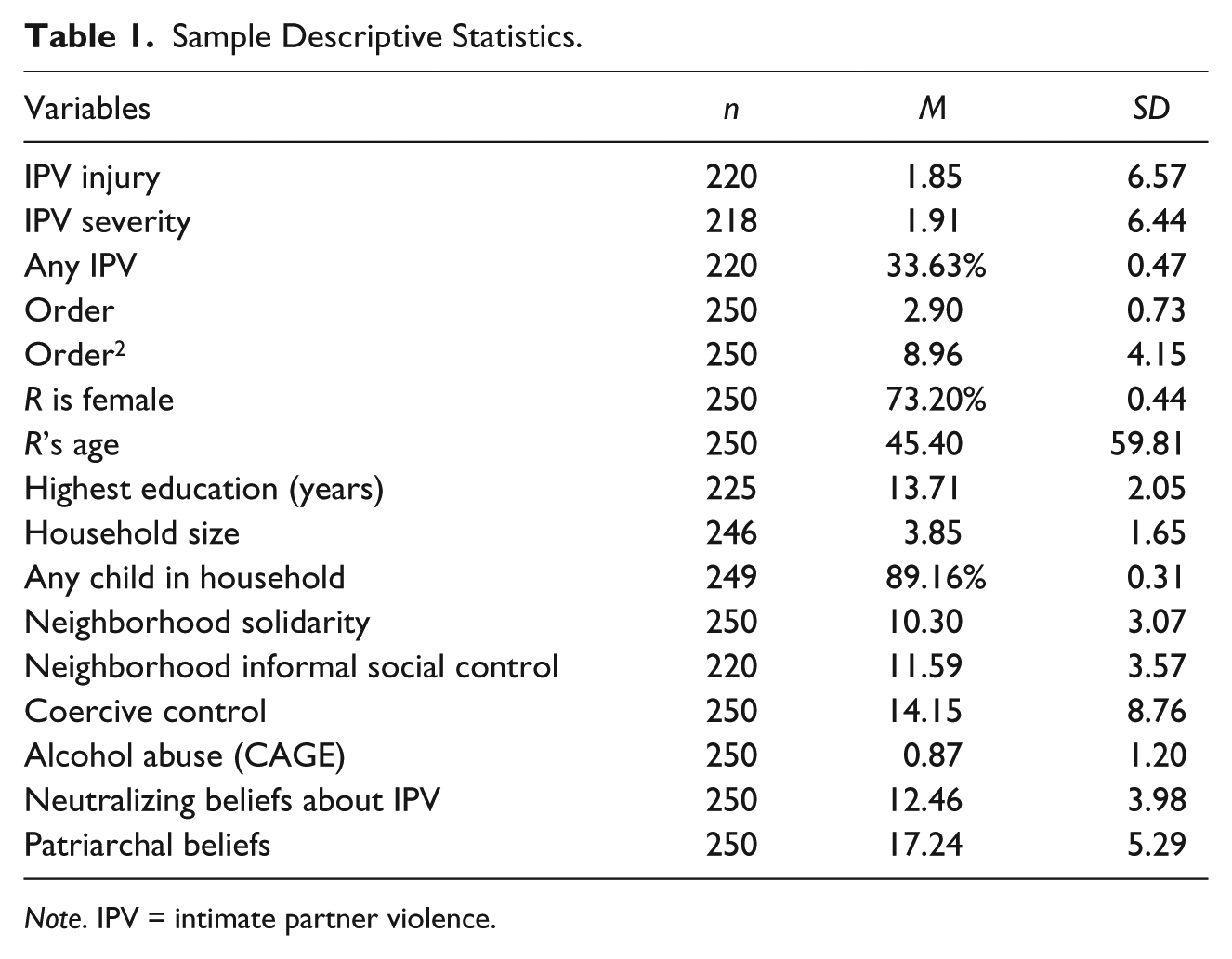
Sample descriptive characteristics are found in Table 1. Among the 250 respondents, 73% were female and 80% were married or currently partnered, and the average age was 45. The average household had 3.8 people, at least one minor child was present in 89% of the households, and 28% of households had at least one partner with a university degree.
Sample Descriptive Statistics.
Note. IPV = intimate partner violence.
Measures
IPV severity and IPV injury
The measure of IPV is a modified version of the Straus and Douglas (2004) Conflict Tactics Scale Short Form (CTS2S), which has been found to have good concurrent validity with the longer form, the CTS2 (Straus & Douglas, 2004). It includes six physical violence items, (1) slapped; (2) pushed, grabbed, or shoved; (3) hit with object; (4) punched, kicked, or bit; (5) beat-up; and (6) used or threatened with a knife or gun, and two injury from physical violence items (had a sprain, bruise, small cut or felt pain the next day because of a fight with the partner and had to see a doctor [MD] because of a fight with partner). Possible responses were once, twice, 3 to 5 times, 6 to 10 times, 11 to 20 times, or more than 20 times in the past year.
Logistic regression coefficients (run separately for violent acts by men and women) from IPV injury regressed on number of each type of violent act were used to weight the violent acts prior to combination in a scale. Thus, a one unit increase in the IPV severity scale is associated with the same increase in the log-odds of injury across the entire CTS. Reliability for the IPV severity scale was acceptable (Cronbach’s α = .71). IPV injury items were combined into a simple scale indicating the number of reported injuries per year (Cronbach’s α = .77). Rates of IPV were high: 29.6% of the sample reported some IPV in the last year, 26% reported IPV by the male partner, 23.7% reported IPV by the female partner. Some form of IPV injury was reported for 9.5% of female partners and 8.2% of male partners. Among households, 87.7% reported no IPV injuries, 5.0% reported between 1 and 10 IPV injuries, 4.1% between 11 and 20 IPV injuries, and 3.2% more than 20 IPV injuries in the last year.
Order
The relationship order scale is meant to capture both physical order and organized procedures to handle day to day living. Directly measuring order in terms of achieved physical order and predictable routines in daily life, rather than the norms that undergird them, allows order to be measured as a unidimensional construct rather than in the two dimensions of conformity and harmonious integration of social action suggested by Parsons (1948). Scree-plot analysis of the principal components for this measure indicated a sharp elbow after the first component, providing some evidence of construct validity. Reliability was good (Cronbach’s α = .84). The responses to the eight items were averaged for each respondent, creating a scale ranging from 1 to 4 with a mean of 2.90 and a standard deviation of 0.73. This range allows us to assess the associated change with an average of a 1 category increase across all items.
Collective efficacy
Based on Sampson et al. (1997) and Zhang, Messner, and Liu (2007), collective efficacy was measured using two scales: neighborhood solidarity and neighborhood informal social control. Solidarity was measured by agreement with four items: (1) this is a close-knit neighborhood; (2) if your family has an important problem, people around here care; (3) people in this neighborhood can be trusted; and (4) people around here are willing to help their neighbors (Cronbach’s α = .85). Informal social control was measured with four items: You could count on your neighbors to do something about it if (1) children were skipping school and hanging around outside, (2) children were showing disrespect to an adult, (3) there was a fight in front of your house/apartment, (4) you were away and someone was trying to steal your bike (Cronbach’s α = .89).
Neutralizing beliefs about IPV
Neutralizing beliefs were measured using a scale created by the first author and designed to adapt the concepts of Matza (1964/1990) to IPV. The four items were as follows: (1) fights between spouses aren’t a big deal as long as nobody gets seriously hurt; (2) if a husband hits his wife, or vice versa, the person who got hit probably deserved it; (3) if a husband hits his wife, he probably did it for her own good; and (4) there are crimes a lot worse than hitting one’s spouse. Possible responses for the items were strongly agree, agree, disagree, and strongly disagree. Reliability for the scale was good (Cronbach’s α = .85).
Coercive control
Coercive control was measured using seven items from Tjaden and Thoennes (1999) suggested by Johnson (2008). These items were intended to reflect control motivated behavior in that the current partner (1) tries to limit your contact with family and friends, (2) is jealous or possessive, (3) insists on knowing who you are with at all times, (4) puts you down in front of others, (5) makes you feel inadequate, (6) shouts or swears at you, (7) prevents you from knowing about or having access to the family income. Possible responses were never, rarely, sometimes, often, and always. Reliability was excellent (Cronbach’s α = .94).
Patriarchal beliefs
Patriarchal beliefs were adapted from Emery et al. (2013) measure. The items were (1) men should be the leaders in society; (2) men should take the initiative in romantic relationships; (3) wives should do most household chores; (4) the family’s economic decisions should be made by the husband; (5) wives should follow their husbands’ opinions about the wife’s job; (6) the husband’s opinion is more important than the wife’s in making important decisions about the children, school, work, and so on, and (7) from time to time, it’s ok for husbands to use violence against their wives to preserve the husband’s authority. Possible responses were strongly agree, agree, disagree, and strongly disagree. Reliability for this scale was good (Cronbach’s α = .89).
Alcohol abuse
Abuse of alcohol was measured using four items from the CAGE measure (Castells & Furianetto, 2005). These four yes or no items were as follows: (1) In the past 3 months, have you ever felt you should cut down on your drinking? (2) In the past 3 months, have people annoyed or criticized you by criticizing your drinking? (3) In the past 3 months, have you ever felt bad or guilty about your drinking? and (4) In the past 3 months, have you ever had an alcoholic drink first thing in the morning? This scale had acceptable reliability (Cronbach’s α = .72).
Analytic Issues
Non-response
Usually, the best approach to making use of refusal conversion data is to weight refusal conversion sample findings by the non-response rate to obtain less biased estimates. This was not done in the current case in calculating IPV prevalence or incidence estimates. The refusal conversion data had lower reported IPV severity (t = 2.04, p < .05) than the ordinary sample, suggesting that social desirability may have been a more serious problem among those who initially refused to participate. Further evidence comes from the fact that the refusal conversion sample showed substantially higher scores on a measure of IPV reporting social desirability (t = 1.99, p < .05). For these reasons, the refusal conversion sample was simply combined with the ordinary sample.
Model correctives
Analyses were conducted in Stata11. Regression models with random effects for each duureg were used to account for clustering in the data. Random effects regression models were used because a Hausman test indicated no significant differences in coefficients between the two models (χ2 = 10.89, df = 14, p = .69) and because random effects models are efficient in this circumstance (Kennedy, 2008). Skewness-Kurtosis tests indicated the IPV injury data were highly skewed (p < .001). For this reason, a non-parametric bootstrap was used to draw statistical inferences (coefficient significance tests; Efron & Tibshirani, 1994) for the models.
Diagnostics
Model diagnostics were run on an OLS version of the model in order to make use of the efficient set of regression diagnostics available in Stata 11. The largest variance inflation factor (VIF) in the linear model was 1.69, suggesting multicollinearity problems are not a threat to the validity of statistical conclusions drawn. Examination of studentized residuals suggested the presence of four outliers after Bonferroni corrections were made for multiple inferences. The linear relationship between order and IPV injury decreased in size but increased in significance (β = 1.52, t = 4.03, p < .001) when these were removed. Outliers were retained in the final model.
Pregibon’s linktest (Pregibon, 1980) revealed evidence of significant non-linearity in the model (t = 4.62, df = 192, p < .001). Using a log-transformation of IPV injury reduced but did not eliminate this finding (t = 3.15, df = 192, p < .002). A series of mini-models including only the IPV variables, order, and one continuous variable were used to iterate through all of the continuous variables in the model to locate the source of non-linearity. None of these showed non-linearity on the linktest. We then suspected that the problem was not linearity per se, but that the linktest, by squaring large residuals, was multiplying outliers into significance (the linktest can misdiagnose non-linearity in the presence of outliers; Kennedy, 2008; Pregibon, 1980). The fact that Pregibon’s (1980) linktest was not significant when outliers were removed from the model confirmed this suspicion (t = 1.32, df = 185, p = .187).
Results
Descriptive statistics are reported in Table 1. Although the results suggest that Ulaanbaatar households experience nearly two IPV injuries on average annually, the mean as a measure of central tendency is problematic because of skew. The median number of IPV injuries annually was zero. The means in the table also fail to reveal that 43.6% of the sample endorsed at least one alcohol abuse item on the CAGE.
Linear Relationship Between IPV Injury and Relationship Order
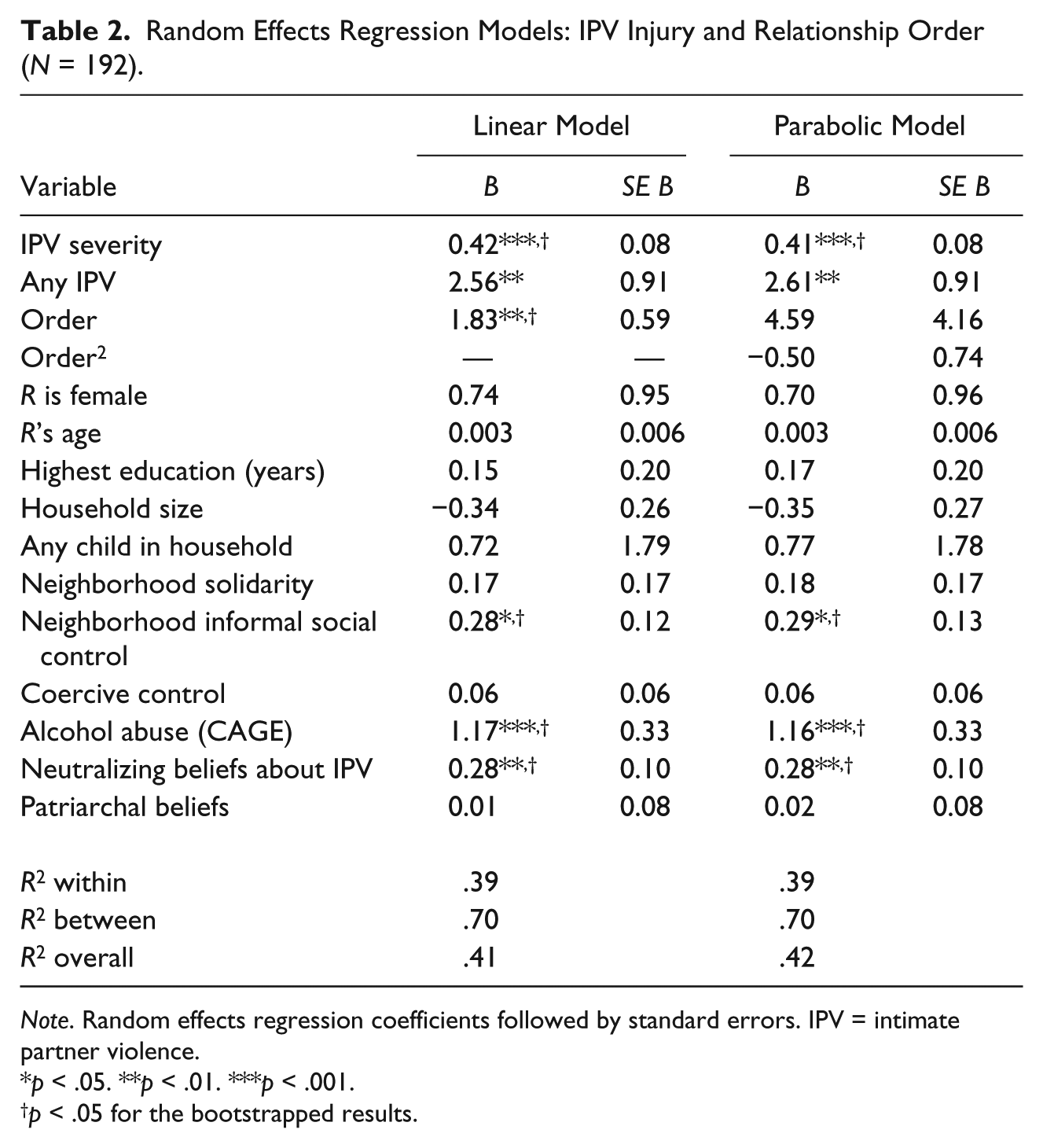
Table 2 provides the results of random effects regression analyses. Non-parametric bootstraps were run for the models because of skew in the dependent variable. Variables that were significant at p < .05 in the bootstrapped models are marked with (ϕ). Consistent with parsimony in variable selection, we first ran a random effects regression model with only a linear estimate for the relationship between IPV injury and order (linear model). This model shows a strong linear relationship between order and IPV injury (β = 1.83, t = 3.11, p < .01). Higher levels of order in relationships are associated with higher prevalence of IPV injury, holding constant IPV severity, prevalence, neighborhood collective efficacy, coercive control, neutralizing beliefs about IPV, patriarchal beliefs, alcohol abuse, and demographic characteristics. More specifically, an average one category increase (e.g. from rarely to sometimes) across all order items is associated with an additional 1.8 reported IPV injuries annually.
Random Effects Regression Models: IPV Injury and Relationship Order (N = 192).
Note. Random effects regression coefficients followed by standard errors. IPV = intimate partner violence.
p < .05. **p < .01. ***p < .001.
p < .05 for the bootstrapped results.
The linear model also shows relationships between IPV injury and neutralizing beliefs about IPV, the CAGE alcohol abuse measure, and the informal social control component of collective efficacy. It is important to note that the model shows a positive relationship between neighborhood informal social control and IPV injury. That is, higher neighborhood informal social control of crime on the street is associated with more, rather than less, IPV injury (β = .28, t = 2.20, p < .05).
No Parabolic Relationship Between IPV Injury and Relationship Order
We predicted that both very low and very high levels of order would be associated with higher rates of IPV injury. The parabolic model did not support this. Neither the squared term nor the linear term for order is significant in the parabolic model. Furthermore, the negative coefficient for the squared term indicates that the estimated parabola is downward, rather than upward facing. There are some grounds to think that this dismissal of the non-linear model may be premature however. The largest VIFs for the parabolic model were for order and order squared, and these were very large (63.6 and 62.4, respectively). The litmus test of significance in this circumstance is a joint significance test of both coefficients, and this was highly significant (χ2 = 9.94, df = 2, p < .01). Perhaps a combination of multicollinearity between the two versions of the order variable and insufficient numbers of highly disorganized households prevented the parabolic model from detecting a relationship?
It is impossible to answer this question directly, but we turned to lowess regression to examine the functional form of the relationship between order and IPV injury more closely. Lowess smoothing performs a locally weighted regression of the dependent variable on the independent variable (StataCorp, 2009); in this case, the residual variance in IPV injury unexplained by other variables in the model and order. Although the smoothed regression did show that the regression line for very low levels of order is based on very few cases (about 6), there was no indication of the upward facing parabola hypothesized.
The smoothed regression also showed that the four outliers occurred for very high levels of IPV injury at relatively high levels of order. These could represent Emery’s (2011) totalitarian dictatorship construct. Thus, it seemed possible that the relationship between order and IPV injury might be partially mediated (Baron & Kenny, 1986) by these outliers. However, Sobel tests showed no evidence of significant mediation (β = .29, Z = 2.20, p = .22).
Discussion
Higher Rates of IPV Injury for Deviant Order?
In the article “Disorder or Deviant Order?” Emery (2011) argues that the continuum of order in relationships is fundamental to understanding IPV. At the low end of the continuum is anarchic IPV, at the high end is totalitarian dictatorship, which is similar but not identical to Johnson’s (2008) intimate terrorism concept. In finding a strong relationship between relationship order and IPV injury, this study provides initial empirical support for one of Emery’s basic arguments: Order is fundamentally important in understanding IPV. Highly ordered relationships must, subject to replication of these results, be considered a risk factor for IPV injury in Mongolia. More broadly, the existence of a strong relationship between relationship order and IPV injury suggests that order may be of importance in understanding other types of violence within families.
Although counter-intuitive from the perspective of social disorganization theory (cf. Browning, 2002; Kornhauser, 1978), the finding that highly ordered relationships are also high risk is consistent with textually rich and feminist accounts of the most severe types of IPV (cf. Dobash & Dobash, 1979; Stark, 2007) and Emery’s (2011) totalitarian dictatorship. It is not inconsistent, but is less consistent with Johnson’s (2008) intimate terrorism because that concept focuses on violence that is control motivated. Johnson’s (2008) construct does not require that control be achieved, which would be necessary for a relationship order backed up by force, as Emery’s type presupposes. It is worth noting that the measure of order is significant when the measure of partner’s control motivated behavior (coercive control) is controlled in the model. This suggests that the relationship between order and IPV injury may not be reducible to a relationship between order and Johnson’s (2008) control motivated behavior on one hand, and control motivated behavior and IPV injury on the other. That is, at least for this study, it appears to be order, rather than control motive, that is important. To further test Emery’s typology, future research might examine the extent to which violence in highly ordered households is preceded by disorder. Such findings would be suggestive of the totalitarian dictatorship form of IPV.
On the other hand, our analyses found no evidence of higher prevalence of IPV injury for very low levels of order. It is possible that Emery’s (2011) conceptualization of anarchic IPV lacks resonance with the empirical experience of couples in relationships (particularly in Mongolia). However, this is a small study and there are only about six relationships characterized by very low levels of order. Indeed, we would hope that the severely distressed, multi-problem households characterized by anarchic IPV would be comparatively rare. A larger study, or one targeted toward a more distressed rather than a general population, may be necessary to fully investigate this construct. In addition, examining alcohol abuse as a mediator, rather than controlling for it, might be more appropriate for a first study of anarchic IPV.
Consistent with existing theory and research, neutralizing beliefs and alcohol abuse were both associated with higher levels of IPV injury (Kantor & Straus, 1990; Matza, 1964/1990; Mooney, 2007). The finding of neutralizing beliefs as a risk factor, in particular, suggests that neutralizing beliefs should continue to be regarded as a critical variable in understanding ongoing patterns of IPV perpetration and victimization. Victims of IPV may be more likely to remain in violent relationships and continue to suffer injury when they excuse the violence that is perpetrated.
Informal Social Control of Street Crime as a Risk Factor for IPV Injury?
From the standpoint of social disorganization theory, there was a second counter-intuitive finding. Neighborhood informal social control of street crime (a component of collective efficacy) was associated with significantly more, rather than less, IPV injury. This flies in the face of social disorganization theory and empirical findings that collective efficacy is a protective factor against IPV (Browning, 2002). However, a close examination of the literature reveals that such an apparent anomaly is not entirely unanticipated. Emery, Jolley, and Wu (2010) found neighborhoods with lower tolerance for crime were associated with lower odds of IPV relationship dissolution. They speculated that neighborhoods high in informal social control of street crime might be more traditional and conservative, favoring a “stay no matter what” approach to marriage. Were this the case, living in such a neighborhood would indeed be a risk factor for IPV injury. Such findings underscore the need for IPV-specific measures of informal social control.
More generally speaking, our findings of positive relationships between order and IPV injury and neighborhood informal social control and IPV injury may speak to a broader reality in Ulaanbaatar. It may be the case that highly generalized traditional social norms in Mongolia support the use of violence to establish and maintain order, both at the neighborhood level and at the family level. If this is the case, higher levels of informal social control at the neighborhood level might also signal greater tolerance for violence in the service of order, and hence, for IPV injury.
Limitations
There are a number of limitations that affect the strength of the conclusions that can be drawn from these findings. First, both IPV injury and IPV severity are subject to reporter bias. The findings are subject to replication and are drawn from a small, non-experimental, cross-sectional study. Although representative of Ulaanbaatar, the findings cannot yet be generalized beyond Mongolia. Moreover, further research is needed to examine the causal direction of the relationship between order and IPV injury. It may be the case that the strong association between order and IPV injury occurs because the totalitarian dictatorship type of IPV is characterized by an elaborate relationship order. That is, it may be that IPV injury is more likely in the totalitarian type, and that the totalitarian type uses violence to create or maintain order. It may also be the case, however, that severe and injury-producing IPV creates a need in victims to perceive or create household order as a coping response. Future analyses will need to control for victim anxiety and to examine quasi-experimental approaches. More broadly, although our measure of order has the advantage of simplicity and of being concrete enough to allow for objective verification (for example, by visitors to the household), the measure does not capture a nuanced subjective experience of order. For example, some of what we measure as disorder may not be subjectively experienced by some respondents as disorder. Finally, we cannot rule out the possibility that the null finding for a relationship between low order and IPV injury stems from a combination of multicollinearity and small sample size.
Conclusion
The findings suggest that in prevalence, severity, and consequences, IPV is a serious problem in Mongolia. Rates of both prevalence and injury are high, with nearly one in three couples reporting IPV and about one in eight couples in Ulaanbaatar reporting some form of IPV injury every year. The true long-term costs of such violence are terrible and inestimable, including, as they do, death, long-term disability, and psychological harm to victims and children. These basic findings suggest a great need for further research into causes of and intervention for IPV in Mongolia.
The findings also provide initial empirical support for the argument that relationship order is fundamentally important in understanding IPV. Further investigation of relationship order, among the other fundamentals of power and norms suggested by Emery (2011), appears to be strongly warranted. The highly ordered totalitarian dictatorship form of IPV may correspond to the lived experiences of many victims, and must be further examined in other contexts. These findings are preliminary. Under the circumstances however, we would tentatively suggest that it may be a mistake to conflate highly ordered relationships with what is beneficial or socially desirable. Then again, theory suggests some modicum of order is necessary to our existence. Perhaps it is safest to say that, with respect to order in relationships, as with many other things, there may be such a thing as too much of a good thing.
Footnotes
Acknowledgements
We wish to thank the Mongolian interview team for their dedication.
Declaration of Conflicting Interests
The author(s) declared no potential conflicts of interest with respect to the research, authorship, and/or publication of this article.
Funding
The author(s) disclosed receipt of the following financial support for the research, authorship, and/or publication of this article: This study was facilitated by NSFC grants 71002014 and 71110107027. Measure development was facilitated by a grant from H. F. Guggenheim foundation and NRF No. 616-2011-2-B000009 (MEST) from the Korean government.