



Abstract
Gender-based domestic violence (DV) comes at great costs to the victims and society at large. Yet, many women hold the view that intimate partner violence (IPV) against women is appropriate behavior. This study aimed at exploring the nexus of experience of different forms of DV and acceptance of IPV as appropriate behavior. Using data from a survey of 480 out-of-school adolescent girls, the researcher shows that psychological abuse is a significant predictor of approval of DV resulting from the wife’s failure to make food available for her husband with victims of abuse approving of violence against women. Conversely, victims of sexual abuse, more than nonvictims, disapproved of wife beating resulting from the wife going out without informing the husband. The implications of the findings are discussed and the study recommends deconstructing women’s negative beliefs upon which DV rests.
Keywords
Introduction
More than it did in the past, domestic violence (DV) has attracted the attention of researchers, human rights activists, and policy makers in recent times as its multifaceted negative consequences have become more worrisome. DV has been described as a broad range of assaultive and coercive behavior, including physical, sexual, and psychological attacks as well as economic coercion used by adults or adolescents against their current or former intimate partners (United Nations International Children’s Fund [UNICEF] and Body Shop International, 2006). Cherlin (2002, p. 386) defines it as violent acts between family members or between women and men in intimate or dating relationships. Others view DV as not limited to persons in intimate relationships. It is described as any form of confrontation between family or household members that typically involves physical harm, sexual assault, or threat of use of physical harm (National Population Commission [NPC] [Nigeria] and ICF Macro, 2009, p. 261). From the definitions above, DV can take three major forms—physical abuse, sexual abuse, and psychological abuse. Examples of physical abuse are slapping, shaking (vigorously), beating with fist or object, strangulation, burning, kicking, and so on, whereas sexual abuse can take the form of coerced sex through threats or intimidation or through physical force, forcing unwanted sexual acts, forcing sex in front of others, and forcing sex with others. Examples of psychological abuse are isolation, verbal aggression, intimidation through destruction of property, threats of violence, and constant belittling and humiliation (NPC [Nigeria] and ICF Macro, 2009, p. 261). DV can also take other forms such as economic deprivation or spiritual deprivation (Aihie, 2009), which are often enforced with threat to use force.
García-Moreno, Jansen, Ellsberg, Heise, and Watts (2005) explain that DV is broad and inclusive of child abuse, intimate partner violence (IPV), and abuse of the elderly. The adopted definition of DV for this study includes child abuse and/or IPV, but not abuse of the elderly because only adolescents are included in the study. More often than not, victims of DV are women who experience IPV/abuse (NPC [Nigeria] and ICF Macro, 2009; World Health Organization [WHO], 2010) and children who experience child maltreatment. IPV is any behavior within an intimate relationship that causes physical, sexual, or psychological harm, including acts of physical aggression, sexual coercions, psychological abuse, and controlling behavior (WHO, 2010). Child maltreatment, however, involves physical and emotional mistreatment, sexual abuse, neglect, and negligent treatment of children by parents or their family members, caregivers, friends, acquaintances, strangers, others in authority, employers, health care workers, and other children (WHO & International Society for Prevention of Child Abuse and Neglect, 2006). These forms of abuse deny the victims of their human rights, and they are potential sources of physical, reproductive health, and emotional harm. So severe is the problem of DV that studies have documented cases against pregnant women (Efetie & Salami, 2007; Envuladu et al., 2012; Project Alert, 2011). Yet, most cases of DV suffered by women are unreported and nothing is done by the victims beyond silence and hoping that the situation will change (Aborisade, 2012; Ashimolowo & Otufale, 2012).
The world over, women experience DV (Abama & Kwaja, 2009; Oladepo, Yusuf, & Arulogun, 2011; WHO, 2010) and studies have documented varying degrees of its prevalence. The Demographic and Health Survey (DHS) shows that more than a quarter (27%) of girls within the age bracket of 15 to 19 years have experienced physical violence since the age of 15 years, and about 16% of them experienced physical violence in the past 12 months (NPC [Nigeria] and ICF Macro, 2009, p. 261). Another study by Alemika (2011) shows that 11% of participants in a nationwide study had experienced DV in the last 3 years preceding the study. In yet another study of young girls and women (ages 11 to 60 years) in South-West Nigeria, 22% of the participants had experienced DV (Project Alert, 2011).
Studies have explored factors responsible for DV. Some macro-level analyses attribute it to patriarchy (A. A. Adebayo & Kolawole, 2013; Eze-Anaba, 2007; Tenuche, 2011); cultural variations, as prevalence of DV varies across regions (Oladepo et al., 2011); and gender-insensitive criminal justice system (A. A. Adebayo & Kolawole, 2013). Others have explored micro-level variables on the part of the perpetrators who are usually men (WHO, 2010) and victims who are usually women (NPC [Nigeria] and ICF Macro, 2009; WHO, 2010). On the part of men who victimize women, studies have identified low education/being unskilled (Envuladu et al., 2012); alcohol consumption/smoking (Envuladu et al., 2012; Yusuf, Arulogun, Oladepo, & Olowokeere, 2011); and multiple sexual partnerships (Envuladu et al., 2012) as factors associated with DV. On the part of the victims of DV, studies have identified associated factors such as intraparental violence (Nnadi, 2012; WHO, 2010); low education (but not “no formal education”; A. A. Adebayo & Kolawole, 2013; NPC [Nigeria] and ICF Macro, 2009); alcohol consumption/substance abuse (Envuladu et al., 2012; WHO, 2010); multiple sexual partnerships (Envuladu et al., 2012); being HIV positive (Envuladu et al., 2012); contribution to the family economy (Ezeah, 2013); not having full-time paid employment/economic dependence (A. A. Adebayo & Kolawole, 2013; R. A. Adebayo, Okulate, Ladapo, & Lawal, 2010; Azhar, Sohail, Yasin, Mahmoud, & Mushtaq, 2012; Eze-Anaba, 2007); being in a polygynous marital union (R. A. Adebayo et al., 2010); and acceptance of violence as appropriate behavior (WHO, 2010). Common reasons given by men for abusing women include disrespect to husband and suspicion of infidelity (Project Alert, 2011).
DV comes at great cost to the victims, the family, and the society at large. Sometimes, the harm can last a lifetime and span generations (WHO, 2010). Some of the negative implications documented through research include ill health (Esere, Idowu, Durosaro, & Omotosho, 2009; NPC [Nigeria] and ICF Macro, 2009; Tenuche, 2011), low self-esteem (Imhonde, Aluede, & Oboite, 2009; NPC [Nigeria] and ICF Macro, 2009), denial of human rights, and death (NPC [Nigeria] and ICF Macro, 2009). Other consequences of DV include physical injury, sleep disturbance (Esere et al., 2009); excessive fear/anxiety, suicidal thoughts, and hatred for men (Esere et al., 2009; Project Alert, 2011); health-risk behavior such as smoking, drug and alcohol misuse, and risky sexual behavior; and behavioral and emotional disturbances that can be associated with the perpetration or experiencing of violence in later life (WHO, 2010). In addition to the negative implications of DV for the welfare of the victims, it is a major threat to social and economic development (Abama & Kwaja, 2009; Nnadi, 2012; Tenuche, 2011). In spite of the negative implications of DV for society in general and the welfare of women in particular, violence against women still enjoys the approval of a significant proportion of people and, quite appallingly, women approve of it more than men (Uthman, Lawoko, & Maradi, 2009, 2010).
In Africa, the proportion of women justifying wife beating for at least one reason range from 17% to 87% (Africa, Health, Human & Social Development Information Service & Africa Coalition on Maternal, Newborn & Child Health, 2013). Among adolescent girls within the age bracket of 15 to 19 years in Nigeria, 17% were of the opinion that a husband is justified in beating his wife if she burns the food, 26% if she argues with him, 31% if she goes out without telling him, 30% if she neglects the children, and 21% if she refuses to have sex with him. Forty percent of the respondents agreed with at least one of these specified reasons for beating a wife (NPC [Nigeria] and ICF Macro, 2009). Research has shown that among women within the age bracket of 15 to 49 years, older women, those in marital unions, those with large spousal age difference, those in polygynous unions (Oyediran & Isiugo-Abanihe, 2005), those with no formal education, rural dwellers, those low on the wealth index, those less exposed to the media (Oyediran & Isiugo-Abanihe, 2005; Uthman, Lawoko, & Maradi, 2009), and those not jointly involved in decision making with their spouses (Uthman, Lawoko, & Maradi, 2009) are more likely to justify wife battering, relative to their respective counterparts.
The social learning theory holds the view that children learn the behaviors they will exhibit by observing what others do. Children imitate violent behavior of parents and other authority figures with which they can identify (Bandura, Ross, & Ross, 1961, 1963). Children from homes where DV is experienced, through observation and personal experience of violence, learn that violence is an acceptable behavior (Bandura, 1973). The implication of this theoretical position for this study is that there is a strong likelihood that DV will become a continuing cycle of violence for the next generation (UNICEF and Body Shop International, 2006). This is because those who experience violence are likely to perceive it as acceptable. This theoretical position provides the basis for the core research question:
To further provide explanation for the relationship between experience of DV and acceptance of same as appropriate behavior, the study set out to provide answers to related research interests that include exploring to ascertain if the different forms of abuse relate in the same way or differently with acceptance of IPV. This research seeks, therefore, to show if experience of physical abuse relates in the same manner with acceptance of IPV as other forms of abuse such as sexual and emotional abuse. In other words, the study explores the relationship between experience of sexual abuse and acceptance of IPV as appropriate behavior, experience of emotional abuse and acceptance of IPV as appropriate behavior, and experience of physical abuse and acceptance of IPV as appropriate behavior among out-of-school adolescent girls. This subpopulation is very likely to be left out of school-based awareness programs designed to change public orientation on DV. The interest in out-of-school adolescent girls also derives from the likelihood that their peculiar experiences are often submerged in larger nationwide studies and these experiences are usually more worrisome and attention-demanding than the pictures painted for the general population (see Kunnuji & Esiet, 2013).
Method
The data used for this study come from a study of 480 out-of-school adolescent (10-19 years old) girls resident in Iwaya community. The community lies in the South-Eastern part of Yaba, Mainland Local Government Area of Lagos state, overlooking the Lagos lagoon. The community covers an area of about 80 hectares and many of the occupants are migrants (Agbola & Agunbiade, 2009). Iwaya community shares its border to the South with Makoko community, which is also a squatter settlement to a large extent. Some of the adult residents of the community are blue-collar workers in government offices in neighboring communities. Many of those in the informal sector are involved in fishing, fish selling (for the women), and petty trading. Many of the households in the community live in squalor without access to improved water, sanitation, and health care facilities (see Agbola & Agunbiade, 2009). In addition, the majority of the residents do not own the land they occupy and they live in constant fear of impending displacement (Ugbodaga, 2011).
A census of all out-of-school girls aged 10 to 19 years was conducted. The only exclusion criterion was lack of willingness to participate in the study when the criteria of sex (females only), age (10-19 years), and schooling status (out-of-school) were met. About 97% of those approached for the study agreed to take part in the exercise. Informed consent was sought and obtained from all the respondents and parental approvals were obtained before interviews were conducted with adolescents aged 18 years and below. The ethical review committee of Action Health Incorporated approved the research design and interview schedule for use. Face-to-face interviews were conducted with the participants outside hearing distance of third parties. The interviews were conducted at each participant’s home/shop frontage and not inside living rooms as a sign of respect for family/household privacy. (Many households lived in single room apartments.) This also helped ensure that other household members were not within earshot during interviews. No material incentives were given to the participants. They were, however, informed that the exercise would serve as a baseline study for an intervention program aimed at providing vocational skills and literacy for girls in need vocational training and/or without basic literacy skill in the population. At the end of the study, participants who had need for literacy and vocational skills were enrolled for vocational training and literacy classes by Action Health Incorporated in collaboration with the Lagos state Agency for Mass Education at no cost to the girls.
The data gathered were screened for internal consistency, coded, and processed for analysis using the Statistical Package for Social Sciences, Version 17.
Procedure
A standardized interview schedule was administered to the participants in face-to-face interviews by trained female field assistants. An average interview lasted about 45 min. Most of the interviews were conducted in Yoruba (the local language in the community) and/or pidgin English as considered suitable by the respondents. Key concepts and phrases in the instrument were translated into the local languages and pidgin English during the training sessions for field assistants. Every completed interview schedule was scrutinized by an office editor who did one of three things: approved the interview for analysis (if the responses were credible and without internal inconsistencies); returned it to the field assistant for a repeat visit to the respondent (if there were omissions or needs for clarifications); or rejected the interview as not usable (if there were irredeemable contradictions).
Measures
Twelve indicators of experience of DV were employed for the study. These can be divided into indicators of experience of physical abuse, sexual abuse, and emotional abuse within the household. Indicators of physical abuse are (a) experience of slapping, (b) experience of kicking or dragging on the floor, (c) experience of pushing/shaking/being pelted with an object, (d) experience of twisting of one’s arm/pulling of one’s hair, (e) experience of punching, and (f) experience of attempt to strangle or burn in the hands of parents/guardians/partners in the last 12 months. The indicators of emotional abuse explored in the study are (a) experience of insults and comments that made the victim feel bad about herself, (b) humiliation in the presence of other people, (c) experience of threats to attack with knife/gun/any other weapon, and (d) experience of any other behavior that caused mental/emotional injury in the hands of parents/guardians/partners in the last 12 months. Two indicators of sexual abuse were employed. These are (a) experience of forced sex and (b) experience of other forms of unwanted sexual act under coercion by parents/guardians/partners in the last 12 months. All indicators of experience of DV were measured in binary categorical form, with experience coded as “1” and absence of it coded as “0.” The overall measurement of experience of the different forms of abuse and DV as a whole was treated in the same manner with experience of at least one form of violence coded as “1” and having not experienced any form of violence coded as “0.”
Seven grounds for the justification of DV were explored in the measurement of justification of IPV. The questions are as follows: A husband is justified in beating his wife if (a) she refuses to have another child, (b) she fails to prepare food on time, (c) she burns the food, (d) she refuses to have sex with him, (e) she argues with him, (f) she neglects the children, and (g) she goes out without telling him. These are “yes” or “no” questions and were treated as binary categorical variables. For each reason provided, justification was coded as “1” and disapproval was coded as “0.” On the whole, approval of wife beating was treated as a binary categorical variable that separates those who have at least one reason for justifying wife beating and those who disapprove of wife beating. These questions were adopted from the 2008 Demographic Health Survey instrument. The same questions had also been used for the multicountry study on DV (see García-Moreno et al., 2005; 2006). These measures are behavior-specific questions related to the identified forms of DV. This approach has been used widely across the globe in the study of DV with the advantage of having a high capacity to encourage greater disclosure of violence than approaches that require survey participants to identify themselves as victims of DV (García-Moreno et al., 2005; 2006). The Cronbach’s alphas for the measures of physical and sexual violence, and psychological abuse are .81, .66, and .73, respectively (see García-Moreno et al., 2005). Background characteristics included in the analyses are education (highest educational institution ever attended), ethnic origin, age, marital status, and migration status. All the variables were measured in categorical form.
Analysis
Simple percentage frequencies were used in the description of the background characteristics of the participants, experience of DV, and approval of wife beating. The binary logistic regression statistic was adopted in the analysis of experience of DV and approval of wife beating. To determine variables to include in the models, chi-square statistics were employed at the bivariate level. Background characteristic variables with statistically significant associations with DV and approval of wife beating were included in the models. Logistic regression models were computed only for acceptance of wife beating for reasons that were found to be significantly associated with experience of at least one form of DV. As independent covariates, experience of physical, psychological, and sexual violence were included in the models for approval of wife beating on the grounds of failing to prepare food for the husband on time; burning the food; and going out without telling the husband. The Hosmer and Lemeshow’s test was used to measure the goodness of fit of the models. For all the tests, the acceptable confidence interval is 95%. Thus, tests were considered significant only in cases where the p value is less than .05.
Ethical Considerations
The study adhered to the ethical procedures of anonymity, confidentiality, and informed consent. Interviews were conducted outside hearing distance of third parties. Identification numbers were assigned after the screening exercise to preserve the identities of the respondents. The writing of this report excludes the use of names or any other means of identification. The study design and instrument used were approved for use by the ethical review committee of Action Health Incorporated. The committee is made up of sociologists, gender researchers, and reproductive health researchers.
Results
Background Characteristics of Participants
Adolescent girls within the age groups of 10 to 14 years and 15 to 19 years make up 26% and 74% of the total number of participants, respectively. The average age of the participants is 16 years. The majority of the girls (88%) were single/never married while 12% were married/living with men as though married or had ever lived in a marital union. One out of every four participants in the study never attended school. The majority (42%) of the participants are of Yoruba origin. Girls of Gun (Ogu) ethnic origin constitute 37% of the sample while Igbo and Hausa girls represent 17% and 4%, respectively. More than half (59%) of the respondents were not literate at all. About 18% could read with some difficulty while only about 23% could read fluently. The mean household size for the sample is 5.73. About 22% of the respondents had lost at least one of their biological parents at the time of the study.
About 39% of the participants in the study migrated into the community while the rest were born into the community. A quarter of them had never attended school; 28% attended primary school while 47% attended secondary school. Among those who attended primary school, 35% completed 6 years of primary education. Among those who attended secondary school, only 16% completed 6 years of secondary education. In all, 35% of the participants completed basic education (9 years of formal education) while less than a tenth (8%) of them completed secondary education. The distribution of the participants by living arrangements shows that 4% of the girls were living with their fathers only, 20% with mothers only, and 39% with both parents. About 8% were living with their husbands/boyfriends while 29% were living with guardians who were not their parents.
Experience of DV
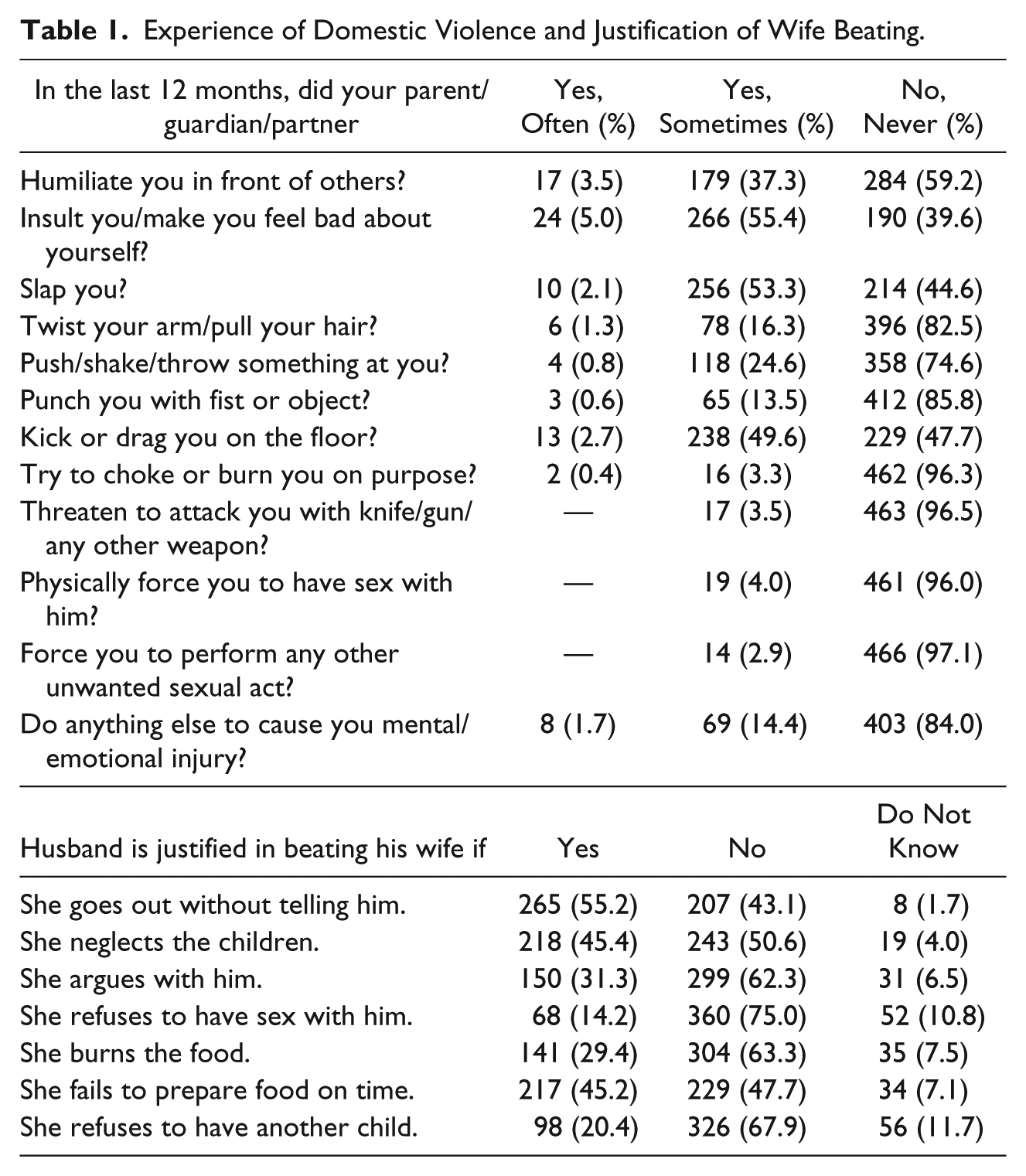
The most prevalent form of abuse in the last 1 year is insult/behavior/comments that made the girls feel bad about themselves. About 6 of every 10 respondents were victims of insult/comments/acts that made them feel bad about themselves as shown in Figure 1. About 55% of the respondents were slapped during the period in focus while a little more than half (52%) were kicked or dragged on the floor. About 40% of the participants were humiliated in front of others while one out of every four was pushed, shaken vigorously, or had something thrown at her. Less than 10% of the participants experienced any of rape, attempt to choke or burn on purpose, threat to attack with knife/gun/any other weapon, or coercion into performing any other unwanted sexual act. On the whole, 85% of the participants had experienced at least one form of DV or another in the last 12 months preceding the study.

Recent experience of domestic violence.
The study further shows that psychological/emotional abuse is the commonest form of abuse in the study population. About 73% of the participants suffered at least one of the four forms of psychological abuse included in the study (i.e., being insulted or made to feel bad with comments/behavior; being humiliated in the presence of other people; experiencing anything capable of causing mental/emotional injury; and being threatened with knife/gun/any other weapon). About 71% of the respondents experienced at least one of the forms of physical abuse explored in this study. These include being slapped, kicked/dragged, and pushed/shaken vigorously/pelted with an object. Other forms of physical abuse are having one’s arm twisted or hair pulled; being punched; and attempt to choke or burn on purpose. About 5% of the participants suffered at least one form of sexual abuse. The two forms of sexual abuse explored in the study are forced sexual intercourse and the performance of any other unwanted sexual act under coercion (see Table 1).
Experience of Domestic Violence and Justification of Wife Beating.
There is no association between experience of at least one form of DV and background characteristics such as age, marital status, migration status, ethnic origin, religion, educational attainment, and living arrangement. Bivariate tests focused on specific forms of abuse and background characteristics revealed, however, that experience of physical abuse is significantly associated with migration status, marital status, and living arrangement. Psychological abuse was found to be significantly associated with ethnic origin, education, and living arrangement, whereas experience of sexual abuse was found to be significantly associated with marital status and migration status.
Multivariate tests (tables not shown) reveal that living arrangement is the only significant predictor of experience of physical violence. Girls living with both parents were found to be twice as likely to report experience of physical violence than those living with their fathers only (p value = .001), whereas those living with their husbands/boyfriends were found to be less likely to report physical abuse than those living with their fathers only (p value = .000). Among girls living with their fathers only, mothers only, both parents, partners, and others, 13 (representing 76.5%), 64 (representing 68.1%), 153 (representing 81.4%), 17 (representing 42.5%), and 95 (representing 67.4%), respectively, were victims of physical violence. The only significant predictor of psychological abuse in the study is education. Girls who attended primary school were less likely to report experience of psychological abuse (87 participants representing 64.9%) than those who never attended school (83 participants representing 68.6%; p value = .041). On the contrary, girls who attended secondary school were more likely to report experience of psychological abuse (46 participants, representing 79.6%) than those who had never attended school (p value = .002). Marital status is the only significant predictor of experience of sexual abuse in the study. Girls who lived with their husbands/or partners as though married were found to be about 2.5 times more likely to report sexual abuse than those who had never been married/never lived with a partner (p value = .000). The frequency distribution shows that while 13 (3.1%) of the single-never married group had experienced sexual abuse, nine (16.1%) of those in marital unions/living as though married had experienced this form of violence.
Justification of IPV
As Table 1 shows, more than half (55%) of the respondents agreed that a man can be justified in beating his wife if she goes out without telling him. About 45% of the respondents justified the beating of a woman by her husband on the ground that she neglects the children. Furthermore, 45% agreed that a husband is justified in beating his wife if she fails to prepare food on time while 31% justified wife beating on the ground that she argues with the husband. In addition, about 29% agreed that the husband is justified in beating the wife if she burns the food. One out of every 5 participants agreed that a husband is justified in beating his wife if she refuses to have another child. About 14% of the participants were of the opinion that a man is justified in beating his wife if she refuses to have sex with him. The study shows that 78% of the participants had at least one justification for wife battering. By implication, only about 22% of the participants opined that wife beating cannot be justified for any of the reasons mentioned in the study.
To make certain that age is not a confounding variable in the analysis of the association between experience and acceptance of DV, the effect of age on acceptance of DV was also tested. The result shows that age is significantly associated with approval of wife beating resulting from the wife arguing with the husband (χ2 = 7.816; df = 2; p value = .020), refusing to have sex with the husband (χ2 = 8.874; df = 2; p value = .012), and failing to prepare food on time (χ2 = 11.323; df = 2; p value = .003). In each case, older girls (ages 15-19 years) were more approving of DV than younger girls (ages 10-14 years). The proportions of younger and older girls approving of DV for these three reasons are 21.8% compared with 34.6%, 7.3% compared with 16.6%, and 32.3% compared with 49.7%, in that order.
Experience of DV and Justification of Wife Beating
In this section, answers are provided to the research questions stated at the beginning of the study. These are as follows: Is experience of any form of DV a predictor of acceptance of IPV as appropriate behavior? Is experience of physical abuse a predictor of acceptance of IPV as appropriate behavior? Is experience of sexual abuse a predictor of acceptance of IPV as appropriate behavior? Is experience of emotional/psychological abuse a predictor of acceptance of IPV as appropriate behavior? The data show that there is a significant association between experience of at least one form of DV and justification of DV resulting from a woman’s failure to prepare the husband’s food on time (χ2 = 21.137; df = 1; p value < .001) and a woman burning the food (χ2 = 4.315; df = 1; p value < .05). For both reasons for wife beating, victims of DV were more likely to approve of DV than those who had no experience of DV. While about half (202 representing 49.6%) of victims of DV approved of wife beating resulting from a wife’s failure to prepare the husband’s food on time, only 15 (about 21%) of participants who did not experience DV in the last 1 year approved of wife beating on the ground of failure to prepare food on time. Similarly, 27 (31%) of the victims of DV approved of wife beating resulting from the wife burning the food while only 14 (representing 19%) of those who never experienced DV in the last 1 year approved of wife beating because of burning of food (see Figure 2).
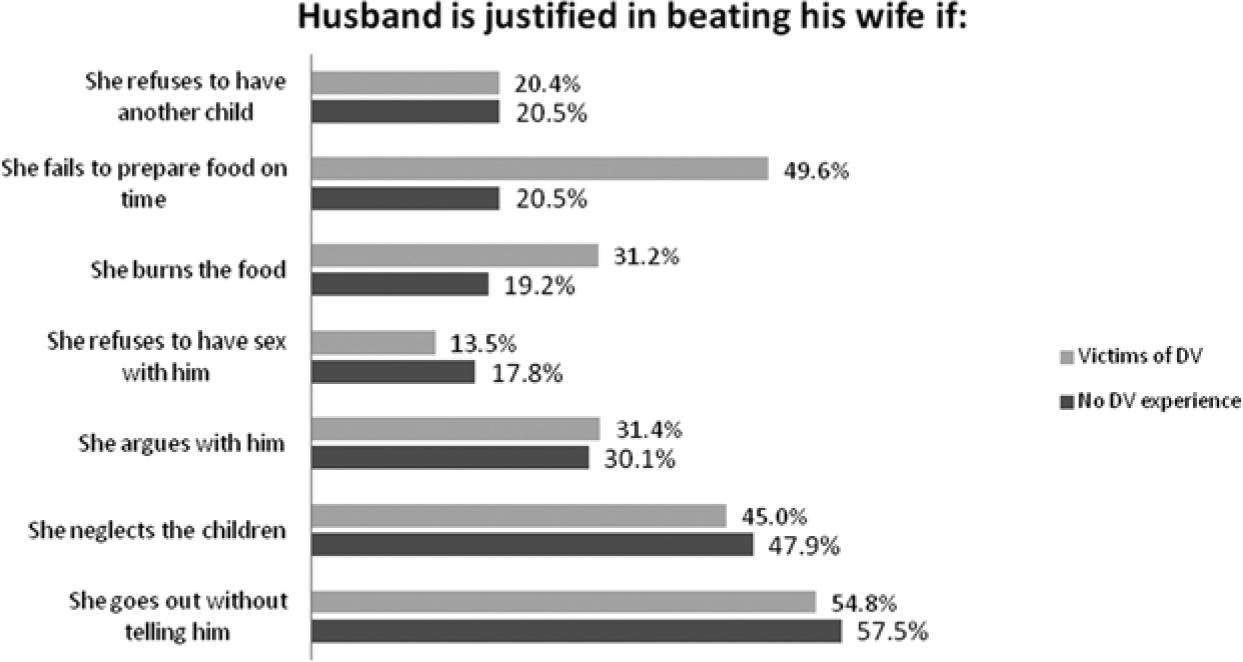
Justification of domestic violence by experience of violence.
As indicated earlier, the study further explored associations between the different forms of abuse (i.e., physical, sexual, or psychological/emotional) and specific grounds for justification of wife beating. Experience of physical abuse was found to be significantly associated with justification of wife beating if the reason is the wife’s failure to prepare the husband’s food on time (χ2 = 8.499; df = 1; p value = .004). While about 169 (49.4%) of victims of physical abuse justified IPV for this reason, only 48 (34.8%) of those who did not experience physical violence approved of IPV for this reason. Experience of psychological abuse was found to be associated with justification of wife beating on two grounds—failure to prepare food on time (χ2 = 19.091; df = 1; p value = .000) and burning the food (χ2 = 12.129; df = 1; p value = .000). A higher proportion (51.3%) of victims of psychological abuse approved of IPV on the ground that the wife fails to prepare the husband’s food on time than those who did not experience emotional/psychological abuse (29%). Similarly, a higher proportion (33.8%) of victims of psychological abuse approved of IPV on the ground that the wife burns the food than those who did not experience psychological abuse (17.6%).
Sexual abuse is significantly associated with justification of wife beating resulting from the wife going out without telling the husband (χ2 = 5.101; df = 1; p value = .024). In this case, however, those who had experienced sexual abuse were found to be less likely to justify wife beating on the ground of the wife going out without telling the husband than those who did not experience sexual abuse. While 7 (31.8%) of those who had experienced sexual abuse justified IPV for this reason, 258 (56.3%) of those who did not experience sexual abuse approved of IPV for the reason that a wife goes out without telling the husband. Justification of wife beating as a result of the wife going out without telling the husband was found to have no significant association with any of the background characteristics. Justification of wife beating resulting from the wife’s failure to prepare the man’s food on time was found to be associated with migration status, age, ethnic, religion, education, and marital status; while justification of wife beating resulting from the wife burning the food relates significantly to ethnic origin and education at the bivariate level. These variables were included in the construction of the models in Table 2 to control for their potential confounding effects.
Summary of Regression Models for Justification of Wife Beating for Selected Reasons.

- p < 0.05; **- p < 0.01; *** - p < 0.001.
As Table 2 (Model 1) shows, girls of Yoruba ethnic origin are twice as likely to justify wife beating resulting from the wife’s failure to prepare food on time as Hausa girls (the reference category). At the multivariate level of analysis, age was not found to be a significant predictor of acceptance of wife beating resulting from food burning. Girls who had ever been into marital unions/live with men as married were also found to be more likely to justify wife beating for the same reason than the single/never married girls. Justification of wife beating for this reason is less likely among migrant girls than it is among nonmigrant girls. The model further shows that girls who suffered emotional abuse are 1.6 times more likely to justify wife beating for the reason of the wife’s failure to prepare the food on time (β = .48, p value < .001). Also at the multivariate level, only two factors can significantly predict the likelihood of approval of wife beating resulting from food burning. These factors are ethnic origin and experience of psychological abuse. As in the approval of wife beating resulting from failure to prepare food on time, Yoruba girls are more likely to approve of wife beating resulting from burning the food. Model 2 of Table 2 further shows that psychologically abused girls are 1.5 times more likely to approve of wife beating than those who did not suffer psychological abuse (β = .40, p value < .01).
The third model shows experience of sexual abuse as the only significant predictor of approval of wife beating as a result of the wife going out without telling the husband. Sexually abused girls were found to be less likely to approve of wife beating on the ground that the wife goes out without telling the husband (β = −.508, p value < .05).
Discussion of Findings
The commonest form of abuse in the study population is emotional/psychological abuse in the form of verbal assault. This is followed by slapping, which is the commonest form of physical abuse experienced. These observations are in perfect agreement with an earlier study, which avers that the commonest forms of DV are verbal abuse and slap on the face (Oladepo et al., 2011). The commonest grounds for acceptance of wife beating in this study are the commonest identified in the DHS (NPC [Nigeria] and ICF Macro, 2009). These are going out without telling the husband and neglecting the children, in that order. More than half of the respondents approved of wife beating for the first reason. Going out without telling the husband is a major source of suspicion. Manifesting here is an unspoken agreement among the women and girls that going out without telling the husband is a sign that the woman has a secret affair, which is a taboo in many parts of the country. This explains why many women and girls do not see any wrong in beating a wife who goes out without letting the husband know her destination.
The study suggests that experience of DV is more prevalent among out-of-school adolescents than it is in the general population of adolescent girls. While only 16% of girls (ages 15-19 years) reported experience of physical abuse in the last 12 months preceding the DHS (NPC [Nigeria] and ICF Macro, 2009), 7 out of every 10 out-of-school girls experienced physical abuse in the last 12 months. In addition, acceptance of DV as an appropriate behavior is also more firmly rooted in out-of-school adolescents than it is in the general population of adolescent girls. Among Nigerian girls (ages 15-19 years) generally, the proportions justifying IPV resulting from food burning, arguing with the husband, going out without telling the husband, neglecting the children, and refusing to have sex with the husband are 17%, 26%, 31%, 30%, and 21%, in that order. Among the studied out-of-school adolescents within the same age bracket, however, the proportions are 30%, 35%, 55%, 49%, and 16%, respectively. Thus, out-of-school adolescents have higher proportions of people justifying abuse for all the reasons except refusal to have sex with the husband.
The study has further revealed the complex nature of the nexus of exposure to DV and perceptions on the propriety of wife beating for different reasons. DV as a composite factor is a significant predictor of acceptance of violence against women. This finding is in agreement with the position of the WHO (2010) that those who experience DV accept it as appropriate behavior. The implication, as argued by UNICEF and Body Shop International (2006) is that DV will become a continuing cycle for the next generation. This suggests that out-of-school girls who are experiencing DV in different parts of Nigeria today, more than those not experiencing DV, see the perpetration of DV as appropriate. Therefore, they are likely to perpetrate same when they become parents or guardians. In addition, if and when these girls enter marital unions, they are also likely to remain susceptible to IPV because they are unlikely to report or say “no” to what they consider appropriate behavior. This also shows why many victims of DV simply keep quiet when they are abused by their husbands (Aborisade, 2012; Ashimolowo & Otufale, 2012).
In addition to establishing the predictive power of experience of DV on acceptance of wife beating, this study has shown that there are specific forms of violation that are associated with specific reasons for the justification of wife beating. Experience of psychological abuse is the strongest form of abuse that is associated with justifying wife beating on any grounds. Girls who experience psychological abuse will approve of wife beating resulting from the wife’s failure to prepare the husband’s food on time or burning the food. The study shows that those who have experienced physical abuse or sexual abuse are not more likely to hold this view than those without the experience of physical/sexual abuse. The implication of this finding is that psychological abuse may have a more devastating effect on justification of IPV than physical and sexual abuse. Psychological abuse may leave no physical mark on the victim. Yet, it has a greater impact on acceptance of IPV as appropriate behavior.
Contrary to what was conjectured, victims of sexual abuse were found to be less likely to approve of wife beating resulting from going out without telling the husband. As stated earlier, going out without telling the husband often leads to suspicion of infidelity. When a woman is suspected or accused of having a secret lover by her husband, she runs the risk of being sexually abused by the husband as shown in the study by Esere et al. (2009). It, therefore, might be the case that a significant proportion of those who have suffered sexual abuse were suspected to be having secret lovers and the men with “legitimate right” to their bodies abused them sexually. As pointed out by Cherlin (2002), there is a widely accepted principle that by marrying and, by extension, living with a man as though married, women give their consent to sexual intercourse with their husbands. Therefore the husbands can demand for the bodies of their wives as a right. With this unpleasant experience, girls who have experienced sexual abuse may object to the propriety of wife beating resulting from going out without telling the husband, which is a proxy for suspicion of infidelity and a risk factor in sexual abuse. Yet, this is far from being conclusive, and future research should interrogate these hypothetical differentials in life experiences of the sexually abused and those not sexually abused and the potential effects of abuse.
Conclusion
Being a victim of psychological abuse is a tested predictor of acceptance of DV as appropriate behavior among out-of-school girls, particularly when the reason for abuse is related to making food available for the husband. The stage thus appears set for an endless cycle of violence. If girls hold the view that DV is acceptable, they will not report cases of abuse; they will be violent in dealing with their own children if they have children; and they will socialize their children to accept DV as appropriate behavior. As research has shown, DV has grave implications for individuals, families, communities, and nations. Therefore, attempts should be made to check DV. In Africa, an adequate explanatory theory of DV has to be multicausal. By the same token, multiple remedies must be proffered (Bowman, 2003).
Suneetha and Nagaraj (2010) have pointed out the limitations of legislation and activism as a tool for combating DV. It is doubtful that DV can be reduced or stopped if the victims do not see it as inappropriate or requiring action even when the best of laws are enacted and the most vibrant of activists keep watch. This explains why a reorientation of girls on the ills of DV and the inappropriateness of violence against women is necessary. While there is need for a complete overhaul of the legal system to protect women in Nigeria, there is also the need to create awareness on women’s rights issues and address cultural biases, beliefs, and ways of socialization, which themselves affect how laws are enforced (Eze-Anaba, 2007). This study agrees with the position of Eze-Anaba (2007) that there is the need to give particular attention to those beliefs held by women themselves about the propriety of DV targeted at them. Also in agreement with WHO (2005), there is the need for training and support for new parents, and increasing incentives for young people to complete their studies, as out-of-school girls fare worse than the general population of girls in the country on the indicators of DV and justification of IPV.
Footnotes
Acknowledgements
The author acknowledges and appreciates the permission given by Action Health Incorporated to use the data.
Declaration of Conflicting Interests
The author(s) declared no potential conflicts of interest with respect to the research, authorship, and/or publication of this article.
Funding
The author(s) disclosed receipt of the following financial support for the research, authorship, and/or publication of this article: The author acknowledges and appreciates the funding support of Ford Foundation (Grant 1100–0708).