



Abstract
Estimates indicate that intimate partner violence (IPV) occurs in approximately 30% of relationships and up to 85% of the relationships of men in substance abuse treatment. However, partners consistently display poor agreement in reporting the presence of IPV. Social desirability is frequently offered as the primary reason for under-reporting of IPV by perpetrators. The goal of the current study was to explicitly test the social desirability hypothesis using both partners’ reports of negotiation, psychological aggression, physical aggression, sexual aggression, and injuries in a substance abuse treatment sample. A total of 54 males and their female partners were recruited from a residential adult substance use treatment facility. Consistent with prior literature, partners displayed poor agreement about the presence of different types of IPV. The male partner’s social desirability was not associated with his reporting of male-to-female physical aggression, psychological aggression, or injuries. Men who engaged in higher levels of self-deceptive enhancement and lower levels of impression management were more likely to under-report male-to-female sexual coercion. Overall, the findings question the generalized importance of social desirability in IPV reporting in substance abuse treatment populations.
Intimate partner violence (IPV) is a significant public health issue that is associated with a host of poor outcomes (Basile, Arias, Desai, & Thompson, 2004; Campbell & Lewandowski, 1997; Ehrensaft, Moffitt, & Caspi, 2006; Taft et al., 2006). IPV is defined as the threatened, attempted, or completed physical, sexual, or emotional abuse that occurs between partners; it occurs in approximately 25% to 30% of relationships (Magdol, Moffitt, Caspi, & Silva, 1998). However, partners display poor agreement about whether IPV occurred (Archer, 1999), making the base rate and sequelae of IPV substantially more difficult to accurately assess. For example, counting only IPV incidents reported by the victim typically doubles the estimated base rate compared with counting only IPV incidents reported by both partners (Szinovacz & Egley, 1995). Partially explaining the lack of concordance is that perpetrators, both male and female, tend to under-report IPV relative to the victim (Archer, 1999).
Social desirability is often offered as the explanation of poor agreement between partners and under-reporting of IPV by the perpetrator (Fernández-González, O’Leary, & Muñoz-Rivas, 2013; Riggs, Murphy, & O’Leary, 1989). Prior investigations typically examined the bivariate relationship between a male’s self-report of his perpetration of IPV and his self-reported social desirability (e.g., Arias & Beach, 1987). Meta-analysis indicates a small effect (Mr = −.18) supporting the hypothesis that increases in social desirability are associated with reporting engaging in less IPV (Sugarman & Hotaling, 1997). However, the primary methodological limitation of this approach is that there is no partner, or victim, report present. Therefore, the bivariate relationship might not reflect under-reporting but rather actual differences in the occurrence of the behavior among men at varying levels of social desirability.
Social desirability reflects the tendency to behave and answer questions in a manner that is viewed positively and is commonly hypothesized as an important reason for the under-reporting of risk-taking behaviors and other socially unacceptable behaviors. According to a framework described by Paulhus and Reid (1991), social desirability represents two underlying processes that differ in intent: Self-deceptive enhancement (SDE) and impression management (IM; Paulhus & Reid, 1991). SDE occurs because humans are prone to match self-perceptions with their attitudes about themselves to reduce cognitive dissonance (Paulhus, 1984). In practice, SDE occurs when individuals who view themselves as a good person respond positively to content objectively consistent with the view of being a good person. In contrast to the more benign construct of SDE, IM occurs when individuals actively distort information to portray themselves in a positive manner (Paulhus, 1984). IM is often attributed as the reason for the under-reporting of socially undesirable behaviors (e.g., Helfritz et al., 2006; Linden, Paulhus, & Dobson, 1986).
Social desirability is often viewed as related to the reporting of a behavior and not the actual behavior itself. In terms of reporting, social desirability represents the tendency to respond to questions, particularly negative questions, in a manner that will be viewed favorably by others (Edwards, 1957). This view is most often applied to and discussed about in IPV (e.g., Moffitt et al., 1997). In contrast to the reporting approach, social desirability can also be a “substantive trait” or behavior (McCrae & Costa, 1983; Smith & Ellingson, 2002). In IPV, socially desirable behavior would be the lack of perpetrating IPV because the desire to be socially desirable inhibits socially unacceptable violence (Grams & Rogers, 1990). Taken together, either of these predictions suggests that social desirability should bias the perpetrator’s IPV reporting to be lower than the victim’s.
Agreement between informants about the presence of IPV is a distinct construct compared with what an individual informant reports. Cross-informant agreement is substantially more developed in children and adolescent psychopathology literature, as well as adult personality, than it is in IPV. In these literatures, informant discrepancies might reflect situational differences (Achenbach, Krukowski, Dumenci, & Ivanova, 2005; De Los Reyes, Bunnell, & Beidel, 2013; De Los Reyes, Henry, Tolan, & Wakschlag, 2009) or internal bias, such as dysphoria (Youngstrom, Izard, & Ackerman, 1999). To study whether social desirability is associated with agreement among informants requires the collection of data from both informants. Without multiple informants, under- or over-reporting cannot be examined because under- and over-reporting are a relative comparison. This methodological artifact has long been recognized but often left unaddressed in IPV (McCrae & Costa, 1983).
Concerns about under-reporting of negative behaviors are particularly prevalent for substance use as well as IPV. Heavy substance use is one of the more robust risk factors for male-to-female IPV (Schumacher, Feldbau-Kohn, Slep, & Heyman, 2001; Stith, Smith, Penn, Ward, & Tritt, 2004). Individuals in substance abuse treatment samples consistently display high levels of IPV (Stuart, O’Farrell, & Temple, 2009) compared with the general population (Schafer, Caetano, & Clark, 1998). Therefore, examining the association of socially desirable responding on IPV in a substance use sample is particularly meaningful because individuals in substance treatment are substantially more likely to be in relationships where IPV is a concern.
Study Hypotheses
Method
Participants
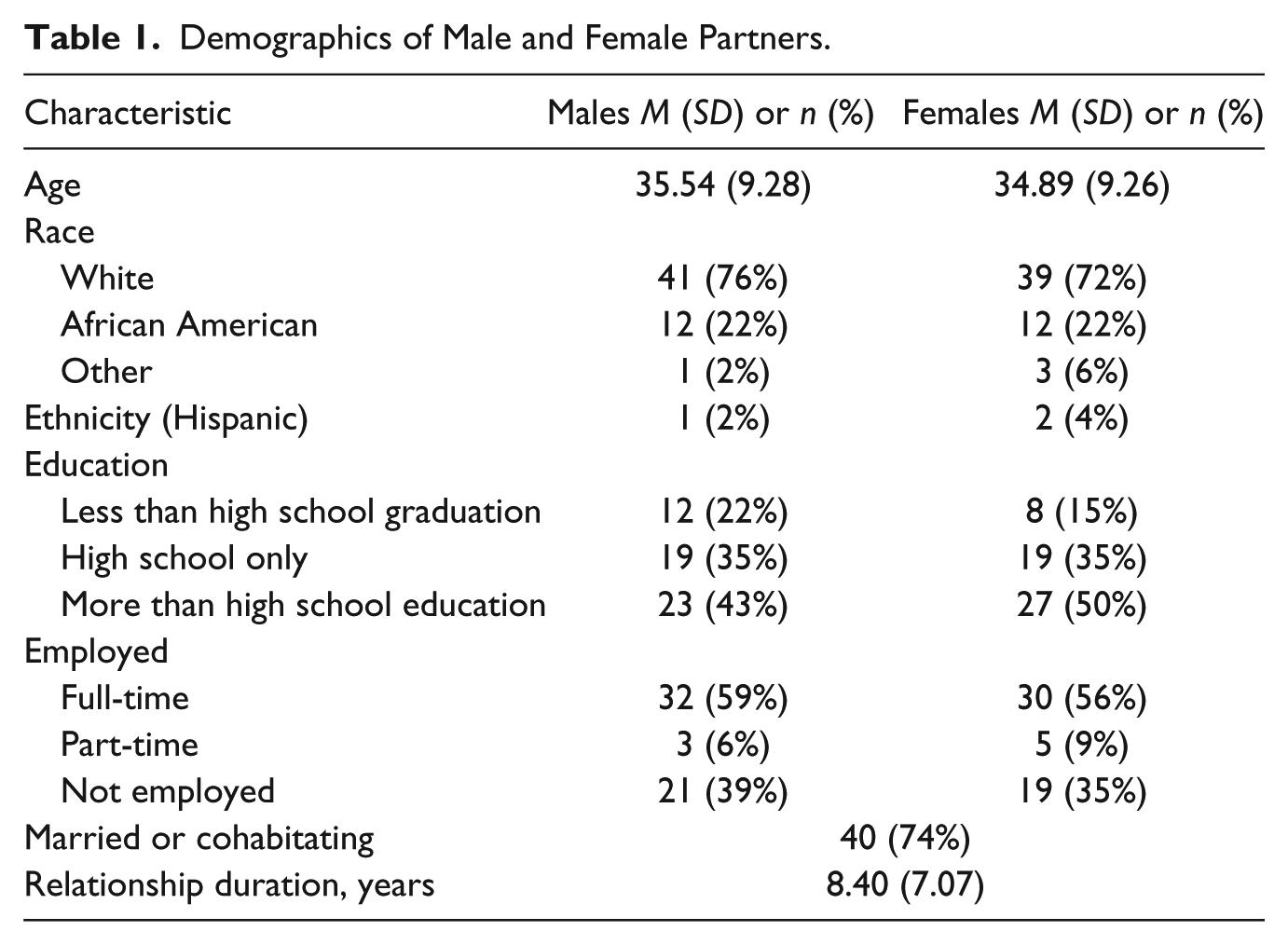
Participants were men enrolled in residential substance abuse treatment, who met criteria for a primary alcohol dependence diagnosis, reported at least five occasions of drinking in the 60 days prior to treatment entry during screening, were in a current or recent (ended within 1 month of study participation) heterosexual relationship of at least 1-year duration, and agreed to allow their female partner to be contacted to participate in the study. Of 109 female partners of male participants whom we attempted to contact, 54 (48%) were contacted and chose to participate. Male participants and female partner participants were recruited as part of two larger studies examining IPV in alcohol treatment samples (Schumacher, Coffey, Leonard, O’Jile, & Landy, 2013; Schumacher, Madson, & Norquist, 2011). Demographic and diagnostic characteristics of male participants and female partner participants are presented in Table 1.
Demographics of Male and Female Partners.
Measures
The Conflict Tactics Scales–Revised (CTS-2)
The CTS-2 (Straus, Hamby, Boney-McCoy, & Sugarman, 1996) is a 78-item scale that asks respondents to endorse the number of times in the past year they or their partner engaged in each of 39 conflict behaviors using a 7-point scale (never, once, twice, 3-5 times, 6-10 times, 10-20 times, and 20+ times). The CTS-2 was scored according to standard scoring procedures (Straus et al., 1996) to create frequency scores for five subscales: Negotiation, Psychological Aggression, Physical Assault, Sexual Coercion, and Injury. A binary variable, representing under- and over-reporting, was created for each type of IPV by the perpetrator. If the male’s scale was greater than the female’s, then the new variable was coded as over-reporting (1). If the male’s scale was less than the female’s, then it was coded as under-reporting (0). This approach results in binary scale scores that reflect under-reporting versus agreement or over-reporting.
The Paulhus Deception Scales (PDS™)
The PDS (Paulhus, 1998), which is the commercially available version of the Balanced Inventory of Desirable Responding (BIDR; Paulhus & Reid, 1991) is a 40-item scale that measures the tendency to provide socially desirable or undesirable responses on 5-point Likert-type scales (1 = not true to 5 = very true). Consistent with empirical evidence for more reliable measurement (Stöber, Dette, & Musch, 2002), sum scores for two subscales were created: self-deceptive enhancement (SDE) and impression management (IM). SDE measures the general tendency to match self-perceptions to attitudes about self. IM measures the tendency to actively manipulate how another perceives you in a positive manner. Higher scores on each scale reflect more SDE or IM.
Procedure
Study staff conducted weekly group recruitment and pre-screening sessions at two residential substance abuse treatment facilities. Men who met pre-screening criteria: an AUDIT score of at least 8, which is indicative of a strong likelihood of hazardous or harmful alcohol consumption, a self-report of at least five occasions of drinking in the 60 days prior to treatment entry; a current or recent relationship of at least 1 year duration; and an answer of “alcohol” or “both equal” to at least one of the five questions about drug and alcohol use, were scheduled for a 3 to 4 hr interview and self-report questionnaire assessment session during which study eligibility was fully assessed. These sessions were conducted in private rooms at the treatment facilities and were preceded by an institutional review board (IRB)-approved documented informed consent procedure. Female partners of the male participants were contacted using information provided by the male participants and scheduled for a 30- to 90-min assessment session during which they provided collateral reports of IPV. These assessments took place as home visits or in a private room in the investigator’s research space and were preceded by an IRB-approved documented informed consent procedure. All participants, both male and female, were compensated for their participation.
Results
Agreement About IPV
Table 2 displays the result of different methods of identifying agreement between each partner’s reporting of each other’s IPV. Each method reflects a different type of agreement. Pearson correlation displays the relative agreement between reporters. Kappa coefficients show the agreement beyond chance for whether individual items were endorsed by both partners. Weighted kappa coefficients display agreement beyond chance for the actual responses given to individual items within each subscale with regard to how much discrepancy was present in responses (e.g., a response pair of “never” plus “3-5 times” lowers kappa more than a response pair of “1-2 times” and “3-5 times”). Across types of agreement, the results were generally consistent in terms of statistical significance. However, using standard interpretations of kappa coefficients (i.e., 0 to .2 is slight, .21 to .40 is poor, .41 to .60 is fair, .61 to .80 is substantial, >.81 to 1.0 is almost perfect) suggests that agreement is at best poor or marginally adequate (Landis & Koch, 1977).
Measures of Agreement in Intimate Partner Violence Reporting.

p< .05.
Male-to-female
Males and their partners displayed adequate agreement about his engagement in psychological, physical aggression, and injurious behavior; poor agreement about sexual aggression; and no agreement about negotiation tactics. Agreement about the amount of IPV was lower than agreement about the presence of IPV. Partners displayed adequate agreement about the amount of psychological aggression; poor agreement about the amount of physical aggression, sexual aggression, and injuries; and no agreement beyond chance about the amount of negotiation tactics.
Female-to-male
Males and their partners displayed adequate agreement about the presence of her engaging in psychological aggression, physical aggression, and injuries; poor agreement about her engaging in physical aggression; and no agreement beyond chance about her use of negotiation and sexual aggression. Similar to the male-to-female decrease in agreement about the amount of IPV, the weighted kappa coefficients were typically lower than the kappa coefficients measuring presence. Partners displayed adequate levels of agreement about the amount of the female partner engaging in psychological aggression and injurious behavior; poor agreement about the amount of her physical aggression; and no agreement beyond chance about her use of negotiation and sexual aggression.
Bivariate Relationship Between IPV and Social Desirability
Male-to-female
Table 3 displays the correlation matrix for the relationship between IM and SDE with different types of IPV by reporter and direction of IPV (male-to-female and female-to-male). The more SDE a male endorsed, the more he endorsed using negotiating tactics with his partner (r = .34, p = .01); however, his partner did not report a similar increase in his use of negotiating tactics, r = .16, p = .25. The more IM a male endorsed, the less psychological aggression he reported using (r = −.42, p< .01); however, his partner did not report a similar decrease in his psychological aggression, r = −.11, p = .48. Men who endorsed more IM were described as engaging in more negotiating tactics by their partners, r = .28, p = .04. SDE and IM were not associated with other forms of IPV, all ps > .05.
Bivariate Correlations Among Social Desirability and Intimate Partner Violence.

Note. SDE = self-deceptive enhancement; IM = impression management.
p< .05.
Female-to-male
Males who engaged in more SDE reported that their partners used more negotiating tactics (r = .28, p = .04); however, partners did not report a similar increase in their own use of negotiating tactics, r = .07, p = .62. The more IM a male endorsed, the less he reported his partner’s use of psychological aggression (r = −.36, p< .01); however, his partner did not report a similar decrease in her use of psychological aggression, r = −.18, p = .20. In addition, the more IM a male engaged in, the more his partner reported negotiating with him (r = .29, p = .03), but he did not report his partner using more negotiation tactics, r = −.13, p = .33. SDE and IM were not associated with other forms of IPV, all ps> .05.
Social Desirability and IPV
SDE and overall agreement
The binary scores representing under-reporting compared with over-reporting were summed into a single scale that represented the general tendency of the male to under or over-report across all domains of IPV. A male’s tendency to under or over-report IPV relative to his partner was fairly consistent, Cronbach’s α = .69. Notably, only two men under-reported every scale relative to their partners and only two men agreed with or over-reported every scale relative to their partners. A male’s general under-reporting of IPV was not associated with his endorsement of IM (rs = .17, p = .21) or of SDE (rs = .02, p = .88).
Male-to-female
Logistic regression indicated that as a male’s SDE increased, he was more likely to under-report his use of negotiation relative to his partner, p< .05. However, the higher his impression management, the more likely he was to agree or over-report his use of negotiation, p< .05. Predicting the under- or over-reporting of sexual aggression was more complex. Main effects suggest that as IM increases, under-reporting increases and as SDE increases, agreement increases, ps < .05. However, the significant interaction term indicates the following: (a) males with low SDE and high IM were most likely to under-report sexual aggression, (b) males with low SDE and low IM were most likely to agree or over-report sexual aggression, and (c) males with high SDE and either low or high IM were just as likely to over-report as under-report sexual aggression, p < .05. SDE and IM did not predict under- or over-reporting of male to female psychological aggression, physical aggression, or injuries, all ps > .05.
Female-to-male
Logistic regression indicated that as a male’s SDE increased, he was more likely to under-report his partner’s use of negotiation, p< .05. In addition, as a male’s IM increased, he was more likely to agree or over-report his partner’s use of negotiation, p< .05. SDE and IM did not predict under- or over-reporting of female to male psychological aggression, physical aggression, sexual aggression, or injuries, all ps> .05.
Discussion
The current study examined the concordance between men seeking treatment for substance use and their partner’s reporting of intimate partner violence within the dyad as well as the commonly hypothesized role of social desirability influencing the male partner’s reports. Concordance rates, as measured by both unweighted and weighted kappas, ranged from poor to adequate agreement depending on the type of IPV as well as who the perpetrator was. For example, male-to-female as well as female-to-male psychological aggression, physical aggression, and injuries caused by IPV all displayed adequate levels of agreement. However, male to female sexual aggression displayed poor agreement and female to male sexual aggression displayed no agreement beyond chance. The current findings are similar to prior findings in substance abuse seeking samples (Panuzio et al., 2006) and slightly better than samples of couples seeking marital therapy (Jouriles & O’Leary, 1985) and community samples (Moffitt et al., 1997). Overall, men in substance use treatment tend to agree with their partners about the presence of IPV well above chance except for in the realm of sexual aggression, suggesting that self-report is generally an acceptable method of querying IPV.
The lack of concordance among partners in reports of IPV is often attributed to socially desirable responding on the part of the perpetrator, particularly if the male is the perpetrator (e.g., Archer, 1999; Moffitt et al., 1997). Consistent with effect sizes seen in prior work, the bivariate relationship between a male’s IM and his reporting of his psychological aggression was moderate (Bell & Naugle, 2007; Dutton & Hemphill, 1992; Sugarman & Hotaling, 1997). However, the bivariate relationship could reflect either socially desirable responding or a general pattern of engaging in prosocial behaviors (i.e., not engaging in IPV). Consistent with this belief, males who engaged in more IM, the more deceptive form of social desirability, were more likely to under-report psychological aggression perpetrated by both himself and his partner suggesting that individuals with higher levels of IM are more likely to attempt to portray the relationship as having less conflict. However, for most forms of IPV, the current study does not support these hypotheses. In contrast to this, IM and SDE did not predict under or over-reporting for physical violence, sexual violence, or injuries caused by IPV. Taken together, these findings question the commonly held hypothesis that reporting differences in IPV occur because of socially desirable responding by the perpetrator.
Limitations
The primary limitation of the current study is the small sample size. Sensitivity analyses indicated the ability to find moderate to large effects; the presence of small, subtle effects may not have been identified. Given that agreement was typically poor to adequate among partners and that differences in reporting of male-perpetrated IPV are often given as the primary hypothesis for poor agreement, the effects were expected to be large and hence detectable even in a small, exploratory sample. Second, the population from which the sample was drawn was for men receiving substance use treatment. Results from this population may not generalize to the general population or more specific populations (e.g., legal cases such as couples seeking divorce or domestic violence) as to the effect of social desirability. Third, the current analyses focus on the male partner’s social desirability leaving the question open as to whether these findings would generalize to the female partner’s reporting. Future studies should examine the role of social desirability in larger, contrasting populations where both reporters complete measures of social desirability as well as IPV.
Conclusion
Despite these limitations, findings suggest concordance between partners in the reporting of different types of IPV is only poor to adequate. In line with recommendations (American College of Obstetricians and Gynecologists, 2002; American Medical Association, 2004), any report of IPV should be attended to by clinicians. The lack of agreement should not be taken to assume that one partner is actively attempting to misrepresent the relationship. Instead, the differences might reflect differences in the salience of IPV between victim and perpetrator. Theoretically, the most important contribution of the current study is the questioning of the common hypothesis that social desirability causes a male perpetrator to under-report IPV relative to his partner.
Footnotes
Acknowledgements
We thank the couples who participated in this research.
Declaration of Conflicting Interests
The author(s) declared no potential conflicts of interest with respect to the research, authorship, and/or publication of this article.
Funding
The author(s) disclosed receipt of the following financial support for the research, authorship, and/or publication of this article: This work was supported in part by grants from the National Institute on Alcohol Abuse and Alcoholism (7R21AA014214-02; R21AA014907-02; PI: Schumacher)