



Abstract
This article describes the development of a scale measuring the extent of men’s belief in female sexual deceptiveness. This belief has been postulated as a component of hostile masculinity and a precursor to more serious sexual-assault-facilitating cognitions, though it has not yet been studied empirically. From a final pool of 22 items, the 14-item Belief in Female Sexual Deceptiveness (BFSD) scale was constructed. Data were collected via online survey from 131 predominantly Hispanic college males; scale items were selected by exploratory factor analysis. Three moderately strongly correlated factors emerged, though they overlapped strongly and are currently considered only for future study. An 8-item short form of the BFSD scale (the BFSD-S) was created, as well. The full BFSD scale showed strong internal consistency and significant correlations with gender role attitudes, unequal/coercive relationship attitudes, history of misperceiving women’s platonic interest as sexual, history of sexual frustration in relationships, adult attachment, belief in immanent justice, attitudes toward intimate partner violence, and rape myth acceptance. Patterns of divergent correlations with other measures also supported the scale’s validity. The BFSD-S performed nearly identically to the BFSD. Limitations, future directions, and implications are discussed.
Keywords
Male sexually aggressive tendencies are not found exclusively in identified sexual offenders, a fact providing both challenges and opportunities for the prediction of sexually aggressive behavior. Cognitive and attitudinal factors contribute importantly to the prediction and study of sexual aggression (Marx, Van Wie, & Gross, 1996; Polaschek & Ward, 2002; Willan & Pollard, 2003), in addition to situational factors (Abbey, McAuslan, Zawacki, Clinton, & Buck, 2001; Leclerc, Beauregard, & Proulx, 2008; Yeater, Lenberg, Avina, Rinehart, & O’Donohue, 2008) and developmental and offense history (Ward & Beech, 2006). Cognitive and attitudinal predictors of sexually aggressive acts or tendencies might be especially useful in populations where offense history is unknown or non-existent. Several such predictors for men have been identified and tested (Abbey, Jacques-Tiura, & LeBreton, 2011; Abbey et al., 2001; Marx et al., 1996; Parkhill & Abbey, 2008; Polaschek & Ward, 2002). Malamuth and colleagues (e.g., Malamuth, Heavey, & Linz, 1996) organized many of them as “hostile masculinity,” a set of schemas and emotional patterns hypothesized to predispose men to sexual aggression:
Subcultures and societies that regard qualities such as power, risk-taking, toughness, dominance, aggressiveness, “honor defending” and competitiveness as “masculine” may breed individuals hostile to qualities associated with “femininity.” . . . [Men who have internalized these characteristics] are likely to be more controlling and aggressive toward women in sexual and non-sexual situations. (Malamuth, Sockloskie, Koss, & Tanaka, 1991, p. 671)
Hostile masculinity encompasses a broad domain: dominance motives, hostility toward women, rape myths, views of relationships as adversarial, and traditional (i.e., hostile) sexism have consistently been associated with sexually aggressive cognitions or behavior in males (Dean & Malamuth, 1997; Logan Greene & Cue Davis, 2011; Malamuth & Brown, 1994). Polaschek and Ward (2002), continuing in this vein, theorized that personal implicit theories of women as “fundamentally unknowable” and as sex objects can precipitate a cascade of interrelated and problematic cognitions: a perception of otherness in women; confusion regarding their behavior; misperception of platonic interest as sexual (Abbey et al., 2001; Jacques-Tiura, Abbey, Parkhill, & Zawacki, 2007); suspicion, hostility, and mistrust of women; an adversarial approach to relationships; a belief that resistance to sexual overtures is mere “scripted refusal” (Marx & Gross, 1995; Marx et al., 1996); and even a sense of victimization when women refuse sexual consent, withdraw it once given, or express purely non-sexual interest; potentially justifying sexual assault within this distorted worldview (see also Malamuth & Brown, 1994).
Although it has received little empirical research attention, a schema of females as sexually deceptive (SFSD) is implicated in this framework as a precursor and maintainer (as well as a result) of sexually aggressive cognitions, driven by a belief that women are “fundamentally unknowable,” predisposing men to rape-conducive attitudes or tendencies. Like many other problematic issues in social cognition, SFSD has been theorized to contain a kernel of truth: Women are thought to gain evolutionary or social benefit from disguising their true sexual intentions in certain situations (Power & Aiello, 1997) and engaging in token resistance (Muehlenhard & Hollabaugh, 1988). Although this hypothesis seems cogent, contemporary data suggest men vastly overestimate the frequency of token resistance (Marx et al., 1996), which occurs rarely (Malamuth & Brown, 1994; Marx et al., 1996), and nearly always within existing relationships (Shotland & Hunter, 1995).
SFSD overlaps, conceptually, with other components of hostile masculinity, and so should be expected to correlate with them. However, in Polaschek and Ward’s (2002) theoretical framework it is more distal from pro-rape cognitions and behavior, as a precursor and maintainer of cognitions that lead to these. A means to assess SFSD might allow testing of this aspect of the framework.
Hostile masculinity is likely generated and reinforced by (sub)cultures (Malamuth et al., 1996). Gender- and sexuality-related schemas and scripts have unique features in Hispanic/Latino populations (Leavell, Tamis-LeMonda, Ruble, Zosuls, & Cabrera, 2011; McLellan-Lemal et al., 2013; Raffaelli & Ontai, 2004; Williams & Adams, 2013). For example, Machismo, a gender role construct similar to hostile masculinity, is characteristic of many Hispanic cultures (Ojeda, Rosales, & Good, 2008). Thus, a Hispanic sample might be beneficial for exploring SFSD and developing a measure of it.
Method
Data for this project were collected from undergraduates via online surveys at a predominantly Hispanic/Latino university in the Southwestern United States.
Participants
A total of 135 male students completed the data collection survey (446 females were excluded). Four records were removed due to invalid responding patterns, leaving 131. Ethnicity was 54.3% Hispanic White, 36.2% Hispanic non-White, and 9.5% “other.” University seniors (46.9%) predominated, followed by juniors (33.6%), sophomores (14.8%), freshmen (2.3%), and “Other” (2.3%). More demographics are reported in Table 1. This study’s sample size and item pool size satisfy many of the varied rules-of-thumb for exploratory factor analysis (EFA; Fabrigar, Wegener, MacCallum, & Strahan, 1999; MacCallum, Widaman, Zhang, & Hong, 1999), and appear to be well within guidelines from empirical and simulation analyses (Arrindell & van der Ende, 1985; MacCallum et al., 1999; Preacher & MacCallum, 2002).
Demographics of Sample.
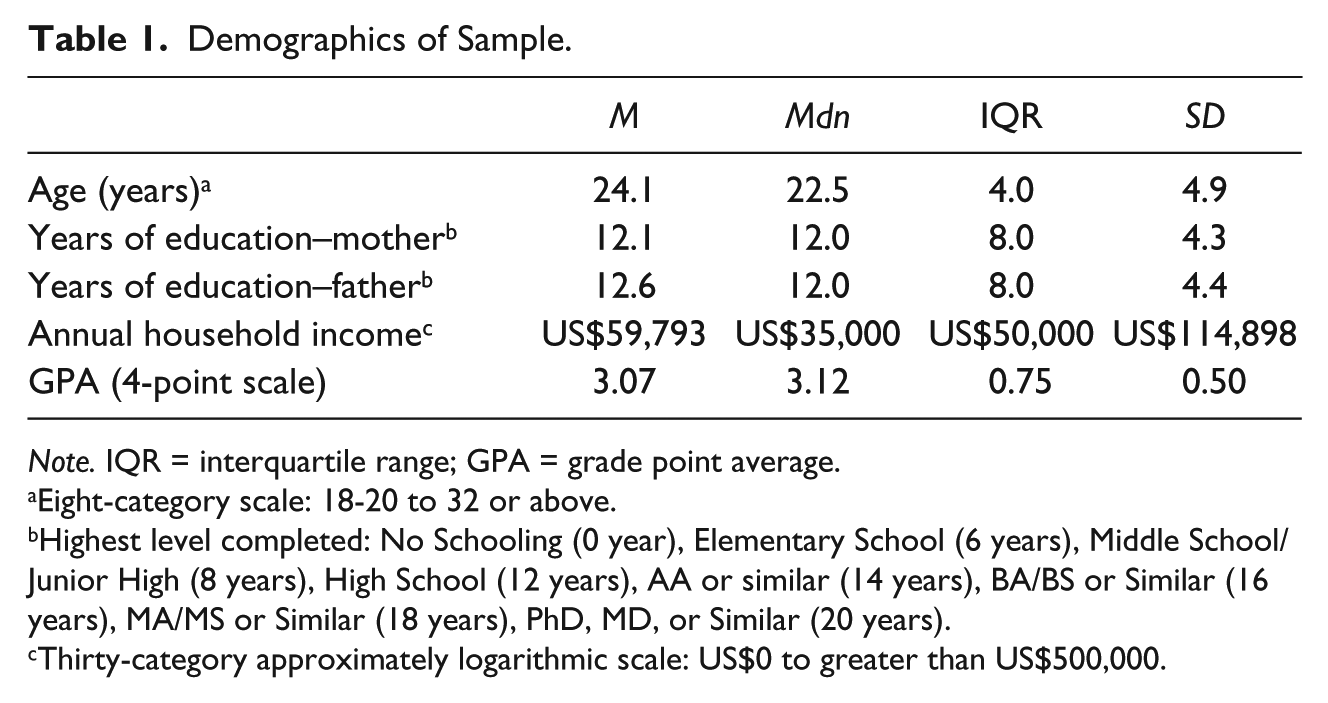
Note. IQR = interquartile range; GPA = grade point average.
Eight-category scale: 18-20 to 32 or above.
Highest level completed: No Schooling (0 year), Elementary School (6 years), Middle School/Junior High (8 years), High School (12 years), AA or similar (14 years), BA/BS or Similar (16 years), MA/MS or Similar (18 years), PhD, MD, or Similar (20 years).
Thirty-category approximately logarithmic scale: US$0 to greater than US$500,000.
Item Pool
The 38 items of the original item pool were generated by the research team based on theoretical descriptions of SFSD (e.g., Polaschek & Ward, 2002), media, and conversations with young adults. Eight items were reverse-keyed. Responses were on a 7-point Likert-type scale (0 = never, 1 = very rarely, 2 = only sometimes, 3 = about half the time, 4 = more often than not, 5 = very often, 6 = almost always). Conceptually redundant items were later removed, leaving 30 items.
Other Measures
Descriptive statistics for all scales used in this study are in Table 2 (alpha values below are from previous research, unless noted). Hostile masculinity was assessed with seven scales. The Hostility Toward Women scale (HTW; Logan Greene & Cue Davis, 2011—α = .83; Lonsway & Fitzgerald, 1995—α = .87) is a predictor of sexual aggressiveness (Logan Greene & Cue Davis, 2011; Payne, Lonsway, & Fitzgerald, 1999). The Adversarial Sexual Beliefs scale (ASB; Burt, 1980—α = .80) is a measure of competitive/exploitative relationship schemas (Jacques-Tiura et al., 2007—α = .72-.80; Malamuth, Linz, Heavey, Barnes, & Acker, 1995—α = .83; O’Dougherty Wright, Norton, & Matusek, 2010). The Need for Sexual Dominance scale (NSD; Nelson, 1978) measures dominance motives for sex (Malamuth et al., 1995—α = .77; Noel, Maisto, Johnson, & Jackson, 2009—α = .82) and has discriminated between sexually assaultive males and controls (Malamuth, Heavey, & Linz, 1993; Malamuth et al., 1995). The Ambivalent Sexism Inventory measures Hostile (ASI-H—α = .80-.82) and Benevolent (ASI-B—α = .73-.85) stereotypes about women (Glick & Fiske, 1996). Attitudes more directly supportive of aggression toward women were assessed with the Illinois Rape Myth Acceptance Scale–Short Form (IRMA-SF; Payne et al., 1999—α = .87; Widman & Olson, 2013), and the Acceptance of Interpersonal Violence scale (AIV; Burt, 1980—α = .59; Parrott & Zeichner, 2003—α = .66), designed to tap attitudes about relational violence toward women. The AIV returned an unacceptably low alpha of .58 due to poor performance of the reverse-keyed items. We scored a revised version (AIV-R) using the three forward-keyed items (see Burt, 1980)—which appeared to tap the conceptual domain effectively.
Descriptive Statistics for All Scales.
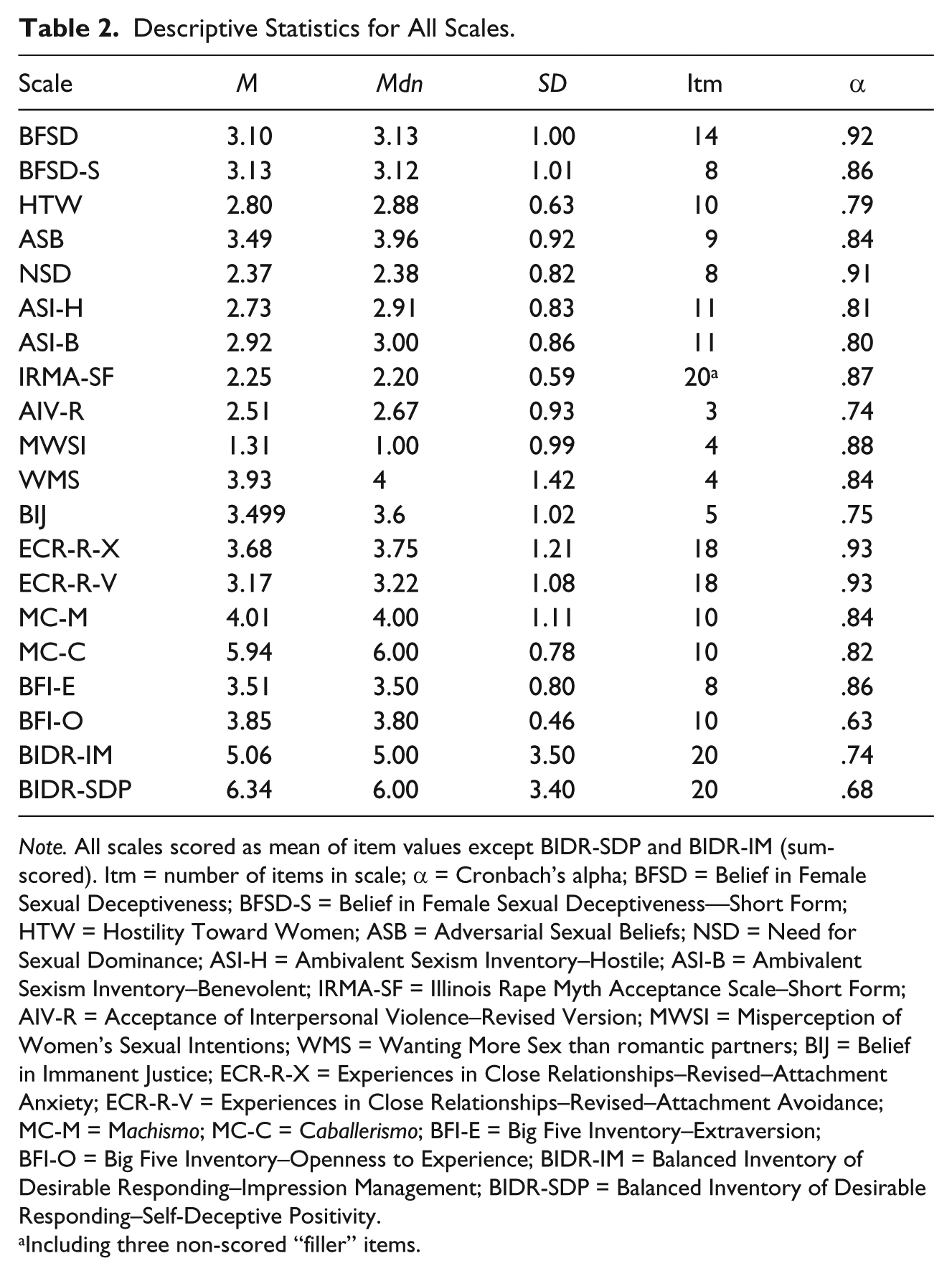
Note. All scales scored as mean of item values except BIDR-SDP and BIDR-IM (sum-scored). Itm = number of items in scale; α = Cronbach’s alpha; BFSD = Belief in Female Sexual Deceptiveness; BFSD-S = Belief in Female Sexual Deceptiveness—Short Form; HTW = Hostility Toward Women; ASB = Adversarial Sexual Beliefs; NSD = Need for Sexual Dominance; ASI-H = Ambivalent Sexism Inventory–Hostile; ASI-B = Ambivalent Sexism Inventory–Benevolent; IRMA-SF = Illinois Rape Myth Acceptance Scale–Short Form; AIV-R = Acceptance of Interpersonal Violence–Revised Version; MWSI = Misperception of Women’s Sexual Intentions; WMS = Wanting More Sex than romantic partners; BIJ = Belief in Immanent Justice; ECR-R-X = Experiences in Close Relationships–Revised–Attachment Anxiety; ECR-R-V = Experiences in Close Relationships–Revised–Attachment Avoidance; MC-M = Machismo; MC-C = Caballerismo; BFI-E = Big Five Inventory–Extraversion; BFI-O = Big Five Inventory–Openness to Experience; BIDR-IM = Balanced Inventory of Desirable Responding–Impression Management; BIDR-SDP = Balanced Inventory of Desirable Responding–Self-Deceptive Positivity.
Including three non-scored “filler” items.
We created two scales to assess additional implications of the theoretical framework: First, Misperception of Women’s Sexual Intentions (MWSI) from Abbey’s (1987) single item, “How many times in your life has a person you were romantically interested in been friendly to you, only for you to discover that you had misperceived that person’s friendliness as a sexual ‘come-on?’” repeated for “a friend,” “an acquaintance,” and “any other person” (0 = 1-2 times, 2 = 3-4, 3 = 5-9, 4 = 10-19, 5 = 20-49, 6 = 50-99, 7 = 100 or more). Second, because problematic implicit theories about women and sex may lead to confusion and sexual frustration (Willan & Pollard, 2003), we assessed participants’ memories of wanting more sex than their romantic partners (WMS) in short-term, long-term, and “casual sex or hookup” relationships with items following O’Dougherty Wright et al. (2010): “ . . . how often did you desire more sexual activity than your partner did?” (0 = never, 1 = very rarely, 2 = rarely, 3 = occasionally, 4 = frequently, 5 = very frequently, 6 = always). In addition, we hypothesized that men who believe that moral actions invariably bring temporal consequences (Furnham, 2002) would interpret complex female behavior as simple deceit. The Belief in Immanent Justice subscale (BIJ; Maes, 1992—α = .83) was translated by a bilingual German speaker in consultation with the research team (1-5; strongly disagree to strongly agree).
Predicting SFSD beliefs to add anxiety to relationship schemas, we included both subscales of the Experiences in Close Relationships–Revised (ECR-R; Fraley, Waller, & Brennan, 2000): Attachment Anxiety (ECR-R-X; α = .95) and Avoidance (ECR-R-V; α = .93; Sibley & Liu, 2004). Given the ethnic composition of our sample, we assessed machismo (MC-M; α = .85) with the machismo-caballerismo scale, as well as caballerismo (MC-C; α = .85), a prosocial masculinity ideal (Arciniega, Anderson, Tovar-Blank, & Tracey, 2008).
The ASI-B, ECR-R-V, and MC-C were included to test divergent validity, as each was predicted to correlate more weakly than its paired scale, if at all, with BFSD scores. We also included the Extraversion (BFI-E; α = .88) and Openness to Experience (BFI-O; α = .81) scales from the Big Five Inventory (BFI; John & Srivastava, 1999) for divergent validation.
Although recent research has led to a reinterpretation of “social desirability” as reflecting non-pathological or even positive traits (Paulhus, 2002; Uziel, 2010), such characteristics still represent a potential confounding source of influence on self-report responding. We included the Balanced Inventory of Desirable Responding (Paulhus, 2002) Self-Deceptive Positivity (BIDR-SDP) and Impression Management (BIDR-IM) subscales to assess this possibility, scored using the full Likert-type response range rather than the recommended dichotomized item method. Alpha was low for BIDR-IM and unacceptably low for BIDR-SDP. We rescored the scales using the recommended method, which increased alpha for BIDR-SDP (see Table 2).
Procedure
Volunteers were recruited from social science courses in return for extra credit. Surveys were completed in campus computer laboratories during scheduled sessions, using the Qualtrics online survey system with the order of items within each psychometric scale randomized for each participant. All responses were anonymous, though records of participation were temporarily kept for reporting extra credit. Factor analyses using ordinary least squares (OLS) minimum residual extraction (Harman & Jones, 1966) and Oblimin oblique rotation (Costello & Osborne, 2005) were performed with the R statistical package (R Development Core Team, 2012).
Results
Descriptive statistics for all scales are presented in Table 2.
EFA
Parallel analysis of the 30-item pool indicated four factors, while Very Simple Structure (VSS; Revelle, 2013; Revelle & Rocklin, 1979) and the Minimum Average Partial criterion (MAP; Velicer, 1976) suggested three. In both solutions the weakest factor, composed of the reverse-keyed items, formed a subscale with low reliability (α < .60) and no apparent conceptual cohesiveness, suggesting that it was based merely on reverse keying. We deleted these items from the pool, leaving 22 items. Parallel analysis of this reduced pool suggested three factors; VSS and MAP indicated only one. Reasonably good simple structure (Table 3) was achieved with three factors, accounting for 37%, 33%, and 29% of available variance (18%, 16%, and 14% of total variance). Only items with factor loadings greater than .40 and cross-factor loadings below .30 were selected for the final scale. Two additional items with low communalities and factor loadings were removed, leaving a 14-item scale (α = .92). The factor subscales were strongly intercorrelated (r = .62-.91), calling into question their separate usefulness. Information about these factors and items not reproted in Table 3 can be found in the online appendix.
BFSD Items and Three-Factor Solution Loadings.
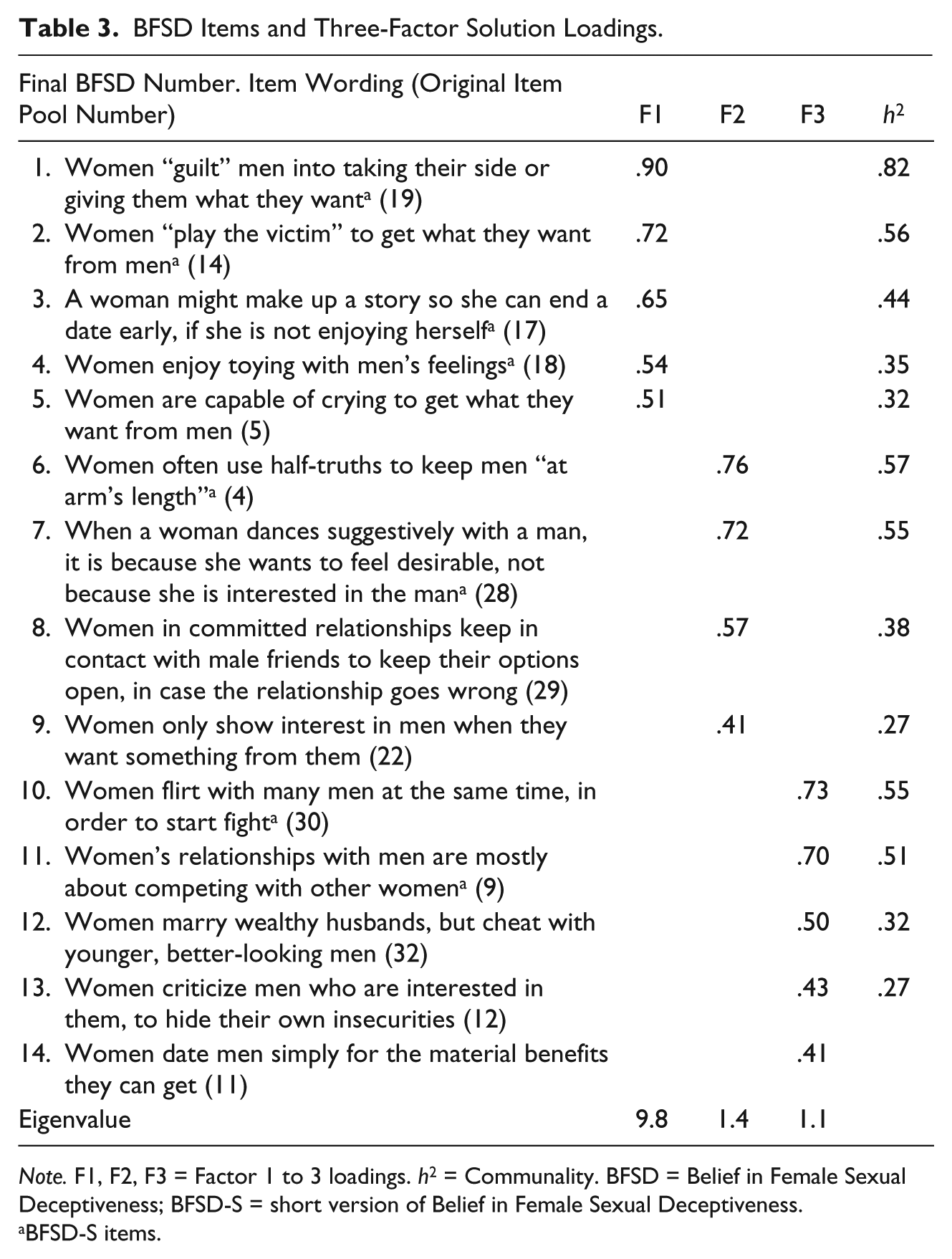
Note. F1, F2, F3 = Factor 1 to 3 loadings. h2 = Communality. BFSD = Belief in Female Sexual Deceptiveness; BFSD-S = short version of Belief in Female Sexual Deceptiveness.
BFSD-S items.
In the one-factor solution, all reduced pool items loaded strongly (>.50) except one. Coefficient alpha for the highest-loading 14 items (α = .93) and correlations with other measures were virtually identical to those of the scale derived from the three-factor solution (differences in r: −.03 to .02, median = .003), leading us to choose the latter as the BFSD because of its broader sampling of the conceptual domain and the potential usefulness of the factor structure in future research.
We developed a shorter scale, attempting to retain most of the domain coverage and reliability of the three-factor structure. Nine items had communalities of .33 or greater (Table 3). One was eliminated with no decrease in reliability, yielding an eight-item short form of the Belief in Female Sexual Deceptiveness (BFSD-S; α = .84). Although the BFSD has higher internal consistency, the BFSD-S performs extremely similarly; correlations with other measures differed by no more than .03 (median difference = .003; interquartile range [IQR] = .014), as seen in Table 4. Short forms were also attempted based on the single-factor solution: Alpha was higher than the BFSD-S for resulting scales of equal (and even shorter) length, but correlations with other scales were slightly but consistently weaker (median difference: .03-.04), suggesting poorer coverage of the conceptual domain.
Correlations Between BFSD, BFSD-S, BFSD Subscales, and Validation Measures.
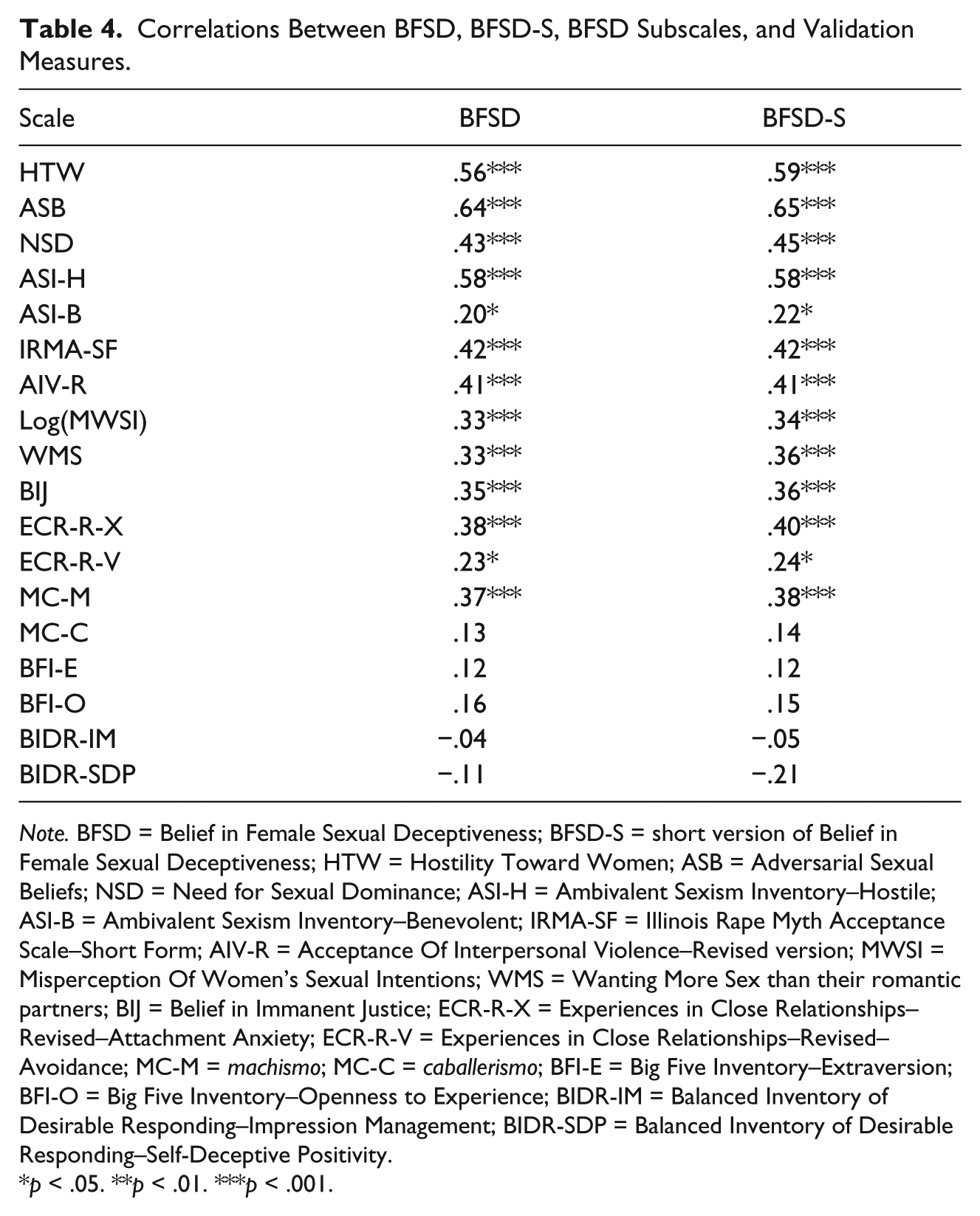
Note. BFSD = Belief in Female Sexual Deceptiveness; BFSD-S = short version of Belief in Female Sexual Deceptiveness; HTW = Hostility Toward Women; ASB = Adversarial Sexual Beliefs; NSD = Need for Sexual Dominance; ASI-H = Ambivalent Sexism Inventory–Hostile; ASI-B = Ambivalent Sexism Inventory–Benevolent; IRMA-SF = Illinois Rape Myth Acceptance Scale–Short Form; AIV-R = Acceptance Of Interpersonal Violence–Revised version; MWSI = Misperception Of Women’s Sexual Intentions; WMS = Wanting More Sex than their romantic partners; BIJ = Belief in Immanent Justice; ECR-R-X = Experiences in Close Relationships–Revised–Attachment Anxiety; ECR-R-V = Experiences in Close Relationships–Revised–Avoidance; MC-M = machismo; MC-C = caballerismo; BFI-E = Big Five Inventory–Extraversion; BFI-O = Big Five Inventory–Openness to Experience; BIDR-IM = Balanced Inventory of Desirable Responding–Impression Management; BIDR-SDP = Balanced Inventory of Desirable Responding–Self-Deceptive Positivity.
p < .05. **p < .01. ***p < .001.
Validity Tests
As seen in Table 4, BFSD scores were significantly positively correlated with hostile masculinity indicators (HTW, ASB, NSD, ASI-H, MWSI [log-transformed to reduce positive skew], and MC-M), with scales tapping other implications of the theoretical framework (WMS, BIJ, and ECR-R-X); and with scales more directly indicating physically and sexually aggressive attitudes (the IRMA-SF and AIV-R). Correlations between BFSD and paired divergent validity scale pairs were as predicted, though not all statistically significant: MC-C versus MC-M (z = 2.05, p < .05), ASI-B versus ASI-H (z = 3.66, p < .001), and ECR-R-X versus ECR-R-V (z = 1.32, p > .05). Correlations with BFI-E and BFI-O were non-significant (though the latter showed low reliability).
The BFSD was unassociated with BIDR-IM and BIDR-SDP scores; it was, however, positively correlated with BFSD-SDP forward-keyed items scored as a scale (r = .34, p < .001), as well as with reverse-keyed items (r = .22, p < .05). The former result is unexpected. Scoring with the full Likert-type scale increased these effects for BIDR-SDP and BIDR-IM. Forward- and reverse-keyed items were positively correlated with each other (r = .40, r = .17), negating concerns of scoring problems.
Correlations between the BFSD-S and external measures were extremely similar to the above, suggesting that, in most situations, the BFSD-S is to be preferred over the full BFSD. To assess the degree of overlap between the BFSD and other potential correlates of sexually aggressive tendencies, all other measures were entered in a multiple regression analysis predicting BFSD scores. Absolute standardized regression coefficients ranged from .02 to .36, with R2 = .53 for the full model, leaving 47% of the variability in BFSD scores unshared.
Discussion
The BFSD’s strong internal consistency and pattern of convergent and divergent correlations provide good initial evidence of its validity, and the substantial proportion of its variability not held in common with other measures suggests utility in models of sexual aggressiveness beyond previously investigated predictors. The BFSD’s association with adversarial views of intimate relationships is especially encouraging as high ASB scores may indicate a belief that “ . . . women are sly, manipulative, and self-centered creatures” (Lonsway & Fitzgerald, 1995). Correlations with MWSI, WMS, and BIJ are consistent with Polaschek and Ward’s (2002) framework. The association with BIJ suggests a future research hypothesis: High levels of both SFSD and just-world beliefs should predict especially hostile pro-rape attitudes, as women are seen as both deceptive and deserving of punishment. Critically, the BFSD was associated with rape myth acceptance and attitudes supportive of violence against women, the two constructs most directly indicative of sexual aggressiveness in this study.
In addition to validation of the BFSD, this study provides evidence that the SFSD construct is related to hostile masculinity and similar factors (Malamuth & Brown, 1994). Future research with the BFSD can test the theorized positioning of SFSD in Polaschek and Ward’s (2002) framework, and whether it improves the prediction of sexually aggressive behavior.
Potential Non-Female-Specific Sexual Attraction in Participants
We did not assess participants’ sexual orientation, with potential consequences for our results. Given that common stereotypes tend to be held by all members of a culture (Devine & Sharp, 2009), it seems likely that factor analysis results might have been unaffected, except by increased random variability, by the inclusion of participants not primarily attracted to women. However, correlations with other measures might well have been biased: Without the personalizing connection of sexual attraction toward the targets of our measures, responses might be less associated with beliefs about women’s sexual deceptiveness. We performed a post hoc analysis to better understand the potential effects of this limitation.
Assuming that up to 9% of participants might be non-heterosexual (Carpenter, 2013), we replicated our data set 100 times (using R), each one including 13 records (i.e., about 10% of 131) randomly selected from the unused female sample. Accounting for probable non-heterosexual females in the added records, we estimate that we approximately doubled the proportion of participants in each data set not attracted primarily to women. VSS nearly invariably suggested extracting one factor in the female-augmented datasets, MAP did so 87% of the time, and parallel analysis suggested two factors (versus 3) in 94% of datasets. Alpha for the BFSD and BFSD-S varied little from the non-augmented results, on average (median: +.02; range: −.008 to .017). Squared correlations with other measures varied little (mean r2 difference = .002, SD = .014). The BFSD appears to have been essentially unaffected by the addition of non-female-attracted participants, increasing our confidence in this study’s results despite the probable inclusion of non-heterosexual men, though this does not substitute for a true replication.
Additional Limitations
The poor performance of the reverse-keyed items in the BFSD item pool was puzzling. Such items also performed very poorly in the AIV. Although without serious consequences, reverse-keyed items also had reduced item-total correlations in the ASI, HTW, BFI-O, and ECR-R-X. Our investigation of the BIDR-SDP’s disappointing reliability showed that the forward- and reverse-keyed items correlated differently with the BFSD and very weakly with each other. Many problematic reverse-keyed items seem, on closer inspection, to have complex sentence structure (e.g., double negatives, negative assertions, or contradictory introductory phrases). This might have led to the failure of the BFSD reverse-keyed items in one of two ways: First, this study sampled from a population dominated by first-generation college attendance and low pre-college academic achievement. The complexity of reverse-keyed items might have led to reduced reading comprehension for some participants, resulting in poor item validity. Second, given that the BIDR was administered near the end of a 1-hr. data collection session, it is possible that haste or fatigue influenced participants’ responses, with similar results. This issue does not seem to threaten the validity of most measures in this study, but reduces our ability to interpret the BIDR scales. It appears that differences in styles of interpersonal self-regulation (Uziel, 2010) might have affected responses, but in ways that are not clear. Given our group data collection format and long survey, Krumpal’s (2011) admonition to minimize such effects through study design seems germane.
This sample was also non-representative of the overall U.S. population in age, education, and ethnicity. Views of sexual assault and its victims may have distinctive features in Hispanic populations (Jimenez & Abreu, 2003), as might attitudes about sexual aggression (Ulloa, Jaycox, Marshall, & Collins, 2004) and patterns of sexual abuse (Kenny & McEachern, 2000). Any such differences might be primarily due to stronger and more prevalent hostile masculinity and related attitudes, or they might arise from more fundamental differences with dominant U.S. culture. Replication in other samples will be required to confirm the generalizability of our results.
Finally, measurement of participants’ history of, or proclivity for, sexual aggression was beyond the scope of this study, precluding a full test of the theoretical framework. Thus, we cannot conclude that the BFSD is associated with sexual aggression, only with its known correlates.
Future Directions and Conclusion
Administration of the BFSD in diverse samples and research situations will clarify the psychometric properties presented here, and we invite others to test or revise the measure accordingly. Although we are intrigued by the potential of the three-factor solution (if it holds up to replication) for exploring the facets of hostile masculinity, we recommend the use of the BFSD-S in most research, and the BFSD where higher reliability is required. To more fully test the theoretical framework articulated in the introduction, future research might include measures of other elements, such as a belief that women are fundamentally unknowable or in frequent female token resistance.
A schema of women as sexually deceptive has been hypothesized as an important precursor to hostile masculinity, which is both theoretically and empirically important in predicting sexual aggressiveness, especially in non-adjudicated samples. We offer the BFSD as a reliable, valid tool for measuring this construct and hope it stimulates further research.
Footnotes
Acknowledgements
We would like to thank Genina Lambert for her excellent work in generating many items for the BFSD pool, Sarah Stegall for her expert guidance of the early phases of data collection, and Miguel Reyes for insights in interpreting the factors. In addition, we are grateful to the many undergraduate and graduate members of the Border Experiences Project for their hard work and willingness to learn new skills at a rapid pace.
Authors’ Note
Copyright for the Belief in Female Sexual Deceptiveness Scale (BFSD and BFSD-S) is retained by Darrin L. Rogers. The scale is licensed under a Creative Commons—Attribution-ShareAlike 3.0 Unported License ( ). The scale may be used, modified, or built upon by anyone, as long as this publication is cited. Modifications of the scale are permitted and encouraged, as long as future licensing is no more restrictive than this license.
Declaration of Conflicting Interests
The author(s) declared no potential conflicts of interest with respect to the research, authorship, and/or publication of this article.
Funding
The author(s) received no financial support for the research, authorship, and/or publication of this article.
Author Biographies
References
Supplementary Material
Please find the following supplemental material available below.
For Open Access articles published under a Creative Commons License, all supplemental material carries the same license as the article it is associated with.
For non-Open Access articles published, all supplemental material carries a non-exclusive license, and permission requests for re-use of supplemental material or any part of supplemental material shall be sent directly to the copyright owner as specified in the copyright notice associated with the article.
