




Abstract
This study was to explore the factors associated with intimate partner violence (IPV) in Nepal. A sample of 3,373 married women was taken from the 2011 Nepal Demographic and Health Survey. Multilevel logistic regression methods were used to analyze the data. The results show that 28.31% of the population experienced the IPV in the past year. The results indicate that female illiteracy, low economic status, violent family history, and a lack of decision-making autonomy were associated with IPV. Regarding family background, whether or not the husband was an alcoholic, the husband’s level of education, and a higher number of children were risk factors associated with IPV. At the community level, women most at risk of IPV were those living in the Terai region, and women belonging to underprivileged castes and ethnic groups. The findings suggest the need for context-specific policy formation and the need for the creation of the certain intervention programs designed to mitigate IPV in Nepal.
Intimate partner violence (IPV) exists in all nations and affects women of all ages (Garcia-Moreno, Jansen, Ellsberg, Heise, & Watts, 2006). It is one of the world’s most pervasive social and human rights problems, resulting in physical and mental health problems that vary from minor to fatal (Campbell et al., 2002; Garcia-Moreno et al., 2006; Golding, 1999; Kishor & Johnson, 2006; Plichta, 2004; Stets & Straus, 1990; Sudha & Morrison, 2011).
Researchers have studied IPV and its associated risk and protective factors throughout the world (Burazeri et al., 2005; Djikanovic, Jansen, & Otasevic, 2010; Flake, 2005; Garcia-Moreno et al., 2006; Janssen et al., 2003; Jewkes, Levin, & Penn-Kekana, 2002; Kimuna, Djamba, Ciciurkaite, & Cherukuri, 2013; Koenig, Ahmed, Hossain, & Mozumder, 2003; Kury, Obergfell-Fuchs, & Woessner, 2004; Meil, 2005; Rani & Bonu, 2009; Tjaden & Thoennes, 2000; Tokuç, Ekuklu, & Avcioğlu, 2010). Due to methodological differences between studies and context-specific factors, it is possible that the severity of IPV, its prevalence, and the associated risk factors differ in cultural-specific contexts, regardless of the acceptance or rejection of violence. To understand the risk or protective factors in culture-specific contexts, previous studies emphasized individual, family background, and community characteristics so that they could provide data to help ascertain what might help mitigate IPV within specific sociocultural contexts (Babu & Kar, 2010; Burazeri et al., 2005; Dalal & Lindqvist, 2012; Djikanovic et al., 2010; Flake, 2005; Jewkes et al., 2002; Koenig et al., 2003; Krishnan, 2005; Rani & Bonu, 2009; Tokuç et al., 2010). For example, Straus and Smith (1990) studied IPV among Hispanic families and explored the dynamism of IPV rates, prevalence, and risk factors in relation to structural characteristics of Hispanic families in the United States.
Situating IPV in Nepal
Male dominance is a deeply rooted cultural norm in Nepali society. Features of this male dominance include early marriages, dowry-related common cultural practices, and cultural norms that require women’s submissive role in family. It also means that IPV is an open-secret in Nepali society. Historically and culturally, women generally accept violence from their husband and this fact is kept inside the home (Sharma, 2007). Acknowledging, for the first time, the deeply rooted problem of IPV in Nepal, the Nepali government recently passed the Domestic Violence Act, 2008. Since then, a few cases of IPV have been brought into courts or into the public domain. Of late, national newspapers in Nepal have begun reporting rapes, severe injury, and the deaths of women as a result of IPV on a daily basis; suggesting this is presently a serious social and legal issue (Dhakal, 2008; Poudel-Tandukar, Poudel, Yasuoka, Eto, & Jimba, 2008).
A few academic studies have been done on IPV in Nepal. Existing research includes a qualitative study conducted in two districts (Dang and Tanahu) based on 15 in-depth case histories on sexual violence, which reported that 74% of young married women had experienced sexual violence within marriage, and that the husband’s alcohol consumption was the strongest predictor for sexual violence (Puri, Tamang, & Shah, 2011). Another is a cross-sectional study carried out in four districts (Dolkha, Sindhupalchok, Dang, and Kapilbastu) among young married women in rural Nepal from four major ethnic groups (Brahnim/Chhetri, Tharu, Tamang, Muslim). This study found that 51.9% of women had experienced some form of violence in their lifetime, with 25.3% being physical violence and 46.2% being sexual violence. This study concluded that a woman’s lack of decision-making autonomy was the strongest predictor of IPV (Lamichhane, Puri, Tamang, & Dulal, 2011). A community-based cross-sectional study of 905 participants among urban poor (225 participants) and general population (680 participants) revealed that 33.8% IPV exist among urban poor in Kathmandu, the capital city of Nepal; 19.9% IPV exists among general populations in Nepal (Oshiro, Poudyal, Poudel, Jimba, & Hokama, 2011). The study found that the husband’s level of alcohol consumption and lower socioeconomic status were both correlated with IPV in both the urban poor and within the general population at large. Risk factors for IPV in the general population were discovered to be early marriage and the husband’s lower level of education.
These studies endeavored to shed light on the prevalence of IPV in Nepal, specifically, its associated risk and protective factors. However, further studies needed to comprehend IPV in Nepal utilizing both sufficiently representative sample sizes and comprehensive understanding of structural factors (individual, family background, and community characteristics) so as to give precise data on the prevalence, risk, or protective factors associated with IPV in Nepal. This, in turn, has helped the creation of effective intervention programs and policies to develop programs to intercede and either prevent abuse or provide services for abused married women. This present study relied on a representative sample of married Nepali women taken from the 2011 Nepal Demographic and Health Survey (NDHS; Ministry of Health and Population [MOHP] [Nepal], New ERA, and ICF International Inc., 2012).
No single factor can explain IPV, rather it is the product of complex interaction among many factors—biological, demographic, individual’s history of abuse, familial, social, economic, and community characteristics (World Health Organization [WHO], 2002). Based on what has been done in previous studies using structural characteristics (Carlson, 1984; Edleson & Tolman, 1992; Heise, 1998; Little & Kantor, 2002; Straus & Smith, 1990), the present study attempts to explore the risk factors associated with IPV in Nepal at the individual, the family background, and the community characteristics.
Method
Data and Participants
This study used the 2011 Nepal NDHS (Ministry of Health and Population [MOHP] [Nepal], New ERA, and ICF International Inc., 2012), a cross-sectional household sample survey of men and women between the ages of 15 and 49. The NDHS survey collected data every 5 years under the aegis of the Government of Nepal with financial support provided by the United Nations Agency for International Development (USAID). In this study, data from nationally representative sample were collected that included both rural and urban clusters as well as 13 domains obtained by cross-classification of three geographical regions (Mountain, Hill, and Terai) and five development regions (East, Central, West, Midwest, and Far-west region).
The NDHS provides both current and reliable information on topics related to fertility preferences as well as maternal and child health issues, HIV/AIDS-related knowledge and awareness. The NDHS collected information concerning women facing different types of domestic violence for the first time in 2010 in Nepal. The NDHS randomly selected 4,121 men and 12,674 women from 11,085 households and conducted face-to-face interview where the response rate was 95% (Ministry of Health and Population [MOHP] [Nepal], New ERA, and ICF International Inc., 2012).
The sample of domestic violence data was collected from the subsample of those households selected for the men’s survey, interviewing only one woman per household. The study analyzed the data for currently married women who were living with a partner in the subsample of the NDHS domestic violence module. This restriction resulted in 3,373 married women being eligible to examine the factors associated with IPV in Nepal.
Measure
Outcome variable
The main dependent variable in the analysis was the wife’s reports of experiencing IPV in past 12 months. The NDHS had utilized a modified version of the Conflict Tactics Scale (Straus, 1990), and asked women whether her husband had ever (a) pushed, shook, or threw something? (b) slapped her? (c) twisted her arm or pulled her hair? (d) punched her with his fist or with something that could hurt her? (e) kicked, dragged, or beat her? (f) choked or burned her on purpose? (g) threatened or attacked her with a knife, gun, or any other weapon? (h) physically forced her to have sexual intercourse with him even when she did not want to? and (i) forced her to perform any sexual acts that she did not want to? Every question that a woman answered “yes” to, from questions (a) to (i) listed above, constituted evidence of IPV, and aggregated values were coded as “1” for experiencing IPV and “0” for not experiencing the partner violence at all (Cronbach’s α = .850).
Independent variable
The explanatory variables were constructed as the indicators of domestic violence predictors that were defined theoretically (Heise, 1998) and examined empirically (Babu & Kar, 2010; Flake, 2005; Jewkes et al., 2002; Koenig et al., 2003) with some variations in Nepalese culture-specific contexts were expected to predict the IPV. These variables were structured into three main blocks within the cultural context of Nepal into the individual, the family, and the community context.
Individual characteristics
The individual characteristic variables consist of two parts: sociodemographic characteristics and female status factors. Sociodemographic characteristics include age, education, economic status, age at marriage, and witnessing violent experience in childhood. Female status factors constituted level of decision-making autonomy in household and assets ownership.
Age was structured as continuous variable. The education level was defined according to the Nepalese education system as illiterate, primary school attainment, secondary school attainment, and higher education. The economic status was grouped into three categories: poor, middle class, and rich. Age at marriage was structured as continuous variable. Another independent variable that was considered was whether or not women had experienced violence in their homes during childhood.
Other variables which were more Nepal specific (or South Asian) were developed to analyze women’s choices, decisions, and access to resources relative to their husbands (Agarwal, 1994; Allendorf, 2007; Dixon-Mueller, 1998; Koenig et al., 2003; Malhotra, Schuler, & Boender, 2002). The status of the individual women was measured based on their participation in decision making, and land ownership. The NDHS asked women whether they participated in decision making in personal health care, major household purchases, visits to family or relatives, and husband’s income. A value of 1 is assigned if the respondents participated in decision making (respondents alone, and jointly with husband and other family members), and value 0 is assigned for women who did not participated (husband only, others). The sum of the values resulted in the score from 0 to 4 (Cronbach’s α = .815). Low autonomy was recorded for those who did not participate at all, score 1 to 3 were recorded as a medium level of autonomy, high autonomy was recorded for those who participated in all decision-making process. The ownership of assets was taken to be an efficacious measure of women status (Anderson & Eswaran, 2009; Dixon-Mueller, 1998). The study therefore measured assets ownership as a dimension of women’s status. Married women who owned land and/or house themselves or jointly were recorded as 1, and 0 for those women who did not.
Family characteristics
Family-level variables that were analyzed included the number of children in the household, whether the husband consumed alcohol, and husband’s educational attainment. These variables were considered because the extensive bodies of literatures in Nepal and around the world have demonstrated that larger family size (Brinkerhoff & Lupri, 1988; Flake, 2005), a husband’s alcohol consumption (Djikanovic et al., 2010; Flake, 2005; Jewkes et al., 2002; Oshiro et al., 2011), and husband’s lower educational attainment (Burazeri et al., 2005; Oshiro et al., 2011) were predictors of partner abuse.
Community characteristics
Neighborhood, for example, urban and rural areas and geographical regions (Dalal & Lindqvist, 2012; Koenig et al., 2003) and caste and ethnicity (Krishnan, 2005; Oshiro et al., 2011), were strong predictors of IPV in Nepal as well as other South Asian countries. These variables were considered into community-level variables in South Asian context (Babu & Kar, 2010) and thus analyzed at the community level in Nepali context. In Nepal, neighborhoods are delineated as being large cities, small cities, towns, or villages. Large cities, small cities, and towns were grouped into urban area classification; villages were under the rural area classification. Nepal has three distinct geographical regions: Mountain, Hill, and Terai (southern plain lands). We coded geographical regions into three categories. Caste and ethnicities were sorted into four categories as the high status Hindu castes (Brahmin and Chhetry), indigenous people (Newars and Janajati), low-status “untouchable” castes (Dalits), and other Terai castes (Madeshi and Muslims; Lawati, 2005). These categories are entitled to social inclusions or exclusions of castes and ethnic groups in education, employment, and other development opportunities in Nepali social hierarchy (Lawati, 2005). In Nepali context, high Hindu castes (Brahmin and Chhetry) are the most privileged groups, whereas untouchables and Terai castes are the least privileged groups. In Nepal, the social status of untouchable women is worse than the social status of their male counterpart; even worse is the condition of Terai castes and Muslims than of untouchables (Bhattachan, Sunar, & Bhattachan, 2009).
Data Analysis
First, this analysis began by examining basic descriptive characteristics of all variables. Second, bivariate associations were examined using the Pearson χ2 test for categorical variables while t statistics were used for continuous variables using the p value of associations. Finally, binary logistic regression models were utilized with adjusted odds ratios of 95% confidence interval (CI). Logistic regression was used to determine if structural factors (individual, family background, and community characteristics) determine the likelihood of IPV. For the final logistic regression analyses, only those variables found to have significant relations (p > .1) in bivariate associations were used. The statistical analyses were performed using the SPSS for windows (version 18; SPSS Inc, Chicago, Illinois) statistical software program.
Ethical Issues
The procedure governing the collection of the NDHS domestic violence subsample data strictly adhered to the ethical and safely recommendations set forth by the World Health Organization (2001). Initially, trained and experienced interviewers established a certain degree of intimacy and trust for the purpose of encouraging respondents to revealing their violence experiences. Following this, the interviewers secured informed consent, before conducting interviews in which the confidentiality of the respondent was guaranteed. The data were collected only if respondents’ privacy could be obtained.
Results
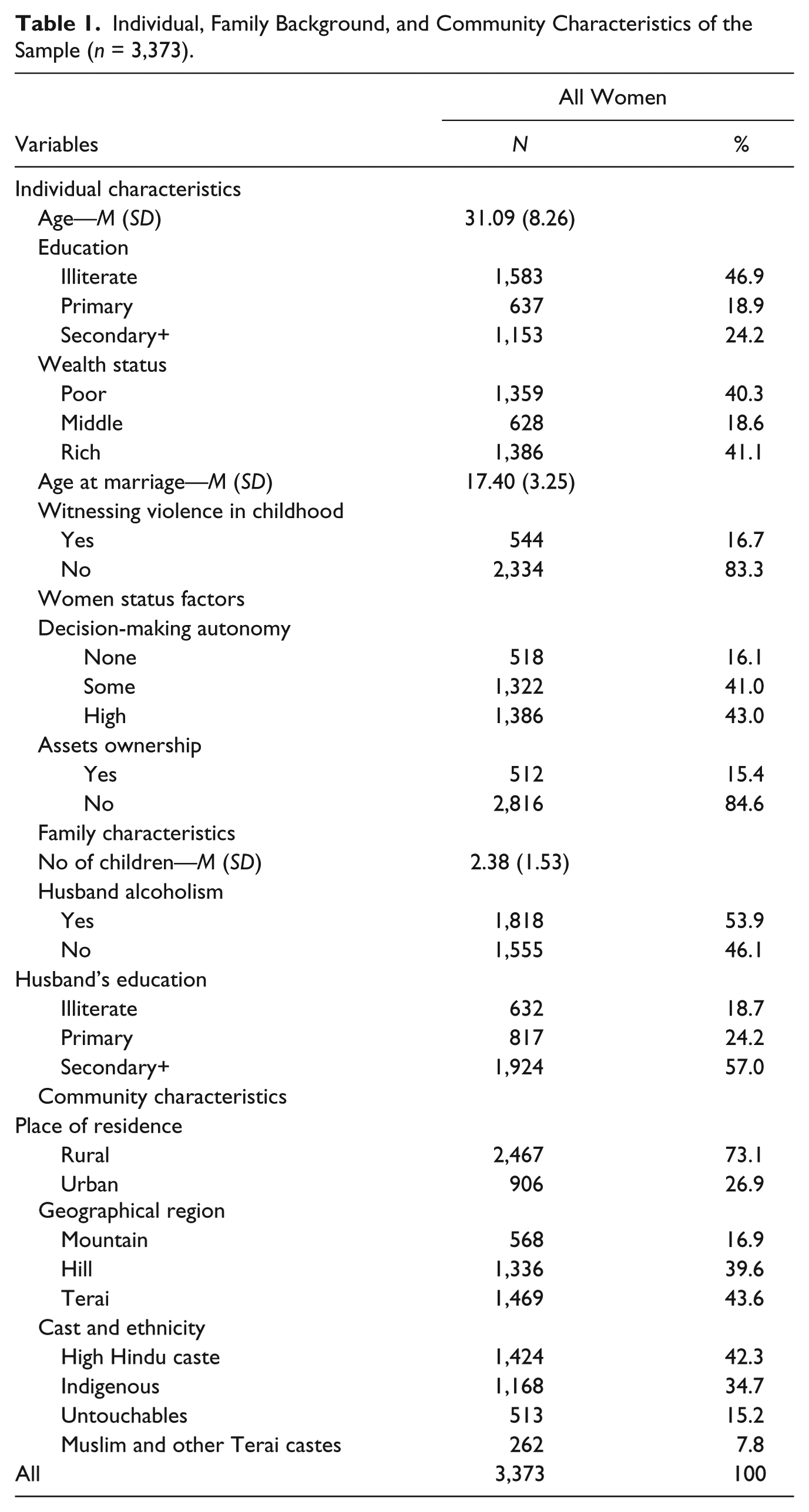
Approximately 28% (28.3%) of the sample reported experiencing IPV in the past 12 months. Table 1 presents that the mean age of women was around 32 years old. Approximately 49% of women never received any formal education; about 24% of women had completed secondary and higher education. Approximately 40% of women came from poor backgrounds. The mean age at marriage was about 17 years. Only 15% women owned assets. Approximately 54% of respondents reported that their husbands were alcoholics. Approximately 19% of Nepalese men never received any formal education; 58% of men had completed secondary and higher education. Approximately 73% of women lived in rural areas. Approximately 17 women lived in the Mountain region; about 40% and 44% of women lived in Hill and Terai regions. A majority of women were Hindu high caste (42.3%), followed by indigenous (34.7%), untouchables (15.2%), and Muslim and other Terai caste (7.8%).
Individual, Family Background, and Community Characteristics of the Sample (n = 3,373).
In Table 2, the descriptive characteristics and the level of significance of women with experience of abuse in a univariate analysis has been presented. At the individual characteristics, the higher the age, the higher the level of experiencing IPV was found. About 37% of women who never attended any schooling experienced IPV. Approximately 34% of women with lower economic statues were victimized of IPV. Approximately 44% of women with violent family history experienced IPV. About 35% of women who lacked decision-making autonomy and 29% of women without asset ownership were victims of IPV. At the family characteristics, 37.1% of women from alcoholic households, and 41.6% of women whose husband was illiterate experienced IPV. At the community characteristics, approximately 29% of rural women, 40% of untouchable caste, and 44% of Muslim and other Terai caste experienced IPV.
Descriptive Characteristics of Ever-Abused Women and p Value Associations for Exposure to Intimate Partner Violence in Past 12 Months (n = 3,373).
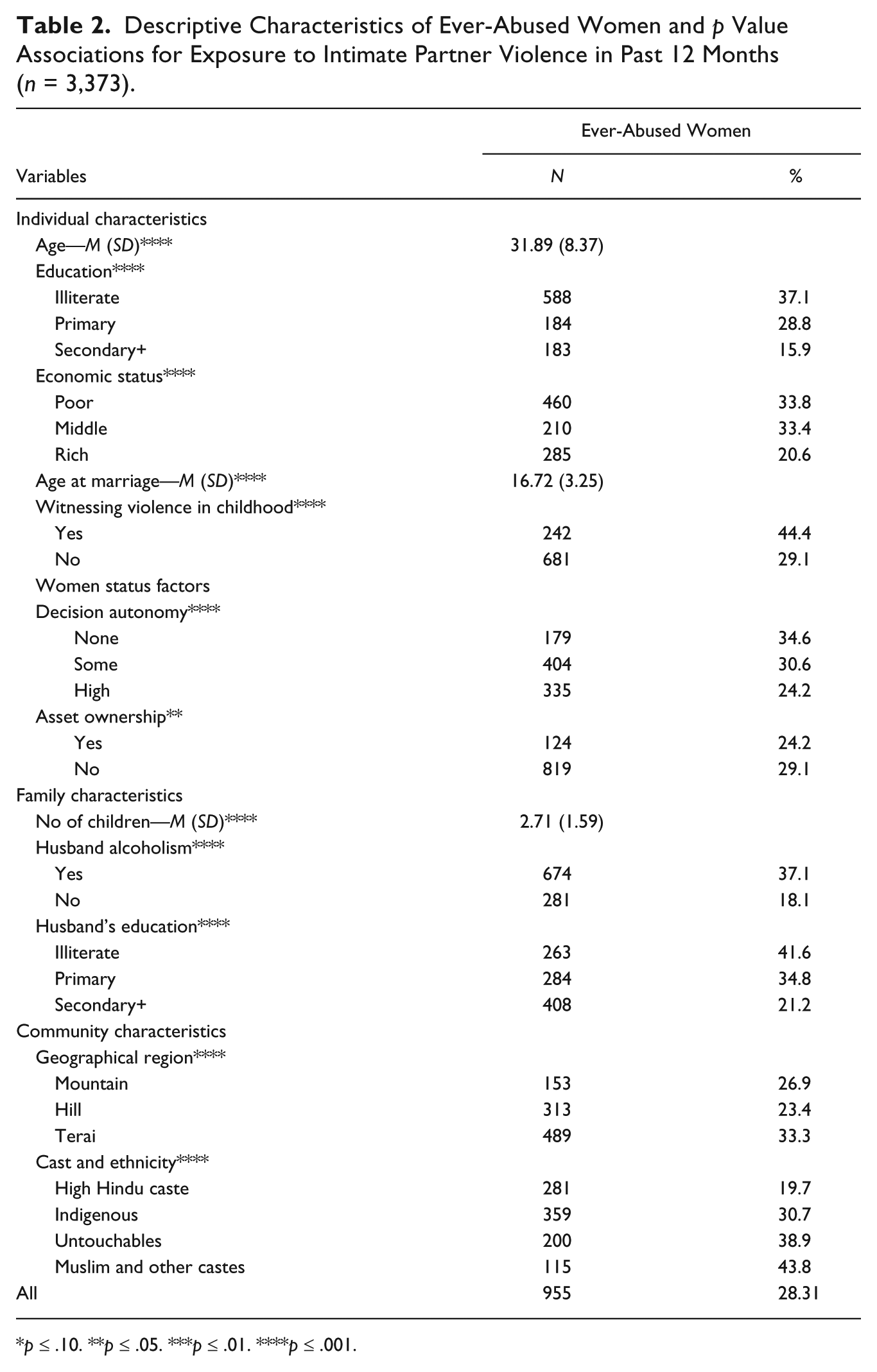
p ≤ .10. **p ≤ .05. ***p ≤ .01. ****p ≤ .001.
Of the 13 independent variables, 12 were found to have a statistically significant association with the victimization of IPV (p ≤ .05). Age, education, economic status, age at marriage, witnessing family violence in childhood, decision-making autonomy, assets ownerships, number of children in household, husband’s alcoholism, husband’s educational level, geographical region, and caste and ethnicity were all found to be significant in bivariate analysis. However, place of residence was not found to be significant determinants of IPV experience.
The results of the multilevel logistic regression analyses are presented in four models in Table 3. Model 1 estimates the likelihood of IPV based on individual characteristics. Age was positively associated with IPV. Lower level of education was strongly associated with higher level of IPV. The odds ratio of experiencing IPV among illiterate women was 2.26 times higher than for women who completed secondary and higher education (p < .0001). The odds ratio of IPV experience among middle class women was much stronger. The odds of experiencing IPV for middle class women were 1.48 (p < .001) and poor class were 1.38 (p < .01) times more likely than women who belonged to the rich class. Age at marriage was negatively associated with IPV (odds ratio [OR] = 0.94, p < .001). Women who witnessed the violence in childhood were more likely to experience IPV (OR = 2.51, p < .001). Women who lacked household decision-making autonomy were found to be more likely to experience IPV (p ≤ .001). Findings from Model 1 suggests that women with low educational attainment, who marry early, witnessed parental violence in childhood, and women those did not have household decision-making autonomy were more likely to experience IPV than their counterparts.
Odds Ratio for the Likelihood of Experiencing Intimate Partner Violence in Nepal, the 2011 NDHS.
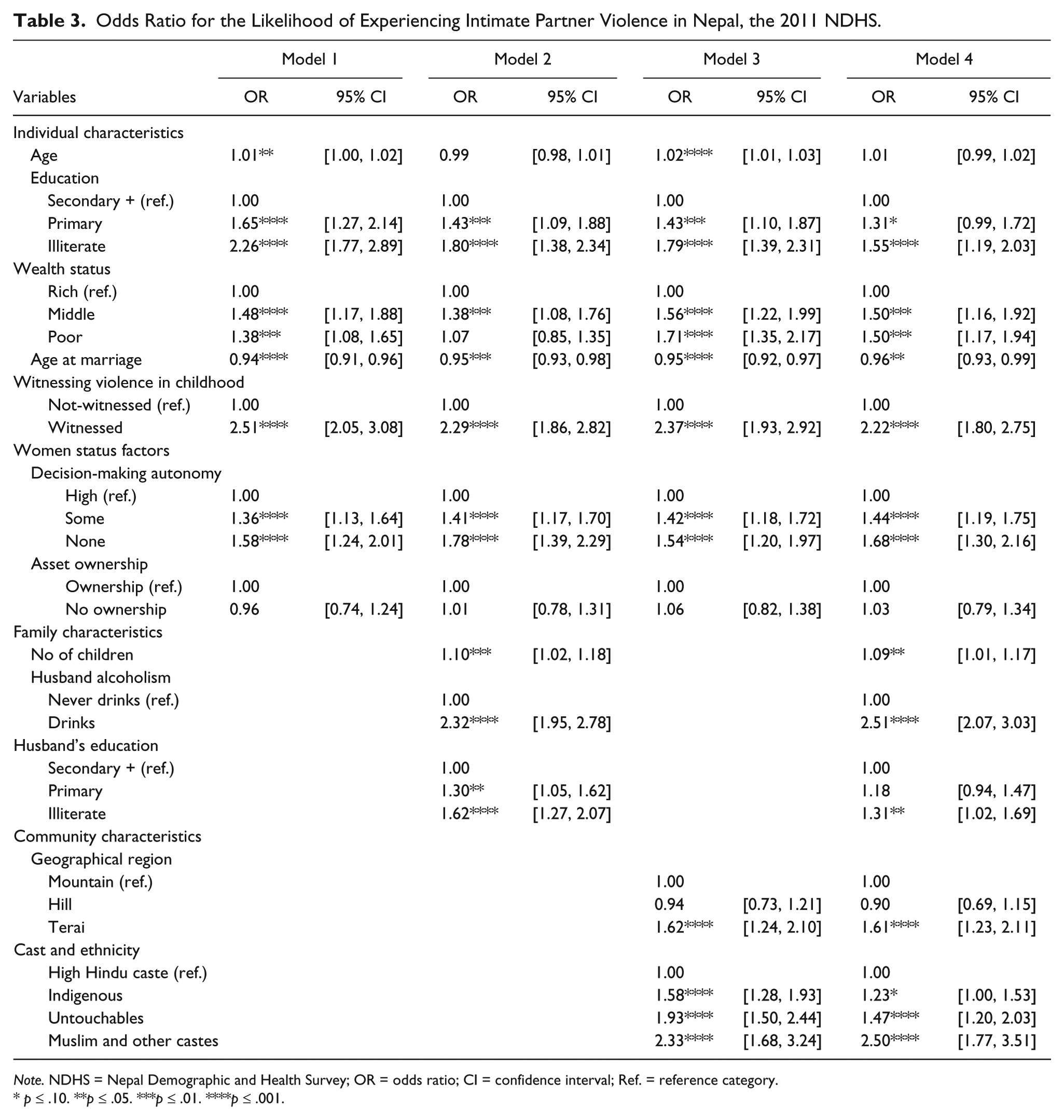
Note. NDHS = Nepal Demographic and Health Survey; OR = odds ratio; CI = confidence interval; Ref. = reference category.
p ≤ .10. **p ≤ .05. ***p ≤ .01. ****p ≤ .001.
Model 2 examines relationships between family characteristics and the likelihood of experiencing IPV after controlling for women’s individual characteristics (see Table 3). The number of children in a family was positively associated with IPV. Husbands who drank alcohol were 2.32 times more likely to abuse their wives (p < .001). Similarly, illiterate husbands were 1.62 times (p < .001) and husbands who completed primary education were 1.30 times (p < .05) more likely to engage in IPV. However, there was no statistical significance difference between men who had completed primary education and higher education to engage in IPV. Model 2 provides important insights into how the likelihood of experiencing IPV was higher in larger families and families with alcoholic and uneducated husbands.
Model 3 tests the relationships between community characteristics and IPV after controlling for women’s individual characteristics (see Table 3). Women living in the Terai region were more likely to experience IPV than women living in the Mountain region (OR = 1.62, p < .001). There were no significant differences in IPV experiences between women who lived in the Mountain and the Hill regions. Similarly, indigenous women, Muslim women and those from untouchable or other Terai castes were more likely to be abused than women from high Hindu castes (p ≤ .001). Findings from Model 3 suggest that women who lived in the Terai region and underprivileged caste and ethnic groups (indigenous, untouchables, and Muslim and other Terai caste) were more likely to experience IPV than women who live in Hill regions and Hindu women from high castes.
Model 4 presents the likelihood of experiencing IPV incorporating the interconnectedness of individual, family background, and community-characteristics variables (see Table 3). Women’s lack of formal education, witnessing violence in childhood, lack of decision-making autonomy, an alcoholic husband, living in the Terai region, being Muslim, and belonging to untouchable and other Terai castes were more likely to experience IPV in Nepal with strong statistical significance (p ≤ .001). Poverty was also predictor of IPV victimization (p < .01). Along with their strong independent effects in Models 1, 2, and 3, these variables retained statistical significance in Model 4, too. Similarly, early marriage, a large number of children in a household, and husband’s lower level of education were also found to be positively correlated with IPV victimization; however, the statistical significance of this relationship was weaker in joint model (p ≤ .05) than in independent models.
Discussion
The findings of this study make a strong contribution toward the exploration of the risk contributors or protective factors of domestic violence literature, especially IPV in culture-specific contexts. The findings of this study shed light on the complex interplay of individual, family background, and community-characteristics variables on IPV in the Nepalese context. The result support existing literatures on IPV beyond the Nepalese context which identify education, the experience of witnessing violence during one’s childhood, decision control, an alcoholic husband, as risk factors of domestic violence in multiple cultural contexts. In addition, in the Nepalese cultural context, this study finds that women’s living in the Terai region and belonging to underprivileged caste and ethnic groups were at greatest risk of experiencing IPV.
Given the variation in cultural context that exist throughout the world, IPV is a complex issue. No single strategy could work in all countries to address this problem. Strategies need to arise from a deep understanding of the broad interplay between the individual, family background, and community-characteristics variables responsible for predictor or protective factors of IPV. In the Nepalese context, married woman are at greater risk of experiencing IPV when they are illiterate, are raised in families where violence is present, and lack decision-making autonomy within their households. Family factors that are correlated with IPV in Nepal include alcoholic or illiterate husbands. At the community level, a woman is at greater risk of being a victim of IPV if she is living in the Terai region and if she is indigenous, untouchable, and comes from Terai caste. As the policy to prevent IPV (Domestic Violence Act, 2008) was recently passed in Nepal for the first time, implementation strategies for effective intervention remain at the initial stage. These findings have therefore an important implication for protecting women against IPV.
Our findings support previous studies of Lamichhane et al. (2011) in Nepal that women’s status factors—mainly women’s educational deprivation and their lack of decision-making autonomy—are the most influential risk makers in IPV victimization in Nepal. About 47% of women are illiterate. As a result of women’s educational deprivation and the cultural context that expects women to take a submissive role, they are socioeconomically less powerful and less autonomous in household decision making. This lower socioeconomic status makes women more likely to accept being victims of violence. In the Nepalese context, less severe forms of physical or sexual violence from husbands are normally accepted. Furthermore, illiterate women were more likely to accept IPV victimization. In such context, empowering women through education and decision control in households would be an important intervention for IPV prevention. In addition, regarding individual characteristics, our results suggest an individual’s violent family background is a strong predictor of IPV experience.
Women’s economic status has a relatively weak association on IPV experience in the joint model; however, the likelihood of IPV victimization is higher among middle and poor women than among rich women. IPV is not limited to particular economic status, but women living in poverty may be more likely to be victims of IPV due to poverty related stress. Conversely, the findings of this study may be tempered by the possibility that rich women may underreport their experience with violence due to concerns over social shame and family prestige. In addition, women’s early age at marriage is also associated with IPV victimization, though the association is weaker. Around 70% of women marry before legal marriage age (20 years) in Nepal. In the Nepalese social context, delaying marriage age could help them to get opportunities of education, employment, and so on. Delaying marriage age could also help to reduce the likelihood of IPV experience.
In family characteristics, we found that husband’s lack of formal education is associated with IPV perpetration; wife-beating practices are mainly observed among alcoholic and illiterate husbands who mainly belong to underprivileged castes and ethnic groups in Nepal. This is strengthened by community characteristics as we found that women who live in the Terai region and women who belong to untouchable and Terai castes (the most underprivileged populations in Nepal) are the most vulnerable to IPV. The findings indicate that low social status makes Nepalese women more likely to become victims of IPV.
Some situational studies conducted by I/NGOs (international/nongovernmental organizations) on IPV found that IPV is a severely underreported crime in Nepal. These studies mainly recommended awareness and advocacy as an important method of intervention. Thus, the findings of our study further assist in identifying the factors that are associated with IPV in Nepal in a broader context of individual, family, and community characteristics. As we identified the victims (e.g., poor, illiterate, lower caste and ethnic women, women with illiterate and alcoholic husbands), we found that women with higher education and higher household decision-making participation were less likely to be victims of IPV. From these findings, awareness and advocacy programs have to be strengthened to empower women to protect themselves from IPV. In such a context, interventions to mitigate IPV may include the development of educational materials in both formal and informal sectors, educating women about gender equality and IPV, awareness about the effects of IPV on health, family harmony, and well-being. Strengthening women’s role as decision makers in their families and communities may also assist in protecting them from IPV in Nepalese context.
Another contribution of this study is that it tests the applicability of a U.S. based or Western European IPV model to a South Asian developing nation, Nepal. These findings indicate that many risk makers for IPV perpetration that were identified in developed countries correspond to the situation in a place that is socioeconomically and culturally different. Variables such as level of education completion, the experience of witnessing violence during one’s childhood, decision-making control, an alcoholic husband were found as risk factors to affect IPV in multiple cultural contexts. However, some variables (age, women’s ownership of assets, and urban and rural residence) that demonstrated IPV prevention or protection in multiple cultural contexts did not correspond to the Nepalese context. Thus, the findings of this study suggests that international collaboration among violence researchers and policy makers would be helpful in understanding violence, and further design interventions and policies to combat IPV in one and/or multiple cultural contexts.
Strengths and Limitations
This study utilized the most recent NDHS data that encompassed all the demographic, socioeconomic, cultural, and geographical variables of the population. The NDHS data collections methodology, and instruments used in domestic violence samplings strictly followed WHO-recommended ethical and safety standards. Thus, the findings of this study are robust and can be generalized across the entire nation. These findings should therefore, will be helpful for national policy making and developing interventions be designed to reduce the incidence of domestic violence in Nepal.
Despite these strengths, the findings of this study are tempered by some limitations. First, the cross-sectional data hinder the study’s ability to make casual connections between predictors and outcome variables. A longitudinal study would be necessary to better ascertain cause and effect, but such data are not currently available in Nepal. The second limitation is that the NDHS survey, unlike a comparable WHO multicountry survey or other violence specialized survey, and still underestimates the size and scope of IPV (Dalal & Lindqvist, 2012). Third, due to privacy concerns and the gravity of domestic violence issues, a noteworthy limitation is the likelihood that many respondents may have been unwilling to report IPV that they may actually have experienced. Finally, the way in which the NDHS questionnaires were developed does not provide data that are useful to examine whether any one particular concern serves to trigger IPV.
Conclusion
In a context where the laws and policies meant to counter IPV are in the initial stage of implementation, it is important to discover the factors that trigger IPV. Based on the findings of this study, any effective intervention strategy should have both institutional and legal dimensions so as to protect abused women and target the groups who are most vulnerable to abuse. In the Nepalese context, intervention services need to be targeted to alcoholic husbands as well as low caste, illiterate Terai populations. Since the domestic violence law enforcement is still in the early stages, appropriate steps that need to be taken for central policy level include implementing laws or developing regulations to better protect women who are victims of IPV, developing trainings for law enforcement, community, and NGO leaders who may be able to help prevent and/or intervene to provide services to protect women who either have been victims or who seem likely to become victims of IPV in Nepal.
Footnotes
Declaration of Conflicting Interests
The author(s) declared no potential conflicts of interest with respect to the research, authorship, and/or publication of this article.
Funding
The author(s) received no financial support for the research, authorship, and/or publication of this article.